Category Archives: Uncategorized

Kingbird earns its status as avian tyrant

Photo by Diana Roberts from Pixabay • A dark tail bordered with an edge of white feathers is a field mark that helps the Eastern kingbird stand apart from other flycatchers.


Erwin resident David Bailey contacted me on Facebook for some assistance with identifying a bird that he observed recently. He provided some photos that helped establish the bird in question as an Eastern kingbird.

Here’s some more information on the Eastern kingbird. First, kingbirds are a part of an extensive family of birds known as flycatchers that are exclusively found in the New World.

The Eastern kingbird is easy to recognize and identify. The bird’s plumage is a study in contrast, being black above and white below. In addition, there’s a noticeable white edge to the tip of the bird’s otherwise all-black tail. There is a red patch of feathers on top of the bird’s head, which gives this pint-sized tyrant a “crown,” but most birders would tell you that this colorful patch is rarely seen and is instead kept concealed at most times.

The scientific name of the Eastern kingbird is Tyrannus tyrannus, a good clue to the bird’s militant nature. Kingbirds, which are about the size of an American robin, are famous for displaying aggressive behavior against much larger birds such as crows and hawks.

Photo by Bryan Stevens • An Eastern kingbird perches on a post in a Limestone Cove field near Unicoi.

While some birds are all bluff, the Eastern kingbird often follows through with its attacks. According to the website All About Birds, kingbirds have been known to knock blue jays right out of a tree.

I’ve observed kingbirds tormenting such large birds as red-tailed hawks and turkey vultures. I once watched a kingbird get so close to a red-tailed hawk that it almost looked like the smaller bird was hitching a ride on the hawk’s back. I suspect the hawk lost a feather or two in the encounter, not to mention its dignity.

Other North American kingbirds include Western kingbird, tropical kingbird, Couch’s kingbird, Cassin’s kingbird and the thick-billed kingbird. On a trip to Salt Lake City in Utah many years back, I got the chance to see a Western kingbird, the counterpart to the Eastern kingbird in that part of the country.

Look for the Eastern kingbird in open terrain that offers plenty of perches. These birds spend most of their time chasing and catching flying insects, which provide the bulk of the bird’s food during the summer months.

While the kingbird is probably to be lauded for helping control populations of insect pests, they are not discriminating in their choice of prey. As a result, kingbirds feed on beneficial insects, such as dragonflies and bees, as well as pests like flies.

Other flycatchers that are relatively common in the region include Eastern phoebe and Eastern wood-pewee. The region is also home to some pint-sized flycatchers during the warmer months, including least flycatcher, Acadian flycatcher, willow flycatcher and alder flycatcher.


Don’t judge the tyrannical kingbird too harshly. These birds are motivated to show aggression to other species due to an inordinate need to protect mates, young and territory. It’s not their fault that they are quite masterful at fulfilling this task.

Kingbirds are not the only birds to exhibit bold, brash behavior. Mockingbirds, brown thrashers and red-winged blackbirds are also quite pugnacious. At home, the male red-winged blackbirds have made numerous attacks on the resident red-shouldered hawks whenever these larger raptors venture too close to the cattail domain of the blackbirds.

To share a sighting, ask a question or make a comment, send me an email at ahoodedwarbler@aol.com.
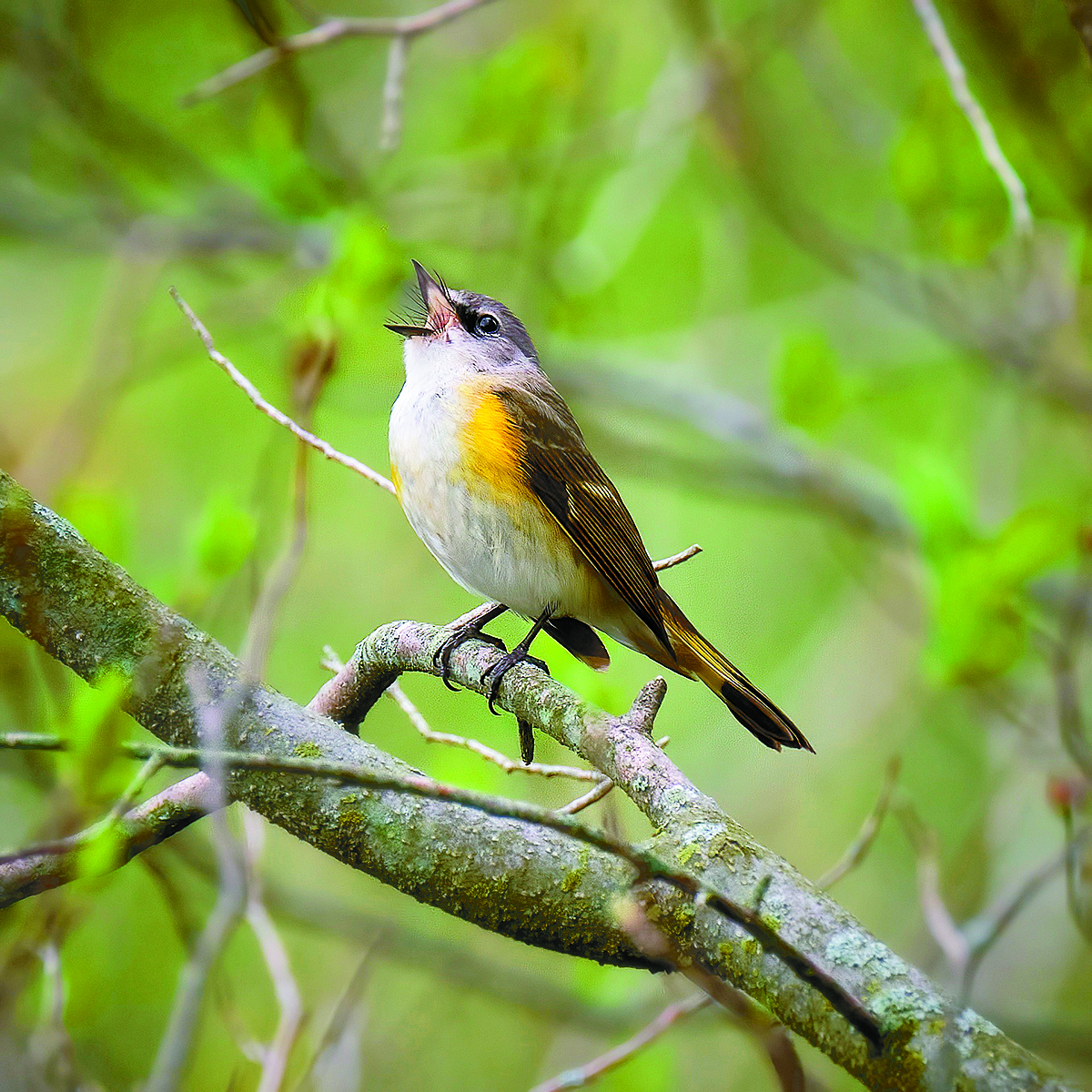


Plumage, behavior help American redstart stand out from most other warblers

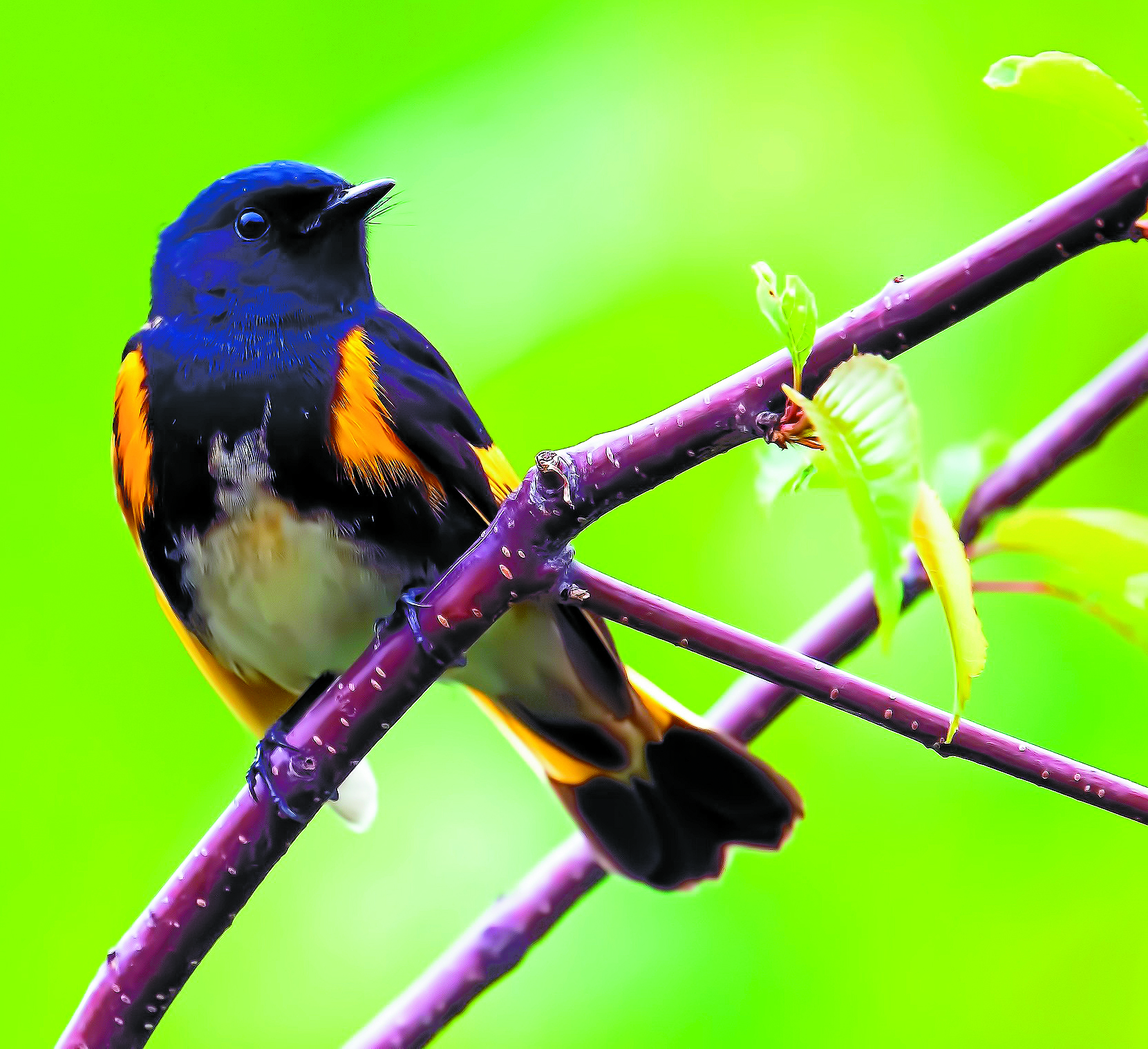
Photo by Hans Toom / Pixabay * Male American redstarts are vibrant birds with a plumage pattern of black, orange and white feathers.

I’ve written about some of our more showy birds in my past few columns. Some of the birds I’ve spotlighted have included scarlet tanagers and rose-breasted grosbeak. This week, I want to introduce one of the more flamboyant members of the warbler family.

Travis Jarrell in Cookeville, Tennessee, contacted me on Facebook for help with identifying a bird, which led to this week’s column.

He also provided a brief video of the little bird as it bathed in a puddle on the flagstones at his home.

His video provided all I needed to identify his bird as a warbler known as an American redstart. Male and female redstarts are both colorful, active birds. Young males also take two years to acquire their adult plumage, showing a plumage intermediate between an adult male and an adult female. I believe that the video Travis captured showed a young male likely born in last year’s nesting season.

I responded with my identification, and Travis replied.

“I had never seen one before, and yes, he was smaller, like a warbler,” he wrote. “It was a thrilling and lovely moment for me, watching him splash in the puddle while the cardinals rumbled in and out of the bird bath. His tail fanning was delightful!”


Photo by Howard Walsh / Pixabay * Female American redstarts are a paler imitation of the male. Females show gray, yellow and white in their plumage instead of the bright orange, black and white of the male.

The tail fanning mentioned by Travis is also a key behavioral trait of American redstarts. They are always fanning their tail feather while on the move. Most experts believe the flashes of color in the tail help the birds to flush prey insects into flight. According to the website, “All About Birds,” American redstarts consume more flying insects than most other warbler species. Their dietary preference for winged insects also brings them into competition with other flycatching species, such as least flycatcher.

American redstarts are among the many neotropical migrants that return to the region each year. Redstarts nest in the region’s mountains up to an elevation of about 4,000 feet and are fairly common from spring to fall. Most American redstarts arrive each spring in late April and immediately get down to the business of raising young. I’ve seen American redstarts constructing nests as early as late April.

The American redstart, even more so than its kin, strikes me as a hyperactive songbird—always on the go, flitting from branch to branch, fanning out its tail feathers and snatching insects flushed from cover. During the nesting season, the male sings a jumbled crescendo of buzzy notes.

There are 115 species of warblers found in the New World, but the American redstart is one of a handful that doesn’t include the word “warbler” in its common name.

The adult male American redstart is unmistakable. His mostly black feathers are accented with bright orange-red patches on the sides, wings and tail. There’s a patch of white on the lower belly and under the tail. For beginners who despair of learning the so-called “confusing fall warblers,” an adult male American redstart is so easily recognized that a sighting of one can produce a big confidence boost.

Females show a similar pattern, being gray-olive where the males are black; females are also lemony yellow where the males are orange, and both have with the same white underparts. A female redstart works alone at nest construction and also does solo duty incubating up to five eggs.

American redstarts nest in in damp woodlands across much of the eastern and northern United States and southern Canada. This warbler becomes much more general in its habitat preferences during the winter and can be found in Central and South America, as well as the Caribbean. Winter habitat ranges from mangrove forests and scrub thickets to plantations for coffee and citrus fruits. A few even take up residence in wooded sections of urban areas.

An occasional American redstart defies the odds and achieves a long life for a songbird. The oldest known American redstart was a male more than 10 years old. According to the website, “All About Birds,” that individual was recaptured and rereleased by a Canadian banding station.

Early French and Spanish explorers gave this pretty songbird some names to match its appearance. From the French, the American redstart received the name “paruline flamboyante,” or flamboyant warbler. The Spanish bestowed the name “candelita Norteña,” or Northern candlelight.

The warblers are one of the families of birds that got me hooked on birding. They make the spring season an exciting time of the year. Get outdoors and enjoy migration. You may be surprised what birds visit your own yard. Don’t delay. As the calendar advances into June, migration’s coming to a close, at least until the start of fall migration in a few months.


Long-running count finds total of 153 bird species

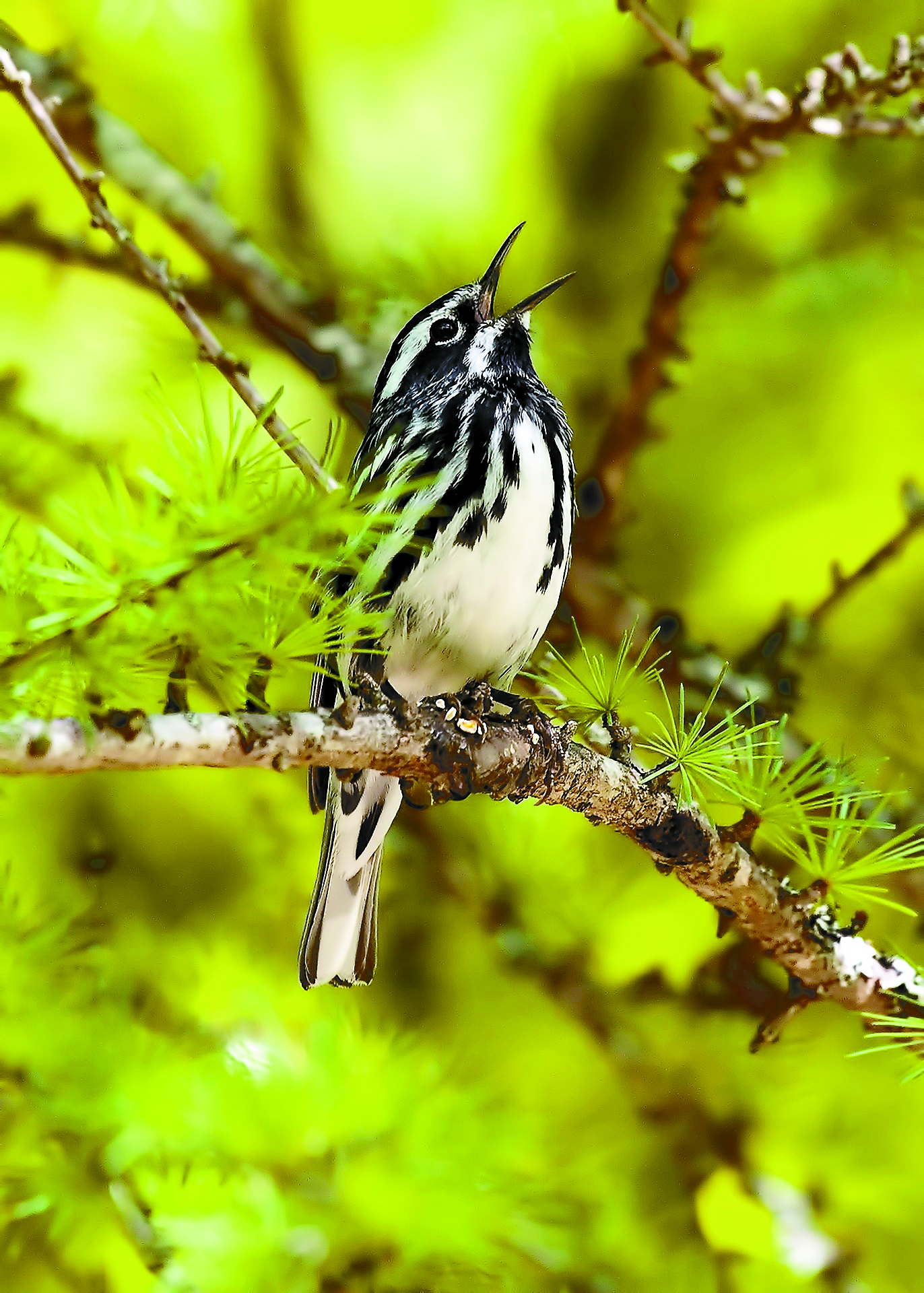
Photo by Hans Toom from Pixabay • A male black-and-white warbler sings from an elevated perch.

The 80th Elizabethton Spring Bird Count was held Saturday, May 6, covering Carter County and parts of adjacent Johnson, Sullivan, Washington and Unicoi counties, with 35 observers in 16 parties and two feeder watchers.
The annual count was conducted by members and friends of the Elizabethton Bird Club.

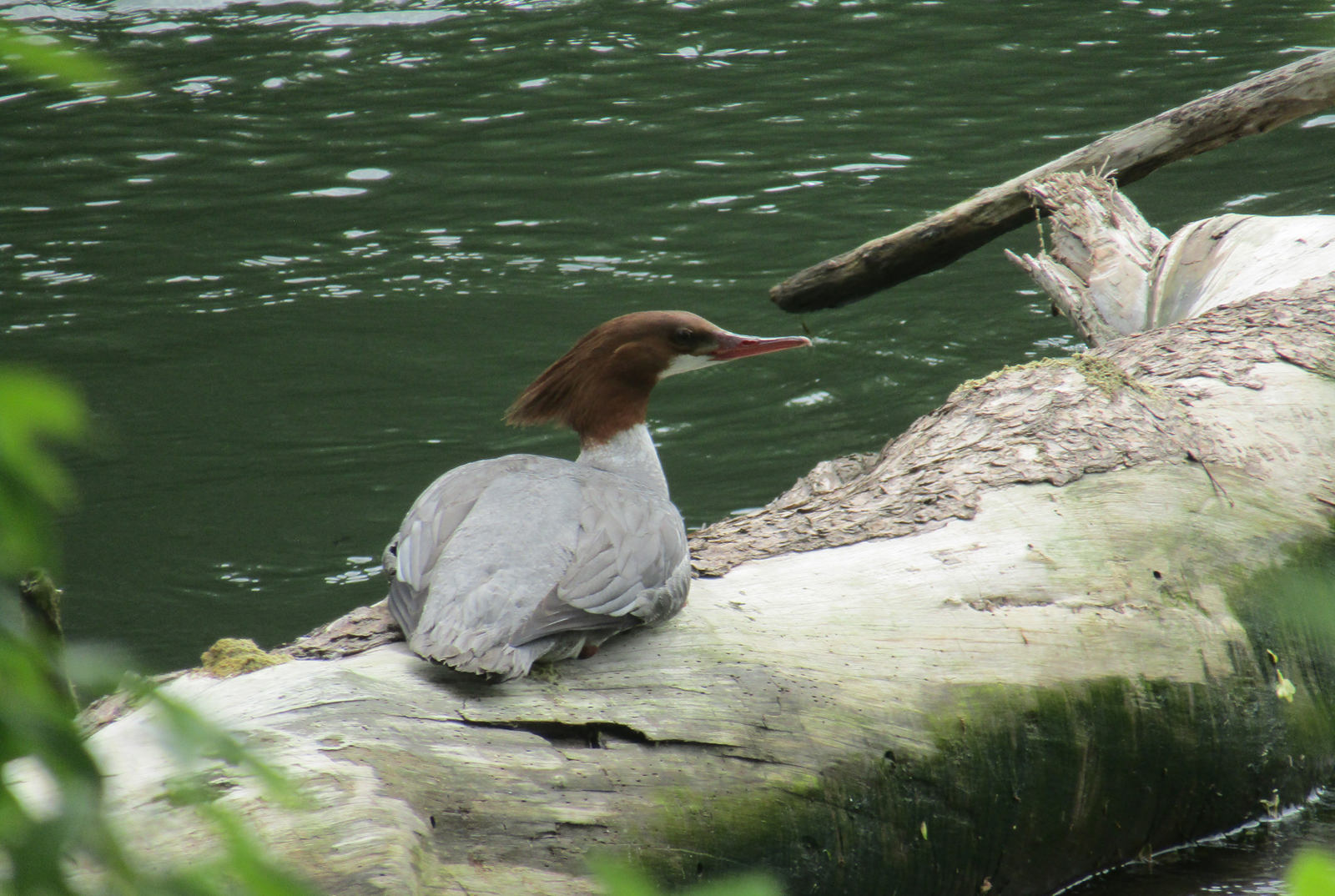
I counted with fellow Elizabethton Bird Club members Chris Soto and Rob Armistead in Elizabethton along the Watauga River and on Holston Mountain. Some highlights from the day included a male scarlet tanager that put on an unbelievable show, as well as a pair of female common mergansers on the Watauga River at Sycamore Shoals State Historic Park.

Participants tallied 153 species, which is exactly the average of the last 20 years. The all-time high was 166 species in 2016.

Longtime count compiler Rick Knight noted that participants tallied 27 species of warblers. In addition, he noted that six different parties found fish crows, a species that would once have been considered a rarity in the region.

The list:

Canada goose, 534; wood duck, 24; blue-winged teal, 13; American wigeon, 1; mallard, 126; hooded merganser, 1; and common merganser, 2.
Ruffed grouse, 1; wild turkey, 33; rock pigeon, 102; Eurasian collared-dove, 1; mourning dove, 194; and yellow-billed cuckoo, 1.

Photo by Bryan Stevens • This female Common Merganser was photographed a previous Spring Bird Count.

Common nighthawk, 1; chuck-will’s-widow, 12; Eastern whip-poor-will, 17; chimney swift, 97; and ruby-throated hummingbird, 25.

Sora, 1; killdeer, 32; least sandpiper, 27; pectoral sandpiper, 3; semipalmated sandpiper, 2; Wilson’s snipe, 1; spotted sandpiper, 60; solitary sandpiper, 32; lesser yellowlegs, 7; and greater yellowlegs, 3.

Common loon, 8; double-crested cormorant, 186; great blue heron, 78; great egret, 1; green heron, 6; black-crowned night-heron, 1; and yellow-crowned night-heron, 3.
Black vulture, 91; turkey vulture, 94; osprey, 10; Cooper’s hawk, 9; bald eagle, 6; red-shouldered hawk, 6; broad-winged hawk, 8; and red-tailed hawk, 25.

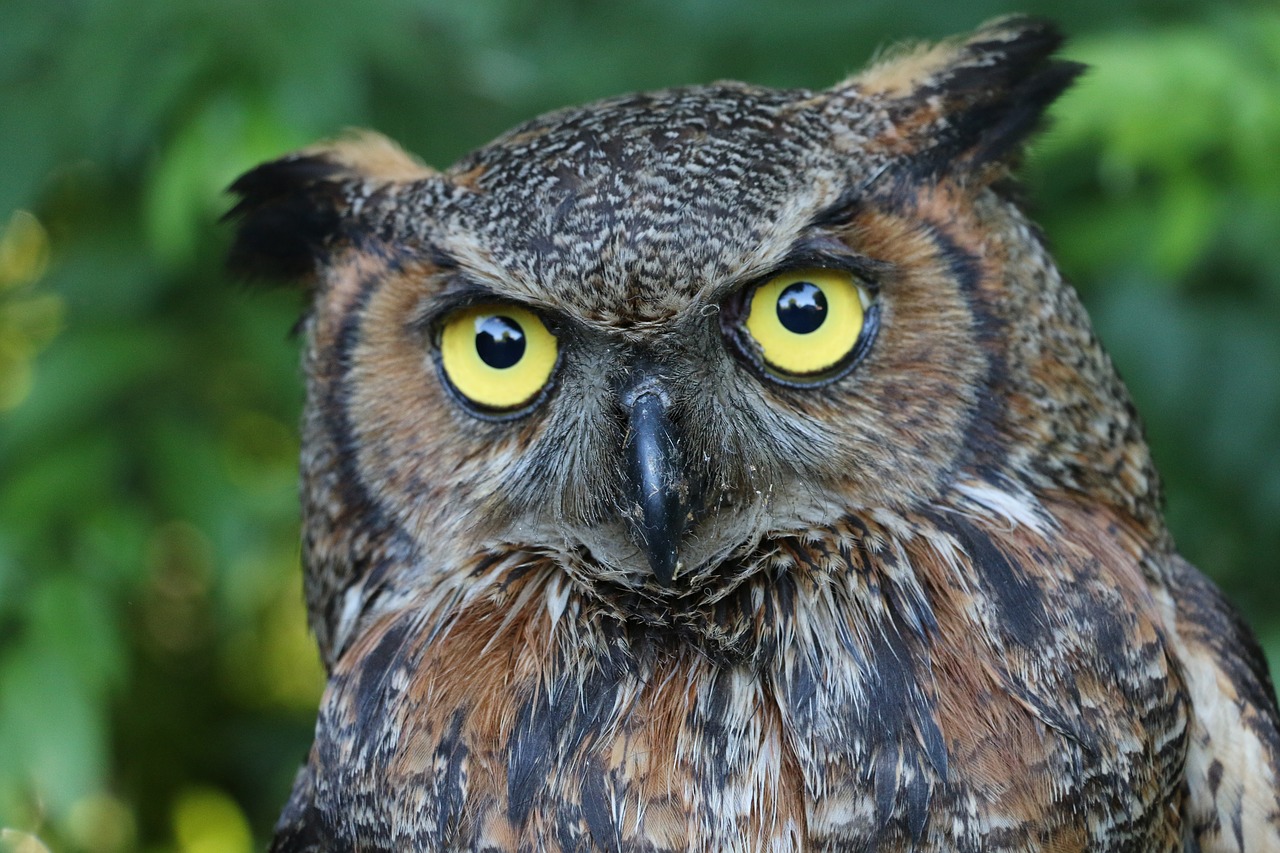
Eastern screech-owl, 7; great horned owl, 1; barred owl, 4; and Northern saw-whet owl, 1.

Photo by Pixabay • A single great horned owl was found on this year’s count.

Belted kingfisher, 15; Red-headed woodpecker, 4; red-bellied woodpecker, 83; yellow-bellied sapsucker, 6; downy woodpecker, 33; hairy woodpecker, 8; Northern flicker, 33; and pileated woodpecker, 31.

American kestrel, 4; great crested flycatcher, 25; Eastern kingbird, 70; Eastern wood-pewee, 13; Acadian flycatcher, 7; least flycatcher, 14; and Eastern phoebe, 86.

White-eyed vireo, 17; yellow-throated vireo, 7; blue-headed vireo, 54; warbling vireo, 18; and red-eyed vireo, 221.

Blue jay, 197; American crow, 294; fish crow, 11; and common raven, 16.
Tree swallow, 193; Northern rough-winged swallow, 75; purple martin, 63; barn swallow, 146; and cliff swallow, 530.

Carolina chickadee, 121; tufted titmouse, 148; red-breasted nuthatch, 12; white-breasted nuthatch, 23; and brown-headed nuthatch, 1.

House wren, 63; winter wren, 7; Carolina wren, 179; blue-gray gnatcatcher, 69; golden-crowned kinglet, 3; and ruby-crowned kinglet 2.

Eastern bluebird, 159; veery, 17; Swainson’s thrush, 1; hermit thrush, 2; wood thrush, 74; American robin, 661; gray catbird, 45; brown thrasher, 69; and Northern mockingbird, 126.

European starling, 540; cedar waxwing, 44; house sparrow, 55; house finch, 61; purple finch, 1; red crossbill, 3; pine siskin, 19; and American goldfinch, 249.

Chipping sparrow, 86; field sparrow, 34; dark-eyed junco, 44; white-crowned sparrow, 1; white-throated sparrow, 9; Savannah sparrow, 2; song sparrow, 252; swamp sparrow, 1; and Eastern towhee, 147.

Yellow-breasted chat, 5; Eastern meadowlark, 62; orchard oriole, 32; Baltimore oriole, 32; red-winged blackbird, 320; brown-headed cowbird, 58; and common grackle, 322.

Ovenbird, 136; worm-eating warbler, 25; Louisiana waterthrush, 26; golden-winged warbler, 4; Black-and-white warbler, 75; Swainson’s warbler,11; Tennessee warbler,1; Kentucky warbler, 3; common yellowthroat, 28; hooded warbler, 152; American redstart, 11; Cape May warbler, 4; Northern parula, 47; magnolia warbler, 6; bay-breasted warbler, 1; Blackburnian warbler, 6; yellow warbler, 7; chestnut-sided warbler, 15; blackpoll warbler, 2; black-throated blue warbler, 79; palm warbler,1; pine warbler, 10; yellow-rumped warbler, 21; yellow-throated warbler, 41; prairie warbler, 1; black-throated green warbler, 61; and Canada warbler, 35.

Scarlet tanager, 55; Northern cardinal, 260; rose-breasted grosbeak, 18; blue grosbeak, 3; indigo bunting, 88; and dickcissel, 2.

Looking over this list perhaps gives a clue to why birders are so excited during spring migration, which stretches out from March to June with the peak in April and May. The region is home to an amazing diversity of birds. Get out and look for some or make your home landscape more inviting for them.

•••
To share a sighting, ask a question or make a comment, email me at ahoodedwarbler@aol.com. I’m also on Facebook.
Hint of tropics arrives in region’s mountains with scarlet tanagers

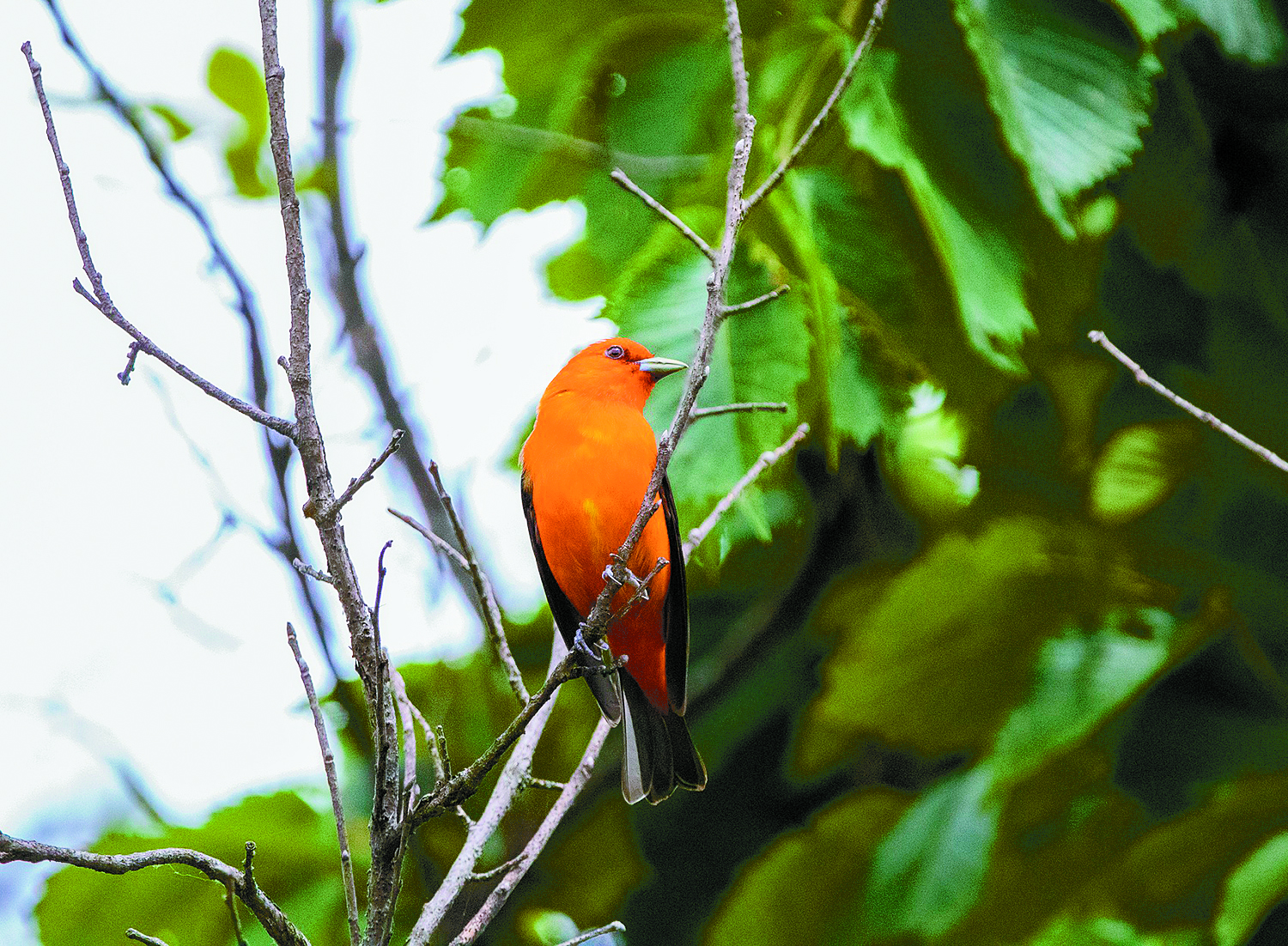
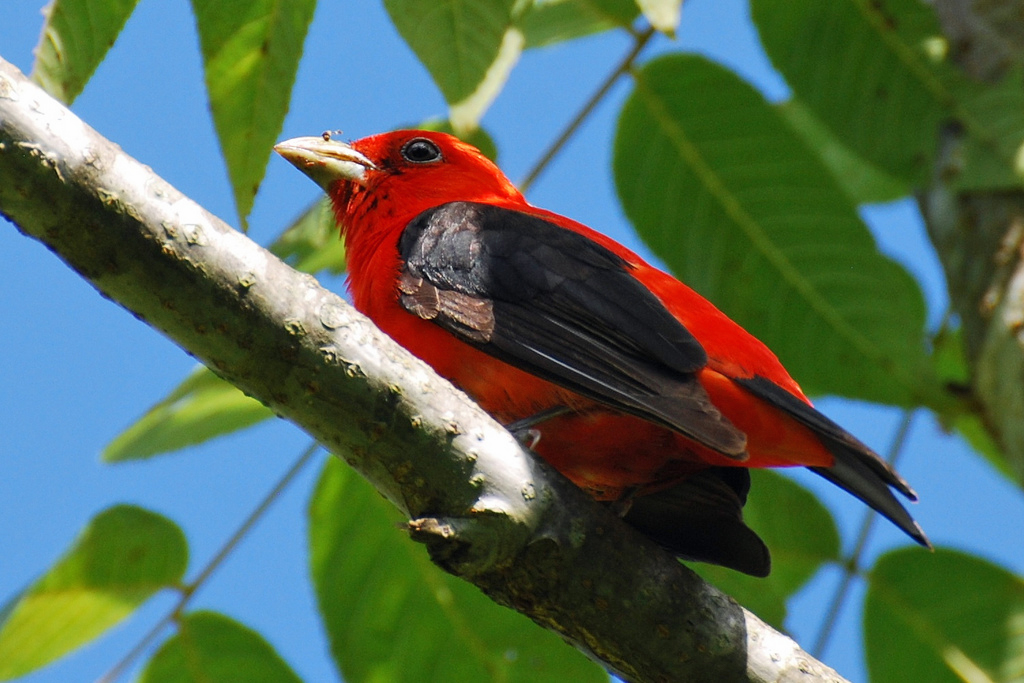
Photo by Vincent Simard from Pixabay • Considering the spectacular plumage of a male scarlet tanager, it’s a pity that this bird is more often heard than seen due to its fondness for living in the woodland canopy.

In late April and early May, once the oaks, the maples, the poplars and other tall deciduous trees begin spreading out new green leaves to create a concealing woodland canopy, a familiar song can be heard coming from the treetops.
Upon first hearing it, listeners might mistake the hidden singer for an American robin. Listen a little closer, however, and the song sounds as if it is being delivered by a hoarse robin with a sore throat.

The producer of the hoarse but melodic song is a scarlet tanager, one of the most showy birds of Eastern woodlands from April to early October.
The scarlet tanager also has an easily recognized call note, best described as a distinctive “chip-burr” or “chip-churr.”

It was the distinctive “chip burr” that first alerted me to the presence of a scarlet tanager during a recent trip to Holston Mountain in Carter County, Tennessee. I was taking part with Chris Soto and Rob Armisted in the recent Spring Bird Count conducted by the Elizabethton Bird Club.

The scarlet tanager was a target bird, which we managed to find, along with other targeted birds such as ruffed grouse, dark-eyed junco and chestnut-sided warbler.
Like the warblers, vireos, flycatchers and other songbirds, the scarlet tanager is migratory. They spend the winter months in the tropical forests of Central and South America. The scarlet tanager is better attired than most birds to provide us a glimpse of what life must be like in the tropical rain forests, which are a riot of color and sound.

Photo Courtesy of Jean Potter
A male scarlet tanager brightens shadowy woodlands with a flash of tropical colors yet remains mostly inconspicuous in the forest canopy.

Observing this dazzling bird, which put on a prolonged show for us, reminded me how it takes only one sighting to sear the vision of this vibrant bird onto our retinas, as well as into our memories.

The scarlet ranager boasts a brilliant plumage of crimson red paired with black wings and tail. Of course, this is the male. The female tanager makes no real claim to the common name with her comparatively drab greenish plumage. However, the scientific name, Piranga olivacea, gives a nod to the olive-green plumage of females, young males and even adult males when molting their feathers.
Although once nominated as a candidate for state bird by the school children of Minnesota, the scarlet tanager ultimately failed to gain the designation. Instead, as perhaps is fitting for the “Land of 10,000 Lakes,” the common loon represents Minnesota as official state bird.

I usually have a few scarlet tanagers in residence around my home during the summer months.

Worldwide, there have traditionally been about 240 species of tanagers. Experts have changed some of the ways they classify tanagers, so that figure is no longer set in stone. Tanagers are a New World family of birds, concentrated mainly in the tropics.
The scarlet tanager and an all-red relative, the summer tanager, are native of the eastern half of the continent, replaced by Western tanagers and hepatic tanagers in the western states. During a visit to Salt Lake City in Utah in 2006 I saw several Western tanagers.

Some of the world’s other tanagers are known by extremely descriptive names, including flame-colored tanager, green-headed tanager, golden-chevroned tanager, azure-shouldered tanager, fawn-breasted tanager, saffron-crowned Tanager, Metallic-green Tanager, turquoise tanager, scarlet-bellied mountain tanager and diademed tanager.

Scientists, who have to occupy themselves, have recently given fresh consideration to the relationship of many tanagers to the other birds of the world. As a result, many of the North American tanagers are now closely allied with such birds as Northern cardinals and more remote from tropical tanagers.

https://www.google.com/search?client=firefox-b-1-d&q=scarlet+tanager+feeding&tbm=vid&sa=X&ved=2ahUKEwimlL7u_Yb_AhV5nGoFHbHEA9kQ0pQJegQICBAB&biw=1249&bih=565&dpr=1.5#fpstate=ive&vld=cid:12a705e3,vid:vRN5BREsi-4

The scarlet tanager is not typically a feeder visitor, but these birds can be lured closer with orange slices placed in special feeders or simply spiked onto the branches of backyard trees. As an added bonus, orange slices can also attract birds such as Baltimore orioles and gray catbirds.

Fond of fruit, the scarlet tanager incorporates various berries into its diet. Landscape around your home with fruit-bearing trees such as mulberry, serviceberry and wild cherry to make your yard more inviting to these elusive bird.

Yes, the scarlet tanager is more often heard than seen, but it is a bird worth seeking out. A sighting of one will amaze you.

•••••

I love to hear from readers. Follow me on Facebook or send email to ahoodedwarbler@aol.com.

Rose-breasted grosbeaks stage their spring return in region

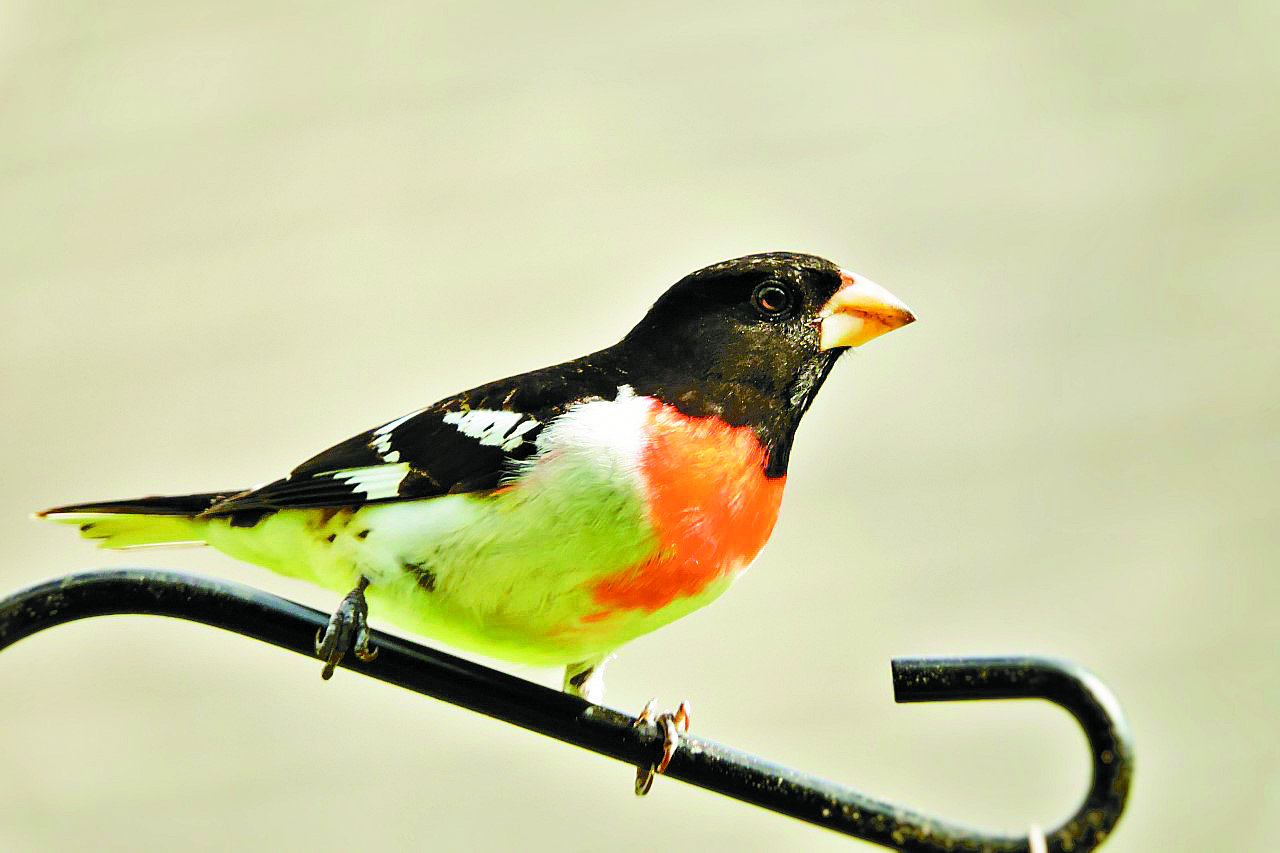
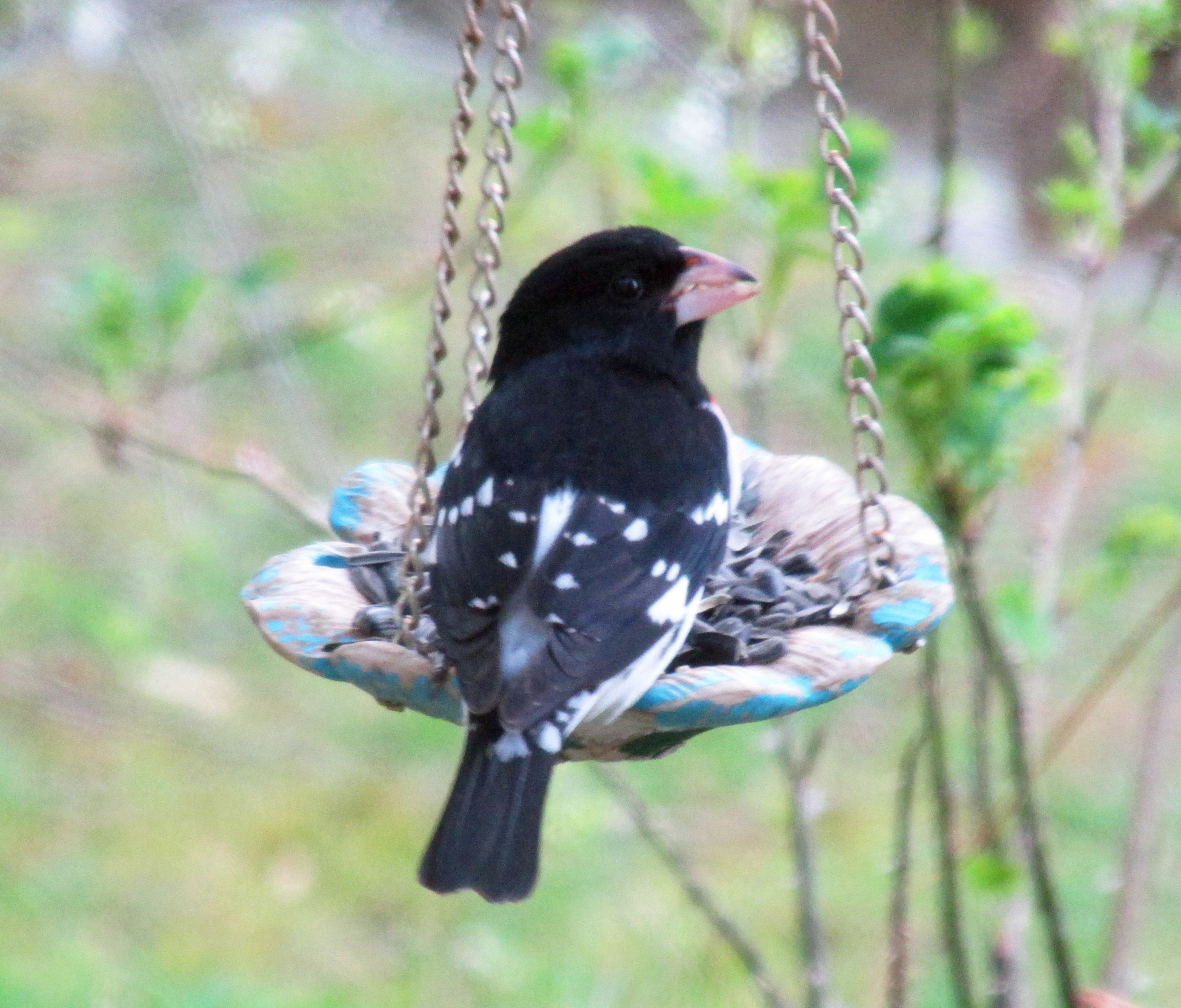
Photo by Susan Killian from Pixabay • Male rose-breasted grosbeaks are stunning birds that bring some tropical color to the Southern Appalachians every spring.


Birds keep returning. At times, it’s like a new bird is putting in an appearance every day. Some of the returning species are showy, others are more subtle in their beauty.
The rose-breasted grosbeak is definitely one of the birds in the showy category. In fact, I’d suggest that a male rose-breasted grosbeak is a showstopper for most people, especially people who have never seen one of these glorious birds.
I haven’t yet seen one this spring, but I am planning to take part in the annual five-county Spring Bird Count conducted by the Elizabethton Bird Club, and I am hopeful I will be fortunate enough to find one of these beauties.
As is usually the case, the grosbeaks tend to arrive in the wake of the first hummingbirds, and this year has been no exception.
•••

Erwin resident Ron Elliott posted on The Erwin Record’s Facebook page about his first spring sighting.”
“Our first sighting of a Rose-breasted Grossbeak today (April 30) at 9:15 a.m.,” Ron wrote.
“The sighting always comes about the first week of May,” he added.
Ron also shared that the secret to observing rose-breasted grosbeak is a well-stocked feeder.
“No seeds, no birds,” he noted.
•••
Ann Windsor in southwest Tennessee shared on Facebook that she had a rose-breasted grosbeak feeding on her deck feeder on May 3 and a few others the previous week. She noted that her daughter, who lives about eight miles away, had had some grosbeaks at her feeder.
•••
Felicia Mitchell in Washington County, Virginia, has hosted two male grosbeaks but, to date, no females.
•••
Karen Fouts on Marion, Virginia, wrote on Facebook about a small flock of visiting grosbeaks.
“I have four or five regulars, all male. I know the females must be here somewhere, but I haven’t seen one yet,” she shared.
•••
Nancy Vernon reported on Facebook seeing grosbeaks in Bristol, Tennessee, on May 3.
•••
Sue Schreiner reported via Facebook on May 3 about seeing a grosbeak fly past at South Holston Lake.
•••
Sharee Bowman mentioned via Facebook about seeing female grosbeaks kast week and males this week in Cedar Bliuff, Virginia.
•••
John Whinery of Fall Branch, Tennessee, said he received his first-ever visit from a rose-breasted grosbeak on his farm on Sunday, April 30.
•••
Brookie and Jean Potter reported that they have hosted two male grosbeaks since May 1 at their home near Wilbur Lake in Elizabethton, Tennessee.
•••
Carolyn Grubb of Bristol, Virginia, also shared that she has hosted a male grosbeak.
•••
Ed Schneider in Nashville, Tennessee, reported lots of grosbeaks passing through during migration earlier in the season.
“Mostly gone through now,” he wrote on Facebook. “Only a single female today (May 4).”
•••
Gary and Nancy Barrigar shared on Facebook that they have hosted male and female grosbeaks since April 28 at ther home in Elizabethton, Tennessee.
•••
Mary Ragland in Abingdon, Virginia, reported that her grosbeaks arrived May 1.
•••

Photo by Bryan Stevens
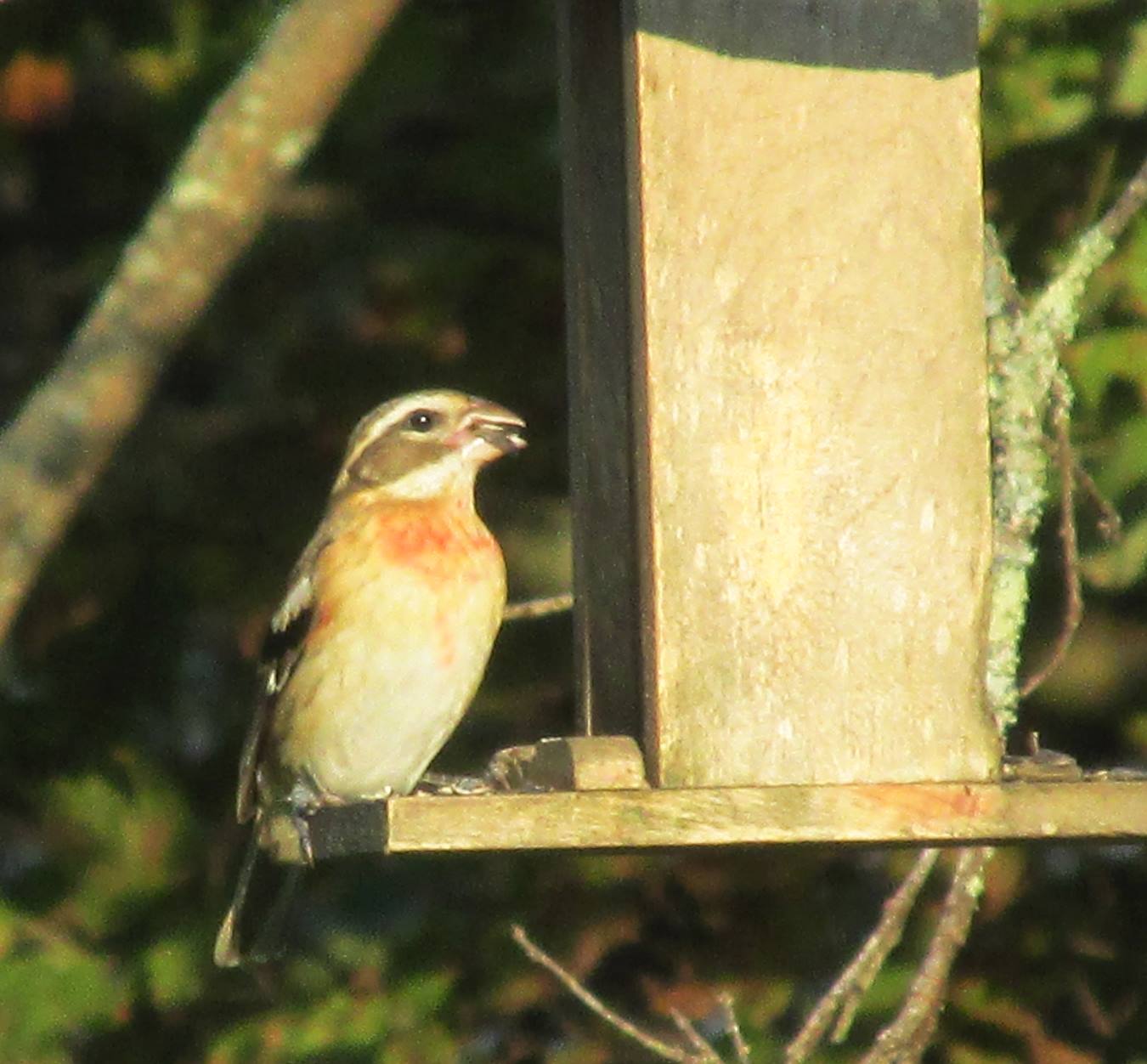
A young male Rose-breasted Grosbeak visits a feeder in September of 2013. Young males resemble females but show a splash of orange on the breast that will be replaced the following spring by the familiar rosy-red patch.

Plenty of rose-breasted grosbeaks pass through northeast Tennessee, southwest Virginia and western North Carolina, and a few even decide to make their summer home on local mountains. However, these birds spread out widely across the eastern half of the North American continent, ranging from northeastern British Columbia to Quebec and Nova Scotia in Canada. They also range south from New Jersey to Georgia. The rose-breasted grosbeak also reaches Colorado, Oklahoma and Kansas.
As fall approaches, the rose-breasted grosbeak migrates south to a winter range that spans central Mexico, Central America and northern South America. As they depart, many of these migrating birds will make autumn visits to again partake of offerings of sunflower seeds at backyard feeders. So, if you don’t get to see these showy birds in the spring, you get another chance in September and October.

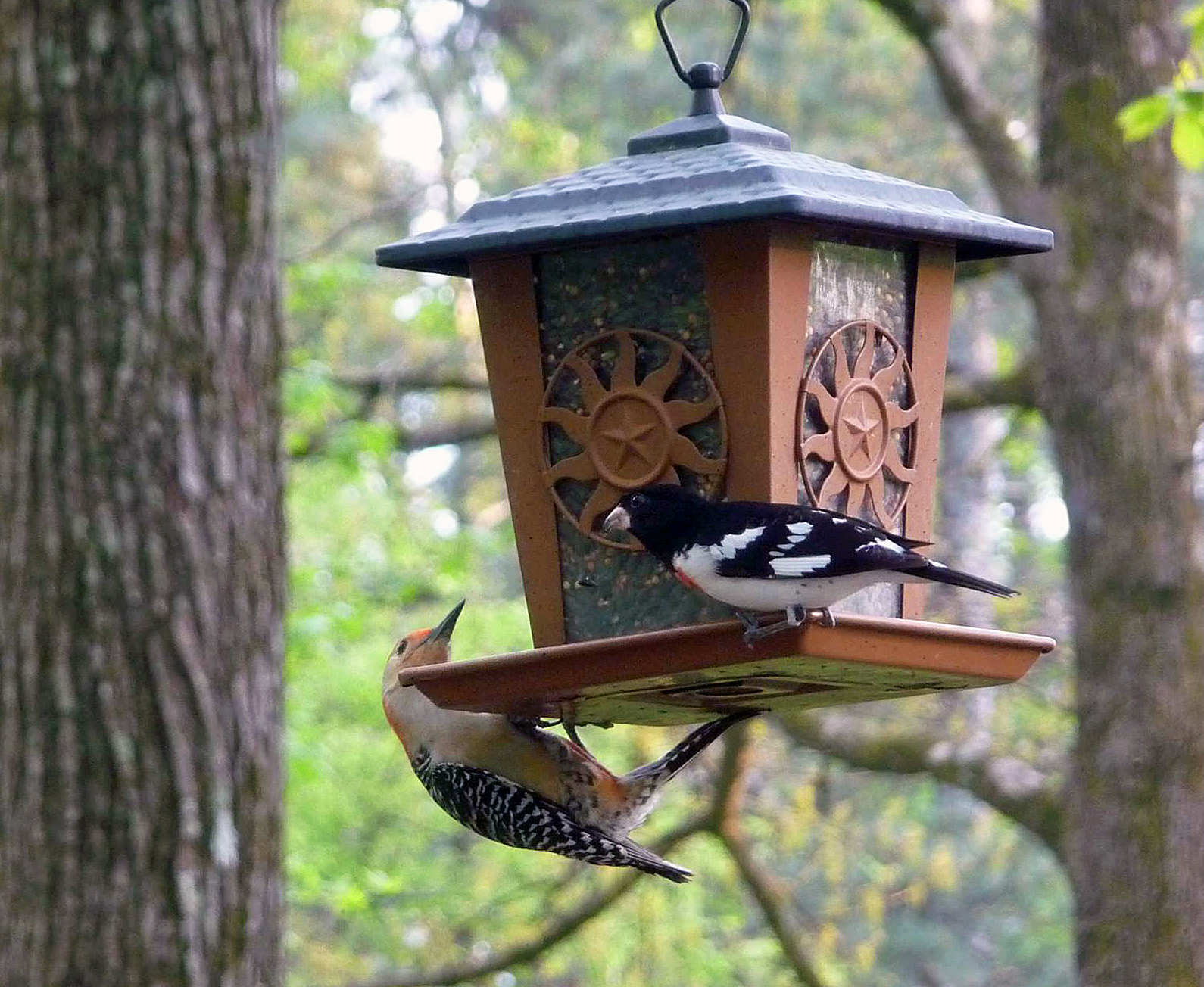
Photo courtesy of Byron Tucker * A rose-breasted grosbeak and a red-bellied woodpecher square off at a feeder.

The male rose-breasted grosbeak gives this species it name. Males are the epitome of the birds that make their home for part of the year in the American tropics. The contrasting black and white plumage is emphasized by a triangular slash of rosy-red color on the breast. Put all those elements together, and the male rose-breasted grosbeak is not a bird that would be mistaken for any other.
The female grosbeak, however, doesn’t stand out in the same way. She is much less colorful than the male. With her brown and white plumage, she is often mistaken for a large sparrow or finch.

Both sexes have a massive bill, which they use to hull sunflower seeds at feeders or glean insects from leaves and branches. It’s the heavy, blunt bill for which the term “grosbeak” is derived. “Gros” is a German term for large or big, so grosbeak simply means a large-beaked bird. People who band birds to further the study of them will tell you that rose-breasted grosbeaks can inflict a wicked nip. Regional bird banders frequently encounter rose-breasted grosbeaks in their mist nets — and bear the scars to prove it.

Away from our feeders, rose-breasted grosbeaks feed on insects, seeds, fruit and even some leaf buds and flowers. I’ve seen these birds satisfying a sweet tooth — or should that be sweet beak? — by feeding on jewelweed flowers and apple blossoms. If sugar’s good for hummingbirds, I am sure it is a valuable energy source for rose-breasted grosbeaks, too.

The rose-breasted grosbeak is a cherished spring visitor that never disappoints when bringing a hint of the tropics to the mountains.

•••
Follow Bryan Stevens on Facebook. To share a sighting, ask a question or make a comment, email him at ahoodedwarbler@aol.com.
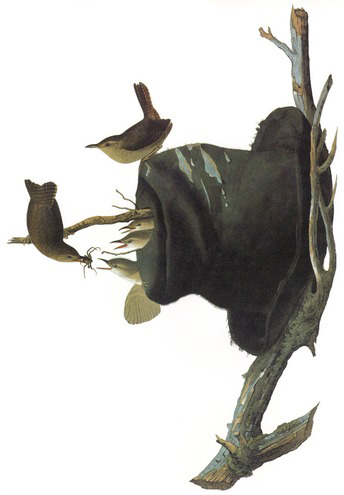
Photo by Bryan Stevens
A male Rose-breasted Grosbeak settles onto a feeder for a meal of sunflower seeds.


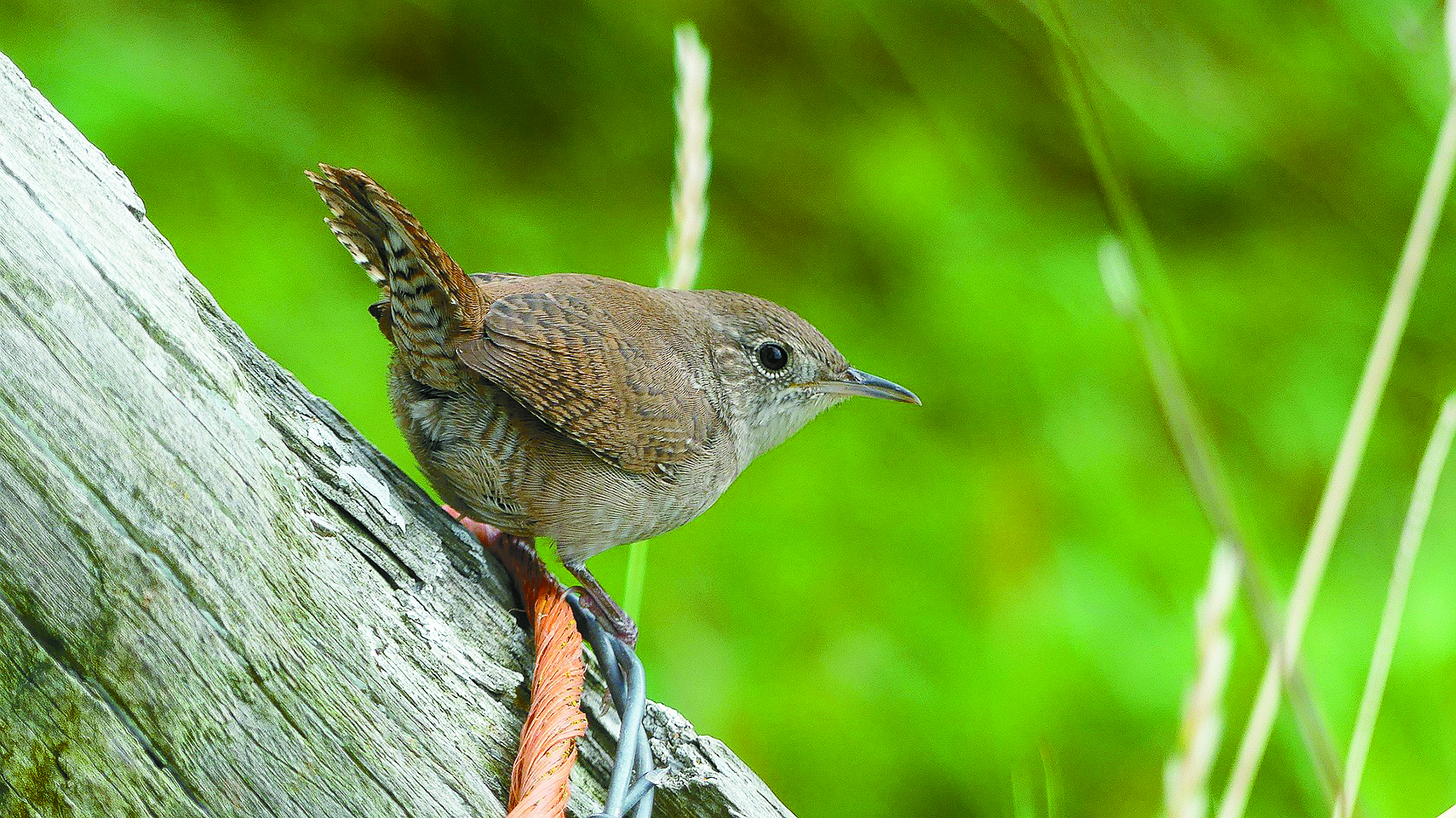
Small house wrens live life large, at times to detriment of neighbors

Photo by ronin2435/Pixabay House wrens are small birds, weighing no more than two nickels, but they live life large and in charge.

Some new spring arrivals have kept things interesting at home. New warblers — common yellowthroat and black-and-white warbler — have brought my warbler yard total to six species for the season. I’m also enjoying visits from ruby-throated hummingbirds and ruby-crowned kinglets. The most recent bird to return has made my bedside alarm clock redundant.

For several recent consecutive mornings, a male house wren has erupted with its bubbly, incessant song outside my bedroom window. House wrens are small birds, reaching a length of about five inches and weighing about 10 grams. To put that in perspective, two nickels in your pocket would weigh the same as a house wren.
For such a small creature, the house wren has a powerful voice that they use with unbridled enthusiasm. The bird’s song penetrates walls and glass windowpanes with ease. The bird’s song has even inspired  a pop song by the group Owl City:

Nevertheless, I’m not begrudging the return of these little birds. There’s a definite joy to their song. If only their other habits matched.

Nature’s not always neat and tidy. In fact, nature operates with rough-and-tumble mechanisms that, all too often, put some of our favorite birds at odds with each other. Like any other living creature, birds compete for resources — food, water, prime nesting real estate and even mates. Some of those pretty and entertaining birds at your feeder or bird baths have a dark side that isn’t often glimpsed.
When some insight is gained into these behaviors, it’s only human to feel discouraged, disenchanted or dismayed by some of our more aggressive species. Although they have their fans, blue jays, various hawks and even the Tennessee state bird, the Northern mockingbird, have attracted plenty of detractors due to their aggressive natures.

Like all of the aforementioned, the house wren is a native bird. I also happen to like house wrens. They have such perky, happy songs, and they’re good parents. They can raise as many as 10 young in one nest box.

Unfortunately, wrens engage in some ruthless behavior when it comes to nesting. House wrens will evict other cavity-nesting birds from next boxes. They will even destroy eggs and young. Our other native birds are not defenseless. For instance, Eastern bluebirds can and do fight back, but despite their small size, house wrens are feisty and they can be quite stubborn.

House wrens like brushy habitat that offers a lot of cover. For anyone who prefers hosting bluebirds, open space is crucial. Of course, chickadees and nuthatches also like brushy habitat and woodland edges, just like the house wrens.
It’s complicated, but I come down on the side of our native birds. House wrens have their place. Non-native birds like the introduced European starling and the house sparrow cannot legitimately claim a place in North America. These species should never have been brought to this country in the first place.

To discourage competition, it’s probably best to not crowd a number of boxes in a small location such as the backyard. If possible, don’t place any other boxes close (at least not within easy view) of each other. Wrens are territorial and their concept of their domain basically extends to whatever they can see.

House wrens have a few other relatives in the region, including Carolina wren, marsh wren, sedge wren and winter wren. The common Carolina wren is a slightly larger relative of the house wren and is probably the most visible of the area’s wrens.
A bird memory from childhood involves a pair of Carolina wrens that built a nest in an old apron my grandmother used as a bag for her clothespins. My grandmother gave up the bag to the birds for the duration of their nesting. At the time the identity of the nesting birds was a mystery, but all these years later I realize these birds were in all likelihood Carolina wrens, which are known for their love of nesting in unusual nooks and crannies.

In more recent years, I’ve hosted Carolina wrens that have nested in plastic shopping bag hanging from a nail in my garage. Another pair once tried to nest in the exhaust vent for my clothes dryer. I’ve also found nests in porch lamps and a flower planter on the porch of the Unicoi County Heritage Museum.

Worldwide, there are about 80 species of wrens. All but one of the world’s wrens are confined to the New World. A variety of common names describe the various species with some creativity, including such monikers as rufous-browed wren, tooth-billed wren, flutist wren, white-headed wren, sepia-brown wren, fawn-breasted wren, ochraceous wren and moustached wren.

Ovenbird is season’s first returning warbler

By Hans Toom from Pixabay • A patch of orange feathers on the crown of an overbid’s head often goes unseen. This shy and retiring bird is more often heard than seen.

It’s gotten to be a bit of a guessing game every spring about which of the warblers will be the first to return to my home.

In 2021, the first warbler to return in the spring was a male Northern parula that arrived on April 9. In 2022, this same species was the first to return, albeit a few days later than the previous year’s date.

The Northern parula didn’t used to be one of the first returning warblers at my home. That honor used to go to hooded warbler or black-throated green warbler. This year, an ovenbird beat all of its kin to arrive on Friday, April 7, in the woodlands around my home, followed a few days later by a black-throated green warbler. This year’s first hooded warbler was a bit tardy and didn’t return until April 23.

The ovenbird is not one of the brightly colored warblers, such as black-throated blue warbler or yellow warbler. The ovenbird is a small brown bird with a white breast marked with dark streaking — an appearance that bears a superficial resemblance to the larger thrushes that share the same woodland habitat. The only hint of color is an orange crown patch bordered by dark stripes atop the bird’s head. Even this orange crown patch is not easily seen. When agitated, an ovenbird may raise its head feathers, which makes this orange mark easier to detect. The ovenbird also shows a distinct white ring around each eye, as well as pink legs and a pinkish bill.

By Hans Toom from Pixabay • The ovenbird gets its name from the shape of its nest, which is said to resemble an old-fashioned Dutch oven.

The resemblance to North America’s brown thrushes didn’t go unnoticed by some early American naturalists. Painter and famous naturalist John James Audubon painted a pair of ovenbirds, which he knew as “golden-crowned thrushes.” When comparing the two names, one can’t help but wish that the inaccurate but more romantically descriptive golden-crowned thrush had stuck.

Unfortunately, ovenbirds are stubborn about letting themselves be seen. They’re easily heard. The males begin singing a loud, rollicking “Teacher! Teacher! Teacher” song almost as soon as they arrive on potential nesting grounds.

The ovenbird, unlike many warblers, is not named for its appearance. Instead, the bird’s name derives from the shape of the nest it builds. The nest is a domed structure placed on the ground, woven from vegetation and containing a side entrance. Early European settlers in North America thought the nest looked like a Dutch oven, hence the name “ovenbird” for the small warbler with the intricate nest.

In April and continuing into May, a couple of dozen warbler species will pass through Tennessee. Some of these warblers find area woodlands and other habitats to their liking. They will pause, explore and perhaps decide to spend their summer nesting season in Northeast Tennessee and Western North Carolina rather than continue migrating farther north.

Many of the warblers that pass through each spring, however, are destined to travel a much longer distance before settling down in their favored habitats for the summer nesting season. These warblers include the Tennessee warbler, Nashville warbler, Cape May warbler, blackpoll warbler and Connecticut warbler. Most of these species nest as far north as New England and Canada.

Others find the Southern Appalachians to their liking. Some of the first warblers to return each year include the Louisiana waterthrush, which favors rushing mountain streams, as well as species such as black-throated green warbler, hooded warbler, ovenbird, black-and-white warbler, worm-eating warbler and common yellowthroat.

The Northern parula offers an abundance of identifying characteristics. Adult males are bluish gray overall with a yellow-green patch on the back and two white wingbars. A chestnut band separates the male’s bright yellow throat and chest. Adult females are often a bit paler and typically lack the male’s breast band. Both males and females have distinctive white eye crescents.

Most warblers lead frenetic lives. They often sing high in the tops of trees, but they do occasionally venture closer to the ground, particularly when foraging for prey, which consists of a variety of insects and small spiders. The Northern parula is even more restless than most of its kin.

The more reliable means of locating a Northern parula is to listen for the male’s buzzy, ascending song. He is a persistent singer from the time of his arrival until mid-summer.

A quirk involving nesting material is somewhat unique to this warbler. In much of the southern United States, the Northern parula conceals its nest inside strands of Spanish moss draped from the limbs of live oaks and other trees. In the Southern Appalachians and other locations farther to the north, the absence of Spanish moss means that the birds rely on various Usnea lichens, which are sometimes referred to as “Old Man’s Beard.”

A pair of Northern parulas will attempt to raise two broods in a nesting season. The female lays two to seven eggs and does most of the nest construction.

Look for spring’s warblers in the coming weeks. Feel free to share any sightings with me by emailing ahoodedwarbler@aol.com.

Photo by Bryan Stevens • The Northern parula’s geographic location during the nesting season determines its use of nesting materials.


Area readers share their first spring hummingbird visits

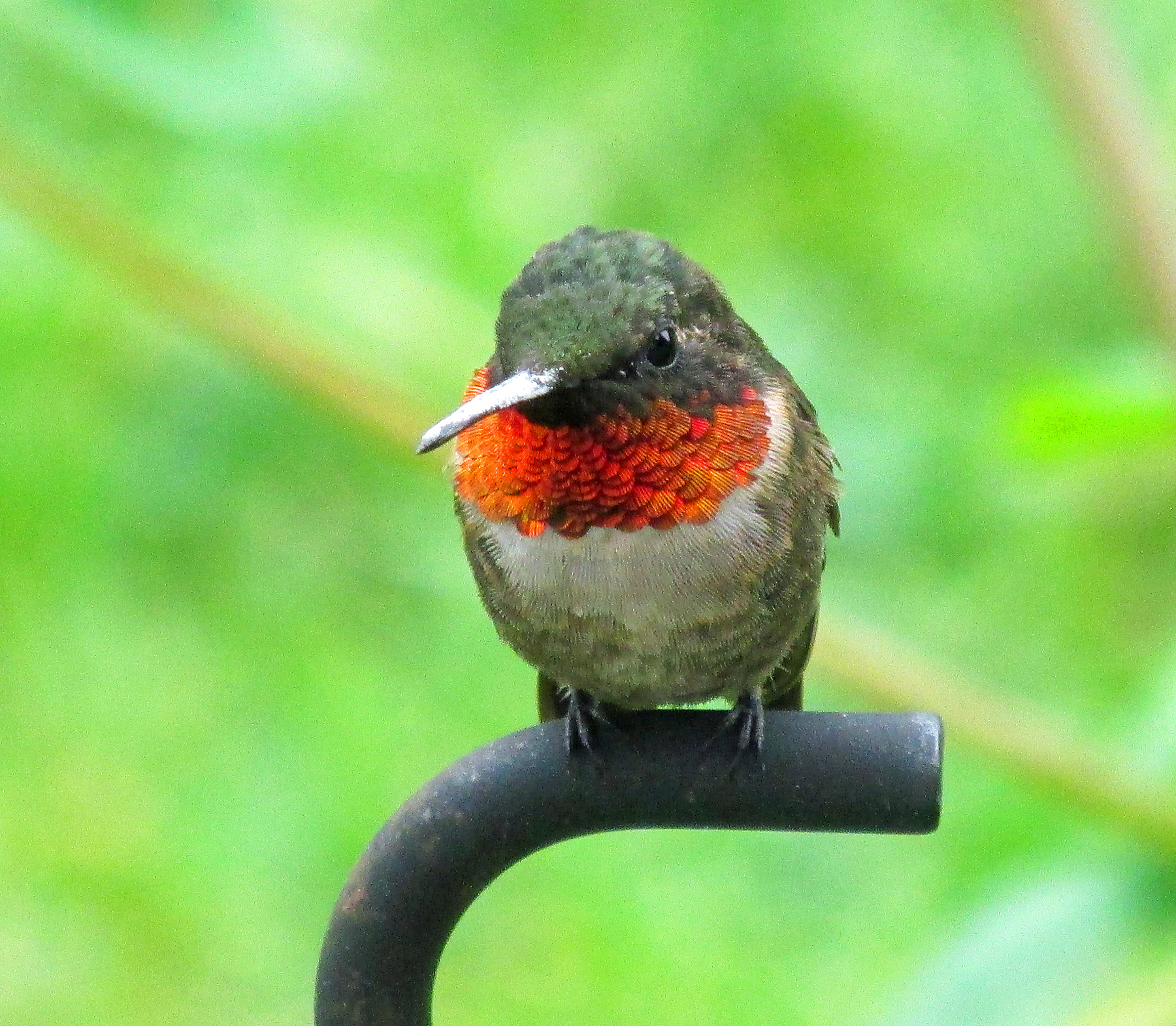
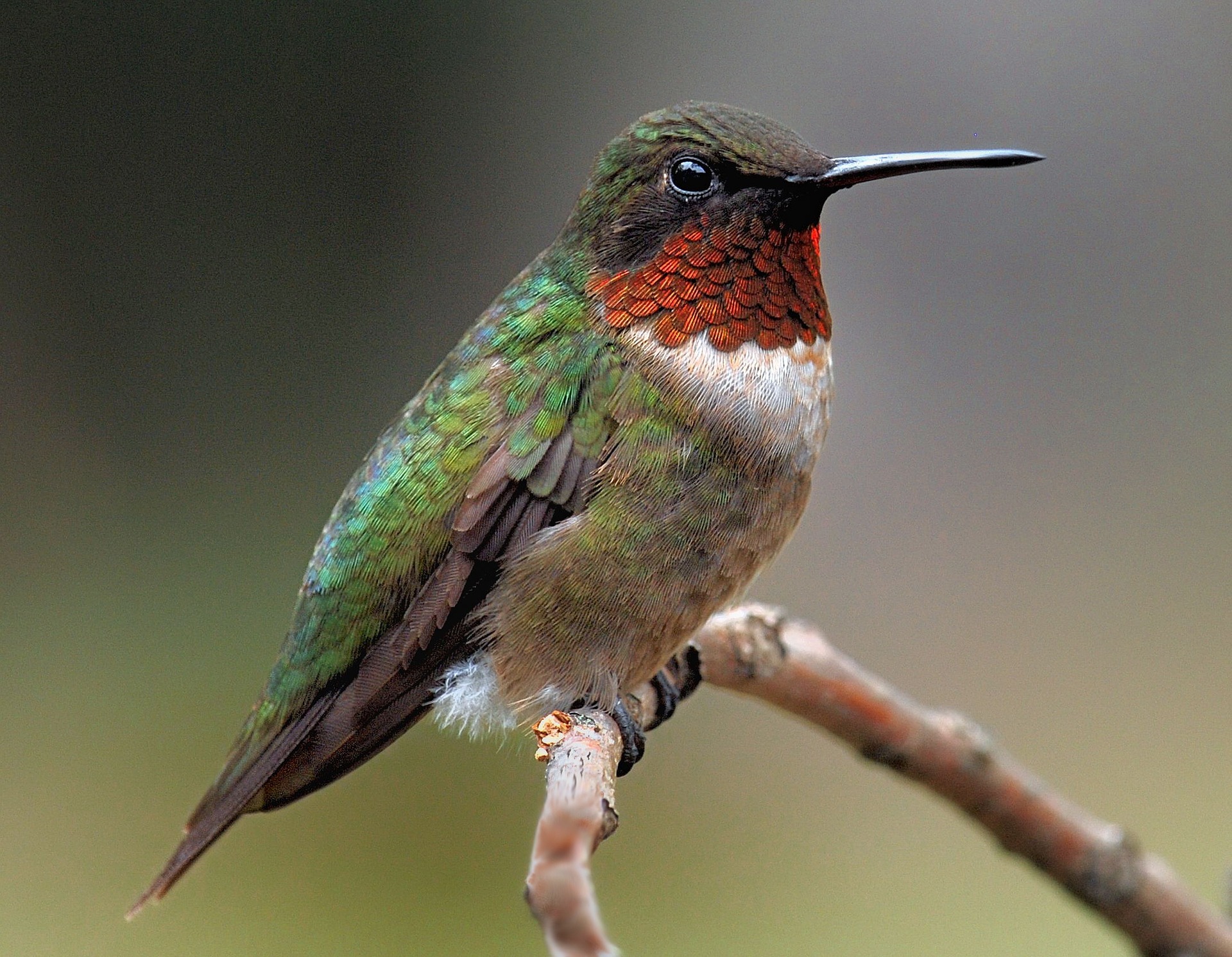
Photo by Bryan Stevens • Ruby-throated hummingbirds such as this male are returning to the region.

I thought I’d give a timely progress report. I wrote recently about a vision problem that has afflicted my left eye. During my most recent visit to my doctor, he noticed the same improvement that I had already been gradually detecting.

He was surprised and admitted he had not expected any improvement. He also noted, perhaps jokingly, that the better vision was not due to anything he had done or prescribed. I contemplated asking, jokingly, if that meant I shouldn’t have to pay for the multiple visits.

Without any more undue digression, I wrote back in February that my goal was to be able to see a ruby-throated hummingbird once they returned in April.
I saw my hope fulfilled when I had a brief glimpse of one on Sunday, April 9, but it was one of those speedy “blink-and-you-missed-it” affairs.
On the next evening. my mom and I watched a male ruby-throated hummingbird feeding at one of her feeders.

Using binoculars, I was able to see the bird fairly clearly. The image is still soft around the edges, but I clearly saw the gleaming red throat when the light hit just right.
By the way, mom had already seen two hummingbirds dueling around her feeders, but that evening’s visitor was solo. We also watched Northern cardinals, Eastern towhees, red-winged blackbirds, song sparrows, and white-throated sparrows, Carolina chickadees, tufted titmice and Carolina wrens.
I’m not where I want to be in regards to having an “eagle eye” for birding, but I’m thankful to have reached this stage and remain optimistic improvement will continue.

Photo by Bryan Stevens • A ruby-throated hummingbird lifts its wings to shake water droplets off its back.

In the meantime, readers continue to share their own first hummingbird sightings of spring.
••••

“I had my first hummingbird April 18 at 6:58 p.m. in Richlands, Virginia,” wrote Helen Whited.
She also shared some other exciting spring sightings.
She reported that she has already seen a rose -breasted grosbeak and a Baltimore oriole.

••••
“I had one ruby-throated hummingbird this past week,” Jeri Layne wrote to me on April 19. “It stopped at the feeder and I haven’t seen any since. Usually I have several by now.”
••••
I saw my first hummers in Roan Mountain April 11,” wrote Cherie Beth. “They were the male ruby-throats.”
••••
“Our first little guy showed up April 15 at 4:30 p.m. here in Stoney Creek near Elizabethton, Tennessee,“ wrote Mary Beierle. “I’m so excited! Can’t wait for a mate to show up also.”
••••
“Saw first ruby-throated humming bird on April 8 at 11 a.m. in Fancy Farm, Kentucky,” wrote Olif Perkins.
••••
Felicia Mitchell in Emory, Virginia, messaged me on Facebook. “First hummingbird spotted at feeder at 6:58 p.m. on April 14,” she wrote.
••••
Rhonda and Randal Eller their first sighting of a male hummingbird on April 19 at their home on the outskirts of Chilhowie, Virginia.
••••
Cheri Miller in Roan Mountain, Tennessee, shared that she saw her first spring hummingbird on April 16.
••••
Nancy Vernon in Bristol, Tennessee, shared that she saw her first hummingbirds (three of them) on April 17. She reported she had only put out the feeder the day before the sightings took place.
••••
Janice Frasier Martin reported her first hummer on April 20. Formerly of Bristol, Tennessee, Janice now lives in Shepherdsville, Kentucky.
••••
Hummingbirds and other migrants are arriving daily. To share sightings, ask questions or make comments, email me at ahoodedwarbler@aol.com.

Photo by Bryan Stevens • Despite a perceived disadvantage of size, ruby-throated hummingbirds are quite capable of thriving in a giant world.

Readers share their hummingbird sightings from as far as Texas, Washington, New Mexico

Photo by Janet Woodward • This male ruby-throated hummingbird arrived at the home of Janet Woodward on April 3. She resides near the Pamlico River in Bath, North Carolina.

My yearly roundup of the first hummingbird sightings of spring has been a doozy so far. I’ve heard from readers in the states of Washington, New Mexico, Texas, Arkansas and Alabama. Closer to home, I’ve also gotten reports from readers in the Carolinas, Georgia and Tennessee. I’ll continue the round-up next week and will keep fingers crossed that perhaps I will have spotted my own first spring hummingbird at my home in Hampton, Tennessee, by then.
••••
Mike Haynes saw his first hummingbird in early March, but he lives a tad outside the region in Odessa, Texas.
“A note to let you know we get hummingbirds here in west Texas around March 5 each year,” he wrote in an email.
Mike is apparently not getting visits from male hummingbirds with their bright red throats.
“They all are unattractive gray birds,” he noted. “We get zero pretty birds.”
Regardless, he makes the best of it and pays close attention to their actions.
“They nest high in the trees,” he wrote. “They are here all summer.”
He also noted that the hummingbirds are “very hostile little guys” and noted that in In the hot (108 degrees) days, they drink a lot. “
“All of these guys are very skittish and fly off even if you open a door,” he said. But it’s all we have.”
Mike shared that he grows tons of bright and colorful flowers and plants to attract hummingbirds.
“We bring our feeders in on Nov. 1 each year,” he wrote.
••••
Patsy Stewart emailed me to report that she saw ruby-throated hummingbirds on March 30 and April 2. The visits took place early in the morning and late in the evening at Patsy’s home in Rossville, Tennessee.
••••
Wanda Dugan shared that she saw a male ruby-throated hummingbird on March 31 at her home in western North Carolina.
••••
“I saw my first hummingbird April 1,” Judy Steele wrote in an email. “Possibly he had been here before I spotted him. I have had a feeder out for a couple of weeks and change it every five to six days and notice less feed when I go out to exchange my feeder. “
All doubts were erased on Saturday, April 1, when she saw a visiting male hummingbird. “He stayed at the feeder for half a minute or so,” she added.
Judy noted that she lives in Loudon, Tennessee, close to Watts Bar Lake.
••••
“Saw the first hummingbird in Gainesboro, Tennessee, today (April 2),” Glenda Stafford wrote in an email. She helpfully noted that Gainesboro is located 100 miles between Nashville and Knoxville.
“We just got our first hummingbird yesterday,” Donna Snyder wrote to me by email. on April 3. “I’ve had our feeders out for two weeks, and I’m so excited to finally have one arrive.” She noted that her family resides in Kings Mountain, North Carolina, in the western part of the state.
••••
“I saw my first hummingbird April, 2 in Albany, Georgia,” wrote Rena Parker in an email to me.
••••
Debra Roy reported her first sighting of a male ruby-throated hummer on April 3 at her home in Richmond Hill, Georgia.
••••
“Saw our first this afternoon (April 3) at 5:57 p.m. central time in Clarksville, Arkansas,” wrote Dr. Buckley T. Foster in an email about his first spring hummingbird sighting.
••••
Reader Janie Balzano lives in New Mexico, so her first spring sighting was not of the ruby-throated hummingbird prevalent in the eastern United States.
“First sighting on Monday (April 3),” Janie wrote. “The feeders were put out three days prior.”
Janie resides at Seven Rivers, New Mexico, halfway between Carlsbad and Artesia.
“We are seeing three males,” she noted.
She shared that two of the tiny visitors are Anna’s hummingbirds and the third is a rufous hummingbird.
••••
Elaine Hallgarth, also of New Mexico, shared that she saw two black-chinned hummingbirds on April 3 at her feeders. An earlier sighting by a non-birder on March 31 was also likely a black-chinned hummingbird. Elaine resides in San Lorenzo, New Mexico.
••••
“The juice is out,” reported Mark Praschak in North Carolina.
“I’ve had my feeder out in New Bern, North Carolina, for a week now,” he wrote on April 3. “No arrivals yet. Their nest from last year is still pretty exposed. Giving it another week or so before the leaves can hide it better. Will advise.”
••••
Fred Rauh of Myrtle Beach, South Carolina, emailed me to let me know that he saw his first spring hummingbird on March 25 at 3 p.m.••••
Frank Alegria emailed me that he saw his first spring hummingbird on March 30 at his home in Pottsboro, Texas.
••••
Rufus Milam in Jacksonville, North Carolina, wrote that he put his feeder out last week and saw one hummingbird on Thursday, March 30. On April 3, he also had a visitor at his feeder on and off since about 9 a.m.
••••
Eleanor Donahue wrote to me to share her first spring sighting.
“Male ruby-throated hummer feeding at our lake home on High Rock Lake, Lexington North Carolina, on April 2 around 3 p.m.,” she noted.
••••
Cody Songs in Foley, Alabama, shared his hummingbird sightings. On April 3, he saw one male.The following day, two males showed up at his feeder.
••••
Richard in Williston, South Carolina, reported that he saw his first spring hummingbird, a male, on March 31.
••••
Lynette Feldbush takes the honors for earliest sighting. She saw a hummingbird back on Feb 28. “I had this one for only two days,” she noted.
Lynette, who lives at Moses Lake, Washington, said she felt saddened when the brief visit ended. Now she is waiting for another hummingbird to arrive. As Lynette lives along the West Coast, her visitor is probably one of about a half dozen different species, including rufous hummingbird, black-chinned hummingbird and broad-tailed hummingbird. In Washington, the Anna’s hummingbird is a year-round resident.
She did share a viideo of her tiny visitor.

••••
Carl Davenport of Calera, Alabama, wrote me on April 5 to inform me that he has had three hummingbirds regularly visiting his feeders since March 30.
••••
Janet Woodward also wrote to share news of the first hummingbird’s arrival.
“I love my hummers and can’t wait for them each year,” she wrote. “Last year I was blessed to see then first on my birthday, March 23, but this year my first sighting was April 3.”
Janet shared that she resides near the Pamlico River in Bath, North Carolina.
••••
Anar Mirkar in Raleigh, North Carolina, shared the news of a first spring hummingbird sighting, which took place on April 4.
••••
Chris Holroyd in Bridgeport, Texas, has seen hummingbird numbers rising since their arrival. “First noticed March 30,” Chris wrote to me on April 4. “Now we have five!
••••
Ellen Decker has had hummingbirds at her feeder since March 23 when they arrived at about 10 a.m. “I am in Longs, South Carolina,” she added. “I see them every day now.”
••••
Cathy Miller in Brevard, North Carolina, got a visit from her first spring hummingbird at 4:45 p.m. on April 5. “It makes me so happy when I see one,” she shared.
••••
“After reading your article about hummers, we put our feeder out and just spotted our first visitor on April 12,” wrote Rick Newell of Jonesborough, Tennessee,
••••
Lydia Davidson reported her first hummingbird at 9 a.m. on April 7 at her home in the Sulphur Springs area of Washington County, Tennessee. “This was a week earlier than 2022,” she noted.
••••
Mary Ellen Higinbotham shared that her first hummingbird arrived at 4:50 p.m. on April 10 at her home on Little Dry Run between Butler and Mountain City, Tennessee.
“I was ready and waiting, thanks to your promptings,” she added.
••••

Photo by Bryan Stevens • A ruby-throated hummingbird visits a feeder for a sip of sugar water.

“Saw our first hummingbird, a male, today (April 13),” Peggy Rogers of Trade, Tennessee, shared. “Just put the feeder out yesterday.
••••
Gail Rogers from Enterprise, Alabama, sent me an email on April 10 about her first hummingbird sighting of spring. She also shared a video of the bird, which happened to be a female ruby-throated hummingbird.

https://www.youtube.com/shorts/vTMduRxYrUI

••••
The Mayfields of Forest Falls, California, wrote about their first hummingbird sighting. The Mayfields live at an elevation of 4,800 feet. “Saw our first hummingbird on Easter (April 9) at 2:30 p.m. How exciting. I filled our feeder immediately.”
Being in California, the Mayfields would have seen a different species than the ruby-throated hummingbird, but they did not specify.
••••
Carolyn Keifer of Roswell, Georgia, saw her first hummingbird on April 5.
••••
Linda Vollmoeller in Pittsboro, North Carolina, shared that her first visit from a hummingbird took place April 6. “I’ve put the first of several feeders out,” she wrote. “So excited!”
••••
Linda Dousharm, who lives in South River, North Carolina, saw her first hummingbird on March 28.
••••
Theresa Nelson saw her first hummingbird (a male) in Charlotte, Tennessee, on April 3. She also shared a movie of her tiny visitor.
••••
Denis Young of Morristown, Tennessee, saw the first spring hummer on April 6, the same arrival date that Denis recorded last year. Denis also reported hosting between 30 and 40 hummingbirds each year.
••••
Linda Gomez of Toano, Virginia, reported two male ruby-throated hummingbirds feeding at her feeder on April 6 at 6 p.m.
••••
“After reading your column in the Herald & Tribune, we put out our feeder on March 30,” wrote Dan M. Johnson of White Oak Court, Johnson City. “I just saw the first hummingbird this morning (April 8).”
••••
Jill LeVin of Loudon, Tennessee, spotted her first hummingbird on April 8.
••••
Dorothy Lane saw a ruby-throated hummingbird on April 4 in Lufkin in East Texas.
••••
J. saw a male ruby-throated hummingbird in Knoxville, Tennessee, on April 8.
••••
Shellye Stone of Decatur Texas, saw a single hummingbird on April 5 and saw two hummingbirds the following day.

Photo by TheSOARnet / Pixabay.com • Male ruby-throated hummingbirds usually migrate ahead of females. These tiny birds must cross the Gulf of Mexico, without stopping, to reach their nesting grounds in the eastern United States. The journey across the Gulf can take them 18 to 22 hours, dependent on weather conditions.

••••
Sharon Underwood of Woodlands, Texas, saw her first hummer feeding on the patio at her home on March 31.
••••
Donald Frazell reported three families of hummingbirds battling on April 9 from his balcony eight miles from downtown Los Angeles.
••••
Paul Isgett of Florence, South Carolina, saw his first spring hummingbirds on April 7.
••••
Steve Ritter shared that his first hummingbird arrived April 9 at his home in Scottsboro, Alabama.
••••
Emil Kunze reported a male ruby-throated hummingbird at mid-day April 9 in Tuscaloosa, Alabama.
••••
Cherie Ramsey hadn’t yet seen a hummingbird, but she shared a nice note. “Thank you for the information on hummingbirds,” she wrote. “This year is the first time I’m putting out a feeder for them. I can’t wait to see them feed.”
••••
Jane Weems reported that she had her first ruby-throated hummingbird on April 6 in Hayden, Alabama. “Beautiful!” Jane wrote.
••••
Ernest Ragan reported his first hummingbird in Ruidoso, New Mexico, on April 8.
••••
Val Bennett noticed a first-of-spring hummingbird at the feeder on April 3. Val lives in Walling, Tennessee.
••••
Cindy Pye saw her first hummingbird on the morning of April 9 at her home in Hephzibah, Georgia.
“So excited,” Cindy wrote. “Waiting for the others.”
••••
Della shared that she saw a male ruby-throated hummingbird on April 6 in Harriman, Tennessee.
••••
Diana Fischer, no address provided, noted that a male ruby-throated hummingbird visited her feeders at 10 a.m. on Easter (April 9).
••••
Nancy Monk has had hummingbirds for awhile at her home in Las Vegas, Nevada. “We have nests with babies,” she wrote. “Babies are two weeks old. Anxiously awaiting flight training to start.”
••••
Ginger Brackins in Erwin, Tennessee, sent me an email about her first sighting. “I just wanted to let you know that I saw my first hummingbird April 11 on Valley Avenue.”
••••
“Spotted male at the feeder on April 5 after a rain,” wrote Patty Everding. The bird returned for the next two days after its arrival, she noted. Patty lives in Central Virginia in Appomattox County.
••••
Lisa Freiss shared that her first hummingbird, a small male, arrived April 7. Lisa lives on William Hawkins Lane, off of Pleasant Valley Road in Mountain City, Tennessee. She also posted her sighting on Facebook. “Then I saw two at the feeder a couple days later,” she added. “Only see them early morning or dusk.”
Of course, the birds were not about to share the feeder. Lisa noted that they chased each other away.
This is the second year her hummers have returned on April 7. She also noted she puts out her feeder on April 5.
••••
Dale Reynolds, who lives just outside Mountain City, Tennessee, saw male ruby-throated hummingbirds on April 11-12.
••••
Alicia R. in Tucker, Georgia, had a visit from a male hummingbird at her two feeders on April 8.
••••
Phillip Jones in Savannah, Georgia, reported in an email on April 8 three sightings of a ruby-throated hummingbird feeding at his feeders during the week.
••••
“I live in the mountains of Western North Carolina, in Canton,” wrote Debby James. “I have had my feeder up for about two weeks.” She saw her first hummingbird on April 7.
Her tiny red-throated visitor arrived on a cold morning with the temperature at 41 degrees. “I enjoy watching these little birds,” she added. “They are amazing.”
••••
Sissy in Eddyville, Kentucky, shared a photo of her first hummingbird of spring in an email sent on April 8.

A photo of Sissy’s hummingbird.

••••
Karen O’Cain wrote that she saw her first hummingbird on April 6 in Nebo, North Carolina, near Marion, North Carolina, in the foothills.
••••
Rebecca Chester saw her first hummingbird on April 6. “I am in Bethesda, Tennessee. I saw your article and you said to let you know when we saw our first hummingbird,” she added.
••••
Mark Bronder reported that ruby-throated hummingbirds arrived at his feeders April 6 at his Asheville, North Carolina, residence at Mills Gap and Pinner’s Cove Road.
••••
The Rogers family of Marshall, North Carolina, reported that the first hummingbird arrived April 6.
••••
Shelia Boyd saw her first hummingbird on April 6 in Northern Mcdowell County, North Carolina. “It was a male ruby-throated,” she added. “I have yet to spot a female.”
••••
Starr Yeager wrote on April 12 that she has seen two hummers in Clarktown in Carter County, Tennessee.
••••
The response has been so incredible I will continue sharing sightings in next week’s column. Keep sharing those stories of first arrivals by emailing me at ahoodedwarbler@aol.com.
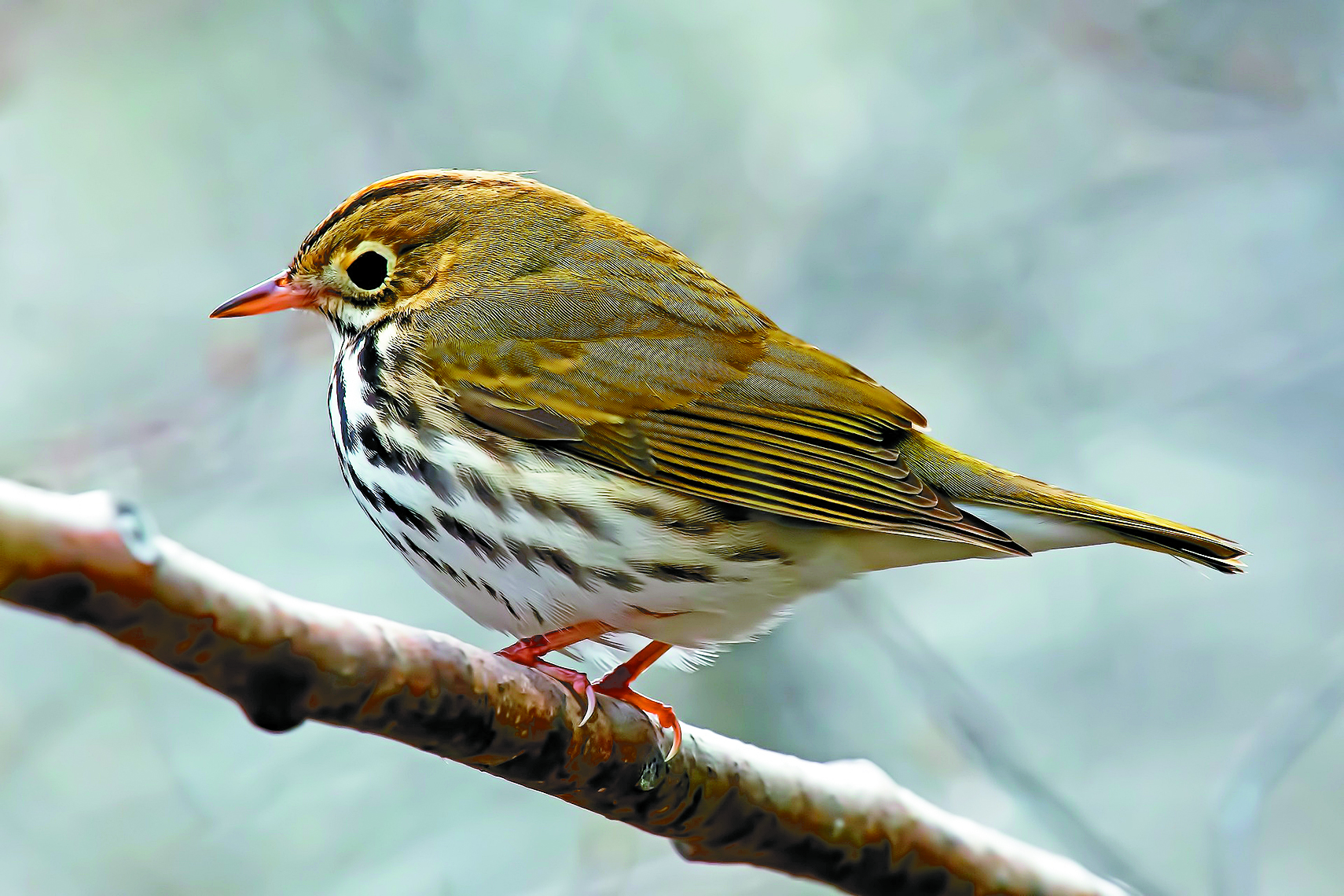
Photo by Bryan Stevens • Keep hummingbirds happy with a sugar water solution of four parts water to one part sugar.


Eggs-traordinary: For birds, it all starts with an egg


Photo by Pixabay  • Holding a precious clutch of eggs, this American robin’s nest is anchored on a foundation of mud. The nest itself is made from twigs and lined with finely woven grass and other plant material.

We’ll celebrate Easter on Sunday, April 9. This holiday has long been associated with eggs due to the symbolism of the egg with such concepts as life and renewal.
The nesting season is ready to go into full swing for most of the bird species that breed in eastern North America.

Although they may employ a variety of strategies to ensure nesting success, they all start off their attempts with a clutch of eggs.
It’s the egg that separates birds from most mammals while still linking them to their reptilian kin. Let’s leave the question of which came first, the prototypical chicken or the proverbial egg, to philosophers and instead take a look at the differences birds employ when it comes to the precious life-giving egg in its fragile yet protective shell.

A few birds devote an enormous investment of time to a single egg. For instance, the American flamingo lays only a single egg, which is incubated for about a month atop a nest made from a mound of mud. This flamingo breeds extensively through the islands of the Galápagos, coastal Colombia, Venezuela and nearby islands, Trinidad and Tobago, along the northern coast of the Yucatán Peninsula, Cuba, Hispaniola, the Bahamas, Virgin Islands and the Turks and Caicos Islands. While other flamingo species are common attractions at zoos, the American flamingo was considered extinct in the United States by 1900. However, recent research indicates that wild birds still make their way into southern Florida. As recently as 2014, a large flock of about 150 wild American flamingos spent time in the Sunshine State.

While there are more than 300 species of hummingbird distributed throughout the New World, the offspring of these tiny birds all emerge, just like all other birds, from an egg — albeit a very small one. Most hummingbirds are “twins,” hatched with a single sibling that will share their nest and the care of a dutiful mother. The female ruby-throated hummingbird lays two eggs. A female hummingbird gets no assistance from the male and has to find enough food to fuel her own body and help her young in the nest grow and thrive.

Most birds lay multiple eggs, although the number in a clutch may vary dramatically from species to species. A female American robin will usually lay three to five eggs in a nest that she builds in the fork between tree branches. The size of her clutch of eggs is fairly typical for many songbirds.

Some songbirds are even more prolific. A female house wren, although a rather small bird, may lay as many as eight or nine eggs. Likewise, the golden-crowned kinglet is one of North America’s smallest songbirds, but the female kinglet may lay as many as 11 eggs in a small nest woven of moss, spider’s silk, lichens and strips of bark. By comparison, the female blue-gray gnatcatcher, while similar in size to a kinglet, attempts to lay no more than three to five eggs.

On the other hand, some birds adjust clutch size depending on the resources available to them. In years when their food — a type of caterpillar often injurious to spruce trees — is abundant, the Cape May warbler may lay as many as nine eggs. In years when the aforementioned spruce budworms are scarce, the female warbler may reduce her clutch size to a mere four eggs.

Photo by Bryan Stevens • American robin sitting on its nest in the shelter of a side of a bridge spanning the Doe River in Elizabethton, Tennessee.

Eggs look fragile, but are actually surprisingly strong. Egg-shaped or “ovoid” objects are considered to be among the strongest shapes in nature. However, strength is no guarantee against a host of hungry predators. Many birds rely on camouflage to protect their eggs. For instance, the female ruffed grouse will usually lay 9 to 14 eggs in a no-fuss nest constructed of leaves in a basin on the forest floor. While incubating her eggs, the grouse hen’s mottled brown plumage makes her almost invisible.

In a similar fashion, the female Eastern whip-poor-will does not build a nest and invariably lays only a pair of eggs, which are placed directly on the forest floor. Her plumage helps her blend with her surroundings, making it extremely difficult to discover a whip-poor-will incubating her eggs.
Many species of ducks are prolific layers of eggs. The wood duck hen may lay as many as 16 eggs in her nest, which may be in a natural tree cavity or a human-made nesting box.

However, not all waterfowl lay a large clutch of eggs. The common loon usually lays only one or two eggs. Once young loons hatch from their eggs, the parents are devoted caregivers, providing food and protection for the one-month period required for young loons to achieve a degree of independence.
Most of our common birds lay eggs that are significantly smaller than the egg of a chicken. Wild turkey hens lay eggs — as many as 17 eggs in some cases — that are noticeably larger than an average chicken egg.

Who takes the prize for largest egg? That distinction, not surprisingly, goes to the world’s largest bird. Africa’s common ostrich hen, which can weigh as much as 220 pounds, lays the largest known bird egg. Furthermore, a female common ostrich will usually incubate about 20 of these large eggs, which can reach a diameter of six inches and weigh three pounds.

Whether a bird’s eggs are small or large, these fragile shells — when all goes well — break open to release some amazing miracles. I think anyone who enjoys sitting on the porch and listening to owls call after dark or watching the antics of birds visiting a feeder will readily agree.

•••

Remember to share your first spring sighting of hummingbirds by emailing me at ahoodedwarbler@aol.com. Please include the date, time and any other details.