Category Archives: Uncategorized

Share your first sightings of spring hummingbirds

Photo by Georgia Lens / Pixabay

The website Journey North noted in a post on March 15, that hummingbird migration along the Pacific Coast has been impacted by the crazy weather that California has experienced in recent weeks.

In the eastern United States, however, the annual migration of ruby-throated hummingbirds is proceeding pretty much on schedule.

According to Journey North, volunteers along the Gulf Coast and in the Southeast have been reporting arriving ruby-throated hummingbirds since early March.
I fully expect that ruby-throated hummingbird migration will bring the first individuals to Northeast Tennessee, Southwest Virginia, and Western North Carolina in early April.
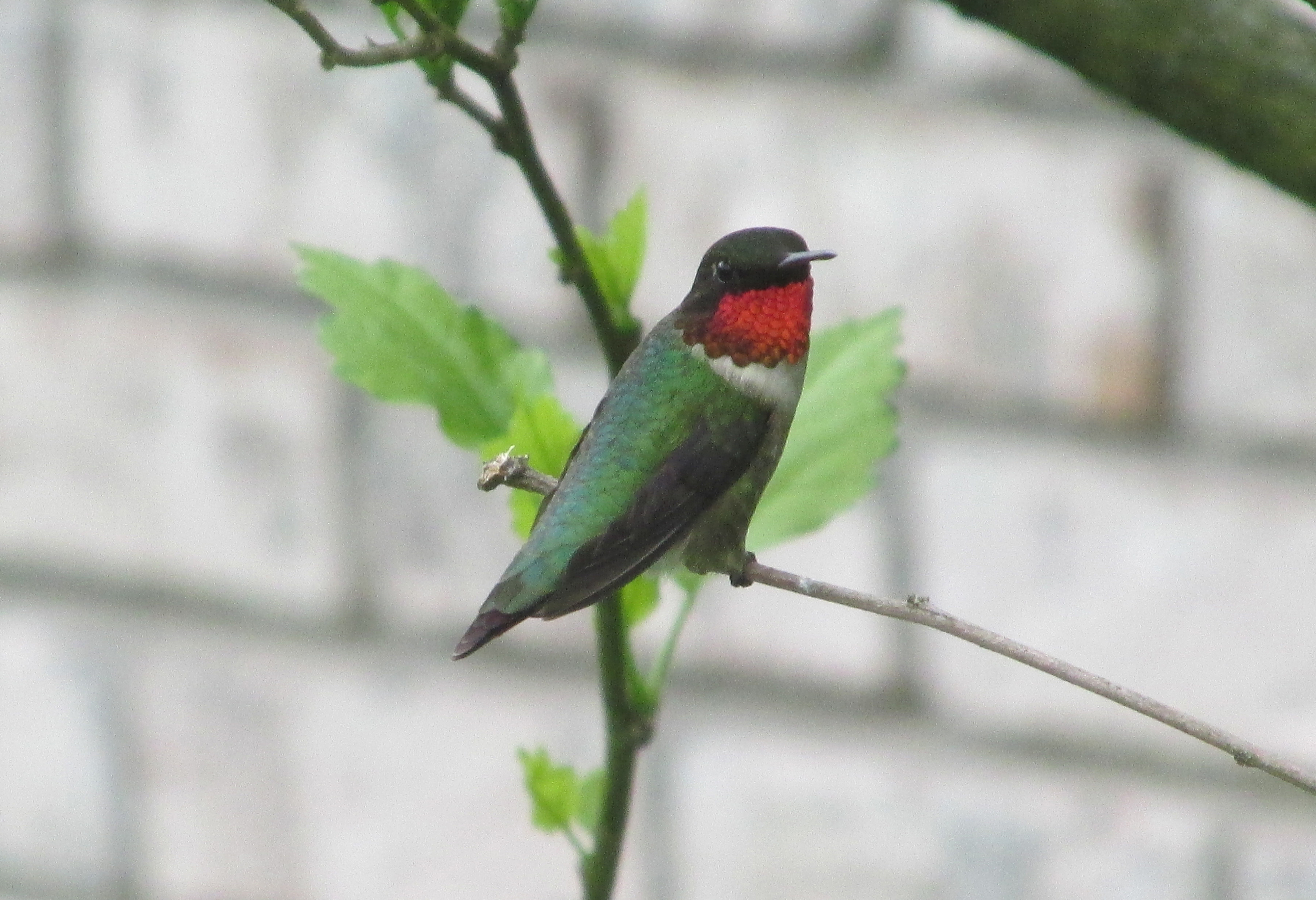
Photo by Bryan Stevens • Male ruby-throated hummingbird show the namesake red throat. The feathers on a male’s throat are iridescent, which means they can change when seen from different angles. In poor light, the ruby-red throat can look almost black.

According to the website, most first spring observations of hummingbirds are males, although a few females are being spotted. Male hummingbirds, the posting noted, arrive first so they can find and defend a territory.

As always, spring migration can be a challenging time for hummingbirds. Temperature, wind patterns and storms can influence the pace of migration.
Even once these tiny birds make their epic spring crossing of the Gulf of Mexico, they will need time to rest and refuel before moving northward. By mid-March, the advance of ruby-throated hummingbirds has usually reached states as Georgia and South Carolina. By the end of March, these tiny flying gems have reached states such as Tennessee and North Carolina.

It’s time to get those sugar water feeders outside and waiting for the early arrivals. Once the chance of late-season freezes has passed, consider planting some colorful native flowers to provide nectar sources for hummingbirds.

Northeast Tennessee usually gets its first spring hummingbirds the first week of April. If you’re seeing hummingbirds, I’d love to know. I have tracked arrivals for several years now. To share your first spring sighting of a ruby-throated hummingbird, email me at ahoodedwarbler@aol.com or contact me on Facebook at http://www.facebook.com/ahoodedwarbler. Please include the date and time of your sighting. I also welcome the sharing of other details about your sightings.
In the meantime, take steps now to welcome hummingbirds back and keep them safe during their stay.

Some ways of ensuring that our hummingbird guests are kept healthy and secure are simply common sense. For instance, don’t use pesticides, herbicides or any other sort of toxin anywhere close to the vicinity of a sugar water feeder or a flower garden. Hummingbirds are such tiny creatures with such intense metabolisms that it only takes a small amount of any harmful substance to sicken or kill one of these little flying gems.

Feeding hummingbirds is easy, but many people try to complicate the process. Only common, pure cane sugar, mixed to a ratio of four parts water to one part sugar, is a safe choice for these birds.

For emphasis, I’ll repeat again that only common, pure cane sugar is safe for hummingbirds. There are no safe substitutes. Do not use organic, raw or brown sugar. Confectioner’s sugar, which contains an anti-caking substance (often corn starch, silicates or stearate salts), is also hazardous to hummingbirds.
The ratio of four parts water to one part sugar utilizing pure cane sugar most closely duplicates the nectar that hummingbirds obtain from some of their favorite flowers. Why try to mess with nature’s perfection?

I cannot imagine why anyone would supplement sugar water for hummingbirds with such human beverages as a sports drink or Kool-aid, but there have been reports of people doing so. Be aware that such additives will only risk the health of these tiny birds.
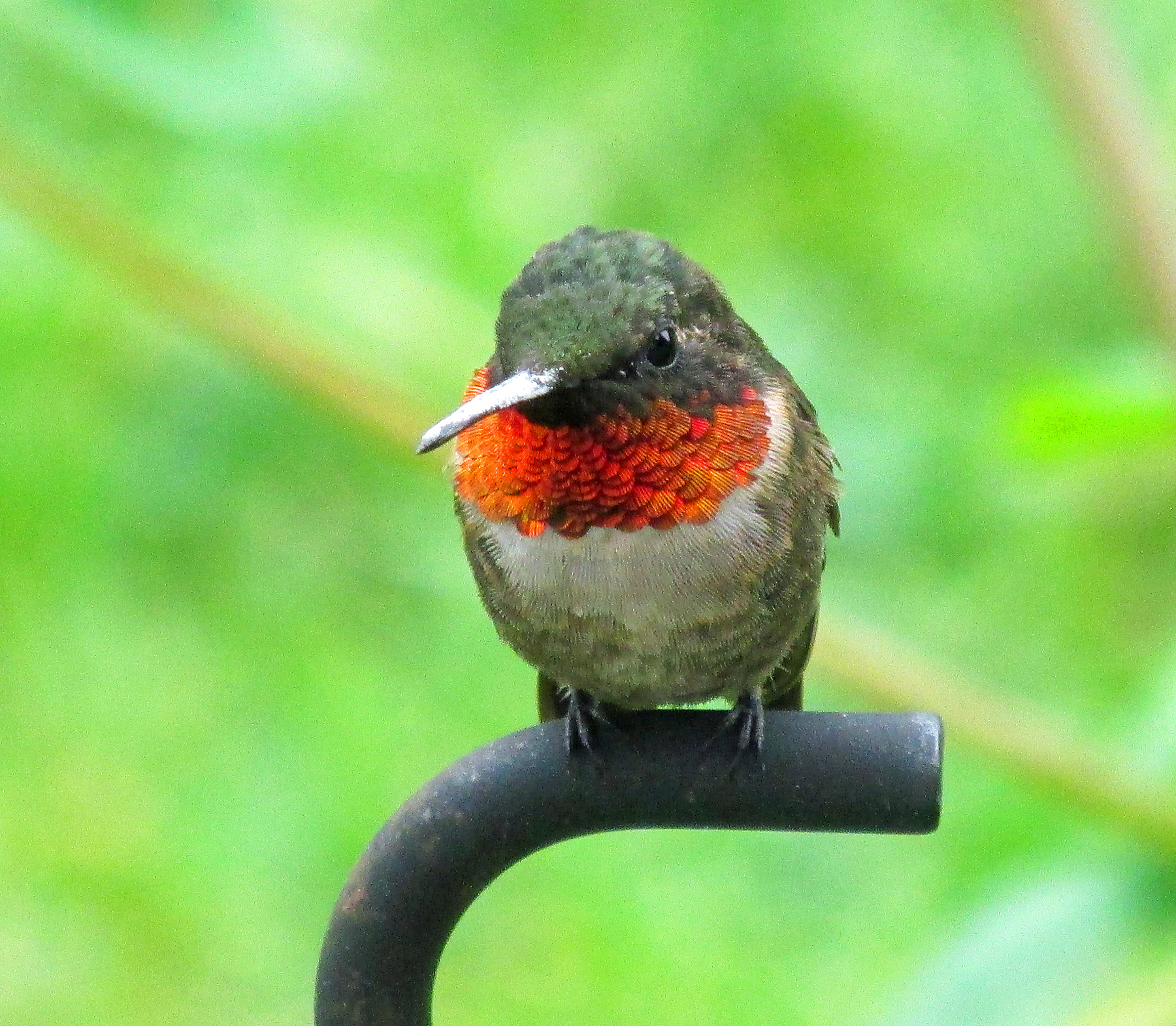
Photo by Bryan Stevens • Despite a perceived disadvantage of size, ruby-throated hummingbirds are quite capable of thriving in a giant world.

Most experts also suggest avoiding red dyes or food colorings, which are often found in commercially marketed hummingbird sugar water. Don’t risk the health of hummingbirds for a little convenience.

It’s easy to make your own sugar water mix, which can be stored in the refrigerator in an empty plastic juice jug. Boil some water and then add one cup of sugar for every four cups of water in your pot. Stir thoroughly. Bottle the mixture until it cools. Fill your feeders and store any remaining sugar water in the fridge in the aforementioned jug. Refrigerated, the mix should stay good to use for at least a week.

In our milder spring weather, changing the sugar water in feeders can probably be done on a weekly basis. When hotter summer temperatures prevail, it’s usually necessary to change the sugar water every two or three days.

•••

Remember to send me those first sightings of returning spring hummingbirds. I’ll be doing my usual roundup to share who gets graced with a visit from one of these tiny beauties.
Flock of cedar waxwings provides ‘berry’ exciting observation

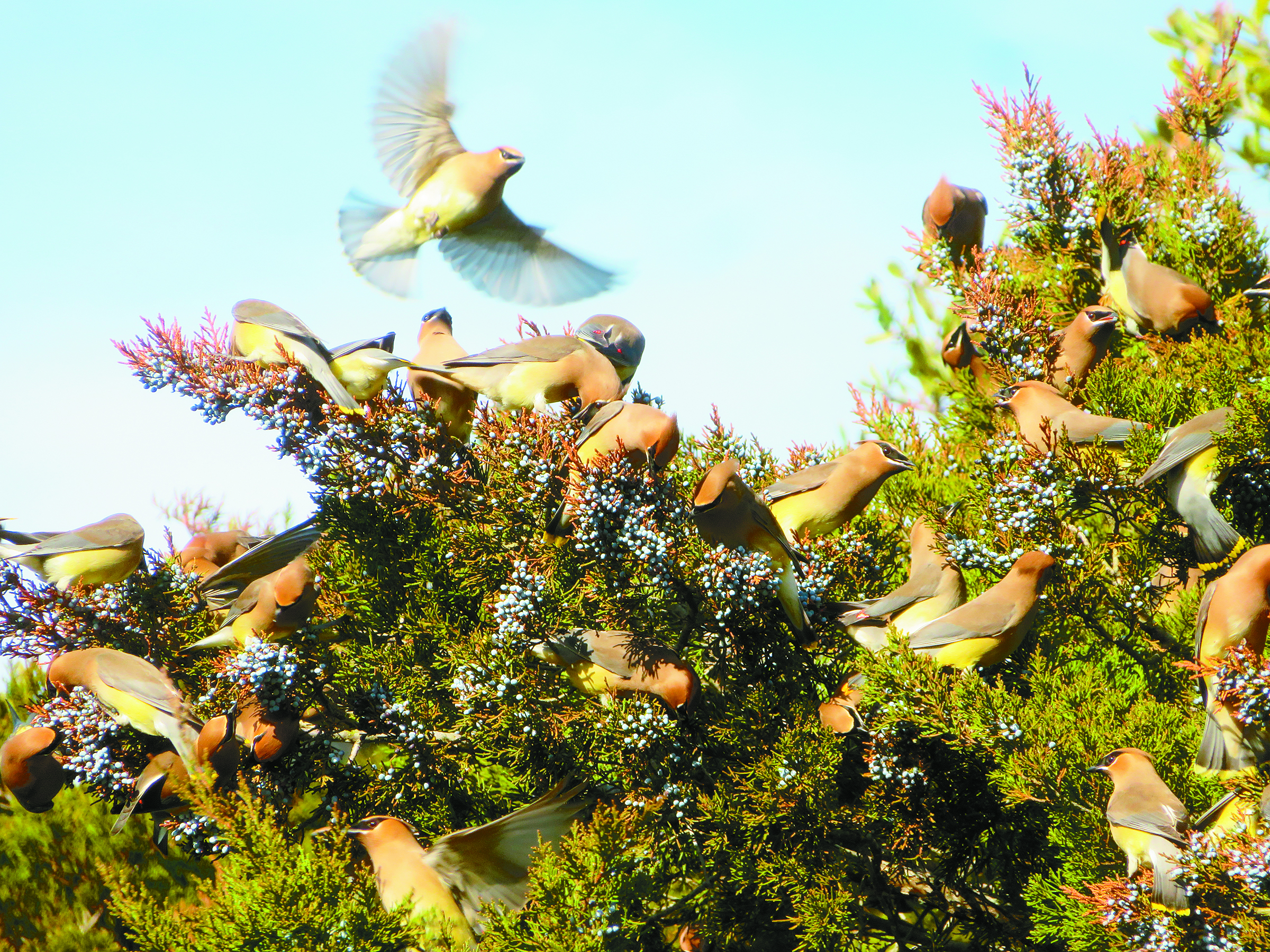
Photo Courtesy of Jim Kroll • Cedar waxwings form large flocks that are capable of stripping berries off trees in a matter of hours when these hungry birds descend on berry-producing trees and shrubs.

Jim Kroll emailed me awhile back to share an observation he made when he and his wife visited Garden City, South Carolina. According to Jim, while riding their bicycles they had the good luck to see a flock of cedar waxwing feasting on berries in a large tree.

“This tree was probably 20 feet tall, and loaded with blue berries,” he wrote.

He also shared a photo of the flock. “There are around 30 waxwings plucking berries,” he said in describing the photo.

He estimated that the flock numbered well over 100 waxwings.

“They left the tree top several times, as if startled, but they would return within a minute and continue their feast,” Jim wrote. “The thing that first caught our attention as we rode under the tree, is that my wife noticed a lot of small pieces of green limbs laying in the road directly under the tree. We turned around to see why the road had so many green limbs and noticed the waxwing flock feasting.”

They made it a point to ride by the tree again on the following two days, hoping to see the waxwing flock again, but did not see them again.

They also discovered that no berries remained on the tree’s branches. The waxwings had consumed all of the berries.

“I looked at an article on the South Carolina Public Radio website that said this is the time of the year that waxwings were migrating south through South Carolina,” Jim wrote.

I replied to Jim’s email and shared an account of an observation I made several years ago at Erwin Fishery Park.

On that occasion, my mom and I watched a couple of mockingbirds wage a losing battle to keep a flock of at least 100 waxwings out of a holly tree laden with berries. The mockingbirds might chase off a dozen waxwings, but there were always a few dozen ready to swoop in and take their place. That tree, too, was stripped of berries. The next time I stopped by I could not detect a single berry still on the tree.

After I shared my waxwing story, Jim replied with some more observations.

“I can see the mockingbirds that you mentioned trying to protect their berry stash,” he wrote. “We regularly see mockingbirds, seemingly being aggressive.”

Jim said that he has also re-named blue jays that visit his bird feeders.

“I call them ‘bully birds’ because they swoop in intentionally trying to scare off the other birds at the feeder,” he wrote.

I thought it interesting that my brother, Mark, told me about a flock of waxwings that he and his wife, Amy, saw at their home in Murrells Inlet, South Carolina. His story was similar to the one Jim shared.

Mark said a flock of waxwings arrived in his yard and swiftly stripped a berry-producing tree of its berries.

Waxwings have a brown and gray silky plumage, a black mask and a perky crest. Some of the wing feathers show red tips. The similarity of these wing tips to melted drops of wax gives these birds the common name of waxwing.

The cedar waxwing has few relatives. Worldwide, there are only two other species: the Bohemian waxwing, of the northern forests of Eurasia and North America; and the Japanese waxwing, found in such northeast Asian countries as Japan, Korea and China.

Although it’s classified as a songbird, the cedar waxwing doesn’t truly produce a vocalization that anyone would contend qualifies as a song. They are, however, very vocal birds, producing shrill, high-pitched notes as they pass through the upper branches of tall trees.

As much as the waxwing has a fondness for fruit, it’s also a bird that would have made an excellent flycatcher. Flocks of these birds will often congregate in trees near the edge of a pond, garden or yard — anywhere winged insects might be found in good numbers — in order to hawk insects on the wing. A waxwing will sally forth from a branch, snatch its prey in mid-air, and return to its perch for a quick snack.

Waxwings are rather nomadic, coming and going with a maddening unpredictability.

Other birds are more dependable, arriving and departing at roughly the same time year after year.

Over the next few weeks, we can expect the spring arrivals of a vast variety of birds. To share a sighting, make a comment or ask a question, email me at ahoodedwarbler@aol.com.

Photo by Bryan Stevens • The waxy tips to the wing feathers are evident in this photograph of a cedar waxwing.

Look for red-winged blackbirds near cattails, other wetland areas

Photo by Howard Walsh/Pixabay * A male red-winged blackbird guards his territory in the spring while attracting potential mates.

Photo by Howard Walsh/Pixabay * A male red-winged blackbird guards his territory in the spring while attracting potential mates.


If it is March or April in Northeast Tennessee or Southwest Virginia or Western North Carolina, for that matter, some birds are making their return after a season-long absence.

On one recent morning, a loud, familiar “kon-ke-ree” sounded from the tops of the cypress trees at the fish pond. In an instant, I realized that the resident male red-winged blackbird was back for another nesting season.

Red-winged blackbirds return yearly every March and begin to seek out nesting habitat in local wetland areas, such as the cattail marshes near my fish pond.

Last year, my first returning male red-winged blackbird arrived on the evening of March 3. This year, the first red-winged blackbird arrived on the morning of March 6. I heard his unmistakable song from inside my house.

The showy and loud red-winged blackbird male that’s once again taken up residence at my fish pond and adjacent stands of cattails has made himself right at home.

Male blackbirds arrive ahead of the females. My recent spring arrival perches daily in the willows and cypresses by the pond and has been singing every day since his return, but he’s still waiting for his intended audience to arrive. Female blackbirds lag a week or so behind the males in returning to their familiar territory.

Any wet field or marsh, especially those offering a stand of cattails, is almost certain to attract red-winged blackbirds at this time of year. I’d almost wager on that certainty.

The blackbirds arriving in spring behave much differently than the quiet, furtive flocks that often make brief visits to feeders during late winter snowstorms.

“The kon-ke-ree song of the male red-winged blackbird is a sure indication that spring is on the way,” according to a profile located at the Tennessee Watchable Wildlife website.

At this time of year, the male red-winged blackbirds seek elevated perches to display and vocalize. Their loud antics are not designed solely to attract mates. Male red-winged blackbirds also sing to warn rival males from intruding into their territories.

The male red-winged blackbird is a very aptly named bird. Glossy black males sport red wing patches that are often trimmed with a narrow band of yellow feathers. By contrast, female red-winged blackbirds are mostly brown birds that could easily be mistaken for large sparrows. Both sexes have sharply pointed bills.

Red-winged blackbirds are fond of wetlands. Any marsh or even a damp field or flooded pasture is likely to attract a few resident red-winged blackbirds. Females choose nesting locations in cattails or other marsh vegetation. She usually lays three or four eggs. Although she does receive some help from the male, most of the responsibility for raising the young is left to her.

There is a reason that male red-winged blackbirds are not always quite as engaged as females in feeding and tending their young. Males are often polygynous, which means that males will often court multiple mates. His time is often occupied defending females and their respective nests from the advances of other male red-winged blackbirds.

According to the website All About Birds, male red-winged blackbirds spend much of the breeding season sitting on a high perch over their territories and singing almost without ceasing from dawn to dusk.

The website also notes that female blackbirds shirk the high profile of the males. They tend to skulk in wetland vegetation as they collect food or nest material.

Both males and females defend nests from intruders and predators. They take this duty quite seriously, as I know personally from being dive-bombed by parent blackbirds when I have gotten a little too close to their nests.

Other relatives of the red-winged blackbird in the United States include the tricolored blackbird found along the Pacific Coast and the yellow-headed blackbird resident in wetlands west of the Great Lakes. Rusty blackbird, common grackle and brown-headed cowbird are other species of blackbirds found in Tennessee, Virginia and North Carolina.

Share a sighting, ask a question or make a comment by emailing me at ahoodedwarbler@aol.com.

Female red-winged blackbirds lack the splashy plumage of males.


Early morning bird encounter may have been type of shorebird


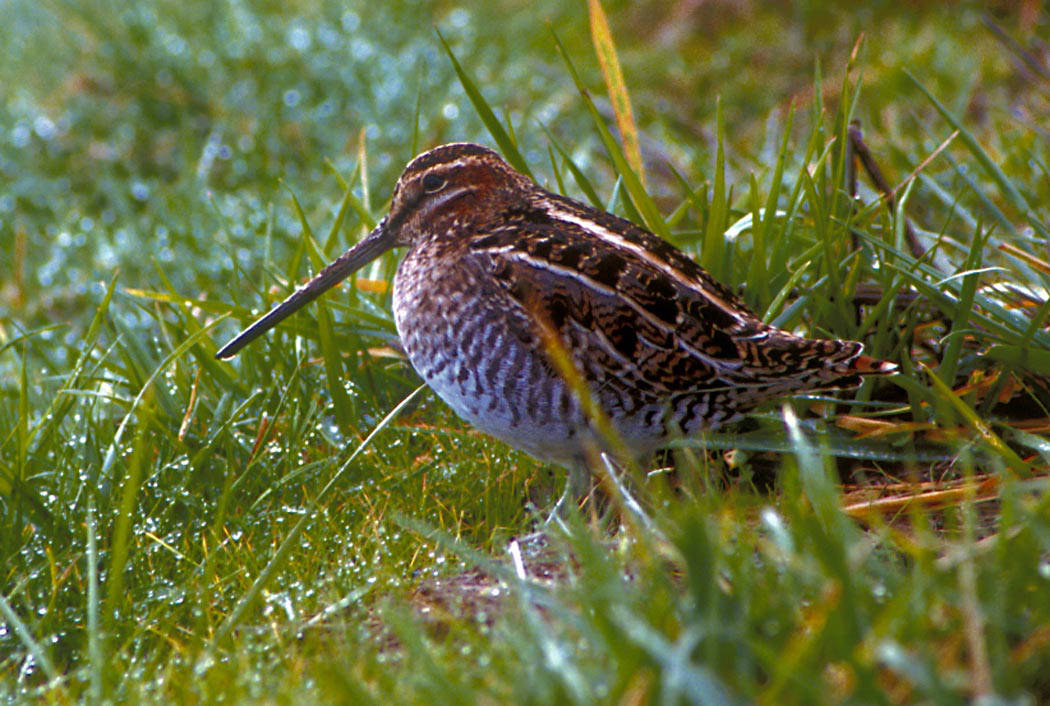
Photo by Patty Browne/USFWS • A Wilson’s snipe seeks out concealing cover in a wet field.

Lynda Carter of Jonesborough sent me an email asking for help making sense of a pre-dawn close encounter of the feathered variety.

“My sister and I were walking this morning before daylight and had a startling experience,” Lynda wrote. “We had started down a gravel drive when a bird flushed right at our feet. The bird flew away at about a 45 degree angle and made quite a bit of sound.”

Lynda wrote that she and her sister agreed the sound was wing noise rather than a call, which ruled out the screech owl they sometimes see on the drive. It would also be unusual for a screech owl to roost on the ground.

Lynda described the noise as louder than a dove taking off.

“I have never noticed doves on the ground at night,” she added before asking me for my best guess regarding the bird’s identity.

I cannot conclusively identify the bird, but I did offer some possibilities in a response to Lynda’s email.

If the location is near woods, I would go out on a limb and make three guesses: Wilson’s snipe, American woodcock or ruffed grouse.

The first two birds are each active both night and day, but the ruffed grouse is usually not active at night. Roosting on a gravel road is also not its style. I included it because a grouse’s wings make quite a lot of noise when they take off.

Wilson’s snipe and American woodcock are atypical shorebirds with long legs and bills. Both are also often active around dusk and dawn. Their plumage lets them blend remarkably well with their surroundings, whether those be wetlands, fields or woodland floors.

Wilson’s snipe looks stocky, thanks in part to the extra-large pectoral (breast) muscles that make up nearly a quarter of the bird’s weight, a feat unmatched by any other shorebird, according to the All About Birds website. Using these massive flight muscles, a snipe can reach speeds estimated at 60 miles an hour.

Photo by Bryan Stevens * A Wilson’s snipe ventures from cover to forage on a muddy bank.

According to All About Birds, the American woodcock nests in young, shrubby, deciduous forests, old fields and mixed forest-agricultural-urban areas across the eastern United States and southern Canada.

In late winter and early spring, these dumpy shorebirds are famous for their nuptial displays conducted in forest openings and old fields. They take flight, and their feathers produce an eerie sound as they make their descent back to the ground.

If the bird flushed from hiding by Lynda and her sister had been vocal, I would have guessed killdeer. But Lynda didn’t hear anything but the apparent noise from the wings, which in my mind rules out the killdeer and its loud vocalizations.

I cautioned Lynda that my guesses were not definitive. Alas, her encounter may remain a mystery, but the unexpected interaction with the unknown bird does sound like it made for a dramatic experience.

To ask a question, make a comment or share a sighting, email me at ahoodedwarbler@aol.com.

Readers ask questions regarding area thrushes

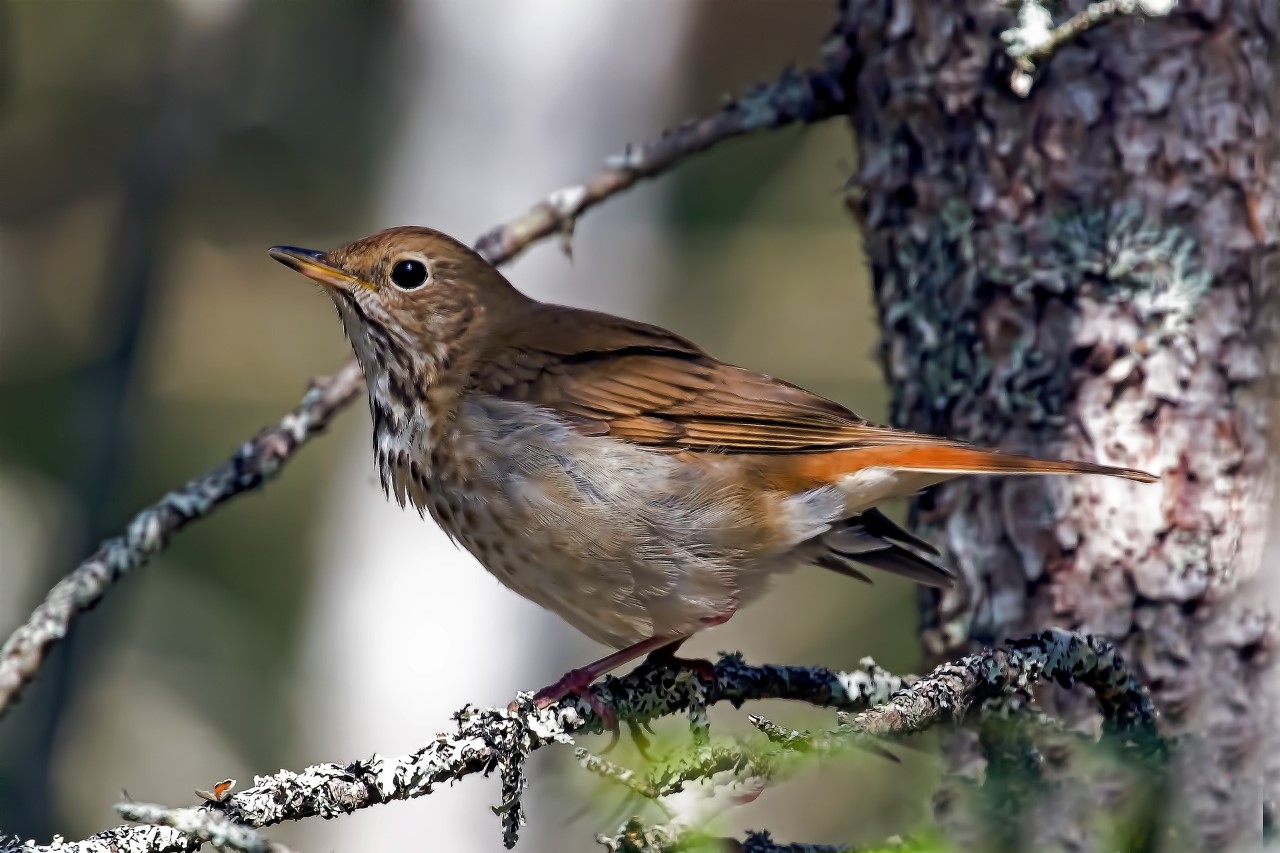
Photo by Hans Toom/Pixabay • Hermit thrushes, such as this individual, are winter visitors to the region. The hermit thrush is related to other members of the thrush family, including Eastern bluebird, American robin and wood thrush.


Carol Garland of Unicoi contacted me via Facebook Messenger about my recent column in the Johnson City Press about bluebirds.

“I have several bluebirds in my yard this year,” Carol wrote in her message.  “I have had a couple maybe every year, but this fall I saw eight on a bush in my yard.”

She described the bush as having purplish berries.

“Bless them, they cleaned it, and I was so glad to have something they could eat,” she continued.  “I don’t know what kind it is but wondered if you would have any idea.”

I suggested that the bush might likely be either a privet, if the berries are very dark purple to almost black, or a beautyberry if the berries are a brighter, almost orchid-like purple.

Most privet plants produce masses of purple-black berries which are fairly popular with birds that spread the seeds widely. Similarly, American beautyberry, also known as French mulberry, produces large clusters of bright purple berries, which birds and deer eat, thus distributing the seeds.

Carol also asked if I knew where she could buy live meal worms for her bluebirds.

“I am going to see if I can get a couple of houses for them, but they must have some places around because they have been here most of the winter,” she added.

For mealworms, I suggested that Carol contact the Wild Birds Unlimited store on W. Market Street in Johnson City. Gardening centers might also be a likely source for either live or freeze-dried mealworms. Searching online would likely provide plenty of possibilities for acquiring this favorite protein source for bluebirds.

Eastern bluebirds are a member of the thrush family of birds, which consists of several species fond of both insects and fruit.

I also heard from Susan Peters of Elizabethton on the subject of bluebirds and other thrushes.

“I really enjoyed your bluebird column, as I am sure so many others did,” Susan wrote in an email to me. “It prompted me to check that my bluebird houses were clean and free of other occupancies.”

She added that she has seen bluebirds in her birdbath with a bit of snow on the edges of the bath. She added that she has a heater in the bath to keep the water thawed during cold spells.

“They are a wonderful winter sight,” she wrote.

“I was wondering if you thought it was possible for a hermit thrush to be in my yard under the feeders,” she also queried. “My identification skills are purely amateur, but in checking my Peterson books, I think I saw one for several days.”

She described the bird as a bit smaller than a wood thrush with a bit more olive color, a white eyering and showing spots/stripes on its breast.

“I really thought the thrushes were migratory,” she wrote.

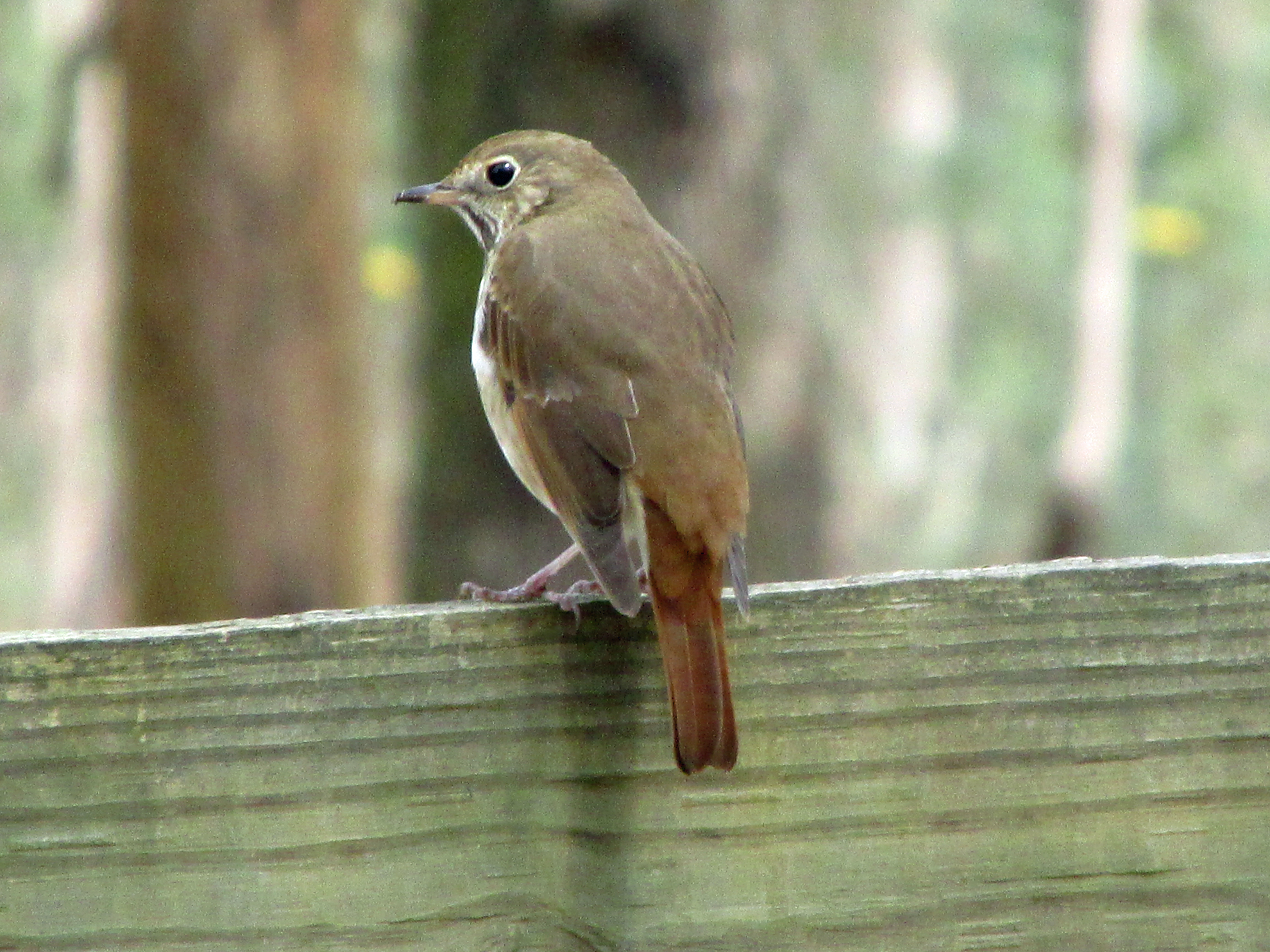
In a reply I explained that most thrushes are migratory. In a sense, even the hermit thrush, a winter resident in the region, is migratory. It simply migrates to the area from the more northern locations that provide breeding habitat for the species.

According to Tennessee Watchable Wildlife on the website of the Tennessee Wildlife Resources Agency, the hermit thrush is primarily a winter visitor to Tennessee arriving in early October and departing by late April. The same holds true for western North Carolina and southwest Virginia.


The entry at Tennessee Watchable Wildlife describes this thrush as a quiet, unobtrusive bird spending most of its time foraging in the leaf litter or in berry-filled tangles at the forest edge.

Susan described seeing the thrush as a real treat.

“The hermit thrush was my mother’s favorite bird,” she wrote.

Photo by Bryan Stevens • A hermit thrush perches on a fence in March in South Carolina. These thrushes are winter residents in much of the eastern United States.

Susan wrote that her mother always called the hermit and wood thrushes “deedle-deedle” birds because of their calls.

“My hermit thrush visits under the feeders almost every morning,” she wrote in a followup email. “What a treat. Thanks again for the confirmation.”

To share sightings, ask questions or make comments, email me at ahoodedwarbler@aol.com.

Still time to count: Annual GBBC runs Feb. 17-20

Photo by Bryan Stevens • People are invited to count birds during a four-day period as part of the 2023 Great Backyard Bird Count taking place from Friday, Feb. 17 through Monday, Feb. 20. Participants will have an opportunity to look for birds, such as this pileated woodpecker, and report their findings.


The 2023 Great Backyard Bird Count will be held Friday, Feb. 17, through Monday, Feb. 20. This year’s GBBC will mark the 26th anniversary of this annual survey that utilizes citizen science to obtain valuable information about the world’s bird populations.

It’s easy to take part. Simply watch the feeders in your own yard or visit a favored birding spot. For instance, participants could choose to count in Persimmon Ridge Park in Jonesborough, Osceola Island Recreation Area in Bristol, Fishery Park in Erwin, Winged Deer Park in Johnson City, Orchard Bog in Shady Valley, Lake Lure in McDowell County, North Carolina or any other personal favorite birding location.
For details on how to report results of your co

unt, please visit http://www.birdcount.org and click the “Participate” menu button.
It really is as simple as counting all the birds you see and submitting your personal checklist.

Since 2013, the GBBC has been a global effort, allowing birders around the world to take part. Participants in 2015 observed almost half of the world’s known bird species, and that effort was surpassed the next year. Momentum has built ever since.

Last year, GBBC participants identified 7,099 species of birds. When you consider that scientists estimate between 9,000 to 10,000 different species of birds throughout the world, that’s a lot of coverage that the GBBC provides each year.
The GBBC is a joint project of the Cornell Lab of Ornithology and the National Audubon Society with partner Bird Studies Canada. With its global perspective, a great many exotic bird species are now tallied on the annual GBBC, but the survey remains firmly established as a grassroots effort to compile data crucial for the conservation of the world’s beloved birds. The information gathered by tens of thousands of volunteers helps track the health of bird populations at a scale that would not otherwise be possible.

It’s incredibly easy to take part in the GBBC. Anyone anywhere in the world can count birds for at least 15 minutes on one or more days of the four-day count period and enter their sightings at http://www.BirdCount.org. There’s no charge or fee for taking part in the GBBC, which is a fun way to observe a variety of birds. Thanks to the flexible count criteria, it is also an easy way to make a contribution to science. The data delivered by the thousands of participants is now collected and compiled by the website ebird.org.

In 2022, the GBBC continued this impressive effort. Here are some interesting tidbits from last year’s survey:
• 7,099 species of birds identified.
• 192 participating countries.
• 359,479 eBird checklists.
• 298,208 Merlin Bird IDs.
• 141,990 photos added to Macaulay Library.
• 384,641 estimated global participants.
The United States had the highest number of checklists with more than 234,000 checklists submitted from all 50 U.S. states and the District of Columbia. California led all states with 20,191 checklists submitted. New York, Texas and Florida rounded out the top tier.

North Carolina birders helped their state rank 6th with 9,926 checklists submitted. Virginia birders can be proud that their commonwealth ranked 7th with 9,469 checklists submitted. Tennessee didn’t fare too poorly. The Volunteer State ranked 23rd with 4,074 checklists submitted.
Internationally, people living in the nations of India and Canada submitted a lot of checklists.

Over my years taking part in the GBBC, I have counted many interesting and unexpected birds, including green-winged teal, Ross’s goose, snow goose, red-shouldered hawk and Cooper’s hawk.

This year’s GBBC will be held over a four-day period, starting on Friday, Feb. 17, and continuing through Monday, Feb. 20.

Participants can count alone or join with groups of fellow birders. Those taking part in the GBBC are invited to count in as many locations as they like. The reported results will help create a real-time snapshot of where birds are distributed during the winter months. Visit http://www.birdcount.org for more details on how to take part in the 2023 GBBC.

Circle these dates on your calendar and get ready to go count birds.

•••••

To share a sighting, make a comment or ask a question, email me at ahoodedwarbler@aol.com.

Man hits a bonanza with recent sighting of eagles

Photo Courtesy of Jim Kroll • These four bald eagles were observed along Mendota Road near Abingdon, Virginia.

Jim Kroll sent me a recent email about a Jan. 30 sighting he made on Mendota Road in Abingdon, Virginia.

“I saw three hawks and an eagle close together in the same tree,” he wrote in his email. “The eagle and one hawk appear to be almost side-by-side on the same limb.”

He added that he had never observed such a combination in the same tree.

“I did not know they got along that well with each other,” Jim wrote.

He noted that he regularly sees hawks near his home in Abingdon and occasionally sees eagles on Mendota Road.

“There was a second eagle,” he added. “The two eagles would fly off together to the river, swooping around each other along the way.”

He said that he watched the hawks and eagles for probably 30 to 45 minutes as they would fly away from the tree multiple times and then return.

He also reported that the hawks were larger than the eagles. This bit of information got me to thinking about his sighting due to the fact that there are no hawks bigger than a bald eagle.

Once I looked at the photo that Jim shared with his email, I realized that his sighting was more remarkable than he realized.

“All four of the birds are eagles,” I wrote to him after viewing the photo. “The dark ones are immature eagles.”

“All four of the birds are eagles,” I wrote to him after viewing the photo. “The dark ones are immature eagles.”

According to information from the East Tennessee State University Eagle Cam project, it typically requires four to five years before young eagles develop the characteristic yellow bill with white head and tail of an adult bird.

Remember that Jim saw a second adult eagle that does not appear in the photograph he shared.

I’m not sure what was taking place with this appearance by multiple eagles. I’m favoring the possibility that the young dark eagles might have been the young of the adult pair of birds. Female eagles are larger than male eagles, so it is also likely the adult bird in the photo is a male and the other eagles in your photo are all females.
The fact that Jim saw five eagles at a single location at the same time is worth commending.

I informed him that I feel lucky when I see one eagle or a pair. I told Jim that to see five eagles at one spot is exceptional and congratulated him.
After I shared my opinion that all the birds in his photo were eagles, he emailed me again.

“We were probably a football field length away from the tree the eagles were in and just jumped to the conclusion that the darker birds were hawks,” he wrote to me.
He had considered how large the birds looked in flight, and he noted that their size and wingspan had not seem right for hawks, but he said he never thought about the other three birds also being eagles. He also shared another photo of the adult eagles flying toward the river.

“Their wingspan was impressive,” he wrote. “It was cool watching them swoop around each other near the river.”

He also shared that he saw another eagle recently near the Nordyke Bridge, five to six miles from where he saw the group of eagles.

Jim added that he has seen eagles at the top of South Holston Dam and along the Virginia Creeper Trail near Alvarado.

The ETSU Eagle Cam project operates eagle cams in Johnson City near Winged Deer Park and in Bluff City.

https://www.etsu.edu/cas/biology/eagle-cam/cameras.php

Here’s some more information about bald eagles from the ETSU Eagle Cam website.
Haliaeetus leucocephalus, better known as the bald eagle, is the United States’ national bird and is an easily recognizable species even to the casual observer. No other bird has a bright white head and tail with a massive yellow bill.
Bald Eagles belong to the family Accipitridae, which also includes hawks, kites, harriers and Old World vultures.

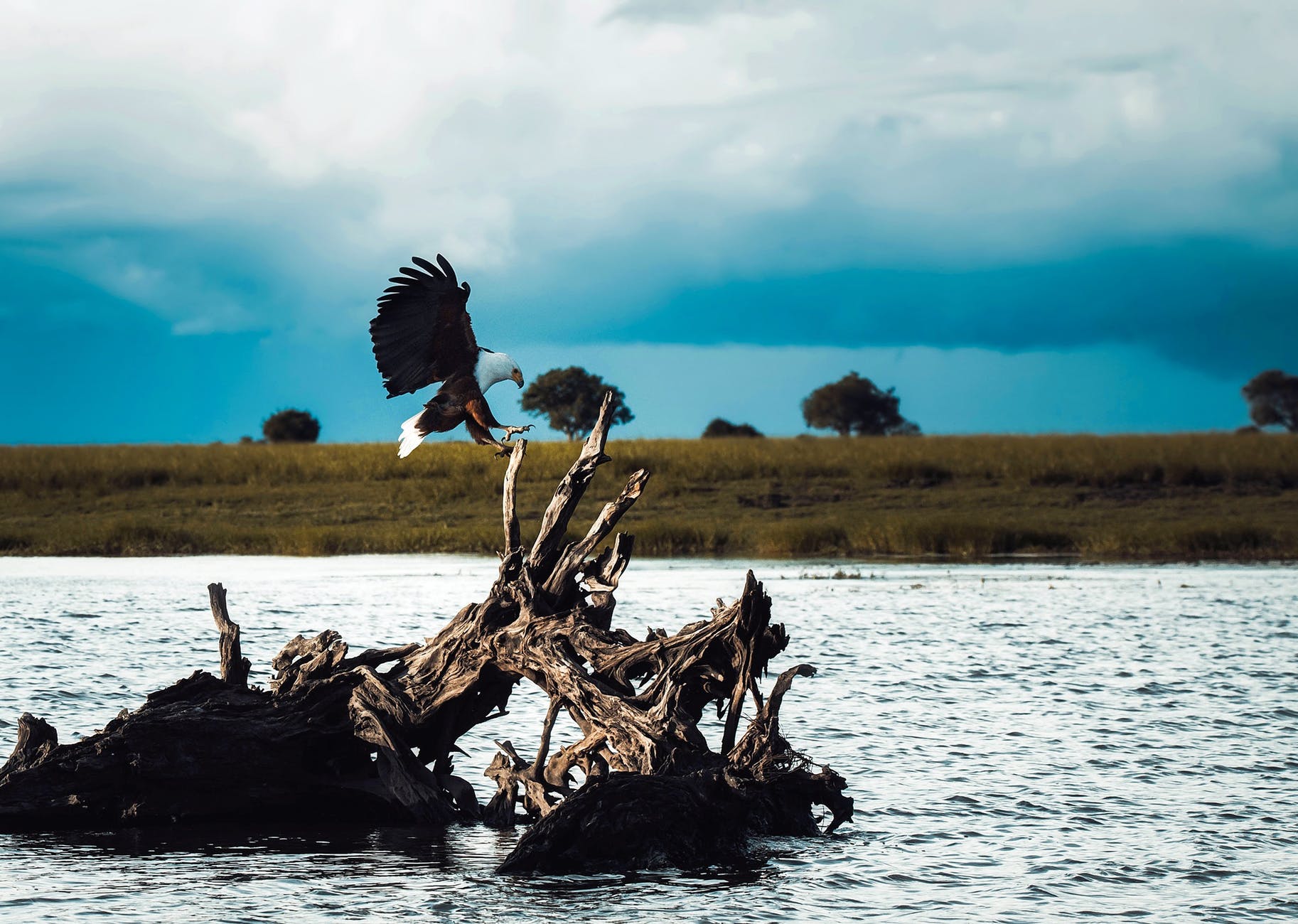
The scientific name roughly translates to “white-headed sea eagle,” which is appropriate because these birds are almost always found nesting near water.

•••

To share a sighting, ask a question or make a comment, email me at ahoodedwarbler@aol.com.

Photo by Pixabay on Pexels.com Bald eagles are often associated with wetland habitats.

Give bluebirds a hand as they scout for nesting locations

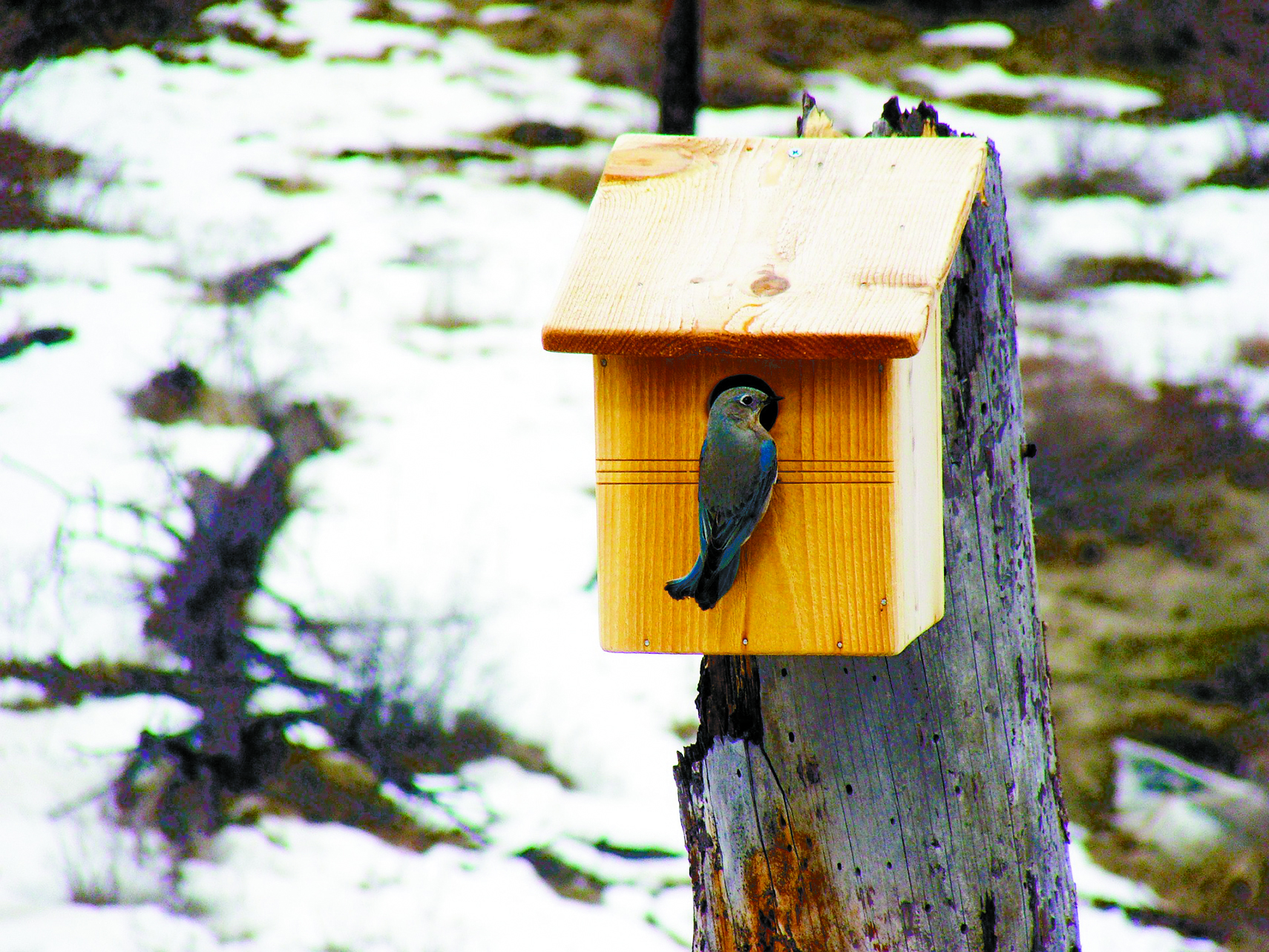
Photo by Matthew Saulsbury/Pixabay • Bluebirds are likely already scouting for nesting cavities and nest boxes in the region.

It’s time to turn the calendar page to February and, depending on the prognostication of the groundhog, winter may or may not be on the wane. Regardless, some of our feather friends are already acting like spring has sprung.
Perhaps it’s simply confusion when days can veer from sunny, short-sleeve conditions to frigid snowstorms, but I tend to trust the instincts of our fine feathered friends.

An email from Unicoi County resident Amanda Austwick proved timely.
“I saw a post on Facebook from a woman in Ontario, Canada, and she had a photo of a bluebird in a tree surrounded by red berries, with a touch of snow on them,” Amanda wrote. “I thought bluebirds migrated south in winter.”

I responded to Amanda’s email and will share some information in this week’s column. For the most part, local bluebirds do not migrate out of the region in winter. Bluebirds living farther north do often, but not always, migrate farther south.
As I mentioned to Amanda, I notice bluebirds almost daily on my drive from home to work. On sunny mornings, male Eastern bluebirds are producing their enthusiastic, warbling song even if there’s been a touch of frost overnight.

The Eastern bluebird is one of North America’s best-known cavity-nesting birds. About 85 species of North American birds use cavities in trees for nesting purposes. Cavity-nesting birds include ducks, such as buffleheads and wood ducks, as well as birds of prey such as Eastern screech-owls and American kestrels. Woodpeckers and nuthatches can excavate their own cavity in a dead or decaying tree.

Others, such as the bluebirds, must find a cavity already in existence. Such cavities are scarce real estate and can be subject to some intense competition.
The Eastern bluebird is at a disadvantage when forced to compete with non-native introduced birds such as aggressive European starlings and house sparrows. Even native competitors such as house wrens and tree swallows are serious rivals when it comes down to staking a claim to prime nesting sites.

Over the years, I have found bluebirds nesting in cavities inside wooden fence posts, but there are fewer wooden fence posts every year. This reinforces the idea of how changing landscapes have affected these birds. Instead of wooden fence posts, many farmers now use metal ones, and dead or dying trees — a much sought-after resource for cavity-nesting birds — are often removed from woodlands. Winter storms this season, along with accompanying high winds, have brought down numerous trees in the woodlands around my home, no doubt removing some current or future nesting possibilities.

When it comes to choosing a nesting cavity, male bluebirds take the lead, investigating and exploring potential sites before introducing females to the chosen real estate. If she accepts his choice, she will build the nest.

Cavities can also find use by bluebirds for secure locations for roosting overnight. According to the website Tennessee Watchable Wildlife, observers have documented bluebirds using nest boxes to stay warm during cold winter nights, packing eight to 12 individuals into one box. With the generated body heat from all those birds, I imagine that was one cozy box!

The website also noted that the oldest known Eastern bluebird in the wild reached an age of 10 years and six months. Given that most songbird live fairly short lives, that was quite an achievement.

For those interested in becoming bluebird landlords, check out nest box designs at the Tennessee Watchable Wildlife website. Several different nest box designs are available at the profile for the Eastern bluebird at tnwatchablewildlife.org.
If you’re not a do-it-yourself individuals, most lawn and garden centers, farm supply stores and speciality bird shops carry readymade bluebird boxes for purchase.
In addition to housing, food and water can be used to lure Eastern bluebirds closer. This bird doesn’t eat seeds, but it can be attracted with an offering of mealworms — live or freeze-dried – or commercially prepared peanut butter nuggets. A water feature in a yard is also a magnet for bluebirds and a host of other bird species.

•••
To ask a question, make a comment or share an observation, please email me at ahoodedwarbler@aol.com.

One warbler is commonplace bird in region during winter

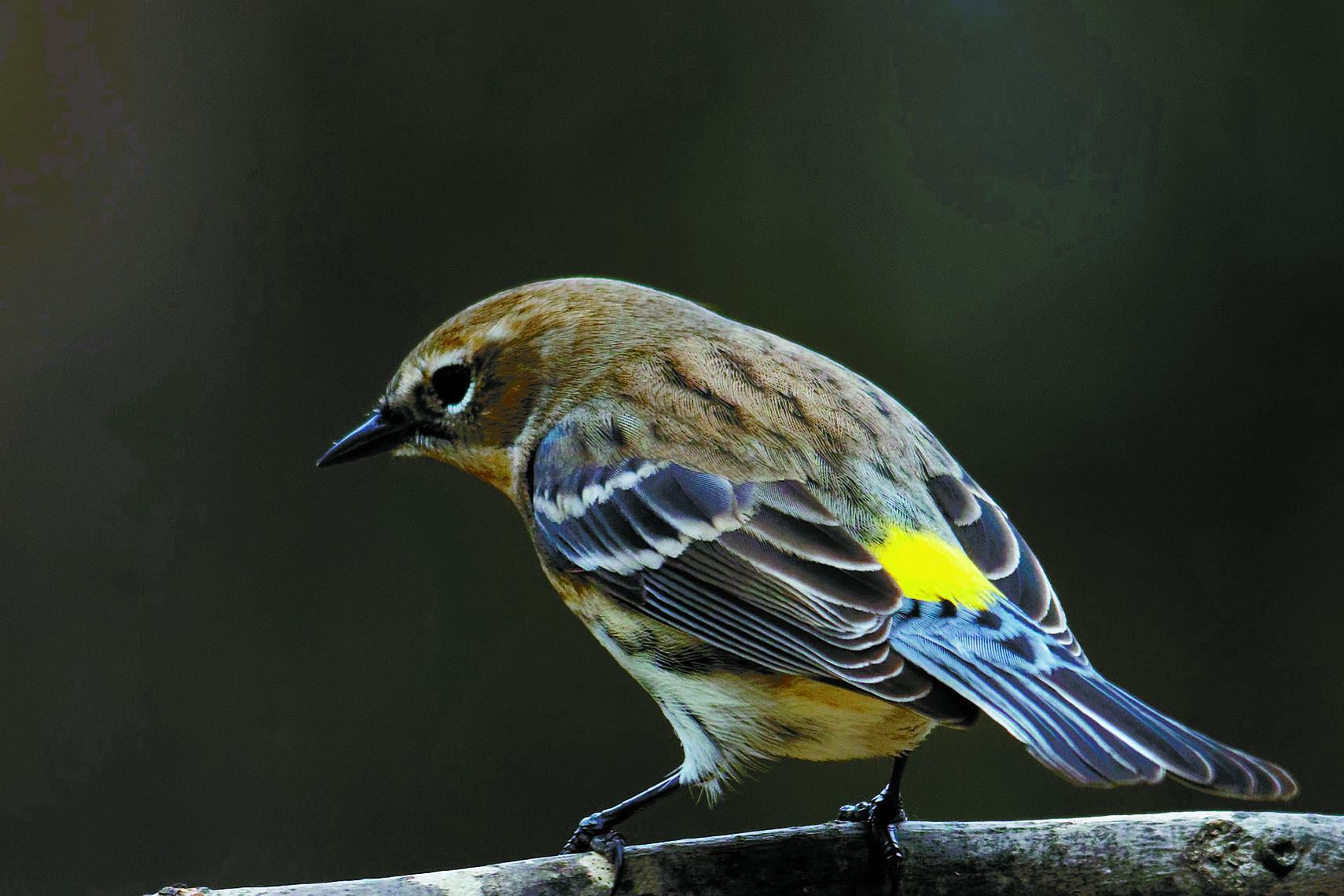
Photos by Edbo/Pixabay • The yellow-rumped warbler is abundant across North America. The species has evolved two distinct sub-species known as the “myrtle warbler” of the Eastern United States and the Audubon’s warbler of the Western United States.

Walk any woodland trails in the region and encounters with yellow-rumped warblers are likely. The linear walking trails in Erwin, walking trails at Sycamore Shoals State Historic Park in Elizabethton and the winding paths at Osceola Island Recreation Area in Bristol are almost certain to yield sightings of this wintering warbler.

A good nickname for this warbler might be “winter warbler” since most other members of the warbler family elect to spend the colder months as far south as Central and South America. From October to early May, the yellow-rumped warbler is a common bird in the region. This species also likes to form large flocks that often flit through the upper branches of trees. They are often joined by other birds, including chickadees, titmice and kinglets in mixed flocks that forage together.

Once the warmer days of summer arrive, yellow-jumped warblers have almost entirely disappeared from the region. Some of the region’s higher peaks attract this warbler during the summer, but this warbler’s population nests farther north than Northeast Tennessee, Southwest Virginia and Western North Carolina.

The yellow-rumped warbler’s appearances changes dramatically from winter to summer. By the time yellow-rumped warblers arrive each autumn, these birds are in drab brown and gray plumage, but they still display the “butter pat” yellow patch on their rump that has prompted birders to saddle this warbler with the nickname “butter butt.”

The lingering yellow-rumped warbler in late April and early May is an entirely different bird. Males have streaked backs of black on slate blue, white wing patches, a streaked breast and conspicuous yellow patches on the crown, flank and rump. Females are similar, but duller overall.

The yellow-rumped warbler ranges across North America from the Pacific to the Atlantic coast, but from the Rocky Mountains westward, the appearance of this warbler changes. Experts have gone back and forth on whether these two sub-species of yellow-rumped warbler should actually be classified as different and distinct species.

The familiar eastern bird is known as the “myrtle warbler,” but the western sub-species is named “Audubon’s warbler” in honor of the artist and early American naturalist John James Audubon. The biggest difference in the two variations is that the Aubuon’s warbler shows a yellow-throat patch compared to the white throat of the myrtle warbler. I’ve seen both. I saw the western Audubon’s warbler during a trip to Utah and Idaho in 2003.

Complicating matters is the fact that the yellow-rumped warbler also ranges into Mexico and Central America, where the appearance of the species changes yet again. Two other forms — Mexico’s black-fronted warbler and Guatemala’s Goldman’s warbler — must be added to the list.

The scientific name of the yellow-rumped warbler is Setophaga coronata. The genus setophaga is taken from ancient Greek and means “eater of moths.” As moths are incredibly abundant, yellow-rumped warblers no doubt consume some of these insects, but their diet is hardly limited to adult moths. They do eat many varieties of caterpillars, as well as beetles, weevils, ants, grasshoppers, gnats and spiders. They will also eat berries, especially during the winter months. It’s their fondness for the berries of wax-myrtle that has given this bird the name “myrtle warbler” to represent the Eastern form of the species. This bird also eats the berries of dogwood, poison ivy, Virginia creeper and dogwood.

The yellow-rumped warbler has also learned to visit feeders. Preferred foods at feeders include sunflower seeds, raisins, peanut butter and suet.

During the long months when most of the colorful, energetic warblers are absent from the region, the yellow-rumped warbler offers some solace, as well as a reminder. In a few months, area woodlands will once again explode with the songs of returning warbler. The chorus will be so vigorous that we’ll hardly notice that the yellow-rumped warbler is no longer part of the choir.

According to the website “All About Birds,” the yellow-rumped warbler is abundant. The website notes that populations of this warbler have held steady from 1966 to 2019, according to the North American Breeding Bird Survey. Partners in Flight estimates a global breeding population of 170 million individual birds.

•••
To ask a question, make a comment or share a sighting, email me at ahoodedwarbler@aol.com.

Watch for American kestrels in open areas, on roadsides

Naser Mojtahed/USFWS • An American kestrel perches on a pole. These small falcons are present throughout the year in the region, but their numbers typically increase during the winter months when individuals from farther north migrate into the area.

The year’s still young, but I am amassing some interesting bird sightings. My very first birds of 2023 were a common raven (heard) and a red-shouldered hawk (seen) at my home on the morning of Jan. 1.

I heard the raven croaking raucously on the ridge behind my home. When I stepped onto my front porch, I startled the red-shouldered hawk from a perch at a willow growing near my fish pond. Since those sightings, I’ve added additional birds, including American kestrel, to my year list.

I’ve observed kestrels at a couple of locations, including one that favors the utility lines along Highway 107 near Bell Cemetery in Limestone Cove and another one that I’ve seen perching on power lines near Rolling Hills between Unicoi and Erwin.
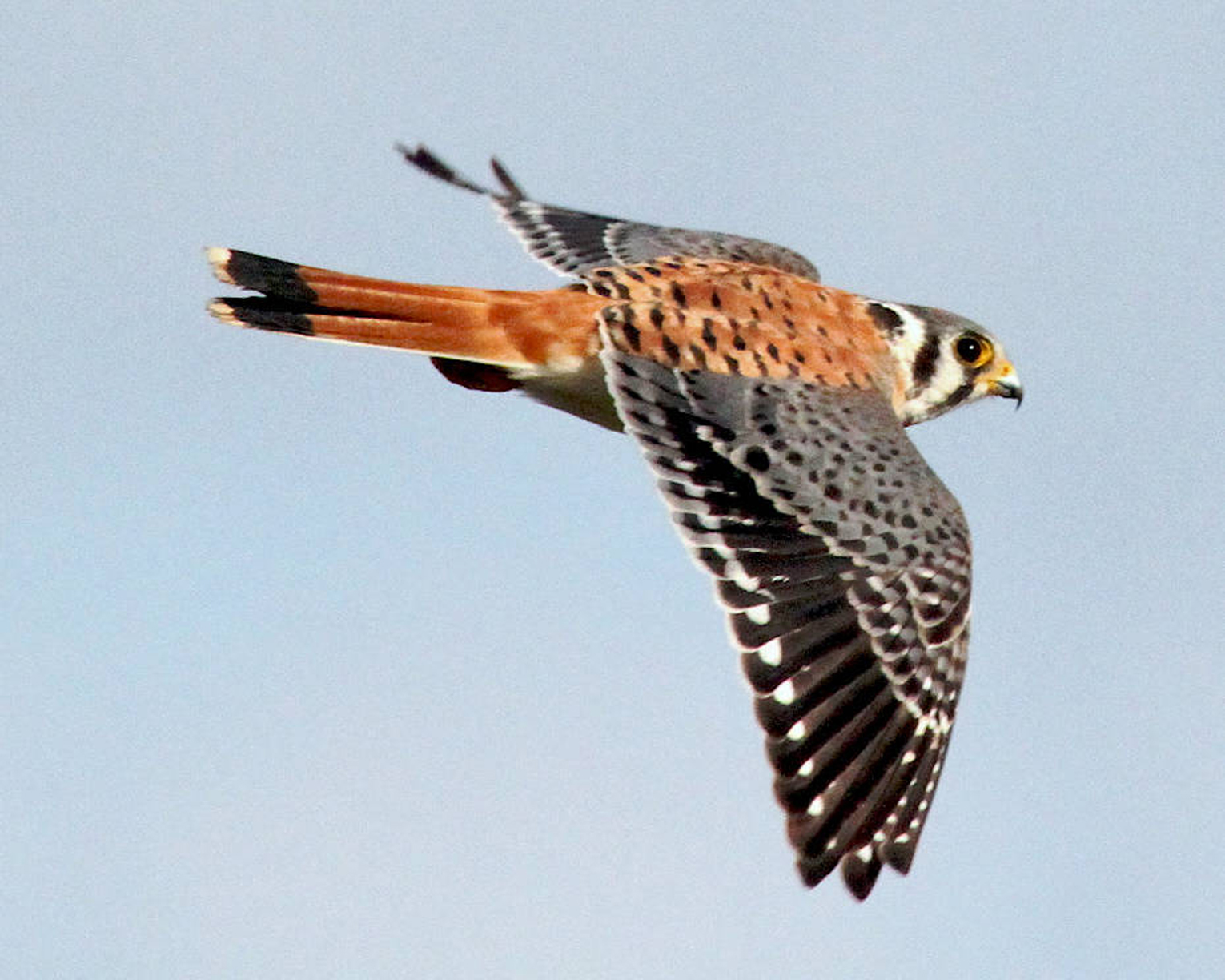
The American kestrel is a small member of the falcon family, which includes such relatives as merlin, peregrine falcon and gyrfalcon. All falcons, regardless of size, share a similar aerodynamic design that includes sleek, streamlined bodies and long, slim wings which taper to pointed tips. They fly with rapid wingbeats and are capable of swift flight.

The American kestrel, although present throughout the year in the region, is somewhat more prominent during the winter months when kestrels from farther north migrate into the region. However, this falcon also nests in the region and can be found at any time of the year in suitable habitat, which is usually open countryside.

The male American kestrel is a colorful bird. He shows a rusty back with some black barring, a rusty tail and steel blue-gray wings. The female kestrel is brownish with black barring on her back and tail. She also shows a buff-colored wash streaked with brown on her under- parts. Both sexes show a strong facial pattern marked by two black “sideburns” on the side of the face.

The American kestrel has long been one of my favorite raptors. They’re seldom as skittish as many other raptors and will permit close observation. Formerly known by the name “Sparrow Hawk,” the American kestrel does not feed entirely on other birds. In fact, a large part of this small falcon’s diet includes rodents and insects.
The kestrel is one of the birds I remember from my childhood “Golden Guide to Birds” book. Raptors are not normally regarded as colorful birds, but the paintings in these little books perfect for child-sized hands showed a beautiful bird with different hues visible in its plumage.

Like many raptors, the American kestrel likes to hunt from a perch, swooping down on unsuspecting prey. The kestrel, however, is also capable of hovering, a type of flight that only a relatively few birds, including the belted kingfisher and the ruby-throated hummingbird, are capable of performing.

In its nesting preference, the American kestrel is unusual among other native falcons and hawks. Kestrels nest in cavities, including abandoned woodpecker holes and nest boxes provided by humans.

The falcons comprise a family of birds with a long history with humans. The sport of falconry, although not as widely practiced today, long ago became associated with royalty and nobility. In fact, falconry has been called “the sport of kings.” The sport basically involved hunting prey, usually other birds, with birds of prey such as falcons. As a pastime, falconry never became as popular in the United States as in other parts of the world.

There are more than 60 species of falcons found worldwide. While the peregrine falcon’s endangered status became well-known in the United States, other falcons have been threatened with extinction. The Mauritius Kestrel once dwindled to a population of only six individuals. Today, the population, due to intensive human effort, has greatly recovered.

Other members of the falcon family can be found in the region, including the peregrine falcon and the merlin. Other falcons in North America include the prairie falcon and the Aplomado falcon. Worldwide, some of the more descriptively named falcons include spotted kestrel, rock kestrel, slaty-backed forest falcon, grey falcon, greater kestrel, lesser kestrel, red-footed falcon, red-necked falcon, sooty falcon and brown falcon.

To share observations, ask questions, or make a comment, email me at ahoodedwarbler@aol.com.

Photo by USFWS/Robert Burton • An American kestrel in flight shows the aerodynamic design that earned this small falcon the common name of sparrow hawk.