Category Archives: Uncategorized

Albatross known as Wisdom returns again to Midway Atoll 

Readers with good memory will recall that I’ve written numerous times over the years about a special bird by the name of Wisdom.

She’s making headlines again!

Wisdom, the world’s oldest known wild bird, recently returned to Midway Atoll. She was first spotted back in this familiar territory on Nov. 24, 2022, in fact.

Wisdom is considered world’s oldest wild bird

The beloved Laysan albatross is at least 71 years old now. Biologists first identified and banded Wisdom in 1956 after she laid an egg, and these large seabirds aren’t known to breed before age five.
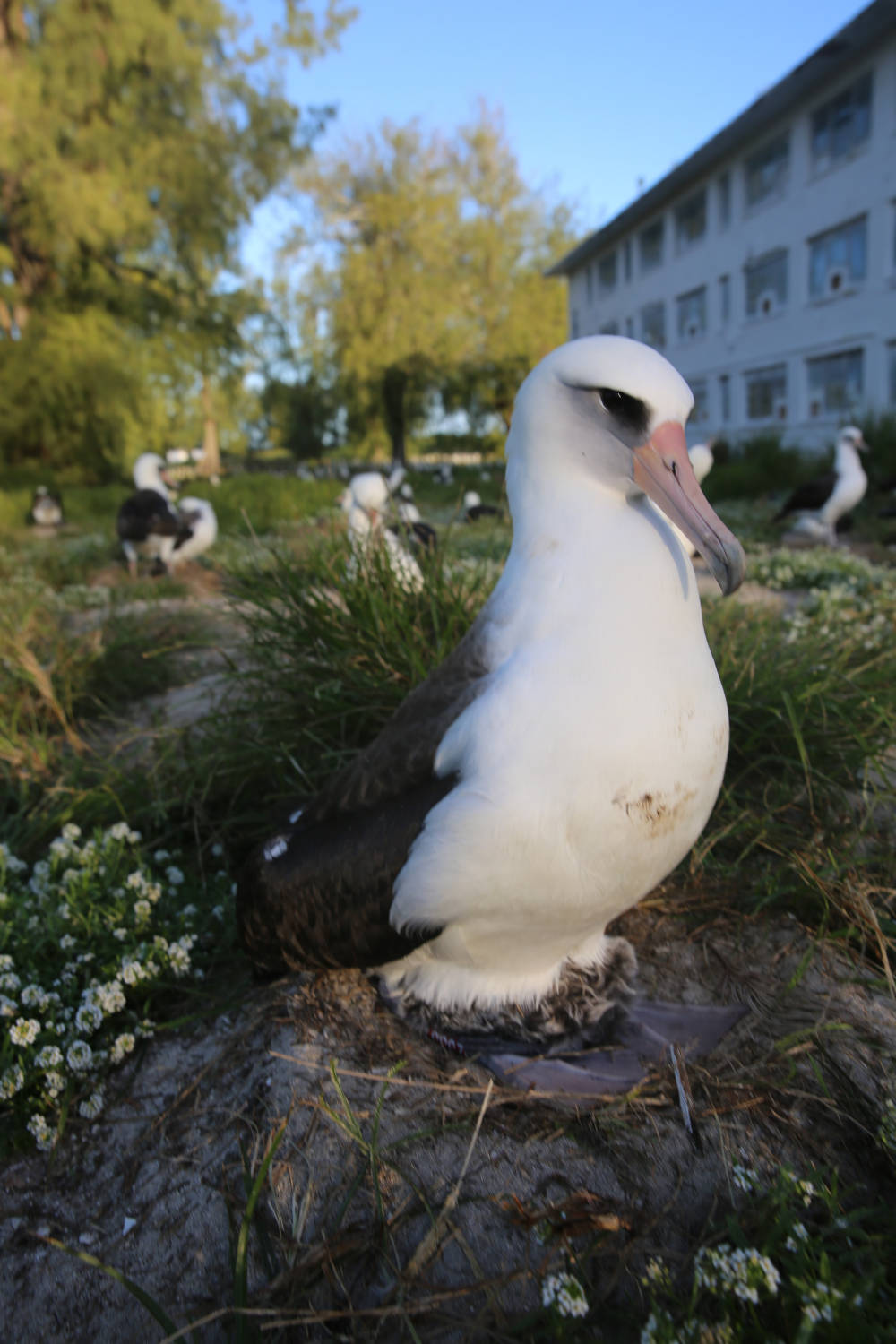
Photo by Bob Peyton/USFWS • Midway Atoll National Wildlife Refuge and Battle of Midway National Memorialwithin Papahānaumokuākea Marine National Monument is a special place for over three million seabirds – they return to Midway Atoll each year to rest, mate, lay eggs and raise their chicks.

Researchers have estimated that Wisdom has produced 50 to 60 eggs and as many as 30 chicks that fledged, according to Jonathan Plissner, supervisory wildlife biologist at Midway Atoll National Wildlife Refuge.

The ageless Wisdom, with her well-known band number of Z333, was first spotted this nesting season on Thanksgiving Day. Her long-time mate, Akeakamai, has yet to be seen and was absent last nesting season, too. Male albatrosses typically return to the breeding site before their mates, wrote Plissner in an email.

For decades, Wisdom and Akeakamai, like most pairs of these albatrosses, returned every year to the same nest site to lay one egg.  

They are among the millions of albatross that return to Midway Atoll on the far northern end of the Hawaiian archipelago to nest and raise their young. 

For some unknown reason, Wisdom only made a brief appearance late last year. In a release dated Dec. 9, 2022, the U.S. Fish and Wildlife Service noted that Wisdom had not been seen in the past week and most mōlī have already laid their egg for the season, but biologists will continue to monitor the area in case the world’s oldest known bird returns.

Among albatross, the Laysan albatross is a small species. This bird has a body length of 23 inches and a wingspan of about 80 inches, or six-and-a-half feet. The larger species of albatross have wingspans of 12 feet. 

Worldwide, there are about 20 or so species of albatross. Most albatrosses range in the Southern Hemisphere from Antarctica to Australia, South Africa, and South America.

In literature, the poem “The Rime of the Ancient Mariner” by Samuel Taylor Coleridge uses an albatross to explore the concepts of innocence and creation.

French poet Charles Baudelaire also featured this bird in his poem titled “L’Albatros.” 

Albatrosses haven’t coexisted easily with humans. Fifteen of the world’s albatross species face possible extinction. Two species, Tristan albatross and waved albatross are considered critically endangered. 

Albatrosses are long-lived birds, with some gaining a ripe old age of 50 years or more. Only parrots rival them for longevity, with some parrots and macaws documents as living more than a century. 

Wisdom hatched her most recent chick in February 2021, making her at least 70 years old at the time. She is the oldest confirmed wild bird and the oldest banded bird in the world.

I hope that Wisdom’s simply off gliding over the world’s vast oceans and will make more future appearances. Since learning of her story, I’ve been continually amazed by her indomitable spirit. Long may she fly.

Speaking of long lives among out feathered friends, there are some impressive age milestones that have been reached by other birds. 

Longevity Records

According to the American Bird Conservancy website, here are some of the world’s longest-lived wild birds:

• common raven — 69 years

• American flamingo — 49 years

• bald eagle — 38 years

• sandhill crane — 37 years

• Canada goose — 33 years

• Atlantic puffin — 33 years

• red-tailed hawk — 30 years

• mourning dove — 30

• great horned owl — 28 years

• mallard — 27 years

• blue jay — 26 years

• great blue heron — 24 years

• laughing gull — 22 years

• piping plover — 17 years

While it’s usually the larger birds that live longer, some songbirds, just like people, can live astonishingly long lives. The hummingbirds, which are truly tiny, can produce individuals that reach a relatively old age. For instance, a broad-billed hummingbird has been documented reaching the age of 14 years.

•••

Email me at ahoodedwarbler@aol.com to share sightings or ask questions. 

Annual Christmas Bird Count nets lower total than usual

Photo by Michael of Pixabay • A yellow-bellied sapsucker clings to the trunk of a tree. A total of 11 sapsuckers was found during the recent Elizabethton Bird Count.

The 80th consecutive Elizabethton Christmas Bird Count was held Saturday, Dec. 17. A total of 24 observers, myself included, in eight parties assisted by two feeder watchers participated.

The weather was less than ideal, with strong winds in parts of the coverage area. Participants tallied 61 species, which longtime count compiler Rick Knight noted was well below the recent 30 year average of 73 species. In fact, this was the lowest species total since 1970 when a mere 58 species were found.

Missed birds included ring-necked duck, horned grebe, ruffed grouse, Eurasian collared-dove, double-crested cormorant, barred owl, great horned owl, white-crowned sparrow; fox Sparrow and Eastern meadowlark.

Knight noted that reasons for the low number are complicated. The wind was a factor in some areas. Also, duck numbers have been generally low so far this winter. Blackbirds have been scarce in this area for most recent winters. Some half-hardy lingerers weren’t found, including house wren, brown thrasher and palm warbler. Some others are low-density wintering birds and were just missed.

So, what did the participants see?
Here’s the list:
Canada goose, 447; mallard, 210, bufflehead, 226; and hooded merganser, 5.
Wild turkey, 5; pied-billed grebe, 4; rock pigeon,148; mourning dove, 86; killdeer, 9; and Wilson’s snipe, 5.

Ring-billed gull 9; common loon, 2; great blue heron, 14; black vulture, 17; turkey vulture, 12; and American kestrel, 12.

Sharp-shinned hawk, 1; Cooper’s hawk, 6; Bald eagle, 5; red-tailed hawk, 22; and Eastern screech-owl, 7.

Belted kingfisher, 15; Red-bellied woodpecker, 26; yellow-bellied sapsucker, 11; downy woodpecker, 17; hairy woodpecker, 4; Northern flicker, 17; and pileated woodpecker, 11.

Eastern phoebe, 17; blue jay, 71; American crow, 733; and common raven, 14.
Carolina chickadee, 108; tufted titmouse, 91; red-breasted nuthatch, 4; white-breasted nuthatch, 45; brown creeper, 1; winter wren, 7; Carolina wren, 86; golden-crowned kinglet, 9; and ruby-crowned kinglet, 15.

Eastern bluebird, 149; hermit Thrush, 9; American robin, 122; Northern mockingbird, 41; Eurasian starling, 714; and cedar waxwing, 281.

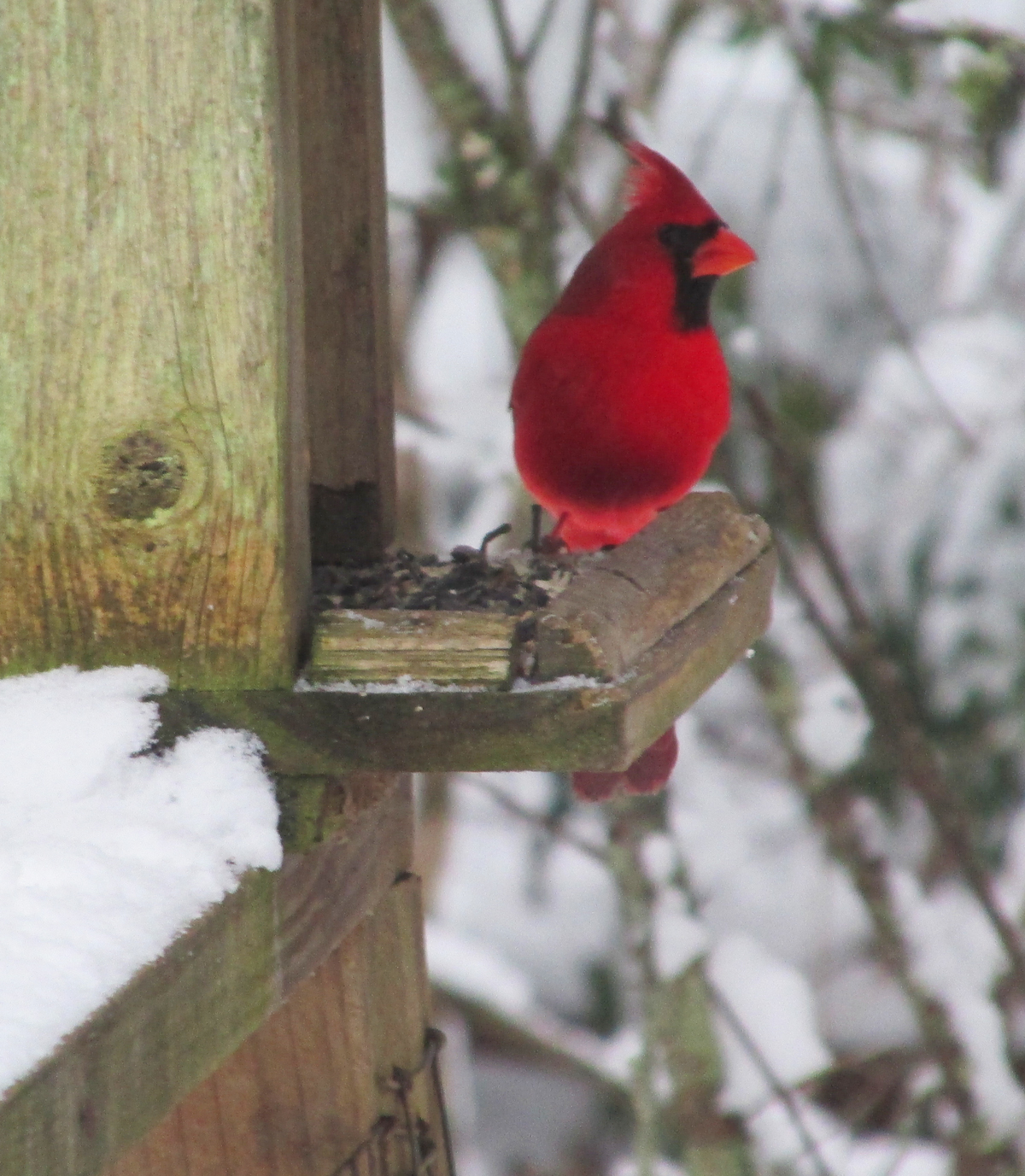
Photo by Bryan Stevens • A male Northern cardinal visits a feeder on a snowy afternoon. Counters found 132 cardinals on the Elizabethton CBC.

House sparrow, 70; house finch 89; purple finch, 3; American goldfinch, 73; chipping Sparrow, 29; field Sparrow, 36; dark-eyed junco, 74; white-throated sparrow, 73; song sparrow, 97; swamp sparrow, 2; and Eastern towhee, 7.

Pine warbler, 2; yellow-rumped warbler, 75; and Northern cardinal, 132.

Observers included Bryan Stevens, Chris Soto, Brookie and Jean Potter, Don Holt, Dianne Draper, Eric Draper, Fred Alsop, Kevin Brooks, Judi Sawyer, Charlie Warden, Deb Mignogno, Rick Knight, Kim Stroud, Dave Gardner, Joe McGuiness, Vern Maddux, Roy Knispel, Pete Range, Harry Lee Farthing, Richard Lewis, Tammy Bright, Scott Turner, Larry McDaniel and David and Connie Irick.

•••

Share sightings, ask questions or make comments by emailing me at ahoodedwarbler@aol.com.


Ruby-crowned kinglets make their winter return

Photo by Steve Carson/Pixabay • Only male ruby-crowned kinglets show the red crown patch that gives the bird is common name.

White-breasted nuthatch or red-breasted nuthatch? Common yellowthroat or yellow-throated warbler? Greater yellowlegs or lesser yellowlegs? These and others are some of the identification questions new birders struggle to answer. The coming winter season provides the perfect opportunity for getting to know the region’s birds better if for no other reason than there are fewer species in residence.
Color, markings and behavior are some of the things to consider when trying to identify a new bird. Another consideration is size. In our region, if the bird’s tiny (even smaller than a chickadee, for instance) the possibilities narrow to two related species known as kinglets.

As their name suggests, kinglets are tiny birds. In fact, the only birds in the eastern half of North America that are smaller than kinglets are some of the hummingbirds. Most of the kinglets, known outside North America as “flamecrests” or “firecrests,” belong to the family, Regulidae, and the genus, Regulus. The family and genus names are derived from a Latin word, regulus, which means “rex,” or “king.” The name was apparently inspired by the colorful crown patches, often red, orange or gold, that resemble the royal “crowns” of kings.

Photo by USFWS • Ruby-crowned kinglets are winter visitors throughout the region.

The two North American species — ruby-crowned kinglet and golden-crowned kinglet — can both be found in the region in winter. The ruby-crowned kinglet typically arrives for the winter season in the first weeks of October. The golden-crowned kinglet usually arrives later in the season.

Four other species of kinglets can be found in North Africa, Europe and Asia. Experts recently removed the ruby-crowned kinglet from the genus Regulus and placed this species in a separate genus, Corthylio. The reclassification was based on size (the ruby-crowned kinglet is actually the largest member of this family) and differences in vocalizations.

Circling back to the matter of identification, the two kinglets are easily distinguished from each other. Although roughly similar in size and overall coloration, the ruby-crowned and golden-crowned kinglets contrast enough that a snap identification is simple with a good look through binoculars. The golden-crowned kinglet has a striped facial pattern formed by bold black and white stripes. The ruby-crowned kinglet, on the other hand, has a bold white eye ring but no striping. The golden-crowned kinglet has an orange crown patch, while the ruby-crowned kinglet has a red crown patch that is, more often than not, kept concealed. Both sexes of the golden-crowned kinglet possess a yellow crown patch, but only the male ruby-crowned kinglet boasts a scarlet patch of feathers atop the head. Observers can expend a lot of energy trying to get a look at the crown patches, which are typically only displayed when the bird is agitated.

Kinglets are very active birds. If warblers can be described as energetic, the kinglets are downright frenetic in their activities. The kinglets almost never pause for long, flitting from branch to branch in trees and shrubs as they constantly flick their wings over their backs. These bursts of hyperactivity can make them difficult to observe. Although small in size, these birds more than compensate for it with a feisty spirit that does them well through the harsh winter months.

Kinglets often join mixed flocks comprised of other species of birds, some of which are regular feeder visitors. Perhaps by observing their flock counterparts, some kinglets have learned to accept feeder fare such as suet, mealworms and chopped nuts. Away from feeders, kinglets mostly feed on a range of small insects and arachnids. These tiny birds will also consume some fruit, such as the berries of poison oaks and dogwoods.

By learning the ruby-crowned kinglet’s call, which is a harsh, fast, two-parted scold that, to my ears, sounds like “Jit Jit,” birders can detect the presence of these tiny birds in thickets and other dense vegetation.

Normally, kinglets have a rather fleeting lifespan. These tiny birds can be considered old if they live three or four years. There are always exceptions. The oldest golden-crowned kinglet on record was six years and four months old. That individual, a male, was documented by a bird bander in 1976, according to the website All About Birds.
Overall, kinglets are trusting, tame birds and a welcome addition to any flocks visiting your yard and garden. These tiny feathered sprites are definitely worth getting to know.

Apologies to Arthur Carlson, but wild turkeys can indeed fly

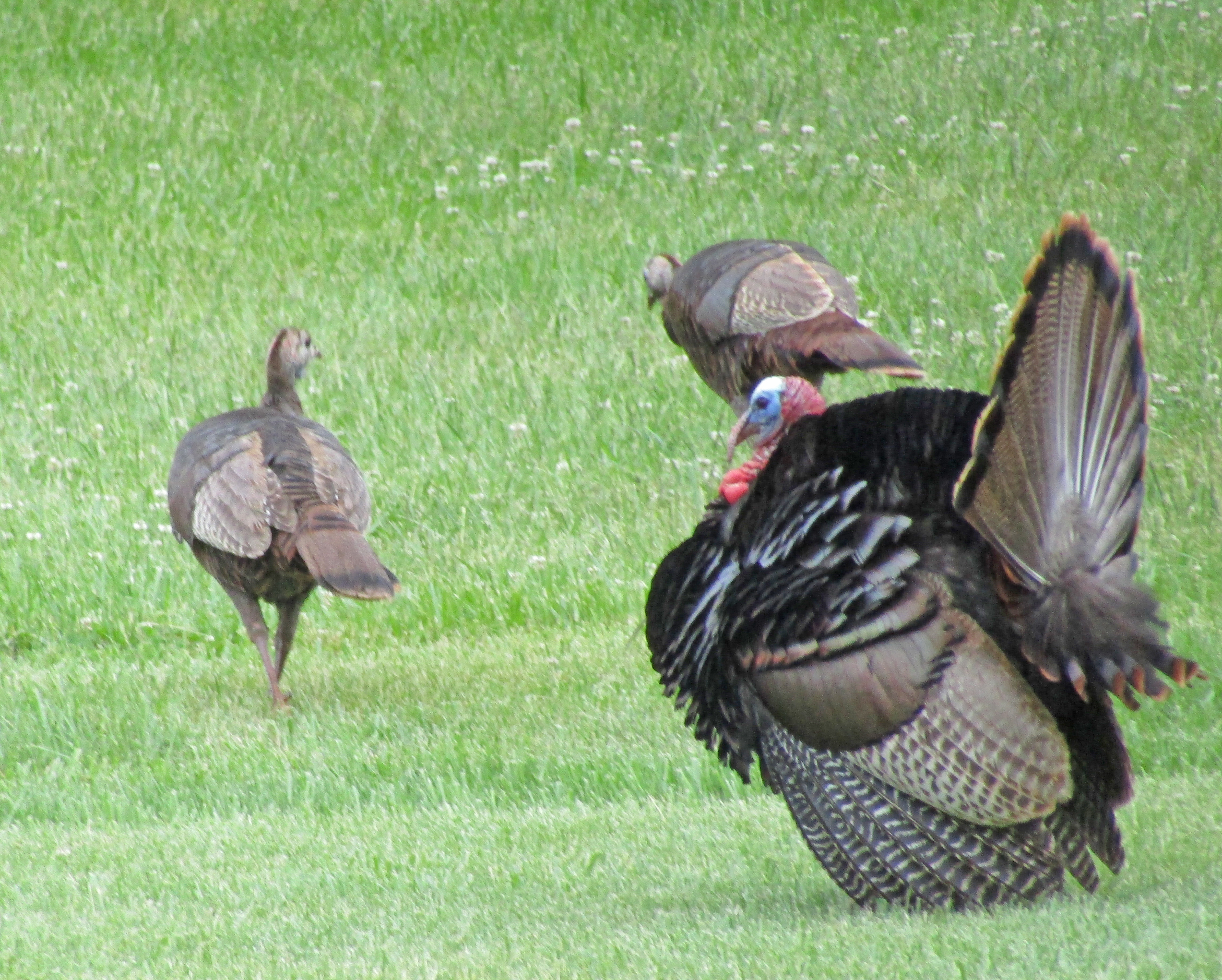
Photo by Bryan Stevens • A male gobbler seeks the attention of hens, as all these Wild Turkeys add to the number of this species found during the count.

NOTE: I wrote the original version of this column back in November of 2015. With some revisions, here’s a timely column on one of the nation’s premier fowls.
As Americans, we all have our holiday traditions. Personally, I will carve 30 minutes from my schedule to watch one of my favorite holiday sitcom episodes.

Not surprisingly, there’s an element linked to birds in the episode, which is often cited as one of the most ingenious sitcom episodes in the history of television. The episode is “Turkeys Away” from the first season of WKRP in Cincinnati, a sitcom that aired from 1978 to 1982 and revolved around the antics of the staff of a down-and-out radio station. The episode originally aired Oct. 30, 1978, early in the first season of the series. I especially like that every member of the ensemble cast was woven into the storyline for this classic Thanksgiving episode. The series is such a favorite I own all the seasons on DVD.

In the event that there are readers who haven’t seen the episode, I’ll try to avoid any blatant spoilers. The action involves a radio promotion that, in hindsight, was destined for disaster. The episode unfolds at the perfect pace, finally culminating in a hilarious series of scenes as the promotion backfires in spectacular fashion. I’ve memorized most of the lines of dialogue, but I still enjoy hearing them delivered by the talented actors Richard Sanders, Loni Anderson, Howard Hesseman and Gordon Jump. Hesseman passed away this year on Jan. 29 at age 81. Frank Bonner, the actor behind sleazy ad rep Herb Tarlek, died June 16, 2021, at age 79. Jump died Sept. 22, 2003, at age 71.

It’s Jump who gets the pivotal line with his perfectly delivered, “As God is my witness, I thought turkeys could fly!”

That classic line provides my segue into the subject of this week’s column, which is America’s wild turkey. I sometimes wonder if my favorite episode of WKRP, which aired 44 years ago, has had some influence in persuading many people that turkeys cannot fly. It’s a widely held misconception that the wild turkey cannot fly. The turkey is perfectly capable of flying at speeds up to 55 miles per hour, but they often prefer to walk and run over the ground. They’re good sprinters, in fact, and can reach a running speed of 25 miles per hour. Turkeys can even swim!

On the other hand, the domesticated barnyard turkey is a fowl of a completely different kind than its wild cousin. Although the wild turkey — the largest of North America’s game birds — can weigh as much as 37 pounds, it’s the domestic turkey that holds the record as a heavyweight. The largest domestic turkey on record tipped the scales at 86 pounds. That bird certainly could have provided an ample banquet for your Thanksgiving meal. Domestic turkeys are bred to be big, which means they are incapable of flight and are also poor runners. Of course, these domestic kin of wild turkeys don’t face a gauntlet of predators.

The wild turkey is a paradoxical fowl, fully capable of shifting from bravado to timidity to meet the situation. Strutting toms have no hesitancy about making themselves the center of attention when the reward is making a favorable impression on a bevy of hens. At other times, these same turkeys, both the performers and their audiences, adopt a more stealthy mode of life. Wild turkeys know that the world’s a dangerous place.

Wild turkeys face various perils at all points in their life cycles, from eggs to newly-hatched young to adult birds. Turkey eggs are a favorite food of such wild animals as raccoons, skunks, opossums and some snakes. Young turkeys, known as poults, are often the prey of domestic dogs and cats, a range of raptors, and other birds such as crows and ravens. Larger predators — bobcats, cougars, coyotes, foxes and eagles — prey on adult turkeys.

I remember the first time that I observed wild turkeys in flight. I was driving near Persimmon Ridge Park in Jonesborough, Tennessee, when about a dozen large, dark birds flew across the road just above the roof of my vehicle. I was definitely perplexed as my mind worked to figure out the identity of these birds. I had almost settled on vultures — although the flight pattern had been all wrong — when I saw that some of these flyers had landed in a field adjacent to the road. On the ground, they were easily recognized as wild turkeys.

The wild turkey’s scientific name is Meleagris gallopavo. The wild bird is exclusively resident in North America, but domesticated turkeys are now raised around the globe. The wild turkey has only one close relative, the ocellated turkey, or Meleagris ocellata, which ranges throughout the Yucatán Peninsula in Mexico as well as the northern parts of Belize and Guatemala. The extent of this fowl’s range is only about 50,000 square miles, while the wild turkey ranges throughout the United States, Canada and Mexico.

In addition to watching my Thanksgiving episode of “WKRP in Cincinnati” I may also take a drive to see if I can’t spy some wild turkeys in the countryside. If they take flight, that would be a bonus!

Update: I didn’t see any turkeys on Thanksgiving 2022, but three days later I had a flock of 14 wild turkeys visit the field next to my fish pond. I startled them and, no surprise here, they flew! Every member of the flock took flight and sailed across Simerly Creek Road and landed in a neighbor’s field.

Photo by Bryan Stevens • Wild Turkeys and Ruffed Grouse were found on this year’s count, but participants failed to locate any Northern Bobwhites.

Column began with visit from dark-eyed junco

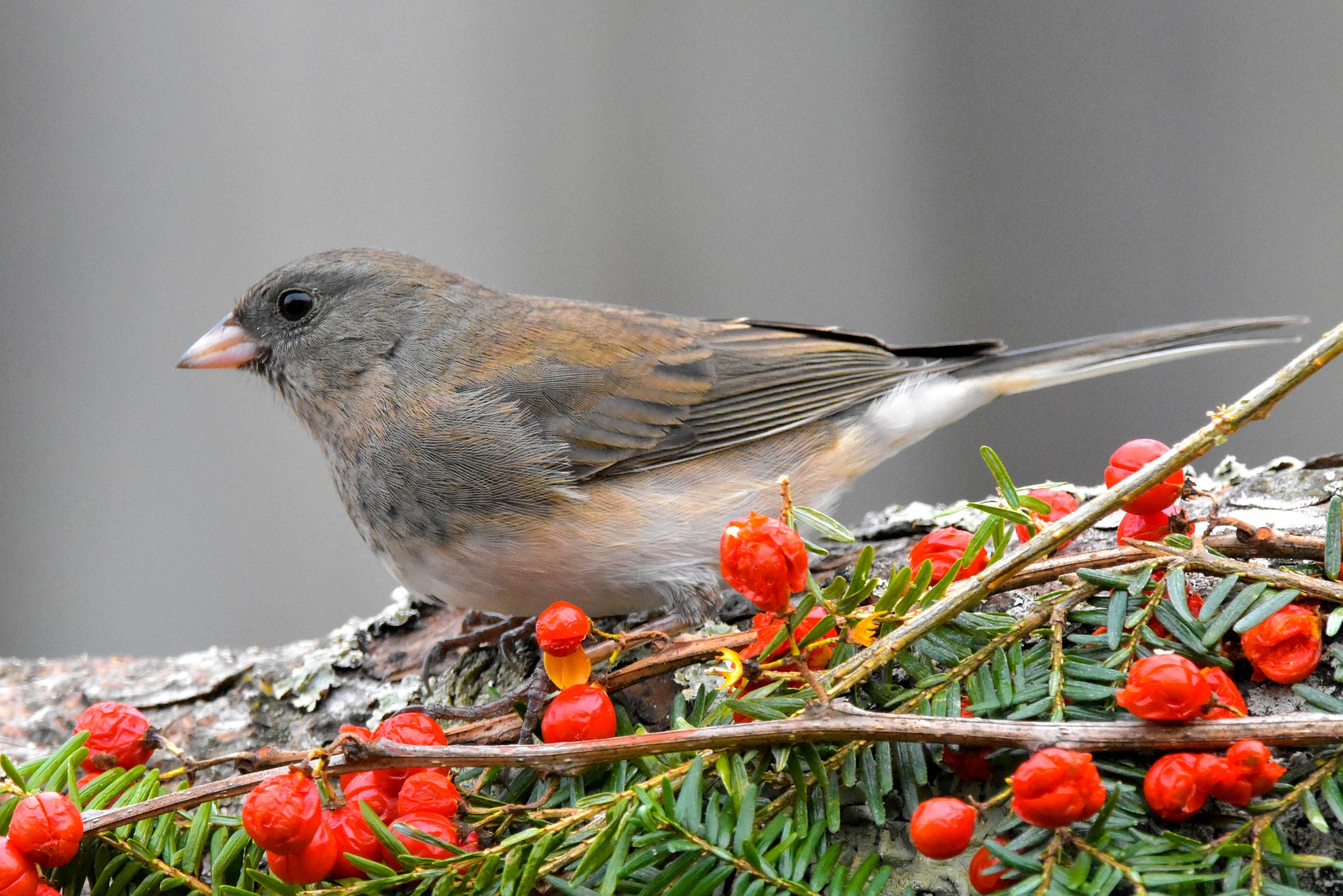
Photo by Jack Bulmer/Pixabay • The dark-eyed junco, or “snow bird” as it’s often known, is a winter visitor to many feeders in the region.

I wrote my first bird column on Sunday, Nov. 5, 1995, which means this weekly column is marking its 27th anniversary this week.

This column has appeared over the last three decades in various newspapers, which I regard as a personal achievement, as well as an accomplishment for our feathered friends. It’s on their behalf that I pen these weekly efforts to promote conservation and good will toward all birds. I have also posted the column as a weekly blog posting since February  2014 at www.ourfinefeatheredfriends.com.

I’ve played detective, helping people identify everything from “rain crows,” or cuckoos, to Muscovy ducks, chukars and double-crested cormorants. I’ve observed unusual birds, including whooping crane, black-necked stilt and clay-colored sparrow, in Northeast Tennessee, Southwest Virginia and Western North Carolina and spotlighted them in these columns.
I still take delight in the kaleidoscopic parade of colorful warblers that pass through the region each spring and fall.

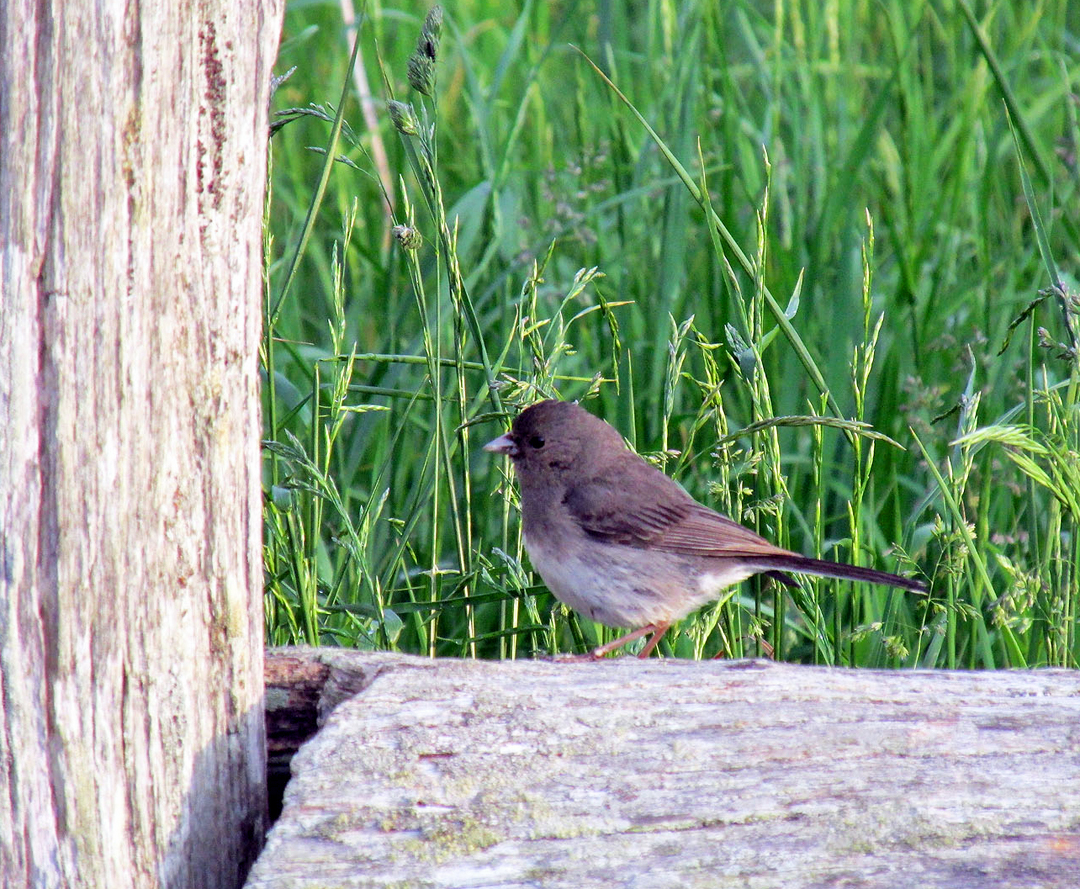
Photo by Bryan Stevens • A dark-eyed Junco visits a hanging feeder.

I’ve covered a lot of terrain in my quest to see birds. I’ve made numerous trips to Musick’s Campground on South Holston Lake in Bristol to see bald eagles, merlins and other raptors, as well as various gulls, terns, shorebirds and waterfowl. I’ve pushed my way through Quarry Bog and Orchard Bog in Shady Valley in Johnson County in pursuit of elusive sparrows, wrens and rails. I’ve visited Winged Deer Park in Johnson City, Sycamore Shoals State Historic Park in Elizabethton and Steele Creek Park in Bristol looking for everything from tanagers, thrushes and terns to avocets and cackling geese.

At my home, I also provide sunflower seed and other supplemental food for the resident birds like Carolina chickadees, white-breasted nuthatches, song sparrows and downy woodpeckers.
Even as I tweak my anniversary column for “Feathered Friends,” the region’s residents have already experienced some heavy frosts and freezes. This prognostication of approaching winter weather is a perfect time to dust off this week’s column, which is a revision of the first bird column I ever wrote. This column focused on a common visitor to yards and feeders during the winter months. In fact, dark-eyed juncos should be returning to the region any day. In fact, I’ve already seen my first dark-eyed junco at home this year.

Here, with some revisions I have made through the years, is that first column.

•••

Of all the birds associated with winter weather, few are as symbolic as the dark-eyed junco, or “snow bird.” The junco occurs in several geographic variations.

John V. Dennis, author of “A Complete Guide to Bird Feeding,” captures the essence of the junco in the following description: “Driving winds and swirling snow do not daunt this plucky bird. The coldest winter days see the junco as lively as ever and with a joie de vivre that bolsters our sagging spirits.” The dark-eyed junco’s scientific name, hyemalis, is New Latin for “wintry,” an apt description of this bird.

Most people look forward to the spring return of some of our brilliant birds — warblers, tanagers and orioles — and I must admit that I also enjoy the arrival of these birds. The junco, in comparison to some of these species, is not in the same league. Nevertheless, the junco is handsome in its slate gray and white plumage, giving rise to the old saying “dark skies above, snow below.”

Just as neotropical migrants make long distance journeys twice a year, the junco is also a migrating species. But in Appalachia, the junco is a special type of migrant. Most people think of birds as “going south for the winter.” In a basic sense this is true. But some juncos do not undertake a long horizontal (the scientific term) migration from north to south. Instead, these birds merely move from high elevations, such as the spruce fir peaks, to the lower elevations. This type of migration is known as vertical migration. Other juncos, such as those that spend their breeding season in northern locales, do make a southern migration and, at times, even mix with the vertical migrants.

During the summer months, a visit to higher elevations mountaintops is almost guaranteed to produce sightings of dark-eyed juncos. Juncos may nest as many as three times in a season. A female junco usually lays three to six eggs for each nest, which she constructs without any assistance from her mate.

Photo by Bryan Stevens • A dark-eyed junco during the summer nesting season at Carver’s Gap on Roan Mountain.

Juncos are usually in residence around my home by early November. Once they make themselves at home I can expect to play host to them until at least late April or early May of the following year. So, for at least six months, the snow bird is one of the most common and delightful feeder visitors a bird enthusiast could want.

Juncos flock to feeders where they are rather mild-mannered — except among themselves. There are definite pecking orders in a junco flock, and females are usually on the lower tiers of the hierarchy. Females can sometimes be distinguished from males because of their paler gray or even brown upper plumage.

Since juncos are primarily ground feeders they tend to shun hanging feeders. But one winter I observed a junco that had mastered perching on a hanging “pine cone” feeder to enjoy a suet and peanut butter mixture.

Dark-eyed juncos often are content to glean the scraps other birds knock to the ground. Juncos are widespread. They visit feeders across North America. The junco is the most common species of bird to visit feeding stations. They will sample a variety of fare, but prefer such seeds as millet, cracked corn or black oil sunflower.

The juncos are a small branch of the sparrow clan. Some of the other juncos include the endangered Guadalupe junco, yellow-eyed junco, Baird’s junco and volcano junco. The last one on the list is endemic to the Talamancan montane forests of Costa Rica and western Panama. Baird’s junco is named for Spencer Fullerton Baird, an American ornithologist and naturalist.
Baird served as secretary  for the Smithsonian Institution from 1878 until  his death in 1887. He greatly expanded the natural history collections of the Smithsonian from 6,000 specimens in 1850 to over two million by the time of his death.

I hope you’ve enjoyed this introduction to juncos. There’s something about winter that makes a junco’s dark and light garb an appropriate and even striking choice, particularly against a backdrop of newly fallen snow.

Of course, the real entertainment from juncos come from their frequent visits to our backyard feeders. When these birds flock to a feeder and began a furious period of eating, I don’t even have to glance skyward or tune in the television weather forecast. I know what they know. Bad weather is on the way!

Photo by Bryan Stevens • A dark-eyed Junco is a common visitor when the weather turns wintry.

Owls haunt the dark of night while flying on silent wings

Photo by Pixabay • A perched Great Horned Owl appears to blend into the structure of a tree’s limbs, offering the nocturnal predator excellent camouflage.

There’s nothing to send shivers traveling along your spine like listening to the haunting hoots of a great horned owl hidden from human eyes by the cloak of darkness. It’s no wonder that owls have also become popular motifs for the celebration of the Halloween holiday. Just remember there’s more to these creatures of the night than perhaps meets the eye. Owls may be our neighbors, but we’ll never truly belong to their world, which must be why they continue to intrigue us.

While human culture has turned owls into beloved creatures, keep in mind these birds are fierce and ferocious predators. For young American crows in their nests, this owl is the stuff of their avian nightmares. It’s no wonder that crows, which no doubt witness their peers taken by the great horned owl as prey when young and helpless, grow up with an abiding hatred of this large nocturnal raptor. Flocks of adult crows form quickly when an owl is discovered at a roost during the daylight hours. With safety in numbers, the crows mercilessly hound and harry such unlucky owls.

Quite often, it does take a crow’s sharp eye to detect a motionless owl at its daytime roost. Great horned owls have a plumage of mottled grays and browns, as well as some white feathers on the chin and throat. This plumage helps them blend into their surroundings. Even when on the move, the great horned owl rarely attracts attention. They can fly in almost perfect silence on their wide wings. I know this from firsthand experience. Back in the early 2000s I visited Orchard Bog in Shady Valley in Johnson County in early spring for a chance to witness the evening display of American woodcocks from the nearby woodlands. While standing with some other birders, I noticed a large shadow moving low over the fields heading toward us. As the bird got closer, it became recognizable as a great horned owl. The owl barely diverted from its flight. In fact, it flew just over our heads, gliding silently on wide wings. I still marvel at how the owl’s wings made no noise whatsoever. The owl continued to glide over the fields until we lost it in the dusk. 

Photo by Alexas-Fotos/Pixabay • A great horned owl is capable of almost silent flight, which helps the predatory bird take prey by surprise. Many myths and superstitions surround the world’s owls, but the truth about owls is often more fascinating.

On another occasion I also witnessed how, when they want to do so, great horned owls can be absolutely silent. While vacationing on Fripp Island, South Carolina, in the 1990s, I would accompany my family members on dusk gold cart excursions. We liked to pull off the side of the road on a causeway that crossed a series of tidal creeks and marsh. On that occasion, a great horned owl flew from nearby woodlands to land on a gnarled snag that rose above the marshland vegetation. Although the owl arrived on silent wings, it soon interrupted the silence with resonant hoots that carried over the marshes. The owl returned to the same snag for two additional evenings during our vacation stay.

I’ve seen other great horned owl over the years in locations from South Carolina and Florida to Utah and Tennessee. I’ve heard many more of these large owls than I have ever been able to get into focus in my binoculars.

Here are a few other interesting facts about the great horned owl:

• This owl is one of the few predators that preys regularly on skunks. Lacking a well-defined sense of smell, owls aren’t bothered in the least by the skunk’s powerful arsenal of stink.

• A wild great horned owl’s longevity peaks at around 13 years of age. Captive owls have been reported reach ages of more than 30 years old.

• Various Native American tribes have held owls in high respect. Dwight G. Smith, author of Great Horned Owl, a book in the Wild Bird Guides series, noted that members of the Zuni tribe of the southwestern United States often hold owl feathers in their mouths to impart the owl’s ability to hunt silently onto their own hunting abilities.

• Great horned owls will eat other birds. They will eat other predatory birds, as well, including ospreys, peregrine falcon and various hawks. The smaller barred owl knows to stay out of their way, too.

• The David Lynch drama “Twin Peaks,” which ran originally on ABC from April of 1990 to June of 1991, spent considerable time dwelling on the mystery that “the owls are not what they seem.” Footage of great horned owls provided a sinister, mysterious mood that fascinated viewers. The series was resurrected in 2017 on Showtime. Alas, although owls returned in the revival of the series, fans still really don’t know the truth about the owls and their importance to the fictional town of Twin Peaks.

• The Celtic people believed that owls knew the paths that led into the underworld. Perhaps that is how owls became regarded as messengers capable of crossing realms. Many Native American tribes have stories about owls delivering messages from the supernatural spirit world to our own reality. 

I align with the cultures that regard an owl as an omen of good fortune. Any time you get a chance to observe an owl, it’s a good thing. It’s not often we get to glimpse these fascinating birds as they emerge from the shadows. Celebrate any opportunity.

•••

As always, email me at ahoodedwarbler@aol.com to share observations, make comments, or ask questions.
Region’s 53rd Fall Bird Count tallies one-day total of 125 species

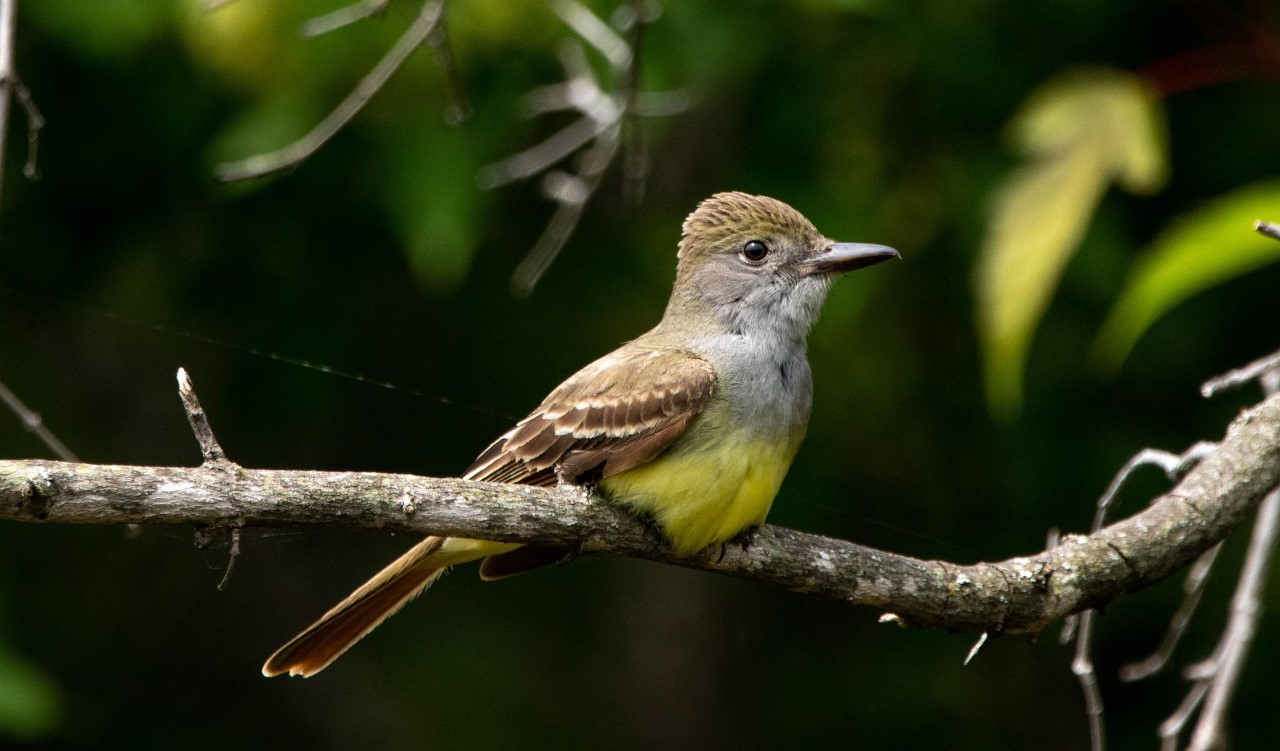
Photo by Image by simardfrancois/Pixabay • A single great crested flycatcher was tallied during this year’s Fall Bird Count conducted by members and friends of the Elizabethton Bird Club.

The 53rd consecutive Elizabethton Fall Count was held Saturday, Sept. 24, conducted by 26 observers in nine parties. The weather was cool and cloudy, with scattered light showers in most areas. Counters covered parts of Carter County and territory in the adjacent counties of Johnson, Sullivan, Unicoi and Washington.

According to long-time count compiler Rick Knight, participants tallied 125 species, which is exactly the average of the last 30 years.

The all-time high for the count was 137 species in 1993. Conversely, the lowest total in the last 30 years was 102 species in 1999.

Along with Rob Armistead, I counted birds around Sycamore Shoals State Historic Park and the linear walking trail along the Watauga River in Elizabethton.
The highlights of our morning included good looks at a male prairie warbler and some common mergansers on the river.

The list:
Canada goose, 881; wood duck, 50; blue-winged teal, 3; mallard, 195; American black duck, 1; and common merganser, 6.

Northern bobwhite, 6; wild turkey, 50; and pied-billed grebe, 1.

Rock pigeon, 477; Eurasian collared-dove, 8; mourning dove, 248; yellow-billed cuckoo, 3; common nighthawk, 1; chimney swift, 91; and ruby-throated hummingbird; 18.

Virginia rail, 2; sora, 1; killdeer, 12; semipalmated sandpiper, 1; and wilson’s snipe, 1.

Double-crested cormorant, 30; great blue heron, 25; great egret, 5; and green heron, 4, Black vulture, 43; turkey vulture, 82; osprey, 8; Northern harrier, 1; sharp-shinned hawk, 1; Cooper’s hawk, 5; bald eagle, 4; red-shouldered hawk, 7; and red-tailed hawk, 9.

Eastern screech-owl, 19; great horned owl, 7; barred owl, 4; belted kingfisher, 25; red-headed woodpecker, 8; Red-bellied woodpecker, 69; yellow-bellied sapsucker, 2; downy woodpecker, 32; hairy woodpecker, 24; Northern flicker, 50; and pileated woodpecker, 29.

American kestrel, 24; merlin, 1; and peregrine falcon, 2.

Great crested flycatcher, 1; Eastern wood-pewee, 12; Acadian flycatcher, 1; Empidonax species, 1; Eastern phoebe, 93; White-eyed vireo, 4; yellow-throated vireo, 3; blue-headed vireo, 15; and red-eyed vireo 11.

Blue jay, 415; American crow, 436; fish crow, 2; common raven, 11; tree swallow, 130; and barn swallow , 6.

Carolina chickadee, 167; tufted titmouse, 136; red-breasted nuthatch, 7; white-breasted nuthatch, 51; house wren, 9; winter wren, 1; marsh wren, 1; Carolina wren, 157; blue-gray gnatcatcher, 1; golden-crowned kinglet, 4; and ruby-crowned kinglet, 3.

Veery, 2; gray-cheeked thrush, 5; Swainson’s thrush, 85; American robin, 271; gray catbird, 37; brown thrasher, 9; Northern mockingbird, 69; and European starling, 453.

Cedar waxwing, 225; house sparrow, 28; house finch, 52; red crossbill, 2; and American goldfinch, 145.

Chipping sparrow, 72; field sparrow, 19; dark-eyed junco, 17; song sparrow, 83; Eastern towhee, 59; Eastern meadowlark, 17; and red-winged blackbird, 67.

Ovenbird, 4; worm-eating warbler, 1; Northern waterthrush, 2; black-and-white warbler, 13; Tennessee warbler, 57; Orange-crowned warbler, 1; Nashville warbler, 3; Common yellowthroat, 15; hooded warbler, 4; American redstart, 34; Cape May warbler, 18; Northern parula, 10; Magnolia warbler, 25; bay-breasted warbler, 16; Blackburnian warbler, 11; chestnut-sided warbler, 5; black-throated blue warbler, 15; palm warbler, 96; pine warbler, 6; Yellow-rumped warbler, 5; yellow-throated warbler, 1; Prairie warbler, 2; black-throated green warbler, 17; and Canada warbler, 1.

Summer tanager, 1; scarlet tanager, 14; rose-breasted grosbeak, 65; blue grosbeak, 2; and indigo bunting, 5.

Some notable misses, according to Knight, were ruffed grouse, broad-winged hawk, brown creeper, common grackle and brown-headed cowbird.

“Many thanks to all participants for another good count,” Knight remarked when posting the summary of the 2022 Fall Bird Count.

•••

To share a sighting, ask a question or make a comment, email me at ahoodedwarbler@aol.com.

Bristol park’s Wildlife Weekend returns Oct. 7-8 to celebrate 25th anniversary

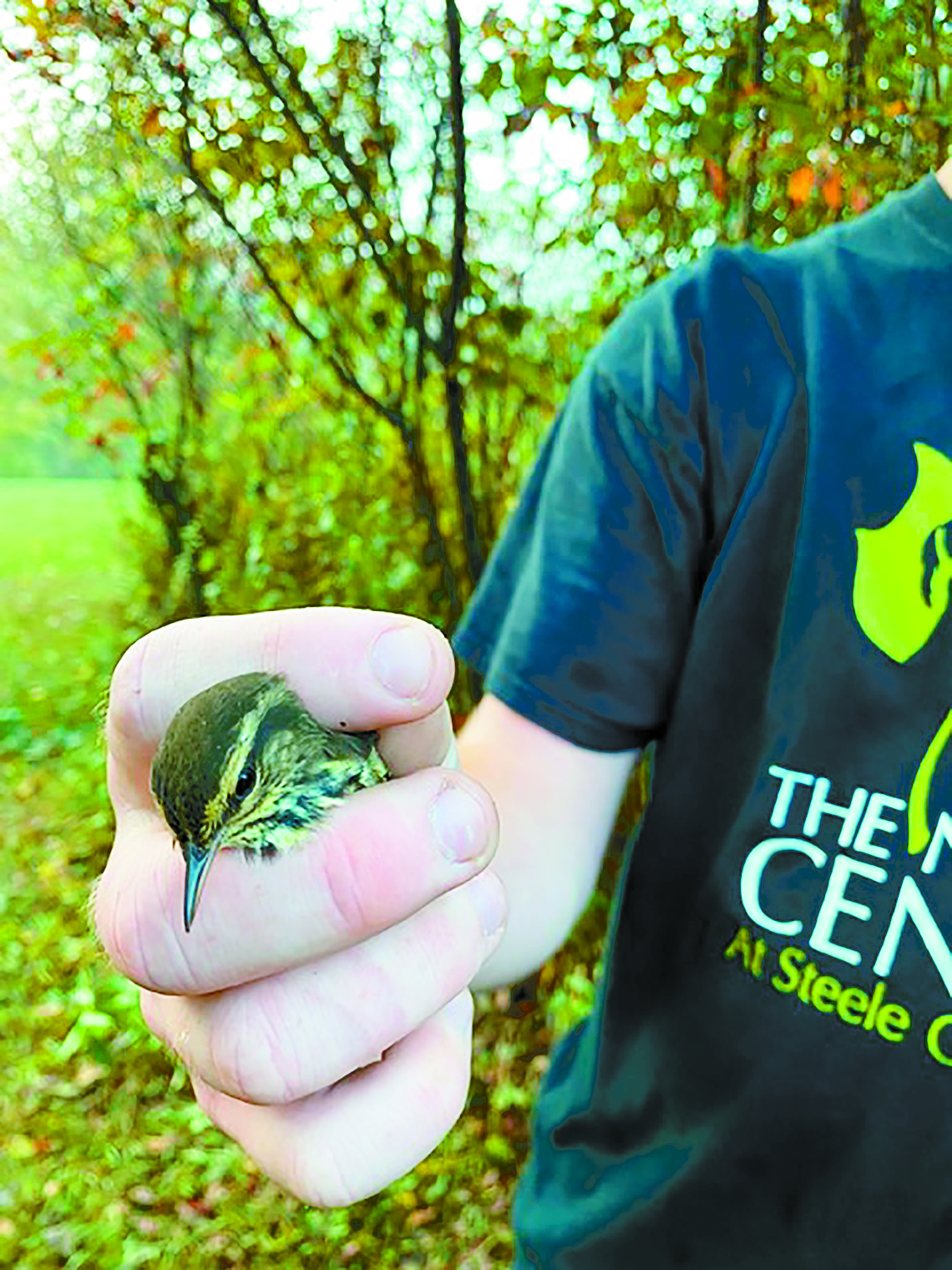
Contributed Photo by Michele Sparks • A Northern waterthrush is secured in a bander’s hand at a bird banding station operated at a previous Wildlife Weekend. Bird banders Richard Lewis and Rack Cross will also conduct a bird banding operation at this year’s Wildlife Weekend at Steele Creek Park in Brisol on Saturday, Oct. 8.

Members of the Friends of Steele Creek Nature Center and Park in Bristol are getting ready to observe a milestone in their yearly staging of Wildlife Weekend on Friday and Saturday, Oct. 7-8.

This year’s event, which will feature the theme “Plants and Pollinators,” will mark the 25th anniversary of the yearly celebration of wildlife in it many forms.

Birds will certainly be part of the mix, as will reptiles and honeybees, not to mention insects, spiders and more. Bird-specific activities scheduled for Oct. 8 include an Early Bird Walk, which will be conducted at 9 a.m. by Bristol Bird Club member Larry McDaniel, as well as a bird banding station located at the thicket near the Civitan Pavilion. Banding will get underway at 9:30 a.m. with longtime bird banders Richard Lewis and Rack Cross on site to introduce bird banding and its value to science to those attending this event.

If you’ve never observed bird banding, I would encourage you to attend this event. Banders receive training and are licensed by the federal government. These sessions also provide an opportunity to observe birds in a way that differs greatly from peering at them through binoculars. Of course, it’s rather hit or miss on what birds might show up in the nets used to capture the birds. Some of the expected birds that may be caught and banded include warblers, sparrows, thrushes, grosbeaks and other songbirds.

Other Saturday activities will include a walk at 10 a.m. to look for spiders and insects with naturalist Cade Campbell, and the two-hour Commander’s Morning Hike. The latter is a guided hike to the highest point in Steele Creek Park.

On Saturday afternoon, another Commander’s Hike will be offered with a different focus: this three-hour hike, which starts at 1 p.m., will give participants a chance to visit the oldest tree within the park.

Other afternoon walks, focused on honeybees, reptiles and mushrooms, will be led by Jeremy Stout, Lance Jessee and Mike Martin respectively. The mushroom walk commences at 1 p.m. The honeybee walk begins at 2 p.m., and the reptile walk will start at 3 p.m.

The popular Wildlife Weekend Passport is back. This scavenger hunt can be played via a downloadable Goosechase app or with a traditional printed hole punch version. Completed passports must be returned to the registration table by 4 p.m. to be eligible for prizes.

Saturday will also offer a variety of interactive exhibits and information tables, both at The Lodge and Nature Center’s lakeside porch from 10 a.m. to 4 p.m. Themes for some of the kiosks will include fossil casting, rocks and minerals, and skins and skulls. 

Wes Walker, who has helped organize the events for Wildlife Weekend, noted that Saturday’s events will also be documented by a local photography group.

“We should be having the Eastman Camera Club on-site that day, “Walker said. “This club, comprised of both amateur and professional photographers, captures various events across the Tri-Cites area.”

Walker touted Wildlife Weekend as a chance to learn more about Steele Creek Park, which is a gem featuring more than 2,000 acres in the middle of Bristol. 

“Most folks are aware of the ‘park’ area, but that only encompasses a fraction of the entire park,” Walker said. “Wildlife Weekend is an opportunity for individuals and families to explore this local treasure, and learn about the natural wonders from local experts.” 

The numerous interactive activities range from crafts, to several-mile hikes. Wildlife Weekend also serves as an excellent way to introduce children to the wonders of nature, as well as a knowledge supplementation for more experienced nature enthusiasts. 

The Bristol Bird Club will operate a kiosk offering information on the region’s varied birds. In addition, members of the Washington County Master Gardeners program will host a kiosk adjacent to their pollinator garden next to the Nature Center’s lakeside porch. The Campbells (Tracy, Cade and Chloe) will offer a family crafts kiosk featuring crafts for making “Critter Keepers” and “Mosaic Magnets.” Megan and David Christian will operate an owl pellet kiosk. By dissecting the pellets, participants can get a hint at the varied diets of owls residing in the park. 

The 25th Wildlife Weekend kicks off on Friday, Oct. 6, with an opening reception at 6 p.m. in the Steele Creek park Nature Center. After a brief overview of the history of Wildlife Weekend, keynote speaker Gerardo Arceo-Gomez will present a program titled “Pollination in Action: Fantastic Bees and Where to Find Them.” Friday’s activities will conclude with an awards ceremony for the 2022 Wildlife Weekend Amateur Photography Contest. 

For more information on the 25th annual Wildlife Weekend, visit http://www.friendsofsteelecreek.org. 


Birding the Big Apple

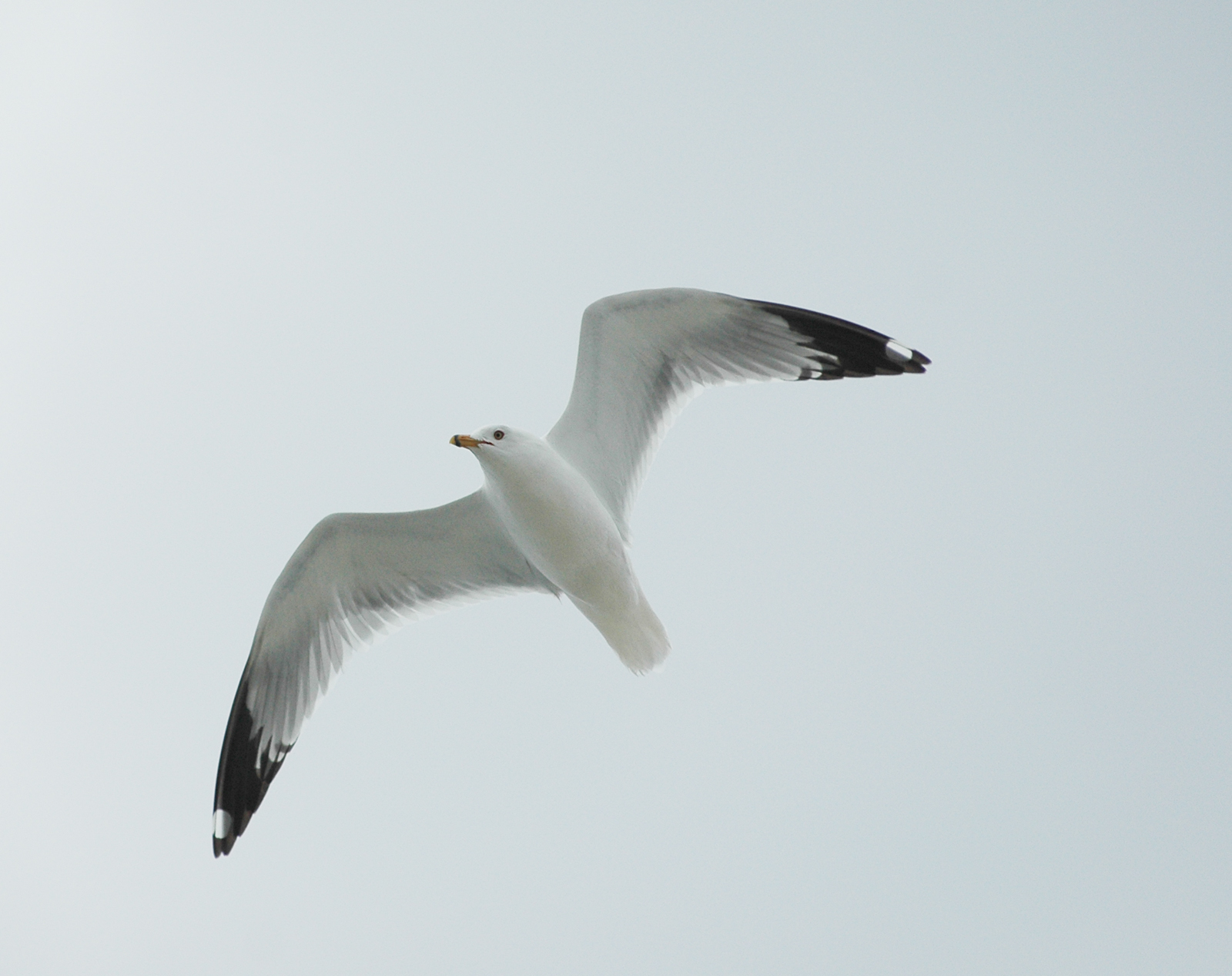
Photo by Bryan Stevens • A Ring-billed Gull in flight. Several of these gulls were seen during my 2002 trip to New York City.

We’re observing 9-11 today, so I thought I’d pull out a post on my birding experiences during my one and only trip to New York City back in July of 2002. I visited not quite a year after the 9-11 attacks. I did visit Ground Zero. The shells of neighboring buildings adjacent to the fallen Towers remained standing and the construction of the memorial at the site was still far in the future.

I wrote this column about my birding experiences in the “Big Apple” for the Herald & Tribune of Jonesborough in July of 2002. It won me a second-place Tennessee Press Association award for “Best Personal Column” the following year.

••••••••

During a recent trip to New York City, mainly for the purpose of visiting friends and seeing the sights, I also availed myself of the opportunity of trying to see a few birds in the Big Apple.

At first glance, New York City doesn’t seem a haven for birds or any other sort of wildlife. Without any serious effort on my part, however, I managed to see 15 different species of birds. My tour guide and friend, David, remained courteous enough to indulge my occasional lapses into birding. David, perhaps like many New Yorkers, is familiar on a daily basis with the Big Apple’s three most prominent members of the bird family — the House Sparrow, the European Starling and the Rock Dove, or pigeon.

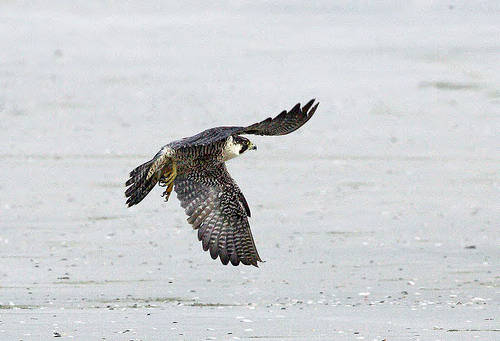
Photo by U.S. FWS • New York’s pigeons no longer find the city a safe haven with the arrival of more peregrine falcon’s as the raptor’s numbers continue to rebound.

Everyone who has visited a city park, whether in Jonesborough or New York City, is probably familiar with the Rock Dove. Commonly called pigeon, the Rock Dove is not a native American bird. But their introduction to this continent paralleled the arrival of European colonists. Pigeons came to this country along with other farmyard animals, such as cattle and sheep. But, once here, the Rock Dove, which is a wild bird in Africa and in the Mediterranean, also managed to establish itself outside the farmyard. Nevertheless, more than most other birds, the Rock Dove still only thrives in the company of humans. In New York City, pigeons are a part of the landscape. They are everywhere! As a result, these birds can cause some problems. Their droppings can damage buildings and statues. They can also spread various diseases to humans. Efforts have been made to curb their numbers, but the pigeon looks to be a permanent part of the New York City landscape.

It’s no longer a paradise for pigeons in the Big Apple, however. The Peregrine Falcon, once endangered, has rebounded with protection from the government. The skyscrapers of New York City have replaced cliff faces as nesting sites for these sleek, aerodynamic predators. While I wasn’t fortunate enough to see a Peregrine Falcon while in New York City, they are there. Their presence has put some balance back into the food chain. The pigeons now have a natural predator.

Earlier this summer, David called me looking for advice about a problem with birds. Seems that a pair of House Sparrows had built a nest beneath his air conditioning unit at his apartment. The problem involved timing. David recently moved to a new apartment and he needed to take the air conditioner with him. In the end, David’s need for the air conditioner outpaced the nesting progress of the sparrows. Now, he’s convinced that the sparrows, like the gulls, are out to get him. More about the gulls later.

The House Sparrow is an non-native species introduced to the United States. The House Sparrow was released intentionally in the United States in the 1850s at different points between New York and New England. Other introductions of this species occurred at other points in the United States. The introductions were huge mistakes. By 1910, the House Sparrow had invaded the entire continent. The House Sparrow is also an aggressive bird. Soon, the House Sparrow came into conflict with a beloved American favorite, the Eastern Bluebird. The major competition between Eastern Bluebirds and House Sparrows is for nesting cavities. House Sparrows have the tenacity to evict even the larger Easter Bluebirds from occupied nests. Occasionally, the sparrows even kill nestling or adult bluebirds. I found the House Sparrow almost as numerous as Rock Doves in most areas of New York City.

But, there was still a third common bird — the European Starling. I encountered the first starlings of my trip in New York City’s famous Central Park. Ironically, Central Park is where the European Starling, now considered the most numerous bird in North America, got its start. The Rock Dove and House Sparrow got here first, but the European Starling didn’t waste any time once the first starlings were released in 1890. The first European Starlings were released at that time in Central Park because some fans of William Shakespeare wanted to release all the birds mentioned in The Bard’s plays. Apparently, only the release of the European Starling had any lasting consequence. Even today, starlings and Shakespeare are very much associated with Central Park. During the summer there is a popular Shakespeare festival held in Central Park. And, on any summer day, there will always be plenty of starlings in the park.

Those were three of the 15 birds I managed to observe on my trip. The remaining 12 species comprised a diverse and at times surprising list. I found American Robins, American Crow, Blue Jay, Chimney Swift, Carolina Wren and Downy Woodpecker within Central Park. In addition, at a large pond within the park I also observed a Green Heron and Mallards. The Robins, in particular, appeared as they would in any park setting. They hopped about on grassy lawns while foraging for food. David told me he recently saw a Roadrunner in the park. I told him that would be an extraordinary discovery since that bird is native to the western United States.

There’s a lot of water in and around New York City. Perhaps it isn’t a surprise to discover birds such as Double-crested Cormorants swimming in the East River. I also saw plenty of gulls. In fact, I saw three different species of gulls — Herring Gulls, Ring-billed Gulls and Laughing Gulls.

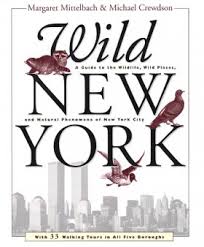
Surprisingly, gulls haven’t always been common in the vicinity of New York City. According to the book Wild New York: A Guide to the Wildlife, Wild Places and Natural Phenomena of New York City by Margaret Mittelbach and Michael Crewdon, gulls did not frequent New York City 100 years ago. Now, there are as many as one million gulls in New York City. The book also mentions one of the attractions: Staten Island’s Fresh Kills Landfill, the largest garbage dump in the world.

The cover of the book Wild New York: A Guide to the Wildlife, Wild Places and Natural Phenomena of New York City by Margaret Mittelbach and Michael Crewdon

My friend David considers gulls evil omens. I tried to do some research into the role of gulls in folklore. I turned to the book by Laura C. Martin titled The Folklore of Birds. Her entry on gulls proved sketchy. Here’s some of what I learned. The word “gull” comes from a Welsh word, “gwylan,” which can be translated as “wailing.” The term “gull” apparently derived from the bird’s wailing or plaintive call. The Latin genus name, Larus, for gull is translated as “ravenous seabird.” So, that leaves us with a ravenous, wailing seabird. Apt descriptions, but not exactly a rich folklore. Birds such as crows and the various species of owls have much more ominous superstitions surrounding them.

••••••••

New York City has a “New York Rare Bird Alert.” If you would like to know what rare birds are being seen in New York City, dial (212) 979-3070. I dialed the number during my visit and received information about excitement regarding large flocks of migrating shorebirds, a Common Raven and nesting Blue Grosbeaks.

(NOTE: The number is still in use. So, if you’re planning any New York visits and would like to bird, the phone number is still valid.)

••••••••

My friend David now lives in Baltimore. I haven’t visited him there, but he has visited me in the mountains near Asheville, N.C. I’d like to thank him again for my taste of the Big Apple.

••••••••

I’d still love to hear from readers. Just post your thoughts here or email me at ahoodedwarbler@aol.com. Keep up with me on Facebook, too.

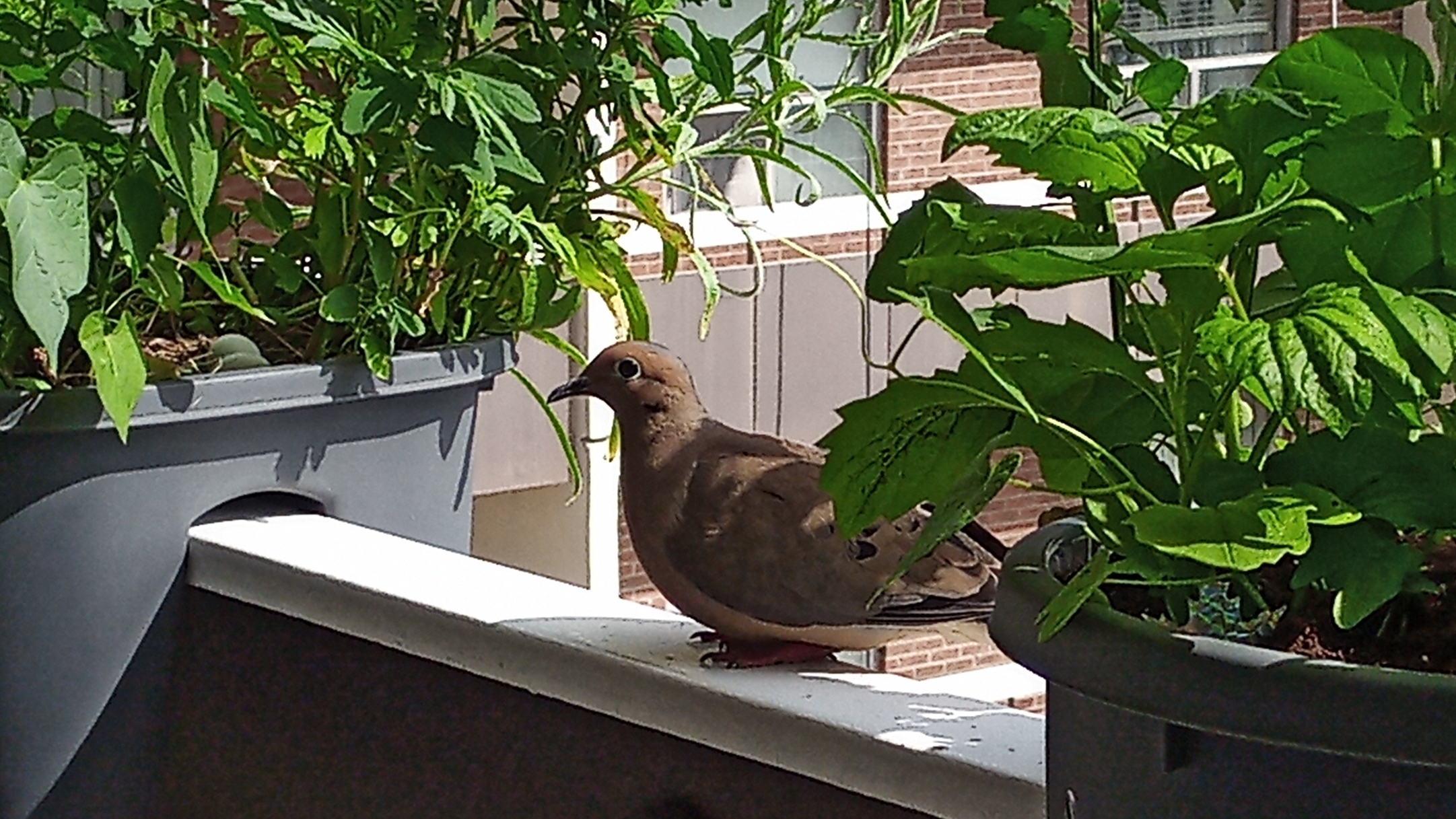
High-rise doves: Pair nests twice on apartment balcony

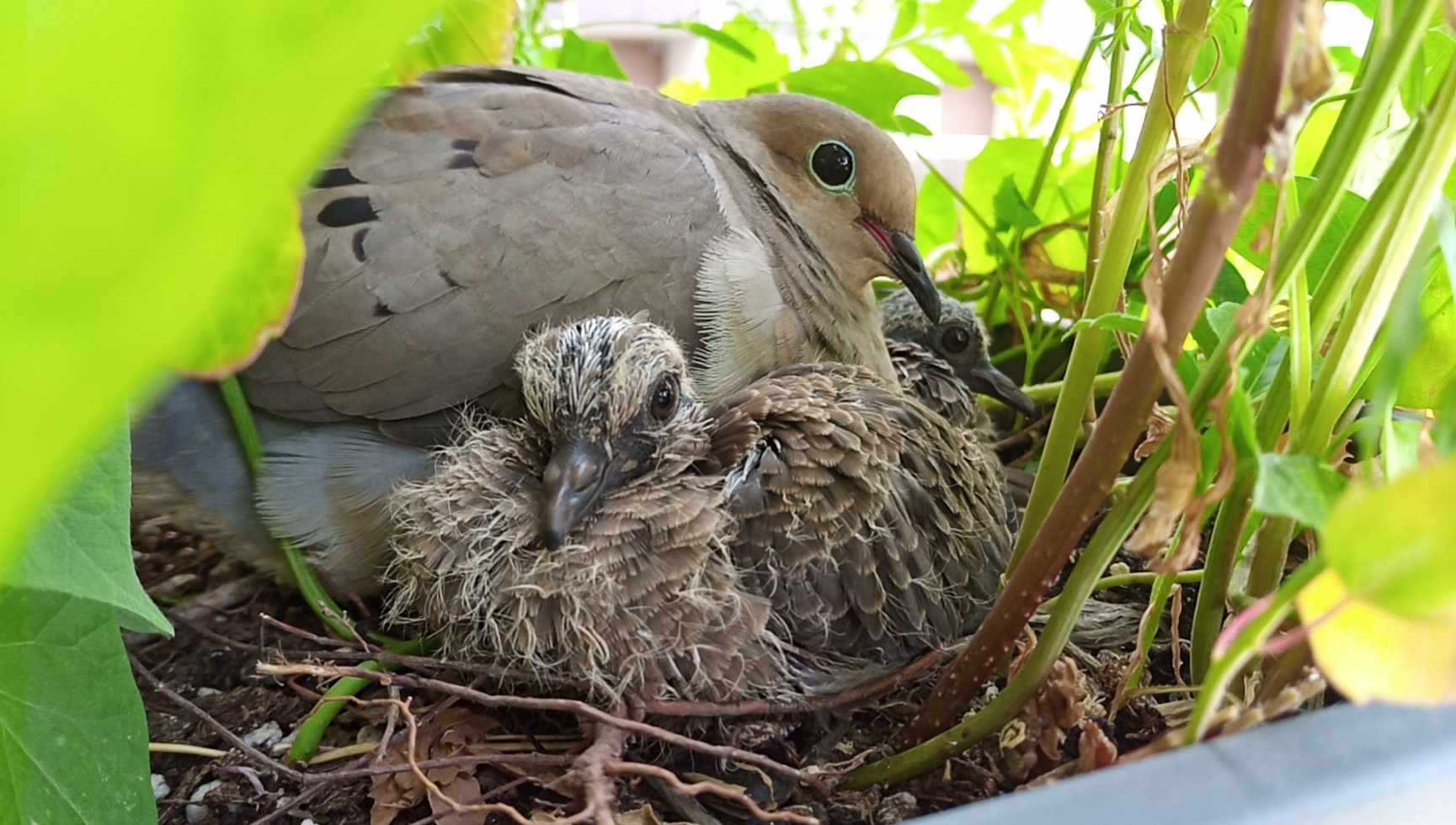
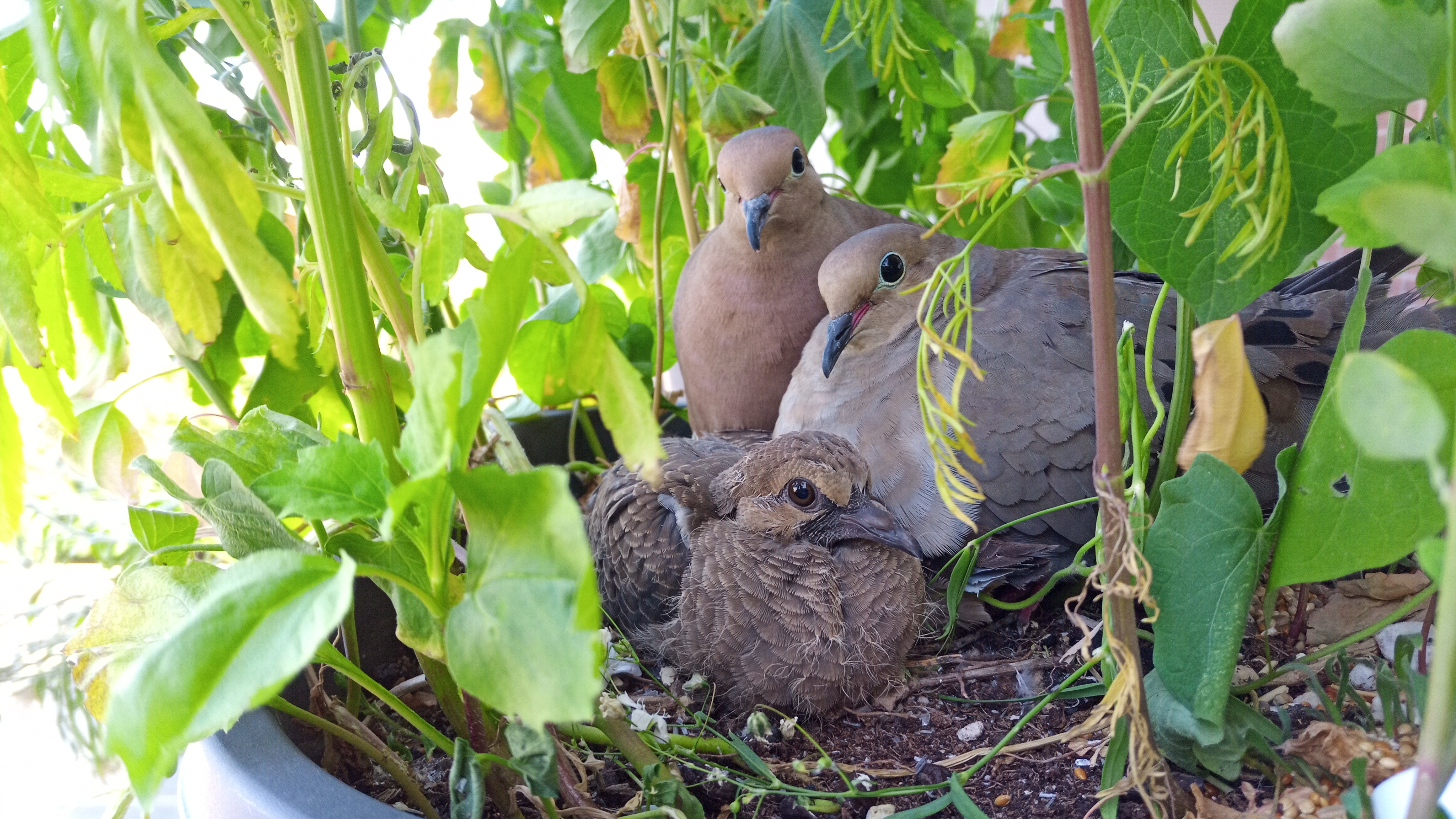
Photo Courtesy of Rob Hicks • One of the parent doves checks on the two young in the nest.

In late July, I wrote about a couple of mourning doves nesting on a front porch column at the home of Star and Tim Barto in Telford, Tennessee.

Star sent another email recently to notify me that the doves are back, undertaking a fourth nesting for the year.

“Just had to share the amazing news — the doves are back on the porch column for the fourth time this year,” she wrote. “So exciting!  After three events this year, I was sure it would be next spring before their return. So glad to be wrong about that.”

Not only did I hear from Star about their nesting doves in Telford, I heard from a reader a little farther afield about a pair of mourning doves that have taken things to a higher level, literally.

Rob Hicks, a resident of Burlington in Ontario, Canada, informed me of an interesting nesting of mourning doves that have taken a liking to his apartment balcony.

Photo Courtesy of Rob Hicks • A view from the balcony where the mourning doves nested.

“I first noticed one (and then both) doves on my balcony railing up on the eighth floor when I was looking at the planters I have out there,” Rob explained in a Facebook message.

He said that the doves would hop around in each potted plant, look around and  then move to the next.  

“I assumed they were looking to set up a nest, but I knew that the balcony repairmen were going to be arriving in a few week,” Rob said.

In case the nesting conflicted with the mandatory maintenance, Rob tried to discourage the birds from setting up their nest.   

“I went out and got some decorative plastic picks and stuck them in the planters, hoping the birds would avoid them, but the following day I noticed the start of a nest in one planter,” he said.

Not only that, but the birds had pulled out the plastic picks. So much for his effort to deter the nesting birds.

The following day he noticed that the nest contained two eggs.

Photo Courtesy of Rob Hicks • The two parent doves stand guard over a nestling.

Presented with a fait accompli, Rob decided to enjoy the rare opportunity of watching the high-rise nesting birds.

“The parents took turns with the eggs for the next two weeks until they hatched,” he wrote. “I noticed the chicks were growing very quickly, and a few times each day I’d notice one of the parents coming back to the nest to feed them.”

After the squabs (the name for young doves) had grown, the parents stopped sitting with them and would only come back a few times a day to feed them.

“The chicks would be flexing their wings and flapping them, so I assumed they’d be flying out soon,” he added. 

He noticed that one of the young doves made its first flight from the planter to an adjacent planter on the railing.  

“The bird then managed to fly down off the balcony towards a clump of nearby trees, where I had seen the parents flying in and out of recently,” Rob wrote.

The other young dove was a little less confident in its abilities and waited two additional days before it finally left the nest.

“Over the next couple of days I saw them (at least one adult and one of the chicks each time) perched on the roof of the building,” he wrote.

Photo Courtesy of Rob Hicks • One of the doves returns for a visit.

He also watched them fly back to the same stand of trees, so he said he assumed the adults were still helping them learn to fly better or perhaps teaching them how to find food. 

Right on schedule, the maintenance workers arrived and he had to clear the plants off his balcony.   

“I moved them to a neighbor’s balcony,” he wrote.

About 10 days later, after his balcony had been repaired, he went to collect his plants from his neighbor’s balcony.

Readers will probably guess what happened next.

“I found the doves had not only found the same plants again on the neighbor’s balcony, but they had already put a nest in the planter and laid  eggs again,” Rob wrote.

Rob reported that four weeks and one day after they laid the second batch of eggs, the last chick in that brood also successfully flew out of the nest.

“Since they raised two broods successfully in those plants this year — so far —  I’m more than happy to welcome them back again if they want to try another nest in them,” he wrote.

Back in 2014, Rob also wrote to tell me about a brown creeper that crashed into his balcony. That story, too, had a happy ending. Although the bird was definitely stunned, it recovered and flew to nearby trees after a short rest.

So, we’re ready to turn the calendar to September and I’m still writing columns about nesting birds. I love it!

To share a bird-related story, make a comment or ask a question, email me at ahoodedwarbler@aol.com.