Tag Archives: Birding

Monk Parakeets tend to choose unexpected locations to call home


7ea3e69a4d6991ee264939d8481cfbb0

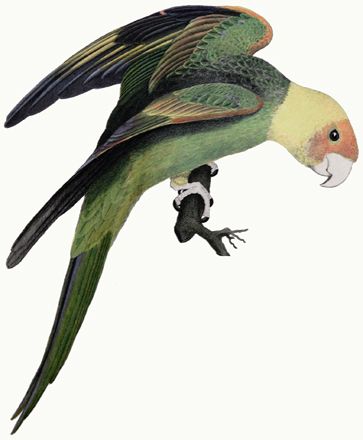
A painting of the now-extinct Carolina Parakeet by early naturalist Alexander Wilson.

What do birders miss when they look back on some of the avian potential lost before Americans became more protective of their wildlife? Obviously, we lament the loss of birds like the ivory-billed woodpecker or the great auk. Losses of bird life in the Hawaiian islands have been staggering. We also lost tiny birds — dusky seaside sparrow and Bachman’s warbler — that would have gone unnoticed by most people.

I’m confident we mourn the loss of some of the most abundant birds to ever roam the continent. One such bird was the now-extinct Carolina parakeet. Many people don’t realize that North America was once home to its own species of parakeet. A few individuals — all that remained of once massive flocks of colorful, noisy native parakeets — made it into the 20th century. The last specimen died in the Cincinnati Zoo on Feb. 21, 1918. Although not declared officially extinct until 1939, the population of the Carolina parakeets crashed suddenly and for reasons still not fully understood.
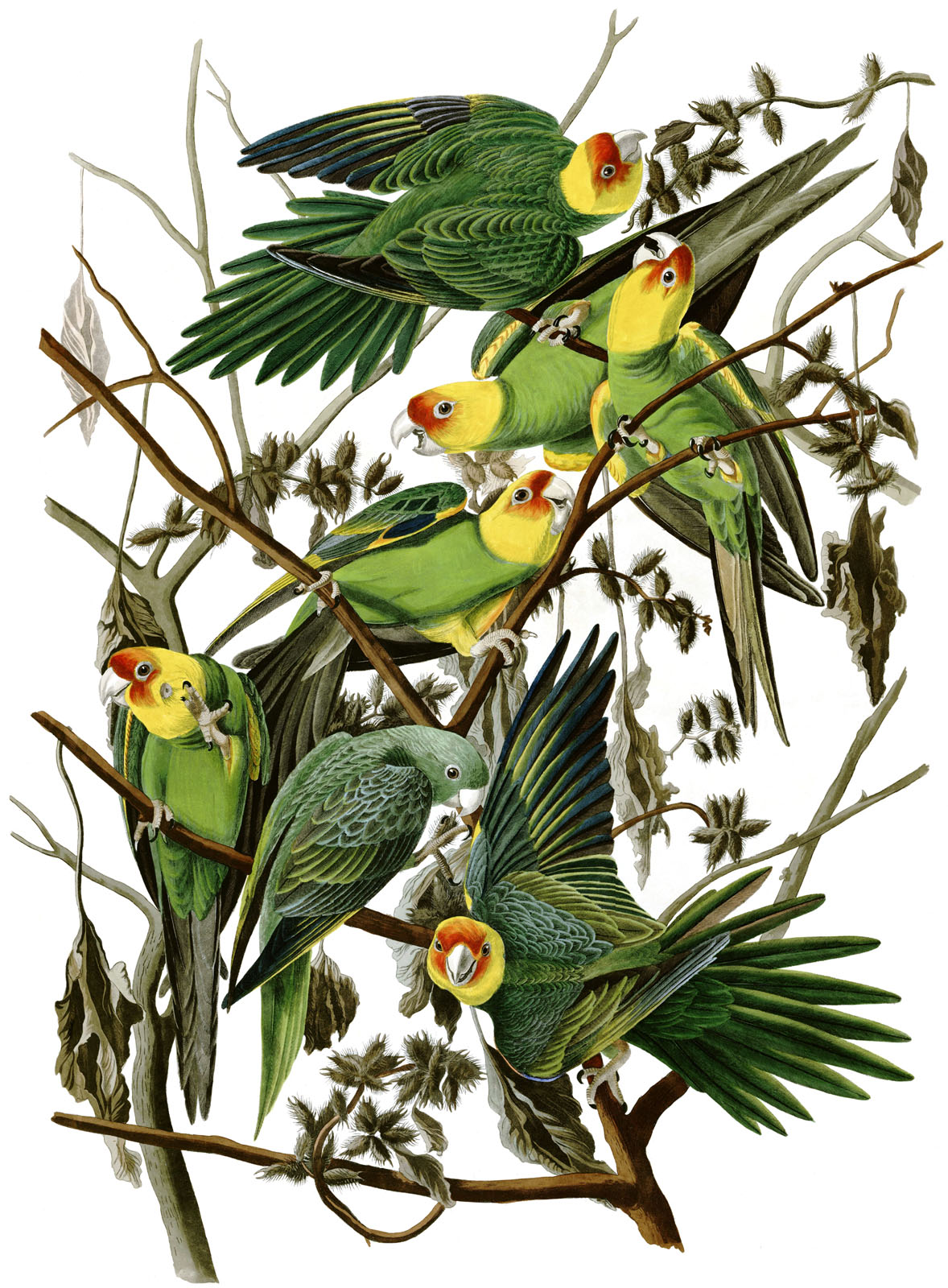
Carolina parakeet, eastern subspecies, Audubon

Early American naturalist and artist John James Audubon painted this flock of Carolina Parakeets.

For instance, large flocks of these birds still flew free until the final years of the 1800s, but in the first decade of the 1900s, these flocks disappeared. The survivor at the zoo was named Incas, and this male Carolina parakeet died a year after his mate, who had been named Lady Jane by the zoo’s staff.

The only other native parrot — the thick-billed parrot of the American southwest — no longer flies north of the Mexican border. An attempt to re-introduce this parrot to Arizona in the 1980s ended in disappointing failure.

To look for parrots in the United States, one usually needs to travel to Florida. The Sunshine State has become a place to find exotic wildlife, from pythons to caymans, as well as a multitude of unusual birds that have escaped from captivity and now find the warm climate of Florida suitable for a feral existence.
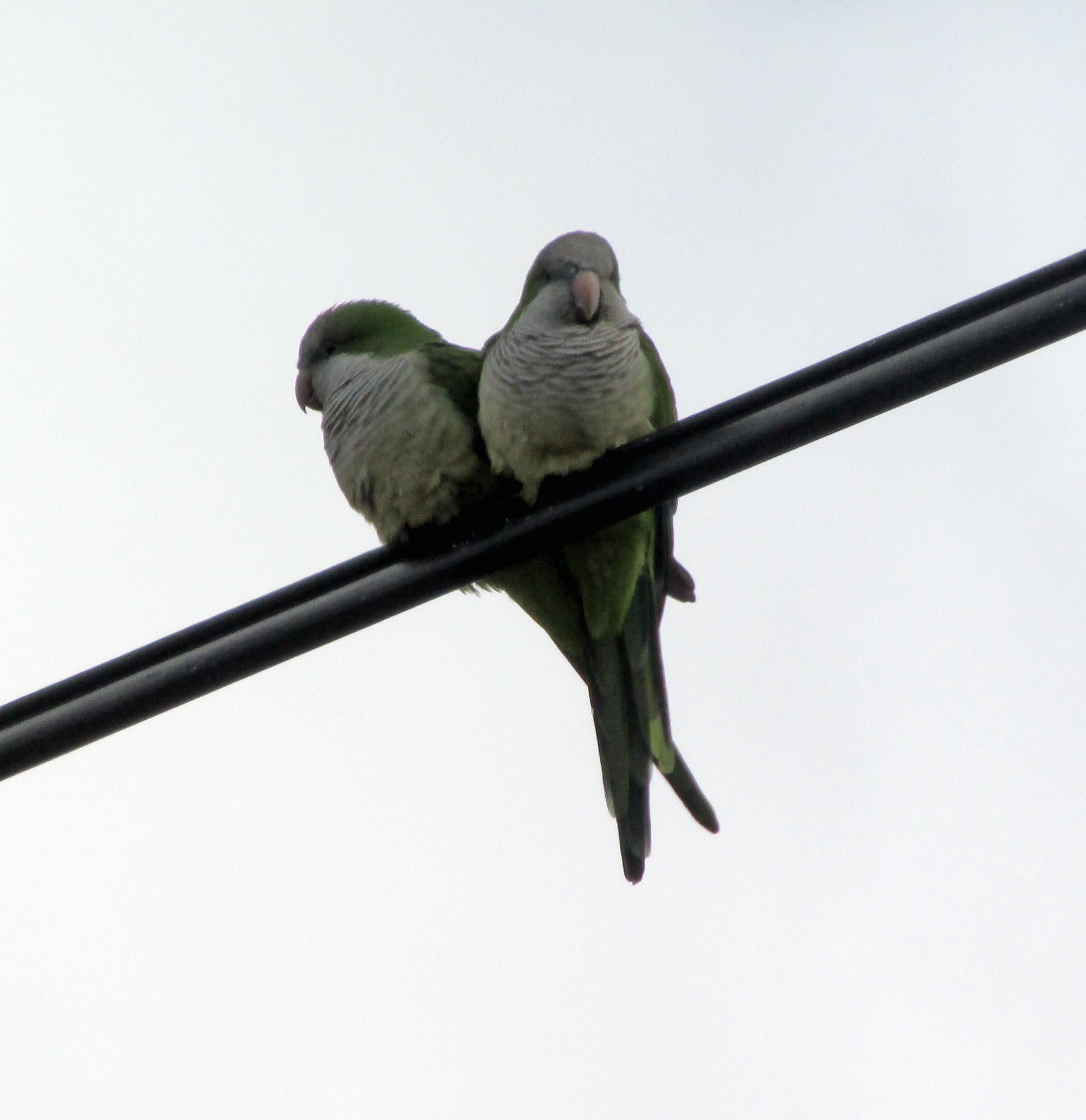
MonkParakeet-Three

Photo by Bryan Stevens                                      This pair of Monk Parakeets has been making a home at an electrical substation in Newland, N.C.

When it comes to parrots, however, there is one species, perhaps tougher than its kin, that has expanded its range across the country. Called the monk parakeet (or quaker parakeet in the pet trade) this bird is not a native species, but it has proved tenacious in making itself at home in such far-flung locations as Delaware and Michigan, as well as Connecticut and Rhode Island. These green beauties have even made themselves at home in New York City. The monk parakeet has also established colonies in Canada’s British Columbia.

Closer to home, these parakeets have also established colonies in Virginia and North Carolina, although I cannot confirm any such attempts in Tennessee. I recently got to see my first monk parakeets in the wild after learning on the Facebook page Carolina Birders that a pair of these parakeets has been found in Newland, North Carolina. Being only about a 20-minute drive from Roan Mountain, Tennessee, it was not difficult for me to make two trips to Newland to look for these two birds, which are residing at an electrical sub-station. I failed to find them on my first trip on a rainy, windy day. When the weather improved, I tried again on Feb. 19 and was successful. I saw the parakeets seated on their nest, perched on wires and visiting a feeder at a home near the sub-station.

MonkParakeet

Photo by Bryan Stevens                                        This pair of monk parakeets have built a nest in an electrical substation in Newland, North Carolina. The feral population of these parakeets in North America stems from wild birds brought from Argentina for sale as pet birds in the 1960s.


The origin of feral monk parakeets in the United States dates back to the 1960s when birds brought from their native Argentina for sale in the pet trade escaped and subsequently thrived in various locations in the country. In researching this bird, I discovered that in North Carolina there are known colonies in Wilmington and Charlotte. Perhaps the pair in Newland are individuals expanding from those colonies. Monk parakeets are most abundant in Florida, but these birds have been found in numerous states, from Texas and Ohio to New Jersey and Delaware. These parakeets have also established feral populations in Europe in Belgium, Spain and Great Britain.

The origin of “monk” for this bird’s name is believed to stem from the gray-colored swath of feathers found on the bird’s breast, throat and forehead. The rest of the bird’s plumage is a bright green in color. The monk parakeet also has an orange bill. The birds are comparable in size to a mourning dove.

MonkParakeets-Two

Photo by Bryan Stevens                                        These two Monk Parakeets now call Newland, N.C., home.

Monk parakeets differ from most other parrots, which are almost exclusively cavity-nesting birds. Monk parakeets form nesting colonies and use twigs and branches to build large, bulky nests. Even a single pair of monk parakeets can build a substantial nest. A colony of these nesting birds usually builds a nest featuring several compartments. The pair of parakeets in Newland have already build a large nest among the transformers of an electrical sub-station. The industrious birds create some large stick structures, and nests weighing 90 pounds have been found.

In the wild, these sociable birds form large flocks. In captivity, the monk parakeet can be taught an extensive vocabulary of words. The monk parakeet can live 20 to 30 years, with captive birds usually living longer than wild ones.
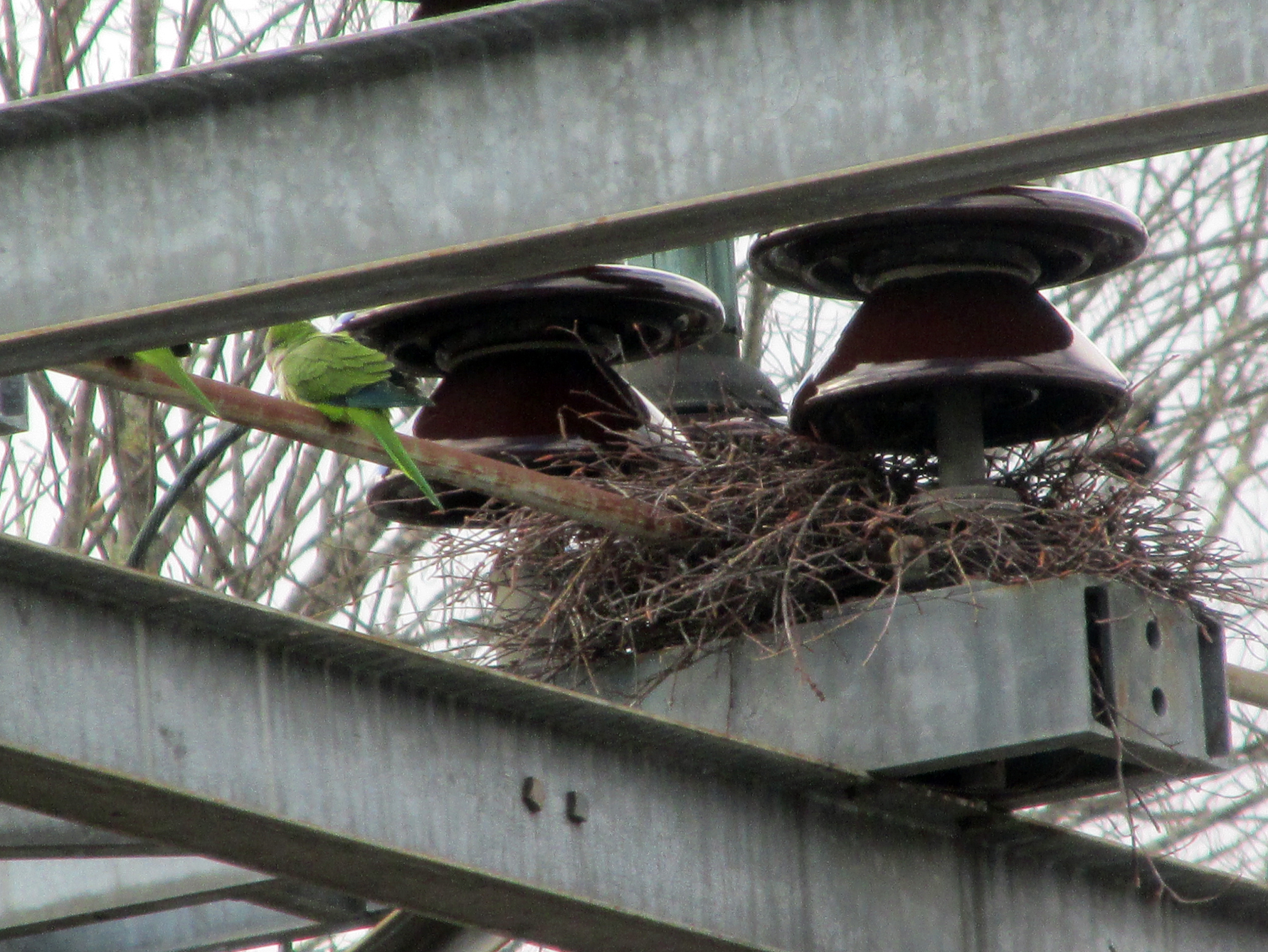
Monk-Nest

Photo by Bryan Stevens                                        The pair of Monk Parakeets have built a bulky nest of twigs and sticks at the Newland electrical substation,

I was thrilled to see this pair of monk parakeets, but it also made me somewhat wistful for what might have been. It would be wonderful to have native parrots still flying free. The extinct Carolina parakeet ranged throughout the eastern United States, including the states of Virginia, Tennessee and North Carolina. If only the dawning of a more environmentally aware age had arrived slightly sooner, the Carolina parakeet might have been saved along with species like the California condor and whooping crane. This native parakeet, if it had endured, might today be considered an ordinary backyard bird.

••••••

USFWS_Inspection_of_Quaker_Parakeet_Shipment_from_Uruguay

John and Karen Hollingsworth                                  USFWS personnel inspect a Quaker, or Monk, Parakeet shipment from Uruguay. Monk parakeets have habit of showing up in unexpected places

To learn more about birds and other topics from the natural world, friend Stevens on Facebook at https://www.facebook.com/ahoodedwarbler. He is always posting about local birds, wildlife, flowers, insects and much more. If you have a question, wish to make a comment or share a sighting, email ahoodedwarbler@aol.com.

Woodpecker’s ‘red belly’ often obscured from view, but ‘redhead’ name often goes to wrong bird


In recent posts I have discussed the smallest and largest of the woodpeckers in the region, as well as focused a spotlight on the oddball yellow-bellied sapsucker and the medium-sized Northern flicker. This week’s post will focus on one of the most common, although ridiculously misnamed, woodpeckers, as well as one of its rather uncommon relatives.

OLYMPUS DIGITAL CAMERA

Photo by Ken Thomas                                            Just as acrobatic as its relatives, the red-bellied woodpecker ranks as a popular visitor to feeders. This photograph shows off the splash of red on the belly that gives this particular woodpecker its name.

Among the woodpecker family, the red-bellied and red-headed woodpeckers are close cousins, belonging to a genus of those tree-clinging birds known as Melanerpes. The term, translated from Latin, means “black creeper.” Indeed, many of the two dozen members of the Melanerpes genus have an extensive amount of black feathers in their plumage. Other members of the genus include woodpeckers from the Caribbean, as well as from Central and South American. Some of them have quite colorful names, such as yellow-tufted woodpecker, golden-cheeked woodpecker and the accurately named beautiful woodpecker, a native of Colombia.

1966266_10205839301334114_1762688218168201429_o

Photo by Bryan Stevens                                  When climbing the trunks of trees, red-bellied woodpeckers don’t often reveal the faint reddish wash on the feathers covering their stomachs. This photo, however, is an exception and shows the trait that gives this medium-sized woodpecker its common name.

The red-bellied woodpecker is one of the most widespread members of this genus with a range that extends from southern Canada to northeastern Mexico, as well as the eastern United States as far south as Florida and as far west as Texas. A century ago the red-bellied woodpecker was almost exclusively a southeastern bird, but it has expanded its range northward and westward considerably in the last 100 years. Its southern origins are hinted at in its scientific name of Melanerpes carolinus, which can be roughly translated as “black creeper of the Carolinas.”

It’s also named for a characteristic of its appearance that is not particularly prominent and not easy to observe. The faint tint of red that tinges the white belly feathers is extremely difficult to observe when this woodpecker is hitching up the trunk of a large tree. Because males, and females to a certain extent, have a red cap, the species has been erroneously referred to as a “red-headed woodpecker” by many casual observers. The true red-headed woodpecker, however, has an entirely red head and a plumage pattern that, considering its color trio of red, white and blue-black, is downright patriotic. The red-headed woodpecker (Melanerpes erythrocephalus) is about the same size as the red-bellied woodpecker.

Redheaded_woodpecker

Photo by Dave Menke/U.S. Fish and Wildlife Service                  The uncommon red-headed woodpecker deserves its common name because it, and not the related red-bellied woodpecker, has an entirely red head.

All woodpeckers are noisy when the mood strikes them, but the red-headed and red-bellied have always struck me as rather more clamorous than some of their relatives. The most common call of the red-bellied woodpecker is a sort of rolling “churr” repeated frequently while the bird is on the move from tree to tree.

To enjoy close views of the red-bellied woodpecker, provide plenty of peanuts, sunflower seeds and suet cakes. If there are any of them in the woods nearby, they will find these food offerings in short order. All my research indicates the same is true of red-headed woodpeckers, but I’ve never observed this woodpecker at my home. I’ve seen red-headed woodpeckers in Tennessee, Virginia and South Carolina, but their populations are somewhat localized. Woodlands dominated by oak trees are often inhabited by both these woodpeckers, which are fond of the acorns produced by these trees.

Female-Redbellied

Photo by Bryan Stevens           A female red-bellied woodpecker peers around a tree trunk.

One reason the red-headed woodpecker may be less common than its cousin relates to its fondness for hawking for flying insects along roadsides. The woodpeckers are frequently struck by cars when swooping after their winged prey. Historically, the American chestnut and beech trees also provided much of the mast crops consumed by these birds. With the extermination of the chestnut and the scarcity of beech in some locations, the red-headed woodpecker now depends on oaks and acorns. In fact, this woodpecker is rarely encountered outside of woodlands with an abundance of oak trees.

At feeders, red-bellied woodpeckers are prickly customers that often refuse to play nice with other birds. I’ve seen them stare down other large feeder birds, including blue jays, mourning doves and evening grosbeaks. With its large bill, the red-bellied woodpecker commands some respect.

10974570_10204879280134184_5728419233300989270_o

Photo by Bryan Stevens                                Although once considered a bird of the southeastern United States, the red-bellied woodpecker has expanded its range north and west during the past century.

Anyone who has hosted these birds knows they are a welcome visitor to any yard. Who knows? Some day I may even get a visit from the elusive red-headed woodpecker, which is the only woodpecker resident in the region to thus far avoid my yard.

••••••

1655770_10205115222432594_4327567867962744958_o

Photo by Mark Stevens     A promotional sign for Brookgreen Gardens in South Carolina bears the image of a red-bellied woodpecker.

To learn more about birds and other topics from the natural world, friend Stevens on Facebook at https://www.facebook.com/ahoodedwarbler. He is always posting about local birds, wildlife, flowers, insects and much more. If you have a question, wish to make a comment or share a sighting, email him at ahoodedwarbler@aol.com.

Northern flicker one of America’s most widespread woodpeckers

 
Facebook friend Melissa Hale posted on my page about her discovery of an unusual feather.
 

“I think I have found a feather from a yellow-shafted flicker,” she wrote. “Do we even have these around here?” She noted that she has heard several species of woodpecker around her home and added that daughter Heather has seen quite a few different woodpeckers around their home.

Flicker-YellowWing

Photo by Donna Dewhurst/U.S. Fish & Wildlife Service              The extended wing of this Northern flicker shows how the eastern race of this woodpecker is known as the “yellow-shafted” form.

 
I posted back that she probably had found a flicker’s feather. The name “yellow-shafted flicker” is one of a great many common names for this medium-sized woodpecker, which is known by birders as the Northern flicker. The phrase “yellow-shafted” describes the Eastern race of this woodpecker, which is replaced in the western United States by the “red-shafted” flicker. In reality, both the yellow and red-shafted birds are considered by experts to be the same species. The yellow feathers in Eastern birds are found under the wings and on the tail. The yellow, or red, sections of the wings are most visible when the bird is in flight. I’ve seen both forms of this woodpecker, observing the red-shafted form of the Northern flicker during trips to Utah in 2003 and 2006.
 
Melissa described the feather as “one of the most beautiful feathers I have ever seen,” which is not too surprising. Most of the region’s woodpeckers are black and white birds. The Northern Flicker, on the other hand, shows considerable color— for a woodpecker. 
 

While flickers can be found during all seasons in the region, this woodpecker is one of the migratory ones. I see the most Northern flickers during fall migration. This woodpecker is one of the few of its kind that migrates to warmer climates during the colder months, although the species is usually not absent from the region in the winter season.

Northern_flicker (2)

Photo by U.S. Fish & Wildlife Service          The Northern Flicker resides in open habitats near trees, including woodlands edges, suburban yards, city parks and orchards.

 
As mentioned earlier, this is a woodpecker with many other common names, including yellow-hammer — a popular name in the Deep South — and harry-wicket, heigh-ho and gawker bird. The Northern flicker is also the only woodpecker to serve a state — Alabama — as an official bird. The flicker earned this distinction back in 1927. Soldiers from Alabama who fought for the Confederacy were nicknamed “yellowhammers” because of their grey-and-yellow uniforms, which matched the colors of the bird. Incidentally, Alabama was one of the first states to ever name an official state bird.
 
The Northern flicker — both the yellow- and red-shafted races — is not the only flicker in the United States. The gilded flicker inhabits many of the deserts — Sonoran, Yuma and Colorado — in the United States. Of course, trees are scarce in deserts, but that hasn’t proven an obstacle for this woodpecker. The bird is closely associated with saguaro cactus. Other desert dwellers depend on this woodpecker. Once the flickers are no longer making use of their nest and roost holes in the multi-armed cacti, other wildlife moved into the chambers. 
 
The Northern flicker is an enthusiastic drummer, pounding loudly on the sides of trees with its stout bill. The purpose of the drumming is to communicate with mates and signal potential rivals that they’re intruding. Toward that objective, flickers sometimes substitute metal utility poles or the sides of buildings for the trunks of trees. In addition to drumming, the flicker also employs a variety of loud vocalizations that are fairly distinctive. A loud, repeated flicker, often translated as “wicka-wicka-wicka,” is similar to the cluck-like call of the larger pileated woodpecker. The flicker is also known for emitting a sharp, loud “kleeer” call can be heard from a considerable distance. Flickers are probably most vocal during the spring months. 10683622_10204092032613488_952638671796664703_o 2
 
If you search for flickers, however, don’t concentrate all your scanning on tree trunks. These woodpeckers spend a lot of time in field or on lawns in search of insect prey, which mostly consists of ants and beetles. Flickers also eat seeds and fruit, and these woodpeckers will also visit feeders for peanuts, sunflower seed and suet. 
 

The adult flicker is a brown bird with black bars on the back and wings. A distinctive black patch occupies the upper breast, while the lower breast and belly are beige with black spots. Males can be identified by a black or red mustache stripe at the base of the beak. They also have a red stripe on the back of their gray heads. The flicker’s dark tail is set apart from a white rump patch that is conspicuous when the bird takes flight.

Northern_flicker (1)

Photo by U.S. Fish & Wildlife Service                  A Northern Flickers looks out from its nesting cavity.

 
The Northern flicker, as either the red- or yellow-shafted reach, ranges across the United States and Canada. The flicker also ranges to Central America, Cuba and the Cayman Islands. Known scientifically as Colaptes auratus, which can be roughly translated as the “golden woodpecker,” there are about a dozen species of flickers in North, Central and South America, as well as the Caribbean. 
 

A couple members of the flicker clan are now extinct. The human introduction of cats and goats to Guadalupe Island, offshore from the western coast of Baja California, Mexico, led to the extinction of this woodpecker in 1906. The Bermuda flicker apparently died out centuries ago, although a few may have lingered into the 17th century. John Smith, the early explorer associated with the Jamestown colony of Virginia, may have written of the Bermuda flicker in a journal recording his voyages. 

Birds-of-GA-northern-flicker

English-born John Abbot explored southeastern Georgia, collecting specimens and painting birds such as this Northern Flicker during the Revolutionary era in Colonial America.

 
Look for Northern flickers in fields, orchards, city parks and well-planted suburban yards. These woodpeckers are usually not too shy around human observers and will sometimes allow for extended observation. If you’re even more fortunate, you could find one visiting your feeders. 
 
••••••
 
To learn more about birds and other topics from the natural world, friend Bryan Stevens on Facebook at https://www.facebook.com/ahoodedwarbler. He is always posting about local birds, wildlife, flowers, insects and much more. If you have a question, wish to make a comment or share a sighting, email ahoodedwarbler@aol.com.

Region’s largest woodpecker always makes big impression

Downy-Male 3

Photo by Bryan Stevens                         The downy woodpecker is the smallest of its kind in the region. Its largest relative is the crow-sized pileated woodpecker.

In recent posts, I’ve discussed the yellow-bellied sapsucker, a definite oddball among the region’s woodpeckers, as well as the downy woodpecker, which is the smallest member of this clan of tree-hugging birds. This week I’d like to discuss the pileated woodpecker. On the other end of the size scale from the downy, the pileated woodpecker ranks as the largest member of this family of birds to make its home in the United States.

Pileated_Woodpecker-27527

Photo by Ken Thomas                                                     The pileated woodpecker, despite its size and noisy personality, is a rather shy bird.

The large pileated woodpecker — it’s the size of a crow — never fails to impress. This bird has a loud, raucous cackling call, which is often heard before the bird is observed. This woodpecker spends a good amount of its time low to the ground, so when one takes flight unexpectedly, often calling loudly as its powerful wing beats carry it away from an observer, the moment can be somewhat startling. These experiences of sudden and unexpected sightings of one of these woodpeckers is often accompanied by exclamations of surprise. Hence common names such as “wood-hen” and “Lord God Bird” have been adopted for these woodpeckers. Other names for the pileated have included carpenter bird, cock-of-the-woods and wood-hen.

PileatedWP-BRISTOL

Photo by U.S. Fish & Wildlife Service                                              The pileated woodpecker, if the ivory-billed woodpecker is truly extinct, reigns as the largest woodpecker in the United States.

At one point, the pileated woodpecker was relegated to second place when it came to the size of native woodpeckers. The often inaccessible swampy woodlands and river bottoms of the American south were home to the former title holder, the ivory-billed woodpecker. With the unsettled status of the ivory-billed woodpecker — is it extinct or is it still lingering in an Arkansas swamp? — the pileated woodpecker is considered the largest woodpecker in the United States. If incontrovertible evidence of the existence of ivory-billed woodpeckers should emerge in the future, the pileated woodpecker would once again find itself overshadowed by this dramatically larger relative.

Although the pileated woodpecker can reach a length of 19 inches, the bird weighs only about 11 ounces. Male and female look similar with a black and white body and a bright red crest. Males show a red stripe — or mustache — on the cheek that is not present in females.

John_James_Audubon_-_Pileated_Woodpecker

Early naturalist and painter John James Audubon painted these pileated woodpeckers in the process of foraging for food.

As mentioned earlier, the pileated woodpecker often can be found low to the ground, foraging on tree stumps and fallen logs, as well as in taller, living trees. The reason for this behavior rests with one of its favorite foods — the humble carpenter ant. The pileated is not the only woodpecker that supplements its diet with ants. For instance, the Northern flicker is also fond of dining on these insects. Studies conducted on the dietary preferences of pileated woodpeckers have revealed that as much as 40 percent of the diet is made up of ants. Some pileated woodpeckers appear to have developed quite an addiction for ants with some individuals dining almost exclusively on ants. These woodpeckers also eat wild fruits and nuts, as well as other insects and their larvae. The pileated woodpecker will occasionally visit a feeder for suet or seeds, but I’ve not had much luck overcoming their instinctive wariness.

Pileated woodpeckers — usually a mated pair — have been among my wild neighbors for years, but they are shy, retiring birds. Despite their bold appearance and capacity for making quite a racket, the pileated woodpecker usually goes out of its way not to attract attention to itself. Because of this, close-up observations of the largest of our woodpeckers are experiences to savor.

10847689_10205532193376607_2833698272038797483_o

Photo by Bryan Stevens                                This pileated woodpecker was photographed at Brookgreen Gardens in South Carolina in 2015.

The bird’s enthusiastic ability to excavate cavities in rotten trees is a boon to other species of birds. Certain species of ducks as well as owls, bats, squirrels and other species of wildlife will often make use of cavities created by pileated woodpeckers for roosting locations or to raise their own young.

Worldwide, there are about 180 different woodpeckers, but the family is conspicuous in its absence from Australia, Madagascar and New Zealand. The pileated woodpecker ranges across the continent, with birds present in the forests across Canada and the eastern United States as well as certain areas along the Pacific coast.

••••••

To learn more about birds and other topics from the natural world, friend Stevens on Facebook at https://www.facebook.com/ahoodedwarbler. He is always posting about local birds, wildlife, flowers, insects and much more. If you have a question, wish to make a comment or share a sighting, email ahoodedwarbler@aol.com.

Sapsuckers are odd birds out among the woodpeckers


Sapsucker-Two

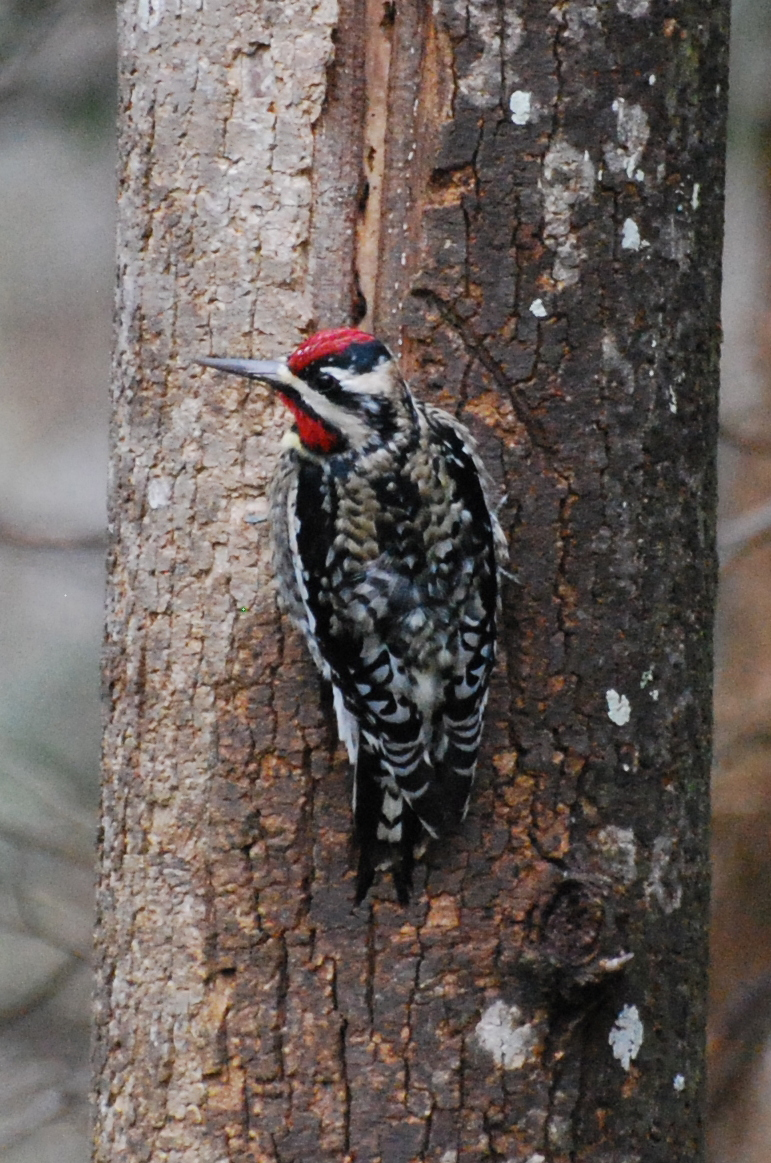
Photo courtesy of Jean Potter                            A male yellow-bellied sapsucker clings to the trunk of a tree.

Worldwide, there are almost 10,000 species of birds. After awhile, you begin to wonder if thinking of unique names for each of these species began to deplete creative reserves.

Then again, some of the names given to birds suggest someone really wanted just to have fun at the expense of birders and nature enthusiasts. After all, you have to be careful about shouting out bird names like blue-footed booby, great bustard and hoary redpoll in mixed company.

There are also bird names that just don’t make a lot of sense — names like dickcissel and phainopepla — even to birders. Then there are names that are oxymoronic, including greater pewee and giant hummingbird.

There are some bird names that sound like fighting words that bring into question concepts like courage and honor. Indeed, I sometimes think people are waiting for a punchline when I inform them there truly is a species of bird known as the yellow-bellied sapsucker.

Sapsucker-One

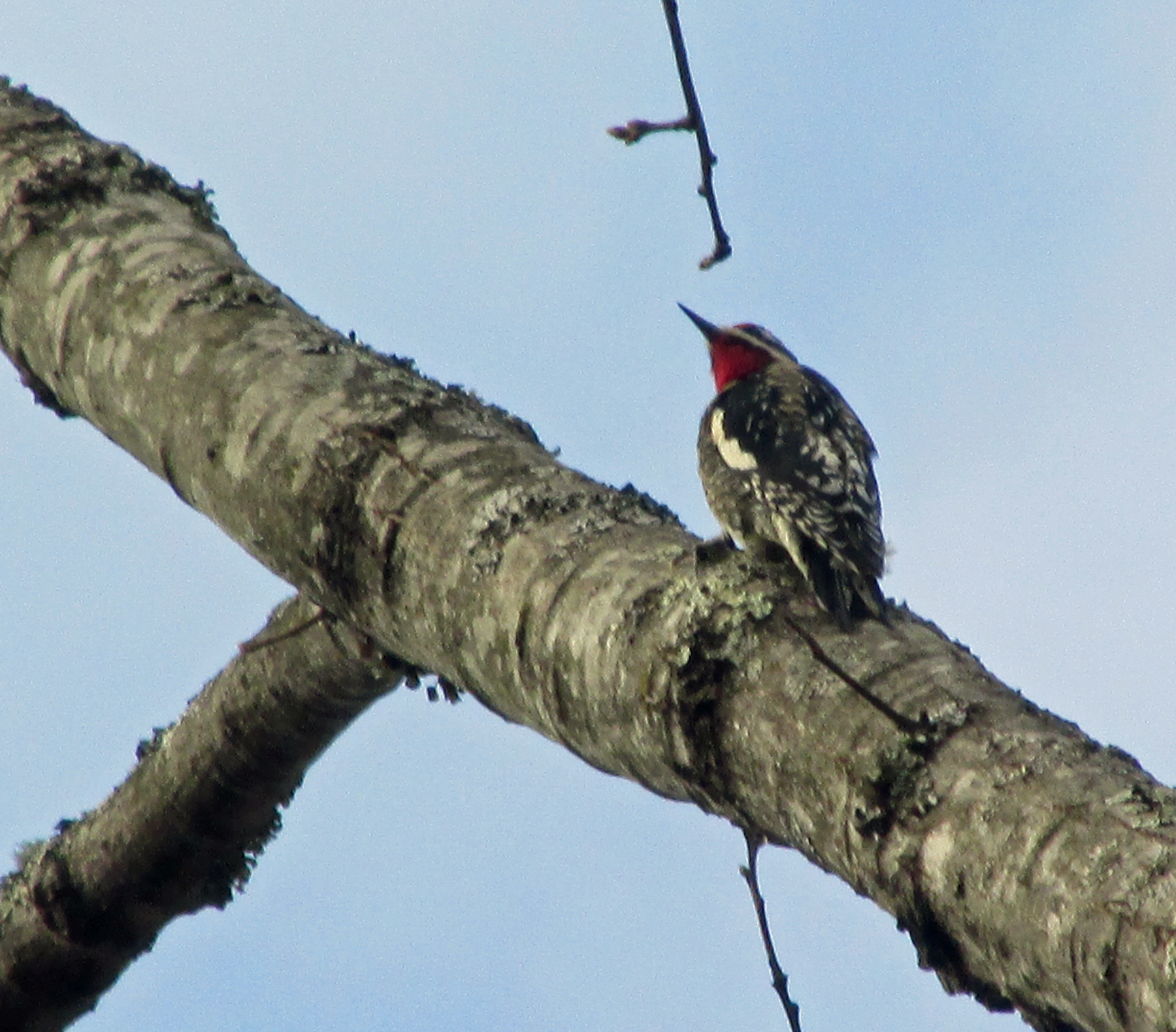
Photo courtesy of Jean Potter                                                                    A male yellow-bellied sapsucker visits a suet basket for a quick meal during a recent cold spell.

I focused on the downy woodpecker, the smallest member of the woodpecker clan in a post from a couple of weeks ago. This week I am exploring one of the family’s oddball members, the aforementioned (and much maligned) yellow-bellied sapsucker.

In profile clinging to the trunk of a tree, the yellow-bellied sapsucker is a rather pudgy, especially for a woodpecker. The sapsucker has black and white plumage enhanced by red foreheads in both sexes. Male sapsuckers also have a bright red throat patch. Both sexes also show a large white stripe on their black wings. And yes, there is enough of a pale yellow wash on the stomach of this odd woodpecker to justify the descriptive “yellow-bellied” as part of its common name.


COUNT-Sapsucker

Photo by Bryan Stevens                                    This yellow-bellied sapsucker was photographed during a Christmas Bird Count.

Sapsuckers harvest sap by using their bills to drill various sorts of holes into the bark of a tree. Some of the more shallow holes, which are usually made in a rectangular fashion, must be maintained on a frequent basis for the bird to continue to derive sap from the tree. These holes — known as sap wells — not only provide nourishment to the sapsucker but to other birds, including hummingbirds, that appreciate a quick sugar fix. Insects also come to these wells, which function as sticky traps to capture the bugs so they can be eaten later when sapsuckers or other birds return to inspect the wells.

audubon-viii-gleaners-of-forest-and-meadow-yellow-bellied-sapsucker-aka-yellow-bellied-woodpecker

Early naturalist and artist John James Audubon painted the yellow-bellied sapsucker, known during his time as the yellow-bellied woodpecker.

Although they tend to prefer trees like maple and birch, sapsuckers are known to feed on more than 250 different varieties of trees. Indeed, they actually do feed on the trees. Not only do these birds subsist largely on sap, they also feed on the cambium layer in the bark of a tree. The sapsucker also supplements its diet with insects, fruits and seeds. Unlike other members of the woodpecker clan, sapsuckers do not visit feeders all that frequently. When a sapsucker does visit a feeder, it is often lured there by the promise of suet.

While most woodpeckers attempt to tough out the winter season in the same region where they spent the summer, the yellow-bellied sapsucker is migratory. Ahead of the coldest months of the year, sapsuckers migrate to the southeastern United States, as well as the West Indies and Central America. During the summer months, most sapsuckers nest in forests across Canada, Alaska and the northeastern U.S. states. There is also a small population of breeding sapsuckers in the Appalachian Mountains of Virginia, Tennessee and North Carolina.

The yellow-bellied sapsucker has a call that sounds amazingly like the meow of a cat. I know about this call from personal experience. While birding in South Carolina a few years ago, I searched diligently for the source of such a call. It sounded somewhat like a gray catbird — another mimic of the common household feline — but not quite. Now I know that when I hear this unusual call I can train my binoculars on the branches and trunks of nearby trees to scan for a sapsucker.

Redbreasted_Sapsucker

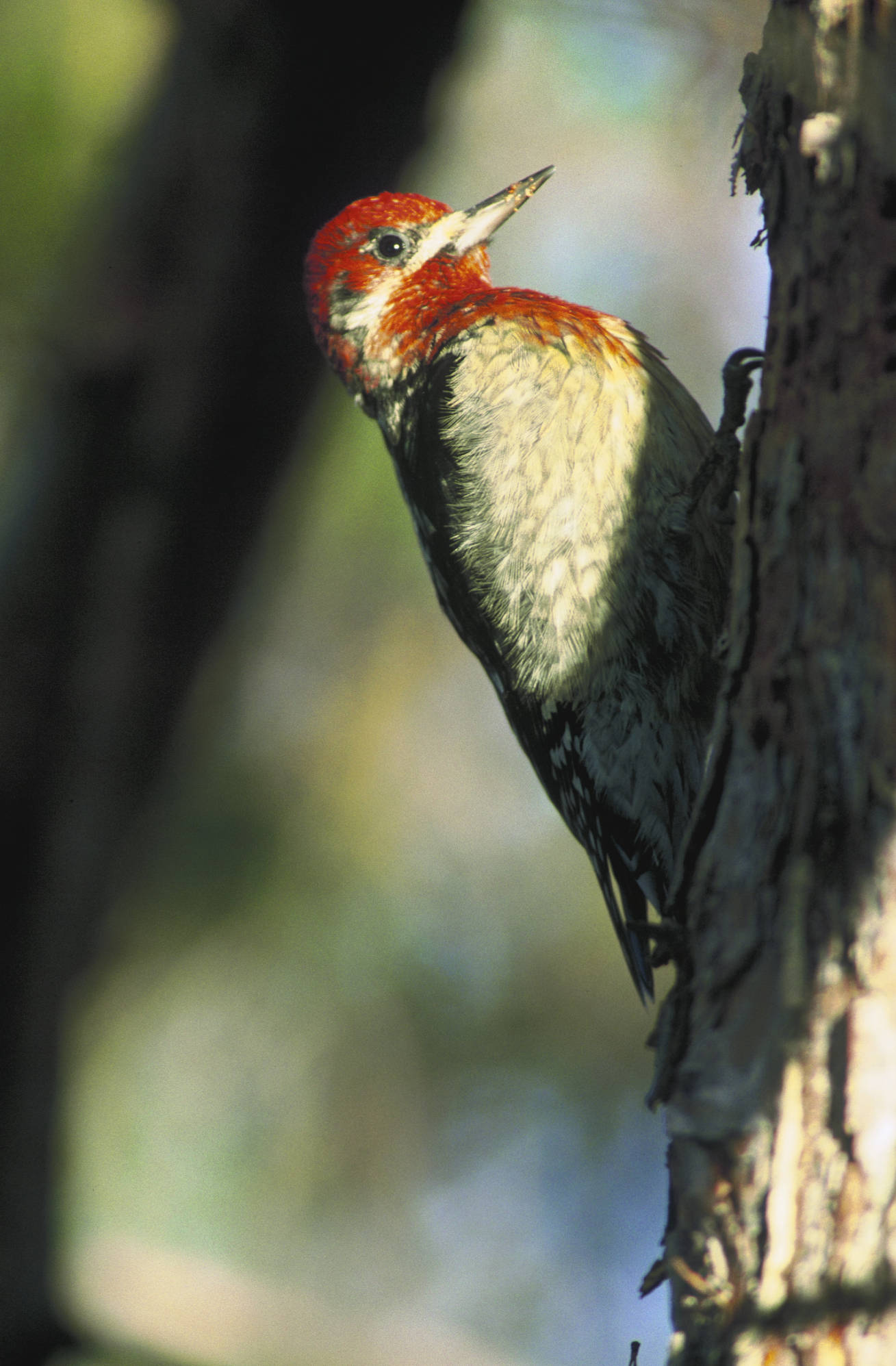
Photo by Dave Menke/U.S. Fish & Wildlife Service The red-breasted sapsucker, shown here, is a relative of the yellow-bellied sapsucker found in the western United States.

There are actually another three sapsucker species — Williamson’s, red-breasted and red-naped — in North America, but they are all birds of the western half of the continent.

It is true of many species of birds that males and females look different. In the case of the Williamson’s sapsucker, males and females look so different that early naturalists mistakenly believed the male and female were entirely different species! Only two decades after the initial discovery of this bird did scientists finally realize that both male and female Williamson’s sapsuckers were the same species. This particular sapsucker was named in honor of Lt. Robert Stockton Williamson, who led a surveying expedition that collected the first male. The intent of the expedition wasn’t focused on collecting birds. Williamson and his men had actually been assigned the job of identifying the best route west for a railway to the Pacific Ocean.

I’ve actually seen very few yellow-bellied sapsuckers at my home, but it isn’t too difficult to find this bird during fall migration and in the winter months at city and state parks in the region. If you observe a yellow-bellied sapsucker in your own yard, consider yourself lucky to get a glimpse of this oddball woodpecker.

••••••

To learn more about birds and other topics from the natural world, friend Stevens on Facebook at https://www.facebook.com/ahoodedwarbler. He is always posting about local birds, wildlife, flowers, insects and much more. If you have a question, wish to make a comment or share a sighting, email ahoodedwarbler@aol.com.

Winter Rally returns to Roan Mountain on Saturday, Feb. 13

Turkeys-Hillside

Photo by Bryan Stevens                                                                    Flock of Wild Turkeys forage on a hillside near Hampton, Tennessee.

As January moves into February, I’ve been seeing more of the birds I’ve come to associate with the winter months.

Ringneckers-Redheaders

Photo by Bryan Stevens                  Ring-necked Ducks and Redheads visit a pond at Erwin Fishery Park in Erwin, Tennessee.

During afternoon drives I’ve observed flocks of wild turkeys in fields near my home. The largest of these flocks consisted of at least two dozen birds. In addition to the turkeys, I’ve been seeing waterfowl at various ponds at local park. Some of these observations have included ducks like Redheads, Ring-necked Ducks, American Wigeons, American Black Ducks and Buffleheads, as well as Pied-billed Grebes, Common Coots and Great Blue Heron. I also found a large flock of Ring-billed Gulls at a large pond near the Elizabethton campus of Northeast Tennessee Community College.

FOXIE

Photo by Bryan Stevens                A Fox Sparrow arrived at feeders during a recent snowstorm.

Recent snowfall has also changed the makeup of the flocks of birds coming to my feeders. A Fox Sparrow has joined the Eastern Towhees I’ve watched foraging on the ground beneath the feeders hanging from the branches of a blue spruce outside my bedroom window.

GullsGreatLakes

Photo by Bryan Stevens                                Ring-billed Gulls at a pond in Elizabethton, Tennessee.

More Purple Finches, in addition to American Goldfinches, have joined the ranks of birds crowding around my black oil sunflower-stocked feeders. Other recent visitors have included European Starlings (a winter rarity at my home) and a male Red-winged Blackbird, which linger for only one snowy day.

•••••••

u25017404-o112351545-53

David Ramsey

It’s time once again to join the fun for a winter celebration of the Roan Highlands on Saturday, Feb. 13, at the Roan Mountain State Park Conference Center. The event will celebrate Roan Mountain’s grassy balds, rare plants, birds, ancient geology and ongoing conservation efforts. The inclusive event is planned as for all ages, so be sure to bring the kids. Presentations are planned by David Ramsey and Gary Kauffman.

Ramsey is a well-known area conservationist, photographer, and tireless fighter for the protection of the 10,000-acre Rocky Fork tract — now a 2,000-acre Tennessee State Park surrounded by 7,600 acres of U.S. National Forest. Ramsey will present a program on photography being one of the most important items in the conservationist’s toolbox. A native of Unicoi, he was Field & Stream’s 2011 “National Hero of Conservation” and a Southern Appalachian Highlands Conservancy’s Stan Murray award winner. Ramsey, whose great-great-grandfather walked these forest paths, brings a generational love to contemporary times on Roan Mountain.

Gary_Kauffman,_US_Forest_Service,_collects_Georgia_aster_seeds_(8057079764)

Photo by U.S. Forest Service                              Gary Kauffman collects seeds for a project for the U.S. Forest Service.

Gary Kauffman is the botanist/ecologist for the National Forests in North Carolina, which covers 1.1 million acres across four forests, the Nantahala and Pisgah National Forests in the mountains, the Uwharrie National Forest in the Piedmont, and the Croatan National Forest in the Coastal Plain. He will speak on the Roan’s rare plants in the balds and forests and the threats of balsam and hemlock wooly adelgid, beech bark disease, and non-native invasive plants.

Since you’re bringing the kids along, be sure to let them know that Xtreme Roan Adventures will have a table set up for owl pellet dissection. Of course, several afternoon hikes are also on the schedule for this year’s Winter Rally.

12615688_10207221841416752_570003004117826680_o

Photo by Bryan Stevens                                                                           The annual Roan Mountain Winter Naturalists Rally returns on Saturday, Feb. 13.

During lunch, Amanda “AJ” Smithson, Seasonal Interpretive Ranger at Roan Mountain State Park, will present a program on forests and fields’ edible plants. Smithson is a graduate from UNC Wilmington and NC State with degrees in Natural Resource Management and GIS.
For more information, on this annual event, visit http://friendsofroanmtn.org/winter%20rally%202016%20brochure.pdf

Winter storms can’t ruffle feathers of the downy woodpecker


Winter Storm Jonas was one for the history books, but the birds at my home weathered the wintry conditions without ruffling their feathers all that much.WinterStormJonas_Top-620x380

The storm reminded me of a major blizzard back in 1993 that set me on the path to becoming the enthusiast about birds that I am today. The Blizzard of ’93 — which was dubbed “a storm of the century” — killed more than 300 people and dumped more than 20 inches of snow across a vast swath of the Appalachians and the Northeastern United States. Fierce winds blew snow around into massive drifts. That storm developed on March 12, 1993, and dissipated by March 15, 1993.

Downy-Topsy

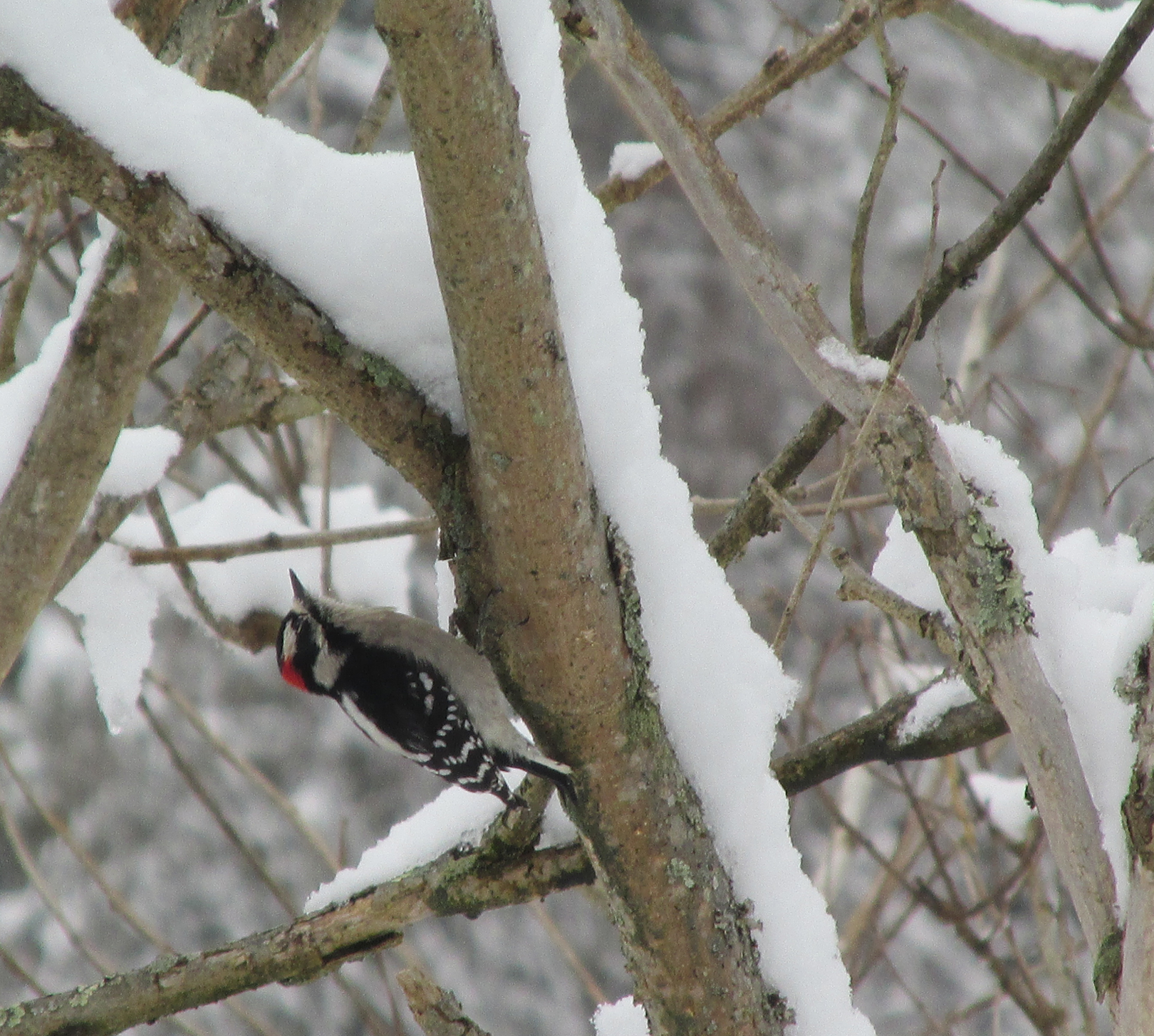
Photo by Bryan Stevens                                  Snow doesn’t deter a determined downy woodpecker.

Winter Storm Jonas dumped almost 11 inches of snow at my home, which was considerably less than back in 1993 when about three feet of snow accumulated. I remember the winds being more fierce with the ’93 storm, as well. Fortunately, my electric power never faltered through either of the storm, but my family was quite stranded for several days in 1993. With very little else to do, I watched my feeders. I remember observing birds like cardinals and juncos endured buffeting winds as they flocked to feeders that I had just placed in the yard earlier that winter. It was the beginning of my desire to learn more about birds, including training myself to identify the various species I encounter at home and afield.

More than 20 years later, the recent Winter Storm Jonas sent a variety of birds flocking to my feeders after what has been a lackluster start to the winter bird-feeding season. Some unexpected visitors — a male red-winged blackbird, two European starlings and a few purple finches — made their first appearance for the winter.

Downy-2

Photo by Bryan Stevens                                    Only the male downy woodpecker sports the red patch of feathers on the back of its head.

The most common visitors at the feeders were the dark-eyed juncos. I estimated that about two dozen of these “snow birds” spent most of the storm perched on my feeders or foraging on the ground beneath them. I also observed numerous Northern cardinals, Eastern towhees, American goldfinches, white-breasted nuthatches, Carolina chickadees, white-throated sparrows, song sparrows and more.

DUo-Downy-Titmouse

Photo by Bryan Stevens                                        A tufted titmouse and downy woodpecker share space at a suet feeder.

One bird that visited frequently also did so with amazing discretion. The downy woodpecker is a small black-and-white bird that often infiltrates a mixed flock of birds to nab a sunflower seed or grab a bit of suet before the other members of the flock are even aware of its presence. Perhaps because of its status as the smallest of the North American woodpeckers, the downy woodpecker is quite good at not drawing attention to itself.

Not only is the downy woodpecker the smallest of the woodpeckers in the United States, it’s also the most common. It’s the woodpecker that most bird lovers encounter in the yards and at their feeders. However, the downy is not the smallest woodpecker in the world. That distinction goes to species known as “piculets” that reside in Asia and South America. Worldwide, more than 180 species of woodpeckers thrive almost worldwide, only absent from the continents of Australia and Antarctica.

Hairy_woodpecker

Photo by U.S. Fish & Wildlife Service The hairy woodpecker is a larger look-alike relative of the downy woodpecker.

The dainty downy woodpecker has a larger lookalike relative. The hairy woodpecker not only bears a strong resemblance to the downy, but shares similar habitat, as well. Despite almost identical plumages, the two species are quite different in size. The downy, at six inches in length, is the size of a sparrow. The larger hairy woodpecker almost 10 inches in length, making it closer in size to a robin.

As most birders know, size is often difficult to determine, especially if you don’t have a downy and hairy woodpecker in close proximity. The deciding factor is usually a good look at the beak of these two birds. A downy woodpecker has a short, stubby, almost un-woodpecker-like bill. The hairy woodpecker, on the other hand, has a large bill like those of such relatives as red-bellied woodpecker and Northern flicker.

Downy-Male-Feb23

Photo by Bryan Stevens                                                    A downy woodpecker visits a feeder for a shelled peanut.

The downy woodpecker is a cavity-nesting bird, but the species does not usually accept man-made nesting boxes although they often utilize them for roosting purposes. Downy woodpeckers endure frigid nights not only by finding a cozy roosting spot but by also lowering their body temperature. This action is a form of controlled hypothermia that is also practiced by such small birds as chickadees, kinglets and hummingbirds.

Downy woodpeckers have a way of hitching themselves along trunks and branches in a jerky fashion. Although not silent by any means, the downy woodpecker limits its utterances to a range of “peents,” as well as a high-pitched jumble of descending notes often described as a “whinny.” Of course, they also make themselves heard by pounding against tree trunks and branches like their larger relatives.

Female-Downy1

Photo by Bryan Stevens                                Downy woodpeckers are quite comfortable climbing along tree trunks and branches.

A pair of downy woodpeckers makes a great addition to the diversity of birds in any yard. Don’t fret too much about them when the weather turns nasty. Despite their small sizes, they have a huge arsenal of adaptations to deal with the cold. Whether its a modest flurry or the “storm of a century,” the downy woodpecker’s not likely to ruffle many feathers in coping.

••••••

To learn more about birds and other topics from the natural world, friend Stevens on Facebook at https://www.facebook.com/ahoodedwarbler. He is always posting about local birds, wildlife, flowers, insects and much more. If you have a question, wish to make a comment or share a sighting, email ahoodedwarbler@aol.com.

Other regional Christmas Bird Counts post some good finds, including Say’s phoebe

Says_Phoebe

Photo by U.S. Fish & Wildlife Service                                         A Say’s phoebe, such as the individual pictured, was a remarkable find for the Blackford CBC in Virginia.

The Blackford Christmas Bird Count took place Jan. 2, 2016, with 65 species found. The highlight of the count was a Say’s Phoebe found by Laverne Hunter, Peggy Herbert, and Jane and Jerry Thornhill.

The Say’s phoebe, a member of the tyrant flycatcher family, is related to the Eastern phoebe. A common bird in the western United States, the Say’s phoebe typically resides in dry, desolate areas. This bird was named for early American naturalist Thomas Say. Several crustaceans and mollusks are also named in Say’s honor. Say was a descendant of other early American naturalists William Bartram and John Bartram.

One other phoebe — the black phoebe — nests in the United States, primarily in California and Oregon. The black phoebe also ranges throughout Central and South America.

Say’s phoebe is an exceptional find in the eastern United States and is definitely a stand-out bird for a Christmas Bird Count conducted in Virginia.

••••••
The Bristol Christmas Bird Count held Dec. 27, 2015, set a new record, but it wasn’t for the number of birds found.
A high temperature of 76 degrees represented the highest temperature ever recorded for a CBC. In fact, the count yielded fewer species than degrees on the thermometer. The 74 species found represented the lowest species total since 1991, according to count compiler Richard Lewis of Bristol, Tennessee. Lewis speculated that the high temperature is likely linked to the low number of species found on the recent CBC.

Marsh_hawk

Photo by U.S. Fish & Wildlife Service    Nine individual Northern harriers, such as the one pictured here, were good finds for the Bristol CBC.

The Bristol CBC has been conducted continuously since 1956. Lewis noted that the count was also conducted one other year, back in 1931. This year’s CBC marked his 35th year as the compiler.

Members and friends of the Bristol Bird Club conduct the annual Bristol CBC, which is the only seasonal bird population survey conducted by the club. Several other locations in southwest Virginia and northeast Tennessee also conduct their own CBCs.

According to Lewis, notable finds for the 2015 Bristol CBC included a common gallinule, Northern saw-whet owl, nine Northern harriers, and seven bald eagles. Other good species included gray catbird, red-headed woodpecker, eared grebe and pine warbler.

Canada_Geese

Photo by U.S. Fish & Wildlife Service            Canada Geese were a common bird for the Bristol CBC.


The most numerous bird on the count was the European starling with 8,982 individuals counted. Other common birds included American crow (857), Canada goose (612) and American robin (520). A total of 14,642 individual birds were counted.

The very first Christmas Bird Count, organized by ornithologist Frank Chapman, was held in December of 1900. For that first count, 27 observers looked for birds in 25 locations across the United States.

This annual survey of bird populations has evolved into a global undertaking. During the 113th count conducted in December-January of 2012–2013, 71,531 people participated in 2,369 locations in the United States, Canada and several other countries. This annual census provides valuable insights into trends in bird populations.

•••••

As counters participating in the recent Bristol CBC discovered, it hasn’t been a particularly exciting winter season for bird enthusiasts. Based on some communication with readers, I’m not alone in finding activity is down at my feeders.

FrogPhoto

Photo Courtesy of Sarah Smith                          The unseasonable mild December weather in the region produced unusual photo opportunities, such as this photo of a frog at an ornamental home at the Smith home in Abingdon, Virginia.

I received a recent email from Randy Smith of Abingdon, Virginia. I met Smith at last year’s birding festival at Hungry Mother State Park.

He sent me the email to share a couple of things, including photos of a real frog sitting on top of a ceramic frog at his goldfish fountain. What makes the photos remarkable is that they were taken the day after Christmas, which is usually a time of year when frogs have been absent already for a couple of months.

“Who would have imagined this much warm weather in December?” Smith wrote in his email. “I thought it was funny he was sitting on the artificial frog … perhaps seeking solace?”

Smith also had a bird-related question, which was basically an inquiry into whether I have noticed a downturn in birds at my feeders this fall/winter

He noted that he has been filling his thistle/nyger feeder only once a week or so, when in past winters he has usually re-filled it at least three to four times per week.

Even keeping the feeder stocked has produced almost no American goldfinches, one of the finch species attracted by nyger thistle seeds.

“The usual visitors are there — chickadees, nuthatches, titmice, woodpeckers,blue jays, cardinals — and a resident group of white-crowned sparrows that are fun to observe,” he wrote. “But overall, numbers and variety are way down. Any thoughts? Is it just the weather?”

I agreed completely with his assessment of bird activity.

This past December was an unusually warm winter month. I was still seeing dragonflies at my fish pond as late as the day after Christmas, which was coincidentally the same day Smith photographed the frog at his home.

I blame the warm weather on this decrease in bird-feeder activity. With such mild weather, birds don’t need to rely on our feeders to supplement their diet. The birds will probably return if and when the region ever experiences any sustained cold weather. So far, January has been slightly more typical in regard to temperatures, so perhaps some fun birds might start showing up at feeders soon.

••••••

At the time I was writing this week’s blog post, Winter Storm Jonas was making itself felt in the region. I will write about the spike in bird feeding as a result of the snowstorm in next week’s post.

•••••

To learn more about birds and other topics from the natural world, friend Stevens on Facebook at https://www.facebook.com/ahoodedwarbler. He is always posting about local birds, wildlife, flowers, insects and much more. If you have a question, wish to make a comment or share a sighting, email ahoodedwarbler@aol.com.

Despite unsavory reputation, vultures provide important function

I’ve always believed that all birds make good neighbors, although I will admit it’s easier to welcome certain birds than it is others.

BlackVultures

Photo by Bryan Stevens                                                                    Black vultures perch together in a tall tree.

Gene Sturgeon, a resident of Abingdon, Virginia, shared a Christmas Day bird observation he made. He wrote that a distant tree (maybe 250 yards from the Sturgeon home) held three large vultures. The birds were perched high in the tree, with their wings outstretched as if they were drying their wings.

“I thought initially they may be cormorants, but another was flying around the neighborhood and looked very much like a vulture,” he wrote. “I couldn’t tell for sure if they were turkey or black vultures, but my son said he saw turkey red heads.”

n_a (32)

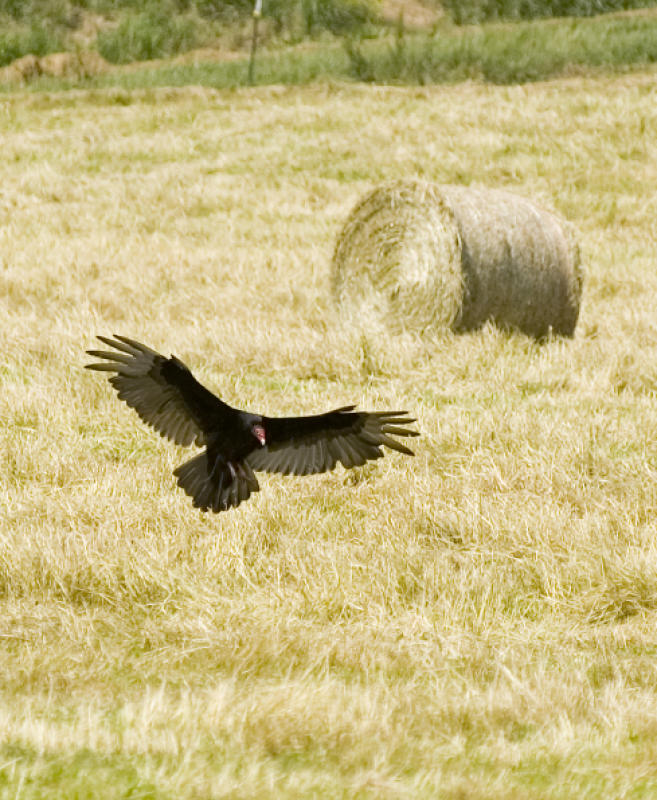
A turkey vulture lands in a pasture.

Curious about the behavior of the vultures, Gene also had a question. “Why would several vultures be drying their wings?” He asked in his email. “I think they are not water birds, and I don’t remember ever seeing vultures in the top of a tree. Perhaps migrating?”

In my response to his email, I told Gene that he had hit on the reason the vultures are there in his neighborhood. The tall tree offer them a perfect perching spot. Sometimes they will spread their wings out in that pose to soak up sunshine. The warmth from the sun’s rays sort of helps re-charge them. By maximizing the surface area of their bodies, morning sunshine can more easily warm them and get them ready to start the day. Basically, vultures are perfect examples of “green” energy in action.

3453851605_690d4883d2_o

Photo by Jean Potter                                                                 A black vulture spreads its wings to bask in the warm sunshine.

The pose described by Gene is actually one I have seen from time to time in other larger raptors. I’ve seen bald eagles perched with that sort of pose. I also informed Gene that his son was right. Turkey vultures have the red heads, and black vultures have black. The heads of both vultures are bare of feathers, which would quickly become soiled from the habit of these birds of pushing their heads into the carcasses of dead animals when feeding.

Gene wasn’t the only person who has sent me an email recently on the subject of vultures. Bettie Hite emailed with some questions she and her husband, Jim, have about vultures in their neighborhood along King College Road in Bristol.

TurkeyVulturesClean

Photo by Bryan Stevens                                  Turkey vultures are one of the few birds with a well developed sense of smell.

“You’ve probably already heard about this, but we have a huge flock of vultures gathering every evening in the trees around the intersection of Middlebrook, Graystone, The Reserve and the golf course on King College Road,” Bettie wrote in her email. “They begin flying in around 4 p.m. and before dark the trees are full of them.”

On the morning of Dec. 14, Bettie informed she counted 32 vultures in a maple tree on Carmack Circle (in Graystone) and six more vultures on the rooftop next to the tree. She noted that the vultures dispersed soon after that.

“There must be dozens of them roosting in the trees at night,” she wrote in her email. “Where are they coming from? Where are they finding enough food for so many of them? Why OUR neighborhood?”

Turkey_Vulture_edited-1

Photo by U.S. Fish and Wildlife Service              The red head of an adult turkey vulture distinguishes it from adult black vultures.

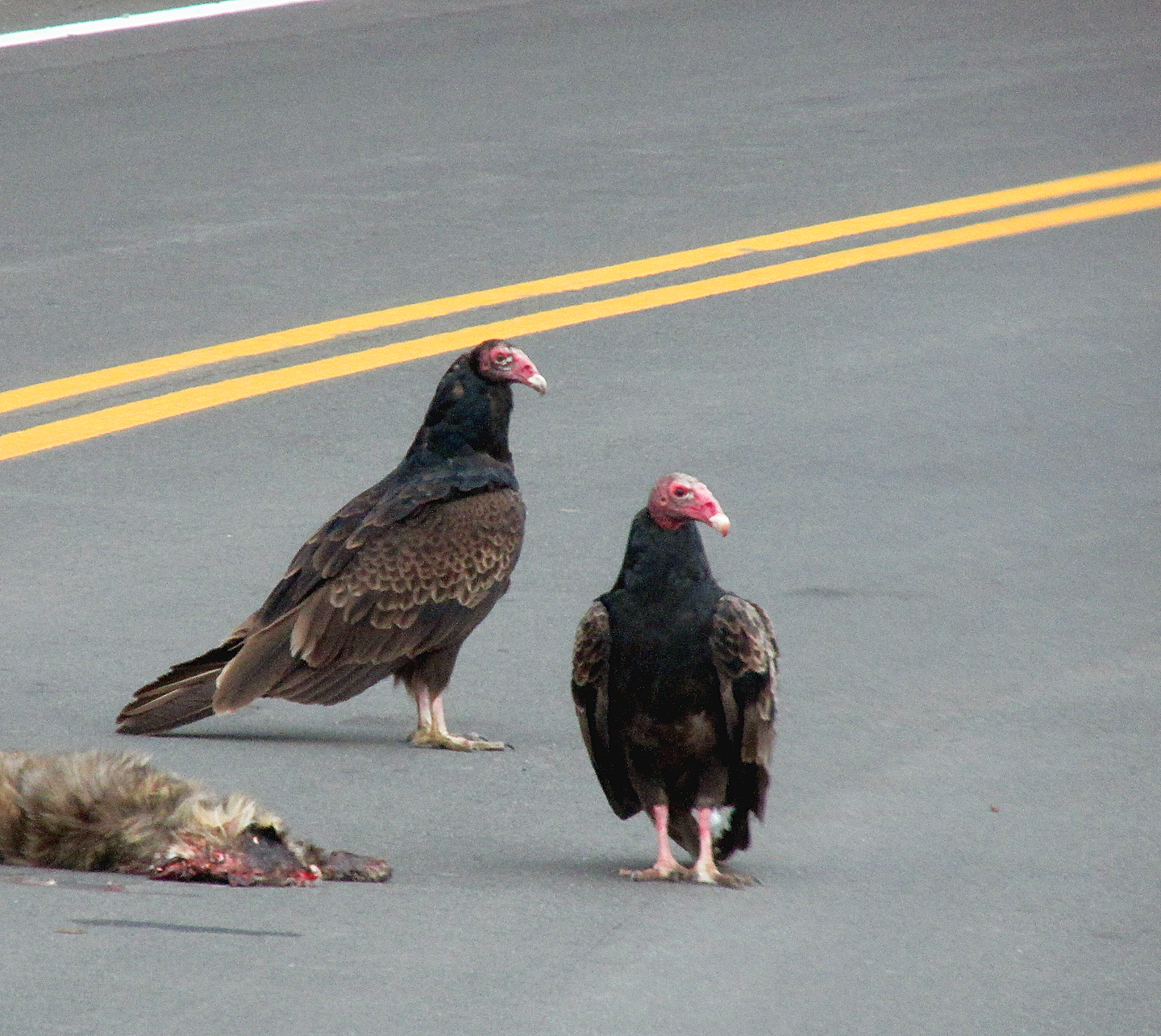
Vultures are year-round residents in the region, and they are sociable birds that tend to form flocks. They are also very efficient birds, and they can soar lazily in the sky until they find something to eat. This time of year, vultures scavenge a lot of the remains of deer dressed and left behind in the woods by hunters, but they also are quite skillful at making use of roadkill. They can fly long distances to look for food without actually depleting energy reserves.

For the most part, they’re harmless. If dozens grow to hundreds, the resulting mess at the roost could conceivably be a health concern. Why have they chosen to roost in the neighborhood where Bettie and her husband reside? That’s more difficult to answer, but I suspect that the trees in the neighborhood are extremely attractive to this particular flock of vultures.

IMG_8045

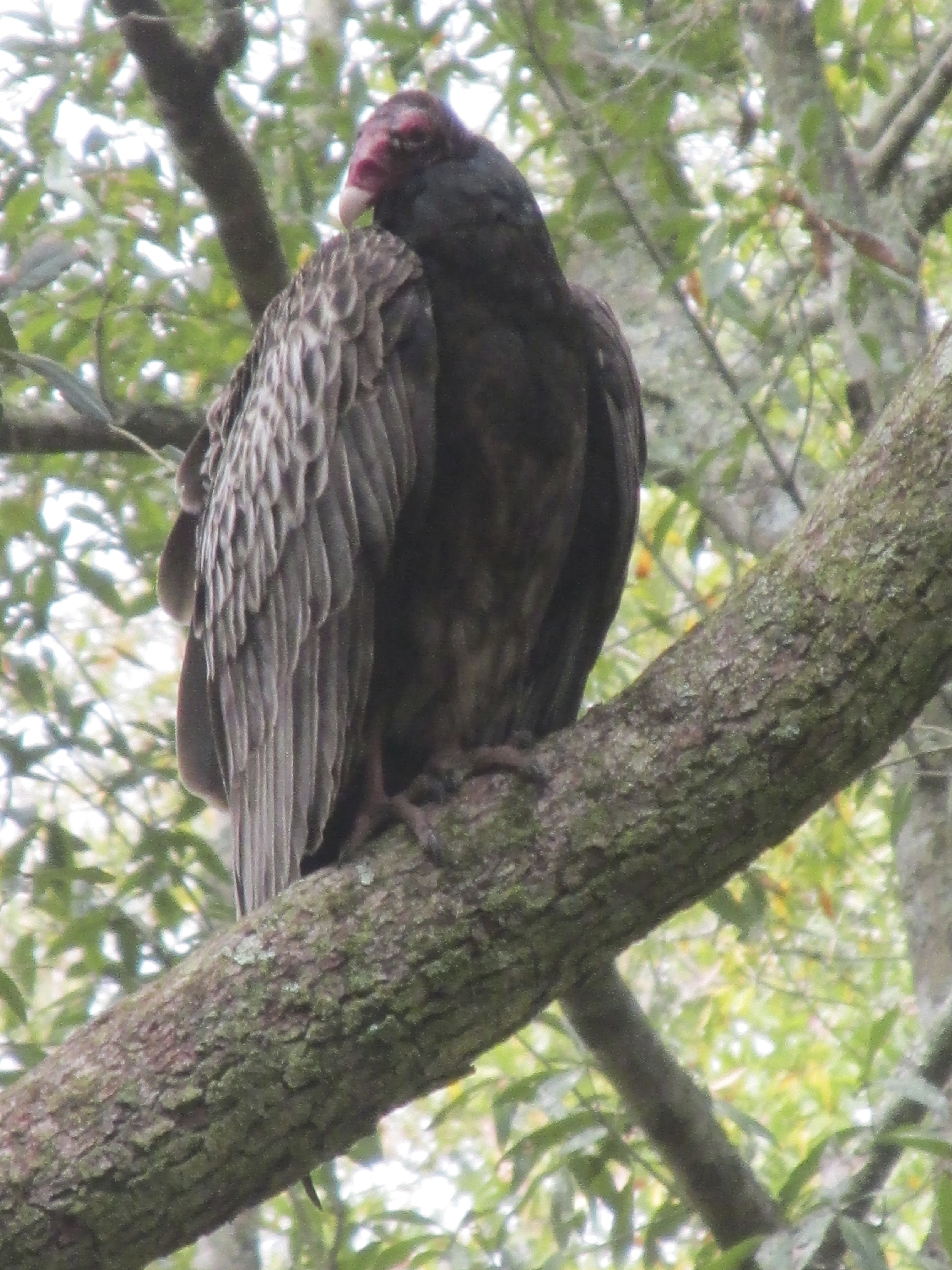
Photo by Bryan Stevens                      A turkey vulture perches quietly on a tree branch.

Turkey vultures are probably more common than black vultures, but I have seen both turkey and black vultures around Bristol. They’re never going to win any beauty contests, but vultures do actually provide a very useful function in the environment. When it comes to finding carrion, turkey vultures also have an advantage over black vultures. Turkey vultures are one of the few birds with a highly developed sense of smell, which helps them identify the wafting scent of decaying roadkill from long distances.

As surprising as it may seem, some American towns actually stage annual vulture festivals. For instance, Wenonah, New Jersey, holds an annual East Coast Vulture Festival every March. The Kern River Nature Preserve in California hosts a Fall Turkey Vulture Festival every September. Makanda, Illinois, is also considering holding a Vulture Fest this October.

••••••

TurkeyVultures

Photo by Bryan Stevens                                                                                                 A trio of turkey vultures share perches in a large tree.

Bryan Stevens lives near Roan Mountain, Tennessee. To learn more about birds and other topics from the natural world, friend Stevens on Facebook at https://www.facebook.com/ahoodedwarbler. He is always posting about local birds, wildlife, flowers, insects and much more. If you have a question, wish to make a comment or share a sighting, email ahoodedwarbler@aol.com.

Chapter’s Roan Mountain Christmas Bird Count finds 52 species

Siskin-PairAtFeeders

An abundance of Pine Siskins on the slopes of Roan Mountain made this small finch the most numerous bird on the recent Roan Mountain CBC.

The 62nd Roan Mountain Christmas Bird Count was held Sunday, Dec 20, with nine observers in two parties. The yearly count is conducted by the Lee and Lois Herndon Chapter of Tennessee Ornithological Society, otherwise known as the Elizabethton Bird Club.


A total of 52 species was tallied, which is is above the recent 30-year average of 45.4 species. The all-time high was 55 species in 1987.
Highlights included: Ruffed Grouse, 1; Peregrine Falcon, 1; Red-breasted Nuthatch, 24; Gray Catbird, 1; Chipping Sparrow, 4; Purple Finch, 2; and Pine Siskin, 282.
The most numerous bird on the count was Pine Siskin, with a total of 282 individuals found, followed by Dark-eyed Junco, 172; American Crow, 93; and European Starling, 57.


11265198_10205657576911117_8122867075059637054_o

Usually a summer bird in the region, a single Gray Catbird was found during the recent Roan Mountain CBC.

Compared to the mild weather for most of December, cold temperatures moved in ahead of the counts for Elizabethton and Roan Mountain were held. As a result, near normal temperatures reigned on the days the counts were conducted. There was even about an inch of snow on top of Roan Mountain.

Female-Redbellied

More common at low elevations, only a single Red-bellied Woodpecker was counted during the Roan Mountain CBC.

Species found on the Roan Mountain CBC follow:
Bufflehead, 11; Ruffed Grouse, 1, Wild Turkey, 1; Great Blue Heron, 1; Turkey Vulture, 1; Sharp-shinned Hawk, 1; Cooper’s Hawk, 1; Red-shouldered Hawk, 2; Red-tailed Hawk, 7; American Kestrel, 1; and Peregrine Falcon, 1.
Rock Pigeon, 23; Mourning Dove, 13; Eastern Screech-Owl, 1; and Barred Owl, 1.
Belted Kingfisher, 3; Red-bellied Woodpecker, 1; Yellow-bellied Sapsucker, 1; Downy Woodpecker, 7; Hairy Woodpecker, 2; and Pileated Woodpecker, 4.
Blue Jay 13; American Crow, 93; Common Raven, 15; Carolina Chickadee, 20, Tufted Titmouse, 13; Red-breasted Nuthatch, 24; White-breasted Nuthatch, 11; and Brown Creeper, 2.
Winter Wren, 6; Carolina Wren, 8; Golden-crowned Kinglet, 16; Eastern Bluebird, 5; American Robin, 19; Gray Catbird, 1; and Northern Mockingbird, 2.
European Starling, 57; Cedar Waxwing, 22; Eastern Towhee, 2; Chipping Sparrow, 4; Field Sparrow, 1; Song Sparrow, 43; Swamp Sparrow, 1; White-throated Sparrow, 6; and Dark-eyed Junco, 172.
Northern Cardinal, 15; House Finch, 2; Purple Finch, 2; Pine Siskin, 282; American Goldfinch, 14; and House Sparrow, 55.
••••••


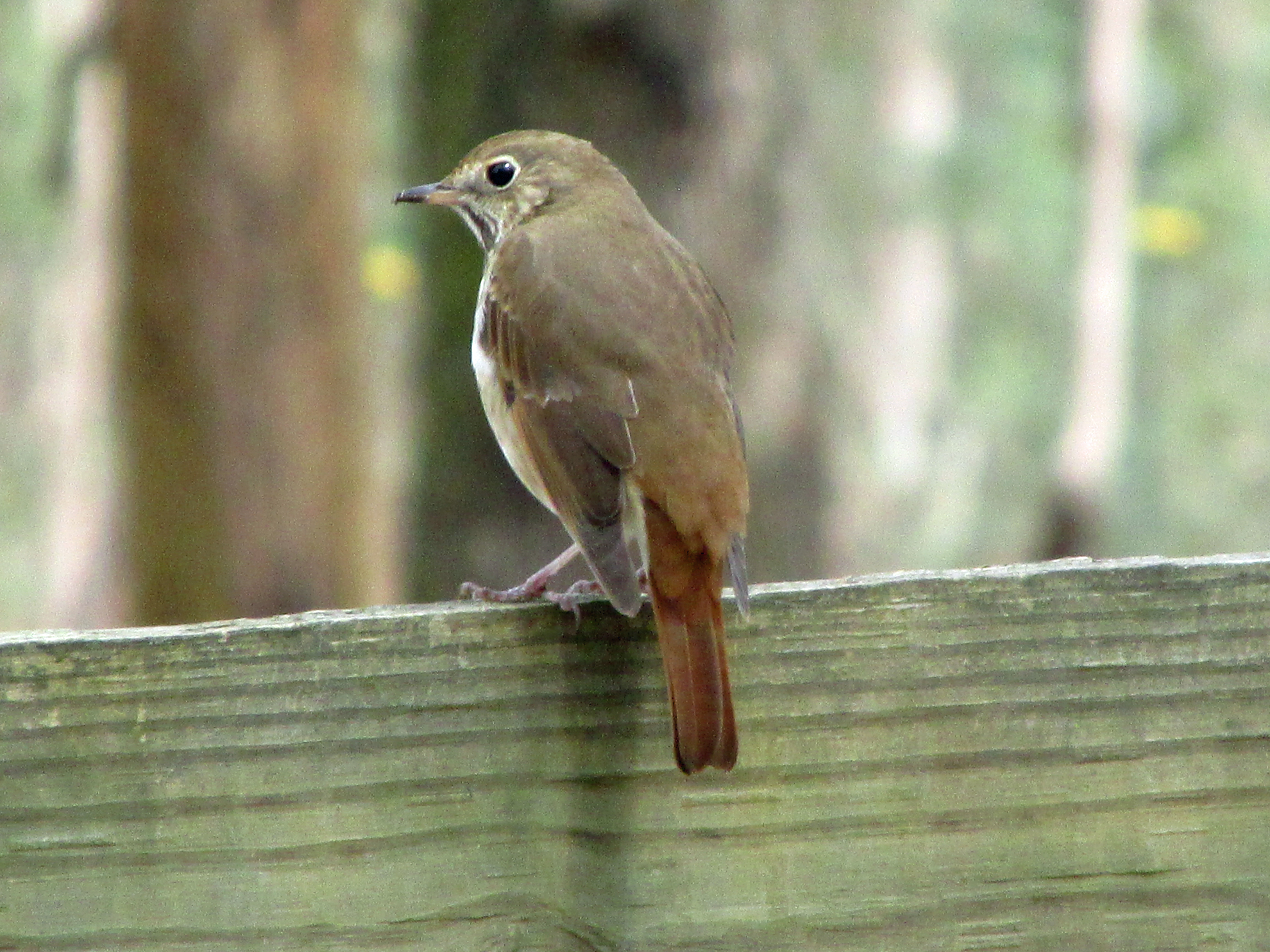
HermitThrush-April

A Hermit Thrush along Simerly Creek was the last bird found on my personal quest for 100 birds in my yard in 2015. This individual was photographed this past March in South Carolina.

My own personal Big Yard Year ended on Dec. 31, 2015. I found my last bird species of the year — Hermit Thrush — lurking in a tangle of rhododendrons on a slope overlooking Simerly Creek. The thrush was the 90th bird I found in my yard in 2015, which brought my quest to an end still shy 10 species of reaching my goal of 100 species in a calendar year.
The Hermit Thrush is the only brown thrush likely to remain in Northeast Tennessee during the winter months. Others, like the Wood Thrush and Veery, winter in the American tropics and return to the United States and Canada each spring for the summer nesting season.
The Hermit Thrush is well known for its song, which consists of a series of clear, musical notes, each on a different pitch, consisting of a piping introductory note and a reedy tremolo. The birds don’t usually sing in winter, but they do produce a call note when disturbed or alarmed that is described as a low “chuck.”
In the summer, the Hermit Thrush feeds on a variety of insects and spiders, but this bird switches to a diet of fruit and berries during the winter months.
The well-known American poet Walt Whitman used a Hermit Thrush as a powerful symbol in his famous poem, “When Lilacs Last in the Dooryard Bloom’d.” Whitman introduces the bird in his poem with the lines, “In the swamp in secluded recesses/A shy and hidden bird is warbling a song/Solitary the thrush/The hermit withdrawn to himself, avoiding the settlements/ Sings by himself a song.”


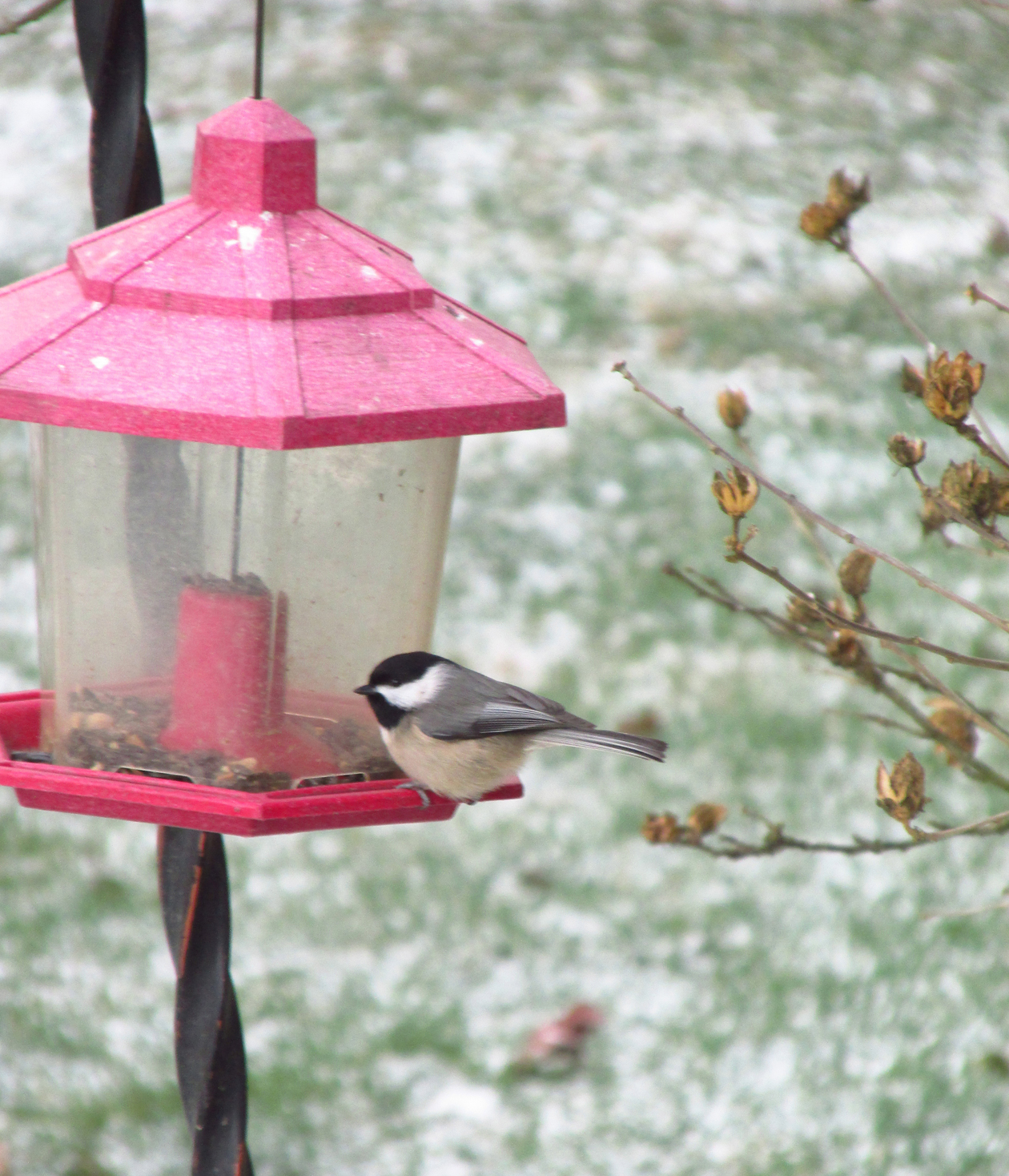
Winterchickadee

Many birds, such as Carolina Chickadees, are almost daily visitors to my yard.

Overall, I am quite pleased with finding the 90 species in my yard. After all, it broke my old record. I can’t help but think on those species that I missed. Winter species like Yellow-bellied Sapsucker and Brown Creeper, which have been relatively rare in my yard, simply didn’t make an appearance in 2015. House Wren was one bird that I had really expected to find. For some reason, however, no House Wrens took up residence at my home in 2015. Other birds that occasionally make migration stops but didn’t visit last year included Vesper Sparrow, Blue-winged Warbler, Kentucky Warbler, and Canada Goose.
I saw most of my birds in January, ending the first month of the year with 26 species. I also saw 14 species in both April and September, which testified to the strength of my yard to attract migrant birds.


Peregrine_Falcon (1)

Photo by U.S. Fish and Wildlife Service This Peregrine Falcon is a captive bird, unlike the one found during the Roan Mountain CBC.

I haven’t decided if I am setting any birding goals for 2016. I may simply enjoy birds without any specific aims. However, the year is still young. If I decide otherwise, I will announce it on my weekly blog.