Tag Archives: Brayden Paulk

Birder with ties to Northeast Tennessee plans Global Big Day

Photo by Bryan Stevens • Brayden Paulk introduces Rufous, a surprisingly tame ruffed grouse that lived on his grandfather’s farm for several years.

Brayden Paulk recently sent me an email to share some recent bird sightings he has made in Georgia.

As background, I’ve known Brayden since the summer of 2016. At the time, he was 17 years old and visiting with his grandparents in Flag Pond for the summer. We got acquainted thanks to an amazing ruffed grouse hanging out at a barn.

Brayden named the grouse Rufous who, as it turned out, was a remarkable bird. Ruffed grouse are, as a rule, shy and retiring birds. Not Rufous. He was an in-your-face sort of grouse. Getting to meet and observe this amazing bird was a privilege.

After we met so that I could make acquaintance with Rufous, Brayden and I did some birding at Rock Creek Recreation Area and then some stops on U.S. Forest Service lands along Highway 107 between Limestone Cove and the North Carolina line. Brayden wanted very much to add a black-throated blue warbler to his life list, and I very much wanted to help him find it.

We did manage to locate a singing veery, a scarlet tanager and a dark-eyed junco. We also found several warblers, including black-and-white warbler, worm-eating warbler and black-throated green warbler, but I began to fear we wouldn’t manage to locate his target bird.

But I am happy to report that we managed to find a male black-throated blue warbler. So, that productive morning back in 2016 resulted in my meeting with a grouse with a lot of personality and Brayden getting a new species for his life list of birds.

When we first met, Brayden was living with his family in Oxford, Alabama. During our first in-person meeting he made a point to tell me that his grandparents, Leon and Janice Rhodes, mailed him every one of my bird columns.

Photo by Bryan Stevens • The late Leon Rhodes teases Rufous the ruffed grouse.

These days he is living in Georgia, which is also providing the focus for most of his birding. He returns often to Tennessee. In fact, he has given a couple of talks to the Elizabethton Bird Club over the years, impressing his audience with his enthusiasm and engaging way of presenting information.

His talk were, surprisingly, not about birds. He spoke about his other passion, fishing, but still managed to make a few mentions of birds in the process.

Brayden has also worked for a couple of summers at Lamar Alexander Rocky Fork State Park in Flag Pond as a seasonal interpretive ranger.

Anyway, enough with the background and back to his recent email.

“I hope everything is going well with you and the bird club,” he wrote. “I wanted to contact you about some interesting recent sightings I have had that I thought you would be interested in. I have been able to put a lot of effort into birding so far this spring and it has turned up some fantastic finds.”
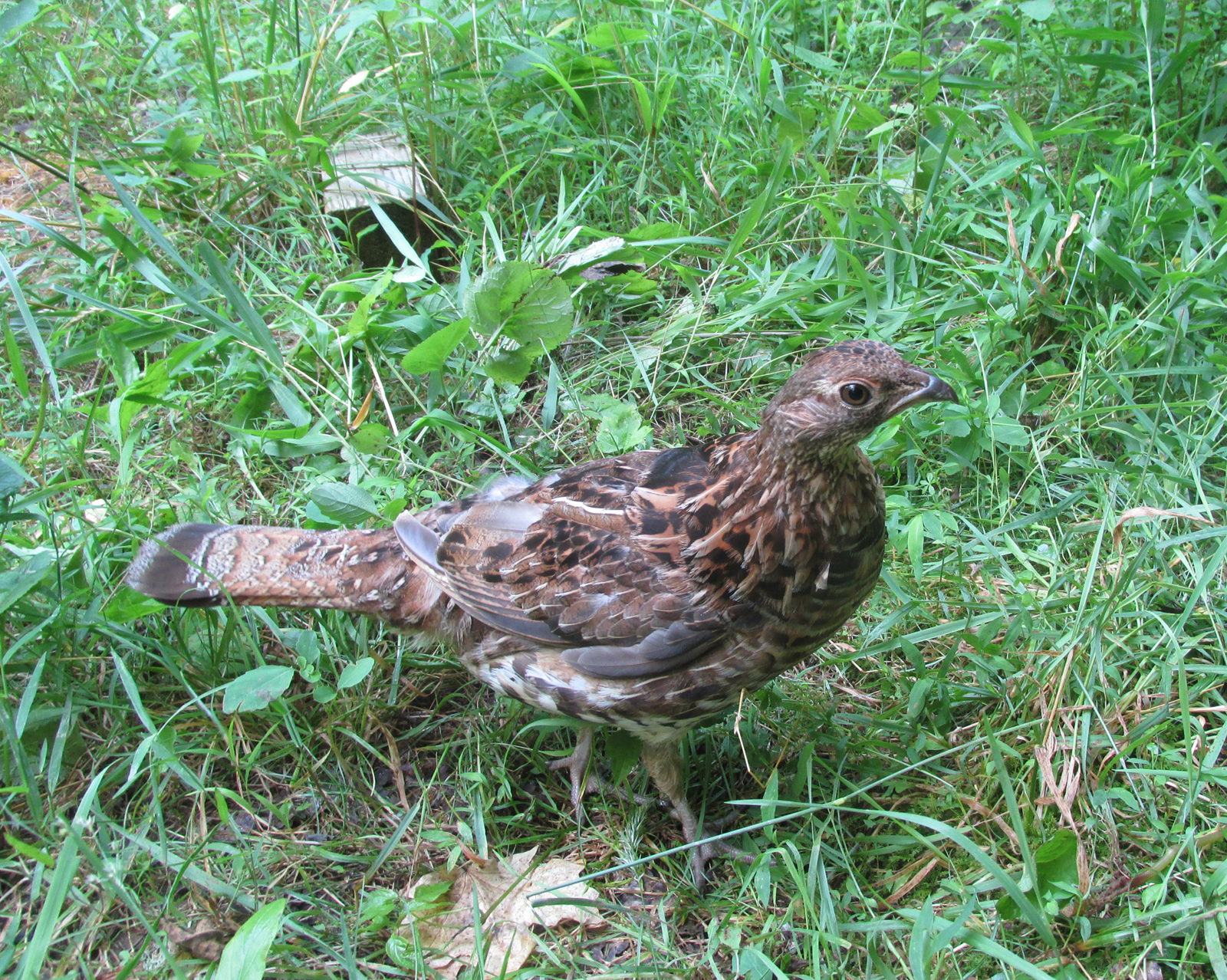
Photo by Bryan Stevens • Rufous, a rather tame ruffed grouse, who made his home in Unicoi County for several years.

His finds have even established some records in Laurens County in Georgia where he now lives.

His local birding loop in his home county has been very productive.

On April 7, his observations of common loons resulted in a county high count for the species. He found 14 loons on one lake and six on another nearby lake. The next highest count before his sighting had stood at two birds.

“That loop has also been very productive for shorebirds, as there are some flooded areas in nearby fields where I have seen lots of greater and lesser yellowlegs and snipe,” he wrote.

“I also got excellent views of a Swainson’s warbler within feet of me at an area on the loop with some swamp and cane thicket habitat,” Brayden added.

On April 7 while running his llocal birding loop in Laurens County, Georgia, Brayden Paulk saw the county high count for common loons with 14 on one lake and 6 on another nearby.

That sighting alone is something that would make many birders envious. I have been birding since 1993 and I can count on one hand the number of looks I’ve had of Swainson’s warbler. The species is often localized, meaning it takes some effort to locate. It’s easy to hear them. The Swainson’s warbler has a loud, ringing song similar to a Louisiana waterthrush. I’ve heard Swainson’s warblers much more frequently than I have seen them.

Brayden also shared his excitement about seeing his first first Horned Lark in the county. He saw the lark, a bird of open fields, at a different location. “It seems to be one of those birds you have to try to find by going to a sod farm or open country,” he noted.

“The Laurens County Loop has also been great for me in the past, and one particular pond turned up the first eBird county records for American avocet, white-rumped sandpiper and long billed dowitcher,” he wrote. “I have also found breeding painted buntings on the loop as well and had an excellent view of them with my dad.”

Brayden also wanted to share some more exciting news.

“I will be moving to Gulf Shores in coastal Alabama in a few weeks, which is one of my favorite places to go birding,” he wrote. “I plan on going to Dauphin Island on the Global Big Day because it is an incredible place to see migrants, and my goal is to find 150 species on that day.”

This year’s Global Big Day is scheduled for Saturday, May 10. Global Big Day is an annual birdwatching event hosted by eBird and Cornell Lab of Ornithology to celebrate and document bird migration. The event was created as a fun and engaging way for bird enthusiasts of all levels to contribute to science and conservation by reporting their bird sightings.

Brayden also hopes to visit Unicoi County again soon to do some birding there and look for some of the species he missed last Summer.

“Thank you for writing your bird articles,” he wrote at the conclusion of his email. “They have inspired me since I was young!”

It’s not easy to put into words how much that unexpected praise made me feel. I am incredibly gratified that I could have provide some inspiration to get such a gifted young man into the field looking for birds.

Readers may recall that I’ve had some deterioration of vision in recent years. With a pair of binoculars, I can still bring birds close enough to enjoy and appreciate their beauty and vivacity. Spotting birds, which is a skill that takes some practice to achieve, is no longer easy for me. Ah, the things we take for granted…

My hearing remains unimpaired. I have enjoyed making note of returning warblers and other birds simply by hearing their familiar songs ringing through the woodlands at my home for yet another spring.

For the past couple of weeks I’ve also had the pleasure of watching daily as a feisty male ruby-throated hummingbird visits the feeders arranged around my front porch.

In closing, I invite everyone to wish Brayden luck with his upcoming Global Big Day. I hope to update everyone with how he does.

•••

To share a sighting, ask a question or make a comment, email me at ahoodedwarbler@aol.com.

Making the acquaintance of a special ruffed grouse with lots of personality

Although I’ve seen many birds over the years, it’s not often that I’m introduced on a first-name basis with one. So, I’m happy to report that I’ve now made the acquaintance of Rufous, a resident of the woodlands around Flag Pond, a small community in Unicoi County, Tennessee.


Rufuous-Two (1)

Photo by Bryan Stevens                               Rufous the ruffed grouse has been visiting the farm of Leon and Janice Rhodes for the past couple of years, apparently showing little fear of his human neighbors.

Rufous is a ruffed grouse that has been a fascinating and funny neighbor to Leon and Janice Rhodes for the past couple of years. I met Rufous on Saturday, June 25, at the Rhodes family farm. Brayden Paulk, a grandson of the couple, invited me to visit and attempt to meet Rufous.


This particular grouse is apparently a creature of habit, and Brayden suggested that a morning visit might be more conducive to my chances of getting to know Rufous.
I arrived around 9 a.m. and met Brayden and his grandfather. We went to a nearby barn, which apparently serves as a familiar meeting spot for Rufous and those people lucky enough to have gotten to know him over the past couple of years.
Rufous is only one member of a family of ruffed grouse in residence on the Rhodes property. In an email to me, Brayden told me that the mountain farm is a good place to see ruffed grouse. The 17-year-old doesn’t live in Tennessee, but he is a frequent visitor, spending time with his grandparents as often as possible. He and his family live in Oxford, Alabama. He also told me that his grandparents send him every one of my bird columns in the mail.

Brayden-Rufous

Photo by Bryan Stevens                Inside his grandfather’s barn, Brayden Paulk spends a moment with Rufous, a ruffed grouse with an abundance of charisma.

“I do happen to live in a great place for birds,” he informed me in an email. His home is located close to the Mountain Longleaf National Wildlife Refuge, which Brayden said is known for breeding blue-headed vireos, red-headed woodpeckers, and Swainson’s warblers.
“It has a lot of longleaf [pine] habitat, so I hope soon that red-cockaded woodpeckers might be reintroduced there, and establish a colony,” he added. The red-cockaded woodpecker is classified as an endangered species across much of the southeastern United States.
Brayden is a volunteer working in the Talladega National Forest in the foothills of the Appalachians on a study focused on the effects of controlled burns on cavity-nesting birds, such as red-cockaded woodpeckers.
He is an enthusiastic and, as I learned after meeting him, quite an accomplished birder. Warblers are his favorite family of birds, followed by ducks and sparrows.
“I enjoy where I live because I get to enjoy species such as the black-throated green warbler, blue-headed vireo and even red crossbill in the summer,” he said.
We have also exchanged emails in a discussion about why some of these birds, which are usually found in the boreal forests much farther north, stay much farther south along the spine of the Southern Appalachians.
His future plans are to major in Conservation Biology. “I hope to get a masters in ornithology from Cornell,” Brayden shared.

Rufous-Three

Photo by Bryan Stevens                               Leon Rhodes uses his cap to challenge Rufous to a friendly duel.

Of course, during our recent meeting, his focus was on arranging a meeting with Rufous, a bird with “a lot of personality.” Both Brayden and his grandfather cautioned that Rufous doesn’t follow a schedule. In other words, the meeting would take place only if Rufous was so inclined.

Although he has a very tame nature, Rufous is most definitely a wild bird.
Fortunately, I didn’t have to wait too long. Brayden was the first to detect the soft clucks as Rufous made his way cautiously toward the old barn. He emerged from the surrounding woodlands and walked into the barn where I was seated and waiting with Brayden and his grandfather.
Rufous immediately noticed my presence, identifying me as a stranger in the midst of some more familiar friends. He kept a wary eye turned on me during his visit. After a few moments of watching Rufous strut around the barn like he owned it — and perhaps he does in his own mind — I removed my camera from my pocket. I made sure that my actions didn’t alarm Rufous. When he didn’t object, I proceeded to take photos and videos of this very personable ruffed grouse.

Chick-Grouse

Photo by Bryan Stevens                              Rufous would have started out life much like this ruffed grouse chick, which was photographed on Holston Mountain in Carter County, Tennessee.

One of his favorite activities during these visits is to duel with a red baseball cap worn by Leon Rhodes. Whenever Brayden’s grandfather removed the cap and waved it in front of Rufous, the grouse became very focused. He channeled his attention almost exclusively on the cap until, with a startlingly swift attack. The entire sequence reminded me of a bull attacking a matador’s red cape.
For probably a half hour, Rufous put on quite a show, and I think Brayden and his grandfather were thrilled that the grouse proved so cooperative during my visit.

ruffed_grouse_audubon

Early American naturalist and painter John James Audubon painted these ruffed grouse as a familym unit.

After my visit with Rufous, I took Brayden for a brief birding trip to Rock Creek Recreation Area near Erwin, Tennessee. I was hopeful we might get to see a black-throated blue warbler, which has been an elusive warbler for Brayden. We did get some good birds at Rock Creek, including hooded warbler, Northern parula, blue-headed vireo, red-eyed vireo, black-throated green warbler and blue-gray gnatcatcher.
We didn’t, however, find a black-throated blue warbler. We didn’t give up, though, and proceeded to the Cherokee National Forest on Unaka Mountain. We made one very productive stop, finding a singing veery, a scarlet tanager and a dark-eyed junco. We also found more warblers, including black-and-white warbler, worm-eating warbler and black-throated green warbler. I’m happy to report we also found a male black-throated blue warbler. So, the productive morning resulted in my meeting with a grouse with a lot of personality and Brayden getting a new species for his life list of birds.
I don’t have any theory to explain Rufous and his acceptance of his human neighbors. I do believe birds, like humans, are individuals. Some of them have quirks that set them apart from others. Although he acts tame, Rufous is still a wild bird. Most ruffed grouse are extremely wary birds that go out of their way to avoid humans. Meeting a grouse that took humans in stride was a fascinating experience.

Grouse 2

Photo Courtesy of Jean Potter                          This photo shows the ruff of feathers that gives this grouse its common name.

The ruffed grouse is named for the male’s neck ruff. These feathers around the neck can be erected in mating displays, creating an impressive “collar.”  The ruffed grouse has served since 1931 as the state bird of Pennsylvania.

Many years ago, a ruffed grouse boldly walked into my front yard and then ventured onto the front porch. Only my timely intervention rescued the visiting grouse from a cat that belonged to my parents.
The unusual behavior of Rufous has persisted for two years. That, in my book, makes him a very unique grouse. I’ll always remember the day that I made his acquaintance.

Rufous-One

Photo by Bryan Stevens       Rufous proved to be a grouse with a unique personality.

••••••

To learn more about birds and other topics from the natural world, friend Stevens on Facebook at https://www.facebook.com/ahoodedwarbler. He is always posting about local birds, wildlife, flowers, insects and much more. If you have a question, wish to make a comment or share a sighting, email ahoodedwarbler@aol.com.