Tag Archives: Carter County Compass

Newest attraction at the Native Wildlife Zoo at Brookgreen Gardens introduces public to migratory waterfowl

FlightsOfPassage

All Photos by Bryan Stevens                                                    The entrance to the new waterfowl habitat at Brookgreen Gardens.

During my recent vacation to Pawleys Island in South Carolina, I’ve been able to visit Brookgreen Gardens, which is one of my favorite attractions in the area.

I was particularly eager to visit “Flights of Passage: Migratory Waterfowl of the Lowcountry,” which is the latest habitat to be added to the Native Wildlife Zoo and Domestic Animal Exhibit at Brookgreen Gardens in South Carolina.

“Flights of Passage” joins the popular Cypress Aviary, an enclosed habitat housing several species of wading birds, such as Black-crowned Night-heron, Great Blue Heron, Snowy Egret, White Ibis and Cattle Egret.

FulvousesSleeping

Fulvous Whistling Ducks take a nap in the afternoon.

Among the waterfowl on display in the “Flights of Passage” habitat are Wood Duck, Redhead, Blue-winged Teal, Ruddy Duck, Hooded Merganser, Northern Pintail, Black-bellied Whistling Duck and Fulvous Whistling Duck.

The Fulvous Whistling Duck, also known as Fulvous Tree Duck, breeds across the world’s tropical regions in Mexico and South America. It is a widespread duck, ranging across four of the world’s continents. This duck has also expanded its range into the West Indies and into the southern United States.

BB-Whistler

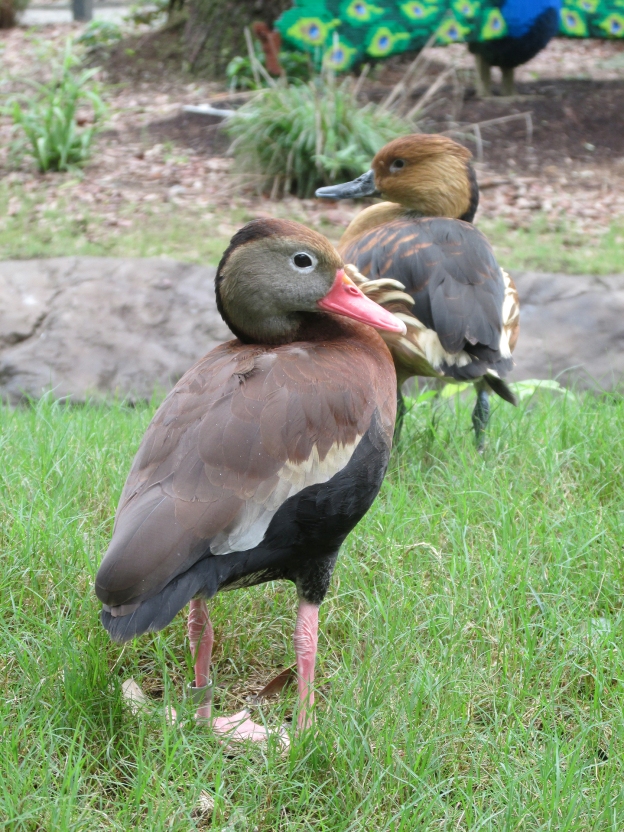
Black-bellied Whistling Duck stands at attention to greet visitors.

The Black-bellied Whistling Duck, formerly also called Black-bellied Tree Duck, is a whistling duck that breeds from the southernmost United States and tropical Central to south-central South America. In the United States, it can be found year-round in parts of southeast Texas, and seasonally in southeast Arizona and Louisiana’s Gulf Coast. It is a rare breeder in Florida, Arkansas, Georgia, Tennessee and South Carolina. In the wild, this duck usually forages for food at night.

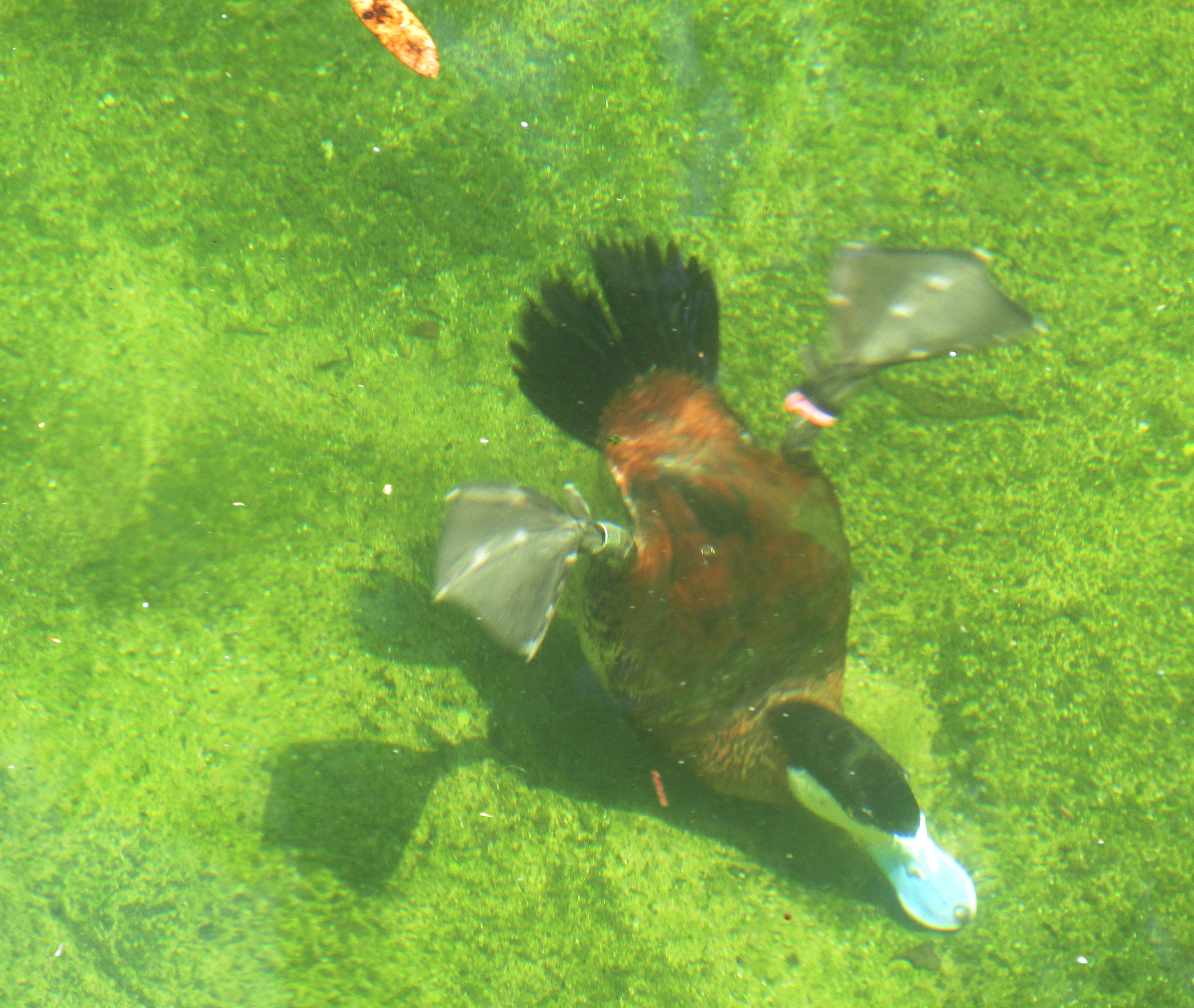
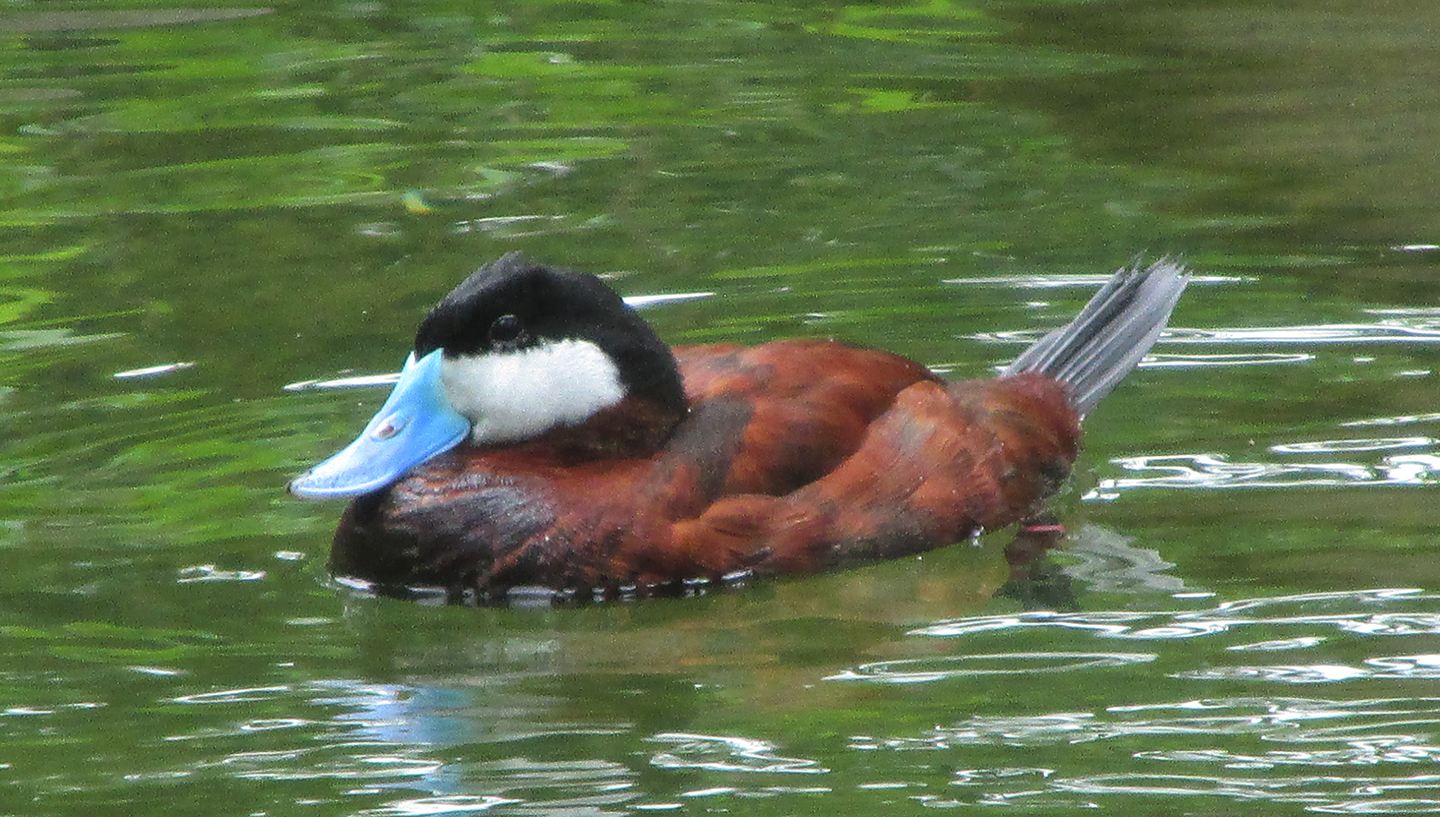
The Ruddy Ducks, especially the male with his bright blue bill, wins many fans among visitors to “Flights of Passage.” The Ruddy Duck is a native of North America, but can also be found in South America along the Andes Mountains. This duck belongs to a family known as the “stiff-tailed ducks.” These ducks migrate to avoid the colder winter conditions, usually spending the winter months on coastal bays or unfrozen lakes and ponds.

WoodDuck-Head

The male Wood Duck is one of North America’s most colorful ducks.

The Wood Duck, also known as the Summer Duck and the Carolina Duck, is one of the few ducks that breeds in the southeastern United States. It is a cavity-nesting bird and will accept nesting boxes provided by humans. Males, or drakes, are considered among the most colorful of North American waterfowl. The Wood Duck is one of two ducks in the genus Aix. Its only close relative is the Mandarin Duck of East Asia and Japan.

The Redhead is a species of diving duck that nests on prairie wetlands across the United States and Canada. It belong to a family of ducks known as “pochards,” which are adapted to foraging underwater. While the Redhead can be legally hunted, the federal government has in place restrictions on the number that can be taken during a hunting season.
Pintails

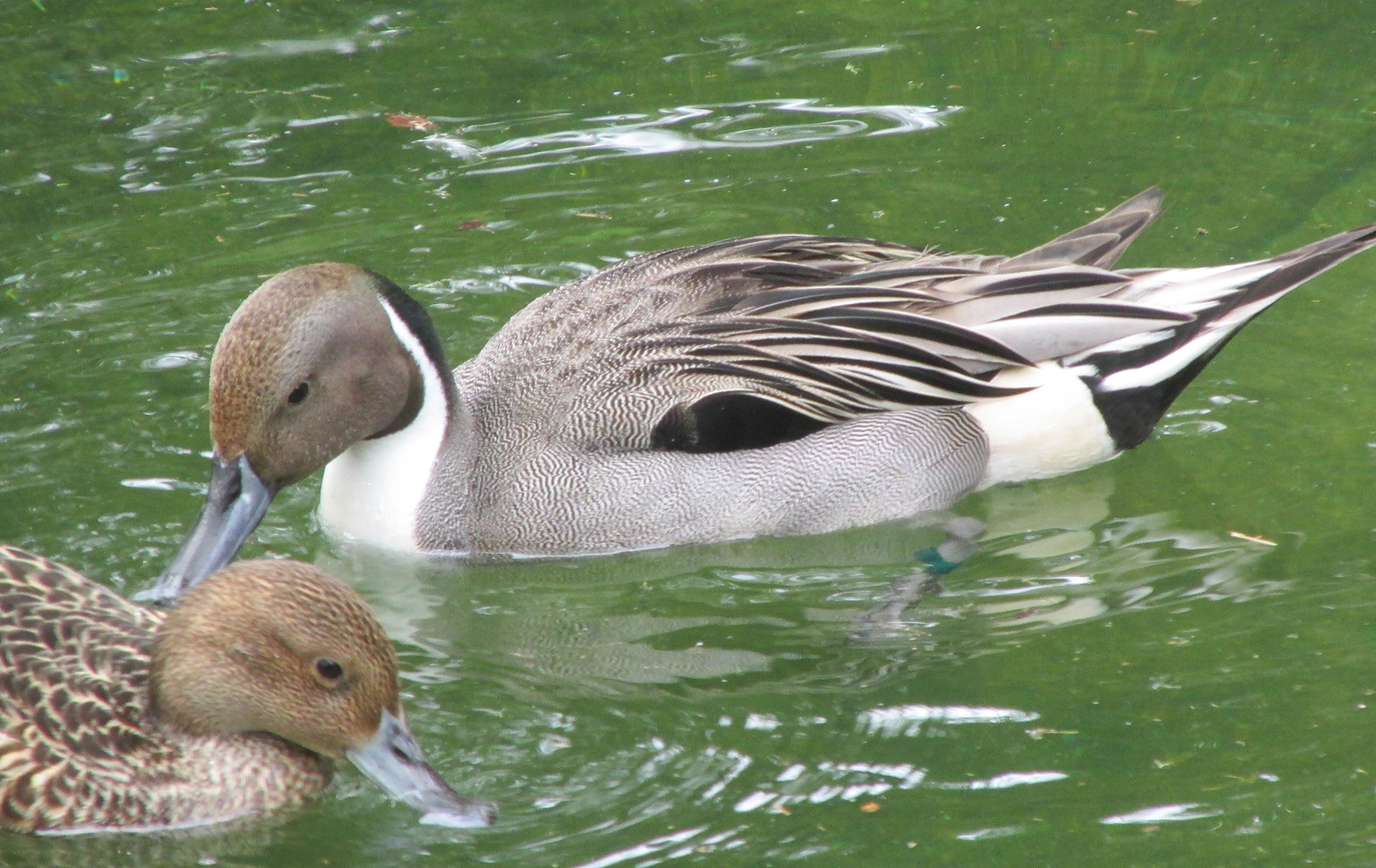
A pair of Northern Pintails enjoys a swim in their pool.

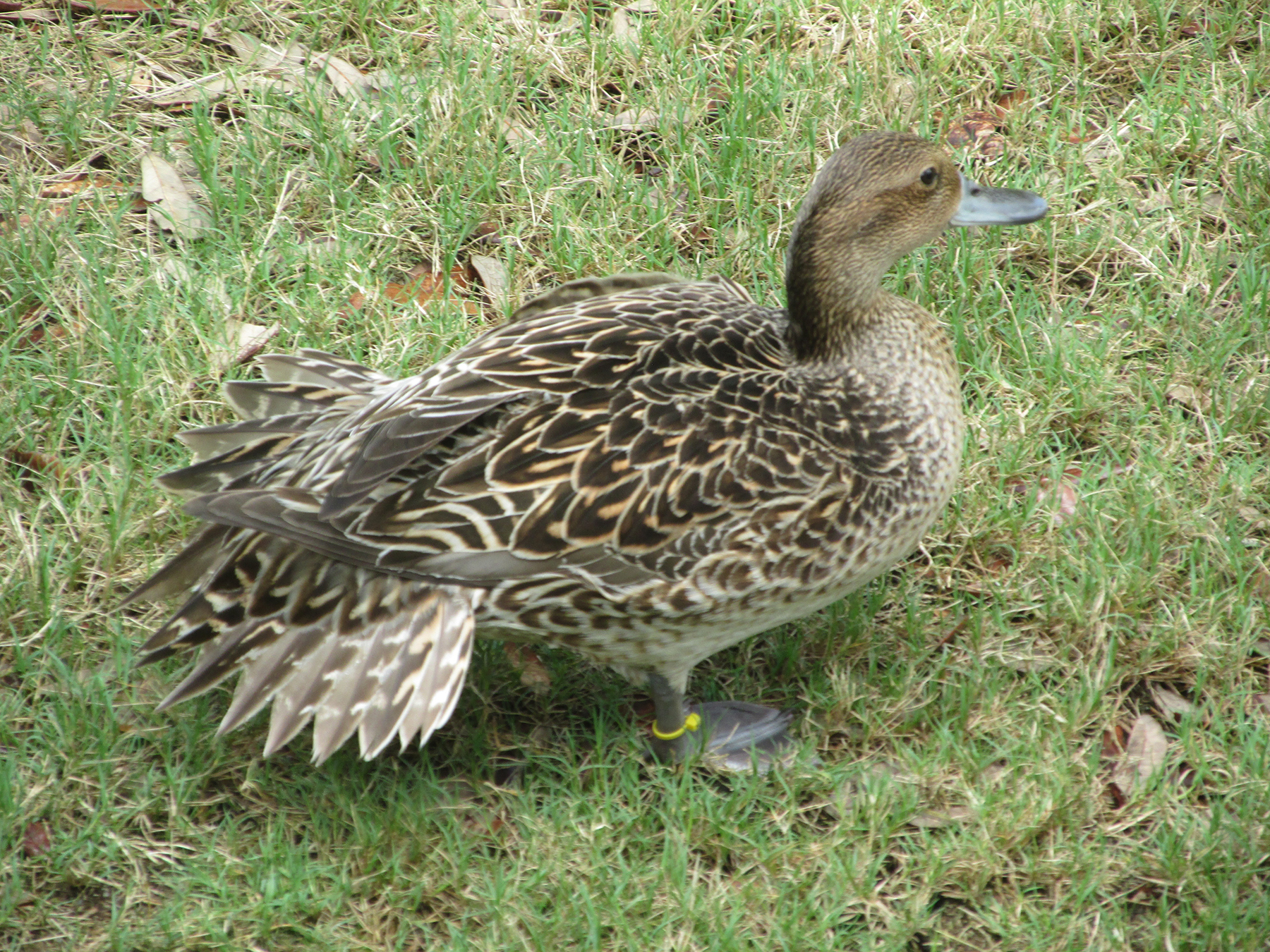
The Northern Pintail is a duck with a wide geographic distribution. Pintails breed in the northern areas of Europe, Asia and North America, but this waterfowl is migratory and winters south of its breeding range to the equator.

Peacock-LegoAndDucks

This Lego sculpture of a peacock is located in the waterfowl habitat as part of the “Nature Connects” exhibition.

The Hooded Merganser, according to the website All About Birds, are excellent divers and can catch numerous aquatic insects, crayfish, and small fish. Males court females by expanding their white, sail-like crests and making very low, gravelly, groaning calls. Hooded Mergansers fly distinctively, with shallow, very rapid wingbeats. Like the Wood Duck, the Hooded Merganser is also a cavity-nesting bird.
Since March 5, visitors to the zoo have also been able to see 12 larger-than-life LEGO® brick sculpture installations in the Native Wildlife Zoo. Created by Sean Kenney, renowned artist and children’s author, “Nature Connects” is an award-winning exhibit currently touring the country. The exhibit is open daily and is included in garden admission through Sept. 5.

Made from almost a half million LEGO® bricks, the sculptures bring nature to life with a six-foot tall hummingbird hovering over a trumpet flower, a deer family made from 48,000 bricks, a giant tortoise, a seven-foot-long giant dragonfly, a bird bath attracting cardinals, bees and a squirrel and much more.

The exhibit features interpretive panels with an educational message for each sculpture to connect children with the natural world and promote conservation.In addition, there are educational activities such as a LEGO® sculpture building contest, scavenger hunts, and 30,000 LEGO® bricks available for guests to play with when you are here.

Ruddy-One

Ruddy Duck keeps one eye open to monitor visitors to the enclosed waterfowl aviary.

Other animals displayed throughout the Native Wildlife Zoo are Great Horned Owl, Turkey Vulture, Bald Eagle, Red-tailed Hawk, Barred Owl, River Otter, American Alligator, Grey Fox, Red Fox and White-tailed Deer.

The grounds and walking trails of Brookgreen Gardens also offer birding opportunities. In the early summer months, visitors can observe Prothonotary Warbler, Common Yellowthroat, Yellow-billed Cuckoo, Great Crested Flycatcher, Brown Thrasher, Brown-headed Nuthatch, Red-headed Woodpecker and many other wild birds.

Redhead

The male Redhead shows the namesake coloration on the drake’s head.

Brookgreen Gardens is a National Historic Landmark and non-profit organization located on U.S. 17 between Murrells Inlet and Pawleys Island. For more information, visit the website at http://www.brookgreen.org or call (843) 235-6000.

According to the attraction’s website, the Native Wildlife Zoo has been an important element of the mission for Brookgreen Gardens since its inception. It is the only zoo accredited by the Association of Zoos and Aquariums on the coast of North and South Carolina. The AZA is America’s most respected organization for zoos and aquariums. All of the native animals in the Native Wildlife Zoo were either bred and raised in captivity or have sustained a major disability due to injury. In either case, these animals could not survive in the wild.

WoodieHen-Branch

Female Wood Duck perched on a tree branch.

Whistlers

Black-bellied Whistling Duck, foreground, with a Fulvous Whistling Duck.
Ruddy-Water

Male Ruddy Duck sporting his blue bill.

Mergansers

Hooded Merganser flaps her wings.

Fulvous-Woodie

Wood Duck, background, and a Fulvous Whistling Duck.

BluewingTeal-SPLASH

Blue-winged Teal splashes in the pool.

Redhead-Hen

A female Redhead rests by the side of the pool.

Redhead

Male Redhead takes a swim in the pool.

Pintail-Head

Northern Pintail

MERG-Hen

Hooded Merganser stands next to the pool.

Woodie-Cute

Wood Duck rests at side of the pool.

RuddyDuck-Swimming

Ruddy Duck dives beneath the surface of the pool.
Pintail-Hen

Female Northern Pintail.

PintailDrake

Male Northern Pintail.

Ruddy-Hen

A female Ruddy Duck takes a refreshing dip in the pool.
Territorial nature of house wrens brings these tiny but feisty birds into conflict with their neighbors


83_House_Wren_cropped-to-the-plate-only

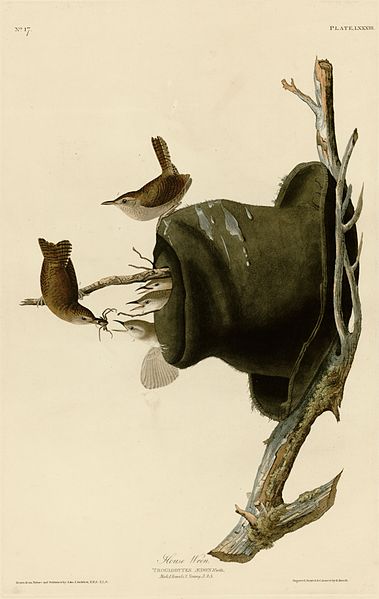
Early naturalist and artist John James Audubon famously painted a family of house wrens utilizing an old hat as a nesting location.

Birds don’t waste much time getting down to the business of nesting each spring. I’ve observed baby robins and bluebirds that are already out of the nest. At home, I have nest boxes occupied by Carolina chickadees, Eastern bluebirds and tree swallows. Unfortunately, for a variety of reasons, nesting attempts don’t always end successfully.

Kathy Shearer, who lives in Emory, Virginia, wrote me last month about a problem affecting her nesting bluebirds.

“I had an active bluebird nest with five eggs until yesterday, when I discovered the shell remnants on the ground beneath the pole,” she wrote. “One was clearly drilled through.” Kathy sent along a photo showing the damage.

“I suspect house wrens, which have followed the bluebird nests for several years, building their own nests in the same box. However, they always let the bluebirds raise two clutches before moving in, until now,” Kathy wrote. “Is there any way to combat these wrens?”

House-wren

Photo by U.S. Fish & Wildlife Service/Dave Menke House wrens make dutiful parents, often tending a brood of as many as eight young.

Kathy’s question presents a definite quandary. With invasive birds, like house sparrows and Eurasian starlings, many bird experts recommend tearing out their nests. Some even suggest disposing of eggs and young. It sounds cruel, but native birds like Eastern bluebirds are at a disadvantage when it comes to competition with these non-native invaders. House sparrows and starlings were never meant to be part of the fauna of North America. Human actions introduced these birds into an environment unprepared for the consequences of the intrusion.

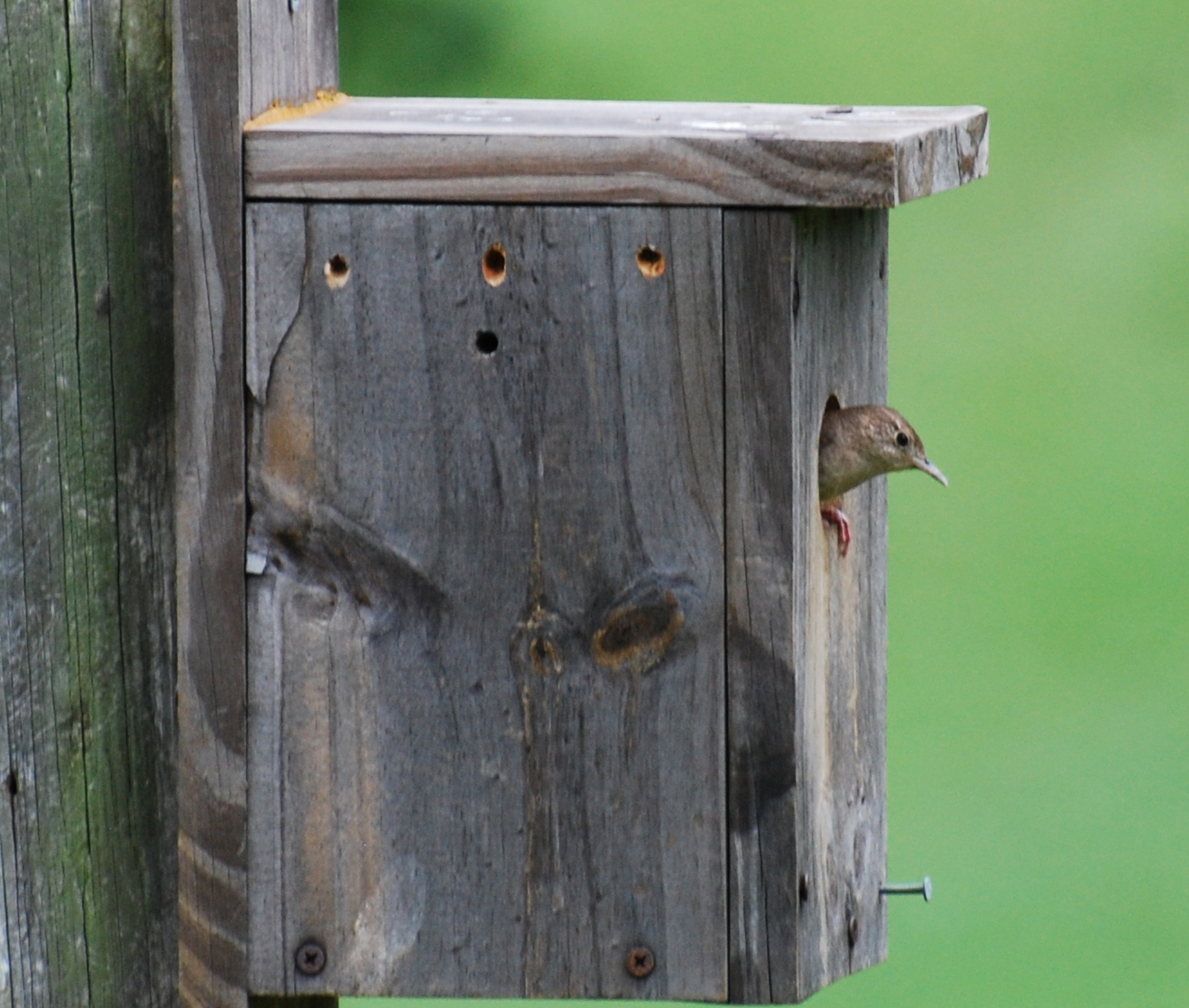
That’s what makes the problem with house wrens a difficult one to solve. The house wren is a native bird that is as much a legitimate part of the environment as bluebirds, tree swallows or other cavity-nesting birds.

Anyone who has ever observed tree swallows and bluebirds competing for a nest box knows that these birds are fierce in their struggles for a nesting location. The house wren, however, uses another approach. These small wrens are stealthy and somewhat ruthless, although both of these terms are something humans have applied as labels to this bird’s natural behavior.

HouseWren-Two

Photo by Jean Potter                                              A house wren checks out a nesting box. Males will often build “dummy nests” to provide females with a choice of nesting locations.

Known by the scientific name of Troglodytes aedon. In Greek myth, Aedon is a woman changed by Zeus into a nightingale, a bird famed for its song. A troglodyte is a cave-dwelling individual. So, roughly translated. the house wren’s scientific name is “cave-dwelling nightingale,” which emphasizes the penchant of the house wren for producing a bubbly, persistent song all out of proportion to the bird’s tiny size. The “cave-dwelling” description comes from the habit of house wrens, as well as other members of the wren family, to skulk near the ground for exploration of nooks, crannies and crevices in search of food.

The house wren arrives in the region just in time for the start of the spring nesting season. Although it is a native bird, this wren often fails to win favor because of its habit of damaging the nests of other cavity-nesting birds such as Eastern bluebirds and Carolina chickadees.

“To a house wren, almost any other nesting bird in its territory threatens competition,” wrote John Eastman in his book, “Birds of Forest, Yard and Thicket.” Eastman, a wildlife biologist and naturalist, emphasized in his chapter on the house wren the territorial nature of the bird. Not only will house wrens puncture the eggs of other birds, they will also kill young birds that are still confined to the nest. Once a pair of house wrens adopts a nesting site, they may remain loyal to it for many years. According to Eastman, these tiny birds display a powerful fidelity to nesting locations from previous seasons.

Caro-Wren-May2016

Photo by Bryan Stevens                                      The two-toned Carolina wren is, for the most part, a kinder and gentler neighbor to other birds in comparison to the related house wren.

I did offer some advice to Kathy, although I cautioned that wrens can be tough to deter since they are extremely territorial. However, they don’t like open spaces as much as bluebirds. I suggested that she make sure her nest boxes are not located near buildings or trees, which could encourage house wrens. House wrens feel most confident when there are thickets, hedges or other thick cover available.

Alternatively, she could provide more nest boxes. House wren males will build multiple “dummy” nests in his attempt to attract a mate. These nests must be approved by the female. Once she makes her selection, she will line the nest with softer materials and then lay her six to eight eggs. If Kathy provides enough boxes, the wrens in her yard might leave the bluebirds alone. I realize that is a big “might.”

Kathy responded with another email after I offered my suggestions. She noted that she lives in a wooded area, so finding open space is difficult. “This bird box is in the middle of the garden, the only open space we have, and has been successful for many years,” she wrote.

Kathy plans to move the box and to put up a second one in the woods that might satisfy the wrens. She also did some of her own research and came across the suggestion of building a guard over the entrance that blocks it from view. “Might give that a try,” she wrote.

CaroWren

Photo Courtesy of Jean Potter                                                A Carolina wren creeps along a fence. Other wrens in North America include Bewick’s wren, marsh wren, sedge wren, cactus wren, winter wren and rock wren.

As much as I hate it when these conflicts arise, house wrens are a native species of bird. That sets them apart from birds like house sparrows and starlings, which are not native. These wrens are small birds, so their aggressive nature is probably a survival adaptation that has served them well as they must contend with larger birds for limited resources.

House wrens are not as photogenic as bluebirds, but they have a lot of traits that make them worth observing. First and foremost, this wren produces an enthusiastic and energetic song. The parents will also rid yards and gardens of a great many insect pests as they work to keep six to eight hungry babies fed. Every wild creature has its place, so I try to offer equal respect to them all.

••••••

To learn more about birds and other topics from the natural world, friend Stevens on Facebook at https://www.facebook.com/ahoodedwarbler. He is always posting about local birds, wildlife, flowers, insects and much more. If you have a question, wish to make a comment or share a sighting, email ahoodedwarbler@aol.com.

Regional spring bird count sets several new records

IndigoBunt

Photo by Bryan Stevens                                  Newly-arrived migrant birds such as Indigo Bunting were well represented on the 73rd annual Elizabethton Spring Bird Count.

The 73rd consecutive Elizabethton Spring Bird Count, which was held Saturday, April 30, set numerous records for this long-running survey of the region’s birds. The 59 observers in 13 parties (both representing record highs for participation) enjoyed favorable weather over the coverage area, which included Carter County and parts of adjacent Johnson, Sullivan, Unicoi and Washington Counties.


Rose-breastedGrosbeak

Photo Courtesy of Jean Potter                              A total of 166 species of birds, including Rose-breasted Grosbeak, pictured, helped participants in the Elizabethton Spring Bird Count, establish a new record high for this annual survey. The old record of 161 species was set back in 2005.

Long-time count compiler Rick Knight announced that the annual count tallied 166 species, eclipsing the previous record of 161 set in 2005. By comparison, the average number over the last 30 years has been 147 species.

Highlights for this year’s Spring Bird Count included American Golden-Plover and Fish Crow, which were new to this annual survey of birds in the region.

Heron-CandlerMurphy

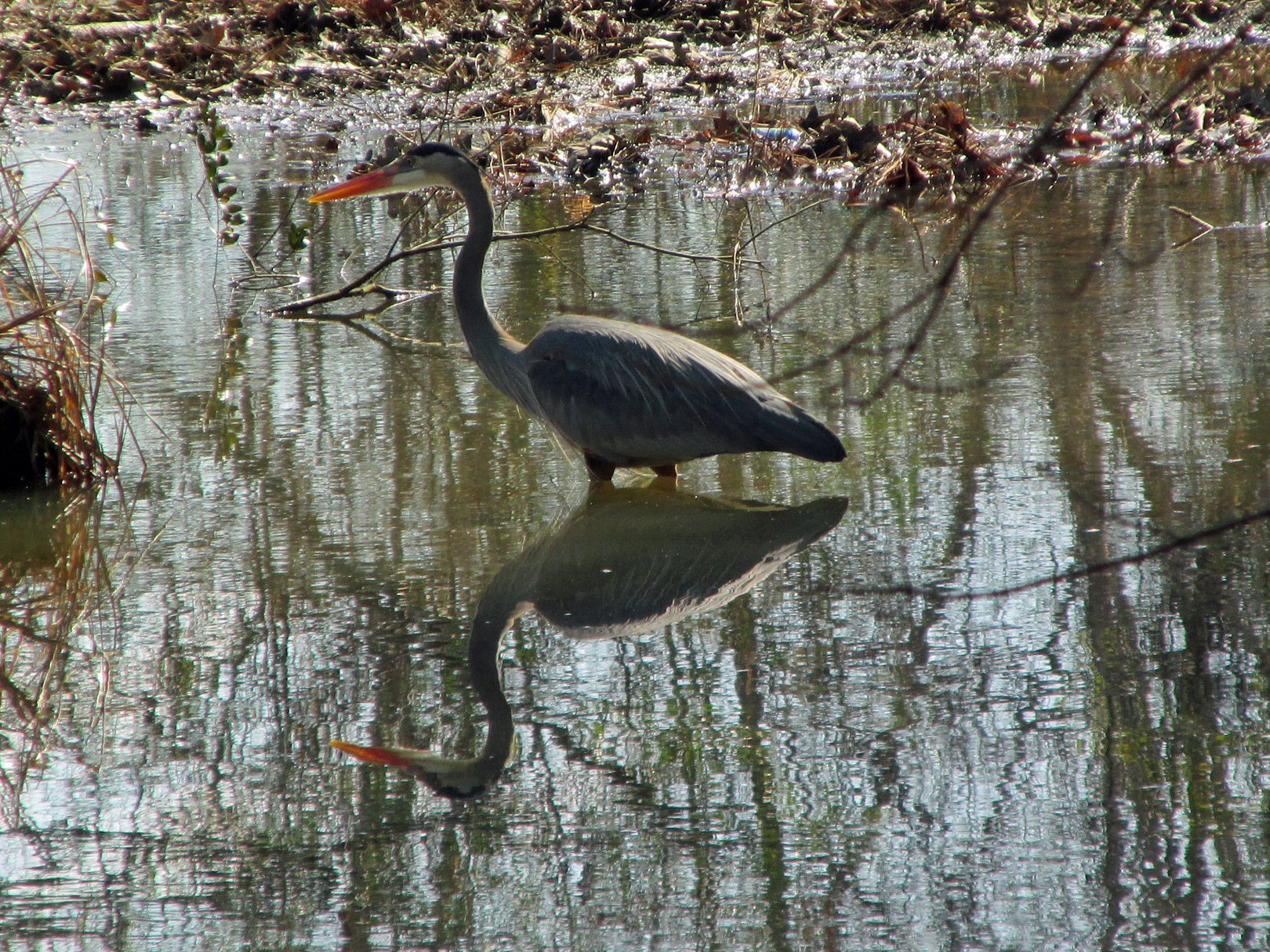
Photo by Bryan Stevens                           The presence of several nesting colonies of Great Blue Herons could help explain a new record-high for this species on this year’s count.

Other notable find included Hooded Merganser (a hen with two young), a lingering pair of Common Mergansers, Virginia Rail, Black-billed Cuckoo, Northern Saw-whet Owl, Peregrine Falcon, Sedge Wren and Cerulean Warbler.

Amazingly, given the long history of this count, 21 species occurred in record high numbers this year. Knight said the increased number of observers and parties certainly contributed to this.

Sora-Jean

Photo Courtesy of Jean Potter                      Although the Sora is rarely found during this annual count, the four individuals found this year represented an all-time high for the species on this yearly survey.

The record highs were for the following species:  Canada Goose (653), Mallard (332), Wild Turkey (57), Great Blue Heron (107), Yellow-crowned Night-Heron (14), Black Vulture (152), Spotted Sandpiper (83), Barred Owl (12), Belted Kingfisher (30), Red-bellied Woodpecker (97), Warbling Vireo (20), Red-eyed Vireo (257), Ovenbird (244), Worm-eating Warbler (39), Yellow-throated Warbler (44), Eastern Towhee (222), Scarlet Tanager (82), and Baltimore Oriole (38). Three species — Orchard Oriole (42), Northern Saw-whet Owl (3) and Sora (4) — tied previous high counts.

Several of these good finds were made by observers counting in Unicoi County at such locations as Rock Creek Recreation Area and Unaka Mountain. The final total follows:

Cardinal_CloseCrop

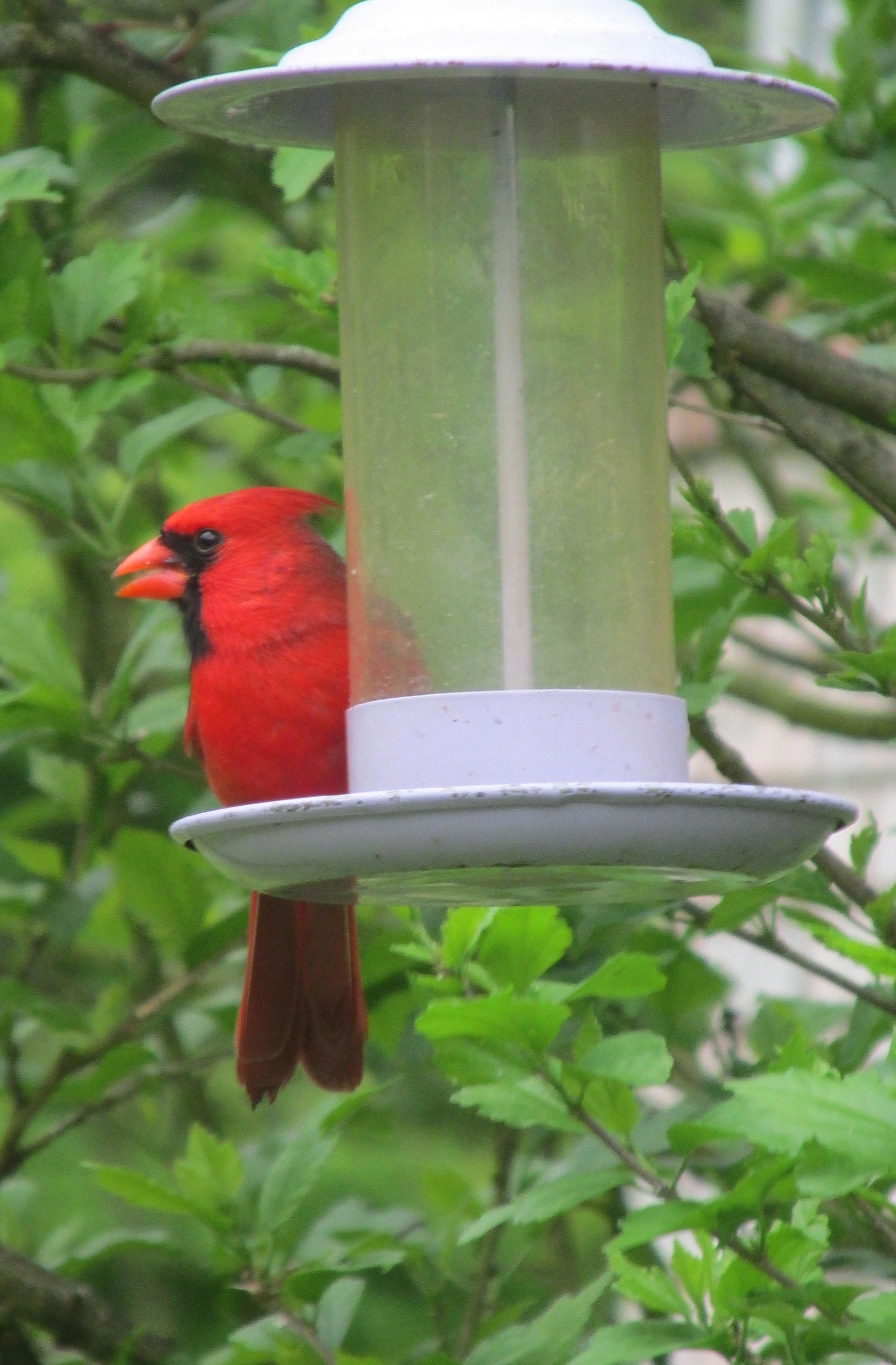
Photo by Bryan Stevens Common backyard birds, such as Northern Cardinal, were among the record-high 166 species found.

Canada Goose,  653; Wood Duck, 85; American Wigeon, 2; Mallard, 332; Blue-winged Teal, 6; Bufflehead, 5; Hooded Merganser, 3; and Common Merganser, 2.
Northern Bobwhite, 1; Ruffed Grouse, 1; Wild Turkey, 57; Common Loon, 1; Pied-billed Grebe, 5; Horned Grebe, 1; and Double-crested Cormorant, 65.
Great Blue Heron, 107; Green Heron, 16; Black-crowned Night-heron, 1; Yellow-crowned Night-Heron, 14; Black Vulture,  152; and Turkey Vulture,  212.
Osprey,  15; Bald Eagle, 10; Sharp-shinned Hawk,  2; Cooper’s Hawk, 7; Broad-winged Hawk, 16; and Red-tailed Hawk,  38.
Virginia Rail,  1; Sora , 4; American Coot, 3; American Golden-Plover, 1; Killdeer,  46; Spotted Sandpiper,  83; Solitary Sandpiper,  34; Greater Yellowlegs,  2; Lesser Yellowlegs , 2; Least Sandpiper, 5; and Pectoral Sandpiper, 2.
Bonaparte’s Gull, 1; Ring-billed Gull, 7; Forster’s Tern, 7; Rock Pigeon, 166; Eurasian Collared-Dove,  3; Mourning Dove,  254; Yellow-billed Cuckoo,  9; and Black-billed Cuckoo, 1.
Eastern Screech-Owl, 10; Great Horned Owl,  6; Barred Owl,  12; Northern Saw-whet Owl, 3; Common Nighthawk, 1; Chuck-will’s-widow, 10; Eastern Whip-poor-will, 32; Chimney Swift , 209; Ruby-throated Hummingbird, 31; and Belted Kingfisher, 30.
Red-headed Woodpecker, 2; Red-bellied Woodpecker,  97; Yellow-bellied Sapsucker, 4; Downy Woodpecker,  37; Hairy Woodpecker, 10; Northern Flicker,  33; Pileated Woodpecker, 43; American Kestrel, 19; and Peregrine Falcon, 1.
Eastern Wood-Pewee,  7; Acadian Flycatcher, 12; Least Flycatcher, 6; Eastern Phoebe, 77; Great Crested Flycatcher, 15; and Eastern Kingbird, 57.
Loggerhead Shrike, 1; White-eyed Vireo, 12; Yellow-throated Vireo, 9; Blue-headed Vireo,  78; Warbling Vireo, 20; Red-eyed Vireo,  257; Blue Jay, 320; American Crow, 338; Fish Crow, 1; Common Raven,  and 14; Horned Lark,  2.
Purple Martin, 81; Tree Swallow, 426; Northern Rough-winged Swallow, 133; Barn Swallow, 217; and Cliff Swallow, 807.
Carolina Chickadee,  173; Tufted Titmouse, 166; Red-breasted Nuthatch, 16; White-breasted Nuthatch, 26; and Brown Creeper,  4.
House Wren,  45; Winter Wren, 4; Sedge Wren, 1; Carolina Wren,  129; Blue-gray Gnatcatcher,  97; Golden-crowned Kinglet, 5; and Ruby-crowned Kinglet, 4.

RedeyedVireo-Jean

Photo Courtesy of Jean Potter                        Vireos, such as this Red-eyed Vireo on a nest, were quite abundant. The numbers of Red-eyed Vireos and Warbling Vireos set all-time highs for the count.

Eastern Bluebird, 157; Veery, 13; Swainson’s Thrush,  2; Wood Thrush, 138; American Robin,  888; Gray Catbird, 55; Brown Thrasher, 45; Northern Mockingbird, 122; European Starling,  986; and Cedar Waxwing, 44.
Ovenbird, 244; Worm-eating Warbler, 39; Louisiana Waterthrush, 32; Golden-winged Warbler, 2; Black-and-white Warbler, 90; Swainson’s Warbler, 6; Nashville Warbler, 1; Kentucky Warbler, 5; Common Yellowthroat, 27; Hooded Warbler, 208; American Redstart, 21; Cape May Warbler, 4; Cerulean Warbler, 2; Northern Parula, 56; Magnolia Warbler, 3; Bay-breasted Warbler, 2; Blackburnian Warbler, 7; Yellow Warbler, 15; Chestnut-sided Warbler, 36; Blackpoll Warbler, 1; Black-throated Blue Warbler, 85; Palm Warbler, 8; Pine Warbler, 10; Yellow-rumped Warbler, 62; Yellow-throated Warbler, 44; Prairie Warbler, 5; Black-throated Green Warbler, 81; Canada Warbler, 44; and Yellow-breasted Chat, 8.
Eastern Towhee, 222; Chipping Sparrow, 126; Field Sparrow, 72; Savannah Sparrow, 1; Grasshopper Sparrow, 4; Song Sparrow, 276; Swamp Sparrow, 5; White-throated Sparrow, 13; White-crowned Sparrow, 11; and Dark-eyed Junco, 63.

Hairy_Male

Photo by Bryan Stevens While some species set record highs, only 10 Hairy Woodpeckers, like this male, were found by participants in the annual Elizabethton Spring Bird Count.

Summer Tanager, 1; Scarlet Tanager, 82; Northern Cardinal, 299; Rose-breasted Grosbeak, 30; Blue Grosbeak, 6; and Indigo Bunting, 126.
Bobolink, 1; Red-winged Blackbird,  480; Eastern Meadowlark, 142; Rusty Blackbird, 2; Common Grackle, 477; Brown-headed Cowbird, 91; Orchard Oriole, 42; and Baltimore Oriole, 38.
House Finch, 56; Pine Siskin, 59; American Goldfinch, 354; and House Sparrow, 80.
•••••

To learn more about birds and other topics from the natural world, friend Stevens on Facebook at https://www.facebook.com/ahoodedwarbler. He is always posting about local birds, wildlife, flowers, insects and much more. If you have a question, wish to make a comment or share a sighting, email ahoodedwarbler@aol.com.

Eastern phoebe easily wins friends with its trusting nature

Considering the bright finery worn by some of the more colorful spring arrivals, I could hardly blame you if the return of the Eastern phoebes escaped your notice. In comparison with vibrant birds like rose-breasted grosbeak, ruby-throated hummingbird, scarlet tanager and yellow warbler, the Eastern phoebe is downright drab.

Phoebe-Baby

Photo by Bryan Stevens                                      This fledgling Eastern phoebe waits patiently on a branch for a parent to bring it a morsel of food. Phoebe-Baby

Phoebe-Two

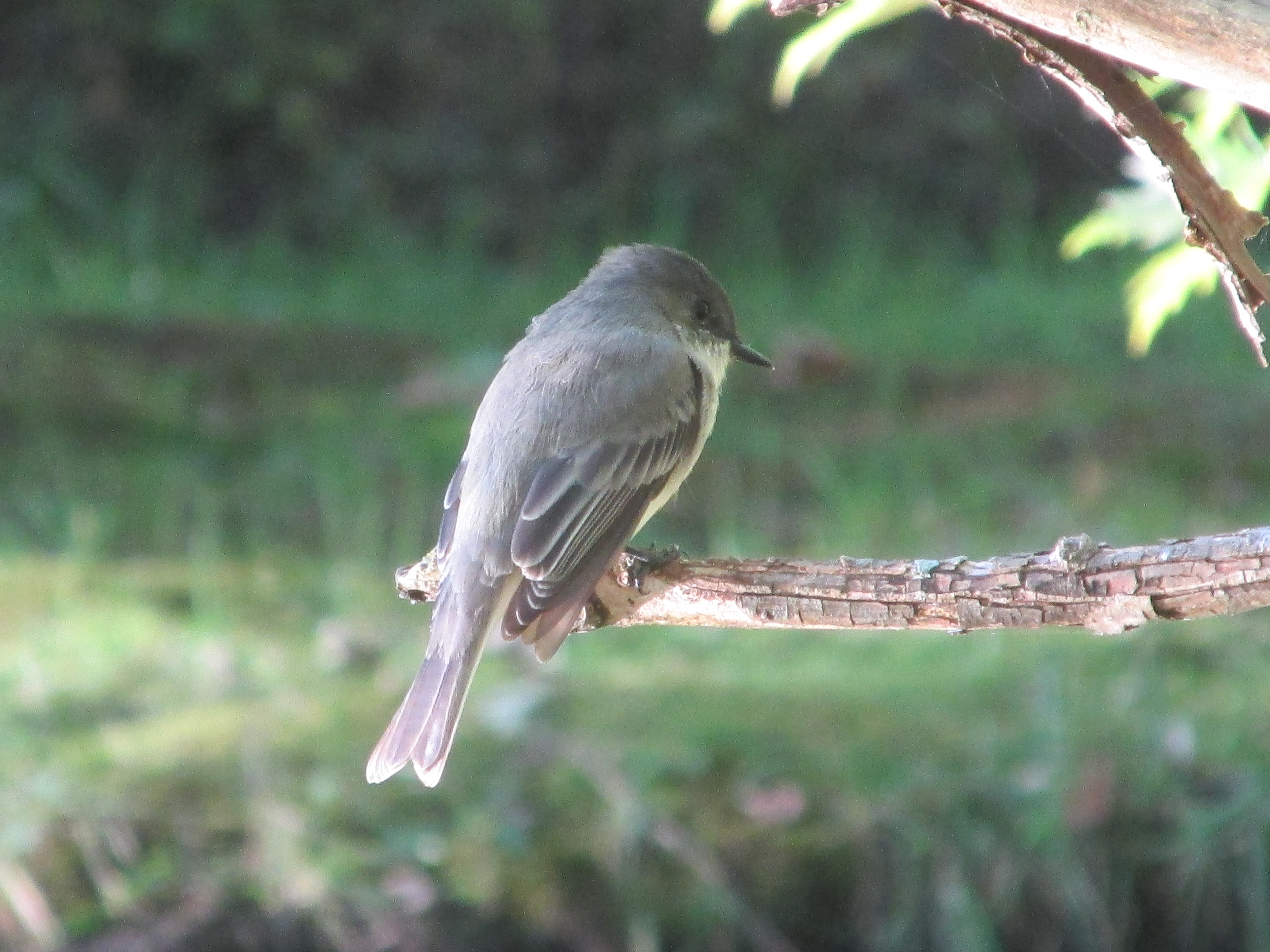
Photo by Bryan Stevens                                                               The Eastern phoebe is a common bird in much of the Eastern United States.

Nevertheless, this member of the flycatcher clan has earned itself a favorite spot in the hearts of many a birdwatcher. It’s one of those birds that even beginning birders find surprisingly easy to recognize and identify. While it may not have a dramatic plumage pattern to hint at its identity, the Eastern phoebe is quite at home around human dwellings and comes into close contact with people going about their daily routines. Rather tame — or at least not too bothered by close proximity with humans — the Eastern phoebe has one behaviorism that sets it apart from all the other similar flycatchers. When this bird lands on a perch, it cannot resist a vigorous bobbing of its tail. Every time that a phoebe lands on a perch, it will produce this easily recognized tail wag. It’s a behavior that makes this bird almost instantly recognizable among birders with the knowledge of this behavioral trait.

The Eastern phoebe is also an enthusiastic springtime singer, and the song it chooses to sing is an oft-repeated two-syllable call “FEE-bee” that provides the inspiration for this bird’s common name.

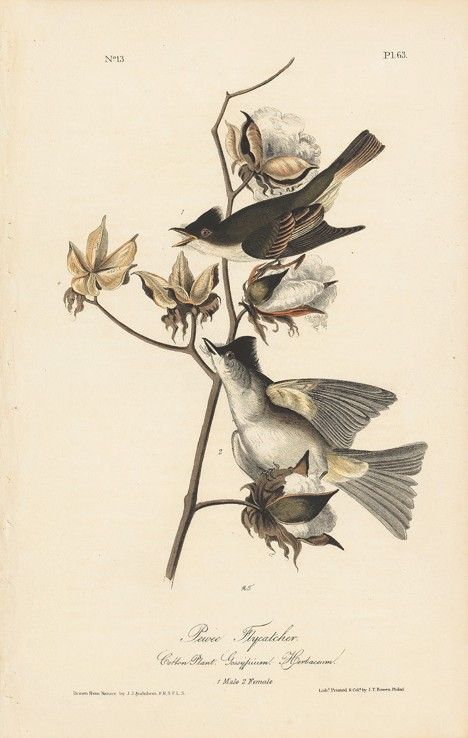
Octavos500_set12

A painting by John James Audubon of Eastern phoebes, or, as he knew them, pewee flycatchers.

Thomas_Say

Thomas Say

The Eastern phoebe, known by the scientific name of Sayornis phoebe, has two relatives in the genus Sayornis. The genus is named after Thomas Say, an American naturalist. The Eastern phoebe’s close relatives include the black phoebe and Say’s phoebe. The black phoebe ranges throughout Oregon, Washington and California and as far south as Central and South America. As its name suggests, this bird has mostly black feathers instead of the gray plumage of its relatives. The Say’s phoebe, also named for the man who gave the genus its name, is the western counterpart to the Eastern phoebe.

Since they belong to the vast family of New World flycatchers, it’s probably no surprise that these phoebes feed largely on insects. The birds will often perch patiently until an insect’s flight brings it within easy range. A quick flight from its perch usually allows the skillful bird to return with a morsel snatched on the wing. In the winter months, the Eastern phoebe also eats berries and other small fruit.

Phoebe-WIllow

Photo by Bryan Stevens                                      An Eastern phoebe forages for insects in the branches of a willow tree.

Phoebes are fond of nesting on human structures, including culverts, bridges and houses. With the latter, they were once known for their habit of placing their nests under sheltering eaves. At my home, a pair of Eastern phoebes often chooses to nest on the wooden rafters in my family’s garage. Phoebes also like to reside near a water source, such as a creek, stream or pond.

Although the species is migratory, a few hardy individuals will usually try to tough out winters in the region. The others that depart in the autumn will migrate to the southern United States and as far south as Central America. On some rare occasions, Eastern phoebes have flown far off their usual course and ended up in western Europe. I can usually count on Eastern phoebes returning to my home in early March, making them one of the first migrants to return each year. Their arrival rarely goes unnoticed since the males tend to start singing persistently as soon as they arrive.

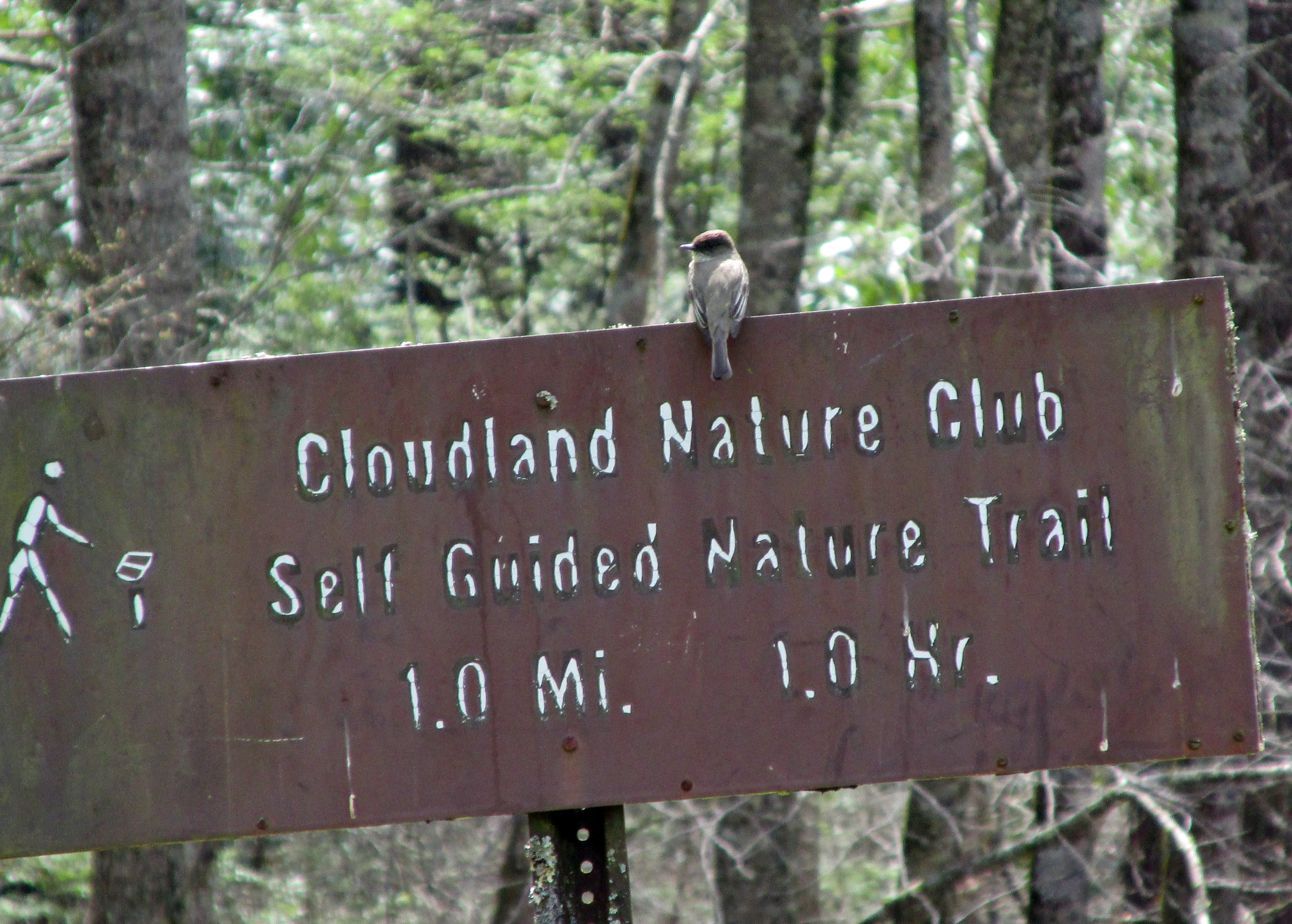
Phoebe-Sign

Photo by Bryan Stevens                                                            An Eastern Phoebe perches on a sign at Roan Mountain State Park in Roan Mountain, Tennessee.

A few weeks ago I wrote about opportunities to take part in citizen science projects for the benefit of birds. The concept of ordinary citizens making a difference in scientific discovery isn’t a new one. More than two centuries ago, one of the most influential birders in history and the namesake of the National Audubon Society used Eastern phoebes to help add to the knowledge of bird migration.

Phoebe-Sept18

Photo by Bryan Stevens            An Eastern phoebe during the fall of the year.

John James Audubon, an early naturalist and famed painter of North America’s birds, conducted an experiment with some young phoebes that represents the first-ever bird banding in the United States of America. His novel experiment, which he carried out in 1803, involved tying some silver thread to the legs of the phoebes he captured near his home in Pennsylvania. He wanted to answer a question he had about whether birds are faithful to home locations from year to year. The following year Audubon again captured two phoebes and found the silver thread had remained attached to their legs. Today ornithologists still conduct bird banding to gather information on birds and the mystery of their migrations.

So, that pair of phoebes that returned to your backyard this spring — they just might be the same ones that have spent past summer seasons providing you with an enlightening glimpse into their lives.

••••••

To learn more about birds and other topics from the natural world, friend Bryan Stevens on Facebook at https://www.facebook.com/ahoodedwarbler. He is always posting about local birds, wildlife, flowers, insects and much more. If you have a question, wish to make a comment or share a sighting, email ahoodedwarbler@aol.com.

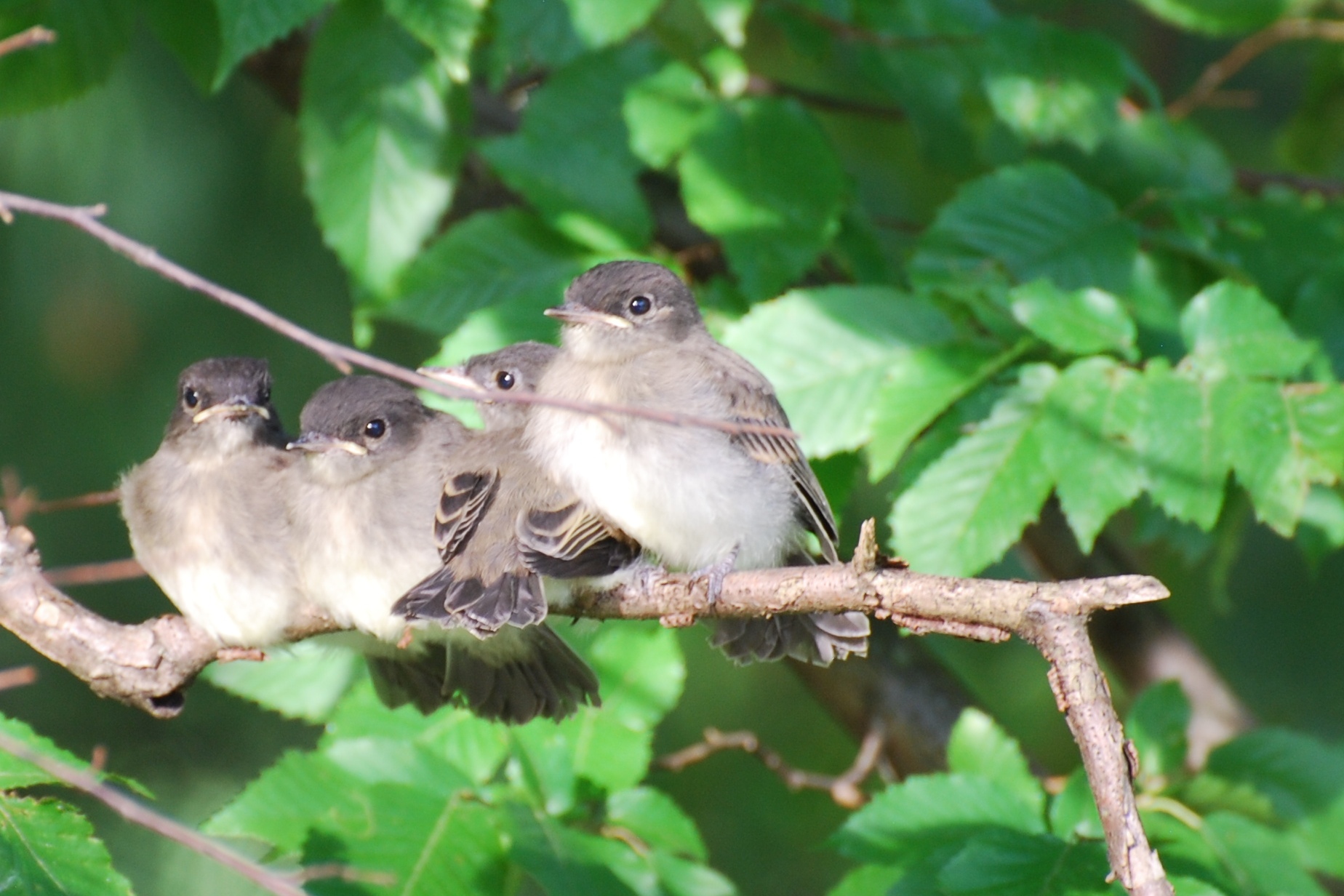
4934813732_fa115579d3_o

Photo Courtesy of Jean Potter                                                                                                          A family of young Eastern Phoebes shares a perch.

Now that hummingbirds are back, here’s how to entice them to stay

4934219635_1db9c900c4_o

Photo Courtesy of Jean Potter                                                              Although hummingbirds migrate back to the region in the spring, their hosts will need to provide a welcoming environment to keep these tiny birds buzzing around the yard all summer.

Now that the hummingbirds have returned to the region, it’s important to know how to attract them and meet their needs. Like most living creatures, hummingbirds require three crucial things — shelter, water and food. A yard with evergreen trees or a thick hedge can provide perfect nighttime roosts for a hummingbird. Other types of trees and shrubs also offer potential nesting locations for female hummingbirds.
Hummingbirds, like all birds, need water. Hummingbirds can get a lot of their water in their diet, but they still need water for bathing. Birds bathe to keep their feathers in good condition. For hummingbirds, which are wizard aerialists among birds, it is even more crucial that their feathers are in good shape. A fountain, trickling waterfall or even a well-timed lawn sprinkler are almost magnetic in their attraction for hummingbirds, which are usually too small to bathe in a regular bird bath.

Keeping visiting ruby-throated hummingbirds can be as simple as planting an abundance of the flowers they love, but offering multiple sugar water feeders also helps. Keep the sugar water mix at a four parts water to one part sugar ratio. Don’t offer honey in your feeders. When mixed with water, it can spoil and spread fungal diseases. There’s also no need to use a solution with any sort of red dye. Studies have indicated that such dyes could have adverse effects on hummer health. Remember that hummingbirds don’t subsist on sugar water alone. They also eat numerous tiny insects and spiders to obtain the protein they need for their dietary needs, so don’t use insecticides near feeders or flowers that hummers are likely to visit.

FemaleRuby-April28

Photo by Bryan Stevens                                    By now, female Ruby-throated Hummingbirds are getting ready to build nests and raise young.

Follow these basic instructions and the hummingbirds will reward you with hours of enchanting entertainment this summer.
•••••
I received even more notifications on the return of these tiny winged gems. Here are a few other shared observations: 
» Harold Randolph spotted his first hummingbird in 2016 on Monday, April 11, near Marion, North Carolina, at Lake James. He sent me an email to report the happy fact.
•••••
» Philip Laws in Unicoi County reported on Facebook that he saw his first spring hummingbird on April 11.
•••••
» Betty Poole asked her daughter to email me to report that she saw her first hummingbird of spring on Wednesday, April 13.
•••••
» Steve Meigs, who lives at an elevation of 2,800 feet in Limestone Cove’s Foxhound Hills community near Unicoi, reported that his first hummingbird arrived April 14 at 11:30 a.m. “That’s a few days earlier than the last few years,” he noted on his Facebook comment.
•••••
» John and Patsy Brenner welcomed back their first hummingbird on Monday, April 18. “I believe it was the ruby-throated, but all I really saw was the flash of green,” John wrote in an email. The Brenners live in Meade Meadows in Abingdon, Virginia. “We are on the seventh fairway of the golf course just across from the Creeper Trail,” he wrote. “We are new subdivision so around the houses there are only small trees. I have nesting bluebirds and tree swallows in a free-standing bird house.”
He also reported other daily sightings, including brown-headed cowbirds, doves, finches, cardinals, red-winged blackbirds, sparrows, robins, starlings and downy woodpeckers.
•••••

» Judy Brown, who lives in Damascus, Virginia, notified me that she saw her first hummingbird of the season on Monday, April 18.

Hummer-Male

Photo by Bryan Stevens                                Flowers and sugar water feeders are just two ways to attract hummingbirds to your yard.

•••••
» Mary Beierle of the Stoney Creek community in Elizabethton, Tennessee, welcomed her first spring hummingbird at 6:13 p.m. on Monday, April 18.
“I am so happy!” Mary wrote in an email. “They are very late this year compared to other recent years. This morning there were two hummers and I’m pretty sure they are a male and a female. I have a friend in Jonesborough, Tennessee, who
had his first hummingbird the day before, around 9 in the morning.”
Mary was thrilled by their return. “Spring is finally officially here, in my opinion,” she noted.
» Eddie and Delores Phipps of  Bluff City, Tennessee, shared that their first sighting also took place on Monday, April 18. They had been out of town for the weekend, so they speculated that the hummingbirds might have showed up a day or two earlier.  
Constance Tate’s first sighting of a spring hummingbird involved not one, but two, birds. “There were two of them at the feeder at 3 p.m. on April 19,” she wrote in an email. Constance lives in Bristol, Tennessee, near Steele Creek.
••••••
» Emory & Henry professor Steven Hopp sent me an email about his first hummer sighting on April 20. “I saw my first hummingbird this morning, when it went directly to the empty hummingbird feeder from last year,” he wrote. “I suppose that tells me she was a returning bird.”
•••••
» Helen Whited informed me that hummers arrived at her home in Richlands, Virginia, on Tuesday, April 19.
•••••
» Phyllis Moore of Bristol, Virginia, notified me by Facebook that she saw her first hummingbird of spring around 7:30 p.m. on Wednesday, April 20.
“My first hummingbird just buzzed past my window where I hang my feeder,” reported Patricia Werth in an email. “I guess I better get busy.” Patricia’s sighting occurred at 6:05 p.m. on Wednesday, April 20.
•••••
» Nancy Vernon of Bristol was very excited when she spotted two hummingbirds at her feeder today at 5 p.m. on Wednesday, April 20, in Bristol. “They are very small,” she said, adding that the sighing involved a male and female pair. 
•••••
» Thia Montgomery, who lives in Blountville, Tennessee, reported that her first hummingbird arrived at about 2 p.m. on April 20. “I have three large terra-cotta pots with flowers, and each has a small shepherd’s hook sunk into it with a hummingbird feeder hung on each hook,” she wrote. “As I was watering the flowers in the pots, the hummingbird buzzed me, so I left off watering so he could have a drink.”
The insistent hummingbird — a male —was the first she had seen this year, although she has had her feeders out since the last week of March.
•••••

» Cecilia Murrell of Abingdon,Virginia, has four feeders available for the hummingbirds, but the first one to show up on Thursday, April 21, fed at the nearly empty feeder. “Maybe he has visited me before,” she wrote in an email. 

13043548_10154798728527366_8192659683794612503_n

Photo by Donna Rea              This was the first hummingbird to visit the Rea residence in 2016.
•••••
» Donna Rea shared on Facebook that hummingbirds had returned to her home in the Rock Creek community of Erwin.
•••••
» James Noel Smith reported on Facebook on April 26 that hummingbirds are back at his home in Unicoi.
••••••
To learn more about birds and other topics from the natural world, friend Stevens on Facebook at https://www.facebook.com/ahoodedwarbler. He is always posting about local birds, wildlife, flowers, insects and much more. If you have a question, wish to make a comment or share a sighting, email ahoodedwarbler@aol.comahoodedwarbler@aol.com.


Hummingbirds receive warm welcome upon their return

12080287_10206626890023339_7221944377156024273_o

Photo by Bryan Stevens                                    The last Ruby-throated Hummingbird to visit my feeders in 2015.

My last ruby-throated hummingbird in 2015 visited my sugar water feeder close to dusk on Oct. 10. I never saw any hummingbirds after that date.

I’m always a little wistful when the last hummingbirds depart in the autumn, but I know they’ll return in the spring. This year, a male ruby-throated hummingbird returned on April 12, 180 days after the last hummingbird departed last fall.

What do the hummingbirds that make their homes in our yards from April to October do during the five months they are absent from the region?

Hummer-Shy

Photo by Bryan Stevens                                       The first male Ruby-throated Hummingbird to visit my feeders in 2016 was a bit camera shy.

Most ruby-throated hummingbirds retreat to southern Mexico and Central America, some winging their way as far south as extreme western Panama, as well as the West Indies and southern Florida. They utilize a variety of habitats, ranging from citrus groves and forest edges to tropical deciduous forests and the edges of rivers and wetlands.

Those ruby-throated hummingbirds that make it as far south as Panama may find that they must compete with 59 other species of hummingbirds that call the Central America country home. Panamanian species that a ruby-throated hummingbird might possibly come into contract with include violet sabrewing, purple-throated mountain gem and white-necked jacobin.

In this region, we can only expect with any confidence to enjoy a single species — the aforementioned ruby-throated hummingbird — for half the year. It’s always great to welcome them home. Here are some of the other hummingbird enthusiasts who shared their “first arrivals” with me.

••••••

Doris Cochran in Marion, North Carolina, saw her first hummingbird on April 6.

“I was having my morning coffee … looking out at the frost we got in Marion last night,” she wrote. Then, from inside her home, she happened to notice something. Giving her sugar water feeder a closer look, she was surprised to see a hummingbird perched on it.

•••••

Beverly Puerckhauer sent me an email on April 5. She informed me that she has house finches visiting at her home, but she hasn’t yet seen a hummingbird.

•••••

Jimmie Daniels, Newland, North Carolina, reported her first hummingbird on April 8.

“I just saw a hummingbird at my house and my feeder was inside,” she informed me by email. “The feeder is out now, but he had already left. I sure hope he comes back.”

•••••

Glen Eller, a resident of Kingsport, Tennessee, saw his first ruby-throated hummingbird of the season on Sunday, April 10, at 6:35 p.m. He shared his observation through a post to the list-serve bristol-birds.

•••••

Pat Stakely Cook notified me of a first hummingbird sighting by Facebook post. “We had our first one here in Marion, North Carolina, on Sunday, April 10,” Pat reported, adding that there had been lots of activity around the feeders once that first hummer showed up.

•••••

Philip Laws, a resident of the Limestone Cove community in Unicoi County, Tennessee, reported his first hummingbird on Monday, April 11.

“I just saw my first hummingbird in Limestone Cove, a male of course, about noon,” he reported in a Facebook message. He added that he hadn’t had time to check his feeder on the previous day, but that the sugar water level was down enough to suggest that the hummingbird had probably been feeding on Sunday, too.

•••••

Susie Condrey of Marion, North Carolina, welcomed back a hummingbird on April 11 at 4:15 p.m.

•••••

Janice Denton of Bristol, Tennessee, reported her first spring hummer arrived on April 11.

“I was sitting on my front porch about 7 on Monday evening when a hummingbird went flying by,” she wrote in an email. “I have my feeders in front of three different windows, so when I went inside, I saw the ruby-throated hummingbird feeding at each of my feeders.”

Janice added that she loves watching the hummingbirds feed. “They are such amazing creatures of God,” she wrote.

•••••

Debbie Oliver, also of Bristol, Tennessee, also reported that her first hummer arrived on April 11.

“I just saw my first hummingbird this spring,” she wrote in her email. She noticed the bird flying around the hummingbird feeder at 7:35 p.m.

•••••

Lorraine Hale posted on bristol-birds that she saw two hummingbirds on Monday, April 11, at her home in Bluff City, Tennessee.

•••••

Karen Andis saw her first hummingbird at her shop on Smith Creek Road in Washington County, Virginia.

“I wanted to let you know we saw our first hummingbird on April 12 at 12:25 p.m.,” she wrote. She added that she has only one feeder out, which still managed to attract this hummingbird.

•••••

Joan Moffitt posted on my Facebook page that she saw her first hummingbird of spring on Tuesday, April 12, around 2:45 p.m. She put out her feeder on Saturday, April 9.

•••••

Harold and Elizabeth Willis saw their first hummingbird at 8 a.m. on Wednesday, April 13. The couple resides in Marion, North Carolina, in the Hankins community near Lake James.

•••••

13063046_10208044734309902_6436013255540173042_o

Photo Courtesy of Linda Kessinger Rhodes Linda Kessinger Rhodes photographed her newly-arrived hummingbird and shared the photo on Facebook.

Linda Kessinger Rhodes sent me a Facebook message reporting her first hummingbird of spring on Thursday, April 14. “There he was — the first hummer I’ve seen at my waiting feeder off Volunteer Parkway in Bristol near the racetrack,” she wrote.

•••••

Marty Huber and Jo Ann Detta of Abingdon, Virginia, spotted their first spring hummer on April 14.

“Our hummingbird arrived  April 14 at 8:10 p.m. just before it got dark,” they shared in an email. “it was so exciting to see the hummer sitting and relaxing on our nectar feeder.”

This year’s hummingbird arrived two days later than last year.

“We hope this one stays around as last year it was ten days before we saw another hummer,” they added.

•••••

Bill and Judy Beckman, who reside on Spivey Mountain in Unicoi County, Tennessee, saw their first hummingbird — a male — around 2 p.m. on Thursday, April 14.

••••••

Steve Meigs saw his first hummingbird of the spring at 11:30 a.m. on April 14 at his home in Foxhound Hills in the Limestone Cove community of Unicoi. “That’s a few days earlier than the last few years,” Steve noted, adding that his home is located at an elevation of 2,800 feet.

••••••

Phyllis Moore informed me via Facebook that her hummingbirds are back in Bristol, Virginia, as of 7:30 p.m. on April 20.

••••••

Hummer-Male

Photo by Bryan Stevens                                     Now that they’re back, hummingbirds will probably stick around until early October.

James Noel Smith of Unicoi informed my via Facebook that the hummingbirds are back at his Unicoi, Tennessee, home as of April 26.

••••••

To learn more about birds and other topics from the natural world, friend Stevens on Facebook at https://www.facebook.com/ahoodedwarbler. He is always posting about local birds, wildlife, flowers, insects and much more. If you have a question, wish to make a comment or share a sighting, email ahoodedwarbler@aol.com.

Migrating warblers offer surprises for alert birders


BlackThroated_Green

Photo by Steve Maslowski/U.S. Fish & Wildlife Service Black-throated green warblers are nesting birds in the region. Other warblers wing their way much farther north to habitats where they prefer to nest and raise young.

April kicked off with some excitement when I heard my first warbler of the spring season singing on the first day of the month from the woodlands near my home. Although I never managed to catch sight of the singer, I identified the bird as a black-throated green warbler by the whistled syllables of its song.

The black-throated green warbler is a common nesting bird in the region’s mountains. Warblers are exclusively birds of the New World. The majority of the world’s 118 species of warblers live in Central and South America, as well as in the Caribbean, but about 50 species spend the nesting season in the United States and Canada before retreating to southern strongholds for the winter months.

3481076952_b3ac2ffab6_o (1)

Photo Courtesy of Jean Potter                           A male Hooded Warbler lurks in a thicket of rhododendron.

The warblers have long been one of my favorite bird families, partly because of their ephemeral natures when it comes to visits in the region. Several of these small songbirds only pass through the region for a few weeks each spring and autumn as they migrate from their wintering grounds to breeding habitats spread across North America. The warblers are, for the most part, birds of the fast-moving, insect-eating persuasion.

Many of these energetic birds will bypass the region except for occasional migratory stops as they wing their way quickly to bug-ridden bogs or coniferous forests farther north. Species with names like mourning warbler, bay-breasted warbler and Wilson’s warbler shoot past northeast Tennessee and southwest Virginia in their haste to reach suitable habitat for raising young in the provinces of Canada or the New England states.

Bachman's_Warbler

The last verified sightings of Bachman’s Warbler took place in the 1970s and the species is probably extinct.

A couple of endangered warblers — Kirtland’s warbler of Michigan and the golden-cheeked warbler of Texas — require extensive management by the federal government to protect their nesting habitat and ensure successful nesting. These two warblers, along with a handful of others, are the only members of the warblers nesting in eastern North America that I haven’t added to my birding life list.

BachmanJohnMugColor01t 2

The Rev. John Bachman

Only one of the warblers known to nest in the United States has ever gone extinct. Bachman’s warbler hasn’t been seen since the late 1970s, although there have been sporadic and unconfirmed sightings since the 1980s. The bird was named in honor of the Rev. John Bachman, an early naturalist and friend of John James Audubon. The species was first collected by Bachman in his native South Carolina in the early 1830s. Historically, Bachman’s warbler bred as far north as Virginia, but the bird’s stronghold was in the states along the Atlantic southern coastal plain. Almost the entire population spends the winter months in Cuba. The disappearance of this small, yellowish bird has never been fully explained and will likely linger as a biological mystery. From its discovery to the plunge toward extinction, Bachman’s warbler was known for only slightly more than a century.

BlackNWhite-Warbler

Photo Courtesy of Jean Potter                              A female Black-and-White Warbler gathers nesting materials.


Most warblers have managed to adapt to changing landscapes brought out by human activity. Some, like the yellow warbler and the yellow-rumped warbler, are quite widespread. The yellow warbler nests across most the continental United States and also reaches Alaska. Closer to home, a few of these warblers nest in the woodlands around my house. The expected species each summer include hooded warbler, black-and-white warbler, ovenbird and Northern parula.

I usually have better luck observing migrating warblers in the fall. I think part of the reason rests with the fact that warblers migrating in the spring are in a hurry to reach their destinations. In contrast, the fall migration is a more leisurely activity that affords these tiny birds the luxury of spending a few days in different locations. If one of those locations happens to be my backyard, I take great pleasure in getting my binoculars on species ranging from Kentucky warbler to blue-winged warbler.

13524560525_278623081f_o

Photo Courtesy of Jean Potter                              A Pine Warbler visits a suet feeder. Most warblers ignore feeders, but these energetic songbirds will visit fountains and water features.

Most warblers will ignore offerings at our feeders, although the occasional pine warbler learns the advantages of visiting suet feeders during the cold months. The most reliable means to attract these tiny, energetic birds is with a water feature, such as a bird bath, ornamental pool or even a bubbling fountain or artificial waterfall. On my property, I have a cattail marsh, a fish pond and a modest creek. As a result, I don’t spend much time working on providing supplemental water sources. For those not blessed with such resources, I highly recommend some sort of water source to increase your chances of visits from warblers.

3947702376_eae6a174fc_o (2)

Photo Courtesy of Jean Potter                            A Black-throated Blue Warbler is captured in preparation for banding.

These tiny birds are not the easiest ones to learn to identify. However, only about four dozen species migrate through the region or stop to spend the summer months. With a good field guide and some practice, it’s not that difficult to learn the different species. The reward is that undeniable spark of magic imparted by an observation of a bird as glorious as a fiery-throated Blackburnian warbler or a handsome black-throated blue warbler.

Returning birds add their songs to the spring’s chorus

Singing-Towhee

Photo by Bryan Stevens                                Eastern Towhee sings from a limb on a sapling.

As we welcome April, I’ve noticed the additions to the early morning chorus produced by the birds in residence around my home. From American robins and Eastern towhees to song sparrows and Carolina chickadees, all our feathered friends produce their own unique serenades to greet each new day.

Songbirds sing to attract mates, discourage rivals, establish territories and for a variety of other reasons.

Of course, the songs of birds play important roles in their daily lives. Half of the world’s bird species are known as passerines, or songbirds; in itself a good indication of the importance of song in the day-to-day routines of birds.

The scientific definition of a songbird is that it is a species with a specialized voice box known as a syrinx. This amazing organ allows for the production of some of the melodic and complex songs characteristic of birds such as wood thrush, Northern cardinal and Carolina wrens. Many of the warblers — a family of birds that should be beginning to returning to the region — produce a diverse range of songs.

Singiong-Grackle

Photo by Bryan Stevens                                        A Boat-tailed Grackle sings from a South Carolina wetland.

Among other purposes, attracting mates, intimidating rivals and signaling territorial borders are some of the reasons birds sing. For human listeners, it’s easy to think that birds also sing for the sheer joy of producing these amazing choruses. That belief, however, is probably based more on the ear of the beholder.

We would probably be unaware of the presence of many birds if it wasn’t for their vocalizations. This fact is particularly true of nocturnal birds or denizens of inaccessible habitats such as swamps and marshes.

I was reminded of this fact when Facebook friend Kenneth Oakes sent me a message on March 23 about the arrival of the first whip-poor-will of the spring.

Caprimulgus_vociferus-Louis-Agassiz-Fuertes-390x264

A painting of a Whip-poor-will by the artist Louis Agassiz Fuertes.

“A whip-poor-will has just arrived,” he wrote in his message. “It is about 12 days early.” Kenneth noted that usually the arrival date for whip-poor-wills, as well as for hummingbirds, is about April 5.

“This is the earliest I’ve ever seen them arrive in this area,” Kenneth wrote. For the past two years, he noted that whip-poor-wills have been a week to 12 days late in arriving in the spring.

Kenneth is not the only person who has reported “early bird” whip-poor-wills. Brookie Potter, who lives with his wife, Jean, near Wilbur Lake in Carter County, Tennessee, heard two calling whip-poor-wills near his home on Easter Sunday, March 27. He reported his observation on bristol-birds, an online list-serve forum for sharing area bird sightings.

Ironically, the whip-poor-will is not one of the world’s many passerine, or songbird, species. Nevertheless, this bird’s nocturnal serenades are one of my fondest childhood memories. I remember sitting on my grandparents’ front porch to listen for hours to the whip-poor-wills as they sang the syllables of their own names from the nearby edges of the woodlands.

Kenneth also reported that he thinks the juncos have departed. “Winter is not over until they leave,” he wrote. “Let’s hope for an early spring.”

All indications, such as the early arrivals of birds such as whip-poor-wills, are that an early spring could be in the works. This is also the time of year when I keep my eyes open for the arrival of the first ruby-throated hummingbirds of spring. In fact, I put out my sugar water feeders the last week of March.

According to websites that track the annual northward migration of these tiny birds, the first hummingbirds should start arriving in Tennessee, Virginia and North Carolina any day now. As always, I invite readers to share with me the date and time of these first sightings.

Email me at ahoodedwarbler@aol.com or send me a message on Facebook to notify me when you observe your first hummingbird of spring 2016.

••••••

WoodDucks-1

Photo by Bryan Stevens                                        A pair of Wood Ducks visited the fish pond several times in March and April.

While I haven’t yet seen hummingbirds, plenty of other birds have been making appearances. My fish pond has been visited twice by pairs of wood ducks. My other recent sightings have included tree swallows, brown thrashers and chipping sparrows. I love spring for the simple fact you never know when a new bird will surprise you with an unanticipated arrival.

••••••

Bryan Stevens lives near Roan Mountain, Tennessee. To learn more about birds and other topics from the natural world, friend Stevens on Facebook at https://www.facebook.com/ahoodedwarbler. He is always posting about local birds, wildlife, flowers, insects and much more. If you have a question, wish to make a comment or share a sighting, email ahoodedwarbler@aol.com.

Annual Spring Naturalists Rally returns to Roan Mountain April 22-24

Bloodroot-Last

Photo by Bryan Stevens  Spring blooms, like this Bloodroot, are still a major focus, but a variety of other topics of natural history have expanded the offerings at this annual event.

Organizers of the 58th annual Roan Mountain Spring Naturalists Rally are pleased to announce this yearly event will continue the tradition of offering nature enthusiasts the opportunity to enjoy field trips and engaging programs that cover many aspects of the natural history of Roan Mountain and the surrounding area.
The Roan Mountain State Park’s Conference Center will host programs, meals, information booths and registration, while field trips will leave from the field on the left before entrance to the cabins in the park. Registration will also be available at the field prior to the field trip departures.

Because of the continued support of the Friends of Roan Mountain, the seasonal Naturalists Rallies have the resources they need to prosper and grow. The Friends of Roan Mountain also provides support for research and restoration projects on the Roan.

Salamander-Pretty

Photo by Bryan Stevens                            Everything from salamanders and dragonflies to edible plants and geology provides a diversity of subjects for the many hikes and programs of the annual rally.


Consider joining the Friends of Roan Mountain, if you are not a member. There are plenty of perks for members, who receive free admission to all Naturalists Rally events and regular editions of the organization’s newsletter, “Friends of Roan Mountain.”

This year’s Spring Naturalists Rally will be held Friday-Sunday, April 22-24. Featured evening speakers for this year’s event are Liz Domingue and Mick Whitelaw. Their programs will feature the topics of butterflies and moths, as well as Roan Mountain’s historic association with the Tweetsie railroad.

CarolinaSatry

Photo by Bryan Stevens                           Butterflies, such as this Carolina Satyr, and moths will provide the focus for Liz Domingue’s evening program at this year’s rally.

Domingue is a naturalist, educator, photographer, writer and guide. Her interest in and study of natural history has been her lifelong pursuit and passion. Through photography, observation, and research, she has studied wildlife, plants, and the natural world in the United States and abroad. She is a co-author of the field guide, Butterflies & Familiar Moths of the Smokies (soon to be in press) and a contributing writer for Smokies Life. In addition, she has served as a contributing writer, photographer and consultant for McGraw-Hill Science Textbooks. Her photos have been published in a variety of books and magazines. Domingue leads guided interpretive hikes and Naturalist Adventure Tours, and conducts environmental education programs for youth, adults, and fellow educators through her own business, “Just Get Outdoors.”

The history of Roan Mountain goes back almost two billion years and includes major mountain building events that created the biggest iron ore deposit known in the eastern United States. Much, much later, high grade magnetite ore was discovered on Roan Mountain after the War of 1812 and was later smelted by the Confederates in a local bloomery. In 1881 a train line designed to bring the ore from Roan Mountain to Johnson City for smelting was begun. The train served the iron mine until 1929 and local communities until 1950 and became known as the “Tweetsie”. This talk
will review the history of the Roan Mountain iron mines and the little train with a heart.

Mick-Whitelaw

Mick Whitelaw

Dr. Mick Whitelaw received his bachelor’s of science degree in geology at Monash University, Melbourne, Australia in 1983 and a doctorate from the University of Florida in 1990. He held instructor positions at the University of Texas, El Paso and the University of Louisiana, Lafayette, before taking his current position in the Department of Geosciences at East Tennessee State University in 2003. He specializes in stratigraphy and the geology of the East Tennessee region and serves as site geologist for the Gray Fossil Site.
For more information or a brochure of the specific events, including a reservation form for all activities, including the Friday and Saturday evening meals, visit http://www.friendsofroanmtn.org/Spring%202016%20Rally%20Brochure.pdf

Caterpillar-AprilTroutLily  DwarfLarkspurCabbageWhite_Close HummerMoth-2004

Red-winged blackbirds making their presence felt in region

Redwing-2

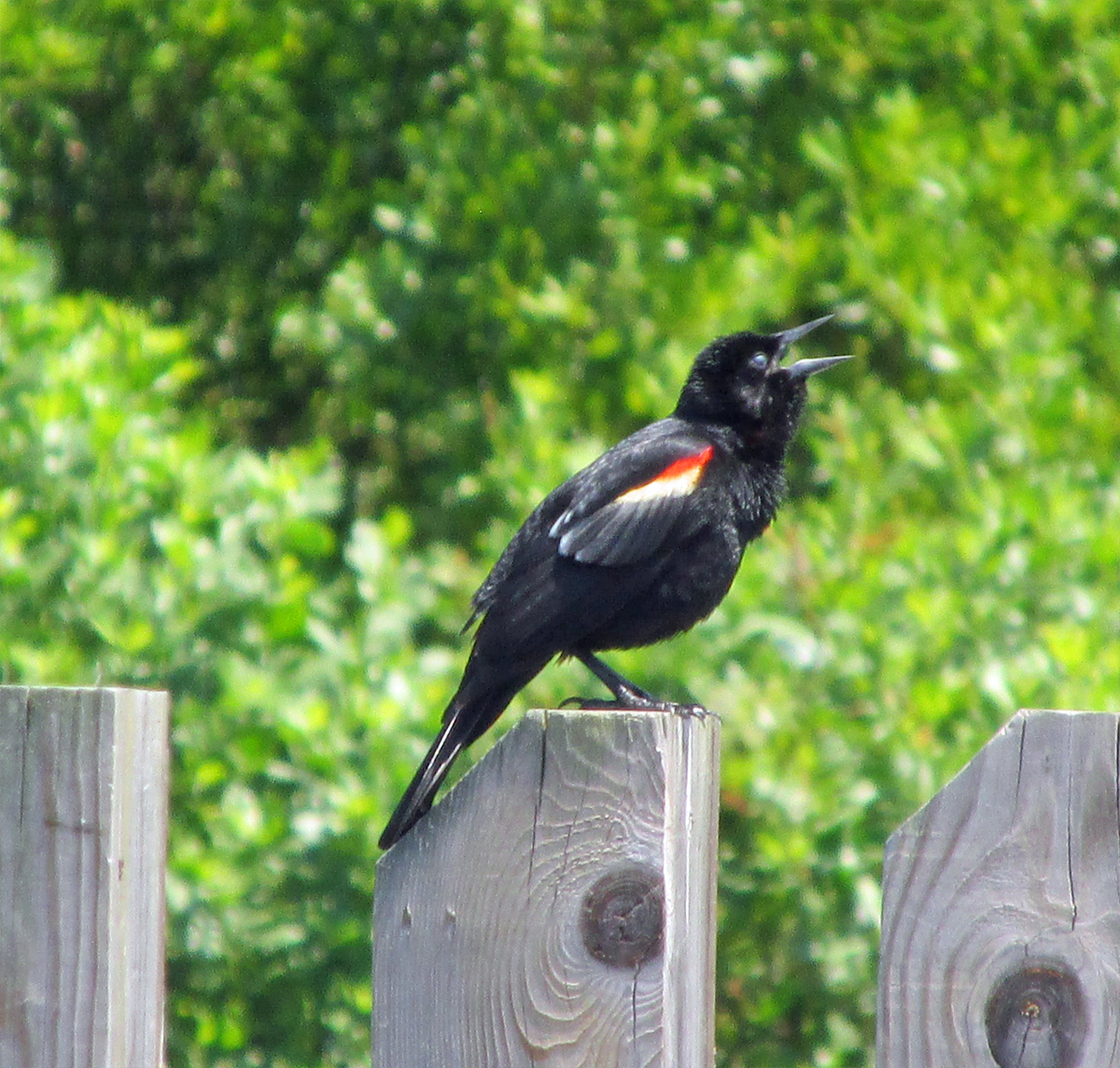
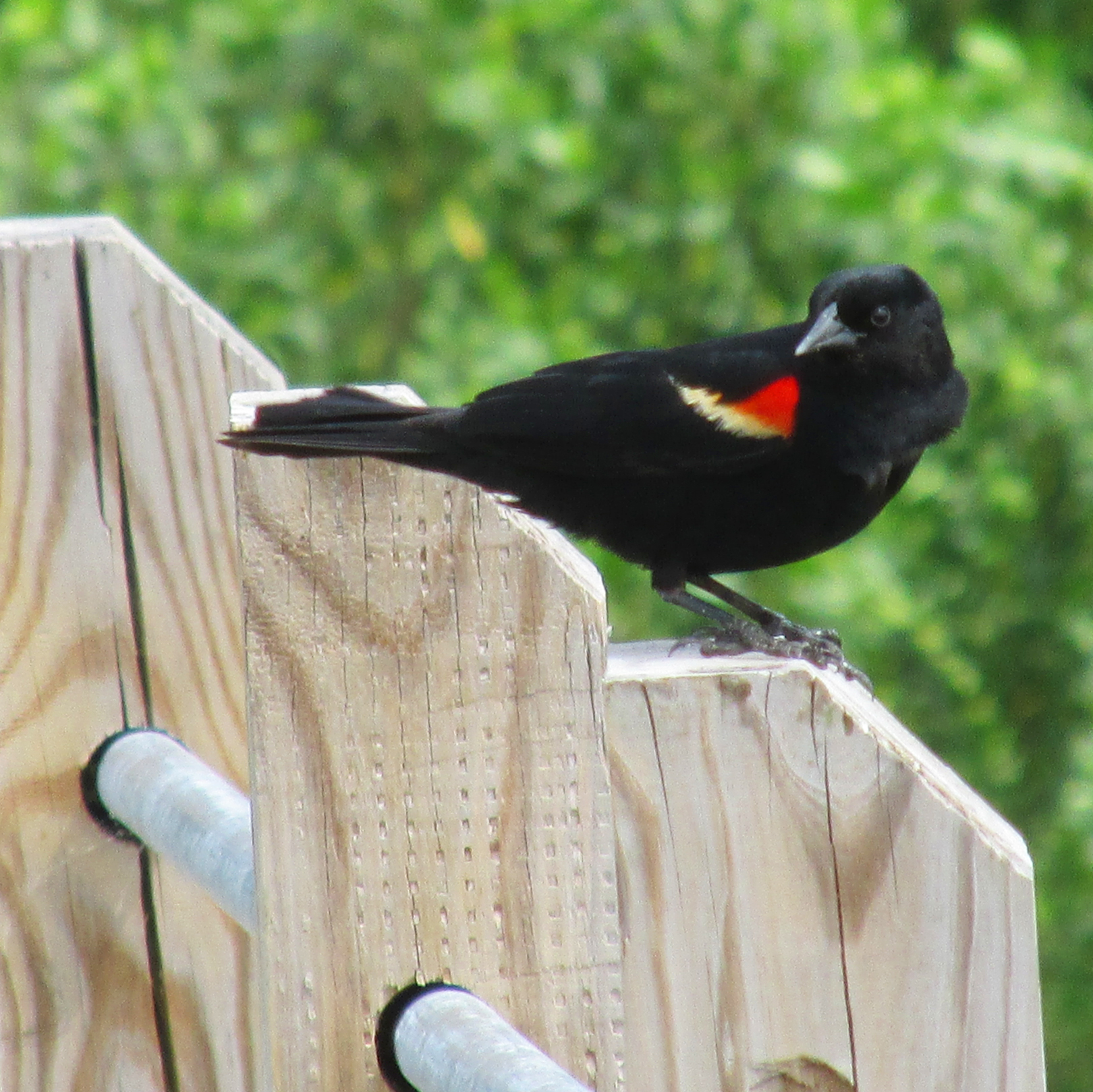
Photo by Bryan Stevens                                      A male red-winged blackbird sings from an elevated perch in a wetland habitat.

I recently received an email from Tom and Helen Stetler in Elizabethton, Tennessee. The couple reported seeing several “early birds” in their yard recently, including American robins and a total of six red-winged blackbirds. “One even went up on the bird feeder,” they wrote.

The couple noted that red-winged blackbirds are usually harbingers of spring, but these birds arrived with some of the last of the wintry weather in February.

“Oh well, better days are coming, Lord willing,” the Stetlers wrote. They also added they have seen Song Sparrows and an Eastern Towhee at their feeder in recent days.

Stetler-Blackbirds

Photo Courtesy of Tom and Helen Stetler            A male red-winged visits a feeder at the Stetler home in Elizabethton.

I’ve long come to associate red-winged blackbirds with early spring. I also had a single red-winged blackbird make a one-day visit in February during a snowstorm. Those February visitors are the vanguard of large numbers of red-winged blackbirds that return in impressive numbers every March. The blackbirds arriving now behave much differently than the quiet, furtive ones that often make brief visits to feeders during late winter snowstorms.

The showy and loud red-winged blackbirds that have returned to my fish pond and adjacent stands of cattails immediately made themselves at home.

“The kon-ke-ree song of the male red-winged blackbird is a sure indication that spring is on the way,” according to a profile located at the Tennessee Watchable Wildlife website.

At this time of year, the male red-winged blackbirds seek elevated perches to display and vocalize. Their loud antics are not designed solely to attract mates. Male red-winged blackbirds also sing to warn rival males from intruding into their territories.

The male red-winged blackbirds is a very aptly named bird. Glossy black males sport red wing patches that are often trimmed with a narrow band of yellow feathers. By contrast, female red-winged blackbirds are mostly brown birds that could easily be mistaken for large sparrows. Both sexes have sharply pointed bills.

RW-Blackbird-Erwin

Photo by Bryan Stevens                                    Male red-winged blackbirds sing to proclaim territories and attract mates.

Red-winged blackbirds are fond of wetlands. Any marsh or even a damp field or flooded pasture is likely to attract a few resident red-winged blackbirds. Females choose nesting locations in cattails or other marsh vegetation. She usually lays three or four eggs. Although she does receive some help from the male, most of the responsibility for raising the young is left to her.

There is a reason that male red-winged blackbirds are not always quite as engaged in feeding and tending their young. Male red-winged blackbirds are often polygynous, which means that males will often court multiple mates. His time is often occupied defending females and their respective nests from the advances of other male red-winged blackbirds.

Other relatives of the red-winged blackbird in the United States include the tri colored blackbird found along the Pacific Coast and the yellow-headed blackbird resident in wetlands west of the Great Lakes. Rusty blackbird, common grackle and brown-headed cowbird are other species of blackbirds found in Tennessee, Virginia and North Carolina.

Some other signs of spring I’ve detected at home have included a bonanza of spring blooms, choruses of spring peeper frogs and even the fluttery flights of a few early butterflies.

Of course, even as I write this week’s column, an unwelcome cold front has plunged temperatures below freezing. It’s only a temporary setback, so I know that spring will continue to advance. My evidence? A range of other birds are poised to return in the coming weeks. Once again, birds like red-winged blackbirds and American robins are just part of the vanguard of returning spring migrants. Spring migration begins as a trickle in March only to explode into a torrent in April and early May.

Hunt-Redwing

Photo by Bryan Stevens                      Red-winged blackbirds generally return to Northeast Tennessee as the weather turns milder in the spring.

If you would like to share your own spring sightings, send me an email at ahoodedwarbler@aol.com.

I am especially interested in hearing about the first arrival dates of ruby-throated hummingbirds. If you’ve seen your first ruby-throated hummingbird of the spring, contact me with the date and time you saw your first hummer of the season.

••••••

Bryan Stevens lives near Roan Mountain, Tennessee. To learn more about birds and other topics from the natural world, friend Stevens on Facebook at https://www.facebook.com/ahoodedwarbler. He is always posting about local birds, wildlife, flowers, insects and much more.