Tag Archives: egrets

Native wading birds wander widely in late summer


Photo by Bryan Stevens • A great egret captures a frog from a pond’s edge in South Carolina.

The fish pond at my home has attracted a stalker. Amid the cattails and beneath the drooping branches of tall bald cypress trees, a lurking great blue heron has patiently been stalking fish, frogs and anything else that comes within striking reach of the bird’s sturdy dagger-shaped beak.

The heron’s visits have prompted me to dig into my archived columns this week. Please enjoy this column, which was previously published in July of 2019, about summer’s wading birds.

•••

North America’s stately wading birds — egrets, herons, bitterns, ibises and their kin — are well-known wanderers in late summer. As with all birds capable of flight, a pair of strong wings cannot be underestimated. Birds can show up in the most likely places.

Take for instance the first confirmed sighting of an American flamingo in Tennessee. This particular flamingo — an almost unthinkable bird for the Volunteer State — showed up along Highway 78 in Lake County on July 13, 2019.

Ruben Stoll and Alan Troyer found the flamingo, backing up their discovery with photographs of the large pink bird associating with great egrets and other wading birds. The flamingo created considerable buzz on rare bird alerts in several nearby states. Many birders rushed to add this exceptional visitor to their state and life lists.

Photo by Bryan Stevens • White ibises occasionally meander away from the coast in late summer. Immature birds will be brown instead of white.

In summers past, other exciting wading birds ranging from little blue herons to wood storks have excited the region’s birders. I recently celebrated my own sighting of one of these wanderers that made a stop at my fish pond on July 10.

I had stepped outside my house and let the door slam a little too loudly behind me, causing a stately great egret near my fish pond to take flight and fly over the roof of my house. I regretted instantly not having a camera with me.

Two days later, I got another chance. The great egret made another appearance. Unfortunately for the tall bird, he attracted the ire of the resident red-winged blackbirds. In a most inhospitable manner, the blackbirds attacked and dived at the egret, which made some awkward attempts to evade the angry blackbirds. Blackbirds are protective of their territory and have swooped at me several times when I’ve ventured too close to their favored cattails.

More prepared on this occasion, I had my camera with me and managed to get a few photographs of the egret.

The next day, only a few miles from my home, Lauri Sneyd Vance took a photograph of a great egret that stopped at her home in Limestone Cove in Unicoi County, Tennessee. Having seen my Facebook post, she notified me that she had also received a visit from an egret. Was it the same bird? Perhaps.

Oddly enough, the bird is actually the second great egret to visit my fish pond. The first one made an unseasonable stop several years ago on a snowy December afternoon — hardly a time of year I might have expected a visit from an egret in the mountains of Northeast Tennessee.

The great egret stands 3.3 feet tall. With an all-white plumage, a long yellow bill and dark legs, this egret is often described as graceful and elegant. Its likeness was incorporated into the logo for the National Audubon Society, an organization formed to protect egrets and other wading birds from a wanton slaughter in the late 1800s when millions of the birds were killed so their feathers could be used in women’s fashions.

During the breeding season, adult great egrets sprout long plumes on their back. These frilly feathers are known as aigrettes, which are used to attract the attention of prospective mates in elaborate mating displays.

According to the All About Birds website, great egrets feed mostly on fish, but they also eat amphibians, reptiles, rodents, songbirds and crustaceans. On visits to the South Carolina coast, I’ve observed great egrets dining on frogs and small fish. In prime habitat, flocks of great egrets will gather to forage together in wetlands or around ponds. More sociable than some herons, great egrets also nest and roost communally.

The other North American egrets include snowy egret, reddish egret and cattle egret. Other egrets found around the world include the intermediate egret, little egret, slaty egret, black egret,dimorphic egret and Chinese egret.

As summer advances, keep your eye on area rivers, lakes and ponds. It’s the best time of year to see egrets, herons and other long-legged wading birds. In the case of the American flamingo, I realize that lightning rarely strikes twice, but if you do happen to see a gangly pink bird, let me know.

•••

Share sightings, ask questions or make comments by emailing me at ahoodedwarbler@aol.com.

Photo by Bryan Stevens
A Great Blue Heron moves stealthily through a wetland.
Egrets and their kin wander widely in late summer

Late summer has a sort of lazy feel of anticipation to it. Most birds are finishing up their nesting season. Hungry fledglings appear at feeders in the company of adults. In recent weeks, I’ve noticed an explosion in the number of hummingbirds visiting my feeders and garden flowers. I’ve also noticed the vanguard of migrant birds that are starting to make appearances as fall migration approaches. It’s not just songbirds, however, that are on the move. Some large and rather conspicuous birds have been attracting attention in recent weeks, including a variety of wading birds.


Sightings this summer of long-legged wading birds in Tennessee and Virginia that are far outside of their usual range have included cattle egret, white ibis and roseate spoonbill. In addition, Susan Hubley reported on Facebook about a tricolored heron at John Sevier Lake in Rogersville, Tennessee, on July 25.

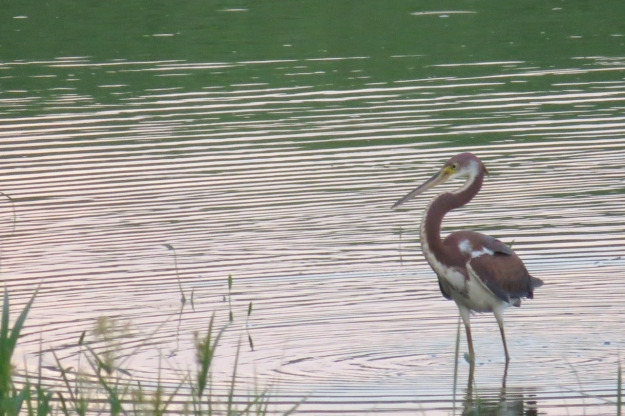
This heron is not usually found this far inland from the coast. Another tricolored heron showed up at Paddle Creek Pond in Bristol, Tennessee, on July 30. Adrianna Nelson reported the sighting on Bristol-Birds, an email network for sharing unusual bird sightings in the region. She also shared some photographs of the bird.

Tri-Colored-ONE

Photo courtesy of Adrianna Nelson • This tricolored heron spent a few days at Paddle Creek Pond in late July and early August. This large farm pond is managed by Crumley Farms Inc. and the Bristol Bird Club to provide habitat for migrating shorebirds and other birds.

“This is the first time I have seen a tricolored heron in Tennessee,” she wrote in a response to an email I sent her. “It is a long way off from its usual range. I have seen them before on Pinckney Island National Wildlife Refuge in South Carolina.”

She described the refuge as an excellent place to see waders, painted buntings, and many other birds. “I get the chance to go almost every year, since it is so close to where we vacation in Hilton Head,” Adrianna wrote.

She also commented on her unexpected observation.

Tri-colored-TWO

Photo courtesy of Adrianna Nelson • This tricolored heron spent a few days at Paddle Creek Pond in late July and early August.

“It is exciting to see something where it doesn’t usually belong,” Adrianna wrote. “I was definitely surprised to see the heron. That’s part of the fun of birding — you never know what to expect!”

She was also excited to share the sighting on Bristol-Birds. “It’s fun to share sightings with the birding community so they can also enjoy rare or unusual birds in our region,” she wrote.

Adrianna noted that she has been birding since age nine. “It all started when I saw a little gray bird hopping around in our yard,” she recalled. “I noticed it was only at our house around the winter months, and I stared to wonder what the bird was.”

After some searching online, she successfully identified the bird as a dark-eyed junco.

“During my search, I was surprised by the wide variety of birds, and I wanted to find as many as possible,” Adrianna wrote. “Since then, I was hooked!

IMG_9069

Photo by Bryan Stevens • This sign marks the importance of Paddle Creek Pond to migrating shorebirds and wading birds.

While diverting storms can’t be ruled out for causing some of these birds to detour into the region, it’s also normal behavior for young wading birds to disperse far and wide after leaving the nest. North American waders, or wading birds, include such long-legged species as herons, egrets, bitterns, ibises, storks and spoonbills. Most species are associated with wetlands or coastal areas.

Late summer birding is usually a period of doldrums as heat and humidity can discourage birders as well as diminish bird activity. However, it’s also the time of year when birders can make some unexpected surprises as wandering waders explore uncharted territory. Some other recent emails have reminded me of that fact.

James Elliott sent me an email describing a bird that is most likely a great egret. “For the second time in 30 years, I saw a magnificent, all-white heron yesterday on the South Houston River,” James wrote.

“I live at the very terminus of Riverside, Bullock Hollow, and Paddle Creek roads,” he wrote. “Big Springs Road is opposite across the river.”

When the bird departed, he said it flew east. He described the bird as “totally white” and “beautiful in flight.” He expressed regret that he was unable to get photographs.

Egret-Susan-Two

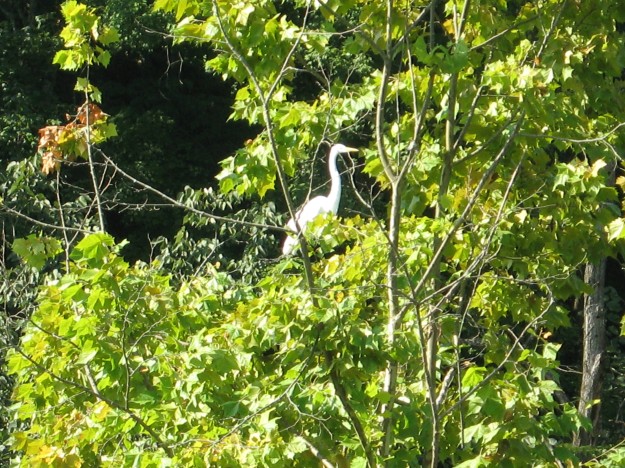
Photo courtesy of Susan Schreiner • This visiting great egret spent some time along the South Holston River in late July. Egrets, herons and other wading birds often wander into some unexpected locations in late summer.

Susan Schreiner, however, did get photographs of a great egret she observed near her home along the South Holston River in Bristol.

“We had a nice visitor today along the South Holston River,” Susan wrote in the email she sent. “When we first spotted it, it was in our tree and then flew down to the water.”

She said the egret has associated with some great blue herons in the vicinity. “It’s quite distinctive,” she wrote of the stately wading bird.

The diversity of the region’s bird life has impressed her. “Coming from Illinois, this is all pretty amazing for me,” she wrote.

Egret_SUSAN 2

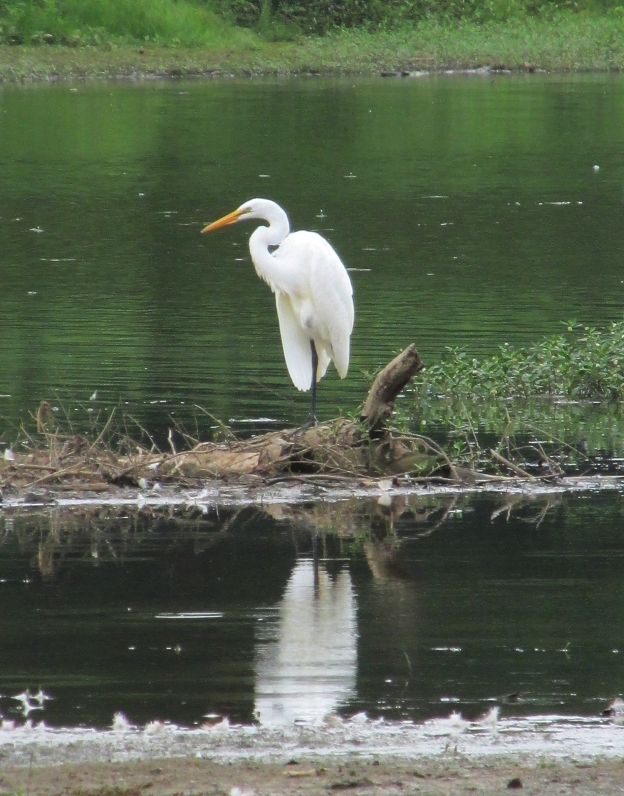
Photo courtesy of Susan Schreiner •Egrets and herons, such as this great egret, wander into some unexpected locations in late summer.

The egret is not the only exceptional bird that Susan has observed. “I occasionally see a bald eagle fly down the river that is just breathtaking,” she wrote in her email.

Through email, James and I discussed whether the bird he saw was a great white heron or a great egret. Since he saw the bird and I did not, I am inclined to go with his identification of great white heron. Although rare outside of Florida, this type of heron — simply a great blue heron in an alternative plumage — has over the years been spotted a handful of times in and around Bristol. Whether an egret or heron, his sighting is more evidence of the tendency of wading birds to wander widely in late summer.

The great egret became a motivational symbol for conservation with the foundation of the National Audubon Society in 1905. Today, the organization has nearly 500 local chapters, each of which is an independent non-profit organization voluntarily affiliated with the National Audubon Society. These chapters often organize birdwatching field trips and conservation-related activities. The National Audubon Society spearheaded efforts to end the mass slaughter of various bird species. Some birds were killed for food, but millions were also killed for their showy feathers that were destined to decorate stylish attire worn as a symbol of high fashion. As early as 1910, some states began passing legislation to abolish trade in bird plumes. The federal government also came to the assistance of birds with the Migratory Bird Treaty Act, which was a law first enacted in 1916 to implement measures to protect and conserve migratory birds.220px-National_Audubon_Society_logo

In 1953, a great egret in flight was chosen as the symbol for the official logo of the National Audubon Society, which was formed in part to prevent the killing of birds for their feathers. Birds like great egrets, snowy egrets, roseate spoonbills and other long-legged waders had been decimated before people responded to the wanton destruction being visited upon these beautiful and awe-inspiring creatures.

The great egret belongs to the genus Ardea, which includes various egrets and herons. Other members of this genus include Goliath heron, black-headed heron, purple heron and pied heron.

The tricolored heron belongs to the genus Egretta, which consists of various herons and egrets that mostly breed in warmer climates. In North America, other members of this genus include snowy egret, reddish egret and little blue heron. Older birding field guides may refer to the tricolored heron as the Louisiana heron, which was an older popular name for the species.

GreatBlue-Egret

Photo by Bryan Stevens • A great blue heron and a great egret patrol a tidal creek in South Carolina.

Although many herons and egrets are tall and stately, there are some pint-sized members of this group of birds. In North America, the smallest is the least bittern. The largest of the world’s herons if the aptly named Goliath heron, which is also known as the giant heron. This wading bird can stand five feet tall and weigh 11 pounds. The Goliath heron is native to sub-Saharan Africa but also ranges into southwest and south Asia. The world’s largest heron feeds almost exclusively on fish.

Other descriptive names for some of the world’s herons include boat-billed heron, white-crested tiger heron, zigzag heron, rufous-bellied heron, whistling heron and white-necked heron.

To try your own luck at observing herons and egrets, scout bodies of water such as ponds, rivers, lakes and streams to increase the odds of getting your own binoculars on one of these elegant waders.

Egreta

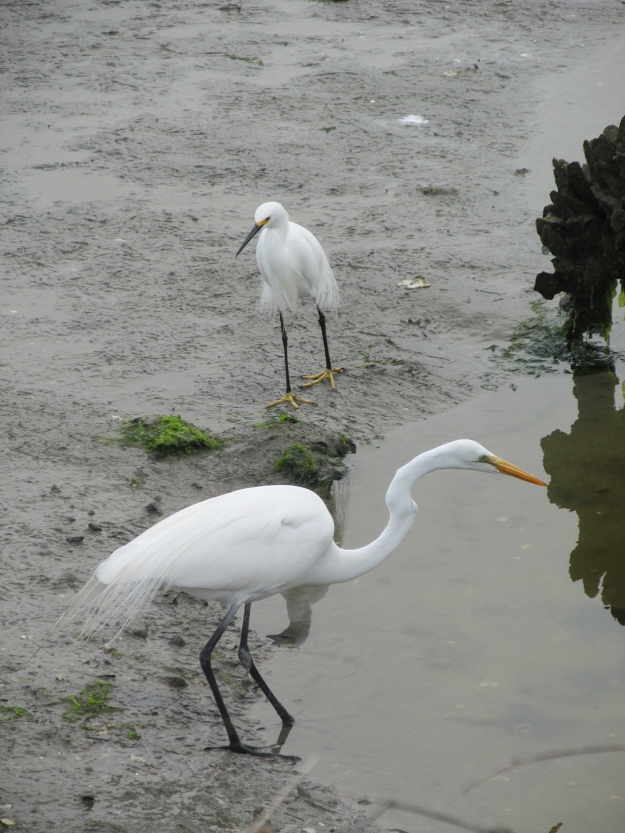
Photo by Bryan Stevens • A snowy egret and a great egret forage for prey on a South Carolina tidal creek.

Keep a look out for wandering waders during late summer season

Summer heat and humidity make the summer season my least favorite one for birding, but every season brings birding surprises. I was reminded of this fact when Larry and Amelia Tipton sent me a recent email asking for help with the identification of some birds near their home.

Attaching a photo with their email, the Tiptons wrote, “These birds showed up a few days ago and we cannot identify them. We would like to know what they are.”

When I opened the photo, I realized that the birds captured in the image would not be considered out of place if the Tiptons lived near the coast of the Carolinas, Georgia or Florida. The birds in the photo, however, were somewhat unexpected in the foothills of western North Carolina near their home in the town of Old Fort.

WhiteIbises

Photo Courtesy of  Larry and Amelia Tipton • Immature white ibises in a field near the Catawba River in North Carolina.

“We live on a farm near the Catawba River but have mostly woodland and fields,” the couple added. “We do not have a pond on our property but have a branch and a larger creek nearby.”

I wrote back and told the Tiptons that the birds they photographed were young white ibises. I informed the Tiptons that the two young ibises are likely testing their wings, so to speak, after leaving the care of their parents. If they like the area, and it sounds like they do, they may decide that the branch and creek are just what they need.

I received a followup email. “We sort of knew these were water birds but were surprised to find them so far away from marsh or wetlands or the ocean,” the Tiptons wrote. “We thought maybe a storm blew them off course during flight.”

While a diverting storm can’t be ruled out, it’s normal behavior for young wading birds to disperse far and wide after leaving the nest. North American waders, or wading birds, include such long-legged species as herons, egrets, bitterns, ibises, storks and spoonbills. Most species are associated with wetlands or coastal areas.

Late summer birding is usually a period of doldrums as heat and humidity can discourage birders as well as diminish bird activity. However, it’s also the time of year when birders can make some unexpected surprises as wandering waders, such as the ibises discovered by the Tiptons, explore uncharted territory.

Other waders this season showing up in unexpected location have included a wood stork found by Linda Walker in Polk County, Tennessee. Likes the ibises in North Carolina, the stork was confining its activities to a small branch bordered by heavy vegetation. These branches are a far cry from the usual wetland haunts of these two species.

Overall, the white ibis and wood stork have some superficial similarities. They are both long-legged white birds with black wing tips and unusual down-turned bills that they use to probe for food, which largely consists of fish and other aquatic prey.

The latter is North America’s only native stork. According to the National Audubon Society, Florida once provided a stronghold for the wood stork in the United States. Unfortunately, the population crashed in the 1990s, decreasing from around 150,000 birds to fewer than 10,000. In recent years, numbers have increased and wood storks have expanded their breeding range into South Carolina. Wood storks are nearly four feet tall, making them one of the tallest of the waders. Wood storks have a dark, featherless heads, giving them a resemblance to vultures. For the most part, they’re rather grotesque birds when observed at close quarters. Soaring overhead on thermal updrafts, wood storks look quite graceful and even majestic thanks to their white plumage and black accents. A wingspan of 65 inches gives them the means to soar easily.

Storks-Two


Photo by Bryan Stevens 
Worldwide there are 19 species of storks, but the wood stork (pictured) is the only native stork   found in the United States.

The Audubon Society identifies the white ibis as one of the most numerous wading birds in Florida, but the bird is common also in other parts of the southeast with appropriate wetland habitat. Like the wood stork, the ibis has declined in Florida in recent decades largely as a result of human encroachment. The white ibis looks like a bird that could have been invented by Dr. Seuss. The all-white plumage is contrasted by pinkish-orange legs, a reddish-pink bill and bright blue eyes. In flight, the white ibis shows black feathers on the edges of its wings.

The affinity for water and wetlands relates to the diet of most waders, which consists of fish and other aquatic prey such as amphibians, crustaceans and even insects. For the remainder of July and into August and September, birders should monitor ponds, small lakes, rivers and even branches and creeks for any wandering waders. For instance, I once made a trip to a park in Greeneville, Tennessee, to observe a pink-hued roseate spoonbill that had made a rare stopover in the region. While that observation took place nearly 20 years ago, I remember vividly finding the pale pink bird playing odd man out among a flock of several dozen Canada geese as a soft rain drizzled from an overcast sky. Although many of the waders cling to coastal habitats, they have wings like other birds and know how to use them. Other waders have been known to show up in unlikely locations, including birds such as tri-colored heron, limpkin and snowy egret.

Of course, I hope to hear from any readers lucky enough to glimpse one of these unanticipated finds. Enjoy your birding.

•••••

Bryan Stevens lives near Roan Mountain, Tennessee. To learn more about birds and other topics from the natural world, friend Stevens on Facebook at https://www.facebook.com/ahoodedwarbler. He is always posting about local birds, wildlife, flowers, insects and much more.