Tag Archives: Feathered Friends

Hummingbirds due to make spring return


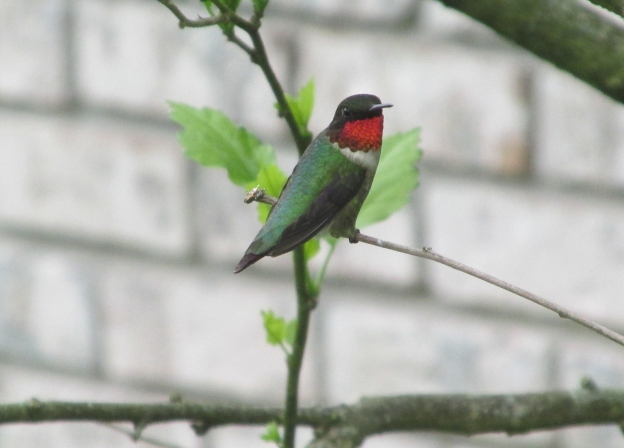
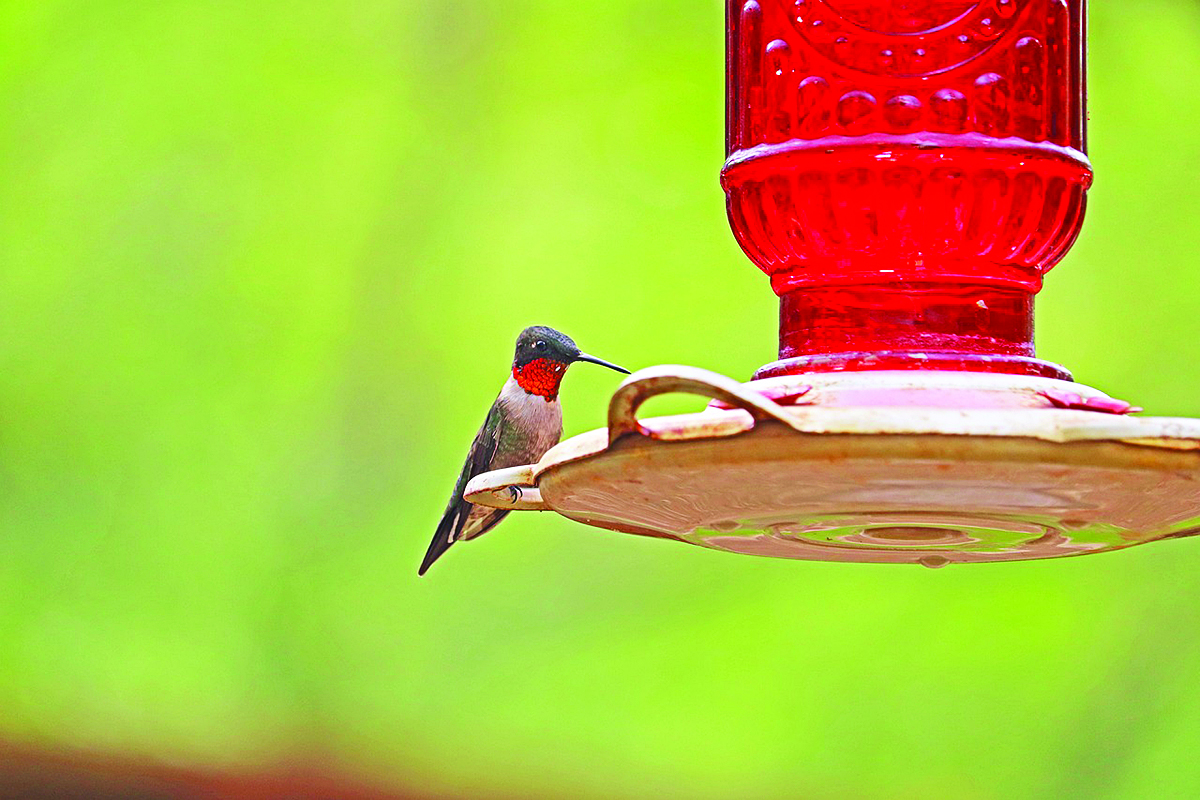
Photo by George from Pixabay • A male ruby-throated hummingbird obtains a dainty perch on a feeder offering sips of sugar water.

On March 4, Nancy Sheehan, a program coordinator for the Journey North website that tracks the migration of hummingbirds, as well as other wild creatures, posted on the project’s website.

“A small number of reports indicate that spring migrating hummingbirds are slowly arriving in southern regions of the United States,” she wrote.

In her post, she also wondered how weather patterns are impacting the pace of migration along the west coast?

That’s an interesting aspect of Journey North. The project tracks migration in both the eastern and western halves of the nation.

Sheehan noted that in the eastern United States, the annual migration of ruby-throated hummingbirds is proceeding pretty much on schedule.

“A small number of reports indicate that spring migrating hummingbirds are slowly arriving in southern regions,” Sheehan wrote. “It is time to put your feeders and potted nectar plants out. These nectar sources provide crucial energy for migrating hummingbirds. Depending on your location, start planting brightly colored native flowers to provide pollinator habitat for hummingbirds and other species such as monarch butterflies. Don’t delay – hummingbirds are here in many locations in the southern U.S.”

It’s fun to monitor hummingbird progress at Journey North, which also tracks the arrival of different hummingbird species in the western United States. There the first arrivals could include Allen’s, Anna’s, Broad-tailed, Black-chinned, Costa’s, Rufous and Allen’s hummingbirds.

I fully expect that ruby-throated hummingbird migration will bring the first individuals to Northeast Tennessee, Southwest Virginia, and Western North Carolina in early April if not late March. It’s even possible there will be some Easter arrival of hummingbirds in the region.

Most first spring observations of hummingbirds are males, although a few females are also early arrivals. Male hummingbirds arrive first so they can find and defend a territory.

As always, spring migration can be a challenging time for hummingbirds. Temperature, wind patterns and storms can influence the pace of migration.

Even once these tiny birds make their epic spring crossing of the Gulf of Mexico, they will need time to rest and refuel before moving northward.

By mid-March, the advance of ruby-throated hummingbirds has usually reached states such as Georgia and South Carolina. By the end of March, these tiny flying gems have reached states such as Tennessee and North Carolina.

It’s time to get those sugar water feeders outside and waiting for the early arrivals. Once the chance of late-season freezes has passed, consider planting some colorful native flowers to provide nectar sources for hummingbirds. In addition, some hanging baskets of flowers can be purchased from garden centers with the benefit that these baskets can be brought indoors during unseasonable cold snaps.

Northeast Tennessee usually gets its first spring hummingbirds the first week of April. If you’re seeing hummingbirds, I’d love to know. I have tracked arrivals for several years now. To share your first spring sighting of a ruby-throated hummingbird, email me at ahoodedwarbler@aol.com or contact me on Facebook at http://www.facebook.com/ahoodedwarbler. Please include the date and time of your sighting. I also welcome the sharing of other details about your sightings.

In the meantime, take steps now to welcome hummingbirds back and keep them safe during their stay.

Most experts also suggest avoiding red dyes or food colorings, which are often found in commercially marketed hummingbird sugar water. Don’t risk the health of hummingbirds for a little convenience.

It’s easy to make your own sugar water mix, which can be stored in the refrigerator in an empty plastic juice jug. Boil some water and then add one cup of sugar for every four cups of water in your pot. Stir thoroughly. Bottle the mixture until it cools. Fill your feeders and store any remaining sugar water in the fridge in the aforementioned jug. Refrigerated, the mix should stay good to use for at least a week.
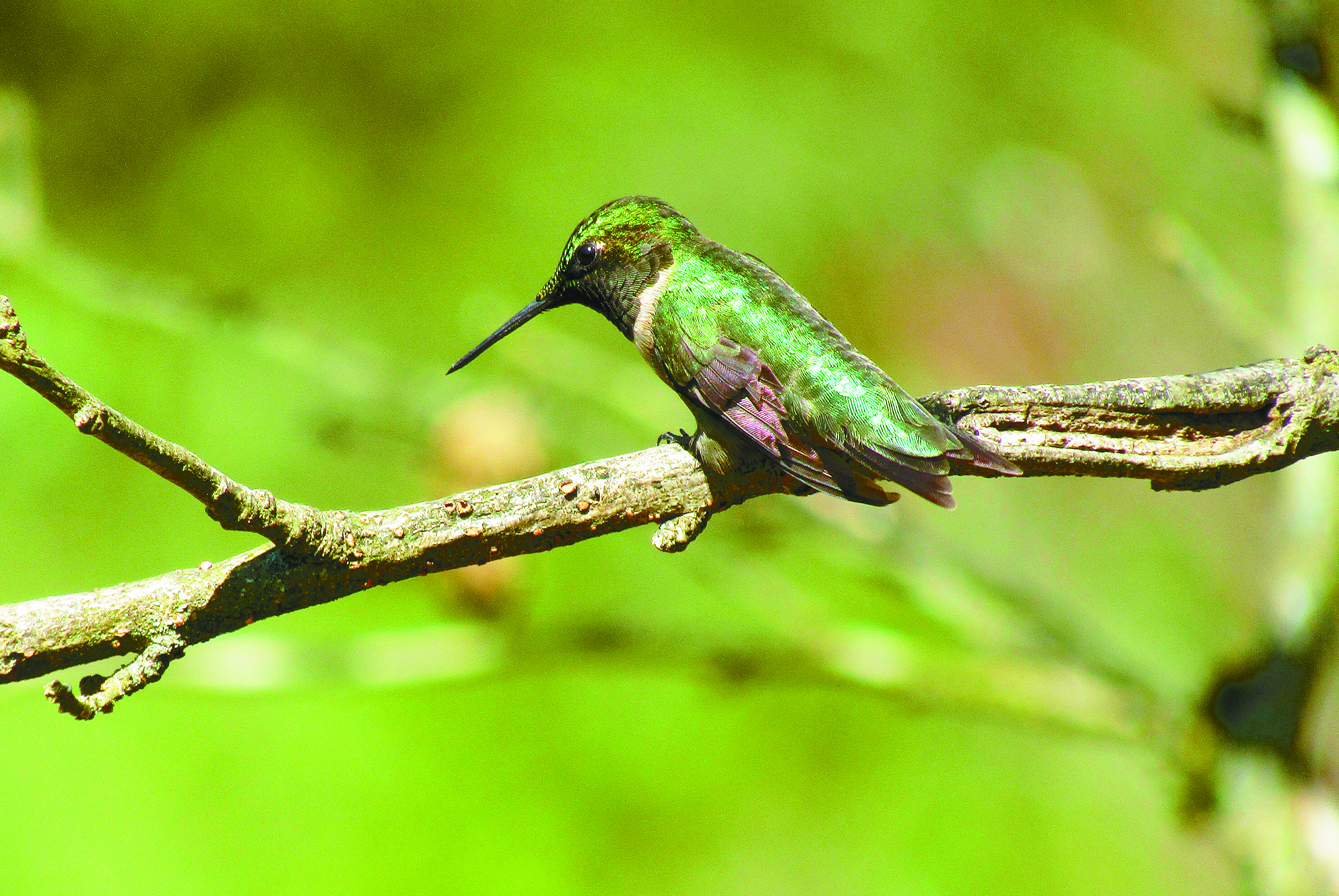
Photo by Bryan Stevens • A male ruby-throated hummingbird surveys his domain.

In our milder spring weather, changing the sugar water in feeders can probably be done on a weekly basis. When hotter summer temperatures prevail, it’s usually necessary to change the sugar water every two or three days.

Some ways of ensuring that our hummingbird guests are kept healthy and secure are simply common sense. For instance, don’t use pesticides, herbicides or any other sort of toxin anywhere close to the vicinity of a sugar water feeder or a flower garden. Hummingbirds are such tiny creatures with such intense metabolisms that it only takes a small amount of any harmful substance to sicken or kill one of these little flying gems.

For emphasis, I’ll repeat again that only common, pure cane sugar is safe for hummingbirds. There are no safe substitutes. Do not use organic, raw or brown sugar. Confectioner’s sugar, which contains an anti-caking substance (often corn starch, silicates or stearate salts), is also hazardous to hummingbirds.

The ratio of four parts water to one part sugar utilizing pure cane sugar most closely duplicates the nectar that hummingbirds obtain from some of their favorite flowers. Why try to mess with nature’s perfection?

I cannot imagine why anyone would supplement sugar water for hummingbirds with such human beverages as a sports drink or Kool-aid, but there have been reports of people doing so. Be aware that such additives will only risk the health of these tiny birds.

•••

Remember to send me those first sightings of returning spring hummingbirds. I’ll be doing my usual roundup to share who gets graced with a visit from one of these tiny beauties.

Blue jays bold, bossy backyard visitors

Photo by edbo23/Pixabay A blue jay grabs a peanut from a feeder.

At my own home, blue jays have an easy life. They’re so much bigger than most of the other birds that visit my feeders that they can be a little bossy toward their smaller kin. All are welcome, though.

The blue jay is the smallest member of the Corvid family in Tennessee. This bird’s larger relatives in the state include the American crow, fish crow and common raven.

The blue jay, which is typically 10 to 12 inches long, is one of the largest songbirds to visit our feeders. They’re fond of sunflower seed, peanuts, suet and other feeder fare. Blue jays are quite noisy and produce a variety of vocalizations. They’re also capable of mimicry and can mimic in convincing fashion the calls of red-tailed and red-shouldered hawks.

While they are primarily woodland birds, blue ays are very adaptable and capable of thriving in suburban parks and other less wild areas. In the fall, acorns are a favorite food. There are times in autumn when almost every blue jay I see has an acorn n its bill. They also tend to stash food for future days, and this habit has also helped re-forest oak woodlands.

Jays are social birds and form flocks, which offers some protection from predators. It only takes one sharp-eyed bird in a flock to sound an alarm to protect the entire group.
Other birds can also detect blue jay alarm calls and react accordingly.

Accipiter hawks — Northern goshawk, Cooper’s hawk, sharp-shinned hawk — are the primary predators on blue jays. They share some of the same habitat and the agile hawks are usually able to outmaneuver the slower flying jays.

I was a little surprised to discover that the blue jay has never been chosen as an official state bird, although it does serve as the official bird for the province of Prince Edward Island in Canada.

Blue jays are undeniably striking birds. They are bright blue on top and white to gray on its throat, chest and belly. They have white wing bars and black and white banding on the tail. Its bill, legs and feet are black. The bird also has a black collar on its lower throat. At a glance, all blue jays — male and female — look alike. However, experts have determined that the black throat collars are subtly different from bird to bird and may help members of a flock recognize each other.

Larger birds typically have longer life spans than small ones. The medium- sized blue jay will probably live longer than a wren or sparrow. The oldest known wild, banded blue jay was at least 26 years, 11 months old when it was found dead after being caught in fishing gear, according to the website All About Birds. It had been banded in 1989 around Saint Pierre and Miquelon, which is a French archipelago south of the Canadian island of Newfoundland. He dead individual was found in the same area in 2016.

There are other species of jays in the United States, including the Steller’s jay, which is the western counterpart of the bue jay, as well as Western scrub-jay, Florida scrub-jay and pinyon jay. Worldwide, there are about 50 species of jays, which are closely related to crows, magpies and other species in the genus of Corvidae.

Some of the descriptive names for other jays include white-throated magpiejay, gray jay, green jay, purplish jay, azure jay, violaceous jay, turquoise jay, beautiful jay, silvery-throated jay, azure hooded jay and black-headed jay.

The smallest of the world’s jays is, appropriately enough, named the dwarf jay. It is eight to nine inches long and weighs about 1.4 ounces.

During two visits to Salt Lake City in Utah in 2003 and 2006, I added a couple of jays to my life list, including Western scrub-jay and Steller’s jay. I also saw black-billed magpies, a close relative of jays.

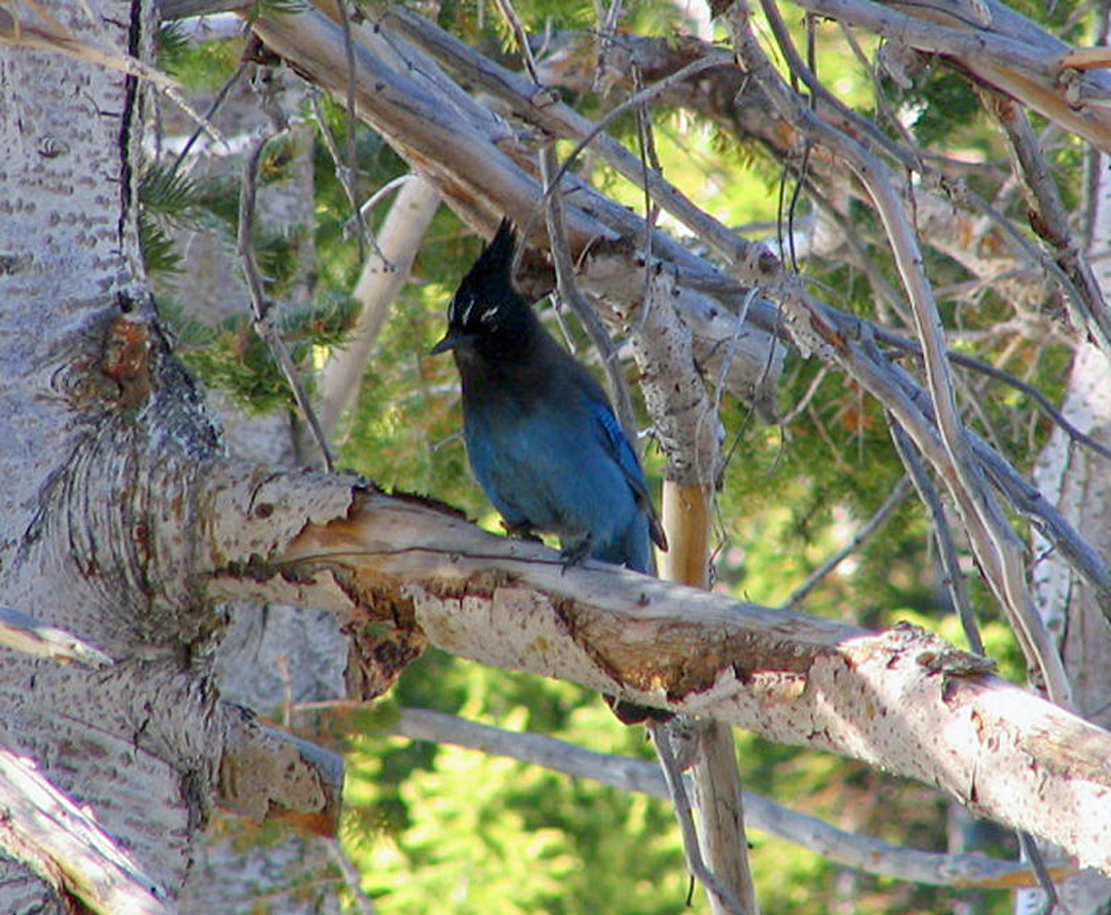
Photo by Bryan Stevens • A Steller’s jay found at Snowbird, a ski resort town near Salt Lake City, Utah.

•••

To share sightings, ask a question or make a comment, email me at ahoodedwarbler@aol.com.

Majestic canvasback among region’s wintering waterfowl

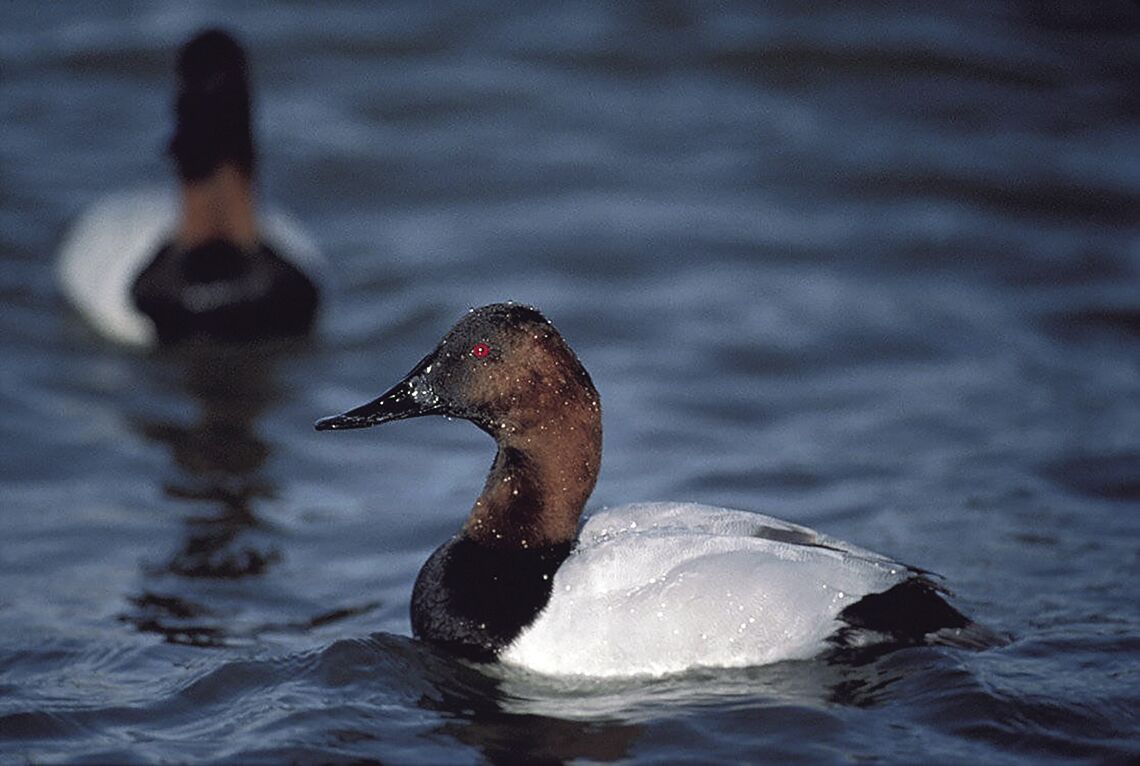
Photo by U.S. Fish & Wildlife/Eugene Hester • The red eye of a male canvasback stands out in as striking a fashion as does the duck’s dark and light plumage.

Erwin resident Joe McGuiness, who is also a fellow member of the Elizabethton Bird Club, alerted me recenntly to the presence of a canvasback drake at a pond along the town’s linear trail.

This duck was with a couple of redheads, also a species of duck, in the pond spanned by a boardwalk in the industrial park on the south side of Erwin. Some birds hold special meaning with me. Although its a natural question for a bird lover to be asked, I have difficulty pinpointing a single bird as my favorite. One of my overall favorite birds is the Northern cardinal. Among the summer-visiting warblers, the hooded warbler has long been my favorite. With shorebirds, the marbled godwit has long been at the top of my rankings. My favorite bird of prey is the American kestrel or, as I first learned of this raptor in the little “Golden Guide to Birds,” the sparrow hawk. Among owls, I have a soft spot for Eastern screech-owls.

I have a favorite duck, too. It’s the canvasback, which is a species of waterfowl that I don’t see very often, which makes observations even more special. I saw my first canvasback in the mid 1990s during a winter visit with my parents to Wilbur Lake near Elizabethton, Tennessee. We always liked visiting this small reservoir during the colder months to view the buffleheads and any other ducks that happened to visit this small mountain lake. On this particular occasion, a flock of redheads had also arrived. While viewing these ducks, we noticed a member of the flock that looked different from the others. Specifically, it was larger and whiter than the redheads. After a brief consultation with my copy of Roger Tory Peterson’s “A Field Guide to the Birds of Eastern and Central North America,” I identified my very first canvasback.

Since that time, I’ve observed canvasbacks at other locations in northeast Tennessee and southwest Virginia. It’s been awhile, but I have observed these ducks at Osceola Island Recreation Area below Holston Dam and at Musick’s Campground at South Holston Lake. Back in January and February of 2014, some canvasbacks took a liking to the pond at Erwin Fishery Park. I’ve also observed canvasbacks on the Watauga River in Elizabethton and on the Holston River in Kingsport. I saw eight canvasbacks on Feb. 22, 2015, on the Watauga River, not very far from where I saw my very first one back in the 1990s. The flock, which consisted of all males, represented a rather high number for this duck in the region.

Recent winter storms that have plowed through the region have brought some unusual ducks. A few days before he notified me of the canvasback, Joe also informed me about a pair of Northern shovelers at Erwin Fishery Park.

A male canvasback is unmistakably regal with a sloping profile that instantly distinguishes it from other ducks. Males, or drakes, have chestnut-red heads, white bodies, black breasts and rears and bright red eyes. The distinctive bill is also black. Females, like many other ducks, are drab and brown but share the distinctive bill, helping to separate them from such relatives as female redheads.

Photo by Bryan Stevens • Canvasbacks on the Watauga River in Elizabethton.

The canvasback is also a fairly large duck with males reaching a body length of 21 inches. Females are only an inch shorter in body length. Drakes weigh an average of 2.7 pounds while hens can weigh 2.5 pounds.

Canvasback breed in prairie potholes in the western United States and Canada. I got the chance to see many of these ducks in their nesting habitat during a trip to Utah in May of 2006. My visit provided very memorable observations of large flocks of these impressive diving ducks. I found them in temporary ponds in flooded fields. Utah had enjoyed abundant rainfall that spring, which was no doubt welcomed by breeding ducks. The trip also yielded observations of such ducks as cinnamon teal, redhead, red-breasted mergansers, ring-necked ducks and gadwalls, as well as other unique wetland-loving species as white-faced ibis, yellow-headed blackbird and Wilson’s phalarope.

During winter, the canvasback usually prefers large open bodies of water, including lakes, ponds and sheltered bays. These ducks are largely vegetarian, although they do consume some animal matter, including insect larvae, snails and other mollusks. This duck’s scientific name, Aythya valisineria, which refers to a species of plant that canvasbacks consume in great quantities. Vallisneria americana, which is often called wild celery or water-celery, doesn’t resemble the vegetable known as celery. These wild plants are long, limp and flat, which led to other common names such as “tape grass” and “eelgrass.”

The canvasback is member of the genus, Aythya, which is comprised of a dozen species of diving ducks. The other members of the genus in North America include greater scaup, lesser scaup, redhead and ring-necked duck. The related tufted duck is a rare visitor to the United States. They’re described diving ducks because they dive under the surface to search for food, rather than dabble around pond edges and shorelines like the ducks known as “dabblers.”

Two members of the genus — Madagascan pochard and Baer’s pochard — are endangered species. In March of 2013, a survey found the population of the Madagascan pochard was about 80 individuals. When surveys found a worldwide population of perhaps fewer than 1,000 individuals, Baer’s pochard was reclassified as “critically endangered” in 2012. The canvasback has never declined to the low levels of these relatives, but it has been a bird that has required some protective oversight from the federal government. At times, this has included exemptions from duck hunting seasons.

Canvasback populations are stronger these days but haven’t been robust for quite some time. According to the Duck Unlimited website, the population of this stately duck has seen some improvement. In 2009, a population survey by the U.S. Department of Fish and Wildlife showed an increase in canvasbacks from 488,000 to 662,000 individuals. According to the Ducks Unlimited website, this population spike took place in the wake of a hunting ban on canvasbacks during the 2008-09 waterfowl season.

•••

To share a sighting, ask a question or make a comment, email me at ahoodedwarbler@aol.com.


Man hits a bonanza with recent sighting of eagles

Photo Courtesy of Jim Kroll • These four bald eagles were observed along Mendota Road near Abingdon, Virginia.

Jim Kroll sent me a recent email about a Jan. 30 sighting he made on Mendota Road in Abingdon, Virginia.

“I saw three hawks and an eagle close together in the same tree,” he wrote in his email. “The eagle and one hawk appear to be almost side-by-side on the same limb.”

He added that he had never observed such a combination in the same tree.

“I did not know they got along that well with each other,” Jim wrote.

He noted that he regularly sees hawks near his home in Abingdon and occasionally sees eagles on Mendota Road.

“There was a second eagle,” he added. “The two eagles would fly off together to the river, swooping around each other along the way.”

He said that he watched the hawks and eagles for probably 30 to 45 minutes as they would fly away from the tree multiple times and then return.

He also reported that the hawks were larger than the eagles. This bit of information got me to thinking about his sighting due to the fact that there are no hawks bigger than a bald eagle.

Once I looked at the photo that Jim shared with his email, I realized that his sighting was more remarkable than he realized.

“All four of the birds are eagles,” I wrote to him after viewing the photo. “The dark ones are immature eagles.”

“All four of the birds are eagles,” I wrote to him after viewing the photo. “The dark ones are immature eagles.”

According to information from the East Tennessee State University Eagle Cam project, it typically requires four to five years before young eagles develop the characteristic yellow bill with white head and tail of an adult bird.

Remember that Jim saw a second adult eagle that does not appear in the photograph he shared.

I’m not sure what was taking place with this appearance by multiple eagles. I’m favoring the possibility that the young dark eagles might have been the young of the adult pair of birds. Female eagles are larger than male eagles, so it is also likely the adult bird in the photo is a male and the other eagles in your photo are all females.
The fact that Jim saw five eagles at a single location at the same time is worth commending.

I informed him that I feel lucky when I see one eagle or a pair. I told Jim that to see five eagles at one spot is exceptional and congratulated him.
After I shared my opinion that all the birds in his photo were eagles, he emailed me again.

“We were probably a football field length away from the tree the eagles were in and just jumped to the conclusion that the darker birds were hawks,” he wrote to me.
He had considered how large the birds looked in flight, and he noted that their size and wingspan had not seem right for hawks, but he said he never thought about the other three birds also being eagles. He also shared another photo of the adult eagles flying toward the river.

“Their wingspan was impressive,” he wrote. “It was cool watching them swoop around each other near the river.”

He also shared that he saw another eagle recently near the Nordyke Bridge, five to six miles from where he saw the group of eagles.

Jim added that he has seen eagles at the top of South Holston Dam and along the Virginia Creeper Trail near Alvarado.

The ETSU Eagle Cam project operates eagle cams in Johnson City near Winged Deer Park and in Bluff City.

https://www.etsu.edu/cas/biology/eagle-cam/cameras.php

Here’s some more information about bald eagles from the ETSU Eagle Cam website.
Haliaeetus leucocephalus, better known as the bald eagle, is the United States’ national bird and is an easily recognizable species even to the casual observer. No other bird has a bright white head and tail with a massive yellow bill.
Bald Eagles belong to the family Accipitridae, which also includes hawks, kites, harriers and Old World vultures.

The scientific name roughly translates to “white-headed sea eagle,” which is appropriate because these birds are almost always found nesting near water.

•••

To share a sighting, ask a question or make a comment, email me at ahoodedwarbler@aol.com.

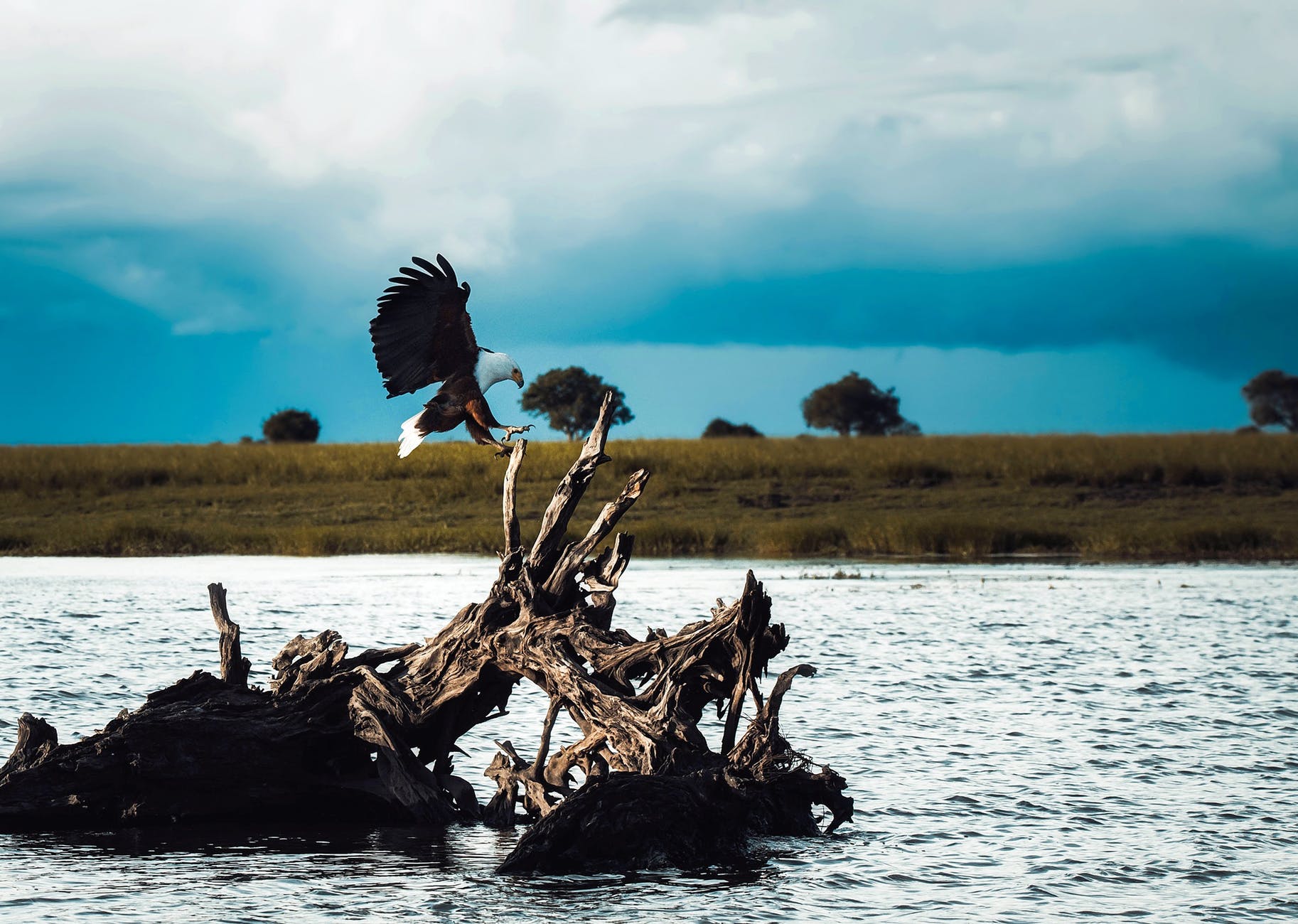
Photo by Pixabay on Pexels.com Bald eagles are often associated with wetland habitats.

Give bluebirds a hand as they scout for nesting locations

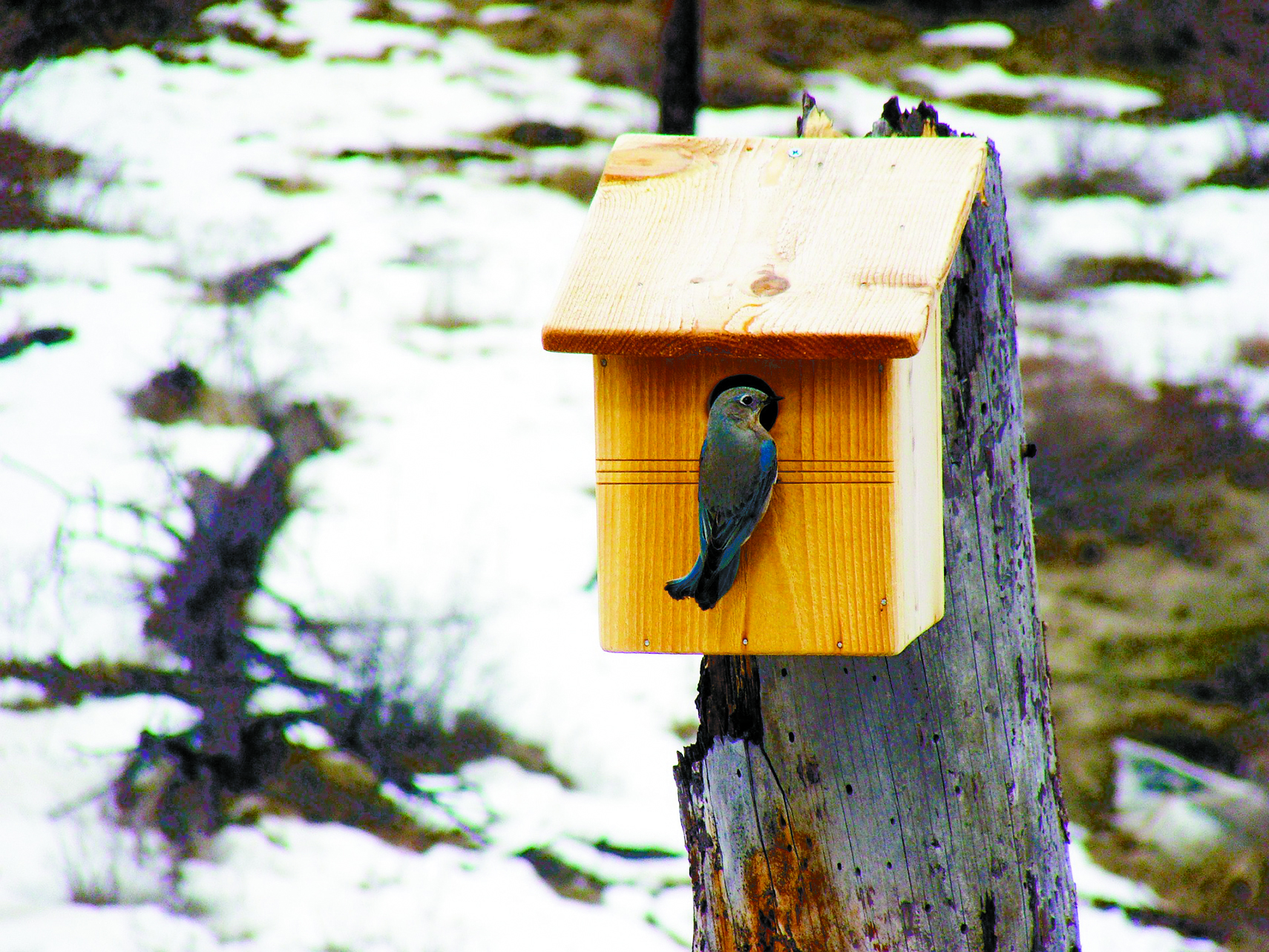
Photo by Matthew Saulsbury/Pixabay • Bluebirds are likely already scouting for nesting cavities and nest boxes in the region.

It’s time to turn the calendar page to February and, depending on the prognostication of the groundhog, winter may or may not be on the wane. Regardless, some of our feather friends are already acting like spring has sprung.
Perhaps it’s simply confusion when days can veer from sunny, short-sleeve conditions to frigid snowstorms, but I tend to trust the instincts of our fine feathered friends.

An email from Unicoi County resident Amanda Austwick proved timely.
“I saw a post on Facebook from a woman in Ontario, Canada, and she had a photo of a bluebird in a tree surrounded by red berries, with a touch of snow on them,” Amanda wrote. “I thought bluebirds migrated south in winter.”

I responded to Amanda’s email and will share some information in this week’s column. For the most part, local bluebirds do not migrate out of the region in winter. Bluebirds living farther north do often, but not always, migrate farther south.
As I mentioned to Amanda, I notice bluebirds almost daily on my drive from home to work. On sunny mornings, male Eastern bluebirds are producing their enthusiastic, warbling song even if there’s been a touch of frost overnight.

The Eastern bluebird is one of North America’s best-known cavity-nesting birds. About 85 species of North American birds use cavities in trees for nesting purposes. Cavity-nesting birds include ducks, such as buffleheads and wood ducks, as well as birds of prey such as Eastern screech-owls and American kestrels. Woodpeckers and nuthatches can excavate their own cavity in a dead or decaying tree.

Others, such as the bluebirds, must find a cavity already in existence. Such cavities are scarce real estate and can be subject to some intense competition.
The Eastern bluebird is at a disadvantage when forced to compete with non-native introduced birds such as aggressive European starlings and house sparrows. Even native competitors such as house wrens and tree swallows are serious rivals when it comes down to staking a claim to prime nesting sites.

Over the years, I have found bluebirds nesting in cavities inside wooden fence posts, but there are fewer wooden fence posts every year. This reinforces the idea of how changing landscapes have affected these birds. Instead of wooden fence posts, many farmers now use metal ones, and dead or dying trees — a much sought-after resource for cavity-nesting birds — are often removed from woodlands. Winter storms this season, along with accompanying high winds, have brought down numerous trees in the woodlands around my home, no doubt removing some current or future nesting possibilities.

When it comes to choosing a nesting cavity, male bluebirds take the lead, investigating and exploring potential sites before introducing females to the chosen real estate. If she accepts his choice, she will build the nest.

Cavities can also find use by bluebirds for secure locations for roosting overnight. According to the website Tennessee Watchable Wildlife, observers have documented bluebirds using nest boxes to stay warm during cold winter nights, packing eight to 12 individuals into one box. With the generated body heat from all those birds, I imagine that was one cozy box!

The website also noted that the oldest known Eastern bluebird in the wild reached an age of 10 years and six months. Given that most songbird live fairly short lives, that was quite an achievement.

For those interested in becoming bluebird landlords, check out nest box designs at the Tennessee Watchable Wildlife website. Several different nest box designs are available at the profile for the Eastern bluebird at tnwatchablewildlife.org.
If you’re not a do-it-yourself individuals, most lawn and garden centers, farm supply stores and speciality bird shops carry readymade bluebird boxes for purchase.
In addition to housing, food and water can be used to lure Eastern bluebirds closer. This bird doesn’t eat seeds, but it can be attracted with an offering of mealworms — live or freeze-dried – or commercially prepared peanut butter nuggets. A water feature in a yard is also a magnet for bluebirds and a host of other bird species.

•••
To ask a question, make a comment or share an observation, please email me at ahoodedwarbler@aol.com.

Sandpiper a surprise addition for summer bird count

Photo by USFWS • A baby least sandpiper shelters beneath its dutiful mother. The aptly named least sandpiper is the smallest species of shorebird.

It’s not too often I get a chance to make a historic bird sighting, but that’s what happened on a recent Saturday while seated on a bench with Rob Armistead having a breakfast break while taking part in a seasonal bird survey in Elizabethton along the Watauga River.

I chose the location for the break because I knew that it has traditionally been a good spot to observe some unexpected species. Past good birds that I’ve observed along this section of the Watauga River have included orange-crowned warbler, yellow-throated vireo, sora, Baltimore oriole and red-headed woodpecker.

On this occasion, a tiny shorebird made an appearance, settling on some exposed rock formations. In April and May, these same rocks are great locations to find migrating spotted sandpipers and solitary sandpipers. 

The bird was smaller than these sandpipers and immediately stood out as a “peep,” a nickname that birders give to a group of small sandpipers that are all similar in appearance.

The one physical trait that help distinguish a least sandpiper from other “peeps” is leg coloration. Least sandpipers have greenish or yellowish legs in contrast to the black legs of other similar “peeps.”

In good light and at close range, Rob and I confirmed that the bird had greenish legs and were thrilled to add a least sandpiper to our own tally of observed birds.

The least sandpiper, as suggested by its name, is the smallest member of the sandpiper family. In fact, this sandpiper, which is not much bigger than a sparrow, is the world’s smallest shorebird. The least sandpiper weighs only a single ounce and is only five to six inches long. 

According to the website All About Birds, the least sandpiper migrates thousands of miles between its Arctic breeding grounds and wintering grounds as far south as Chile and Brazil.

In releasing the count compilation, official compiler Rick Knight made note of the fact that the least sandpiper represents a late migrant and the first-ever June record for the species in the five-county area. 

During the course of the day, Rob and I joined Brookie and Jean Potter for a trip to Holston Mountain, where we added some mid- to high-elevation species such as scarlet tanager, rose-breasted grosbeak, veery, Eastern wood-pewee, dark-eyed junco, ruffed course and chestnut-sided warbler. 

Photo by Bryan Stevens • A male rose-breasted grosbeak perched on a branch on Roan Mountain, Tennessee.

This year’s survey was the 29th annual Carter County Summer Bird Count and was conducted by members and friends of the Elizabethton Bird Club. I’ve been participating on this yearly survey of local birds since the late 1990s.

This year’s count was held Saturday, June 11. A total of 22 observers took part in this year’s count. 

A total of 116 species was tallied, which is right on average for the last decade and slightly above the average of 114 over the previous 28 years, according to Knight.

He noted that the all-time high for this count was 123 species in 2017.

Here’s the total:

 Canada goose, 131; wood duck, 9; mallard, 53; ruffed grouse, 3; and wild turkey, 20.

Rock pigeon, 49; Eurasian collared-dove, 1; mourning dove, 155; yellow-billed cuckoo, 1; Chuck-will’s-widow, 4; Eastern whip-poor-will, 9; chimney swift, 116; and ruby-throated hummingbird, 22.

Killdeer, 18; least sandpiper, 1; double-crested cormorant, 13; great Blue heron, 22; and green heron, 2.

Black vulture, 5; turkey vulture, 65; Cooper’s hawk, 4; bald eagle, 1; red-shouldered hawk, 2; broad-winged hawk, 5; red-tailed hawk, 5; Eastern screech-owl, 6; and barred owl, 3.

Belted kingfisher, 5; red-bellied woodpecker, 32; downy Woodpecker, 23; hairy woodpecker, 4; Northern flicker, 27; and pileated woodpecker, 16.

American kestrel, 1; great crested flycatcher, 2; Eastern kingbird, 27; Eastern wood-pewee, 31; Acadian flycatcher, 20; alder flycatcher, 2; least flycatcher, 12; and Eastern phoebe, 73.

White-eyed vireo, 5; yellow-throated vireo, 1; blue-headed vireo, 54; warbling vireo, 1; and red-eyed vireo, 165.

Blue jay, 110; American crow, 259; fish crow, 2; and common raven, 10.

Tree swallow, 118; Northern rough-winged swallow, 45; purple martin, 22; barn swallow, 173; and cliff swallow, 265.

Carolina chickadee, 73; tufted titmouse, 93; red-breasted nuthatch, 14; white-breasted nuthatch, 23; house wren, 57; winter wren,  4; and Carolina wren,  116.

Blue-gray gnatcatcher,  23; golden-crowned kinglet, 7; Eastern bluebird, 152; veery,  29; hermit thrush, 1; wood thrush, 66; American robin,  581; gray catbird, 60; brown thrasher,  22; and Northern mockingbird, 70

European starling, 411; cedar waxwing, 61; house sparrow, 98; house finch, 51; pine siskin, 10; and American goldfinch, 170.

Grasshopper sparrow, 1; chipping sparrow,  80; field sparrow, 43, dark-eyed junco, 70; song sparrow, 348; Eastern towhee, 150; yellow-breasted chat, 7.

Eastern meadowlark, 13; orchard oriole, 2; Baltimore oriole , 1; red-winged blackbird, 73; brown-headed cowbird, 49; and common grackle,143.

Ovenbird, 77; worm-eating warbler  3; Louisiana waterthrush, 12; golden-winged warbler,  2; black-&-white warbler, 31; Swainson’s warbler, 6; common yellowthroat, 31; hooded warbler,  110; American redstart , 6; Northern parula, 47; magnolia warbler, 1; Blackburnian warbler,  5; yellow warbler, 3; chestnut-sided warbler, 31; black-throated blue warbler, 49; pine warbler,  3; yellow-rumped warbler, 1; yellow-throated warbler, 16; black-throated green warbler, 19; and Canada warbler,  10.

Scarlet tanager, 42; Northern cardinal, 173; rose-breasted grosbeak, 7; blue grosbeak, 4; and indigo bunting, 161.

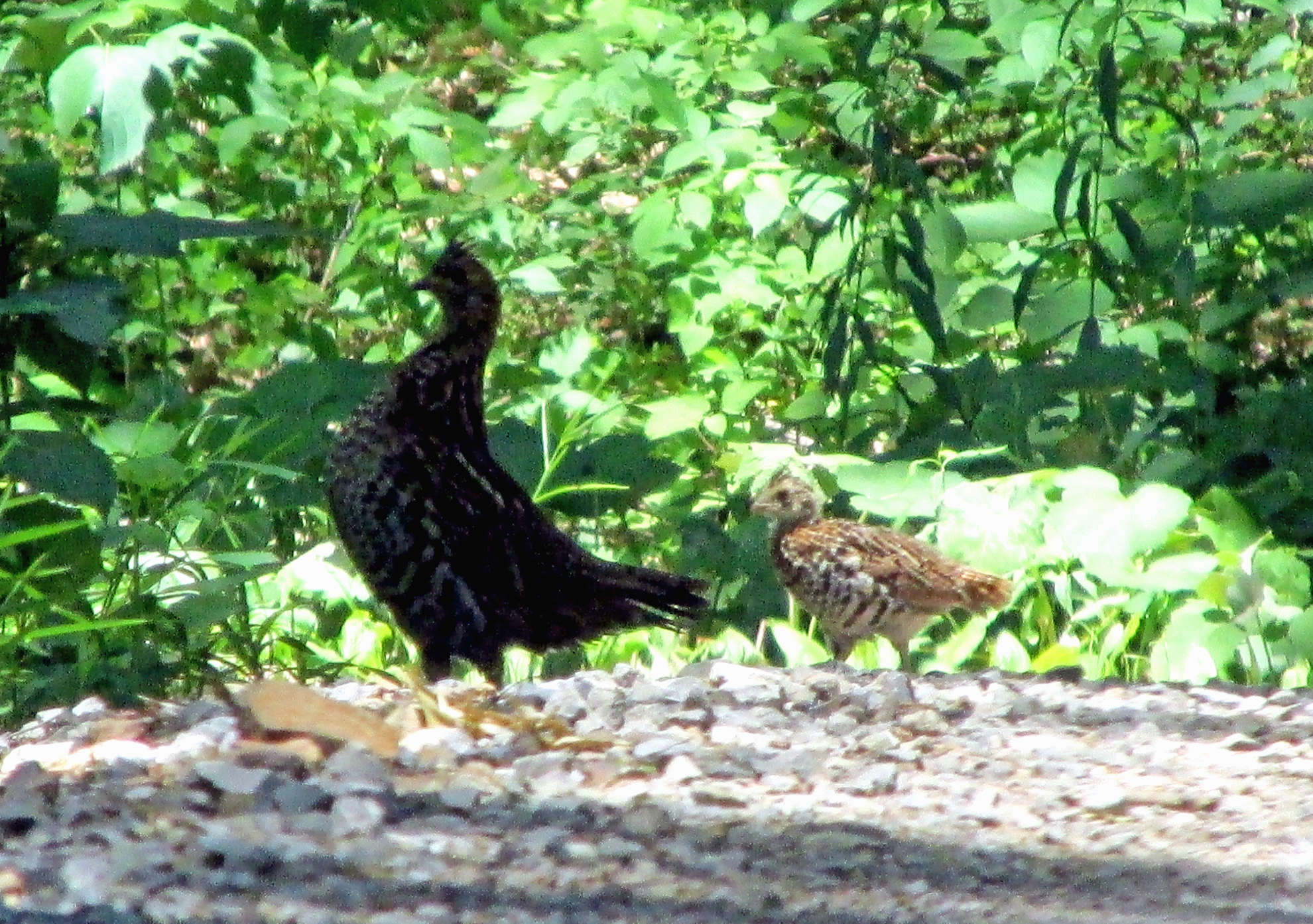
Photo by Bryan Stevens • A young grouse follows its mother into concealment by the edge of a road on Holston Mountain, Tennessee.

My other personal highlight on this count was seeing three young Ruffed Grouse darting  across the road, one at a time, while riding on Panhandle Road to the top of Holston Mountain. Those three young grouse turned out to be the only grouse counted by any participants on the count.

The Unicoi County Summer Bird Count was conducted Saturday, June 18. I’ll provide the results of that count in an upcoming column. 

Culprit emerges in ‘murder mystery’

Photo by Tom Ferguson/Pixabay • A sharp-shinned hawk perches at the edge of a bird bath. The raptor’s talons, which are on full display, help explain this bird’s efficiency as a predator. 

Darlene Bloomfield emailed me from her home in Parry Sound, Ontario, in Canada. She wanted my help in solving an avian “whodunnit” type of mystery. 

“We had both a robin and a brown thrasher nesting in our cedar hedge,” Darlene wrote in her email.

“Both seemed to have babies,” she added. “The other morning we found a mound of robin feathers on the ground in front of the hedge along with many tiny feathers.”

She also noted that the robins are no longer around.

“Would a thrasher kill a robin?” Darlene asked. “We have seen them chasing each other.”

She also noted that they didn’t find the bodies of the dead robins.

So, in a case perhaps best filed under NCIS Ontario, I looked at the clues and responded.

Robins and thrashers are about the same size and will skirmish if they have to defend their territory, but sadly the evidence points to another culprit.

The little mound of feathers sounds like what a hawk (likely a sharp-shinned hawk or Cooper’s hawk) would leave behind after grabbing a meal in a yard or garden.

The absence of the bodies is also explained. The predatory hawk likely dined on robin and left only the plucked feathers as evidence. 

I expressed sympathy that the incident happened. I’ve been somewhat light-hearted in my relation of the mystery in this column, but it’s important to note that hawks and other predatory creature are not evil. They are not villains. They are doing what they were designed to do. 

The sharp-shinned hawk and its larger relative, the Cooper’s hawk, are classified as accipiter hawks. The sharp-shinned hawk and Cooper’s hawk are the two raptors most often encountered by people who feed birds. Part of the family of Accipiter hawks, these two species are widespread in woodlands.

The Cooper’s hawk is larger, often described as similar in size to an American crow. The Sharp-shinned, on the other hand, is usually described as the size of a dove. There’s some overlap in size, so it is not the only reliable means of identifying these hawks. For example, female Sharp-shinned hawks are roughly equivalent in size to a male Cooper’s hawk. As with many raptors, the female is larger than the male in both these species.

There are some other things to look for in telling these species apart. For instance, adult Sharp-shinned hawks often look like they have a dark cap or hood. The eyes on a sharp-shinned hawk also look like they are halfway between the front and back of the head. In addition, the head itself looks small in comparison to the overall size of this hawk’s body.

These two species feed heavily on songbirds, which causes some bird-lovers distress. I like to view predation incidents as good examples of how the the natural world is good at keeping things balanced. 

The sharp-shinned is really beautiful, especially for a hawk. Preying on songbirds doesn’t make them “bad” birds. They’re extremely efficient predators, and if you’ve ever witnessed one of these raptors in action, you can’t help but be impressed by both the power and precision deployed by these raptors in capturing prey.

The Accipiter genus of hawks includes about 50 species. In Northeast Tennessee, as well as across much of North America, the two common species are sharp-shinned hawk and Cooper’s hawk. A third species, the Northern goshawk, is a rare visitor to the region.


The Northern goshawk is a large, powerful hawk, and it is also fiercely defensive of its nest. This hawk is known to attack other raptors, mammals and even humans that stray too close to its nesting site.

Goshawk is a term derived from “goose hawk,” referring to the ability of this bird when utilized in falconry to take down such large prey as geese.

Other Accipiter hawks around the world include spot-tailed sparrowhawk, rufous-chested sparrowhawk, grey-headed goshawk, chestnut-flanked sparrowhawk, semi-collared hawk, red-thighed sparrowhawk and tiny hawk, which is one of the world’s smallest raptors. This diminutive hawk is about the size of a European starling and lives in Central and South America.

The sharp-shinned hawk will feed on a variety of birds, ranging in size from sparrows, warblers and thrushes to birds as large as ruffed grouse and mourning dove. This hawk also feeds on small mammals, reptiles and insects.

•••

To share a sighting, make a comment or ask a question, please email me at ahoodedwarbler@aol.com.

Sales of local calendar fund bird-worthy aims


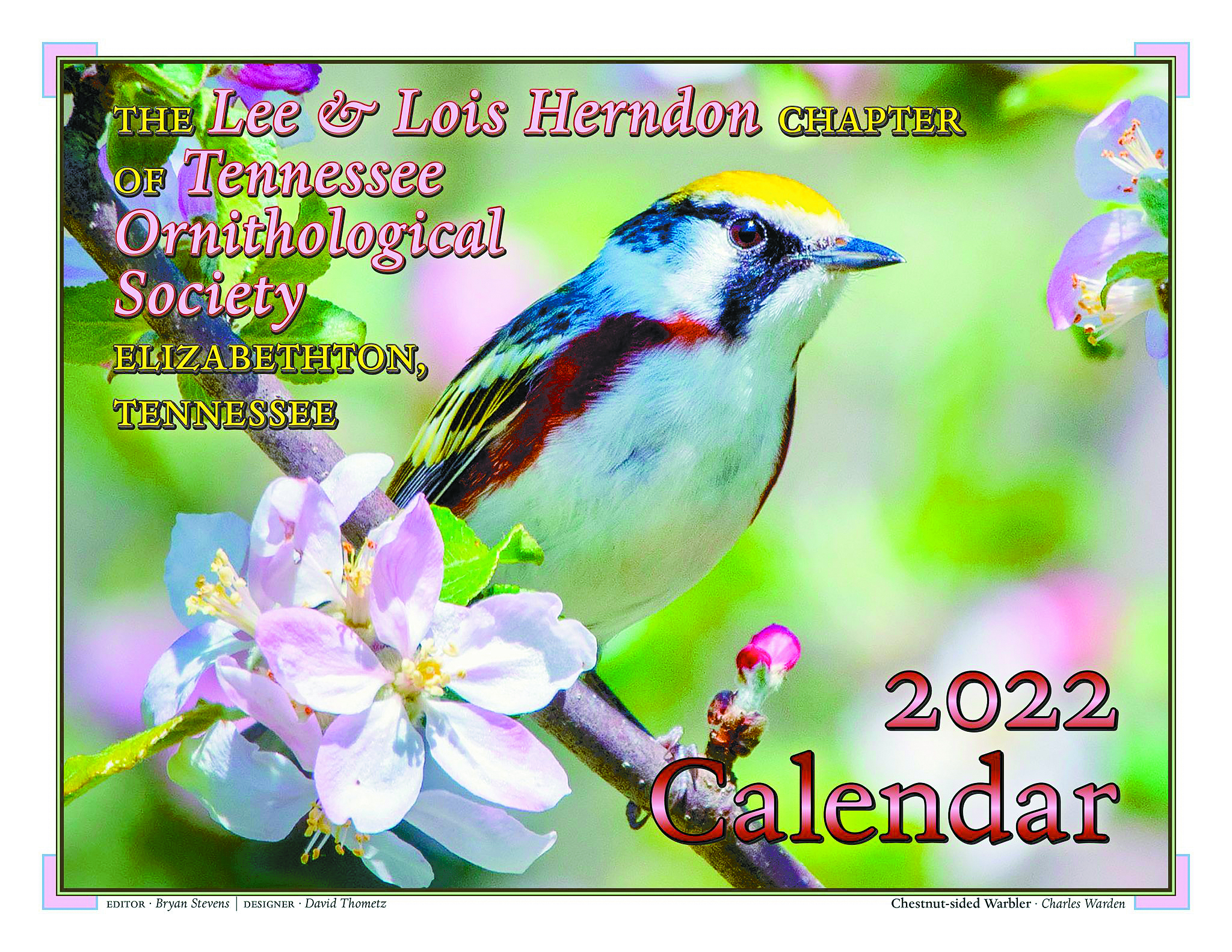
The front cover of the 2022 bird calendar produced by the Elizabethton Bird Club features a photo of a chestnut-sided warbler taken by club member Charles Warden. The calendar is available for purchase for $15, plus $2 for shipping and handling. They make great Christmas gifts for nature and bird enthusiasts. For more information, email ahoodedwarbler@aol.com. 

If you didn’t find all you needed on Black Friday for those on your shopping list, here’s a suggestion. The Lee and Lois Herndon Chapter of Tennessee Ornithological Society, also known as the Elizabethton Bird Club, has produced its annual calendar featuring bird photographs by its members and friends of the organization.

These calendars make wonderful Christmas gifts and stocking stuffers. This year’s front cover features a gorgeous photo of a chestnut-sided warbler taken by club member Charles Warden. This is Warden’s first year contributing photographs to the club’s yearly calendar project. More of his photos are on display through the calendar. He is a resident of Johnson City.

“I took the photo on the Spring Bird Count with Fred Alsop and Judi Sawyer on May 1 of this year at Hampton Creek Cove,” Warden said.

He said that the bird was among the blooms of what he thinks was an apple tree.

“We heard the warbler and chased it down,” he said. “It came out in the open and posed nicely for pictures.”

He has been interested in photography since he took a beginning photography class at East Tennessee State University on a lark in 1977.

“I am lucky enough to be making a living as a photographer for ETSU marketing.”

Bird photography is certainly a challenge, he said, and requires much patience, decent equipment and a lot of luck.

“It’s been a learning curve for sure, and it’s still a tough call when to take the binoculars down and put the camera up as it’s so mesmerizing to watch the birds,” Warden said.

The chestnut-sided warbler is a summer resident in the region and can be found at middle and higher elevations on many of the area’s mountains, including Unaka and Roan. Unlike many warblers, both males and females are brightly colored, with the female being slightly less so. Males during the summer nesting season show a yellow crown, black mask, white cheeks, throat and breast and the namesake chestnut flanking on his sides.

He’s also a cheery and persistent singer when he arrives on his nesting territory. His song is usually transcribed as “Pleased, pleased, pleased to meetcha!” For birders, it’s like a welcoming reintroduction each spring when this particular song is heard from the branches of trees in local woodlands.

For the singing male, there’s a more personal reason for singing his song. The “pleased, pleased, pleased to meetcha” refrain is a way of attracting the attention of potential mates. Males sing an entirely different song once settled into nesting activities with a mate. The song used to attract mates is more heavily accented, according to the website, All About Birds. Some males sing only unaccented songs and thus have a lower success rate at attracting mates.

Chestnut-sided warblers are classified by scientists as birds that favor successional habitats for nesting purposes. These sorts of habitats are usually disturbed by human activities such as logging. However, disturbed habitats can be created by natural occurrences, including fires, flooding and storm damage. During the winter months, this warbler withdraws into Central America with many individuals finding suitable habitat on shade-coffee plantations.

Female chestnut-sided warblers will weave a nest of bark, grass and other components all bound together with gathered spider silk. She will lay three to five eggs. These warblers make the most of the summer season, often nesting a second time after raising their first brood.

Chestnut-sided warblers feed largely on insects, but the birds also incorporate seeds and fruits into their diet. Young are fed by both parents on a diet of small insects, spiders and caterpillars. The chestnut-sided warbler’s scientific name, Setophaga pensylvanica, roughly translates as “eater of moths from Pennsylvania,” which is a nod to the bird’s insect-rich diet.

Other warblers that can be found in the mountains of Northeast Tennessee — and in the pages of the calendar — include black-throated blue warbler, golden-winged warbler, worm-eating warbler, hooded warbler, prairie warbler and common yellowthroat.

Like most small songbirds, the New World warblers, to which the chestnut-sided warbler belongs, don’t have long lifespans. A few individuals, however, defy the odds. According to the website, All About Birds, the longest-lived chestnut-sided warbler documented by scientists was a nearly seven-year-old bird banded in Rhode Island in 1980. The bird had been banded in the same state six years and 11 months earlier in 1973.

Of course, with the exception of the yellow-rumped warbler, most of the warblers don’t spend the winter months in the region. With one of these calendars, however, you can enjoy beautiful photos of some of our most lovely warblers while awaiting their return this spring in mid-April and early May.

The inside pages of the professionally-produced calendar feature dozens more full-color photographs and an informative and educational grid. These calendars sell for $15 plus $2 for shipping. All sales help the club fund birding programs, public park feeders, conservation efforts and other activities in upper Northeast Tennessee.

For more information on how to obtain a calendar, email me at ahoodedwarbler@aol.com.


American crow’s dark reputation more from plumage than behavior

There’s something rather autumnal about watching a flock of American crows glean the last scattered kernels of corn from a harvested field as one of the flock stands sentry and ready to utter the alarm with some guttural “caws” should anything potentially threatening appear on the scene. Crows are such a part of the landscape that they would almost escape our notice if they didn’t come with centuries of accumulated baggage that makes us distrust them and suspect their every action.

While seeking birds far afield, I have occasionally spotted some innovative scarecrows standing guard in gardens and agricultural fields. I’m not sure if anyone still erects these human effigies for their original purpose of warding off crows and other feathered agricultural pests. These days, scarecrows likely serve an ornamental purpose and are often part of a yard’s whimsical Halloween or autumn decorations.

The crow, largely thanks to its glossy black feathers, but perhaps also with a nod to its avian intelligence, has long been associated with Halloween. Greeting cards and decorations for the holiday often feature depictions of bats, owls and black cats, as well as the inevitable crow and the accompanying scarecrow. With a brain about as big as a man’s thumb, the crow is renowned among ornithologists and other scientists for its keen intelligence. Crows are not fooled for a second by the charade of a straw-stuffed, brainless friend of Dorothy propped in a field.

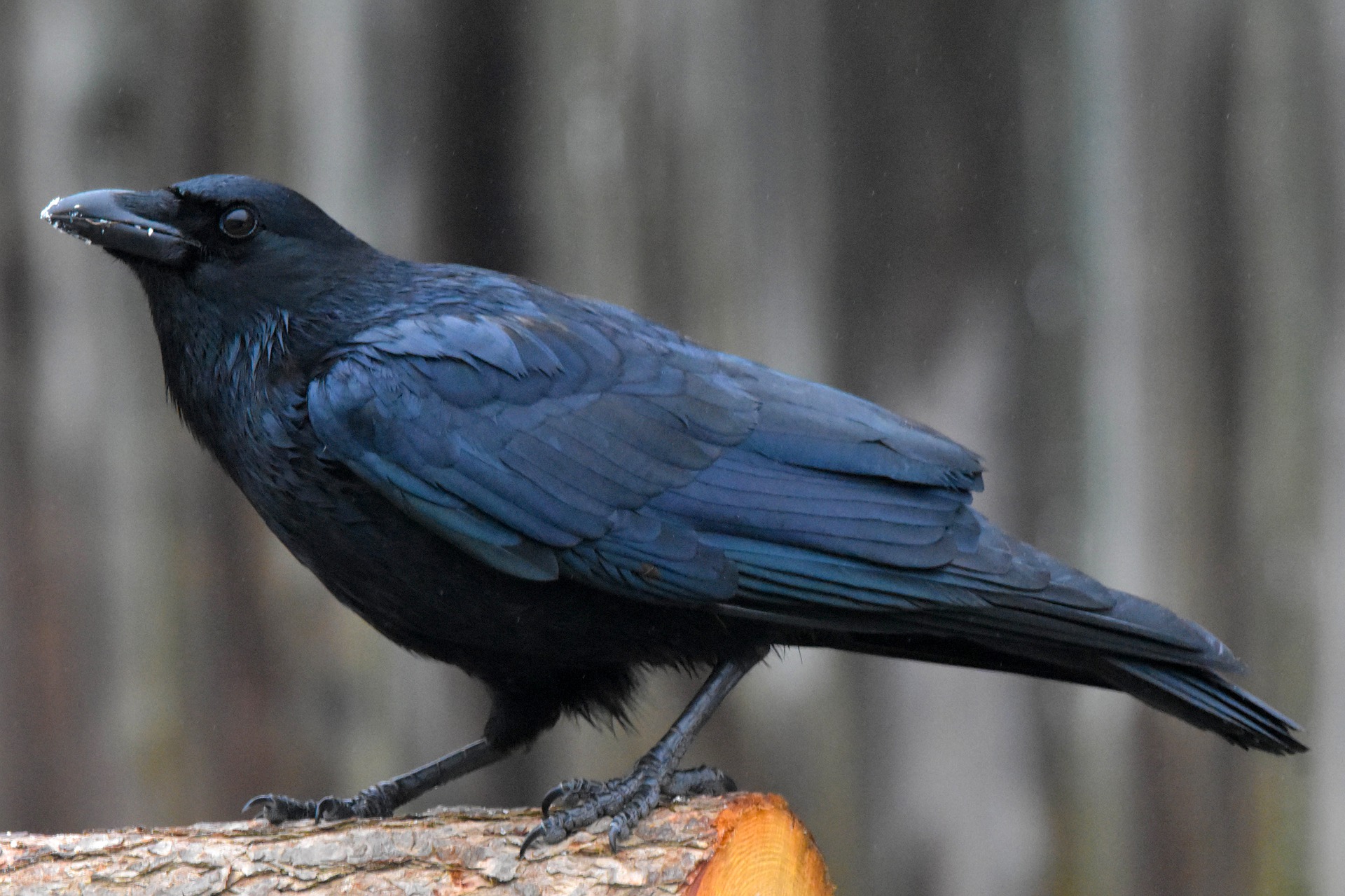
Photo by Jack Bulmer/Pixabay • An American crow perches on a log. Due to its dark coloration, crows have often been associated with evil and other dark forces. In actuality, crows are admirable, highly intelligent birds.

The intelligence of this bird has long been known. Early American naturalist William Bartram wrote about a crow named Tom in a highly entertaining essay titled “Anecdotes of an American Crow.” Bartram, who lived from 1739 to 1823, brought humorous observations and keen insight to his subject as he wrote about the joys — as well as tribulations — of living with Tom, a crow that enjoyed tormenting Bartram’s dog and purloining the writer’s spectacles and trying to hide them.

The essay demonstrates that almost as soon as Europeans arrived in North America, some of those with a bent toward the natural world recognized the intelligence and amazing adaptability of the American crow. As well as writing about the natural world, Bartram earned widespread acclaim for his drawings of botanical and ornithological subjects. Tom, the featured crow in Bartram’s brief essay, certainly exhibited intelligence of an impressive degree. Not only did the crow steal his owner’s eyeglasses, he foiled Bartram’s first attempt to reclaim them. The story makes very humorous reading. To read Bartram’s account, visit http://www.geocities.ws/jswortham/crow.

What else have crows done down through the ages to gain such a dark and much undeserved reputation? It probably doesn’t help matters that a flock of crows is known as a “murder.” Ancient Greeks considered crows as omens, which often foretold death and other disasters. The warrior goddess known as the Morrighan from Celtic mythology often appears in the form of a crow or raven. She is also often portrayed as being accompanied by a group of these black-plumaged birds. Many Native American tribes revere crows as communicators between worlds. Crows have been documented using tools and solving problems, which shows an uncanny ability to analyze and strategize. The early Celtic people also noted and admired these traits in crows.

I think the Celts and Native tribes had the right idea. Crows are admirable birds for many reasons. For instance, they are very social birds, often forming family flocks. They may also form much larger flocks for the purpose of roosting. When nesting, this social behavior comes in useful for a mated pair. Offspring from previous successful nesting efforts often serve as helpers. In addition to gaining their own life experience on successful nesting and caring for chicks, these older siblings may protect the nest site from predators or even deliver food to fill hungry beaks and bellies.

While famous for their associations to humans and our agriculture, crows forage far beyond the cornfield for their food. Many crows scavenge road-killed wildlife, such as squirrels, opossums and rabbits. While they certainly don’t turn up their beaks at the notion of eating carrion, crows do so less often than birds such as turkey vultures, black vultures and the crow’s fellow corvid, the common raven.

The kinship to the raven is evident, but even moderately experienced birders rarely confuse these similar species. The raven is a large bird with a heavy beak, a distinctive profile and a wedge-shaped tail. In a direct comparison with a raven, a crow looks downright puny. Both are members of the corvid family, which consists of 120 species including jays, rooks, magpies and jackdaws. Some of the world’s other crows include the descriptively named little crow, hooded crow, carrion crow, collared crow, long-billed crow and violet crow. While most of the world’s crows are thriving, the Hawaiian crow has been extinct in the wild since 2002, although the species still exists in captive-breeding programs in various zoos.

Thanks to its resourcefulness and intelligence, the crow is deserving of more respect and even admiration. The American crow is a uniquely American success story. Think more of Bartram’s story about Tom the crow and not the dark, misguided myths and legends about crows this Halloween. Long may the crows fly.

Barn owl helps kin earn ghostly reputation

Photo by Kevinsphotos by Pixabay • A barn owl flies through the darkness without any difficulty whatsoever. Special adaptations make barn owls a silent, highly efficient predator on rodents, some songbirds, and some reptiles and amphibians.

Halloween is drawing closer, and it’s definitely the one night of the year that we become acutely aware of things that go bump in the night.

While goblins and ghouls can be dismissed as mere apparitions of the imagination, some real-life feathered phantoms do roam the darkness, perhaps even in your own backyard. If so, you are more likely to have heard them than to have seen them.

If you do hear anything unusual Halloween night, chances are the sounds may have been produced by an owl.

Several species of owl reside in Northeast Tennessee, including the Eastern screech-owl, the barred owl, the great horned owl and the barn owl. A fifth owl, the tiny Northern saw-whet owl, can be found at some high-elevation locations, including Unaka Mountain in Unicoi County. A few other owls have made sporadic appearances in the region, including long-eared owl, short-eared owl and even snowy owl.

The barn owl is an owl that has adapted its ways to co-exist with humans. Even its common name refers to the fact that these owls will roost and nest in barns and other structures. They are also known to select natural tree cavities, caves and other human structures, including recesses build into sports stadiums and arenas. My most recent sightings of barn owls took place at a grain silo in Sullivan County a few years ago, a large barn located on Antelope Island State Park in Utah in 2006 and under the eaves of the old theatre on the campus of the Mountain Home Veterans Administration near East Tennessee State University back in 2000. These sporadic sightings are testimony to the overall elusive nature of this owl.

I was surprised to learn during my background research that the barn owl is the most widely distributed species of owl as well as one of the most widespread birds on the planet. This owl is also referred to as common barn owl, to distinguish it from other species in the barn-owl family Tytonidae. Owls in this family comprise one of two main lineages of living owls, the other being the typical owls in the Strigidae family. The barn owl, known by the scientific name, Tyto alba, is found almost worldwide except in polar and desert regions, Asia north of the Alpide belt, most of Indonesia, and the Pacific islands.

The genus name for this owl is Tyto, a variation of the ancient Greek word, “tutō,” which meant “owl.” The barn owl family, Tytonidae, consists of true barn owls, as well as grass owls and masked owls.

All owls are carnivores, but the barn owl specializes on rodents more than many of its kin. However, this owl will also eat other birds and insects.

Because of their pale plumage and nocturnal habits, barn owls have been saddled with such common names as demon owl, death owl, night owl and ghost owl.

Other common names include rat owl, inspired by one of its major prey items, and barnyard owl and church owl, which are two haunts where these owls often roost or perch. I also liked the name scritch owl and hissing owl, which were acquired because of vocalizations from this bird.

Barn owls have several adaptations that allow them to hunt in complete darkness. These owls have excellent hearing, allowing them to pinpoint prey even when the absence of light renders vision useless. The characteristic facial disc of the barn owl helps channel sounds toward the bird’s ears.

Even the feathers of owls have adapted to the need to stalk wary prey without revealing their presence. Specialized feathers permit owls to fly almost silently. Their feathers absorb flight noises and even alter air turbulence to keep the flight smooth and quiet. Most prey never suspect the owl’s approach until it’s far too late.

For the average person the term “owl” is representative of what is actually an extremely diverse family of birds. Worldwide, there are about 220 species of owls varying in size and habits.

Humans have come up with some descriptive names for various owls around the world. A sampling of these names includes fearful owl, pharaoh eagle-owl, collared owlet, pearl-spotted owlet, least pygmy-owl, red-chested owlet, buff-fronted owl, Stygian owl, vermiculated fishing-owl, black-and-white owl, bare-legged owl, maned owl, bearded screech-owl, spectacled owl and golden-masked owl.

Owls, according to Linda Spencer, author of “Knock on Wood: A Serendipitous Selection of Superstitions,” have inspired a mixed bag of superstitions ever since humans stood up. Owls have long been associated with the forces of both good and evil. The “hoot” or call of an owl is believed by people of many cultures to foretell death. There are some interesting ways to counter the ominous hoot of an owl, according to Spencer. Means of warding off the evil owl power include putting irons back in the fire, throwing salt, pepper and vinegar on the fire, tying a knot or taking one’s clothes off, turning them inside out and putting them back on.

According to Laura Martin, author of “The Folklore of Birds,” one of the earliest human drawings depicting owls dates back to the early Paleolithic period. The scene is of a family of snowy owls painted on a cave wall in France.

Owls have also entered the culture as symbols of wisdom and goodness. The wise old owl, Martin writes, dates back to the time of King Arthur. The sorcerer Merlin was always shown with an owl on his shoulder. During the Middle Ages owls became symbols of learning and intelligence. The Greeks didn’t fear owls as did the Romans. In fact, the owl was the sacred mascot of the Greek goddess Athena.

There’s one more owl-related myth I forgot to mention. There is a Chinese belief that owls snatch the souls of unwary people — just something you should know if you are out and about after dark on Halloween night.

Photo by skitter photos/Pixabay • Look for owls on Halloween and every other dark night.