Tag Archives: Northeast Tennessee

Seasonal snipe hunts can be productive

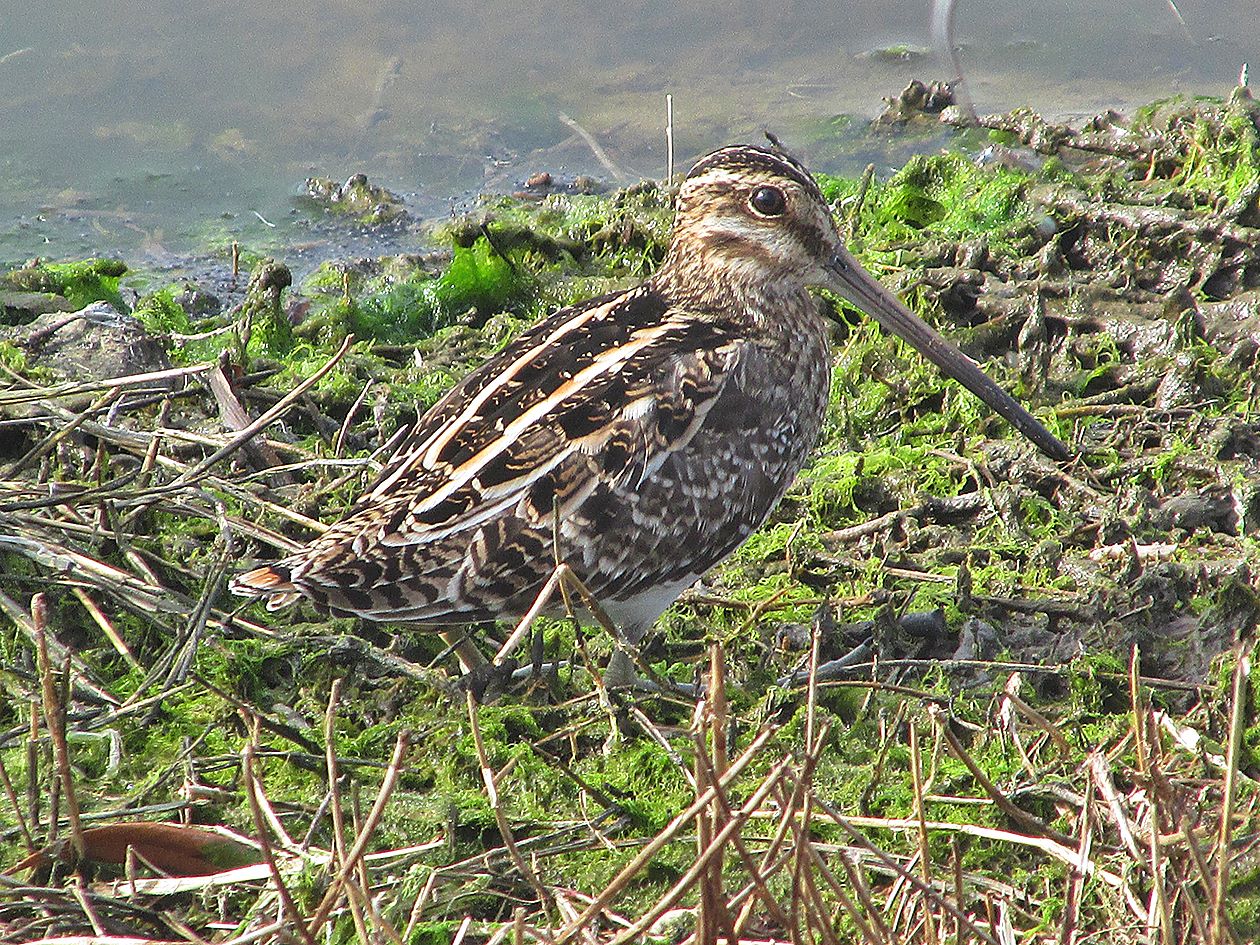
Photo by Bryan Stevens • A Wilson’s snipe forages on muddy ground in a wetland at Huntington Beach State Park in South Carolina.

Have you ever gone on a wild goose chase? Perhaps you have memories of being taken on a snipe hunt?

If so, I don’t need to tell you that our feathered friends have inspired a lot of unusual sayings and activities. The snipe hunt is widely regarded as a rite of passage. I’m not sure if these “hunts” are still organized on moonless nights to pull a playful prank on unsuspecting or naive adolescents. The gist of this practical joke is that these would-be snipe hunters are given a bag or sack to use in capturing the supposedly elusive, perhaps mythical snipe.

The “snipe hunt” has also come to symbolize a lesson in futility since the target of the hunt is never found despite some diligent efforts. It’s all harmless fun, but what bothers me is that the tradition of the snipe hunt reinforces the mistaken idea that this elusive creature is a make-believe bird.

That’s not the case! I know of what I speak, having seen plenty of snipes over the years. There are some things about this unusual bird that makes it understandable how this creature became the focus of the long-running tradition of the snipe hunt.

The Wilson’s snipe is one of North America’s more elusive birds. It’s an aberrant shorebird that doesn’t exactly fit the mold of the birds any coastal visitor has probably seen running along the surf’s edge on a beach.

The snipe is an odd, gangly bird with long legs and an even more absurdly long bill. It’s also remarkably well camouflaged to blend with its preferred surroundings in flooded fields and wetland marshes. It is one of those shorebirds that usually makes its home far from beaches and the crash of the ocean’s surf.

So, to reiterate, there really is such a bird as a snipe. In fact, there are several species of snipes, although only one — Wilson’s snipe — can be found in Northeast Tennessee. Some of the world’s other 25 species of snipe include jack snipe, wood snipe, pintail snipe, noble snipe and imperial snipe. What makes the noble and imperial snipes worthy of such pretentious names isn’t quite clear.
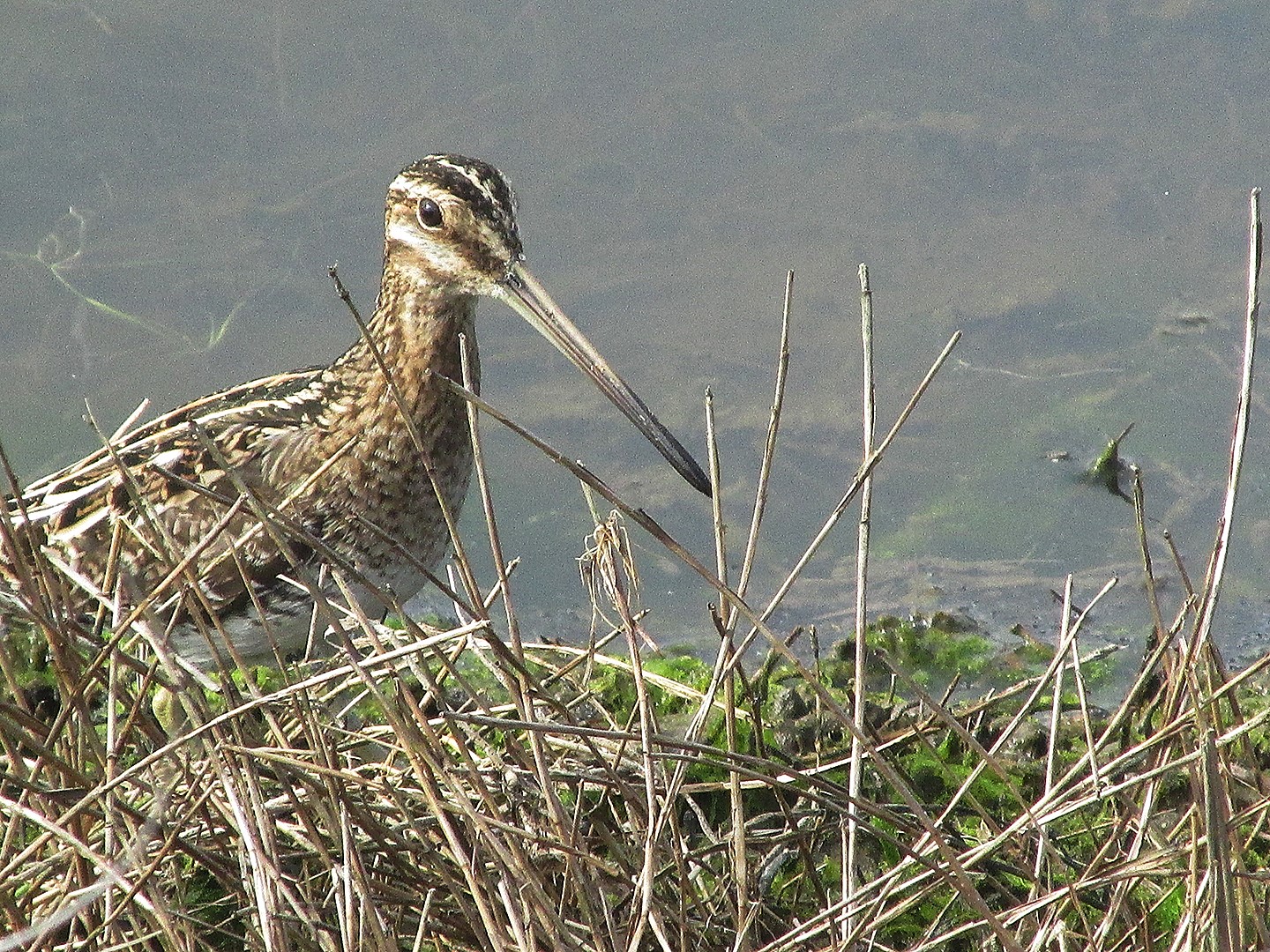
Photo by Bryan Stevens • The Wilson’s snipe can blend well with wetland vegetation.

Any wet field or pasture may conceal hidden Wilson’s snipes during the spring. A few of these hardy shorebirds sometimes spend the winter in the region. Flushing a snipe from a tangle of grass right at your feet as you walk through a wet field always works to get the heart pumping faster.

The Wilson’s snipe uses its long bill to probe in the mud for prey, which can include earthworms, insects and other invertebrates.

Formerly known as the common snipe, the Wilson’s snipe nests in wetland habitats across Canada and the northern United States. The bird’s common name pays homage to Alexander Wilson, an early American ornithologist. In addition to his expertise on birds, Wilson was also a poet and an illustrator. He was born in Scotland in 1766, but he died at age 47 in 1813 in Philadelphia, Pennsylvania.

I’ve located Wilson’s snipes in all of the Northeastern Tennessee counties. I still hold the record for most snipes seen at one time. I was birding in Johnson County with the late Wallace Coffey when we encountered a flock consisting of 126 Wilson’s snipes overrunning Quarry Bog in Shady Valley.

I’ve also observed this snipe in coastal South Carolina, including a close-range observation while visiting Huntington Beach State Park. My South Carolina birding over the years has yielded observations of other shorebirds, including willet, greater yellowlegs, black-bellied plover, short-billed dowitcher and Wilson’s plover, yet another shorebird named in honor of Wilson.

Looking back through my records helped resurface a memory of a fun trip back in 2003 to look for snipe and its even odder relative, the American woodcock. On Tuesday, March 11, I traveled with Tess Cumbie, Reece Jamerson and Howard Langridge to Johnson County’s Shady Valley. Our first stop at Quarry Bog yielded lots of red-winged blackbirds, Eastern meadowlarks and song sparrows. We also flushed about a dozen or so snipe. Other birds seen during our visit included a great blue heron, swamp sparrow, three common grackles, a wood duck and a flock of American robins.
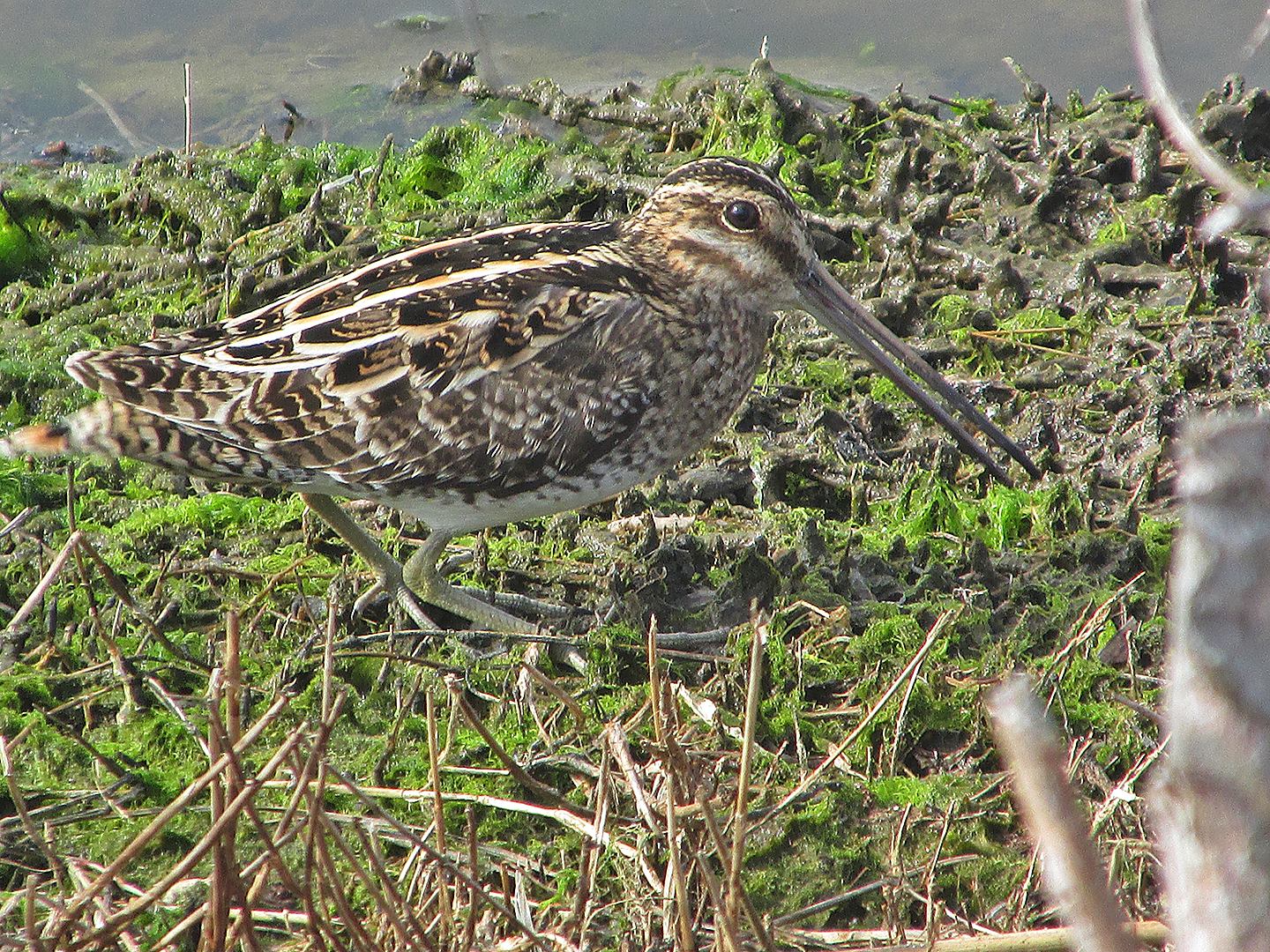
Photo by Bryan Stevens • Although only one species — Wilson’s snipe — can be found in Northeast Tennessee, there are 25 species of snipe found worldwide, including jack snipe, wood snipe, pintail snipe, noble snipe and imperial snipe.

We arrived at Orchard Bog to settle in before twilight with our hope for a show by the American woodcocks, also known by such names as bogsucker and timber doodle. Before the timberdoodles began their show, several wood ducks flew overhead and a flock of eight Canada geese splashed down in the bog. At least two American woodcocks began making their “peent” calls shortly before 7 p.m. Then one of the timberdoodles took to the air, giving a fine show in his display flight. The timberdoodles seemed to give anywhere between 18 to 34 “peent” calls before they would take to the air in a display that also let us hear the “twittering” feathers as they ascended and descended. When it got too dark to really see their flights, we left, but the timberdoodles were still “peenting” in the bog.

As spring advances in the region, many of these shorebirds will make migratory stops along the shores of lakes and rivers or by the edges of farm ponds. Look for snipes around puddles in flooded fields or even along the banks of small streams. The family of shorebirds is dazzling in its diversity, and they’re definitely worth seeking out.

•••

If you have a question, wish to make a comment or share a sighting, email ahoodedwarbler@aol.com.

Photo by Bryan Stevens • Although not rare, Wilson’s snipes are not likely to be encountered unless people actively seek them out in their wetland habitats.
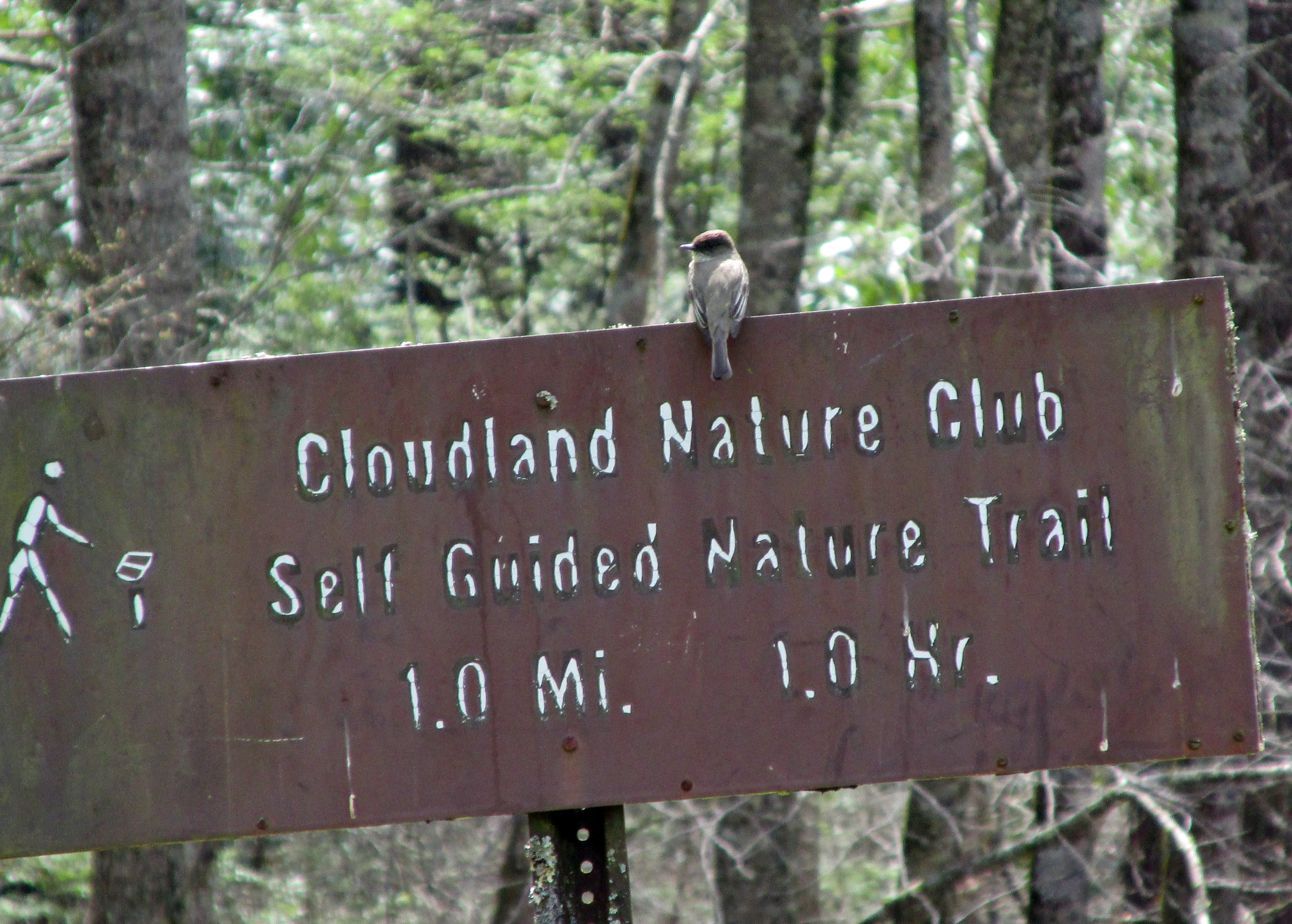
Phoebe’s return a signal other arrivals due soon

An Eastern phoebe has returned to the woodlands around my home.

I’m not sure when the resident phoebes departed last fall. They were still prominent in their daily activities in late October and early November. I think they probably slipped off, unnoticed, around Thanksgiving. Some winters, a few Eastern phoebes linger throughout the cold months, often near an open source of water that’s unlikely to freeze.

With the arrival of March and warmer weather, at least one Eastern phoebe, a male, is back and singing tirelessly every morning. The song is easy to memorise. The singing bird simply repeats its name — fee bee, fee bee — in scratchy, descending sets of tones.

Considering the bright finery worn by some of the more colorful spring arrivals, Eastern phoebes are comparatively drab. The gray and white plumage of this species of flycatcher pales in comparison with vibrant birds like rose-breasted grosbeak, ruby-throated hummingbird, scarlet tanager and yellow warbler.

Nevertheless, this member of the flycatcher clan has earned itself a favorite spot in the hearts of many a birdwatcher. It’s one of those birds that even beginning birders find surprisingly easy to recognize and identify. While it may not have a dramatic plumage pattern to hint at its identity, the Eastern phoebe is quite at home around human dwellings and comes into close contact with people going about their daily routines. Rather tame — or at least not too bothered by close proximity with humans — the Eastern phoebe has one behavior that sets it apart from all the other similar flycatchers. When this bird lands on a perch, it cannot resist a vigorous bobbing of its tail. Every time that a phoebe lands on a perch, it will produce this easily recognized tail wag. It’s this tell-tale action that makes this bird almost instantly recognizable among birders with the knowledge of this behavioral trait.

Photo by Bryan Stevens • A young Eastern Phoebe perches in the shelter of some branches.

The Eastern phoebe, known by the scientific name of Sayornis phoebe, has two relatives in the genus Sayornis. The genus is named after Thomas Say, an American naturalist. The Eastern phoebe’s close relatives include the black phoebe and Say’s phoebe. The black phoebe ranges throughout Oregon, Washington and California and as far south as Central and South America. As its name suggests, this bird has mostly black feathers instead of the gray plumage of its relatives. The Say’s phoebe, also named for the man who gave the genus its name, is the western counterpart to the Eastern phoebe.

Since they belong to the vast family of New World flycatchers, it’s probably no surprise that these phoebes feed largely on insects. That’s why phoebes overwintering in the region are always found near water. The open water also attracts flying insects. The birds will often perch patiently until an insect’s flight brings it within easy range. A quick flight from its perch usually allows the skillful bird to return with a morsel snatched on the wing. In the winter months, however, the Eastern phoebe also eats berries and other small fruit when insect scarcity makes this exclusive diet almost impossible.

Phoebes are fond of nesting on human structures, including culverts, bridges and houses. With the latter, they were once known for their habit of placing their nests under sheltering eaves. At my home, a pair of Eastern phoebes often chooses to nest on the wooden rafters in my family’s garage. Phoebes also like to reside near a water source, such as a creek, stream or pond.

Although the species is migratory, a few hardy individuals will usually try to tough out winters in the region. The others that depart in the autumn will migrate to the southern United States and as far south as Central America. On some rare occasions, Eastern phoebes have flown far off their usual course and ended up in western Europe. I can usually count on Eastern phoebes returning to my home in early March, making them one of the first migrants to return each year.

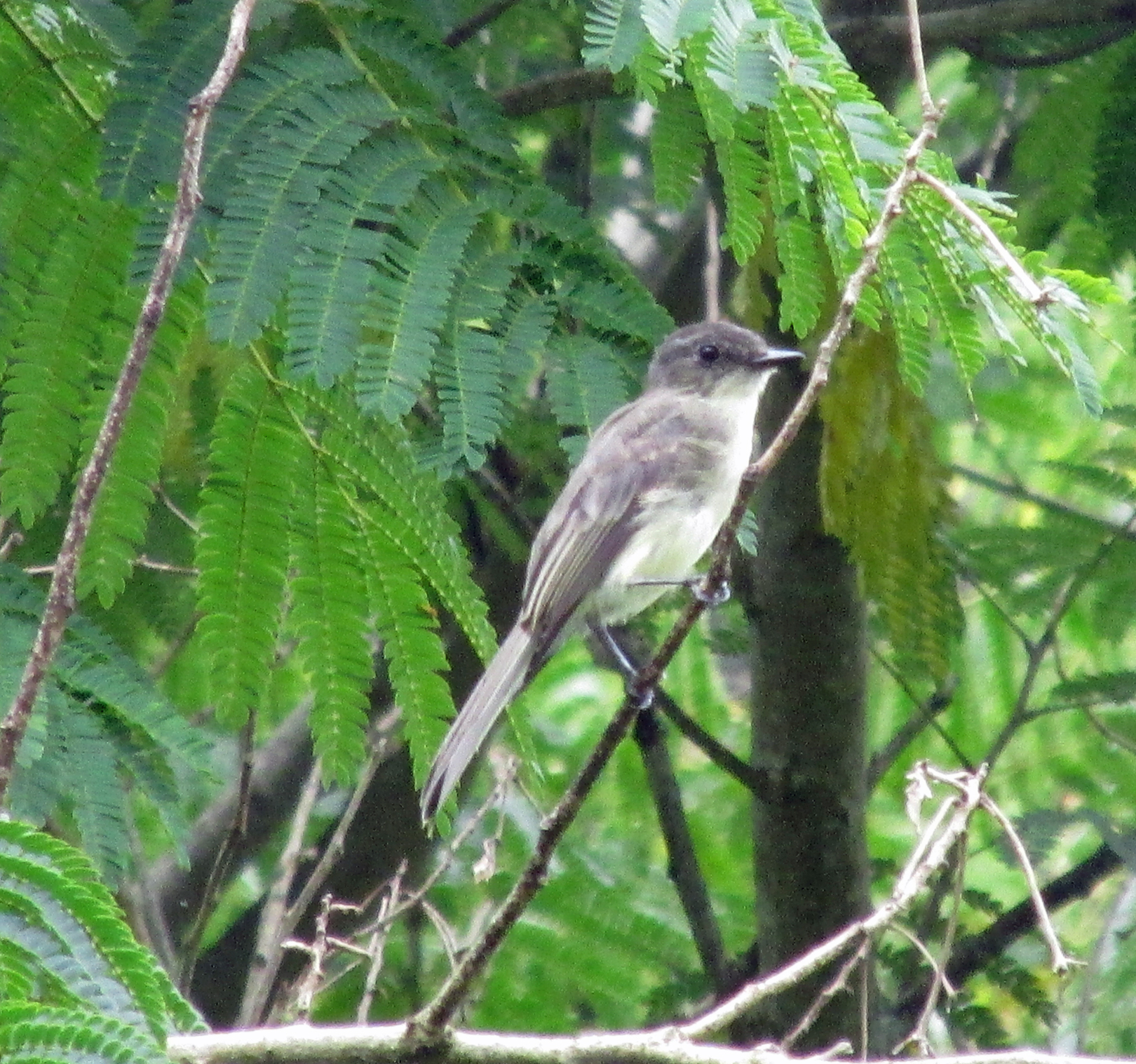
Photo by Bryan Stevens • An Eastern Phoebe perches in a mimosa tree.

This year, like the dependability of clockwork, I began hearing that easily recognized song on mornings during the first days of March when I walked to my car to depart for work. It’s due to their noisy nature that their arrival rarely goes unnoticed. Males tend to start singing persistently as soon as they arrive. I doubt it will take the male residing near my home long to attract a mate.

John James Audubon, an early naturalist and famed painter of North America’s birds, conducted an experiment with some young phoebes. His simple test represents the first-ever bird banding in the United States of America. His novel experiment, which he carried out in 1803, involved tying some silver thread to the legs of the phoebes he captured near his home in Pennsylvania. He wanted to answer a question he had about whether birds are faithful to home locations from year to year. The following year Audubon again captured two phoebes and found the silver thread had remained attached to their legs. Today ornithologists still conduct bird banding to gather information on birds and the mystery of their migrations.

So, that pair of phoebes that returned to your backyard this spring — they just might be the same ones that have spent past summer seasons providing you with an enlightening glimpse into their lives.

Over the past few years, I’ve had a pair of Eastern phoebes nest on the blades of a ceiling fan on my front porch. Other past nesting locations have included the rafters in my garage. If a pair happens to take up residence on your own front porch or in your garage, I hope you’ll welcome them. The pleasure of observing them raising their family will more than compensate for a slight mess and a few weeks of inconvenience.

••••••

To learn more about birds and other topics from the natural world, friend Bryan Stevens on Facebook at https://www.facebook.com/ahoodedwarbler. He is always posting about local birds, wildlife, flowers, insects and much more. If you have a question, wish to make a comment or share a sighting, email ahoodedwarbler@aol.com.

Smallest of birds lead the spring migration charge

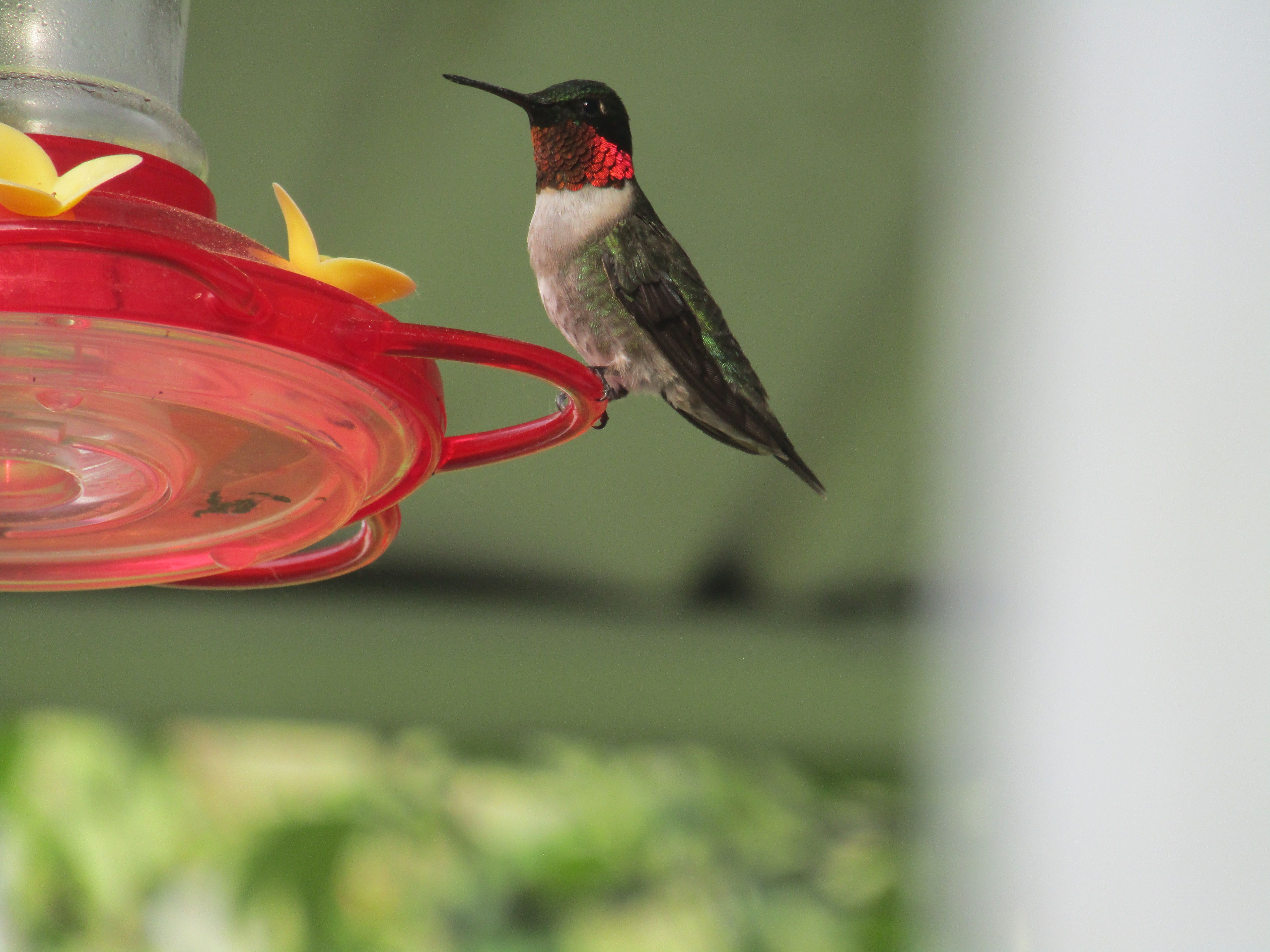
Photo by Bryan Stevens • Welcoming back hummingbirds also involves making sure that they remain healthy and safe while spending the next six months in our yards and gardens. Readers are also invited to share the time and date of their first spring hummingbird arrivals.


We’ve reached the middle of March. Some of our favorite birds are on their way back to spend the warmer months with us. I’ve always been impressed that our smallest birds — ruby-throated hummingbird, blue-grey gnatcatcher and ruby-crowned kinglets — lead the charge in returning to the region after an absence of several months.

Of course, a few larger birds also tend to arrive early. The most prominent of these is probably the broad-winged hawk. These medium-sized raptors usually arrive in late March and early April.

But it’s the noisy and bold brigade of tiny birds that will capture our attention. By the end of March, the blue-grey gnatcatcher will be back, buzzing its zee-zee notes as it flits about branches budding with new green leaves. These tiny birds seem to time their arrival to coincide with the emergence of some of the first greenery of the season.

In the first days of April, ruby-throated hummingbirds will return, checking to see whether the feeders or a stand of early spring flowers are still in place.

Ruby-crowned kinglets, which make a similar passage in the fall, will transit through the region again in the spring as they make their way north to breeding grounds in spruce-fir forests in the northern regions of the United States and Canada.

These are not the only small “early birds.” Some other pint-sized songbirds that arrive in early spring include Louisiana waterthrush and yellow-throated warbler.

There are 17 species of gnatcatchers. Most of these species reside in Central and South America. Some of the other species found in North America include California gnatcatcher and black-capped gnatcatcher.

Kinglets are very active birds. If warblers can be described as energetic, the kinglets are downright frenetic in their activities. The kinglets almost never pause for long, flitting from branch to branch in trees and shrubs as they constantly flick their wings over their backs. These bursts of hyperactivity can make them difficult to observe. Although small in size, these birds more than compensate for it with a feisty spirit that does them well through the harsh winter months.

Gnatcatchers are also constantly on the move, flicking their tails and darting through the branches of trees just starting to put out new green leaves. They glean caterpillars and small insects from the undersides of leaves to help fuel a demanding metabolism.

Photo Courtesy of Jean Potter • Blue-gray Gnatcatchers are tiny, energetic bundles of feathers.

Kinglets and gnatcatchers often join mixed flocks comprised of other species of birds, some of which are regular feeder visitors. Perhaps by observing their flock counterparts, some kinglets have learned to accept feeder fare such as suet, meal worms and chopped nuts. Away from feeders, kinglets mostly feed on a range of small insects and arachnids. Gnatcatchers are strictly eaters of insects, but while a feeder holds no attraction for them, their curious nature often makes these tiny birds quite approachable.

Normally, kinglets have a rather fleeting lifespan. They pay a price for their frantic, fast-paced lifestyles and can be considered old if they live three or four years. There are always exceptions. The oldest golden-crowned kinglet on record was six years and four months old. That individual, a male, was documented by a bird bander in 1976, according to the website All About Birds.

Likewise, gnatcatchers live brief lives. The oldest known blue-gray gnatcatcher was a male, and at least four years, two months old, when it was recaptured at a banding station in Pennsylvania and rereleased, according to the All About Birds website.

Of course, the smallest of the small is the ruby-throated hummingbird, which is officially the most diminutive of all birds found in the Eastern United States. This hummingbird is only 2.8 to 3.5 inches in length and weighs less than half an ounce.

The oldest known ruby-throated hummingbird, according to All About Birds, was a female, and at least 9 years, 2 months old when she was recaptured and rereleased in 2014 during banding operations in West Virginia.

The effort these tiny birds expend to return each year to entertain us during the warmer months is nothing short of extraordinary.

Information on the website for Perky Pet, which markets hummingbird feeders and other items for birds, describes the stages of spring migration. Once they respond to the urge to head north, most ruby-throated hummingbirds have reached Mexico’s Yucatan Peninsula by February.

The jungles of the Yucatan are rich with food and these tiny birds begin to feast on insects as they prepare for one of the toughest migrations for any bird. The majority of these hummingbirds will make a nonstop crossing of the Gulf of Mexico. This epic journey can take them 18 to 22 hours to complete. Some individuals cross the Gulf as early as February, but most of these little birds will wait to cross in March. A month or so later, the first wave of these migrants have usually reached Northeast Tennessee, Southwest Virginia and Western North Carolina.

•••

As always, I like to track the arrival dates of ruby-throated hummingbirds and appreciate readers sharing this information with me every spring. To share your first hummingbird sighting of spring, email me at ahoodedwarbler@aol.com. Please provide the date and time of the bird’s arrival. Other details, such as whether the bird is a male or female, is also appreciated.

•••

Bryan Stevens has written about birds and birding since 1995. Contact him at ahoodedwarbler@aol.com.

Red-bellied woodpeckers, other birds raise their profile during recent snowstorm

Photo by Bryan Stevens • A red-bellied woodpecker makes a tentative approach to a feeder stocked with sunflower seeds. Red-bellied woodpeckers are fairly common in the region.

I’m sure many share my sentiment that with February almost in the rear-view mirror it could be hoped that winter might be nearly at an end.

That misguided hope was dashed last week when another winter storm struck the region, accompanied by another blast of Arctic chill. At least the birds didn’t seem to mind terribly.

Dark-eyed juncos, Eastern towhees, song sparrows and American goldfinches flocked to my feeders. Another bird’s persistent “churr” call made the presence of a red-bellied woodpecker known even before I managed to sight one visiting one of my feeders.

Among the woodpecker family, the red-bellied and red-headed woodpeckers are close cousins, belonging to a genus of those tree-clinging birds known as Melanerpes. The term, translated from Latin, means “black creeper.” Indeed, many of the two dozen members of the Melanerpes genus have an extensive amount of black feathers in their plumage.

Other members of the genus include woodpeckers from the Caribbean, as well as from Central and South America. Some of them have quite colorful names, such as yellow-tufted woodpecker, golden-cheeked woodpecker and the accurately named beautiful woodpecker, a native of Colombia.

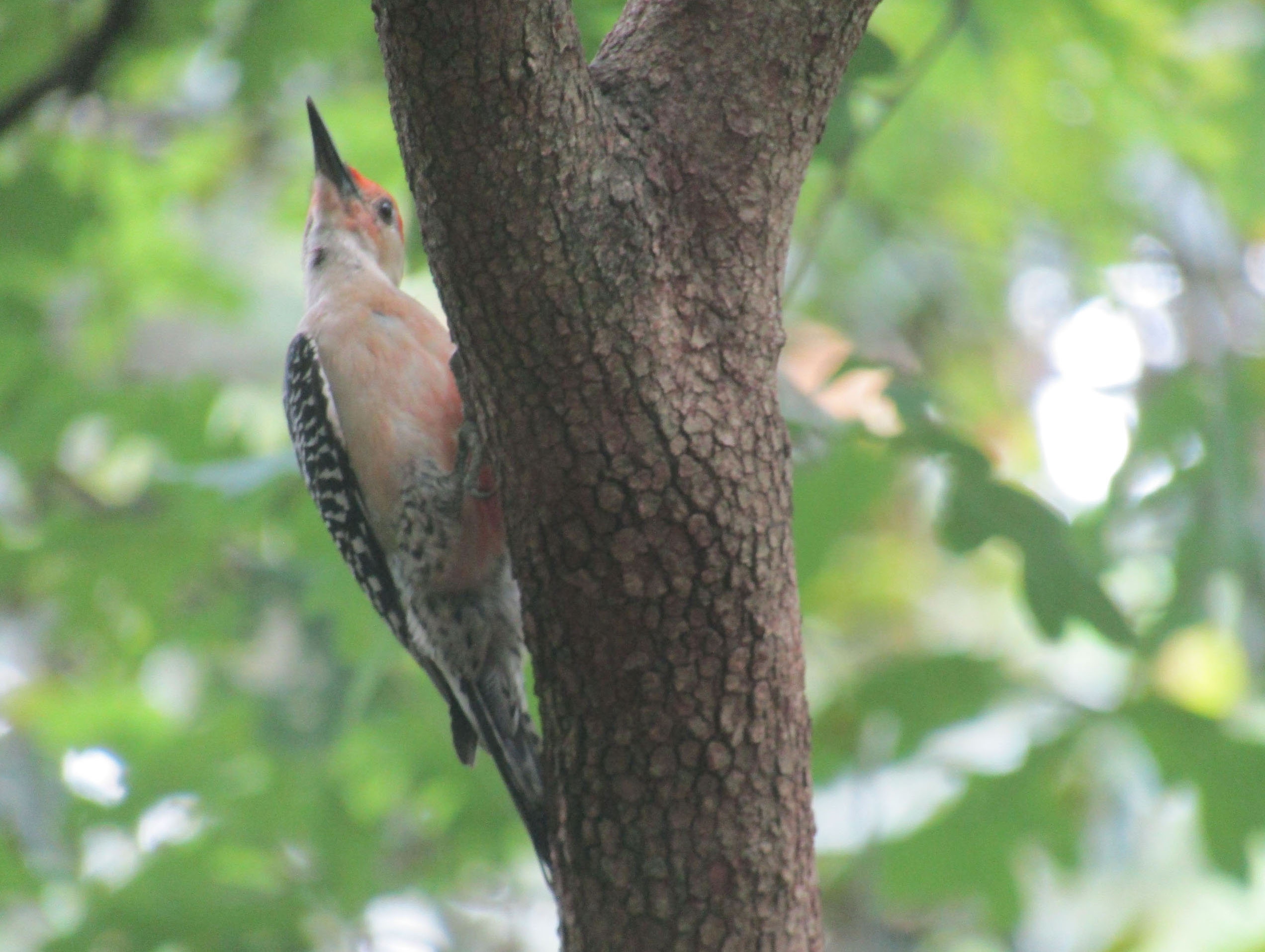
Photo by Bryan Stevens • Red-bellied woodpeckers are common throughout the southeastern United States.

The red-bellied woodpecker is one of the most widespread members of this genus with a range that extends from southern Canada to northeastern Mexico, as well as the eastern United States as far south as Florida and as far west as Texas. A century ago the red-bellied woodpecker was almost exclusively a southeastern bird, but it has expanded its range northward and westward considerably in the last 100 years. Its southern origins are hinted at in its scientific name of Melanerpes carolinus, which can be roughly translated as “black creeper of the Carolinas.”

It’s also named for a characteristic of its appearance that is not particularly prominent and difficult to observe. The faint tint of red that tinges the white belly feathers is extremely difficult to observe when this woodpecker is hitching up the trunk of a large tree. Because males, and females to a certain extent, have a red cap, the species has been erroneously referred to as a “red-headed woodpecker” by many casual observers. The true red-headed woodpecker, however, has an entirely red head and a plumage pattern that, considering its color trio of red, white and blue-black, is downright patriotic. The red-headed woodpecker (Melanerpes erythrocephalus) is about the same size as the red-bellied woodpecker.

All woodpeckers are noisy when the mood strikes them, but the red-headed and red-bellied have always struck me as rather more clamorous than some of their relatives. The most common call of the red-bellied woodpecker is a sort of rolling “churr” repeated frequently while the bird is on the move from tree to tree.

To enjoy close views of the red-bellied woodpecker, provide plenty of peanuts, sunflower seeds and suet cakes. During the recent snowstorm I would no doubt have enjoyed even more views of the visiting red-bellied woodpecker if I hadn’t been out of suet cakes. The offerings of sunflower seeds and peanuts, I’m happy to report, were gratefully accepted.

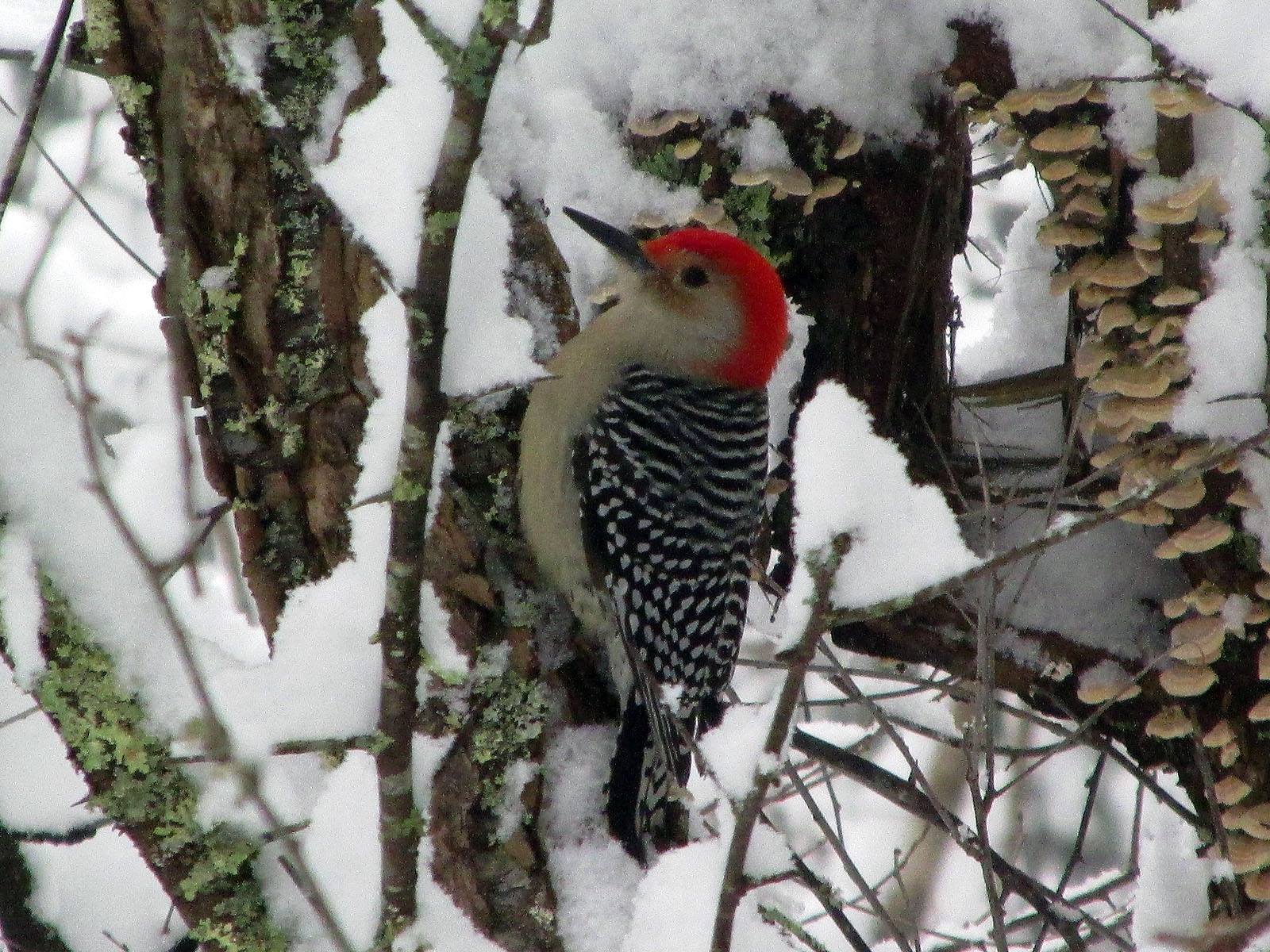
Photo by Bryan Stevens • A red-bellied woodpecker climbs snow-covered branches.

If there are any of these woodpeckers in the woods nearby, they will find these food offerings in short order. All my research indicates the same is true of red-headed woodpeckers, but I’ve never observed this woodpecker at my home. I’ve seen red-headed woodpeckers in Tennessee, Virginia and South Carolina, but their populations are somewhat localized. Woodlands dominated by oak trees are often inhabited by both these woodpeckers, which are fond of the acorns produced by these trees.

One reason the red-headed woodpecker may be less common than its cousin relates to its fondness for hawking for flying insects along roadsides. The woodpeckers are frequently struck by cars when swooping after their winged prey. Historically, the American chestnut and beech trees also provided much of the mast crops consumed by these birds. With the extermination of the chestnut and the scarcity of beech in some locations, the red-headed woodpecker now depends on oaks and acorns. In fact, this woodpecker is rarely encountered outside of woodlands with an abundance of oak trees.

At feeders, red-bellied woodpeckers are prickly customers that often refuse to play nice with other birds. I’ve seen them stare down other large feeder birds, including blue jays, mourning doves and evening grosbeaks. With its large bill, the red-bellied woodpecker commands some respect.

Anyone who has hosted these birds knows they are a welcome visitor to any yard. Who knows? Some day I may even get a visit from the elusive red-headed woodpecker, which is the only woodpecker that resides in the region to thus far avoid my yard.

•••

To ask a question, make a comment or share a bird sighting, email me at ahoodedwarbler@aol.com.

Red-winged blackbird, other birds set to return in coming weeks

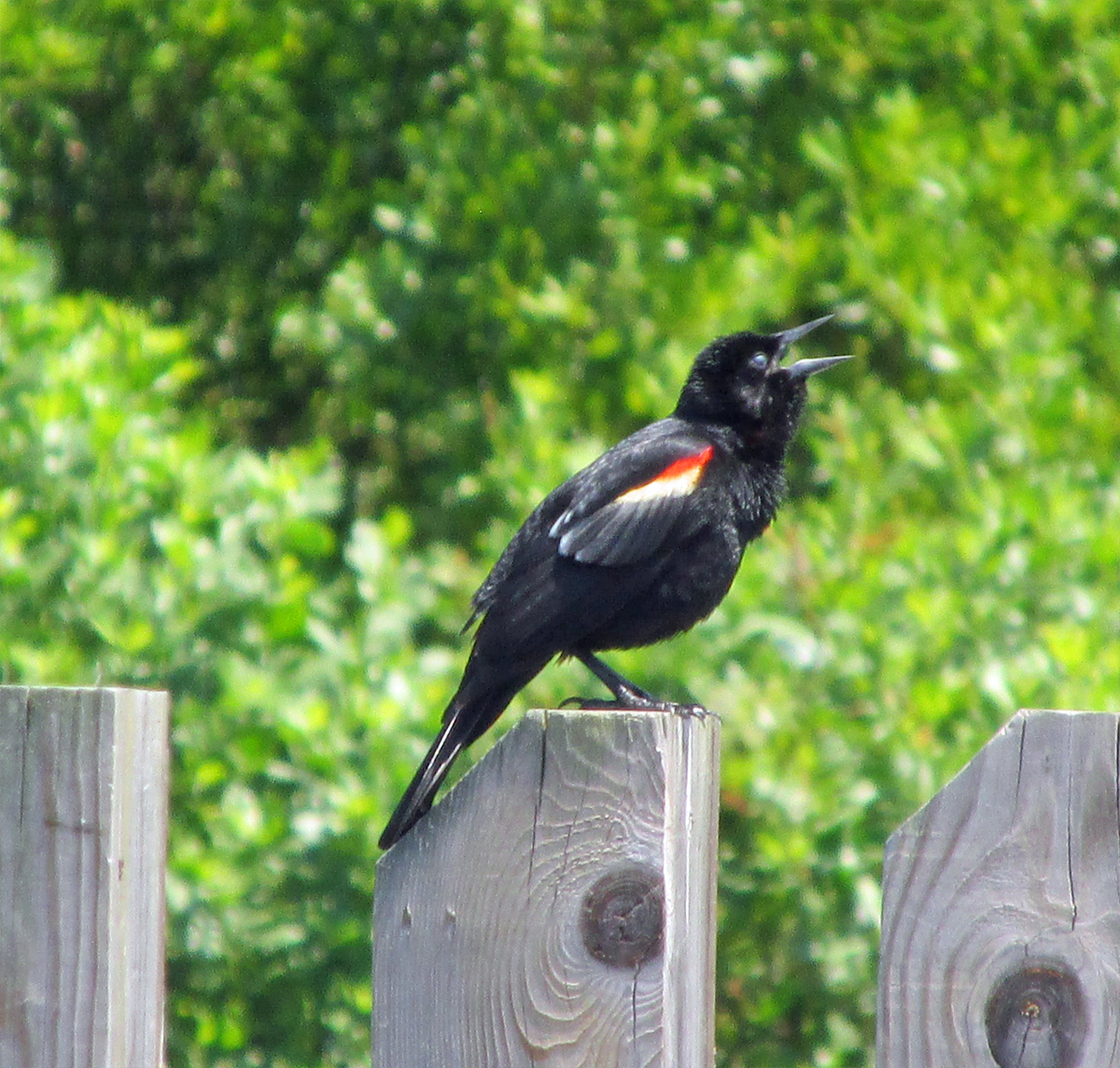
Photo by Bryan Stevens • A male red-winged blackbird sings to attract mates and ward off rivals.

February’s the shortest month, and it is more than halfway over. There are already signs that some birds are ready to embrace the shift in seasons as winter advances, albeit in fits and starts, toward spring.

On Feb.11, three mallards visited my fish pond. The presence of mallards at any pond is not all that surprising. The mallard is arguably the most recognized of North America’s native ducks. But these were wild birds, as indicated by their wary behavior and their ability to spring into strong flight when I surprised them quite by accident.

Spring migration begins as early as February and March. Eastern bluebirds, which for the most part are not migratory, are already checking out nesting boxes.

The months of March, April and May will bring an influx of migrants. Ruby-throated hummingbirds will soon make their annual crossing of the Gulf of Mexico. These tiny birds usually make landfall in the United States as early as February, but they don’t usually venture as far north as Northeast Tennessee, Western North Carolina and Southwest Virginia until early April.

Bryan Stevens • On Feb.11, three mallards visited my fish pond. I am hoping they are the start of more migrating birds arriving in the coming weeks.

Warblers, orioles, thrushes, flycatchers, tanagers and many other migrants also return in April and May. A variety of waterfowl, raptors and shorebirds pass through the region during these months, as well.

March brings the early birds, including species such as brown thrasher, blue-gray gnatcatcher and red-winged blackbird.

Red-winged blackbirds return with a venegeance in early March or sometimes in late February.

I’m ready to hear their loud, familiar “kon-ke-ree” sounds again from the tops of the cypress trees at the fish pond. It’s always a fun moment to welcome these birds back.

Red-winged blackbirds return yearly in early spring and begin to seek out nesting habitat in local wetland areas, such as the cattail marshes near my fish pond.

My first returning male red-winged blackbird arrived on the evening of March 3 in 2022. The first red-winged blackbird arrived on the morning of March 6 the following year. I heard his unmistakable song from inside my house.

The showy and loud red-winged blackbird males soon take up residence at my fish pond and adjacent stands of cattails after their return.

Male blackbirds arrive ahead of the females. They immediately search out prominent perches and begin singing every day in anticipation of an intended audience. Female blackbirds lag a week or so behind the males in returning to their familiar territory.

Any wet field or marsh, especially those offering a stand of cattails, is almost certain to attract red-winged blackbirds at this time of year. I’d almost wager on that certainty.

The blackbirds arriving in spring behave much differently than the quiet, furtive flocks that often make brief visits to feeders during late winter snowstorms.

“The kon-ke-ree song of the male red-winged blackbird is a sure indication that spring is on the way,” according to a profile located at the Tennessee Watchable Wildlife website.

At this time of year, the male red-winged blackbirds seek elevated perches to display and vocalize. Their loud antics are not designed solely to attract mates. Male red-winged blackbirds also sing to warn rival males from intruding into their territories.

The male red-winged blackbird is a very aptly named bird. Glossy black males sport red wing patches that are often trimmed with a narrow band of yellow feathers. By contrast, female red-winged blackbirds are mostly brown birds that could easily be mistaken for large sparrows. Both sexes have sharply pointed bills.

Red-winged blackbirds are fond of wetlands. Any marsh or even a damp field or flooded pasture is likely to attract a few resident red-winged blackbirds. Females choose nesting locations in cattails or other marsh vegetation. She usually lays three or four eggs. Although she does receive some help from the male, most of the responsibility for raising the young is left to her.

There is a reason that male red-winged blackbirds are not always quite as engaged as females in feeding and tending their young. Males are often polygynous, which means that males will often court multiple mates. His time is often occupied defending females and their respective nests from the advances of other male red-winged blackbirds.

According to the website All About Birds, male red-winged blackbirds spend much of the breeding season sitting on a high perch over their territories and singing almost without ceasing from dawn to dusk.

The website also notes that female blackbirds shirk the high profile of the males. They tend to skulk in wetland vegetation as they collect food or nest material.

Bryan Stevens • Female red-winged blackbirds lack the showy plumage of males. They look more like an overgrown sparrow.

Both males and females defend nests from intruders and predators. They take this duty quite seriously, as I know personally from being dive-bombed by parent blackbirds when I have gotten a little too close to their nests.

Other relatives of the red-winged blackbird in the United States include the tricolored blackbird found along the Pacific Coast and the yellow-headed blackbird resident in wetlands west of the Great Lakes. Rusty blackbird, common grackle and brown-headed cowbird are other species of blackbirds found in Tennessee, Virginia and North Carolina.

For birders, the weeks ahead are an exciting time. In spirit, I think others often join our excitement if for no other reason than to celebrate that spring is just around the corner. These “early bird” arrivals are merely the harbingers of the season.

Share a sighting, ask a question or make a comment by emailing me at ahoodedwarbler@aol.com.

Bryan Stevens • In fall, male red-winged blackbird are bereft of the striking glossy plumage of spring.


Birds make use of various strategies to attract and keep mates

Shauna Fletche/Pixabay • Some birds, like waxwings, like to present tasty treats to their potential mates.


With Valentine’s Day around the corner, it’s an opportune time to see how courtship is handled among our fine feathered friends. Most birds don’t bring a box of chocolates or a bouquet of roses when they take up courtship of a prospective mate, but birds have several equivalent behaviors that they employ to attract the attentions of the opposite sex. In honor of Valentine’s Day I thought a look at some of the more unusual courtship rituals of some of our feathered friends would be appropriate.

Aerial acrobatics designed to impress

In late winter and early spring, a true oddball begins courting. The American woodcock, also known by such whimsical names as “bog sucker” and “timberdoodle,” is a shorebird that has completely abandoned the shore in favor of woodlands and fields. Beginning as early as February, American woodcocks in the region conduct nightly courtship displays, starting at dusk, that combine aerial acrobatics with an assortment of unusual acoustical flourishes. Any wet field adjacent to a wooded area could offer a stage for these evening displays, but unless you know where to look and make an effort to do so, the American woodcock might as well remain a phantom of the night.

These mating rituals provide almost the only time of the year during which this bird makes itself available for observation. It’s only during this brief window that opens into their lives that we can be assured a glimpse. Even then, our peeks at woodcocks often consist of a fuzzy twilight escapade as the bird flings itself heavenward only to make a spiraling descent a few seconds later. The displays begin with a distinct vocalization, a type of “pent,” that also has the quality of sounding like some sort of mechanical buzzer.

Once the displays conclude for the season, the birds assume nesting duties, usually unobserved by humans. The rest of the year, almost nothing but blind, sheer luck would allow a birder to stumble across an American woodcock. It’s almost as if they disappear after these spring flights of fancy.

Birds bearing gifts

Many birds present small trinkets to a prospective mate. For instance, many male penguins make a present of a stone or pebble to female penguins. There could be more than a simple bribe behind this gift. Female penguins don’t build elaborate nests. In fact, a scrape on the bare ground, perhaps encircled by a collection of pebbles, marks the extent of their nest construction. So, the perfect pebble could be the way to winning a female penguin’s heart.

The way to the heart is through the stomach

Observant birders may have witnessed a male Northern cardinal slip a female a morsel of food, such as a peanut or a shelled sunflower kernel. It’s a marked change for this bird. During the winter months, a male cardinal is more likely to chase a female away from a feeder rather than share food with her. However, as spring approaches, his behavior undergoes a change and he becomes content to feed next to a female cardinal, often slipping her some choice tidbits.

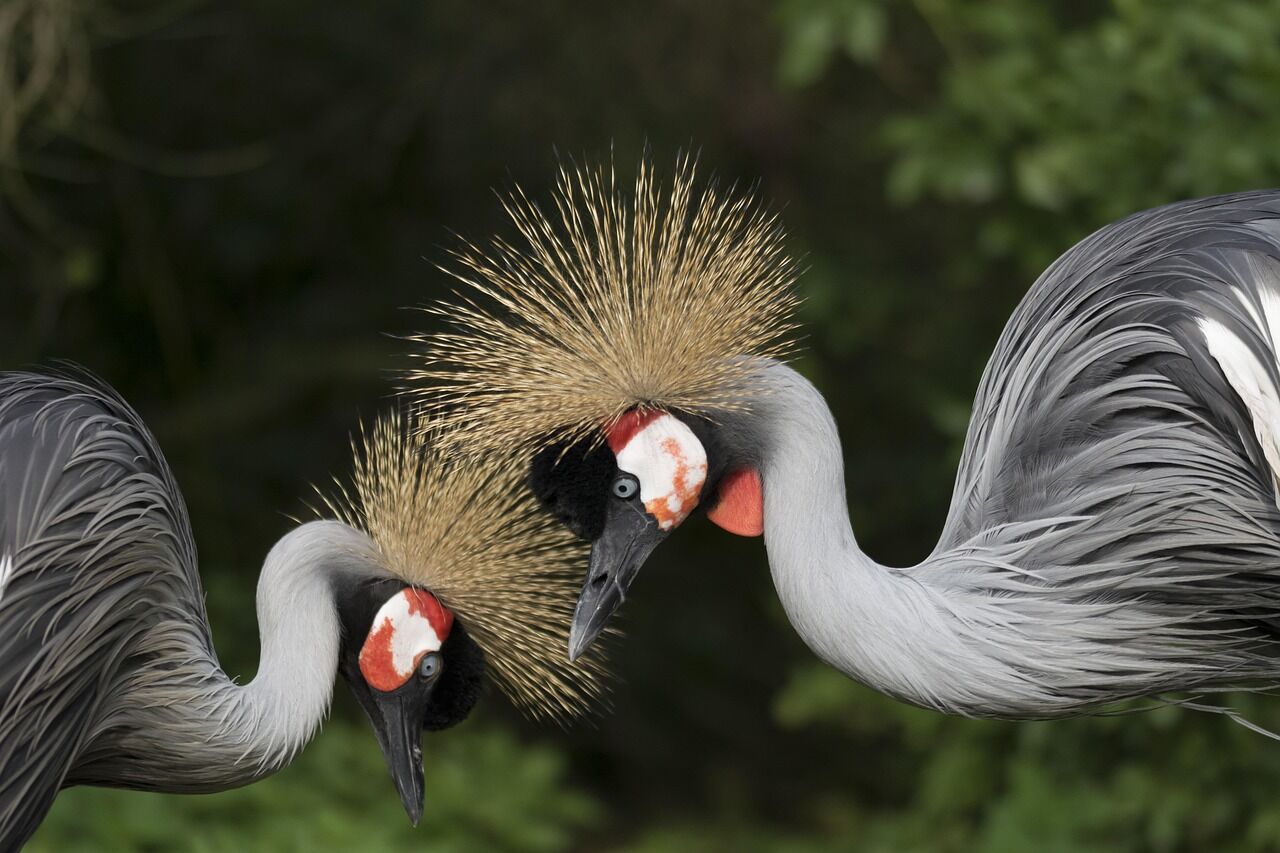
Sabine van Erp/Pixabay • Bow to your partner: Grey-crowned cranes perform an elaborate dance designed to strengthen their bond.

May I have this dance?

Many species of birds perform elaborate and ritualistic dance displays. Among birds known for tripping the light fantastic are flamingoes, cranes, grouse and grebes. Cranes are one of the oldest families of birds on earth. They’re also some of the most accomplished dancers in the animal kingdom. Pairs perform very ritualistic dances that, if the performers were human, would no doubt require the services of an accomplished choreographer. Cranes mate for life and the ritual of dancing is a way to strengthen the bonds between a mated pair. The ability to dance is, apparently, not instinctive. Young cranes must practice their dance moves, a process that can take years before they master the elaborate dance.

Dave Menke/U.S. Fish & Wildlife Service • A pair of Clark’s Grebes displays in a courtship ritual known as “rushing” or “weed dance.” Birds use a variety of strategies to attract and keep mates.

Synchronized swimming

While many birds dance to impress a mate or strengthen pair bonds, grebes perform a dance that takes place completely on the surface of the water. A pair will engage in this intricate performance, perfectly mirroring the moves of the other as they literally race across the surface of the water. These dances by grebes are also known as “rushing” or “weed dance.” It’s called as a weed dance because at the culmination of the ritual, the birds usually hold some type of aquatic plants in their bills while racing swiftly over the surface of the water. Pairs that perform well together stay together, building a nest and raising young.

Good housekeeping seal of approval

The tropical family of bowerbirds are famous for complex nests built by males and then decorated with bright and colorful objects to catch the eye of a potential mate. The nests of these birds are actually referred to as a “bower.” Usually constructed on the ground, the male will line the approachs to the bower with items such as shells, leaves, flowers, feathers, stones, berries, and even discarded garbage, including plastic scraps or bits of glass. Unusually odd items pressed into these decorative displays have included coins and spent rifle shells. This habit of male bowerbirds must rank as the ultimate in trying to impress a mate with shiny bling.

These are just a few of the inventive ways that birds go about attracting and keeping mates. Perhaps you can pick up some pointers from our feathered friends to ensure you have a great Valentine’s Day this year.

•••

If you have a question, wish to make a comment or share a sighting, email me at ahoodedwarbler@aol.com.

Birds have developed ways of dealing with cold

David Ellis/USFWS • A common redpoll feasts on stiff goldenrod seed. These small finches can endure temperatures 100 degrees below freezing.

With the arrival of January, we can probably be assured of some cold weather. I’m not fond of the cold, but I can put on gloves and a thicker coat and I am good to go.

What about our feathered friends? How do birds cope when temperature plummet below freezing?

Birds actually employ a range of strategies and behaviors that keep them cozy even during the worst that winter can hurl at them.

Some birds avoid the necessity of coping with cold by migrating. All those tropical species that brighten the warmer seasons in the mountains of Southern Appalachia withdraw to warmer areas in Central and South America during the winter.

Those birds that elect not to put distance between themselves and cold temperatures must do something to stay warm. Feathers are one of a bird’s defining traits, and they can do a neat trick with their feathers to stay warm. You’ve probably seen them do this. They will fluff their feathers, trapping air between them to provide insulation. If you’ve ever noticed that some birds look “fatter” in extreme cold it’s likely because they have fluffed up to combat the cold.

Of course, feathers require good maintenance to help with the task of staying warm, and birds are diligent about such tasks. Preening feathers on a routine basis keeps them watertight and able to hold in heat. Some birds even grow extra feathers in autumn to prepare for cold temperatures. That’s similar to dogs or cats growing a denser coat of fur in anticipation of wintry temperatures.

Birds have different comfort levels when its comes to personal space, but many of the more sociable species will huddle together. You’ve probably seen nature documentaries of penguins in the Antarctic as they huddle together for weeks on end to endure the harsh conditions of the globe’s southernmost continent.

Larger species of birds, such as geese and grouse, eat more and gain weight, which is often achieved by the storage of body fat.

Other birds have also adopted the huddling strategy in a cozy cavity or nest box. My most vivid recollection of an observation of this strategy involved Eastern bluebirds. During a severe cold snap accompanied by snow and blustery winds, I watched multiple bluebirds enter one of my nesting boxes. I’m not sure how many entered the box, but it was likely about eight to 10 birds.

Necessity makes birds adaptable. The next day the aforementioned high winds took down the post that held the nest box. At dusk the bluebirds showed up again. They looked baffled to find the box had disappeared. Then I saw them fluttering into an old tire that I had used at the base of the pole to help anchor the box. Faced with oncoming darkness, they chose to huddle together inside the old tire.

Natural cavities in trees also provide cozy roosting spaces for birds. Chickadees and titmice, nuthatches and woodpeckers seek out such cavities ahead of time so they will always be ensured of a warm space during bouts of inclement weather.

The biological mechanism of torpor is one that’s probably familiar to fans of hummingbirds, but other small birds can also take steps to lower their body temperature. Chickadees and kinglets put this ability to good use. In these small birds, the adaptation being employed is known as controlled hypothermia. Chickadees can drop their body temperature by as much as 22 degrees below normal daytime body temperature.

Snakes and reptiles can enter a physical state called brumation, where they sleep more but still wake to eat, drink and enjoy the sun on warmer days, according to information on the Facebook page of the U.S. Fish and Wildlife Service. Since snakes are cold-blooded, they’re lethargic at these colder temperatures even when they’re on the move.

Hibernation, although a strategy widely used by mammals, is rare in birds. The common poorwill (a relative of whip-poor-will and chuck-will’s-widow – is the only bird known to go into torpor for extended periods that can range from weeks to months. On the southern edge of their range in the United States, poorwills spend much of the winter hibernating, usually concealed in rock piles.

There’s warmth in numbers. Crows, starlings, robins and other species will gather in communal roosts to use body warmth to stay warm overnight. Sometimes these roosts are quite large and can lead to conflict with nearby humans who may not want the noise and mess that comes with hosting a large flock of birds.

While warm socks and gloves protect human toes and fingers, birds don’t have to worry about frostbite. Quick circulation means that blood does not linger in their feet long enough to freeze. In addition, the legs and feet of birds are covered in scales. Like feathers, the scales provide excellent insulation.

Some birds will gather together in large stands of evergreens. I’ve observed house sparrows gathering in the holly trees outside the courthouse in downtown Erwin at dusk on cold evenings.

There are things we can do to help. Plant evergreen trees or construct a brush pile that will provide shelter from the elements, as well as a measure of safety from predators, for the birds that share our lawns and gardens.

Many people already feed birds. Try supplementing seeds with some food rich in fat. Birds, unlike us, will not be adversely affected by a high-fat diet. Their metabolism allows them to burn off the extra calories in an enviable amount of time. Some high-fat foods that birds will love include peanut butter and beef suet, as well as peanuts and other assorted nuts. While it’s relatively simple to render suet into a usable for for birds, most people cannot be blamed for turning to commercially made suet cakes. Many of these are also made even more appealing with a mix of peanuts or fruit into the suet cake. The extra calories derived from these foods will let birds better regulate their body temperature and tolerate the more frigid nights.

It’s also important to provide liquid water for birds. Outdoor heaters designed to fit into a birth bath can help prevent the water from freezing during cold snaps.

Birds will also appreciate a sunny spot. By basking in sunshine, they can also boost their internal temperature.

Some birds are just built for cold. For example, snowy owls have been observed in temperatures 80 degrees below zero. Species of redpolls, a type of finch, can endure temperatures 100 degrees below freezing.

Emperor penguins live and nest in some of the most inhospitable terrain on the planet. Those who have viewed the documentary film “March of the Penguins” will be familiar with the species. Their colonies on the ice in the Antarctic must endure temperatures than can plunge to -40 degrees Farenheit. They must also survive frigid winds that can reach 90 miles per hour.

Emperor penguins have several adaptation to help them survive such cold conditions, according to the World Wildlife Fund. These penguins have two layers of feathers, a reserve of fat and beaks and flippers that are proportionally smaller than those for other penguin species.

Lee Karney/USFWS • The common raven can live in a range of habitats, but these large and intelligent birds are especially adapted to cold.

The common raven is another bird that shrugs off cold and snow. They can survive and thrive in habitats as varied as Arctic tundra and scorching deserts. If temperatures drop below -4 degrees Farenheit, ravens can generate extra body heat.

All things considered, birds are simply better at coping with cold than we are.

•••

Bryan Stevens has written about birds since 1995. To ask a question, make a comment or share a bird sighting, email him at ahoodedwarbler@aol.com.

Kinglets are tiny birds with huge appeal

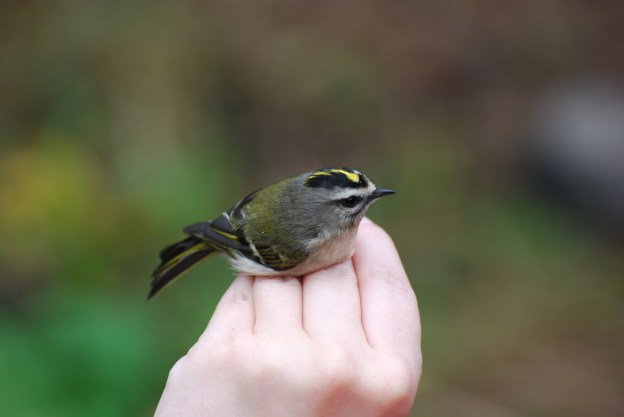
Photo by Beth McPherson • A golden-crowned kinglet recovers in the photographer’s hand after striking a window.

With the recent cold weather, I’ve been seeing a few golden-crowned kinglets, as well as the closely related ruby-crowned kinglet, at my home.

Golden-crowned kinglets are fairly common winter birds. Ruby-crowned kinglets, although not always as common as their relative, also are found in the region during the winter season.

Both the golden-crowned and ruby-crowned kinglets are members of a family of tiny birds known collectively as kinglets and firecrests. They’re such tiny, energetic birds that they absolutely excel with the “cuteness” factor.

All kinglets are very tiny birds, as well as extremely active ones. They are also the only members of this family of birds found in North America. Four other species, however, are native to Europe, Asia and North Africa. The remaining species include goldcrest, common firecrest, Madeira firecrest and flamecrest, which is also known as the Taiwan firecrest.

Kinglets, as their name suggests, are tiny birds. In fact, about the only North American birds smaller than kinglets are some of the hummingbirds. The kinglets belong to the family, Regulidae, and the genus, Regulus. The family and genus names are derived from a Latin word, regulus, which means “rex,” or “king.” The name was apparently inspired by the colorful crown patches, often red, orange or gold, that resemble the royal “crowns” of kings.

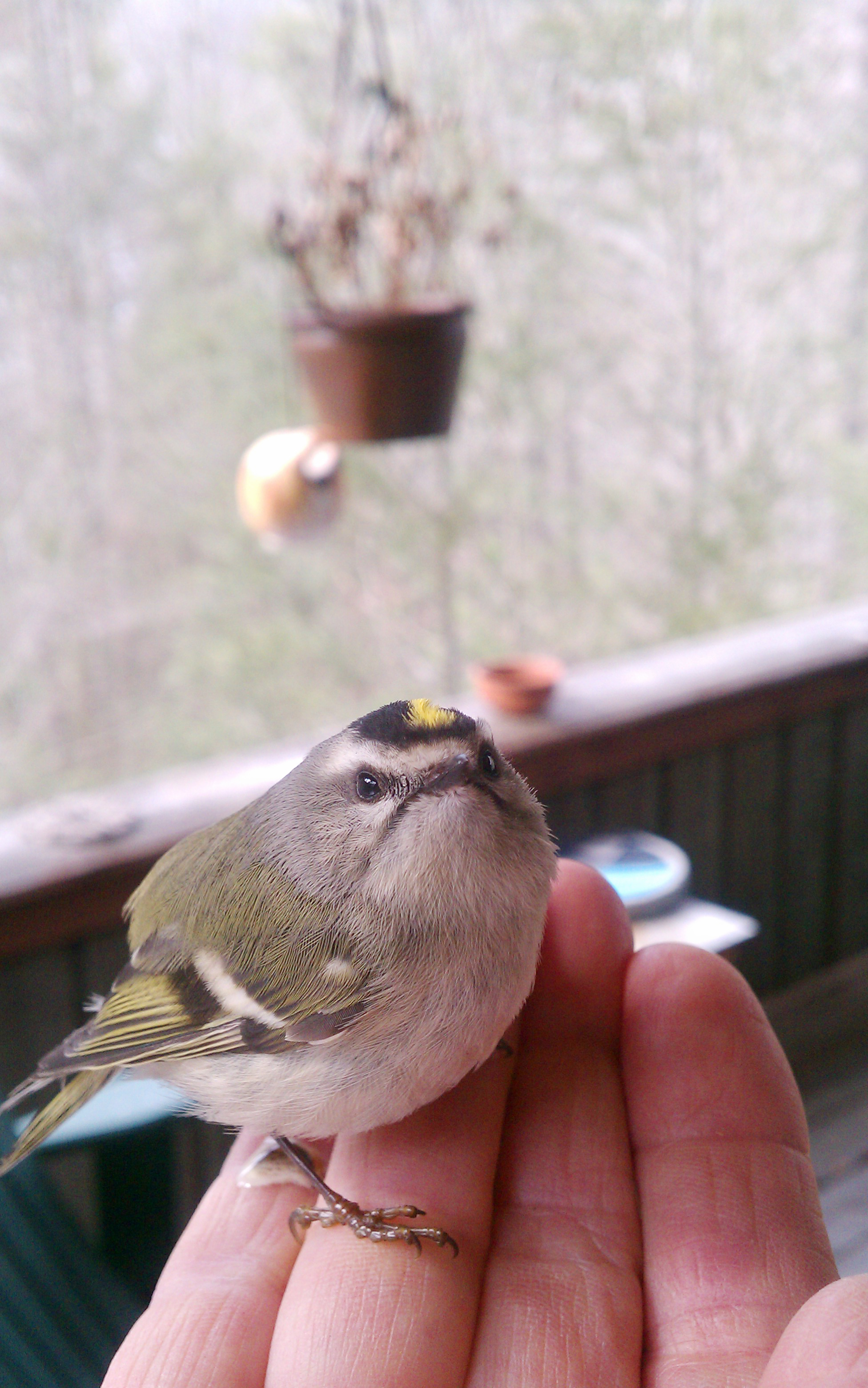
Although similar in size and overall coloration, the ruby-crowned and golden-crowned kinglets are easily distinguished from each other. Side by side, the two species of North American kinglets are easy to identify. The golden-crowned kinglet has a striped facial pattern formed by bold black and white stripes. The ruby-crowned kinglet, on the other hand, has a bold white eye ring but no striping.

The golden-crowned kinglet has an orange crown patch, while the ruby-crowned kinglet has a red crown patch that is, more often than not, kept concealed. Both sexes of the golden-crowned kinglet possess an orange crown patch, but only the male ruby-crowned kinglet boasts a scarlet patch of feather atop the head.

Kinglets are active birds, foraging vigorously for small insects and spiders. When foraging, both kinglet species have a habit of flicking their wings over the backs. Even if you can’t get a good look at the birds, this behavior alone helps contrast them from other small birds, including some warblers and wrens.

Golden-crowned kinglets are widespread in the region during the winter. During the summer months, head to the slopes of some of the region’s higher mountains to look for these tiny birds that nest at the higher elevations of the Southern Appalachians.

Ruby-crowned kinglets can also be found in the region during the winter, but extreme cold weather will often force these less cold-hardy birds to eke out the winter months farther south.

Kinglets don’t typically visit feeders, but they do tend to join mixed flocks with membership consisting of such species as tufted titmouse, Carolina chickadee and white-breasted nuthatch. When traveling with such flocks, kinglets may visit the space around feeders but rarely take seeds or other fare offered at feeders.

In recent decades, perhaps assisted by the surge in the popularity of feeding birds, kinglets have been observed sampling such fare as suet cakes, peanut chips and scraps of sunflower seeds that have been shelled and dropped by other birds.

Normally, kinglets have a rather fleeting lifespan. These tiny birds can be considered old if they live three or four years. There are always exceptions. The oldest golden-crowned kinglet on record was six years and four months old. That individual, a male, was documented by a bird bander in 1976, according to the website All About Birds.

Kinglets are surprisingly tame at time and often exhibit as much curiosity about us as we display toward them. They’re very active birds, however, constantly moving from perch to perch. These bursts of hyperactivity can make them difficult to observe with any satisfaction since they so rarely remain still for long.

•••

To learn more about birds and other topics from the natural world, friend me on Facebook at https://www.facebook.com/ahoodedwarbler. I like to post about local birds, wildlife, flowers, insects and other aspects of the natural world.

Seasonal transitions raise profiles of flickers, other birds

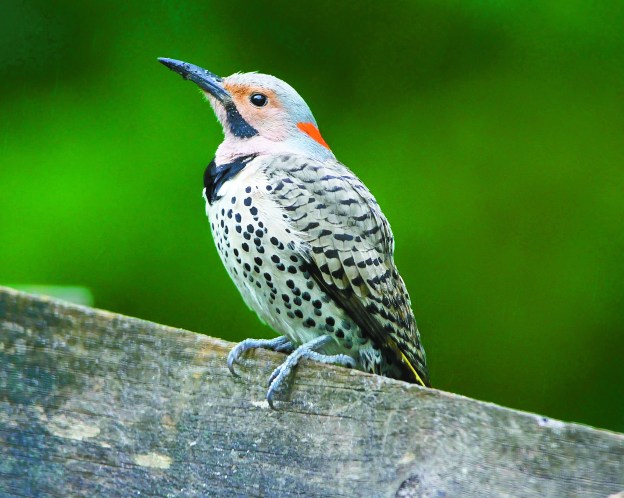
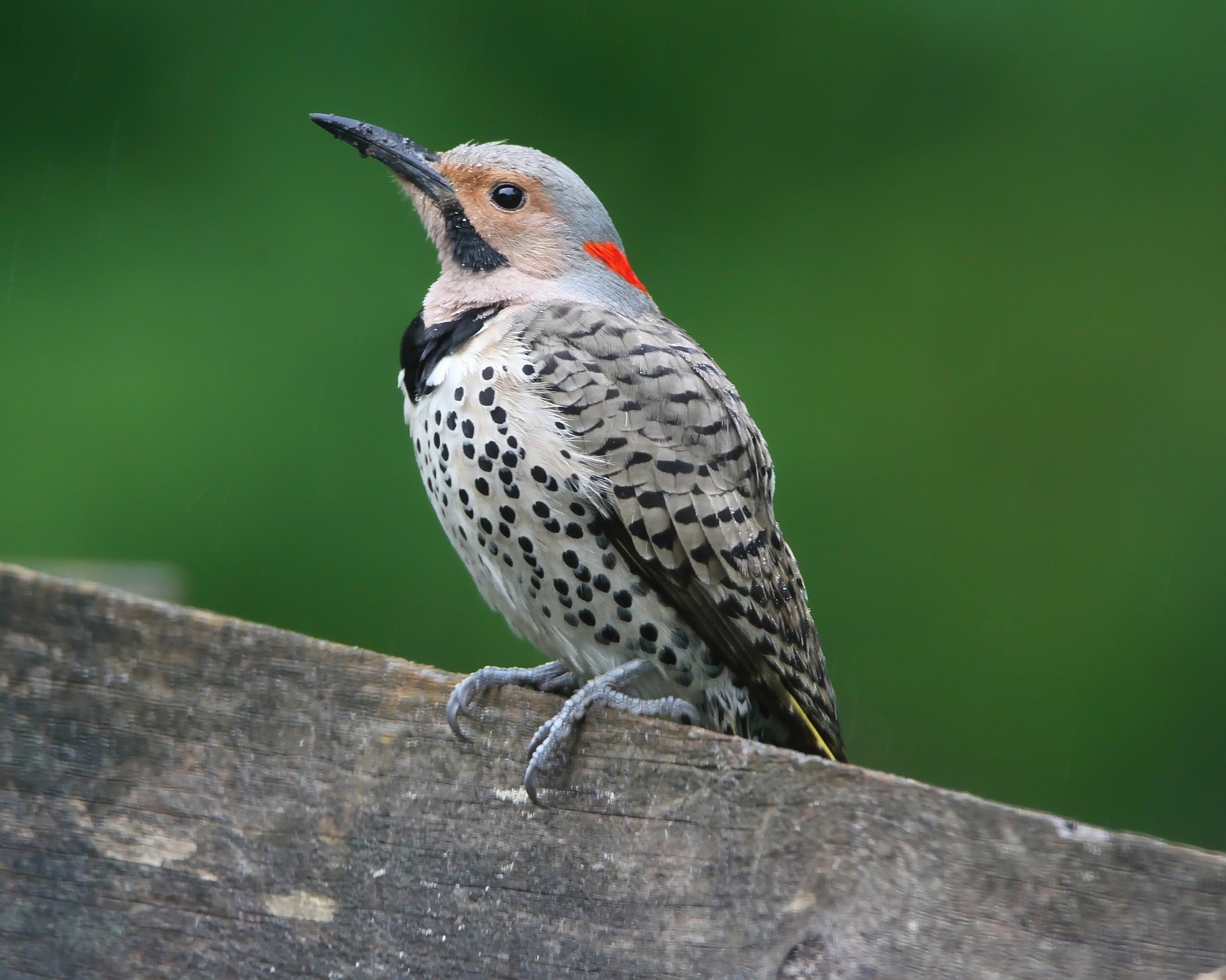
NatureLady/Pixabay • Northern flickers belong to the woodpecker family. Relatives living in the region include the pileated woodpecker, yellow-bellied sapsucker and downy woodpecker. Unlike most woodpeckers, flickers spend an extensive amount of time foraging on the ground for various insects.

Robin Free, a resident of Scott County, Virginia, emailed me after reading a recent column about owls. She told me she was interested in attracting more owls to her property, which she noted boasts an abundance of ground squirrels and mice.

I congratulated her on the fact that with all those ground squirrels and mice her home should make for happy hunting grounds for any owls in the vicinity.

I suggested she could play a recording of a screech-owl call at dusk to see if she can get a real owl to respond. These small owls are very curious and will readily respond.

Photo by Bryan Stevens
An Eastern Screech-Owl at rest in a roosting hole in a large sycamore tree.

The owl that Robin and most os us are likely to attract is the Eastern screech-owls. Since screech-owls are cavity-nesters, people can offer a roosting/nesting box. Obviously, these boxes have to be a little larger than for songbirds. Simply do a Google search to find screech-owl boxes for purchase.

Here’s some info I found online about screech-owl boxes. Placement is crucial. Mount the box at least 10 feet high in a tree, on a pole or on the edge of woods, fields or wetlands. Keep it away from trees where squirrels can jump to it. Add a couple of inches of wood chips or saw dust for nesting material.


•••

In this transition from fall to winter, some birds have adopted higher profiles around my home. I hear and see ruby-crowned kinglets and white-throated sparrows almost every morning as I leave for work. I am also seeing and hearing Northern flickers.

Flickers are woodpeckers, but there are some differences between them and other members of this clan. While flickers can be found during all seasons in the region, this woodpecker is one of the migratory ones. I see the most Northern flickers during fall migration. This woodpecker is one of the few of its kind that usually migrates to warmer climates during the colder months, although the species is not completely absent from the region in the winter season.

This species also has many other common names, including yellow-hammer — a popular name in the Deep South — and harry-wicket, heigh-ho and gawker bird. The Northern flicker is also the only woodpecker to serve a state — Alabama — as an official bird. The flicker earned this distinction back in 1927. Alabama soldiers who fought for the Confederacy were nicknamed “yellowhammers” because of their grey-and-yellow uniforms, which matched the colors of the bird. Incidentally, Alabama was one of the first states to ever name an official state bird.

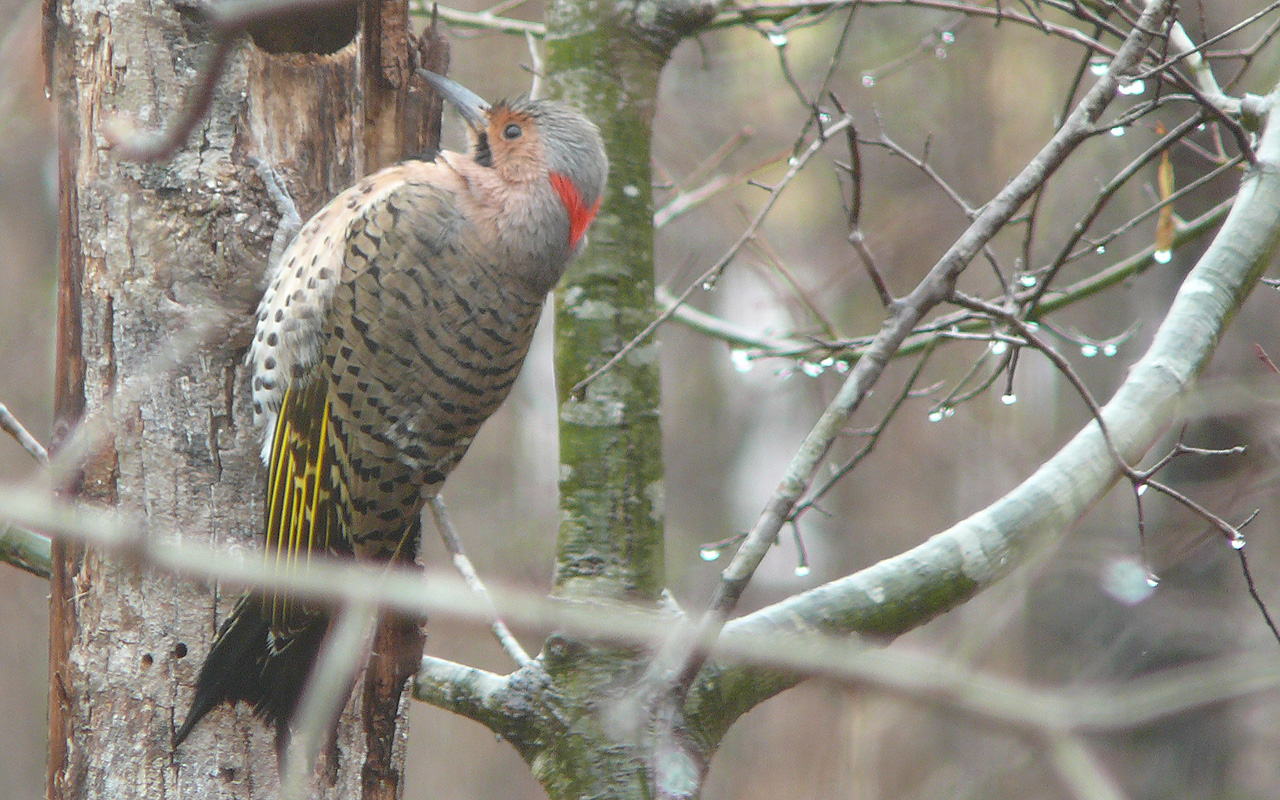
There are two races of Northern flicker — yellow-shafted and red-shafted — found in the United States. Eastern flickers show yellow feather shafts beneath the wings while western counterparts show red beneath the wings. A trip to Utah several years ago gave me a chance to also see the red-shafted race of this bird.

The Northern flicker is also not the only flicker in the United States. The gilded flicker inhabits many of the deserts — Sonoran, Yuma and Colorado — in the United States. Of course, trees are scarce in deserts, but that hasn’t proven an obstacle for this woodpecker. The bird is closely associated with saguaro cactus. Other desert dwellers depend on this woodpecker. Once the flickers are no longer making use of their nest and roost holes in the multi-armed cacti, other wildlife moved into the chambers.

The Northern flicker is an enthusiastic drummer, pounding loudly on the sides of trees with its stout bill. The purpose of the drumming is to communicate with mates and signal potential rivals that they’re intruding. Toward that objective, flickers sometimes substitute metal utility poles or the sides of buildings for the trunks of trees. In addition to drumming, the flicker also employs a variety of loud vocalizations that are fairly distinctive. A loud, repeated vocalization, often translated as “wicka-wicka-wicka,” is similar to the cluck-like call of the larger pileated woodpecker. The flicker is also known for emitting a sharp, loud “kleeer” call that can be heard from a considerable distance. It’s that call that I’ve been hearing most mornings in the woodlands around my home.

The adult flicker is a brown bird with black bars on the back and wings. A distinctive black patch occupies the upper breast, while the lower breast and belly are beige with black spots. Males can be identified by a black or red mustache stripe at the base of the beak. They also have a red stripe on the back of their gray heads. The flicker’s dark tail is set apart by a white rump patch that is conspicuous when the bird takes flight..

Look for Northern flickers in fields, orchards, city parks and well-planted suburban yards. These woodpeckers are usually not too shy around human observers and will sometimes allow for extended observation. If you’re even more fortunate, you could find one visiting your yard or garden. Just remember to scan the ground. This is one woodpecker that’s not a consistent tree-hugger like many of its kin.

•••

Bryan Stevens has written weekly about birds and birding since 1995. Email him at ahoodedwarbler@aol.com to share sightings, ask questions or make comments.


Spotlight on dark-eyed junco launched weekly column 29 years ago

Pixabay • A dark-eyed junco visits a deck for birdseed.

I wrote my first bird column on Sunday, Nov. 5, 1995, which means this weekly column is marking its 29th anniversary this week.

Looking back, it seems almost unbelievable that I’ve written anything on a regular weekly basis for almost 30 years. This column has appeared in a total of six different newspapers, which I regard as a personal achievement, as well as an accomplishment for our feathered friends. It’s on their behalf that I pen these weekly efforts to promote conservation and good will toward all birds. I have also posted the column as a weekly blog posting since February 2014 at http://www.ourfinefeatheredfriends.com.

I’ve played detective, helping people identify everything from “rain crows,” or cuckoos, to Muscovy ducks, rose-breasted grosbeaks and house finches. I’ve observed unusual birds, including white pelicans, brants and roseate spoonbills, in Northeast Tennessee, Southwest Virginia and Western North Carolina and spotlighted them in these columns.

Photo by Ken Thomas • A dark-eyed junco perches on some bare branches on a winter’s day.

While my vision challenges remain, I find that looking through binoculars works just fine, allowing me to spin the focus wheel and still take delight in the kaleidoscopic parade of colorful warblers that pass through the region each spring and fall as well as the fast-paced duels of ruby-throated hummingbirds. My main problem these days is the inability to spot movement, especially in treetops where many birds like to hang out.

At my home, I continue to provide sunflower seed and other supplemental food for the resident birds like Carolina chickadees, white-breasted nuthatches, song sparrows and downy woodpeckers.

Even as I tweak my anniversary column for “Feathered Friends,” I’m looking forward to the winter bird feeding season. The prognostication of approaching winter weather is a perfect time to dust off this week’s column, which is a revision of the first bird column I ever wrote. This column focused on a common visitor to yards and feeders during the winter months. In fact, dark-eyed juncos should be returning to the region any day. Here, with some revisions I have made through the years, is that first column.

•••

Of all the birds associated with winter weather, few are as symbolic as the dark-eyed junco, or “snow bird.” The junco occurs in several geographic variations.

John V. Dennis, author of “A Complete Guide to Bird Feeding,” captures the essence of the junco in the following description: “Driving winds and swirling snow do not daunt this plucky bird. The coldest winter days see the junco as lively as ever and with a joie de vivre that bolsters our sagging spirits.” The dark-eyed junco’s scientific name, hyemalis, is New Latin for “wintry,” an apt description of this bird.

Most people look forward to the spring return of some of our brilliant birds — warblers, tanagers and orioles — and I must admit that I also enjoy the arrival of these birds. The junco, in comparison to some of these species, is not in the same league. Nevertheless, the junco is handsome in its slate gray and white plumage, giving rise to the old saying “dark skies above, snow below.”

Just as neotropical migrants make long distance journeys twice a year, the junco is also a migrating species. But in Appalachia, the junco is a special type of migrant. Most people think of birds as “going south for the winter.” In a basic sense this is true. But some juncos do not undertake a long horizontal (the scientific term) migration from north to south. Instead, these birds merely move from high elevations, such as the spruce fir peaks, to the lower elevations. This type of migration is known as vertical migration. Other juncos, such as those that spend their breeding season in northern locales, do make a southern migration and, at times, even mix with the vertical migrants.

During the summer months, a visit to higher elevations mountaintops is almost guaranteed to produce sightings of dark-eyed juncos. Juncos may nest as many as three times in a season. A female junco usually lays three to six eggs for each nest, which she constructs without any assistance from her mate.

Juncos are usually in residence around my home by early November. Once they make themselves at home I can expect to play host to them until at least late April or early May of the following year. So, for at least six months, the snow bird is one of the most common and delightful feeder visitors a bird enthusiast could want.

Juncos flock to feeders where they are rather mild-mannered — except among themselves. There are definite pecking orders in a junco flock, and females are usually on the lower tiers of the hierarchy. Females can sometimes be distinguished from males because of their paler gray or even brown upper plumage.

Since juncos are primarily ground feeders they tend to shun hanging feeders. But one winter I observed a junco that had mastered perching on a hanging “pine cone” feeder to enjoy a suet and peanut butter mixture.

Dark-eyed juncos often are content to glean the scraps other birds knock to the ground. Juncos are widespread. They visit feeders across North America. The junco is the most common species of bird to visit feeding stations. They will sample a variety of fare, but prefer such seeds as millet, cracked corn or black oil sunflower.

The juncos are a small branch of the sparrow clan. Some of the other juncos include the endangered Guadalupe junco, yellow-eyed junco, Baird’s junco and volcano junco. The last one on the list is endemic to the Talamancan montane forests of Costa Rica and western Panama. Baird’s junco is named for Spencer Fullerton Baird, an American ornithologist and naturalist.

Baird served as secretary for the Smithsonian Institution from 1878 until his death in 1887. He greatly expanded the natural history collections of the Smithsonian from 6,000 specimens in 1850 to over two million by the time of his death.

I hope you’ve enjoyed this introduction to juncos. There’s something about winter that makes a junco’s dark and light garb an appropriate and even striking choice, particularly against a backdrop of newly fallen snow.

Of course, the real entertainment from juncos comes from their frequent visits to our backyard feeders. When these birds flock to a feeder and began a furious period of eating, I don’t even have to glance skyward or tune in the television weather forecast. I know what they know. Bad weather is on the way!

•••

I’ve already seen the first of the season’s white-throated sparrows, a reliable precursor to juncos. If you’d like to share your first sighting this season of dark-eyed juncos, email me at ahoodedwarbler@aol.com. As always, the column is open as a line of communication with fellow bird enthusiasts. I’ve enjoyed sharing stories about birds with countless readers over the past 29 years. I can also be reached on Facebook at https://www.facebook.com/ahoodedwarbler.