

After you have fed the birds long enough, you’re going to get visits from “mystery” birds. No matter how thoroughly you thumb through the pages of your field guides or how many online Google searches you conduct, it can be hard to pin down the identity of certain birds, especially when you encounter them for the first time.
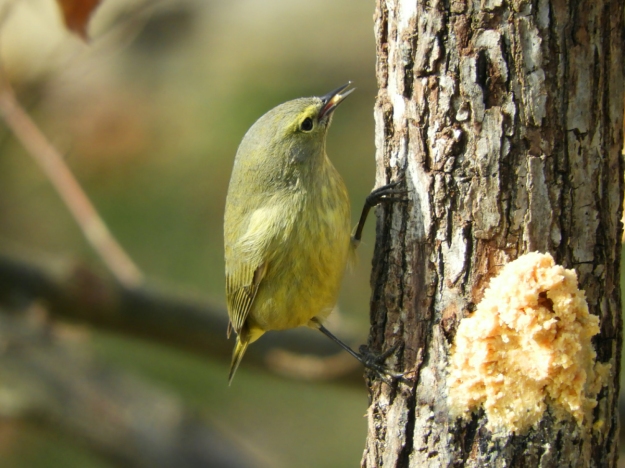
Photo by Rebecca Boyd • This orange-crowned warbler has found a favorable winter residence at the home of Rebecca Boyd in Knoxville, Tennessee, making frequent visits to suet feeders to supplement its usual diet of insects and berries.
In the summer and fall, young birds recently out of the nest can cause some confusion when they show up in the company of their parents at feeders. In the winter, often a season characterized by subdued plumages and nomadic wanderers, the surprise visitors can be one of the many “little brown birds” in the sparrow clan or a summer bird like an oriole or thrush that has decided to take a shot at overwintering.
Or, with greater frequency each winter, it might be one of the warblers. That was the case when Rebecca Boyd, a resident of Knoxville, Tennessee, contacted me recently via Facebook asking for assistance with a bird identification.

Photo by Rebecca Boyd • This orange-crowned warbler is one of the more nondescript members of the warbler family.
Although most of the warblers beat a hasty retreat from North America every fall, a handful of species have increasingly begun to spend the winter months far north of their usual tropical haunts. Some of these species include yellow-rumped warbler, pine warbler and palm warbler, but the low-profile orange-crowned warbler is also becoming more common between November and March, especially in yards and gardens offering supplemental food such as suet cakes.
The small greenish-yellow bird that showed up at Rebecca’s home was easily identified, thanks to some great photographs that she took of her visitor. I communicated to her that I believed her bird to be an orange-crowned warbler. She had also conducted her own research, which had also led her to that conclusion.
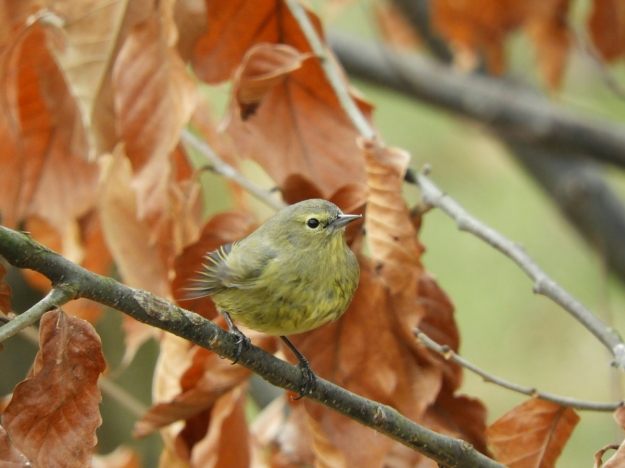
Photo by Rebecca Boyd • This orange-crowned warbler has found a home at the residence of Rebecca Boyd in Knoxville, Tennessee, this winter.
Rebecca said she also shared some photos with birding groups on Facebook, which brought some helpful feedback. “I’ve gotten numerous responses that orange-crowned warblers are becoming a lot more common on the east side of the Mississippi, with quite a few people saying they are seeing them in their yards, too,” Rebecca wrote.
The orange-crowned warbler is one of the more undistinguished members of this New World family of birds that numbers about 115 species. The bird gains its common name from a physical feature that is rarely seen — an orange patch of feathers that, unless the bird is extremely excited or agitated, is usually concealed beneath its dull greenish-yellow feathers. It’s not a field mark that’s considered reliable for identifying the bird.
Rebecca got a lucky break and managed to photograph this elusive feature on her visiting bird. She said the feathers on the bird’s head appeared wet, which may have explained the appearance of the orange crown.
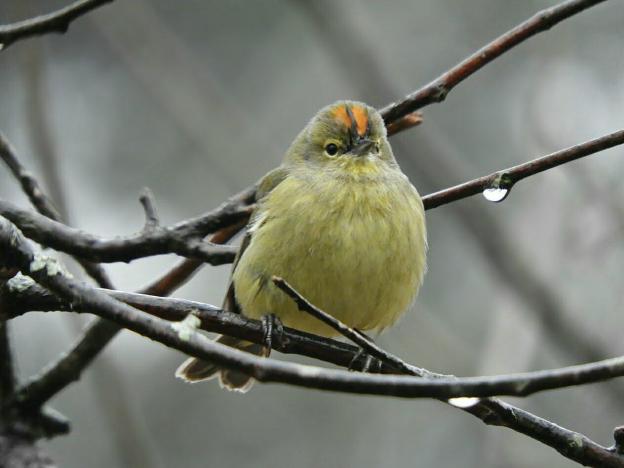
Photo by Rebecca Boyd • Wet feathers made the rarely seen orange crown visible on this orange-crowned warbler that has taken up residence at the home of Rebecca Boyd in Knoxville, Tennessee, this winter.
So, what does signify an orange-crowned warbler? The lack of wing bars, as well as the absence of a strong facial pattern is a strong indicator. The bird in Rebecca’s photo is not nearly as drab as this warbler can appear. Some appear very gray with only a hint of yellow or green in their plumage. There is often faint gray streaking evident in their yellow-green breast feathers. This warbler always shows yellow beneath its tail, a feature that is often only glimpsed as an observed bird is diving into cover. These birds also have sharp, thin bills. It’s usually a process of eliminating other suspects that brings birders to identify one of these warblers.
Unlike some warblers restricted to either the eastern or western United States, the orange-crowned warbler migrates and winters throughout the nation, east and west, although it primarily only nests within the western United States, as well as Alaska and Canada.
Although Rebecca said she has only been bird-watching and taking pictures for a little over a year, she has been a general point-and-shoot photography hobbyist for years. “My backyard is a bird paradise that attracts numerous and varied species,” Rebecca noted. “My favorites are bluebirds and hummingbirds, but the little warblers are also very special.”
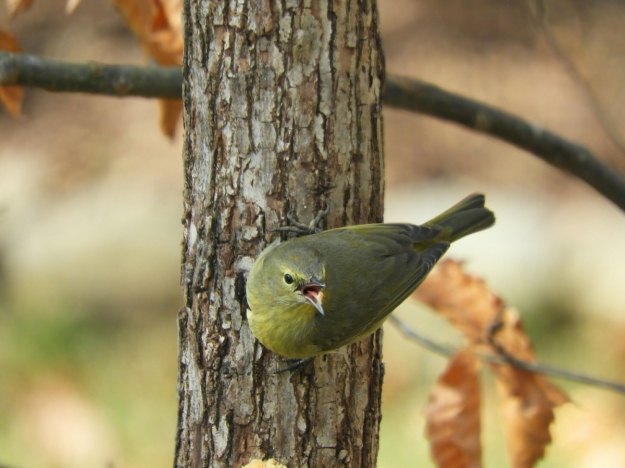
Photo by Rebecca Boyd • Besides orange-crowned warbler, like this individual, other warblers on occasion winter in the United States. Species most often attempting to spend the winter months in the United States include palm warbler, pine warbler, and yellow-rumped warbler.
Most of the warblers are currently residing on the island of the the Caribbean, or far south in Central and South America. A few others spend the winter in Florida or other southern states. The 50 or so species that nest in the United States and Canada will begin arriving as early as next month, although the majority of these summer residents will arrive or pass through the region in late April and May.
So, while it has a colorful name, the orange-crowned warbler is one of the more drab and nondescript members of its family. Other warblers living throughout the Americas include flame-throated warbler, crescent-chested warbler, citrine warbler and arrowhead warbler.
I’ll just keep daydreaming on the occasional snowy day of the approach of spring, which signals that the kin of the orange-crowned warbler will be winging their way north again in only a couple more months. I, for one, can’t wait.
••••••
If you have a question, wish to make a comment or share a sighting, email ahoodedwarbler@aol.com.
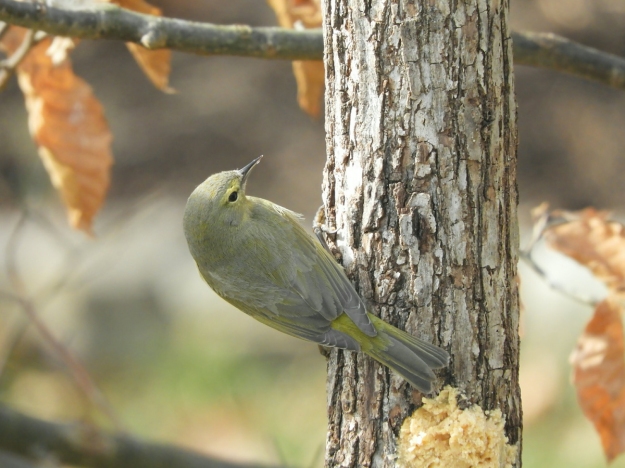
Photo by Rebecca Boyd • This orange-crowned warbler grabs a bit of suet from a feeder at the home of Rebecca Boyd in Knoxville, Tennessee.


 Our Fine Feathered Friends