Category Archives: Belted Kingfisher

56th annual Fall Bird Count finds 120 species in Northeast Tennessee

Photo by Jean Potter A single Wilson’s warbler made it onto the tally for this year’s Fall Bird Count

The 56th annual Elizabethton Fall Bird Count was held Saturday, Oct. 4. A total of 25 observers participated in about 13 parties. The weather was good, with clear skies, no wind and temperatures ranging from 42 to 82 degrees.

This year’s count tallied 120 species, plus two gull species and one Empidonax species of flycatcher. This total is slightly below the recent 30 year average of 124 species, according to compiler Rick Knight The all-time high on this count was 137 species in 1993.

The count is conducted in the Northeast Tennessee counties of Carter, Johnson, Sullivan, Unicoi and Washington.

Photo by Bryan Stevens A total of four pied-billed grebes were found during the recent Fall Bird Count. Numbers of this species will increase as the season advances.

The list:

Canada goose, 466; wood duck, 34; blue-winged teal, 21; mallard, 64; common merganser, 12; wild turkey, 15; and pied-billed grebe, 4.

Rock pigeon, 183; Eurasian collared-dove, 2; mourning dove, 145; yellow-billed cuckoo, 3; chimney swift, 176; and ruby-throated hummingbird, 1.

Killdeer, 41; spotted sandpiper, 3; solitary sandpiper, 2; and two gull species that could not be positively identified.

Double-crested cormorant, 30; green heron, 3; great egret, 5; great blue heron, 26; black vulture, 39; and turkey vulture, 195.

Osprey, 5; sharp-shinned hawk, 1; Cooper’s hawk, 6; bald eagle, 7; red-shouldered hawk, 6; broad-winged hawk, 1; red-tailed hawk, 17; American barn owl, 1; Eastern screech-owl, 24; great horned owl, 5; barred owl, 7; and Northern saw-whet owl, 3.

Belted kingfisher, 22; red-headed woodpecker, 5; red-bellied woodpecker, 71; yellow-bellied sapsucker, 9; downy woodpecker, 41; hairy woodpecker, 17; Northern flicker, 54; and pileated woodpecker, 17.

American kestrel, 14; merlin, 4; Eastern wood-pewee, 17; unidentifiable Empidonax species, 1; Eastern Phoebe, 82; yellow-throated vireo, 6; blue-headed vireo, 23; Philadelphia vireo, 4; red-eyed vireo, 10; and loggerhead shrike, 1.

Blue jay, 360; American crow, 416; fish crow, 4; and common raven, 21.

Carolina chickadee, 158; tufted titmouse, 140; tree swallow, 120; ruby-crowned kinglet, 13; golden-crowned kinglet, 4; cedar waxwing, 126; red-breasted nuthatch, 13; white-breasted nuthatch, 70; and brown creeper, 1.

Carolina wren, 135; house wren, 3; gray catbird, 27; brown thrasher, 9; Northern mockingbird, 74; and European starling, 560.

Photo by Jean Potter A Carolina wren creeps along a fence. A total of 135 of these wrens made it onto the recent Fall Bird Count.

Eastern bluebird, 157; veery, 1; gray-cheeked thrush, 5; Swainson’s thrush, 42; wood thrush, 7; American robin, 233.

House sparrow, 34; house finch, 50; red crossbill, 3; American goldfinch, 64; chipping sparrow, 51; field sparrow, 6; dark-eyed junco, 30; white-crowned sparrow, 1; white-throated sparrow, 2; savannah sparrow, 1; song sparrow, 98; swamp sparrow, 2; Eastern towhee, 47; and yellow-breasted chat, 1.

Eastern meadowlark, 20; red-winged blackbird, 70; brown-headed cowbird, 208; and common grackle, 24.

Ovenbird, 2; Northern waterthrush, 2; black-and-white warbler, 6; Tennessee warbler, 47; orange-crowned warbler, 1; Nashville warbler, 1; common yellowthroat, 12; hooded warbler, 5; American redstart, 21; Cape May warbler, 9; Northern parole, 21; magnolia warbler, 28; bay-breasted warbler, 47; Blackburnian warbler, 4; chestnut-sided warbler, 3; black-throated blue warbler, 11; palm warbler, 26; pine warbler, 4; yellow-rumped warbler, 4; yellow-throated warbler, 2; black-throated green warbler, 14; and Wilson’s warbler, 1.

Photo by Bryan Stevens • Male American redstarts are unmistakable warblers in their orange, black and white plumage.

Scarlet tanager, 9; Northern cardinal, 165; Rose-breasted grosbeak, 13; and indigo bunting, 9.

Some species were noteworthy in their absence. Notable misses included white-eyed vireo, blue-gray gnatcatcher, winter wren, hermit thrush and blue grosbeak.

The count was held a week later than usual due to the fall meeting of the Tennessee Ornithological Society in

Johnson City. This may have accounted for some of the misses or low numbers for some species , such as the single hummingbird. On the other hand, the later date may have contributed to finding some of the later migrants, including orange-crowned warbler and white-throated sparrow.

The count has been held on the first Saturday in October a few times previously.

•••

Bryan Stevens began writing about birds, birders and birding in 1995. To share a sighting, ask a question or make a comment, email him at ahoodedwarbler@aol.com.

Belted kingfisher is a member of an interesting family of birds

Photo by Pexels/Pixabay A common kingfisher, also known as river kingfisher, perches near a water source. The common kingfisher ranges widely across Europe, Asia and North Africa.

Fishing is a favorite pastime for many people, who like nothing better than to spend a lazy summer afternoon trying their luck at their favorite fishing spot. Some of our feathered friends are skilled anglers.

The belted kingfisher’s nature as an angler rules out this bird ever visiting feeders in the backyard, but that doesn’t mean you’re unlikely to see this bird. For most of June and now July a belted kingfisher has been lurking around the creek and pond at my home.  With a little strategic effort, an observation of a belted kingfisher is fairly easy to obtain, especially during the summer months. If you live near a stream, pond, river or other body of water, you have probably been fortunate enough to observe a belted kingfisher as it goes about its daily routine.

If you are a fishing enthusiast yourself, you’ve likely shared some favorite fishing holes with this bird. The belted kingfisher is patient in its pursuit of fish. The birds prefer to perch on an exposed branch or a wire that overlooks a body of water that offers ample fishing opportunities. The belted kingfisher, however, is capable of hovering in place in order to spot and then capture its prey in an impressive plunge and lunge into the water.

Most of my observations of hunting kingfishers have involved the birds in their ambush approach to fishing — perching and diving on the unsuspecting fish. I have on a few occasions, however, also observed kingfishers as they hover over the water in a quest for a meal.

The belted kingfisher, like most of its kin, looks to have a head and bill that are slightly too large for the rest of the body. It’s the long, heavy bill that the kingfishers uses to snatch fish from their watery homes.

Photo by Bryan Stevens • A belted kingfisher perches on a branch along the Erwin Linear Trail.

Speaking of kin, the belted kingfisher is only one of 114 species found worldwide. Worldwide, these amazing birds range in size from the 16-inch-long laughing kookaburra of Australia to the tiny African dwarf kingfisher, which at four inches in length is smaller than most sparrows. This family of birds is divided into three groupings, the river kingfishers, the tree kingfishers and the water kingfishers. Kingfishers are a cosmopolitan family of birds with species present on every continent except Antarctica.

Despite the name “kingfisher,” not all kingfishers exist on a diet of fish. Some members of the kingfisher family instead prey on other quarry, such as snakes, lizards and insects.

Some interesting common names have been used to identify the world’s kingfishers, including half-collared kingfisher, shining blue kingfisher, blue-eared kingfisher, azure kingfisher, indigo-banded kingfisher, silvery kingfisher, malachite kingfisher, white-bellied kingfisher, cerulean kingfisher, rufous-backed kingfisher, spangled kookaburra, rufous-bellied kookaburra, shovel-billed kookaburra, lilac kingfisher, brown-winged kingfisher, stork-billed kingfisher, great-billed kingfisher, striped kingfisher, lazuli kingfisher, ultramarine kingfisher, cinnamon-banded kingfisher, sacred kingfisher, mewing kingfisher, chattering kingfisher, glittering kingfisher, red-breasted paradise kingfisher, pied kingfisher and green-and-rufous kingfisher.

The three North American kingfishers, however, are exclusively fish-eaters. The belted kingfisher, with a range that spans most of the United States, is the only kingfisher encountered by most Americans. Two others, the ringed kingfisher and the green kingfisher, are found in Texas and occasionally in other locations near the Mexican border.

In her book “The Folklore of Birds,” Laura C. Martin writes that in some accounts the kingfisher, not the dove, was the second bird Noah released from the ark after the Biblical flood. Instead of looking for land, the kingfisher flew too high and the sun scorched the bird’s feathers. After his setback with the raven and now the kingfisher, Noah made the kingfisher remain on the ark’s deck to catch its food from the water.

Halcyon days, a term meaning a period of peaceful quiet, is derived from Greek legend. According to the legend, the god Zeus restrained the storms during the period when the kingfishers nest. The scientific name for the belted kingfisher is Megaceryle alcyon, a variation on the term “halcyon.”

Again in Martin’s book, there is an account of a Cherokee legend about how the kingfisher acquired its angling lifestyle. The poor bird wanted to be a waterbird, but lacked the equipment to make a living at fishing. The other animals convened a council and, in pity for the kingfisher’s plight, endowed the bird with its spear-like bill. Since that time, the bird has been known as “king of the fishers.”

The “king of the fishers” is indeed to be envied by human anglers. Although not successful in every attempt, the belted kingfisher is certainly exceptional in its pursuit of fish. According to John Eastman in his book, “Birds of Lake, Pond and Marsh,” the belted kingfisher typically captures about 10 fish per day. Some human anglers would envy a success rate like that.

To observe this bird for yourself, stake out a pond or section of river -— the linear trail in Erwin and the pond at Fishery Park are good locations. In my experience, however, the belted kingfisher is somewhat wary of humans, so observe from a respectful distance or you’re likely to scare off the bird, which will depart giving its rattling call that sounds so much like a sound of pure annoyance.

Belted kingfisher and its kin successful at fishing, much more

Photo by Public Domain Photos/Pixabay.com • A female belted kingfisher returns to a perch after a successful catch.

A belted kingfisher has visited the fish pond quite frequently throughout this summer. The bird’s arrival is usually heralded by its hoarse, rattling call. The bird is rather shy, so any observation usually has to be done with some degree of stealth.

Belted kingfisher

I know fishing is a favorite pastime for many people. In these times of social distancing, there’s probably nothing better for some people to do than to spend a lazy summer afternoon baiting a hook and trying their luck at their favorite fishing spot. While doing so, they have probably encountered the angling counterpart among our feathered friends. The belted kingfisher’s nature as an angler rules out this bird visiting feeders in the backyard, but that doesn’t mean one is unlikely to see this bird. With a little strategic effort, a glimpse of a belted kingfisher is fairly easy to obtain, especially during the summer months. Any stream, pond, river or other body of water increases the chances of observing this fascinating bird.

The belted kingfisher prefers to perch on an exposed branch or a wire that overlooks a body of water that offers ample fishing opportunities. The belted kingfisher, however, is capable of hovering in place in order to spot and then capture its prey in an impressive plunge and lunge into the water.

Most of my observations of hunting kingfishers have involved the birds in their ambush approach to fishing — perching and diving on the unsuspecting fish. I have on a few occasions also observed kingfishers as they hover over the water in a quest for a meal.

The belted kingfisher, like most of its kin, looks to have a head and bill that are slightly too large for the rest of the body. It’s the long, heavy bill that the belted kingfisher uses to snatch fish from their watery homes.

The term “belted” refers to bands of feathers across the bird’s belly. Female belted kingfishers sport bands of rusty-red and blue feathers, while males are limited to a blue belt across the upper breast. Female belted kingfishers are an exception to the rule that most male birds are more vividly colored than their female companions.

A walnut tree with some dead branches overlooking my family’s fish pond is a favorite perching site for visiting belted kingfishers. A few become become regular visitors almost every spring and summer. In past years, I’ve been delighted by pairs of kingfishers that have brought as many as six of their offspring to hunt around the edges of the pond and creek near my home.

When a belted kingfisher does manage to capture a fish — not always a certainty, despite their great skill — the bird will usually fly to a perch where they will beat the fish unconscious before swallowing it. I remember one particular kingfisher that liked to catch fish in the creek and then fly to the corner of the metal garage roof where the bird proceeded to beat senseless the unlucky fish.

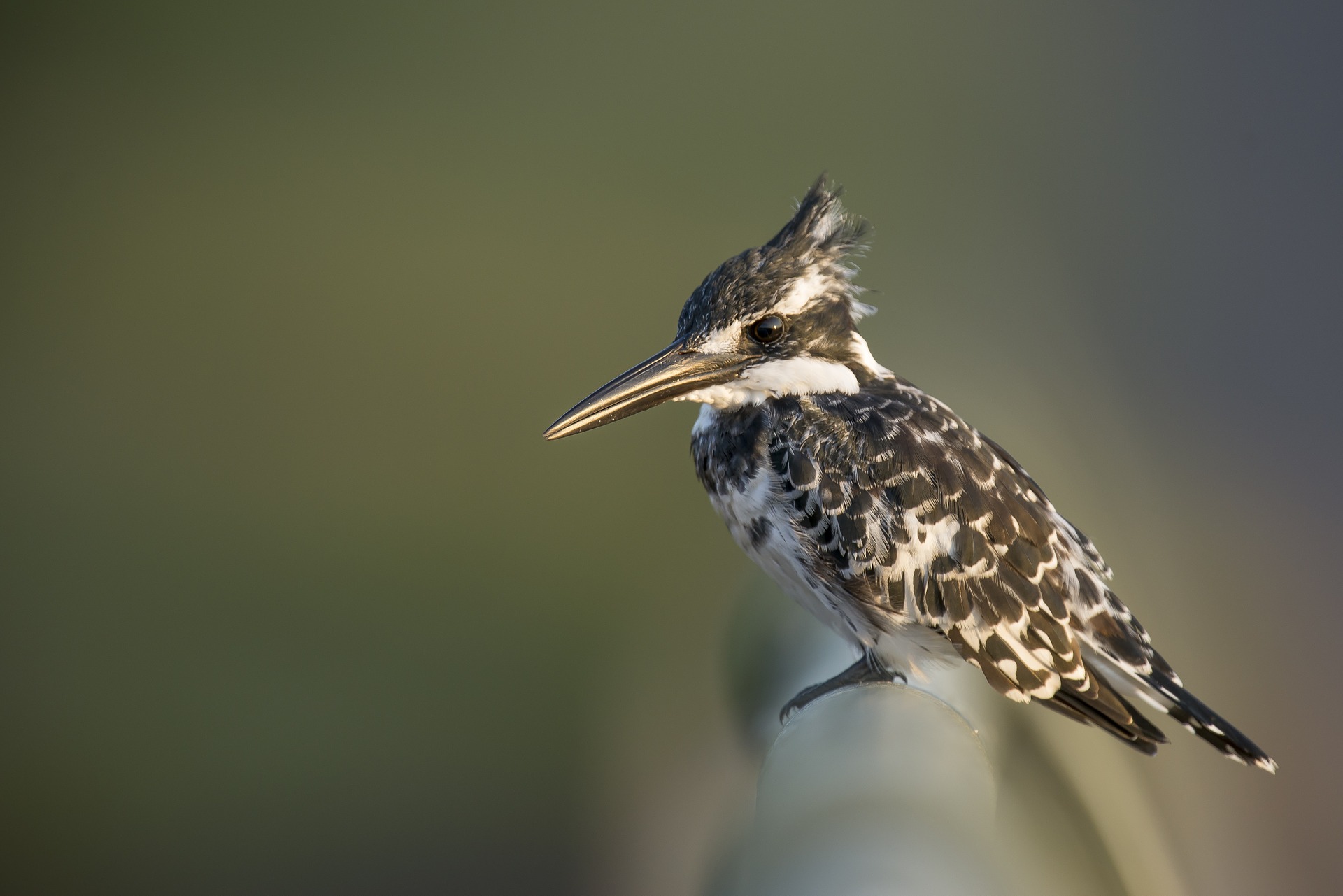
Photo by Pixabay.com • The pied kingfisher is a common member of the kingfisher family that ranges throughout Europe.

While the belted kingfisher is the only one of its kind in the eastern United States, the kingfishers are a large family of birds found around the globe. Worldwide, there are about 90 species of kingfishers that range in size from the 16-inch-long laughing kookaburra of Australia to the tiny African dwarf kingfisher, which at four inches in length is smaller than most sparrows. This family of birds is divided into three groupings: the river kingfishers, the tree kingfishers and the water kingfishers.

Despite the name “kingfisher,” not all kingfishers exist on a diet of fish. Some members of the kingfisher family instead prey on other quarry, such as snakes, lizards and insects.

Some of the varied names for members of this far-flung family of birds include moustached kingfisher, malachite kingfisher, shining-blue kingfisher, azure kingfisher, hook-billed kingfisher, little kingfisher, banded kingfisher, red-breasted paradise kingfisher, lilac kingfisher, glittering kingfisher, great-billed kingfisher, chocolate-backed kingfisher, ultramarine kingfisher, chattering kingfisher and yellow-billed kingfisher.

Photo by WelshPixie/Pixabay.com • The malachite kingfisher is a river kingfisher widely distributed in Africa south of the Sahara.

The family also consists of a group of related birds from Australia and New Guinea known as kookaburras, which includes blue-winged kookaburra, spangled kookaburra, rufous-bellied kookaburra, and the well-known laughing kookaburra. Hollywood often dubs the raucous calls of kookaburras into the background soundscapes of movies and shows with tropical themes.

Photo by Magee/Pixabay.com • The raucous calls of the kookaburra, an Australian kingfisher, are often incorporated into the background of jungle scenes in Hollywood movies.

There’s nothing quite so disappointing as coming home empty-handed after a day of fishing. Belted kingfishers rarely suffer that disappointment. Although not successful in every attempt, the belted kingfisher is certainly exceptional in its pursuit of fish. According to John Eastman in his book, “Birds of Lake, Pond and Marsh,” the belted kingfisher typically captures about 10 fish per day. That’s a feat that many human anglers might envy.