Category Archives: Birds in the News

Bald eagles, always impressive, not an uncommon sight in region

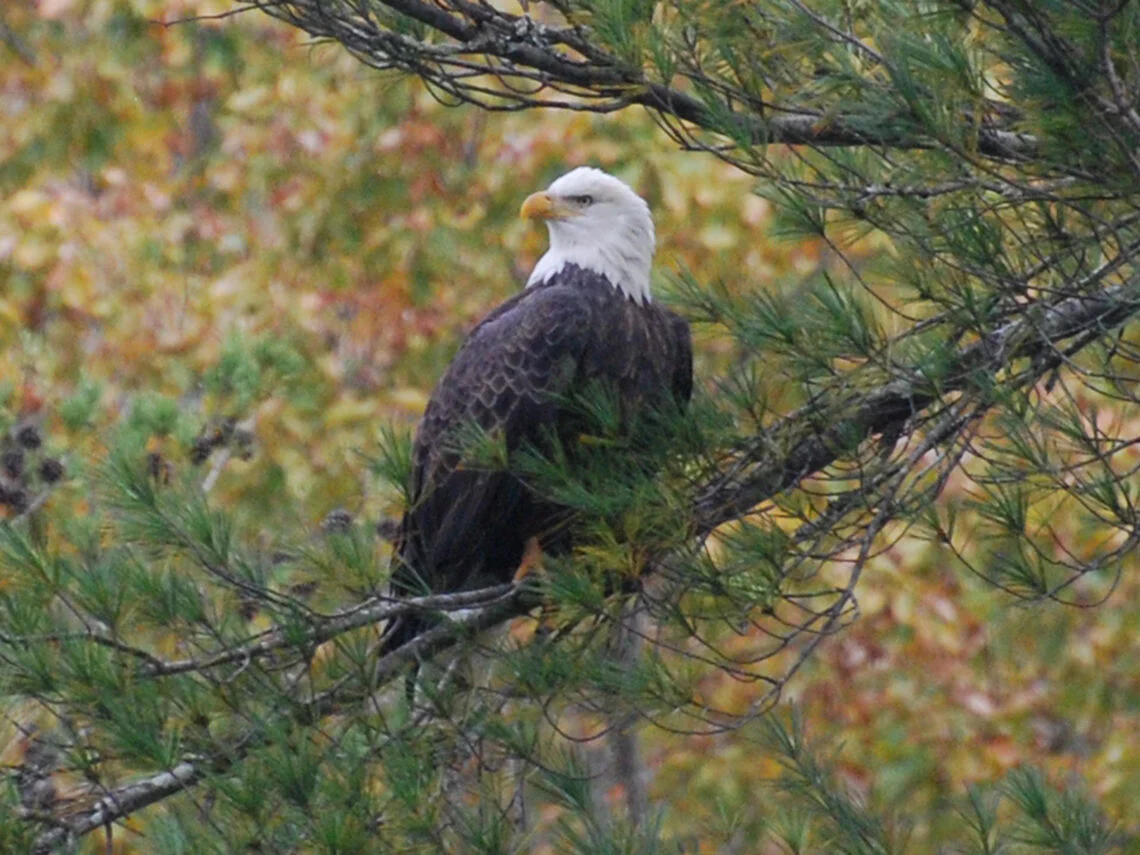
Photo by Jean Potter • A sighting of a bald eagle in the wild is always a memorable moment for the lucky observer.

I hope everyone had a wonderful Fourth of July filled with plenty of red, white and blue. For those who ventured onto area lakes and rivers, I’m hopeful that they perhaps got to glimpse the nation’s official bird.

The bald eagle been recognized as the penultimate bird in the United States of America since the latter decades of the 18th century. I’ve seen many bald eagles in my lifetime, and a sighting of one of these magnificent raptors never disappoints. The resurgence of the once-endangered bald eagle in the lower 48 states has been a laudable accomplishment that all Americans should view with pride.

Photo by Bryan Stevens • The Endangered Species Act has helped save birds like the Bald Eagle from possible extinction.

While the recent Independence Day remains fresh in memory, I thought it might be a good time to share some interesting information on our national bird, the American bald eagle, which officially became the national emblem in 1782 when the great seal of the United States was adopted. Although Benjamin Franklin famously expressed reservations about making the bald eagle our national bird, in hindsight it’s clear that Americans made the right choice.

Despite elevating this native bird to such lofty status, we have not always been kind to the bald eagle. We allowed habitat destruction and toxic pesticides to bring this eagle to the brink of extinction. With well-deserved protection, however, the bald eagle rebounded, and the Department of Interior finally took the eagle off the threatened species list on June 28, 2007.

The bald eagle has been more frequently observed by birders in Northeast Tennessee in recent years. Some of the region’s rivers and lakes are good places to look for bald eagles, particularly in the fall and winter. A few lakes even regularly host nesting bald eagles. I’ve observed bald eagles in Tennessee, South Carolina, Florida and Virginia.

The bald eagle (Haliaeetus leucocephalus) is a member of a genus known as Haliaeetus, or sea eagles. There are seven other living species in the genus: the white-bellied sea eagle, Sanford’s sea eagle, African fish eagle, Madagascar fish eagle, Pallas’s fish eagle, white-tailed eagle and Steller’s sea eagle. The eagles are incredibly majestic birds and important symbols of the value of natural places and creatures.

Steller’s sea eagle is named for the German naturalist Georg Wilhelm Steller, who is renowned for his work as a pioneer in the natural history of Alaska. The 49th state to join the union is also the stronghold for the bald eagle. On occasion, Steller’s sea eagle has strayed into U.S. territory at Alaskan locations including the Pribilof Islands and Kodiak Island. Steller’s sea eagle is bigger than the bald eagle. In fact, it is the largest member of the Haliaeetus genus of eagles, making this bird one of the largest raptors in the entire world.

Ben Franklin wasn’t enthusiastic about the bald eagle as the national bird, but perhaps, considering he favored the Wild Turkey, it’s best we don’t eat our national bird every Thanksgiving.

The naturalist for which this eagle is named has also been honored by the naming of other creatures, including Steller’s sea lion and the now-extinct Steller’s sea cow, as well as several birds, including Steller’s jay and Steller’s eider. He was the first naturalist to describe several creatures native to Alaska, although two of these, the sea cow (a relative of the manatees) and the spectacled cormorant, are now extinct. The latter, which was the largest cormorant to ever live, is a particularly sad story. These cormorants were basically eaten into extinction, exploited as a food source by sailors and fur traders. The last spectacled cormorants perished around 1850 on a Russian island off the coast of the Kamchatka Peninsula.

Fortunately, we have proven a little more far-sighted in our treatment of the bald eagle, which was removed from the U.S. government’s list of endangered species on July 12, 1995, and transferred to the list of threatened species. In 2007, bald eagle numbers had rebounded enough in the Lower 48 states to also allow for the bald eagle to be removed from the list of threatened species.

Male and female adult bald eagles have a blackish-brown back and breast; a white head, neck and tail; and yellow feet and bill. Juvenile bald eagles are a mixture of brown and white and reach full maturity in four to five years. The female bald eagle is 35 to 37 inches in length, slightly larger than the male, with a wingspan that ranges from 72 to 90 inches. Bald eagles weigh from 10 to 14 pounds. The bald eagle’s diet consists mostly of fish, some of which are scavenged, but these large raptors are also capable of preying on everything from muskrats and ducks to rabbits and snakes. The bald eagle will also feed on carrion.

More than 240 years after it was declared an official emblem of the United States, the bald eagle has become an instantly recognizable American symbol. Long may the eagles fly.

•••

Bryan Stevens has written about birds and birding since 1995. To ask a question, make a comment or share a sighting, email him at ahoodedwarbler@aol.com.

Cedar waxwings provide entertainment as they feast on mulberries

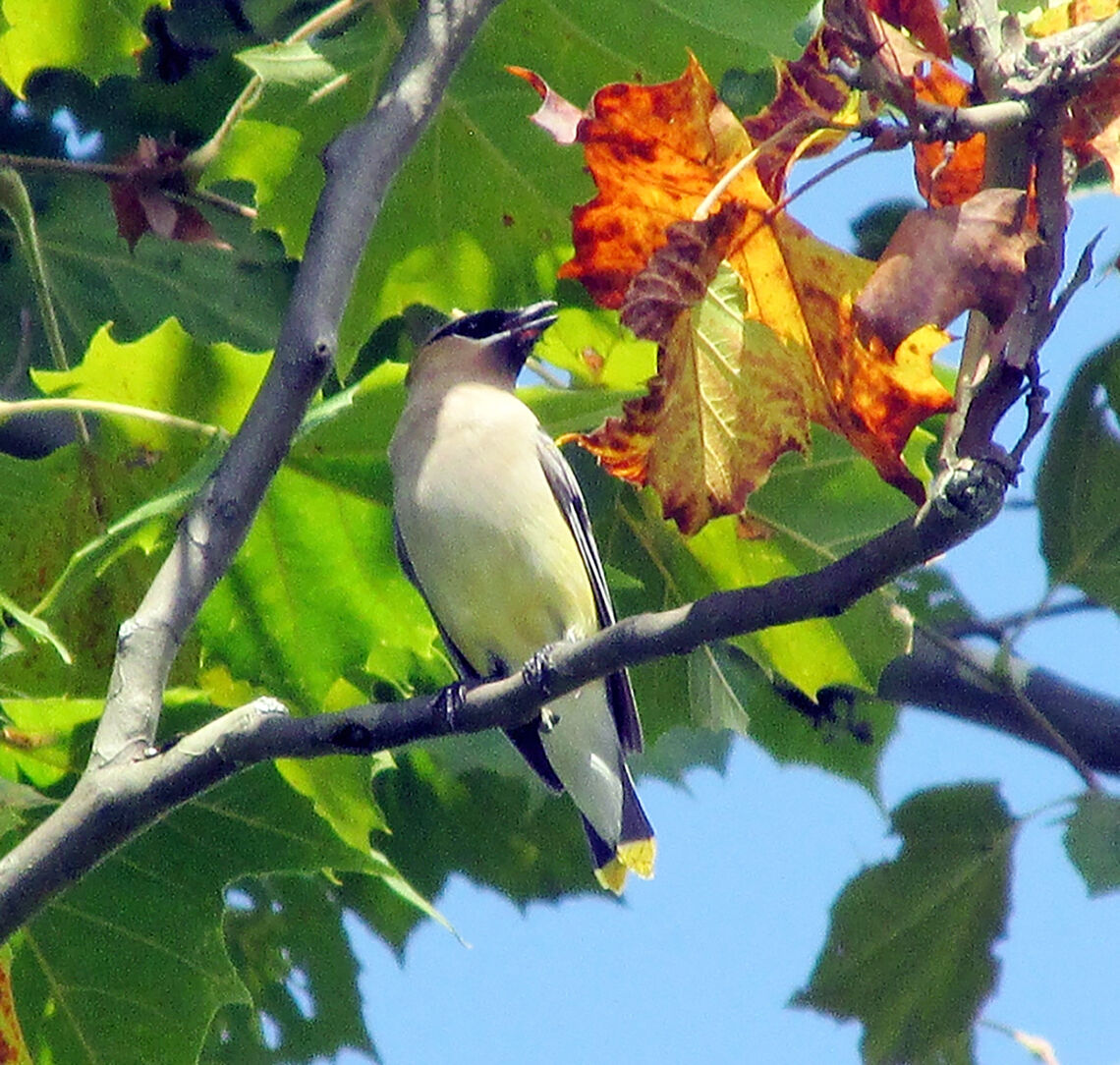
Photo by Jack Bulmer/Pixabay • A cedar waxwings strikes a stately pose on a branch.

Spring turned out to be a rainy season in Northeast Tennessee. As we move into the official summer season as of Friday, June 20, summer’s also looking like it might be wetter than usual.

Rainfall hasn’t stopped the rhythms of the seasons. For instance, two mulberry trees at home have produced a bonanza of ripening berries for our fruit-loving feathered friends.

So far, the main beneficiaries of all this bounty has been the local cedar waxwings. These sleek and distinctive birds have a brown and gray silky plumage, a black mask and a perky crest. Some of the wing feathers show red tips. The similarity of these wing tips to melted drops of wax gives these birds the common name of waxwing.

There’s no absolute explanation of the purpose for these waxy tips. Experts have theorized that the colorful wingtips might help attract mates.

Other birds have competed for access to the berries, including American robins, gray catbirds and at least one scarlet tanager.

Cedar waxwings love their fruit. They’re not quite a frugivore, which is a scientific term for animals that depend mostly on raw fruits for sustenance. The website All About Bird recommends planting native trees and shrubs that bear small fruits, including such species as mulberry, dogwood, serviceberry, cedar, juniper, hawthorn and winterberry, to attract cedar waxwings.

Photo by Bryan Stevens • A cedar waxwing perches in the upper branches of a tree.

The cedar waxwing has few relatives. Worldwide, there are only two other species: the Bohemian waxwing, of the northern forests of Eurasia and North America; and the Japanese waxwing, found in such northeast Asian countries as Japan, Korea and China.

Although it’s classified as a songbird, the cedar waxwing does’t truly produce a vocalization that anyone would contend qualifies as a song. They are, however, very vocal birds, producing shrill, high-pitched notes as they pass through the upper branches of tall trees.

Early American naturalist and artist John James Audubon painted this pair of cedar waxwings.

As much as the waxwing has a fondness for fruit, it’s also a bird that would have made an excellent flycatcher. Flocks of these birds will often congregate in trees near the edge of a pond, garden or yard — anywhere winged insects might be found in good numbers — in order to hawk insects on the wing. A waxwing will sally forth from a branch, snatch its prey in mid-air, and return to its perch for a quick snack. Dragonflies often feed on mayflies and dragonflies but they will also forage on a wide array of other winged insects.

Waxwings are rather nomadic, coming and going with a maddening unpredictability. They often follow the available sources of food, whether that’s the multitude of flying insects attracted by pond and rivers or a particularly bountiful crop of fruit.

They can form large flocks. I once observed a flock that probably consisted of 100 individuals as they stripped berries in early winter from a holly tree. Adding some comic relief to the scene were two Northern mockingbirds making a futile attempt to disperse the waxwings and thus claim all the berries for themselves. The mockingbirds would chase off a dozen or so birds only for twice that number to descend on the vacated spot in the tree’s branches. It was a losing battle, but I am confident that once they settled down, the mockingbirds managed to enjoy the supply of berries alongside the overwhelming numbers of waxwings.

I’ve enjoyed the friendly flock of waxwings as they’ve feasted on mulberries. The only drawback has been that I am usually observing their antics in late evening when the sun is behind these birds. Fortunately, even a waxwing’s sleek silhouette is still a sight to behold and enjoy.

•••

To share a sighting, ask a question or make a comment, send me an email to ahoodedwarbler@aol.com.

Photo by Bryan Stevens • A pair of cedar waxwings hawk for insects near a pond.

Red-bellied woodpeckers, other birds raise their profile during recent snowstorm

Photo by Bryan Stevens • A red-bellied woodpecker makes a tentative approach to a feeder stocked with sunflower seeds. Red-bellied woodpeckers are fairly common in the region.

I’m sure many share my sentiment that with February almost in the rear-view mirror it could be hoped that winter might be nearly at an end.

That misguided hope was dashed last week when another winter storm struck the region, accompanied by another blast of Arctic chill. At least the birds didn’t seem to mind terribly.

Dark-eyed juncos, Eastern towhees, song sparrows and American goldfinches flocked to my feeders. Another bird’s persistent “churr” call made the presence of a red-bellied woodpecker known even before I managed to sight one visiting one of my feeders.

Among the woodpecker family, the red-bellied and red-headed woodpeckers are close cousins, belonging to a genus of those tree-clinging birds known as Melanerpes. The term, translated from Latin, means “black creeper.” Indeed, many of the two dozen members of the Melanerpes genus have an extensive amount of black feathers in their plumage.

Other members of the genus include woodpeckers from the Caribbean, as well as from Central and South America. Some of them have quite colorful names, such as yellow-tufted woodpecker, golden-cheeked woodpecker and the accurately named beautiful woodpecker, a native of Colombia.

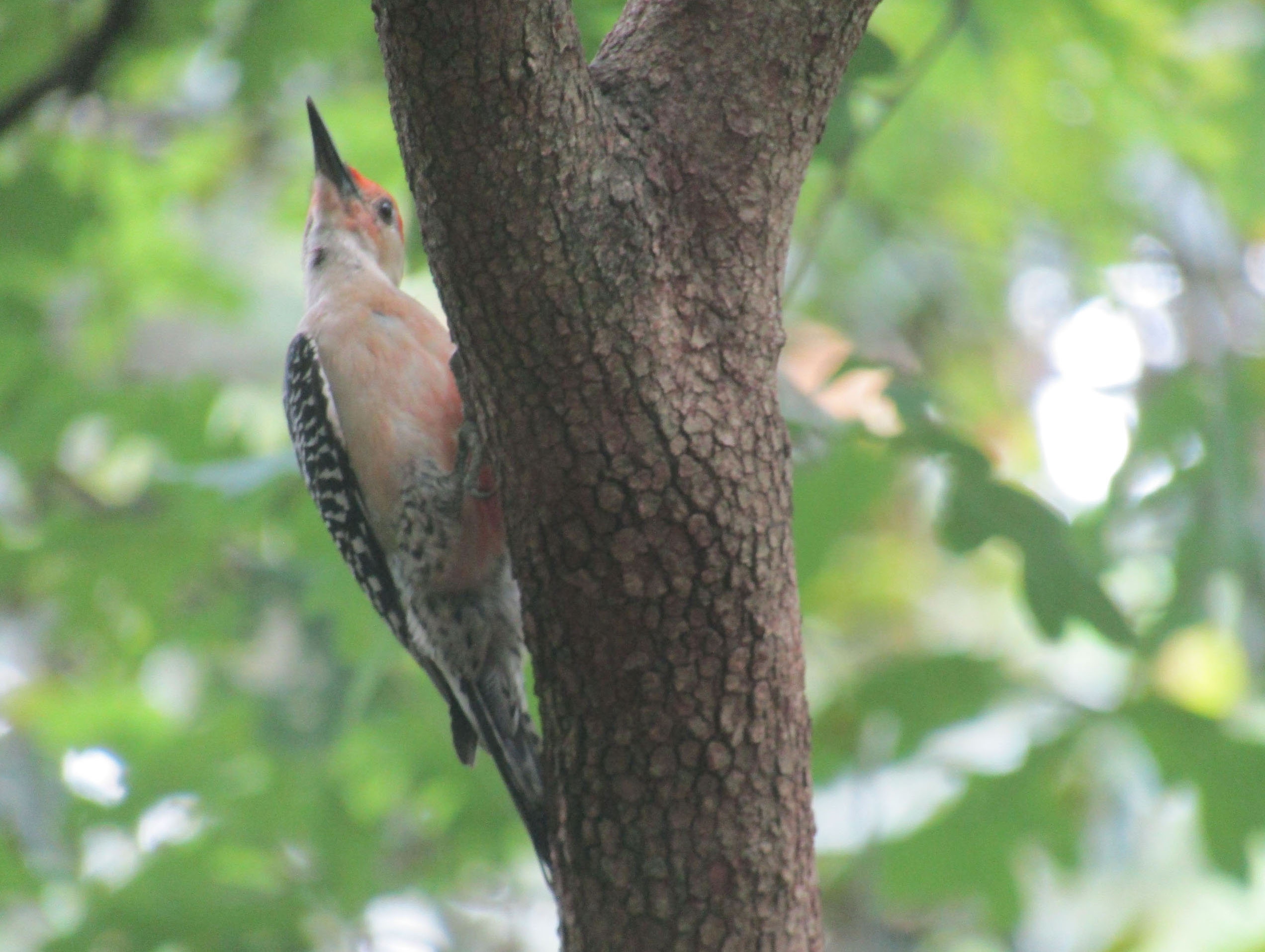
Photo by Bryan Stevens • Red-bellied woodpeckers are common throughout the southeastern United States.

The red-bellied woodpecker is one of the most widespread members of this genus with a range that extends from southern Canada to northeastern Mexico, as well as the eastern United States as far south as Florida and as far west as Texas. A century ago the red-bellied woodpecker was almost exclusively a southeastern bird, but it has expanded its range northward and westward considerably in the last 100 years. Its southern origins are hinted at in its scientific name of Melanerpes carolinus, which can be roughly translated as “black creeper of the Carolinas.”

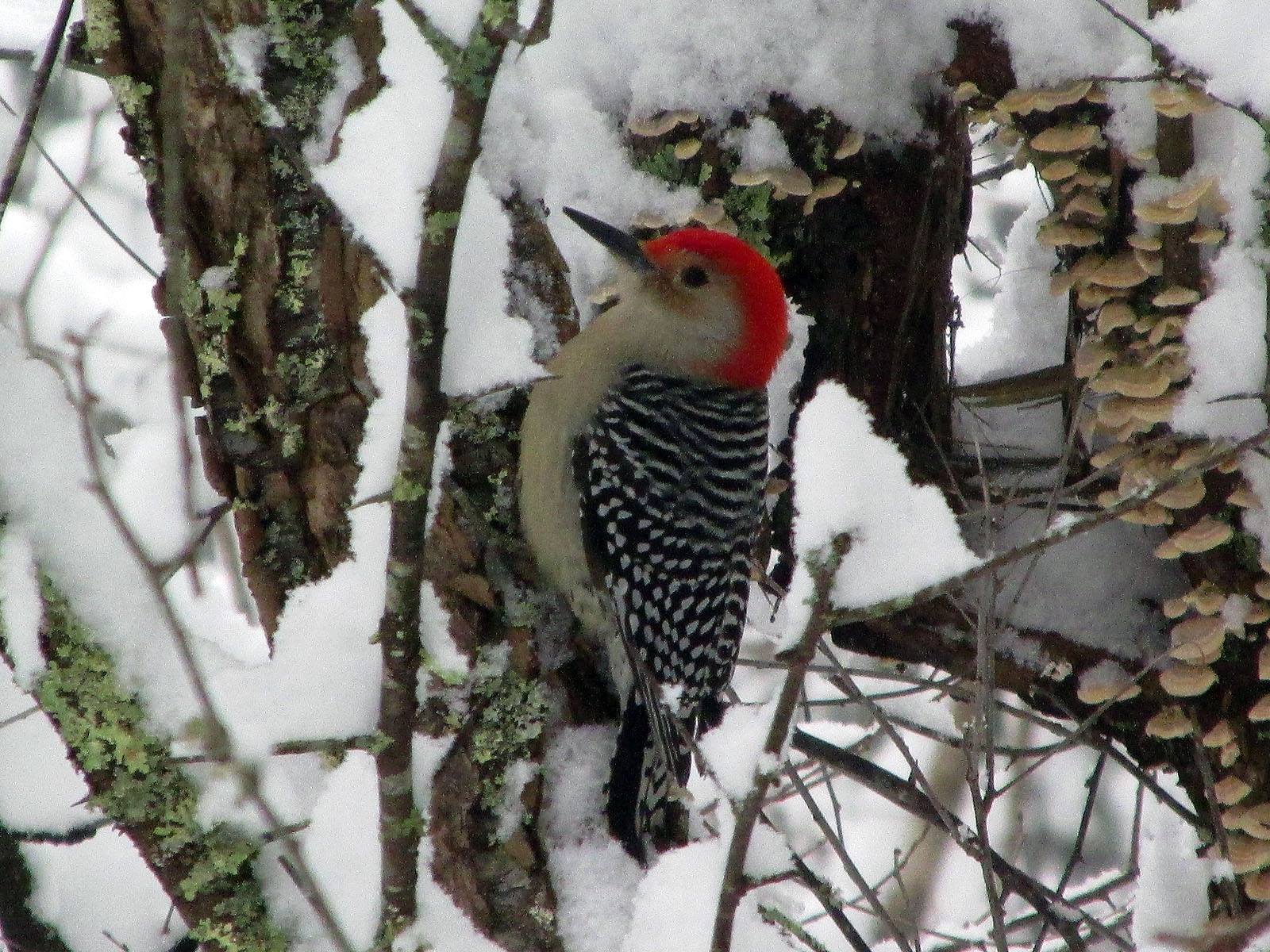
It’s also named for a characteristic of its appearance that is not particularly prominent and difficult to observe. The faint tint of red that tinges the white belly feathers is extremely difficult to observe when this woodpecker is hitching up the trunk of a large tree. Because males, and females to a certain extent, have a red cap, the species has been erroneously referred to as a “red-headed woodpecker” by many casual observers. The true red-headed woodpecker, however, has an entirely red head and a plumage pattern that, considering its color trio of red, white and blue-black, is downright patriotic. The red-headed woodpecker (Melanerpes erythrocephalus) is about the same size as the red-bellied woodpecker.

All woodpeckers are noisy when the mood strikes them, but the red-headed and red-bellied have always struck me as rather more clamorous than some of their relatives. The most common call of the red-bellied woodpecker is a sort of rolling “churr” repeated frequently while the bird is on the move from tree to tree.

To enjoy close views of the red-bellied woodpecker, provide plenty of peanuts, sunflower seeds and suet cakes. During the recent snowstorm I would no doubt have enjoyed even more views of the visiting red-bellied woodpecker if I hadn’t been out of suet cakes. The offerings of sunflower seeds and peanuts, I’m happy to report, were gratefully accepted.

Photo by Bryan Stevens • A red-bellied woodpecker climbs snow-covered branches.

If there are any of these woodpeckers in the woods nearby, they will find these food offerings in short order. All my research indicates the same is true of red-headed woodpeckers, but I’ve never observed this woodpecker at my home. I’ve seen red-headed woodpeckers in Tennessee, Virginia and South Carolina, but their populations are somewhat localized. Woodlands dominated by oak trees are often inhabited by both these woodpeckers, which are fond of the acorns produced by these trees.

One reason the red-headed woodpecker may be less common than its cousin relates to its fondness for hawking for flying insects along roadsides. The woodpeckers are frequently struck by cars when swooping after their winged prey. Historically, the American chestnut and beech trees also provided much of the mast crops consumed by these birds. With the extermination of the chestnut and the scarcity of beech in some locations, the red-headed woodpecker now depends on oaks and acorns. In fact, this woodpecker is rarely encountered outside of woodlands with an abundance of oak trees.

At feeders, red-bellied woodpeckers are prickly customers that often refuse to play nice with other birds. I’ve seen them stare down other large feeder birds, including blue jays, mourning doves and evening grosbeaks. With its large bill, the red-bellied woodpecker commands some respect.

Anyone who has hosted these birds knows they are a welcome visitor to any yard. Who knows? Some day I may even get a visit from the elusive red-headed woodpecker, which is the only woodpecker that resides in the region to thus far avoid my yard.

•••

To ask a question, make a comment or share a bird sighting, email me at ahoodedwarbler@aol.com.

Hungry robins emerge during deep freeze to feast on berries

Robins – by the hundreds – poured into downtown Erwin last week. Most of them ended up on perches around the parking lot between the Clinchfield Senior Adult Center and the rear of the offices of The Erwin Record.

Photo by Bryan Stevens • While American robins like fruit when its available, they also spend a lot of time feeding on earthworms and insects.


The newspaper’s office manager Ken Silvers alerted me to the presence of the “huge flock” of robins. He even joked that he felt like he had stepped into a scene from the movie “The Birds.” Their arrival had been preceded by several nights of single digit temperatures.

In a few weeks, robins will likely be making their annual spring resurgence, but their mid-January appearance in such numbers was somewhat surprising. The fact is that, although we don’t think of robins very much in winter, they are still very much present in the region. The same is true of waxwings and is particularly true about European starlings.

While downtown Erwin would not usually be an ideal location for robins, there was something present to attract them: Berry-producing ornamental holly trees.

In the colder months of the year, robins form large, loosely organized flocks, often taking up residence in wooded lots. After several days of frigid weather, the robins were likely desperate to exploit an available food source. The flock spent a couple of hours gorging on holly berries. Even later in the day a few dozen robins lingered around the shrubs, gleaning the remaining berries from the branches.

The American robin is a large bird in the thrush family, which in North America also includes such birds as Eastern bluebird, wood thrush and Townsend’s solitaire. It’s probably a bird that is well-known to birders and non-birders alike.


In the British Isles, the European robin is simply known as “robin” or “robin redbreast.” When the first English colonists arrived in New England and other parts of colonial-era North America, they took pleasure in finding that some of the birdlife in the New World resembled familiar birds from their homeland. The red-breasted American robin looked like the bird they knew in the Old World as “robin,” which motivated them to name the New World bird “robin,” as well.

Sharkolot/Pixabay • Early American colonists from Europe, familiar with the European robin of their homeland, saw the red breast feathers on the American robin and named the large thrush robin as well.

Other than the red breast, however, the two robins are not all that similar. The American robin is the larger of the two birds. Farther separating these two birds is the fact that the European robin is not a thrush but rather a member of the family of Old World flycatchers.

In some other ways, the two robins are similar. Both are fond of earthworms, spending a great deal of their time on the ground foraging for worms. They will also follow human gardeners at their work, waiting patiently for the followed person to disturb the soil with a spade or hoe and expose earthworms for the waiting bird. They are also rather tolerant of humans and have learned to make their own homes close to human dwellings.

Some of the British transplants to North America must have felt homesick for familiar things because several unsuccessful attempts were made to introduce the European robin to the United States and Canada. European robins introduced in New York and Oregon failed to gain a foothold, unlike the introduction of such alien birds as the house sparrow and European starling.

On a few occasions, migrating American robins have overflown their destinations and ended up in the United Kingdom. For instance, an American robin became a first for London birdwatchers when one was found in that nation’s capital city in March of 2006. Whether of the European or American persuasion, robins have long been a favorite of birdwatchers and nature enthusiasts.

In a few weeks we will have more American robins pouring into our lawns, our gardens and our parks. The American robin has always been a perennial harbinger of spring. But it’s not always necessary to wait until winter’s waning to enjoy observation of this popular songbird.

•••

Bryan Stevens has written about birds and birding since 1995. To ask a question, make a comment or share a sighting, email him at ahoodedwarbler@aol.com.

Tiffany/Pixabay • The American robin keeps a lower profile but is still present in the region during the winter months.

Kinglets are tiny birds with huge appeal

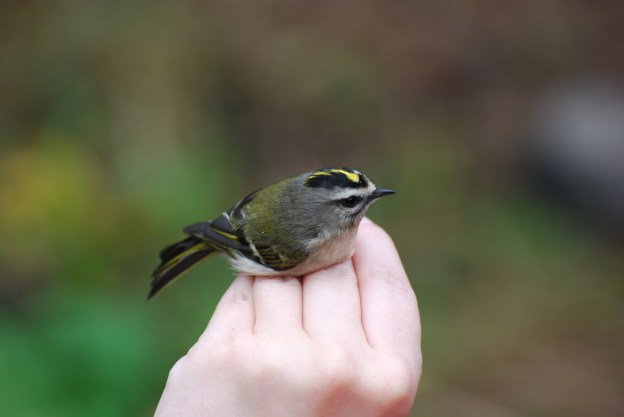
Photo by Beth McPherson • A golden-crowned kinglet recovers in the photographer’s hand after striking a window.

With the recent cold weather, I’ve been seeing a few golden-crowned kinglets, as well as the closely related ruby-crowned kinglet, at my home.

Golden-crowned kinglets are fairly common winter birds. Ruby-crowned kinglets, although not always as common as their relative, also are found in the region during the winter season.

Both the golden-crowned and ruby-crowned kinglets are members of a family of tiny birds known collectively as kinglets and firecrests. They’re such tiny, energetic birds that they absolutely excel with the “cuteness” factor.

All kinglets are very tiny birds, as well as extremely active ones. They are also the only members of this family of birds found in North America. Four other species, however, are native to Europe, Asia and North Africa. The remaining species include goldcrest, common firecrest, Madeira firecrest and flamecrest, which is also known as the Taiwan firecrest.

Kinglets, as their name suggests, are tiny birds. In fact, about the only North American birds smaller than kinglets are some of the hummingbirds. The kinglets belong to the family, Regulidae, and the genus, Regulus. The family and genus names are derived from a Latin word, regulus, which means “rex,” or “king.” The name was apparently inspired by the colorful crown patches, often red, orange or gold, that resemble the royal “crowns” of kings.

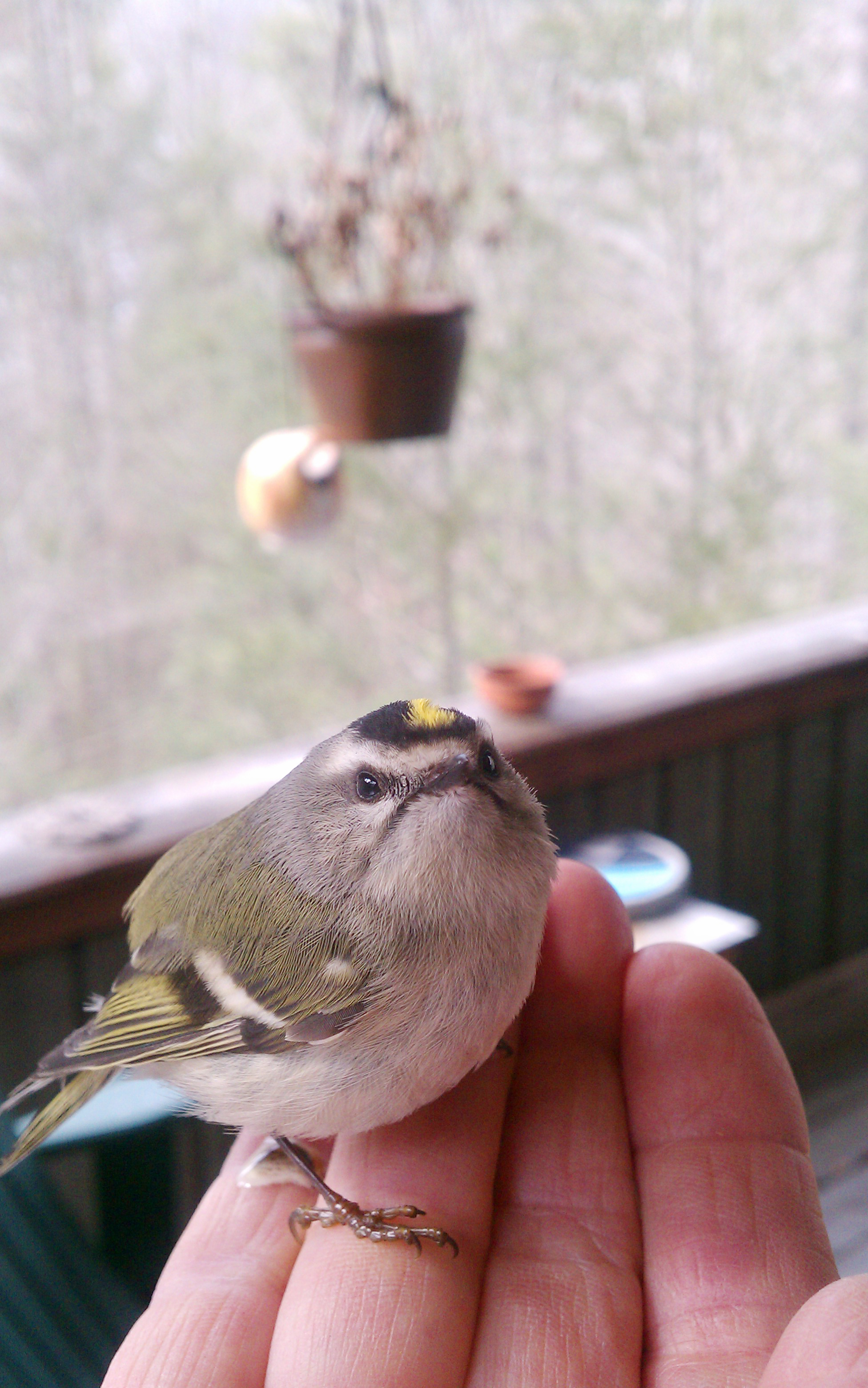
Although similar in size and overall coloration, the ruby-crowned and golden-crowned kinglets are easily distinguished from each other. Side by side, the two species of North American kinglets are easy to identify. The golden-crowned kinglet has a striped facial pattern formed by bold black and white stripes. The ruby-crowned kinglet, on the other hand, has a bold white eye ring but no striping.

The golden-crowned kinglet has an orange crown patch, while the ruby-crowned kinglet has a red crown patch that is, more often than not, kept concealed. Both sexes of the golden-crowned kinglet possess an orange crown patch, but only the male ruby-crowned kinglet boasts a scarlet patch of feather atop the head.

Kinglets are active birds, foraging vigorously for small insects and spiders. When foraging, both kinglet species have a habit of flicking their wings over the backs. Even if you can’t get a good look at the birds, this behavior alone helps contrast them from other small birds, including some warblers and wrens.

Golden-crowned kinglets are widespread in the region during the winter. During the summer months, head to the slopes of some of the region’s higher mountains to look for these tiny birds that nest at the higher elevations of the Southern Appalachians.

Ruby-crowned kinglets can also be found in the region during the winter, but extreme cold weather will often force these less cold-hardy birds to eke out the winter months farther south.

Kinglets don’t typically visit feeders, but they do tend to join mixed flocks with membership consisting of such species as tufted titmouse, Carolina chickadee and white-breasted nuthatch. When traveling with such flocks, kinglets may visit the space around feeders but rarely take seeds or other fare offered at feeders.

In recent decades, perhaps assisted by the surge in the popularity of feeding birds, kinglets have been observed sampling such fare as suet cakes, peanut chips and scraps of sunflower seeds that have been shelled and dropped by other birds.

Normally, kinglets have a rather fleeting lifespan. These tiny birds can be considered old if they live three or four years. There are always exceptions. The oldest golden-crowned kinglet on record was six years and four months old. That individual, a male, was documented by a bird bander in 1976, according to the website All About Birds.

Kinglets are surprisingly tame at time and often exhibit as much curiosity about us as we display toward them. They’re very active birds, however, constantly moving from perch to perch. These bursts of hyperactivity can make them difficult to observe with any satisfaction since they so rarely remain still for long.

•••

To learn more about birds and other topics from the natural world, friend me on Facebook at https://www.facebook.com/ahoodedwarbler. I like to post about local birds, wildlife, flowers, insects and other aspects of the natural world.

September brings spike in bird migration

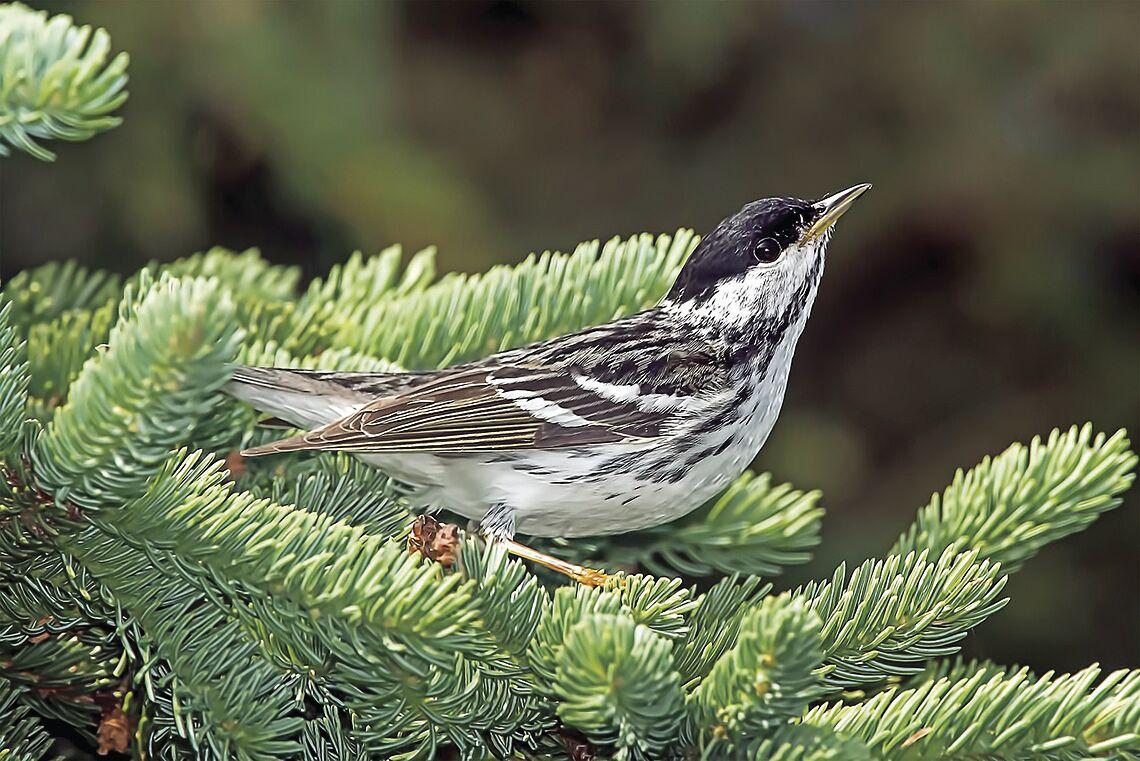
Hans Toom/Pixabay • Few warblers make as great a journey as the blackpoll warbler. This small songbird makes a roundtrip flight of 12,400 miles for its seasonal migrations each year.

September’s arrival puts fall migration into sharp focus. The birds that returned this past spring — the warblers, vireos, tanagers, grosbeaks, flycatchers, hawks, hummingbirds and many more — have begun or are beginning to make their way back to the locations where they will spend the winter months far from the cold, bleak conditions over most of North America.

Every morning as I leave for work I hear the buzz of hummingbird wings. When I return in the evening, I am often greeted by the scolding calls of red-eyed vireos from the woodlands around my home.

Some of these birds migrate out of the tropics every spring to avoid competition. Others find North America a land of abundant, albeit temporary, resources. This land of plenty offers a wealth of insects, seeds, fruit and other nourishing, nutritious food to help parent birds keep their strength while they work to ensure their young thrive. Of course, once the bountiful period concludes, they return to the tropics of Central and South America to winter. Those that do so successfully will make the journey back to the United States and Canada in the spring. It’s an ongoing cycle, repeating year after year, season after season.

The phenomenon of migration isn’t exclusive to the neotropical migrants of the New World. Birds in other parts of the world migrate, too. Waterfowl, shorebirds and raptors are among some of the families of birds that stage impressive migrations.

Photo by Jonathan Cannon/Pixabay.com • The Arctic tern outdoes all other birds when it comes to migration. These seabirds journey from their Arctic nesting grounds to spend the winter around the Antarctic, a journey of some 50,000 miles a year.

The Arctic tern, for example, truly takes migration to extremes. This small seabird travels each year from its Arctic nesting grounds to the Antarctic region, where it spends the winter months. Put into terms of mileage, the Arctic tern can travel about 50,000 miles in a single year. For a bird with a body length of about 15 inches and a wingspan of about 28 inches, this incredible migration is an astonishing feat. These statistics permit the Arctic tern to easily lay claim to the title of champion migrant among our feathered friends.

According to the website for National Geographic, Arctic terns face a serious threat from climate change. In a profile on the tern at its website, National Geographic warns that Arctic terns are projected to lose 20 to 50 percent of their habitat due to the temperature changes linked to climate change. They also face loss of habitat due to encroachment by human activities such as oil drilling.

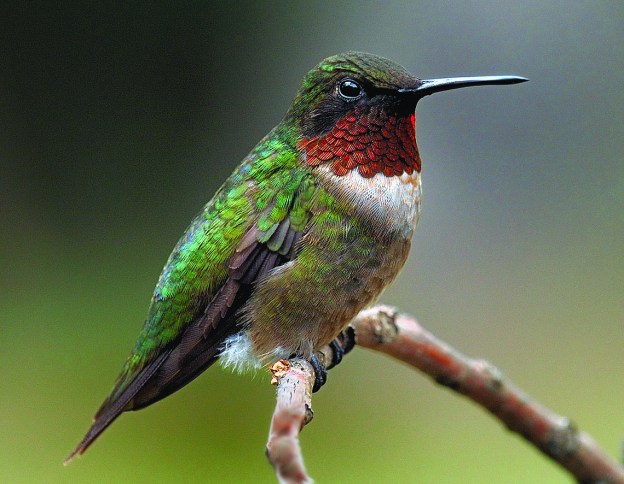
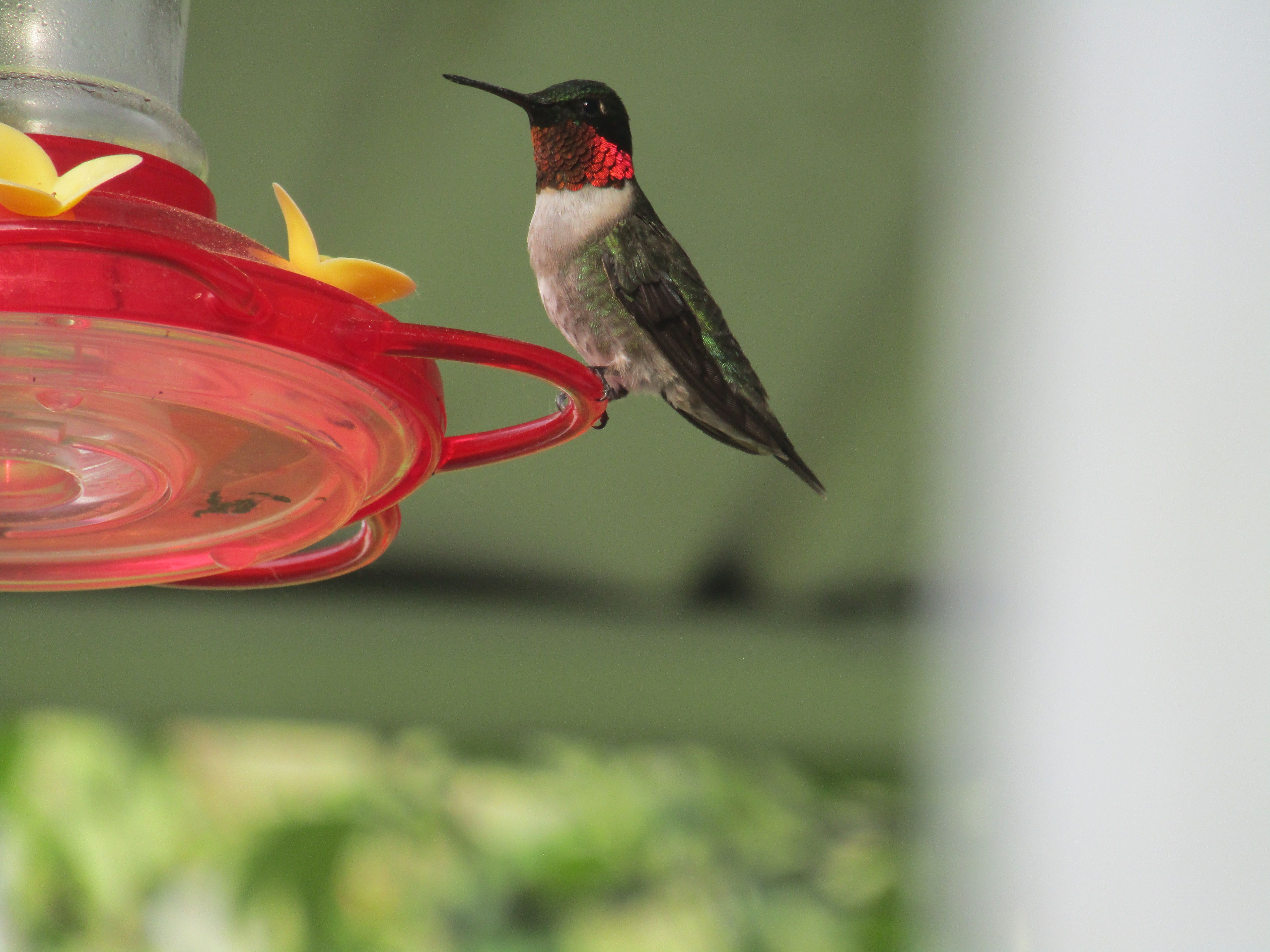
The ruby-throated hummingbird, a favorite of many bird enthusiasts living in the eastern United States, makes an impressive migration each year. Just to reach the United States, these tiny birds undertake a strenuous journey. They leave their wintering grounds in Central America to return to the United States and Canada for the nesting season. Most of these tiny birds, which are barely four inches long, make a non-stop flight of more than 500 miles across the Gulf of Mexico. The journey can take almost an entire day. With the end of summer, the entire population of ruby-throated hummingbirds, increased by a new generation of young birds, makes the Gulf crossing for a second time in a year to return to the American tropics for the winter months.

Photo by Bryan Stevens • A ruby-throated hummingbird perches at a feeder for a sip of sugar water.

Among North America’s buteo hawks, which includes raptors such as red-shouldered hawk and red-tailed hawk, the broad-winged hawk stands out as a dedicated migrant. These hawks form flocks that at times number in the hundreds or thousands as they sail and glide on thermals rising over various mountain ranges. These hawks and other raptors are well-known in the region for migrating past the Mendota Fire Tower in Southwest Virginia every September and early October.

The broad-winged hawk’s counterpart in the western United States is Swainson’s hawk, which shares the broad-winged hawk’s inclination for migrating in large flocks. Swainson’s hawk is named for William Swainson, the famous 19th century English naturalist for which Swainson’s thrush is also named.

The hooded warbler, my favorite member of the migratory New World warblers, migrates back to Mexico and Central America for the winter months after nesting during the spring and summer in a range concentrated in the southeastern United States. The males, after going quiet in late summer, have started singing on occasion from the shaded woods around my house. I think this has more to do with restlessness as they prepare for to depart on a migration flight that will take them to the balmy Caribbean, Mexico and Central America while we shiver through the months between October and April. It’s not a migration of an incredible distance, but it’s still quite an accomplishment for a bird only five inches long and weighing less than half an ounce.

Another warbler is a true migratory champion. Few warblers make as great a journey as the blackpoll warbler. Instead of migrating over land, this five-inch-long warbler undertakes a two-stage migration. The first half of the migration is a non-stop flight of about 1,500 miles. Every fall, these tiny birds fly over the Atlantic Ocean during this part of their migration, departing from Canada or the northern United States and not stopping until they reach various locations in the Caribbean. There they will spend some time recovering from the exhausting first half of their journey before they continue their way to such South American countries as Colombia and Venezuela. Once again, during the time they spend flying over open ocean, these tiny warblers do not feed.

Fall’s a great time to witness the variety of avian life. Look for some of these migrants passing through your yards, gardens or favorite birding spots.

For those wanting suggestions for seeking out migrating birds, the linear trail in Erwin, Rocky Fork State Park in Flag Pond and Limestone Cove Recreation Area are some good bets.

•••

To ask a question, make a comment or share a sighting, email me at ahoodedwarbler@aol.com. 

Elizabethton Bird Club announces speakers for fall programs

Brayden Paulk will speak to the Elizabethton Bird Club on Sept. 3 on the topic of microfishing.

The Lee and Lois Herndon Chapter of Tennessee Ornithological Society, also known as the Elizabethton Bird Club, will soon begin its schedule of monthly meetings for 2024-25.

The brief business meetings are always accompanied by an informative and entertaining program on birds, birding or other subjects from the natural world.

These programs are a great way to learn more about our feathered friends as well as other related subjects from the natural world. They are free, open to the public and hosted by a welcoming group of people.

Here’s the schedule for Fall 2024:

September

Brayden Paulk, a young naturalist with family ties in Unicoi County, will present the first program on Tuesday, Sept. 3, with a talk on “Microfishing,” which involves anglers focusing on a diverse array of tiny species of fish.

Paulk has also been working as a naturalist with Lamar Alexander Rocky Fork State Park this summer and fall. He gave a program a couple of years ago for the club on “Trash Fishing,” which explored other angling options other than the typical gamefish species. As both fishing and birding are among his interests, he will no doubt find a way to work something into his program about birds.

October

The guest speaker for the meeting on Tuesday, Oct. 1, will be Mark Stevens. A former publisher for The Erwin Record, he will present a program titled “Building a Birding Festival” that will focus on his development of the Hammock Coast Birding Festival in South Carolina. Stevens, who works as tourism director for the Georgetown County Chamber of Commerce, will be giving the program remotely from his home in South Carolina, but the hybrid meeting also offers a chance to attend in-person with other birding enthusiasts. The festival is organized by the South Carolina Hammock Coast, the marketing arm for the Georgetown County Chamber. The third annual Hammock Coast Birding Festival is scheduled for Feb. 6-9, 2025.

November

Vern Maddux, the treasurer for the club, will be the speaker on Tuesday, Nov. 5. Maddux is a world traveler when it comes to seeing birds and will present a program on one of his recent international birding adventures to South Georgia and Falklands. South Georgia is a mountainous barren island in the South Atlantic Ocean, 800 miles east-southeast of the remote South Atlantic archipelago that makes up the Falkland Islands. With rugged terrain and cliff-lined coasts, the hundreds of islands and islets in the Falklands are home to sheep farms and abundant birdlife.

December

In the busy month of December, yours truly will give the program. I will present a powerpoint presentation titled “What’s in a Name?” on North American birds named after people. Among our native birds, we have quail, woodpeckers, sparrows, finches, warblers, hawks and other birds are known by names of historical figures ranging from John James Audubon to William Clark and Meriwether Lewis.

My program will be held on Tuesday, Dec. 3. I will discuss the American Ornithological Society’s decision in 2023 to end what are known as eponyms, in which species names honor people. The renaming of dozens of species will be a gradual process.

The club’s 2025 schedule has not been completed, but will include a program by local naturalist Lewis Tester in the spring on dragonflies.

The public is always welcome to attend these programs. Programs begin at 7 p.m.

The club meets at the Elizabethton campus of Northeast State Community College in Room 135 when the school’s schedule permits. When school is not in session, meetings are held on Zoom or at other announced locations. To receive updates on the club’s schedule, events and activities, email elizabethtonbirtdingclub@gmail.com and ask to be placed on a free mailing list.

The Elizabethton Bird Club holds seasonal birds count in spring, summer, fall and winter. The club also organizes and sponsors regular field trips to destinations through Northeast Tennessee. These activities are also open to interested members of the public.

•••

To share a sighting, make a comment or ask a question, email me at ahoodedwarbler@aol.com.

Surprise! Hummingbirds come in variety of sizes

This week’s column is about hummingbirds, the big and the small ones. Frances Lamberts in Jonesborough sent me an email earlier this month that got the ball rolling for this week’s hummingbird column.

“Two hummingbirds were here for a good week long,

at the end of April,” Frances wrote. “Then they were gone, and I haven’t seen any since. Despite the heat/drought (and with some watering), the

property has many favorite flowers in bloom, including the blue salvia, red pole beans, monarda, many others come and gone, the cardinal flowers about to bloom.”

Her question was a simple one: “Where are the hummers?”

She noted that she has kept a “first sightings” record for about 20 year. One year the hummingbirds didn’t arrive until mid June, which worried her at the time.

“What is happening now?” Frances asked.

The simple and honest answer is that it’s not really possible to land on any single answer. Birds have wings, and hummingbirds are capable to long-distance flights.

Still, a setting such as the one Frances described with such a wide variety of blooms should be teeming with hummingbirds.

Personally, it’s been a perplexing season. My hummingbirds arrived back in April, stuck around for perhaps a week, and then almost disappeared. They returned in mid-June, remained visible for a couple of weeks, but have since pulled another vanishing act.

In any given year, the numbers of hummingbirds passing thorough is going to fluctuate. Some years, these tiny flying gems will be present in good numbers on an almost daily basis. Other years, hummingbirds can become quite scarce.

I usually enjoy my best hummingbird numbers in the fall as these little birds begin their leisurely journey back south. Late August and the month of September is usually a great time to watch hummingbirds. I’m optimistic that the same will hold true this fall.

In some other hummingbird news, the world added another species of hummingbird this year when the giant hummingbird of South America got split into two distinct species.

Abi Cole, writing for Audubon Magazine, reported in an article on June 7, 2024, that scientists have considered two distinct populations of giant hummingbird — a migratory southern population in Chile, Argentina and Bolivia, and a non-migratory northern population in Chile, Ecuador and Peru — to be the same species.

Now, scientists have reconsidered that belief and learned that the two species have been able to fool scientists for so long by basically, as Cole’s article phrases it, by hiding in plain sight.

Cole’s article details the elaborate process by which giant hummingbirds were captured and fitted with geolocator devices. The article credits Jessie Williamson, lead author of the new study and a National Science Foundation postdoctoral research fellow, with unraveling the mystery.

Williamson did so by intensively studying the Chilean population. The resulting research also revealed some huge surprises.

For centuries, there has been speculation about where the Chilean giant hummingbirds go to spend the winter. Now we know – they make an astonishing, record-breaking 5,200-mile round trip to spend several months with their cousins in the Peruvian Andes.

Because the Chilean and Peruvian birds look so much alike, no one had ever realized that they were co-existing with each other during the winter season.

Of course, the name “giant hummingbird” is almost an oxymoron for a family of birds famous for their diminutive size. Now that we have two species of giant hummingbirds, they can’t both hold the title of world’s biggest hummingbird.

So, which is the bigger bird? As it turns out, the giant hummingbirds living year round in the Andes, now known as the northern giant hummingbird, is slightly bigger than the migratory southern giant hummingbird.

The article about these discoveries is fascinating. To read it for yourself, visit http://www.audubon.org/magazine/scientists-discover-worlds-largest-hummingbird-hiding-plain-sight.

The giant hummingbird does earn the right to that name. Both of the two species weigh between 18 and 24 grams and have a wingspan of about 8.5 inches. They have a body length of 9.1 inches. For a useful comparison, they are about equal to the size of a European starling or a Northern cardinal.

They are not the dazzling beauties most people associate with hummingbirds. Giant hummingbirds have a drab greenish plumage above with a whitish rump patch and dingy coloration below with variable rusty tones and dusky spotting. They do have the long bills and overall physical shape of other hummingbirds. The scientific name is Patagona gigas, roughly translated as the giant of Patagonia.

Photo by Bryan Stevens • Welcoming hummingbirds also involves making sure that they remain healthy and safe while spending time in our yards and gardens.

Count the giant hummingbird (either of the two species) as birds I’d like to see some day. The world’s diversity of hummingbirds is dazzling, but I feel fortunate to enjoy the ruby-throated hummingbird from April to October every year. As anyone knows who hosts these tiny birds, ruby-throated hummingbirds are dazzling and engaging guests during their all-too-brief.

•••

To ask a question, make a comment or share a sighting, email me at ahoodedwarbler@aol.com.


Great auk’s story ended 180 years ago this week

Although he never saw the species in person, famous naturalist and artist John James Audubon painted this pair of great auks about the time the species was heading toward extinction.

It’s summer and the birds are busy nesting in the mountains and valleys of the Southern Appalachians. Eighteen decades ago, during a summer nesting season far away in the North Atlantic, the story of an unusual seabird came to a brutal end.
The last pair of great auks was killed on Eldey, off the coast of Iceland, on June 3, 1844. This little-known tragedy ended the last known breeding attempt for the species 180 years ago this week.


The great auk, also known as the great Northern penguin, once inhabited the Atlantic coasts of both North America and Europe. This flightless bird achieved the status of “great” due to its size. Adult great auks reached a height of about 32 inches and could weigh as much as 11 pounds, making them much larger than any of their close relatives. This bird had a black back and a white belly in a two-tone plumage that does indeed resemble the appearance of many penguins. The bird’s black beak was heavy and hooked, with grooves on its surface, excellent for catching fish.


The great auk belonged to the bird family of Alcidae, which also includes such birds as auks, auklets, murres, murrelets, puffins, razorbills and guillemots. The family is not closely related to penguins, which are only found in the Southern Hemisphere. The great auk’s scientific name – Pinguinus impennis – has reinforced the misconception that penguins and the great auk were closely related.

Photo by Kevin/Pixabay • The razorbill, also known as the lesser auk, is probably the member of the Alcidae that most resembles the great auk, albeit on a diminished scale.


Today, one close relative of the great auk still swims in the North Atlantic off the coasts of both North America and Europe. The razorbill (Alca torda) is the sole species in the genus Alca since the extinction of the great auk in the mid-19th century.


Razorbills, as did their larger relative, nest in colonies. Razorbill nesting colonies exist off the coasts of Canada, Iceland, Norway, Wales and the United Kingdom. After the nesting season, razorbills abandon the land and spend the winter months at sea. Razorbills are occasionally spotted as far south as the Carolinas, Georgia and Florida during the winter season.
Razorbills have a body length of almost 17 inches and weigh from one to two pounds, placing them well shy of the size of their extinct relative.


Great auks figured prominently in the cultures of some native sea-going tribes. Although Native Americans did hunt the birds, their efforts had been sustainable.
The coming of European explorers and settlers threw the balance out of whack for this species, which nested in large colonies. Explorers in North America plundered the great auks as a food source and also used the flesh of the birds as fish bait. In Europe, a demand developed for the great auk’s down, those dense, insulating feathers that provided a warm, protective layer against the chill of North Atlantic waters.


These factors quickly led to a steep decline in numbers as early as the 1700s. Sadly, museums and private collectors began to clamor for specimens as the great auk became more rare. The collecting of the birds, as well as their eggs, for this purpose is blamed by some experts with the ultimate extinction of the species.


Pairs of great auk, which mated for life, focused their nesting efforts on raising one chick at a time, which made the species even more vulnerable. A report of a single great auk in 1852 off the Grand Banks of Newfoundland is accepted by some experts, which means this bird was the last known individual of its kind.


The bird’s legacy has lived on, especially with naturalists and birders. The scientific journal of the American Ornithological Society was titled “The Auk” in honor of the species until 2021 when the name of the publication changed to simply “Ornithology.”
The presence of skins and bones in museums around the world have encouraged speculation that modern technological advances in genetics and cloning could possibly revive the great auk from preserved DNA.


Such scenarios seem a little too Hollywood and reminiscent of the “Jurassic Park” and “Jurassic World” films. The reality is that the great auk is part of a lamentable extinction club with such members as Labrador duck, passenger pigeon, Carolina parakeet, Bachman’s warbler and many others, dating back to birds like the moas and the dodos.


It would be nice, especially for birders, if cruises in the North Atlantic could still offer the opportunity to view these fantastic birds swimming in the cold waters. It is still possible to view nesting colonies of birds like the Atlantic puffin, black guillemot and razorbill. If I do get the chance to view these sea-going birds some day, I’ll be thinking of the great auk when I do so.


•••


To share a sighting, make a comment or ask a question, please email me at ahoodedwarbler@aol.com.

Limpkin discovery in December caps off the year in birding

Photo courtesy of Tom and Cathy McNeil • A limpkin in Hampton, Tennessee, stunned the local birding community with its appearance in a most unlikely location.

At the end of the year, it’s a good time to look back. All years deliver some surprises when it comes to bird sightings, but 2023 seemed to truly produce some unusual and totally unexpected sightings for birders in Northeast Tennessee and beyond.

In the waning days of December, one of the biggest local bird surprises of the year took place in Hampton in Carter County when the birding community got word of a limpkin hanging out on the Doe River behind a trailer park. The bird, which usually ranges no farther north than Florida, is not exactly one that would be expected in Northeast Tennessee in the final days before Christmas.


Tom McNeil, a fellow birder, posted the news on his Facebook page.

“A big thanks to my brother, Ed McNeil, for alerting the Hampton community to keep an eye out for this limpkin that has been sneaking around since probably October,” Tom wrote.

Regular readers of this column will recall that Tom and his wife, Cathy, have seen several unusual birds this year, including storm-driven American flamingos in Tennessee and North Carolina, as well as an ancient murrelet at Chickamauga Dam near Chattanooga. Then, just as the year’s winding down, up pops a limpkin practically in their back yard.

According to Tom’s post, David Vines first reported the limpkin in November, but it has remained quite elusive.  However, Ashley Taylor spotted the bird on Dec. 17 and let Tom’s brother know that she saw it at the Rivers Edge community.

“I texted Brookie and Jean Potter,” Tom wrote. “They were on it in no time. Cathy and I rushed down and added it to our Carter County life list.”

Tom credited some awesome networking in the birding community and beyond in bringing the limpkin’s presence to light.

Photo by Bryan Stevens • A limpkin wanders near a canal in Orlando, Fla., in October-November of 2007.

The limpkin, known by the scientific Aramus guarauna, is also called carrao, courlan and crying bird. It’s a large wading bird related to rails and cranes, and the only species in the family Aramidae. Limpkins are found mostly in wetlands in warm parts of the Americas, from Florida to northern Argentina, but has been spotted as far north as Wisconsin.

These birds feed on mollusks, with the diet dominated by apple snails. Its name derives from its “limping” gait when it walks.

I’ve seen and heard limpkins on numerous occasions during visits to Florida. They are unique birds and can become so acclimated to humans that I have observed several limpkins at some of the busy Disney theme parks near Orlando, Florida.

Photo by Bryan Stevens • The limpkin remained present in the River’s Edge trailer park in Hampton on Christmas Eve, 2023. The bird has been spotted in different locations around the small town of Hampton since October.

My mom and I got to see the visiting limpkin on Christmas Eve. On a whim, we drove through the trailer park that had been the location for previous sightings. We drove all the way to the end of the road and were headed back out when we found the bird busy feeding in a yard of one of the trailers.

Why this bird is haunting the Doe River in Carter County, apparently for the past couple of months, is a bit of a mystery. It’s not likely to find apple snails in the Doe, but there are probably crayfish, small fish and plenty of aquatic invertebrates that will keep a limpkin nourished. The recent dip in temperatures hasn’t seemed to affect the bird, although it would not often be exposed to such cold in its usual range.

It’s like I’ve indicated many times in this column. Birds have wings, and they know how to use them. They can show up in some of the most unlikely places. Keep your eyes open and you may be surprised by what you find. Best wishes to all the readers of this column. I hope everyone sees plenty of good birds in 2024.

•••

To share a sighting, make a comment or ask a question, email ahoodedwarbler@aol.com.