Category Archives: Bryan Stevens

Dark-eyed juncos deserving of affectionate ‘snowbirds’ nickname

Photo by Bryan Stevens Dark-eyed juncos are winter residents in the region.

As I mentioned in last week’s column, I published my first “Feathered Friends” on Sunday, Nov. 5, 1995.

In celebration of that milestone, here’s that first column with a few revisions that have been added over the years.

•••

Of all the birds associated with winter weather, few are as symbolic as the dark-eyed junco, or “snow bird.” The junco occurs in several geographic variations.

The cover of the classic “A Complete Guide to Bird Feeding” by John V. Dennis.

John V. Dennis, author of “A Complete Guide to Bird Feeding,” captures the essence of the junco in the following description: “Driving winds and swirling snow do not daunt this plucky bird. The coldest winter days see the junco as lively as ever and with a joie de vivre that bolsters our sagging spirits.”

The dark-eyed junco’s scientific name, hyemalis, is New Latin for “wintry,” an apt description of this bird.

Most people look forward to the spring return of some of our brilliant birds — warblers, tanagers and orioles — and I must admit that I also enjoy the arrival of these birds. The junco, in comparison to some of these species, is not in the same league. Nevertheless, the junco is handsome in its slate gray and white plumage, giving rise to the old saying “dark skies above, snow below.”

Just as neotropical migrants make long distance journeys twice a year, the junco is also a migrating species. But in Appalachia, the junco is a special type of migrant. Most people think of birds as “going south for the winter.” In a basic sense this is true. But some juncos do not undertake a long horizontal (the scientific term) migration from north to south. Instead, these birds merely move from high elevations, such as the spruce fir peaks, to the lower elevations. This type of migration is known as vertical migration. Other juncos, such as those that spend their breeding season in northern locales, do make a southern migration and, at times, even mix with the vertical migrants.
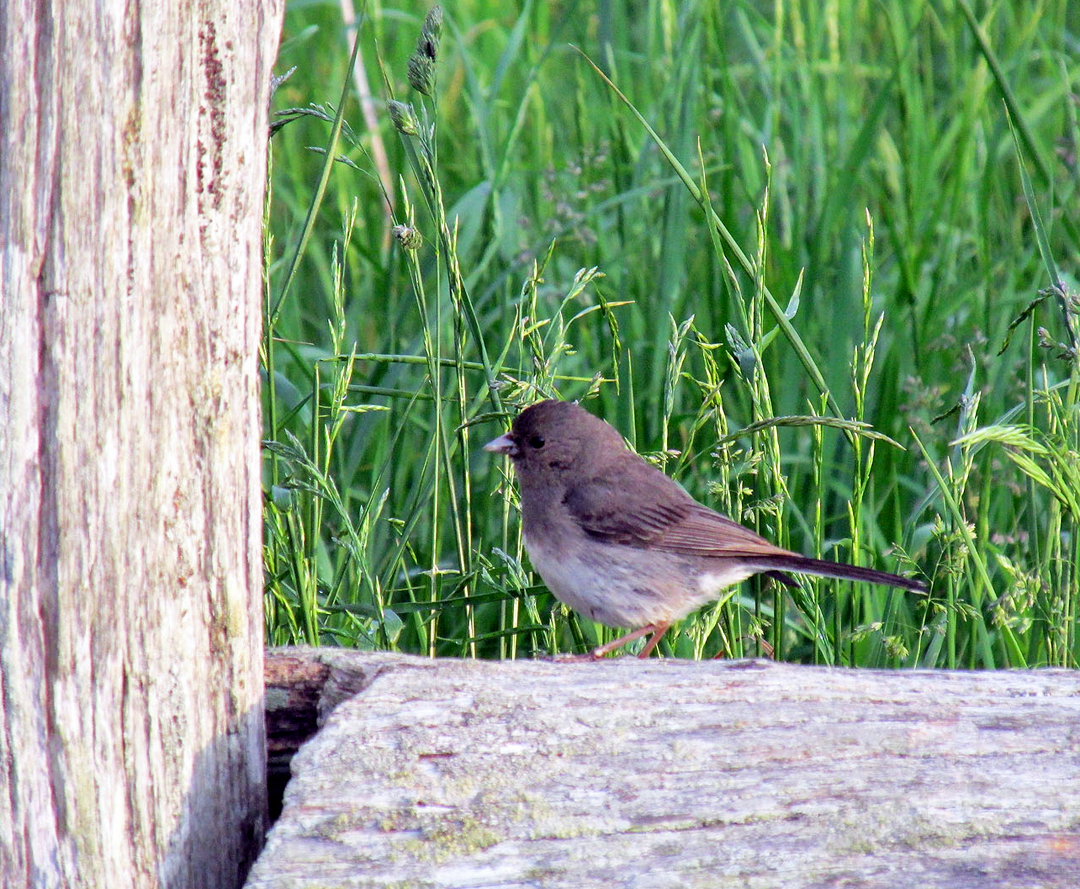
Photo by Bryan Stevens • Dark-eyed junco nests on high mountain slopes during the summer month. This dark-eyed junco was photographed at Carver’s Gap on Roan Mountain during the summer nesting season.

During the summer months, a visit to higher elevations mountaintops is almost guaranteed to produce sightings of dark-eyed juncos. Juncos may nest as many as three times in a season. A female junco usually lays three to six eggs for each nest, which she constructs without any assistance from her mate.

Juncos are usually in residence around my home by early November. Once they make themselves at home I can expect to play host to them until at least late April or early May of the following year. So, for at least six months, the snow bird is one of the most common and delightful feeder visitors a bird enthusiast could want.

Juncos flock to feeders where they are rather mild-mannered — except among themselves. There are definite pecking orders in a junco flock, and females are usually on the lower tiers of the hierarchy. Females can sometimes be distinguished from males because of their paler gray or even brown upper plumage.

Since juncos are primarily ground feeders they tend to shun hanging feeders. But one winter I observed a junco that had mastered perching on a hanging “pine cone” feeder to enjoy a suet and peanut butter mixture.

Photo by Ken Thomas • A dark-eyed junco perches on some bare branches on a winter’s day.

Dark-eyed juncos, widespread across North America, readily visit feeder but are often content to glean the scraps other birds knock to the ground. The junco is the most common species of bird to visit feeding stations. They will sample a variety of fare, but prefer such seeds as millet, cracked corn or black oil sunflower.

The juncos are a small branch of the sparrow clan. Some of the other juncos include the endangered Guadalupe junco, yellow-eyed junco, Baird’s junco and volcano junco.

The last one on the list is endemic to the Talamancan montane forests of Costa Rica and western Panama.

The endangered Guadalupe junco is confined to an island. Recent efforts to eliminate feral goats and cats from the island have shown some positive results for this species.

Baird’s junco is named for Spencer Fullerton Baird, an American ornithologist and naturalist. Baird served as secretary for the Smithsonian Institution from 1878 until his death in 1887. He greatly expanded the natural history collections of the Smithsonian from 6,000 specimens in 1850 to over two million by the time of his death.

I hope you’ve enjoyed this introduction to juncos. There’s something about winter that makes a junco’s dark and light garb an appropriate and even striking choice, particularly against a backdrop of newly fallen snow.

Of course, the real entertainment value of juncos comes from their frequent visits to our backyard feeders. When these birds flock to a feeder and begin a frenzied bout of feeding, I don’t even have to glance skyward or tune in the television weather forecast. I know what they know. Bad weather is on the way!

••••

I’ve not seen the first junco of the season, but I have observed some other late-autumn migrants, including ruby-crowned kinglets and a swamp sparrow.

If you’d like to share your first sighting this season of dark-eyed juncos, email me at ahoodedwarbler@aol.com. As always, the column is also a line of communication with fellow bird enthusiasts. I’ve enjoyed sharing stories about birds with countless readers over the past 30 years. I can also be reached on Facebook at https://www.facebook.com/ahoodedwarbler.
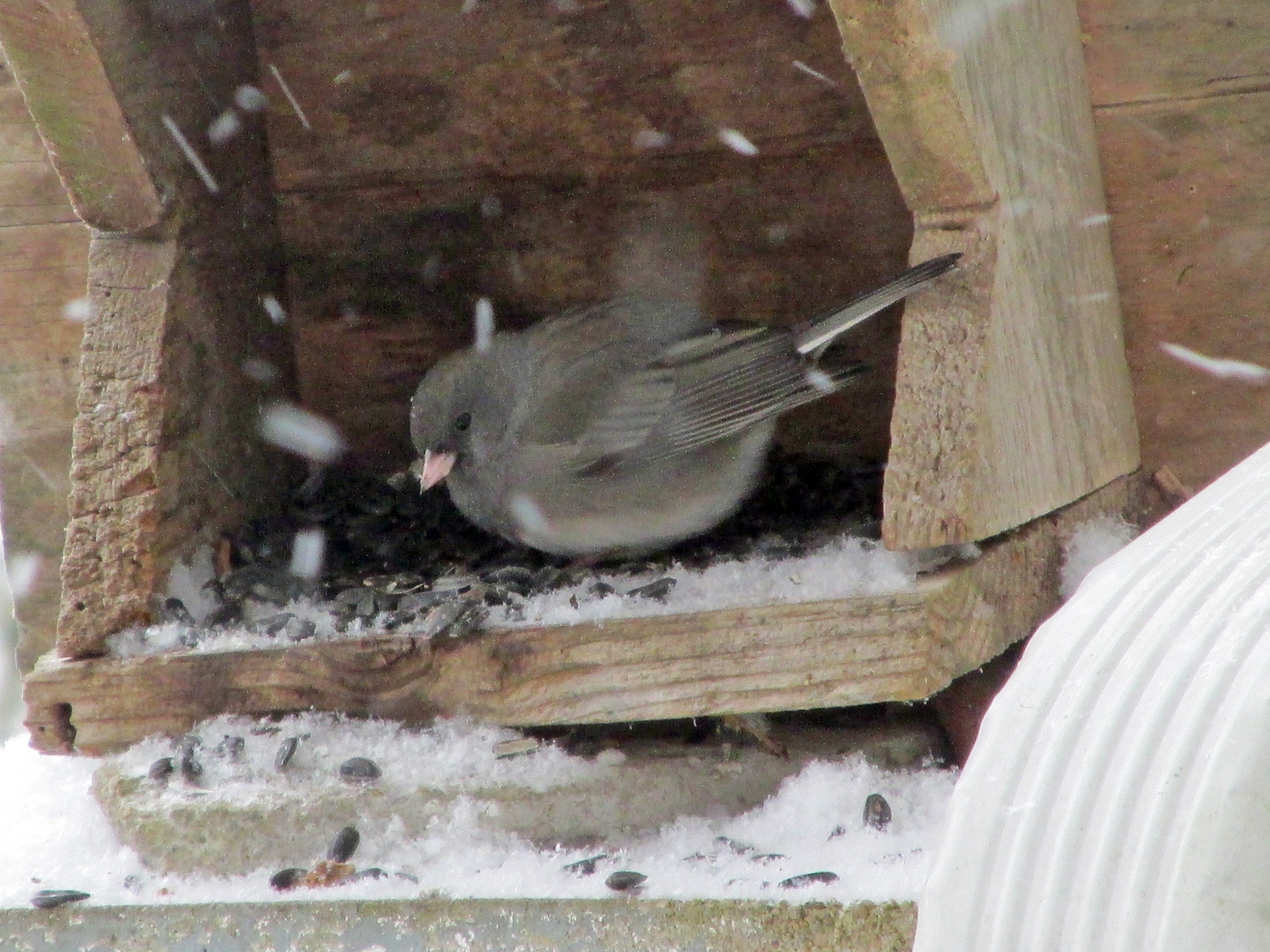
Photo by Bryan Stevens Dark-eyed juncos embrace feeders when weather takes a turn for the worse.

Scissor-tailed flycatchers making Jonesborough a summer home

Photo Courtesy of Lowell Christian • The female scissor-tailed flycatcher in Jonesborough shows the namesake tail feathers and some colorful plumage while in flight.

It’s been a good while since I’ve seen a new life bird to add to my species list.

“Life birds” are simply a new species that a birder has never encountered. Many birders list their “lifers,” which I do in a casual manner. My “lifers” are always documented in my weekly birding column.

I encountered my last life bird back in May 2020 during the pandemic when I observed my first-ever Mississippi Kite at Sycamore Shoals State Historic Park in Elizabethton.

Now, after a trip to Jonesborough, I’ve added scissor-tailed flycatcher. It’s a bird that I’ve wanted to see since I began birding back in the 1990s. I figured I’d have to make a trip to Texas or Oklahoma to add this to my list, however. I never imagined seeing this bird so close to home.

Photo by Bryan Stevens • The tail of the scissor-tailed flycatcher makes it difficult to confuse this bird with any other.

I actually saw two birds, a mated pair, tending their nest in Tennessee’s oldest town. The scissor-tailed flycatcher is the official state bird of Oklahoma, where this species would normally be expected.

This is the third consecutive summer season that this flycatcher’s been confirmed in Washington County. This streak of annual sightings started in 2023 when Dan Huffine, a sharp-eyed birder, saw one while baling hay.

A profile of the species on the Tennessee Wildlife Resources Agency website observes that the scissor-tailed flycatcher has significantly expanded its breeding range in the past several decades and now nests in Tennessee.

The first scissor-tailed flycatcher was reported in the state in 1964, the first nesting attempt was discovered in 1978 and the first successful nest was documented in 1983 in Rutherford County, according to the TWRA website.

I want to thank fellow birder Lowell Christian for providing great directions for finding the parents and their nest. He’s also a fantastic bird photographer. Check out his photos on his Facebook page.

The scissor-tailed flycatcher feeds largely on winged insects, earning its place within the flycatcher family. However, this species will also eat fruit when its available.

Photo Courtesy of Lowell Christian • The female scissor-tailed flycatcher forages in a parking lot.

This flycatcher is placed by experts within the genus Tyrannus, which includes the kingbirds. Other relatives in North America include Eastern kingbird, Western kingbird, tropical kingbird, Couch’s kingbird and Cassin’s kingbird. There’s also a giant kingbird native to Cuba and a loggerhead kingbird that is found throughout the Caribbean and on rare occasions in Florida.

Kingbirds are famous for their pugnacious behavior, not hesitating to attack larger birds such as hawks, vultures and crows in defense of their territory. Scissor-tailed flycatchers are also considered aggressive toward a variety of other birds.

Photo by Bryan Stevens • An Eastern kingbird perches on a fence post.

According to the website All About Birds, scissor-tailed flycatcher numbers declined by about 31% between 1966 and 2014. The estimate comes from statistics gathered by the North American Breeding Bird Survey.

The website also noted that Partners in Flight estimates a global breeding population of 9.5 million scissor-tailed flycatchers, with 92% breeding in the United States, and 50% spending some part of the year in Mexico.

A scissor-tailed flycatcher is unlikely to be confused with any other bird. Adult males are pale gray birds with blackish wings and black tails with white edges. Adults show salmon-pink flanks that extend to underwing patches that are very conspicuous in flight.

As is the case with so many species of birds, males are more colorful than females. The bird’s body is about the size of an American robin, but it looks bigger due to the long tail that gives this species its common name.

The All About Birds website notes that the scissor-tailed flycatcher isn’t always content to stay within its expected range. As I’ve mention on previous occasions in this column, birds have wings and will fly where they wish to fly.

The species tends “to wander widely on their way to and from the wintering grounds, a habit they share with relatives like the fork-tailed flycatcher and tropical kingbirds,” according to a profile of the species on the website.

Scissor-tailed flycatchers may makes appearances almost anywhere in North America, according to the website. I’m delighted to report that evidently also holds true for Northeast Tennessee.

One place that the bird is definitely expected is Oklahoma. Since May 26, 1951, the scissor-tailed flycatcher has been the officially designated Oklahoma state bird.

Jonesborough is known for storytelling, and I hope you agree that these Oklahoma migrants making a new home for themselves and their young in Tennessee’s oldest town is a terrific tale.

•••

Bryan Stevens has written about birds and birding since 1995. To ask a question, make a comment or share a sighting, email him at ahoodedwarbler@aol.com.

Birder with ties to Northeast Tennessee plans Global Big Day

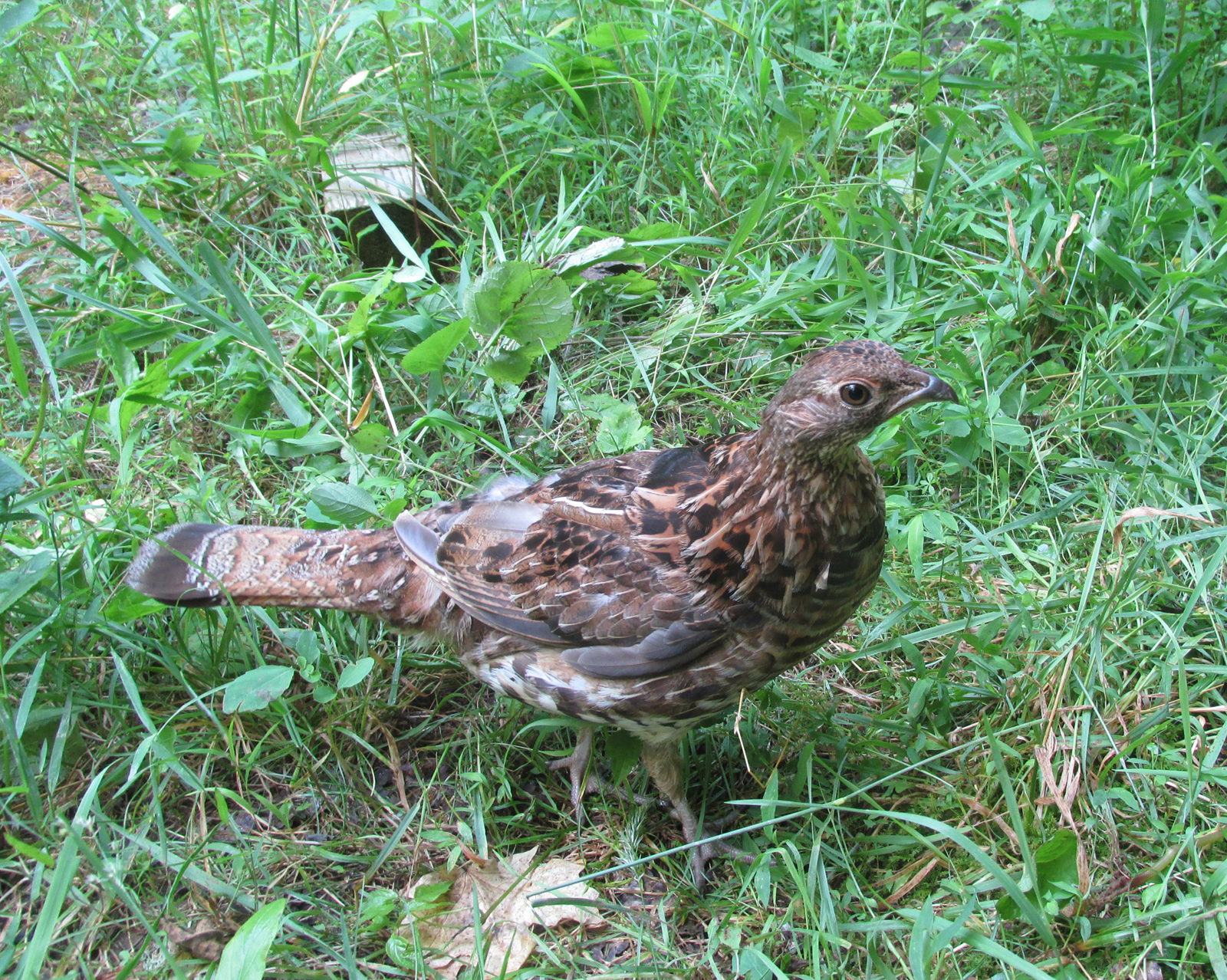
Photo by Bryan Stevens • Brayden Paulk introduces Rufous, a surprisingly tame ruffed grouse that lived on his grandfather’s farm for several years.

Brayden Paulk recently sent me an email to share some recent bird sightings he has made in Georgia.

As background, I’ve known Brayden since the summer of 2016. At the time, he was 17 years old and visiting with his grandparents in Flag Pond for the summer. We got acquainted thanks to an amazing ruffed grouse hanging out at a barn.

Brayden named the grouse Rufous who, as it turned out, was a remarkable bird. Ruffed grouse are, as a rule, shy and retiring birds. Not Rufous. He was an in-your-face sort of grouse. Getting to meet and observe this amazing bird was a privilege.

After we met so that I could make acquaintance with Rufous, Brayden and I did some birding at Rock Creek Recreation Area and then some stops on U.S. Forest Service lands along Highway 107 between Limestone Cove and the North Carolina line. Brayden wanted very much to add a black-throated blue warbler to his life list, and I very much wanted to help him find it.

We did manage to locate a singing veery, a scarlet tanager and a dark-eyed junco. We also found several warblers, including black-and-white warbler, worm-eating warbler and black-throated green warbler, but I began to fear we wouldn’t manage to locate his target bird.

But I am happy to report that we managed to find a male black-throated blue warbler. So, that productive morning back in 2016 resulted in my meeting with a grouse with a lot of personality and Brayden getting a new species for his life list of birds.

When we first met, Brayden was living with his family in Oxford, Alabama. During our first in-person meeting he made a point to tell me that his grandparents, Leon and Janice Rhodes, mailed him every one of my bird columns.

Photo by Bryan Stevens • The late Leon Rhodes teases Rufous the ruffed grouse.

These days he is living in Georgia, which is also providing the focus for most of his birding. He returns often to Tennessee. In fact, he has given a couple of talks to the Elizabethton Bird Club over the years, impressing his audience with his enthusiasm and engaging way of presenting information.

His talk were, surprisingly, not about birds. He spoke about his other passion, fishing, but still managed to make a few mentions of birds in the process.

Brayden has also worked for a couple of summers at Lamar Alexander Rocky Fork State Park in Flag Pond as a seasonal interpretive ranger.

Anyway, enough with the background and back to his recent email.

“I hope everything is going well with you and the bird club,” he wrote. “I wanted to contact you about some interesting recent sightings I have had that I thought you would be interested in. I have been able to put a lot of effort into birding so far this spring and it has turned up some fantastic finds.”

Photo by Bryan Stevens • Rufous, a rather tame ruffed grouse, who made his home in Unicoi County for several years.

His finds have even established some records in Laurens County in Georgia where he now lives.

His local birding loop in his home county has been very productive.

On April 7, his observations of common loons resulted in a county high count for the species. He found 14 loons on one lake and six on another nearby lake. The next highest count before his sighting had stood at two birds.

“That loop has also been very productive for shorebirds, as there are some flooded areas in nearby fields where I have seen lots of greater and lesser yellowlegs and snipe,” he wrote.

“I also got excellent views of a Swainson’s warbler within feet of me at an area on the loop with some swamp and cane thicket habitat,” Brayden added.

On April 7 while running his llocal birding loop in Laurens County, Georgia, Brayden Paulk saw the county high count for common loons with 14 on one lake and 6 on another nearby.

That sighting alone is something that would make many birders envious. I have been birding since 1993 and I can count on one hand the number of looks I’ve had of Swainson’s warbler. The species is often localized, meaning it takes some effort to locate. It’s easy to hear them. The Swainson’s warbler has a loud, ringing song similar to a Louisiana waterthrush. I’ve heard Swainson’s warblers much more frequently than I have seen them.

Brayden also shared his excitement about seeing his first first Horned Lark in the county. He saw the lark, a bird of open fields, at a different location. “It seems to be one of those birds you have to try to find by going to a sod farm or open country,” he noted.

“The Laurens County Loop has also been great for me in the past, and one particular pond turned up the first eBird county records for American avocet, white-rumped sandpiper and long billed dowitcher,” he wrote. “I have also found breeding painted buntings on the loop as well and had an excellent view of them with my dad.”

Brayden also wanted to share some more exciting news.

“I will be moving to Gulf Shores in coastal Alabama in a few weeks, which is one of my favorite places to go birding,” he wrote. “I plan on going to Dauphin Island on the Global Big Day because it is an incredible place to see migrants, and my goal is to find 150 species on that day.”

This year’s Global Big Day is scheduled for Saturday, May 10. Global Big Day is an annual birdwatching event hosted by eBird and Cornell Lab of Ornithology to celebrate and document bird migration. The event was created as a fun and engaging way for bird enthusiasts of all levels to contribute to science and conservation by reporting their bird sightings.

Brayden also hopes to visit Unicoi County again soon to do some birding there and look for some of the species he missed last Summer.

“Thank you for writing your bird articles,” he wrote at the conclusion of his email. “They have inspired me since I was young!”

It’s not easy to put into words how much that unexpected praise made me feel. I am incredibly gratified that I could have provide some inspiration to get such a gifted young man into the field looking for birds.

Readers may recall that I’ve had some deterioration of vision in recent years. With a pair of binoculars, I can still bring birds close enough to enjoy and appreciate their beauty and vivacity. Spotting birds, which is a skill that takes some practice to achieve, is no longer easy for me. Ah, the things we take for granted…

My hearing remains unimpaired. I have enjoyed making note of returning warblers and other birds simply by hearing their familiar songs ringing through the woodlands at my home for yet another spring.

For the past couple of weeks I’ve also had the pleasure of watching daily as a feisty male ruby-throated hummingbird visits the feeders arranged around my front porch.

In closing, I invite everyone to wish Brayden luck with his upcoming Global Big Day. I hope to update everyone with how he does.

•••

To share a sighting, ask a question or make a comment, email me at ahoodedwarbler@aol.com.

Ruby-throated hummingbirds stage their spring return to region

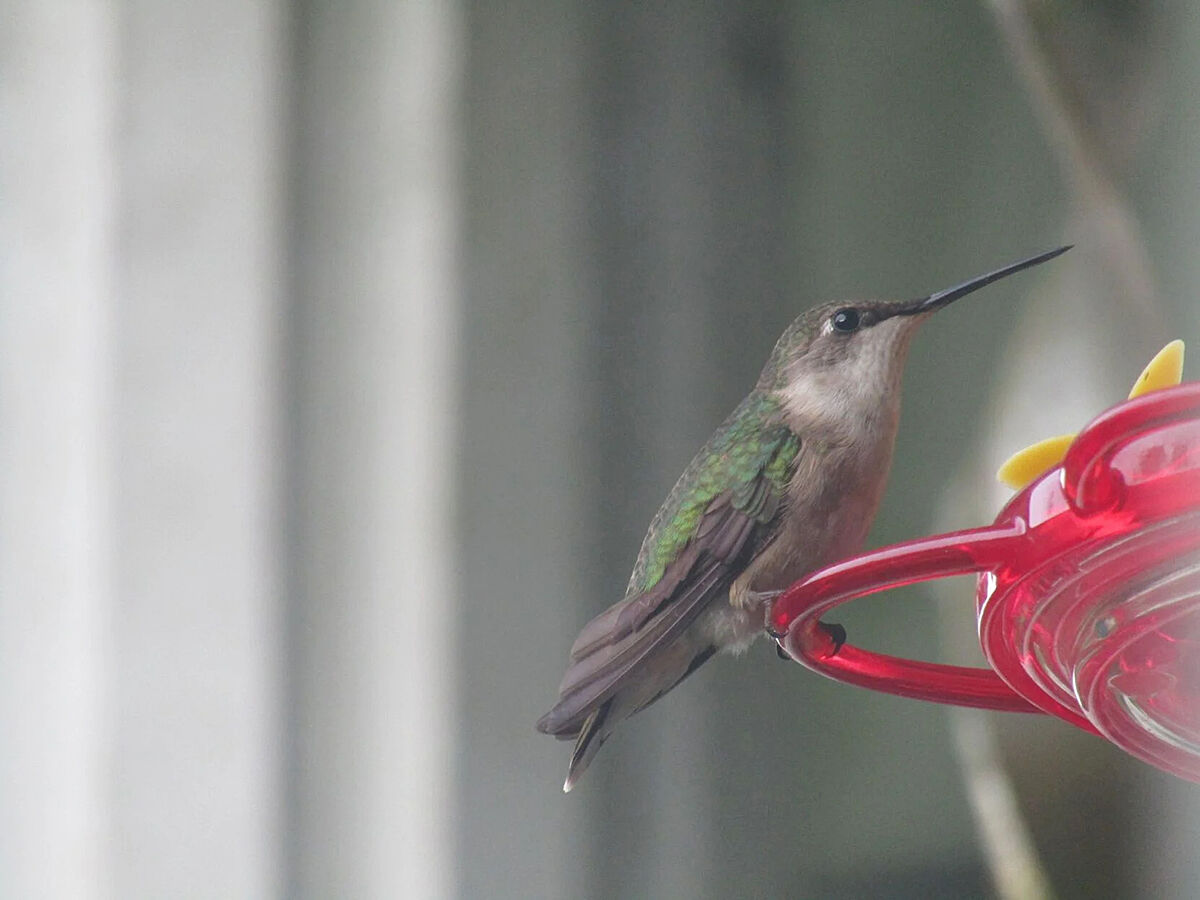
Bryan Stevens • A male ruby-throated hummingbird perches on a sugar water feeder.

In an article posted on March 27, Journey North, an organization and website that tracks migrating hummingbirds, announced that so far this spring, bird-watchers in 12 states had reported ruby-throated hummingbirds, but it’s still early in the season.

“So far, we have one sighting each in Kentucky and Tennessee and two in Arkansas, but we’re expecting more in the coming weeks,” noted the blog post by Journey North.

One week later, hummingbirds arrived in locations in Unicoi County, Carter County and Washington County in Northeast Tennessee.

Journey North is a citizen science project that engages citizen scientists in a global study of wildlife migration and seasonal change. It’s a fun way to track the migration of everything from hummingbirds to butterflies like monarchs.

•••

“Hummingbirds are here!” Beverly King, a resident on Marbleton Road in Unicoi, wrote in an email. “We saw our first hummingbird today, Saturday, April 5.”

Beverly noted that she was excited to see hummingbirds slightly early this year.

“We usually see them about the 15th of the month,” she added. “Well, my feeders are now up. We could not tell if it was a female or a male.”

Bryan Stevens • A female ruby-throated hummingbird perches on a feeder.


•••

Erwin resident Amy Tipton sent me a Facebook message announcing that her parents had enjoyed a visit from a returning hummingbird.

“My parents, Edison and Emma Jean Wallin, had their first hummingbird of the season visit today, Saturday, April 5 at 4:30,” Amy wrote. “They live about a mile up Limestone Cove in Unicoi.”

•••

Dianne Draper in Jonesborough shared on my Facebook page about her first hummingbirds of the season.

“Our first ones showed up on April 5,” she noted. “We had two.”

•••

I’ve already seen my first hummingbird, as well. I have a bed of tulips blooming at my home. I planted them last fall and have been thrilled with their performance. I was outdoors admiring the tulips when I heard a brief but tantalizing buzzing noise. Although I scanned all around me, I failed to confirm that I’d heard a hummingbird.

A half hour later, however, while reading on my front porch, I saw my first hummingbird of 2025 when a male zipped up to one of my sugar water feeders. He returned twice while I stayed outdoors reading on a misty afternoon. He arrived at 4:14 p.m. on Sunday, April 6.

In 2024, I saw my first hummingbird on April 17 at 7:15 p.m. This year’s bird is certainly arriving earlier than is typical, but I was thrilled to see him.

•••

Gayle Riddervold, who lives only a few miles from my home on Simerly Creek Road in Hampton, reported that she and Becky Kinder saw their first spring hummingbird on April 8.

“We just saw our first hummingbird today,” Gayle wrote in a Facebook message. “Yesterday we saw a belted kingfisher on our road.”

•••

Brookie and Jean Potter, residents at Wilbur Lake in Elizabethton, sent me a text about the arrival of their first spring hummingbird on Wednesday, April 9, at 5:45 p.m.

They added, “It came back to feed again around 7 p.m.”

•••

Technically, TD, a follower of my “Our Fine Feathered Friends” blog, provided the earliest report of a hummingbird this spring. Of course, TD has the benefit of living in Texas, close to the Gulf of Mexico that these tiny birds must cross to return to the United States each spring.

The bird TD spotted arrived on Wednesday March 26, at 2:34 p.m. central time.

“A ruby-throated hummingbird male stopped at my feeder on my front porch a mile from Corpus Christi Bay after an hour of a rain shower,” TD wrote in a comment.

TD also reported that Corpus Christi has been in a drought so severe that residents have not been allowed to water outside since last fall.

TD’s hummingbird arrived with the first rainfall in more than two months.

“So I was watching the lovely rain when this hummingbird perched onto my hummingbird feeder,” TD wrote. “I have a very large window and hang four hummingbird feeders along the front porch.”

TD noted that the male’s iridescent ruby red around his neck resembled a scarf. “I named him Texas Tuxedo,” TD shared.

TD also saw a female hummingbird on Wednesday, April 2, at 7:15 a.m.

TD said the female hummer acted shy and fluttered around the feeder before feeling safe to perch for feeding.

It’s usually the case that females lag behind males in their annual migration back to the United States.

•••

Photo by Bryan Stevens • A male ruby-throated hummingbird perches at a feeder for a sip of sugar water.

The hummingbirds are an amazing family of birds. There are an estimated 330 species of hummingbirds, all of which are found in the New World. Consider that these dazzling little birds have been given vividly descriptive names, such as cinnamon-throated hermit, red-tailed comet, blue-chinned sapphire, lazuline sabrewing, sparkling violetear, fiery topaz, green-tailed goldenthroat, bronze-tailed plumeleteer, amethyst-throated mountain-gem, peacock coquette, red-billed emerald, empress brilliant, purple-backed sunbeam, green-backed hillstar, orange-throated sunangel, black metaltail, marvelous spatuletail and blue-tufted starthroat.

The only hummingbird species to inhabit the eastern United States from spring to fall each year is the ruby-throated hummingbird, which is currently arriving at various points from Florida to Maine and westward to states like Illinois, Minnesota and Oklahoma and north into Canada.

To return each year, ruby-throated hummingbirds make an awe-inspiring and non-stop crossing of the Gulf of Mexico. Even more incredible, they make the trip again in the fall when they return to warmer locations in Central America to spend the winter months.

Ruby-throated hummingbirds lead relatively brief lives. The oldest known ruby-throated hummingbird was a female, according to the website All About Birds. She was at least 9 years, 2 months old when she was recaptured and rereleased in 2014 during banding operations in West Virginia.

•••

These shared sightings represent some of the “early bird” sightings of hummingbirds. I welcome more reports as other people continue to observe returning hummingbirds. Email me at ahoodedwarbler@aol.com or find me on Facebook to share your sightings. Provide a date and time, if possible. Good luck with the hummingbird watching.

Birds make use of various strategies to attract and keep mates

Shauna Fletche/Pixabay • Some birds, like waxwings, like to present tasty treats to their potential mates.


With Valentine’s Day around the corner, it’s an opportune time to see how courtship is handled among our fine feathered friends. Most birds don’t bring a box of chocolates or a bouquet of roses when they take up courtship of a prospective mate, but birds have several equivalent behaviors that they employ to attract the attentions of the opposite sex. In honor of Valentine’s Day I thought a look at some of the more unusual courtship rituals of some of our feathered friends would be appropriate.

Aerial acrobatics designed to impress

In late winter and early spring, a true oddball begins courting. The American woodcock, also known by such whimsical names as “bog sucker” and “timberdoodle,” is a shorebird that has completely abandoned the shore in favor of woodlands and fields. Beginning as early as February, American woodcocks in the region conduct nightly courtship displays, starting at dusk, that combine aerial acrobatics with an assortment of unusual acoustical flourishes. Any wet field adjacent to a wooded area could offer a stage for these evening displays, but unless you know where to look and make an effort to do so, the American woodcock might as well remain a phantom of the night.

These mating rituals provide almost the only time of the year during which this bird makes itself available for observation. It’s only during this brief window that opens into their lives that we can be assured a glimpse. Even then, our peeks at woodcocks often consist of a fuzzy twilight escapade as the bird flings itself heavenward only to make a spiraling descent a few seconds later. The displays begin with a distinct vocalization, a type of “pent,” that also has the quality of sounding like some sort of mechanical buzzer.

Once the displays conclude for the season, the birds assume nesting duties, usually unobserved by humans. The rest of the year, almost nothing but blind, sheer luck would allow a birder to stumble across an American woodcock. It’s almost as if they disappear after these spring flights of fancy.

Birds bearing gifts

Many birds present small trinkets to a prospective mate. For instance, many male penguins make a present of a stone or pebble to female penguins. There could be more than a simple bribe behind this gift. Female penguins don’t build elaborate nests. In fact, a scrape on the bare ground, perhaps encircled by a collection of pebbles, marks the extent of their nest construction. So, the perfect pebble could be the way to winning a female penguin’s heart.

The way to the heart is through the stomach

Observant birders may have witnessed a male Northern cardinal slip a female a morsel of food, such as a peanut or a shelled sunflower kernel. It’s a marked change for this bird. During the winter months, a male cardinal is more likely to chase a female away from a feeder rather than share food with her. However, as spring approaches, his behavior undergoes a change and he becomes content to feed next to a female cardinal, often slipping her some choice tidbits.

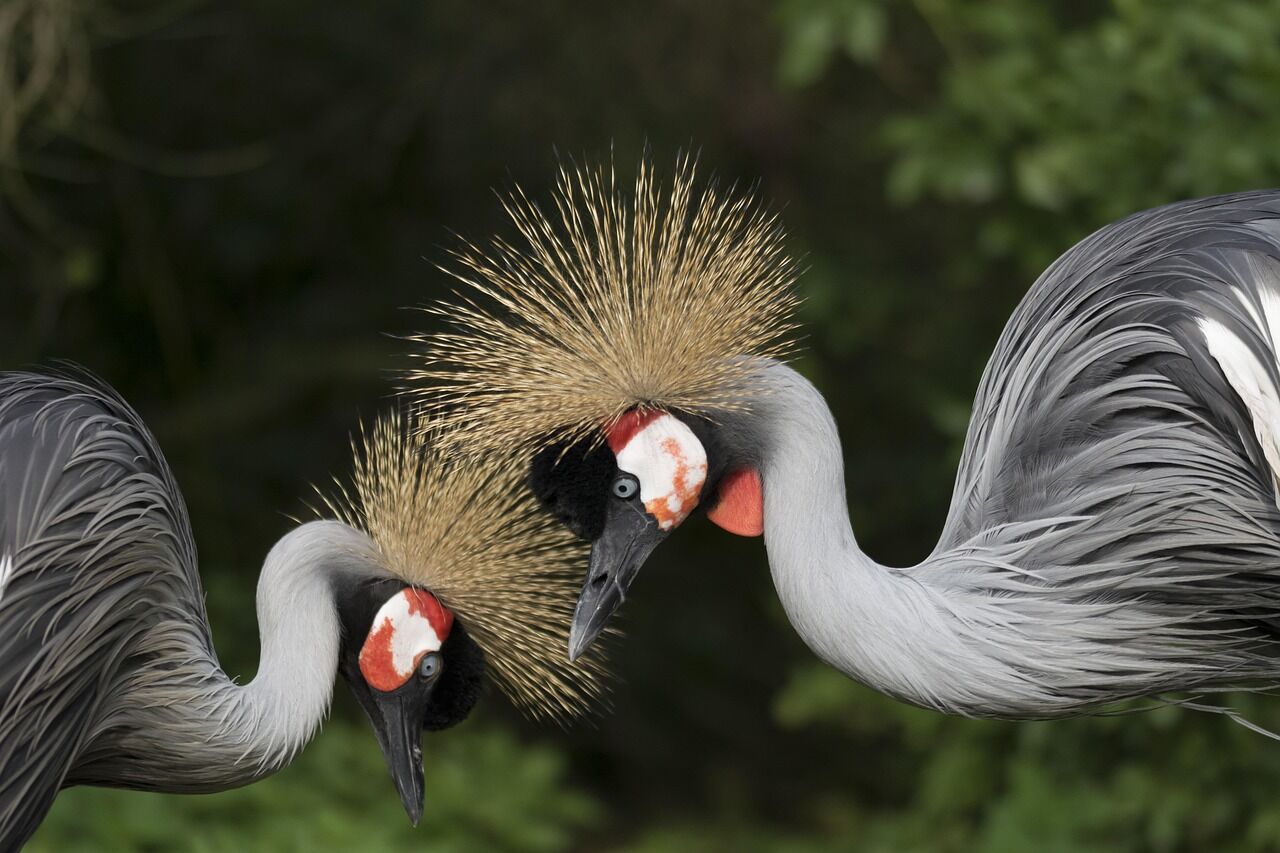
Sabine van Erp/Pixabay • Bow to your partner: Grey-crowned cranes perform an elaborate dance designed to strengthen their bond.

May I have this dance?

Many species of birds perform elaborate and ritualistic dance displays. Among birds known for tripping the light fantastic are flamingoes, cranes, grouse and grebes. Cranes are one of the oldest families of birds on earth. They’re also some of the most accomplished dancers in the animal kingdom. Pairs perform very ritualistic dances that, if the performers were human, would no doubt require the services of an accomplished choreographer. Cranes mate for life and the ritual of dancing is a way to strengthen the bonds between a mated pair. The ability to dance is, apparently, not instinctive. Young cranes must practice their dance moves, a process that can take years before they master the elaborate dance.

Dave Menke/U.S. Fish & Wildlife Service • A pair of Clark’s Grebes displays in a courtship ritual known as “rushing” or “weed dance.” Birds use a variety of strategies to attract and keep mates.

Synchronized swimming

While many birds dance to impress a mate or strengthen pair bonds, grebes perform a dance that takes place completely on the surface of the water. A pair will engage in this intricate performance, perfectly mirroring the moves of the other as they literally race across the surface of the water. These dances by grebes are also known as “rushing” or “weed dance.” It’s called as a weed dance because at the culmination of the ritual, the birds usually hold some type of aquatic plants in their bills while racing swiftly over the surface of the water. Pairs that perform well together stay together, building a nest and raising young.

Good housekeeping seal of approval

The tropical family of bowerbirds are famous for complex nests built by males and then decorated with bright and colorful objects to catch the eye of a potential mate. The nests of these birds are actually referred to as a “bower.” Usually constructed on the ground, the male will line the approachs to the bower with items such as shells, leaves, flowers, feathers, stones, berries, and even discarded garbage, including plastic scraps or bits of glass. Unusually odd items pressed into these decorative displays have included coins and spent rifle shells. This habit of male bowerbirds must rank as the ultimate in trying to impress a mate with shiny bling.

These are just a few of the inventive ways that birds go about attracting and keeping mates. Perhaps you can pick up some pointers from our feathered friends to ensure you have a great Valentine’s Day this year.

•••

If you have a question, wish to make a comment or share a sighting, email me at ahoodedwarbler@aol.com.

Elizabethton Bird Club announces speakers for fall programs

Brayden Paulk will speak to the Elizabethton Bird Club on Sept. 3 on the topic of microfishing.

The Lee and Lois Herndon Chapter of Tennessee Ornithological Society, also known as the Elizabethton Bird Club, will soon begin its schedule of monthly meetings for 2024-25.

The brief business meetings are always accompanied by an informative and entertaining program on birds, birding or other subjects from the natural world.

These programs are a great way to learn more about our feathered friends as well as other related subjects from the natural world. They are free, open to the public and hosted by a welcoming group of people.

Here’s the schedule for Fall 2024:

September

Brayden Paulk, a young naturalist with family ties in Unicoi County, will present the first program on Tuesday, Sept. 3, with a talk on “Microfishing,” which involves anglers focusing on a diverse array of tiny species of fish.

Paulk has also been working as a naturalist with Lamar Alexander Rocky Fork State Park this summer and fall. He gave a program a couple of years ago for the club on “Trash Fishing,” which explored other angling options other than the typical gamefish species. As both fishing and birding are among his interests, he will no doubt find a way to work something into his program about birds.

October

The guest speaker for the meeting on Tuesday, Oct. 1, will be Mark Stevens. A former publisher for The Erwin Record, he will present a program titled “Building a Birding Festival” that will focus on his development of the Hammock Coast Birding Festival in South Carolina. Stevens, who works as tourism director for the Georgetown County Chamber of Commerce, will be giving the program remotely from his home in South Carolina, but the hybrid meeting also offers a chance to attend in-person with other birding enthusiasts. The festival is organized by the South Carolina Hammock Coast, the marketing arm for the Georgetown County Chamber. The third annual Hammock Coast Birding Festival is scheduled for Feb. 6-9, 2025.

November

Vern Maddux, the treasurer for the club, will be the speaker on Tuesday, Nov. 5. Maddux is a world traveler when it comes to seeing birds and will present a program on one of his recent international birding adventures to South Georgia and Falklands. South Georgia is a mountainous barren island in the South Atlantic Ocean, 800 miles east-southeast of the remote South Atlantic archipelago that makes up the Falkland Islands. With rugged terrain and cliff-lined coasts, the hundreds of islands and islets in the Falklands are home to sheep farms and abundant birdlife.

December

In the busy month of December, yours truly will give the program. I will present a powerpoint presentation titled “What’s in a Name?” on North American birds named after people. Among our native birds, we have quail, woodpeckers, sparrows, finches, warblers, hawks and other birds are known by names of historical figures ranging from John James Audubon to William Clark and Meriwether Lewis.

My program will be held on Tuesday, Dec. 3. I will discuss the American Ornithological Society’s decision in 2023 to end what are known as eponyms, in which species names honor people. The renaming of dozens of species will be a gradual process.

The club’s 2025 schedule has not been completed, but will include a program by local naturalist Lewis Tester in the spring on dragonflies.

The public is always welcome to attend these programs. Programs begin at 7 p.m.

The club meets at the Elizabethton campus of Northeast State Community College in Room 135 when the school’s schedule permits. When school is not in session, meetings are held on Zoom or at other announced locations. To receive updates on the club’s schedule, events and activities, email elizabethtonbirtdingclub@gmail.com and ask to be placed on a free mailing list.

The Elizabethton Bird Club holds seasonal birds count in spring, summer, fall and winter. The club also organizes and sponsors regular field trips to destinations through Northeast Tennessee. These activities are also open to interested members of the public.

•••

To share a sighting, make a comment or ask a question, email me at ahoodedwarbler@aol.com.

Indigo buntings speak to the summer season

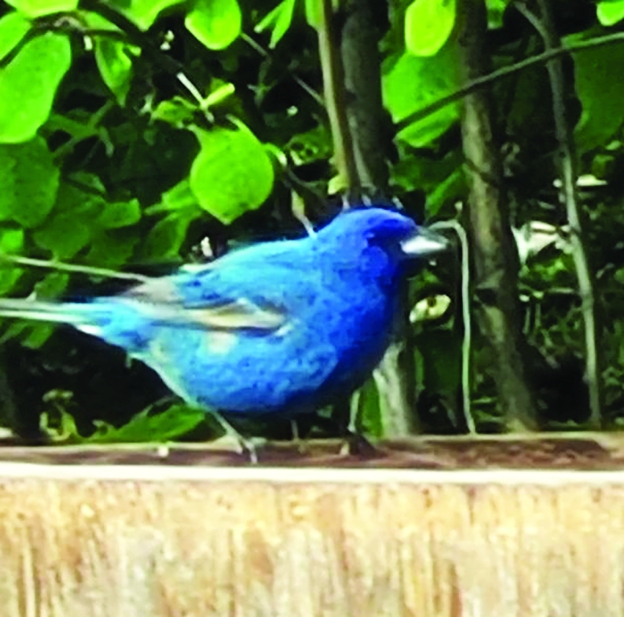
Photo courtesy of George Stone • Indigo buntings range from southern Canada to northern Florida during the summer months, occasionally even expanding beyond this wide range.

George Stone emailed me after finding my weekly bird column online.

“I live approximately 90 miles west of Edmonton, Alberta, Canada,” he wrote in his email. “This morning (June 6) I had my first ever sighting of an indigo bunting at my feeder!”

He also asked a question, wanting to know if indigo buntings are rare in his location in Canada.

I did some digging online and found that indigo buntings range from southern Canada to northern Florida in the summer. I relayed this information to George in a reply to his email, congratulating him on his sighting.

I informed him that I reside in Northeast Tennessee, close to the borders with Virginia and North Carolina. I also told him that in summer, indigo bunting is not rare at all here in Northeast Tennessee. I saw and heard several while doing a summer bird count on June 8 in the Limestone Cove community of Unicoi County.

Photo by Bryan Stevens • The male indigo bunting is a resplendent bird.

The male indigo bunting is the only solid blue bird in the eastern United States, but it’s all an illusion — literally a trick of the light. The indigo bunting’s feathers are not really blue; the male’s brilliant azure plumage is caused by the process of diffraction of light around the structure of the bird’s feathers. This process scatters all but the blue light, and the resulting color shifts from black to blue to turquoise as the angle of reflected light changes. In bright light, it can even look unnaturally vivid blue. In poor light, however, an indigo bunting male can appear black. Fortunately, indigo buntings have both a characteristic body shape and song, so even if the birds are not seen in their best light, they can still be recognized.

For such a bright blue bird, indigo buntings are not easy to detect. Males like to find an elevated perch and sing to proclaim their territory and pitch their availability to potential mates. Learn the song, which consists of a burst of jumbled, high-pitched notes, and use that knowledge to help pinpoint singing males. Once you zero in on the singing bird’s location, it’s easy to focus binoculars and enjoy peeking at such a pretty bird.

The indigo bunting belongs to a genus of birds known as Passerina, which is included the family Cardinalidae, which includes birds like Northern cardinal and rose-breasted grosbeak. They are often lumped into a group known as North American buntings, although they are not closely related to such birds as snow bunting and lark bunting. The latter is even recognized as the official state bird for Colorado, a unique honor for this group of birds. The other members of the Passerina genus include lazuli bunting, varied bunting, painted bunting, rose-bellied bunting, orange-breasted bunting and blue grosbeak.

Photo by Bryan Stevens • Newly-returned neotropical migrants, such as this Indigo Bunting, increased the total number of species for the annual spring count.

Worldwide, other birds known as buntings include such descriptively named species as slaty bunting, corn bunting, white-capped bunting, gray-necked bunting, cinereous bunting, lark-like bunting, cinnamon-breasted bunting, chestnut-eared bunting, little bunting, yellow-throated bunting, golden-breasted bunting, black-headed bunting, red-headed bunting and yellow bunting.

For me, the indigo bunting has always been a bird of the summer season. Not even the heat of mid-day tires out a persistently singing male indigo bunting. They linger into the early October, but later in the season the bird begin to molt feathers and take on a more shabby look. Enjoy them while they’re here.

•••

To ask a question, make a comment or share a sighting, email me at ahoodedwarbler@aol.com.


Hooded warbler easily wins fans among birders

Photo by Jean Potter • A male hooded warbler flits through the foliage of a rhododendron thicket.

The woods surrounding my home have been alive with birdsong. We’re almost ready to turn the calendar to June, but there’s been no diminishment in the fervor of the daily chorus.

The main members of the feathered choir are warblers. I’ve heard yellow-throated warbler, black-throated green warbler, black-and-white warbler, Northern parula, ovenbird, common yellowthroat and, my favorite, hooded warbler, morning and evening.

During the winter months when the hooded warbler absents itself from Northeast Tennessee, the species resides in the forests of Mexico, as well as in Belize, Costa Rica and other Central American nations.

Like many of the ruby-throated hummingbirds that make their home in the United States for the summer, the hooded warbler’s seasonal migrations take it across the vast open waters of the Gulf of Mexico. After that amazing crossing, these small songbirds disperse throughout the southeastern United States.

That birds as small as hummingbirds and warblers make this incredible migration twice yearly is one of nature’s most phenomenal feats of endurance. In a presentation by Kenn and Kimberly Kaufman that I attended six years ago, I learned that these tiny birds put on incredible fat reserves to help fuel their valiant Gulf crossings.

The warblers, also known as wood-warblers, are an exclusively New World family, numbering approximately 116 species. About 50 of these species make their home in the eastern United States and Canada for the spring and summer, departing in the fall and returning to tropical wintering grounds. Some are extremely bright and colorful birds. The hooded warbler is somewhere in the middle in a sliding scale that goes from dull to wow.

Other colorful warblers that share similar tastes in range and habitat with the hooded warbler include the American redstart, black-throated blue warbler and black-throated green warbler.

Readers who make it to the end of this weekly column will know that even my email address is a testament to my enthusiasm for the hooded warbler.

Hooded warblers nest in the woodlands around my home. So, from the time my favorite warbler returns in April until the last individual departs in October, I enjoy regular glimpses of this colorful and interesting bird. Like all warblers, the hooded warbler is quite energetic, dashing after tiny insects in the branches of shrubs and trees. Hooded warblers often forage close to the ground, which makes observing them easier.

Of course, birds are free to break the rules. One of my most memorable sightings of a hooded warbler involved a male singing from the upper branches of a dead pine tree. I’d estimate that the bird was at least 40 feet off the ground, singing his little heart out to attract a mate. I was standing on an elevated rise of land while the tree providing the warbler its perch was lower in a gully that actually placed bird and observer on a roughly level playing field.

The bird sang for many moments, which is not always the case with warblers. These birds tend to dash for cover at the slightest disturbance, but this enthusiastic male didn’t seem to pay and heed to the fact that most of its kin prefer to skulk in shrubs and dense rhododendron thickets no more than a few feet off the ground.

Back in the late 1990s, when I had just started out in birding, I observed two adult hooded warblers feeding a couple of young birds only recently out of the nest.

I was enjoying observing the sweet scene as the parent birds carried foods to the young birds, which begged incessantly and loudly when, unexpectedly, a song sparrow wandered into the scene.

The sparrow was brutally beset by the parent warblers, which attacked the intruder from all sides. The poor sparrow, having no clue to the reason for their ire, beat a hasty retreat. Sparrows are no threat, but that didn’t matter to these zealous parents.

When I first began birding, I was only dimly aware there was a family of birds known as warblers, which are now hands-down my overall favorite birds. The hooded warbler was one of the first birds I managed to identify on my own.

It’s one bird unlikely to be mistaken for any other. Every time I behold a hooded warbler, I marvel at the bird’s exquisite appearance. The gold and green feathers seem to glow brightly in the dim light of the shadowy thickets of rhododendron they prefer to inhabit. The black hood and bib surrounding the male’s yellow face stands out by virtue of its stark contrast from the brighter feathers. Large coal-black eyes complete the effect. The appearance of the male bird provides this species with its common name. The female has an identical yellow-green coloration as the male, although she is slightly more drab. She lacks the black hood and bib, although older females may acquire some dark plumage on the head and around the face. Both sexes also show white tail feathers that they constantly fan and flick as they move about in thick vegetation and shrubbery.

The warblers are, in short, an incredible family of birds. I’ve seen all but a handful of the species that reside for part of the year in the eastern United States. I still want to see a Connecticut warbler and cerulean warbler, as well as the endangered Kirtland’s warbler of Michigan and the golden-cheeked warbler of Texas.

I’ve come to think of the hooded warblers at my home as “my warblers.” There may be a kernel of truth to my belief. The website All About Birds in a profile on the species notes that a seven-year study conducted in Pennsylvania gave evidence that male hooded warblers are faithful to nesting territories from previous years. Approximately 50% of banded males were shown to return to the same area to breed again year after year.

So, some of those hooded warblers singing from the rhododendron thickets at my home are probably birds returning for consecutive spring seasons. Some of the warblers that returned back in April could be great-great-great grandchildren of those warblers that attacked the unfortunate song sparrow. At the least, it gives me pleasure to think so.

•••

To share a sighting, ask a question or make a comment, email me at ahoodedwarbler@aol.com, an address that shows my profound fascination for this particular bird.

Photo by Bryan Stevens • A male hooded warbler peers from a tangle of branches.

Red-breasted nuthatch helps couple achieve milestone

Photo by Bryan Stevens • A red-breasted nuthatch clings to the mesh of a feeding tube to get at the peanuts contained within.

Good friends and fellow members of the Elizabethton Bird Club, Brookie and Jean Potter achieved a personal birding milestone at the end of January.

Both Brookie and Jean managed to see 100 birds in the first month of 2024 in the five-county area. Brookie had already accomplished this feat many years ago, but Jean had never been able to do it – until now.

“We did it today on the last day of the month,” she shared in an email.

Brookie ended the month with 101 species of birds, and Jean reached 100.

Their final bird of the month was red-breasted nuthatch. They had to put in some effort to find the species, finally traveling to Carver’s Gap on the state line between North Carolina and Tennessee on Roan Mountain.

“We kept waiting for this bird to come to our feeder, but when it didn’t come, we had to go to Carver’s Gap, which had snow, fog and a temperature of 29 degrees,” she said.

According to Jean, they located two of these little nuthatches close to the parking area.

“The things we do to find birds,” Jean remarked.

If they can find another 100 or more species of birds in the remaining 11 months of 2024, the couple will be eligible for the Howard P. Langridge Award. The Elizabethton Bird Club presents this award to any member who manages to see 200 or more species in a single year in the five-county area. The award commemorates the contributions of the late Langridge to birding in the region. In 2000, Langridge broke the record for most species seen in a single year in Northeast Tennessee. The record was later broken again by Rick Knight.

Photo by Bryan Stevens • A red-breasted nuthatch picks through seeds and peanuts at a feeder.

In our region, the stubby red-breasted nuthatch is another member of a family that often finds its way to our yards. Smaller than the related white-breasted nuthatch and, as far as I can tell, complacent in the company of chickadees and titmice, the red-breasted nuthatch is always a welcome visitor.

This little feeder visitors has a tell-tale “yank yank” call that it produces when excited that sounds very much like a little tin horn. The red-breasted nuthatch, perhaps because it spends so much of the year in more remote areas, can also be amazingly tame when it pays a winter visit.

Both red-breasted and white-breasted nuthatches can be attracted to feeders by offering peanuts, sunflower seeds and suet. They are also cavity-nesting birds, but are more reluctant about accepting a nesting box as a place to rear young. They will gladly accept an old woodpecker hole or other natural cavity in a tree.

The website All About Birds notes that red-breasted nuthatches are common, and their populations have increased throughout most of their range between 1966 and 2019, according to the North American Breeding Bird Survey.

The website also points out that Partners in Flight estimates a global breeding population of 20 million and rates the species a 6 out of 20 on the Continental Concern Score, indicating a species of low conservation concern.

While the red-breasted nuthatch is a small bird, some members of its family aren’t so petite. On the other end of the size scale is the appropriately named giant nuthatch, which reaches a length of almost eight inches. The giant nuthatch ranges through China, Thailand and Burma and is bigger than a downy woodpecker, another of our more common visitors at backyard feeders in our region.

Worldwide, there are about 25 species of nuthatches, some of which have surprisingly descriptive names for birds that spend most of their lives creeping in obscurity along the trunks and branches of trees. Some of the more creative common names for these little birds include beautiful nuthatch, velvet-fronted nuthatch, sulphur-billed nuthatch, chestnut-bellied nuthatch, snowy-browed nuthatch and chestnut-vented nuthatch.

These birds are named “nuthatch” for the habit of some species to wedge a large seed in a crack and hack at it with their strong bills.

In some winters, red-breasted nuthatches can be quite common in the region. That’s not been the case this winter, as shown by the difficulty Brookie and Jean had in locating this bird.

•••

For those interested, there’s a great chance to get outdoors and look for red-breasted nuthatches and other birds. The annual Great Backyard Bird Count will be held Friday, Feb. 16, through Monday, Feb. 19.

It’s easy to take part in this global survey of bird populations all around the planet.

The first step is to choose a location for looking. A favorite park, walking trail or your own back yard will work.

Next, actively watch for birds for 15 minutes or more, at least once over the four days from February 16–19.

You will need to identify all the birds you see or hear within your planned time/location and use the best tool for sharing your bird sightings.

For a beginning bird admirer and those who are new to bird identification, try using the Merlin Bird ID app to pinpoint what birds you are seeing or hearing.

If you have participated in previous GBBCs before and want to record numbers of birds, try the eBird Mobile app or enter your bird list on the eBird website using a desktop/laptop computer.

If you already contribute to Merlin or eBird, continue what you are doing. All entries over the 4-day period count towards GBBC.

For more information on the GBBC, visit http://www.birdcount.org.

•••

To share a sighting, ask a question or make a comment, email me at ahoodedwarbler@aol.com.


Pileated woodpecker never fails to make spectacular first impression

Photo by Jason Gillman from Pixabay • The pileated woodpecker is the largest woodpecker in the region, reaching a length of about 19 inches. By comparison, the region’s smallest, the downy woodpecker, is only about 7 inches long.

The ivory-billed woodpecker barely escaped a declaration of extinction in 2023. Whether this woodpecker, the largest in North America, is still alive is a matter for debate, but a slightly smaller relative remains an abundant and rather visible bird.

Over the years, many readers have emailed me about their encounters with pileated woodpeckers, which can be impressive and even startling when a sighting is unexpected.

The pileated woodpecker has actually had an abundance of common names associated with it. English naturalist Mark Catesby, who died in 1749, gave this large bird the name of “large red-crested woodpecker.” The Swedish botanist Carl Linnaeus apparently gave the woodpecker the scientific name of Dryocopus pileatus.

Another English naturalist, John Latham, apparently gave the bird the common name of pileated woodpecker, basing the name on the scientific name established by Linnaeus. Beyond this history of how the bird eventually got the name pileated woodpecker, there are a lot of folk names for this particular bird, including such interesting ones as “king of the woods” and “stump breaker.”

The loud vocalization of this woodpecker has also inspired names such as “wood hen.” Other names along these lines include “Indian hen” and “laughing woodpecker.” If anyone knows of other common names for the pileated woodpecker, I’d enjoy hearing about them.

Depending on whether you believe that the ivory-billed woodpecker still exists somewhere in Cuba, Arkansas or some other remote pocket of its former range, the pileated woodpecker is the largest of North America’s woodpeckers.

Pileated woodpeckers are cavity-nesting birds, and they use their large, stout bills to efficiently excavate their own nesting cavities in dead or dying trees. These cavities can be used in later nesting seasons by other cavity-nesting birds, such as Eastern screech-owls and wood ducks, that are incapable of excavating their own nesting cavities.

Photo by Bryan Stevens • A pileated woodpecker perches on a branch of a walnut tree.

Male pileated woodpecker show a red whisker stripe on the side of the face that is absent in the female. Otherwise, they look similar.

These large woodpeckers — they can reach a length of about 19 inches — often forage close to the ground on old stumps or fallen logs.

The pileated woodpecker is widespread in the United States and Canada, favoring wooded areas in both countries. This woodpecker has proven adaptable, now thriving even in suburban areas offering sufficient woodland habitat.

•••

I wrote last week about the limpkin in Hampton. Over the Christmas holiday, I managed to observe this remarkable bird. My mom and I both watched the bird while it foraged for food in a yard at a trailer park. Usually not found beyond Florida, this winter visitor has created quite a sensation in the local birding community. Getting to observe this unusual visitor made our holidays a bit brighter.

•••

Share a sighting, ask a question or make a comment by emailing me at ahoodedwarbler@aol.com.

Photo by Bryan Stevens • A limpkin roams in a yard at the River’s Edge trailer park in Hampton, Tennessee, on Christmas Eve 2023.