Category Archives: orioles

No shortage of contenders to vie for most beautiful bird status

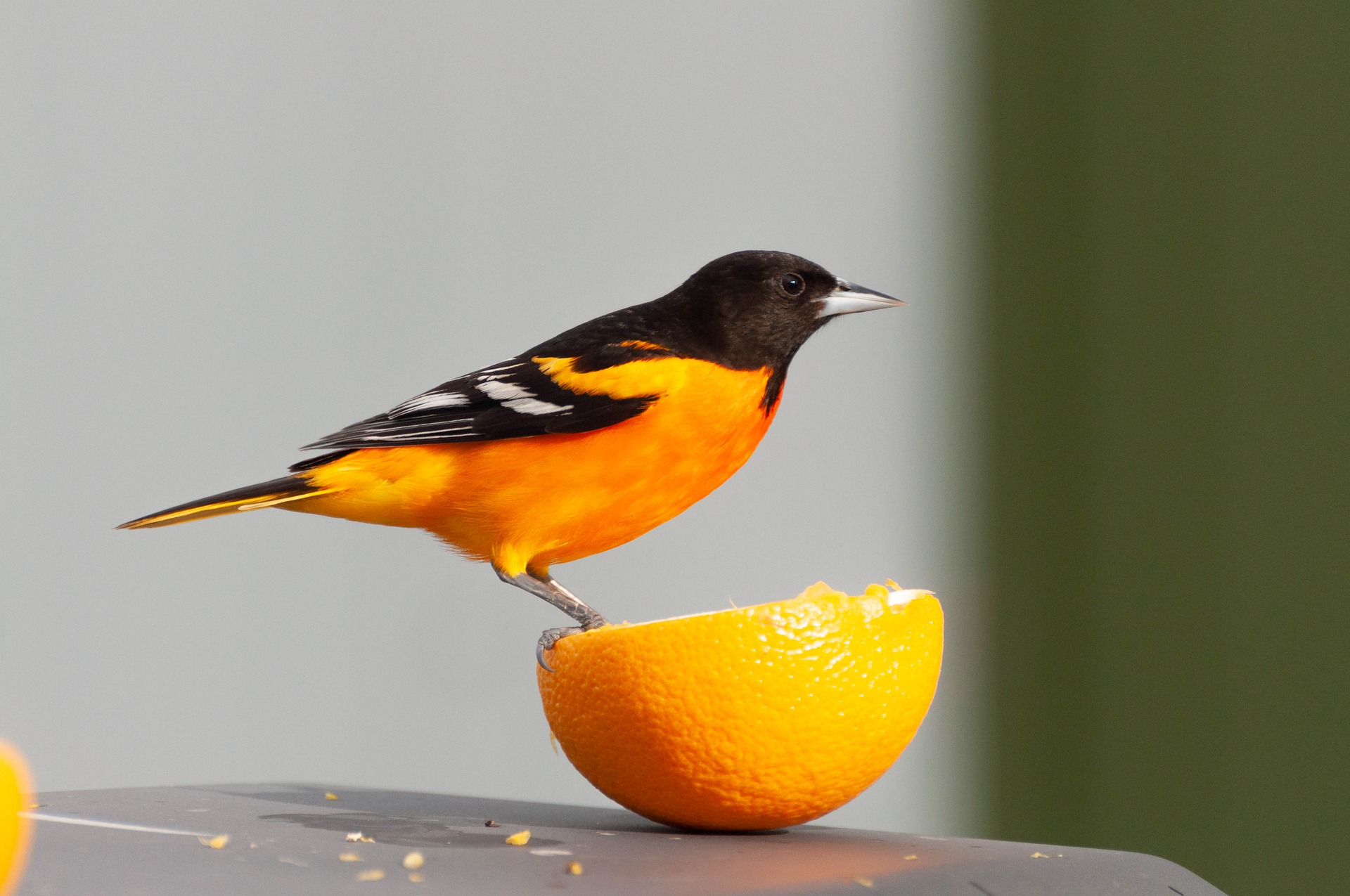
Karen Burke/Pixabay • A Baltimore oriole feeds from a dish of grape jelly. Male orioles show off vibrant feathers during the spring season.

Last week’s column focused on rose-breasted grosbeaks. Males of this species are a stunning sight every spring. People seeing them for the first time are always blown away.

After a link to last week’s column was posted to Facebook, Daisy Scism in Damascus, Virginia, commented that she had a visit from a rose-breasted grosbeak at her feeder recently.

The arrival of rose-breasted grosbeaks got me to thinking of other colorful birds that spend the summer months in Northeast Tennessee, Western North Carolina and Southwest Virginia.

Here’s my list of must-see birds sure to knock your socks off with their dramatic appearance.

Scarlet Tanager

In late April and early May, once the oaks, the maples, the poplars and other tall deciduous trees begin spreading out new green leaves to create a concealing woodland canopy, a familiar song can be heard coming from the treetops. Upon first hearing it, listeners might mistake the hidden singer for an American robin. Listen a little closer, however, and the song sounds as if it is being delivered by a hoarse robin with a sore throat.
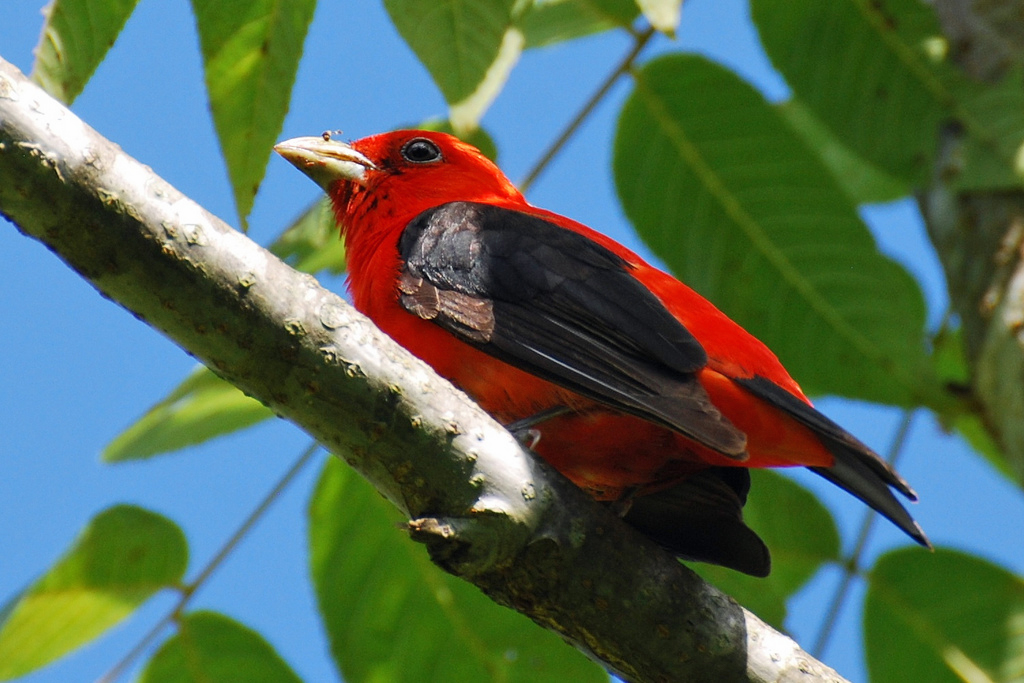
Photo Courtesy of Jean Potter
A male scarlet tanager brightens shadowy woodlands with a flash of tropical colors yet remains mostly inconspicuous in the forest canopy.

The producer of the hoarse but melodic song is a scarlet tanager, one of the most showy birds of Eastern woodlands from April to early October. The scarlet tanager also has an easily recognized call note, best described as a distinctive “chip-burr” or “chip-churr.”

Photo by Bryan Stevens • Despite the brilliant scarlet and black feathers, tanagers are more often heard than seen,

The male scarlet tanager boasts a brilliant plumage of crimson red paired with black wings and tail. Of course, this describes only the male. The female tanager makes no real claim to the common name with her comparatively drab greenish plumage. However, the scientific name, Piranga olivacea, gives a nod to the olive-green plumage of females, young males and even adult males when molting their feathers.

Baltimore Oriole

The Baltimore oriole would stand out among North American birds even without its colorful plumage and its long association with the city of Baltimore and its affiliated Major League Baseball team.

For instance, few other birds can match the Baltimore oriole for the sheer elaborate nature of the woven nest these birds construct for the purpose of sheltering eggs and young. The nests resemble hanging baskets that the female oriole weaves from a variety of collected strips of grass. The lining inside is even more elaborate and features soft materials such as plant down, feathers or even wool that can insulate and cushion the eggs. The nest itself is anchored securely in the fork of a tree branch.

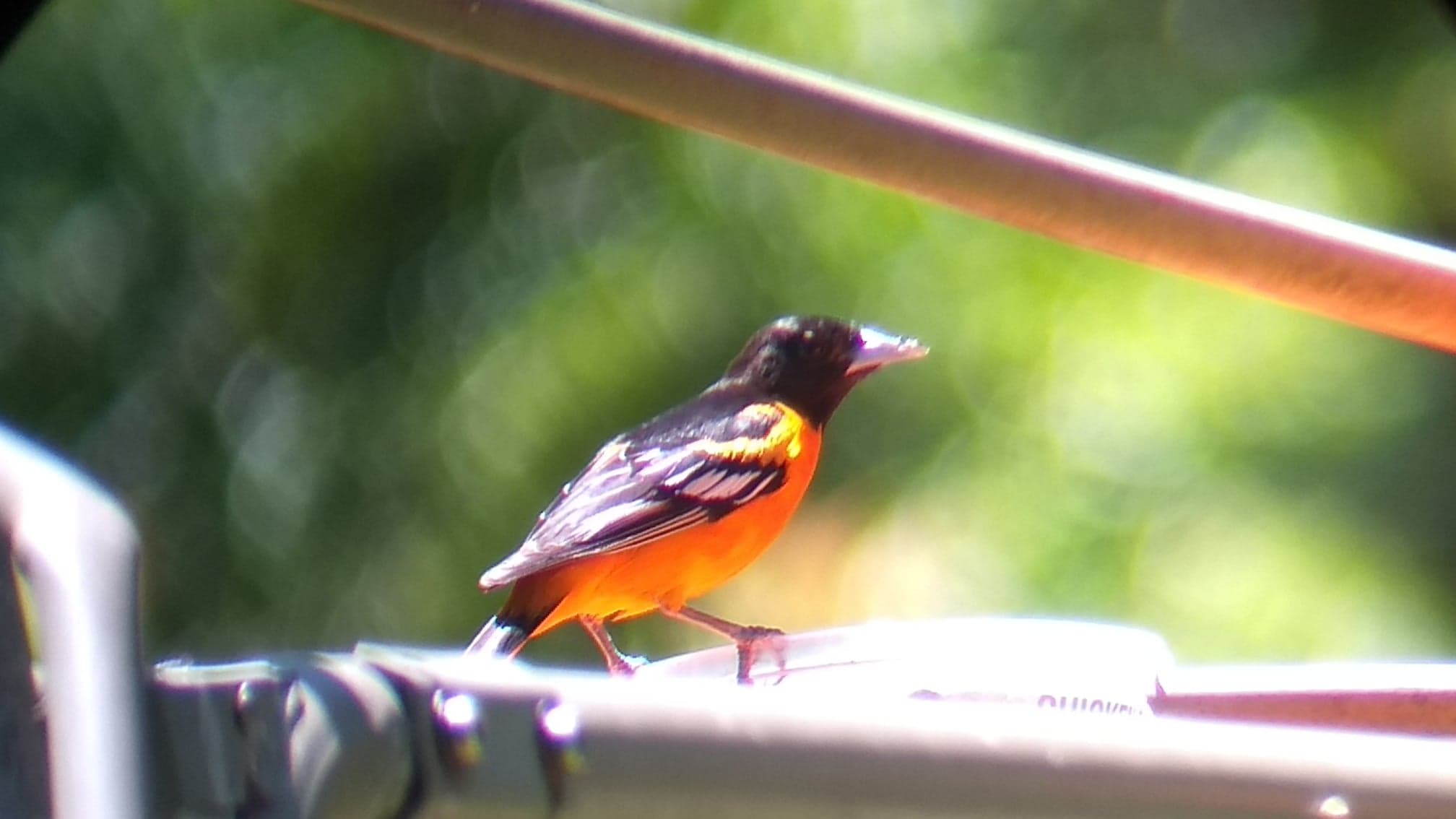
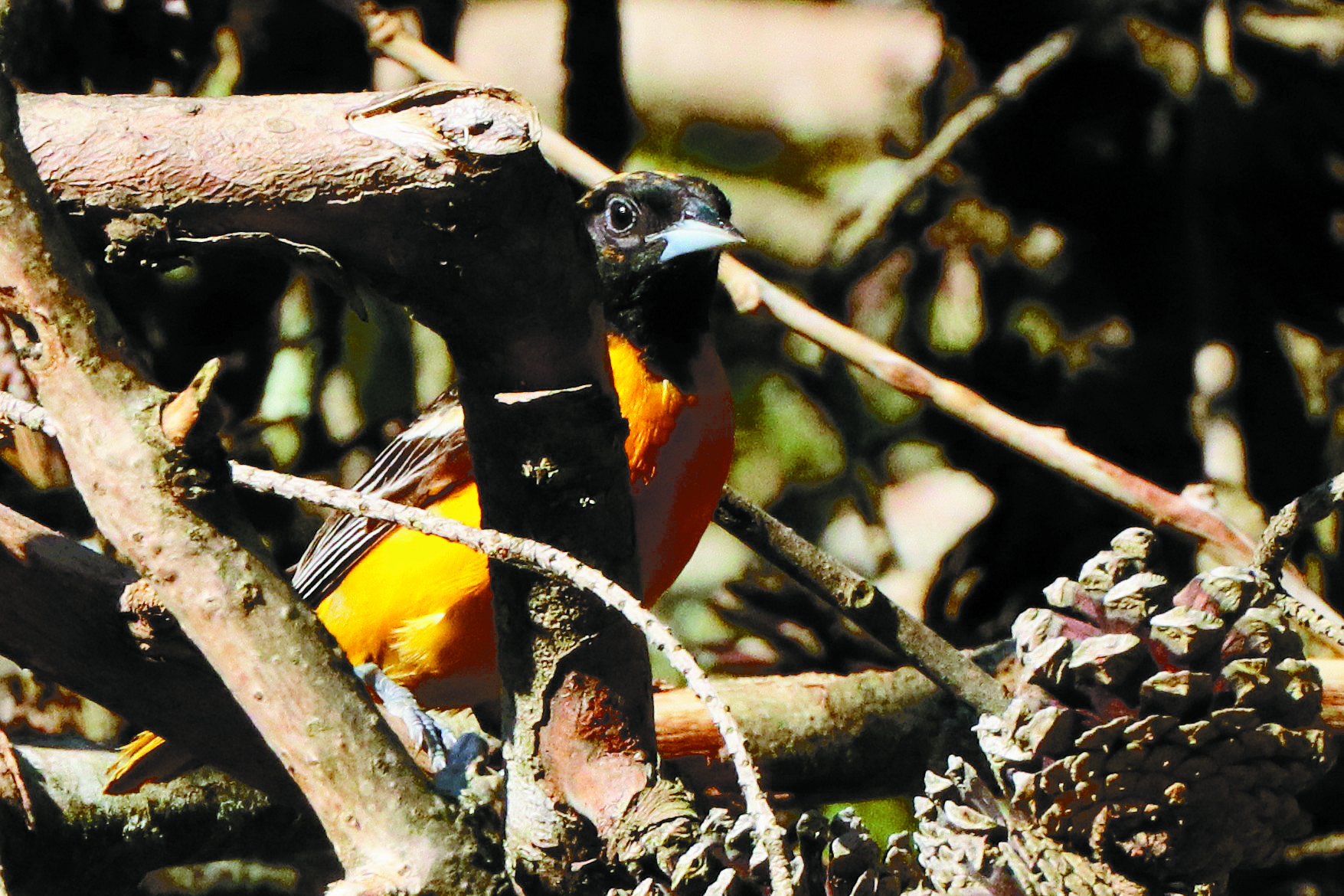
Again, credit for being on a list of stunning regional birds goes to the males. The adult male Baltimore oriole is orange on the underparts, shoulder patch and rump, with some individual birds appearing a very deep flaming orange and others appearing yellowish orange. All of the rest of the male’s plumage is black. Adult female are yellow brown on the upper parts with darker wings and dull orange yellow on the breast and belly. The juvenile oriole is similar looking to the female, with males taking until the fall of their second year to reach adult plumage.

Photo by Bryan Stevens • The male indigo bunting is a resplendent bird.

Indigo Bunting

The indigo bunting is one of the reasons I love to pay attention to the clientele visiting my feeders. This small songbird likes to reside in the boundary region where forests and woodlands meet fields and pastures. Personally, the indigo bunting has always been a bird that is suggestive of the long, hot days of summer.

One of my earliest and still quite vivid birding memories is a recollection of a shockingly blue bird atop a blue spruce tree in my yard. Several decades later, the tree is no longer standing, but these beautiful birds — I now know those long-ago summer visitors were indigo buntings — still return each year to my yard and gardens.

The male indigo bunting is the only solid blue bird in the eastern United States, but it’s all an illusion — literally a trick of the light. The indigo bunting’s feathers are not really blue; the male’s brilliant azure plumage is caused by the process of ;right diffraction around the structure of the bird’s feathers. This process scatters all but the blue light, and the resulting color shifts from black to blue to turquoise as the angle of reflected light changes. In bright light, it can even look unnaturally vivid blue. In poor light, however, an indigo bunting male can appear black.

Indigo buntings usually arrive in the region in late April, and I’ve seen them linger until late October, although most indigo buntings have left the region by late September.

•••

Do you have your own candidates for most beautiful birds. Feel free to email me your choice at ahoodedwarbler@aol.com. Share sightings, ask questions or make comments as well.
Region’s orioles are part of blackbird clan

A Baltimore oriole gathers nesting material. • Photo courtesy of Kaylynn Sanford Wilster

Kaylynn Sanford Wilster shared on Facebook her observation of Baltmore orioles gathering nesting materials at her lakeside home in Piney Flats. She also noted that, although she offers oriole feeders, she has had no takers so far.
“They were gathering nesting materials so doubt if I will see them there again, but I was thrilled,” she informed me.

She also noted that observing the birds in person makes clear that the colors of their feathers do not always match the images contained in some bird books.
Her Merlin app, which can identify birds through recording made of their songs, has detected both Baltimore and orchard orioles on a few occasions.
In addition to Kaylynn’s sighting, Lindsay Anne McAuliffe saw and photographed a male Baltimore oriole in Jonesborough. Her friend, Serina Marshall, shared the sighting with me.

These sightings are more examples of the excitement of spring migration when a new bird could be just around the corner.

The Baltimore oriole, despite its bright plumage, is a member of one of the blackbird clans, known in scientific circles as the Icterus genus. In his book, “Birds of Forest, Yard, and Thicket,” John Eastman notes that there are 26 species in the genus, eight of which nest in the United States.

Photo by Bryan Stevens • Orchard orioles, like this bird, as well as Baltimore orioles, were found on the Spring Bird Count.

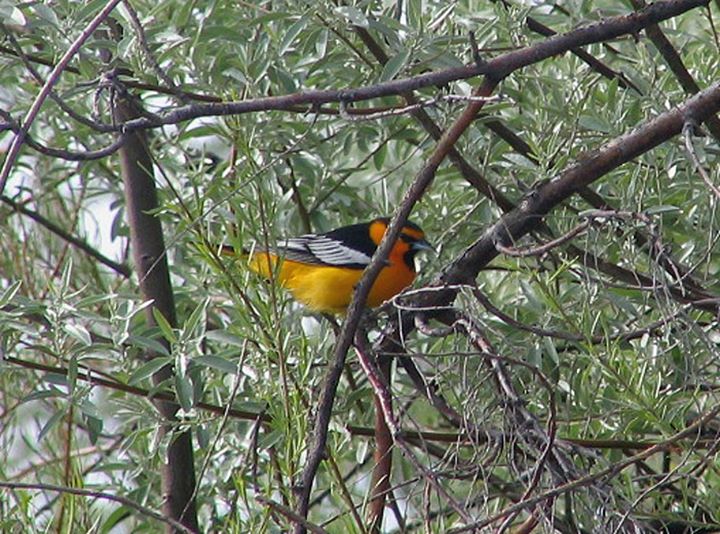
In the Eastern United States, there are only two orioles — the Baltimore oriole and its smaller relative, the orchard oriole. The western half of the nation is home to a half dozen orioles, including Bullock’s oriole, Scott’s oriole, Audubon’s oriole, hooded oriole and Altamira oriole.

I saw several gaudy, noisy Bullock’s orioles during a trip to Utah in May of 2006.I actually have better luck finding the orchard oriole closer to home. I have learned that tall trees are an essential part of the Baltimore oriole’s favored habitat. Baltimore orioles are well-known for their colorful appearance, but their fame also rests with a sack-like nest that Eastman describes as a “durable marvel of tight-woven plant fibers” in his informational book. Eastman also notes that during another era in America, the Baltimore oriole often built its marvelous nests in American elms before Dutch elm disease almost eradicated these trees from the landscape. He reports that maples, willows and apples have served as nesting trees in the absence of elms. Once the hard-working female oriole sets to work, she may spend eight days or longer weaving plant fibers into a strong pouch suspended from the outer ends of drooping branches. The durability of the nest means that other birds, including house finches, may occupy the old nest once abandoned by the original inhabitant.

Orioles are present in the region from April to October, generally retreating to the American tropics for the cold months of winter. There they may live on plantations that produce such much-coveted crops as bananas, coffee and cacao, which is the essential ingredient for chocolate

The Baltimore oriole is named in honor of one of the founding fathers of the state of Maryland. George Calvert, or Baron Baltimore, was an influential English colonist instrumental in establishing the colony of Maryland. His servants wore orange and black uniforms, which inspired early American naturalist Mark Catesby to name the bird the Baltimore oriole. The bird’s association with the the city of Baltimore and the state of Maryland has continued to this day. The bird is also famous as the namesake of one of America’s professional baseball teams.

Baltimore orioles eat insects and fruit, but these adaptive birds have also developed a fondness for sweet nectar. Orioles no longer have to raid sugar water feeders meant for hummingbirds. Many manufacturers of bird-feeding equipment now produce affordable sugar water feeders specifically designed for use by orioles. Many bird enthusiasts also use orange slices and grape jelly to lure orioles into their yards. I’ve tried these tricks, but I’ve attracted more gray catbirds and scarlet tanagers than I have orioles.

If you’re fortunate enough to have a Baltimore oriole as a neighbor, it isn’t only their bright coloration and elaborate nest building that recommend these birds. They’re also one of the few birds willing to eat the hairy tent caterpillars that are often a blight on the landscape. Back in the late 1990s, I observed a male Baltimore oriole visiting a large caterpillar tent in the branches of a cherry tree. The bird methodically plucked the caterpillars from the silken tent, eating them one after the other. While many birds avoid some of the spiny and hairy caterpillars, orioles actively seek them out and do a great service of reducing the damage these hungry caterpillars can inflict on the environment.

To share a sighting, email me at ahoodedwarbler@aol.com.

Region’s two oriole species make their spring return

Photo by MillionPM/Pixabay.com • Oranges, as well as offerings of grape jelly, are often successful at luring Baltimore orioles to feeders.

Earlier this spring, Kaylynn Wilster, who resides in Jonesborough, Tennessee, emailed me for information about orioles.

“Do you know when the orioles return to our area?” Kaylynn asked. In her email, she also shared that she had a female Baltimore oriole gathering nesting materials in her yard last summer.

“I put out an oriole feeder this year,” she added. So far, she noted, only chickadees have discovered the grape jelly.

In addition, Brenda Hickman Dishner, who lives near Holston Dam in Bristol, Tennessee, contacted me through Facebook to ask if I have seen orioles in the area.

Brenda added that she has put out oriole feeders for the past three years with no luck.

Photo provided by Gloria Blevins • A male Baltimore Oriole visits a feeder at the Blevins home in Damascus, Virginia.

It seems many people are hoping to welcome these bright orange and black birds to their feeders. In my reply to Kaylynn and Brenda, I told them to expect orioles to arrive in late April and early May. I’ve found orioles uncommon visitors to my home, but my prediction on timing proved more or less correct.

Gloria Blevins shared a photo of the Baltimore orioles that have been visiting her home in Damascus, Virginia. In a Facebook message, she shared that the orioles have been feeding on grape jelly that she had provided them since May 2.

Although she no longer lives locally, Kathy Noblet has been seeing lots of Baltimore orioles at her home in Mount Vernon, Ohio, since late April. Her photographs of these colorful birds have been nothing short of amazing. She has shared new photographs on Facebook on an almost daily basis for the past couple of weeks.

“The orioles continue to come to my deck and pig out on grape jelly,” Kathy posted on May 6. “They are fun to watch!”

I also heard back from Kaylynn on May 15. “There was a male oriole getting a drink at my pond about four days ago,” she informed me in an email.

Photo by USFWS • Baltimore orioles, like this male, are members of the blackbird family, making them relatives of species such as Eastern meadowlarks, brown-headed cowbirds, common grackles and red-winged blackbirds.

The Baltimore oriole, despite its bright plumage, is a member of one of the blackbird clans, known in scientific circles as the Icterus genus. In his book, “Birds of Forest, Yard, and Thicket,” John Eastman notes that there are 26 species in the genus, eight of which nest in the United States.

In the eastern United States, there are only two orioles — the Baltimore oriole and its smaller relative, the orchard oriole. The western half of the nation is home to a half dozen orioles, including Bullock’s oriole, Scott’s oriole, Audubon’s oriole, hooded oriole and Altamira oriole. I saw several gaudy, noisy Bullock’s orioles during a trip to Utah in May of 2006.

Tall trees are an essential part of the Baltimore oriole’s favored habitat. Baltimore orioles are well-known for their colorful appearance, but their fame also rests with a sack-like nest that Eastman describes as a “durable marvel of tight-woven plant fibers” in his informational book. Eastman also notes that during another era in America, the Baltimore oriole often built its marvelous nests in American elms before Dutch elm disease almost eradicated these trees from the landscape. He reports that maples, willows and apples have served as nesting trees in the absence of elms. Once the hard-working female oriole sets to work, she may spend eight days or longer weaving plant fibers into a strong pouch suspended from the outer ends of drooping branches. The durability of the nest means that other birds, including house finches, may occupy the old nest once abandoned by the original inhabitant.

Orioles are present in the region from April to October, retreating to the American tropics for the winter. There they may live on plantations that produce such much-coveted crops as bananas, coffee and cacao, which is the essential ingredient for chocolate.

George Calvert, Lord Baltimore

The Baltimore oriole is named in honor of one of the founding fathers of the state of Maryland. George Calvert, or Baron Baltimore, was an influential English colonist instrumental in establishing the colony of Maryland. His servants wore orange and black uniforms, which inspired early American naturalist Mark Catesby to name the bird the Baltimore oriole. The bird’s association with the the city of Baltimore and the state of Maryland have continued to this day. The bird is also famous as the namesake of one of America’s professional baseball teams.

Baltimore orioles eat insects and fruit, but these adaptive birds have also developed a fondness for sweet nectar. Orioles no longer have to raid sugar water feeders meant for hummingbirds. Many manufacturers of bird-feeding equipment now produce affordable sugar water feeders specifically designed for use by orioles. Many bird enthusiasts also use orange slices and grape jelly to lure orioles into their yards. I’ve tried these tricks, but I’ve attracted more gray catbirds and scarlet tanagers than I have orioles. In my book, that’s not a disappointment. I happen to like catbirds and tanagers.

With orioles, I’ve had better luck by refraining from a bit of pest control. Back in the late 1990s, I observed a male Baltimore oriole visiting a large caterpillar tent in the branches of a cherry tree. The bird methodically plucked the caterpillars from the silken tent, eating them one after the other. I’ve since learned that this is not an odd occurrence for Baltimore orioles. While many birds avoid spiny and hairy caterpillars, orioles actively seek them out and do a great service by reducing the damage these hungry caterpillars can inflict on the environment.

If you’re wanting to see orioles, I can share some area “hot spots” for these colorful birds. The waterfront at Winged Deer Park in Johnson City, Tennessee, has fewer tall trees than it did a few years ago, but the remaining trees still attract orioles. Warriors Path State Park in Kingsport, Tennessee, has long been a place that local birders depend on for sightings of Baltimore orioles. I also had some impressive sightings of both orioles at Hungry Mother State Park a few years ago. Although those birds could have been spring migrants, this park in Marion, Virginia, certainly offers habitat that orioles would find attractive.

Want more details on how to attract orioles to your yard using specialized feeders? Check out this helpful article from Birds and Blooms. https://www.birdsandblooms.com/birding/attracting-birds/bird-nesting/how-to-attract-orioles/

Photo by Bryan Stevens • In the western part of the United States, the Baltimore oriole is replaced by Bullock’s oriole.