Category Archives: Ovenbird

Ovenbird is season’s first returning warbler

By Hans Toom from Pixabay • A patch of orange feathers on the crown of an overbid’s head often goes unseen. This shy and retiring bird is more often heard than seen.

It’s gotten to be a bit of a guessing game every spring about which of the warblers will be the first to return to my home.

In 2021, the first warbler to return in the spring was a male Northern parula that arrived on April 9. In 2022, this same species was the first to return, albeit a few days later than the previous year’s date.

The Northern parula didn’t used to be one of the first returning warblers at my home. That honor used to go to hooded warbler or black-throated green warbler. This year, an ovenbird beat all of its kin to arrive on Friday, April 7, in the woodlands around my home, followed a few days later by a black-throated green warbler. This year’s first hooded warbler was a bit tardy and didn’t return until April 23.

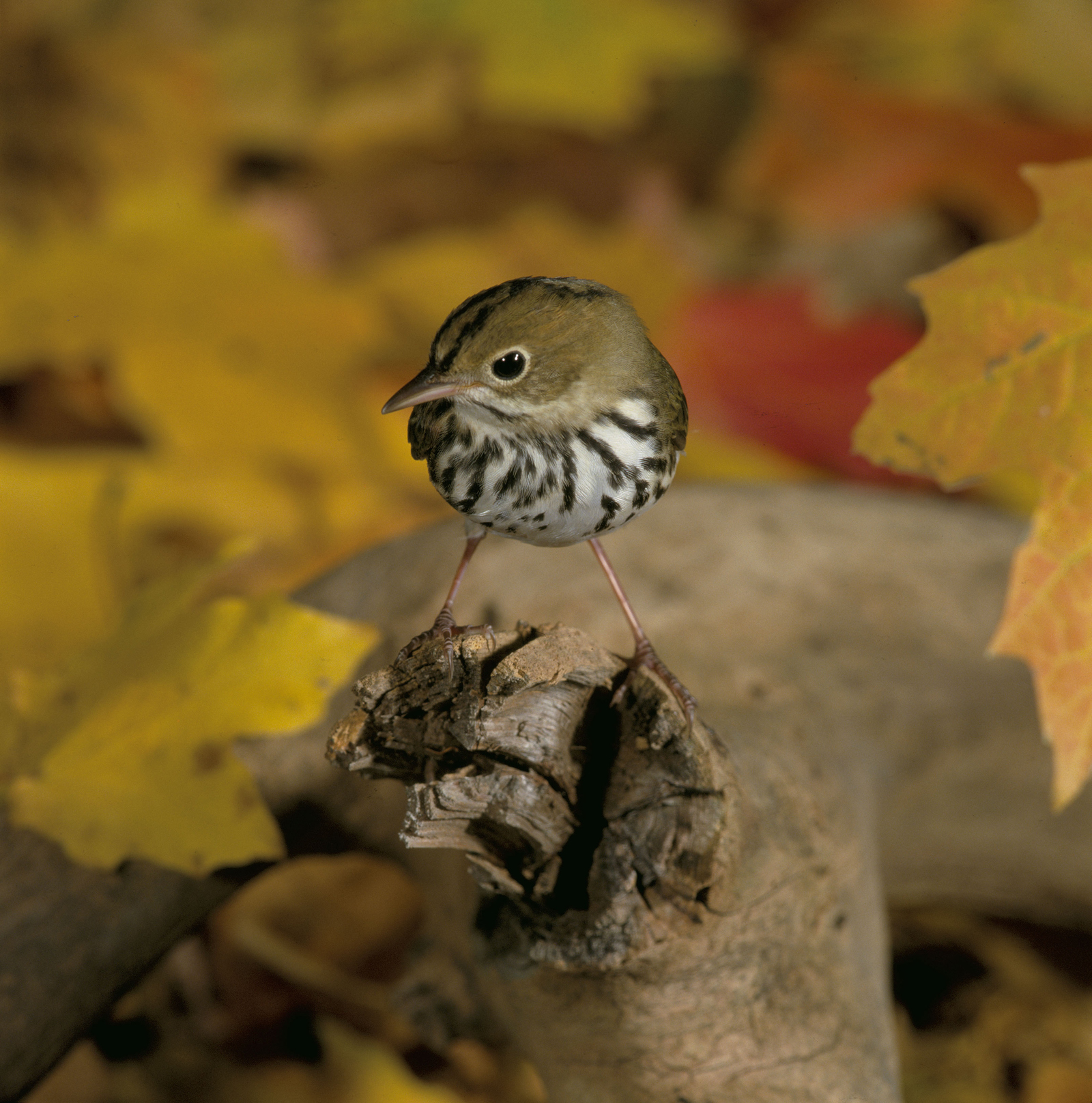
The ovenbird is not one of the brightly colored warblers, such as black-throated blue warbler or yellow warbler. The ovenbird is a small brown bird with a white breast marked with dark streaking — an appearance that bears a superficial resemblance to the larger thrushes that share the same woodland habitat. The only hint of color is an orange crown patch bordered by dark stripes atop the bird’s head. Even this orange crown patch is not easily seen. When agitated, an ovenbird may raise its head feathers, which makes this orange mark easier to detect. The ovenbird also shows a distinct white ring around each eye, as well as pink legs and a pinkish bill.
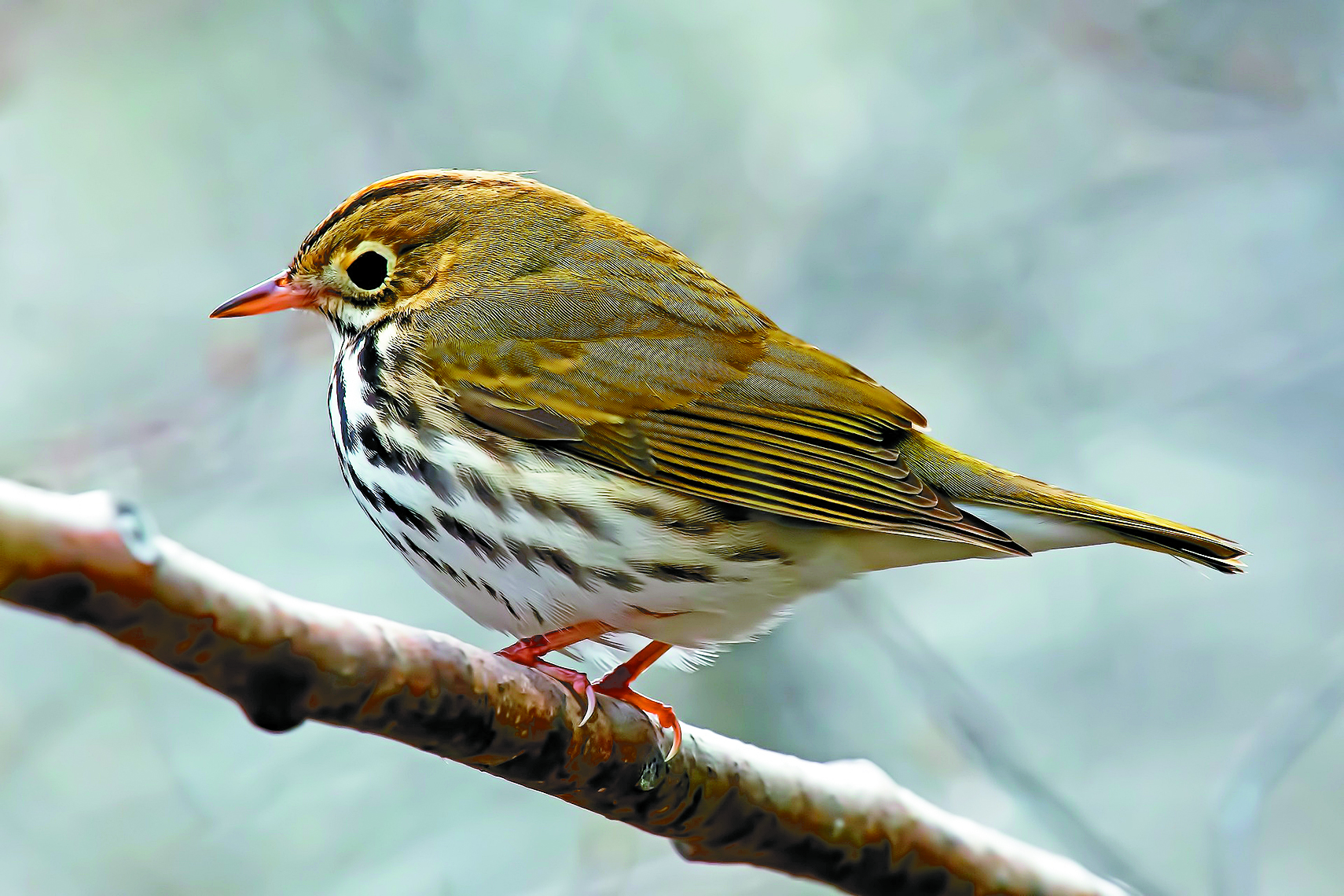
By Hans Toom from Pixabay • The ovenbird gets its name from the shape of its nest, which is said to resemble an old-fashioned Dutch oven.

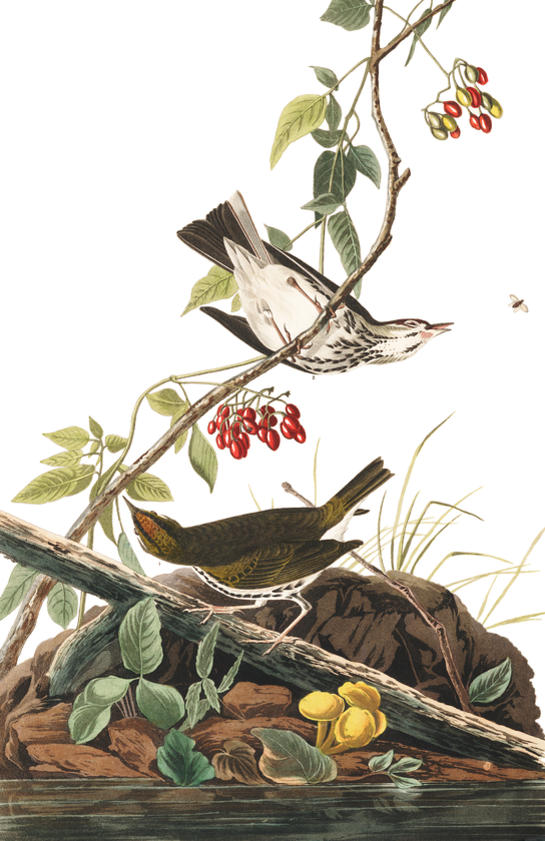
The resemblance to North America’s brown thrushes didn’t go unnoticed by some early American naturalists. Painter and famous naturalist John James Audubon painted a pair of ovenbirds, which he knew as “golden-crowned thrushes.” When comparing the two names, one can’t help but wish that the inaccurate but more romantically descriptive golden-crowned thrush had stuck.

Unfortunately, ovenbirds are stubborn about letting themselves be seen. They’re easily heard. The males begin singing a loud, rollicking “Teacher! Teacher! Teacher” song almost as soon as they arrive on potential nesting grounds.

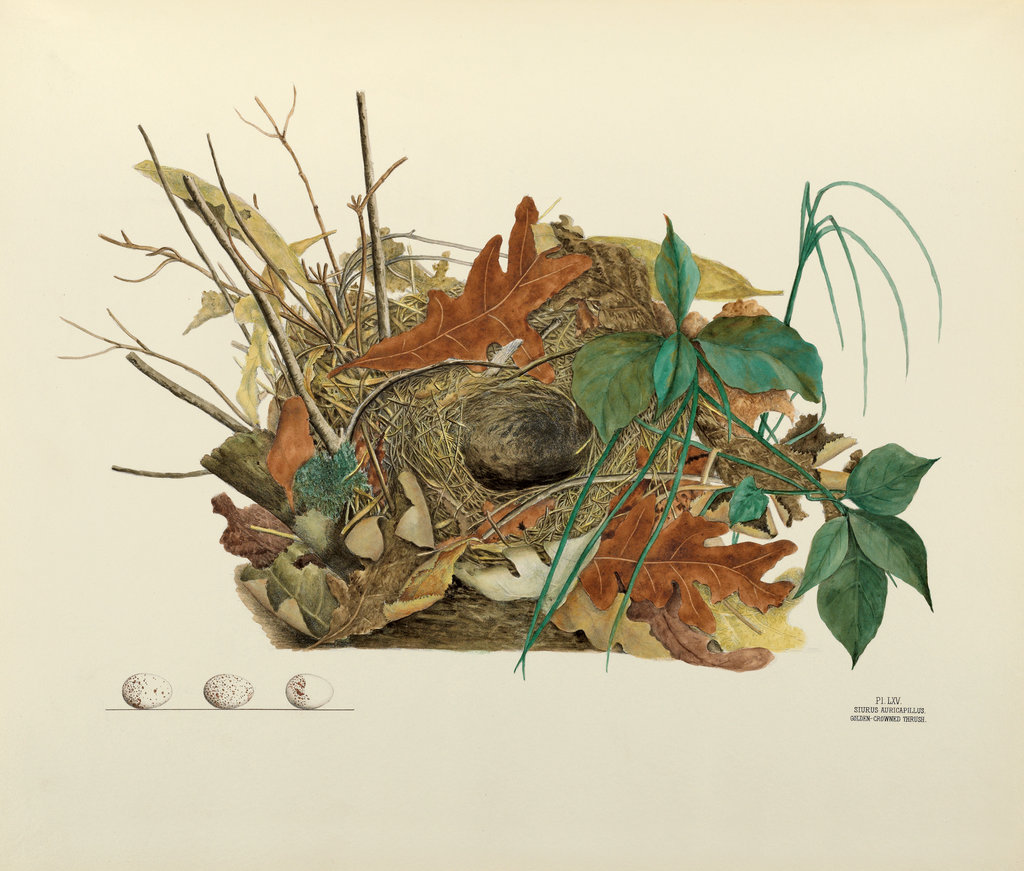
The ovenbird, unlike many warblers, is not named for its appearance. Instead, the bird’s name derives from the shape of the nest it builds. The nest is a domed structure placed on the ground, woven from vegetation and containing a side entrance. Early European settlers in North America thought the nest looked like a Dutch oven, hence the name “ovenbird” for the small warbler with the intricate nest.

In April and continuing into May, a couple of dozen warbler species will pass through Tennessee. Some of these warblers find area woodlands and other habitats to their liking. They will pause, explore and perhaps decide to spend their summer nesting season in Northeast Tennessee and Western North Carolina rather than continue migrating farther north.

Many of the warblers that pass through each spring, however, are destined to travel a much longer distance before settling down in their favored habitats for the summer nesting season. These warblers include the Tennessee warbler, Nashville warbler, Cape May warbler, blackpoll warbler and Connecticut warbler. Most of these species nest as far north as New England and Canada.

Others find the Southern Appalachians to their liking. Some of the first warblers to return each year include the Louisiana waterthrush, which favors rushing mountain streams, as well as species such as black-throated green warbler, hooded warbler, ovenbird, black-and-white warbler, worm-eating warbler and common yellowthroat.

The Northern parula offers an abundance of identifying characteristics. Adult males are bluish gray overall with a yellow-green patch on the back and two white wingbars. A chestnut band separates the male’s bright yellow throat and chest. Adult females are often a bit paler and typically lack the male’s breast band. Both males and females have distinctive white eye crescents.

Most warblers lead frenetic lives. They often sing high in the tops of trees, but they do occasionally venture closer to the ground, particularly when foraging for prey, which consists of a variety of insects and small spiders. The Northern parula is even more restless than most of its kin.

The more reliable means of locating a Northern parula is to listen for the male’s buzzy, ascending song. He is a persistent singer from the time of his arrival until mid-summer.

A quirk involving nesting material is somewhat unique to this warbler. In much of the southern United States, the Northern parula conceals its nest inside strands of Spanish moss draped from the limbs of live oaks and other trees. In the Southern Appalachians and other locations farther to the north, the absence of Spanish moss means that the birds rely on various Usnea lichens, which are sometimes referred to as “Old Man’s Beard.”

A pair of Northern parulas will attempt to raise two broods in a nesting season. The female lays two to seven eggs and does most of the nest construction.

Look for spring’s warblers in the coming weeks. Feel free to share any sightings with me by emailing ahoodedwarbler@aol.com.

Photo by Bryan Stevens • The Northern parula’s geographic location during the nesting season determines its use of nesting materials.

 

County’s Summer Bird Count finds 104 species

Members and friends of the Lee & Lois Herndon Chapter of the Tennessee Ornithological Society enjoyed a busy June, conducting its two annual summer bird counts last month. To the satisfaction of everyone involved, these counts encountered normal temperature after a spring count this past May that actually saw some snowfall when it was held on May 6.

IMG_4140

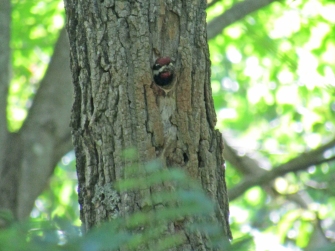
Photo by Bryan Stevens • Nesting Yellow-bellied Sapsuckers can be found at higher elevations in Unicoi County. This woodpecker is usually considered a winter bird in the region, but a few nest in the mountains.

According to long-time compiler Rick Knight, the chapter holds these summer counts in the counties of Carter and Unicoi to provide a set of baseline data on the diversity and numbers of breeding birds in these two local counties. This supplements other summertime data collection projects, such as the long-running Breeding Bird Survey (one route in Carter County) and the Nightjar Survey (three local routes).

The Carter County Summer Bird Count was initiated shortly after the conclusion of the Tennessee Breeding Bird Atlas project. The Unicoi County Summer Bird Count’s origins are more recent, with this survey making its debut in June of 2014. The fourth consecutive Unicoi County Summer Count was held June 17 with 21 observers in five parties looking for birds on Unaka Mountain, as well as such locations as Erwin, Limestone Cove and Flag Pond. Morning weather was favorable, but scattered rain in the afternoon hindered some efforts. A total of 104 species were tallied, down slightly from the three-year average of 111 species. Highlights included a Bald Eagle, Merlin and six Yellow-bellied Sapsuckers, including a nest with young. A total of 20 species of warblers were tallied, including Swainson’s Warbler, Magnolia Warbler, Blackburnian Warbler and Prairie Warbler. Other notable birds include Hermit Thrush and Blue Grosbeak.

I took part on the count, looking for birds in the Limestone Cove area of the county with Brookie and Jean Potter, Charles Moore, and David and Connie Irick. Beyond bird, we saw other wildlife, including skunks, white-tailed deer, rabbits, groundhogs and various butterflies.

IMG_4146

Photo by Bryan Stevens • A young Red-winged Blackbird begs food from its attentive mother.

A highlight of our count took place near the Appalachian Trail along Highway 107 at Iron Mountain Gap where we found a pair of Yellow-bellied Sapsuckers delivering food to young inside a nesting cavity in a tree easily viewed from the roadside. In addition, a singing Chestnut-sided Warbler put on quite a show for a group of admiring birders enchanted with this bird’s dazzling plumage and energetic antics.

The total for the count follows:

Canada Goose, 73; Wood Duck, 22; Mallard; Wild Turkey, 19; Great Blue Heron, 13; and Green Heron, 3.
Black Vulture, 300; Turkey Vulture, 28; Sharp-shinned Hawk, 2; Cooper’s Hawk, 1; Bald Eagle, 1; Broad-winged Hawk, 7; Red-tailed Hawk, 4; American Kestrel, 2; and Merlin, 1.
Rock Pigeon, 67; Mourning Dove, 87; Great Horned Owl, 1; Barred Owl, 2; Chuck-will’s-Widow, 4; Whip-poor-will, 9; and Chimney Swift, 61.
Ruby-throated Hummingbird, 15; Belted Kingfisher, 4; Red-bellied Woodpecker, 13; Yellow-bellied Sapsucker, 6; Downy Woodpecker, 10; Hairy Woodpecker, 3; Northern Flicker, 7; and Pileated Woodpecker, 8.
Eastern Wood-Pewee, 7; Acadian Flycatcher, 24; Eastern Phoebe, 30; Great Crested Flycatcher, 3; and Eastern Kingbird, 14.
White-eyed Vireo, 4; Yellow-throated Vireo, 1; Blue-headed Vireo, 26; Red-eyed Vireo, 95; Blue Jay, 53; American Crow, 88; Fish Crow, 7; and Common Raven, 7.
Northern Rough-winged Swallow, 36; Purple Martin, 14; Tree Swallow, 70; Barn Swallow, 77; and Cliff Swallow, 149.
Carolina Chickadee, 51; Tufted Titmouse, 43; Red-breasted Nuthatch, 1; White-breasted Nuthatch, 18; Brown Creeper, 3; House Wren, 14; Carolina Wren, 42.

IMG_4172

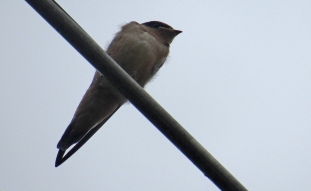
Photo by Bryan Stevens • Most swallows, like this Barn Swallow, have fledged and will join their parents in migrating south in the coming weeks of late summer.

Blue-gray Gnatcatcher, 5; Golden-crowned Kinglet, 7; Eastern Bluebird, 33; Veery, 25; Hermit Thrush, 4; Wood Thrush, 37; American Robin, 281; Gray Catbird, 31; Brown Thrasher, 12; Northern Mockingbird, 24; European Starling, 534; and Cedar Waxwing, 49.
Ovenbird, 29; Worm-eating Warbler, 2; Louisiana Waterthrush, 4; Black-and-white Warbler, 12; Swainson’s Warbler, 6; Common Yellowthroat, 2; Hooded Warbler, 37; American Redstart, 4; Northern Parula, 19; Magnolia Warbler, 3; Blackburnian Warbler, 2; Yellow Warbler, 1; Chestnut-sided Warbler, 15; Black-throated Blue Warbler, 29; Pine Warbler, 1; Yellow-throated Warbler, 3; Prairie Warbler, 3; Black-throated Green Warbler, 16; Canada Warbler, 9; and Yellow-breasted Chat, 2.
Eastern Towhee, 55; Chipping Sparrow, 49; Field Sparrow, 8; Song Sparrow, 120; Dark-eyed Junco, 37; Scarlet Tanager, 27; Northern Cardinal, 83; Rose-breasted Grosbeak, 4; Blue Grosbeak, 2; and Indigo Bunting, 82.
Red-winged Blackbird, 84; Common Grackle, 58; Eastern Meadowlark, 9; Brown-headed Cowbird, 29; and Orchard Oriole, 1.
House Finch, 33; American Goldfinch, 96; and House Sparrow, 17.

YoungCardinal

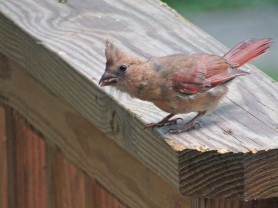
Photo by Bryan Stevens • Young birds, like this Northern Cardinal, point to a successful nesting season for most of the region’s birds.

Next week, I’ll post results from the Elizabethton Summer Bird Count.


••••••

To ask a question, make a comment or share a sighting, email ahoodedwarbler@aol.com or friend Stevens on Facebook.

Ovenbird often a difficult bird to get to know

Last week, I discussed the worm-eating warbler, which is one of the more drab warblers in terms of appearance. I think that must have started a trend, because so far this migration season has been dominated by some of the less colorful — but still very interesting — warblers. The opening days of September brought with them the annual fall parade of migrating warblers. As usual, this yearly opportunity to view visiting warblers began as a trickle of species but has picked up in intensity as each day passed.

ovenbird

Photo by Jean Potter                                         Ovenbird sings from an elevated perch in the woodland canopy.

 By Sunday, Sept. 11, I had already observed close to a dozen species of warblers, including hooded warbler, black-throated green warbler, Northern waterthrush, ovenbird, magnolia warbler, chestnut-sided warbler, black-and-white warbler, Tennessee warbler, and American redstart. 
 
One of the first warblers to arrive at my home this spring was the enigmatic ovenbird. With its loud, ringing song — “Teacher! Teacher! Teacher!” — it’s impossible not to notice the arrival of this warbler.  Why describe this warbler as enigmatic? For starters, ovenbirds do not easily permit even stealthy birders to glimpse them. I have gotten good looks at ovenbirds throughout the years, but they are still difficult to observe. They are one of the warblers more easily heard than seen. When they are observed, it’s usually no more than a fleeting look before the bird dives back into heavy cover. That’s not always the case, however.
ovenbird-warbler

Photo by U.S. Fish & Wildlife Service/Steve Maslowski                      The ovenbird is not named for its plumage or its habitat preference. Instead, its name refers to the shape of its nest. Ovenbirds and other warblers are currently migrating through the region.

 
I’ve actually seen three different ovenbirds this fall, with increasingly good looks at this warbler each time I have encountered it. The ovenbird is not one of the brightly colored warblers, such as black-throated blue warbler or yellow warbler. The ovenbird is a small brown bird with a white breast with dark streaking — an appearance that bears a superficial resemblance to the larger thrushes that share the same woodland habitat. The only hint of color is an orange crown bordered by dark stripes atop the bird’s head. Even this orange crown patch is not easily seen. When agitated, an ovenbird may raise its head feathers, which makes this orange mark easier to detect. The ovenbirds I’ve observed recently have all shown off that orange crown patch to great effect. The ovenbird also has a distinct white ring around its eyes, as well as pink legs and a pinkish bill.
plate-143-golden-crowned-thrush-final

Early naturalist John James Audubon painted a pair of Ovenbirds, which he knew as “Golden-crowned Thrushes.”

 
The ovenbird, unlike many warblers, is not named for its appearance. Instead, the bird’s name derives from the shape of the nest it builds. The nest is a domed structure placed on the ground, woven from vegetation and containing a side entrance. Early European settlers in North America thought the nest looked like a Dutch oven, hence the name “ovenbird” for the small warbler with the intricate nest.
 
Rather than hopping along the length of a branch or limb, an ovenbird walks in a deliberate fashion. This bird feeds on insects, spiders and other small prey items foraged from the woodland floor. On rare occasions, a lingering ovenbird shows up at feeders during the winter months.
 
Ovenbirds spend the summer nesting season in mature deciduous and mixed forests across Canada and the eastern United States. They do not make as lengthy a migration as that undertaken by some of their relatives. Ovenbirds migrate each fall to the southeastern United States, the West Indies, and from Mexico to northern South America for the winter season. 
  
The two warblers most closely related to the ovenbird are the Louisiana waterthrush and Northern waterthrush. These atypical warblers share a preference for leading lives spent mostly near the ground adjacent to streams. The Louisiana waterthrush seeks out the rushing water of our mountain streams during early spring while the Northern waterthrush prefers quiet pools of water farther north during its nesting season. The ovenbird, however, is not as closely associated with water.
09audubon-ensha-slide-4jho-jumbo

Amateur ornithologist and artist Genevieve Jones painted this depiction of the Ovenbird’s namesake nest.

 
While I have used the adjective “drab” to describe some of these brown warblers, it is not truly accurate. Although these warblers lack bright colors like orange, yellow and blue, they have an incredible, subtle beauty all their own. In the coming weeks, I will discuss some of the brighter warblers in this fascinating family of migratory songbirds.
 
Warblers are not the only birds migrating through the region. Other notable migrants I’ve observed recently have included common nighthawks, red-eyed vireos and green herons. 
 
•••••
 
Bryan Stevens lives near Roan Mountain, Tennessee. To learn more about birds and other topics from the natural world, friend Stevens on Facebook at https://www.facebook.com/ahoodedwarbler. He is always posting about local birds, wildlife, flowers, insects and much more. If you have a question, wish to make a comment or share a sighting, email ahoodedwarbler@aol.com.