Category Archives: Painted Bunting

Birder with ties to Northeast Tennessee plans Global Big Day

Photo by Bryan Stevens • Brayden Paulk introduces Rufous, a surprisingly tame ruffed grouse that lived on his grandfather’s farm for several years.

Brayden Paulk recently sent me an email to share some recent bird sightings he has made in Georgia.

As background, I’ve known Brayden since the summer of 2016. At the time, he was 17 years old and visiting with his grandparents in Flag Pond for the summer. We got acquainted thanks to an amazing ruffed grouse hanging out at a barn.

Brayden named the grouse Rufous who, as it turned out, was a remarkable bird. Ruffed grouse are, as a rule, shy and retiring birds. Not Rufous. He was an in-your-face sort of grouse. Getting to meet and observe this amazing bird was a privilege.

After we met so that I could make acquaintance with Rufous, Brayden and I did some birding at Rock Creek Recreation Area and then some stops on U.S. Forest Service lands along Highway 107 between Limestone Cove and the North Carolina line. Brayden wanted very much to add a black-throated blue warbler to his life list, and I very much wanted to help him find it.

We did manage to locate a singing veery, a scarlet tanager and a dark-eyed junco. We also found several warblers, including black-and-white warbler, worm-eating warbler and black-throated green warbler, but I began to fear we wouldn’t manage to locate his target bird.

But I am happy to report that we managed to find a male black-throated blue warbler. So, that productive morning back in 2016 resulted in my meeting with a grouse with a lot of personality and Brayden getting a new species for his life list of birds.

When we first met, Brayden was living with his family in Oxford, Alabama. During our first in-person meeting he made a point to tell me that his grandparents, Leon and Janice Rhodes, mailed him every one of my bird columns.

Photo by Bryan Stevens • The late Leon Rhodes teases Rufous the ruffed grouse.

These days he is living in Georgia, which is also providing the focus for most of his birding. He returns often to Tennessee. In fact, he has given a couple of talks to the Elizabethton Bird Club over the years, impressing his audience with his enthusiasm and engaging way of presenting information.

His talk were, surprisingly, not about birds. He spoke about his other passion, fishing, but still managed to make a few mentions of birds in the process.

Brayden has also worked for a couple of summers at Lamar Alexander Rocky Fork State Park in Flag Pond as a seasonal interpretive ranger.

Anyway, enough with the background and back to his recent email.

“I hope everything is going well with you and the bird club,” he wrote. “I wanted to contact you about some interesting recent sightings I have had that I thought you would be interested in. I have been able to put a lot of effort into birding so far this spring and it has turned up some fantastic finds.”
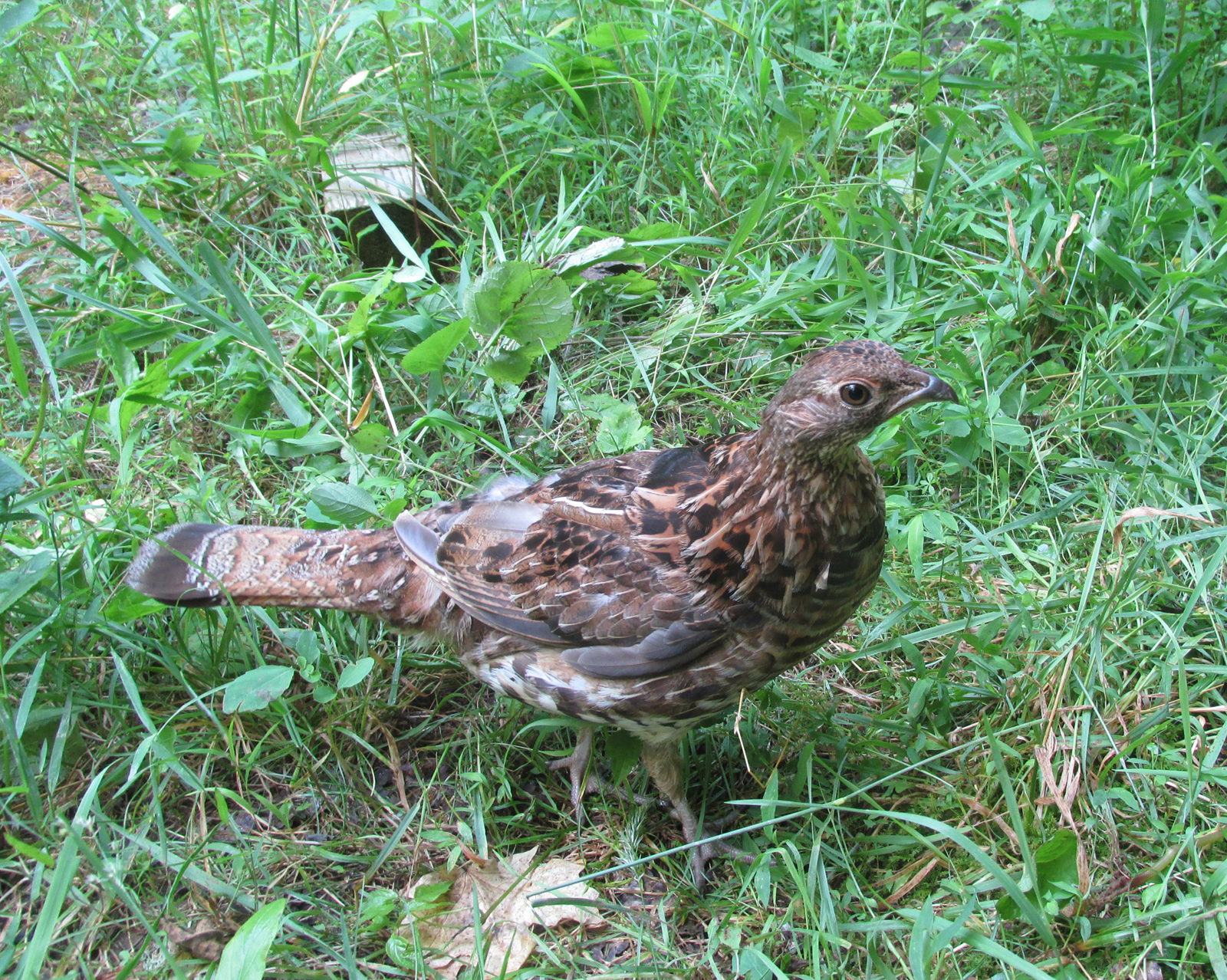
Photo by Bryan Stevens • Rufous, a rather tame ruffed grouse, who made his home in Unicoi County for several years.

His finds have even established some records in Laurens County in Georgia where he now lives.

His local birding loop in his home county has been very productive.

On April 7, his observations of common loons resulted in a county high count for the species. He found 14 loons on one lake and six on another nearby lake. The next highest count before his sighting had stood at two birds.

“That loop has also been very productive for shorebirds, as there are some flooded areas in nearby fields where I have seen lots of greater and lesser yellowlegs and snipe,” he wrote.

“I also got excellent views of a Swainson’s warbler within feet of me at an area on the loop with some swamp and cane thicket habitat,” Brayden added.

On April 7 while running his llocal birding loop in Laurens County, Georgia, Brayden Paulk saw the county high count for common loons with 14 on one lake and 6 on another nearby.

That sighting alone is something that would make many birders envious. I have been birding since 1993 and I can count on one hand the number of looks I’ve had of Swainson’s warbler. The species is often localized, meaning it takes some effort to locate. It’s easy to hear them. The Swainson’s warbler has a loud, ringing song similar to a Louisiana waterthrush. I’ve heard Swainson’s warblers much more frequently than I have seen them.

Brayden also shared his excitement about seeing his first first Horned Lark in the county. He saw the lark, a bird of open fields, at a different location. “It seems to be one of those birds you have to try to find by going to a sod farm or open country,” he noted.

“The Laurens County Loop has also been great for me in the past, and one particular pond turned up the first eBird county records for American avocet, white-rumped sandpiper and long billed dowitcher,” he wrote. “I have also found breeding painted buntings on the loop as well and had an excellent view of them with my dad.”

Brayden also wanted to share some more exciting news.

“I will be moving to Gulf Shores in coastal Alabama in a few weeks, which is one of my favorite places to go birding,” he wrote. “I plan on going to Dauphin Island on the Global Big Day because it is an incredible place to see migrants, and my goal is to find 150 species on that day.”

This year’s Global Big Day is scheduled for Saturday, May 10. Global Big Day is an annual birdwatching event hosted by eBird and Cornell Lab of Ornithology to celebrate and document bird migration. The event was created as a fun and engaging way for bird enthusiasts of all levels to contribute to science and conservation by reporting their bird sightings.

Brayden also hopes to visit Unicoi County again soon to do some birding there and look for some of the species he missed last Summer.

“Thank you for writing your bird articles,” he wrote at the conclusion of his email. “They have inspired me since I was young!”

It’s not easy to put into words how much that unexpected praise made me feel. I am incredibly gratified that I could have provide some inspiration to get such a gifted young man into the field looking for birds.

Readers may recall that I’ve had some deterioration of vision in recent years. With a pair of binoculars, I can still bring birds close enough to enjoy and appreciate their beauty and vivacity. Spotting birds, which is a skill that takes some practice to achieve, is no longer easy for me. Ah, the things we take for granted…

My hearing remains unimpaired. I have enjoyed making note of returning warblers and other birds simply by hearing their familiar songs ringing through the woodlands at my home for yet another spring.

For the past couple of weeks I’ve also had the pleasure of watching daily as a feisty male ruby-throated hummingbird visits the feeders arranged around my front porch.

In closing, I invite everyone to wish Brayden luck with his upcoming Global Big Day. I hope to update everyone with how he does.

•••

To share a sighting, ask a question or make a comment, email me at ahoodedwarbler@aol.com.

Indigo buntings among summer’s most welcome birds

Photo by HeronWorks/Pixabay.com • An indigo bunting feeds on millet seeds at a backyard feeder. These dazzling blue birds are a common summer visitors in Northeast Tennessee.

It’s been a wet summer so far, and a verdant hue has been the rule as trees and other plants seem to be thriving. The green canopy of trees around my home offers concealment for hidden singers, including red-eyed vireos, wood thrushes, and indigo buntings. Those last ones have been a source of some frustration. I have heard a male indigo bunting singing persistently on a daily basis all last month, but glimpsing him in the green foliage has been a challenge.

Two recent summer bird counts have also emphasized some of the more commonplace birds in the region. While American robins and European starlings were extremely abundant, these two birds are permanent residents and are present year-round. A few other summer songbirds also helped swell the ranks of some of the seasonally common birds. For instance, the Unicoi County Summer Bird Count found a total of 131 indigo buntings, while the Carter County Summer Bird Count tallied 105 of these little blue beauties. Both of these Northeast Tennessee surveys are conducted by members of the Lee and Lois Herndon Chapter of Tennessee Ornithological Society.

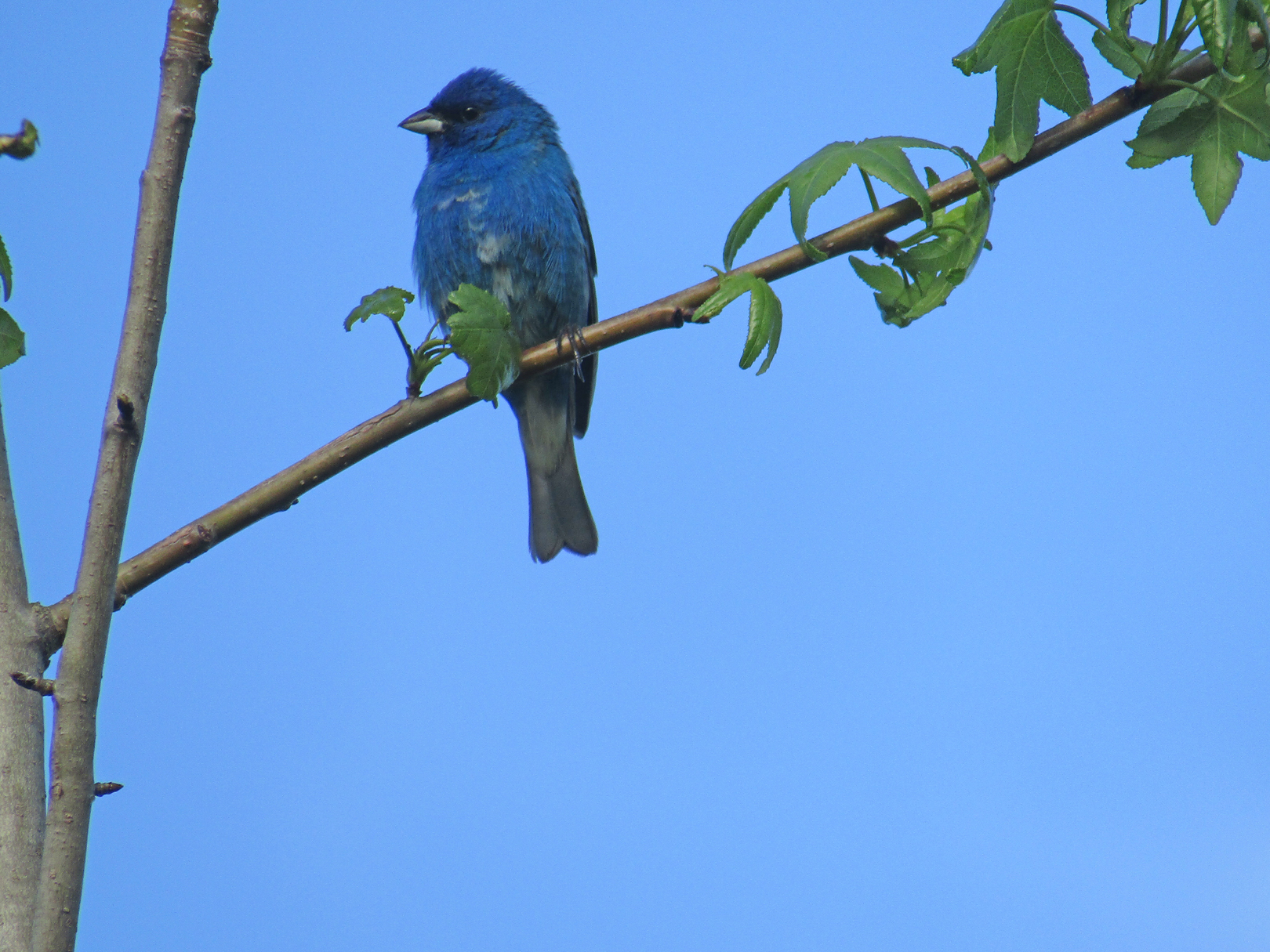
Photo by Bryan Stevens • Neotropical migrants, such as this indigo bunting, provide some vibrant color during the hot summer months.

Buntings like to reside in the boundary region where forests and woodlands meet fields and pastures. Personally, the indigo bunting has always been a bird that is suggestive of the long, hot days of summer. One of my earliest and still quite vivid birding memories is a recollection of a shockingly blue bird and a stunning yellow and black bird sharing perches atop a blue spruce tree in my yard. Several decades later, the tree is no longer standing, but these beautiful birds — I now know these summer visitors were indigo buntings and American goldfinches — return year after year to my yard and gardens.

Photo by Bryan Stevens • This male’s indigo bunting’s plumage is beginning to look somewhat worn in late summer.

These birds usually arrive in the region in late April and I’ve seen them in late October, although most indigo buntings have left the region by late September. Male indigo buntings are persistent singers, and in the past couple of weeks one very enthusiastic male has been singing even during the hottest hours of recent July afternoons. The preference of this small songbird is to sing from the tops of tall trees. They are often concealed by the green leaves. When I do get a glimpse of the obscured songster, often all I see is a dark shape silhouetted against the bright sky. Sometimes, if he plunges from the upper branches into the woodland understory, I get that telltale glimpse of blue feathers.

The indigo bunting is the only solid blue bird in the eastern United States. It’s all an illusion, however. The indigo bunting’s feathers are not really blue; the male’s brilliant azure plumage is caused by the process of refraction. This process absorbs all but blue light, which explains why the indigo bunting appears blue. In bright light, it can even look unnaturally vivid blue. In poor light, however, an indigo bunting male can appear black. Fortunately, indigo buntings have both a characteristic body shape and song, so even if the birds are not seen at their best, they can still be recognized.

Like many species of songbirds, the male is by far the most colorful. In this instance, the male is also responsible for the species’ name. Indigo is a blue dye that was once an important crop in the South. The drab female may boast some blue highlights in her plumage. Juvenile birds just out of the nest also resemble the female. Pay close attention to any indigo buntings you observe as summer progresses. Juvenile birds will look mostly brown with just a hint of blue in the wings and the tail. These will be the young buntings that were hatched this spring and early summer. They will often accompany their parents to feeders, where they are extremely fond of millet seed. I like to have some feeders stocked with millet when the buntings begin to return each spring. They will also feed on thistle and sunflower seeds. Away from our feeders, they also devour plenty of seeds from various noxious weeds. Because of the indigo bunting’s appetite for the seeds of destructive weeds, it is considered a very beneficial bird. Tangible value and exceptional beauty — that’s not a bad combination for such a tiny bird.

Photo by Bryan Stevens • Although bright blue, a male indigo bunting will often blend with its surroundings.

Indigo buntings common and colorful summer bird in region

Photo by Bryan Stevens • The male indigo bunting’s one of the region’s more vibrantly colored birds of summer.

The recent five-county Spring Bird Count, conducted Saturday, May 4, by the Elizabethton Bird Club, found 145 species in the five Northeast Tennessee counties of Carter, Johnson, Sullivan, Unicoi and Washington. The count included such cities as Bristol, Johnson City, Jonesborough, Kingsport, Erwin, and Mountain City. A total of 57 participants in 11 parties counted during the annual survey of avian populations in the region. The long-running count is the only spring census of birds conducted in the area.

Not surprisingly, some of the most abundant birds included Canada goose, European starling, American crow, red-winged blackbird and common grackle. Some of the more common songbirds included red-eyed vireo, Northern cardinal, American robin, hooded warbler, American goldfinch and Indigo bunting.

The indigo bunting is one of the reasons spring is such a wonderful time of the year to watch the visitors to feeders. This small songbird likes to reside in the boundary region where forests and woodlands meet fields and pastures. Personally, the indigo bunting has always been a bird that is suggestive of the long, hot days of summer. One of my earliest and still quite vivid birding memories is a recollection of a shockingly blue bird atop a blue spruce tree in my yard. Several decades later, the tree is no longer standing, but these beautiful birds — I now know these summer visitors were indigo buntings — still return each year to my yard and gardens.

Photon by Bryan Stevens • Indigo Buntings will perch on wires and sing for hours even during hot summer days.

These birds usually arrive in the region in late April, and I’ve seen them linger until late October, although most indigo buntings have left the region by late September. Upon arrival, male indigo buntings become tenacious singers, repeating their jumbled notes even during the hottest hours of summer afternoons. The preference of this small songbird is to sing from the tops of tall trees, where they are often concealed by the green leaves. When I do get a glimpse of the obscured songster, often all I see is a dark shape silhouetted against the bright sky. Sometimes, if he plunges from the upper branches into the woodland understory, I get that telltale glimpse of blue feathers.

The indigo bunting is the only solid blue bird in the eastern United States, but it’s all an illusion — literally a trick of the light. The indigo bunting’s feathers are not really blue; the male’s brilliant azure plumage is caused by the process of diffraction of light around the structure of the bird’s feathers. This process scatters all but the blue light, and the resulting color shifts from black to blue to turquoise as the angle of reflected light changes. In bright light, it can even look unnaturally vivid blue. In poor light, however, an indigo bunting male can appear black. Fortunately, indigo buntings have both a characteristic body shape and song, so even if the birds are not seen at their best, they can still be recognized.

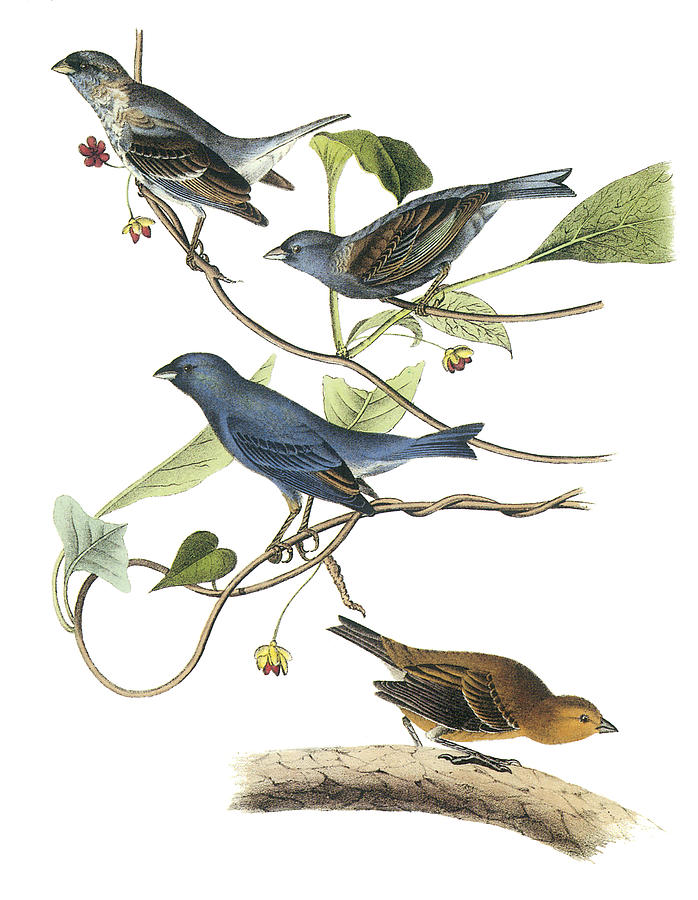
Early American naturalist and artist captured the differences in male, female and immature indigo buntings in this painting of the species.

Soon after returning to the eastern United States each spring, female buntings begin to gather materials to construct a well-crafted, cup-shaped nest. The male usually stays close to her, but he offers no assistance with nest building. She usually lays a clutch of three to four eggs, but she may nest another two times in a single season.

She will incubate the eggs for almost two weeks, but the young remain in the nest another two weeks after being hatched as featherless, blind and helpless young completely dependent on the care of attentive parents. The task of raising so many broods in the space of only a few months requires the participation of both the female and her mate, who must work hard to bring enough insects to the nest to keep the young fed.

Like many species of songbirds, the male is by far the most colorful. In this instance, the male is also responsible for the species’ name. Indigo is a blue dye that was once an important crop in the South. The drab female may boast some blue highlights in her plumage. Juvenile birds just out of the nest also resemble the female. Pay close attention to any indigo buntings you observe as summer progresses. Juvenile birds will look mostly brown with just a hint of blue in the wings and the tail. These will be the young buntings that were hatched this spring and early summer. They will often accompany their parents to feeders.

Indigo buntings are particularly fun birds to observe in late summer. Although some books indicate that males are not very active in rearing young, I have on numerous occasions witnessed male buntings feeding fledglings at feeders. Indigo bunting juveniles, like the young of many other birds, beg for tidbits from parents by “bowing,” spreading their wings and shivering. These actions usually prompt a parent to pop some morsel into an impatient youngster’s open bill. Indigo buntings are relatively easy to view. They frequent weedy fields and roadside brush. During the breeding season, males can also be seen singing from prominent perches. The song, a distinctive jumble of notes, can help observers find these dedicated singers.

The male indigo bunting is one of the most colorful birds to visit feeders in the region. This species is also extremely fond of millet seed. I like to have some feeders stocked with millet when the buntings begin to return each spring. They will also feed on thistle and sunflower seeds. Away from our feeders, they also devour plenty of seeds from various noxious weeds. Because of the indigo bunting’s appetite for the seeds of destructive weeds, it is considered a beneficial bird.

Photo by Bryan Stevens • Newly-returned neotropical migrants, such as this Indigo Bunting, increased the total number of species for the annual spring count.

One of the most attractive summer scenes is to observe American goldfinches and indigo buntings feeding together on the nodding heads of summer sunflowers. The goldfinch males, resplendent in their bright yellow and black plumage, compete with the blue indigo bunting males for the fresh sunflower seeds. When bright red male Northern cardinals join in, observers have a complete artists’s palette for summer viewing.

The indigo bunting will usually respond to human squeaks that imitate a bird’s call. When a flock or family group of buntings are disturbed by a human observer, they usually begin a chorus of alarmed “chipping.”

As I indicated earlier, indigo buntings remain in the region until late September. Although this bird typically winters in Mexico, Panama and the Caribbean, in recent decades some indigo buntings have only gone as far south as Florida to spend the winter. There in the Sunshine State, the indigo buntings may mingle with a close relative, the splendidly multi-colored painted bunting. I usually see these vibrant songbirds whenever I visit coastal South Carolina in spring or summer. Male painted buntings are probably one of the most colorful birds in the United States with hues of red, green, purple and blue in their feathers.

Photo by Bryan Stevens • A male painted bunting enjoys a bath in a fountain at Hunting Beach State Park in South Carolina.

Other North American buntings include the snow bunting, the lazuli bunting and the lark bunting, which is also the official state bird for Colorado. Some of the common but descriptive names for some of the world’s other buntings include rose-bellied bunting, orange-breasted bunting, cinereous bunting, white-capped bunting, lark-like bunting, ochre-rumped bunting, golden-breasted bunting, chestnut-bunting, red-headed bunting, yellow bunting, blue bunting, little bunting, brown-rumped bunting, meadow bunting, corn bunting and crested bunting.

Keep your feeders stocked with millet and sunflower seeds if you want to increase your chances of seeing indigo buntings, as well as other handsome summer songbirds such as American goldfinch, chipping sparrow and Eastern towhee.

Photo by Bryan Stevens • Although bright blue, a male indigo bunting will often blend with its surroundings.

Indigo bunting one of summer’s common songbirds

IMG_6700

Photo by Bryan Stevens • The male indigo bunting is a resplendent bird.

Two recent summer bird counts emphasized some of the more commonplace birds in the region. While American robins and European starlings were extremely abundant, these two birds are permanent residents and are present year-round. A few other summer songbirds also helped swell the ranks of some of the seasonally common birds. For instance, the Unicoi County Summer Bird Count found a total of 141 indigo buntings while the Elizabethton Summer Bird Count tallied 82 of these little blue beauties. Both of these Northeast Tennessee surveys are conducted by members of the Lee and Lois Herndon Chapter of Tennessee Ornithological Society.

The indigo bunting likes to reside in the boundary region where forests and woodlands meet fields and pastures. Personally, the indigo bunting has always been a bird that is suggestive of the long, hot days of summer. One of my earliest and still quite vivid birding memories is a recollection of a shockingly blue bird atop a blue spruce tree in my yard. Several decades later, the tree is no longer standing, but these beautiful birds — I now know these summer visitors were indigo buntings — return year after year to my yard and gardens.

Count-IndigoBunting

Photo by Bryan Stevens • Neotropical migrants, such as this Indigo Bunting, increase the variety of bright and colorful birds in eastern North America from spring until fall each year.

These birds usually arrive in the region in late April and I’ve seen them in late October, although most indigo buntings have left the region by late September.

Male indigo buntings are persistent singers, and in the past couple of weeks one very enthusiastic male has been singing even during the hottest hours of recent July afternoons. The preference of this small songbird is to sing from the tops of tall trees. They are often concealed by the green leaves. When I do get a glimpse of the obscured songster, often all I see is a dark shape silhouetted against the bright sky. Sometimes, if he plunges from the upper branches into the woodland understory, I get that telltale glimpse of blue feathers.

The indigo bunting is the only solid blue bird in the eastern United States. It’s all an illusion, of course. The indigo bunting’s feathers are not really blue. The male’s brilliant azure plumage is caused by the process of refraction. This process absorbs all but blue light, which explains why the indigo bunting appears blue. In bright light, it can even look unnaturally vivid blue. In poor light, however, an indigo bunting male can appear black. Fortunately, indigo buntings have both a characteristic body shape and song, so even if the birds are not seen at their best, they can still be recognized.

Indigo-Count

Photon by Bryan Stevens • Indigo Buntings will perch on wires and sing for hours even during hot summer days.

Like many species of songbirds, the male is by far the most colorful. In this instance, the male is also responsible for the species’ name. Indigo is a blue dye that was once an important crop in the South. The drab female may boast some blue highlights in her plumage. Juvenile birds just out of the nest also resemble the female. Pay close attention to any indigo buntings you observe as summer progresses. Juvenile birds will look mostly brown with just a hint of blue in the wings and the tail. These will be the young buntings that were hatched this spring and early summer. They will often accompany their parents to feeders.

Indigo buntings are particularly fun birds to observe in late summer. Although some books indicate that males are not very active in rearing young, I have on numerous occasions witnessed male buntings feeding fledglings at feeders. Indigo bunting juveniles, like the young of many other birds, beg for tidbits from parents by “bowing,” spreading their wings and shivering. These actions usually prompt a parent to pop some morsel into an impatient youngster’s open bill. Indigo buntings are relatively easy to view. They frequent weedy fields and roadside brush. During the breeding season, males can also be seen singing from prominent perches. The song, a distinctive jumble of notes, can help observers find these dedicated singers.

IndigoBunt

Photo by Bryan Stevens • Although bright blue, a male indigo bunting will often blend with its surroundings.

The male indigo bunting is one of the most colorful birds to visit feeders in the region. This species is also extremely fond of millet seed. I like to have some feeders stocked with millet when the buntings begin to return each spring. They will also feed on thistle and sunflower seeds. Away from our feeders, they also devour plenty of seeds from various noxious weeds. Because of the indigo bunting’s appetite for the seeds of destructive weeds, it is considered a very beneficial bird.

One of the most attractive summer scenes is to observe American goldfinches and indigo buntings feeding together on the nodding heads of summer sunflowers. The goldfinch males, resplendent in their bright yellow and black plumage, compete with the blue indigo bunting males for the fresh sunflower seeds. When bright red male Northern cardinals join in, observers have a complete artists’s palette for summer viewing.

The indigo bunting will usually respond to human squeaks that imitate a bird’s call. When a flock or family group of buntings are disturbed by a human observer, they usually begin a chorus of alarmed “chipping.”indigo-bunting-john-james-audubon

As I indicated earlier, indigo buntings remain in the region until late September. Although this bird typically winters in Mexico, Panama and the Caribbean, in recent decades some indigo buntings have only gone as far south as Florida to spend the winter. There in the Sunshine State, the indigo buntings may mingle with a close relative, the splendidly multi-colored painted bunting. I usually see these vibrant songbirds whenever I visit coastal South Carolina in spring or summer. Male painted buntings are probably one of the most colorful birds in the United States with hues of red, green, purple and blue in their feathers.

PaintedBunting-Male (1)

Photo by Bryan Stevens • The male painted bunting is one of North America’s most colorful birds.

Other North American buntings include the snow bunting, the lazuli bunting and the lark bunting, which is also the official state bird for Colorado. Some of the common but descriptive names for some of the world’s other buntings include striolated bunting, cinnamon-breasted bunting, cinereous bunting, white-capped bunting, lark-like bunting, ochre-rumped bunting, golden-breasted bunting, chestnut-bunting, red-headed bunting, yellow bunting, little bunting, brown-rumped bunting, meadow bunting, corn bunting and crested bunting.

Keep your feeders stocked with millet and sunflower seeds if you want to increase your chances of seeing indigo buntings. They will need some dependable places to re-fuel and rest during their upcoming fall migration.

South Carolina trip provides excellent viewing opportunities to observe one of nation’s most colorful birds

PaintedBunting-Male (1)

Photos by Bryan Stevens                                                          A male Painted Bunting feeds on millet seed at a feeder at Huntington Beach State Park in South Carolina.

I enjoyed a recent excursion to coastal South Carolina, which provided me a change to look for birds at such locations as Huntington Beach State Park and Brookgreen Gardens. These two attractions are two of my favorite places to bird when I get an opportunity to a stay at Pawleys Island in South Carolina.

PaintedBunting-Feeder

The male Painted Bunting is one of the most colorful birds in North America.

Southwest Virginia, Northeast Tennessee and Western North Carolina share some colorful species of birds, including rose-breasted grosbeak, Baltimore oriole, scarlet tanager and indigo bunting. The vibrant blue plumage of a male indigo bunting makes it one of the most coveted birds at feeders. One of my earliest bird memories is one that recalls summer sightings of “blue birds,” or indigo buntings, perched in the same blue spruce tree with “yellow birds,” or American goldfinches. It’s very likely that such memorable childhood sightings set me on the path to becoming a birding and nature enthusiast.

It’s fun to speculate that I might have traveled that path even sooner if I’d observed in that blue spruce one of the relatives of the indigo bunting. The painted bunting, which I saw frequently during my South Carolina vacation, is often described as one of the most colorful birds in the United States. A male painted bunting’s plumage is an almost shocking blend of blue, green, yellow and red feathers, which make males appear almost too tropical for a bird that makes its home for part of the year in the United States. The color pattern for the male painted bunting consists of a blue head, a red eye-ring, red underparts and a green backs. Females and immature birds are a uniform, bright lemon-green overall, with a pale eye-ring. Two years are required for a male painted bunting to acquire the vibrant plumage that has given the bird its common name.

Painted-Perch

It’s easy to see how the male painted bunting acquired its reputation as one of North America’s most colorful birds.

The painted bunting is a specialty bird of the southern United States, as well as some locations in the southwestern United States, including southern Arizona and New Mexico. A thriving population exists along the Atlantic Coast in South Carolina, Georgia and Florida. These colorful birds also occur in Louisiana, Texas, Arkansas and Oklahoma. Some other common names for this bird include painted finch and rainbow bunting. Early French colonists to the New World named this songbird “Nonpareil,” which means “without equal.” That neatly sums up the amazing appearance of this bird.

Bird feeders help this bird overcome its shyness in the presence of humans. Huntington Beach State Park in South Carolina maintains several feeders filled with millet, which is a small seed favored by buntings, as well as some sparrows and finches. The feeders located at the park’s Nature Center are a popular destination for people hoping to get a good look at a painted bunting. Of course, the buntings share the feeders with other birds, including chickadees, cardinals, house finches, brown-headed cowbirds and red-winged blackbirds.

Paintedbunting-FemaleTwo

Female and immature painted buntings are greenish-yellow birds that are eclipsed by the more vibrant adult males.

Away from feeders, however, it can be difficult to find painted buntings. Males sing from elevated perches in spring and early summer, which can simplify the effort of locating them. The greenish females blend well with their surroundings and can be a much bigger challenge to observe. Once I learned to recognize the male’s song, finding painted buntings away from feeders became easier.

Before federal protections were put into place, painted buntings were often captured and caged as exotic pets. Although such practices are now illegal in the United States, these birds are still captured in some Central American locations for sale as a pet caged bird. I’ve always believed that it’s much more enjoyable to observe any bird free to fly, sing and live out its life in the wild.

Female-PaintedBuntinge

A female Painted Bunting decides to visit a hummingbird feeder.

The population of painted buntings has declined, particularly on barrier islands off the coasts of Georgia and South Carolina. Destruction of habitat has been a major factor, but these birds are also victimized by brown-headed cowbirds. The female cowbirds slip their own eggs into the nests of unsuspecting birds, which often raise the young cowbirds even at the expense of their own young.

Painted buntings do show up in some unexpected places, but there are only a few records for the region. In November of 2015, a male painted bunting showed up at Prospect Park in Brooklyn, New York, of all places. That particular bird lingered until Jan. 3, 2016, before it was last seen prior to a cold front moving into New York. The surest way to see a painted bunting is to visit some of its strongholds along the southern Atlantic Coast or the other regions in the United States where this technicolor dream of a bird ranges.

IndigoBunt

Indigo Buntings are fairly common songbirds in much of the eastern United States.

Until then, enjoy the painted bunting’s much more common, at least in this region, relative. The indigo bunting usually returns to the region in April and lingers into early October. Indigo buntings are also fond of visiting feeders for offerings of millet or sunflower seed.

Besides indigo buntings, other related birds include the lazuli bunting, varied bunting and blue bunting. Other birds named bunting, but not as closely related, include the snow bunting and the lark bunting. The term “bunting” when used with a bird basically refers to various seed-eating birds with stubby, cone-shaped bills.

13179389_10207987541958787_6482701987005342322_n

The Lazuli Bunting takes the place of Indigo Buntings in the western half of the United States. This male was photographed in Utah.

Perhaps some day in the future I’ll glimpse a migrant painted bunting that has strayed off course and has ended up in southwest Virginia or northeast Tennessee. Until that hypothetical day, I’ll continue to look for this dazzling bird any time I am in the Low Country of South Carolina. In addition, I’ll simply enjoy the electric blue plumage of the adult male indigo buntings that visit my feeders almost daily during the summer months.

••••••

Bryan Stevens lives near Roan Mountain, Tennessee. To learn more about birds and other topics from the natural world, friend him on Facebook at https://www.facebook.com/ahoodedwarbler. He is always posting about local birds, wildlife, flowers, insects and much more.

13308508_10208193039736103_5797206863247911756_o

This male Painted Bunting visits feeders at Huntington Beach State Park in South Carolina.