
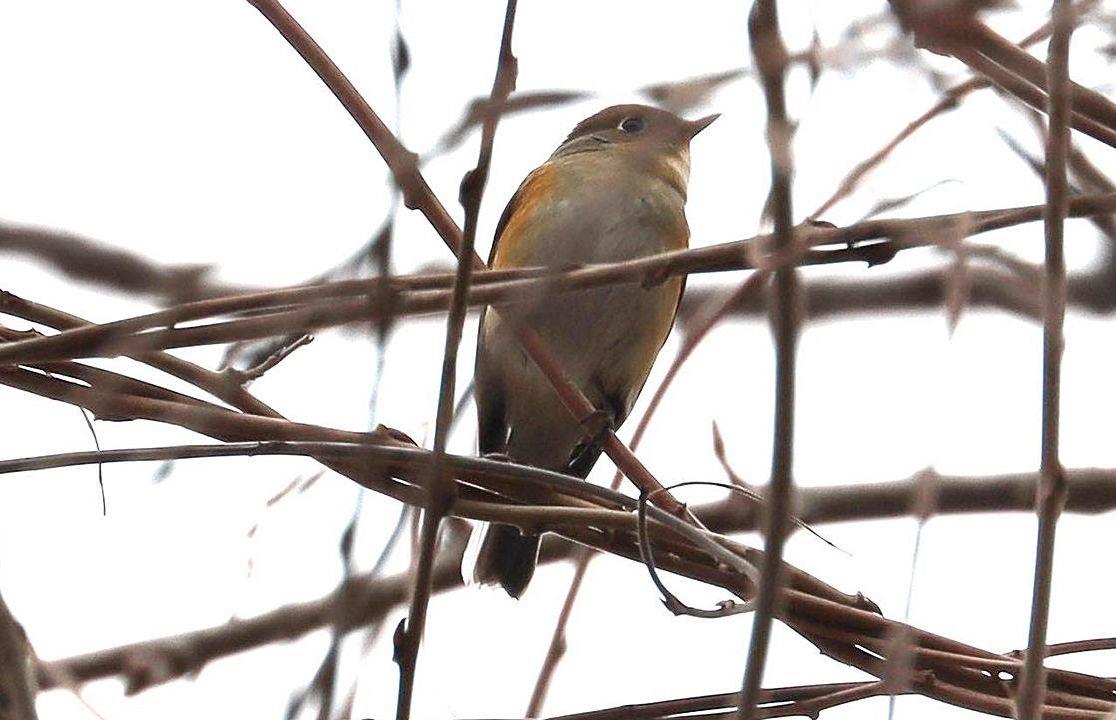
Photo by Tom McNeil • This red-flanked bluetail created quite a stir when it showed up in Fairfax County, Virginia, along the Potomac River.
Here’s confirmation that birds have wings and know how to use them to travel to some totally unexpected places. A good birding friend, fellow member of the Elizabethton Birding Club and, like me, an alumni of Hampton High School, has added a new bird – a species that I’d never even heard of – to his life list.
Tom McNeil posted on his Facebook page on Jan. 4 that he departed Winston-Salem, North Carolina, at 3 a.m. and drove to the Washington, D.C., Metro Area for a chance at seeing a little 5-inch-long bird.
From long acquaintance with Tom, I know he doesn’t hesitate to go after these “rare birds.” This particular bird – a red-flanked bluetail – had been generating a lot of excitement, Tom noted, since making its unlikely appearance in Fairfax County, Virginia.
The bird had already been present for four days when McNeil made his scramble to get binoculars on the bird.
I got the chance to discuss his sighting after he returned home just ahead of Winter Storm Fern after he had gone on another quick trip to add one of the common ground doves spotted in Sampson County to his North Carolina list.
“I came home to make sure the pipes didn’t freeze,” Tom said.
His wife, Cathy, works as a travel nurse and was working in Winston-Salem, North Carolina, for the weekend. “Unfortunately she is probably going to have to stay overnight at the hospital,” Tom said, explaining that the storm was expected to be really bad there.
North American Rarity
The rarity of the red-flanked bluetail is mind-boggling. Most sightings of this bird in North America have taken place in Alaska, but there are also 2023 records from California and New Jersey.
“This is only the second record in the eastern United States,” Tom said. “The first was in New Jersey, two years ago.”
He added, “I heard some people speculating that it was the same bird that was in New Jersey. I can’t even begin to speculate how it wound up here.”
This Eurasian species, according to Tom, should be hanging out around China, not just outside the capital of the United States. Tom noted that the bird represents only the second record of this species in the eastern United States.
That’s more than I knew. Thank goodness for Google. A little research and I soon learned that the red-flanked bluetail belongs to a group of insect-eating birds known as chats. Formerly, chats were thought to be thrushes. Genetic analysis has proven, however, that they are in fact a type of Old World flycatcher.
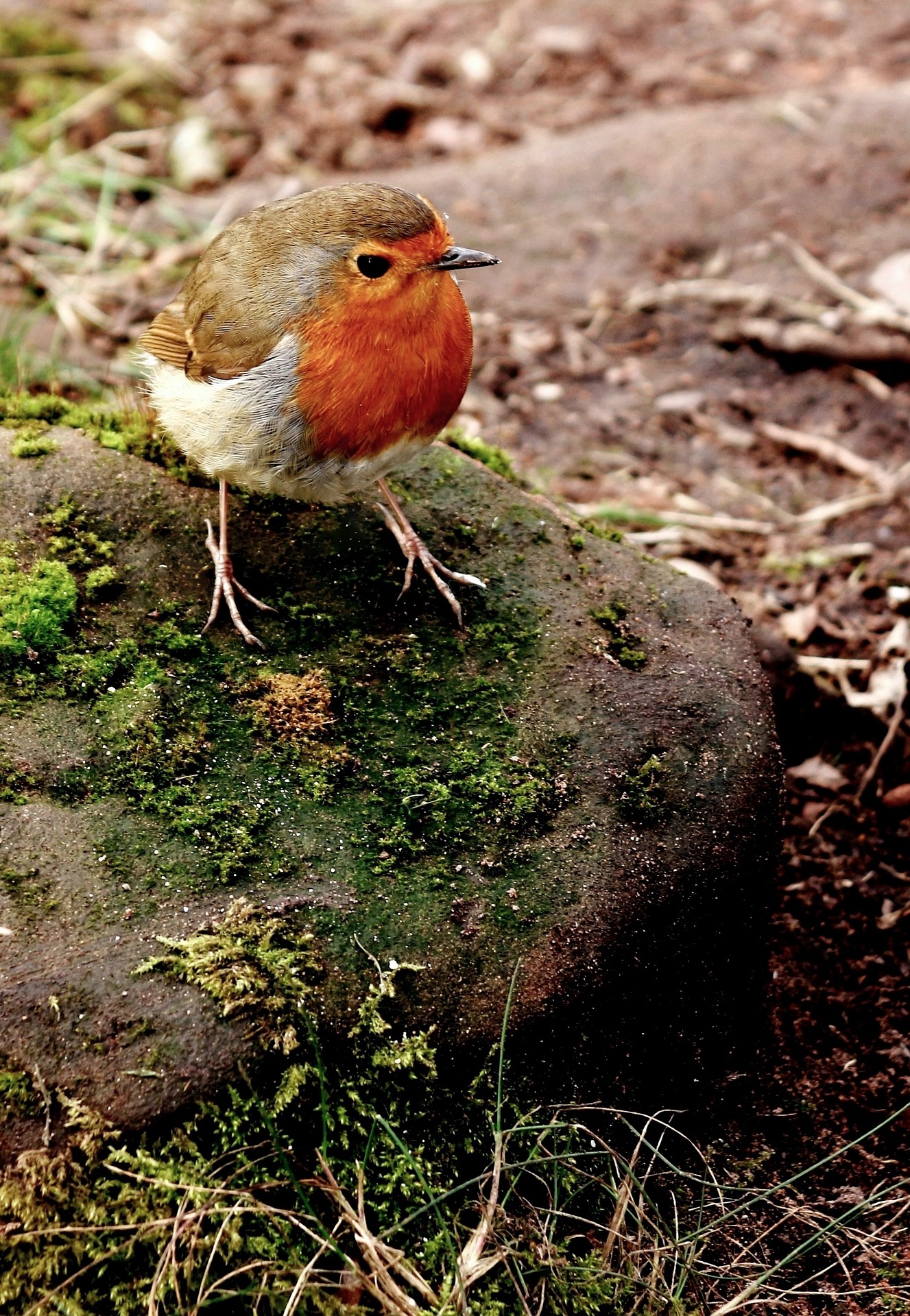
Photo by Andrew Poynton/Pixabay.com • The European robin is actually an Old World flycatcher and a relative of the red-flanked bluetail.
The fact that chats resemble Old World thrushes can be attributed to convergent evolution, which is the independent evolution of similar features and appearances in species of different lineages. Flycatchers and thrushes are birds, but that’s where the similarities end.
The red-flanked bluetail, known by the scientific name (Tarsiger cyanurus) is a small bird that breeds in mixed coniferous forests in northern Asia, parts of central Asia and northeastern Europe. It is migratory, nesting in Siberia and wintering mainly in southeast Asia, in the Indian subcontinent, the Himalayas, Taiwan and northern Indochina. In other words, it’s not supposed to be close to Washington. D.C.
What’s in a Name
You have to love this bird’s extremely descriptive common name. It was previously known as the orange-flanked bush-robin, which is also quite descriptive. Considering the bird is a flycatcher, however, calling it a bush-robin would not be accurate.
Tom added the bird to his life list with relative ease. His wife, Cathy, is a travel nurse and was working in Winston-Salem, North Carolina, when Tom learned that the bird was present in Great Falls Park in Virginia.
“From Winston-Salem, that is about 5.5 hours,” he said. “I left at 3 a.m. and got there about 8:30 a.m.,” he explained. “I only had to walk less than a quarter-mile to the area where it had been seen the most.”
He soon discovered that 75 or more people were already gathered and looking for the bird.
“They were spread out over a distance of about 200 yards,” he said. “After about an hour, someone spotted it and everyone converged on it. It was pretty exciting and humorous to watch.”
While the bird shows a blue tail and rump, it lacks the bright blue upperparts of an adult male red-flanked bluetail.
Based on the bird’s appearance, Tom said most observers have identified the bird as a female. “But it could be an immature male,” he added.
Birding Surprises
“Needless to say, it was a lifer,” he noted.
A “lifer” is birder slang for a species a birder has observed for the first time and added to a cumulative life list of species seen.
The bird has spent much of its time close to the Potomac River since its arrival in Fairfax County in Virginia.
“Apparently the Maryland state line passes very close to the shore,” Tom said. “Some folks were standing out in the river trying to add the bird to their Maryland lists.”
The red-flanked bluetail has certainly been his best bird so far in 2027.
“Back in December I picked up Swainson’s hawk, MacGillivray’s warbler and Brewer’s blackbird for my North Carolina life list,” Tom said.
“Cathy and I both went down to Chattanooga and got a great cormorant and Franklin’s gull for Tennessee,” he added.
He posted on Facebook that his biggest personal milestone for 2025 was getting his American Birding Association area 600th bird – a Townsend’s warbler – in a backyard in Charlotte, North Carolina.
Cathy had to work and didn’t get to go with Tom on the trip to get the bluetail.
“So if it’s still around in the next few days, we will probably go up and try for it together,” Tom said.
Here’s a recording someone made of a red-flanked bluetail in California in 2023.
Winging It
Birds have wings, as I’ve pointed out many times, and they know how to use them. It’s just more evidence that one never knows when an unexpected bird might make an appearance. This is the magic that keeps birding exciting.
•••
Bryan Stevens has written about birds, birding and birders since 1995. Email him at ahoodedwarbler@aol.com to share a sighting, ask a question or make a comment.
 Our Fine Feathered Friends