Category Archives: Uncategorized

Wrench of warblers signals start of autumn migration

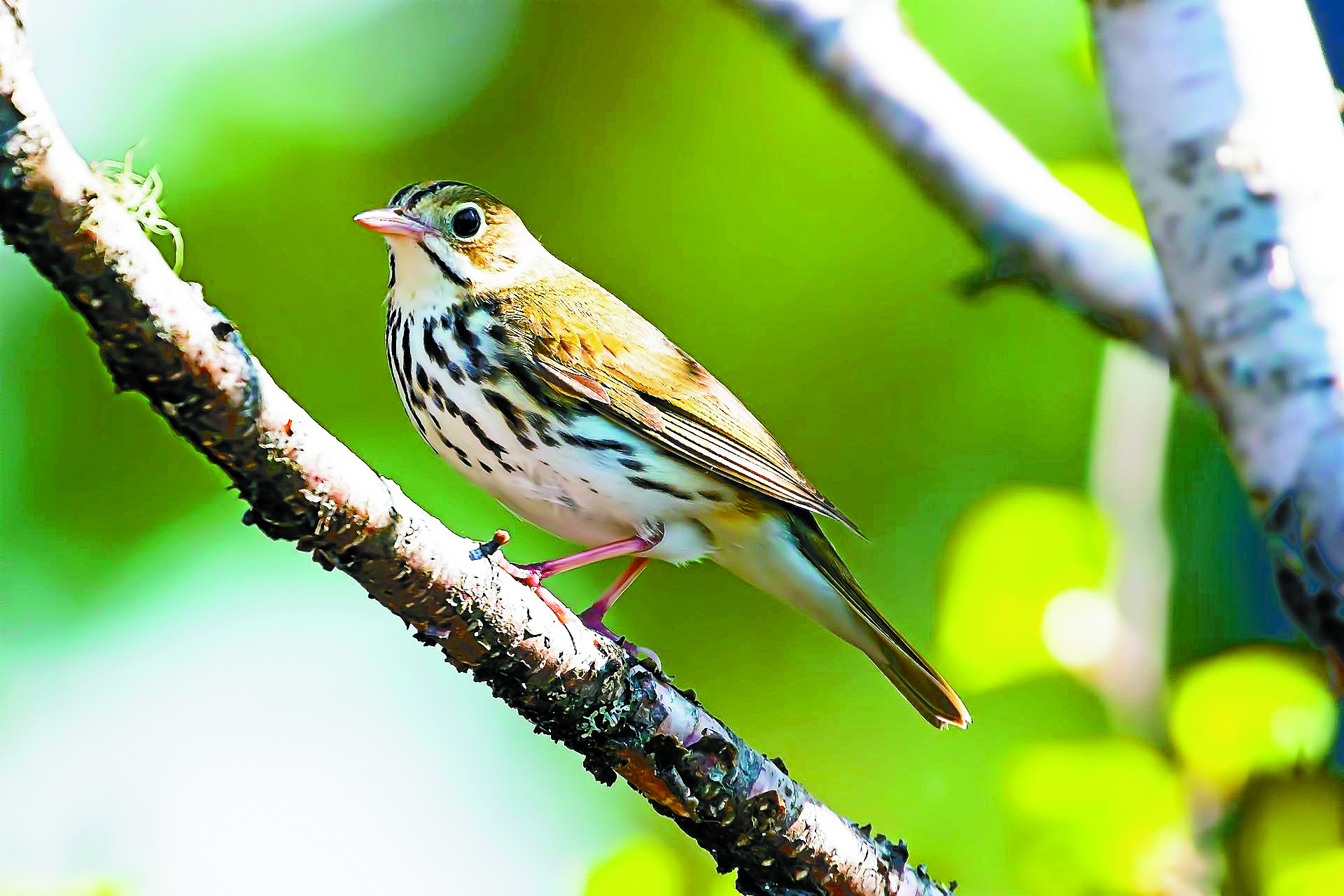
Photo by Hans Toom/Pixabay • An ovenbird, a member of the warbler family, perches on a branch. The bird gets its name from the shape of its nest, which resembles an old-fashioned Dutch oven. When male ovenbirds arrive on a potential nesting territory in the spring, they begin singing their loud, ringing “Teacher! Teacher! Teacher!” call almost tirelessly.

Autumn arrived Sunday, Aug. 14, heralded by a barely audible chip note that shattered the almost eerie silence that had accompanied my late morning woodland stroll up to that point. That timid chip note opened the floodgates, and I soon had a mixed flock of songbirds shadowing me, the scolding chorus increasing in volume as they demanded an explanation for my intrusion.

Of course, it’s not yet fall according to the calendar. The season won’t officially arrive until Thursday, Sept. 22. But there’s a day that comes every year that provides a tiny spark that kicks off my annual pastime of looking for migrating birds during my favorite season of the year.

The bird that unleashed the torrent of angry birds turned out to be an ovenbird, a species of warbler that nests in local woodlands every summer. In rapid succession, I also glimpsed a female black-throated blue warbler and a female hooded warbler. I also found it interesting that these warblers, particularly the hooded warbler, were also bus maneuvering to get a better look at me. I suppose it pays to be aware of one’s surroundings.

The in-your-face members of the mixed flock I encountered included a strident group of tufted titmice and some equally cantankerous Carolina chickadees. A couple of red-eyed vireos also took part in the songbird cacophony as these various birds joined forces to demand to know what I was doing in “their” woods.

Each warbler produces its own variation of the chip note, which is a vocalization that these nervous and energetic birds make as they flit from branch to branch through the woods. Learning to listen for the “chip” notes of the warblers that often join these mixed flocks is a great way to increase your warbler-watching opportunities. By “weeding” out the chickadees and titmice, it became easier to pinpoint the location of birds like the vireos and warblers.

Chip notes function for different purposes, but are usually produced when an individual warbler is alarmed by something, such as a human walking past their location. In some species, chip notes also provide a “contact call” to keep birds in touch with each other and aware of teach other’s location.

Many warbler species chip frequently while migrating, but there are also a few species such as Northern parula and black-and-white warbler that don’t usually produce these helpful chip notes. Unlike songs, which are almost exclusively produced by male warblers, both sexes produce chip notes.

I didn’t have binoculars with me when I encountered the flock, but I managed to put together enough behaviorisms and visual cues to identify the three species of warblers. 

Ovenbirds differ from other songbirds in that they do not hop along a branch or over the woodland floor. Ovenbirds walk. They take slow, deliberate steps, which is exactly how the bird I saw moved, sidling along a branch gently sloping toward the ground.

Female black-throated blue warblers are drab, especially in comparison to the breathtaking males of the species. They do have a little white square on each wing that is a good way to quickly identify them. At close range, I easily detected the square even without benefit of binoculars. I’m getting older, and my vision’s declined somewhat, but I’m pleased to still manage even tricky warbler identifications.

The female hooded warbler was easy. As she flew from branch to branch, she constantly fanned her tail, flashing the white outer tail feathers in a trademark manner for the species. Female hooded warblers don’t shine with the same radiance as the males, and they also lack the namesake black hood. A good look, however, is usually sufficient for identifying them. 

Most people have probably heard of a “murder” of crows as a way to describe a flock of these particular birds. Warblers also have their collective names. According to the Birdorable Blog, a flock of warblers is often referred to as a bouquet, a confusion, a fall, a cord or a wrench of warblers. 


This fact was new to me. I personally like “wrench of warblers.” It has alliteration and it describes how these amazing little songbirds can definitely “wrench” one’s attention from other matters.

I’ll be getting distracted a lot this fall as I seek not only warblers, but other migrants such as nighthawks and flycatchers, thrushes and tanagers, grosbeaks and sparrows, as well as raptors and shorebirds. August, September and October are busy months for some of our feathered friends. Keep alert and see if you can encounter your own “wrenches” of warblers this autumn.

If you’d like to share observations, make a comment or ask a question, email me at ahoodedwarbler@aol.com.


 

Join a bird club to gain birding experience

Photo Courtesy of Michele Sparks • Joining a bird club is a great way of gaining expertise in birding by meeting like-minded people of various experience levels.

Where does a beginning birder look for help getting started in the engaging pastime of birding?

In my own case, I turned to local birding organizations in Elizabethton and Bristol in Northeast Tennessee. 

Today, those two organizations that helped nurture my interest in birding are known as the Lee & Lois Herndon Chapter of Tennessee Ornithological Society, also known as Elizabethton Bird Club, and the J. Wallace Coffey Chapter of TOS, also known as the Bristol Bird Club.

I didn’t know the namesakes for the Elizabethton club, but I knew J. Wallace Coffey from the late 1990s until his death in 2016. Coffey and many other individuals helped guide and polish my birding skills with helpful advice, suggestions and, above all else, friendship. Any novice birder needs to extend some feelers to local birding groups. No online resources, smart phone apps or printed field guides can match the reservoir of experience that veteran birders have to offer.

Today the Bristol Bird Club is headed by President Larry McDaniel. 

He echoed my advice to new birders.

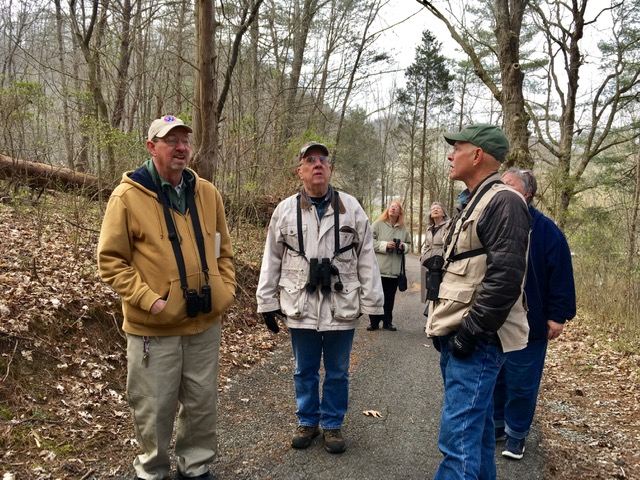
Photo Courtesy of Michele Sparks • George Larkins, Larry McDaniel and Teresa Hutson watch for hawks from atop Mendota Mountain in Southwest Virginia.

“Becoming a part of a local bird club such as the Bristol Bird Club is a great way for new and beginning birders to be around experienced birders who love to help you learn about birding,” McDaniel said. 

“You can quickly learn where to find birds in the area, how to know the birds you see in your own yard and many ways of learning how to identify different species,” he added. 

McDaniel noted that joining a birding group is also a great way to meet new friends who share a common interest. 

“We offer many outings where you will get to be in the field with other birders,” he said. “All of our outings are suitable for all levels including kids.”

McDaniel noted that many of those outing will focus on some of the region’s birding hot spots.

“Some of our favorite places to bird include South Holston Lake, Osceola Island (Recreation Area) below South Holston Dam, Paddle Creek Pond, Steele Creek Park, Holston Mountain, Shady Valley, Jacob’s Nature Park in Johnson City, Roan Mountain, Whitetop Mountain and Burke’s Garden,” he said. “There are many other spots that we like to frequent.”

Later this fall, a seasonally popular spot will come into play.

“Another favorite destination is the Mendota Hawk Watch where Ron Harrington and others have been conducting hawk counts in September for many years,” McDaniel said. “There are days when we can observe thousands of broad-winged hawks fly over as they make their way south.”

In addition, the Mendota Hawk Watch is a great way to look for other migrating raptors, including ospreys, bald eagles and occasionally golden eagles. 

“The club has a master bird bander,” McDaniel added. “Richard Lewis bands birds at his property and does an annual public demonstration during Wildlife Weekend at Steele Creek Park.”

Photo Courtesy of Michele Sparks • Birding clubs organize bird walks to various locations known for producing good birding opportunities.

McDaniel also shared some of the club’s rich history.

“The Bristol Bird Club has a long history,” he noted. “The club has been active since 1950. We are the J. Wallace Coffey chapter of the Tennessee Ornithological Society and an affiliate club of the Virginia Society of Ornithology. 

“Wallace was a major force in leading the club for over 50 years,” McDaniel added. “When he passed away a few years ago, members decided to rename the club in his honor.”

McDaniel said that the club has also worked with local landowners over the years to establish some of the most important birding hotspots in the area. 

“We also sponsor several Christmas Bird Counts,” he said.

McDaniel said that the club meets at 7 p.m. on the third Tuesday of each month in the Expedition Room of The Summit Building located at 1227 Volunteer Parkway in Bristol, Tennessee. 

“The meetings can also be joined on Zoom,” McDaniel said. “Zoom meeting invitations are sent to the BBC email group and posted on our Facebook group. To join the email group, send a request to BristolBirdClub2022@gmail.com. You can also find us and join our Facebook group to get more information and current news about the club. We also sponsor an email list serve called Bristol-Birds that you may join to receive information on recent sightings.”

He pointed out that the club does not have regular meetings during the months when the group hosts a club picnic and yearly banquet. 

“These dates are announced well ahead of time,” he said. 

“There is no regular meeting in December, but we do usually have a BBC Christmas party some time in December.”

The club will also participate in the 25th anniversary of the annual Wildlife Weekend at Steele Creek Park on Friday and Saturday, Oct. 7-8.  

McDaniel will lead a walk starting at 9 a.m. on Oct. 8 to the bird banding station operated by banders Richard Lewis and Rack Cross. “Plants and Pollinators” will provide the theme for this year’s Wildlife Weekend. Guest speaker for the Oct. 7 evening program will be Gerardo Arceo-Gomez, an associate professor in the biology department at East Tennessee State University.

Members of the Bristol Bird Club are also automatically members of the Tennessee Ornithological Society. 

“Membership with the Virginia Society of Ornithology requires individuals to join VOS on their own,” he noted.

Current BBC membership rates, including TOS membership, are family, $32; individual, $28; and student (K-12), $15. 

To make a comment, share a sighting or ask a question, email me at ahoodedwarbler@aol.com.

•••

Bryan Stevens has been writing weekly about birds since November of 1995.

Photo Courtesy of Michele Sparks • Getting to know other birds can be a rewarding experience on many levels.

Broad-winged hawks staging for migration

The broad-winged hawk needs a better publicist.

Photo by USFWS • Broad-winged hawks nest in the region during the summer, but these raptors stage massive migration flights every fall to return to their winter range in Central and South America. These hawks are smaller relatives of such raptors as red-tailed hawk and red-shouldered hawk.

Monarch butterflies with their impressive migration flights to reach mountains in Mexico where they will spend the winter and ruby-throated hummingbirds with their twice-a-year non-stop crossings of the Gulf of Mexico have consumed much of the press coverage for long-distance migrants. Even the Arctic tern, a bird most people will never see, has monopolized the phenomenon of migration due to its astounding migratory journeys from the Arctic Circle to the Antarctic Circle. That feat, incidentally, equals a 18,641-mile round trip. 

The broad-winged hawk, known scientifically as Buteo platypterus, thrills onlookers every September by staging phenomenal migratory flights that can include hundreds or thousands of individual birds. Outside of birding circles, however, the broad-winged hawk is not nearly as widely known as the monarch butterfly or Eastern North America’s ruby-throated hummingbird.

The genus Buteo includes the broad-winged hawk’s larger kin, including red-tailed hawk, rough-legged hawk, red-shouldered hawk and ferruginous hawk. Outside the United States, raptors in the buteo genus are often known as “buzzards.” When the first European colonists came to the New World, they applied the term buzzard to both types of native vultures as well as the large raptors like Swainson’s hawk that reminded them of the ones back in Europe such as the common buzzard.

Some of the buteo species have adapted to life on islands, including the Galapagos hawk and the Hawaiian hawk. There’s an endangered sub-species of broad-winged hawk known as the Puerto Rican broad-winged hawk that resides in forests on the island of Puerto Rico. 

Some of these hawks have quite descriptive names, including the white-throated hawk, gray-lined hawk, zone-tailed hawk and short-tailed hawk, as well as long-legged buzzard, jackal buzzard and red-necked buzzard.

The broad-winged hawk is a relatively small hawk, ranging in body length from 13 to 17 inches. As is the case with most raptors, females are larger than males. The broad-winged hawk is a predator, but they prey on relatively small prey, including  insects, amphibians, snakes, crustaceans, rodents and the occasional songbird.

These hawks are extremely vocal during their summer stay in wooded areas across the Eastern United States. It’s their piercing two-part whistled call that often draws the attention of onlookers to the bird’s presence. 

These hawks are already growing restless. In the first days of August, I saw three broad-winged hawks in different locations in the span of a couple of days. Young hawks have left the nest and are gaining a degree of independence. They will soon join their parents for the yearly migration to southern wintering grounds as far south as southern Brazil. 

Some famous places to witness the annual broad-winged hawk migration include Hawk Ridge, Minnesota, and Hawk Mountain, Pennsylvania. 

Closer to home, birders have gathered every September since 1958 for the Mendota Fire Tower Hawkwatch. The site is located atop Clinch Mountain at an old fire tower near Mendota, Virginia. The site straddles the county line between the Virginia counties of Russell and Washington and reaches an elevation of 3,000 feet.

Even without traveling to a hawkwatch site, it’s not too difficult to see one of these raptors in September. I’ve seen large flocks, or kettles, of broad-winged hawks while birding on Holston mountain near Elizabethton.

All too often, hawks and other raptors don’t receive the love they deserve from the public. They may even run afoul of misinformed individuals who may regard all predatory birds as “bad.” The reality is that all hawks are valuable components of a healthy, working ecosystem, with each species filling a certain niche.

•••

Stevens has been writing weekly about birds since 1995. To share a sighting, ask a question or make a comment, email ahoodedwarbler@aol.com. 

Eastern phoebe pair returns to familiar nest location

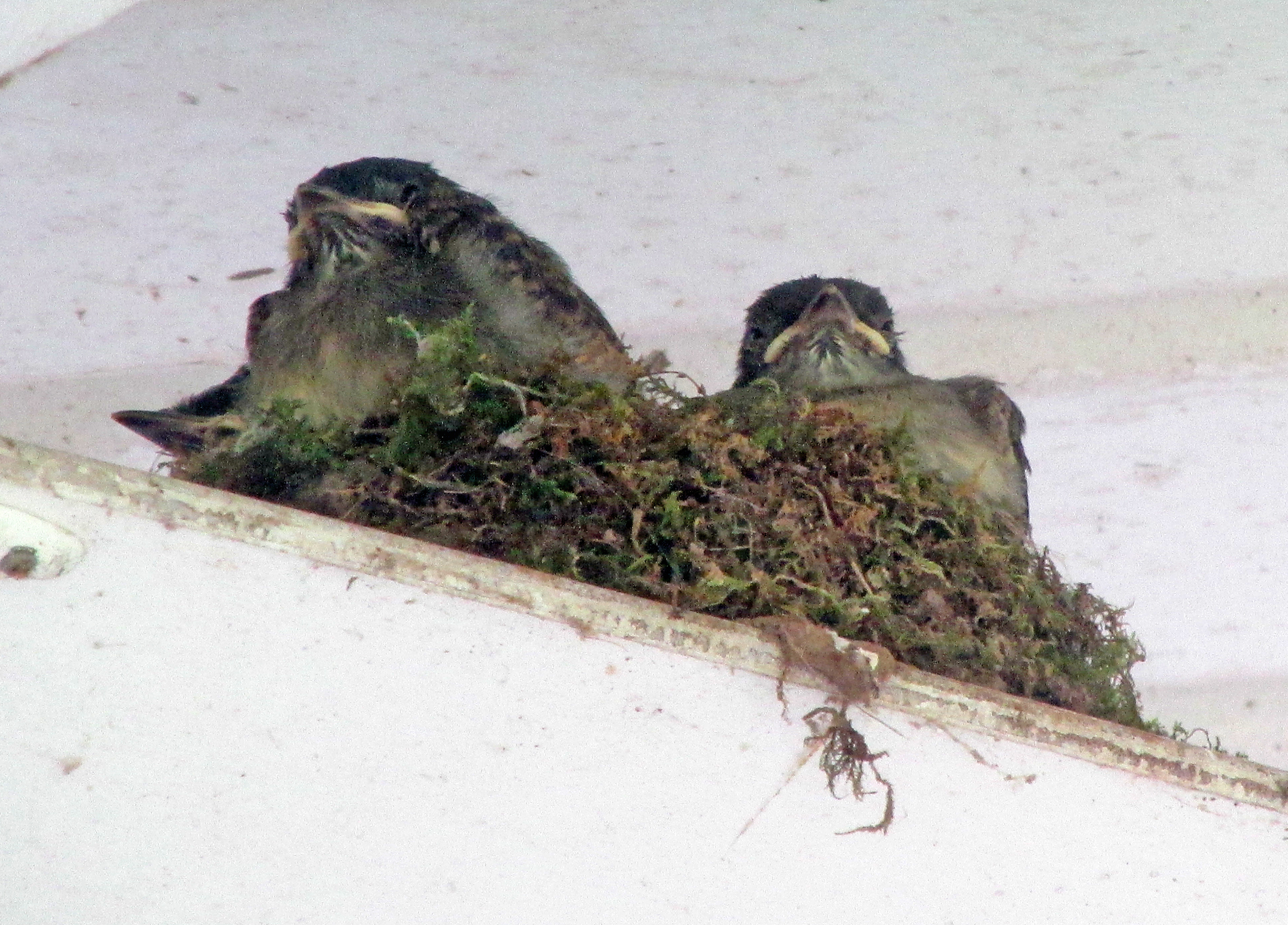
Photo by Bryan Stevens • A young Eastern phoebe not long out of the nest.

A pair of Eastern phoebes is nesting on one of the blades of my front porch ceiling fan. It’s the second time phoebes have selected the fan blades for a nesting site. Nothing was left of the previous nest, which was constructed several years ago. Suddenly, almost overnight, a new nest appeared.

The female phoebe sat diligently on the nest at night, and for the past couple of weeks I’ve avoided turning on the porch light at night so as not to disturb her.

Considering the bright finery worn by some of the more colorful summer birds, the Eastern phoebe can easily escape notice. In comparison with vibrant birds like rose-breasted grosbeak, ruby-throated hummingbird, scarlet tanager and yellow warbler, the Eastern phoebe is downright drab.

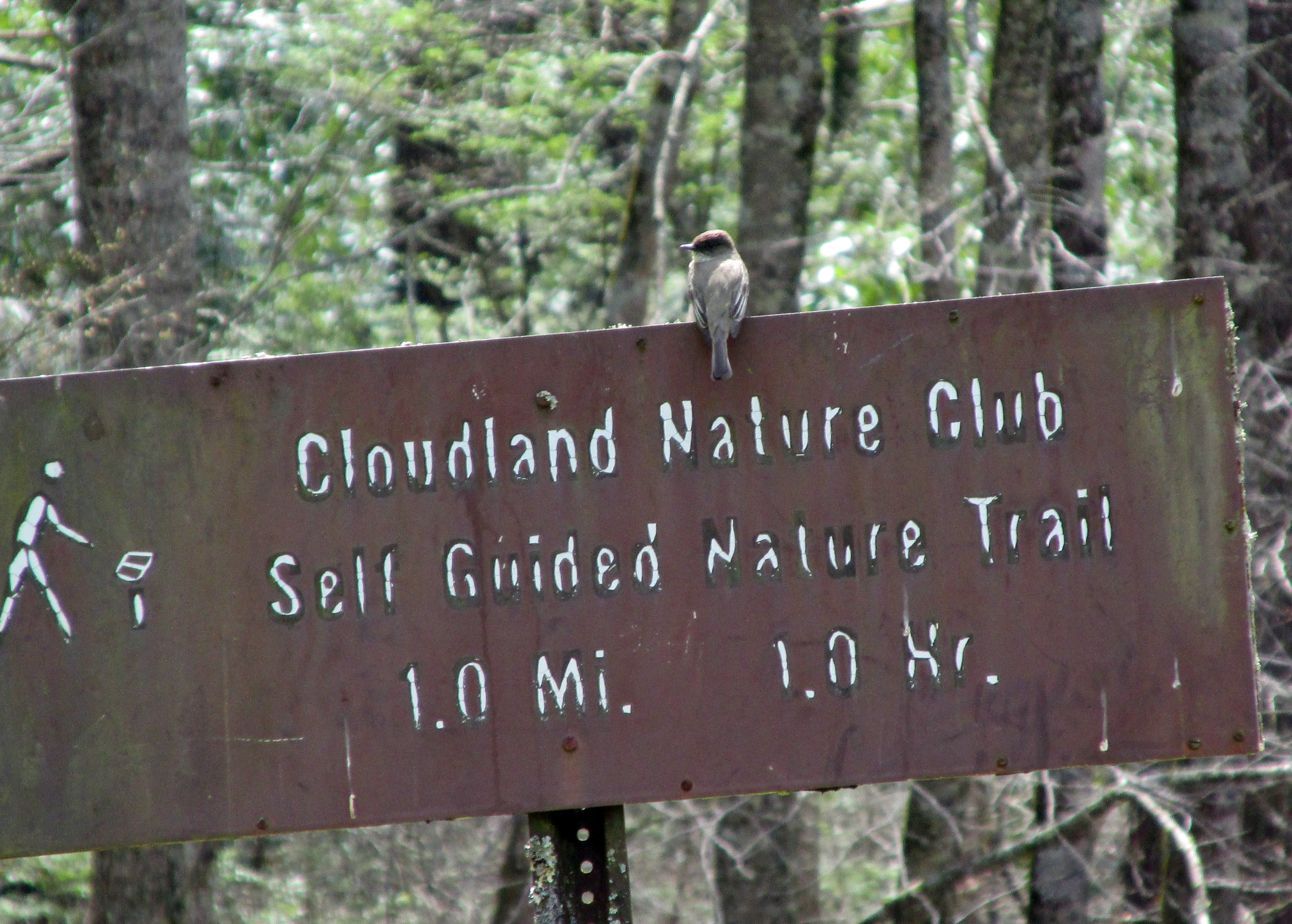
Nevertheless, this member of the flycatcher clan has earned itself a favorite spot in the hearts of many a birdwatcher. It’s one of those birds that even beginning birders find surprisingly easy to recognize and identify. While it may not have a dramatic plumage pattern to hint at its identity, the Eastern phoebe is quite at home around human dwellings and comes into close contact with people going about their daily routines. Rather tame — or at least not too bothered by close proximity with humans — the Eastern phoebe has one behaviorism that sets it apart from all the other similar flycatchers. When this bird lands on a perch, it cannot resist a vigorous bobbing of its tail. Every time that a phoebe lands on a perch, it will produce this easily recognized tail wag. It’s a behavior that makes this bird almost instantly recognizable among birders with the knowledge of this behavioral trait.

Photo by Bryan Stevens • Young phoebes occupy a nest previously build on a blade of a porch ceiling fan.

The Eastern phoebe is also an enthusiastic springtime singer, and the song it chooses to sing is an oft-repeated two-syllable call “FEE-bee” that provides the inspiration for this bird’s common name.

The Eastern phoebe, known by the scientific name of Sayornis phoebe, has two relatives in the genus Sayornis. The genus is named after Thomas Say, an American naturalist. The Eastern phoebe’s close relatives include the black phoebe and Say’s phoebe. The black phoebe ranges throughout Oregon, Washington and California and as far south as Central and South America. As its name suggests, this bird has mostly black feathers instead of the gray plumage of its relatives. The Say’s phoebe, also named for the man who gave the genus its name, is the western counterpart to the Eastern phoebe.

Since they belong to the vast family of New World flycatchers, it’s probably no surprise that these phoebes feed largely on insects. The birds will often perch patiently until an insect’s flight brings it within easy range. A quick flight from its perch usually allows the skillful bird to return with a morsel snatched on the wing. In the winter months, the Eastern phoebe also eats berries and other small fruit.

Phoebes are fond of nesting on human structures, including culverts, bridges and houses. With the latter, they were once known for their habit of placing their nests under sheltering eaves. At my home, a pair of Eastern phoebes often chooses to nest on the wooden rafters in my family’s garage.  In fact, a pair nested in the garage earlier this year. Phoebes also like to reside near a water source, such as a creek, stream or pond.

I suspect this nesting is a second attempt since it began in mid June. I got my first glimpse of the babies in the best when two fuzzy heads and beaks appeared over the rim of the nest on Thursday, July 7. 

Photo by Bryan Stevens • An Eastern phoebe perches on a sign by a trail in Roan Mountain, Tennessee.

Plants are great lures to increase bird diversity

Photo by Bryan Stevens • Bee Balm is a great attractor for butterflies and hummingbirds.

A mulberry tree overhanging the creek at my home produced a bonanza of fruit in mid-June. Some birds that hadn’t put in recent appearances suddenly became daily visitors. Cedar waxwings, gray catbirds, American robins, Northern cardinals and even a scarlet tanager feasted while the mulberries lasted.

Cedar waxwings win fans almost anywhere they go. Chances of luring these birds to your home and property can increase by offering some essential requirements. Tall trees, especially those that bear fruit, are attractive to these sociable birds. It’s more often water, not food, however, that will bring a flock of these birds close. They love a good splash in a bath, whether the source is a shallow stream or an ornamental pool set into the landscape.

Waxwings tend to travel in sizable flocks, usually in search of new food sources. The many members comprising a flock can deplete resources in a remarkably short time. Once the mulberry harvest is finished, they will seek out other fruit, including wild cherries and elderberries.

•••

In a garden plot dozens of common milkweed blooms began attracting butterflies, bees and other pollinators a few week ago. More recently, naturalized scarlet bee balm, which has spread vociferously through the woodland edge, has persuaded the finicky ruby-throated hummingbirds to return. Rhododendron maximus, often called “laurel,” is also in bloom, attracting its fair share of pollinators.

It’s important to note, however, that hummingbird numbers always fluctuate from year to year. Someone in Roan Mountain or Flag Pond might be overwhelmed with these tiny gems while people living in Erwin or Johnson City are still hoping to attract visits from these little birds. For instance, numbers might appear down in Northeast Tennessee but could be booming across the border in Western North Carolina.

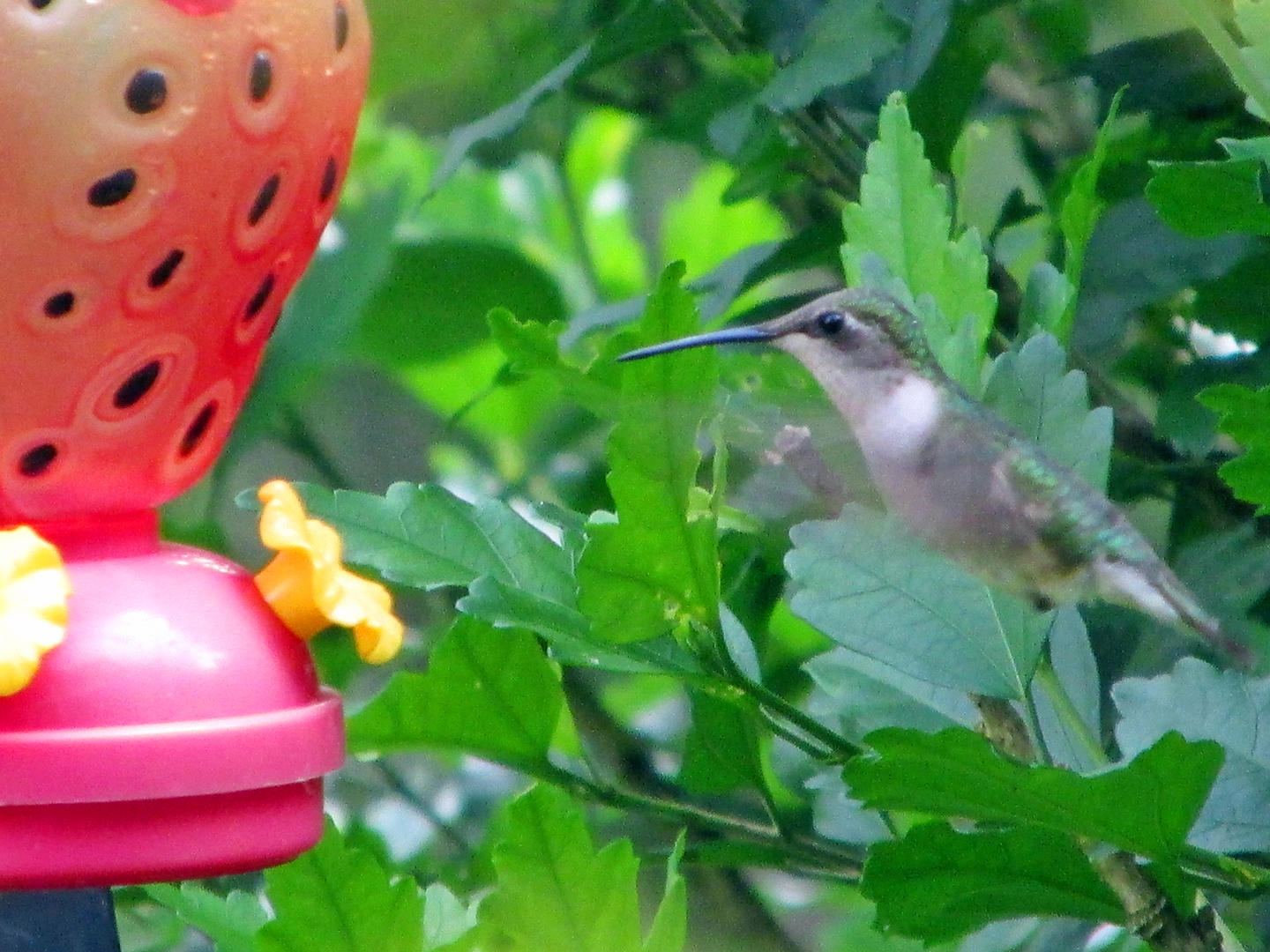
Photo by Bryan Stevens • Feeders with sugar water are great, but some nectar-bearing plants will increase the appeal from the point of view of the hummingbirds visiting.

The bee balm bloom is just the start. Those flowers will be replaced at my home by crocosmia’s red blooms and the orange blossoms of native jewelweed, also known as touch-me-not for its exploding seed pods. Hummingbirds are wild about these plants, as well as other summer garden favorites like canna, pineapple sage and 

If, like myself, you’ve been disappointed with seemingly low numbers of hummingbirds this spring, my best advice is to wait until late July and early August when young birds are out of the nest and parents and young start the slow-paced migration back south. Invariably, I see more hummingbirds in late summer and early fall than in the spring.

•••

Plots of wildflowers, sunflowers and day lilies are in bloom again at the Erwin National Fish Hatchery. While stopped there to take some photos with my phone, I heard American goldfinches twittering in the trees, probably attracted to the prospect of a bountiful spread of fresh seeds. The wildflowers include coneflowers, coreopsis and gaillardia, all different wildflowers that produced seeds sought by seed-eating birds like finches and sparrows.

To attract a diversity of feathered friends, its productive to move beyond simply offering a bird bath and well-stocked feeder. Landscaping lawns and gardens to offer plants that can provide a source of seeds, nectar or berries is also a great way to attract birds.

Summer is a season of plenty for American goldfinches. Even roadside ditches are choked with chicory, evening primrose and other seed-producing plants often dismissed as “weeds.” Simply driving local roads has produced several sightings of flocks of American goldfinches in recent weeks.

These small, vibrant finches are also regular visitors to my feeders, although they don’t really need my offering of black oil sunflower seeds to supplement the natural smorgasbord available to them.

The American goldfinch is also one of the last songbirds to nest each season. Some goldfinches don’t even start to think about nesting until late July and early August. Learn more about how the plants you select for inclusion in your landscape can benefit our feathered friends. The Audubon Society’s website had a helpful article online at http://www.audubon.org/news/how-make-your-yard-bird-friendly-0. 

To ask a question, share a sighting or make a comment, email me at ahoodedwarbler@aol.com. 
Unicoi County Summer Bird Count finds 109 species

The ninth annual Unicoi County Summer Count was held Saturday, June 18, with 15 observers in five parties. Participants tallied 102 species, which is below the average of 109 species for this count.

My party of counters included Brookie and Jean Potter, Rob Armistead and myself. We counted in the Limestone Cove community, which meant I had the convenience of counting practically in my own back yard.

Some good birds were found by the count parties, including yellow-billed cuckoo, yellow-bellied sapsucker, warbling vireo and fish crow, which was found for a second consecutive year. Fish crows have been expanding their presence in counties throughout Northeast Tennessee.

My group was pleased to get good looks at birds like rose-breasted grosbeak and yellow-bellied sapsucker.

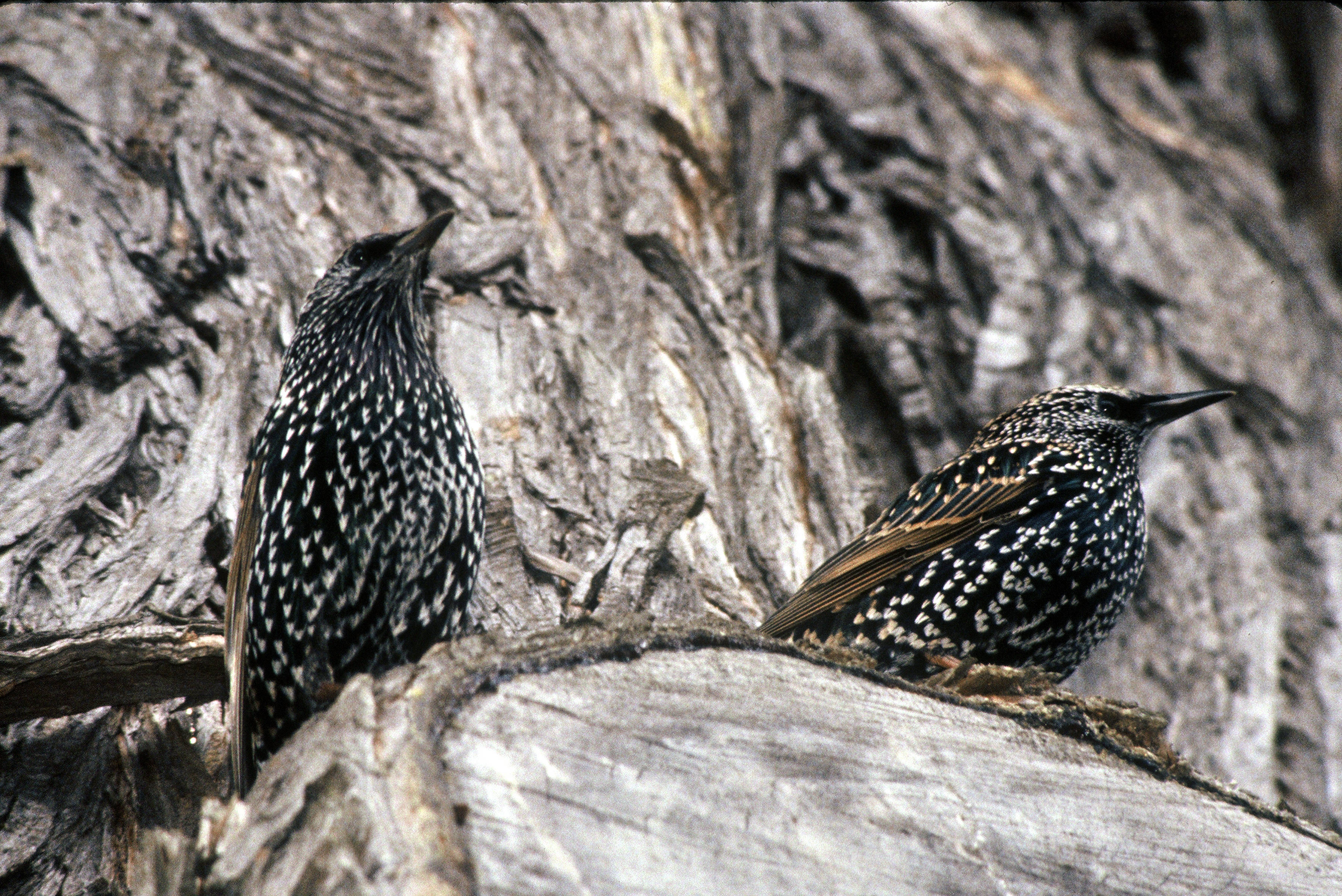
European starling came out on top as most abundant bird with 339 individuals counted. The American robin came in a distant second with 269 individual robins found.

Photo by U.S. Fish & Wildlife Service
The European Starling ranked as the most common species on the count.

The list:

Canada goose, 54; wood duck, 6; mallard, 47; wild turkey, 1; rock pigeon, 86; mourning dove, 100; and yellow-billed cuckoo, 1.

Chuck-will’s-widow, 2; Eastern whip-poor-will, 12; chimney swift, 19; ruby-throated hummingbird, 7; and killdeer, 13.

Great blue heron, 3; green heron, 1; black vulture, 10; turkey vulture, 48; Cooper’s hawk, 1; red-shouldered hawk, 1; broad-winged hawk, 6, and red-tailed hawk, 3.

Eastern Screech-Owl, 2; barred owl, 1; belted kingfisher, 3; red-bellied woodpecker, 13; yellow-bellied sapsucker, 4; downy woodpecker, 10; Northern flicker, 5, and pileated woodpecker, 9.

Great crested flycatcher, 1; Eastern kingbird, 13; Eastern wood-pewee, 6; Acadian flycatcher, 23; least flycatcher, 2; and Eastern phoebe, 65.

White-eyed vireo, 4; blue-headed vireo, 36; warbling vireo, 2; red-eyed vireo, 108; blue jay, 56; American crow, 173; fish crow, 2; and common raven, 4.

Tree swallow, 78; Northern rough-winged swallow, 25; purple martin, 40; barn swallow,  50; cliff Swallow  100; Carolina chickadee, 50; tufted titmouse, 37; red-breasted nuthatch, 1; white-breasted nuthatch, 2; and brown creeper, 3.

House wren, 26; Carolina wren, 92; blue-gray gnatcatcher, 12; golden-crowned kinglet, 4; Eastern bluebird, 82; veery, 10; hermit thrush, 1; wood thrush, 36; American robin, 269; gray catbird, 20; brown thrasher, 14; and Northern mockingbird, 25.

European starling, 339; cedar waxwing, 35; house sparrow, 16; house finch, 32; and American goldfinch, 80.

Chipping sparrow, 67; field sparrow, 13; dark-eyed junco, 10; song sparrow, 166; Eastern towhee, 32.

Yellow-breasted chat, 1; Eastern meadowlark, 6; orchard oriole, 2; red-winged blackbird, 67; Brown-headed cowbird, 21; and common grackle, 54.

Ovenbird  37; worm-eating Warbler, 13; Louisiana waterthrush, 6; black-and-white warbler, 10; Swainson’s warbler, 5; Kentucky warbler, 1; common yellowthroat, 3; hooded warbler, 45; American redstart, 1; Magnolia warbler, 1; Northern parula, 20; Blackburnian warbler; 2; yellow warbler; 1; chestnut-sided warbler, 6; black-throated blue warbler, 26; yellow-throated warbler, 7; black-throated green warbler, 27; and Canada warbler, 1.

Scarlet tanager, 17; Northern cardinal, 98; rose-breasted grosbeak, 3; and indigo bunting, 108.

Tanagers are among world’s most colorful birds

Photo Courtesy of Jean Potter
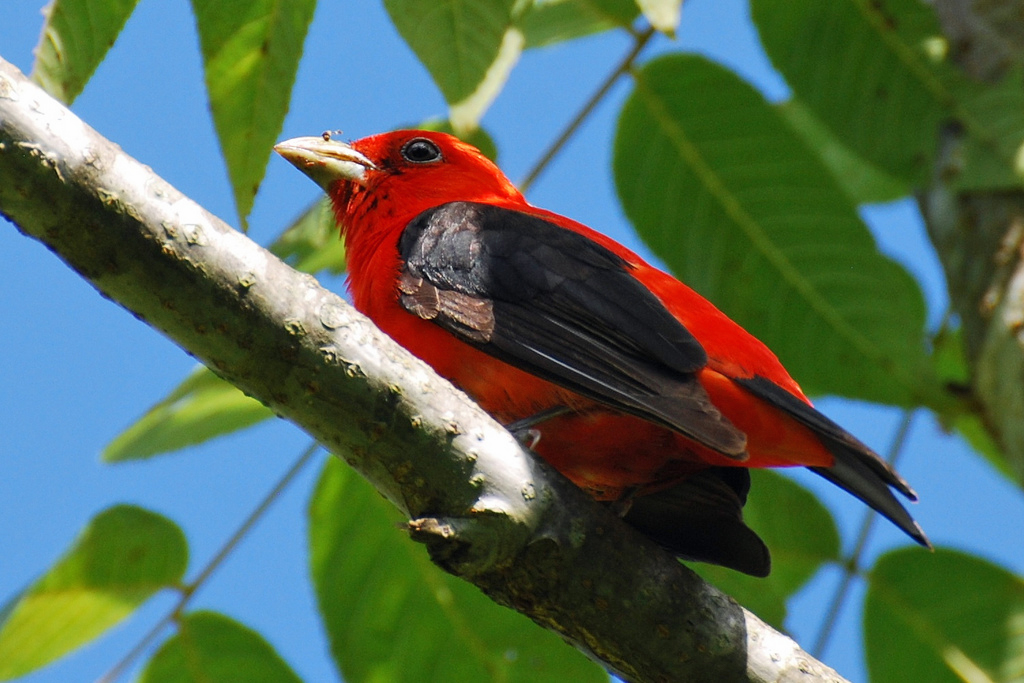
A male scarlet tanager brightens shadowy woodlands with a flash of tropical colors yet remains mostly inconspicuous in the forest canopy.

The daily chorus of songbirds greeting the dawn is usually welcome unless I’m feeling particularly sleepy. Carolina wrens are one of the first birds in residence to sing each day. This time of year they get plenty of accompanists, including American robins, Eastern phoebes, Carolina chickadees, Northern cardinals, Eastern towhees, red-eyed vireos, indigo buntings, hooded warblers, ovenbirds and others.

As June arrived, however, I began to take notice of the absent voice of scarlet tanagers. It wasn’t until June 9 that I heard the first male scarlet tanager of the season singing from the wooded ridge behind my home.

In late April and throughout May, once the oaks, the maples, the poplars and other trees begin spreading out new green leaves to create a concealing woodland canopy, a familiar song can be heard from the treetops. 

Upon first hearing it, listeners might mistake the hidden singer for an American robin. Listen a little closer, however, and the song sounds as if it is being delivered by a robin stricken a bit hoarse with a sore throat.

The producer of the hoarse but melodic song is a scarlet tanager, one of the most showy birds of Eastern woodlands from April to early October. Like the warblers, vireos, flycatchers and other songbirds, the scarlet tanager is migratory. They spend the winter months in the tropical forests of Central and South America. The scarlet tanager is better attired than most birds to provide us a glimpse of what life must be like in the tropical rain forests, which are a riot of color and sound.

It takes only one sighting to sear the vision of these vibrant birds into our retinas, as well as into our memories. The scarlet tanager boasts a brilliant plumage of crimson red paired with black wings and tail. Of course, this is the male. The female scarlet tanager makes no real claim to the common name with her comparatively drab greenish plumage. However, the scientific name, Piranga olivacea, gives a nod to the olive-green plumage of females, young males and even adult males when molting their feathers.

Although once nominated as a candidate for state bird by the school children of Minnesota, the scarlet tanager ultimately failed to gain the designation. Instead, as perhaps is fitting for the “Land of 10,000 Lakes,” the common loon represents Minnesota as official state bird.

The related summer tanager is less widespread in Northeast Tennessee, but males of this species are no less dramatic in appearance than the Scarlet Tanager. Male summer tanagers are a rosy-red over all their body. Females, with a dull greenish plumage, are relegated to the background. She can be distinguished from her counterpart, the scarlet tanager, because of their darker wings and larger bills.

The summer tanager holds the distinction of being the only all-red bird in North America. Birds like Northern cardinals and scarlet tanagers also have some black in their plumage.

I’ve seen summer tanagers at Steele Creek Park in Bristol and Willow Springs Park in Johnson City. Sadly, over the years my sightings of this attractive songbird have been few and far between. My most memorable observation of a male summer tanager took place many years ago during a spring visit to Fripp Island, South Carolina. Most of the summer tanagers I have observed in Northeast Tennessee have been females.

On the other hand, I usually have a few scarlet tanagers in residence around my home during the summer months. If the woodlands at my home fail to attract this bird, I can usually make a visit to higher elevations on Roan Mountain, Unaka Mountain or Holston Mountain to gain an exciting glimpse of this beautiful bird.

Worldwide, there have traditionally been about 240 species of tanagers. Experts have changed some of the ways they classify tanagers, so that figure is no longer set in stone. Tanagers are a New World family of birds, concentrated mainly in the tropics.

In the western United States, the scarlet and summer tanagers are replaced by Western tanagers and hepatic tanagers. During a visit to Salt Lake City in Utah in 2006 I saw several Western tanagers.

Some of the world’s other tanagers are known by extremely descriptive names, including flame-colored tanager, green-headed tanager, golden-chevroned tanager, azure-shouldered tanager, fawn-breasted tanager, saffron-crowned tanager, metallic-green tanager, turquoise tanager, scarlet-bellied mountain tanager and diademed tanager.

A print of Scarlet Tanagers by early North American naturalist and painter John James Audubon.

Scientists have recently given fresh consideration to the relationship of many tanagers to the other birds of the world. As a result, many of the North American tanagers are now closely allied with such birds as Northern cardinal and have been pushed into a tenuous relationship with tropical tanagers.

The scarlet tanager is not typically a feeder visitor, but you can lure these birds with orange slices placed in special feeders or simply spiked onto the branches of backyard trees. As an added bonus, orange slices can also attract birds such as baltimore orioles and gray catbirds.

Fond of fruit, the scarlet tanager incorporates various berries into its diet. Landscape around your home with fruit-bearing trees such as mulberry, serviceberry and wild cherry to make your yard more inviting to these elusive bird.

Yes, the scarlet tanager is more often heard than seen, but it is a bird worth seeking out. A sighting is guaranteed to impress. Seeing a scarlet tanager will almost make observers feel like they’ve been dropped into a tropical jungle instead of standing beneath a woodland canopy in the Southern Appalachians.

I’ll be participating in some summer bird counts over the next few weeks, so I am hopeful that my 2022 drought of scarlet tanager sightings will soon be at an end.

Bird count finds 147 species in region

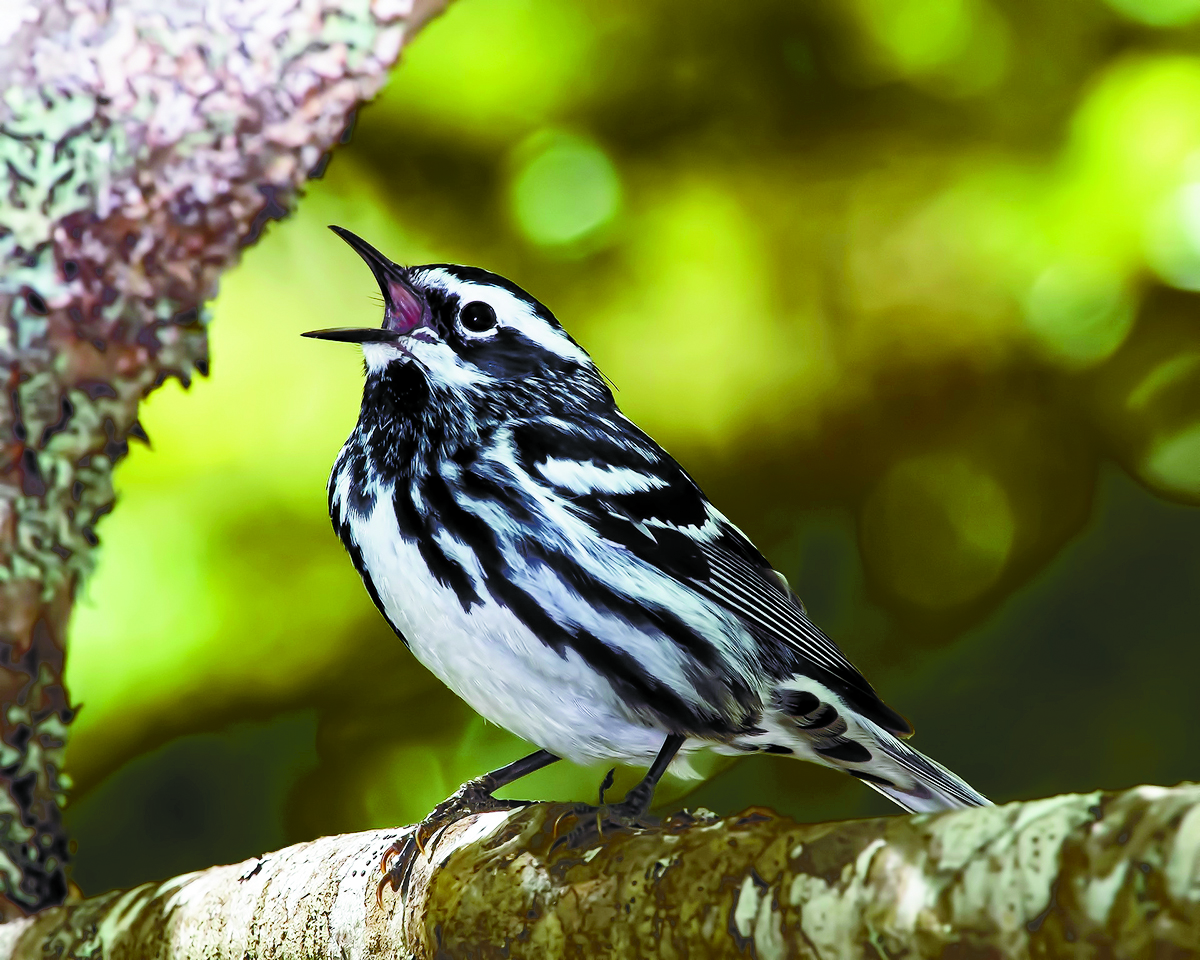
Photo Hans Tooms/ Pixabay • A male black-and-white warbler sings his buzzy song from a woodland perch. A total of 37 individual black-and-white warblers were found during the recent Spring Bird Count conducted by the Elizabethton Bird Club in Northeast Tennessee.


The 79th consecutive Elizabethton Spring Count was held Saturday, May 7, with 28 observers in about a dozen parties, plus two feeder watchers. The area covered included Carter County and parts of the adjacent counties of Johnson, Sullivan, Washington and Unicoi.

The weather was less than ideal, with cool temperatures ranging from 45 to 60 and mist or light rain for part or most of the day. The mountainous areas had the most rain.

Long-time compiler Rick Knight noted that participants tallied 147 species, which is slightly below the recent 30 year average of 150 species.

In addition, most species were in reduced numbers, likely due to the difficulties presented by the weather (less singing, fewer soaring birds) during the count. On the other hand, the weather may have grounded some of the shorebirds. Large numbers of swallows and swifts were foraging low over the water in different locations due to the cool temperatures.

Also significant were some of the species missed by participants, including ruffed grouse, sora, American woodcock, both night-herons, sharp-shinned hawk, red-shouldered hawk, brown creeper, ruby-crowned kinglet and hermit thrush.

Some of the more abundant birds included American robin (924), European starling (730), Canada goose (482) and red-winged blackbird (302).

The list follows:

Canada goose, 482; wood duck,  58, blue-winged teal,  4; mallard, 113; bufflehead, 1; hooded merganser,  3; and common merganser,  1.

Wild turkey, 41; rock pigeon, 124; Eurasian collared-dove, 4; mourning dove, 259; yellow-billed cuckoo, 2; common nighthawk, 1; chuck-will’s-widow, 6; Eastern whip-poor-will, 12; chimney swift, 401; and ruby-throated hummingbird, 19.

Killdeer, 32; least sandpiper, 16; pectoral sandpiper, 2; semipalmated sandpiper, 1; spotted sandpiper, 34; solitary sandpiper, 13; lesser yellowlegs, 5;  greater yellowlegs, 1; and ring-billed gull,  3.

Common loon, 3; double-crested cormorant, 75; great blue heron, 51; great egret, 3; and green heron, 10.

Black vulture,  40; turkey vulture, 56; osprey, 4; cooper’s hawk, 3; bald eagle, 5; broad-winged hawk, 2; red-tailed hawk, 8; Eastern screech-owl, 3; great horned owl, 2;  and barred owl,  1.

Belted kingfisher, 11; red-headed woodpecker,  2; red-bellied woodpecker, 46; yellow-bellied sapsucker, 3; downy woodpecker,  20; hairy woodpecker,  7; Northern flicker,  36; and pileated woodpecker,  29.

American Kestrel,  8; great crested flycatcher, 14; Eastern kingbird, 30; Eastern wood-pewee, 11; Acadian flycatcher,  15; least flycatcher, 2; and Eastern phoebe,  61.

White-eyed vireo, 7; Yellow-throated vireo, 4; Blue-headed vireo,  25; warbling vireo,  8; red-eyed vireo,  149; blue jay,  192; American crow,  280; fish crow,  4  (present third year in a row) and common raven,  8.

Bank swallow, 6; tree swallow, 399; northern rough-winged swallow,  168; purple martin,  94; barn swallow,  405; and cliff swallow,  499.

Carolina chickadee, 123; tufted titmouse,  140; red-breasted nuthatch, 1; white-breasted nuthatch,  11; house wren,  53; winter wren,  1; Carolina wren, 161; and blue-gray gnatcatcher, 51.

Golden-crowned kinglet,  2; Eastern bluebird, 141; veery, 19; gray-cheeked thrush, 1; Swainson’s thrush, 3; wood thrush,  51; American robin,  924; gray catbird, 75; brown thrasher,  64; Northern mockingbird,  93; European starling, 730; and cedar waxwing,  75.

House sparrow, 50; house finch, 62; pine siskin, 3; and American goldfinch,  224.

Grasshopper Sparrow, 1; chipping sparrow, 95; field sparrow,  29; dark-eyed junco, 19; white-crowned sparrow, 1; white-throated sparrow, 1; savannah sparrow,  1; song sparrow, 290; Lincoln’s sparrow, 1; and Eastern towhee,  151.

Yellow-breasted chat, 11; Eastern meadowlark,  91; orchard oriole,  20; Baltimore oriole, 11; red-winged blackbird,  302; brown-headed cowbird, 101; and common grackle,  281.

Ovenbird,  88; worm-eating warbler, 13; Louisiana waterthrush, 25; Northern waterthrush, 1; golden-winged warbler, 1; black-and-white warbler, 37; Swainson’s warbler, 6; Tennessee warbler, 1; Kentucky warbler, 5; common yellowthroat, 17; hooded warbler,  85; American redstart,  14; Cape May warbler, 1; Northern parula, 46; magnolia warbler,  2; bay-breasted warbler, 2; Blackburnian warbler,  3; yellow warbler, 9; chestnut-sided warbler, 15; blackpoll warbler,  2; black-throated blue warbler,  33; palm warbler, 1; pine warbler,  9; yellow-rumped warbler,  9; yellow-throated warbler,  44; prairie warbler,  1; black-throated green warbler, 33; and Canada warbler, 10.

Summer tanager, 1; scarlet tanager,  60; Northern cardinal,  270;  rose-breasted grosbeak,  11; blue grosbeak,  8; indigo bunting , 104; and dickcissel,  2.

•••

Based on the count results, it’s not difficult to see that many birds are moving through the region as part of the yearly phenomenon of spring migration. Share a sighting, ask a question or make a comment by emailing ahoodedwarbler@aol.com.

Red-headed woodpeckers more uncommon than some of their kin


Photo by Pixabay • The red-headed woodpecker is accurately named for its entirely red head. Male and female red-headed woodpeckers are identical in appearance, but young birds lack the red head.

Some readers asked for help in determining the identity of some birds that they have encountered. I tried to offer some insight into each query.

First, Lynda Carter in the Lamar community of Washington County emailed me recently with a question about a possible sighting of a red-headed woodpecker.

“I know they are uncommon and I did not get my binoculars on the bird,” Lynda wrote. “I saw the bird land in a large open-crowned oak after hearing a call very like (a) red-bellied (woodpecker) but different somehow.”

Lynda noted that she could see a lot of red on head and when the bird flew across her pasture to a pine tree, she could see big blocks of black and white in the plumage.

“I shared my sighting with my sister who lives up the mountain from me and she thought she spotted the same bird on a telephone pole in her yard a few days later,” Lynda said.

Lynda added that she and her sister live on the end of Embreeville Mountain. “We are interested in your thoughts concerning our mystery bird,” she wrote.

I responded to Lynda with my absolute confidence that she and her sister did see a red-headed woodpecker. Here are a few reasons for my belief in the identification she came up with.

The large patches of black and white are trademark characteristics of a red-headed woodpecker. The black is actually almost a glossy blue-black.

Of course, the entirely red head also separates the aptly-named red-headed woodpecker from all other members of the family in the region.

She and her sister also live in a section of Washington County near some known locations for finding red-headed woodpeckers.

Photo by USFWS • The red-headed woodpecker is an easily identified bird for anyone getting a good look.

It’s also spring. Red-headed woodpeckers are partly migratory, so her sighting could have involved a migrating bird. I’ve seen several red-headed woodpeckers in the spring in some surprising locations over the years.

We corresponded a bit more and Lynda shared more about the birds around her home.

“I do live in a great spot for birding,” she wrote.  “We have open pasture, wooded gullies and the mountain behind us. Cherokee National Forest is my neighbor to the south and the Nolichucky River is just down the road.”

Lynda hosts nesting wood thrushes that return to the same open wooded patch behind her house. “I just love hearing their song in early morning hours and again in the evening,” she wrote.

She also wrote that she has seen more scarlet tanagers, which is always a thrill, in the last year or two.

“I have had male and female rose-breasted grosbeak at my bin feeder,” she added.

She has recently heard Eastern meadowlarks, red-eyed vireo and ovenbird. She also provides several nest boxes currently occupied by Eastern bluebirds and tree swallows.

The red-headed woodpecker and its relative, the red-bellied woodpecker, belong to a genus of tree-clinging birds known as Melanerpes. The term, translated from Latin, means “black creeper.” Indeed, many of the two dozen members of the Melanerpes genus have an extensive amount of black feathers in their plumage. Other members of the genus include woodpeckers from the Caribbean, as well as from Central and South American. Some of them have quite colorful names, such as yellow-tufted woodpecker, golden-cheeked woodpecker and the accurately named beautiful woodpecker, a native of Colombia.

The red-bellied is a common bird in the region, but some effort or simple good luck is needed to find red-headed woodpeckers. These woodpeckers, which often form family flocks, have localized populations that shift from year to year.

One reason the red-headed woodpecker may be less common than its cousin relates to its fondness for hawking for flying insects along roadsides. The woodpeckers are frequently struck by cars when swooping after their winged prey. Historically, the American chestnut and beech trees also provided much of the mast crops consumed by these birds. With the extermination of the chestnut and the scarcity of beech in some locations, the red-headed woodpecker now depends on oaks and acorns. In fact, this woodpecker is rarely encountered outside of woodlands offering an abundance of oak trees.

https://www.youtube.com/watch?v=Is6MB_8-7ro

•••

Ed Wells, who lives in Nebo, North Carolina, near Lake James, emailed me recently and presented me with another identification challenge.

“I enjoy reading your feature each week,” Wells wrote.  “You always inform and teach me.”

He  also attached some photographs of a bird that flew into the side of his house in 2021.

“I have not been able to make a positive ID,” he said.  “It appeared to be a small shorebird with a straight bill of medium length. Wing span was probably 10 inches or less and perhaps about the same from bill to tail.”

“I moved the stunned bird out of the cold wind and placed it on some mulch,” Ed wrote. “It eventually recovered and flew away.”

Ed also shared that while boating on the lake recently, he saw a bird that he believes might be the same species as his mystery bird. The shorebird was perched on rocks near the waterline.

“My boat startled it and it flew rapidly away,” he added.

https://www.youtube.com/watch?v=gD6nQm1CFKI

Based on his photos, the best I could do was determine the bird was some sort of “peep,” which is a birding nickname for a group of small- to medium-sized sandpipers.

I speculated that the bird might have been a stilt sandpiper, but I also consulted Rick Knight, a veteran birder with much more experience with shorebirds.

“The bill looks too short for stilt sandpiper,” Rick concluded. He said that he would lean toward the bird being a least sandpiper or pectoral sandpiper.

Many shorebirds have been migrating through the region in recent weeks. During the recent five-county Spring Bird Count conducted by the Elizabethton Bird Club, counters found several shorebird species, including least sandpiper, pectoral sandpiper, semipalmated sandpiper, spotted sandpiper, solitary sandpiper, lesser yellowlegs greater yellowlegs and killdeer.

•••

Have questions about birds? Email me at ahoodedwarbler@aol.com. Feel free to make comments and share observations, too.

Common yellowthoat, other birds help make migration exciting time

Photo by Pixabay • With a black mask, the male common yellowthroat resembles a tiny feathered bandit as he goes about his daily routine interrupted by bouts of singing his “witchety! witchety! witchety!” song.

Photo by Pixabay
With a black mask, the male common yellowthroat resembles a tiny feathered bandit as he goes about his daily routine interrupted by bouts of singing his “witchety! witchety! witchety!” song.

A hummingbird flew in to one of my porch feeders at 6:28 p.m. on April 23. The arrival made this bird the first hummingbird I have seen this spring. Although quite a bit later than expected, I decided that it’s better late than never. The bird, a male with a dazzling red throat, flew right to the feeder hanging on the porch. I had switched out the water in all three of my feeders only a few minutes prior to the bird’s initial appearance. The bird knew exactly where the feeder was hanging, so I am confident he had already been around for a few days.

There have been other new arrivals, too. A hooded warbler announced its return in song, singing from the shaded woodlands the same day the first hummingbird arrived. On April 28, a common yellowthroat made sure to get noticed by singing from some willows near the creek before popping into view as I watched through binoculars.

In the past week, flocks of chimney swifts have also begun twittering and swooping over the streets of Erwin.

A few more people have shared their stories of first spring sightings of hummingbirds.

Ann Windsor in Selmer, Tennessee, posted on my Facebook page on April 23 that her hummingbirds had returned a few days earlier. “He has set up his sole ownership of our feeder,” she noted.
•••
“I just now saw my first hummingbird of the season here in Abingdon,” Mary Ragland commented on my Facebook page on April 23.
•••
Betty Lacy in Elizabethton has also welcomes back hummingbirds.
“My hummingbirds are here daily,” she wrote. “I love to watch them.”
•••
Dawn Peters in Jonesborough saw her first hummingbird on April 23.
“I saw my first one about 5 p.m. today,” she wrote on my Facebook page.
•••
Linda Cauley noted that she is hosting two of the tiny birds.
“Two showed up in Unicoi at my feeders,” she wrote on my Facebook page.
•••
The hummingbirds at Kaylynn Wilster’s home at Boone Lake played a bit coy.
“I didn’t see mine at first but the level in the feeders was dropping so I knew they were here,” she wrote on my Facebook page on April 23. “Saw my first one about four days ago — a beautiful male.”
She also saw one at a greenhouse that she visited recently. “The greenhouses go to great effort to get them out,” she added in her comment.
•••
Donna Barnes Kilday in Erwin saw her first on April 14.
“Now I have at least two that want control of both feeders,” she wrote on my Facebook page. “So much fun to watch!”

•••
Philip Laws in Limestone Cove wrote a comment on my Facebook page on April 27 about his hummingbirds.
“We have had them for several days,” Philip wrote.
“My favorite story was when I returned to a former house that we had been out of a couple of years,” he wrote. “A male came up and flew to and circled the spot where a feeder had hung two years before. Needless to say, I quickly returned with a feeder and kept it going for the rest of that summer.”
•••
Mack Hayes, who resides in the Bowmantown community in Washington County, saw his first male ruby-throated hummingbird on April 22. In another comment on my Facebook page, he added a few days later, a female hummingbird has also arrived.
“Glad to see they made it back,” Mack wrote.
•••
As I mentioned at the start of the column, warblers have been putting in sporadic appearances this spring.

I thought I’d spotlight the common yellowthroat this week. The male common yellowthroat looks like a dapper feathered bandit with his black mask with a silvery-gray eye stripe, brown upper parts and a bright yellow throat. Females have the yellow throat but lack the black mask.
The website All About Birds notes in a profile on the species that male common yellowthroats arrive first on breeding grounds in the spring and begin defending territories.

According to the profile, fighting among males grows more intense once the female birds arrive. Researchers have also found that the black mask of male yellowthroats acts as a trigger for some of this fighting. Some enterprising researchers added a black paper mask to a stuffed female yellowthroat. When placed within view of male yellowthroats, the stuffed bird weathered attacks from territorial males.

Photo by USFWS • The male common yellowthroat wears a mask like a feathered bandit.

The common yellowthroat at my home was probably one of these eager males ready to get a head start on the summer’s nesting season. Common yellowthroats are one of the many warblers that nest in the Northeast Tennessee during the summer months. They can be found from lower elevation to higher ones, but they will usually not be found outside of a habitat that offers dense vegetation to their particular liking. A weedy slope in a backyard, a marshy stand of cattails, or overgrown fields are some places suitable for this noisy if “under the radar” bird.
The common yellowthroat is one of the birds that benefits from a lawn and garden that are not kept trimmed and manicured. They will only thrive in habitats that offer dense thickets and other tangles of vegetation. To attract birds like the common yellowthroat, keep some corners of your property in a more “natural” state. The neighbors may look askance, but the birds will thank you.

It’s the female yellowthroat that will build the nest. She lays one to six eggs. She will often locate the nest close to the ground, but it’s always well hidden.

The common yellowthroat belongs to a genus of warblers known as Geothlypsis. Three other members – MacGillivray’s warbler, mourning warbler and Kentucky warbler – in the genus are resident in the United States and Canada for part of the year.

It’s easy to detect the presence of this warbler in the springtime. The male invariably gives himself away by singing his ringing syllables of “Witchety! Witchety! Witchety!” In fact, my recent visitor alerted me to his presence by doing just that. As with many warblers, the male’s song helps attract mates and also establishes the boundaries of his territory.

Although this warbler would prefer to skulk under a weedy canopy, it has one weakness. Common yellowthroats are incredibly curious birds. They will respond to squeaking or mechanical bird calls. Unlike some birds that pop into view for a brief look before diving back into cover, common yellowthroats can often be called into view several times during an observation.

There will no doubt be plenty of migrant sightings as we continue into May. Look for such vibrant visitors as orioles, tanagers, indigo buntings and rose-breasted grosbeaks in the coming days.  To share a sighting, make a comment or ask a question, email me at ahoodedwarbler@aol.com.