Man hits a bonanza with recent sighting of eagles

Photo Courtesy of Jim Kroll • These four bald eagles were observed along Mendota Road near Abingdon, Virginia.

Jim Kroll sent me a recent email about a Jan. 30 sighting he made on Mendota Road in Abingdon, Virginia.

“I saw three hawks and an eagle close together in the same tree,” he wrote in his email. “The eagle and one hawk appear to be almost side-by-side on the same limb.”

He added that he had never observed such a combination in the same tree.

“I did not know they got along that well with each other,” Jim wrote.

He noted that he regularly sees hawks near his home in Abingdon and occasionally sees eagles on Mendota Road.

“There was a second eagle,” he added. “The two eagles would fly off together to the river, swooping around each other along the way.”

He said that he watched the hawks and eagles for probably 30 to 45 minutes as they would fly away from the tree multiple times and then return.

He also reported that the hawks were larger than the eagles. This bit of information got me to thinking about his sighting due to the fact that there are no hawks bigger than a bald eagle.

Once I looked at the photo that Jim shared with his email, I realized that his sighting was more remarkable than he realized.

“All four of the birds are eagles,” I wrote to him after viewing the photo. “The dark ones are immature eagles.”

“All four of the birds are eagles,” I wrote to him after viewing the photo. “The dark ones are immature eagles.”

According to information from the East Tennessee State University Eagle Cam project, it typically requires four to five years before young eagles develop the characteristic yellow bill with white head and tail of an adult bird.

Remember that Jim saw a second adult eagle that does not appear in the photograph he shared.

I’m not sure what was taking place with this appearance by multiple eagles. I’m favoring the possibility that the young dark eagles might have been the young of the adult pair of birds. Female eagles are larger than male eagles, so it is also likely the adult bird in the photo is a male and the other eagles in your photo are all females.
The fact that Jim saw five eagles at a single location at the same time is worth commending.

I informed him that I feel lucky when I see one eagle or a pair. I told Jim that to see five eagles at one spot is exceptional and congratulated him.
After I shared my opinion that all the birds in his photo were eagles, he emailed me again.

“We were probably a football field length away from the tree the eagles were in and just jumped to the conclusion that the darker birds were hawks,” he wrote to me.
He had considered how large the birds looked in flight, and he noted that their size and wingspan had not seem right for hawks, but he said he never thought about the other three birds also being eagles. He also shared another photo of the adult eagles flying toward the river.

“Their wingspan was impressive,” he wrote. “It was cool watching them swoop around each other near the river.”

He also shared that he saw another eagle recently near the Nordyke Bridge, five to six miles from where he saw the group of eagles.

Jim added that he has seen eagles at the top of South Holston Dam and along the Virginia Creeper Trail near Alvarado.

The ETSU Eagle Cam project operates eagle cams in Johnson City near Winged Deer Park and in Bluff City.

https://www.etsu.edu/cas/biology/eagle-cam/cameras.php

Here’s some more information about bald eagles from the ETSU Eagle Cam website.
Haliaeetus leucocephalus, better known as the bald eagle, is the United States’ national bird and is an easily recognizable species even to the casual observer. No other bird has a bright white head and tail with a massive yellow bill.
Bald Eagles belong to the family Accipitridae, which also includes hawks, kites, harriers and Old World vultures.

The scientific name roughly translates to “white-headed sea eagle,” which is appropriate because these birds are almost always found nesting near water.

•••

To share a sighting, ask a question or make a comment, email me at ahoodedwarbler@aol.com.
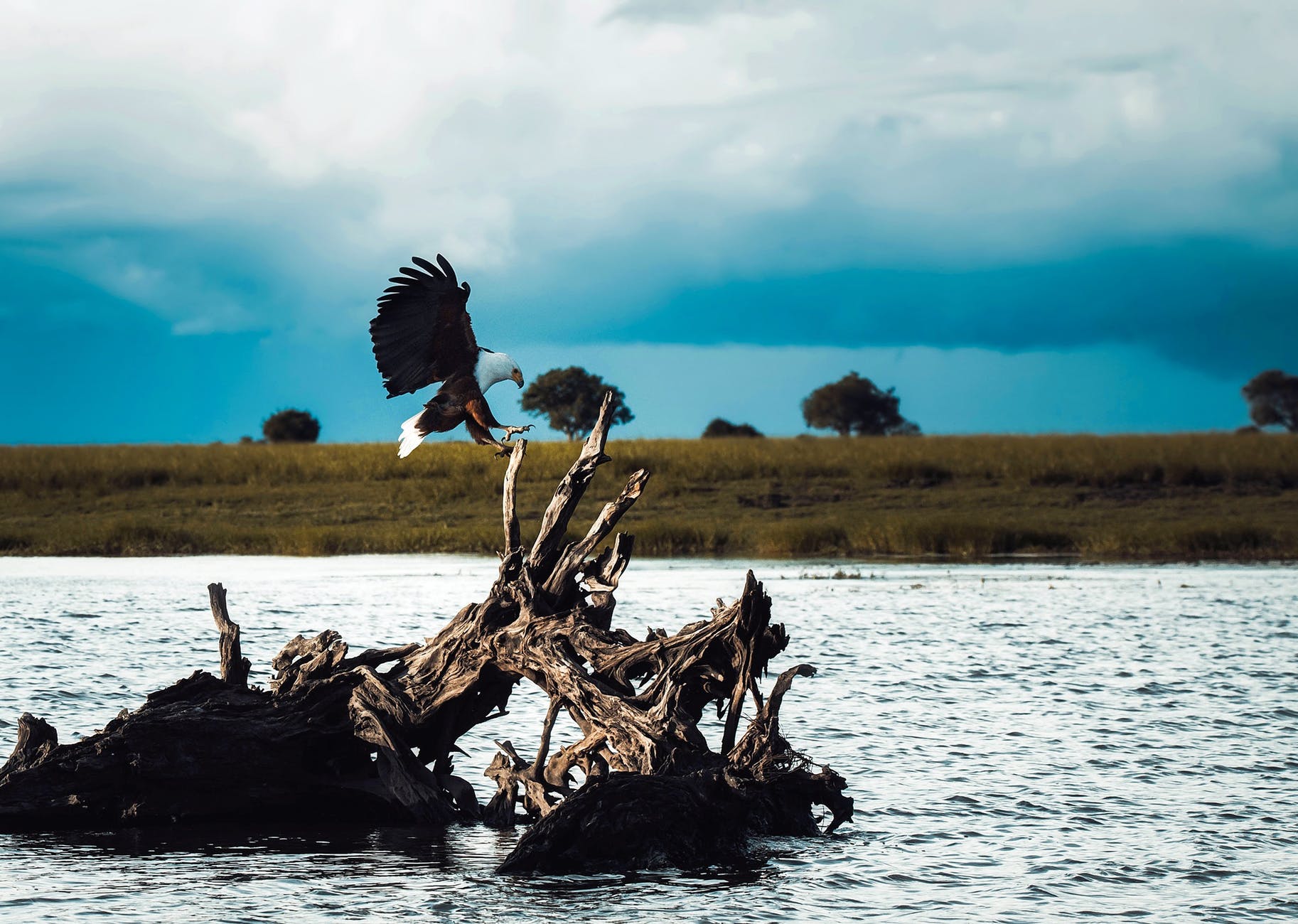
Photo by Pixabay on Pexels.com Bald eagles are often associated with wetland habitats.
Give bluebirds a hand as they scout for nesting locations

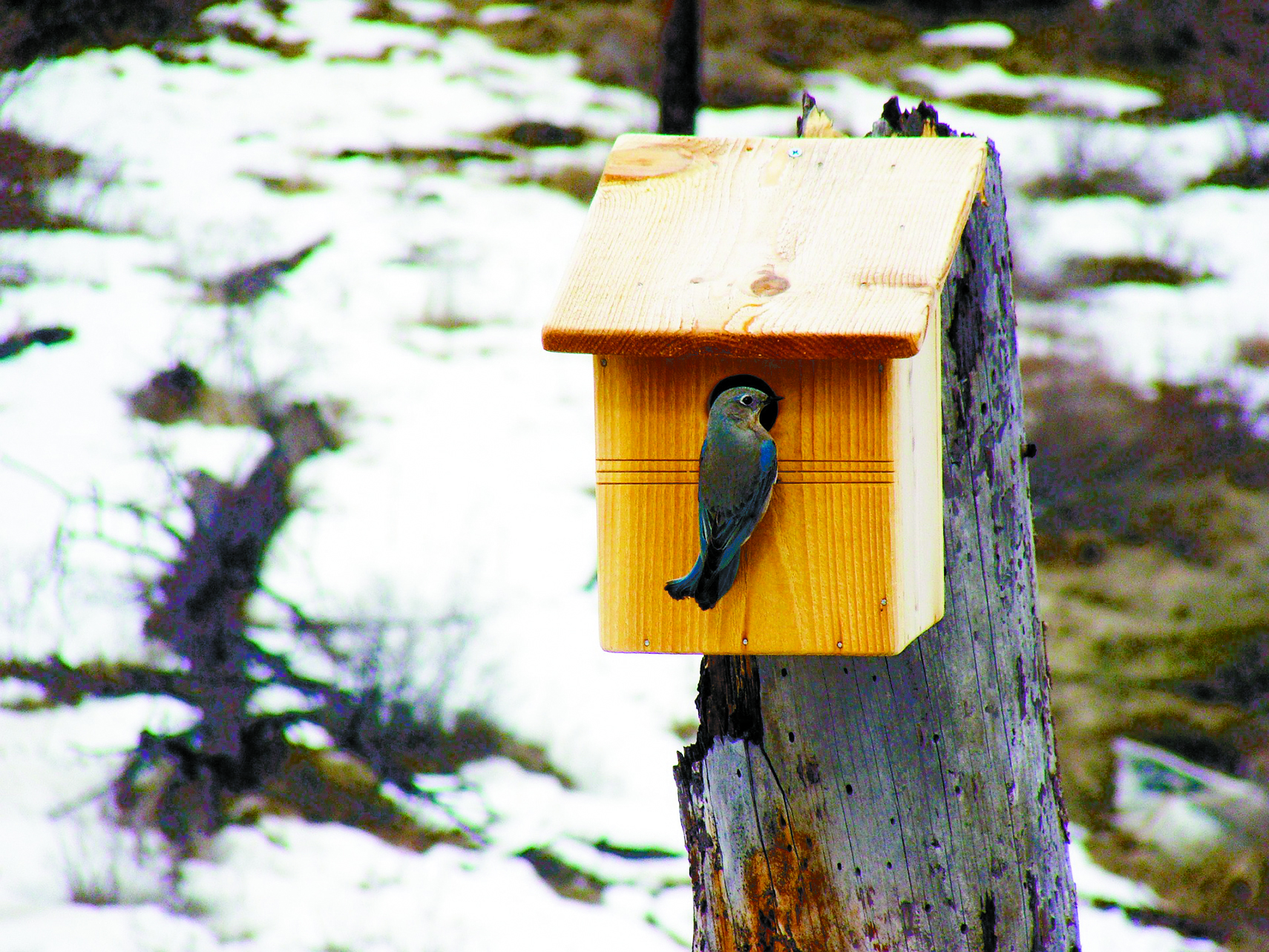
Photo by Matthew Saulsbury/Pixabay • Bluebirds are likely already scouting for nesting cavities and nest boxes in the region.

It’s time to turn the calendar page to February and, depending on the prognostication of the groundhog, winter may or may not be on the wane. Regardless, some of our feather friends are already acting like spring has sprung.
Perhaps it’s simply confusion when days can veer from sunny, short-sleeve conditions to frigid snowstorms, but I tend to trust the instincts of our fine feathered friends.

An email from Unicoi County resident Amanda Austwick proved timely.
“I saw a post on Facebook from a woman in Ontario, Canada, and she had a photo of a bluebird in a tree surrounded by red berries, with a touch of snow on them,” Amanda wrote. “I thought bluebirds migrated south in winter.”

I responded to Amanda’s email and will share some information in this week’s column. For the most part, local bluebirds do not migrate out of the region in winter. Bluebirds living farther north do often, but not always, migrate farther south.
As I mentioned to Amanda, I notice bluebirds almost daily on my drive from home to work. On sunny mornings, male Eastern bluebirds are producing their enthusiastic, warbling song even if there’s been a touch of frost overnight.

The Eastern bluebird is one of North America’s best-known cavity-nesting birds. About 85 species of North American birds use cavities in trees for nesting purposes. Cavity-nesting birds include ducks, such as buffleheads and wood ducks, as well as birds of prey such as Eastern screech-owls and American kestrels. Woodpeckers and nuthatches can excavate their own cavity in a dead or decaying tree.

Others, such as the bluebirds, must find a cavity already in existence. Such cavities are scarce real estate and can be subject to some intense competition.
The Eastern bluebird is at a disadvantage when forced to compete with non-native introduced birds such as aggressive European starlings and house sparrows. Even native competitors such as house wrens and tree swallows are serious rivals when it comes down to staking a claim to prime nesting sites.

Over the years, I have found bluebirds nesting in cavities inside wooden fence posts, but there are fewer wooden fence posts every year. This reinforces the idea of how changing landscapes have affected these birds. Instead of wooden fence posts, many farmers now use metal ones, and dead or dying trees — a much sought-after resource for cavity-nesting birds — are often removed from woodlands. Winter storms this season, along with accompanying high winds, have brought down numerous trees in the woodlands around my home, no doubt removing some current or future nesting possibilities.

When it comes to choosing a nesting cavity, male bluebirds take the lead, investigating and exploring potential sites before introducing females to the chosen real estate. If she accepts his choice, she will build the nest.

Cavities can also find use by bluebirds for secure locations for roosting overnight. According to the website Tennessee Watchable Wildlife, observers have documented bluebirds using nest boxes to stay warm during cold winter nights, packing eight to 12 individuals into one box. With the generated body heat from all those birds, I imagine that was one cozy box!

The website also noted that the oldest known Eastern bluebird in the wild reached an age of 10 years and six months. Given that most songbird live fairly short lives, that was quite an achievement.

For those interested in becoming bluebird landlords, check out nest box designs at the Tennessee Watchable Wildlife website. Several different nest box designs are available at the profile for the Eastern bluebird at tnwatchablewildlife.org.
If you’re not a do-it-yourself individuals, most lawn and garden centers, farm supply stores and speciality bird shops carry readymade bluebird boxes for purchase.
In addition to housing, food and water can be used to lure Eastern bluebirds closer. This bird doesn’t eat seeds, but it can be attracted with an offering of mealworms — live or freeze-dried – or commercially prepared peanut butter nuggets. A water feature in a yard is also a magnet for bluebirds and a host of other bird species.

•••
To ask a question, make a comment or share an observation, please email me at ahoodedwarbler@aol.com.

One warbler is commonplace bird in region during winter

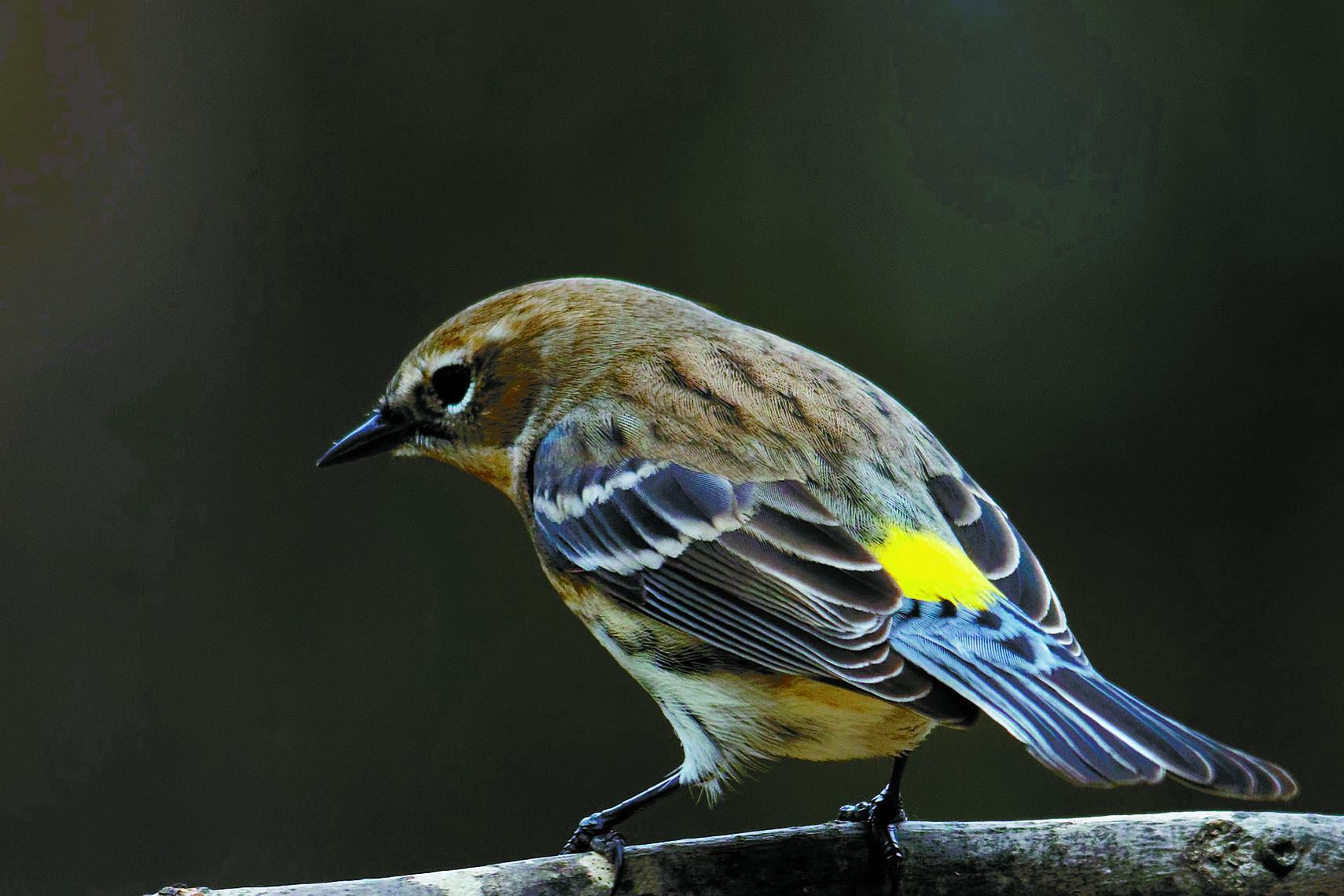
Photos by Edbo/Pixabay • The yellow-rumped warbler is abundant across North America. The species has evolved two distinct sub-species known as the “myrtle warbler” of the Eastern United States and the Audubon’s warbler of the Western United States.

Walk any woodland trails in the region and encounters with yellow-rumped warblers are likely. The linear walking trails in Erwin, walking trails at Sycamore Shoals State Historic Park in Elizabethton and the winding paths at Osceola Island Recreation Area in Bristol are almost certain to yield sightings of this wintering warbler.

A good nickname for this warbler might be “winter warbler” since most other members of the warbler family elect to spend the colder months as far south as Central and South America. From October to early May, the yellow-rumped warbler is a common bird in the region. This species also likes to form large flocks that often flit through the upper branches of trees. They are often joined by other birds, including chickadees, titmice and kinglets in mixed flocks that forage together.

Once the warmer days of summer arrive, yellow-jumped warblers have almost entirely disappeared from the region. Some of the region’s higher peaks attract this warbler during the summer, but this warbler’s population nests farther north than Northeast Tennessee, Southwest Virginia and Western North Carolina.

The yellow-rumped warbler’s appearances changes dramatically from winter to summer. By the time yellow-rumped warblers arrive each autumn, these birds are in drab brown and gray plumage, but they still display the “butter pat” yellow patch on their rump that has prompted birders to saddle this warbler with the nickname “butter butt.”

The lingering yellow-rumped warbler in late April and early May is an entirely different bird. Males have streaked backs of black on slate blue, white wing patches, a streaked breast and conspicuous yellow patches on the crown, flank and rump. Females are similar, but duller overall.

The yellow-rumped warbler ranges across North America from the Pacific to the Atlantic coast, but from the Rocky Mountains westward, the appearance of this warbler changes. Experts have gone back and forth on whether these two sub-species of yellow-rumped warbler should actually be classified as different and distinct species.

The familiar eastern bird is known as the “myrtle warbler,” but the western sub-species is named “Audubon’s warbler” in honor of the artist and early American naturalist John James Audubon. The biggest difference in the two variations is that the Aubuon’s warbler shows a yellow-throat patch compared to the white throat of the myrtle warbler. I’ve seen both. I saw the western Audubon’s warbler during a trip to Utah and Idaho in 2003.

Complicating matters is the fact that the yellow-rumped warbler also ranges into Mexico and Central America, where the appearance of the species changes yet again. Two other forms — Mexico’s black-fronted warbler and Guatemala’s Goldman’s warbler — must be added to the list.

The scientific name of the yellow-rumped warbler is Setophaga coronata. The genus setophaga is taken from ancient Greek and means “eater of moths.” As moths are incredibly abundant, yellow-rumped warblers no doubt consume some of these insects, but their diet is hardly limited to adult moths. They do eat many varieties of caterpillars, as well as beetles, weevils, ants, grasshoppers, gnats and spiders. They will also eat berries, especially during the winter months. It’s their fondness for the berries of wax-myrtle that has given this bird the name “myrtle warbler” to represent the Eastern form of the species. This bird also eats the berries of dogwood, poison ivy, Virginia creeper and dogwood.

The yellow-rumped warbler has also learned to visit feeders. Preferred foods at feeders include sunflower seeds, raisins, peanut butter and suet.

During the long months when most of the colorful, energetic warblers are absent from the region, the yellow-rumped warbler offers some solace, as well as a reminder. In a few months, area woodlands will once again explode with the songs of returning warbler. The chorus will be so vigorous that we’ll hardly notice that the yellow-rumped warbler is no longer part of the choir.

According to the website “All About Birds,” the yellow-rumped warbler is abundant. The website notes that populations of this warbler have held steady from 1966 to 2019, according to the North American Breeding Bird Survey. Partners in Flight estimates a global breeding population of 170 million individual birds.

•••
To ask a question, make a comment or share a sighting, email me at ahoodedwarbler@aol.com.

Watch for American kestrels in open areas, on roadsides

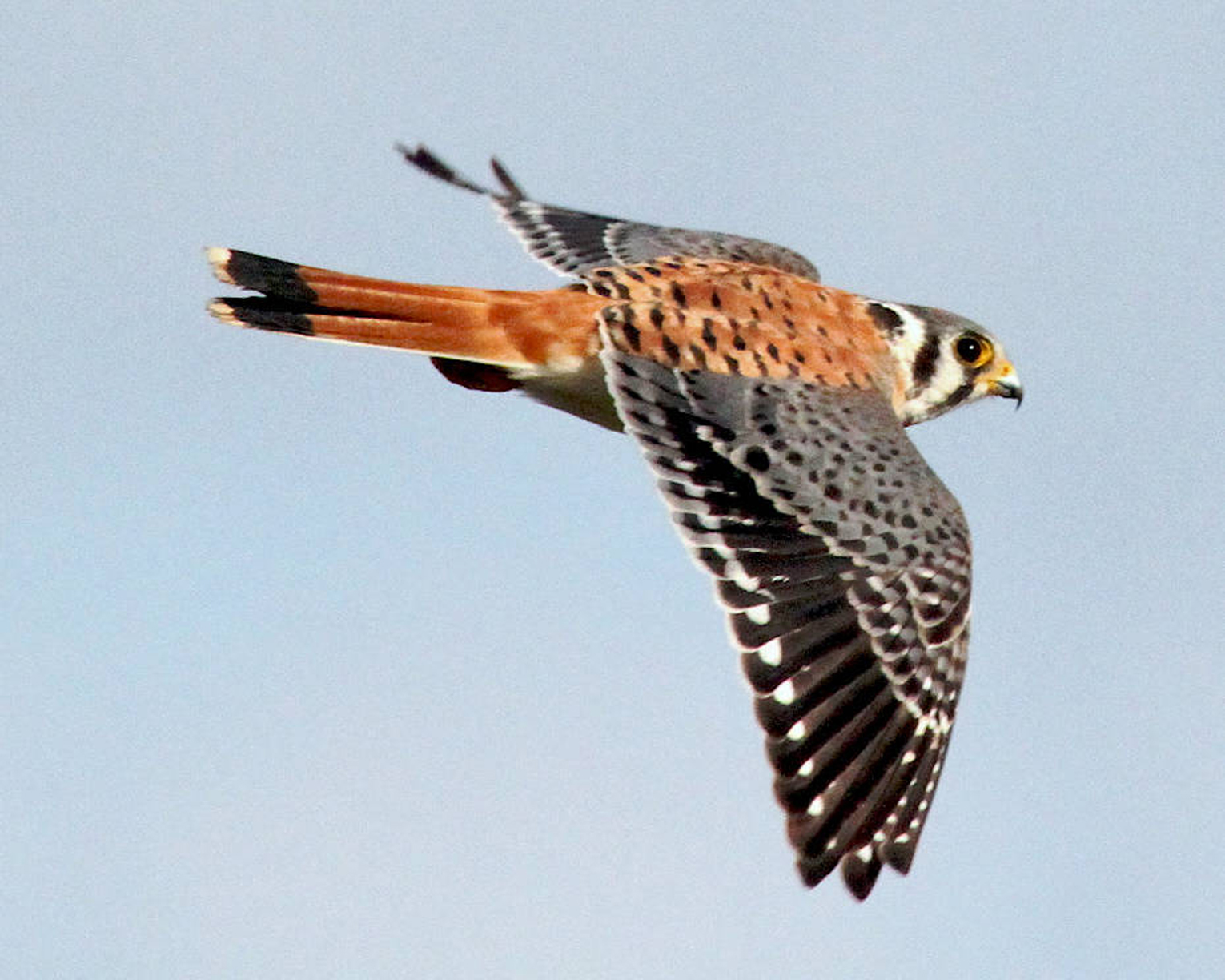
Naser Mojtahed/USFWS • An American kestrel perches on a pole. These small falcons are present throughout the year in the region, but their numbers typically increase during the winter months when individuals from farther north migrate into the area.

The year’s still young, but I am amassing some interesting bird sightings. My very first birds of 2023 were a common raven (heard) and a red-shouldered hawk (seen) at my home on the morning of Jan. 1.

I heard the raven croaking raucously on the ridge behind my home. When I stepped onto my front porch, I startled the red-shouldered hawk from a perch at a willow growing near my fish pond. Since those sightings, I’ve added additional birds, including American kestrel, to my year list.

I’ve observed kestrels at a couple of locations, including one that favors the utility lines along Highway 107 near Bell Cemetery in Limestone Cove and another one that I’ve seen perching on power lines near Rolling Hills between Unicoi and Erwin.
The American kestrel is a small member of the falcon family, which includes such relatives as merlin, peregrine falcon and gyrfalcon. All falcons, regardless of size, share a similar aerodynamic design that includes sleek, streamlined bodies and long, slim wings which taper to pointed tips. They fly with rapid wingbeats and are capable of swift flight.

The American kestrel, although present throughout the year in the region, is somewhat more prominent during the winter months when kestrels from farther north migrate into the region. However, this falcon also nests in the region and can be found at any time of the year in suitable habitat, which is usually open countryside.

The male American kestrel is a colorful bird. He shows a rusty back with some black barring, a rusty tail and steel blue-gray wings. The female kestrel is brownish with black barring on her back and tail. She also shows a buff-colored wash streaked with brown on her under- parts. Both sexes show a strong facial pattern marked by two black “sideburns” on the side of the face.

The American kestrel has long been one of my favorite raptors. They’re seldom as skittish as many other raptors and will permit close observation. Formerly known by the name “Sparrow Hawk,” the American kestrel does not feed entirely on other birds. In fact, a large part of this small falcon’s diet includes rodents and insects.
The kestrel is one of the birds I remember from my childhood “Golden Guide to Birds” book. Raptors are not normally regarded as colorful birds, but the paintings in these little books perfect for child-sized hands showed a beautiful bird with different hues visible in its plumage.

Like many raptors, the American kestrel likes to hunt from a perch, swooping down on unsuspecting prey. The kestrel, however, is also capable of hovering, a type of flight that only a relatively few birds, including the belted kingfisher and the ruby-throated hummingbird, are capable of performing.

In its nesting preference, the American kestrel is unusual among other native falcons and hawks. Kestrels nest in cavities, including abandoned woodpecker holes and nest boxes provided by humans.

The falcons comprise a family of birds with a long history with humans. The sport of falconry, although not as widely practiced today, long ago became associated with royalty and nobility. In fact, falconry has been called “the sport of kings.” The sport basically involved hunting prey, usually other birds, with birds of prey such as falcons. As a pastime, falconry never became as popular in the United States as in other parts of the world.

There are more than 60 species of falcons found worldwide. While the peregrine falcon’s endangered status became well-known in the United States, other falcons have been threatened with extinction. The Mauritius Kestrel once dwindled to a population of only six individuals. Today, the population, due to intensive human effort, has greatly recovered.

Other members of the falcon family can be found in the region, including the peregrine falcon and the merlin. Other falcons in North America include the prairie falcon and the Aplomado falcon. Worldwide, some of the more descriptively named falcons include spotted kestrel, rock kestrel, slaty-backed forest falcon, grey falcon, greater kestrel, lesser kestrel, red-footed falcon, red-necked falcon, sooty falcon and brown falcon.

To share observations, ask questions, or make a comment, email me at ahoodedwarbler@aol.com.

Photo by USFWS/Robert Burton • An American kestrel in flight shows the aerodynamic design that earned this small falcon the common name of sparrow hawk.

Albatross known as Wisdom returns again to Midway Atoll 

Readers with good memory will recall that I’ve written numerous times over the years about a special bird by the name of Wisdom.

She’s making headlines again!

Wisdom, the world’s oldest known wild bird, recently returned to Midway Atoll. She was first spotted back in this familiar territory on Nov. 24, 2022, in fact.

Wisdom is considered world’s oldest wild bird

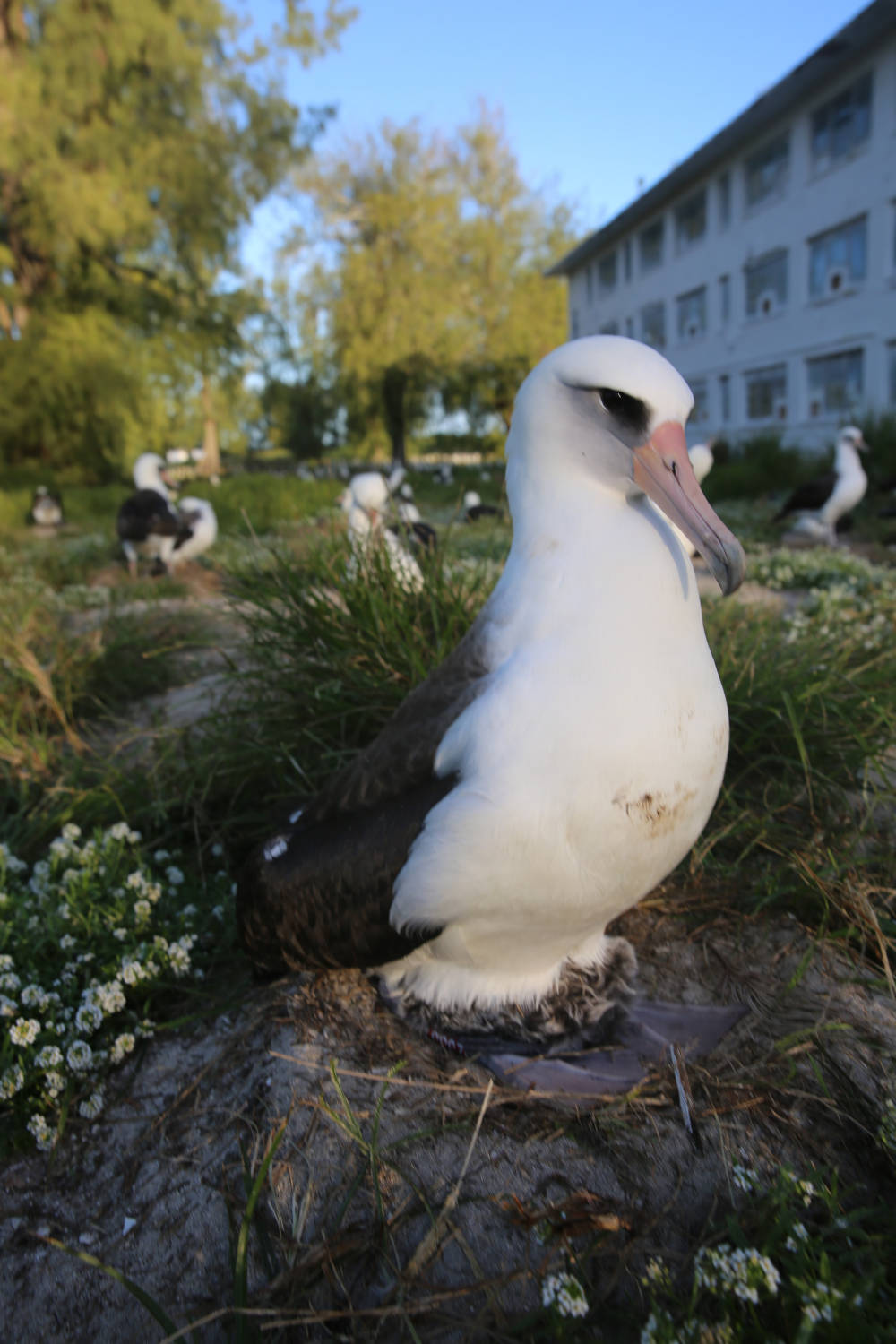
The beloved Laysan albatross is at least 71 years old now. Biologists first identified and banded Wisdom in 1956 after she laid an egg, and these large seabirds aren’t known to breed before age five.

Photo by Bob Peyton/USFWS • Midway Atoll National Wildlife Refuge and Battle of Midway National Memorialwithin Papahānaumokuākea Marine National Monument is a special place for over three million seabirds – they return to Midway Atoll each year to rest, mate, lay eggs and raise their chicks.

Researchers have estimated that Wisdom has produced 50 to 60 eggs and as many as 30 chicks that fledged, according to Jonathan Plissner, supervisory wildlife biologist at Midway Atoll National Wildlife Refuge.

The ageless Wisdom, with her well-known band number of Z333, was first spotted this nesting season on Thanksgiving Day. Her long-time mate, Akeakamai, has yet to be seen and was absent last nesting season, too. Male albatrosses typically return to the breeding site before their mates, wrote Plissner in an email.

For decades, Wisdom and Akeakamai, like most pairs of these albatrosses, returned every year to the same nest site to lay one egg.  

They are among the millions of albatross that return to Midway Atoll on the far northern end of the Hawaiian archipelago to nest and raise their young. 

For some unknown reason, Wisdom only made a brief appearance late last year. In a release dated Dec. 9, 2022, the U.S. Fish and Wildlife Service noted that Wisdom had not been seen in the past week and most mōlī have already laid their egg for the season, but biologists will continue to monitor the area in case the world’s oldest known bird returns.

Among albatross, the Laysan albatross is a small species. This bird has a body length of 23 inches and a wingspan of about 80 inches, or six-and-a-half feet. The larger species of albatross have wingspans of 12 feet. 

Worldwide, there are about 20 or so species of albatross. Most albatrosses range in the Southern Hemisphere from Antarctica to Australia, South Africa, and South America.

In literature, the poem “The Rime of the Ancient Mariner” by Samuel Taylor Coleridge uses an albatross to explore the concepts of innocence and creation.

French poet Charles Baudelaire also featured this bird in his poem titled “L’Albatros.” 

Albatrosses haven’t coexisted easily with humans. Fifteen of the world’s albatross species face possible extinction. Two species, Tristan albatross and waved albatross are considered critically endangered. 

Albatrosses are long-lived birds, with some gaining a ripe old age of 50 years or more. Only parrots rival them for longevity, with some parrots and macaws documents as living more than a century. 

Wisdom hatched her most recent chick in February 2021, making her at least 70 years old at the time. She is the oldest confirmed wild bird and the oldest banded bird in the world.

I hope that Wisdom’s simply off gliding over the world’s vast oceans and will make more future appearances. Since learning of her story, I’ve been continually amazed by her indomitable spirit. Long may she fly.

Speaking of long lives among out feathered friends, there are some impressive age milestones that have been reached by other birds. 

Longevity Records

According to the American Bird Conservancy website, here are some of the world’s longest-lived wild birds:

• common raven — 69 years

• American flamingo — 49 years

• bald eagle — 38 years

• sandhill crane — 37 years

• Canada goose — 33 years

• Atlantic puffin — 33 years

• red-tailed hawk — 30 years

• mourning dove — 30

• great horned owl — 28 years

• mallard — 27 years

• blue jay — 26 years

• great blue heron — 24 years

• laughing gull — 22 years

• piping plover — 17 years

While it’s usually the larger birds that live longer, some songbirds, just like people, can live astonishingly long lives. The hummingbirds, which are truly tiny, can produce individuals that reach a relatively old age. For instance, a broad-billed hummingbird has been documented reaching the age of 14 years.

•••

Email me at ahoodedwarbler@aol.com to share sightings or ask questions. 

Annual Christmas Bird Count nets lower total than usual

Photo by Michael of Pixabay • A yellow-bellied sapsucker clings to the trunk of a tree. A total of 11 sapsuckers was found during the recent Elizabethton Bird Count.

The 80th consecutive Elizabethton Christmas Bird Count was held Saturday, Dec. 17. A total of 24 observers, myself included, in eight parties assisted by two feeder watchers participated.

The weather was less than ideal, with strong winds in parts of the coverage area. Participants tallied 61 species, which longtime count compiler Rick Knight noted was well below the recent 30 year average of 73 species. In fact, this was the lowest species total since 1970 when a mere 58 species were found.

Missed birds included ring-necked duck, horned grebe, ruffed grouse, Eurasian collared-dove, double-crested cormorant, barred owl, great horned owl, white-crowned sparrow; fox Sparrow and Eastern meadowlark.

Knight noted that reasons for the low number are complicated. The wind was a factor in some areas. Also, duck numbers have been generally low so far this winter. Blackbirds have been scarce in this area for most recent winters. Some half-hardy lingerers weren’t found, including house wren, brown thrasher and palm warbler. Some others are low-density wintering birds and were just missed.

So, what did the participants see?
Here’s the list:
Canada goose, 447; mallard, 210, bufflehead, 226; and hooded merganser, 5.
Wild turkey, 5; pied-billed grebe, 4; rock pigeon,148; mourning dove, 86; killdeer, 9; and Wilson’s snipe, 5.

Ring-billed gull 9; common loon, 2; great blue heron, 14; black vulture, 17; turkey vulture, 12; and American kestrel, 12.

Sharp-shinned hawk, 1; Cooper’s hawk, 6; Bald eagle, 5; red-tailed hawk, 22; and Eastern screech-owl, 7.

Belted kingfisher, 15; Red-bellied woodpecker, 26; yellow-bellied sapsucker, 11; downy woodpecker, 17; hairy woodpecker, 4; Northern flicker, 17; and pileated woodpecker, 11.

Eastern phoebe, 17; blue jay, 71; American crow, 733; and common raven, 14.
Carolina chickadee, 108; tufted titmouse, 91; red-breasted nuthatch, 4; white-breasted nuthatch, 45; brown creeper, 1; winter wren, 7; Carolina wren, 86; golden-crowned kinglet, 9; and ruby-crowned kinglet, 15.

Eastern bluebird, 149; hermit Thrush, 9; American robin, 122; Northern mockingbird, 41; Eurasian starling, 714; and cedar waxwing, 281.

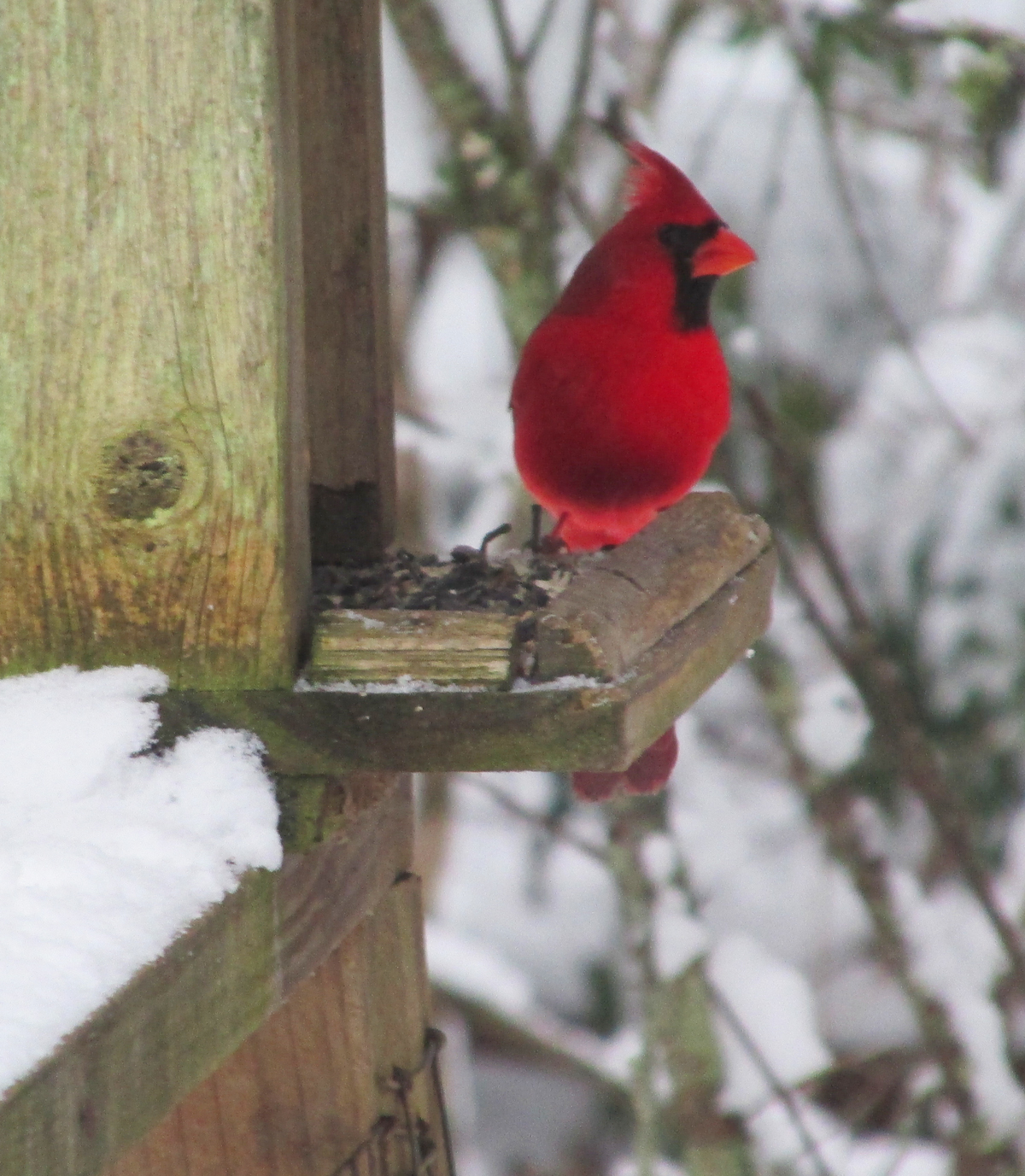
Photo by Bryan Stevens • A male Northern cardinal visits a feeder on a snowy afternoon. Counters found 132 cardinals on the Elizabethton CBC.

House sparrow, 70; house finch 89; purple finch, 3; American goldfinch, 73; chipping Sparrow, 29; field Sparrow, 36; dark-eyed junco, 74; white-throated sparrow, 73; song sparrow, 97; swamp sparrow, 2; and Eastern towhee, 7.

Pine warbler, 2; yellow-rumped warbler, 75; and Northern cardinal, 132.

Observers included Bryan Stevens, Chris Soto, Brookie and Jean Potter, Don Holt, Dianne Draper, Eric Draper, Fred Alsop, Kevin Brooks, Judi Sawyer, Charlie Warden, Deb Mignogno, Rick Knight, Kim Stroud, Dave Gardner, Joe McGuiness, Vern Maddux, Roy Knispel, Pete Range, Harry Lee Farthing, Richard Lewis, Tammy Bright, Scott Turner, Larry McDaniel and David and Connie Irick.

•••

Share sightings, ask questions or make comments by emailing me at ahoodedwarbler@aol.com.


Vultures adept at living in close contact to people

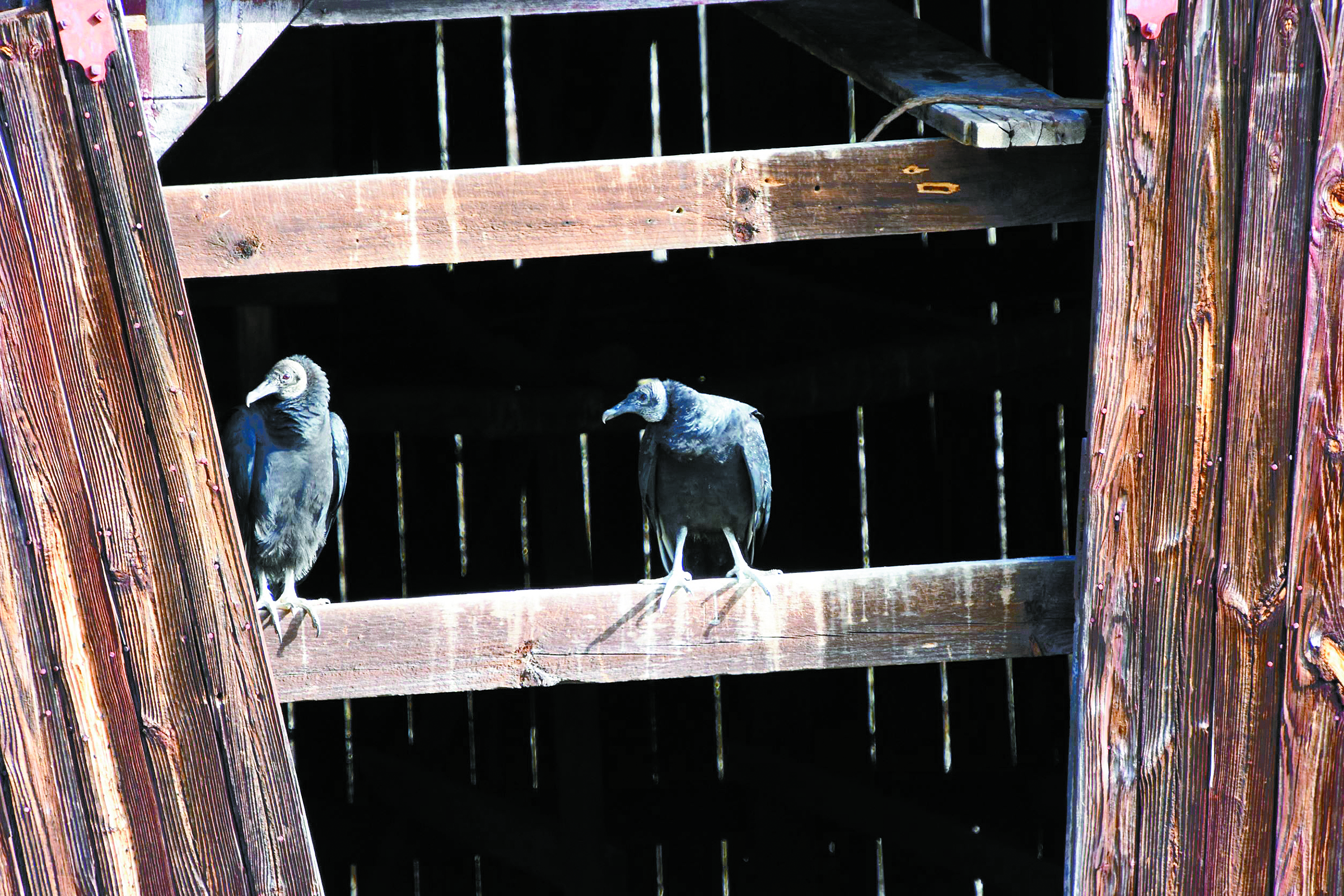
Photo Courtesy of Jean Potter • A pair of black vultures bask in the winter sunshine in an old barn located in the Gap Creek community near Elizabethton, Tennessee.

I took part in the recent Elizabethton Christmas Bird Count conducted by members and friends of the Elizabethton Bird Club. I enjoyed a cold but sunny Saturday morning looking for birds with Chris Soto and Brookie and Jean Potter.

The first Christmas Bird Counts were conducted on Christmas Day (Dec. 25) in 1900. The annual census arose from a proposal made by famed ornithologist Frank M. Chapman. According to Audubon.org, these yearly counts, conducted throughout the country, have provided a wealth of data over the past century.

Observations made due to CBCs have helped Audubon researchers, conservation biologists, wildlife agencies and other interested individuals to study the long-term health and status of bird populations across North America. When combined with other surveys such as the Breeding Bird Survey, the data provides a picture of how the continent’s bird populations have changed in time and space over the past hundred years.

The Lee and Lois Herndon Chapter of Tennessee Ornithological Society, otherwise known as the Elizabethton Bird Club, has a long history of participation in the annual Christmas Bird Count. In fact, the club has conducted two different counts — one for Elizabethton and another for Roan Mountain — for decades. The 2022 CBC marked 80 unbroken years in conducting a CBC for Elizabethton. Not even the ongoing pandemic deterred members for carrying out Christmas Bird Counts in 2020 and 2021.The club has also conducted 69 Roan Mountain CBCs, but inclement weather on the unpredictable Roan has forced cancellation of this annual count on a few occasions.

Christmas Bird Counts are challenging. Birds are more scarce. Weather conditions can sometimes present a challenge. On this year’s count, my group struggled to come up with common species such as killdeer and Eastern phoebe, although we did eventually manage to find these target birds.

It was far from certain whether we would find the region’s two native vultures: turkey vulture and black vulture. We added turkey vultures to the list when we encountered some soaring individuals. We later found our black vultures in a delightfully random fashion. While driving through the Gap Creek community we passed an old barn and spied two black vultures roosting in the barn loft. Surprised, we circled back, documented the vultures in photographs and remarked on finding the birds just inside a building.

Perhaps that shouldn’t be a huge surprise. Like many other species of birds, vultures have learned to co-exist near humans much in the same fashion as Canada geese, Eastern bluebirds, American robins and mallards. Like these birds, vultures are highly adaptive creatures. Unlike some types of wildlife that shy away from human contact, vultures and some other birds have adapted to the human environment – perhaps a bit too well. Vulture behavior can be destructive. In recent years, some of these destructive tendencies have become quite infamous among birders. This new behavior apparently first surfaced among vultures wintering in south Florida.
They have been known to tear window and roof caulking, vent seals, shingles, rubber seals on car windshields, windshield wipers and other soft, rubbery materials. In addition, their excrement is acidic and may damage painted surfaces and landscaping. The birds also regurgitate a smelly, acidic vomit. Unfortunately, vultures apparently pass on these bad habits to others of their kind and such aberrant behavior is now being seen outside of the Sunshine State.

Some communities in the region have also had to deal with large roosting flocks of vultures. A few years back as many as 100 vultures had been documented in Abingdon, Virginia. This number may rise and fall, depending on conditions.
On some of my recent walks around downtown Erwin, I have frequently observed black vultures and turkey vulture soaring lazily overhead on both sunny and overcast days.

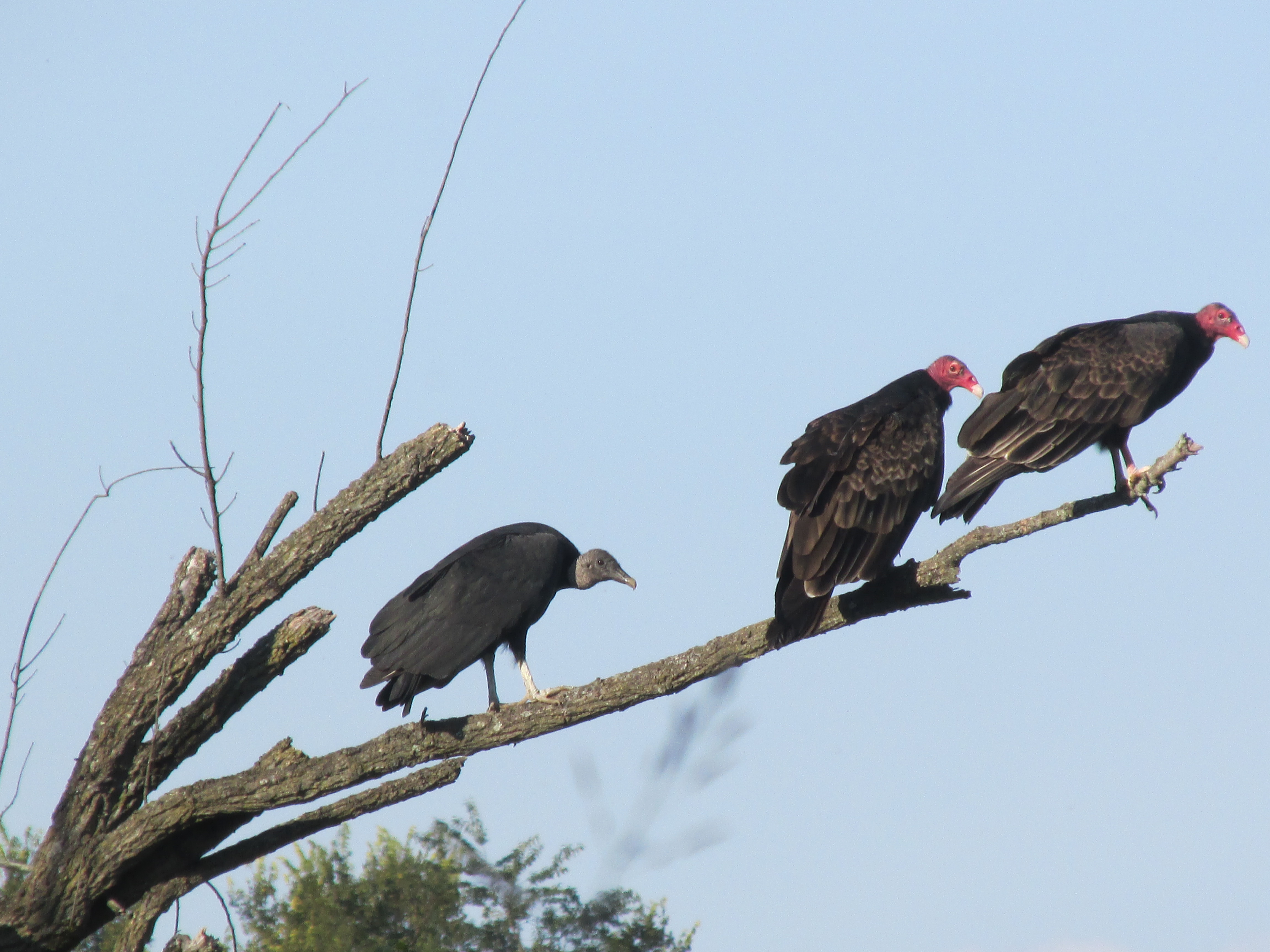
Vultures are part of the web of life, which connects them and their fellow creatures to our own lives. Turkey vultures are larger than black vultures, weighing about four to five pounds, with a wingspan of six feet. The turkey vulture’s most distinctive feature is its bright red, featherless head. In flight, a turkey vulture often appears to “wobble” and, from underneath, all of the flight feathers are light colored.
On the other hand, black vultures are smaller, weighing less than four pounds, with a wingspan of five feet or less. The black vulture’s head is grey and featherless, but larger in proportion than the turkey vultures. Viewed in flight, only the outer flight feathers of the black vulture are white.

Although smaller in size, black vultures are feisty and aggressive birds. They often outcompete turkey vultures at carcasses. They will also only reluctantly abandon a feeding site at a carcass. My family almost learned this the hard way many years ago during a trip to South Carolina when my father almost ran his car into a flock of black vultures feeding on a road-killed deer. I warned him that the vultures might not get out of the way, and he slowed the car’s speed. The vultures moved back from the edge of the road as our car traveled past them. Looking back, I noticed they immediately hopped back onto the carcass after we had passed. If we had sped past at full speed, one of the bird’s could easily have panicked and flown into our path. A four-pound bird can do a lot of damage if it hits the windshield of a car traveling at 40 to 50 miles per hour. Trust me! You don’t want to put this to the test.

Photo by Bryan Stevens • A black vulture, left, shares a perch with two turkey vultures.

Perhaps that’s the moral of the story. Give vultures a wide berth and, in theory, they will do the same for you. Let’s face it. Vultures aren’t going to be cute and cuddly faces for ecological awareness. A polar bear or penguin, vultures simply are not. They still have a role to play, and we should be grateful they were created for just that purpose.


Cardinals provide a great symbol for Christmas season

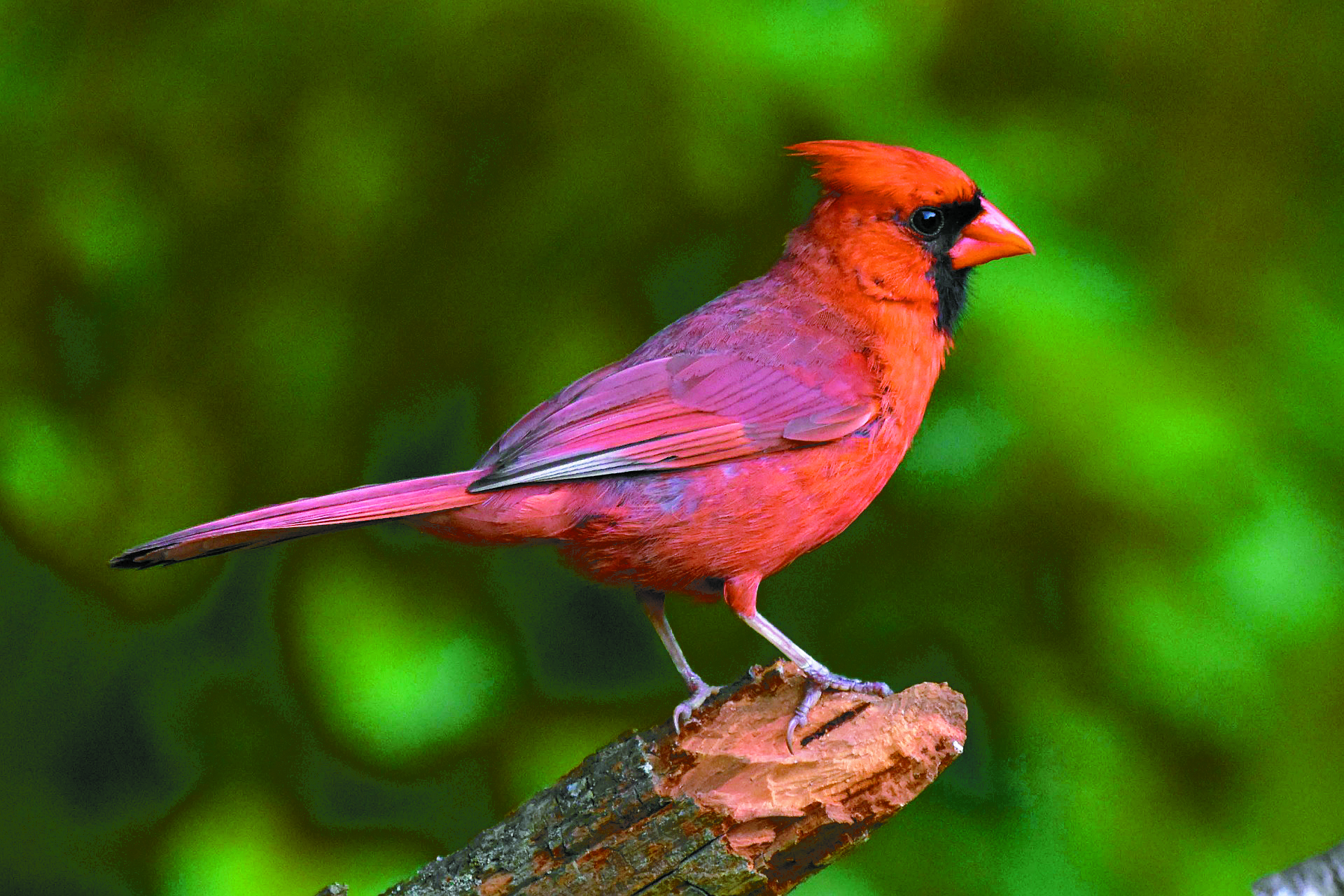
Photo by Jack Bulmer/Pixabay • A male Northern cardinal is a cheerful feathered ambassador on even a dreary day. While fairly commonplace, cardinals are worth getting to know and are easily attracted with sunflower seed.

Christmas 2022 is almost upon us. As is my usual custom, I want to share my enthusiasm for the Northern cardinal, one of my favorite birds. One male cardinal around my home as become very accustomed to my presence. He has even learned my routine and knows when to anticipate my daily stocking of the feeders with sunflower seeds.

At first, he kept an eye on my actions from a safe distance, but he gradually grew bolder. Soon, he began to land on the feeder before I even had my back turned and was heading back inside the house. His familiarity also bred impatience. He began to detect my routine. Once I get home from work in the evening, I head first to the mailbox. More often than not, I glimpse a flash of red feathers near the feeders while retrieving the most recent postal deliveries. My dependable cardinal always makes me smile. The bird has learned that a meal is imminent once I have completed this one chore.

If I don’t immediately return to the feeders with sunflower seeds, he will wait until I emerge from the house. He isn’t quite so brave that he will stay perched on the feeder as I replenish the supply, but he has definitely learned that his human friend is the source of all the free seeds.

I have always enjoyed watching cardinals. The beauty of both male and female cardinals is undeniable. They’re usually nervous, twitchy birds, so it has been fun watching this particular male cardinal grow accepting of my presence.
The Northern cardinal, especially the brilliant red male, stands out against a winter backdrop of snow white, deep green or drab gray. Over the years, the cardinal has also become associated with the Christmas season. How many Christmas cards have you received this holiday season with a cardinal featured in the artwork? I’d wager that at least a few cards in any assortment of holiday greetings will feature the likeness of a Northern cardinal.

There is a possible reason that male cardinals try to outshine each other when it comes to their bright red plumage. According to the website Tennessee Watchable Wildlife, brighter red male cardinals are able to hold territories that have denser vegetation, feed young at higher rates and have greater reproductive success than males with feathers of a duller hue.

The Northern cardinal belongs to a genus of birds known as Cardinalis in the family Cardinalidae. There are only two other species in this genus, and they range across North America and into northern South America. The two relatives are the pyrrhuloxia, or Cardinalis sinuatus, of the southwestern United States, and the Vermilion cardinal, or phoeniceus, a bird found in Colombia and Venezuela.
The Northern cardinal is a native and abundant bird. Cardinals are a widespread species, ranging westward to the Dakotas and south to the Gulf Coast and Texas. The southeastern United States was once the stronghold of the cardinal population. In the past century, however, cardinals have expanded their range into New England and Canada.

The cardinal accepts a wide variety of food at feeders. Sunflower seed is probably their favorite, but they will also sample safflower seed, cracked corn, peanuts, millet, bakery scraps and even suet. While we may get the idea that cardinals feed largely on seed, that is a misconception based on our observation of the birds at our feeders. Cardinals away from our feeders eat insects and fruit, including the berries of mulberry, holly, pokeberry, elderberry, Russian olive, dogwood and sumac.
The cardinal uses its large beak to efficiently hull sunflower seeds or deal with other foods foraged in field and forest away from our feeders. The large, heavy beak hints at the cardinal’s kinship with birds such as tanagers and grosbeaks. In fact, some of America’s early naturalists referred to the bird as “cardinal grosbeak.” Other common names include the apt “redbird” moniker and “Virginia nightingale.”

Even once the holidays are past, there’s nothing like a glimpse of a Northern cardinal to add some cheer to a bleak winter day. It’s not surprising that such a popular bird has also become associated with many trappings of the Christmas season.
“You see cardinals on greeting cards, stationery, paper plates, paper napkins and tablecloths, doormats, light switch plates, candles, candle holders, coffee mugs, plates, glasses, Christmas tree ornaments and lights, bookmarks, mailboxes, Christmas jewelry,” writes June Osborne in “The Cardinal,” a book about this popular bird.

“And the list goes on,” Osborne writes. “Cardinals have become an integral part of the way that many people celebrate the holiday season.”

I can be included among such people. My Christmas decorations include an assortment of cardinal figurines and ornaments. There are other birds — doves and penguins for example — associated with the holiday season, but for me the holidays magnify the importance of one of my favorite birds. The cardinal, in its festive red plumage, appears made to order for a symbol of the holiday season.


Unusual goose spotted visiting Unicoi pond

Contributed Photo by Joe McGuiness • A visiting snow goose stands by the edge of a Unicoi pond as a nearby Canada goose preens its feathers. Snow geese are known for two color phases: white and blue. This particular goose appears to have characteristics of both color phases.

I was left a phone message on the first day of December by Erwin resident Joe McGuiness, who is also a fellow member of the Elizabethton Bird Club.
Joe wanted to let me know about an unusual goose that had been present at a farm pond along Massachusetts Avenue in Unicoi.

He had already identified the bird as a snow goose, which has two distinct coloration phases: the namesake white phase and a dark phase known as a “blue goose.”
The problem with this particular goose was that it seemed to show characteristics of a typical snow goose and a “blue” goose.

“Based on the fact that it has a white belly, I think this is a retrograde between a white phase and blue phase of the snow goose,” Joe wrote in a followup email.
“Not a true blue phase of the snow goose,” he determined. Based on my own observation, I concurred with his assessment.

The visiting snow goose has been hanging out with a flock of Canada geese that move from the pond to some nearby fields.

Of the geese found in the region, the well-known Canada goose is nearly ubiquitous. Surprisingly, that’s not always been the case. For instance, in his book, “The Birds of Northeast Tennessee,” Rick Knight points out that the Canada geese now present throughout the year resulted from stocking programs conducted in the 1970s and 1980s. In earlier decades, the Canada goose was considered a rare winter visitor to the region. Seeing the Canada goose in every sort of habitat from golf courses to grassy margins along city walking trails, it’s hard to imagine a time when this goose wasn’t one of the region’s most common waterfowl.

Photo by Bryan Stevens • A snow goose swims amid Canada geese a few years ago at the pond at Fishery Park in Erwin, Tennessee.

The world’s geese are not as numerous as ducks, but there are still about 20 species of geese worldwide, compared to about 120 species of ducks. While both ducks and geese are lumped together as waterfowl, most geese are more terrestrial than ducks. Birders are just as likely to spot geese in a pasture or on the greens of a golf course as they are on a lake or pond.

The snow goose breeds in regions in the far north, including Alaska, Canada, Greenland and even the northeastern tip of Siberia. They may spend the winter as far south as Texas and Mexico, although some will migrate no farther than southwestern British Columbia in Canada.

The snow goose bucks the trends that show many species of waterfowl declining. Recent surveys show that the population of the snow goose exceeds five million birds, which is an increase of more than 300 percent since the mid-1970s. In fact, this goose is thriving to such a degree that the large population has begun to inflict damage on its breeding habitat in some tundra regions.

A smaller relative to the snow goose is the Ross’s goose, which for all practical purposes looks like a snow goose in miniature. The common name of this goose honors Bernard R. Ross, who was associated with the Hudson’s Bay Company in Canada’s Northwest Territories.

Here’s a quick history lesson. Hudson’s Bay Company is the oldest commercial corporation in North America. The company has been in continuous operation for more than 340 years, which ranks it as one of the oldest in the world. The company began as a fur-trading enterprise, thanks to an English royal charter in back in 1670 during the reign of King Charles II. These days, Hudson’s Bay Company owns and operates retail stores throughout Canada and the United States.

In addition to his trade in furs, Ross collected specimens for the Smithsonian Institution in Washington, D.C. Ross is responsible for giving the goose that now bears his name one of its early common names – the Horned Wavy Goose of Hearne. I wonder why that never caught on?
Ross repeatedly insisted that this small goose was a species distinct from the related and larger lesser snow goose and greater snow goose. His vouching for this small white goose eventually convinced other experts that this bird was indeed its own species.
Ross was born in Ireland in 1827. He died in Toronto, Ontario, in 1874. He was described by other prominent early naturalists as “enthusiastic” and “a careful observer” in the employ of Hudson’s Bay Company. When John Cassin gave the Ross’s Goose its first scientific name of Anser rossii in 1861, he paid tribute to the Hudson’s Bay Company’s Ross.

•••

Some other notable waterfowl have already been spotted this winter. A Northern pintail has been observed at Erwin Fishery Park. As winter extends its icy grip farther north, more waterfowl are likely to migrate through the region. Keep an eye on rivers, ponds and lakes to see what unusual waterfowl might be visiting.


Northern flickers claim kinship as part of woodpecker family

Photo by NatureLady/Pixabay • Northern Flickers belong to the woodpecker family. Relatives living in the region include the pileated woodpecker, yellow-bellied sapsucker and downy woodpecker. Unlike most woodpeckers, flickers spend an extensive amount of time foraging on the ground for various insects.

While driving along Simerly Creek Road on a recent morning, a flash of yellow and white darted from the trees adjacent to the road and flew ahead of my vehicle a short distance before veering back into the trees.

An oval of white — the rump patch of a Northern flicker — stood out on the bird and made identification simple, even while traveling at a speed of 40 miles per hour.
Flickers are woodpeckers, but they are some differences between them and other members of this clan. While flickers can be found during all seasons in the region, this woodpecker is one of the migratory ones. I see the most Northern flickers during fall migration. This woodpecker is one of the few of its kind that usually migrates to warmer climates during the colder months, although the species is not completely absent from the region in the winter season.

This species also has many other common names, including yellow-hammer — a popular name in the Deep South — and harry-wicket, heigh-ho and gawker bird. The Northern flicker is also the only woodpecker to serve a state — Alabama — as an official bird. The flicker earned this distinction back in 1927. Alabama soldiers who fought for the Confederacy were nicknamed “yellowhammers” because of their grey-and-yellow uniforms, which matched the colors of the bird. Incidentally, Alabama was one of the first states to ever name an official state bird.

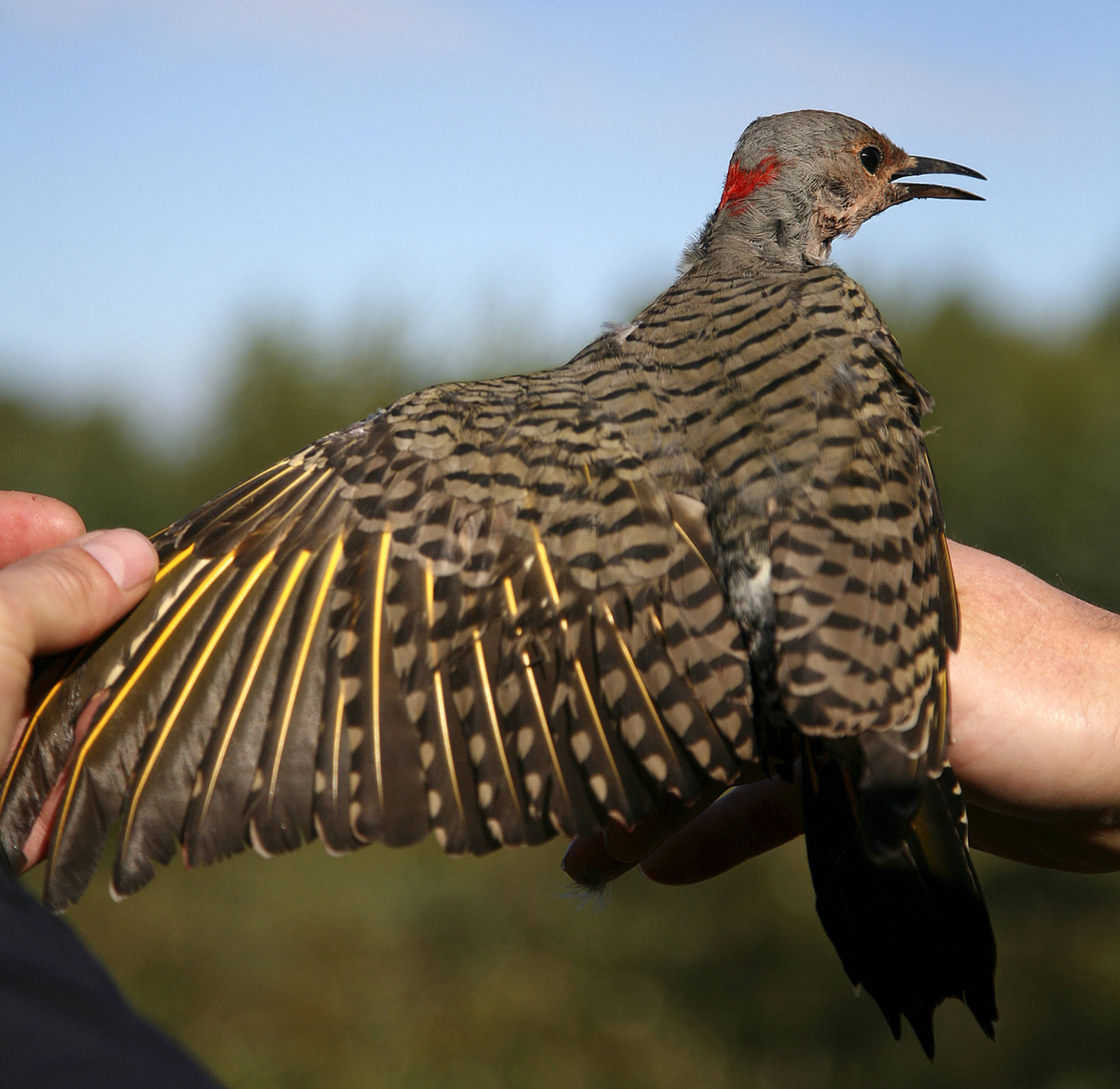
There are two races of Northern flicker — yellow-shafted and red-shafted — found in the United States. Eastern flickers show yellow feather shafts beneath the wings while western counterparts show red beneath the wings. A trip to Utah several years ago gave me a chance to also see the red-shafted race of this bird.

The Northern flicker is also not the only flicker in the United States. The gilded flicker inhabits many of the deserts — Sonoran, Yuma and Colorado — in the United States. Of course, trees are scarce in deserts, but that hasn’t proven an obstacle for this woodpecker. The bird is closely associated with saguaro cactus. Other desert dwellers depend on this woodpecker. Once the flickers are no longer making use of their nest and roost holes in the multi-armed cacti, other wildlife moved into the chambers.

The Northern flicker is an enthusiastic drummer, pounding loudly on the sides of trees with its stout bill. The purpose of the drumming is to communicate with mates and signal potential rivals that they’re intruding. Toward that objective, flickers sometimes substitute metal utility poles or the sides of buildings for the trunks of trees. In addition to drumming, the flicker also employs a variety of loud vocalizations that are fairly distinctive. A loud, repeated vocalization, often translated as “wicka-wicka-wicka,” is similar to the cluck-like call of the larger pileated woodpecker. The flicker is also known for emitting a sharp, loud “kleeer” call that can be heard from a considerable distance. Flickers are probably most vocal during the spring months.

When searching for flickers, however, don’t spend all your time scanning tree trunks. Flickers spend a lot of time in fields or on lawns in search of insect prey, which mostly consists of ants and beetles. Flickers also eat seeds and fruit, and these woodpeckers will also visit feeders for peanuts, sunflower seed and suet.
The adult flicker is a brown bird with black bars on the back and wings. A distinctive black patch occupies the upper breast, while the lower breast and belly are beige with black spots. Males can be identified by a black or red mustache stripe at the base of the beak. They also have a red stripe on the back of their gray heads. The flicker’s dark tail is set apart by a white rump patch that is conspicuous when the bird takes flight.

Some woodpeckers have been impacted by the rise of automobiles. According to the website All About Birds, in the mid 20th century, red-headed woodpeckers were quite commonly hit by cars as the birds foraged for aerial insects along roadsides. I thought of this tidbit of information as I reflected on my most recent flicker sighting.

Look for Northern flickers in fields, orchards, city parks and well-planted suburban yards. These woodpeckers are usually not too shy around human observers and will sometimes allow for extended observation. If you’re even more fortunate, you could find one visiting your yard or garden. Just remember to scan the ground. This is one woodpecker that’s not a consistent tree-hugger like many of its kin.

Photo by USFWS • The yellow feather shafts of the “yellow-shafted” race of Northern flicker are evident in this photo.