New York trip in 2002 allowed time to find 15 species of birds

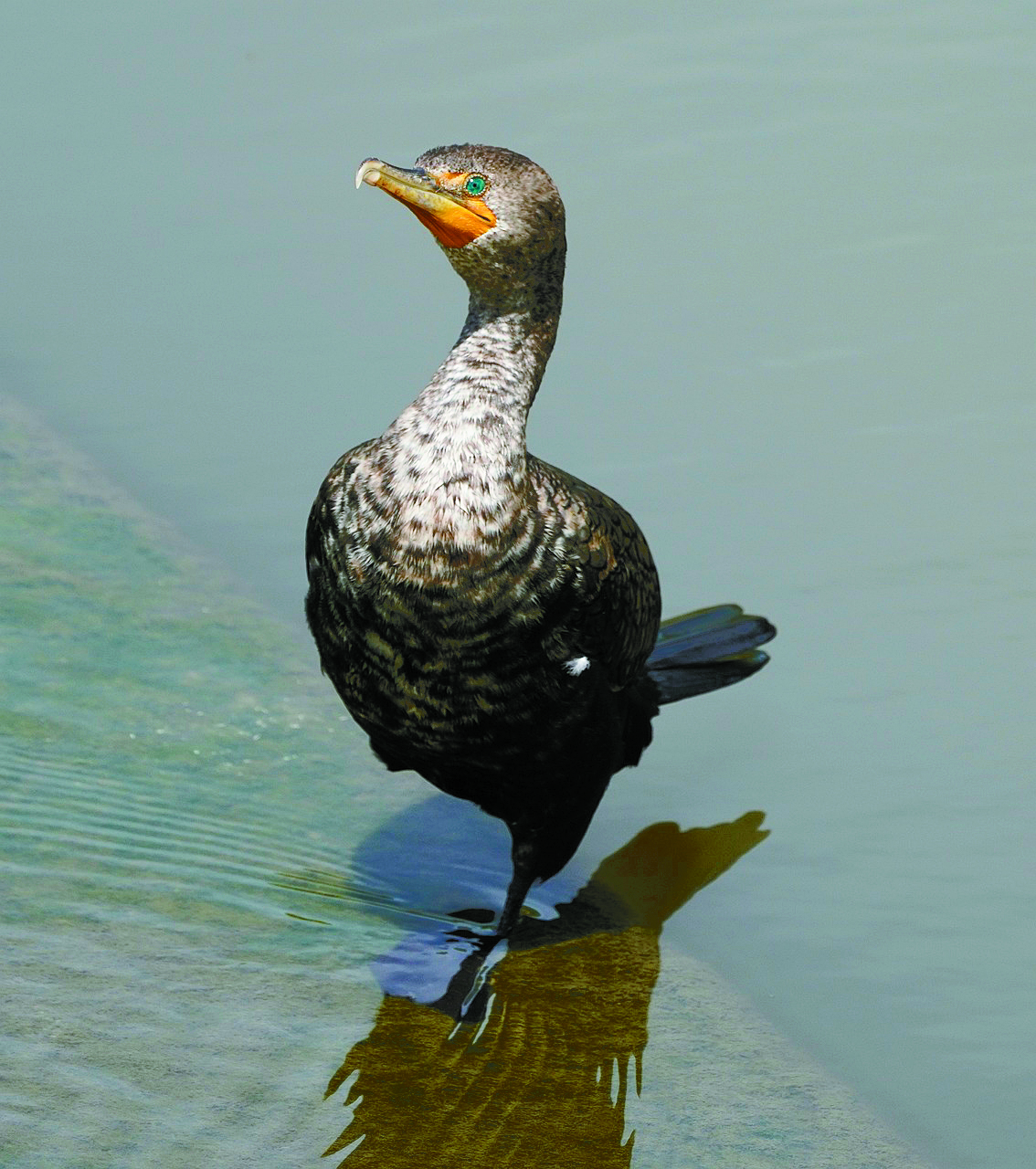
Photo by stephmcblack/Pixabay • A double-crested cormorant stands at attention on a submerged perch.

I originally wrote this week’s column about my birding experiences in the “Big Apple” for the Herald & Tribune of Jonesborough, Tennessee, in July of 2002. The column won a second-place Tennessee Press Association award for “Best Personal Column” the following year.

Has it really been 21 years? Wow! Time flies.

While the column is about birds I saw during my brief New York stay in July of 2002, the trip didn’t allow for the time to dedicate to serious birding. The birds I saw were all incidental to the other activities I crowded into the narrow window of time I had for experiencing New York City.

Here’s the original column:

During a recent trip to New York City, mainly for the purpose of visiting friends and seeing the sights, I also availed myself of the opportunity of trying to see a few birds in the Big Apple.

At first glance, New York City doesn’t seem a haven for birds or any other sort of wildlife. Without any serious effort on my part, however, I managed to see 15 different species of birds. My tour guide and friend, David, remained courteous enough to indulge my occasional lapses into birding. David, perhaps like many New Yorkers, is familiar on a daily basis with the Big Apple’s three most prominent members of the bird family — the house sparrow, the European starling and the rock dove, or pigeon.

Everyone who has visited a city park, whether in Jonesborough or New York City, is probably familiar with the rock dove. Commonly called pigeon, the rock dove is not a native American bird. But their introduction to this continent paralleled the arrival of European colonists. Pigeons came to this country along with other farmyard animals, such as cattle and sheep. But, once here, the rock dove, which is a wild bird in Africa and in the Mediterranean, also managed to establish itself outside the farmyard. Nevertheless, more than most other birds, the rock dove still only thrives in the company of humans. In New York City, pigeons are a part of the landscape. They are everywhere! As a result, these birds can cause some problems. Their droppings can damage buildings and statues. They can also spread various diseases to humans. Efforts have been made to curb their numbers, but the pigeon looks to be a permanent part of the New York City landscape.

It’s no longer a paradise for pigeons in the Big Apple, however. The peregrine falcon, once endangered, has rebounded with protection from the government. The skyscrapers of New York City have replaced cliff faces as nesting sites for these sleek, aerodynamic predators. While I wasn’t fortunate enough to see a peregrine falcon while in New York City, they are there. Their presence has put some balance back into the food chain. The pigeons now have a natural predator.

Earlier this summer, David called me looking for advice about a problem with birds. Seems that a pair of house sparrows had built a nest beneath his air conditioning unit at his apartment. The problem involved timing. David recently moved to a new apartment and he needed to take the air conditioner with him. In the end, David’s need for the air conditioner outpaced the nesting progress of the sparrows. Now, he’s convinced that the sparrows, like the gulls, are out to get him. More about the gulls later.

The house sparrow is a non-native species introduced to the United States. The house sparrow was released intentionally in the United States in the 1850s at different points between New York and New England. Other introductions of this species occurred at other points in the United States. The introductions were huge mistakes. By 1910, the house sparrow had invaded the entire continent. The house sparrow is also an aggressive bird. Soon, the house sparrow came into conflict with a beloved American favorite, the Eastern bluebird. The major competition between Eastern bluebirds and house sparrows is for nesting cavities. House sparrows have the tenacity to evict even the larger Easter bluebirds from occupied nests. Occasionally, the sparrows even kill nestlings or adult bluebirds. I found the house sparrow almost as numerous as rock doves in most areas of New York City.
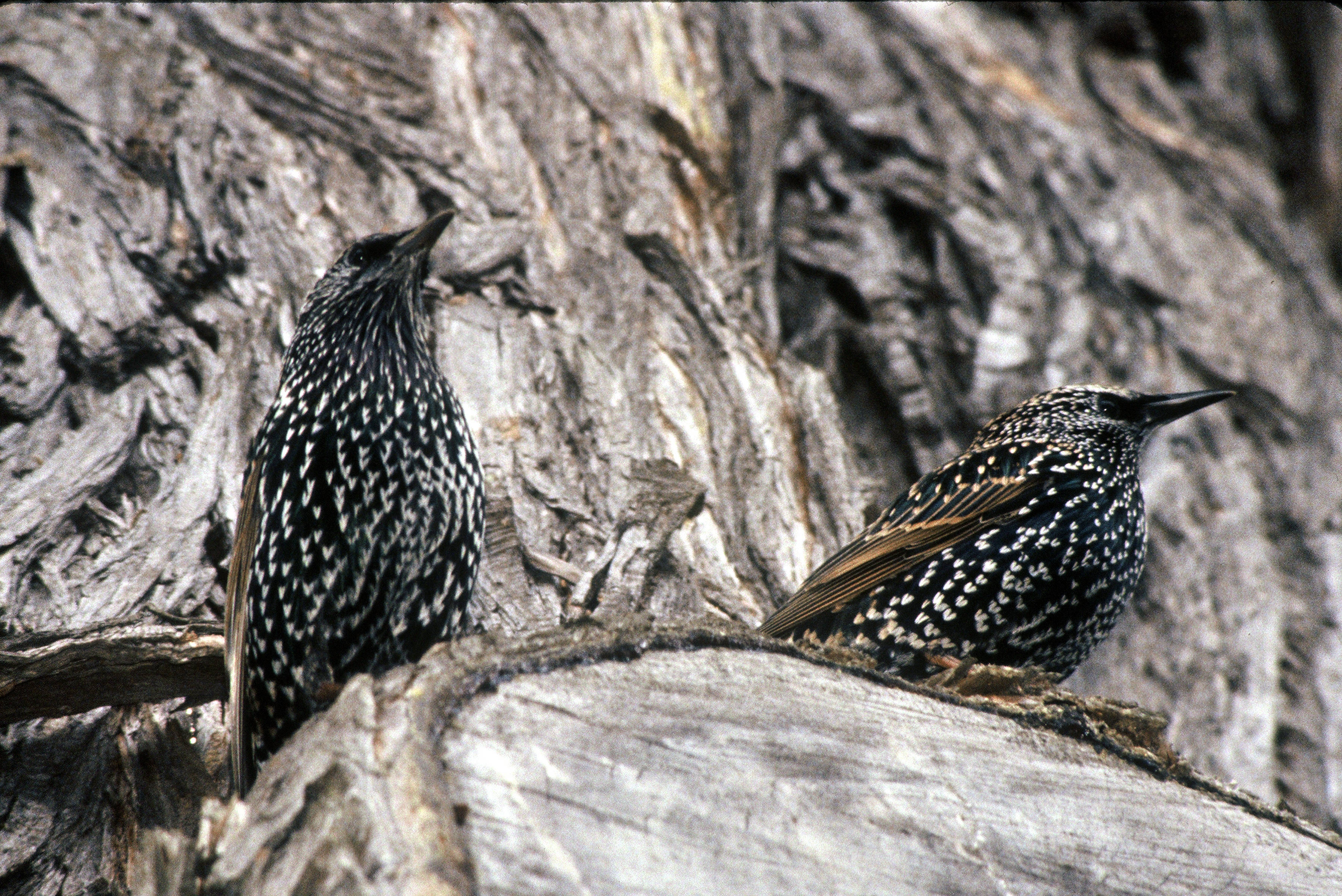
Photo by U.S. Fish & Wildlife Service
The European Starling is prevalent in New York City and the surrounding area.

But, there was still a third common bird — the European starling. I encountered the first starlings of my trip in New York City’s famous Central Park. Ironically, Central Park is where the European starling, now considered the most numerous bird in North America, got its start. The rock dove and house sparrow got here first, but the European starling didn’t waste any time once the first starlings were released in 1890. The first European starlings were released at that time in Central Park because some fans of William Shakespeare wanted to release all the birds mentioned in The Bard’s plays. Apparently, only the release of the European starling from that list of birds had any lasting consequence. Even today, starlings and Shakespeare are very much associated with Central Park. During the summer there is a popular Shakespeare festival held in Central Park. And, on any summer day, there will always be plenty of starlings in the park.

Those were three of the 15 birds I managed to observe on my trip. The remaining 12 species comprised a diverse and at times surprising list. I found American robin, American crow, blue jay, chimney swift, Carolina wren and downy woodpecker within Central Park. In addition, at a large pond within the park I also observed a green heron and mallards. The robins, in particular, appeared as they would in any park setting. They hopped about on grassy lawns while foraging for food. David told me he recently saw a roadrunner in the park. I told him that would be an extraordinary discovery since that bird is native to the western United States.

There’s a lot of water in and around New York City. Perhaps it isn’t a surprise to discover birds such as double-crested cormorants swimming in the East River. I also saw plenty of gulls. In fact, I saw three different species of gulls — herring gulls, ring-billed gulls and laughing gulls.
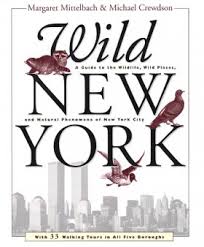
The cover of the book Wild New York: A Guide to the Wildlife, Wild Places and Natural Phenomena of New York City by Margaret Mittelbach and Michael Crewdon

Surprisingly, gulls haven’t always been common in the vicinity of New York City. According to the book “Wild New York: A Guide to the Wildlife, Wild Places and Natural Phenomena of New York City” by Margaret Mittelbach and Michael Crewdon, gulls did not frequent New York City 100 years ago. Now, there are as many as one million gulls in New York City. The book also mentions one of the attractions: Staten Island’s Fresh Kills Landfill, the largest garbage dump in the world.

My friend David considers gulls evil omens. I tried to do some research into the role of gulls in folklore. I turned to the book by Laura C. Martin titled “The Folklore of Birds.” Her entry on gulls proved sketchy. Here’s some of what I learned. The word “gull” comes from a Welsh word, “gwylan,” which can be translated as “wailing.” The term “gull” apparently derived from the bird’s wailing or plaintive call. The Latin genus name, Larus, for gull is translated as “ravenous seabird.” So, that leaves us with a ravenous, wailing seabird. Apt descriptions, but not exactly a rich folklore. Birds such as crows and the various species of owls have much more ominous superstitions surrounding them.
•••
New York City has a “New York Rare Bird Alert.” If you would like to know what rare birds are being seen in New York City, dial (212) 979-3070. I dialed the number during my visit and received information about excitement regarding large flocks of migrating shorebirds, a common raven and nesting blue grosbeaks.
(Note: The number is still in use. So, if you’re planning any New York visits and would like to bird, the phone number is still valid.)
•••
My friend David now lives in Baltimore. I haven’t visited him there, but he has visited me in the mountains near Asheville, North Carolina. I’d like to thank him again for my taste of the Big Apple.
•••
I love to hear from readers. Email me at ahoodedwarbler@aol.com with comments, questions or sightings to share.

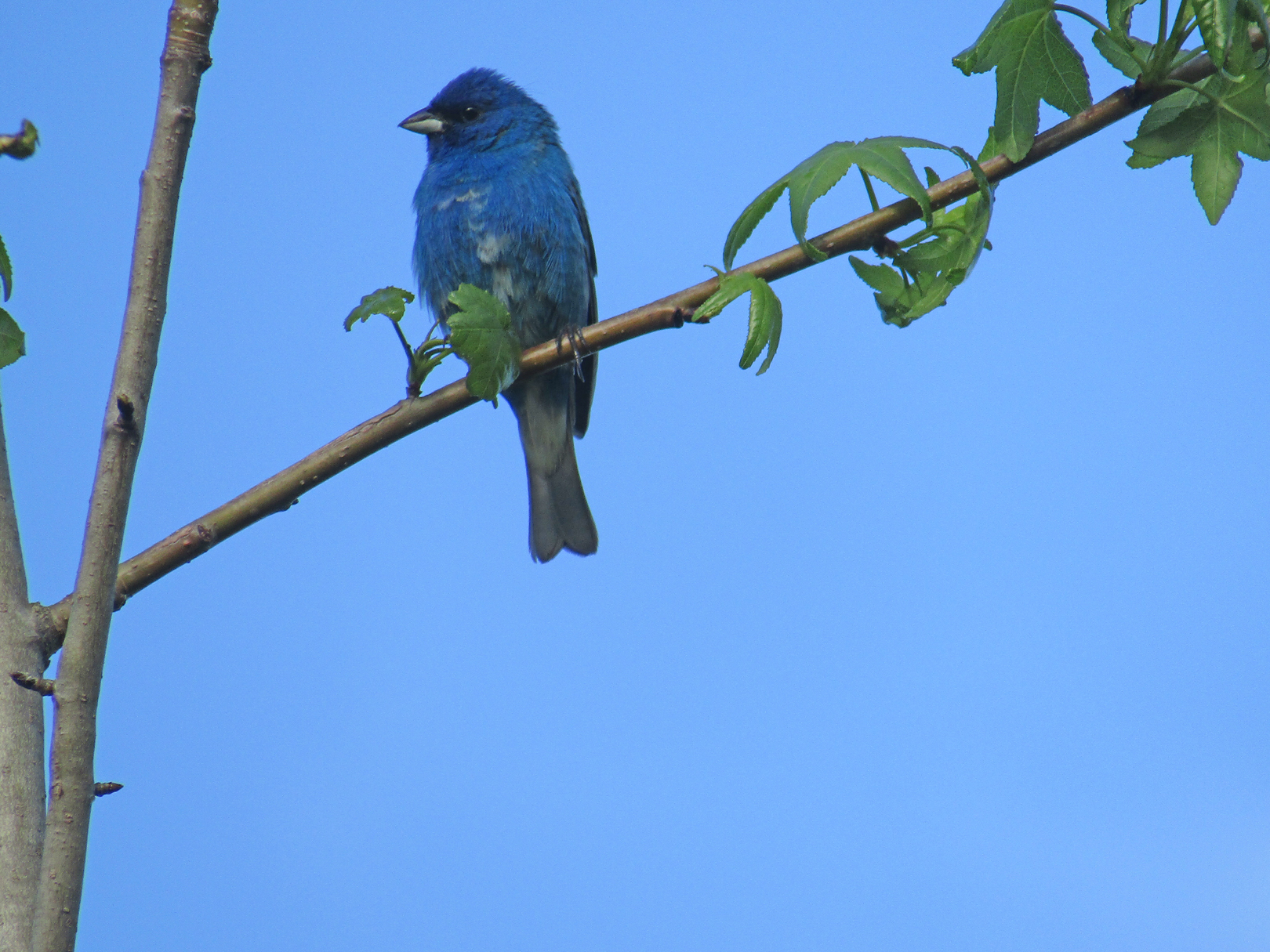
Indigo bunting’s blue appearance is a trick of the light

Photo by heronworks/Pixabay • A male indigo bunting visits a feeder for a meal of seeds. These birds are fairly common in the region during the summer months.


The indigo bunting is one of the reasons I love to pay attention to the clientele visiting my feeders. This small songbird likes to reside in the boundary region where forests and woodlands meet fields and pastures. Personally, the indigo bunting has always been a bird that is suggestive of the long, hot days of summer.

One of my earliest and still quite vivid birding memories is a recollection of a shockingly blue bird atop a blue spruce tree in my yard. Several decades later, the tree is no longer standing, but these beautiful birds — I now know those long-ago summer visitors were indigo buntings — still return each year to my yard and gardens.

Indigo buntings usually arrive in the region in late April, and I’ve seen them linger until late October, although most indigo buntings have left the region by late September.

Upon arrival, male indigo buntings become tenacious singers, repeating their jumbled notes even during the hottest hours of summer afternoons. The preference of this small songbird is to sing from the tops of tall trees, where they are often concealed by the green leaves. When I do get a glimpse of the obscured songster, often all I see is a dark shape silhouetted against the bright sky. Sometimes, if he plunges from the upper branches into the woodland understory, I get that telltale glimpse of blue feathers.

The male indigo bunting is the only solid blue bird in the eastern United States, but it’s all an illusion — literally a trick of the light. The indigo bunting’s feathers are not really blue; the male’s brilliant azure plumage is caused by the process of diffraction of light around the structure of the bird’s feathers. This process scatters all but the blue light, and the resulting color shifts from black to blue to turquoise as the angle of reflected light changes. In bright light, it can even look unnaturally vivid blue. In poor light, however, an indigo bunting male can appear black. Fortunately, indigo buntings have both a characteristic body shape and song, so even if the birds are not seen in their best light, they can still be recognized.

Like many species of songbirds, the male is by far the most colorful. In this instance, the male is also responsible for the species’ name. Indigo is a blue dye that was once an important crop in the South. The drab female may boast some blue highlights in her plumage. Juvenile birds just out of the nest also resemble the female. Pay close attention to any indigo buntings you observe as summer progresses. Juvenile birds will look mostly brown with just a hint of blue in the wings and the tail. These will be the young buntings that were hatched in spring and early summer. They will often accompany their parents to feeders.

Photo by Bryan Stevens • The male indigo bunting is a resplendent bird.

Indigo buntings are particularly fun birds to observe in late summer. Indigo bunting juveniles, like the young of many other birds, beg for tidbits from parents by “bowing,” spreading their wings and shivering. These actions usually prompt a parent to pop some morsel into an impatient youngster’s open bill. Indigo buntings are relatively easy to view. They frequent weedy fields and roadside brush.

The indigo bunting belongs to a genus of birds known as Passerina, which is included the family Cardinalidae, which includes birds like Northern cardinal and rose-breasted grosbeak. They are often lumped into a group known as North American buntings, although they are not closely related to such birds as snow bunting and lark bunting. The latter is even recognized as the official state bird for Colorado, a unique honor for this group of birds. The other members of the Passerina genus include lazuli bunting, varied bunting, painted bunting, rose-bellied bunting, orange-breasted bunting and blue grosbeak.

Worldwide, other birds known as buntings include such descriptively named species as slaty bunting, corn bunting, white-capped bunting, gray-necked bunting, cinereous bunting, lark-like bunting, cinnamon-breasted bunting, chestnut-eared bunting, little bunting, yellow-throated bunting, golden-breasted bunting, black-headed bunting, red-headed bunting and yellow bunting.

The male indigo bunting is one of the most colorful birds to visit feeders in the region. This species is also extremely fond of millet seed. I like to have some feeders stocked with millet when the buntings begin to return each spring. They will also feed on thistle and sunflower seeds. Away from our feeders, they also devour plenty of seeds from various noxious weeds. Because of the indigo bunting’s appetite for the seeds of destructive weeds, it is considered a beneficial bird.
••••
Bryan Stevens has been birding since the 1990s and has written about birds and birding since 1995. Email him at ahoodedwarbler@aol.com to share sightings, ask questions or make comments.

Photo by Bryan Stevens • Newly-returned neotropical migrants, such as this Indigo Bunting, increased the total number of species for the annual spring count.

Great crested flycatchers select some interesting nest material

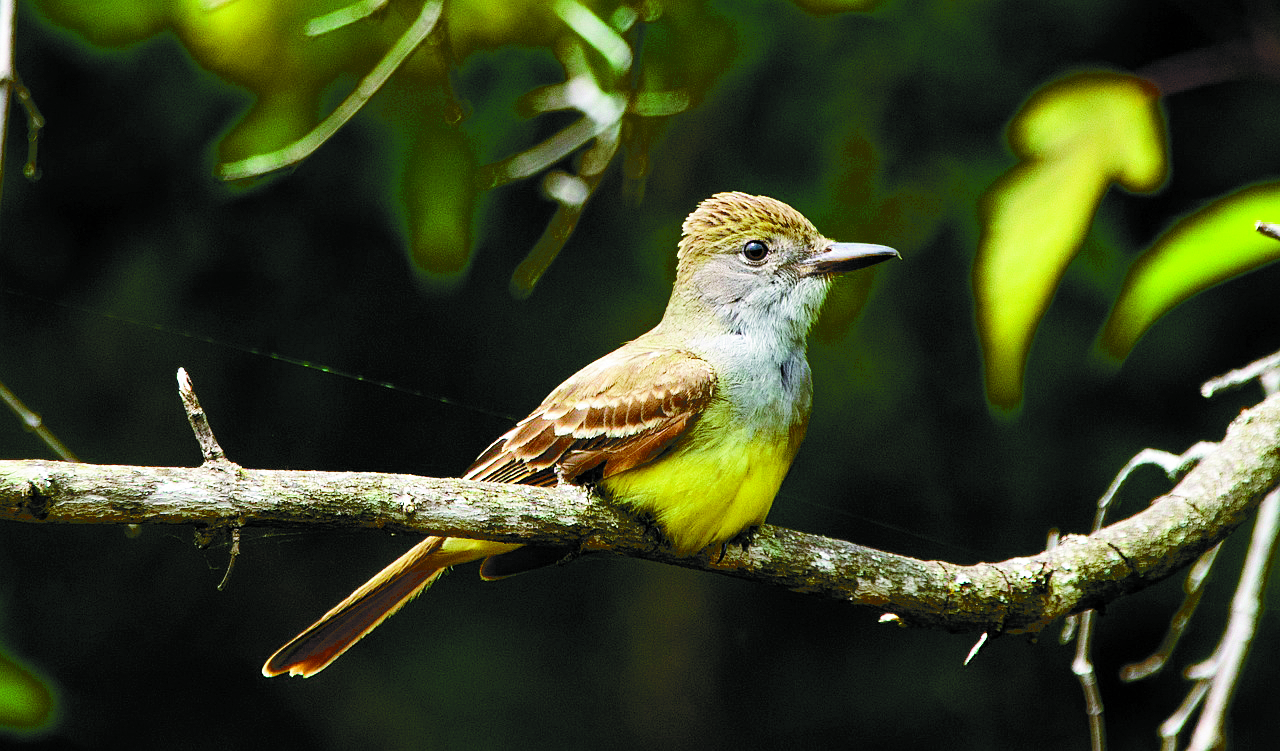
Photo by simardfrancois from Pixabay * The great crested flycatcher is indeed crested and a member of the flycatcher family. The descriptive term “great,” however, is subjective but supported by the fact that this species possesses many interesting traits and behaviors.

Many of my friends and family members are afflicted with a fear of snakes. They’re in good company. Statistics indicate that about a third of the population has this particular phobia. Scientifically, this phobia is known as ophidiophobia.

Before anyone reads further, this is not a column about snakes. There’s only one solid connection between snakes and this week’s featured bird. More on that shortly.

I’ve been writing about flycatchers for the past couple of columns, including the Eastern kingbird and scissor-tailed flycatcher. This week, I am introducing readers to another member of the family.

The great crested flycatcher has an impressive name. Like many species of birds, this one has been given a puzzling common name considering the bird’s appearance doesn’t really justify such a grandiose name.

The great crested flycatcher does indeed sport a raggedy crest. For a flycatcher, it is almost a showy bird with its brown and dull yellow plumage. There’s not much to explain the adjective “great” in this bird’s name. It’s only about eight inches long. Helped by the shaggy crest, this flycatcher looks like it has a head slightly too large for its body.

The great crested flycatcher is unique among the region’s flycatchers in nesting inside natural cavities, in the same fashion as such popular cavity-nesting birds as Eastern bluebird and tree swallow. The great crested flycatcher will also nest inside bird boxes, although the entrance hole needs to be slightly larger than the ones required for bluebirds and other small songbirds.

It’s this flycatcher’s nesting habits that provide the tenuous connection to snakes. Great crested flycatchers almost invariably weave a shed snakeskin into the nest during the construction process.

This flycatcher has become quite famous for its incorporation of a snakeskin into the construction of its nest. This prevalent tendency on the part of great crested flycatcher isn’t practiced as a whim. Studies suggest that the snake skin serves as a deterrent to ward off potential predators that might seek to eat the flycatcher’s eggs. With the advent of the era of mass production, the great crested flycatcher occasionally substitutes cellophane or other varieties of clear plastic in place of the traditional snake skin. The speculation is that the bird mistakes the cellophane for the remnant left behind when a snake sheds its old skin.

During spring visits to coastal South Carolina, I’ve observed these flycatchers attempting to nest inside wooden paper delivery boxes. I’m not sure what the newspaper subscribers thought of these clever attempts to take up residence in the boxes.

You’ll probably hear a great crested flycatcher before you see it. Even when hidden in the forest canopy, the great crested flycatcher betrays its presence with its loud “Wheep!” call. They’re not skittish birds, however, and some patience will often result in a visual observation of the bird.

Like with most other flycatchers, insects are the focus of the dietary preference of this bird. However, the great crested flycatcher will also eat some seasonally available fruit, including various berries. The bird’s favored way to forage for insects is to perch on a branch until an insect wanders into range. Once it spots an insect, the flycatcher swoops down to capture its prey.

The great crested flycatcher belongs to the Myiarchus genus of flycatchers, which consists of about two dozen species ranging throughout Central, South and North America. In the United States, the other two members of the genus are the ash-throated flycatcher, which resides in the western United States, and the brown-crested flycatcher, a resident of southern California, southern Nevada, central Arizona and southern Texas. Both of these species also range into Mexico and Central America.

The island of Jamaica is home to another member of the genus with a claim to a rather unusual name. The sad flycatcher, better known in Jamaica as “little Tom Fool,” is considered a common resident of Jamaican forests.

The tyrant flycatchers (Tyrannidae) are a family of passerine birds which occur throughout North and South America. They are considered the largest family of birds, with more than 400 species. They are the most diverse avian family in every country in the Americas, except for the United States and Canada, where they are present but without the diversity seen south of the U.S. border.

Other descriptively named tyrant flycatchers include rufous flycatcher, stolid flycatcher, black-capped flycatcher, yellow-bellied flycatcher, fork-tailed flycatcher, golden-winged tody-flycatcher, flammulated flycatcher, boat-billed flycatcher, ornate flycatcher, cinnamon flycatcher and vermilion flycatcher. The latter is a bit of a standout among flycatchers in having brilliant red plumage.

Listen for that loud “wheep” call, often coming from the upper levels of the woodland canopy. The hidden singer often produces the call repeatedly. Once the summer nesting season ends, these birds are typically silent. On occasion, however, an individual bird will not remain mute, and I have heard the loud “wheep” call even in September and October during fall migration.

Although the great crested flycatcher is found in the region, I have observed this bird with more frequency farther south in states like Georgia and South Carolina. You just have to use a little more effort to observe this interesting bird closer to home.

I have had the chance to observe nesting great crested flycatchers at the homes of friends and family members. More than 20 years ago, a family of great crested flycatchers took up residence in a box mounted to the garage at the home of my uncle, Ray Sneyd, in Limestone Cove.

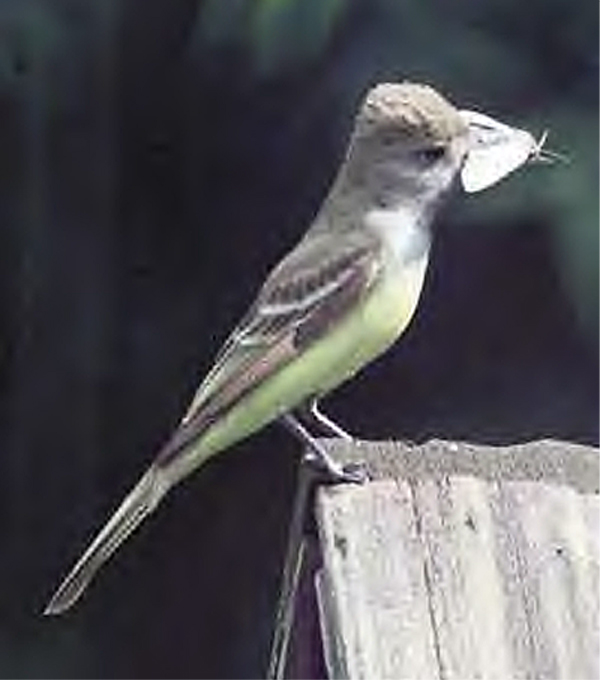
A Great Crested Flycatcher holds a moth in its beak prior to feeding the insect to its hungry young.

Back in the late 1990s, I also made the acquaintance of Brookie and Jean Potter, who reside at Wilbur Lake in Carter County, when they sought out help identifying a great crested flycatcher nesting in a bird box at their home. The experience also set the Potters on their own path into birding. We have had many fun birding adventures in the subsequent years.

To share a sighting, ask a question or make a comment, email me at ahoodedwarbler@aol.com.


Man’s return to birding yields scissor-tailed flycatcher sighting


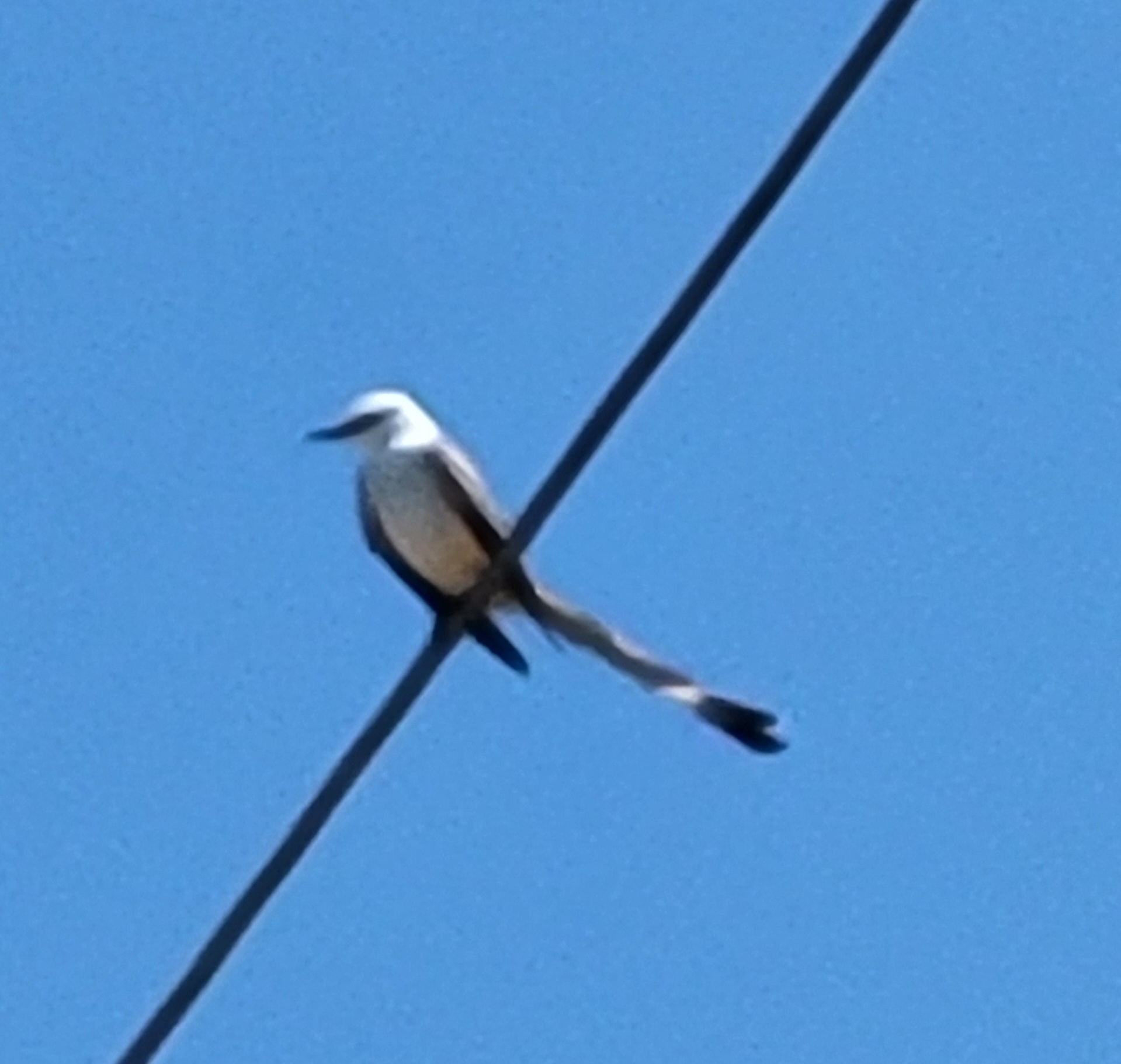
Photo by Pixabay • The scissor-tailed flycatcher is the state bird of Oklahoma and not a species often found within the borders of the Volunteer State. Nevertheless, one such flycatcher was recently spotted by Dan Huffine as he baled hay in a field in Jonesborough.

Birding is a lot like riding a bike. Once you learn how, it’s always going to stick with you.

That’s certainly been the case for Jonesborough resident Dan Huffine, who got his start in birding back in the last decade of the 20th century.

“I was very active in birding back in early ’90s,” Huffine said.

He’s now emerging after a long hiatus from birding, and he’s done so in a big way with a recent sighting of a scissor-tailed flycatcher.

He wasn’t even actively looking for birds — he was simply baling some hay in a field in Jonesborough.

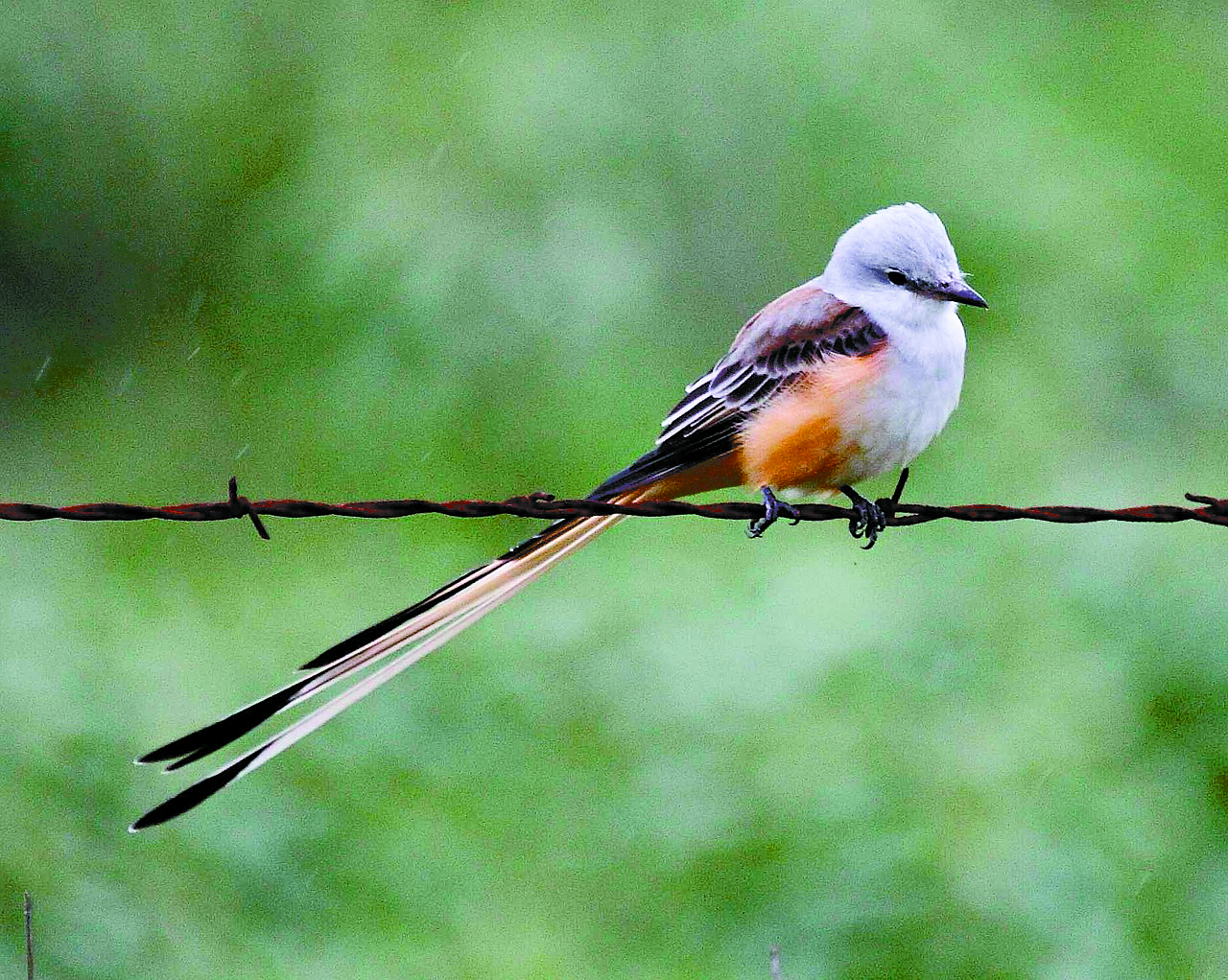
Photo by Danny Huffine • On a subsequent trip to look for the scissor-tailed flycatcher, Dan Huffine was rewarded with a chance to snap a photo of the bird perched on a wire.

“The bird was sitting on a windrow of hay facing me as i approached it on a tractor and round baler,” he explained.

He noted that his first impression was, “Wow! That mockingbird has a really white-looking head.”

As he got closer, the bird flew and revealed that it was definitely not a Northern mockingbird.

“It had that unmistakable long tail with some pinkish color under the wings,” Huffine said.

He stopped the tractor, not believing what he had just seen.

“My immediate thought was no one will believe me,” Huffine said. “I got some poor quality cell phone pictures. I got a better shot later in the day. I so wanted others to confirm my sighting.”

Toward that end, he contacted me and sought out my help in getting him in touch with Rick Knight and Fred Alsop, two very accomplished and well-known birders in the region.

Huffine’s excitement was contagious. Some other birders have now observed the flycatcher, which is a bird much more likely to be found in Oklahoma or Texas rather than Northeast Tennessee.

In fact, Huffine’s sighting became only the third-ever sighting of a scissor-tailed flycatcher in Northeast Tennessee. All of the sightings have taken place in Washington County.

According to the website “All About Birds,” scissor-tailed flycatcher numbers declined by about 31% between 1966 and 2014. The estimate comes from statistics gathered by the North American Breeding Bird Survey.

The website also noted that Partners in Flight estimates a global breeding population of 9.5 million scissor-tailed flycatchers, with 92% breeding in the United States, and 50% spending some part of the year in Mexico.

A scissor-tailed flycatcher is unlikely to be confused with any other bird. Adult males are pale gray birds with blackish wings and black tails with white edges. Adults show salmon-pink flanks that extend to underwing patches that are very conspicuous in flight. As is the case with so many species of birds, males are more colorful than females.

The bird’s body is about the size of an American robin, but it looks bigger due to the long tail that gives this species its common name.

The “All About Birds” website notes that the scissor-tailed flycatcher doesn’t always stay within its expected range.
This species tends to wander widely on their way to and from the wintering grounds, a habit they share with relatives like the fork-tailed flycatcher and tropical kingbirds. During spring and fall, scissor-tailed flycatchers may show up almost anywhere in North America, as far north

as British Columbia and Nova Scotia — or Northeast Tennessee.
One place that the bird is expected is Oklahoma. Since May 26, 1951, the scissor-tailed flycatcher has been the officially designated Oklahoma state bird.
Even during Huffine’s hiatus from birding, he still managed to see some fantastic birds, including a snowy owl in Beckley, West Virginia, back in 2014.
“I started an ebird account in early 2022,” he said.

“I am starting over with my life list.”

The only bird that he has kept on his list is the aforementioned snowy owl.
“Birding is much easier now than it was 30 years ago,” Huffine said. “We have better optics.”

He noted that birding apps have also proliferated, including eBird and Merlin.
“Just don’t over trust Merlin,” Huffine cautioned.

He has some target species that he’d like to find in east Tennessee, including Northern saw-whet owl and ruffed grouse.

“Ruffed grouse has become a much harder species i(to find) in the last 30 years,” Huffine said.

He has some solid advice for anyone who would like to replicate his success.
“It’s is easy to dream about far-off places to visit, but look for everything that is present where you are,” he said. “You might find a scissor-tailed flycatcher.”


Kingbird earns its status as avian tyrant

Photo by Diana Roberts from Pixabay • A dark tail bordered with an edge of white feathers is a field mark that helps the Eastern kingbird stand apart from other flycatchers.


Erwin resident David Bailey contacted me on Facebook for some assistance with identifying a bird that he observed recently. He provided some photos that helped establish the bird in question as an Eastern kingbird.

Here’s some more information on the Eastern kingbird. First, kingbirds are a part of an extensive family of birds known as flycatchers that are exclusively found in the New World.

The Eastern kingbird is easy to recognize and identify. The bird’s plumage is a study in contrast, being black above and white below. In addition, there’s a noticeable white edge to the tip of the bird’s otherwise all-black tail. There is a red patch of feathers on top of the bird’s head, which gives this pint-sized tyrant a “crown,” but most birders would tell you that this colorful patch is rarely seen and is instead kept concealed at most times.

The scientific name of the Eastern kingbird is Tyrannus tyrannus, a good clue to the bird’s militant nature. Kingbirds, which are about the size of an American robin, are famous for displaying aggressive behavior against much larger birds such as crows and hawks.

Photo by Bryan Stevens • An Eastern kingbird perches on a post in a Limestone Cove field near Unicoi.

While some birds are all bluff, the Eastern kingbird often follows through with its attacks. According to the website All About Birds, kingbirds have been known to knock blue jays right out of a tree.

I’ve observed kingbirds tormenting such large birds as red-tailed hawks and turkey vultures. I once watched a kingbird get so close to a red-tailed hawk that it almost looked like the smaller bird was hitching a ride on the hawk’s back. I suspect the hawk lost a feather or two in the encounter, not to mention its dignity.

Other North American kingbirds include Western kingbird, tropical kingbird, Couch’s kingbird, Cassin’s kingbird and the thick-billed kingbird. On a trip to Salt Lake City in Utah many years back, I got the chance to see a Western kingbird, the counterpart to the Eastern kingbird in that part of the country.

Look for the Eastern kingbird in open terrain that offers plenty of perches. These birds spend most of their time chasing and catching flying insects, which provide the bulk of the bird’s food during the summer months.

While the kingbird is probably to be lauded for helping control populations of insect pests, they are not discriminating in their choice of prey. As a result, kingbirds feed on beneficial insects, such as dragonflies and bees, as well as pests like flies.

Other flycatchers that are relatively common in the region include Eastern phoebe and Eastern wood-pewee. The region is also home to some pint-sized flycatchers during the warmer months, including least flycatcher, Acadian flycatcher, willow flycatcher and alder flycatcher.


Don’t judge the tyrannical kingbird too harshly. These birds are motivated to show aggression to other species due to an inordinate need to protect mates, young and territory. It’s not their fault that they are quite masterful at fulfilling this task.

Kingbirds are not the only birds to exhibit bold, brash behavior. Mockingbirds, brown thrashers and red-winged blackbirds are also quite pugnacious. At home, the male red-winged blackbirds have made numerous attacks on the resident red-shouldered hawks whenever these larger raptors venture too close to the cattail domain of the blackbirds.

To share a sighting, ask a question or make a comment, send me an email at ahoodedwarbler@aol.com.


Region’s orioles are part of blackbird clan

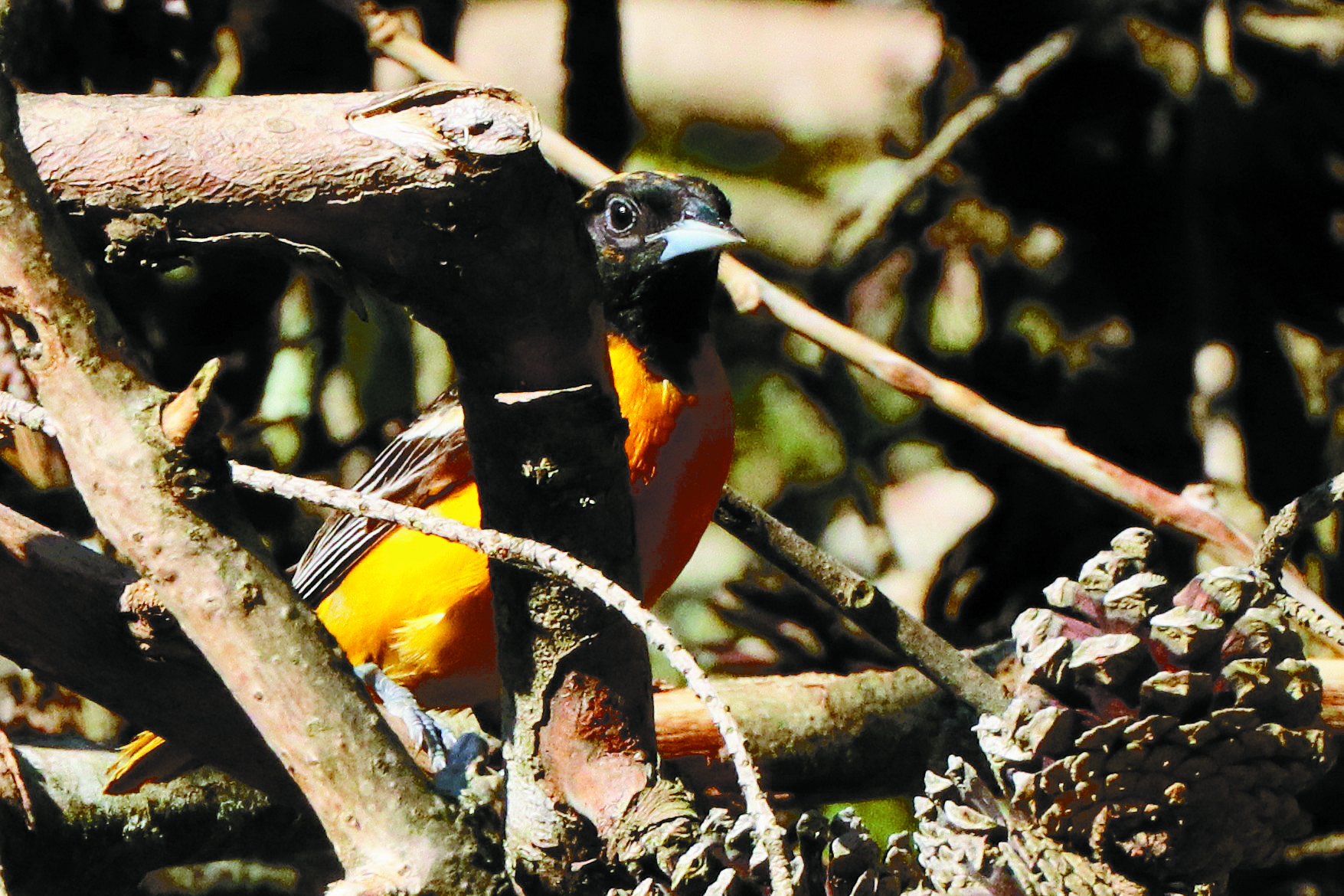
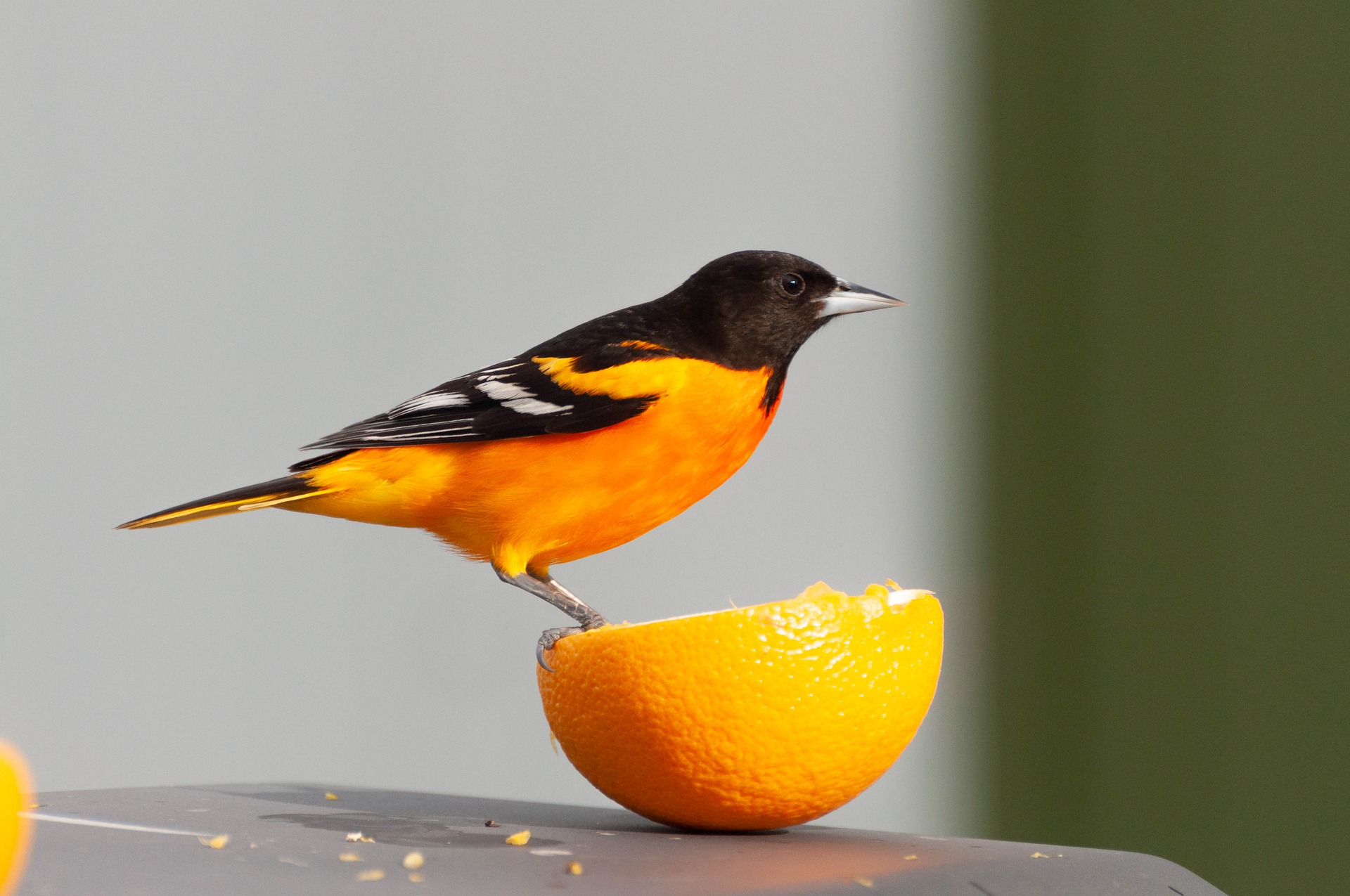
A Baltimore oriole gathers nesting material. • Photo courtesy of Kaylynn Sanford Wilster

Kaylynn Sanford Wilster shared on Facebook her observation of Baltmore orioles gathering nesting materials at her lakeside home in Piney Flats. She also noted that, although she offers oriole feeders, she has had no takers so far.
“They were gathering nesting materials so doubt if I will see them there again, but I was thrilled,” she informed me.

She also noted that observing the birds in person makes clear that the colors of their feathers do not always match the images contained in some bird books.
Her Merlin app, which can identify birds through recording made of their songs, has detected both Baltimore and orchard orioles on a few occasions.
In addition to Kaylynn’s sighting, Lindsay Anne McAuliffe saw and photographed a male Baltimore oriole in Jonesborough. Her friend, Serina Marshall, shared the sighting with me.

These sightings are more examples of the excitement of spring migration when a new bird could be just around the corner.

The Baltimore oriole, despite its bright plumage, is a member of one of the blackbird clans, known in scientific circles as the Icterus genus. In his book, “Birds of Forest, Yard, and Thicket,” John Eastman notes that there are 26 species in the genus, eight of which nest in the United States.

Photo by Bryan Stevens • Orchard orioles, like this bird, as well as Baltimore orioles, were found on the Spring Bird Count.

In the Eastern United States, there are only two orioles — the Baltimore oriole and its smaller relative, the orchard oriole. The western half of the nation is home to a half dozen orioles, including Bullock’s oriole, Scott’s oriole, Audubon’s oriole, hooded oriole and Altamira oriole.

I saw several gaudy, noisy Bullock’s orioles during a trip to Utah in May of 2006.I actually have better luck finding the orchard oriole closer to home. I have learned that tall trees are an essential part of the Baltimore oriole’s favored habitat. Baltimore orioles are well-known for their colorful appearance, but their fame also rests with a sack-like nest that Eastman describes as a “durable marvel of tight-woven plant fibers” in his informational book. Eastman also notes that during another era in America, the Baltimore oriole often built its marvelous nests in American elms before Dutch elm disease almost eradicated these trees from the landscape. He reports that maples, willows and apples have served as nesting trees in the absence of elms. Once the hard-working female oriole sets to work, she may spend eight days or longer weaving plant fibers into a strong pouch suspended from the outer ends of drooping branches. The durability of the nest means that other birds, including house finches, may occupy the old nest once abandoned by the original inhabitant.

Orioles are present in the region from April to October, generally retreating to the American tropics for the cold months of winter. There they may live on plantations that produce such much-coveted crops as bananas, coffee and cacao, which is the essential ingredient for chocolate

The Baltimore oriole is named in honor of one of the founding fathers of the state of Maryland. George Calvert, or Baron Baltimore, was an influential English colonist instrumental in establishing the colony of Maryland. His servants wore orange and black uniforms, which inspired early American naturalist Mark Catesby to name the bird the Baltimore oriole. The bird’s association with the the city of Baltimore and the state of Maryland has continued to this day. The bird is also famous as the namesake of one of America’s professional baseball teams.

Baltimore orioles eat insects and fruit, but these adaptive birds have also developed a fondness for sweet nectar. Orioles no longer have to raid sugar water feeders meant for hummingbirds. Many manufacturers of bird-feeding equipment now produce affordable sugar water feeders specifically designed for use by orioles. Many bird enthusiasts also use orange slices and grape jelly to lure orioles into their yards. I’ve tried these tricks, but I’ve attracted more gray catbirds and scarlet tanagers than I have orioles.

If you’re fortunate enough to have a Baltimore oriole as a neighbor, it isn’t only their bright coloration and elaborate nest building that recommend these birds. They’re also one of the few birds willing to eat the hairy tent caterpillars that are often a blight on the landscape. Back in the late 1990s, I observed a male Baltimore oriole visiting a large caterpillar tent in the branches of a cherry tree. The bird methodically plucked the caterpillars from the silken tent, eating them one after the other. While many birds avoid some of the spiny and hairy caterpillars, orioles actively seek them out and do a great service of reducing the damage these hungry caterpillars can inflict on the environment.

To share a sighting, email me at ahoodedwarbler@aol.com.

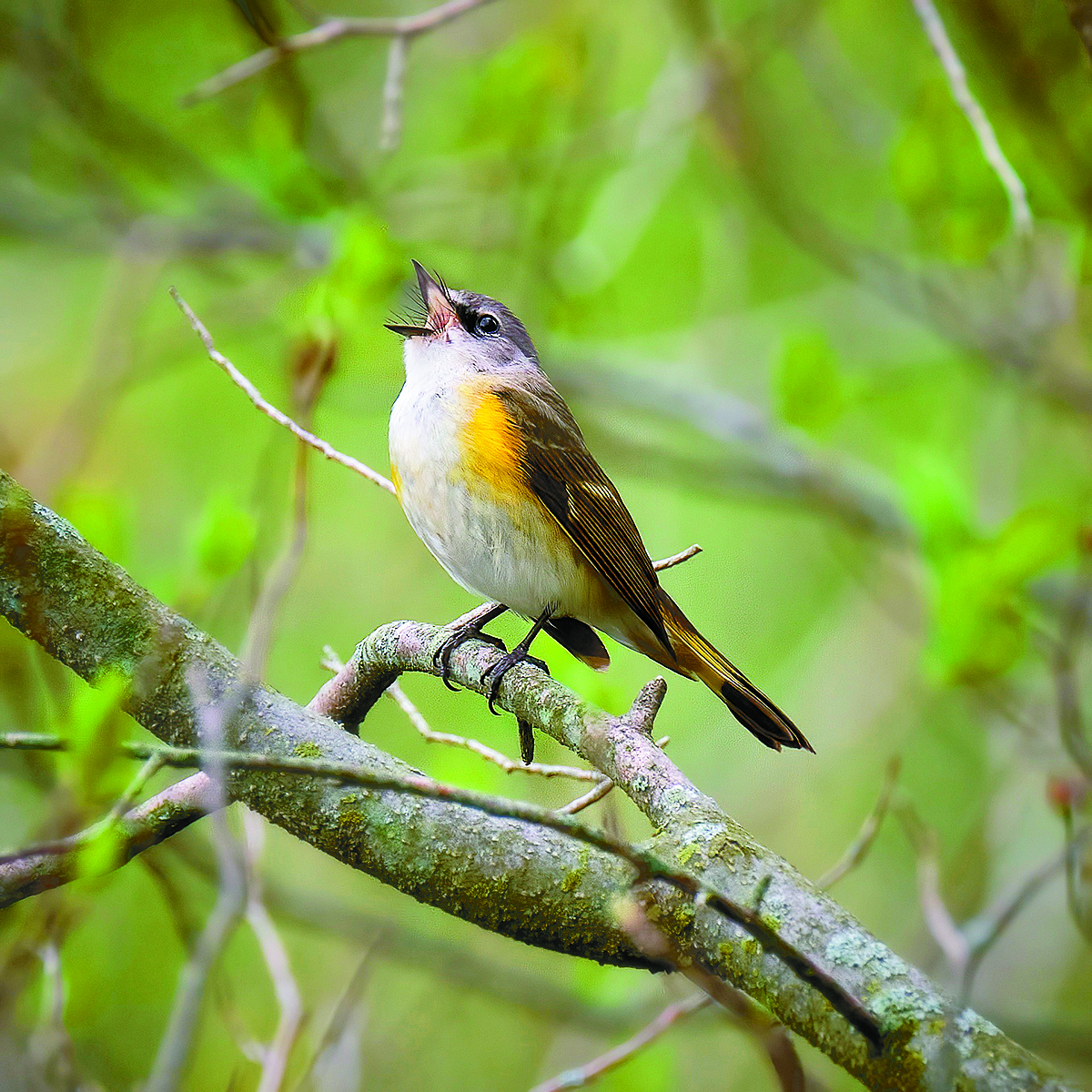
Plumage, behavior help American redstart stand out from most other warblers

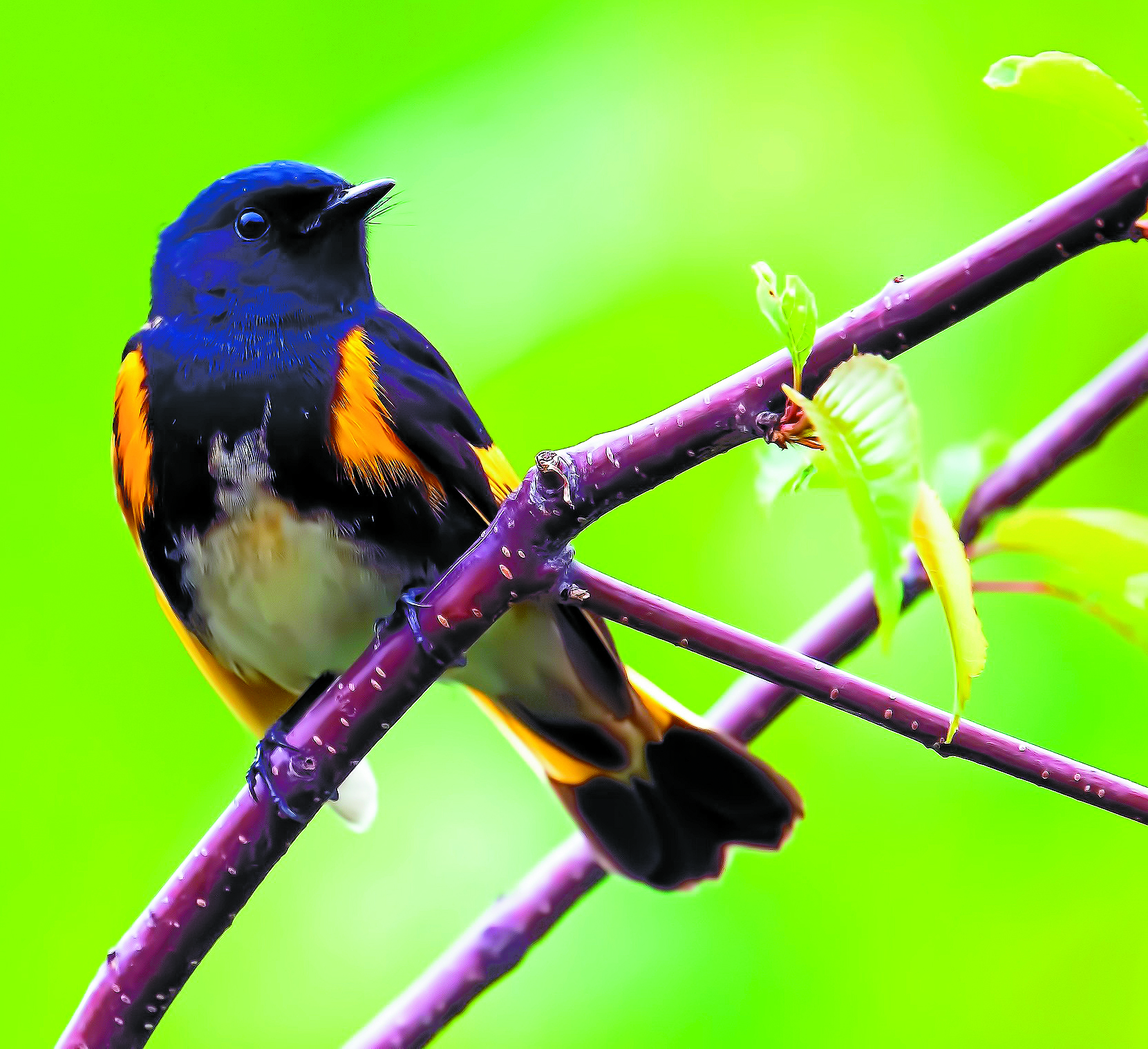
Photo by Hans Toom / Pixabay * Male American redstarts are vibrant birds with a plumage pattern of black, orange and white feathers.

I’ve written about some of our more showy birds in my past few columns. Some of the birds I’ve spotlighted have included scarlet tanagers and rose-breasted grosbeak. This week, I want to introduce one of the more flamboyant members of the warbler family.

Travis Jarrell in Cookeville, Tennessee, contacted me on Facebook for help with identifying a bird, which led to this week’s column.

He also provided a brief video of the little bird as it bathed in a puddle on the flagstones at his home.

His video provided all I needed to identify his bird as a warbler known as an American redstart. Male and female redstarts are both colorful, active birds. Young males also take two years to acquire their adult plumage, showing a plumage intermediate between an adult male and an adult female. I believe that the video Travis captured showed a young male likely born in last year’s nesting season.

I responded with my identification, and Travis replied.

“I had never seen one before, and yes, he was smaller, like a warbler,” he wrote. “It was a thrilling and lovely moment for me, watching him splash in the puddle while the cardinals rumbled in and out of the bird bath. His tail fanning was delightful!”


Photo by Howard Walsh / Pixabay * Female American redstarts are a paler imitation of the male. Females show gray, yellow and white in their plumage instead of the bright orange, black and white of the male.

The tail fanning mentioned by Travis is also a key behavioral trait of American redstarts. They are always fanning their tail feather while on the move. Most experts believe the flashes of color in the tail help the birds to flush prey insects into flight. According to the website, “All About Birds,” American redstarts consume more flying insects than most other warbler species. Their dietary preference for winged insects also brings them into competition with other flycatching species, such as least flycatcher.

American redstarts are among the many neotropical migrants that return to the region each year. Redstarts nest in the region’s mountains up to an elevation of about 4,000 feet and are fairly common from spring to fall. Most American redstarts arrive each spring in late April and immediately get down to the business of raising young. I’ve seen American redstarts constructing nests as early as late April.

The American redstart, even more so than its kin, strikes me as a hyperactive songbird—always on the go, flitting from branch to branch, fanning out its tail feathers and snatching insects flushed from cover. During the nesting season, the male sings a jumbled crescendo of buzzy notes.

There are 115 species of warblers found in the New World, but the American redstart is one of a handful that doesn’t include the word “warbler” in its common name.

The adult male American redstart is unmistakable. His mostly black feathers are accented with bright orange-red patches on the sides, wings and tail. There’s a patch of white on the lower belly and under the tail. For beginners who despair of learning the so-called “confusing fall warblers,” an adult male American redstart is so easily recognized that a sighting of one can produce a big confidence boost.

Females show a similar pattern, being gray-olive where the males are black; females are also lemony yellow where the males are orange, and both have with the same white underparts. A female redstart works alone at nest construction and also does solo duty incubating up to five eggs.

American redstarts nest in in damp woodlands across much of the eastern and northern United States and southern Canada. This warbler becomes much more general in its habitat preferences during the winter and can be found in Central and South America, as well as the Caribbean. Winter habitat ranges from mangrove forests and scrub thickets to plantations for coffee and citrus fruits. A few even take up residence in wooded sections of urban areas.

An occasional American redstart defies the odds and achieves a long life for a songbird. The oldest known American redstart was a male more than 10 years old. According to the website, “All About Birds,” that individual was recaptured and rereleased by a Canadian banding station.

Early French and Spanish explorers gave this pretty songbird some names to match its appearance. From the French, the American redstart received the name “paruline flamboyante,” or flamboyant warbler. The Spanish bestowed the name “candelita Norteña,” or Northern candlelight.

The warblers are one of the families of birds that got me hooked on birding. They make the spring season an exciting time of the year. Get outdoors and enjoy migration. You may be surprised what birds visit your own yard. Don’t delay. As the calendar advances into June, migration’s coming to a close, at least until the start of fall migration in a few months.


Long-running count finds total of 153 bird species

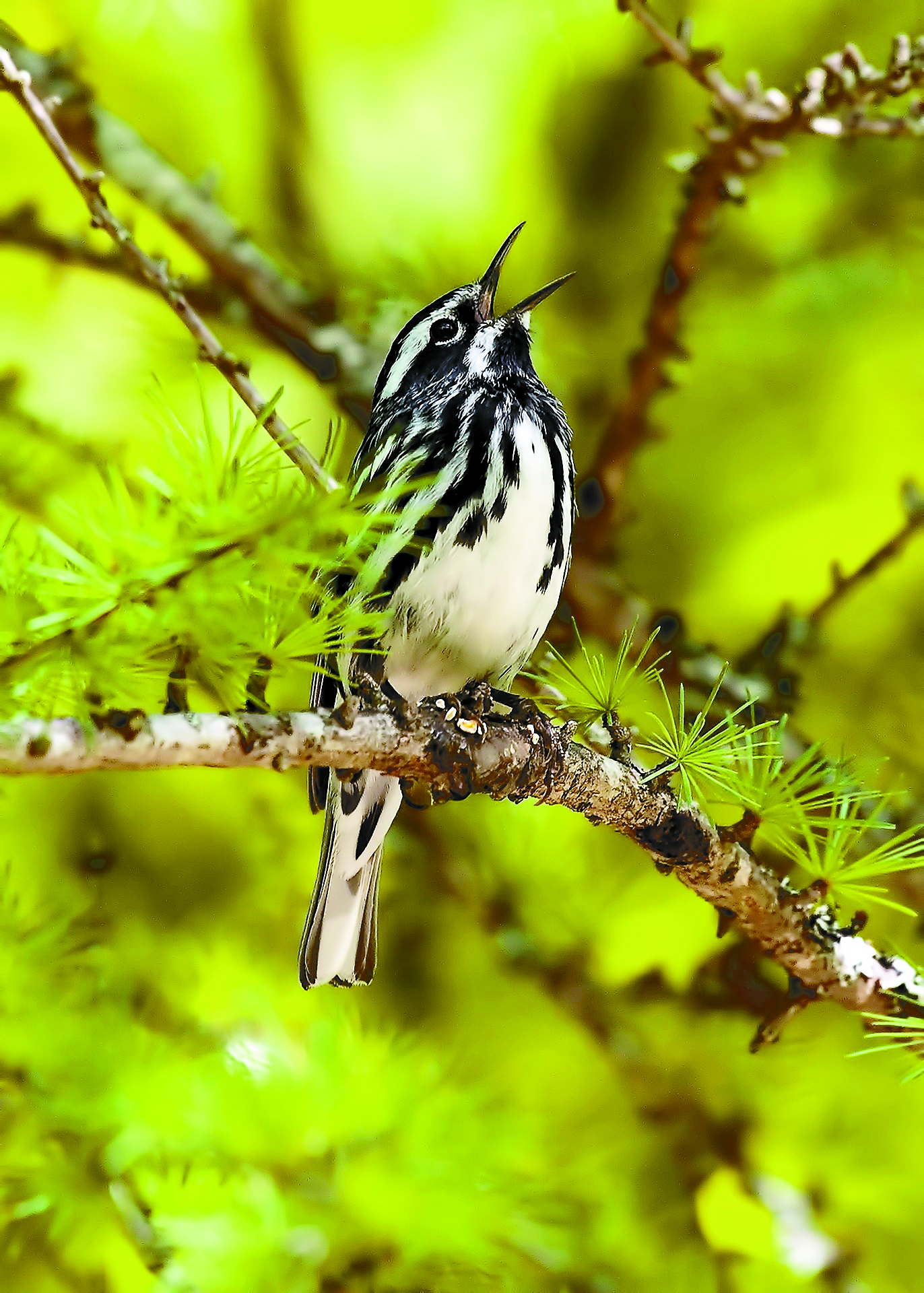
Photo by Hans Toom from Pixabay • A male black-and-white warbler sings from an elevated perch.

The 80th Elizabethton Spring Bird Count was held Saturday, May 6, covering Carter County and parts of adjacent Johnson, Sullivan, Washington and Unicoi counties, with 35 observers in 16 parties and two feeder watchers.
The annual count was conducted by members and friends of the Elizabethton Bird Club.

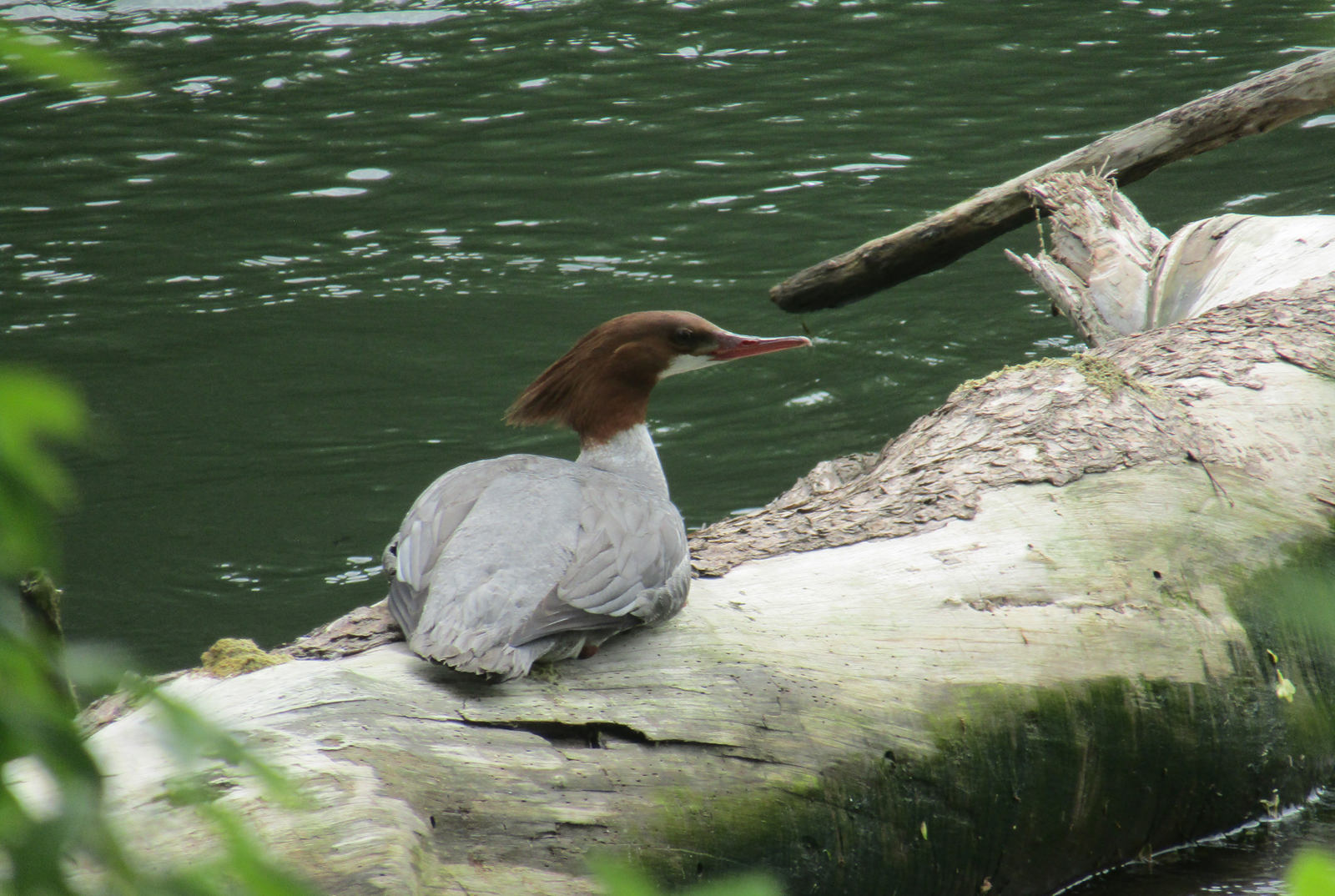
I counted with fellow Elizabethton Bird Club members Chris Soto and Rob Armistead in Elizabethton along the Watauga River and on Holston Mountain. Some highlights from the day included a male scarlet tanager that put on an unbelievable show, as well as a pair of female common mergansers on the Watauga River at Sycamore Shoals State Historic Park.

Participants tallied 153 species, which is exactly the average of the last 20 years. The all-time high was 166 species in 2016.

Longtime count compiler Rick Knight noted that participants tallied 27 species of warblers. In addition, he noted that six different parties found fish crows, a species that would once have been considered a rarity in the region.

The list:

Canada goose, 534; wood duck, 24; blue-winged teal, 13; American wigeon, 1; mallard, 126; hooded merganser, 1; and common merganser, 2.
Ruffed grouse, 1; wild turkey, 33; rock pigeon, 102; Eurasian collared-dove, 1; mourning dove, 194; and yellow-billed cuckoo, 1.

Photo by Bryan Stevens • This female Common Merganser was photographed a previous Spring Bird Count.

Common nighthawk, 1; chuck-will’s-widow, 12; Eastern whip-poor-will, 17; chimney swift, 97; and ruby-throated hummingbird, 25.

Sora, 1; killdeer, 32; least sandpiper, 27; pectoral sandpiper, 3; semipalmated sandpiper, 2; Wilson’s snipe, 1; spotted sandpiper, 60; solitary sandpiper, 32; lesser yellowlegs, 7; and greater yellowlegs, 3.

Common loon, 8; double-crested cormorant, 186; great blue heron, 78; great egret, 1; green heron, 6; black-crowned night-heron, 1; and yellow-crowned night-heron, 3.
Black vulture, 91; turkey vulture, 94; osprey, 10; Cooper’s hawk, 9; bald eagle, 6; red-shouldered hawk, 6; broad-winged hawk, 8; and red-tailed hawk, 25.

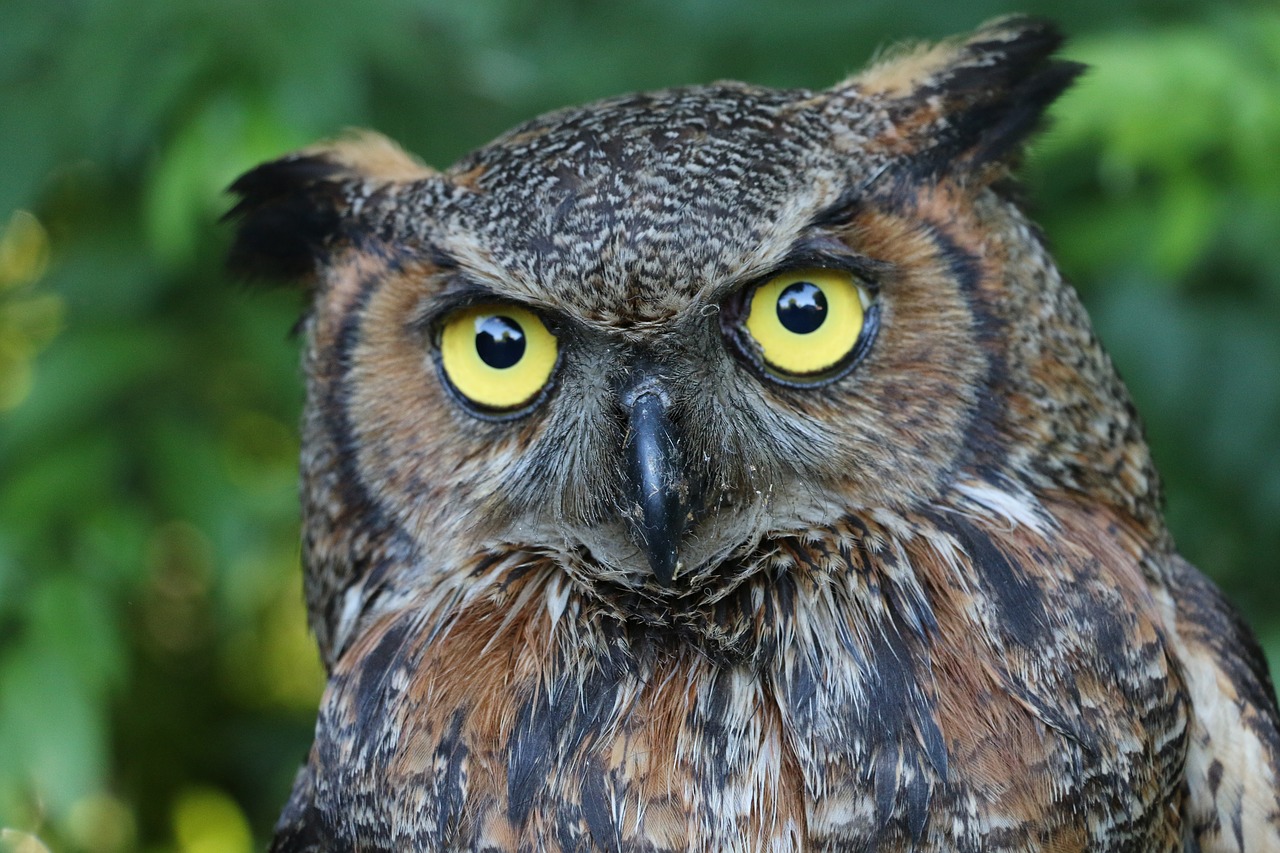
Eastern screech-owl, 7; great horned owl, 1; barred owl, 4; and Northern saw-whet owl, 1.

Photo by Pixabay • A single great horned owl was found on this year’s count.

Belted kingfisher, 15; Red-headed woodpecker, 4; red-bellied woodpecker, 83; yellow-bellied sapsucker, 6; downy woodpecker, 33; hairy woodpecker, 8; Northern flicker, 33; and pileated woodpecker, 31.

American kestrel, 4; great crested flycatcher, 25; Eastern kingbird, 70; Eastern wood-pewee, 13; Acadian flycatcher, 7; least flycatcher, 14; and Eastern phoebe, 86.

White-eyed vireo, 17; yellow-throated vireo, 7; blue-headed vireo, 54; warbling vireo, 18; and red-eyed vireo, 221.

Blue jay, 197; American crow, 294; fish crow, 11; and common raven, 16.
Tree swallow, 193; Northern rough-winged swallow, 75; purple martin, 63; barn swallow, 146; and cliff swallow, 530.

Carolina chickadee, 121; tufted titmouse, 148; red-breasted nuthatch, 12; white-breasted nuthatch, 23; and brown-headed nuthatch, 1.

House wren, 63; winter wren, 7; Carolina wren, 179; blue-gray gnatcatcher, 69; golden-crowned kinglet, 3; and ruby-crowned kinglet 2.

Eastern bluebird, 159; veery, 17; Swainson’s thrush, 1; hermit thrush, 2; wood thrush, 74; American robin, 661; gray catbird, 45; brown thrasher, 69; and Northern mockingbird, 126.

European starling, 540; cedar waxwing, 44; house sparrow, 55; house finch, 61; purple finch, 1; red crossbill, 3; pine siskin, 19; and American goldfinch, 249.

Chipping sparrow, 86; field sparrow, 34; dark-eyed junco, 44; white-crowned sparrow, 1; white-throated sparrow, 9; Savannah sparrow, 2; song sparrow, 252; swamp sparrow, 1; and Eastern towhee, 147.

Yellow-breasted chat, 5; Eastern meadowlark, 62; orchard oriole, 32; Baltimore oriole, 32; red-winged blackbird, 320; brown-headed cowbird, 58; and common grackle, 322.

Ovenbird, 136; worm-eating warbler, 25; Louisiana waterthrush, 26; golden-winged warbler, 4; Black-and-white warbler, 75; Swainson’s warbler,11; Tennessee warbler,1; Kentucky warbler, 3; common yellowthroat, 28; hooded warbler, 152; American redstart, 11; Cape May warbler, 4; Northern parula, 47; magnolia warbler, 6; bay-breasted warbler, 1; Blackburnian warbler, 6; yellow warbler, 7; chestnut-sided warbler, 15; blackpoll warbler, 2; black-throated blue warbler, 79; palm warbler,1; pine warbler, 10; yellow-rumped warbler, 21; yellow-throated warbler, 41; prairie warbler, 1; black-throated green warbler, 61; and Canada warbler, 35.

Scarlet tanager, 55; Northern cardinal, 260; rose-breasted grosbeak, 18; blue grosbeak, 3; indigo bunting, 88; and dickcissel, 2.

Looking over this list perhaps gives a clue to why birders are so excited during spring migration, which stretches out from March to June with the peak in April and May. The region is home to an amazing diversity of birds. Get out and look for some or make your home landscape more inviting for them.

•••
To share a sighting, ask a question or make a comment, email me at ahoodedwarbler@aol.com. I’m also on Facebook.

Hint of tropics arrives in region’s mountains with scarlet tanagers

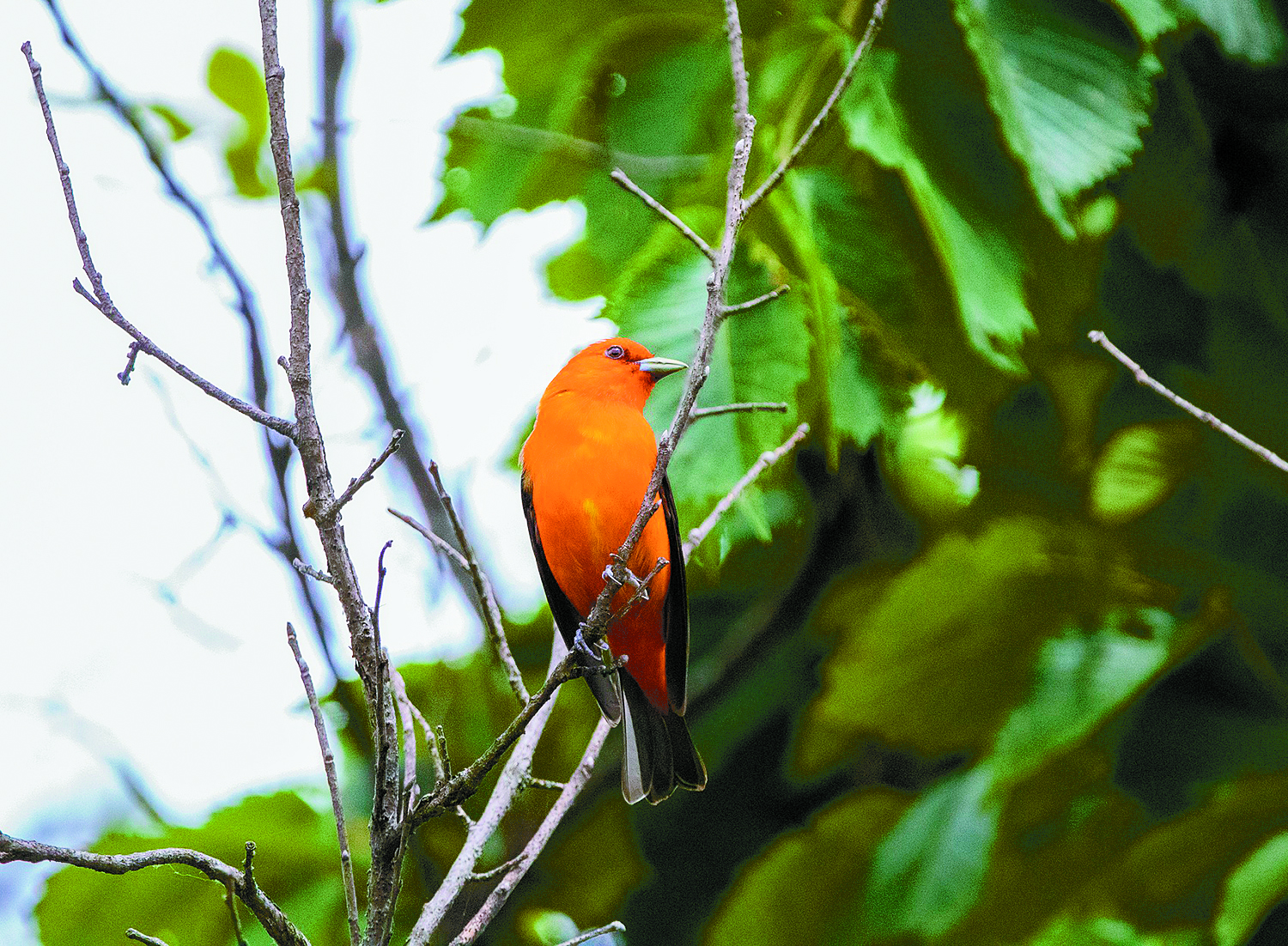
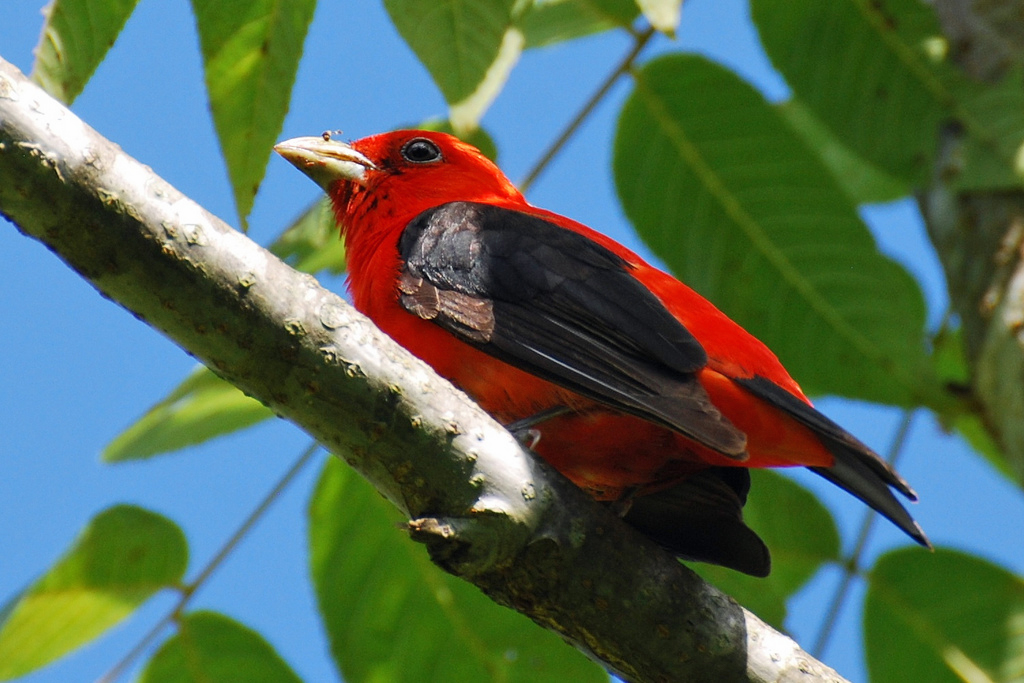
Photo by Vincent Simard from Pixabay • Considering the spectacular plumage of a male scarlet tanager, it’s a pity that this bird is more often heard than seen due to its fondness for living in the woodland canopy.

In late April and early May, once the oaks, the maples, the poplars and other tall deciduous trees begin spreading out new green leaves to create a concealing woodland canopy, a familiar song can be heard coming from the treetops.
Upon first hearing it, listeners might mistake the hidden singer for an American robin. Listen a little closer, however, and the song sounds as if it is being delivered by a hoarse robin with a sore throat.

The producer of the hoarse but melodic song is a scarlet tanager, one of the most showy birds of Eastern woodlands from April to early October.
The scarlet tanager also has an easily recognized call note, best described as a distinctive “chip-burr” or “chip-churr.”

It was the distinctive “chip burr” that first alerted me to the presence of a scarlet tanager during a recent trip to Holston Mountain in Carter County, Tennessee. I was taking part with Chris Soto and Rob Armisted in the recent Spring Bird Count conducted by the Elizabethton Bird Club.

The scarlet tanager was a target bird, which we managed to find, along with other targeted birds such as ruffed grouse, dark-eyed junco and chestnut-sided warbler.
Like the warblers, vireos, flycatchers and other songbirds, the scarlet tanager is migratory. They spend the winter months in the tropical forests of Central and South America. The scarlet tanager is better attired than most birds to provide us a glimpse of what life must be like in the tropical rain forests, which are a riot of color and sound.

Photo Courtesy of Jean Potter
A male scarlet tanager brightens shadowy woodlands with a flash of tropical colors yet remains mostly inconspicuous in the forest canopy.

Observing this dazzling bird, which put on a prolonged show for us, reminded me how it takes only one sighting to sear the vision of this vibrant bird onto our retinas, as well as into our memories.

The scarlet ranager boasts a brilliant plumage of crimson red paired with black wings and tail. Of course, this is the male. The female tanager makes no real claim to the common name with her comparatively drab greenish plumage. However, the scientific name, Piranga olivacea, gives a nod to the olive-green plumage of females, young males and even adult males when molting their feathers.
Although once nominated as a candidate for state bird by the school children of Minnesota, the scarlet tanager ultimately failed to gain the designation. Instead, as perhaps is fitting for the “Land of 10,000 Lakes,” the common loon represents Minnesota as official state bird.

I usually have a few scarlet tanagers in residence around my home during the summer months.

Worldwide, there have traditionally been about 240 species of tanagers. Experts have changed some of the ways they classify tanagers, so that figure is no longer set in stone. Tanagers are a New World family of birds, concentrated mainly in the tropics.
The scarlet tanager and an all-red relative, the summer tanager, are native of the eastern half of the continent, replaced by Western tanagers and hepatic tanagers in the western states. During a visit to Salt Lake City in Utah in 2006 I saw several Western tanagers.

Some of the world’s other tanagers are known by extremely descriptive names, including flame-colored tanager, green-headed tanager, golden-chevroned tanager, azure-shouldered tanager, fawn-breasted tanager, saffron-crowned Tanager, Metallic-green Tanager, turquoise tanager, scarlet-bellied mountain tanager and diademed tanager.

Scientists, who have to occupy themselves, have recently given fresh consideration to the relationship of many tanagers to the other birds of the world. As a result, many of the North American tanagers are now closely allied with such birds as Northern cardinals and more remote from tropical tanagers.

https://www.google.com/search?client=firefox-b-1-d&q=scarlet+tanager+feeding&tbm=vid&sa=X&ved=2ahUKEwimlL7u_Yb_AhV5nGoFHbHEA9kQ0pQJegQICBAB&biw=1249&bih=565&dpr=1.5#fpstate=ive&vld=cid:12a705e3,vid:vRN5BREsi-4

The scarlet tanager is not typically a feeder visitor, but these birds can be lured closer with orange slices placed in special feeders or simply spiked onto the branches of backyard trees. As an added bonus, orange slices can also attract birds such as Baltimore orioles and gray catbirds.

Fond of fruit, the scarlet tanager incorporates various berries into its diet. Landscape around your home with fruit-bearing trees such as mulberry, serviceberry and wild cherry to make your yard more inviting to these elusive bird.

Yes, the scarlet tanager is more often heard than seen, but it is a bird worth seeking out. A sighting of one will amaze you.

•••••

I love to hear from readers. Follow me on Facebook or send email to ahoodedwarbler@aol.com.

Rose-breasted grosbeaks stage their spring return in region

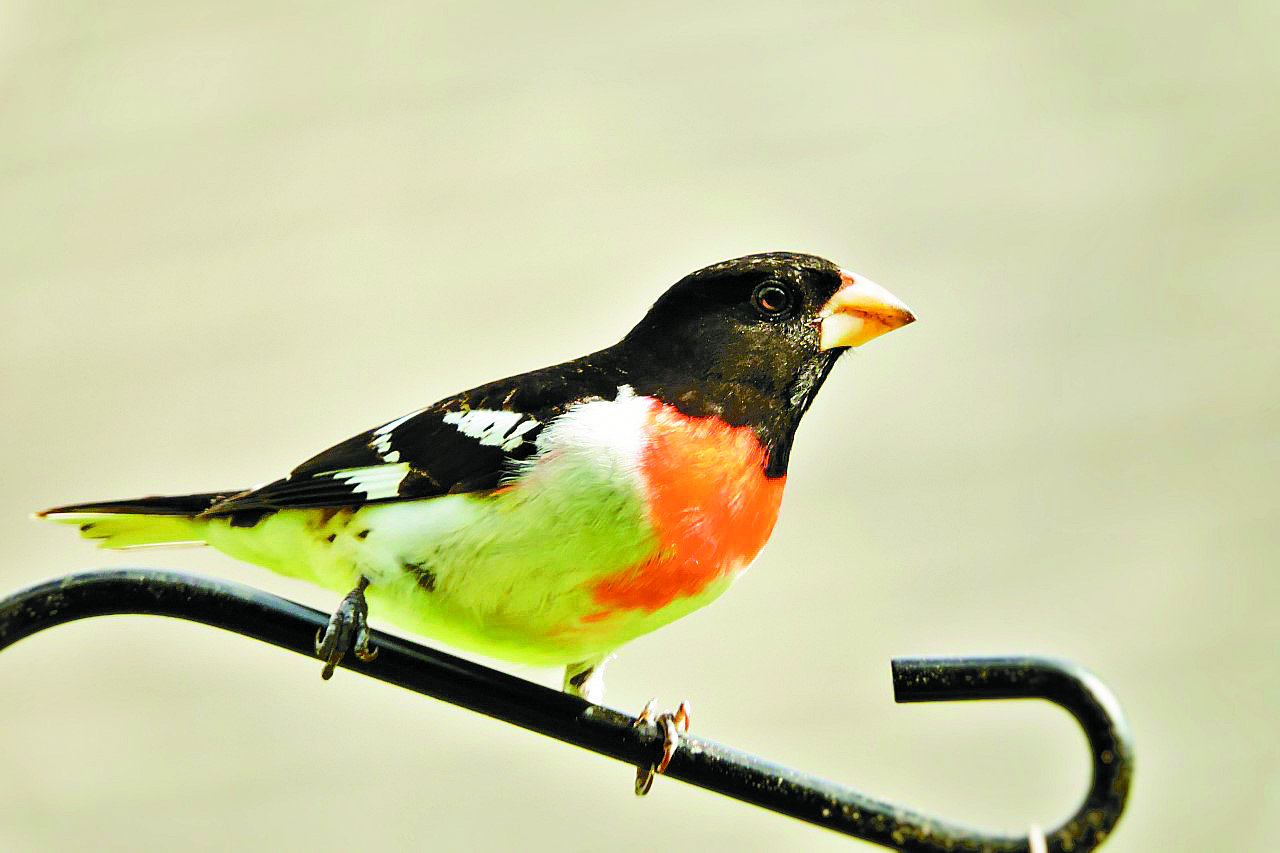
Photo by Susan Killian from Pixabay • Male rose-breasted grosbeaks are stunning birds that bring some tropical color to the Southern Appalachians every spring.


Birds keep returning. At times, it’s like a new bird is putting in an appearance every day. Some of the returning species are showy, others are more subtle in their beauty.
The rose-breasted grosbeak is definitely one of the birds in the showy category. In fact, I’d suggest that a male rose-breasted grosbeak is a showstopper for most people, especially people who have never seen one of these glorious birds.
I haven’t yet seen one this spring, but I am planning to take part in the annual five-county Spring Bird Count conducted by the Elizabethton Bird Club, and I am hopeful I will be fortunate enough to find one of these beauties.
As is usually the case, the grosbeaks tend to arrive in the wake of the first hummingbirds, and this year has been no exception.
•••

Erwin resident Ron Elliott posted on The Erwin Record’s Facebook page about his first spring sighting.”
“Our first sighting of a Rose-breasted Grossbeak today (April 30) at 9:15 a.m.,” Ron wrote.
“The sighting always comes about the first week of May,” he added.
Ron also shared that the secret to observing rose-breasted grosbeak is a well-stocked feeder.
“No seeds, no birds,” he noted.
•••
Ann Windsor in southwest Tennessee shared on Facebook that she had a rose-breasted grosbeak feeding on her deck feeder on May 3 and a few others the previous week. She noted that her daughter, who lives about eight miles away, had had some grosbeaks at her feeder.
•••
Felicia Mitchell in Washington County, Virginia, has hosted two male grosbeaks but, to date, no females.
•••
Karen Fouts on Marion, Virginia, wrote on Facebook about a small flock of visiting grosbeaks.
“I have four or five regulars, all male. I know the females must be here somewhere, but I haven’t seen one yet,” she shared.
•••
Nancy Vernon reported on Facebook seeing grosbeaks in Bristol, Tennessee, on May 3.
•••
Sue Schreiner reported via Facebook on May 3 about seeing a grosbeak fly past at South Holston Lake.
•••
Sharee Bowman mentioned via Facebook about seeing female grosbeaks kast week and males this week in Cedar Bliuff, Virginia.
•••
John Whinery of Fall Branch, Tennessee, said he received his first-ever visit from a rose-breasted grosbeak on his farm on Sunday, April 30.
•••
Brookie and Jean Potter reported that they have hosted two male grosbeaks since May 1 at their home near Wilbur Lake in Elizabethton, Tennessee.
•••
Carolyn Grubb of Bristol, Virginia, also shared that she has hosted a male grosbeak.
•••
Ed Schneider in Nashville, Tennessee, reported lots of grosbeaks passing through during migration earlier in the season.
“Mostly gone through now,” he wrote on Facebook. “Only a single female today (May 4).”
•••
Gary and Nancy Barrigar shared on Facebook that they have hosted male and female grosbeaks since April 28 at ther home in Elizabethton, Tennessee.
•••
Mary Ragland in Abingdon, Virginia, reported that her grosbeaks arrived May 1.
•••

Photo by Bryan Stevens
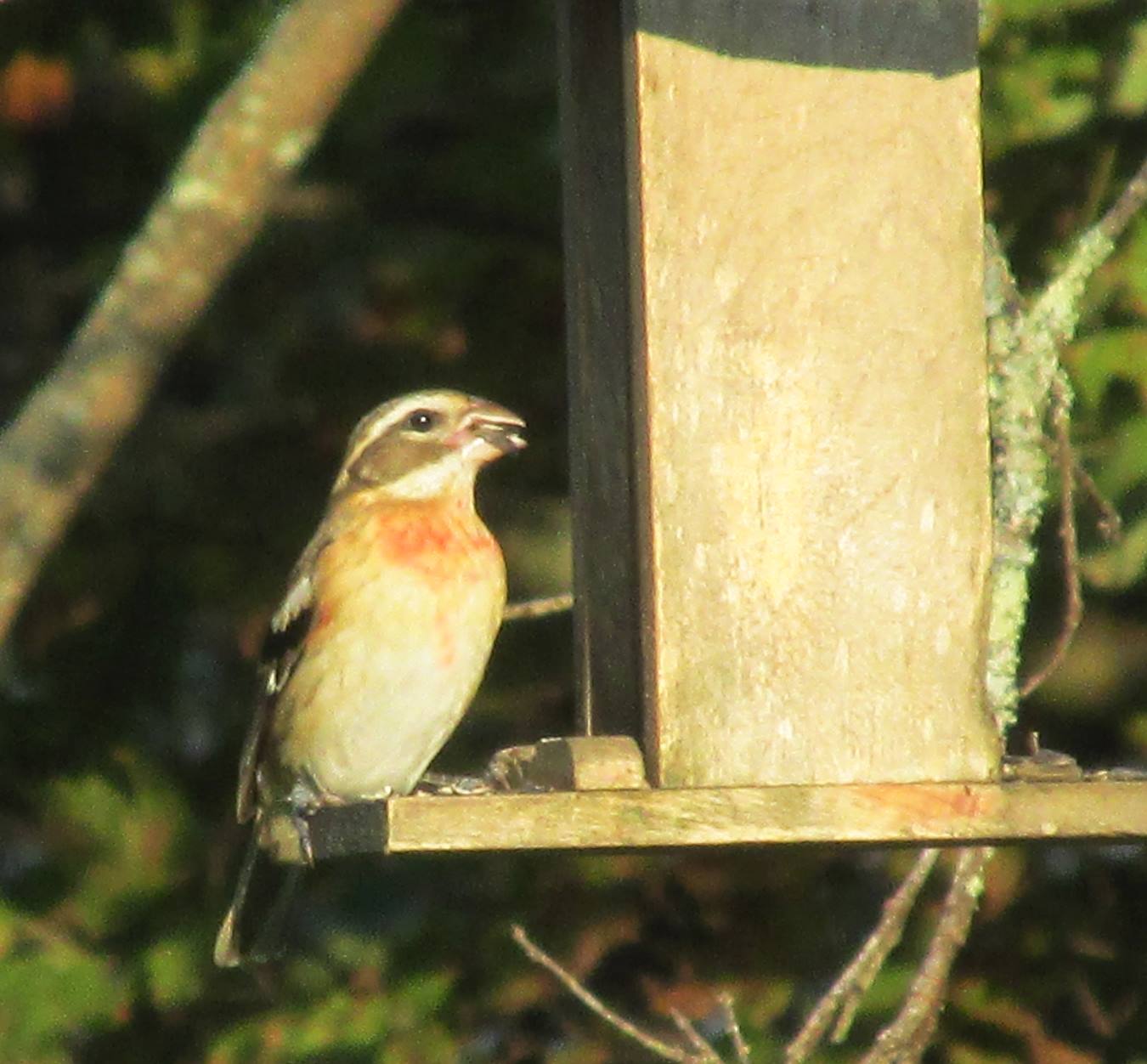
A young male Rose-breasted Grosbeak visits a feeder in September of 2013. Young males resemble females but show a splash of orange on the breast that will be replaced the following spring by the familiar rosy-red patch.

Plenty of rose-breasted grosbeaks pass through northeast Tennessee, southwest Virginia and western North Carolina, and a few even decide to make their summer home on local mountains. However, these birds spread out widely across the eastern half of the North American continent, ranging from northeastern British Columbia to Quebec and Nova Scotia in Canada. They also range south from New Jersey to Georgia. The rose-breasted grosbeak also reaches Colorado, Oklahoma and Kansas.
As fall approaches, the rose-breasted grosbeak migrates south to a winter range that spans central Mexico, Central America and northern South America. As they depart, many of these migrating birds will make autumn visits to again partake of offerings of sunflower seeds at backyard feeders. So, if you don’t get to see these showy birds in the spring, you get another chance in September and October.

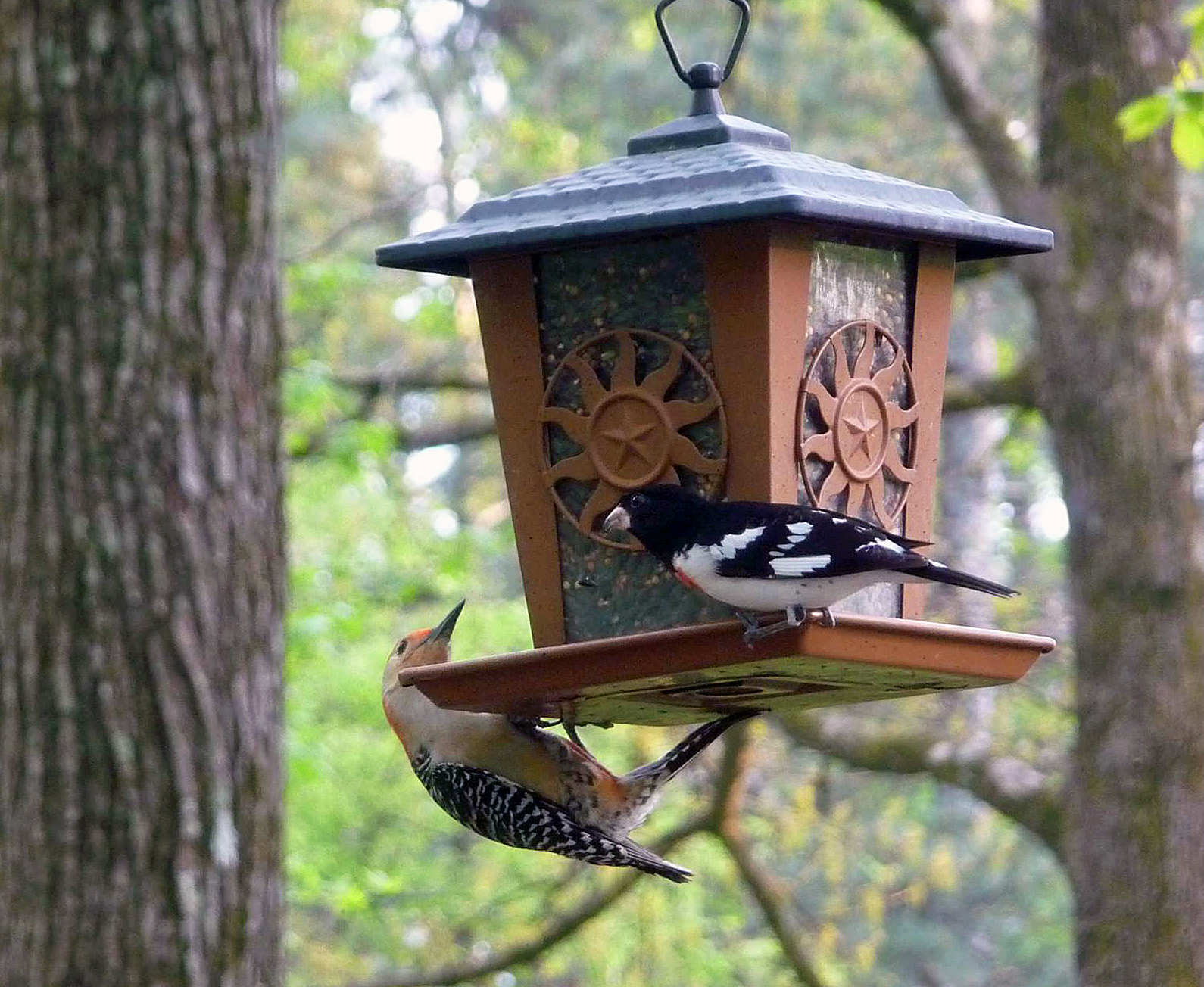
Photo courtesy of Byron Tucker * A rose-breasted grosbeak and a red-bellied woodpecher square off at a feeder.

The male rose-breasted grosbeak gives this species it name. Males are the epitome of the birds that make their home for part of the year in the American tropics. The contrasting black and white plumage is emphasized by a triangular slash of rosy-red color on the breast. Put all those elements together, and the male rose-breasted grosbeak is not a bird that would be mistaken for any other.
The female grosbeak, however, doesn’t stand out in the same way. She is much less colorful than the male. With her brown and white plumage, she is often mistaken for a large sparrow or finch.

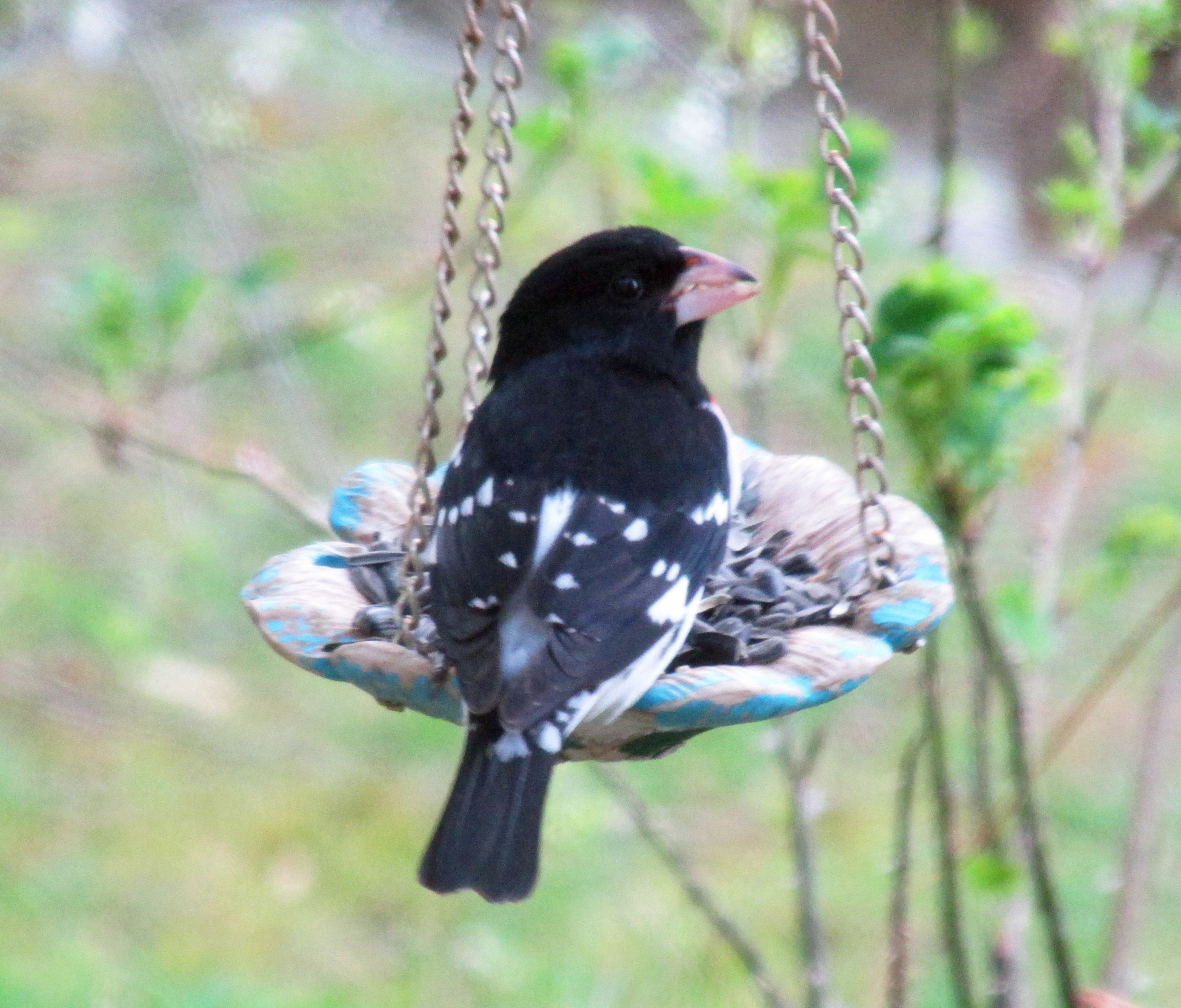
Both sexes have a massive bill, which they use to hull sunflower seeds at feeders or glean insects from leaves and branches. It’s the heavy, blunt bill for which the term “grosbeak” is derived. “Gros” is a German term for large or big, so grosbeak simply means a large-beaked bird. People who band birds to further the study of them will tell you that rose-breasted grosbeaks can inflict a wicked nip. Regional bird banders frequently encounter rose-breasted grosbeaks in their mist nets — and bear the scars to prove it.

Away from our feeders, rose-breasted grosbeaks feed on insects, seeds, fruit and even some leaf buds and flowers. I’ve seen these birds satisfying a sweet tooth — or should that be sweet beak? — by feeding on jewelweed flowers and apple blossoms. If sugar’s good for hummingbirds, I am sure it is a valuable energy source for rose-breasted grosbeaks, too.

The rose-breasted grosbeak is a cherished spring visitor that never disappoints when bringing a hint of the tropics to the mountains.

•••
Follow Bryan Stevens on Facebook. To share a sighting, ask a question or make a comment, email him at ahoodedwarbler@aol.com.

Photo by Bryan Stevens
A male Rose-breasted Grosbeak settles onto a feeder for a meal of sunflower seeds.