Flamingo Fallout: Local couple makes two long-distance trips to see flamingos displaced by Hurricane Idalia

Photo by Cathy McNeil • A lone American flamingo wades along the edge of a farm pond in Wayne County, Tennessee. The bird, and others of its kind, were displaced by Hurricane Idalia, blown from the Yucatan to 10 U.S. states, including Tennessee and the Carolinas.


I can’t say it often enough: Birds have wings! That’s the joy of birding. An unexpected bird can show up in the most unlikely locations, all thanks to the power of flight.

On occasion, Mother Nature lends a hand, too, as in the case with displaced American flamingos that have been found in at least 10 U.S. states, including Tennessee and North Carolina, in recent weeks. These refugees from the storm have found themselves achieving celebrity status as birders from across the country have flocked to find them after rare bird alerts popped up in several states.

“This has definitely been a flamingo week in the eastern United States,” Tom McNeil posted on his Facebook page. “Following the passage of Hurricane Idalia, displaced American flamingos have been located in ten or more states!”

On Sunday, Sept. 3, McNeil and his wife, Cathy, made a round-trip trek of 670 miles to see 11 American flamingos that had been found in the Outer Banks of North Carolina. The birds had been discovered on Sept 2.

“If I had not already been in North Carolina, I would have probably chosen to go see the five birds that had been found in Wayne County, Tennessee, on the same day,” McNeil wrote on Facebook.

“Lucky for us, one of the Tennessee birds stayed until Sept. 6 and we were able to go see it,” McNeil said.

The McNeils left their home in Carter County, Tennessee, at 3 a.m. and made the 830-mile round-trip drive to visit with a young flamingo for a few minutes.

That’s a lot of miles, but the McNeils enjoy chasing after rare or unexpected birds. Cathy McNeil even got a photo of the young flamingo.

It’s not even their first dash to the Outer Banks this year. Back on July 28, the couple traveled there to add a Pacific golden-plover to their life lists. “We were successful!” McNeil noted in a Facebook post.

He added some other interesting details.

“This is the fifth year that this bird has made a late July appearance in the Cape Point region of Hatteras Island,” he wrote. “It is thought to be the same bird. Luckily we were able to chase it this year.”

To add to the luck, this year the bird spent a lot of time in the Cape Point Campground.

“We were able to get it from the air-conditioned comfort of the car,” McNeil wrote. “No sand-marching required!”

Photo by Bryan Stevens • A Chilean flamingo at Zoo Atlanta. Pink Floyd, an escaped Chilean flamingo, haunted the Great Salt Lake in Utah for many years.

Once again, it bears repeating: Birds have wings!

The first storm-driven flamingos were spotted in Ohio. Afterwards, these birds showed up in North and South Carolina, Tennessee, Virginia, Alabama, Texas, Kentucky and even as far north as Pennsylvania.

National Public Radio even put the birds on air, so to speak, in a feature by Dustin Jones posted to the NPR website on Sept. 7. In that article, Nate Swick, digital communications manager for the American Birding Association, addressed the flamingo fallout.

As for the flamingos, these refugees from Hurricane Idalia will have to do their best to straggle home.

Swick noted that flamingos are big, strong birds, more than capable of making their way back home, just as they did in 2019 following Hurricane Barry when that storm hit the northern part of the Gulf of Mexico and drove a handful of flamingos to western Tennessee and Missouri.

Swick said that the consensus is that the flamingos swept up by Hurricane Idalia were likely birds from the Yucatan Peninsula, which separates the Gulf of Mexico and the Caribbean Sea.

Despite their name, American flamingos are not birds one is ever likely to find in the continental United States with the possible exception of Florida. Also known as the Caribbean flamingo, this bird lives in and around brackish water and saltwater environments, including marshes, estuaries and coastlines. Based on the range of this species, Caribbean flamingo is a more accurate name.

The species did once live wild in the Sunshine State, but the Florida population was hunted into extermination by the early 1900s. Most Florida American flamingos today are captive birds that have managed to escape from zoos and aviaries. A few are probably wandering individuals from the Caribbean.

There are six flamingo species found worldwide, but the American (Caribbean) flamingo is the only species native to North America. The other species are greater flamingo, lesser flamingo, Chilean flamingo, James’s flamingo and Andean flamingo.

Another famous flamingo vagrant by the name of Pink Floyd haunted the Great Salt Lake in Utah from 1988 to 2005. Pink Floyd was a captive Chilean flamingo living at the Tracy Aviary in downtown Salt Lake City who escaped and found that he was content to live life in the wild for 17 years.

I visited Tracy Aviary during a visit to Salt Lake City in 2008, a few years after the last sighting of Pink Floyd. Although the captive birds in Pink Floyd’s flock had their wing feathers clipped on a regular basis, Pink Floyd apparently avoided these sessions.

I think he had his escape in mind all along. The Great Salt Lake, teeming with brine shrimp, a favorite food of flamingos, beckoned him to spread his wings and fly to freedom. In the process, he became a local legend. Although he’s probably gone – it has been close to 20 years since the last sighting – keep in mind Chilean flamingos can live 40 to 50 years. If Pink Floyd is still living the life of a free bird, he might only be in his late 30s.

Once again, and everyone keep this in mind: Birds have wings! They can and do show up in the most unlikely places. Keep your eyes open.

Photo by Bryan Stevens • Chilean flamingos at Zoo Atlanta.
Nomadic crossbills are cone specialists


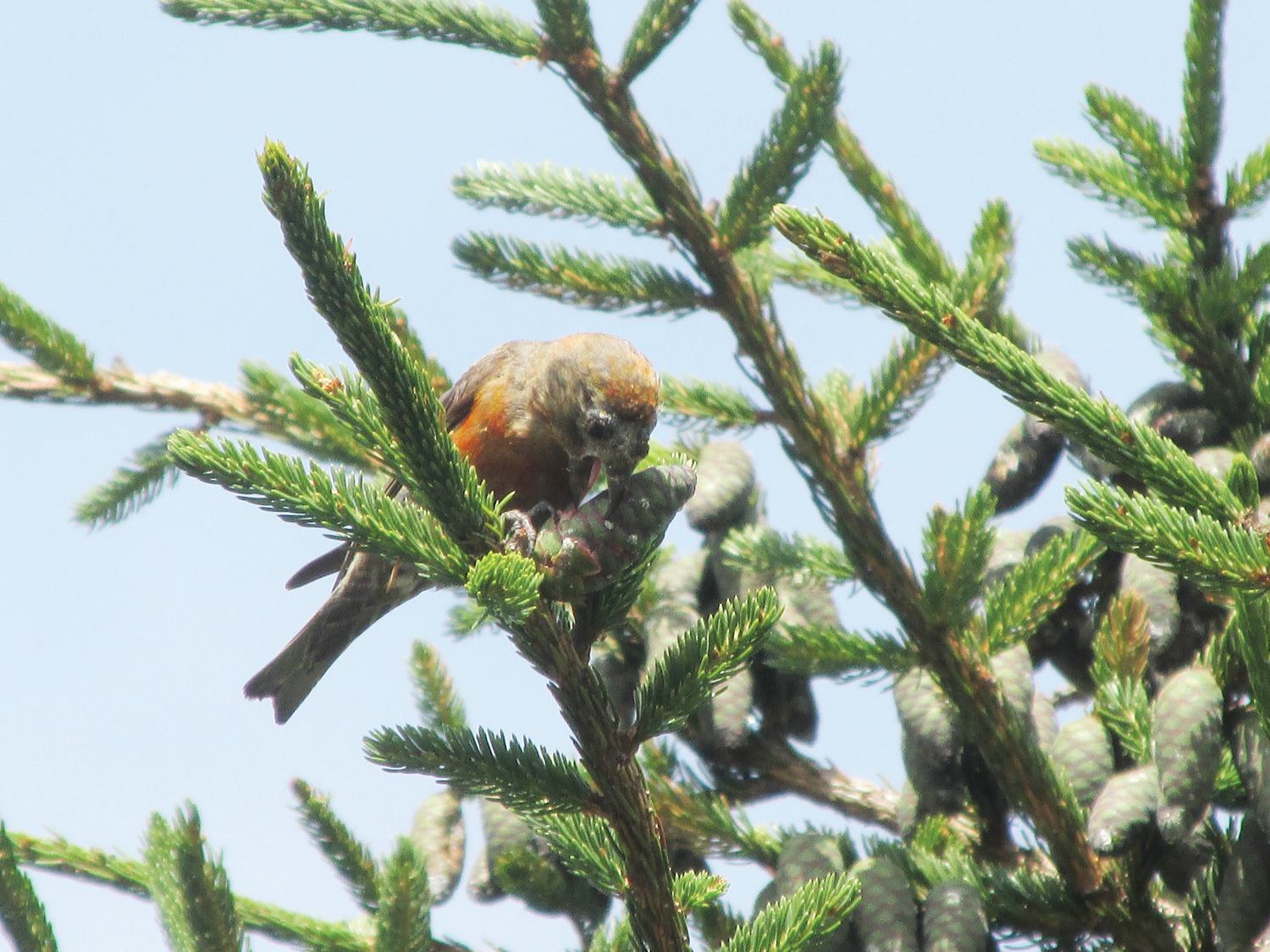
Photo by Bryan Stevens • As cone specialists, red crossbills have evolved twisted beaks to get the job done.

This column originally ran Sept. 10, 2013, in The Erwin Record.

am seeing green herons on almost every visit I make to any local body of water. In the last week, I have seen this small heron at the pond at Erwin Fishery Park, at Musick’s Campground on South Holston Lake in Bristol and from the boardwalk over the pond along the linear trail near Erwin’s Riverview Industrial Park.

A green heron at Erwin Fishery Park was stalking dragonflies along the edge of the pond and appeared to be having good success at capturing these winged insects.

I saw the heron catch and eat several dragonflies while observing it.

•••

My mother and I made a trip to Carver’s Gap on Roan Mountain on Saturday, Aug. 3. We hadn’t even gotten out of the car when my mom noticed some red crossbills perched in the upper branches of some of the Fraser firs near the parking area at Carver’s Gap. We continued to watch the crossbills and counted a total of seven birds, although the flock may have consisted of a few additional members.

The observation of the red crossbills allowed me to add this bird to my 2013 list as Bird No. 170 for the year.

It’s going to be a challenge to get those other 30 species to reach the 200 mark for the year, but I am looking forward to it.

The crossbills were all busy ripping apart the new cones on the firs to get at the seeds. Feeding on cones must be a messy business because the feathers around their heads appeared matted in a few spots. I had never thought about it, but these birds must constantly get pine resin on their feathers as they use their crossed bills to pry open cones. One of the male crossbills made quick work of several cones, using his bill to take them apart with exquisite precision. He had the process honed into a science.

The red crossbill, known by the scientific name Loxia curvirostra, is a member of the finch family, which includes such well-known feeder-visiting birds as American goldfinch, house finch, purple finch and pine siksin. In Europe, the species is known by the name common crossbill.

Crossbills have distinctive beaks, which cross at the tips, enabling them to skillfully extract seeds from conifer cones and other fruits.

Red crossbills are rather nomadic and breed in areas with an abundant crop of cones. These birds may wander widely between years to find a good cone crop. Perhaps because of this year’s wet weather, there’s a bounty of new cones on the trees at Carver’s Gap, so it has been a good summer to look for red crossbills.

For many years, this was one of my “nemesis” birds. No matter how hard I tried, I kept striking out in attempts to observe the species. I made many trips to Unaka Mountain and to Carver’s Gap on Roan Mountain to look for this bird before I finally got a good look at a pair of birds picking up grit from gravel at the edge of the Carver’s Gap parking lot.

Experts debate how many species of crossbills exist, but the current consensus is that there are five species worldwide. In addition to the red crossbill, the white-winged crossbill lives in North America but is an even more rare visitor to Northeast Tennessee.

The other three species are the parrot crossbill of northwest Europe and western Russia, the Scottish crossbill of the Caledonian Forests of Scotland and the Hispaniolan crossbill of the Caribbean island of Haiti and the Dominican Republic.

After observing the crossbills and taking several photos, we made the ascent to the grassy balds to look for other birds. I held some hope of finding a vesper sparrow, but these small birds never made an appearance.

I did observe common yellowthroats, golden- crowned kinglets, American robins, gray catbirds, cedar waxwings, dark-eyed juncos and Northern ravens during my hike on the balds.

When we returned to the parking lot at Carver’s Gap, we found some stands of blooming bee balm, which attracted visits from several ruby-throated hummingbirds.

•••

I received an email this past week from Crystal Miller about a fascinating observation of bald eagles on Friday, July 26, 2013.

“I was rafting down the lower Nolichucky River, in Tennessee, just past the Devil’s Looking Glass,” Crystal wrote. She was rafting with five other people when they saw a huge nest on the right side of the river. She said the nest was fully occupied, except for one parent circling overhead.

“The other parent was a few feet from the nest, while other younger eagles were closer, inside and around the nest,” she wrote. “We paddled against the current as long as the river would allow before we succumbed to the river.”

Crystal said others on the raft took pictures of the eagles and the nest.

“None of the younger eagles had white, or bald heads, but one I noticed had incredibly large legs,” she wrote.

She described her rafting adventure as the “best trip ever.”

Crystal also shared that her mother was born and grew up along the river and that her grandmother still lives in a house near the river.

“That eagle nest made me happy,” she concluded.

Crystal’s sighting of this family of eagles is more evidence that this once endangered national bird is indeed fully recovered and thriving.

Earlier this year, I learned of reports of a bald eagle nest in Unicoi County near the Devil’s Looking Glass. It’s very likely Crystal’s story provides more evidence that the nesting was successful.

Other eagles also successfully nested in Sullivan County and Washington County. A nest at Wilbur Lake in Carter County, unfortunately, was destroyed during a powerful storm this past spring.

•••

Bryan Stevens has written about birds since 1995. Email him at ahoodedwarbler@aol.com to share a sighting, ask a question or make a comment.

Readers share recent hummingbird observations as summer draws to a close

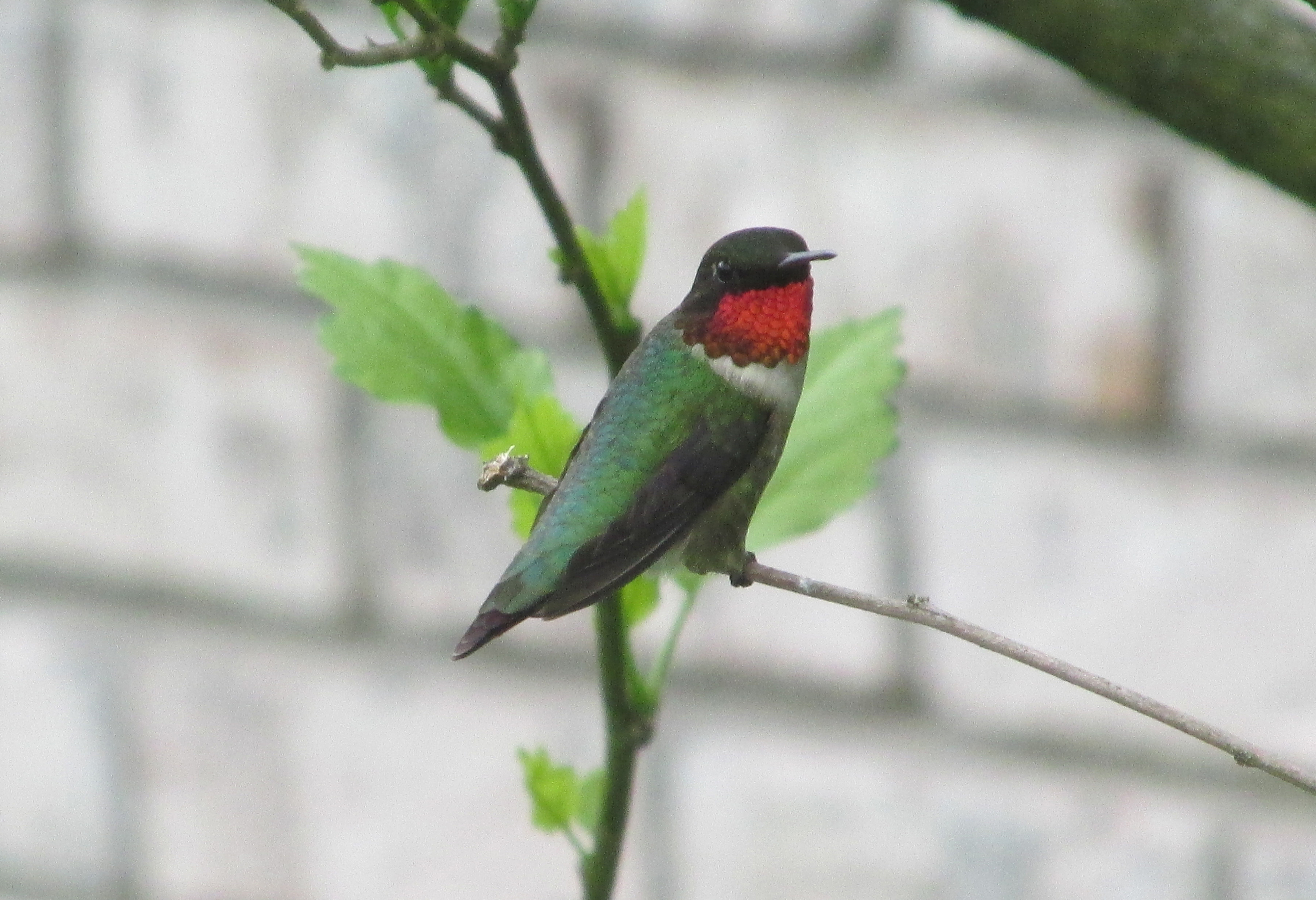
Photo by Bryan Stevens • The bright red throat patch, or gorget, of a male ruby-throated hummingbird makes the bird stand out. Female and young hummingbirds lack the bright throat color on the throat.

For the past week or so, I cannot step onto my front porch without hearing the whir of hummingbird wings or the twitters of this tiny bird’s fussy vocalizations.

I had written about hummingbirds recently, which prompted several readers to share some of their own stories or ask questions about these birds.

Laurie Philhower posted a comment on Facebook after reading my recent column about hummingbirds.

“I live in Middle Tennessee,” she noted. “I have five hummingbird feeders out, and they are full every day.”

I have the same number of feeders filled and available at my own home, and I’ve had no shortage of hummingbirds eager to line up for sugary sips.

•••

Carole Franklin also commented via Facebook after reading the column on hummingbirds.

“My feeder has been more busy the last couple of weeks than it has all summer,” she wrote. “Keep looking for different ones in the mix. I keep the feeder filled and fresh until the first freeze. Then put it back out afterwards just in case.”

I applaud Carole for her diligence. Every autumn, some western hummingbirds venture into the region. To date, species such as rufous hummingbird and Allen’s hummingbird have been documented. They are, however, almost always present at a location with a hummingbird feeder.

•••

Photo by Bryan Stevens • A male ruby-throated hummingbird perches at a feeder for a sip of sugar water.

Jewel Bentley contacted me with an interesting question after reading the hummingbird column.

“I have read that we need to increase the amount of sugar in hummingbird feeders right before they begin their migration south. Is this true?”

I wrote back and suggested that she refrain from making the sugar formula stronger. The four parts water to one part sugar is a formula designed to imitate the sugar content of flower nectar. There’s really no need to boost it.

•••

Lorraine Henderson sent me an email regarding my column.

“Thanks so much for the information about hummingbirds,” she wrote. “I will plant some more flowers.”

Right now, my hummingbirds cannot get enough of the jewelweed in bloom along the edges of my yard. They love to visit the abundant tiny orange blooms on each jewelweed plant. The best thing about jewelweed is that it’s wild and springs up each year without any need of my assistance.

•••

I also heard from Paulette Calli, who emailed me from California.

“Just wanted to thank you for your wonderful article on these lovely birds,” Paulette wrote. “I was curious about their life as well as migration. I am in Southern California, and my neighbor and I sit outside in the early evening and watch them play. They sometimes get so close to our faces but never hurt us. I think they are thanking us for their birdbath and sugar water.”

Her thoughts on hummingbird gratitude make sense to me. I also enjoyed hearing about her hummingbirds hovering in her face.

I do think that hummingbirds, as well as other birds, are often just as curious about us as we are about them.

Photo by Bryan Stevens • A ruby-throated hummingbird visits a feeder for a sip of sugar water.

•••

I also received an email from John Rush in Dewey, Arizona.

“I think Central Arizona is one of the last places you’d expect for bird sightings,” he wrote.

But, he added, “if you feed them, they will come,” which is certainly true.

“Right now I am enjoying four species of hummingbirds: Anna’s, rufous, black-chinned and broad-tailed,” he wrote. “Sometimes as many as 20 at a time, letting me get so close that I can feel the wind on my face from their wings.”

John certainly has a yard that seems a magnet for birds.

“In my yard I have spotted Northern flickers, gila and ladderback woodpeckers, vermilion flycatchers, Western bluebirds, juncos, blue grosbeaks and many other species,” he wrote.

He added that he is visited daily by raptors, including red-tailed hawk, Cooper’s hawk and American kestrels, as well as the occasional great blue heron.

“Just down the road from my home I spotted a ferruginous hawk,” he noted.

At Lynx Lake, which is about 15 miles from his home, he had watched a pair of mated bald eagles almost weekly.

“So, as you can see, this is a great place to see so many birds,” he said. “It’s crazy! And I omitted quite a few.”

I wrote back and congratulated John for the diversity he enjoys at his Arizona home.

His location is ideal for hummingbirds. Many birders wanting to add hummingbirds to their life lists head to Arizona.

I confessed that I would love to see Anna’s and broad-tailed hummingbirds, two species that have so far evaded being added to my list.

•••

Linda Dabney from Louisville, Kentucky, also emailed me with an inquiry about whether all ruby-throated hummingbirds have the namesake ruby-red throat.

It’s a good question. I see many more female and young hummingbirds than adult males, yet it’s only those adult males that sport the bright red throat.

Females and young hummingbirds are still ruby-throated hummingbirds, but they lack the red throat patch, or gorget, that the males use to dazzle onlookers.

•••

Laura Huggins in Englewood, Tennessee, posted a comment on Facebook after reading the column.

“They come visit us often,” she said. “My husband and I enjoy them very much.”

Laura’s observation gets right to the heart of the appeal of these tiny birds. They are special visitors during their all-too-brief seasonal stay. In exchange for providing them with sips of sugar water, they offer us hours of entertainment and fun memories.

September’s going to see many more ruby-throated hummingbirds winging their way through East Tennessee, Southwest Virginia and western North Carolina. In the western United States, in states like California and Arizona, a similar migration schedule will take place. I hope some of these tiny voyagers stop and linger. Make the most of these final few weeks to enjoy their feisty attitudes and sizzling antics.

•••

Bryan Stevens has written about birds since 1995. To ask a question, make a comment or share a sighting, please email him at ahoodedwarbler@aol.com.

Photo by Bryan Stevens • Male ruby-throated hummingbird show the namesake red throat. The feathers on a male’s throat are iridescent, which means they can change when seen from different angles. In poor light, the ruby-red throat can look almost black.

Fewer ducks may fly south this winter

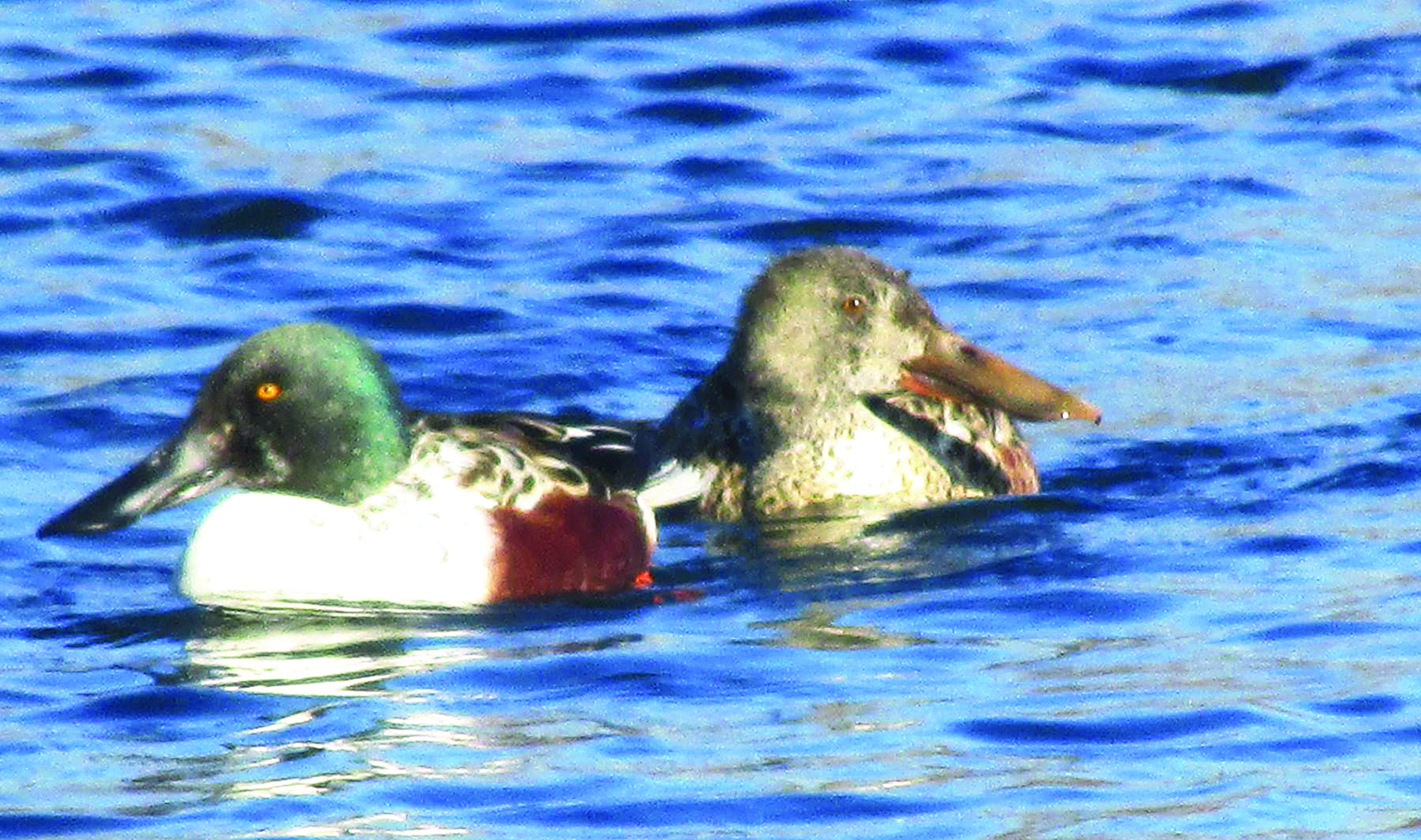
Photo by Bryan Stevens • A pair of Northern shovelers made a stop at the pond at Erwin Fishery Park in a previous winter season.

The website Ducks Unlimited reported that there may be fewer ducks and other waterfowl flying south in late fall and early winter, according to the recently released 2023 Waterfowl Population Status report by the U.S. Fish and Wildlife Service.
The report, based on surveys conducted in May and early June by FWS, Canadian Wildlife Service and other partners,
Total populations were estimated at 32.3 million breeding ducks in the traditional survey area, a 7% drop from 2022’s estimate of 34.7 million and 9% below the long-term average compiled since 1955.
While most duck species showed declines, two species actually boosted their numbers. The population of canvasback, a species of diving duck, increased by 6% from 2022. Northern pintail, a species of dabbling duck, showed an even more dramatic increase with total numbers of this duck spiking by 24% since last year’s survey.
In Northeast Tennessee, Western North Carolina and Southwest Virginia both canvasback and Northern pintail are uncommon winter visitors, so this report gives cause for some optimism for birders hoping to see these two species during the winter of 2023-24.
In addition, North America’s smallest duck – green-winged teal – saw a 17% increase in its population. This pint-sized duck is only about 14 inches long and weighs 17.5 ounces at the most. To put that in some perspective, this duck weighs just a little more than a regulation football.
Waterfowl migration is rather erratic in the region. It’s usually possible to see a variety of waterfowl species between November and March in the region. Lake, rivers and ponds are essential habitat for finding these birds.
Some well-known waterfowl observation locations in Northeast Tennessee include Wilbur Lake in Carter County and Osceola Island Recreation Area near Bristol. In Erwin, the large pond at Fishery Park has attracted some unusual ducks in past winters.
If water remains open and unfrozen farther north, some ducks are reluctant to fly south. So, hoping for a successful waterfowl viewing season in our region requires hoping for a severe winter farther north around the Great Lakes and in Canada.
I enjoy turning my attention to waterfowl when the winter season arrives and there are fewer birds present at my home and my favorite birding spots. Some of my favorite ducks include Northern shoveler, canvasback, bufflehead and ring-necked duck.
A few species of ducks nest in the region. These breeding ducks include mallard, wood duck and common merganser. I hope the cold weather is not too early this year, but the arrival of ducks and other waterfowl is always a silver lining that takes the edge off the arrival of ice and snow.
•••
At home, I am still enjoying the frantic daily antics of several ruby-throated hummingbirds. I’m still waiting for fall warblers, but I know I can expect to see them fairly soon. Join me in keeping alert and enjoying the possibilities of some unexpected avian visitors during the coming migratory seasons.
•••

To ask a question, make a comment or share a sighting, please email me at ahoodewabler@aol.com.

Nighthawks, other migrants will share autumn skies for journey south

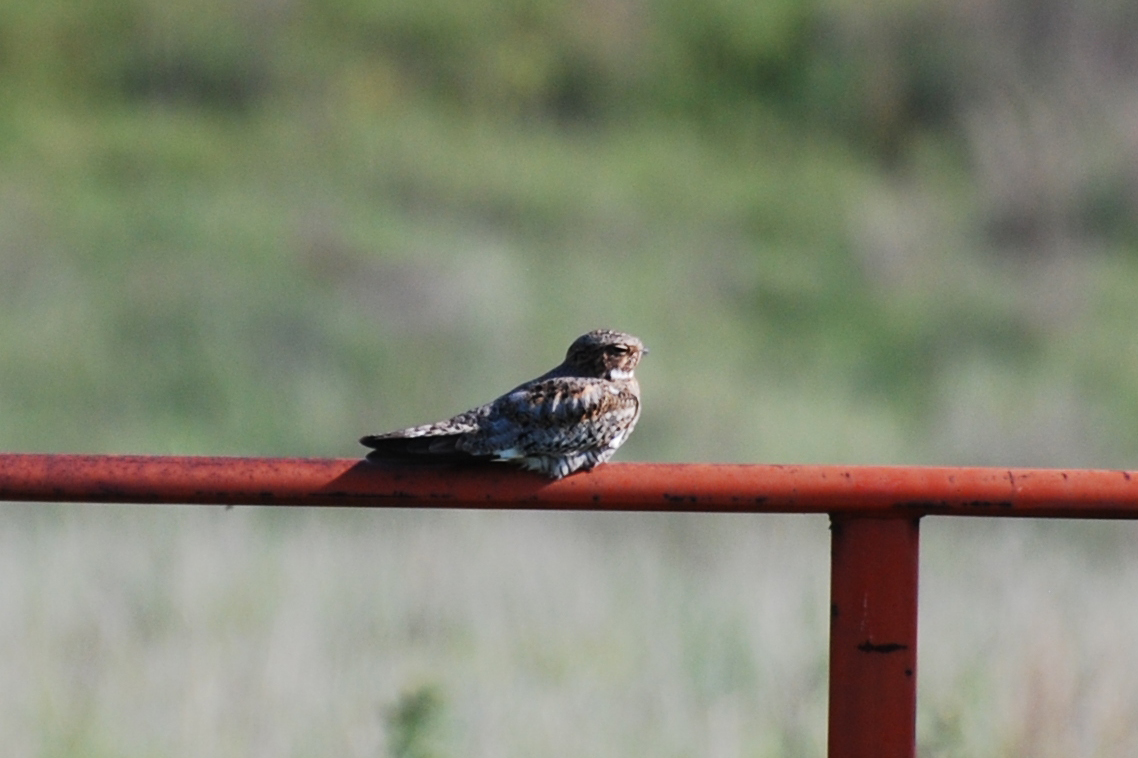
Photo by Jean Potter • A common nighthawk rests on a metal railing.

The skies are busy thoroughfares in autumn as the birds that raced like mad to reach spring nesting grounds are now reversing their journey to return to their usual winter range.

The common nighthawk has one of the longest migration routes of any North American bird. Twice a year, these birds migrate for distances ranging from 1,600 to 4,200 miles. Nighthawks that spend the spring and summer in Canada travel to southern South America for the winter months.

We’ve already reached mid-August, so nighthawks should soon provide their own contribution to the spectacle of fall migration. Keep looking skyward in the coming weeks to avoid missing the autumn passage of such varied migrants as chimney swifts, broad-winged hawks and common nighthawks.

So, what is a common nighthawk? First, this bird, despite what is implied by its name, is not a hawk. It’s also not strictly nocturnal. Particularly in the fall, nighthawks are active during daylight hours when engaged in catching winged insects. Outside of fall migration, these birds can often be observed over large parking lots or well-lit streets, snatching up insects swarming around the light poles.

The common nighthawk is one of three members of the nightjar family found in the region during the summer months. The other two nightjars are the whip-poor-will and chuck-will’s-widow, birds that produce their namesake vocalizations in the nocturnal hours. Both of these species migrate, but they don’t take the dramatic approach employed by nighthawks. Each fall, common nighthawks form large flocks, ranging in size from dozens to hundreds or even thousands of individuals, as they migrate south for the winter.

Unlike whips and chucks, the common nighthawk isn’t active only after dark, which makes it much easier to observe these birds. They look somewhat like swifts and swallows but are much larger. They are brownish-gray birds with pointed wings and forked tails. They are easily identified by distinctive white patches on the underside of their wings.

The nightjar, or Caprimulgidae, family of birds is also sometimes known as “goatsuckers.” Apparently, in trying to explain the nocturnal tendencies of these birds, the Greeks came up with the imaginative but erroneous idea that birds like nighthawks liked to sneak into barns and have a meal of fresh goat’s milk. In reality, nighthawks feed almost exclusively on insects, including ants, wasps, beetles, caddisflies, moths, mayflies, flies, crickets, grasshoppers and other insects. They capture much of their insect prey on the wing.

There are almost 80 species of nightjars in the world. Less than 10 occur in North America. Many of the common nighthawk’s relatives have been given descriptive names, such as long-trained nightjar, collared nightjar, spot-tailed nightjar, red-necked nightjar, golden nightjar, fiery-necked nightjar, swamp nightjar, pennant-winged nightjar, lyre-tailed nightjar, little nightjar, sickle-winged nightjar, rufous-bellied nighthawk, short-tailed nighthawk, sand-coloured nighthawk and least nighthawk.

Nighthawks can also appear almost magically, as if out of thin air. First, observers may see one of two birds, then several, followed quickly by dozens or sometimes hundreds as they wheel and cavort in the skies overhead with impressive grace and agility. I’ve seen flocks that would easily number more than 500 birds in locations throughout the region, although flocks often number only a couple of dozen birds.

So, keep your eyes gazing skyward. The next flock of migrating common nighthawks may fly over your home.

•••

To ask a question, make a comment or share a sighting, email Bryan Stevens at ahoodedwarbler@aol.com.

Hummingbird season is approaching its peak

Photo by Bryan Stevens • Keep hummingbirds happy with a sugar water solution of four parts water to one part sugar.

Thomas Hood, who lives near Burnsville, North Carolina, shared a note about his summer hummingbirds.

“We have a bunch of ruby-throated (hummingbirds),” Thomas wrote in an email.

He noted that last year, he hosted as many as 40 individual hummingbirds. This year he estimates he has hosted as many as 20.

“Late visitors this year, but they put on a great airshow,” he added.

He said that he has two feeders up and two handheld ones that he uses to attract hummingbirds to his home in the North Carolina mountains.

Thomas also shared a video of his tiny flying visitors.

In a follow-up email, he noted that the hummingbird population continues to grow.

“We love the entertainment they provide,” he wrote. “After the big storm yesterday, we estimated there are now near 30.”

•••

Thomas’s email was another reminder that it has been a busy season for female hummingbirds. Those that have been successful with their nesting were able to fledge twin hummingbirds and encourage them to spread their wings and leave the nest.

For hummingbirds, it’s invariably two eggs per nest for some good reasons. First, the nest is so small — about the size of a walnut half-shell — that there is barely room for two eggs, let alone more. Second, once the young hatch, the nest has just enough room to accommodate them as they grow, fed well by their mother. Third, feeding two hungry young hummingbirds is a demanding task. A female hummingbird has to find enough food to fuel her own body and help her young in the nest grow and thrive. It’s a full-time job during the daylight hours. She’s pressed hard to succeed at raising two young. Attempting to care for more would most likely prove impossible.

Now that many female hummingbirds have finished the task of bringing forth a new generation of hummingbirds, the leisurely fall migration can begin.

Hummingbirds are not as frantic about moving south in the fall as they are single-minded about heading north every spring. Numbers of these birds always reach a peak in late summer and early fall at my home, and this year’s shaping up to be a repeat of past ones.

Hummingbird species number around 340, making the family second in species only to the tyrant flycatchers in sheer size. Both of these families consist of birds exclusive to the New World.

With so many hummingbird species, people have been hard pressed to give descriptive names to all these tiny gems. Some of the dazzling array of names include little hermit, hook-billed hermit, fiery topaz, sooty barbthroat, white-throated daggerbill, hyacinth visorbearer, sparkling violetear, horned sungem, black-eared fairy, white-tailed goldenthroat, green mango, green-throated carib, amethyst-throated sunangel, green-backed firecrown, wire-crested thorntail, festive coquette, bronze-tailed comet, black-breasted hillstar, black-tailed trainbearer, blue-mantled thornbill, bearded mountaineer, colorful puffleg, marvelous spatuletail, bronzy inca, rainbow starfrontlet, velvet-purple coronet, pink-throated brilliant, coppery emerald, snowcap, golden-tailed sapphire and violet-bellied hummingbird.

Photo by Bryan Stevens • Male ruby-throated hummingbird show the namesake red throat. The feathers on a male’s throat are iridescent, which means they can change when seen from different angles. In poor light, the ruby-red throat can look almost black.

Our own hummingbird, which we can claim from April through October every year, is the ruby-throated hummingbird. Ruby-throats are remarkable birds that nest throughout the eastern United States, as well as southern Canada. In winter, most ruby-throats withdraw to Central America and Mexico, although a few winter in Florida. They are famous for the amazing feat of crossing the Gulf of Mexico twice each year as they travel to their nesting grounds and then back to their overwintering homes.

The next generation of hummingbirds always helps swell the number of these tiny birds in our yards in late summer and early fall. It’s our duty as hosts to keep them safe as they stop in our yards and gardens during their fall migration. Many of the hummingbirds in the fall will be making their first migration, so they will need all the help we can provide to make a successful journey.

Perhaps consider enhancing your plantings of summer flowers while also continuing to offer multiple sugar water feeders. Keep the sugar water mix at a four parts water to one part sugar ratio. Don’t offer honey in your feeders. When mixed with water, it can spoil and spread fungal diseases.

Remember that hummingbirds don’t subsist on sugar water alone. They also eat numerous tiny insects and spiders to obtain the protein they need for their dietary needs, so don’t use insecticides near feeders or flowers that hummers are likely to visit.

So, until October frosts eventually drive them out of the region, enjoy the ruby-throated hummingbirds while you can.

•••

Bryan Stevens has written about birds since 1995. Share a sighting, make a comment or ask a question by emailing him at ahoodedwarbler@aol.com.

Photo by Bryan Stevens • A ruby-throated hummingbird lifts its wings to shake water droplets off its back.

Birding Kingsports strives to engage with community

Photo by PublicDomainImages from Pixabay • The Kingsport Greenbelt offers one of the few locations in Northeast Tennessee to observe nesting yellow-crowned night herons. Rarities found in Kingsport have included harlequin duck and Virginia’s warbler.

Birding Kingsport is an organization dedicated to fostering an enthusiasm for birds and birding. It’s also one of three birding organizations located in Northeast Tennessee. Previous columns have highlighted birding groups based in Elizabethton and Bristol.

Betty Bailey is part of the leadership team that helms Birding Kingsport, also known as the Fred J. Alsop III Chapter of the Tennessee Ornithological Society. The organization was founded in 2015.

“Bill Grigsby was instrumental in the establishment of our club,” Bailey noted. “We strive to promote the public awareness of birds, nature and conservation issues through the study of birds primarily in the greater Kingsport area and through projects aimed to conserve bird populations.”

Bailey noted that one such project is the ongoing building and monitoring of nest boxes for Eastern bluebirds on the Kingsport Greenbelt.

She also pointed out that the Kingsport Birding Trail (KBT) was the first recognized birding trail in the state of Tennessee.

“Our linear park, the Kingsport Greenbelt, hosts six KBT locations,” she added.

“We make a concerted effort to participate in community events, like Warriors’ Path Spring Nature Festival and events at the Exchange Place,” she said.

“In addition to local bird walks to birding hot spots, we offer field trips to Roan Mountain, Seven Islands State Birding Park, Burke’s Garden, Phipps Bend, Laurel Run and other areas in our region,” Bailey said. “We count birds in Sullivan County in the spring for the Lee and Lois Herndon Chapter in Elizabethton.”

Instead of chapter officers, Birding Kingsport has chosen a leadership group to helm the organization.

“We felt this would be a better way to share the responsibilities of running the chapter and get more people involved with helping out with the tasks required,” Bailey said. “We have six members on the team.”

Bailey noted that Helen Sirrett served as club president for many years prior.

The chapter is also featured on the website tnbirds.org.

The public can like the group on Facebook at Birding Kingsport, a chapter of the Tennessee Ornithological Society. The chapter’s name — the Fred J. Alsop III Chapter of TOS — honors well-known local birder and retired East Tennessee State University biology professor Fred J. Alsop.

Bailey noted that Kingsport is also fortunate to have many different and varied habitats.

“This rich source of habitats allows many species to thrive,” she explained. “For example, over 130 species have been recorded on the Kingsport Greenbelt. A couple of our members and expert birders — Bambi Fincher and Sherrie Quillen — located a Virginia’s warbler near the Holston River on a very cold winter’s day.”

Although the chapter is the newest birding group in Northeast Tennessee, it is not lacking for distinctive accomplishments.

“We have conducted an Audubon Christmas Bird Count each year,” Bailey said.

Chapter members also conduct bird walks during Kingsport’s Fun Fest event each year to introduce people to birding and the importance of maintaining local habitats.

She also noted that the group has worked with the city of Kingsport to establish birding-related signage on the Kingsport Greenbelt with photographs by club member Belinda Bridwell.

Bailey also said that the chapter has hosted two state meetings for the Tennessee Ornithological Society with birders flocking to the Kingsport area from all parts of Tennessee.

Bailey sees many benefits that a birding group can provide to a novice birder or an experienced birder new to the area, including the sharing of information about local habitats, migration patterns that bring in different species to the area and how to better observe and identify birds in their natural habitats.

She also issued an invitation. “New and experienced birders can help with citizen science projects such as the Audubon Christmas Bird Count,” she said. “Experienced birders have the opportunity to share knowledge with other interested people and to increase public awareness of birding and conservation.”

For more information, email birdingkingsport@gmail.com.

•••

Bryan Stevens has written about birds and birding since 1995. Contact him at ahoodedwarbler@aol.com.

Bristol Bird Club members happy to take newcomers under their wings

Photo by PublicDomainImages from Pixabay • A loggerhead shrike perches on a branch to survey its territory. These songbirds can be difficult to locate in the region, so it helps to know more experienced birders when seeking out the more uncommon species.

With three birding organizations in Northeast Tennessee, newcomers to the pastime have plenty of options when looking for affiliation with like-minded individuals.

Last week, I spotlighted the Elizabethton Bird Club. This week, I am putting the focus on the Bristol Bird Club. Next week, the column will feature Birding Kingsport.

Larry McDaniel, a former president of the Bristol Bird Club, endorses the importance of birding organizations for the beginning birder.

“Becoming a part of a local bird club such as the Bristol Bird Club is a great way for new and beginning birders to be able to be around experienced birders who love to help you learn about birding,” McDaniel said.

Membership in a local birding group can help newcomers to birding quickly learn where to find birds in the area, according to McDaniel.

Experienced birders are also accessible for such tasks as learning how to know the birds that people see in their own yards. A more experienced birder, McDaniel noted, can also share information on the many ways of learning how to identify different species.

“It is also a great way to meet new friends who share a common interest,” McDaniel added. “We offer many outings where you will get to be in the field with other birders. All of our outings are suitable for all levels, including kids.”

McDaniel noted that the lure of birds is a powerful draw for many people.

“Birding and bird watching have been a fascination for many people for a very long time,” he said. “It gets more and more popular as time goes on.”

McDaniel added that there’s something about birds that captivates human attention.

“Many are spectacular in appearance while others are quite cryptic, blending in with the habitat they are in,” he said. “Either way brings excitement to the watcher. Just seeing a gorgeous scarlet tanager can fill you with awe. Finding a singing red-eyed vireo that’s hiding in the thick foliage of a tall tree creates a satisfying sense of achievement.”

Photo Courtesy of Jean Potter
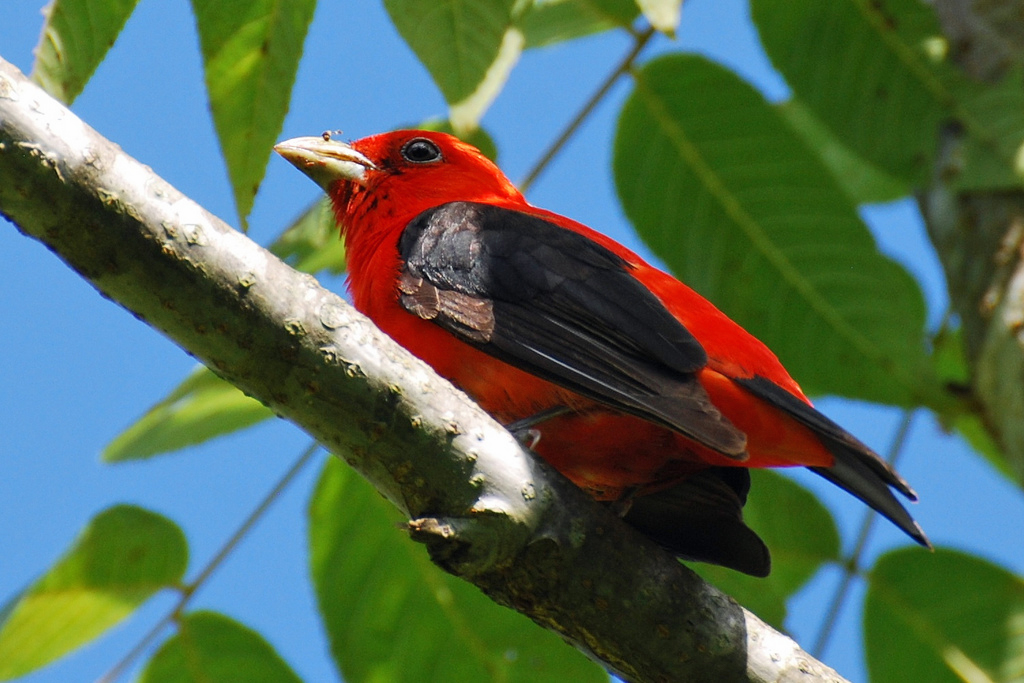
A male scarlet tanager brightens shadowy woodlands with a flash of tropical colors yet remains mostly inconspicuous in the forest canopy.

Bird behavior is also one reason for people to devote their time to observing birds.

“Hawks in flight, songbirds bringing food to their young or a heron hunting for a fish in shallow water are just a few examples of behaviors that draw our attention,” McDaniel said.

“It seems there is always something new to see and learn,” he added. “There is an old saying, ‘birding is a lifetime guarantee against boredom.’”

Michele Sparks, first vice president for the Bristol Bird Club, joined McDaniel in promoting the importance of membership in a birding group for people looking to expand their birding skills.

“By joining the Bristol Bird Club, a beginner birder would have many opportunities to meet experienced, friendly birders who not only have monthly meetings with guest speakers but take to the field to study birds on a regular basis,” Sparks said.

“We have scheduled field trips, and then there are individuals who meet weekly for the pleasure of birding,” she added. “New members are always welcome, but the connections you make are most important for new birders.” Sparks said many members want extra help finding birds in the area (commonly called hot spots), identifying birds and getting bird tips.

In addition, Sparks said, “The pleasure of being outdoors to study birds can connect with those members who routinely bird in the local areas.”

Sparks noted that the Bristol Bird Club maintains a Facebook page highlighting upcoming events such as the recent trip to Panhandle Road and a “Whips and Chucks Outing” held in early June to look and listen for nocturnal whip-poor-wills and chuck-will’s-widows.

Sparks noted that the Bristol Bird Club holds regularly scheduled monthly bird walks at Steele Creek Park in Bristol, Tennessee, usually the second Thursday of the month, as well as bird walks at Jacob’s Nature Center in Johnson City.

The Bristol Bird Club belongs to both the Tennessee Ornithological Society and Virginia Ornithological Society. The chapter’s name — the J. Wallace Coffey Chapter — honors the memory of the late J. Wallace Coffey, a longtime leader in the group.

•••

Bryan Stevens has been writing about birds and birding since 1995. To ask a question, make a comment or share a sighting, email him at ahoodedwarbler@aol.com.

Elizabethton birding group will celebrate 80th anniversary in 2024

Photo by Dominik Rheinheimer/Pixabay * Members of a birding club are always willing to help newcomers learn to identify some great birds, such as this great blue heron.

To support and nurture new birders as they test their wings and take flight into the pastime, three different birding organizations exist in the region.

An article written by Gustave Axelson and published Sept. 19, 2018, on the website, All About Birds, provides some recent information about the American enthusiasm for birding.

Forty-eight million Americans 16 and older are bird watchers. It’s a staggering figure that also includes the more than 16 million birders who travel beyond their home to watch birds and 10 million more who specifically travel to seek out songbirds.
Birders spend, benefitting the economy. For instance, $1.7 billion is spent on equipment and another $4 billion is spent on food for birds.

Regional birding organizations headquartered in Bristol, Elizabethton and Kingsport are always ready to welcome new members into the ever-growing flock of birders.
Beginning this week with the Elizabethton Bird Club, I will spotlight each of these birding organization in my weekly column.

Photo by Pixabay.com • A good pair of binoculars will bring birds much closer.

The Elizabethton Bird Club, also known as the Lee and Lois Herndon Chapter of the Tennessee Ornithological Society, will celebrate its 80th anniversary in 2024.
Dave Gardner took office as the club’s newest president in June.

“As a still relatively new birder, I think the biggest advantage to being in a birding organization is just the opportunity to learn from other birders,” Gardner said. “It’s somewhat embarrassing to admit now, but when I began birding I didn’t know that ravens and crows were different birds. I was a complete novice.”

His interest in the pastime grew with repeated exposure to birding activities and events.

“Furthermore, I didn’t realize that birding was something I was interested in,” he said. “It took going out on field trips and bird counts to awaken that interest.”
A friendship with Kim Stroud, who recently finished up her tenure as president of the Elizabethton Bird Club, as well as some other members of the group, helped foster Gardner’s growing interest in birds and birding.

Photo by Bryan Stevens • Birders will come from near and far to look for rarities that make an unexpected appearance in the region.

“Without the guidance of more experienced birders, I would have quickly become frustrated by how much I didn’t know,” he said. “For a new birder, there’s no better way to learn than by going birding with more experienced people.”

Even with a few years of birding experience under his belt, he said he is still amazed by the vast wealth of knowledge in the club. He also noted that the knowledge is not limited to birds but also covers history, nature and many other topics.

“The other great benefit from being in the club is the simple camaraderie,” Gardner said. “I’ve met people through the bird club that I now consider friends, and I’ve traveled to places I never would have even thought to go, like the Okefenokee Swamp and Hiwasee National Wildlife Refuge. Two of our members recently got married, after meeting on a club trip to Charleston, South Carolina.”
Gardner also believes the long history of the Elizabethton Bird Club in the region is not to be overlooked.

“I think the advantage of having such a long history is the institutional knowledge that comes with it,” he said. “We have records that go back to the 1940s, which helps with tracking trends in populations and migration patterns.”

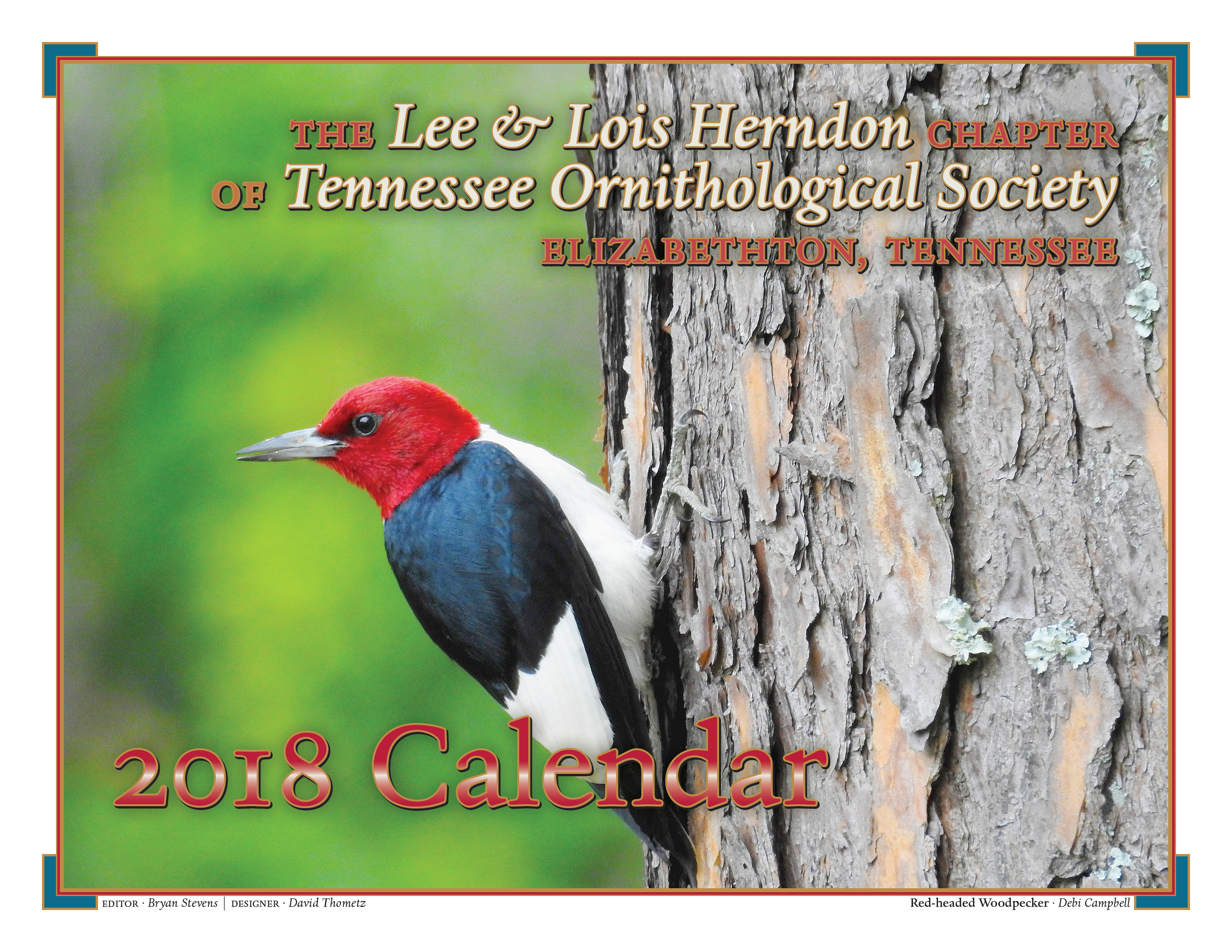
The chapter publishes a yearly calendar with photos taken by members.

Gardner noted that being a long-standing organization also helps the club and its leaders to develop good working relationships with local governments, parks and landowners.

Kim Stroud said that she believes there are two main benefits to joining a birding organization.

“The first is that it is a great educational opportunity,” she explained. “For beginning birders, being surrounded by experienced birders is a great way to learn more about birds — not just their field marks and calls, but also what habitats they occur in and what seasons certain species are here.”

These organizations also offer many benefits to experienced birders who are new to the region.

“Clubs like ours can show newcomers where the great local birding sites are.” Stroud said.

She noted that some birders from outside the region are not accustomed to birding in the mountains.

“For example, one transplant from the flat part of Ohio was amazed to learn that some birds, like black-throated blue warbler and black-throated green warbler, occur at different elevations.

“The idea that some birds only occur at specific elevations was not something she ever had to consider before, because everything was about the same elevation,” Stroud said. “Information like this can be crucial when trying to target specific bird species.”

According to Stroud, the second benefit of joining an active birding organization is social.

“Joining a club offers the opportunity to meet new people and make new friends, who have similar interests,” she said. “Our chapter is very active and provides many different types of events, including interesting programs at our meetings and banquets, social gatherings like picnics and Christmas parties, field trips to local birding hotspots and opportunities for travel, like trips to the Outer Banks, coastal South Carolina and Georgia and even a planned trip to Texas.”
“The Lee & Lois Herndon Chapter dates all the way back to 1944,” Stroud said.
The Herndons were a couple that helped found the group and provided leadership to the group for many years.

“Because members of our chapter have been birding this area for almost 80 years, we have an extensive knowledge about the birds in the local area.”
She noted that members know what species of birds to expect, where to go to find these species, and even when migrant species should return each year.
Much of the localized information is highlighted in a book by chapter member Rick Knight titled “The Birds of Northeast Tennessee.”

Stroud noted that the chapter also has a long history of performing seasonal bird counts.

“We just completed our 80th Spring Bird Count,” Stroud said. “Count data that covers such a great span of time is invaluable to scientists who are studying long-term population trends in bird species, which is crucial work given the effect of climate change and the recent studies indicating a massive decline in American birds.”

•••

To ask a question, make a comment or report a sighting, email me at ahoodedwarbler@aol.com.

Annual summer bird count nets 110 species

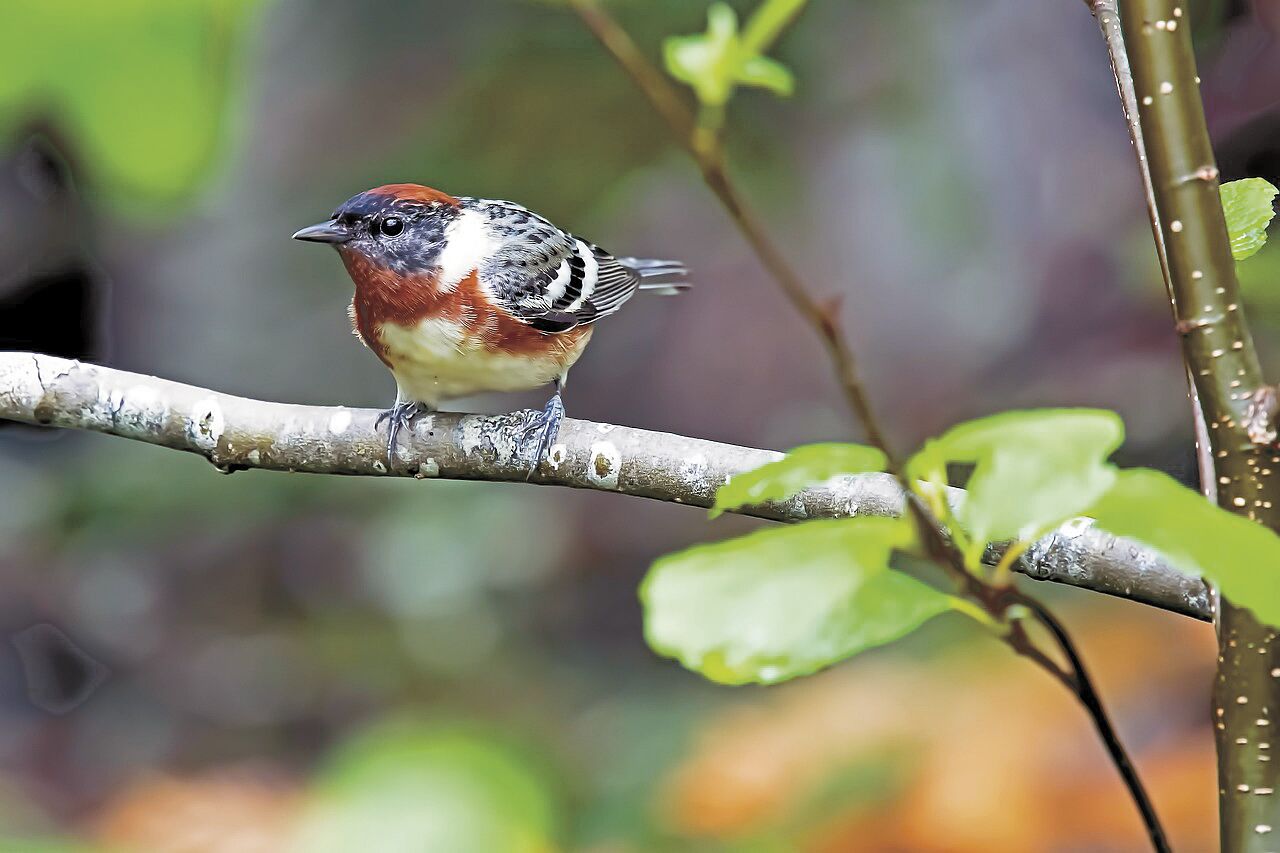
Photo by Hans Toom/Pixabay * A single bay-breasted warbler was likely a late migrant traveling through Unicoi County to reach nesting territory in Canada.


The 10th Unicoi County Summer Bird Count was held Saturday, June 3, with 19 observers in five parties. Participants tallied 110 species, which was slightly above the average of 108 species.

The weather was good: clear to partly cloudy with a temperature range from 48 to 84 degrees and little wind.

I counted close to home in Limestone Cove and along Highway 107 to the North Carolina state line. I was accompanied by Brookie and Jean Potter.

As always, the count had some unexpected misses, including chuck-will’s-widow, Cooper’s hawk, great horned owl, yellow- throated vireo, Baltimore oriole, common yellow-throat and prairie warbler.

Three Northern bobwhites represented only the second record for the species in the history of this count.

Osprey also made its debut on this year’s count.

https://www.google.com/search?client=firefox-b-1-d&q=Youtube+bay-breasted+warbbler#fpstate=ive&vld=cid:72fa665c,vid:Zj3T5O5SlqU

The list
Canada goose, 40; wood duck, 2; mallard, 13; Northern bobwhite, 3; ruffed grouse, 1; and wild turkey, 10.

Rock pigeon, 37; mourning dove, 81; yellow-billed cuckoo, 2; Eastern whip-poor-will, 11; chimney swift, 27; and ruby-throated hummingbird, 8.

Killdeer, 6; great blue heron, 4; green heron, 2; black vulture, 4; and turkey vulture, 43.

Osprey, 1; bald eagle, 1; red-shouldered hawk, 1; broad-winged hawk, 5; and red-tailed hawk, 1.

Eastern screech-owl, 6; barred owl, 1; belted kingfisher, 9; red-bellied woodpecker, 20; yellow-bellied sapsucker, 2; downy woodpecker, 12; hairy woodpecker, 1; Northern flicker, 11; and pileated woodpecker, 18.

American kestrel, 1; great crested flycatcher, 1; Eastern kingbird, 1;

Eastern wood-pewee, 9; Acadian flycatcher, 33; least flycatcher, 5; and Eastern phoebe, 56.

White-eyed vireo, 5; blue-headed vireo, 48; warbling vireo, 1; and red-eyed vireo, 165.

Blue jay, 82; American crow, 111; fish crow, 3; and common raven, 4.

Tree swallow, 73; Northern rough-winged swallow 41; purple martin, 41; barn swallow, 39; and cliff swallow, 47.

Carolina chickadee, 56; tufted titmouse, 75; red-breasted nuthatch, 4; white-breasted nuthatch, 9; and brown creeper, 2.

House wren, 22; winter wren, 8; Carolina wren, 98; blue-gray gnatcatcher, 16; and golden-crowned kinglet, 8.

Eastern bluebird, 55; veery, 14; hermit thrush, 2; wood thrush, 16; American robin, 239; gray catbird, 16; brown thrasher, 9; and Northern mockingbird, 23.

European starling, 264; cedar waxwing, 22; house sparrow, 20; house finch, 30; red crossbill, 1; and American goldfinch, 41.

Chipping sparrow, 52; field sparrow, 5; dark-eyed junco, 19; song sparrow, 141; Eastern towhee, 53; and yellow-breasted chat, 3.

Eastern meadowlark, 10; orchard oriole, 2; red-winged blackbird, 74; brown-headed cowbird 19; and common grackle, 119.

Ovenbird 44; worm-eating warbler, 11; Louisiana waterthrush, 11; black-and-white warbler, 23; Swainson’s warbler, 13; Kentucky warbler, 2; hooded warbler, 91; American redstart, 4; Northern parula, 21; magnolia warbler, 1; bay-breasted warbler, 1; Blackburnian warbler, 6; yellow warbler, 6; chestnut-sided warbler, 9; black-throated blue warbler, 30; pine warbler; 1; yellow-throated warbler, 20; black-throated green warbler, 23; and Canada warbler, 15.

Scarlet tanager, 24; Northern cardinal, 87; rose-breasted grosbeak, 1; blue grosbeak, 1; and indigo bunting,106.

•••

Bryan Stevens has birded in Northeast Tennessee since the early 1990s. He has written about birds and birding since 1995. To ask a question, make a comment or share a sighting, email him at ahoodedwarbler@aol.com.