Tag Archives: Birding

Birding is a popular pastime for many Americans.

Count sets new records while gathering data on world’s birds

Photo by Bryan Stevens • The downy woodpecker ranked among the 10 most frequently reported birds on the 2017 Great Backyard Bird Count. A record number of 173,826 people took part in this year’s GBBC, which was held Feb. 17-20.

In announcing the results of this year’s Great Backyard Bird Count, organizers of the annual global bird survey shared an anecdote about a second-grade student in Memphis, Tennessee. The girl, who obviously enjoyed making a contribution as a citizen scientist for the GBBC, made a real connection with the birds she was being asked to count.

Calling her participation the “best day of her life,” the girl went on to share her excitement about seeing a downy woodpecker. She was hardly alone in seeing this small woodpecker. A total of 38,760 checklists across the country included downy woodpecker with their totals.

The girl’s joy at discovering a downy woodpecker — a bird that was completely new to her — all but guarantees that she will look forward to taking part in the 2018 GBBC. If her interest in birds continues to develop, she just may catch the birding bug herself.

Photo by Bryan Stevens • Counting crows and other birds at Shook Branch at Watauga Lake during the recent GBBC.

The 2017 Great Backyard Bird Count is now part of the history books, and thanks to participants from around the world, this year’s GBBC ranked as the biggest count in its 20-year history. Participants set a new high bar for number of checklists submitted and total number of species reported.

An estimated 214,018 participants took part this year, compared to the 2016 final total estimate of 163,763 individuals. An incredible total of 5,940 different species was tallied by GBBC participants, which is a dramatic spike from last year’s total of 5,689 species. That record number of participants also turned in a record number of completed checklists — 173,826, compared to the final total of 162,052 in 2016.

The three states with birders submitting the most checklists were, in descending order, New York, Pennsylvania and California. Incidentally, Virginia came in sixth, with 5,190 checklists submitted during the 2017 GBBC. North Carolina came in ninth with 4,220 checklists submitted by 2017 GBBC participants. Birders in Tennessee will need to step up for future counts. The Volunteer State ranked 20th on the list with 2,215 checklists submitted.

The states seeing the most species of birds reported were, in descending order, California (370 species), Texas (360 species) and Florida (309 species). North Carolina checklists indicated a total of 213 species to land the Tar Heel State at No. 8 on the list of states with most species reported. Virginia, in 12th place, tallied a total of 196 species. Tennessee came in 32nd place with 136 species, which isn’t too bad for a landlocked state.

In North America, the most numerous birds reported on the count included several species of geese, as well as blackbirds, starlings and crows. A total of 4,793,261 snow geese made this bird the most numerous North American species reported on the GBBC. Other common birds, in descending order, included red-winged blackbird with 2,464,572 individual birds tallied, as well as Canada goose, 1,895,077; European starling, 919,038; mallard, 715,594; ring-billed gull, 647,950; American coot, 500,261; greater white-fronted goose, 426,040; common grackle, 416,720; and American crow, 378,483. During my participation this year, I saw several of these species, including red-winged blackbird, Canada goose, European starling, mallard, ring-billed gull and American crow.

Photo by Bryan Stevens • Killdeer in Limestone Cove during the Great Backyard Bird Count held last month.

The ten most frequently reported species, in descending order, were Northern cardinal, American crow, mourning dove, dark-eyed junco, downy woodpecker, blue jay, black-capped chickadee, house finch, house sparrow and white-breasted nuthatch. While taking part in the GBBC last month, I saw all these species with the exception of the black-capped chickadee. Instead, my submitted checklists featured Carolina chickadees.

The birds on the most frequently reported list are almost without exception birds of yards and gardens, making them more likely to be counted by more individual participants. On the other hand, the most numerous, or abundant, birds are those that join together to form large flocks. They’re widespread, but less likely to be encountered in yards and gardens.

I counted at home and at several favorite birding locations. During a visit to Watauga Lake in Carter County, Tennessee, my mother and I observed an immature bald eagle and a yellow-bellied sapsucker, which turned out to be among my personal GBBC highlights this year. I always enjoy looking for birds during the four-day count period. I also like to feel that I am contributing to a shared knowledge about birds and their populations.

Photo by Bryan Stevens • Buffleheads on the Watauga River during the recent GBBC.

If you would like to view photos of birds from around the world that were taken during this year’s GBBC, visit gbbc.birdcount.org/photo-subs-2017/.

If you didn’t get to take part this year, be sure to plan ahead for next year when the GBBC will be held Feb. 16-19, 2018. Help make next year’s count another one for the record books.

•••••

To learn more about birds and other topics from the natural world, friend Stevens on Facebook at https://www.facebook.com/ahoodedwarbler. He is always posting about local birds, wildlife, flowers, insects and much more. If you have a question, wish to make a comment or share a sighting, email ahoodedwarbler@aol.com.


Birds, other wildlife deserve protection of Endangered Species Act

Photo by Lisa Hupp/USFWS • A bald eagle has an average of 7,000 feathers. Bald eagles are protected under the Bald and Golden Eagle Protection Act. For instance, it is against the law to possess their feathers or other remains. Eagles are abundant enough they no longer qualify for listing under the Endangered Species Act.

The Endangered Species Act serves as one of the strongest, most effective wildlife protection laws in the world. Although the ESA was not meant to protect only birds — the law actually protects everything from bats and whales to wolves and shellfish — it has done an outstanding job ensuring that our feathered friends continue to fly free and thrive in a world they must increasingly share with human beings.

According to Earthjustice — an environmental law organization that uses the power of the law to fight for the earth and its inhabitants — the ESA was passed with overwhelming bipartisan support more than 40 years ago to provide a legal safety net for wildlife, fish and plant species that are in danger of extinction.

Photo by Scott Flaherty/USFWS • The California condor is an example of a species saved from the brink of extinction thanks to the Endangered Species Act. Much work remains to be done to protect this large bird.

Earthjustice and other environmental groups are warning that some members of the current Congress want to slash the Endangered Species Act, threatening the very existence of the imperiled wildlife and ecosystems the Act protects. Some politicians from the state of Utah seem to be leading this effort, which is a sad irony considering the wealth of natural majesty the unique lands of Utah has to offer.

None other than President Richard Nixon, a Republican, signed the ESA into law back on Dec. 28, 1973, and it was an effort that crossed political party lines that made the legislation a reality. Biologists warn that our planet is facing a sixth wave of mass extinction, according to a release from Earthjustice. The Endangered Species Act, which has prevented 99 percent of the species under its care from vanishing, is precisely the kind of effective tool needed today. It has revived the bald eagle, the American alligator, the California condor and many others.

House Natural Resources Chairman Rob Bishop (R-UT) has said he wants to “repeal and replace” the Endangered Species Act. Others are supporting legislative proposals that would make it harder for the U.S. Fish and Wildlife Service to resolve Endangered Species Act lawsuits. The ESA is truly a prime example of the old saying, “If it’s not broke, don’t try to fix it.” Bishop and his allies, to put it plainly, are wrong.

Photo by Lou George/USFWS • The Kirtland’s Warbler is an endangered songbird that has seen its numbers slowly increase thanks to the protection of the Endangered Species Act.

If there’s ever been a government regulation that has done what it set out to do, it has been the Endangered Species Act. Without the ESA, many of our birds, including the nation’s official bird, might no longer still exist on the planet. The bald eagle had been reduced to a mere 417 pairs in 1963. With the passage of the ESA, the eagle began to rebound. In 2007, in a highly publicized success story, the existence of 11,040 pairs of bald eagles in the United States allowed this majestic bird to be removed from its listing under the ESA in 2007.

Photo by USFWS • Whooping cranes still exist largely due to protections afforded them by the Endangered Species Act.

The bald eagle is only one of the many birds to benefit from the protection of the ESA. The tall and stately whooping crane and the beautiful and tiny Kirtland’s warbler are some of the other birds that are slowly showing population increases once they were afforded intensive protection under the ESA. The nene, or Hawaiian goose, and the peregrine falcon — the world’s fastest bird — have also received much needed protection.

Lest anyone think that eagles and other formerly endangered species are completely out of the woods, just consider the recent rash of bald eagle shootings in Tennessee. Two eagles, one in Rhea County and one in Meigs County, were victims of shootings. The severity of their injuries resulted in both birds being euthanized.

It’s heartbreaking to think that anyone would shoot a bald eagle, a bird that all patriotic Americans should revere as a lofty symbol of the nation’s majesty. The shootings are a reminder that it’s still not a safe world for many of the birds and other creatures that share the planet with us. The ESA is a marvelous piece of legislation that gives a measure of protection to the helpless. The law allows all Americans to share in the responsibility of being wise stewards of God’s diverse and wonderful creatures.

Photo by Steve Maslowski/U.S. Fish and Wildlife Service • The golden-cheeked warbler, a beautiful but endangered songbird that nests in Texas, is one of many birds that benefits from protections provided by the Endangered Species Act.

Demanding that the government keep the ESA strong and intact is not and should not be mere politics. It’s showing that Americans still value wildlife and the rights of future generations to enjoy that wildlife over money and short-term profits. Left or right, Republican or Democrat, the Endangered Species Act should be immune to political differences.

On a purely personal level, I hope to one day see such endangered songbirds as the golden-cheeked warbler and the black-capped vireo, and I want the same for future generations. That’s not likely to happen without the protections of the ESA remaining strong and intact.

Let your state and federal representatives know that you support continued protections for birds and other wildlife. We can co-exist with the amazing variety of wild creatures that share our planet. It’s just a matter of priorities. Our congressional representatives and senators need to know Americans aren’t willing to tolerate attacks on the ESA. Our president and his administration need to receive the same message.

Photo by Ted Heuer/U.S. Fish and Wildlife Service • The Nene, or Hawaiian goose, has gradually increased in numbers thanks to the Endangered Species Act.

If you enjoy birds, keep visiting local and state parks. Continue planning trips to National Parks and Wildlife Refuges. Don’t stop feeding your backyard birds. Most importantly, fight to make sure the wildlife that makes the world a richer place continues to find that humans do make good neighbors.

For information on how to contact your government officials to express your thoughts on the value of the Endangered Species Act, visit http://www.usa.gov/elected-officials.

••••••

To learn more about birds and other topics from the natural world, friend Stevens on Facebook at https://www.facebook.com/ahoodedwarbler. He is always posting about local birds, wildlife, flowers, insects and much more.


Vultures aren’t typical poster birds for ecological awareness, but perhaps they should be

vultures-tree

Photo by Bryan Stevens • A flock of vultures gathers in a dead pine tree on a gloomy winter afternoon.

Cougars have returned to eastern mountains, white-tailed deer numbers are out of control and hungry black bears sometimes wander into towns. Encounters between humans and wildlife are nothing new. I was reminded of this fact when I received a recent email from Gene Sturgeon on the subject of vultures. Gene and his wife, Catheryn, reside in Abingdon, Virginia. The town, it would seem, has experienced a recent invasion.

“In our new neighborhood, the black vultures are ever-present,” Gene wrote. “They circle endlessly, and never seem to land on the carrion that attracts them. Turkey vultures typically are seen on the carrion, but these blacks never appear to be feeding. Also, I can’t imagine this neighborhood has more than the normal number of dead animals.”

Gene has also observed that the black vultures, starting in mid-afternoon, begin to gather in selected trees. Usually two nearby trees, he noted, will contain dozens of them for the night.

vulture-tower

Photo by Bryan Stevens • Vultures gather atop an industrial building in downtown Erwin, Tennessee.

Gene asked if the behavior he has observed is fairly typical. I replied to his email that I believe that his observations are accurate and typical. While the birds seem to be roosting in his neighborhood, they are probably not finding their food there. Vultures are capable of soaring long distance in search of food, so they may actually be dining far away from Gene’s Abingdon neighborhood.

bryan-vulture

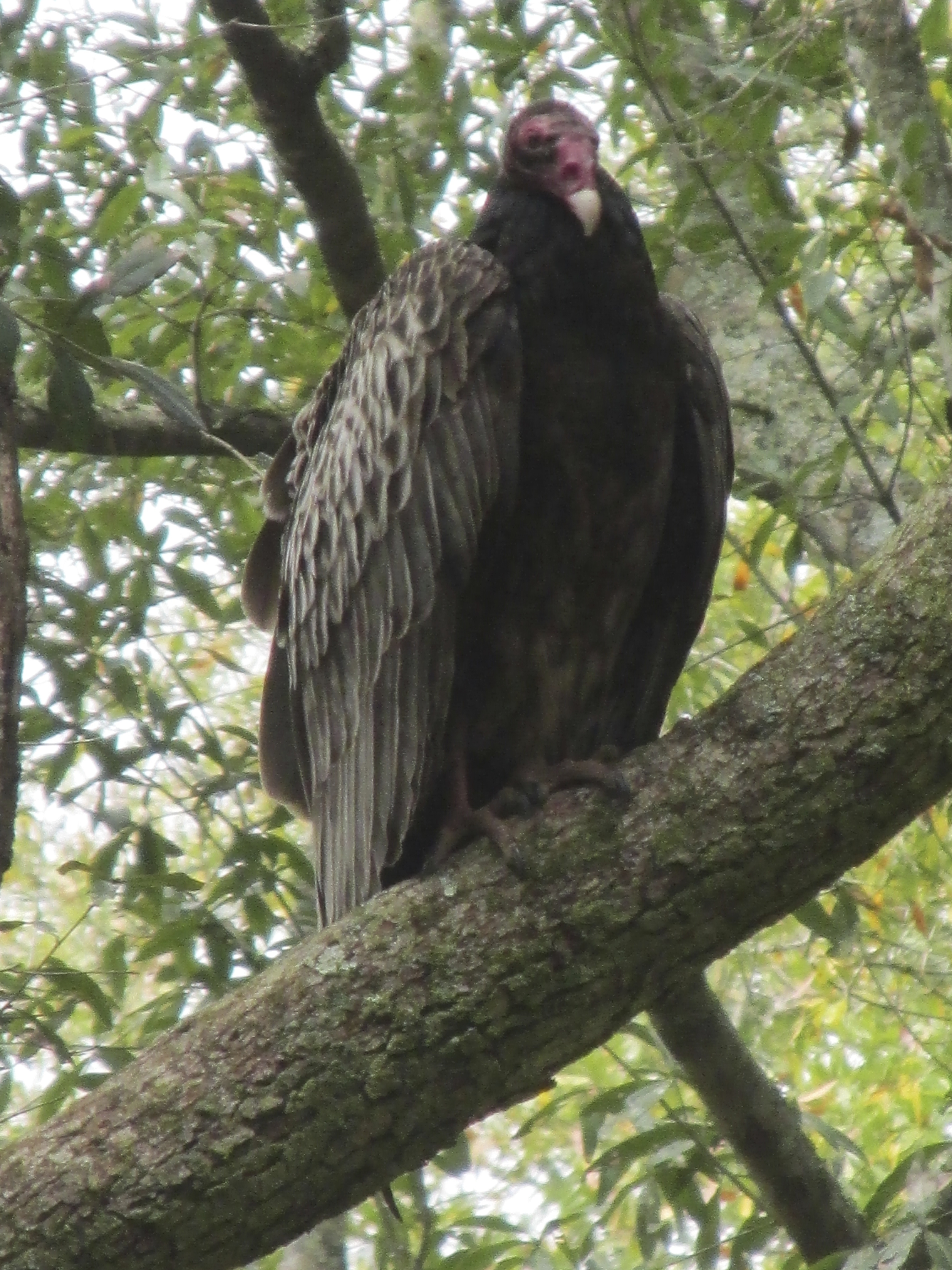
Photo by Bryan Stevens • A turkey vulture perches on a branch in a South Carolina woodland.

I asked him if there were pine trees or other types of evergreens because it’s my understanding that vultures are often fond of thick stands of pine. I am guessing this is because such trees offer protection and shelter from the elements. Gene wrote back to inform me that both pine trees and leafless trees are present near his home. “The leafless tree attracts the larger cloud of black vultures,” he added.

Doubtless, some residents are uneasy when these uninvited neighbors swell the neighborhood. I was somewhat surprised by Gene’s observation, but I was also taken aback to learn that Abingdon has for years boasted an extremely substantial population of vultures. In fact, the Abingdon Police Department has even compiled a fact sheet to educate the public about these large birds. According to the release, it is around this time of year that Abingdon sees an increase in the number of vultures due to weather patterns. The APD has apparently received complaints from some citizens about the vultures roosting in their neighborhoods.

tvultures

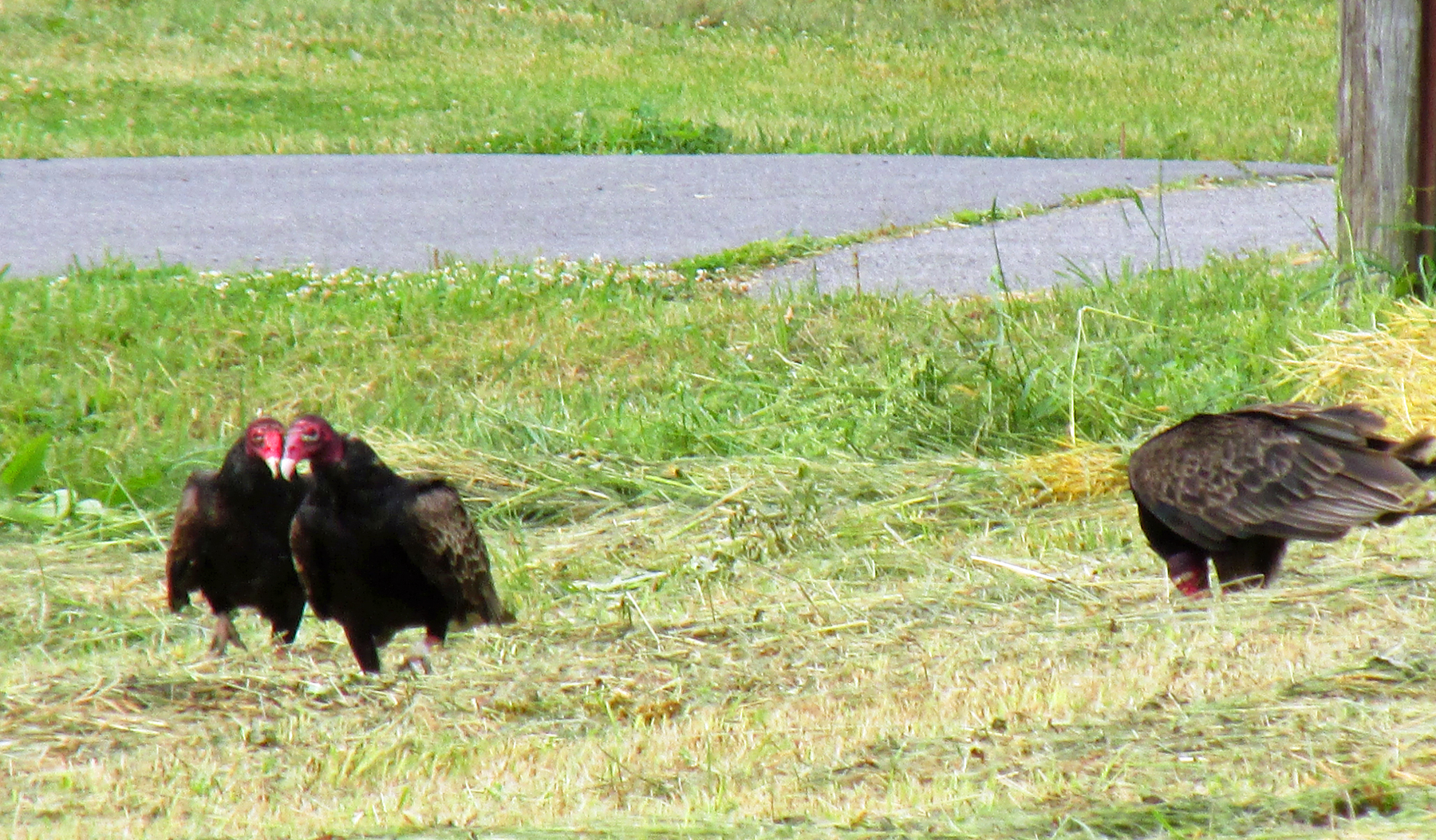
Photo by Bryan Stevens • Turkey vultures forage in a freshly mowed field near Abingdon, Virginia. As scavengers, vultures play a vital but often unappreciated role in the environment.

I was glad to note that the fact sheet recognizes the important of vultures in the ecosystem. These large birds serve an important function. Without vultures, local yards and roads would be littered with rotting, stinking, animal carcasses — and the health risks that accompany them.

Nothing prohibits a private land owner from contacting a professional wildlife specialist to disturb the roosts at owner expense. If I might offer unsolicited advice, however, I’d recommend against wasting your money. The tactics, while they may make a temporary difference, don’t usually solve anything in the long run.

vultures-soaring

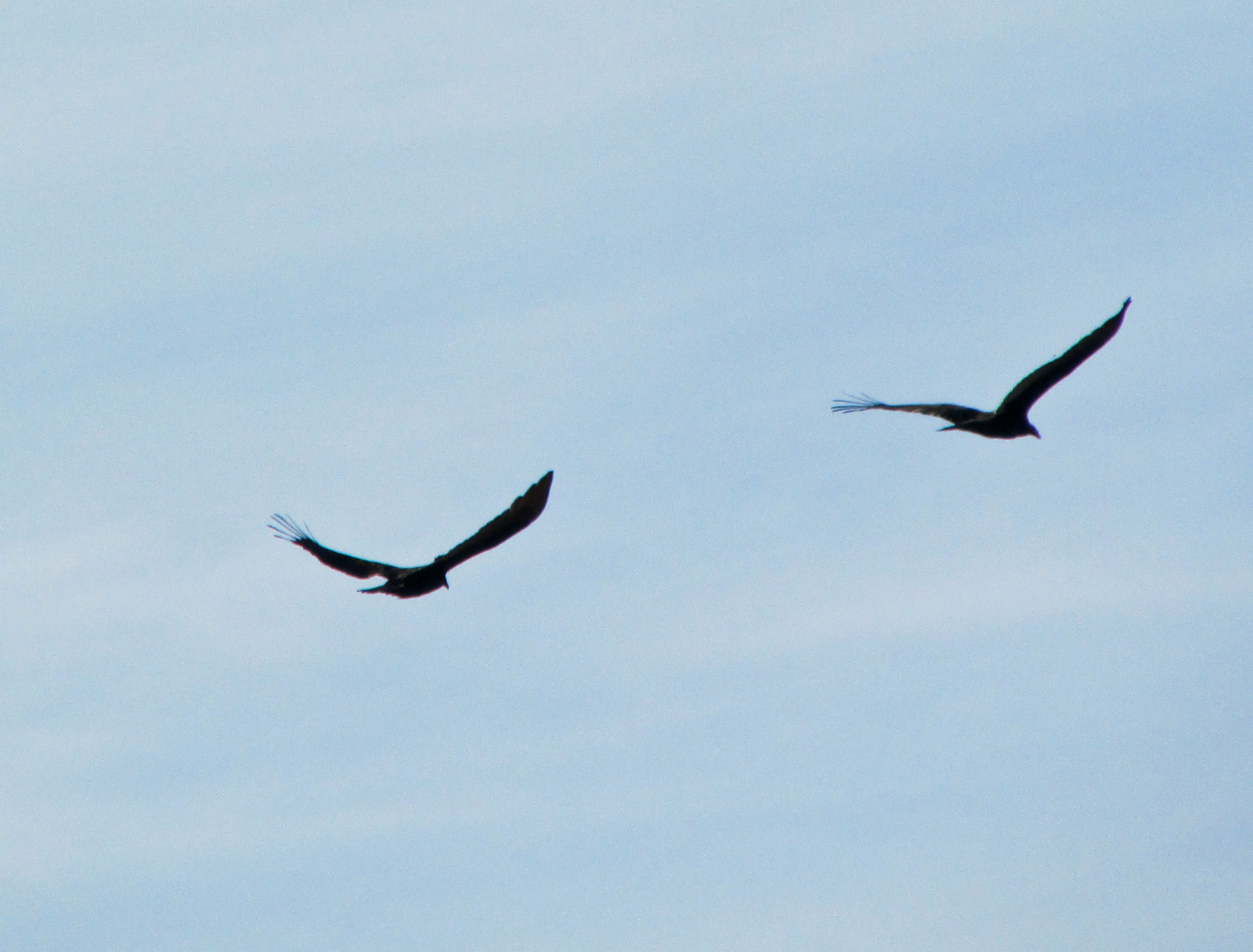
Photo by Bryan Stevens • Turkey vultures in their usual V-shaped silhouette characteristic of a soaring vulture.

Abingdon’s government, for both ethical and legal reasons, cannot kill vultures. Private citizens are also forbidden by law to kill vultures or hire exterminators to do so. Vultures are protected by the Migratory Bird Treaty Act. The birds, their nests and eggs cannot be killed or destroyed without a permit from the U.S. Department of the Interior’s Fish and Wildlife Service. Private citizens are also not legally permitted to use fireworks to try to disperse vulture flocks.

The best thing to do is make your home and yard less attractive to these large, scavenging birds. While reading some tips put forward by the APD, I was struck by how some of the advice, if followed, can protect homes from other potential nuisance wildlife ranging from raccoons and opossums to black bears and skunks. According to the APD, there are several things people can do to make their yards less attractive as a roosting place for vultures:
• Ensure that you are not inadvertently attracting the vultures. Common attractions include open containers of pet food, uncovered garbage cans, and pet food bowls.
• Remove any dead trees that make convenient perches for vultures.
• Use humane perch deterrents, like motion-activated sprinklers or lights.

vulture-halloween

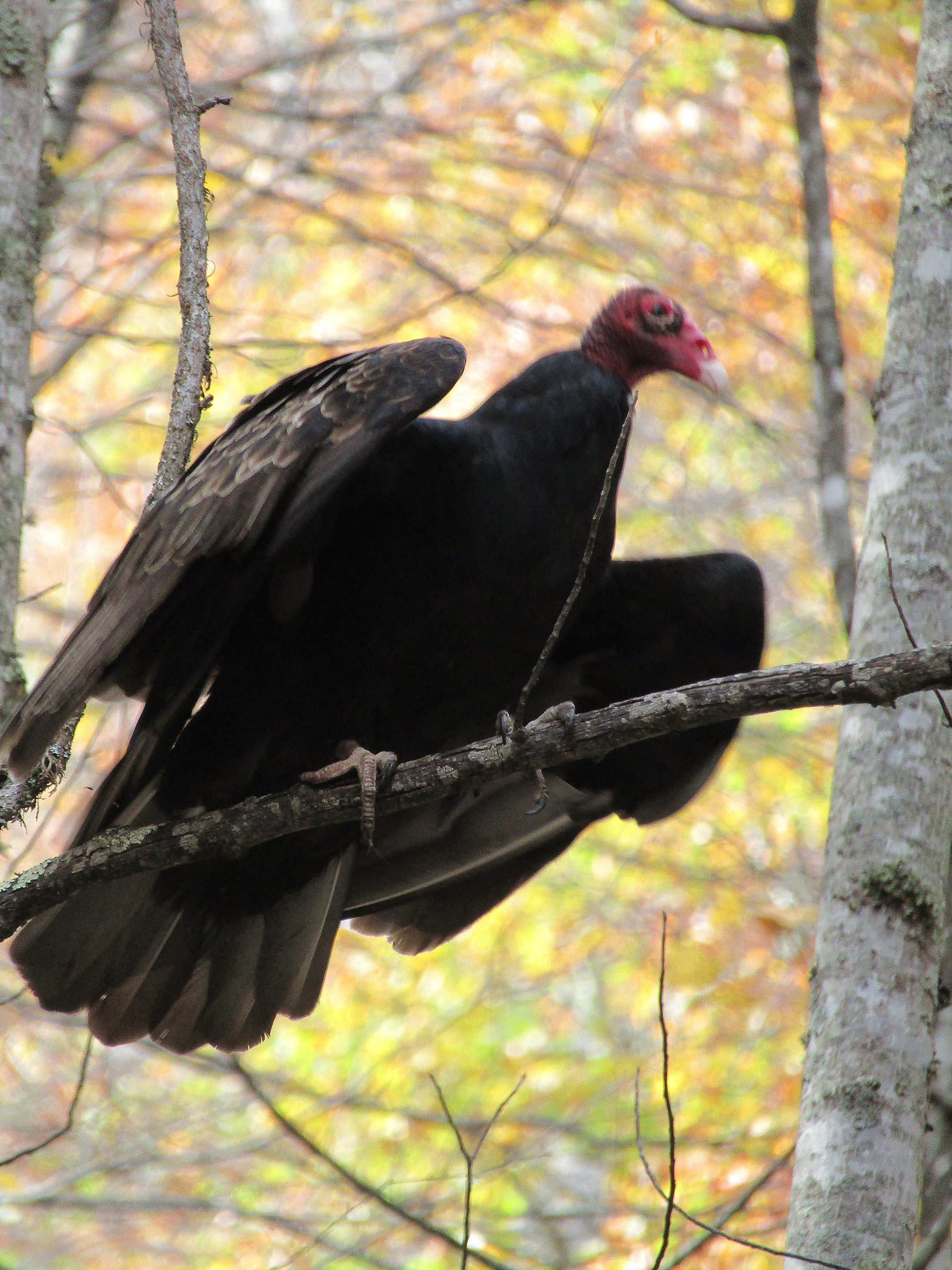
Photo by Bryan Stevens • A Turkey Vulture perches in a woodland in Roan Mountain, Tennessee, during late fall.

The APD also pointed those wishing for more information to the Cornell Lab of Ornithology website, which has excellent information about both species of vulture, including conservation information.

I was very pleased to see that the APD tried to dispel misinformation about these valuable birds. People are, naturally enough, concerned for their pets because of the presence of these large birds. Vultures are carrion eaters, which means eat animals that are already dead, preferring animals that have been dead for two to four days. While there are no accounts of turkey vultures preying upon live animals, there have been occasional reports of black vultures preying upon small, live and relatively defenseless animals.

That tells most, but not all, of the story. Black vultures occasionally will attack newborn livestock, but these birds are not likely to go after the family dog or cat, especially if the pet is mobile and in good health. Nevertheless, it is still a good idea to keep cherished pets indoors. While vultures pose little danger to them, plenty of other animals, such as coyotes, are much more opportunistic than vultures. Keeping cats and dogs confined indoors also protects wild birds and other wildlife from the instinctive predatory notions of our precious pets.

BS-VULTURES

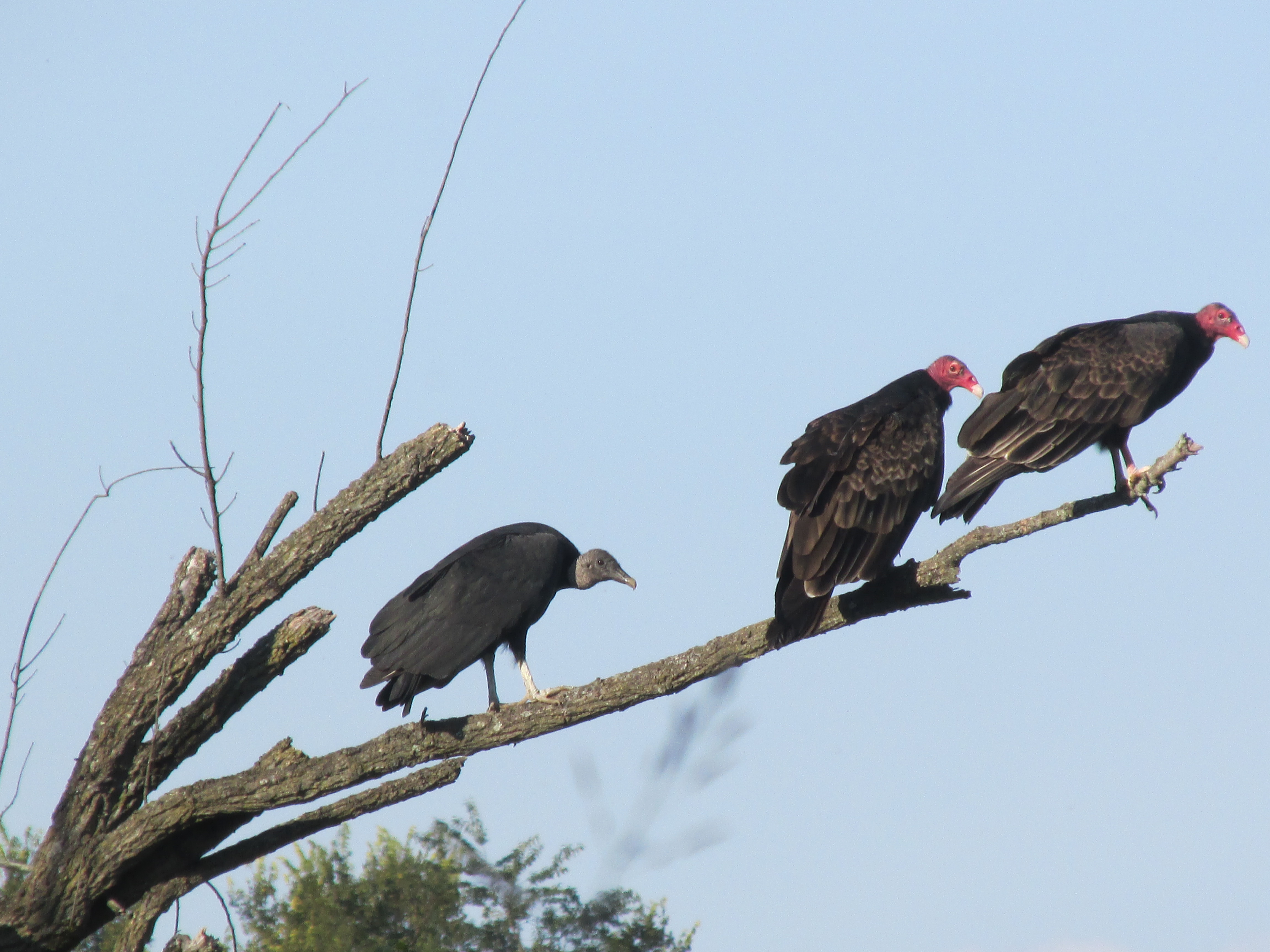
Photo by Bryan Stevens • A black vulture and two turkey vultures share a perch near Boone Lake in Sullivan County, Tennessee.

While both vultures are migratory birds, their numbers have always fluctuated and will continue to do so. As their populations increase, their range has increased as well. Both species are present in the Abingdon area year-round. Because of the town’s location, their numbers increase from November through early February as they follow the weather patterns. In colder periods, they move farther south, in warmer periods, farther north. Abingdon’s climate makes for a good wintering location. As it gets warmer, non-resident flocks tend to move farther north.

Like many other species of birds, some vultures have learned to co-exist near humans, just like such birds as Canada geese, Eastern bluebirds, American robins and mallards. Like these birds, vultures are highly adaptive creatures. Unlike some types of wildlife that shy away from human contact, vultures and some other birds have adapted to the human environment – perhaps a bit too well. Vulture behavior can be destructive. In recent years, some of these destructive tendencies have become quite infamous among birders. This new behavior apparently first surfaced among vultures wintering in south Florida.

TurkeyVulturesClean

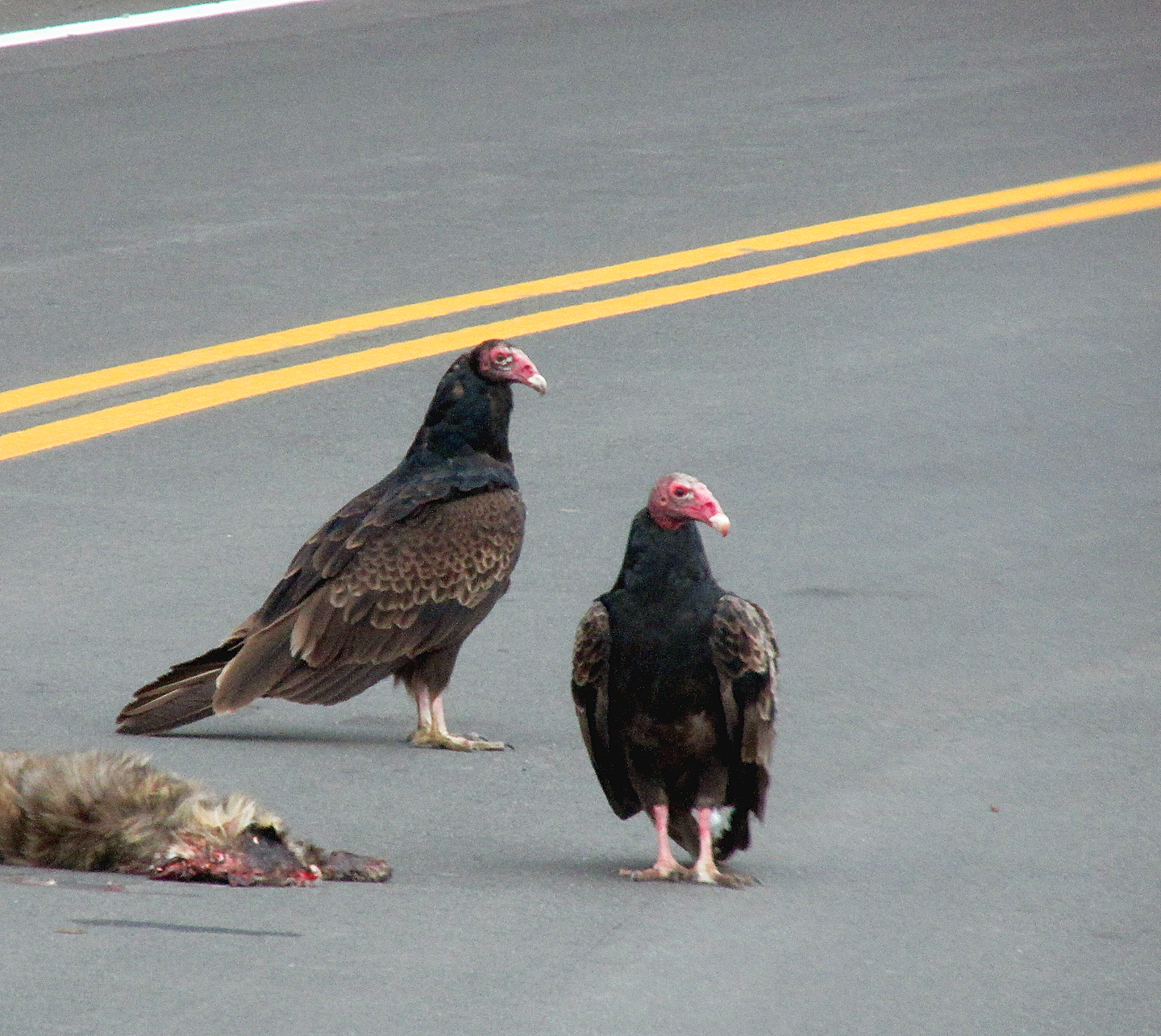
Photo by Bryan Stevens • Turkey vultures regularly dispose of road-killed animals.

They have been known to tear window and roof caulking, vent seals, shingles, rubber seals on car windshields, windshield wipers and other soft, rubbery materials. In addition, their excrement is acidic and may damage painted surfaces and landscaping. The birds also regurgitate a smelly, acidic vomit. Unfortunately, vultures apparently pass on these bad habits to others of their kind and such aberrant behavior is now being seen outside of the Sunshine State.

According to the APD, flocks of as many as 100 vultures have been documented in Abingdon. This number may rise and fall, depending on conditions. Vultures are part of the web of life, which connects them and their fellow creatures to our own lives. Turkey vultures are larger than black vultures, weighing about four to five pounds, with a wingspan of six feet. The turkey vulture’s most distinctive feature is its bright red, featherless head. In flight, a turkey vulture often appears to be “wobbling” and, from underneath, all of the flight feathers are light colored.

Turkey_Vulture_edited-1

Photo by U.S. Fish & Wildlife Service • Turkey vultures have bare red heads, as opposed to the black heads of the related black vulture. While larger than black vultures, turkey vultures are less aggressive than their smaller relatives.

On the other hand, black vultures are smaller, weighing less than four pounds, with a wingspan of five feet or less. The black vulture’s head is grey and featherless, but larger in proportion than the turkey vultures. Viewed in flight, only the outer flight feathers of the black vulture are white.

Although smaller in size, black vultures are feisty and aggressive birds. They often outcompete turkey vultures at carcasses. They will also only reluctantly abandon a feeding site at a carcass. My family almost learned this the hard way during a trip to South Carolina when my father almost ran his car into a flock of black vultures feeding on a road-killed deer. I warned him that the vultures might not get out of the way, and he slowed the car’s speed. The vultures hopped back from the edge of the road as our car traveled past them. Looking back, I noticed they immediately hopped back onto the carcass after we had passed. If we had sped past at full speed, one of the bird’s could easily have panicked and flown into our path. A four-pound bird can do a lot of damage if it hits the windshield of a car traveling at 40 to 50 miles per hour. Trust me! You don’t want to put this to the test.

Perhaps that’s the moral of the story. Give vultures a wide berth and, in theory, they will do the same for you. Let’s face it. Vultures aren’t going to be cute and cuddly faces for ecological awareness. A polar bear or penguin, vultures simply are not. They still have a role to play, and we should be grateful they were created for just that purpose.

Origins of the name of Muscovy duck shrouded in mystery

Joan Stenger sent me an email recently about an unusual waterfowl observation. On a recent  Saturday, she visited downtown Bristol where the creek widens a bit near the fire station and beside the park. Joan wrote that she saw a flock of ducks and Canada geese and enjoyed watching them.

muscovy-ducks

Photo by Bryan Stevens                                                             Muscovy ducks seen outside of Texas are domesticated versions of the wild waterfowl. Male Muscovy ducks sport red carbuncles around their bills.

“One fellow stood on the opposite bank and had bright red marks on his face,” she added. “My daughter and I went over the bridge and into the park to get closer and hopefully get a better view.”

Joan described the odd duck as larger than the other ducks but not as big as the geese. “Its back was dark dark blue with teal,” she wrote. “I had never seen such a duck! “
She said they continued to watch the flock of Canada geese and then returned home.  There she consulted her bird books and only found one small mention and picture of a Muscovy duck. Armed with that information, she conducted an online search for more information about Muscovy ducks.
 “Have you seen many of these fellows?” Joan asked in her email.
In my reply to her email, I informed Joan that Muscovy ducks are becoming more common. However, outside of Texas, most Muscovy Ducks seen are “feral” domesticated versions of the wild bird. Many people have probably also seen feral mallards that are content to reside year-round with us. The Muscovy ducks have probably decided the same thing.
In southern Texas, it is possible to observe wild Muscovy ducks, but sightings of these ducks outside of the Lonestar State involve domesticated ducks. Like mallards, Muscovy ducks have long been domesticated, and some of the domesticated individuals have gone feral. These ducks, descendants of their wild ancestors, have become more common, both nationwide and locally.

I’ve heard from other curious people over the years about encounters with Muscovy ducks. The birds behave unusually for a duck. For instance, they often pant like a dog and strut around more like a wild turkey than a typical duck. Most of these feral Muscovy ducks are also relatively tame in association with people, long ago having learned to connect humans with free handouts of bread, popcorn and other foods.

muscovy-three

Photo by Bryan Stevens                                                            Wild Muscovy ducks are dark waterfowl with white wing patches. Domesticated Muscovy ducks exhibit a wide variety of plumage colors, including brown and white feathers.

In the wild, Muscovy ducks are native to Mexico, as well as Central and South America. Before Christopher Columbus reached the New World in 1492, natives had long domesticated this duck. When Columbus first visited the New World, he even took back to Europe some of these ducks.
The term “Muscovy” is a reference to the Russian city of Moscow, but the reasons behind the connection of this duck’s common name to Moscow are obscure. One theory is that the duck acquired the name in association with the Company of Merchant Adventurers to New Lands, later shortened to the Muscovy Company. Perhaps this chartered trading outfit sold some of these ducks to European customers in the 1500s.
After all, Columbus and early explorers named the wild turkey for the faraway country of Turkey, mistakenly believing that the New World provided a more direct route to this realm so important to trade. Perhaps the Muscovy duck also acquired a name connected with Moscow for no better reason. It does appear that the origins of the name are one of history’s odd mysteries.
Adding to the mystery is the fact that the duck’s scientific name also refers to a city — Cairo in Egypt — far from this bird’s native home. Translated, the Muscovy duck’s scientific name means “musky bird from Cairo.” Another common name for the duck is Barbary duck, which refers to a region of Africa home to modern-day Libya.

While the wild Muscovy duck is a tropical bird, the domestic ones are perfectly capable of weathering cold temperatures as low as 10 degrees Fahrenheit.

muscovy-two

Photo by Bryan Stevens                                                       Domesticated and feral Muscovy ducks are widespread across North America. These ducks were first discovered by Europeans arriving in the New World, although native tribes had long raised them as domestic animals.

The Muscovy Duck has only one other close relative, the white-winged wood duck of India and Bangladesh, One of the world’s largest ducks, the white-winged wood duck is a seriously endangered species. One curious fact about this duck is its tendency to only forage for food after dark.

Wild Muscovy ducks are large waterfowl with a black plumage accented with big white wing patches. They can be almost 34 inches long and weigh as much as nine pounds. It’s the heads of these ducks that really make them stand apart. Both sexes have bare black-and-red or all-red faces. Males also sport pronounced caruncles at the base of the bill, as well a a slight crest of feathers. The appearance of domestic Muscovy ducks is quite variable, with some birds sporting almost entirely white plumage.
Muscovy ducks and mallards will also hybridize, producing sterile offspring that are known as “mullards.” I’ve observed both domestic Muscovy ducks and “mullard” hybrids at local parks, but I haven’t yet seen any wild Muscovy ducks. The domestic version of this duck has also established feral populations around the globe in locations such as Europe, New Zealand, Canada and Australia.henry_charles_bryant00
•••••••
In addition to asking her question about Muscovy ducks, Joan shared a story about bluebirds at her home.
“We feed the birds year round and enjoy their antics at the feeders,” she reported. “We were pleased to have bluebirds raise a nest full of babies this year, although I was told that we would not have bluebirds because we live in town.” Apparently “no one told the bluebirds,” Joan joked.
Because of her feeders and the bird baths, she receives visits from a good variety of birds, mostly dominated by the cardinals.


Birds bring their best game when seeking mates

clarks_grebes_rushing

Photo by Dave Menke/U.S. Fish & Wildlife Service • A pair of Clark’s Grebes displays in a courtship ritual known as “rushing” or “weed dance.” Birds use a variety of strategies to attract and keep mates.

Most birds don’t bring a box of chocolates or a bouquet of roses when they take up courtship of a prospective mate, but birds have several equivalent behaviors that they employ to attract the attentions of the opposite sex. Since we recently celebrated Valentine’s Day, I thought a look at some of the more unusual courtship rituals of some of our feathered friends would be appropriate.

Birds bearing gifts. Many birds present small trinkets to a prospective mate. For instance, many male penguins make a present of a stone or pebble to female penguins. There could be more than a simple bribe behind this gift. Female penguins don’t build elaborate nests. In fact, a scrape on the bare ground, perhaps encircled by a collection of pebbles, marks the extent of their nest construction. So, the perfect pebble could be the way to winning a female penguin’s heart.

cardinals-dec18

Photo by Bryan Stevens • Northern Cardinals are beginning to pair together in anticipation of the spring nesting season.

The way to the heart is through the stomach. Observant birders may have witnessed a male Northern cardinal slip a female a morsel of food, such as a peanut or a shelled sunflower kernel. It’s a marked change for this bird. During the winter months, a male cardinal is more likely to chase a female away from a feeder rather than share food with her. However, as spring approaches, his behavior undergoes a change and he becomes content to feed next to a female cardinal, often slipping her some choice tidbits.

May I have this dance? Many species of birds perform elaborate and ritualistic dance displays. Among birds known for tripping the light fantastic are flamingoes, cranes, grouse and grebes. Cranes are one of the oldest families of birds on earth. They’re also some of the most accomplished dancers in the animal kingdom. Pairs perform very ritualistic dances that, if the performers were human, would no doubt require the services of an accomplished choreographer. Cranes mate for life and the ritual of dancing is a way to strengthen the bonds between a mated pair. The ability to dance is, apparently, not instinctive. Young cranes must practice their dance moves, a process that can take years before they master the elaborate dance.

mallardpair

Photo by Bryan Stevens • A pair of Mallards find a thawed spot on a frozen pond.

Synchronized swimming. While many birds dance to impress a mate or strengthen pair bonds, grebes perform a dance that takes place completely on the surface of the water. A pair will engage in this intricate performance, perfectly mirroring the moves of the other as they literally race across the surface of the water. These dances by grebes are also known as “rushing” or “weed dance.” It’s called as a weed dance because at the culmination of the ritual, the birds usually hold some type of aquatic plants in their bills while racing swiftly over the surface of the water. Pairs that perform well together stay together, building a nest and raising young.

print2-2

An 18th century illustration of the habits of the Bower Birds.

Good housekeeping seal of approval. The tropical family of bowerbirds are famous for complex nests built by males and then decorated with bright and colorful objects to catch the eye of a potential mate. The nest of these birds are actually referred to a “bower.” Usually constructed on the ground, the male will line the approach to the bower with items such as shells, leaves, flowers, feathers, stones, berries, and even discarded garbage, including plastic scraps or bits of glass. Unusually odd items pressed into these decorative displays have included coins and spent rifle shells. This habit of male bowerbirds must rank as the ultimate in trying to impress a mate with shiny bling.

These are just a few of the inventive ways that birds go about attracting and keeping mates. Perhaps you followed some of these tips from our feathered friends to ensure you had a great Valentine’s Day.

•••••

To learn more about birds and other topics from the natural world, friend Stevens on Facebook at https://www.facebook.com/ahoodedwarbler. He is always posting about local birds, wildlife, flowers, insects and much more. If you have a question, wish to make a comment or share a sighting, email ahoodedwarbler@aol.com.

Annual Great Backyard Bird Count enlists public as citizen scientists for global survey

clapper_rail

Photo by U.S. Fish & Wildlife Service/Lee Karney • The Clapper Rail is abundant in saltwater marshes and mangrove swamps from Massachusetts to South America. Observant participants in the Great Backyard Bird Count are sure to find some of these reclusive birds.

I look forward every year to the annual Great Backyard Bird Count, a survey established as a citizen science project back in 1998. Since 2013, the GBBC has been a global effort, allowing birders around the world to take part. Participants in 2015 observed almost half of the world’s known bird species, and that effort was surpassed just last year during the 2016 count. Over the years, I have counted various interesting birds, including green-winged teal, Ross’s goose, snow goose, American kestrel and Cooper’s hawk, while taking part in the GBBC.

The GBBC is a joint project of the Cornell Lab of Ornithology and the National Audubon Society with partner Bird Studies Canada. With its global perspective, a great many exotic bird species are now tallied on the annual GBBC, but the survey remains firmly established as a grassroots effort to compile data crucial for the conservation of the world’s beloved birds. The information gathered by tens of thousands of volunteers helps track the health of bird populations at a scale that would not otherwise be possible.

parakeet_auklet_flight_castle_rock_shumagin_islands

Photo by U.S. Fish & Wildlife Service/Steve Hillebrand • Parakeet Auklets in flight in the Alaska Maritime National Wildlife Refuge. The Great Backyard Bird Count extends beyond North America and now covers the entire globe.

It’s incredibly easy to take part in the GBBC. Anyone anywhere in the world can count birds for at least 15 minutes on one or more days of the four-day count period and enter their sightings at http://www.BirdCount.org. There’s no charge or fee for taking part in the GBBC, which is a fun way to observe a variety of birds. Thanks to the flexible count criteria, it is also an easy way to make a contribution to science. The data delivered by the thousands of participants is now collected and compiled by the website ebird.org.

This year’s GBBC will be held over a four-day period, starting on Friday, Feb. 17, and continuing through Monday, Feb. 20. Participants are invited to count birds at their own homes in their yards and gardens. They can also travel farther into the field, birding in their favorite parks, wildlife refuges or other birding hot spots. Participants can count alone or join with groups of fellow birders. Those taking part in the GBBC are invited to count in as many locations as they like. The reported results will help create a real-time snapshot of where birds are distributed during the winter months.

sandhill_cranes

Photo by U.S. Fish & Wildlife Service/Lee Karney • A pair of Sandhill Cranes in a New Mexico wetland.

The 2016 Great Backyard Bird Count saw 142 species of birds reported in Tennessee. In Virginia, a total of 177 species was counted by participants in the annual survey. The Old Dominion State has a distinct advantage over landlocked Tennessee in having ample coastal access to the Atlantic Ocean, which helps explain the more than 30 additional species tallied in Virginia. Birds like brown pelican, American oystercatcher, Northern gannet, purple sandpiper and great black-backed gull represented finds not found in Tennessee.

Both states were outpaced by GBBC participants in North Carolina, who managed to find an incredible total of 213 species, including red-cockaded woodpecker, little blue heron, razorbill, brant, parasitic jaeger, Northern fulmar and Western tanager.

Overall, the top three species-rich states were Florida (323), Texas (359) and California (369). In the lower 48 states of the United States, a total of 616 species of birds were reported for the 2016 GBBC.

sharptailed_grouse-2

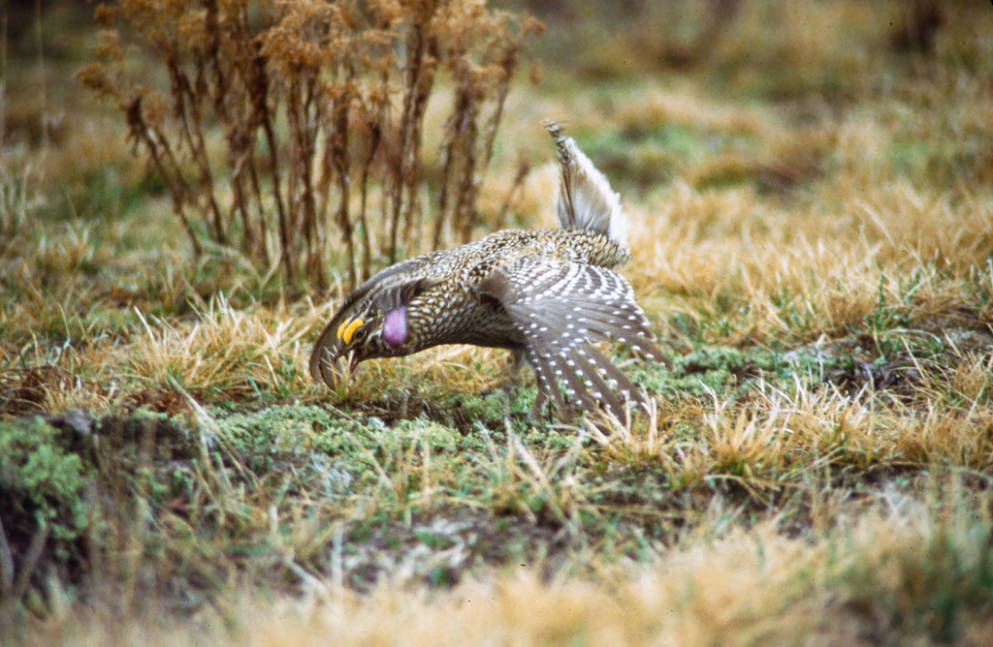
Photo by U.S. Fish & Wildlife Service/Richard Baetsen • Sharp-tailed grouse engaged in a mating display. Keeping track of populations of vulnerable species is a major component of the annual GBBC.

The 2016 GBBC shattered records. An estimated 163,763 bird watchers from more than 130 countries joined the effort. Participants submitted 162,052 bird checklists reporting 5,689 species, which is more than half the known bird species in the world and 599 more species than the previous year. So, what results will 2017 produce?

Social media, like Facebook and Twitter, have helped raise awareness about the importance of the GBBC, which has proven helpful in tracking long-term population trends of North American birds, as well as the bird populations on other continents. If anything, counting birds during the GBBC is an easy way to do your part to advance the cause of science intended to improve the plight of our beloved birds. So, circle the dates on your calendar and join me in taking part in the upcoming Great Backyard Bird Count. For more information on the Great Backyard Bird Count, visit www.BirdCount.org.

•••••

Bryan Stevens lives near Roan Mountain, Tennessee. To learn more about birds and other topics from the natural world, friend Stevens on Facebook at https://www.facebook.com/ahoodedwarbler. He is always posting about local birds, wildlife, flowers, insects and much more. If you have a question, wish to make a comment or share a sighting, email ahoodedwarbler@aol.com.

2017gbbc_robinposter

Flicker, towhee among recent winter bird arrivals

Towhee1

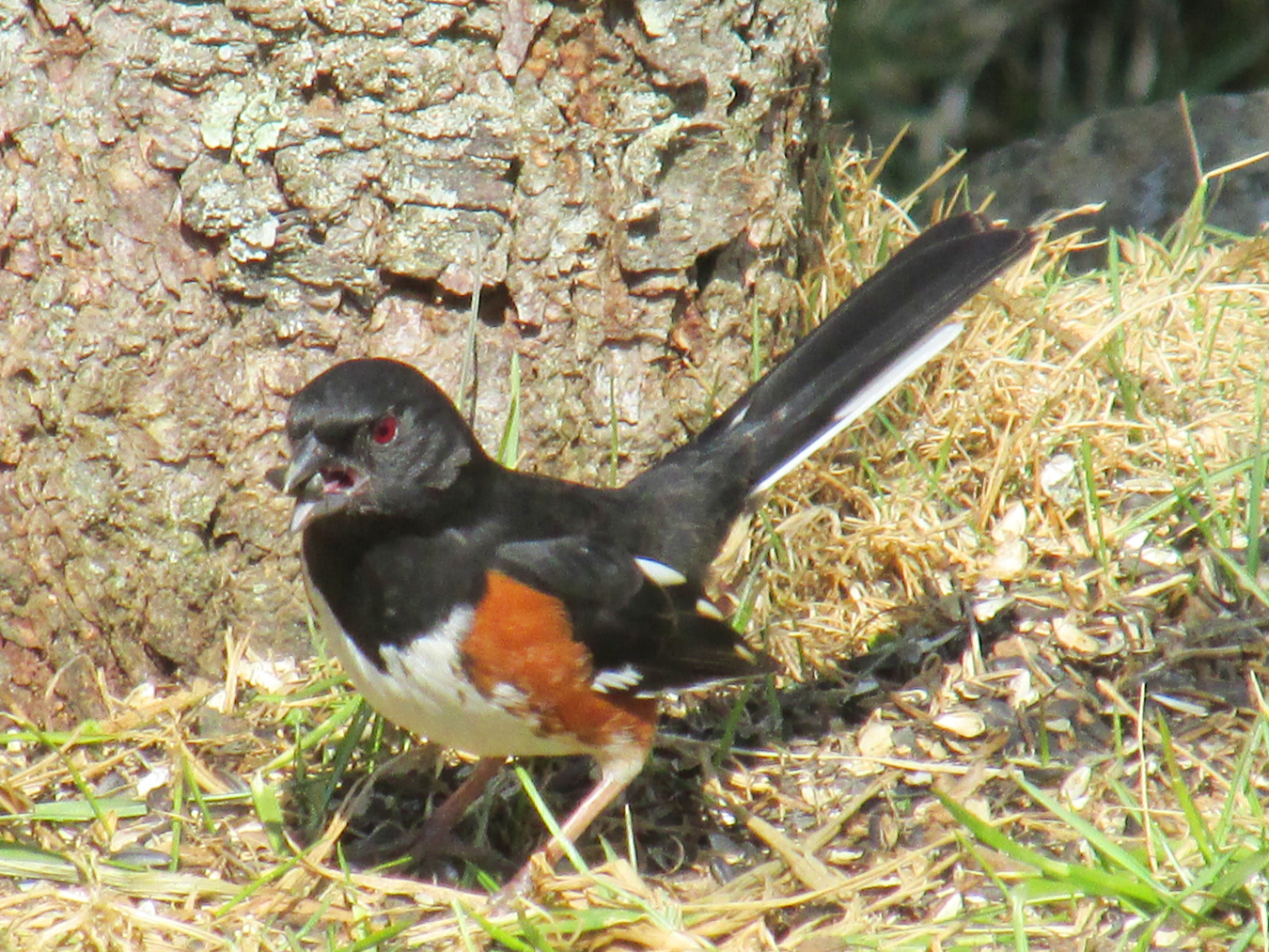
Photo by Bryan Stevens • An Eastern towhee feeds on the ground beneath a feeder.

I’d almost given up on any new birds arriving to break the daily monotony of birds in my yard when two birds put in their first appearances of the year. An Eastern towhee and a Northern flicker both showed up simultaneously for the first time in 2017 on Jan. 13.

The towhee, a male, was feeding in the usual manner of its kind, scratching vigorously on the ground beneath my feeders. Towhees are quite ingenious at uncovering any seeds dropped by other birds.

flicker

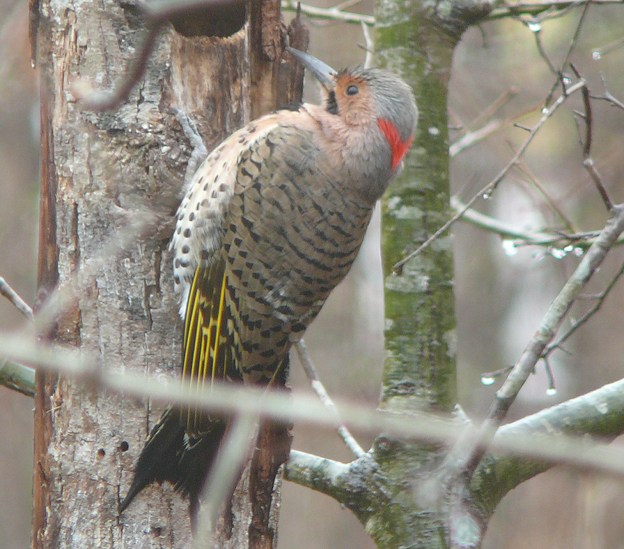
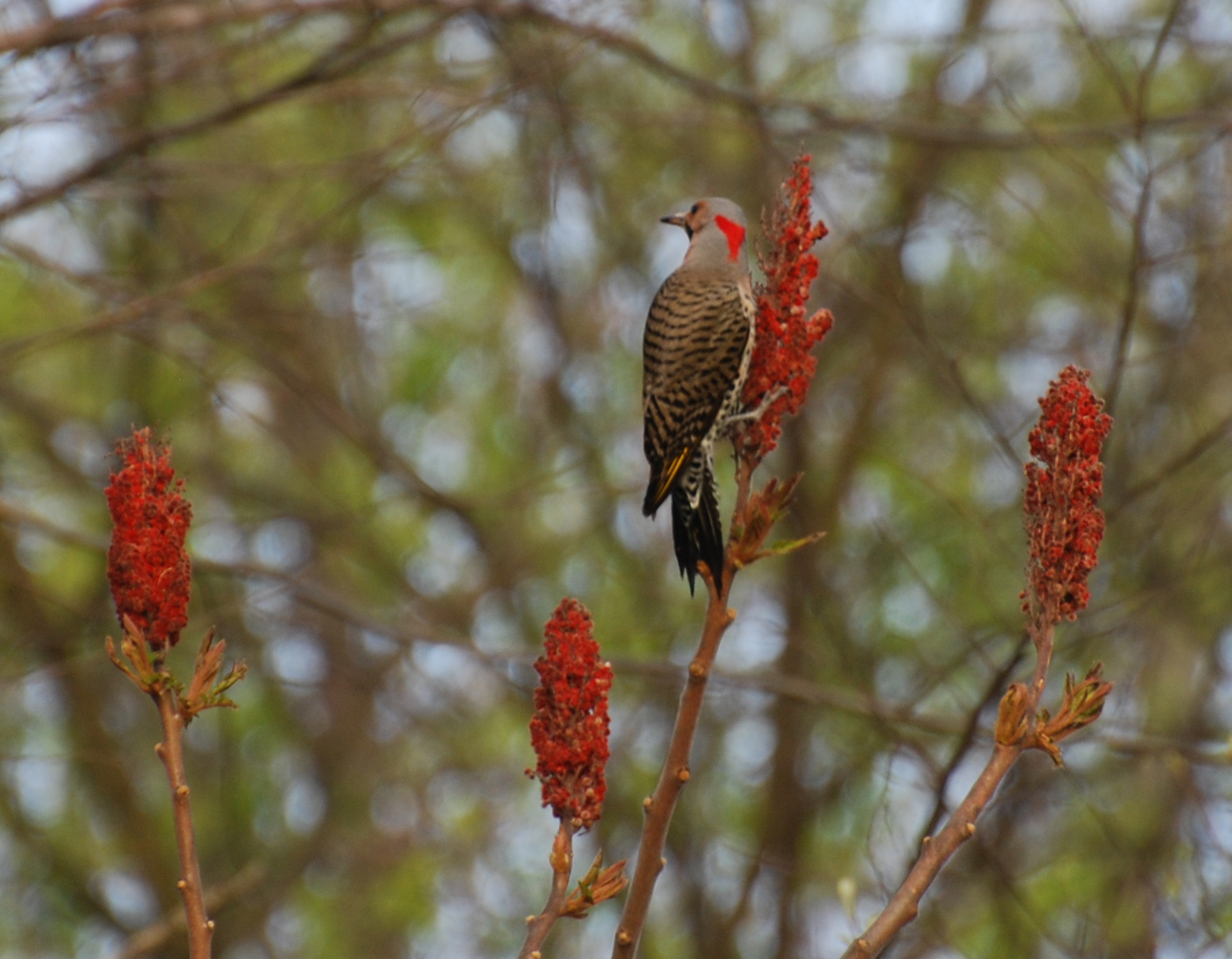
Photo by Jean Potter • A Northern flicker perches on a staghorn sumac.

The flicker was calling from the upper branches of a very tall tree at the edge of a wood lot near my home. The ringing calls of the flicker carried quite clearly even from a distance. Most woodpeckers, including the Northern flicker, are enthusiastic performers. We often think of woodpeckers in association with loud, repetitive drumming with their beaks against the trunk of a tree. Flickers are also known for using other surfaces for drumming. I’ve observed flickers drumming agains metal utility poles and metal siding on homes. That’s really not so strange when you consider that the purpose of the drumming is to communicate with mates or to signal potential rivals that they’re getting a little too close.

Woodpeckers are also known for a variety of vocalizations, and the Northern flicker is no exception. In addition to drumming, the flicker also employs a variety of loud vocalizations that are fairly distinctive. A loud, repeated flicker, often translated as “wicka-wicka-wicka,” is similar to the cluck-like call of the larger pileated woodpecker. The flicker is also known for emitting a sharp, loud “kleeer” call can be heard from a considerable distance. It was this “kleer” call that first drew my attention to the presence of the flicker at my home on Jan. 13.

Flickers are probably most vocal during the spring months. They go quiet for a period during the summer nesting season but start to make themselves heard again during the fall months. A warm, sunny day during the winter is often motivational enough to convince flickers to vocalize.

northern_flicker-1-2

Photo by U.S. Fish & Wildlife Service • A Northern flicker peers from a nesting cavity.

A lot of wildlife is probably getting mixed signals thanks to the extremely mild January temperatures. For instance, I’ve already had a few crocuses blooming in my gardens. Bees and other pollinators have also awoken from winter slumber to take advantage of the unseasonal blooms. If frigid weather does eventually arrive, I hope that these “early birds” suffer no ill effects.

The Northern flicker is the second-largest woodpecker in the region. The only bigger member of the family is the large and unmistakable pileated woodpecker. The flicker ranges across the United States and Canada. The flicker is also present in Central America, Cuba and the Cayman Islands. Known scientifically as Colaptes auratus, which can be roughly translated as the “golden woodpecker,” there are about a dozen species of flickers in North, Central and South America, as well as the Caribbean.

birds-of-ga-northern-flicker

The Nothern flicker is the official state bird of Alabama, where the bird is known as “Yellowhammer.”

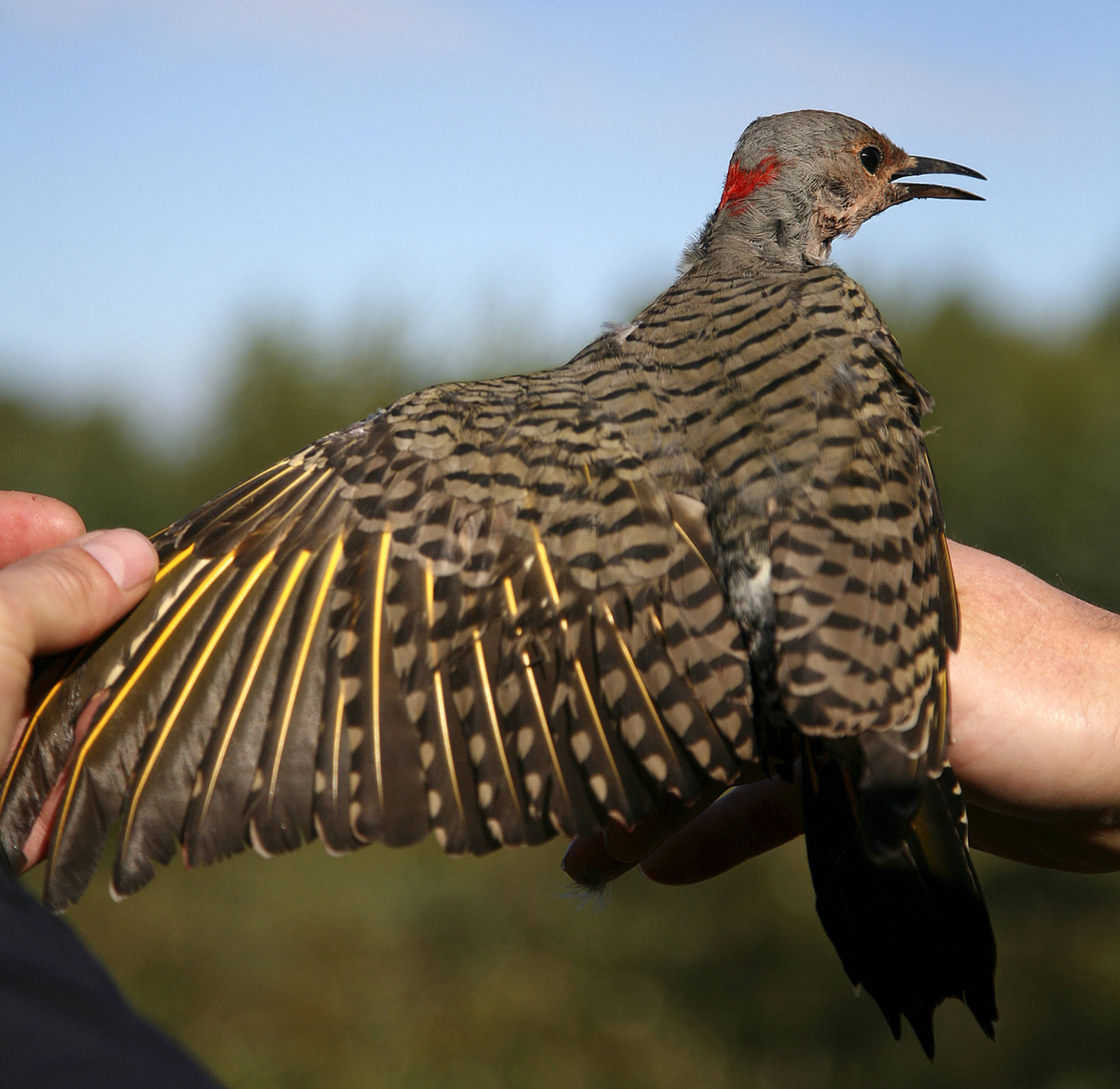
In the United States and Canada, flickers in the eastern half of the continent are known as “yellow-shafted” flickers. The phrase “yellow-shafted” describes the Eastern race of this woodpecker, which is replaced in the western United States by the “red-shafted” flicker. In reality, both the yellow and red-shafted birds are considered by experts to be the same species. The yellow feathers in Eastern birds are found under the wings and on the tail. The yellow, or red, sections of the wings are most visible when the bird is in flight. I’ve seen both forms of this woodpecker, observing the red-shafted form during trips to Utah in 2003 and 2006.

Although most people think of woodpeckers as spending most of their time clinging to the trunks of trees, the flicker actually has something in common with the Eastern towhee. Like the towhee, the flicker spends a lot of time on the ground hunting for its favorite food — ants. The flicker even has a special adaptation — a barbed tongue — that it uses to capture ants.

flicker-yellowwing-2

Photo by U.S. Fish and Wildlife Service • A Northern flicker, captured for a banding operation, has its wing extended to show the yellow feathers indicative of the eastern race of this species.

Flickers will come to feeders, but I’ve never had much luck attracting them. Perhaps I’ve not offered the right fare. The late John V. Dennis recommends “meat scraps, cracked walnuts and pecans, halved oranges and apples, and white bread” in his book, “A Complete Guide to Bird Feeding.” Even Dennis acknowledged that flickers are, at best, wary visitors to feeders. Not much has changed since Dennis wrote his book back in 1977. If any readers have had success luring flickers to their feeders, I’d love to hear their advice for attracting them.

The flicker has even been recognized as an official state bird by Alabama. Of course, Alabama officially bestowed the recognition on the “yellowhammer,” a nod to a nickname for both the flicker as well as Confederate soldiers during the Civil War. Even today, Alabama is still known as the Yellowhammer State. Somewhat surprisingly, the flicker is the only woodpecker that has received designation as a state bird.

••••••

To learn more about birds and other topics from the natural world, friend Stevens on Facebook at https://www.facebook.com/ahoodedwarbler. He is always posting about local birds, wildlife, flowers, insects and much more. If you have a question, wish to make a comment or share a sighting, email ahoodedwarbler@aol.com.

Kinglets are energetic sprites among our feathered friends

Beth-Golden-crownKinglet

Photo by Elizabeth McPherson • This Golden-crowned Kinglet recovered after striking a window.

There are many different ways to become more familiar with the backyard birds at your own home. I’m fond of keeping a year list of all the bird species that travel through the yard and garden at my home. Keeping such a list is a great way to document the seasonal comings and goings of the bird life in your own neighborhood. You may be surprised at what you see.

Patricia Werth, a resident of Abingdon, Virginia, sent me an email to share the results of her year of counting birds in her yard.

“I told you at the beginning of 2016 I was going to list all the birds that come to my feeder or are in our yard,” she wrote. “I counted 29, but I just saw a very small bird that resembled the goldfinch, except smaller and more greenish on the back. Was that a warbler? I am not very good differentiating between sparrows, either.”

She was pleased with her 2016 results, but she wanted some suggestions for identifying the unknown bird. Based on her description of the bird’s small size and greenish coloration on the back, I suggested she do some online research into kinglets.

I received a second email from Patricia thanking me for the suggestion. “After looking up the kinglets, I do believe it was the female golden-crowned kinglet,” she wrote, adding that she was certain that she had seen her before.

Jean-Golden-crownKinglet

Photo by Jean Potter • This Golden-crowned Kinglet was captured and banded as part of an ornithological study.

The identification of the golden-crowned kinglet took her total to 30 species. “Seeing that they (kinglets) rarely eat seeds that was a real treat to have them visit,” Patricia wrote. “I believe I have heard them call, too, but thought it was a chickadee, as they are so vocal.”

Her year’s already off to a good start with goldfinches at her feeders. With the recent snowfall, she also saw her first dark-eyed junco of the year. When it comes to size, however, few of the birds that patronize our feeders are as diminutive in size as the kinglets.

rubycrownkinglet

Photo by U.S. Fish & Wildlife Service/Donna Dewhurst • The ruby-crowned kinglet, pictured, and golden-crowned kinglet are among North America’s smallest birds. Both species are occasional winter visitors in the region. The birds are named for bright crown patches that contrast with their overall drab appearance.

As their name suggests, kinglets are tiny birds. In fact, about the only North American birds smaller than kinglets are some of the hummingbirds. The kinglets, known outside North America as “flamecrests” or “firecrests,” belong to the family, Regulidae, and the genus, Regulus. The family and genus names are derived from a Latin word, regulus, which means “rex,” or “king.” The name was apparently inspired by the colorful crown patches, often red, orange or gold, that resemble the royal “crowns” of kings. In addition to the two North American species, four other species of kinglets can be found in North Africa, Europe and Asia.

john-james-audubon-ruby-crowned-kinglet-1-male-2-female-kalmia-augustifolia

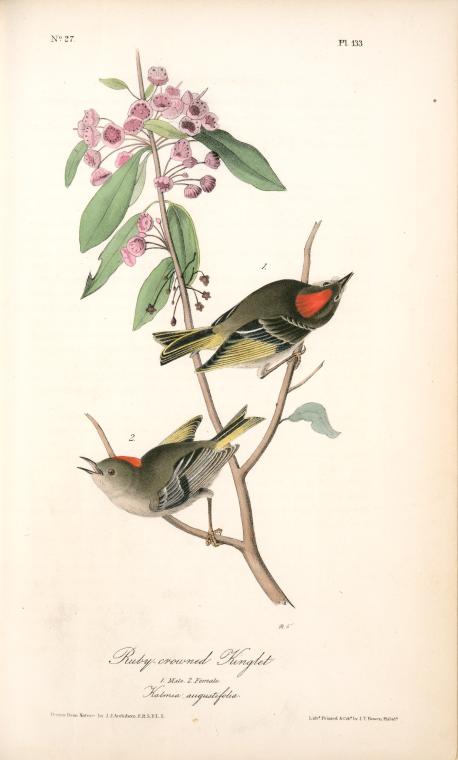
Early American naturalist and artist painted this pair of Ruby-crowned Kinglets.

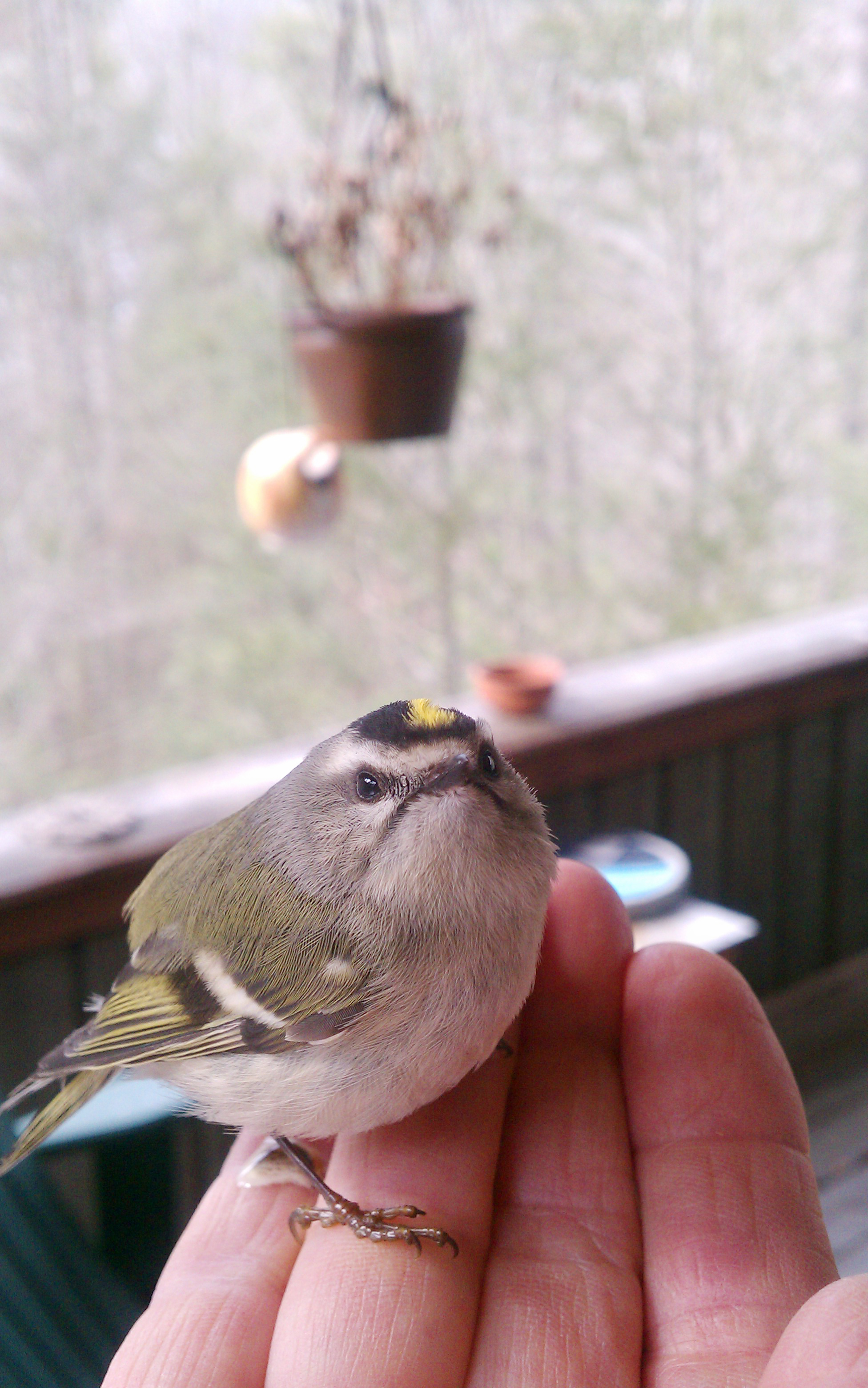
Although similar in size and overall coloration, the ruby-crowned and golden-crowned kinglets are easily distinguished from each other. Side by side, the two species of North American kinglets are easy to identify. The golden-crowned kinglet has a striped facial pattern formed by bold black and white stripes. The ruby-crowned kinglet, on the other hand, has a bold white eye ring but no striping. The golden-crowned kinglet has an orange crown patch, while the ruby-crowned kinglet has a red crown patch that is, more often than not, kept concealed. Both sexes of the golden-crowned kinglet possess a yellow crown patch, but only the male ruby-crowned kinglet boasts a scarlet patch of feathers atop the head. Observers can expend a lot of energy trying to get a look at the crown patches, which are typically only displayed when the bird is agitated.

Kinglets are very active birds. If warblers can be described as energetic, the kinglets are downright frenetic in their activities. The kinglets almost never pause for long, flitting from branch to branch in trees and shrubs as they constantly flick their wings over their backs.  These bursts of hyperactivity can make them difficult to observe. Although small in size, these birds more than compensate for it with a feisty spirit that does them well through the harsh winter months.

cuviers_regulus

John James Audubon painted this depiction of a bird he referred to as Cuvier’s Kinglet in the early 1700s. No other person has ever encountered a bird matching this description.

Kinglets often join mixed flocks comprised of other species of birds, some of which are regular feeder visitors. Perhaps by observing their flock counterparts, some kinglets have learned to accept feeder fare such as suet, meal worms and chopped nuts. Away from feeders, kinglets mostly feed on a range of small insects and arachnids. These tiny birds will also consume some fruit, such as the berries of poison oaks and dogwoods.

Normally, kinglets have a rather fleeting lifespan. These tiny birds can be considered old if they live three or four years. There are always exceptions.  The oldest golden-crowned kinglet on record was six years and four months old. That individual, a male, was documented by a bird bander in 1976, according to the website All About Birds.

Overall, kinglets are trusting, tame birds and a welcome addition to any flocks visiting your yard and garden. These tiny feathered sprites are definitely worth getting to know.

•••••

The Bristol Bird Club will conduct a birding trip of Burke’s Garden, Virginia, on Saturday, Feb. 11. Red-headed woodpecker, a relative of the Northern flicker, is among the target birds. Other possible birds will include golden eagles, rough-legged hawks, horned larks and a pair of bald eagles on a nesting site located in the beautiful, bowl-like valley of Burke’s Garden.e80948b8-92fa-44d2-b107-d9223014aff0_d

Participants should plan to meet by 8 a.m. at the Hardee’s at 900 E. Fincastle St. in Tazewell, Virginia. Arrive early and enjoy breakfast. Attendees will carpool to Burke’s Garden. Those making the trip might also glimpse alpacas and a camel. Bring a bit of cash if you would like to enjoy a soup and sandwich lunch at the Amish Store. For more information on this trip, call Kevin Blaylock at (423) 943-5841.

I visited Burke’s Garden for the first time almost 20 years ago on one of these February field trips. It was quite the memorable birding experience and yielded me my first-ever sightings of rough-legged hawk and common goldeneye.

Looking back on the birding highlights of 2016


img_4718

All photography by Bryan Stevens • An American goldfinch feeds during the snowfall from Winter Storm Helena.

Although its been many years since grade school, I still enjoy a good snow day. Much of the snow from Winter Storm Helena fell overnight, so I awoke on a Saturday morning to see a tranquil blanket of ice crystals that would have made a perfect white Christmas had the storm arrived only a few weeks earlier.

img_4697

Winter Storm Helena has produced the only significant snowfall so far this winter in Northeast Tennessee.

Of the many things I pondered on my lazy Saturday morning was the fact that we didn’t used to name our snowstorms. After a quick consultation with Google on my computer, I learned that The Weather Channel kicked off this trend of bestowing names on winter storms back in the fall of 2012. I guess the rest of the media quickly followed suit. I do have Winter Storm Helena to thank for a definite uptick in the number of birds seeking out my feeders for an easy meal of sunflower seeds or suet. I gazed out a window for most of the morning, keeping watch on the mixed flock of birds that made a steady pilgrimage to the feeders.

A feisty flock of dark-eyed juncos, its members racing across the snow-covered ground beneath the feeders in search of seeds dropped by other birds, could easily claim the distinction of being among the most faithful visitors. The “snow birds” kept their position near the feeders for most of the day.

Other common visitors included the frantic tufted titmice and Carolina chickadees. These tiny bundles of feathers are always engaged in a perpetual race to grab a seed, fly to a perch, eat the seed, then repeat the process.

An occasional solitary downy woodpecker or no-nonsense white-throated sparrow broke the sameness in the ranks of the flocks. A flash of red signaled the arrival of a male Northern cardinal. Noisy screeches signaled the arrival of blue jays. The jays ate quickly and soon departed.

least-bittern-photo

A least bittern climbs through wetland vegetation at Huntington Beach State Park in South Carolina.

It wasn’t too long before I found myself hoping for the unexpected: a lone common redpoll among the dull goldfinches or a querulous flock of evening grosbeaks. Yes, those are long shots, but that’s what makes watching birds so exciting. I enjoyed several memorable birding moments last year, and I’m starting to look forward to what surprises watching birds might bring in 2017. Rather than predict what some of those unanticipated moments might be, I thought I’d look back at my top birding moments from 2016. Here’s my list:

rufous-handy

A rufous hummingbirds rests in a gloved hand after being banded.

• During a June trip to South Carolina, I saw a life bird. It’s not often that I get to add a new species to my list, so I was quite pleased. The bird — a least bittern — also represented the final species of heron that I needed to complete my observation of all North America’s herons. I saw the least bittern — very briefly — on the first day of my visit to Huntington Beach State Park. Not trusting my eyes, I declined to acknowledge I’d seen this diminutive heron. A few days later, on a tip from another birder, I got my “official” look at this bird, as well as some photos.

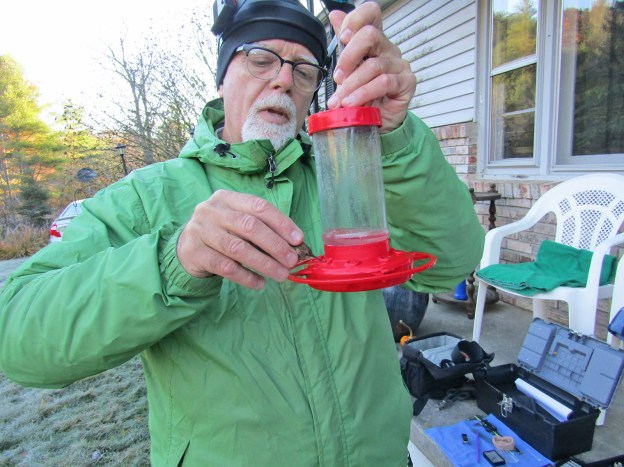
• A male rufous hummingbird visited feeders maintained by my mother and me from Oct. 7 to Nov. 5, 2016. I can be confident in the identification of the bird because noted bird bander Mark Armstrong traveled to my home to capture, document and band the bird. Now, with a tiny band around its leg, if the hummer returns next year we might be able to confirm it’s the same bird. This is the third sighting of a rufous hummingbird I have made at my home over the past several years.

three-phoebes

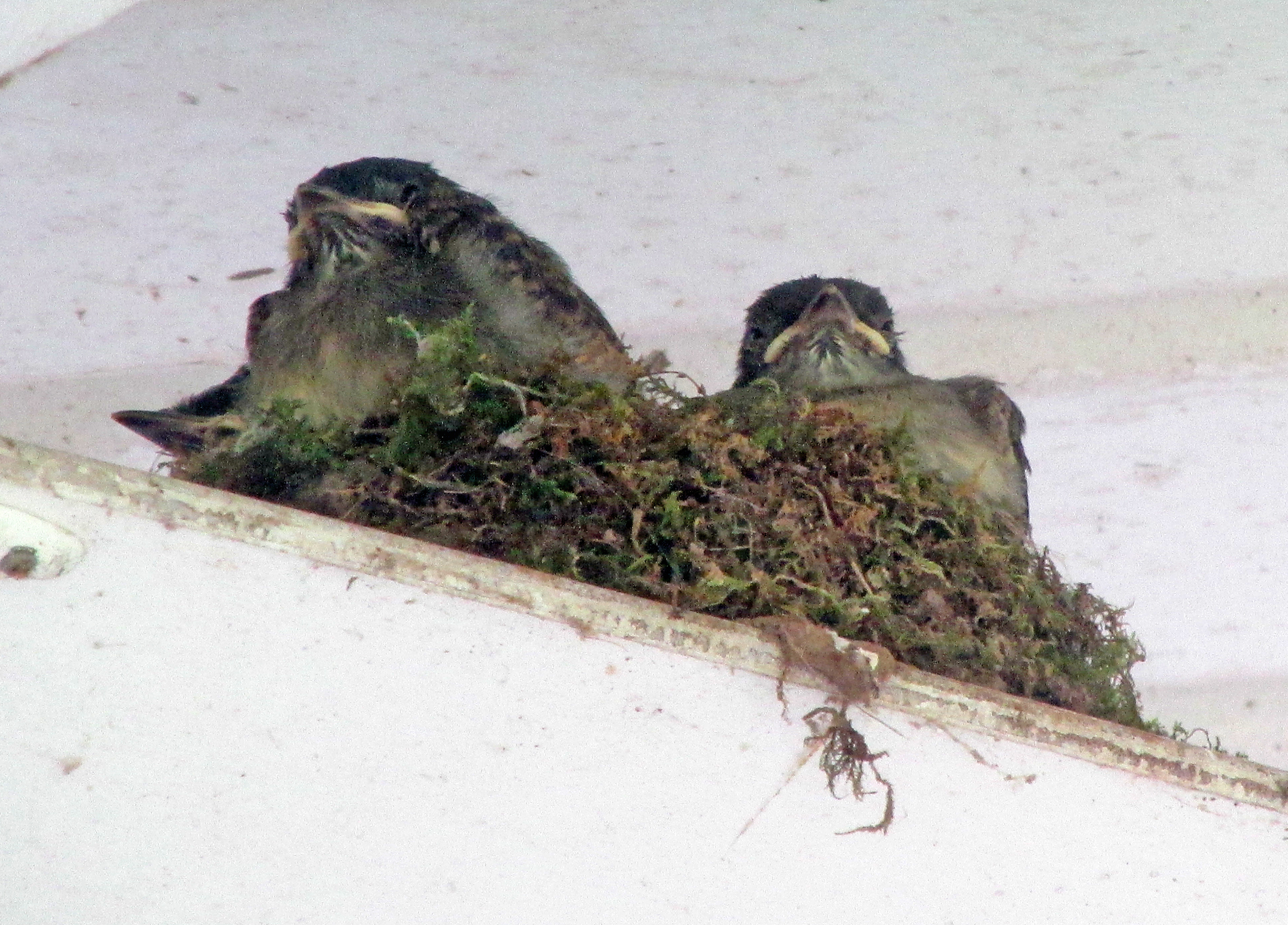
Three young Eastern phoebes share a crowded nest.

• Eastern phoebes build a nest on my porch fan. When I returned home after my summer vacation, I was delighted to find a pair of Eastern phoebes had built a nest on the blades of the ceiling fan on my front porch. Needless to say, the fan was taken out of commission during their nesting activity. The phoebes raised three fledglings, giving me a daily glimpse into their progress. During the recent snowstorm, I had a single phoebe foraging in the willows at the creek. I speculated that the bird could be one of the now mature nestlings from this summer’s porch nest.

hummer-mother

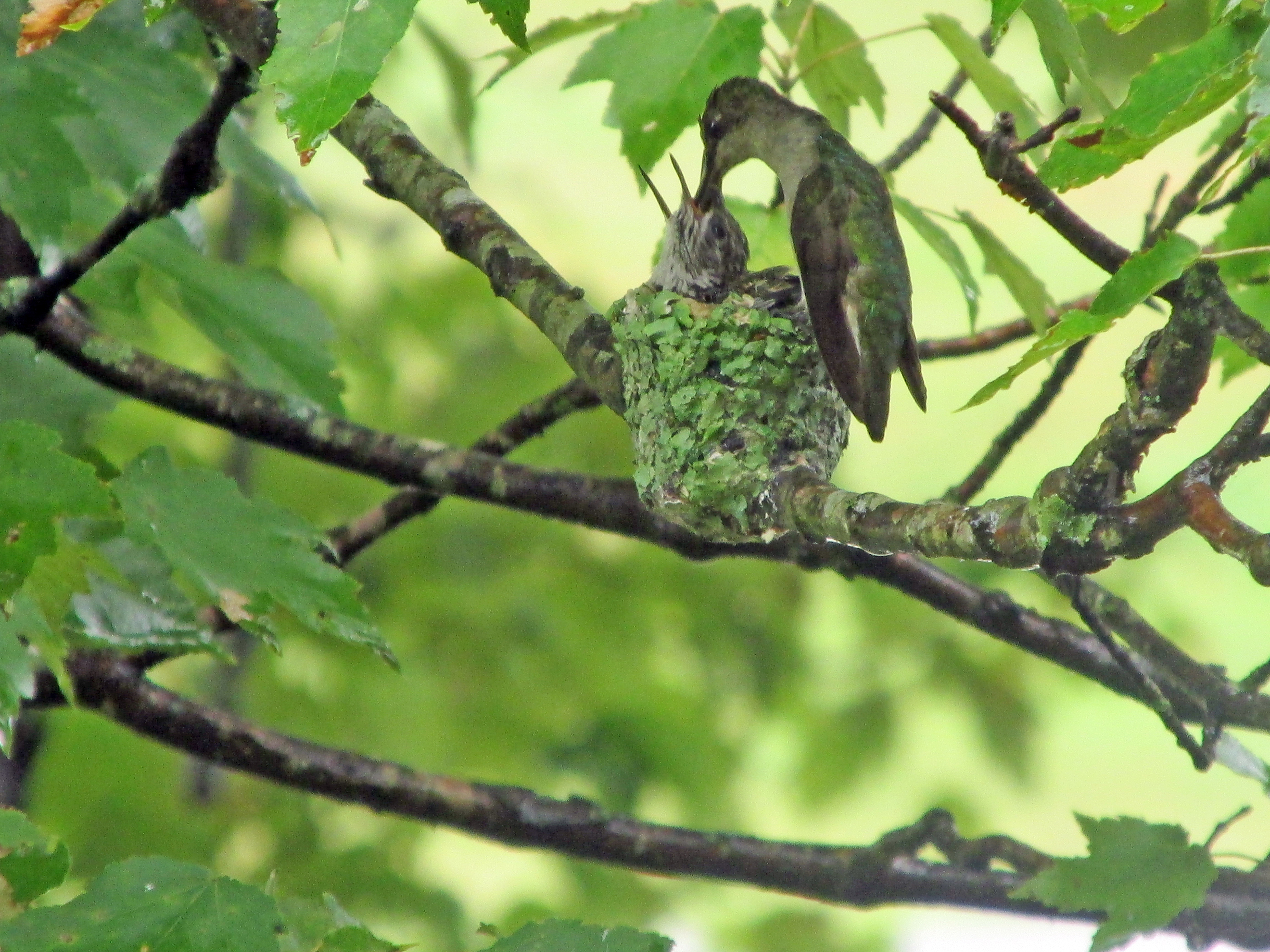
The mother hummingbird Bliss tends her two offspring.

• Last year was a stellar year for hummingbirds, which have always been one of my favorite birds. I’ve always been curious about hummingbird nests, but I’ve never succeeded in finding one. I still haven’t found one, but I was invited by Bluff City resident Donna Ottinger to visit and see a ruby-throated hummingbird nest in a maple tree in her yard. It was an incredible experience to see my first ruby-throated hummingbird nest, still occupied at the time by two tiny hatchlings being dutifully tended by their mother, a hummingbird Donna named Bliss.

ruffedgrouse-2016

Rufus, a ruffed grouse, resides in Flag Pond in Unicoi County.

• I met a most unusual ruffed grouse this past year in the mountains near Flag Pond in Unicoi County, Tennessee. The grouse, by the name of Rufus, has been a fascinating and funny neighbor to Leon and Janice Rhodes for the past couple of years. I met Rufus on Saturday, June 25, at the Rhodes family farm. Brayden Paulk, a grandson of the couple, had invited me. The unique wild grouse acted like one of the family. The memorable meeting ranks as one of my most fascinating bird observations.
If anyone had asked me at the start of 2016 what I expected from the year, I would never have predicted adding a least bittern to my life list or making the acquaintance of a grouse named Rufus. I can look forward with confidence to another round of delightful birding surprises in 2017.

•••••

To learn more about birds and other topics from the natural world, friend Stevens on Facebook at https://www.facebook.com/ahoodedwarbler. He is always posting about local birds, wildlife, flowers, insects and much more. If you have a question, wish to make a comment or share a sighting, email ahoodedwarbler@aol.com.

Long-running bird counts find some surprises

woodduck-head

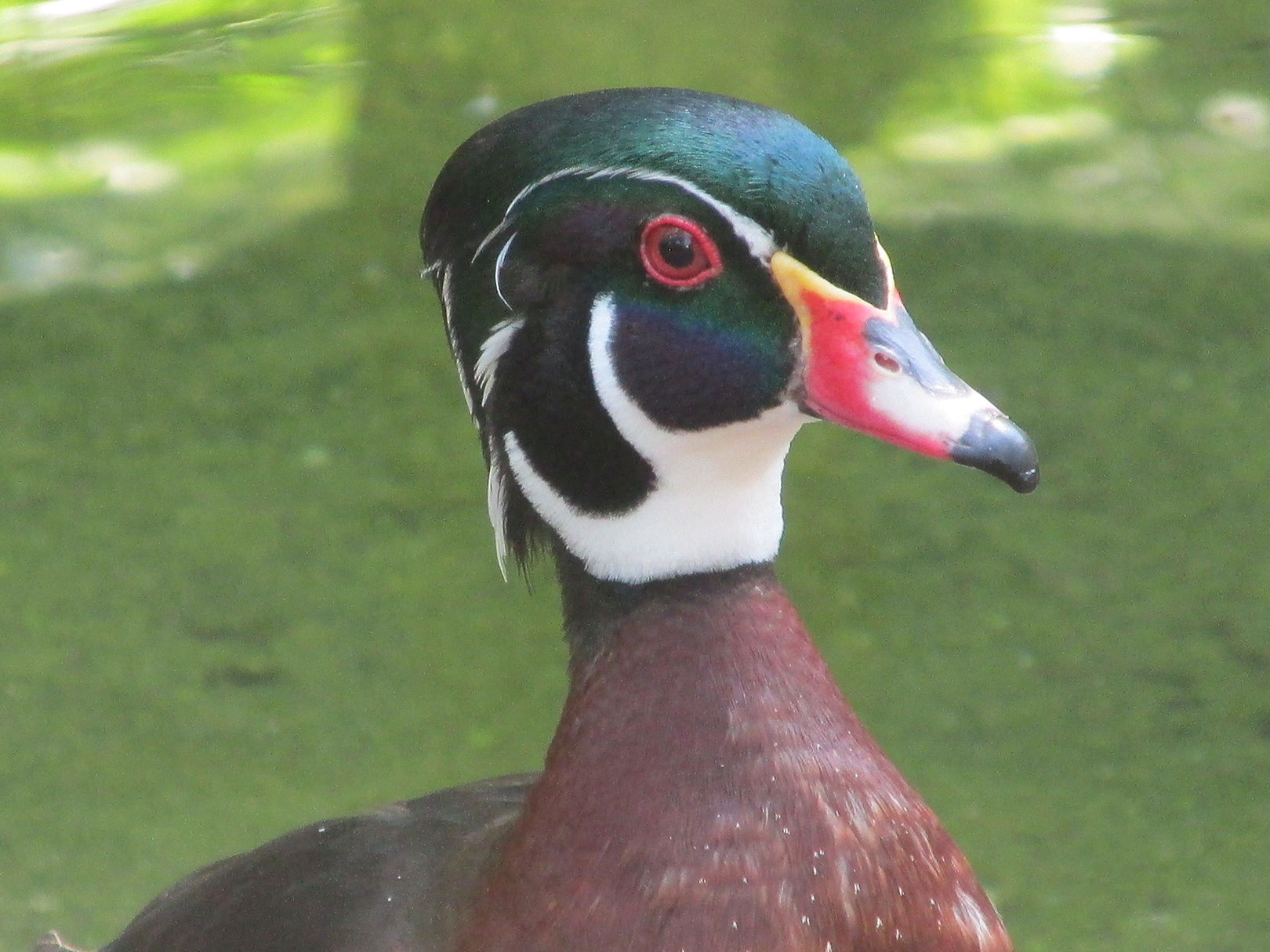
Photo by Bryan Stevens • Abundant waterfowl, such as this Wood Duck, helped push the 2016 Elizabethton Christmas Bird Count to tie a previous record.
The annual Christmas Bird Counts conducted by the Lee and Lois Herndon Chapter of Tennessee Ornithological Society found some good birds.

The 74th consecutive Elizabethton CBC was held on Saturday, Dec. 17. Twenty-four observers in six parties, plus one feeder-watcher, participated. Conditions were generally favorable and featured mild temperatures (35-66 degrees) on a mostly cloudy day with windy conditions, especially in the higher elevations.

I spent the morning and early afternoon counting birds with Chris Soto and Charles Moore along the Watauga River in Elizabethton. We also received some assistance from Michelle Sparks.

cbc-femaletowhee

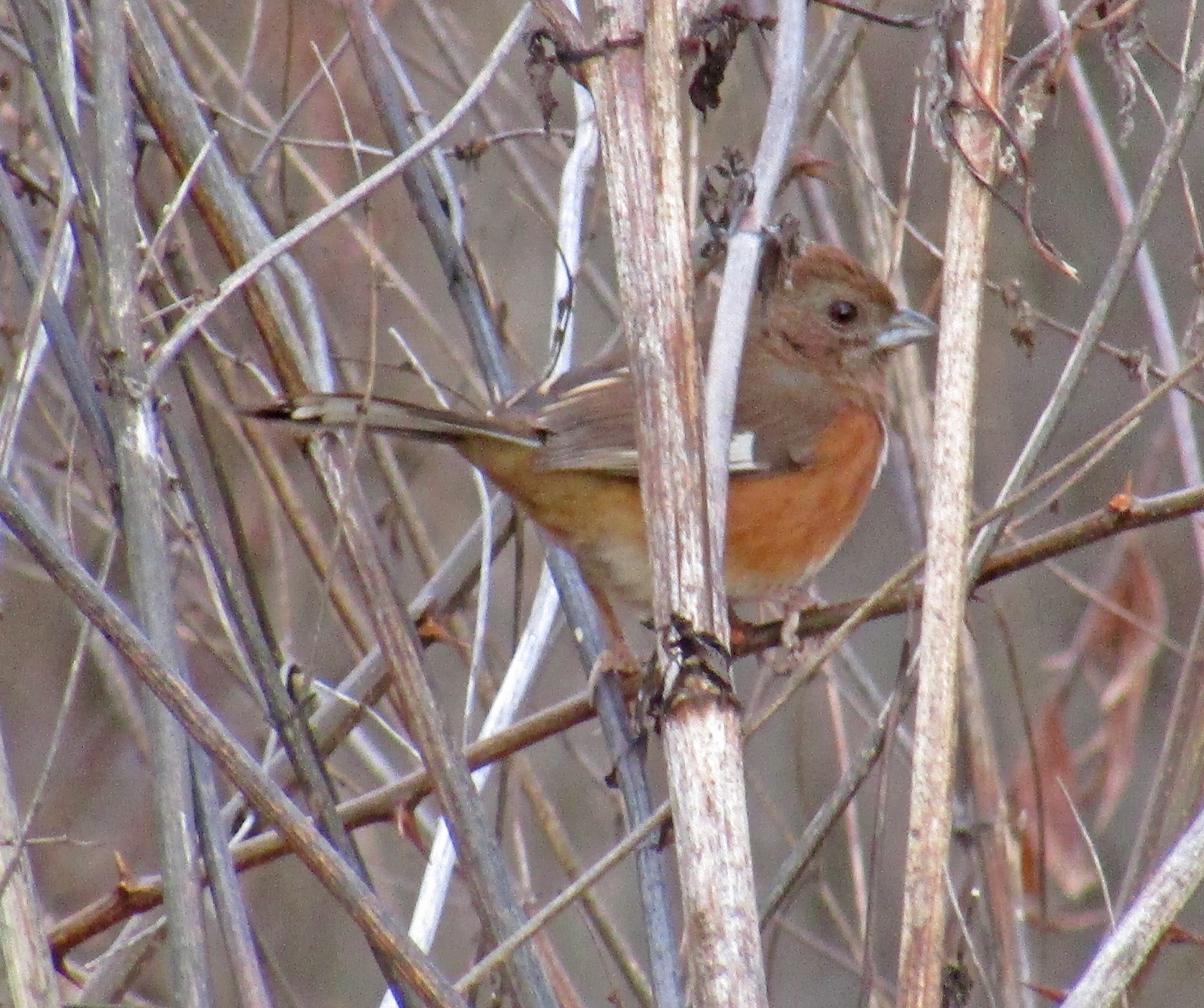
Photo by Bryan Stevens • This female Eastern Towhee was one of several towhees found on the 2016 Elizabethton CBC.

A total of 80 species were tallied, tying the all-time high for this count set in 2012.  By comparison, the average over the last 30 years has been 72 species, according to the count’s long-time compiler, Rick Knight.

Knight said that highlights from the count included:

• 12 species of ducks (plus four more in count week) were counted on this year’s CBC. In particular, wigeon, shoveler, green-winged teal, both scaup and red-breasted merganser are scarce on this count, but all were found this year.

• Double-crested Cormorant was found for just the seventh time on this CBC, with six of those times since 2004.

• This CBC marked just the third time in the last 24 years and 10th ever on this CBC that Red-headed Woodpecker has made the count.

• The seven Red-breasted Nuthatches reported represented an above average number for this species.

• This was only the third time for Pine Warbler on this CBC in the last 50 years and the three Pine Warblers found this year represent a high count for this CBC.

• A single Savannah Sparrow was the first on this CBC in 16 years. There’s not much accessible habitat for this sparrow within the count area.

• Nine Purple Finches on this CBC marked the most found since 1987.

heron-cold

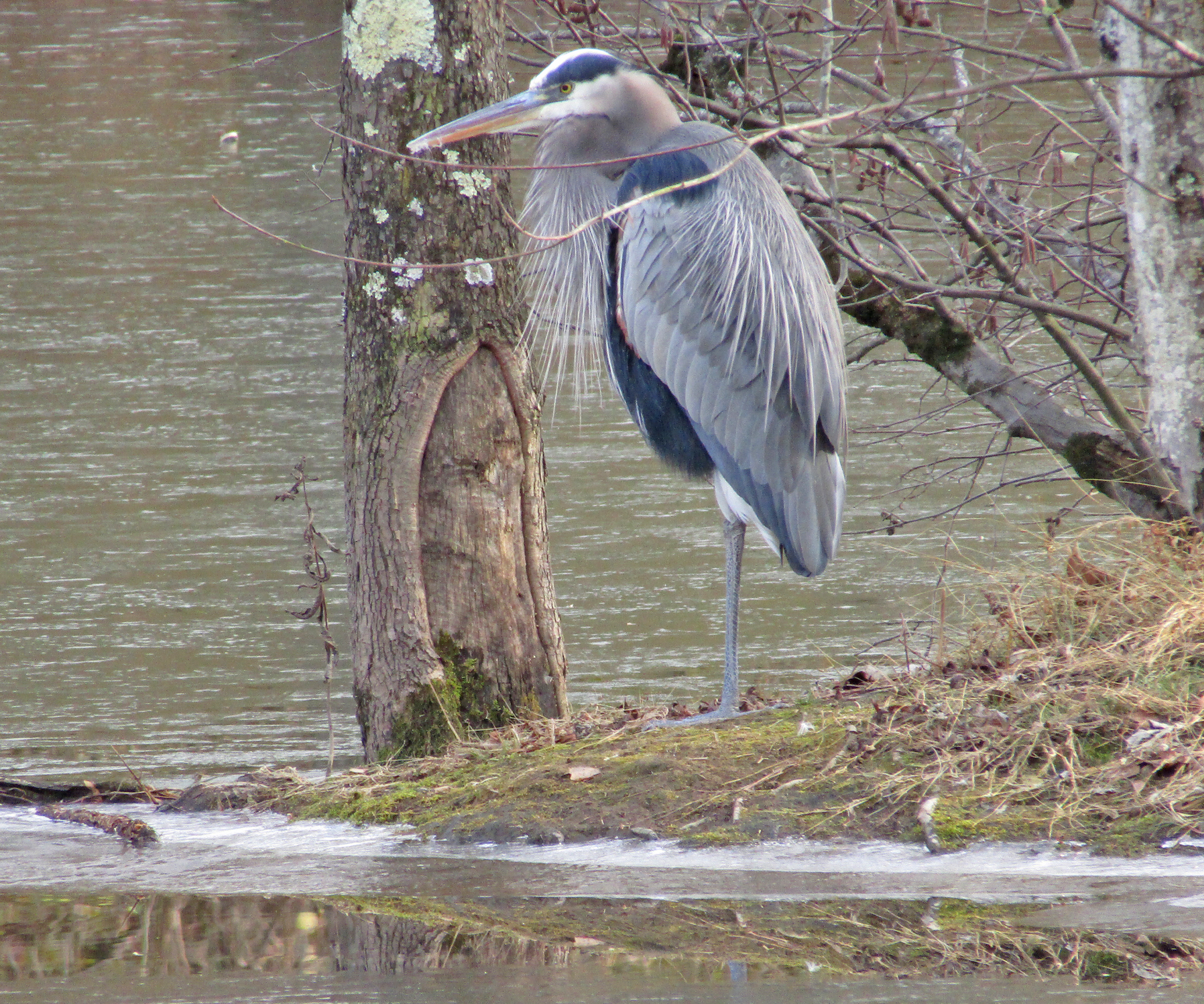
Photo by Bryan Stevens • The 26 Great Blue Herons found during the Elizabethton CBC almost tied the old record.

• Red Crossbills on this year’s CBC marked only the fourth occurrence on this CBC in the last 30 years.

Nevertheless, the Elizabethton CBC had some notable misses, including Brown Creeper, White-crowned Sparrow and Pine Siskin.

Some species are showing rather obvious trends on this CBC, according to Knight.

• The 114 Wild Turkeys found are the second most found in the  last 24 years. Prior to that date, no turkeys had been found on this CBC.

• Great Blue Herons continue to increase. The 26 individuals found represent the second most ever reported on this CBC.

• The four Bald Eagles found meant that this large raptor has been found for 17 of last 18 years, but only three times before that.

• Only three Killdeers were found, which reflects a continuing decline on this CBC likely due to habitat loss and degradation.

red-bellied-bryan

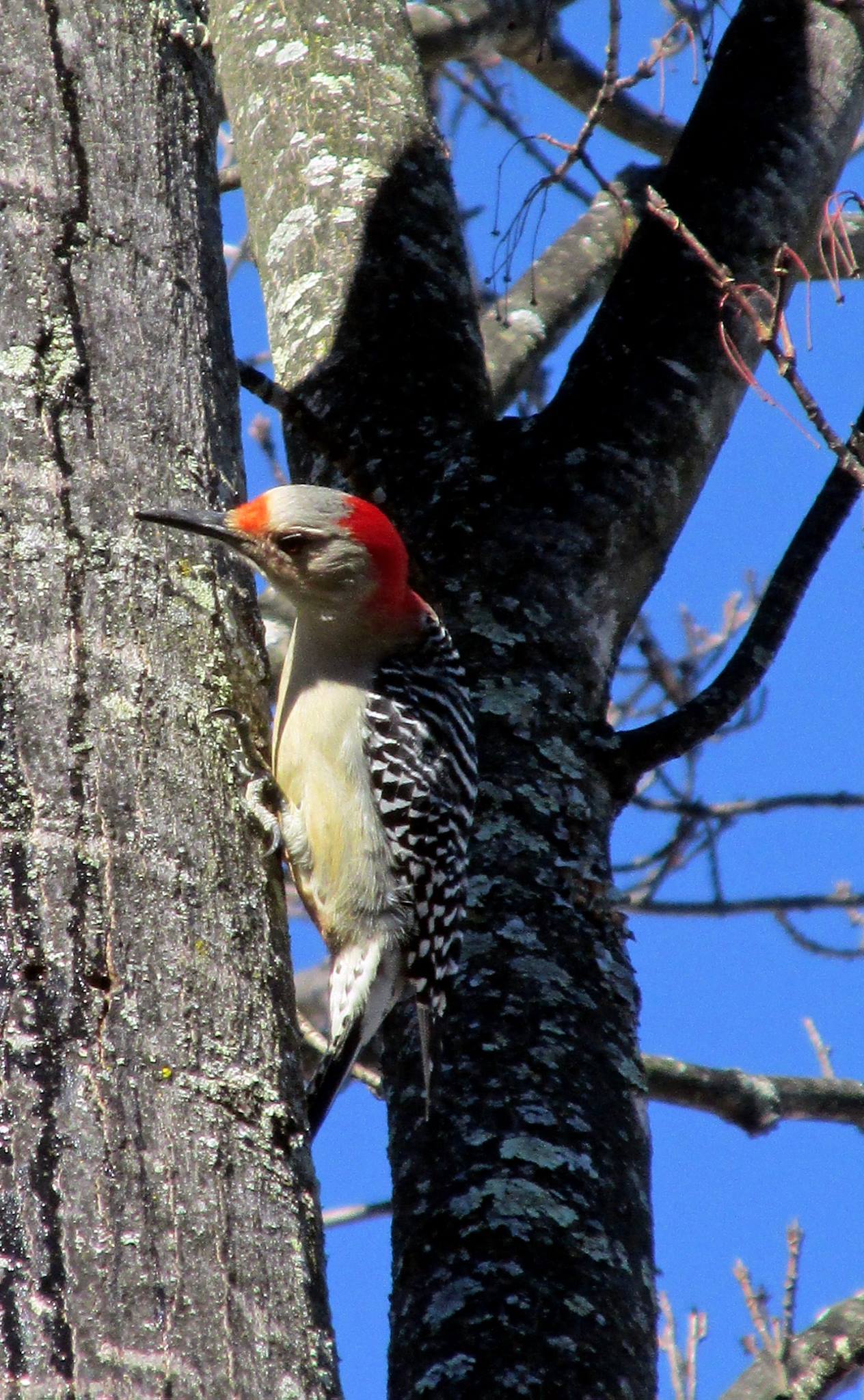
Photo by Bryan Stevens • The 47 Red-bellied Woodpeckers on the 2016 Elizabethton CBC set an all-time high for this species.

• The eleven Eurasian Collared-Doves found means that this dove has been found five of the last eight years.

• The 21 Belted Kingfishers found tied for second highest total ever for this species.

• The 47 Red-bellied Woodpeckers found set a new high count for this species, which has shown a steady increase in the foothills and lower mountains. CBCs conducted in the 1970s in Elizabethton had only single-digit counts for this woodpecker.

• Common Raven, with 13 found on this year’s CBC, has been found yearly since 1974, but none had appeared on this count prior to that date.

• Eastern Bluebird numbers continued to rise yearly. The 177 bluebirds this year represent the third-highest count for this species.

• Numbers for Field Sparrow, Song Sparrow and White-throated Sparrow showed the fewest of these three species since 1996, 1974 and 1969, respectively. These low sparrow numbers may be due to drought this year, which meant fewer seeds to feed these sparrows.

The total for the Elizabethton CBC follows:

nuthatch-grabandgo

Photo by Bryan Stevens • Feeder visitors, like this White-breasted Nuthatch, were abundant birds on both Christmas Bird Counts.

Canada Goose, 426; Wood Duck, 1; Gadwall, 10; American Wigeon, 2; American Black Duck, 1; Mallard, 205; Northern Shoveler, 2; Green-winged Teal, 3; Ring-necked Duck, 1; Greater Scaup, 2; Lesser Scaup, 1; Bufflehead, 256; and Red-breasted Merganser, 4.

Ruffed Grouse, 1; Wild Turkey, 114; Common Loon, 3; Pied-billed Grebe, 10; Horned Grebe, 21; Double-crested Cormorant, 4; and Great Blue Heron, 26.

Black Vulture, 10; Turkey Vulture, 2; Sharp-shinned Hawk, 4; Cooper’s Hawk, 8; Bald Eagle, 4; and Red-tailed Hawk, 13.

American Coot, 33; Killdeer, 3; Wilson’s Snipe, 4; Ring-billed Gull, 3; Rock Pigeon, 487; Eurasian Collared-Dove, 11; and Mourning Dove, 246.

Eastern Screech-owl, 2; Great Horned Owl, 1; Barred Owl, 2; Belted Kingfisher, 21; Red-headed Woodpecker, 2; Red-bellied Woodpecker, 45; Yellow-bellied Sapsucker, 7; Downy Woodpecker, 23; Hairy Woodpecker, 7; Northern Flicker, 15; and Pileated Woodpecker, 24.

American Kestrel, 13; Eastern Phoebe, 10; Blue Jay, 209; American Crow, 541; and Common Raven, 13.

crows-dec-21

Photo by Bryan Stevens • American Crows are abundant birds on these two CBCs.

Carolina Chickadee, 114; Tufted Titmouse, 102; Red-breasted Nuthatch, 7; White-breasted Nuthatch, 41; Winter Wren, 8; Carolina Wren, 85.

Golden-crowned Kinglet, 19; Ruby-crowned Kinglet, 3; Eastern Bluebird, 175; Hermit Thrush, 4; American Robin, 105; and Northern Mockingbird, 40.

European Starling, 809; Cedar Waxwing, 272; Pine Warbler, 3; and Yellow-rumped Warbler, 58.

Eastern Towhee, 25; Chipping Sparrow, 29; Field Sparrow, 7; Savannah Sparrow, 1; Fox Sparrow, 1; Song Sparrow, 70; Swamp Sparrow, 2; White-throated Sparrow, 57; and Dark-eyed Junco, 135.

Northern Cardinal, 92; House Finch, 74; Purple Finch, 5; Red Crossbill, 7; American Goldfinch, 101; and House Sparrow, 17.

••••••

The 64th Roan Mountain CBC was held on Wednesday, Dec. 21, with six participants in two parties. Conditions were generally favorable: mild temperatures (21-53 degrees) were coupled with clear skies and no significant winds.

amblackduck

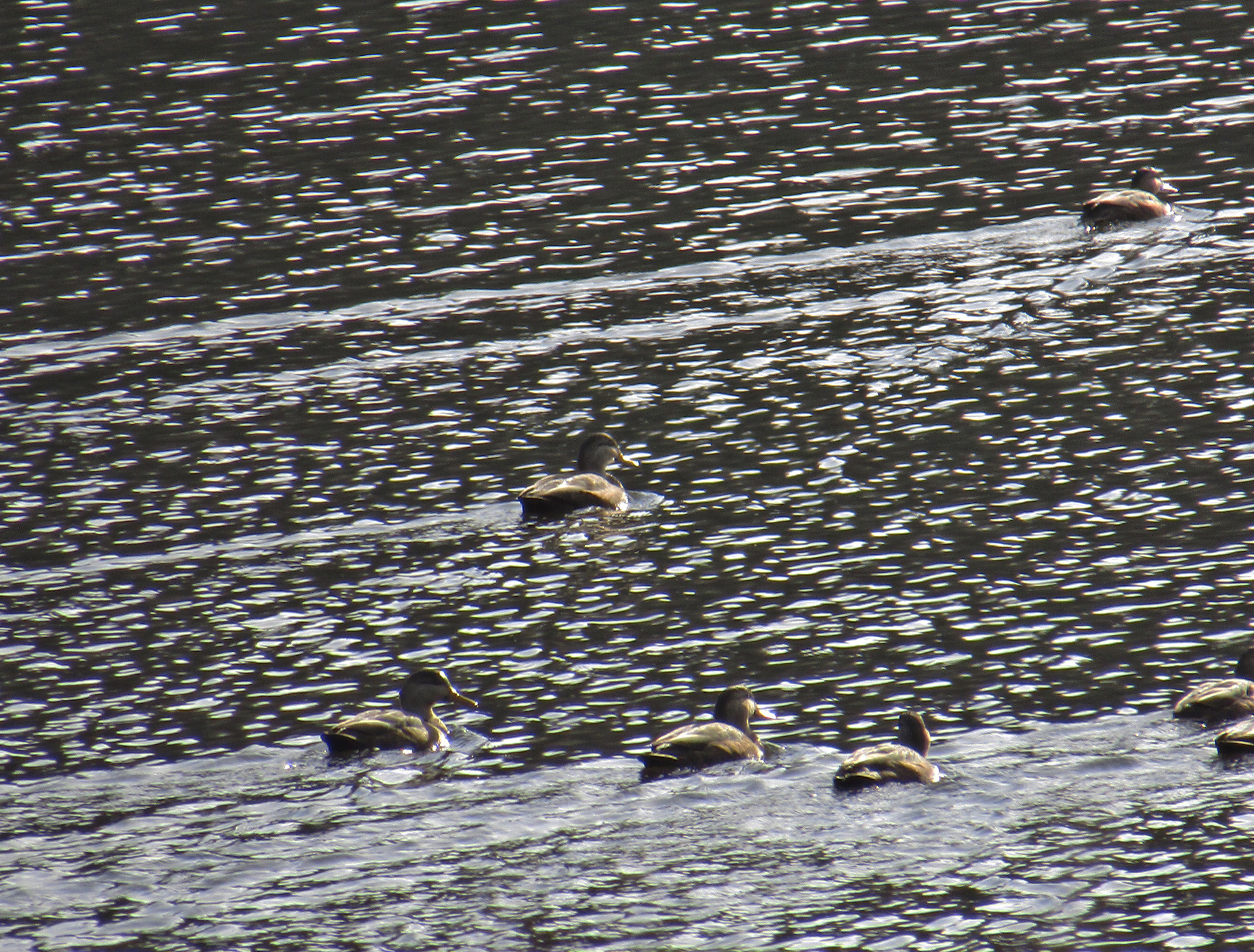
Photo by Bryan Stevens • These American Black Ducks were found at Ripshin Lake during the Roan Mountain CBC.

A total of 42 species were tallied, slightly below the recent 30-year average of 46. The all-time high was 55 species back in 1987. Despite the decent weather, birds were hard to find. I counted with Brooke and Jean Potter in the town of Roan Mountain and on Ripshin Mountain.

Highlights included 12 American Black Ducks, a single Red-breasted Nuthatch, a solitary Ruby-crowned Kinglet and two Purple Finches. Notable misses for this count included Ruffed Grouse, Hairy Woodpecker, Northern Flicker, Brown Creeper, American Robin, Cedar Waxwing, Eastern Towhee and Pine Siskin.

The total for the Roan Mountain CBC follows:

Canada Goose, 5; American Black Duck, 12;  Bufflehead, 6; Wild Turkey, 8; Pied-billed Grebe, 1; and Great Blue Heron, 1.

Turkey Vulture, 1; Cooper’s Hawk, 1; Red-tailed Hawk, 6; Rock Pigeon, 25; Mourning Dove, 66; Barred Owl, 2; and Belted Kingfisher, 1.

rthawk-three

Photo by Bryan Stevens • Red-tailed Hawks are a fairly common winter raptor in the region.

Red-bellied Woodpecker, 6; Yellow-bellied Sapsucker, 1; Downy Woodpecker, 7; and Pileated Woodpecker, 2.

Eastern Phoebe, 1; Blue Jay, 22; American Crow, 170; and Common Raven, 9.

Carolina Chickadee, 24; Tufted Titmouse, 17; Red-breasted Nuthatch, 1; White-breasted Nuthatch, 6; Winter Wren, 2; and Carolina Wren, 18.

Golden-crowned Kinglet, 7; Ruby-crowned Kinglet, 1; Eastern Bluebird, 6; Northern Mockingbird, 3; and European Starling, 78.

Field Sparrow, 10; Fox Sparrow, 2; Song Sparrow, 55; White-throated Sparrow, 8; Dark-eyed Junco, 68; and Northern Cardinal, 12.

House Finch, 6; Purple Finch, 2; American Goldfinch, 17; and House Sparrow, 24.