

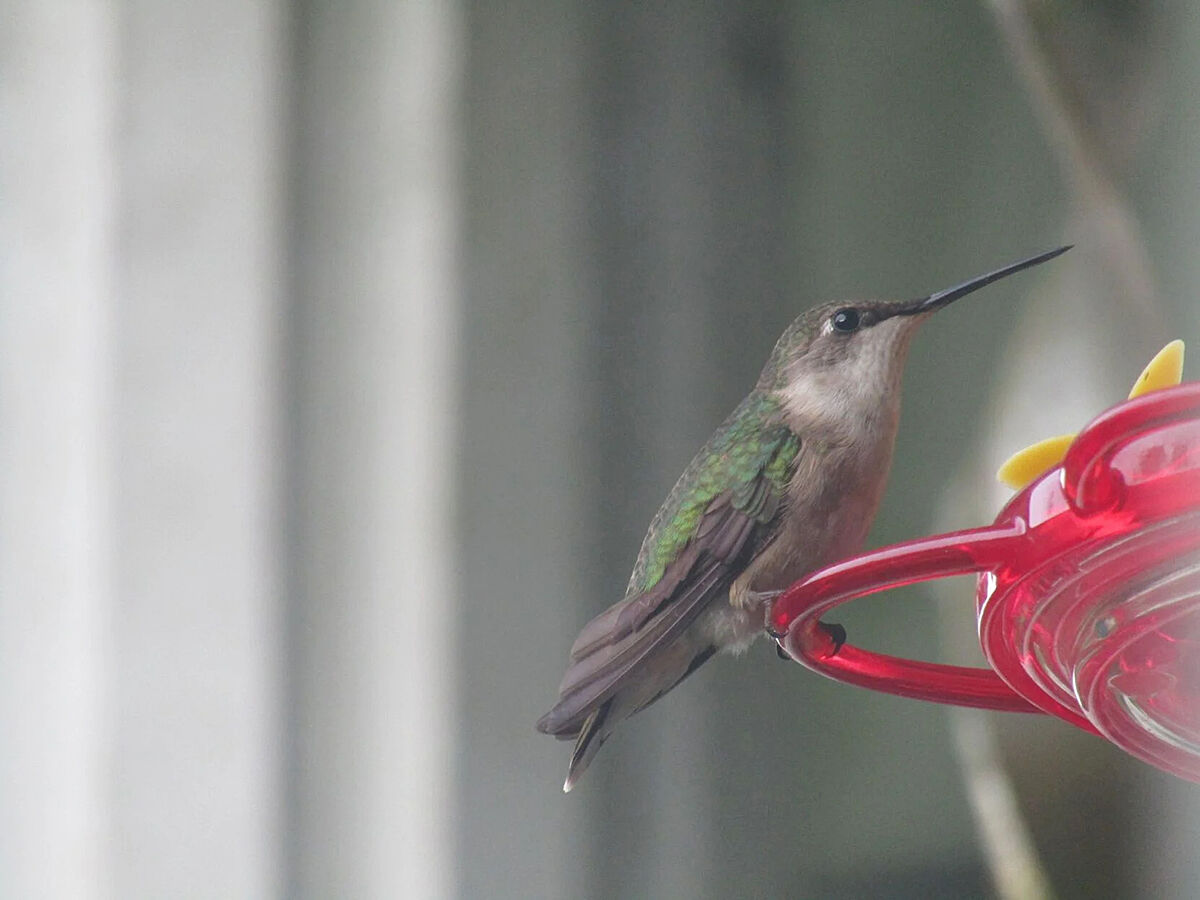
Michele Spark • Female ruby-throated hummingbirds lack the red throat patch, known as a gorget, that is present on adult males.
Readers continue to welcome back hummingbirds and share their first spring sightings of these tiny birds.
•••
“My husband Marvin and I saw our first hummingbird March 31 in Rogersville, Tennessee,” Mary Powers wrote in an email.
“We’ve been seeing them most days since then,” she added.
Mary said she put the feeder up a week before her sighting.
“Of course I change the syrup every week and clean it,” she noted.
•••
Kenneth Oakes commented on my Facebook page about his first sighting.
“I’ve just seen my first this year about 30 minutes ago on April 6 in an area near Sunshine, North Carolina,” Kenneth wrote.
•••
Dianne Rebmann emailed me to share her first spring hummingbird sighting.
“I saw my first hummingbird April 8,” she wrote. “There were actually two of them, and I caught them on Trailcam.”
Dianne lives in the Willowbrook community in Kingsport near the Meadowview Convention Center.
•••
Annie Morton and Pete Fredrick emailed me information about their first spring sighting.
“We wanted to share the news that we saw our first ruby-throated hummingbird (male) at home on April 9,” they wrote. “We live off Dry Creek Road in Unicoi County.”
They added that they hung a feeder last week after reading my article in The Erwin Record about the pending arrival time for hummingbirds.
“What a thrill to see the first one at the feeder while eating our breakfast yesterday morning,” they added to the end of their email.
•••
Diane Graham, a Jonesborough resident, spotted her first little one Wednesday morning (April 9) at her feeder.
“I think he was passing through,” she wrote in her email.
Diane also recorded two other visiting hummingbirds, one each on April 10 and April 11.
“None are yet making multiple visits during the day,” she added.
•••
April Kerns Fain commented on my Facebook page about her first sighting. “I saw the first one on April 9,” commented April, who lives in Unicoi.
•••
Sue Schreiner posted on my Facebook page about her first spring sighting.
“Just spotted my first hummingbird today (April 11) in Bluff City. Yay!” Sue wrote.
•••
Felicia Mitchell in Meadowview, Virginia, shared her first spring hummingbird sighing via a Facebook message. Felicia saw her first hummingbird on Sunday, April 13.
•••
In a Facebook comment on April 13, Flag Pond resident Regina Ray reported that she has seen her first spring hummingbird.
•••
Paula Elam Booher commented on my Facebook page that she saw her first hummingbird of spring in Bristol on April 13.
•••
Gina Kinney emailed to let me know that her mom Ginger Brackins saw her first hummingbird on April 14 at 6:25 p.m. in Erwin.
“She wanted me to email you right away,” Gina wrote.
•••
“I’ve had my hummingbird feeders up for a few weeks, but finally this afternoon (April 14) at 4 p.m. a female hummer had one all to herself,” Michelle Sparks, a resident of Bluff City, wrote to me by email.
•••
“Yesterday (April 14) I saw a hummingbird check out our feeder,” Donald Beck emailed me.
“It did not drink and I have not seen it any time since,” Donald, a resident of Bray Road in Stanley Valley in Rogersville, reported.
“Was it just on its way north?” Donald also asked.
It’s true, I noted in my response to his question, that many of these first hummingbird sightings are not the birds that will spend the summer months with us. Many of these “early” hummingbirds will continue migrating farther north, but others will arrive, like what they see and decide to stick around.
•••
Diane Hensley Silvers posted on April 16 in a Facebook comment that hummingbird numbers have only increased since the first one arrived.
“I have several now,” Diane wrote. “They arrived at my house in Washington County about 10 days ago.”
•••

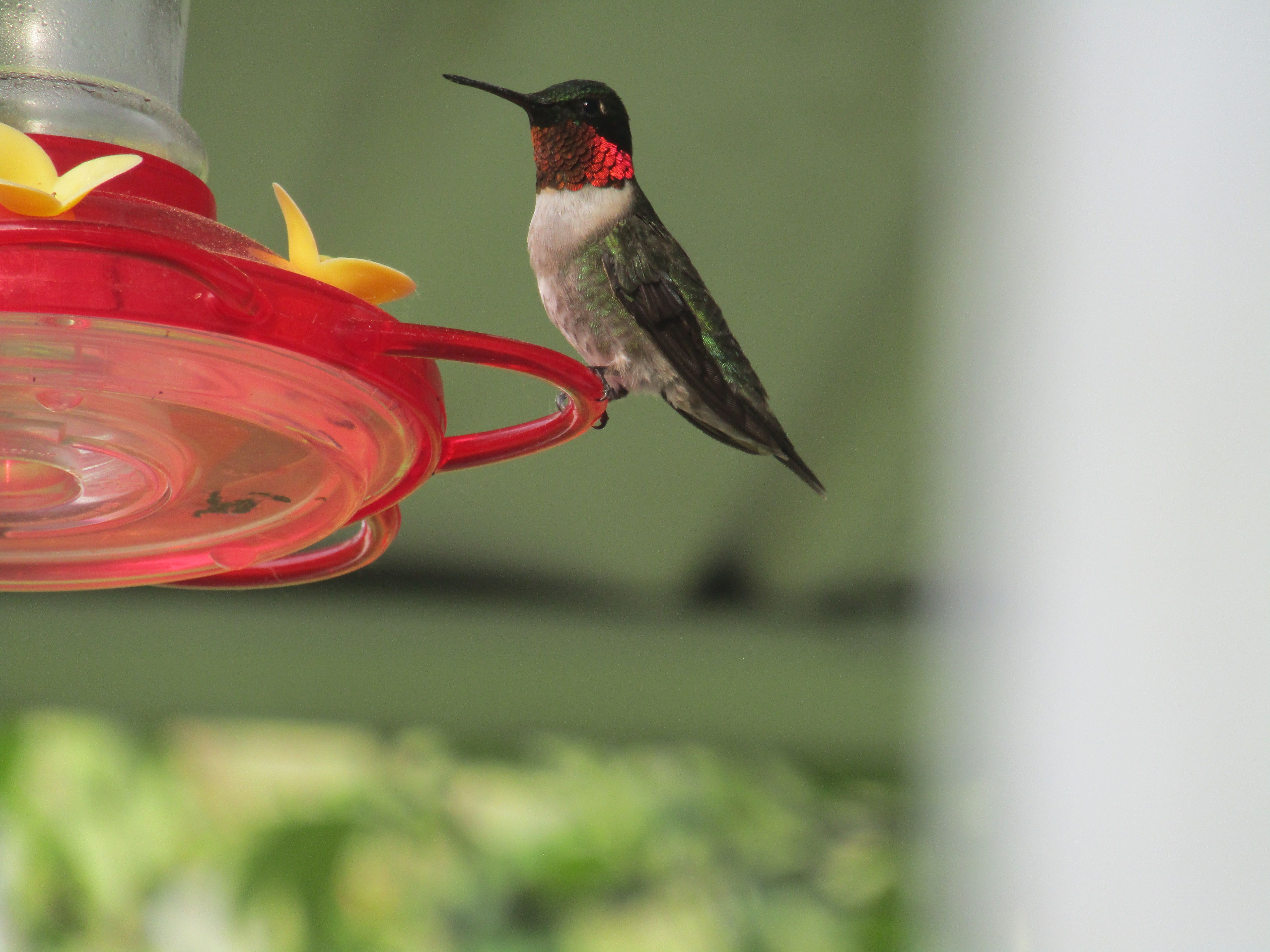
Photo by Bryan Stevens • Ruby-throated hummingbirds such as this male are returning to the region.
Tennessee’s Watchable Wildlife offers an online profile for the ruby-throated hummingbird, including interesting information about how such a tiny bird makes its phenomenal crossing of the Gulf of Mexico each spring to return to the eastern United States.
To accomplish this tremendous migratory crossing, a hummingbird will double its body mass by fattening on nectar and insects in the weeks prior to departure.
No hummingbird species other than ruby-throated hummingbird breeds in Tennessee, but several Western species have been found in the state during the non-breeding season. They arrive anytime after late August and usually depart in April. At least seven western species of hummingbird has been recorded in the Volunteer State, including rufous, black-chinned, Allen’s, Anna’s, calliope and broad-tailed hummingbirds.
There’s also a couple of reports of a green violet-ear, a species that is usually found in forested regions of Mexico and Nicaragua. The species has ventured into Tennessee twice, being documented in Memphis in September of 2007 and in Montgomery County in July of 2020.
I’ve seen several of these western “visitors” throughout the years, but my greatest affection is still attached to the ruby-throated hummingbird.
Most hummingbirds impress with their size, or rather the lack of it. It’s that tiny size that has prompted people to describe them as “miracles” from the time the first European explorers sailed to the New World in the late 1400s. When Spanish explorers first encountered them, they had no equivalent birds in Europe to use as a reference. They referred to hummingbirds as “joyas voladoras,” or flying jewels.
If your yard offers some trees and shrubs, necessary for perching, you can attract ruby-throated hummingbirds. It pays to have a feeder available with a fresh mixture of one part sugar to four parts water. This is the formula that closely matches the sweetness of nectar available from flowers. In warm conditions, you’ll need to change out the mixture every few days. Give the feeders a scrubbing and rinse while changing out the sugar water. Then sit back and enjoy the antics of these pint-sized delights.
•••
To share a sighting, ask a question or make a comment, email me at ahoodedwarbler@aol.com.
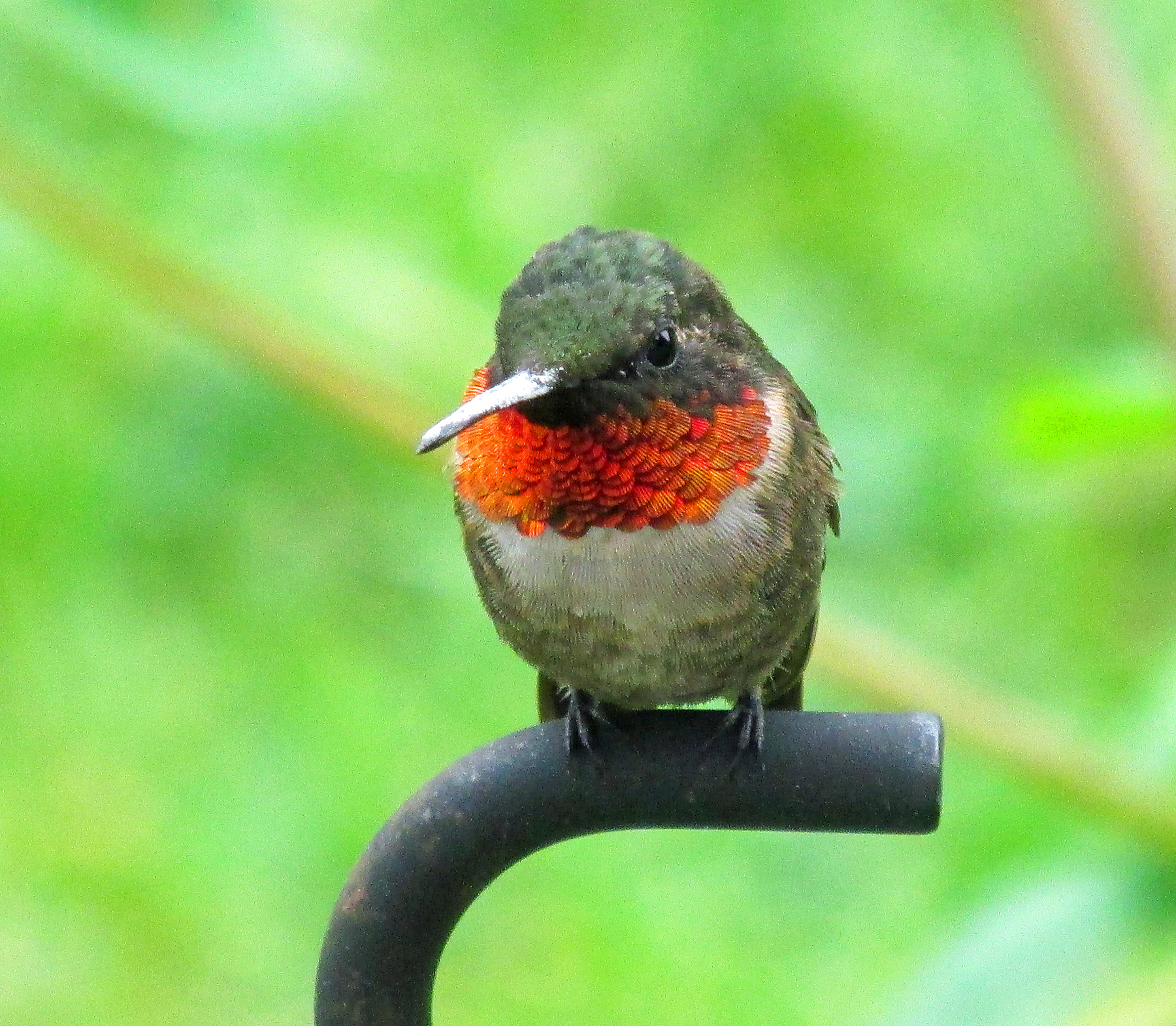
Photo by Bryan Stevens • Despite a perceived disadvantage of size, ruby-throated hummingbirds are quite capable of thriving in a giant world.











 Our Fine Feathered Friends