Tag Archives: Carter County Compass

Annual Great Backyard Bird Count enlists public as citizen scientists for global survey

clapper_rail

Photo by U.S. Fish & Wildlife Service/Lee Karney • The Clapper Rail is abundant in saltwater marshes and mangrove swamps from Massachusetts to South America. Observant participants in the Great Backyard Bird Count are sure to find some of these reclusive birds.

I look forward every year to the annual Great Backyard Bird Count, a survey established as a citizen science project back in 1998. Since 2013, the GBBC has been a global effort, allowing birders around the world to take part. Participants in 2015 observed almost half of the world’s known bird species, and that effort was surpassed just last year during the 2016 count. Over the years, I have counted various interesting birds, including green-winged teal, Ross’s goose, snow goose, American kestrel and Cooper’s hawk, while taking part in the GBBC.

The GBBC is a joint project of the Cornell Lab of Ornithology and the National Audubon Society with partner Bird Studies Canada. With its global perspective, a great many exotic bird species are now tallied on the annual GBBC, but the survey remains firmly established as a grassroots effort to compile data crucial for the conservation of the world’s beloved birds. The information gathered by tens of thousands of volunteers helps track the health of bird populations at a scale that would not otherwise be possible.

parakeet_auklet_flight_castle_rock_shumagin_islands

Photo by U.S. Fish & Wildlife Service/Steve Hillebrand • Parakeet Auklets in flight in the Alaska Maritime National Wildlife Refuge. The Great Backyard Bird Count extends beyond North America and now covers the entire globe.

It’s incredibly easy to take part in the GBBC. Anyone anywhere in the world can count birds for at least 15 minutes on one or more days of the four-day count period and enter their sightings at http://www.BirdCount.org. There’s no charge or fee for taking part in the GBBC, which is a fun way to observe a variety of birds. Thanks to the flexible count criteria, it is also an easy way to make a contribution to science. The data delivered by the thousands of participants is now collected and compiled by the website ebird.org.

This year’s GBBC will be held over a four-day period, starting on Friday, Feb. 17, and continuing through Monday, Feb. 20. Participants are invited to count birds at their own homes in their yards and gardens. They can also travel farther into the field, birding in their favorite parks, wildlife refuges or other birding hot spots. Participants can count alone or join with groups of fellow birders. Those taking part in the GBBC are invited to count in as many locations as they like. The reported results will help create a real-time snapshot of where birds are distributed during the winter months.

sandhill_cranes

Photo by U.S. Fish & Wildlife Service/Lee Karney • A pair of Sandhill Cranes in a New Mexico wetland.

The 2016 Great Backyard Bird Count saw 142 species of birds reported in Tennessee. In Virginia, a total of 177 species was counted by participants in the annual survey. The Old Dominion State has a distinct advantage over landlocked Tennessee in having ample coastal access to the Atlantic Ocean, which helps explain the more than 30 additional species tallied in Virginia. Birds like brown pelican, American oystercatcher, Northern gannet, purple sandpiper and great black-backed gull represented finds not found in Tennessee.

Both states were outpaced by GBBC participants in North Carolina, who managed to find an incredible total of 213 species, including red-cockaded woodpecker, little blue heron, razorbill, brant, parasitic jaeger, Northern fulmar and Western tanager.

Overall, the top three species-rich states were Florida (323), Texas (359) and California (369). In the lower 48 states of the United States, a total of 616 species of birds were reported for the 2016 GBBC.
sharptailed_grouse-2

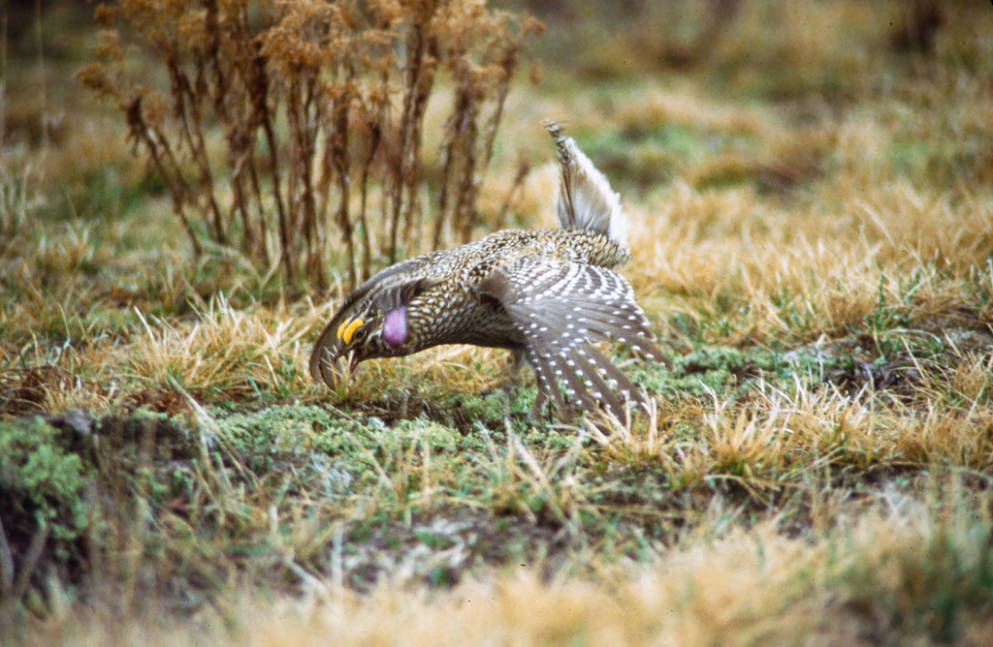
Photo by U.S. Fish & Wildlife Service/Richard Baetsen • Sharp-tailed grouse engaged in a mating display. Keeping track of populations of vulnerable species is a major component of the annual GBBC.

The 2016 GBBC shattered records. An estimated 163,763 bird watchers from more than 130 countries joined the effort. Participants submitted 162,052 bird checklists reporting 5,689 species, which is more than half the known bird species in the world and 599 more species than the previous year. So, what results will 2017 produce?

Social media, like Facebook and Twitter, have helped raise awareness about the importance of the GBBC, which has proven helpful in tracking long-term population trends of North American birds, as well as the bird populations on other continents. If anything, counting birds during the GBBC is an easy way to do your part to advance the cause of science intended to improve the plight of our beloved birds. So, circle the dates on your calendar and join me in taking part in the upcoming Great Backyard Bird Count. For more information on the Great Backyard Bird Count, visit www.BirdCount.org.

•••••

Bryan Stevens lives near Roan Mountain, Tennessee. To learn more about birds and other topics from the natural world, friend Stevens on Facebook at https://www.facebook.com/ahoodedwarbler. He is always posting about local birds, wildlife, flowers, insects and much more. If you have a question, wish to make a comment or share a sighting, email ahoodedwarbler@aol.com.
2017gbbc_robinposter

Flicker, towhee among recent winter bird arrivals

Towhee1

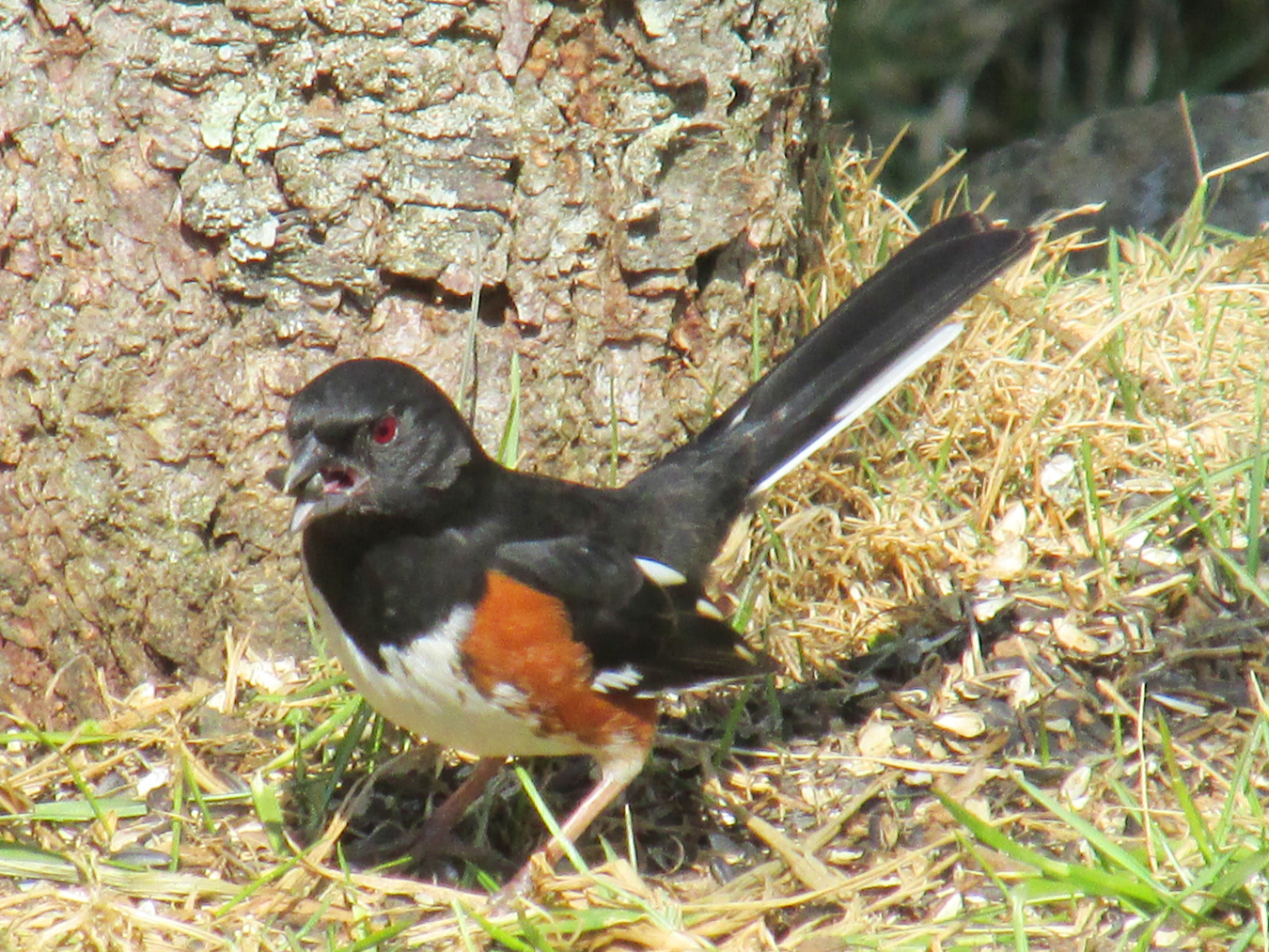
Photo by Bryan Stevens • An Eastern towhee feeds on the ground beneath a feeder.

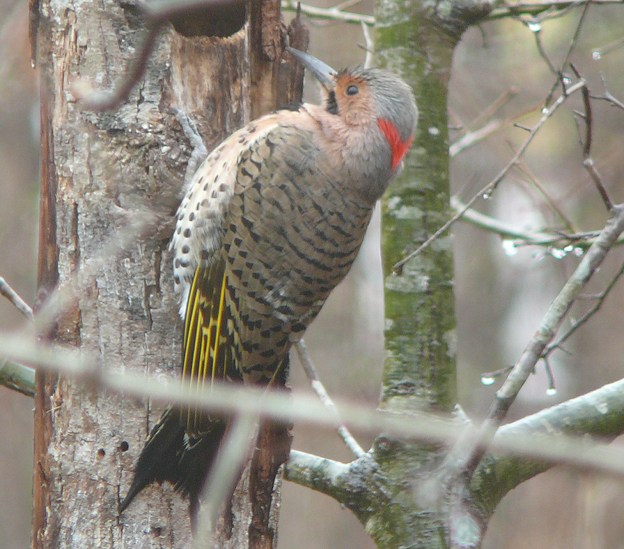
I’d almost given up on any new birds arriving to break the daily monotony of birds in my yard when two birds put in their first appearances of the year. An Eastern towhee and a Northern flicker both showed up simultaneously for the first time in 2017 on Jan. 13.

The towhee, a male, was feeding in the usual manner of its kind, scratching vigorously on the ground beneath my feeders. Towhees are quite ingenious at uncovering any seeds dropped by other birds.

flicker

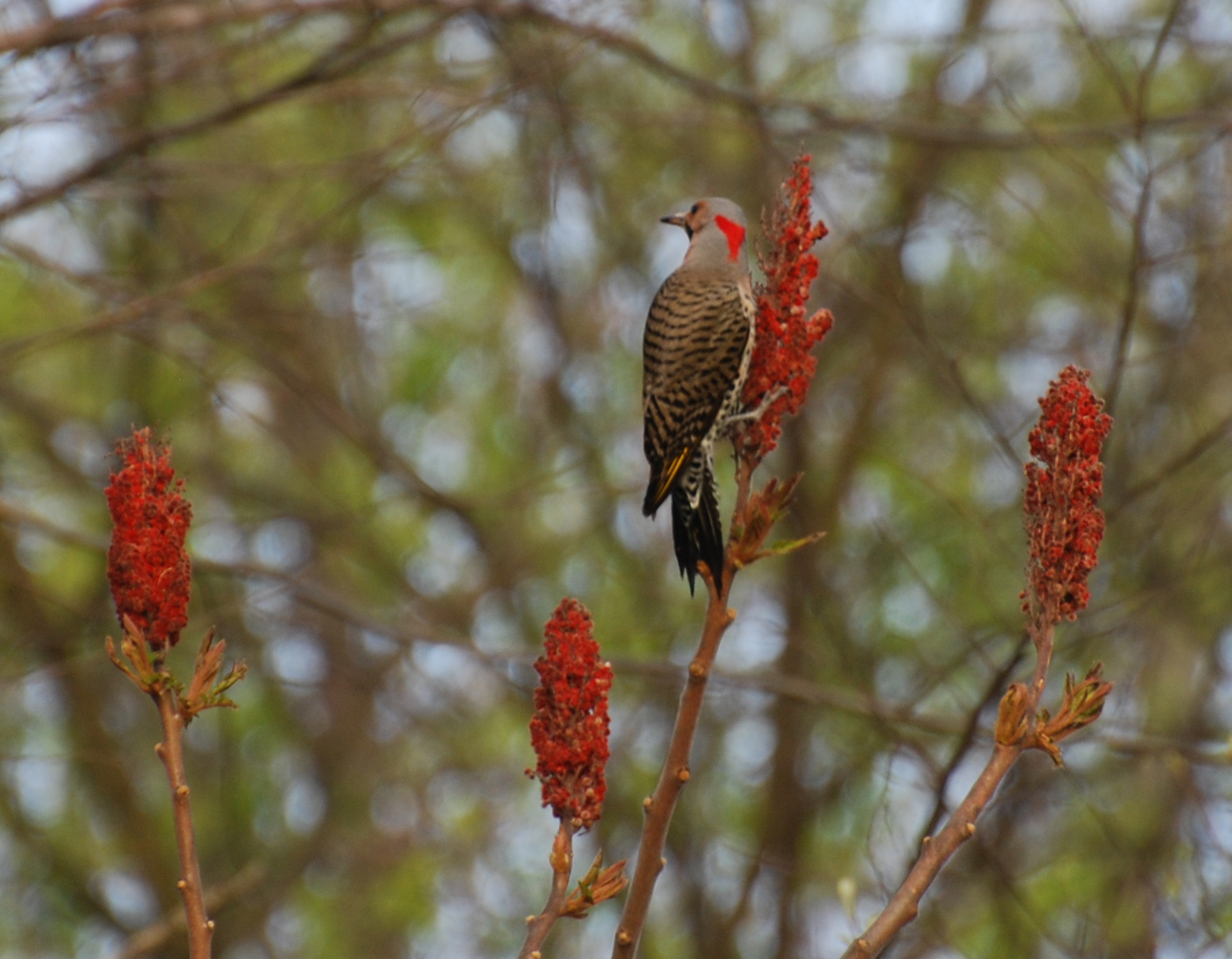
Photo by Jean Potter • A Northern flicker perches on a staghorn sumac.

The flicker was calling from the upper branches of a very tall tree at the edge of a wood lot near my home. The ringing calls of the flicker carried quite clearly even from a distance. Most woodpeckers, including the Northern flicker, are enthusiastic performers. We often think of woodpeckers in association with loud, repetitive drumming with their beaks against the trunk of a tree. Flickers are also known for using other surfaces for drumming. I’ve observed flickers drumming agains metal utility poles and metal siding on homes. That’s really not so strange when you consider that the purpose of the drumming is to communicate with mates or to signal potential rivals that they’re getting a little too close.

Woodpeckers are also known for a variety of vocalizations, and the Northern flicker is no exception. In addition to drumming, the flicker also employs a variety of loud vocalizations that are fairly distinctive. A loud, repeated flicker, often translated as “wicka-wicka-wicka,” is similar to the cluck-like call of the larger pileated woodpecker. The flicker is also known for emitting a sharp, loud “kleeer” call can be heard from a considerable distance. It was this “kleer” call that first drew my attention to the presence of the flicker at my home on Jan. 13.

Flickers are probably most vocal during the spring months. They go quiet for a period during the summer nesting season but start to make themselves heard again during the fall months. A warm, sunny day during the winter is often motivational enough to convince flickers to vocalize.

northern_flicker-1-2

Photo by U.S. Fish & Wildlife Service • A Northern flicker peers from a nesting cavity.

A lot of wildlife is probably getting mixed signals thanks to the extremely mild January temperatures. For instance, I’ve already had a few crocuses blooming in my gardens. Bees and other pollinators have also awoken from winter slumber to take advantage of the unseasonal blooms. If frigid weather does eventually arrive, I hope that these “early birds” suffer no ill effects.

The Northern flicker is the second-largest woodpecker in the region. The only bigger member of the family is the large and unmistakable pileated woodpecker. The flicker ranges across the United States and Canada. The flicker is also present in Central America, Cuba and the Cayman Islands. Known scientifically as Colaptes auratus, which can be roughly translated as the “golden woodpecker,” there are about a dozen species of flickers in North, Central and South America, as well as the Caribbean.

birds-of-ga-northern-flicker

The Nothern flicker is the official state bird of Alabama, where the bird is known as “Yellowhammer.”

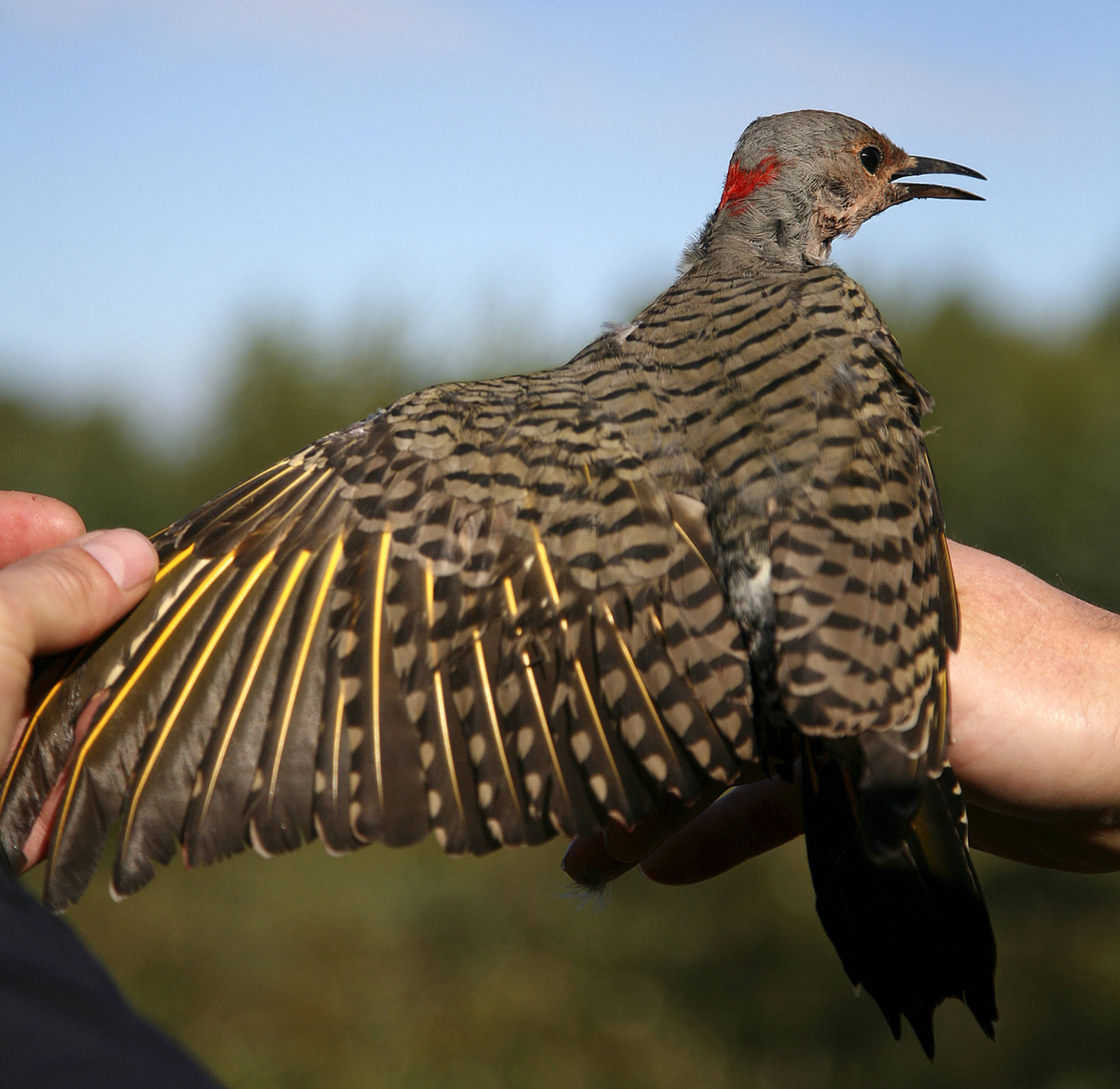
In the United States and Canada, flickers in the eastern half of the continent are known as “yellow-shafted” flickers. The phrase “yellow-shafted” describes the Eastern race of this woodpecker, which is replaced in the western United States by the “red-shafted” flicker. In reality, both the yellow and red-shafted birds are considered by experts to be the same species. The yellow feathers in Eastern birds are found under the wings and on the tail. The yellow, or red, sections of the wings are most visible when the bird is in flight. I’ve seen both forms of this woodpecker, observing the red-shafted form during trips to Utah in 2003 and 2006.

Although most people think of woodpeckers as spending most of their time clinging to the trunks of trees, the flicker actually has something in common with the Eastern towhee. Like the towhee, the flicker spends a lot of time on the ground hunting for its favorite food — ants. The flicker even has a special adaptation — a barbed tongue — that it uses to capture ants.

flicker-yellowwing-2

Photo by U.S. Fish and Wildlife Service • A Northern flicker, captured for a banding operation, has its wing extended to show the yellow feathers indicative of the eastern race of this species.

Flickers will come to feeders, but I’ve never had much luck attracting them. Perhaps I’ve not offered the right fare. The late John V. Dennis recommends “meat scraps, cracked walnuts and pecans, halved oranges and apples, and white bread” in his book, “A Complete Guide to Bird Feeding.” Even Dennis acknowledged that flickers are, at best, wary visitors to feeders. Not much has changed since Dennis wrote his book back in 1977. If any readers have had success luring flickers to their feeders, I’d love to hear their advice for attracting them.

The flicker has even been recognized as an official state bird by Alabama. Of course, Alabama officially bestowed the recognition on the “yellowhammer,” a nod to a nickname for both the flicker as well as Confederate soldiers during the Civil War. Even today, Alabama is still known as the Yellowhammer State. Somewhat surprisingly, the flicker is the only woodpecker that has received designation as a state bird.

••••••

To learn more about birds and other topics from the natural world, friend Stevens on Facebook at https://www.facebook.com/ahoodedwarbler. He is always posting about local birds, wildlife, flowers, insects and much more. If you have a question, wish to make a comment or share a sighting, email ahoodedwarbler@aol.com.
Kinglets are energetic sprites among our feathered friends

Beth-Golden-crownKinglet

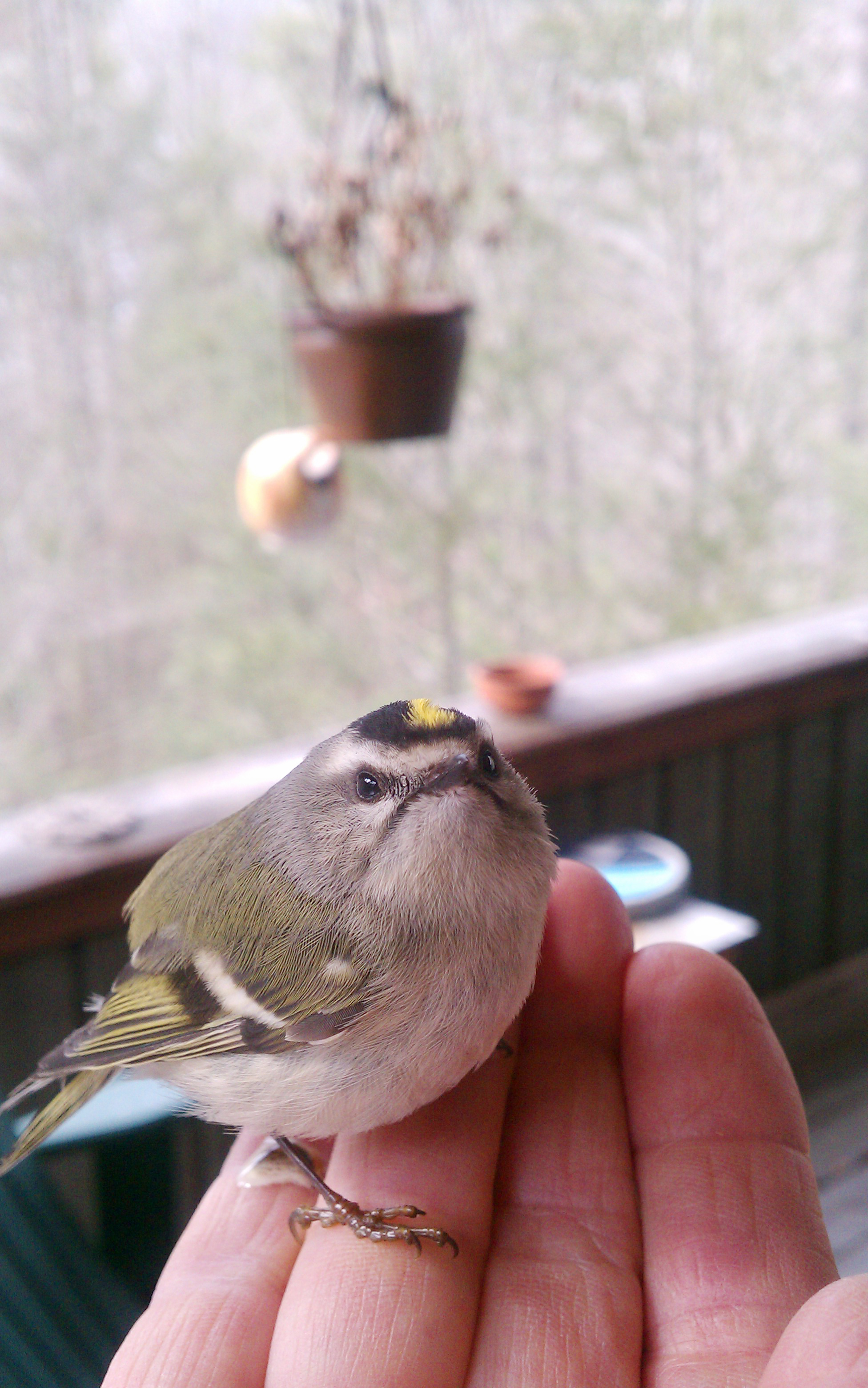
Photo by Elizabeth McPherson • This Golden-crowned Kinglet recovered after striking a window.

There are many different ways to become more familiar with the backyard birds at your own home. I’m fond of keeping a year list of all the bird species that travel through the yard and garden at my home. Keeping such a list is a great way to document the seasonal comings and goings of the bird life in your own neighborhood. You may be surprised at what you see.

Patricia Werth, a resident of Abingdon, Virginia, sent me an email to share the results of her year of counting birds in her yard.

“I told you at the beginning of 2016 I was going to list all the birds that come to my feeder or are in our yard,” she wrote. “I counted 29, but I just saw a very small bird that resembled the goldfinch, except smaller and more greenish on the back. Was that a warbler? I am not very good differentiating between sparrows, either.”

She was pleased with her 2016 results, but she wanted some suggestions for identifying the unknown bird. Based on her description of the bird’s small size and greenish coloration on the back, I suggested she do some online research into kinglets.

I received a second email from Patricia thanking me for the suggestion. “After looking up the kinglets, I do believe it was the female golden-crowned kinglet,” she wrote, adding that she was certain that she had seen her before.

Jean-Golden-crownKinglet

Photo by Jean Potter • This Golden-crowned Kinglet was captured and banded as part of an ornithological study.

The identification of the golden-crowned kinglet took her total to 30 species. “Seeing that they (kinglets) rarely eat seeds that was a real treat to have them visit,” Patricia wrote. “I believe I have heard them call, too, but thought it was a chickadee, as they are so vocal.”

Her year’s already off to a good start with goldfinches at her feeders. With the recent snowfall, she also saw her first dark-eyed junco of the year. When it comes to size, however, few of the birds that patronize our feeders are as diminutive in size as the kinglets.

rubycrownkinglet

Photo by U.S. Fish & Wildlife Service/Donna Dewhurst • The ruby-crowned kinglet, pictured, and golden-crowned kinglet are among North America’s smallest birds. Both species are occasional winter visitors in the region. The birds are named for bright crown patches that contrast with their overall drab appearance.

As their name suggests, kinglets are tiny birds. In fact, about the only North American birds smaller than kinglets are some of the hummingbirds. The kinglets, known outside North America as “flamecrests” or “firecrests,” belong to the family, Regulidae, and the genus, Regulus. The family and genus names are derived from a Latin word, regulus, which means “rex,” or “king.” The name was apparently inspired by the colorful crown patches, often red, orange or gold, that resemble the royal “crowns” of kings. In addition to the two North American species, four other species of kinglets can be found in North Africa, Europe and Asia.

john-james-audubon-ruby-crowned-kinglet-1-male-2-female-kalmia-augustifolia

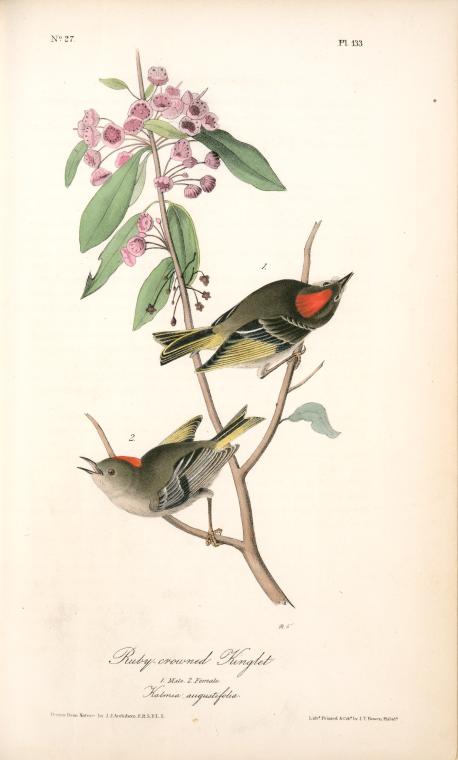
Early American naturalist and artist painted this pair of Ruby-crowned Kinglets.

Although similar in size and overall coloration, the ruby-crowned and golden-crowned kinglets are easily distinguished from each other. Side by side, the two species of North American kinglets are easy to identify. The golden-crowned kinglet has a striped facial pattern formed by bold black and white stripes. The ruby-crowned kinglet, on the other hand, has a bold white eye ring but no striping. The golden-crowned kinglet has an orange crown patch, while the ruby-crowned kinglet has a red crown patch that is, more often than not, kept concealed. Both sexes of the golden-crowned kinglet possess a yellow crown patch, but only the male ruby-crowned kinglet boasts a scarlet patch of feathers atop the head. Observers can expend a lot of energy trying to get a look at the crown patches, which are typically only displayed when the bird is agitated.

Kinglets are very active birds. If warblers can be described as energetic, the kinglets are downright frenetic in their activities. The kinglets almost never pause for long, flitting from branch to branch in trees and shrubs as they constantly flick their wings over their backs.  These bursts of hyperactivity can make them difficult to observe. Although small in size, these birds more than compensate for it with a feisty spirit that does them well through the harsh winter months.

cuviers_regulus

John James Audubon painted this depiction of a bird he referred to as Cuvier’s Kinglet in the early 1700s. No other person has ever encountered a bird matching this description.

Kinglets often join mixed flocks comprised of other species of birds, some of which are regular feeder visitors. Perhaps by observing their flock counterparts, some kinglets have learned to accept feeder fare such as suet, meal worms and chopped nuts. Away from feeders, kinglets mostly feed on a range of small insects and arachnids. These tiny birds will also consume some fruit, such as the berries of poison oaks and dogwoods.

Normally, kinglets have a rather fleeting lifespan. These tiny birds can be considered old if they live three or four years. There are always exceptions.  The oldest golden-crowned kinglet on record was six years and four months old. That individual, a male, was documented by a bird bander in 1976, according to the website All About Birds.

Overall, kinglets are trusting, tame birds and a welcome addition to any flocks visiting your yard and garden. These tiny feathered sprites are definitely worth getting to know.

•••••

The Bristol Bird Club will conduct a birding trip of Burke’s Garden, Virginia, on Saturday, Feb. 11. Red-headed woodpecker, a relative of the Northern flicker, is among the target birds. Other possible birds will include golden eagles, rough-legged hawks, horned larks and a pair of bald eagles on a nesting site located in the beautiful, bowl-like valley of Burke’s Garden.e80948b8-92fa-44d2-b107-d9223014aff0_d

Participants should plan to meet by 8 a.m. at the Hardee’s at 900 E. Fincastle St. in Tazewell, Virginia. Arrive early and enjoy breakfast. Attendees will carpool to Burke’s Garden. Those making the trip might also glimpse alpacas and a camel. Bring a bit of cash if you would like to enjoy a soup and sandwich lunch at the Amish Store. For more information on this trip, call Kevin Blaylock at (423) 943-5841.

I visited Burke’s Garden for the first time almost 20 years ago on one of these February field trips. It was quite the memorable birding experience and yielded me my first-ever sightings of rough-legged hawk and common goldeneye.

Long-running bird counts find some surprises

woodduck-head

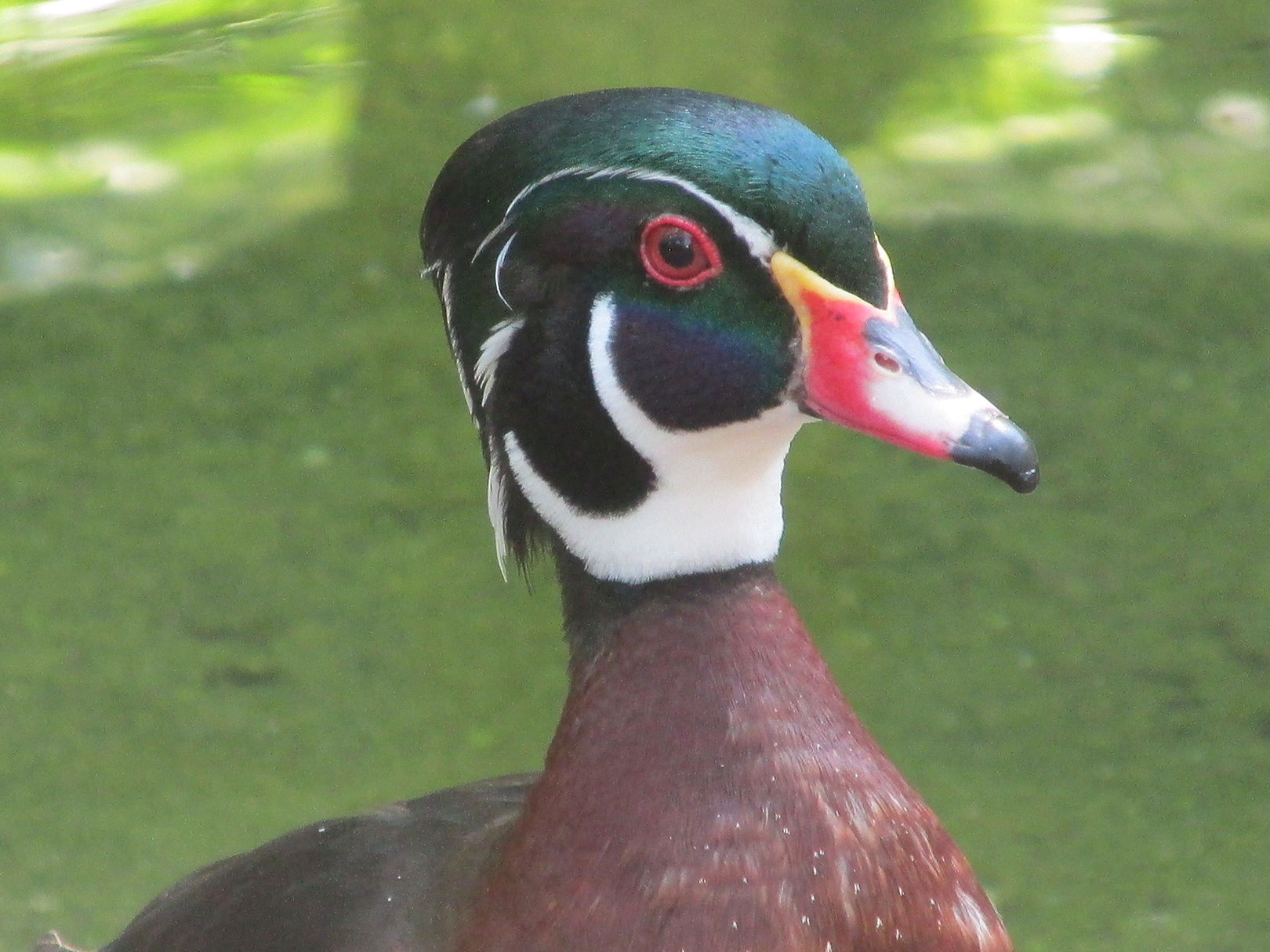
Photo by Bryan Stevens • Abundant waterfowl, such as this Wood Duck, helped push the 2016 Elizabethton Christmas Bird Count to tie a previous record.

The annual Christmas Bird Counts conducted by the Lee and Lois Herndon Chapter of Tennessee Ornithological Society found some good birds.

The 74th consecutive Elizabethton CBC was held on Saturday, Dec. 17. Twenty-four observers in six parties, plus one feeder-watcher, participated. Conditions were generally favorable and featured mild temperatures (35-66 degrees) on a mostly cloudy day with windy conditions, especially in the higher elevations.

I spent the morning and early afternoon counting birds with Chris Soto and Charles Moore along the Watauga River in Elizabethton. We also received some assistance from Michelle Sparks.

cbc-femaletowhee

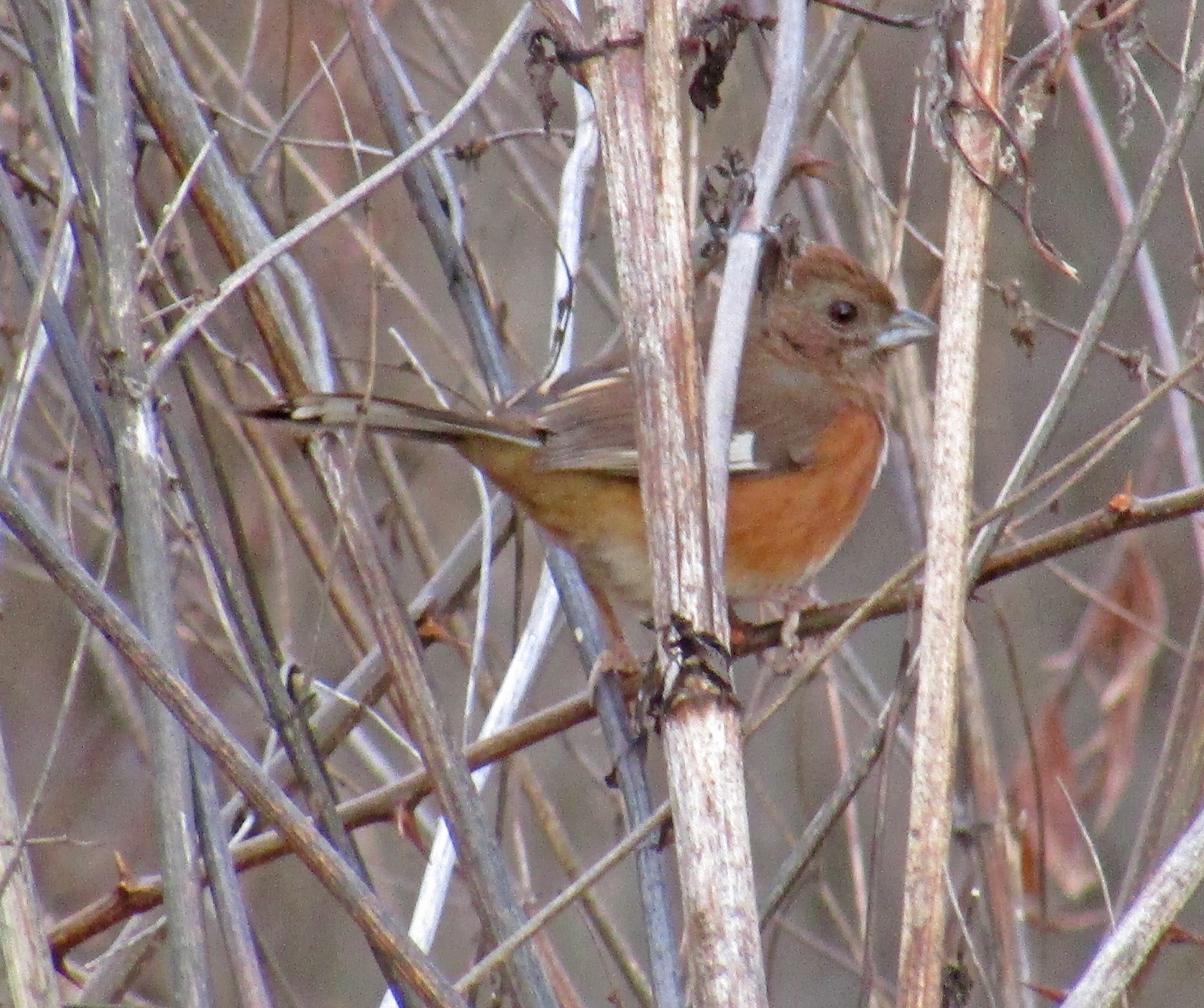
Photo by Bryan Stevens • This female Eastern Towhee was one of several towhees found on the 2016 Elizabethton CBC.

A total of 80 species were tallied, tying the all-time high for this count set in 2012.  By comparison, the average over the last 30 years has been 72 species, according to the count’s long-time compiler, Rick Knight.

Knight said that highlights from the count included:

• 12 species of ducks (plus four more in count week) were counted on this year’s CBC. In particular, wigeon, shoveler, green-winged teal, both scaup and red-breasted merganser are scarce on this count, but all were found this year.

• Double-crested Cormorant was found for just the seventh time on this CBC, with six of those times since 2004.

• This CBC marked just the third time in the last 24 years and 10th ever on this CBC that Red-headed Woodpecker has made the count.

• The seven Red-breasted Nuthatches reported represented an above average number for this species.

• This was only the third time for Pine Warbler on this CBC in the last 50 years and the three Pine Warblers found this year represent a high count for this CBC.

• A single Savannah Sparrow was the first on this CBC in 16 years. There’s not much accessible habitat for this sparrow within the count area.

• Nine Purple Finches on this CBC marked the most found since 1987.

heron-cold

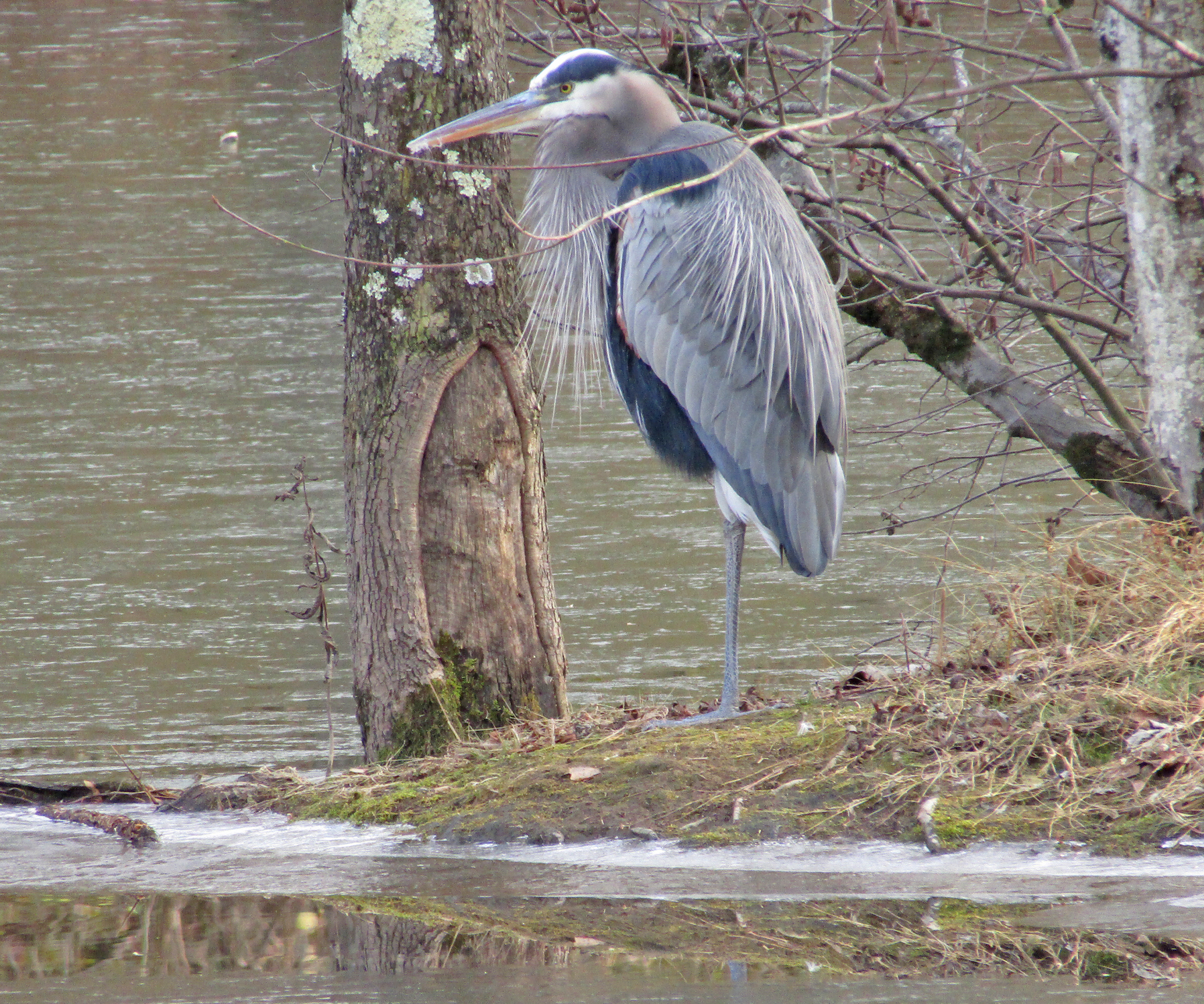
Photo by Bryan Stevens • The 26 Great Blue Herons found during the Elizabethton CBC almost tied the old record.

• Red Crossbills on this year’s CBC marked only the fourth occurrence on this CBC in the last 30 years.

Nevertheless, the Elizabethton CBC had some notable misses, including Brown Creeper, White-crowned Sparrow and Pine Siskin.

Some species are showing rather obvious trends on this CBC, according to Knight.

• The 114 Wild Turkeys found are the second most found in the  last 24 years. Prior to that date, no turkeys had been found on this CBC.

• Great Blue Herons continue to increase. The 26 individuals found represent the second most ever reported on this CBC.

• The four Bald Eagles found meant that this large raptor has been found for 17 of last 18 years, but only three times before that.

• Only three Killdeers were found, which reflects a continuing decline on this CBC likely due to habitat loss and degradation.

red-bellied-bryan

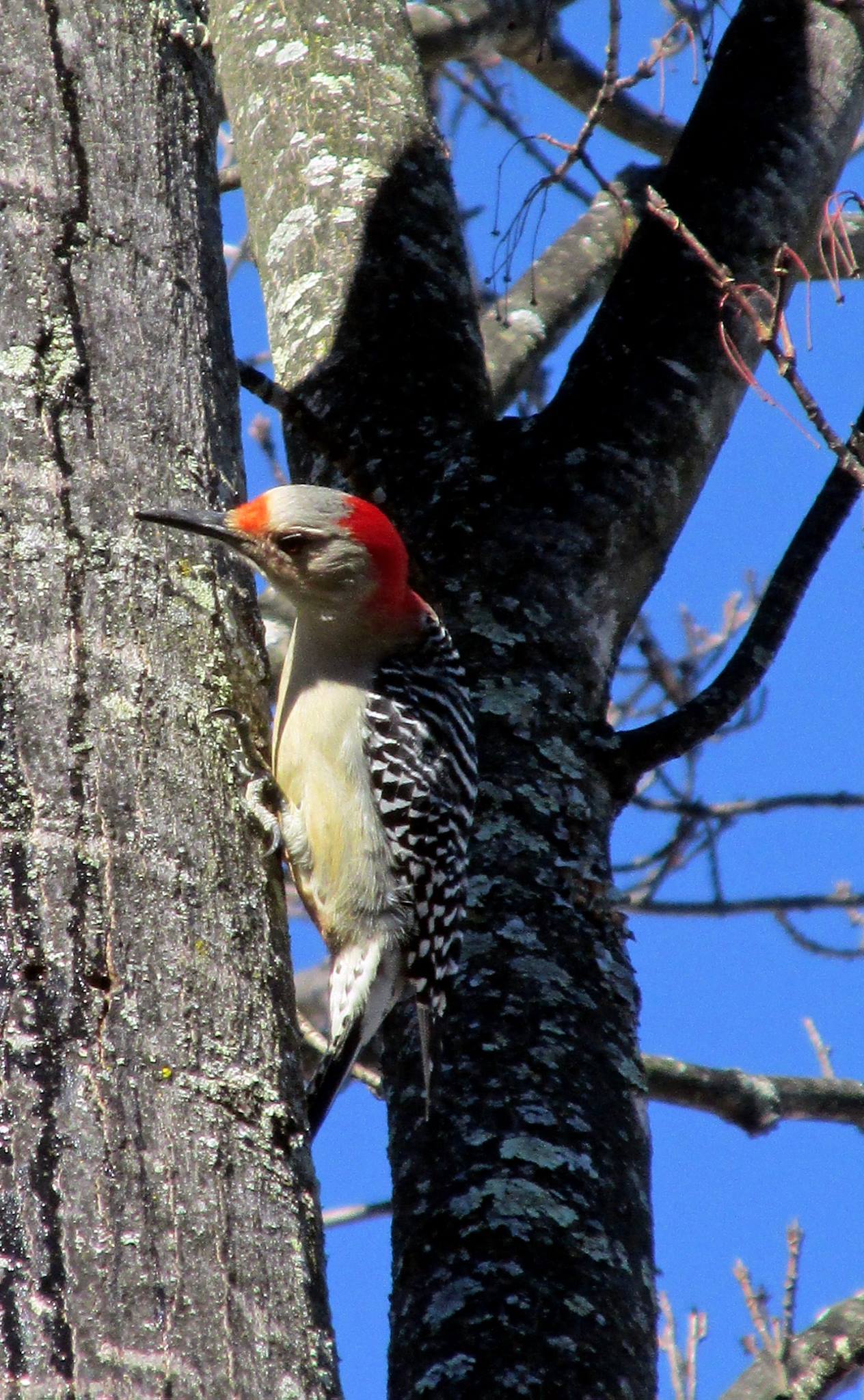
Photo by Bryan Stevens • The 47 Red-bellied Woodpeckers on the 2016 Elizabethton CBC set an all-time high for this species.

• The eleven Eurasian Collared-Doves found means that this dove has been found five of the last eight years.

• The 21 Belted Kingfishers found tied for second highest total ever for this species.

• The 47 Red-bellied Woodpeckers found set a new high count for this species, which has shown a steady increase in the foothills and lower mountains. CBCs conducted in the 1970s in Elizabethton had only single-digit counts for this woodpecker.

• Common Raven, with 13 found on this year’s CBC, has been found yearly since 1974, but none had appeared on this count prior to that date.

• Eastern Bluebird numbers continued to rise yearly. The 177 bluebirds this year represent the third-highest count for this species.

• Numbers for Field Sparrow, Song Sparrow and White-throated Sparrow showed the fewest of these three species since 1996, 1974 and 1969, respectively. These low sparrow numbers may be due to drought this year, which meant fewer seeds to feed these sparrows.

The total for the Elizabethton CBC follows:

nuthatch-grabandgo

Photo by Bryan Stevens • Feeder visitors, like this White-breasted Nuthatch, were abundant birds on both Christmas Bird Counts.

Canada Goose, 426; Wood Duck, 1; Gadwall, 10; American Wigeon, 2; American Black Duck, 1; Mallard, 205; Northern Shoveler, 2; Green-winged Teal, 3; Ring-necked Duck, 1; Greater Scaup, 2; Lesser Scaup, 1; Bufflehead, 256; and Red-breasted Merganser, 4.

Ruffed Grouse, 1; Wild Turkey, 114; Common Loon, 3; Pied-billed Grebe, 10; Horned Grebe, 21; Double-crested Cormorant, 4; and Great Blue Heron, 26.

Black Vulture, 10; Turkey Vulture, 2; Sharp-shinned Hawk, 4; Cooper’s Hawk, 8; Bald Eagle, 4; and Red-tailed Hawk, 13.

American Coot, 33; Killdeer, 3; Wilson’s Snipe, 4; Ring-billed Gull, 3; Rock Pigeon, 487; Eurasian Collared-Dove, 11; and Mourning Dove, 246.

Eastern Screech-owl, 2; Great Horned Owl, 1; Barred Owl, 2; Belted Kingfisher, 21; Red-headed Woodpecker, 2; Red-bellied Woodpecker, 45; Yellow-bellied Sapsucker, 7; Downy Woodpecker, 23; Hairy Woodpecker, 7; Northern Flicker, 15; and Pileated Woodpecker, 24.

American Kestrel, 13; Eastern Phoebe, 10; Blue Jay, 209; American Crow, 541; and Common Raven, 13.

crows-dec-21

Photo by Bryan Stevens • American Crows are abundant birds on these two CBCs.

Carolina Chickadee, 114; Tufted Titmouse, 102; Red-breasted Nuthatch, 7; White-breasted Nuthatch, 41; Winter Wren, 8; Carolina Wren, 85.

Golden-crowned Kinglet, 19; Ruby-crowned Kinglet, 3; Eastern Bluebird, 175; Hermit Thrush, 4; American Robin, 105; and Northern Mockingbird, 40.

European Starling, 809; Cedar Waxwing, 272; Pine Warbler, 3; and Yellow-rumped Warbler, 58.

Eastern Towhee, 25; Chipping Sparrow, 29; Field Sparrow, 7; Savannah Sparrow, 1; Fox Sparrow, 1; Song Sparrow, 70; Swamp Sparrow, 2; White-throated Sparrow, 57; and Dark-eyed Junco, 135.

Northern Cardinal, 92; House Finch, 74; Purple Finch, 5; Red Crossbill, 7; American Goldfinch, 101; and House Sparrow, 17.

••••••

The 64th Roan Mountain CBC was held on Wednesday, Dec. 21, with six participants in two parties. Conditions were generally favorable: mild temperatures (21-53 degrees) were coupled with clear skies and no significant winds.

amblackduck

Photo by Bryan Stevens • These American Black Ducks were found at Ripshin Lake during the Roan Mountain CBC.

A total of 42 species were tallied, slightly below the recent 30-year average of 46. The all-time high was 55 species back in 1987. Despite the decent weather, birds were hard to find. I counted with Brooke and Jean Potter in the town of Roan Mountain and on Ripshin Mountain.

Highlights included 12 American Black Ducks, a single Red-breasted Nuthatch, a solitary Ruby-crowned Kinglet and two Purple Finches. Notable misses for this count included Ruffed Grouse, Hairy Woodpecker, Northern Flicker, Brown Creeper, American Robin, Cedar Waxwing, Eastern Towhee and Pine Siskin.

The total for the Roan Mountain CBC follows:

Canada Goose, 5; American Black Duck, 12;  Bufflehead, 6; Wild Turkey, 8; Pied-billed Grebe, 1; and Great Blue Heron, 1.

Turkey Vulture, 1; Cooper’s Hawk, 1; Red-tailed Hawk, 6; Rock Pigeon, 25; Mourning Dove, 66; Barred Owl, 2; and Belted Kingfisher, 1.

rthawk-three

Photo by Bryan Stevens • Red-tailed Hawks are a fairly common winter raptor in the region.

Red-bellied Woodpecker, 6; Yellow-bellied Sapsucker, 1; Downy Woodpecker, 7; and Pileated Woodpecker, 2.

Eastern Phoebe, 1; Blue Jay, 22; American Crow, 170; and Common Raven, 9.

Carolina Chickadee, 24; Tufted Titmouse, 17; Red-breasted Nuthatch, 1; White-breasted Nuthatch, 6; Winter Wren, 2; and Carolina Wren, 18.

Golden-crowned Kinglet, 7; Ruby-crowned Kinglet, 1; Eastern Bluebird, 6; Northern Mockingbird, 3; and European Starling, 78.

Field Sparrow, 10; Fox Sparrow, 2; Song Sparrow, 55; White-throated Sparrow, 8; Dark-eyed Junco, 68; and Northern Cardinal, 12.

House Finch, 6; Purple Finch, 2; American Goldfinch, 17; and House Sparrow, 24.


Practice of feeding birds a relatively recent development


155_emilydickinsonsmall

Emily Dickinson

thoreau

Henry David Thoreau

Some recent bouts of cold weather brought increased numbers of birds to my feeders. It’s easy to look at the birds flocking to feeders and think that this special relationship between them and their human hosts is a long-running one. However, the practice of tempting birds with food to invite them to take part in our daily lives is a fairly recent one. The concept of feeding the birds began to develop in the 19th century, motivated in part by some of the early naturalists and transcendental thinkers of New England.

cardinal_driveway-copy

A Northern Cardinal checks out a gravel drive for dropped seeds.

For instance, the 19th century writer Emily Dickinson described feeding birds in some of her poems. In addition, she wrote about hummingbirds attracted to the flowers in the gardens that she tended with her sister at their home in Amherst, Massachusetts. Dickinson’s fellow writer, Henry David Thoreau, fed birds at Walden Pond as early as 1845. He later wrote his pivotal work, “Walden,” based on his experiences living in his small cabin in the woods. The work is filled with his description of birds and other wildlife.

florencemerriam1904

Florence Merriam Bailey

The late John V. Dennis, author of “The Complete Guide to Bird Feeding,” sketches out the history of feeding birds in his informative work. Dennis noted that early American naturalist and painter John James Audubon wrote in the 18th century about people from the old country (Europe) feeding birds during spells of bad weather. For a long time, Dennis noted in his book, feeding of birds remained rather sporadic. This began to change in the late 1800s. The evolution of bird feeding was documented by Florence Augusta Merriam Bailey, a 19th century ornithologist and naturalist.

Bailey wrote “Birds Through an Opera Glass” in 1889, becoming one of the first writers to write about birds for popular audiences without too much emphasis on the more scientific aspects of ornithology. She also wrote “Birds of Village and Field: A Bird Book for Beginners,” intended to foster an interest in birds and birding among the general public. Bailey even identified in her writings the first person — a Mrs. E. B. Davenport — to implement a winter-long, even year-long, practice of feeding birds. Another woman — Caroline Soule — developed the first hummingbird feeder back in 1900. She took a glass cylinder, filled it with a sugar water mixture and attached an handmade artificial flower to it. When she hung the feeder near a trumpet vine at her home, she reported that the hummingbirds readily fed from her feeder. Dennis noted that Soule’s basic feeder design has needed very little modification in the last century.

Finches-AtFeeder

House Finches visit a feeder in suburban Atlanta, Ga.

Althea Sherman discovered that ruby-throated hummingbirds quickly learned to associate clear bottles filled with sugar water as a source of food. Her 1913 study of hummingbird feeding behavior also noted that hummingbirds remembered the locations of artificial feeders from a previous year and would hover at those precise spots when they returned each spring. So, in less than a century, humans have had a major influence on hummingbirds, helping them adapt to supplemental food sources provided by humans hoping to lure these tiny birds into their yards and gardens for extended stays.

Feeding of birds expanded rapidly in popularity. Today, some estimates indicate that as many as 55 million Americans regularly feed the birds in their yards and gardens. Bird feeding is second only to gardening as the most popular hobby in the United States. The two activities can also overlap. The month of February was named National Bird-Feeding Month by the U.S. Congress back in 1994.

DUo-Downy-Titmouse

A Tufted Titmouse and Downy Woodpecker visit a feeder for a chunk of suet.

Feeding the birds can be expensive, but all that money is, without a doubt, good for the economy. Americans spend about $3 billion a year on bird feed. Another $800 million goes to purchase bird feeders, baths and houses. The variety of food is quite extensive, but I generally offer black oil sunflower seeds and commercial mixtures of suet and peanut butter. I sometimes supplement my offerings to the birds with peanuts, nyjer thistle seed (a favorite of American goldfinches) and safflower seed. The latter is useful if you want to discourage squirrels. Unfortunately, the hard shells of safflower seeds also make them inaccessible to some smaller birds, but birds like tufted titmouse and Northern cardinal appear to have no difficulty with these seeds.

Some people have great luck feeding a wide range of birds, including Eastern bluebirds, Baltimore orioles and ruby-crowned kinglets. My bluebirds show an occasional interest in my feeders, but orioles and kinglets have largely ignored them. For bluebirds, mealworms, which can be purchased live or freeze-dried, are a very popular food.

img_4688

Dark-eyed Junco visits a feeder during a snowstorm.

I’ve come a long way since my childhood when my grandmother would let me scatter crumbled cornbread on the ground for the dark-eyed juncos ahead of snowstorms. I also remember that the juncos, or snowbirds, would flock to the site where my grandfather dumped the ashes from his wood stove. I suspect the ash provided supplemental minerals and nutrients craved by the birds.

 
Some birds are quite adventurous in their tastes. On a whim, I once placed a stale McDonald’s apple pie on my front porch during a winter cold spell. A Carolina wren discovered the pastry and made frequent trips each day to feast on this unexpected bonanza. The wren whittled away at the pie, which soon disappeared. I suspected the wren probably advertised to friends, so other wrens may have helped in finishing off the pie.

 
Human generosity can help birds survive frigid cold snaps, but for the most part, they’re not dependent on humans for their food. The reason to feed birds is entirely a selfish one. We take immense pleasure in observing their antics as they interact with each other at our feeders. Experts have even shown that such activities as bird feeding can be therapeutic in reducing stress in human observers.

 
People can also choose to further the cause of science by taking part in studies such as Project FeederWatch, a nationwide survey of bird populations focused on birds coming to feeders maintained by project participants.

 
In the 2015-16 winter season, 1,373 individuals participated in Project FeederWatch in the southeastern United States. The most common birds reported by observers were Northern cardinal, Carolina chickadee, mourning dove, American goldfinch and tufted titmouse. Finishing out the Top 10 feeder birds in this section of the nation were Carolina wren, house finch, blue jay, red-bellied woodpecker and downy woodpecker. Almost 98 percent of participants reported Northern cardinals at their feeders, which means the cardinal has become an almost universal feeder visitor in the southeast.


imgres
The roots of Project FeederWatch extend back to 1976 Ontario, Canada, when Dr. Erica Dunn with Canada’s Long Point Bird Observatory established the Ontario Bird Feeder Survey. After a successful 10-year run, its organizers realized that only a continental survey could accurately monitor the large-scale movements of birds. Therefore, Long Point Bird Observatory decided to expand the survey to cover all of North America.

 
The expansion launched in the winter of 1987-88, when more than 4,000 people enrolled. FeederWatchers represented every state in the U.S. except Hawaii, as well as most Canadian provinces. Project FeederWatch continues to be a cooperative research project of the Cornell Lab of Ornithology and Bird Studies Canada (formerly the Long Point Bird Observatory) on an annual basis. To learn more, visit http://feederwatch.org/
•••••
The Lee and Lois Herndon Chapter of Tennessee Ornithological Society, based in Elizabethton, Tennessee, is once again offering for sale its annual calendar. All proceeds from sales of the 2017 calendar benefit the chapter’s work to promote birds and birding. This year’s calendar features nearly 100 full-color photographs. Calendars are $15 and can be obtained at the office of the Bristol Herald Courier, 320 Bob Morrison Blvd., Bristol, Virginia. To reserve a copy, email me at ahoodedwarbler@aol.com or message me on Facebook.
•••••


To learn more about birds and other topics from the natural world, friend Stevens on Facebook at https://www.facebook.com/ahoodedwarbler. He is always posting about local birds, wildlife, flowers, insects and much more.

Annual Christmas Bird Count a more peaceable custom than its predecessors

cbc-cooperhawk

Photo by Bryan Stevens • This adult Cooper’s Hawk was found on the 2016 Elizabethton CBC.

I participated in the annual Elizabethton Christmas Bird Count and Roan Mountain Christmas Bird Count conducted by the Lee and Lois Herndon Chapter of Tennessee Ornithological Society on Saturday, Dec. 17, and Wednesday, Dec. 21.

During the Elizabethton Count with my fellow counters — Charles Moore, Chris Soto and Michelle Sparks — we found some good winter birds, including gadwalls and buffleheads on the Watauga River, white-throated sparrows and yellow-bellied sapsuckers at Sycamore Shoals State Historic Park and a Cooper’s hawk near the American Legion headquarters near downtown Elizabethton. I helped Brookie and Jean Potter with the Roan Mountain CBC. Some of our good birds included Ruby-crowned Kinglet, American Black Duck and Purple Finch. I will provide the results of both these CBCs in upcoming blog posts.

Despite a sore toe that hampered my walking this year, I was determined to take part. I’ve participated in Christmas Bird Counts, often shortened by birders to CBCs, since the late 1990s. Other long-running CBCs in the region include the Bristol CBC, the Shady Valley CBC and the Roan Mountain CBC. I have always tried to take part in this annual tradition which has become part of my own holiday celebration.

WinterWren

Photo by U.S. Fish & Wildlife Service • The Winter Wren is a small but noisy bird.

According to the National Audubon Society’s website, the tradition of the Christmas Bird Count arose from a less than bird-friendly custom. By the turn of the 20th century, so-called sportsmen would conduct a “Side Hunt,” a rather blood-thirsty Christmas custom that saw hunters competing to see who could score the largest amount of feathered and furred corpses.

The annual holiday bird survey may even have arisen from an earlier custom with roots in Europe that came to the United States of America with early colonists. The “Side Hunt” has some similarity to a peculiar celebration in Ireland and other European countries known as “Wren Day” or “Hunt the Wren Day.” The event was conducted the day after Christmas, the date of Dec. 26 being consigned as Saint Stephen’s Day. By the 20th century, the hunt consisted of tracking down a fake wren carried atop a decorated pole. Crowds would parade through towns in masks and colorful attire. These groups were referred to as “wren boys.”

chapman

Frank Chapman

Whether or not the “Side Hunt and “Wren Hunt” shared any connections, it was a huge step forward for conservation when preeminent ornithologist Frank M. Chapman proposed a new holiday tradition. His radical idea was to count birds during the Christmas season rather than hunting and killing them.

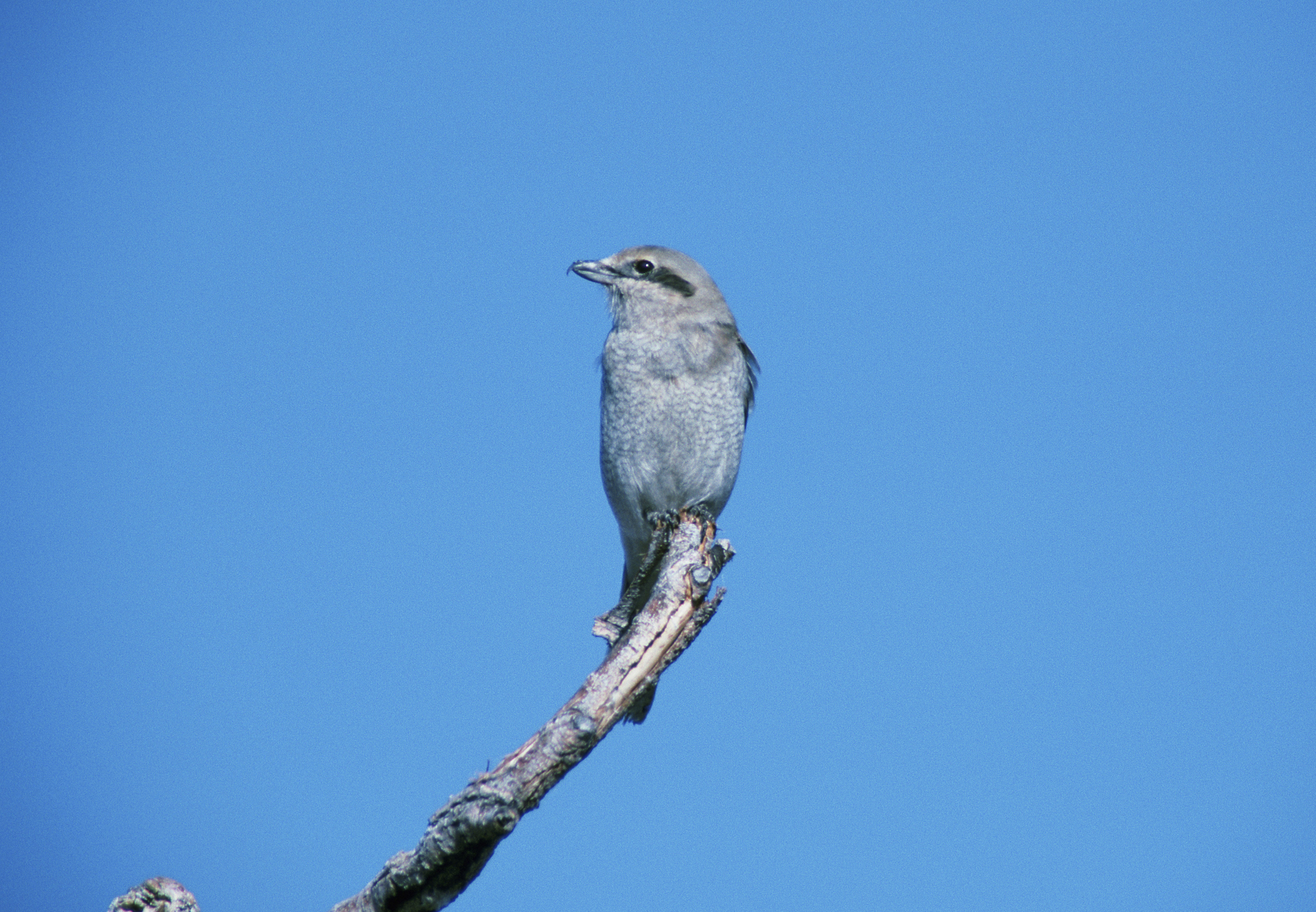
The Christmas Bird Count is now conducted each year on dates between Dec. 14 and Jan. 5. The first CBC took place in December of 1900 with 27 observers participating at 25 locations in the United States and Canada. Fifteen of the counts were conducted in the northeastern United States from Massachusetts to Philadelphia. Results from that first count in 1900 didn’t truly reflect the diversity of North America’s birds, but there were nonetheless interesting. The Greater Boston CBC boasted only one participant and only found 17 species. However, some of those species included such good birds as American tree sparrow, brown creeper, Northern shrike and Northern bobwhite.

Northern shrike perched on bare branch

Photo by Dave Menke/U.S. Fish & Wildlife Service • The Northern shrike, pictured, was one of the birds represented on one of the very first Christmas Bird Counts conducted in the United States.


These days the Christmas Bird Count is also conducted in almost 20 other nations around the world, although participants still largely hail from the United States and Canada. CBCs are still conducted under the auspices of the National Audubon Society. The CBC is one of the earliest examples of citizen science in action. People of different levels of experience can easily participate in a CBC and in so doing contribute to the scientific data available about bird populations in winter in the United States. Trends can be deduced from some of the fluctuations in populations of various bird species in different regions of the nation.

cbc-deer

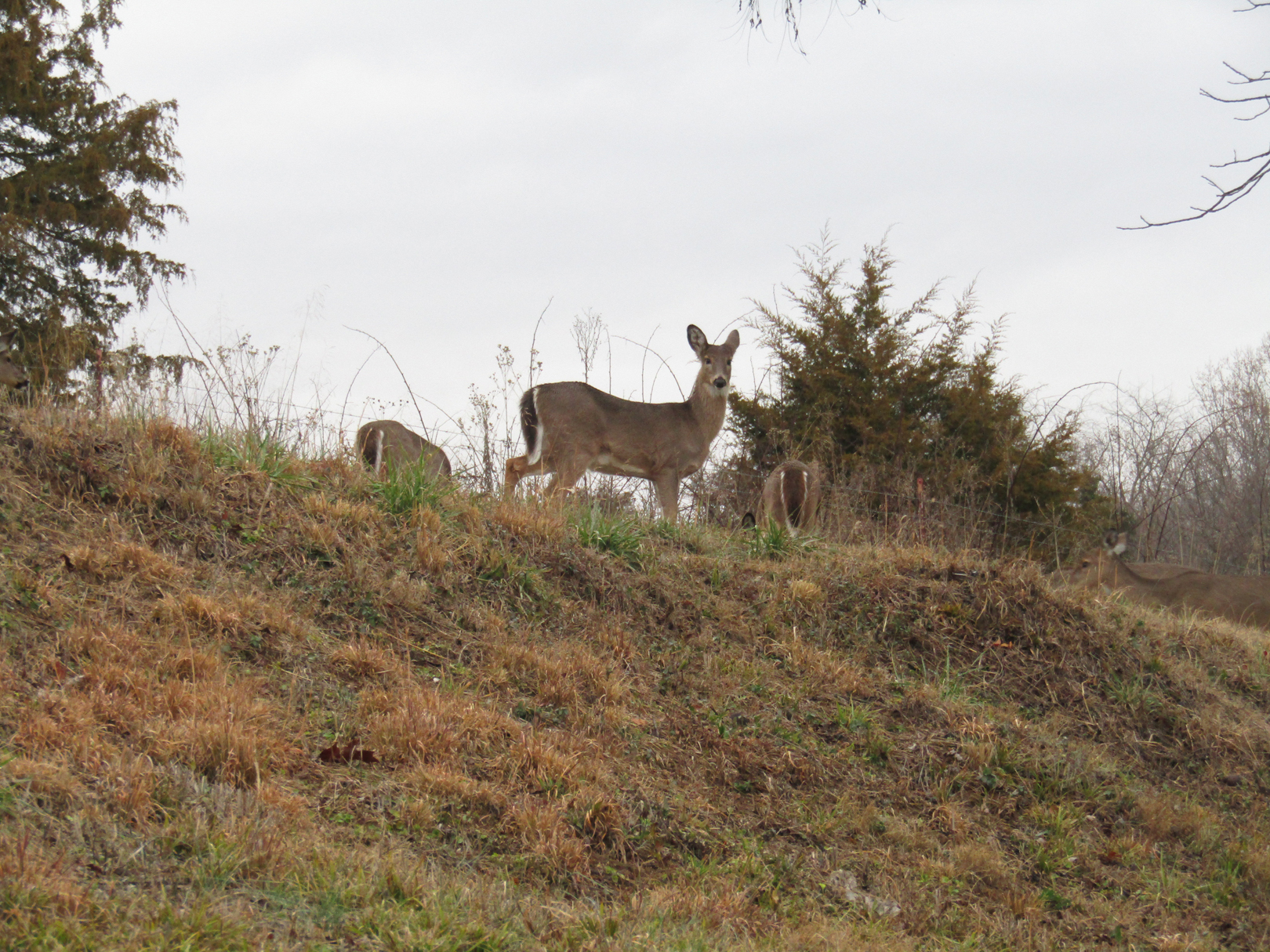
Photo by Bryan Stevens • Other wildlife, such as white-tailed deer, is often spotted while counting birds for the CBC.

We’ve come a long way since the days when birders used a gun to bring a bird up close and personal for inspection. There’s still competition, but these days birders are trying to see which count party can observe and identity the most species of birds. The only evidence we bring back from the field is an occasional photograph.

••••••

I had a mistake in a recent post on the history of feeding birds. Americans spend about $3 billion a year on bird feed. In my recent post, I erred in stating that the figure spent on bird seed was $3 million. When you think about it, Americans really do love their birds. The evidence is right there in how much money we spend to feed them. I hope readers of my weekly blog posts enjoyed a wonderful Christmas. My wish for 2017 is that everyone gets to see plenty of fun birds.

••••••

To learn more about birds and other topics from the natural world, friend Stevens on Facebook at https://www.facebook.com/ahoodedwarbler. He is always posting about local birds, wildlife, flowers, insects and much more.

Cardinals provide perfect symbol for Christmas holiday

cardinal-brookgreen

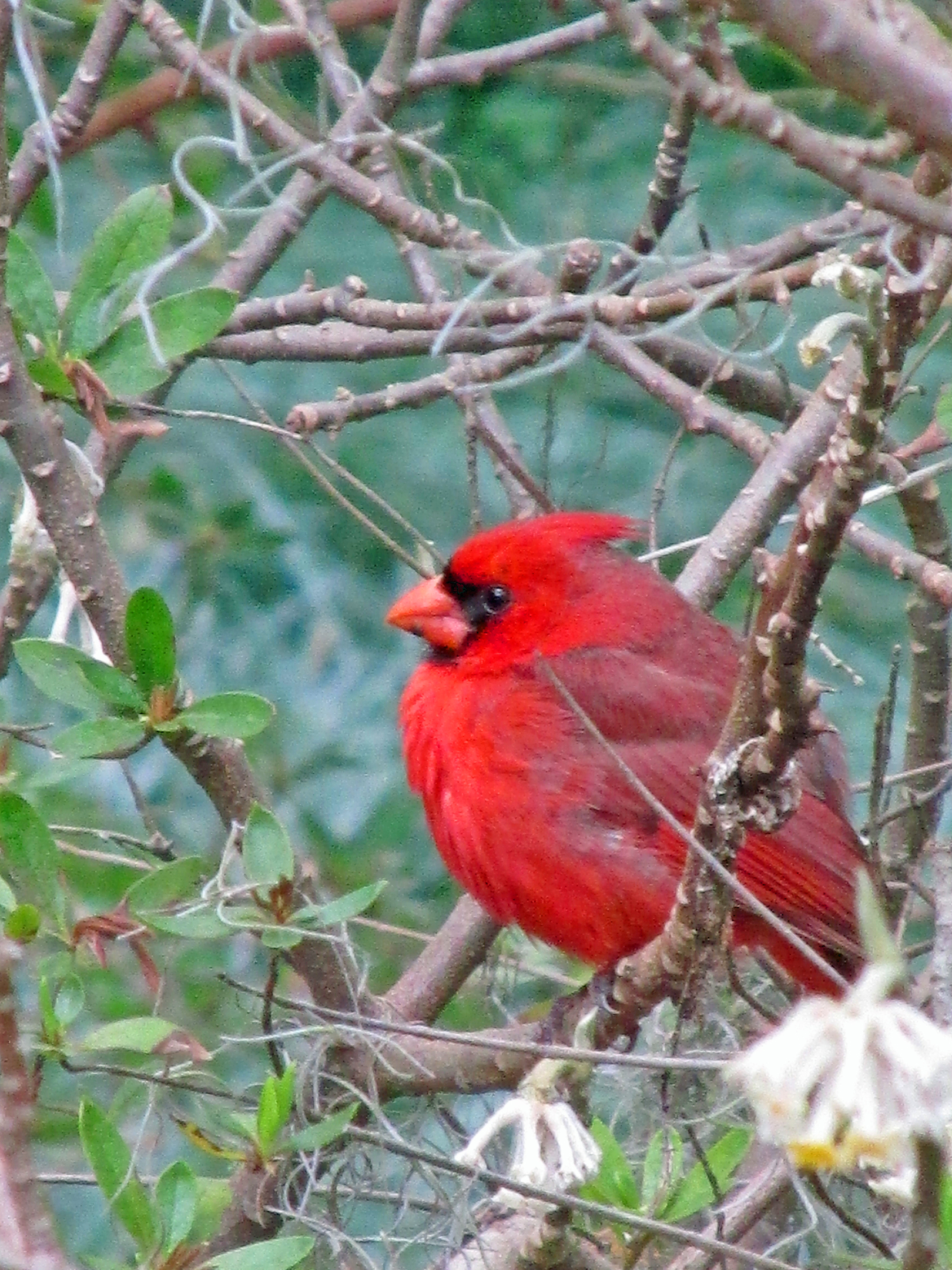
Photo by Bryan Stevens • Male Northern cardinals are among the most showy of North American birds.

Often, when people think of the birds of the winter season, their thoughts focus on some of the less-than-colorful feeder visitors — the brown sparrows and wrens, the black and white chickadees, the drab American goldfinches so unlike their summer appearance of bright yellow and black.

There’s one bird, however, that stands out in any season. The Northern cardinal, especially the brilliant red male, stands out against a winter backdrop of snow white, deep green or drab gray. Over the years, the cardinal has also become associated with the Christmas season. How many Christmas cards have you received this holiday season with a cardinal featured in the artwork? I’d wager that at least a few cards in any assortment of holiday greetings will feature the likeness of a Northern cardinal.

cardinal-2

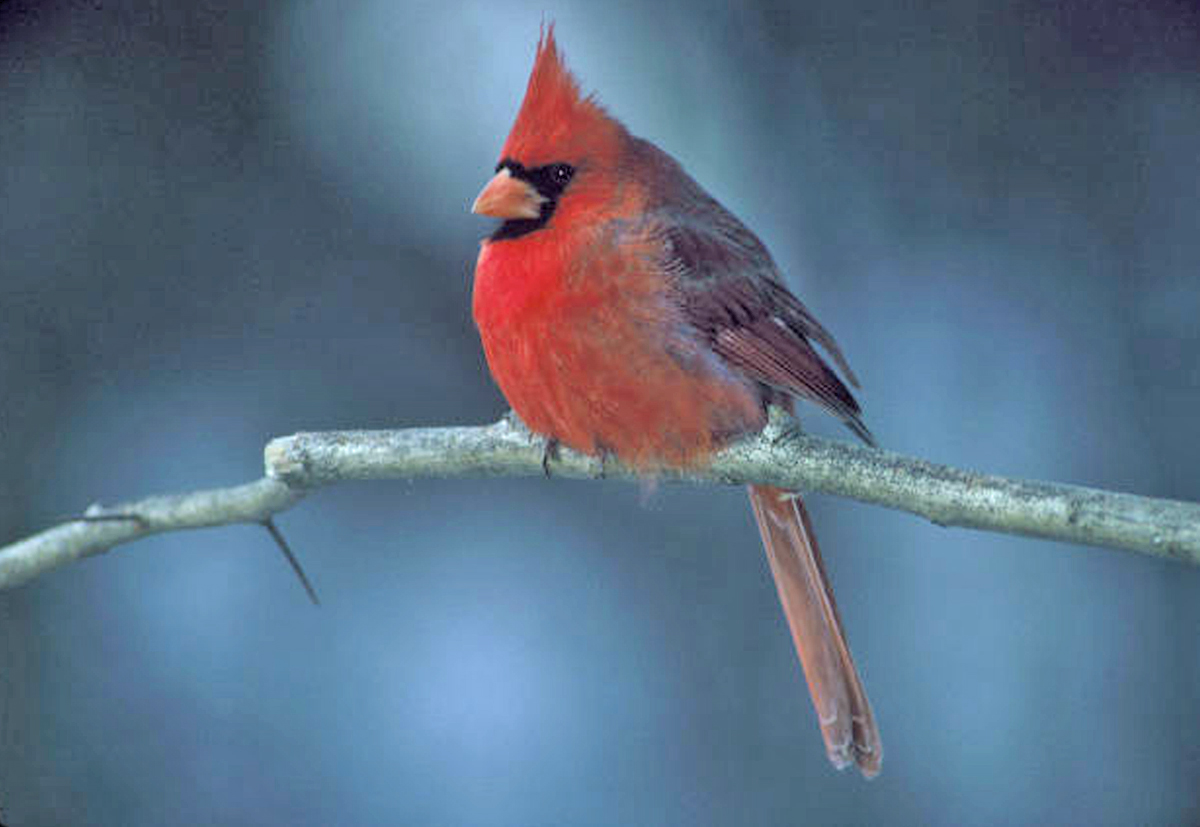
Photo by U.S. Fish & Wildlife Service • Male Northern cardinals are welcome birds in a bleak winter landscape.

There’s some more evidence to put forward as testimony to the popularity of the Northern Cardinal. It’s the official state bird of seven states: North Carolina, West Virginia, Ohio, Illinois, Indiana, Kentucky and Virginia. Only the Northern mockingbird, which represents five states as official state bird, even comes close to the Northern cardinal in this respect.

The Northern cardinal belongs to a genus of birds known as Cardinalis in the family Cardinalidae. There are only two other species in this genus, and they range across North America and into northern South America.

The two relatives are the pyrrhuloxia, or Cardinalis sinuatus, of the southwestern United States, and the Vermilion cardinal, or phoeniceus, a bird found in Colombia and Venezuela. Two other South American birds — red-crested cardinal and yellow-billed cardinal — are more closely related to tanagers than to our familiar Northern cardinal. Both the Northern cardinal and red-crested cardinal have been introduced into the state of Hawaii, so two non-native birds from different parts of the globe are now resident in the Aloha State.

bs-cardinalinsnow

Photo by Bryan Stevens • A female Northern cardinal visits a feeder for a meal of black oil sunflower seeds.

The Northern cardinal is a native and abundant bird. Cardinals are a widespread species, ranging westward to the Dakotas and south to the Gulf Coast and Texas. The southeastern United States was once the stronghold of the cardinal population. In the past century, however, cardinals have expanded their range into New England and Canada.

The cardinal accepts a wide variety of food at feeders. Sunflower seed is probably their favorite, but they will also sample safflower seed, cracked corn, peanuts, millet, bakery scraps and even suet. While we may get the idea that cardinals feed largely on seed, that is a misconception based on our observation of the birds at our feeders. Cardinals away from our feeders eat insects and fruit, including the berries of mulberry, holly, pokeberry, elderberry, Russian olive, dogwood and sumac.

froze-femcardinal

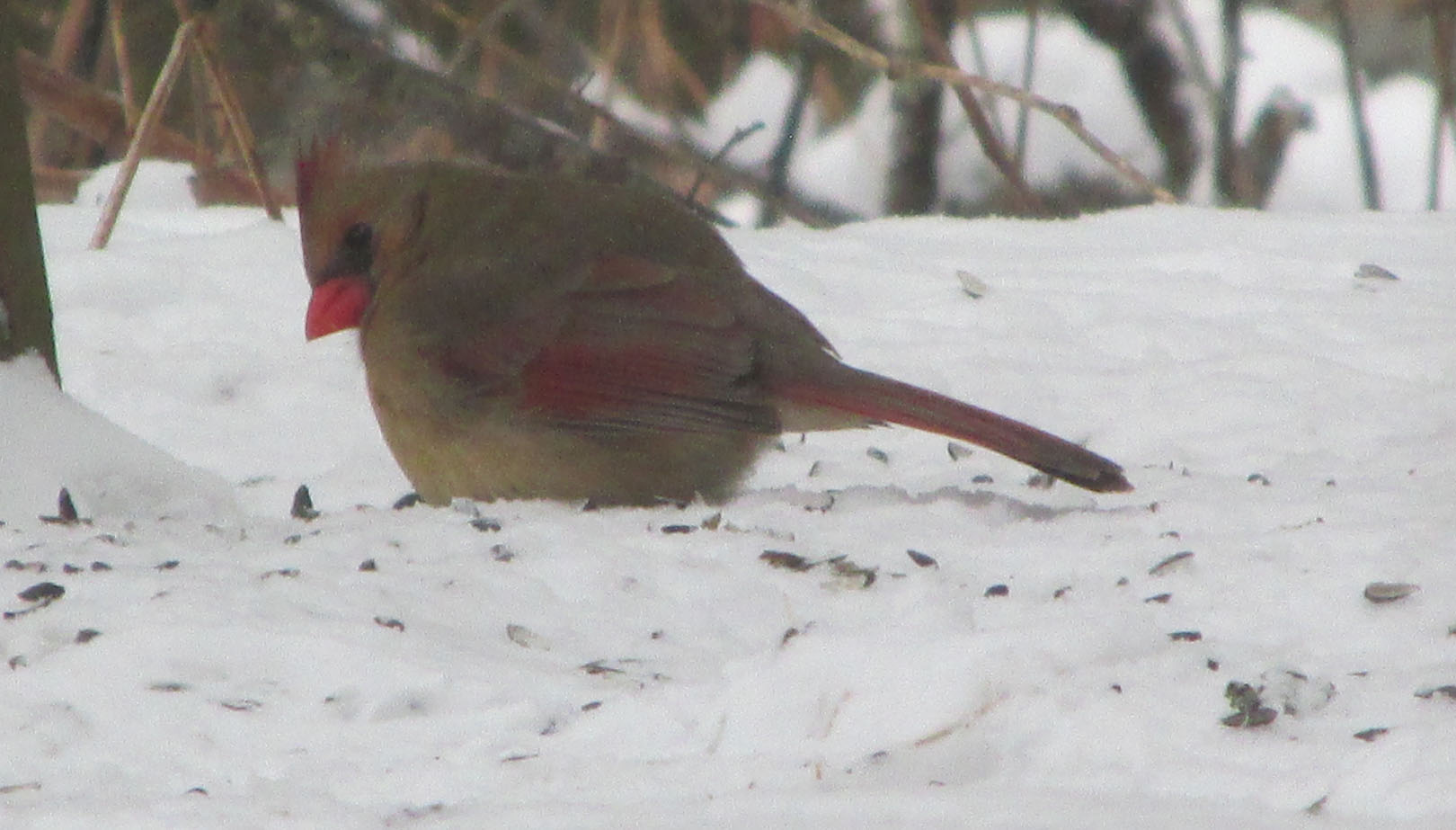
Photo by Bryan Stevens • Female cardinals scans the snow’s surface for seeds dropped by other birds.

Even once the holidays are past, there’s nothing like a glimpse of a Northern cardinal to add some cheer to a bleak winter day. People can also choose to further the cause of science by taking part in studies such as Project FeederWatch, a nationwide survey of bird populations focused on birds coming to feeders maintained by project participants.

In the 2015-16 winter season, 1,373 individuals participated in Project FeederWatch in the southeastern United States. The most common birds reported by observers were Northern cardinal, Carolina chickadee, mourning dove, American goldfinch and tufted titmouse. Finishing out the Top 10 feeder birds in this section of the nation were Carolina wren, house finch, blue jay, red-bellied woodpecker and downy woodpecker. Almost 98 percent of participants reported Northern cardinals at their feeders, which means the cardinal has become an almost universal feeder visitor in the southeast.

The roots of Project FeederWatch extend back to 1976 Ontario, Canada, when Dr. Erica Dunn with Canada’s Long Point Bird Observatory established the Ontario Bird Feeder Survey. After a successful 10-year run, its organizers realized that only a continental survey could accurately monitor the large-scale movements of birds. Therefore, Long Point Bird Observatory decided to expand the survey to cover all of North America.

The expansion launched in the winter of 1987-88, when more than 4,000 people enrolled. FeederWatchers represented every state in the U.S. except Hawaii, as well as most Canadian provinces. Project FeederWatch continues to be a cooperative research project of the Cornell Lab of Ornithology and Bird Studies Canada (formerly the Long Point Bird Observatory) on an annual basis. To learn more, visit http://feederwatch.org/

il_fullxfull.56973554

Early naturalist and artist John James Audubon painted this pair of Northern Cardinals.

It’s not surprising that such a popular bird has also become associated with many trappings of the Christmas season.

“You see cardinals on greeting cards, stationery, paper plates, paper napkins and tablecloths, doormats, light switch plates, candles, candle holders, coffee mugs, plates, glasses, Christmas tree ornaments and lights, bookmarks, mailboxes, Christmas jewelry,” writes June Osborne in her book The Cardinal. “And the list goes on. Cardinals have become an integral part of the way that many people celebrate the holiday season.”

cardinals-dec18

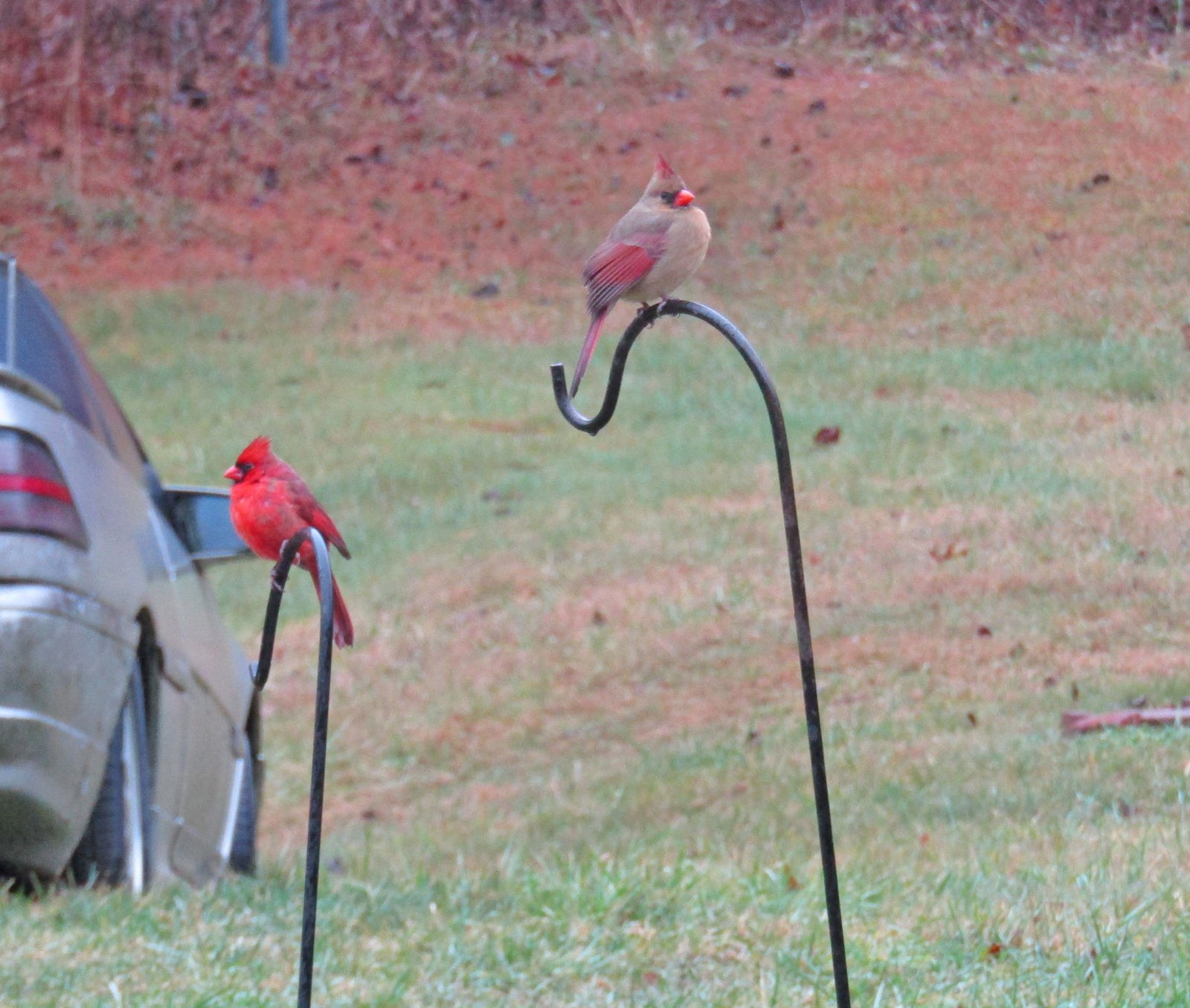
Photo by Bryan Stevens • A pair of Northern Cardinals claim perches near a feeder.

I can be included among such people. My Christmas decorations include an assortment of cardinal figurines and ornaments. There are other birds — doves and penguins for example — associated with the holiday season, but for me the holidays magnify the importance of one of my favorite birds. The cardinal, in its festive red plumage, appears made to order for a symbol of the holiday season.

Here’s some additional cardinal trivia to increase your knowledge of this fascinating bird:

• Cardinals are also known by such common names as redbird and Virginia nightingale.

• Cardinals differ in appearance based on gender. The male boasts crimson plumage, a crest, a black face and orange bill. The female, although less colorful, is also crested. Female cardinals are soft brown in color, with varying degrees of a reddish tinge in their feathers, particularly in their wings.

• The cardinal’s preference for dense cover makes them likely neighbors for such birds as Carolina wrens and brown thrashers.

• The oldest recorded Northern Cardinal was a female, and she was 15 years, nine months old when she was found in Pennsylvania, according to the website, All About Birds.

The thrill of the chase keeps some fervent birders seeking out ‘rare’ birds

northernwheatear-one

Photo by Jean Potter • This Northern wheatear caused great excitement in the Tennessee birding community with an extended stay at a farm in the Volunteer State in November.

A little bird caused a huge stir among birders in the Volunteer State back in November.

A Northern wheatear — a six-inch-long bird that breeds in open, stony terrain across the Northern hemisphere from Asia and Europe as well as northwestern and northeastern Canada, Alaska and Greenland — made a most unlikely migratory stop at a farm in Loudon County, Tennessee, supposedly en route to its wintering grounds in Africa. The visiting songbird turned out to be the first of its kind ever documented in Tennessee.
Credit for the discovery of the bird goes to Tony King, a birder who hails from Lenoir City, Tennessee. He found the bird at Windy Hill Farm, a privately owned agricultural enterprise in Loudon County. After seeking confirmation from other experienced birders, King put out the word about his rare bird.
Almost immediately, birders flocked to the Loudon County farm — with the gracious permission from the farm’s owners — for a chance to see a bird not often glimpsed in the Lower 48 states.
Birders who saw the wheatear observed the bird actively feeding on the ground and perching on fence posts. Several members from the Elizabethton and Bristol bird clubs made the journey to Loudon County to add the wheatear to their state list for Tennessee and, for many individuals, on life lists of birds seen nationwide.

northernwheatear-two

Photo by Jean Potter • The Northern wheatear at the Loudon County farm spent much time perched on fence posts.

The wheatear is a truly long-distance migrant, but it’s difficult to speculate why this individual bird’s journey took it far enough off course to land in Tennessee. My schedule didn’t permit me to immediately try to add this bird to my own life list. I made plans to make the trip on Nov. 23 as part of my Thanksgiving break. Unfortunately, the bird departed on Nov. 20, hopefully to continue its long journey to Africa for the winter months.
The wheatear got me to thinking about the way determined birders “chase” rare birds to add to their life lists. Some people are quite dedicated — or fanatical — to pursuing reports of rare birds to the point they will drop everything to chase down coveted birds.
Adding to the thrill of the chase for birders in Tennessee was the fact that a couple of days after the wheatear departed, a Bohemian waxwing became another “first” for its kind in the state. Unfortunately, that bird apparently didn’t stick around. It’s fun to speculate their reasons, but finding the motivation among our feathered friends can be an exercise in futility. I have my own motto about these rare visitors. Birds have wings, and they know how to use them. It’s that ability to pick up and fly to distant places that is part of their appeal.
I understand the appeal of chasing after a rare or hard-to-get bird. I’ve chased my share of birds. I achieved a long-held desire to see a snowy owl when I made the trip to Spring Hill, Tennessee, back in February of 2009. That’s probably the farthest I’ve traveled to observe a specific bird.
In November of 2003 I made a shorter but ultimately unsuccessful trip to Knoxville, Tennessee, for an attempt at getting binoculars on a sage thrasher that had been reported. Although I spent several hours with dozens of other birders looking for the bird, it never put in an appearance.


rufous-halloween

Photo by Bryan Stevens • The rufous hummingbird is one of several hummingbirds native to the western United States that has ventured into Tennessee on occasion.

My most memorable “rare bird” — and one that I chased across state lines — was a green-breasted mango, a tropical species of hummingbird. I saw that bird while it was visiting a feeder at a home in Concord, North Carolina, in November of 2000. The species is known to stray into southern Texas, but appearances outside of the Lone Star State have been rare. This hummingbird is normally found in Mexico and Central America, but in addition to the Concord bird the species was documented in Beloit, Wisconsin, back in September of 2007. The Wisconsin bird was captured and taken to a zoo because of fears it would not survive the onslaught of the frigid Wisconsin winter season.
Another personal miss — and I should kick myself for not making an attempt at seeing this bird — was a hooded crane that visited Hiwassee Refuge in December of 2011 and January of 2012. The hooded crane, a rare species from Asia, was associating with the thousands of sandhill cranes that regularly gather at the wildlife refuge near Brentwood, Tennessee.
I’m quite proud of the four hummingbird species on my Tennessee list. I traveled to Nashville, Tennessee, in December of 1997 to see a calliope hummingbird. Closer to home I’ve seen Allen’s hummingbirds and rufous hummingbirds, and, of course, ruby-throated hummingbirds.
One pertinent bit of information about the Northern wheatear is in order. The wheatear is not a rare bird. In fact, the bird is quite common with an estimated population of almost three million birds. The same is true of many of the “rare bird” sightings that excite birders. Some of these exceptional visitors are often not considered rare. The rarity comes from the bird showing up in a totally unexpected location, such as a Northern wheatear spending a week at a Tennessee farm.
That’s why an American white pelican at Middlebrook Lake in Bristol, Tennessee, a harlequin duck on the Holston River in Kingsport, Tennessee, and a Northern redpoll in Shady Valley, Tennessee, can quickly generate excitement in the birding community.

jp-harlequinduck

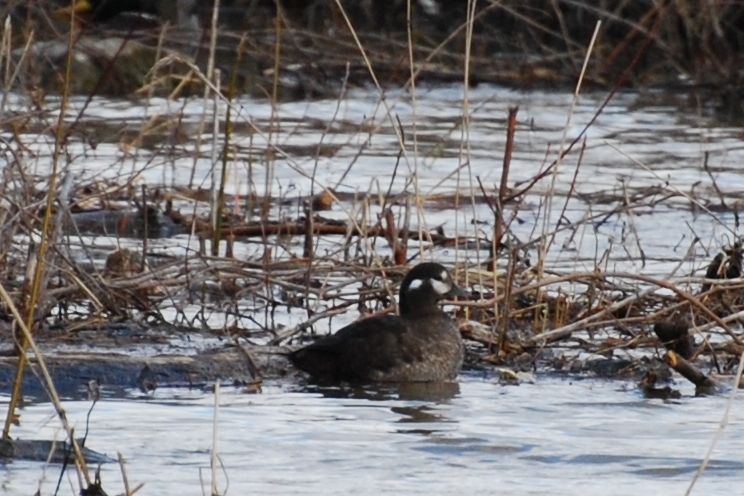
Photo by Jean Potter • This harlequin duck was a remarkable find a few years ago on the Holston River in Kingsport, Tennessee.

Most experienced birders offer one bit of advice — don’t delay. They’re words to take to heart for those seeking to chase after rare birds. In other words, if you snooze, you lose. My friend, the late Howard Langridge, was of that persuasion. In January of 2000, Howard tried to persuade me to ride with him from Elizabethton to Shady Valley in the midst of a raging snowstorm for the opportunity to see a long-eared owl. I declined. Howard made the trip, regardless of the snow and ice. As a reward, he saw the owl at the home of John and Lorrie Shumate.
After the storm passed, Howard accompanied me and Allan Trently to Shady Valley on a night when the mercury in the thermometer hovered at around zero. Almost needless to say, we didn’t even glimpse a feather of the long-eared owl. The owl’s stay at the Shumate home proved quite brief.
Of course, that’s all part of the thrill of the chase. You see some, but some you don’t see. It makes the birds that you do see even more memorable.

kayla-calendar

Photo by Bryan Stevens • Kayla Carter with the Elizabethton Chamber of Commerce displays one of the calendars being sold by members of the Elizabethton Bird Club.

•••••
The Lee and Lois Herndon Chapter of Tennessee Ornithological Society, based in Elizabethton, is once again offering for sale its annual calendar.

All proceeds from sales of the 2017 calendar benefit the chapter’s work to promote birds and birding. This year’s calendar features nearly 100 full-color photographs. Calendars are $15. They are currently available at the Elizabethton Chamber of Commerce. In addition, for another $2 for shipping and handling, a calendar can be mailed.  To reserve a copy, email me at ahoodedwarbler@aol.com or message me on Facebook.

Pine warbler among a few of its kind to attempt wintering in United States

pinewarbler-bryantwo

Photo by Bryan Stevens • A pine warbler check out an offer of suet.

I’ve wondered on occasion if “warbler withdrawal” is a legitimate medical condition. Of about 40 species of warblers that spend the nesting season in the eastern United States, almost all of them absent themselves from the country between late October and early March. That’s a problem for people who consider this energetic family of birds one of their favorites.

For the most part, the winter months are bereft of warblers, which number among my favorite birds. Most of the warblers retreat during the cold season to the tropics, hence their inclusion under the umbrella of neotropical migrants. Such migrant birds visit North America for the nesting season. By autumn, having raised their young, these birds are ready to wing their way back south to spend the winter in far more comfortable conditions.

Fortunately, warbler fans don’t have to quit their favorite birds “cold turkey.” A handful of these birds tough out the winter season, especially in the southeastern United States. One of them has in recent decades become a faithful visitor to feeders.

The pine warbler is an attractive member of its clan with a plumage consisting mostly of various hues of yellow and gray. Some males will show extremely bright yellow feathers, but females and young birds may show only a bare minimum of yellow coloration.

pinewarbler-jean

Photo by Jean Potter •  A pine warbler perches on the edge of a feeder filled with seeds.

Unlike warblers such as the magnolia warbler and the palm warbler, the pine warbler truly does have an affinity for the tree for which its named. Magnolia warblers, on the other hand, are really more at home gleaning the branches of spruce trees while a weedy field is often the preferred habitat of a palm warbler. The pine warbler is rarely found away from pine trees, but the bird is not too particular about the type of pine, being known to frequent about a dozen different varieties of pine trees.

The pine warbler is less of an insect-eater than other warblers, but when it comes to feeders this bird’s often looking for supplemental protein. This fact explains why suet cakes, as well as homemade or commercial mixtures of suet and peanut butter, are one of the best ways to lure these warblers to feeding stations.

The population of this warbler has actually been on the increase since 1966, according to various surveys conducted on pine warbler numbers. Almost the entire population spreads out across the eastern United States, with much lesser numbers of pine warbler making their home in Canada.

Keep a careful watch on your feeders for this species. From a casual glance, pine warblers could easily be mistaken for American goldfinches. The two birds are about the same size, but the warbler has a longer bill than the goldfinch, which has a blunt, cone-shaped bill. Individual pine warblers will join mixed flocks of birds. The membership of some of these flocks will consist of such regular feeder visitors as Carolina chickadees, white-breasted nuthatches, golden-crowned kinglets and downy woodpeckers. Farther south, especially in Georgia, South Carolina and Florida, the mixed flock members might shift to include brown-headed nuthatches and ruby-crowned kinglets.

pine_warbler_ngm-v31-p316-d

American naturalist and painter Louis Agassiz Fuertes painted this pine warbler.

The late John V. Dennis in his book, “A Complete Guide to Bird Feeding,” identified the pine warbler as one of a handful of warblers that are winter visitors to feeding stations. Dennis noted that it’s not difficult to appeal to the appetite of a pine warbler. In addition to its customary preferences — suet, peanut butter and crushed nut meats — this warbler will also feeds on sunflower seeds, especially after other birds have hulled the kernels from the outer shell. Pine warblers quickly become experts at gleaning dropped bits of sunflower kernels dropped by other birds.

Dennis also noted that “food is usually an afterthought” to many warblers. A more reliable magnet for attracting these birds is a source of water, which warblers need for drinking and bathing. So, keep an eye on your bird baths or ornamental ponds if you would like to observe this bird. The other warblers identified as potential feeder visitors by Dennis include orange-crowned warbler, Cape May warbler, yellow-rumped warbler and yellow-breasted chat.

pinewarbler-jean-two

Photo by Jean Potter • A mix of suet and seeds proves attractive to pine warblers.

In northeast Tennessee, southwestern Virginia and western North Carolina, there are only three warblers that bird enthusiasts are likely to see in the winter. The yellow-rumped warbler is by far the most common winter warbler, but palm warblers and pine warblers are also occasional winter residents. I observed a palm warbler about a week ago near the boardwalk on Erwin’s linear trail. A few other warblers are occasional stragglers, attempting to eke out a living during the cold months. For instance, I’ve seen a few common yellowthroats during the winter over the years.

With the exception of the yellow-rumped warbler, however, the chances of enjoying warblers during the winter are rather slim. So, if you can succeed at persuading a pine warbler to establish residence at your feeders, you’ll be able to enjoy the accomplishment with daily visits from this entertaining bird.

According to the website All About Birds, an occasional pine warbler defies longevity expectations. For instance, a female pine warbler was recaptured and rereleased during a 2013 banding operation. The bird was at least seven years and 10 months old based on this documentation, which represents a new longevity record for the species. Give a pine warbler a helping hand this winter by offering plenty of its favorite foods at your feeders. Should no pine warblers show up, I’m certain that the other birds in the neighborhood will benefit from the offerings.

•••••

img_20161128_084644991_hdr

Photo by Judy and Bill Beckman • The Beckmans photographed this bald eagle near the Cane River in North Carolina.

Judy and Bill Beckman emailed me recently about a bald eagle they spotted along the Cane River on a drive to Burnsville, North Carolina. The Beckmans live on Spivey Mountain in Unicoi County. They saw the eagle in late November. Bald eagles have made a strong comeback in the region and are becoming much more common than in past decades.

•••••

The Lee and Lois Herndon Chapter of Tennessee Ornithological Society, based in Elizabethton, is once again offering for sale its annual calendar.

pinewarbler-bryan

Photo by Bryan Stevens • A wintering pine warbler visits a suet feeder.

All proceeds from sales of the 2017 calendar benefit the chapter’s work to promote birds and birding. This year’s calendar features nearly 100 full-color photographs. Calendars are $15, plus $2 for shipping and handling. To reserve a copy, email me at ahoodedwarbler@aol.com.

•••••

To learn more about birds and other topics from the natural world, friend Stevens on Facebook at https://www.facebook.com/ahoodedwarbler. If you have a question, wish to make a comment or share a sighting, email ahoodedwarbler@aol.com.

Indomitable spirit allows Northern mockingbird to rule the roost

mocking_bird_audubon-2

When John James Audubon painted this famous depiction of mockingbirds, he added an attacking rattlesnake to the scene to demonstrate the fearless nature of the mockingbird in defending its young.

We know some birds by their colorful feathers and others by a distinctive song. The Northern mockingbird pushes itself into our awareness not so much from brilliant plumage or a unique song — this bird actually copies the songs of other birds — but from an indomitable spirit all out of proportion to its size.

The mockingbird is a relatively common bird in most of the region, but it has always been rather scarce bird at my home. These birds don’t usually visit my yard and gardens outside of late fall and early winter. Close relatives like the gray catbird and brown thrasher, however, are usually fairly common birds in spring, summer and fall. I’ve even had thrashers visit during the winter months, as well as an unexpected December sighting of a catbird last year.

mockingbird-nov11

Photo by Bryan Stevens                                        The Northern mockingbird is the official state bird for five southern states, in part due to the bird’s assertive nature and spirited attitude.

The mockingbird, as well as the catbird and thrasher, belongs to a group of birds known as the “mimic thrushes.” The group provides a convenient umbrella for some related songbirds capable of imitating the songs of other birds. Mimidae, the Latin root for “mimic,” provides the scientific name for the family, which includes mockingbirds and the New World catbirds, as well as thrashers. The Northern mockingbird is best known for the ability to mimic, but relatives like the gray catbird and brown thrasher are also talented mimics.

The varied repertoire of a mockingbird has always impressed human listeners. Laura C. Martin notes in her book, The Folklore of Birds, that the Choctaw Indians referred to the mockingbird as hushi balbaha, or “the bird that speaks a foreign language.”

b8e8402458e5b09d8a0e9bbd917a8b81

The Galapagos Mockingbird documented by Charles Darwin.

Mockingbirds will break into song — their own and those of other birds — at almost any time of day or night. Both sexes sing. Biologists have speculated that there might not be a limit to the songs mockingbirds can learn to imitate, while other experts believe that the mockingbird’s mimicry might not quite be so extensive.

The Northern mockingbird is the only mockingbird found in North America, but Central America, South America and some of the Caribbean islands are also home to 16 other species of mockingbirds. Several endemic species of mockingbirds also inhabit some of the islands in the Galápagos archipelago.

11182682_10205503100649307_2008250169840024301_o

Photo by Bryan Stevens                                                  Hungry young mockingbirds await a tidbit from a parent.

Some of these other mockingbirds include brown-backed mockingbird, white-banded mockingbird, blue mockingbird, blue-and-white mockingbird, chalk-browed mockingbird, Bahama mockingbird and tropical mockingbird.

Anyone with much experience with mockingbirds would probably agree that these birds are bold, courageous and sometimes fiercely assertive. The aggression of the mockingbird was on full display when I once observed a pair of these birds attempting to defend a berry-laden holly tree from a voracious flock of cedar waxwings. Badly outnumbered, the two mockingbirds would successfully chase off several waxwings only for another dozen or so waxwings to take the place of their vanquished flock mates. Although the flock of waxwings consisted of about 80 individual birds, the mockingbird pair put up a valiant struggle tom defend the food represented by those holly berries.

kenthomas-mockingbird-2

Photo by Ken Thomas                                           A mockingbird keeps an alert watch on its surroundings.

Nesting mockingbirds are also very defensive of both their nest and young. They will attack anything that moves in the vicinity, including domestic cats and dogs, as well as humans. I recently observed a young red-tailed hawk perched in a tree. Crows and blue jays were screaming in protest at the large raptor’s presence, but the only bird to actually make contact with the hawk was a single mockingbird that swiped the back of the hawk’s head in a persuasive effort to convince the raptor to move along.

It’s that feisty attitude that impresses most people about mockingbirds. Even people who don’t like this bird — some consider it a bully — usually give grudging credit that the bird doesn’t lack in courage or spirit.

mockingbird

Photo by Bryan Stevens                          The mockingbird gets its name from the ability to mimic the songs of many other species of birds.


Perhaps that’s the reason five states — Tennessee, Texas, Florida, Arkansas and Mississippi — have made the mockingbird their official state bird. The southern makeup of these states reflects that the mockingbird has always been a bird of the southern United States even as it has expanded its range northward and westward.

The mockingbird was designated the state bird by the Tennessee General Assembly in 1933. The mockingbird’s designation had been decided earlier that same year in an election conducted by the Tennessee Ornithological Society. Florida and Texas both selected the mockingbird in 1927, Arkansas in 1929, and Mississippi in 1944. The mockingbird was once the official state bird of South Carolina but was replaced by the Carolina wren in 1948.

If the mockingbird had a slogan, it might be something like “don’t mess with me.” The mockingbird in your yard or garden considers the territory its own little kingdom. Intruders beware.