Tag Archives: Eastern Screech-Owl

Eastern screech-owls are ‘beautiful little hunters’

Courtesy of Carl Peters • An Eastern screech owl perches on a shepherd’s hook holding bird feeders in an Erwin yard.

I received an email from Susan Peters, an Elizabethton resident, along with a photo taken of a small owl by her brother, Erwin resident Carl Peters.

The photo was taken at a friend’s home in Erwin when the owl perched on a shepherd’s hook used for holding a hanging bird feeder.
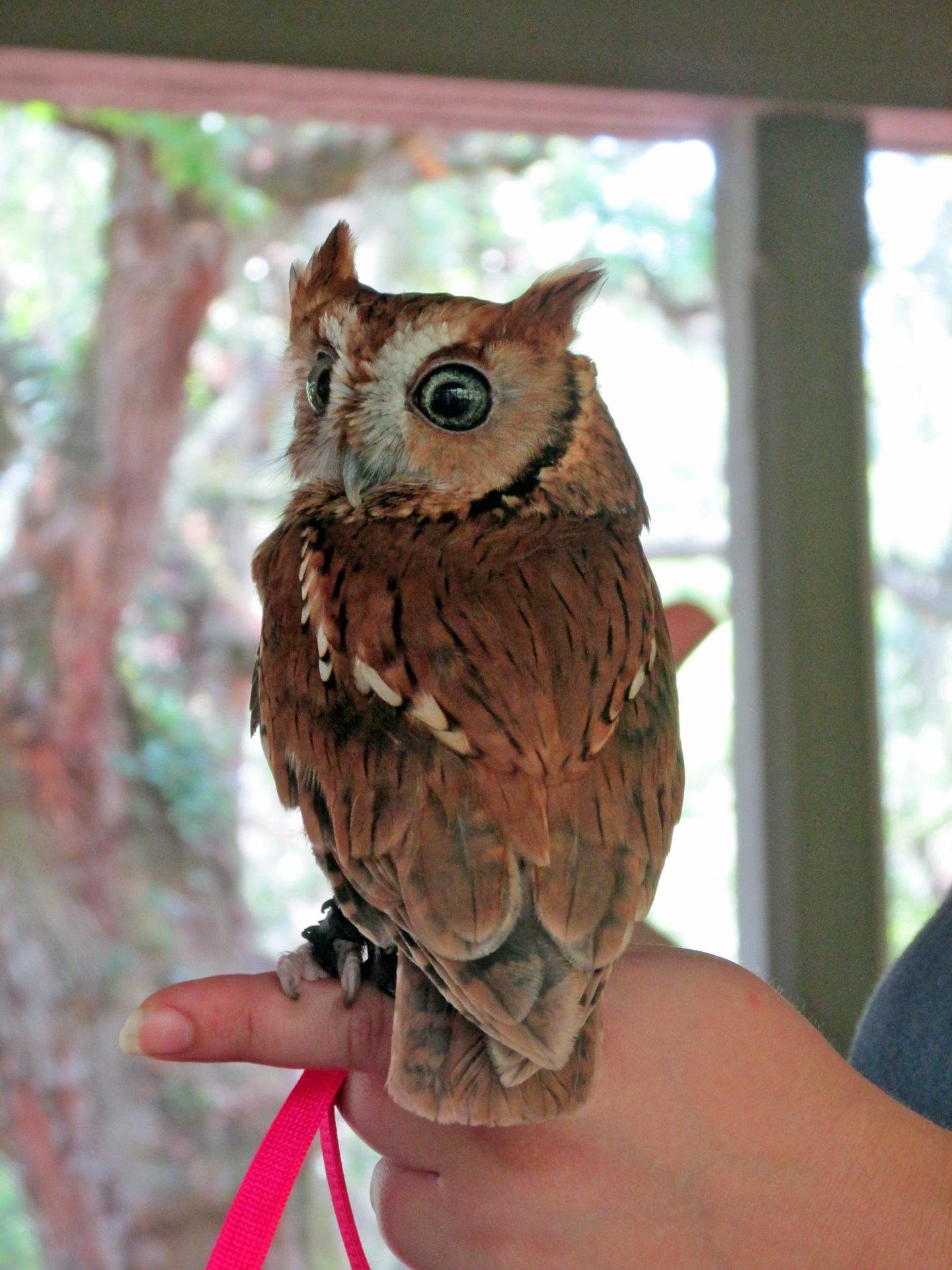
Photo by Bryan Stevens • Lucy, a rehabilitated owl living in captivity at Brookgreen Gardens in South Carolina, educates the public about her fellow owls.

“It’s a beautiful little hunter,” Susan remarked in her email, adding that she would love to have the owl identified. She speculated that the visitor might be a Northern saw-whet owl or boreal owl. The latter would have been far out of range. Saw-whet owl was a possibility considering these tiny owls are known to reside on Unaka Mountain, but a closer study pointed to the identity of the visitor being an Eastern screech-owl.

As Susan pointed out in her email, no ear tufts are prominently visible on the bird in the photo. But any number of reasons could explain the absence of the ear tufts. These tufts, which are actually feathers that the ow can control, help with camouflage or to signal an individual owl’s mood. They can raise their tufts if they want to appear larger and more intimidating or flatten them to blend in with a tree trunk, and they may also flatten them when agitated or in a state of attentiveness.

There’s not a lot in the photo for a size comparison with the bird, but it seemed more the size of a screech-owl than the slightly smaller saw-whet owl. I’ve seen both owls and the saw-whet always strikes me as more dainty than a screech-owl.

An adult Eastern screech-owl is about 10 inches long, which is about the same size as an American robin. The owl, however, is much more sturdily built than the robin. This owl’s wingspan is usually between 18 and 24 inches. Weight varies, but a heavy screech owl weighs only 6 to 8 ounces. That’s equivalent to a cup of water.

Eastern screech-owls come in two color variations, sometimes referred to as “morphs.” These are red or rufous and gray. There is a rare brown variation that may be a hybrid of a red owl and a gray owl. The highest percentage of red screech owls occurs in Tennessee, of all places, with an estimated 79 percent of owls in the Volunteer State being of the red variety. I’ve actually not seen a red morph in many years. My recent sightings have been of gray individuals. The owl in Carl’s photo appears to be a red morph.

Eastern screech-owls are effective predators, or as Susan described them, “beautiful little hunters,” but they mostly tackle small prey, such as house sparrows, mice and large insects.

Owls are more common than we think; we simply don’t encounter them often because of their nocturnal lifestyle. The Eastern screech-owl has proven very adaptable to living in close proximity to human beings.

Many myths have taken root about owls. Some of these are more grounded in reality than others.

Photo by Bryan Stevens
An Eastern Screech-Owl at rest in a roosting hole in a large sycamore tree.

A prevalent belief is that owls are wise. Of course, that’s a relative term. Is it meant they are wiser than other birds or wiser than human beings. According to the website for the International Owl Center, owls are probably seen as wise due to their large eyes, resolute posture and relatively silent behavior. The website acknowledges that owls are good at being owls, but they are stubborn birds when people attempt to train captive specimens to perform tasks.

Not all owls, despite persistent claims, are nocturnal. It’s true, according to the International Owl Center, that a large proportion of owls are nocturnal, meaning they are active at night.

But there are always exceptions. According to the International Owl Center, a few owls are diurnal, meaning they are active during the day, and some others are crepuscular, meaning they are most active at dawn and dusk.

There are approximately 230 to 250 species of owls. There’s some debate among the experts about the exact number. Here are some interesting common names for some of those species: Golden masked owl, ashy-faced owl, white-fronted scops owl, black-capped screech-owl, cinnamon screech owl, snowy owl, Eurasian eagle owl, spectacled owl, mottled wood owl, great grey owl, pearl-spotted owlet, little owl, barking owl, powerful owl, Tasmanian boobook, chocolate boobook, laughing owl, long-eared owl and short-eared owl.

I’ve been hearing two species of owl – Eastern screech-owl and great horned owl – at home this fall. That’s the other thing. You’re much more likely to hear an owl than see one. I don’t mind. It makes this little bird a bit more mysterious, and there’s something to be said to being able to put on an air of mystery.

•••

Share a sighting, ask a question or make a comment by emailing me at ahoodedwarbler@aol.com.

Photo by Bryan Stevens
An Eastern Screech-Owl perches in the branches of an Eastern hemlock.
Why do owls give a hoot? For many reasons

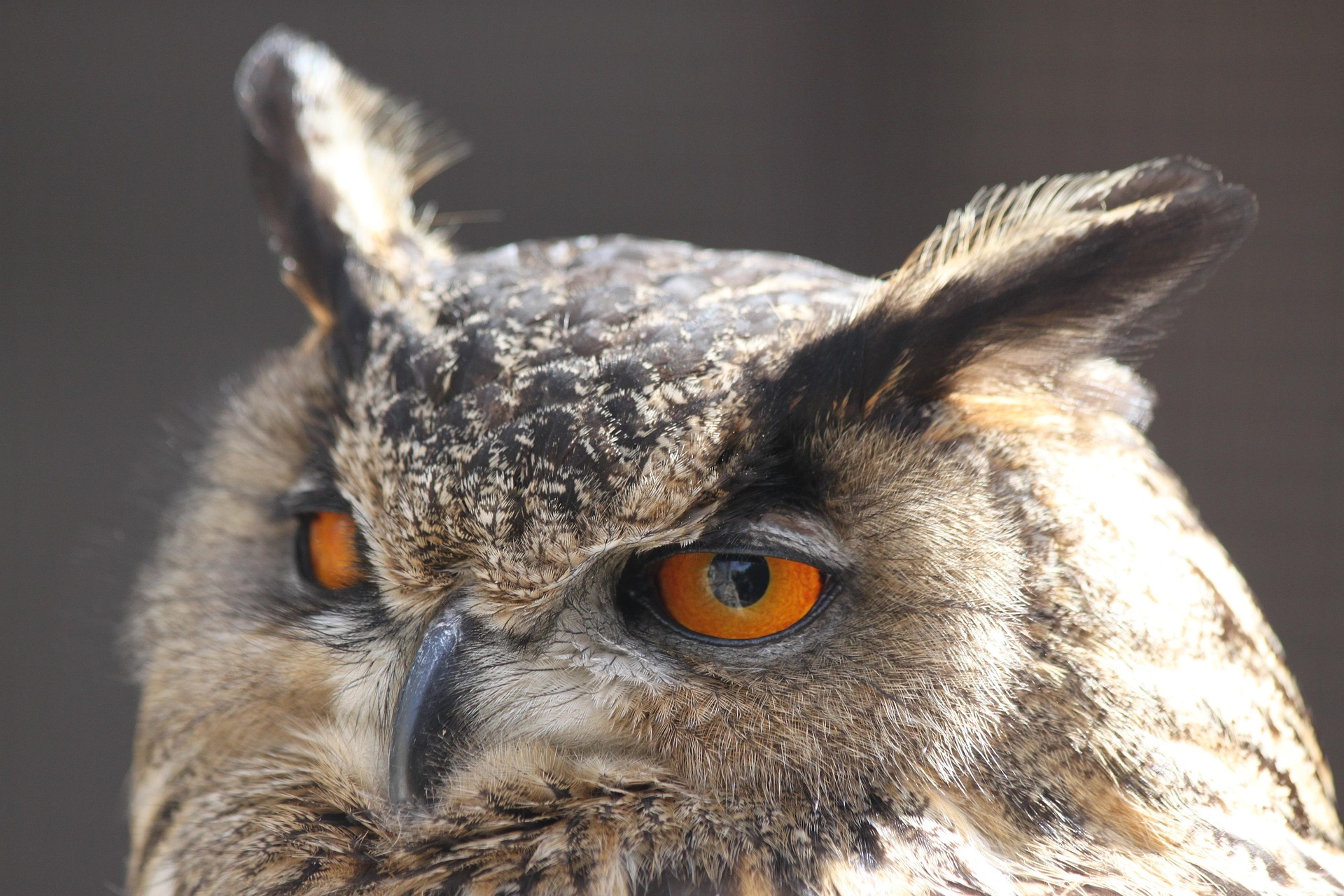
Dave Menke/USFWS Great horned owls, such as this individual, are effective predators after dark.

As September slid into October, the evening serenades began. At first, they consisted of a pair of Eastern screech-owls calling from the surrounding woodlands. On Oct. 2, the low hoots of a great horned owl joined the wailing calls of the two screech-owls.

I’ve gotten into the habit of 10-minute walks in the evening after dinner, and I posted about the owls on my Facebook account.

Several friends responded, including Tom McNeil, a fellow birders and an fellow alumna of Hampton High School.

“We’ve been hearing a pair (of great horned owls) hooting up on the ridge between you and us,” Tom wrote. “We also had a barred owl calling a few weeks ago, which was only the second time ever.”

Tom and his wife, Cathy, reside in the Piney Grove community of Hampton. As he indicated, only a steep mountain ridge separates his property from mine.

That ridge is a magnet for birds, ranging from pileated woodpeckers and wild turkeys to warblers, vireos, tanagers, flycatchers and many other songbirds. The bird population changes with the seasons, but there’s always a diversity of birds making their home on those wooded slopes.

Linda Cauley also responded to my Facebook post, sharing that she also had recently heard a great horned owl.

Larry A. Woodward/USFWS Eastern screech-owl chicks peer from the tree cavity that served as their first home.

Kaylynn Sanford Wilster has also been hearing a great horned owl. “First great horned owl I’ve had here in forever it seems like,” she wrote. “I think there’s just one but I’m not sure.”

Joanne Campbell commented on my post.

“We had a big hoot owl right outside our door last week,” Joanne wrote. “Closest I’ve ever been to one.”

I’d been surprised to hear screech-owls, which are considerably smaller than a great horned owl, calling at the same time as their larger kin. Great horned owls are not finicky and will dine on any smaller creature they can seize in their strong talons. I’d heard that smaller owls usually go silent in the presence of this large nocturnal predator.

Of course, the screech-owls were relatively close to my home while the great horned owl’s calls were notably distant. Perhaps they felt that enough space existed between them to ease any worries.

I also got to wondering why owls are so vocal. A little research came up with some answers.

First, it’s important to note that Eastern screech-owls produce different vocalizations for various purposes. One of my favorites is the “whinny,” a descending call that is, apparently, a territorial display to inform other owls that they have claimed a territory as their own.

At this time of the year, juvenile screech-owls are also striking out on their own away from parental care. These young owls deploy the whinny to establish their own territories. They will need a well-defined territory to ensure they can find enough prey during the lean, cold winter months.

The whinny itself is of short duration, lasting only a couple of seconds. Screech-owls also produce other sounds, which have been described as hoots, barks and squeal.

Another common screech-owl vocalization is an even-pitched trill, often called a “bounce song” or tremolo. I can do a decent job imitating this sound, and I’ve often stirred up songbirds by doing so. A flock will sometimes materialize as if from thin air, as the members of the flock scold and search for the owl. It’s a good way to draw some curious birds closer for observation.

Bryan Stevens Lucy, a rehabilitated owl, helps programmers at Brookgreen Gardens provide educational programs about owls to the public.

Great horned owls, or “hoot owls” as they are widely known, also produce their low, nocturnal calls for many of the same reasons as screech-owls do. These large owls hoot to communicate, with the most common reasons being to define and defend territory, locate and attract a mate during breeding season and stay in contact with their young. Hooting also helps them establish boundaries with other owls and signals their presence, making their calls particularly energetic and frequent in the autumn and winter months when territories are being set up.

Pairs of great horned owls will hoot together as part of their courtship to strengthen their bond. A female owl’s voice is notably higher in pitch than the male’s, according to the website All About Birds. I’m hoping I will soon hear the duet that Tom and Cathy are enjoying on the other side of the ridge. So far, I’ve only detected the one great horned owl. I have heard these mesmerizing duets in the past, however. Listening can produce shivers down the spine. Of course, that is also helped by the fact they most often hoot on evenings once the weather had become more chilly.

The days are shorter, nights are longer, so now is a great time to get familiar with the owls. It can be as easy as stepping onto the front porch and listening.

•••

Bryan Stevens has been writing about birds, birding and birders since 1995. To share a sighting, ask a question or make a comment, email him at ahoodedwarbler@aol.com.

Photo by Irene K-s/Pixabay.com
An Eastern screech owl keeps an eye on its surroundings.

Vocal screech owls are pint-sized predators

Photo by Bryan Stevens • An Eastern screech owl perches on a hemlock branch. These owls are much smaller than such relatives as great horned owl and barred owl.

It’s been my pleasure to enjoy almost daily serenades by an Eastern screech owl residing in the woods around my home. The small owl’s shivery wailing calls usually start around dusk and can continue at intervals throughout the night.

Back in September while I watched almost daily for migrants from a lawn chair, I heard on a couple of occasions the “early bird” owls calling occasionally from shady wooded areas. The owls tended to call more often during the daytime when conditions were overcast.

I always pause and listen when I hear the wailing and haunting vocalizations of the screech-owls that make their home in the woodlands that surround my home. I’m glad to have this small owl as a neighbor, but I fully realize that owls have suffered from a dark reputation in certain corners. The fact is, unless you are a small rodent or some sort of insect-sized prey, the Eastern screech-owl makes an excellent addition to the neighborhood.

On the verge of Halloween, a closer look at this small owl is warranted. An adult Eastern screech owl is usually only between six and nine inches in length. Many people upon first seeing a screech-owl assume it’s a baby owl. During past trips to Brookgreen Gardens in South Carolina, I have enjoyed attending the daily educational programs conducted by the zoo staff at Brookgreen. These programs are designed to introduce visitors to various examples of native wildlife. The presenter usually introduced a couple of animals to the audience. On several occasions, the show featured birds of prey, including hawks and owls.

Photo by Irene K-s/Pixabay.com • An Eastern screech owl keeps an eye on its surroundings.

Two of the shows during my visit to Brookgreen back in 2019 featured Lucy, an Eastern screech-owl, and people in the audience invariably asked if she was a baby owl. To their astonishment, they learned that Lucy was an adult screech-owl and unlikely to grow any bigger.

There are larger owls in our region, including the great horned owl and barred owl. Lucy and her kin must avoid these much larger owls, which would not scruple at making a meal of the much smaller owl.

Because of their small size, screech-owls prey on some comparatively small creatures, including insects, small rodents, amphibians, songbirds and reptiles. The Eastern screech-owl is also a cavity-nesting bird and will accept bird boxes provided by humans so long as the box’s entrance hole is customized to their size.

The screech owl is the owl most likely to encounter human beings. It’s an adaptable little feathered predator, just as much at home in the backyard and garden as it is in parks and woodlands. In addition to nesting in cavities, this owl roosts in them during the daytime hours. Look for roosting screech-owls in knotholes of trees or in unoccupied wood duck boxes. Although they come in two color phases — red and gray — both variations are quite capable of camouflage. When perched or roosting, these small owls blend remarkably with their surroundings.

The Eastern screech owl also produces a variety of odd wails and other vocalizations including a distinctive, trembling “whinny” call that is often made when the owl feels curious or alarmed. It’s a wavering, haunting call that is made after dark, most often at the hours closer to dawn and dusk. Imitating the call of a screech-owl or playing a recording is also a trick for getting some shy songbirds to show themselves. Screech owls are not-so-welcome co-habitants among my yard’s songbirds, which will flock to this owl’s call and band together to “mob” the predator and try to convince it to depart the immediate area.

As small as the Eastern screech-owl is, the United States is home to several other pint-sized owls, including Western screech-owl, Northern pygmy-owl, Northern saw-whet owl, flammulated owl and elf owl, which at six inches tall and a weight of less than an ounce qualifies as the world’s smallest owl.

Photo by U.S. Fish and Wildlife Service • The tiny Northern Saw-whet Owl nests on several of the region’s higher mountains.

Any time I finish listening to a calling owl and go back indoors for the evening, I reflect on the fact that screech-owls make good neighbors. Their prey preferences remove many nuisance insects and rodents from the habitat they share with humans as well as other wildlife. If you’re hearing an odd, winnowing call from the edge of the woods at your own home, there’s a good chance that you have one of these small owls as a neighbor.

Keep alert for these small owls and their larger kin as we observe this year’s Halloween holiday, as well as other days and nights throughout the year.

•••

To learn more about birds and other topics from the natural world, friend Bryan Stevens on Facebook at https://www.facebook.com/ahoodedwarbler. He enjoys posting about local birds, wildlife, flowers, insects and much more. If you have a question, wish to make a comment or share a sighting, email him at ahoodedwarbler@aol.com.

Holly Keepers/USFWS • A red Eastern screech owl peeks from a perch among some evergreen branches.

Screech-owls are tiny terrors in the dark

Photo by Irene K-s/Pixabay.com • An Eastern screech owl keeps an eye on its surroundings.

I’ve been listening to almost daily serenades by an Eastern screech-owl in the woods around my home. The wailing, trembling vocalization usually starts around dusk and can continue at intervals throughout the night. As a half moon rose in the darkening sky on the evening of Oct. 22, I paused a few moments to listen to the wailing and haunting vocalizations of two different screech-owls from the edges of the woods.

I’m glad to have this small owl as a neighbor, but I fully realize that owls have suffered from a dark reputation in certain corners. The fact is, unless you are a small rodent or some sort of insect-sized prey, the Eastern screech-owl makes an excellent neighbor.

Photo by Bryan Stevens • An Eastern screech-owl perches in the branches of an Eastern hemlock.

On the verge of Halloween, a closer look at this small owl is warranted. An adult Eastern screech-owl is usually only between six and nine inches in length. Many people upon first seeing a screech-owl assume it’s a baby owl. During past trips to Brookgreen Gardens in South Carolina, I have enjoyed attending the daily educational programs conducted by the zoo staff at Brookgreen. These programs are designed to introduce visitors to various examples of native wildlife. The presenter usually introduced a couple of animals to the audience. On several occasions, the show featured birds of prey, including hawks and owls.

Two of the shows during my visit to Brookgreen back in 2019 featured Lucy, an Eastern screech-owl, and people in the audience invariably asked if she was a baby owl. To their astonishment, they learned that Lucy was an adult screech-owl and unlikely to grow any bigger. There are larger owls in our region, including the great horned owl and barred owl. Lucy and her kin must avoid these much larger owls, which would not scruple at making a meal of the much smaller owl.

Photo by Bryan Stevens • Lucy, a red Eastern screech-owl at Brookgreen Gardens.

Because of their small size, screech-owls prey on some comparatively small creatures, including insects, small rodents, amphibians, songbirds and reptiles. The Eastern screech-owl is also a cavity-nesting bird and will accept bird boxes provided by humans so long as the box’s entrance hole is customized to their size.

The screech-owl is the owl most likely to encounter human beings. It’s an adaptable little feathered predator, fully as at home in the backyard and garden as it is in parks and woodlands. In addition to nesting in cavities, this owl roosts in them during the daytime hours. Look for roosting screech-owls in knotholes of trees or in unoccupied wood duck boxes. Although they come in two color phases — red and gray — both variations are quite capable of camouflage. When perched or roosting, these small owls blend remarkably with their surroundings.

The Eastern screech owl also produces a variety of odd wails and other vocalizations including a distinctive, trembling “whinny” call that is often made when the owl feels curious or alarmed. It’s a wavering, haunting call that is made after dark, most often at the hours closer to dawn and dusk. Imitating the call of a screech-owl or playing a recording is also a trick for getting some shy songbirds to show themselves. Screech-owls are not-so-welcome neighbors among my yard’s songbirds, which will flock to this owl’s call and band together to “mob” the predator and try to convince it to depart the immediate area.

In addition to the Eastern screech-owl, the United States is also home to several other small owls, including Western screech-owl, Northern pygmy-owl, Northern saw-whet owl, flammulated owl and elf owl, which at six inches tall and a weight of less than an ounce qualifies as the world’s smallest owl.

When I finished listening to the recent owl duet and returned indoors for the evening, I reflected on the fact that screech-owls make good neighbors. Their prey preferences remove many nuisance insects and rodents from the habitat they share with humans as well as other wildlife. If you’re hearing an odd, winnowing call from the edge of the woods at your own home, there’s a good chance that you have one of these small owls as a neighbor. Keep alert for these small owls as we approach this year’s Halloween.

•••••

To learn more about birds and other topics from the natural world, friend Stevens on Facebook at https://www.facebook.com/ahoodedwarbler. He is always posting about local birds, wildlife, flowers, insects and much more. If you have a question, wish to make a comment or share a sighting, email ahoodedwarbler@aol.com.

Photo by Bryan Stevens • An Eastern screech-owl at rest in a roosting hole in a large sycamore tree.

Dark reputation of world’s owls is being rehabilitated as people learn more about them and their habits


greathornedowl-2

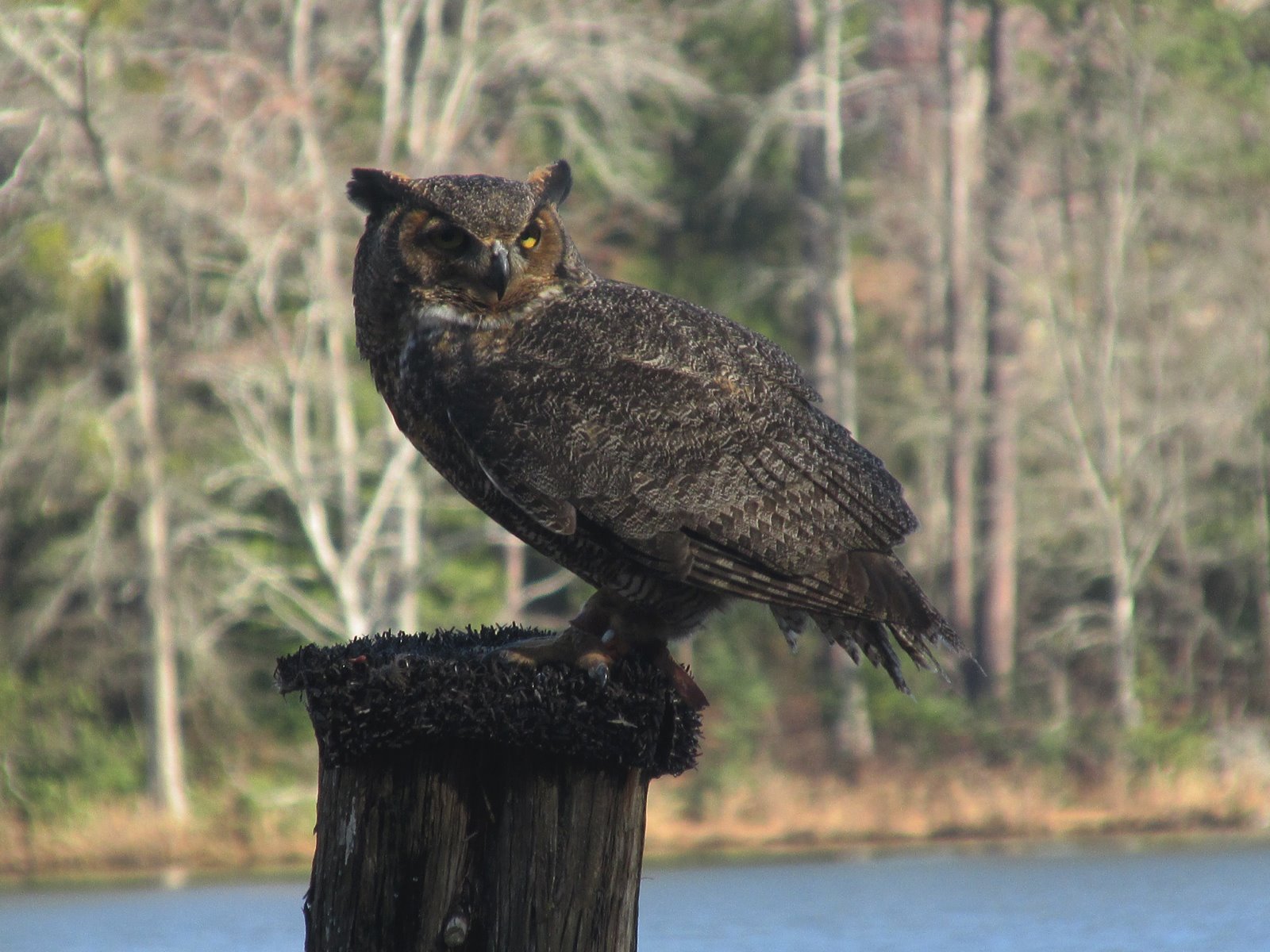
Photo by Bryan Stevens / A great horned owl perches on a post during its part in a wild bird show at Callaway Gardens in Pine Mountain, Georgia.

As I sit at my computer working on this week’s post, I can hear the low, sonorous call of a great horned owl from the woods located behind my house. The great horned owl is one of two species I often hear near my home. In addition, I regularly hear the much smaller Eastern screech-owl calling from the same woods. The intervals around dusk and dawn are popular times for owls to produce their eerie calls. At present, there’s a pair of great horned owls living in the woods near my home. If I hear one, I usually hear the other. These large owls call to each other to communicate their whereabouts. Perhaps it helps them avoid surprise encounters with each other once they begin hunting after the sun sets.

The great horned owl lives and hunts in the woodlands of northeast Tennessee, southwest Virginia and western North Carolina. These large owls thrive in rural areas, but these adaptable predatory birds have also learned to survive in the suburbs and even city parks. While quite at home in the region, the great horned owl is not confined to the Southern Appalachians. These owls also make their home in the wetlands along the southern Atlantic coast, as well as arid deserts of the American southwest. If nothing else, the great horned owl has shown amazing resilience and adaptability.

With about 200 different species, the world’s owls form an order known as Strigiformes. Characteristics that define owls include a mostly solitary and nocturnal existence. These predatory birds are also typified by such physical traits as an upright stance, binocular vision, exceptional hearing, sharp talons, and feathers adapted for silent flight.

BarredOwl-Perched

Photo by Bryan Stevens / A Barred Owl blends with the background in this photo taken of a wild owl at Brookgreen Gardens in South Carolina.

The smallest owl — weighing as little as an ounce and measuring a mere five inches) — is the elf owl (Micrathene whitneyi). To give you some perspective, that DVD of your favorite movie also weighs about an ounce. The common house sparrow that flocks in shopping center parking lots is slightly bigger than this tiny owl. According to the website, The Owl Page, the elf owl was originally known as Whitney’s Owl. The scientific name whitneyi is a Latinized word formed from the last name of Josiah Dwight Whitney, a prominent American geologist for whom the diminutive owl was named. Whitney was considered the foremost authority of his day on the economic geology of the United States. In addition to having a tiny owl named in his honor, Whitney’s name graces Mount Whitney, the highest point in the continental United States, and the Whitney Glacier, which was the first confirmed glacier in the United States.

The miniature elf owl is every bit the predator, but its prey generally consists of various insects as well as such desert dwellers as scorpions and spiders. Despite the extremes of the environment in which it lives, the elf owl does just fine. It prefers areas offering plenty of saguaro cactus. Cavities in these iconic desert plants provide roosting and nesting locations for this tiny owl. The elf owl range from the southwest regions of the United States to Central Mexico and Baja California. Unfortunately, the numbers of this owl in Texas and California have declined in recent times.33ecc634b6bf2f56939e0c28a1e0c6c0

To find the world’s largest owl, head to the other side of the world to the islands of Japan, as well as remote areas of Siberia, Manchuria and Korea. With a body comparable in size to that of a young child and a wingspan wider than six feet, the Blakiston’s fish owl (Bubo blakistoni) earns its distinction as the largest owl in the world. The fish owls are part of a larger grouping of birds known as eagle owls, which specialize in hunting in habitats found along large rivers. Female Blakiston’s fish owls are larger than males, and a large female can weigh as much as 10 pounds and attain a 6.5-foot wingspan. This big owl was named after English naturalist Thomas Blakiston (1832-1891) who found the first specimen on Japan’s northern island of Hokkaido in 1883. According to Paul Frost of The Raptor Foundation, this owl is sacred to the Ainu, a native people residing on Hokkaidu. The Ainu refer to this owl as “kotan kor kamuy,” which means “god of the village” or “god who defends the village”.

While many culture view owls with misgivings, often associating their nocturnal tendencies with more sinister motives, that’s not always the case. For instance, the Japanese people believe that owls bring good fortune. In addition, owls offer protection from suffering. Other cultures have feared and reviled owls. The ancient Romans share much of the blame for the negative image owls are still overcoming. Romans considered owls as harbingers of death, defeat and other disasters. To ward off the evil caused by an owl, Romans advised that the offending owl should be killed and nailed to a door. Such a bloodthirsty solution leads me to think that owls had more to fear from Romans than Romans had to fear from them.

The need for common names for the 200 species of owls has resulted in some creative monikers. Some of the most descriptive common names for some of the world’s owls include ashy-faced barn owl, barking owl, brown owl, cuckoo owlet, fearful owl, giant eagle owl, Christmas Island hawk owl, snowy owl, laughing owl, rufous owl, tawny-bellied screech owl, winking owl, and spotted wood owl.

great_horned_owl_and_chick-2

Photo by George Gentry/U.S. Fish and Wildlife Service / A Great Horned Owl is shown on the nest with one of her chicks.

Many relatives of the great horned owl have proven equally adaptive, carving out niches for themselves in habitats as diverse as jungles, deserts and the frozen tundra. Indeed, the great horned owl has many relatives living in our region. The Eastern screech owl is a tiny cousin, but some other large owls that live in the area include the barred owl and the barn owl. More rare to the region are visits by such owls as the short-eared owl and the long-eared owl. There’s even another tiny relative — the Northern saw whet owl — that is rarely heard and even more seldom seen.

Regardless of the species, the activities of owls are invariably cloaked in darkness. Despite electric lights and other trappings of civilization, people still delight in the shivers that result from hearing the hoots of an owl. It’s truly no surprise that owls have become popular motifs in the weeks leading up to our recent celebration of the Halloween holiday. Owls may live alongside us, but we’ll never truly belong to their world, which consists of all the spooky things that go bump in the night.

•••••

Bryan Stevens lives near Roan Mountain, Tennessee. If you have a question, wish to make a comment or share a sighting, email ahoodedwarbler@aol.com. Find him on Facebook at https://www.facebook.com/ahoodedwarbler.

Tremulous call of Eastern screech-owl baffles couple

Photo by Bryan Stevens An Eastern Screech-Owl at rest in a roosting hole in a large sycamore tree.

Photo by Bryan Stevens
An Eastern Screech-Owl at rest in a roosting hole in a large sycamore tree.

I received a recent email from Lewis Chapman seeking help in solving the identity of a nocturnal caller. Chapman and his wife moved to Laurel Bloomery in Johnson County, Tennessee, in late June.

“Shortly after we arrived we started hearing a strange night bird call that could best be described as an eerie winnowing,” he wrote in his email. After the couple conducted some Internet research into the mysterious after-hours vocalist, his wife suggested the caller might be a snipe.

As mentioned in previous columns, the snipe is a real bird despite its reputation as a mythical creature thanks to the rural tradition of the “snipe hunt.” While the calling bird at their home did remind them of a Wilson’s snipe, they were not convinced.

“Is this the right time of year to be hearing one in our area?” Lewis asked in his email. “Is there another bird that makes this kind of winnowing?” Both of his astute questions helped me narrow the possibilities.

In my reply, I did inform Lewis that the Wilson’s snipe, as well as the closely related American woodcock, make their home in the region. The summer season, however, isn’t the best time of year to hear either of these relatively elusive shorebirds. These birds are most vocal at the peak of their breeding season, which usually occurs much earlier in the year.

Screech-Owl-LUCY

Photo by Bryan Stevens                     Lucy, an Eastern screech-owl, is part of an educational program at Brookgreen Gardens in South Carolina that teaches audiences some fascinating information about native wildlife. For instance, despite her small size, Lucy is an adult owl, not a baby.


It was his second question, especially the description of the “winnowing” sound, that got me thinking in an entirely different direction. It also helped that I’ve heard some of these small, nocturnal vocalists at my own home in recent weeks. I suggested that the Chapmans get online and look up the song and other vocalizations of the Eastern Screech-owl.

An adult Eastern screech-owl is usually only between six and nine inches in length. Many people upon first seeing a screech-owl assume it’s a baby owl. On a recent South Carolina trip I made several visits to Brookgreen Gardens near Pawleys Island. On several of these visits I attended the daily educational programs conducted by the zoo staff at the gardens that are designed to introduce visitors to various examples of native wildlife. The presenter usually introduced a couple of animals to the audience. On several occasions, the show featured birds of prey, including hawks and owls.

Two of the shows featured Lucy, an Eastern screech-owl, and people in the audience invariably asked if she was a baby owl. To their astonishment, they learned that Lucy was an adult screech-owl and unlikely to grow any bigger. There are larger owls in our region, including the great horned owl and barred owl. Lucy and her kin must avoid these much larger owls, which would have no hesitation at trying to make a meal of the much smaller owl.

Because of their small size, screech-owls prey on some comparatively small creatures, including insects, small rodents, amphibians and reptiles. The Eastern screech-owl is also a cavity-nesting bird and will accept bird boxes provided by humans so long as the box’s entrance hole is customized to their size.

Screech-Owl

Photo by Bryan Stevens                                      An Eastern Screech-owl perches among some hemlock branches.

The screech-owl is probably the owl most likely to encounter human beings. It’s an adaptable little feathered predator, fully as at home in the backyard and garden as it is in parks and woodlands. In addition to nesting in cavities, this owl roosts in them during the daytime hours. Look for roosting screech-owls in knotholes of trees or in unoccupied wood duck boxes. Although they come in two color phases — red and gray — both variations are quite capable of camouflage. When perched or roosting, these small owls blend remarkably with their surroundings.

The Eastern screech owl also produces a variety of odd wails and other vocalizations including a distinctive, trembling “whinny” call that is often made when the owl feels curious or alarmed. It’s a wavering, haunting call that is made after dark, most often at the hours closer to dawn and dusk. Imitating the call of a screech-owl or playing a recording is also a trick for getting some shy songbirds to show themselves. Screech-owls are unwelcome neighbors among songbirds, which will flock to this owl’s call and band together to “mob” the predator and try to convince it to depart the immediate area.

In addition to the Eastern screech-owl, the United States is also home to several other small owls, including Western screech-owl, Northern pygmy-owl, Northern saw-whet owl, flammulated owl and elf owl.

After I pointed to the screech-owl as the identity of the unseen caller at the Chapman home, I did receive another email from Lewis. My suggestion of the screech-owl proved correct. “It’s fun having the Eastern screech-owl in our woods,” he wrote back. “It has a beautiful call and most nights it does it for quite awhile.”

Audubon-Owls

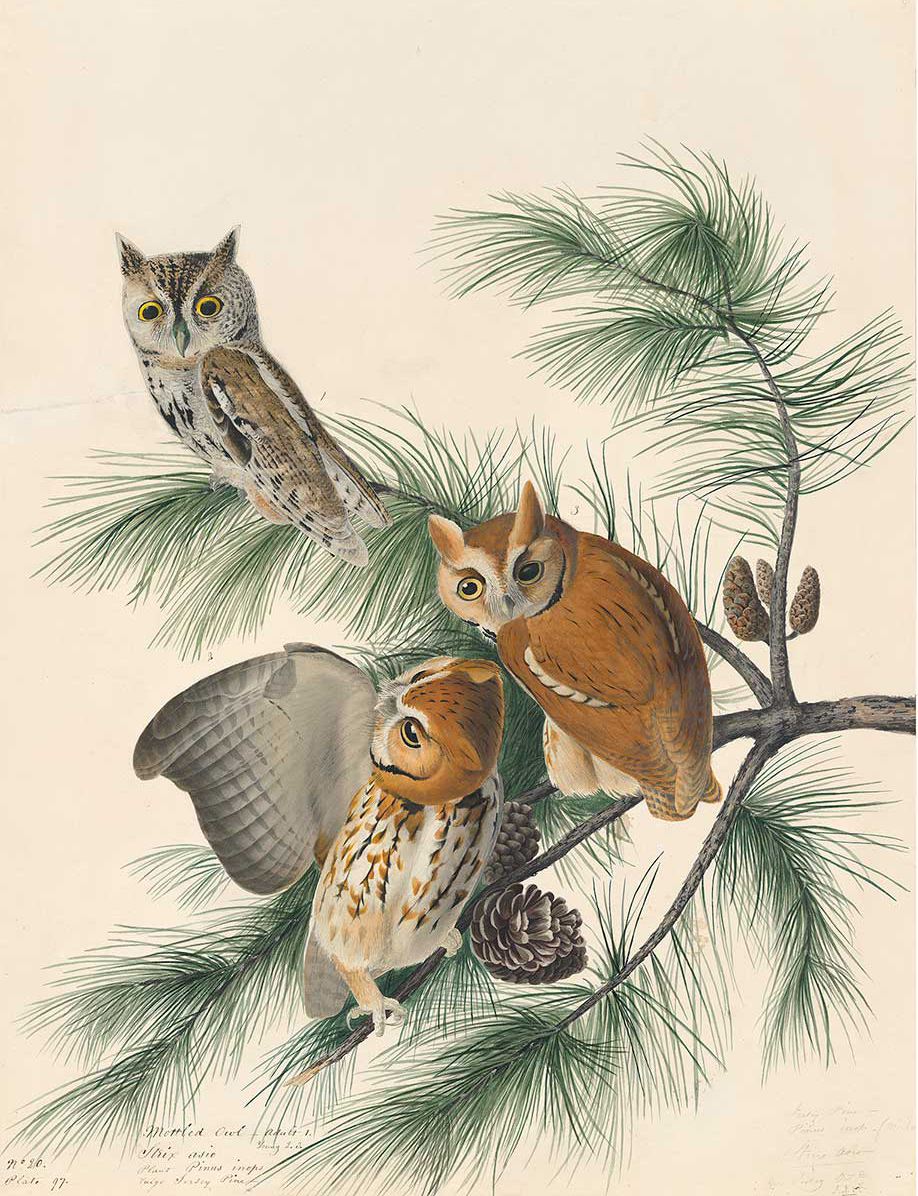
Early naturalist and artist John James Audubon painted a family of Eastern Screech-owls.

Screech-owls do make good neighbors. Their prey preferences remove many nuisance insects and rodents from the habitat they share with humans as well as other wildlife. If you’re hearing an odd, winnowing call from the edge of the woods at your own home, there’s a good chance that you have one of these small owls as a neighbor.

Since moving to Laurel Bloomery, the Chapmans have already seen many great backyard birds, including indigo bunting, great crested flycatcher, ruby-throated hummingbird, house wren, black-and-white warbler, pileated woodpecker and chipping sparrow. Now they can also add Eastern screech-owl to the list. Who knows? They may some day also add a Wilson’s snipe to their yard list of birds.

•••••

To learn more about birds and other topics from the natural world, friend Stevens on Facebook at https://www.facebook.com/ahoodedwarbler. He is always posting about local birds, wildlife, flowers, insects and much more. If you have a question, wish to make a comment or share a sighting, email ahoodedwarbler@aol.com.

Owls perfectly suited to reign once the sun sets

It was a frosty morning on Simerly Creek on Oct. 20, and the sunrise had given a pink hue to some overhead clouds for a nice enhancement of the morning. From the wooded hollow across the road, I heard a very vocal Eastern Screech-Owl greeting the day with trembling wails. Although Eastern Screech-Owls are normally nocturnal, they can be most active within a couple of hours of both sunset and sunrise. Although I was headed to work, perhaps this particular owl was, in its own way, sending a message of “Good night and sleep tight.”

Photo by U.S. Fish and Wildlife Service The tiny Northern Saw-whet Owl nests on several of the region's higher mountains.

Photo by U.S. Fish and Wildlife Service
The tiny Northern Saw-whet Owl nests on several of the region’s higher mountains.

The calling owl also reminded me that we’ll celebrate Halloween later this week. It’s the one night of the year that we become acutely aware of things that go bump in the night. Of course, what you must also take into consideration are those nocturnal birds that glide through the darkness on nearly silent wings.

Ghouls and goblins can be dismissed as mere apparitions of the imagination. Some real-life feathered phantoms, however, do roam the darkness, perhaps even in your own backyard. Chances are, you have more likely heard them rather than to have seen them.

If you do happen to hear anything slightly unusual this coming Halloween night, listen carefully. It’s a safe bet that the sound — whether it’s a deep, resonant hoot or a trembling wail — might just be produced by an owl.
Several species of owls reside in Southwest Virginia and Northeast Tennessee, including Eastern screech-owl, barred owl, barn owl and great horned owl. A fifth owl, the tiny Northern saw-whet owl, can be found at some high-elevation locations. A few other owls have made sporadic appearances in the region, including long-eared owl, short-eared owl and even snowy owl.

Photo by Bryan Stevens An Eastern Screech-Owl perches in the branches of an Eastern hemlock.

Photo by Bryan Stevens
An Eastern Screech-Owl perches in the branches of an Eastern hemlock.

The most common — and two of my favorites — are the large great horned owl and the small Eastern screech-owl.

The great horned owl is widespread in the Americas and is one of the more frequently encountered owls in the region. A fearsome nocturnal predator, the great horned owl has rightly earned the name “Tiger of the Night.”

1602056_10202525845179781_102132457_o

Photo by Bryan Stevens A Great Horned Owl surveys the audience during a raptor show at Callaway Gardens in Pine Mountain, Ga.

Although rabbits are its most common prey, this large owl is not a finicky predator. This owl has been known to capture and consume everything from armadillos and muskrats to great blue herons and young American alligators. They will also prey on various amphibians, fish, crustaceans and even insects. The great horned owl is also known to prey on smaller owls, which includes almost all of the other owls found in the region.
All owls are extremely beneficial predators. The tiny Eastern screech-owl feeds on mice, insects, lizards, crayfish and the occasional bird. If not for owls and other predators, prey species — whether rodents or insects — would multiply beyond the means of the environment to support them. Anyone facing the problem of mice and rats seeking an easier living inside a human home can appreciate the role played by predatory owls.
Although the Eastern screech-owl’s only about 10 inches long, it has a wingspan of 20 to 24 inches. By comparison, the great horned owl is about 25 inches long with an equally impressive wingspan of between three and five feet. The structure of an owl’s feathers are what enables these winged predators to fly silently through the shadows.

Otus_asio_audubon

Early naturalist John James Audubon painted this family of Eastern Screech-Owls.

Many species of owls have proven capable of thriving even in the face of human alteration of the environment. Both the great horned owl and the Eastern screech-owl are known to hunt in both rural and urban areas. They also can make a home in a suburban park. In fact, the great horned owl has proven extremely adaptable and can be found in such varied habitats as forests, swamps and deserts.
For the average person the term “owl” is representative of what is actually an extremely diverse family of birds. Worldwide, there are about 220 species of owls varying in size and habits.
In North America owls range in size from such tiny species as the sparrow-sized elf owl of the southwestern United States to the continent-ranging great horned owl. Humans have come up with some descriptive names for various owls around the world. A sampling of these names includes fearful owl, pharaoh eagle-owl, collared owlet, pearl-spotted owlet, least pygmy-owl, red-chested owlet, buff-fronted owl, Stygian owl, vermiculated fishing-owl, black-and-white owl, bare-legged owl, maned owl, bearded screech-owl, spectacled owl and golden-masked owl.
Most people become aware of the presence of an owl by hearing its call. Not all owls, however, produce a “who who” call. For instance, the Eastern screech-owl’s calls are haunting, shivering wails. The deep hoots of a great horned owl are incredibly impressive. The barred owl boasts quite a vocabulary of calls, including hoots, cackles and chilling screams.

Photo by Bryan Stevens A Barred Owl rests on a perch during an educational raptor program offered at Callaway Gardens in Pine Mountain, Ga.

Photo by Bryan Stevens
A Barred Owl rests on a perch during an educational raptor program offered at Callaway Gardens in Pine Mountain, Ga.

I’ve seen great horned owls in Tennessee, Virginia, South Carolina and Utah in environments ranging from woodlands to coastal wetlands. This owl is one of the first birds to nest each year, starting as early as late January and early February.

Owls, according to Linda Spencer, author of “Knock on Wood: A Serendipitous Selection of Superstitions,” have inspired a mixed bag of superstitions ever since humans stood up. Owls have long been associated with the forces of both good and evil. The “hoot” or call of an owl is believed by people of many cultures to foretell death. There are some interesting ways to counter the ominous hoot of an owl, according to Spencer. Means of warding off the evil owl power include putting irons in your fire, throwing salt, pepper and vinegar on the fire, tying a knot or taking one’s clothes off, turning them inside out and putting them back on.

According to Laura Martin, author of “The Folklore of Birds,” one of the earliest human drawings depicting owls dates back to the early Paleolithic period. The scene is of a family of snowy owls painted on a cave wall in France.

13922

Owls have also entered the culture as symbols of wisdom and goodness. The wise old owl, Martin writes, dates back to the time of King Arthur. Martin also notes that the sorcerer Merlin was always shown with an owl on his shoulder. She also explains that during the Middle Ages owls became symbols of learning and intelligence. Martin also reveals that Greeks didn’t fear owls as did the Romans. In fact, the owl was the sacred mascot of the Greek goddess of wisdom, Athena.
She also delves into owl lore in Japan, where pictures and figures of owls are placed in homes to ward off famine or epidemics. There is some logic to this practice since owls can help prevent such disasters by keeping rodents in check. As well as being carriers of disease, rodents can deplete stores of grain.

Photo by Bryan Stevens A Burrowing Owl photographed in 2006 at Antelope Island State Park in Utah.

Photo by Bryan Stevens
A Burrowing Owl photographed in 2006 at Antelope Island State Park in Utah.

The main fascination humans hold for owls rests in their mystery. Owls, as mainly nocturnal creatures, rarely cross paths with us.

Owls have many adaptations that help them stake out their claim on the night hours. Owls possess large eyes with binocular vision and extremely accurate depth perception — which also make them seem more expressive to human observers.
Owls cannot completely rotate their heads, but they come close. Owls are flexible enough to be able to turn their heads in a 270-degree arc, or three-quarters of the way around.
Owls have keen hearing to go with their excellent eyesight. In fact, owls don’t even need to see their prey to capture it. Tests with barn owls in total darkness have shown that they are capable of catching mice by hearing alone. An owl’s prominent facial disk directs sounds toward their ears. The “ear tufts” on the great horned owl and some other relatives are ornamental feathers, and not actual ears.
There’s one more owl-related myth I forgot to mention. There’s a Chinese belief that owls snatch the souls of unwary people — just something you should know if you are out and about after dark on Halloween night.

Photo by Bryan Stevens An Eastern Screech-Owl at rest in a roosting hole in a large sycamore tree.

Photo by Bryan Stevens
An Eastern Screech-Owl at rest in a roosting hole in a large sycamore tree.