Tag Archives: Louisiana Waterthrush

Northern waterthrush provides warbler watching highlight

Photo by Bryan Stevens • Even in migration, both waterthrushes like to stay near water. This Northern waterthrush was photographed along the linear trail in Erwin, Tennessee.

My usual pastime of fall warbler watching declined somewhat this season, for a variety of reasons.

Time, that commodity so rare for many of us, played a part. It’s also more difficult these days to spot the movements of these swift, energetic birds in dense foliage. A vision problem that developed this past February that I have detailed in earlier columns hampered me.

My hearing’s still good, knock on wood, and I managed to hear quite a few warblers this autumn, including hooded warbler, black-throated blue warbler and Northern waterthrush.

So, I spent less time watching for the warblers this autumn and saw fewer warblers. There’s probably a connection.

I did manage to spot a few reliable favorites. I added a Northern waterthrush on a recent misty morning with that chill in the air so associated with the transition of seasons.

This warbler produces a rather loud “chunk!” chip note that’s distinctive enough to alert birders to the presence of one of these birds.

Photo by Bryan Stevens • The Northern waterthrush, pictured, has a beige eye line rather than the white one usually shown by the Louisiana waterthrush.

With some patience, I got a decent look at the Northern waterthrush, which is a migrant through the region in both spring and fall. Northern waterthrushes frequent wet habitats with dense ground cover. In migration, even a puddle or a damp thicket is enough to attract one of these warblers. My recent sighting took place in the branches of a sprawling yew tree adjacent to a creek.

The related Louisiana waterthrush is a summer resident – and one of the first warblers to return each spring – that nests in the region. The two waterthrushes are very similar in appearance. The Louisiana waterthrush has a heavier bill and a white eye line, while the Northern waterthrush’s eye line is usually somewhat yellowish-beige. A Louisiana waterthrush typically also has a whiter belly and underparts.

The two waterthrushes are the only species in the genus Parkesia, so named to honor American ornithologist Kenneth C. Parkes, who was for many years Curator of Birds at Carnegie Museum of Natural History.

The common name of the Louisiana waterthrush is not a very apt one, as this bird does not have any special affinity for the state of Louisiana. Someone collected some of the early specimens of the Louisiana waterthrush in its namesake location, and the name has stuck through the years.

According to the website All About Birds, Northern waterthrushes are numerous, and their population has grown by an estimated 54% since 1970. Partners in Flight estimates the global breeding population at 17 million. The species rates an 8 out of 20 on the Continental Concern Score, indicating it is a species of low conservation concern.

Songbirds usually lead brief lives, but the oldest recorded Northern waterthrush was at least 8 years, 11 months old when it was recaptured and re-released during banding operations in Michigan in 1987, according to All About Birds. The bird had been banded originally in Ontario, Canada, in 1978.

Northern waterthrushes migrate through the region throughout October, so there’s still a window open for seeing one. Search near quiet water surrounded by thickets and listen for that chip note.

•••

To ask a question, share a sighting of make a comment, email me at ahoodedwarbler@aol.com.
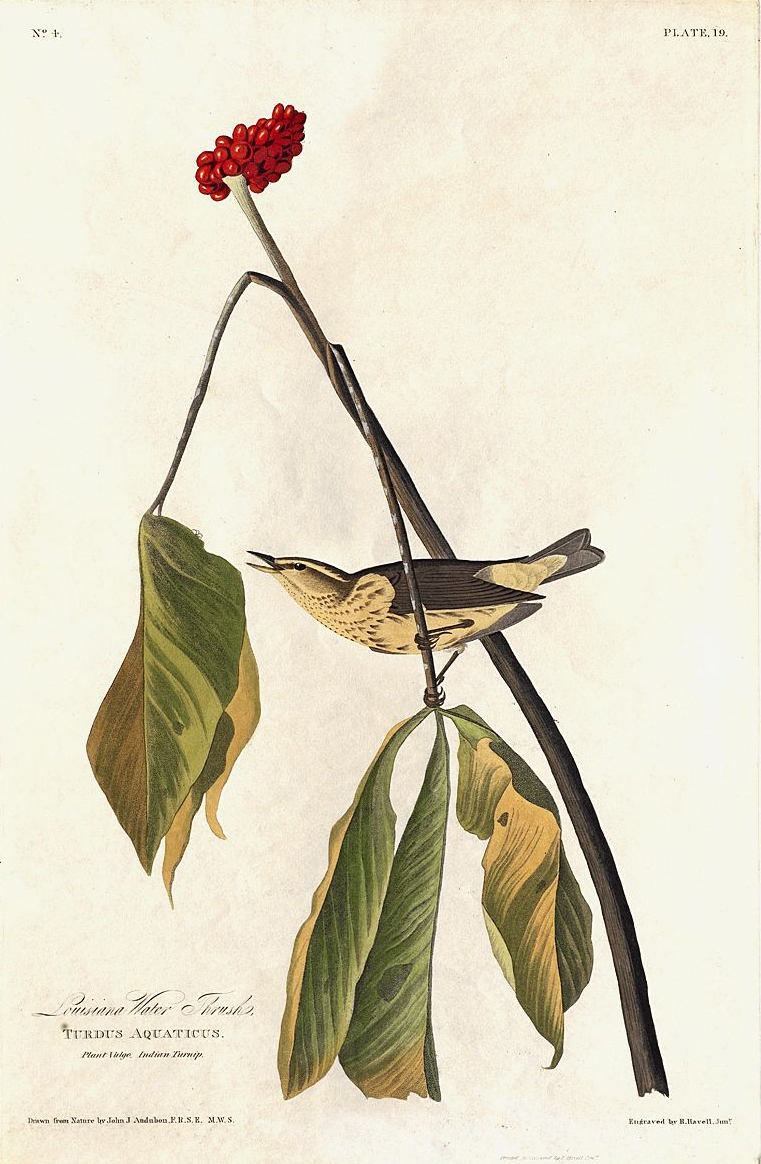
Early artist and naturalist John James Audubon painted this Louisiana waterthrush.

Reader’s mystery bird turns out to be Louisiana waterthrush

On occasion, readers seek out my help with identifying birds they encounter. I am always glad to assist. Photographs, a recording of the bird’s song, or even a well-written description are often all that’s necessary to pinpoint the identities of mystery birds.

Lewis and Jeana Chapman, residents of Laurel Bloomery, Tennessee, notified me in an email that they have been enjoying some good birdwatching trips. They also wanted some help with the identity of a bird they observed last summer.

NoWaterthrush

Photo by Bryan Stevens • The Northern waterthrush, pictured, has a beige eye line rather than the white one usually shown by the Louisiana waterthrush.

“My wife and I love to go to the Creeper Trail in Virginia and enjoy the creek,” Lewis wrote in an email. “On these trips in the summer months, we have watched this bird run along the rocks of the shore feeding.”

He also mentioned that he had attached in his email some photos, which proved extremely helpful. “Our closest guess at what type of bird it is was a spotted sandpiper, but its beak/bill seems too short. Any help you can give us would be greatly appreciated.”

A quick scan of the photos the Chapmans sent with their email helped me narrow the options down to two related birds — a Louisiana waterthrush and a Northern waterthrush. I used three criteria — location, season and plumage — to identify the bird in their photos as a Louisiana waterthrush.

Louisiana Waterthrush

Photo by Adobe Stock • Subtle plumage differences, as well as habitat, behavior and seasonal presence, are factors in distinguishing the Louisiana waterthrush, pictured, from the closely related Northern waterthrush. The Louisiana waterthrush nests along fast-moving streams in the area while the Northern waterthrush does not breed in the region.


The Chapmans had good reason to suspect the bird might have been a spotted sandpiper, but for the true identity of the bird in question, it’s necessary to delve into the family of warblers, which includes species such as American redstart, ovenbird, common yellowthroat, Northern parula and black-throated blue warbler.

The two waterthrushes are very similar in appearance. Louisiana Waterthrushes has a heavier bill and a white eye line, while the Northern Waterthrush’s eye line is usually somewhat yellowish-beige. A Louisiana waterthrush typically also has a whiter belly and underparts.

Appearance wasn’t even the most important element of the criteria. Location and season more readily helped confirm the identity. The Louisiana waterthrush has a range concentrated on the southern part of the eastern half of the United States, mostly south of the states of New York, Michigan and Wisconsin. In this region, only the Louisiana waterthrush is known to nest. The Northern waterthrush is strictly a spring and fall migrant, electing to nest near bogs and slow streams in Canada and the northern tier of states in the United States.

The Louisiana waterthrush also attracts attention with its characteristic “teetering” gait. Much like the spotted sandpiper, this waterthrush bobs the rear half of its body up and down as it walks and forages by the sides of streams. In their behavior, this shorebird and this warbler are very much alike. The waterthrush will often turn over wet leaves or other stream debris to search for prey items, such as aquatic insect larvae, crustaceans, snails and even small fish. The Louisiana waterthrush was once known as the water wagtail, which makes reference to the aforementioned teetering gait.

Waterthrush-Painting 2

Early artist and naturalist John James Audubon painted this Louisiana waterthrush.

Many warblers have shown signs of decline in recent years. The Louisiana waterthrush, however, appears to have bucked that trend. According to the website All About Birds, Louisiana waterthrush populations were stable between 1966 and 2015, based on statistics from the North American Breeding Bird Survey. Partners in Flight estimates a global breeding population of 360,000, with almost all of those individuals spending at least part of the year in the United States. About a quarter of the population retreats into Mexico during the winter season. The rest winter in Florida and some of the Gulf Coast states, as well as the islands of the Caribbean.

While most songbirds are fortunate to survive two or three years in the wild, at least one Louisiana waterthrush lived to the age of at least 11 years and 11 months. The bird, a male, was seen in New Jersey in the wild and identified by a band on one of his legs. He had been banded in the same state, according to All About Birds.

The two waterthrushes are the only species in the genus Parkesia, so named to honor American ornithologist Kenneth C. Parkes, who was for many years Curator of Birds at Carnegie Museum of Natural History. The common name of the Louisiana waterthrush is not a very apt one, as this bird does not have any special affinity for the state of Louisiana. Someone collected some of the early specimens of the Louisiana waterthrush in its namesake location, and the name has stuck through the years.

Waterthrush

Photo by Bryan Stevens • Even in migration, both waterthrushes like to stay near water.

Not every bird mystery that comes my way via Facebook or in an email is so easily resolved. This identification, which happened to involve the New World warblers, my favorite family of birds, once again showed me the amazing diversity of this group of birds. From the terrestrial Louisiana waterthrush to the treetop-dwelling cerulean warbler, it’s an amazing group of songbirds I’m always happy to introduce to bird enthusiasts.