Tag Archives: nature

Birds make use of various strategies to attract and keep mates

Shauna Fletche/Pixabay • Some birds, like waxwings, like to present tasty treats to their potential mates.


With Valentine’s Day around the corner, it’s an opportune time to see how courtship is handled among our fine feathered friends. Most birds don’t bring a box of chocolates or a bouquet of roses when they take up courtship of a prospective mate, but birds have several equivalent behaviors that they employ to attract the attentions of the opposite sex. In honor of Valentine’s Day I thought a look at some of the more unusual courtship rituals of some of our feathered friends would be appropriate.

Aerial acrobatics designed to impress

In late winter and early spring, a true oddball begins courting. The American woodcock, also known by such whimsical names as “bog sucker” and “timberdoodle,” is a shorebird that has completely abandoned the shore in favor of woodlands and fields. Beginning as early as February, American woodcocks in the region conduct nightly courtship displays, starting at dusk, that combine aerial acrobatics with an assortment of unusual acoustical flourishes. Any wet field adjacent to a wooded area could offer a stage for these evening displays, but unless you know where to look and make an effort to do so, the American woodcock might as well remain a phantom of the night.

These mating rituals provide almost the only time of the year during which this bird makes itself available for observation. It’s only during this brief window that opens into their lives that we can be assured a glimpse. Even then, our peeks at woodcocks often consist of a fuzzy twilight escapade as the bird flings itself heavenward only to make a spiraling descent a few seconds later. The displays begin with a distinct vocalization, a type of “pent,” that also has the quality of sounding like some sort of mechanical buzzer.

Once the displays conclude for the season, the birds assume nesting duties, usually unobserved by humans. The rest of the year, almost nothing but blind, sheer luck would allow a birder to stumble across an American woodcock. It’s almost as if they disappear after these spring flights of fancy.

Birds bearing gifts

Many birds present small trinkets to a prospective mate. For instance, many male penguins make a present of a stone or pebble to female penguins. There could be more than a simple bribe behind this gift. Female penguins don’t build elaborate nests. In fact, a scrape on the bare ground, perhaps encircled by a collection of pebbles, marks the extent of their nest construction. So, the perfect pebble could be the way to winning a female penguin’s heart.

The way to the heart is through the stomach

Observant birders may have witnessed a male Northern cardinal slip a female a morsel of food, such as a peanut or a shelled sunflower kernel. It’s a marked change for this bird. During the winter months, a male cardinal is more likely to chase a female away from a feeder rather than share food with her. However, as spring approaches, his behavior undergoes a change and he becomes content to feed next to a female cardinal, often slipping her some choice tidbits.

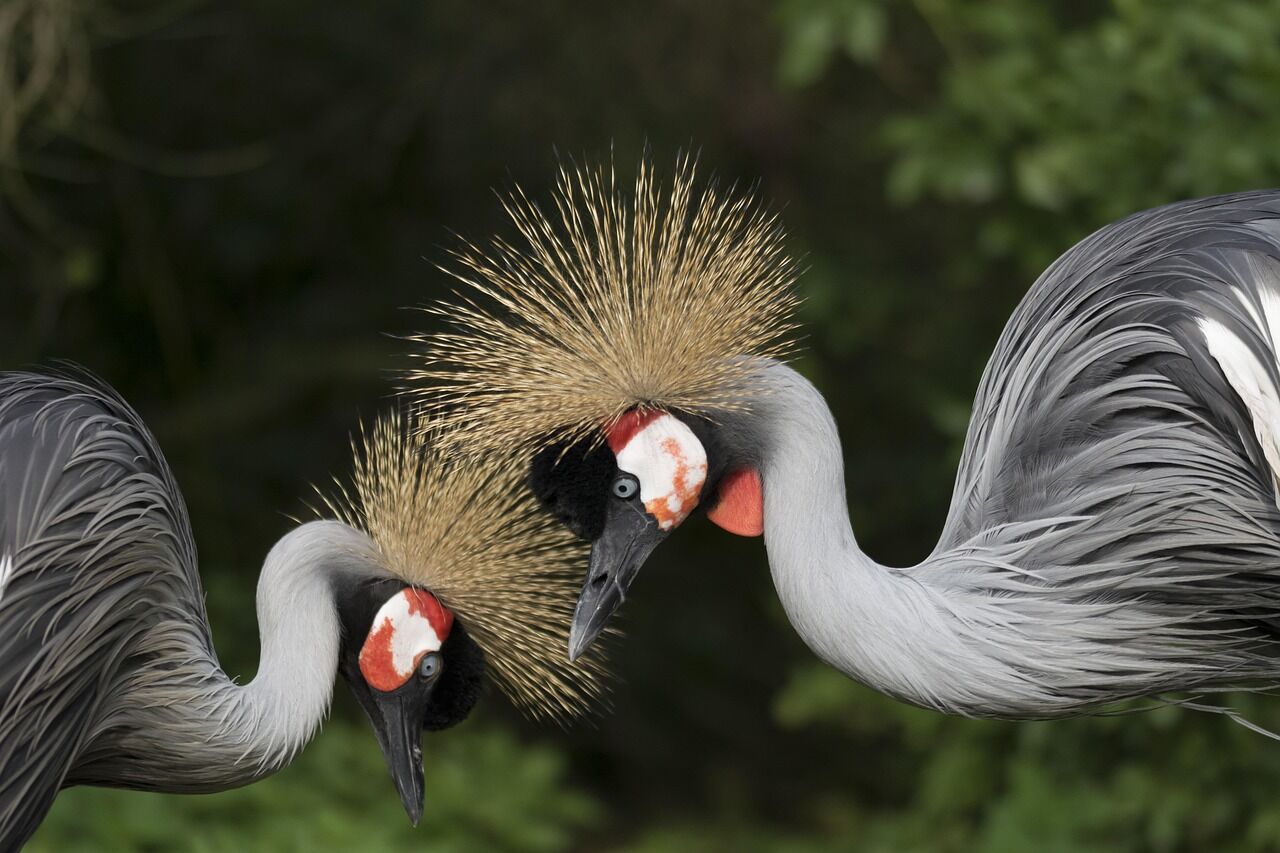
Sabine van Erp/Pixabay • Bow to your partner: Grey-crowned cranes perform an elaborate dance designed to strengthen their bond.

May I have this dance?

Many species of birds perform elaborate and ritualistic dance displays. Among birds known for tripping the light fantastic are flamingoes, cranes, grouse and grebes. Cranes are one of the oldest families of birds on earth. They’re also some of the most accomplished dancers in the animal kingdom. Pairs perform very ritualistic dances that, if the performers were human, would no doubt require the services of an accomplished choreographer. Cranes mate for life and the ritual of dancing is a way to strengthen the bonds between a mated pair. The ability to dance is, apparently, not instinctive. Young cranes must practice their dance moves, a process that can take years before they master the elaborate dance.

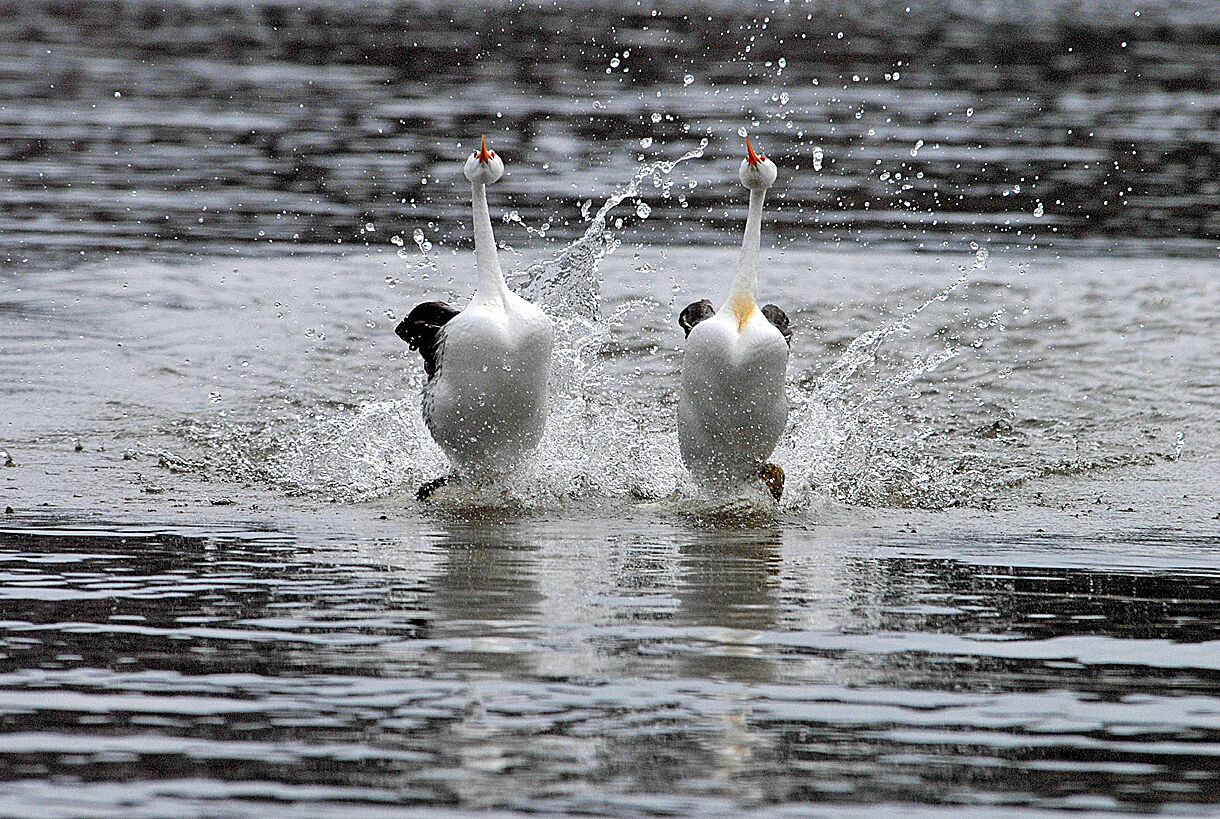
Dave Menke/U.S. Fish & Wildlife Service • A pair of Clark’s Grebes displays in a courtship ritual known as “rushing” or “weed dance.” Birds use a variety of strategies to attract and keep mates.

Synchronized swimming

While many birds dance to impress a mate or strengthen pair bonds, grebes perform a dance that takes place completely on the surface of the water. A pair will engage in this intricate performance, perfectly mirroring the moves of the other as they literally race across the surface of the water. These dances by grebes are also known as “rushing” or “weed dance.” It’s called as a weed dance because at the culmination of the ritual, the birds usually hold some type of aquatic plants in their bills while racing swiftly over the surface of the water. Pairs that perform well together stay together, building a nest and raising young.

Good housekeeping seal of approval

The tropical family of bowerbirds are famous for complex nests built by males and then decorated with bright and colorful objects to catch the eye of a potential mate. The nests of these birds are actually referred to as a “bower.” Usually constructed on the ground, the male will line the approachs to the bower with items such as shells, leaves, flowers, feathers, stones, berries, and even discarded garbage, including plastic scraps or bits of glass. Unusually odd items pressed into these decorative displays have included coins and spent rifle shells. This habit of male bowerbirds must rank as the ultimate in trying to impress a mate with shiny bling.

These are just a few of the inventive ways that birds go about attracting and keeping mates. Perhaps you can pick up some pointers from our feathered friends to ensure you have a great Valentine’s Day this year.

•••

If you have a question, wish to make a comment or share a sighting, email me at ahoodedwarbler@aol.com.

Birds have developed ways of dealing with cold

David Ellis/USFWS • A common redpoll feasts on stiff goldenrod seed. These small finches can endure temperatures 100 degrees below freezing.

With the arrival of January, we can probably be assured of some cold weather. I’m not fond of the cold, but I can put on gloves and a thicker coat and I am good to go.

What about our feathered friends? How do birds cope when temperature plummet below freezing?

Birds actually employ a range of strategies and behaviors that keep them cozy even during the worst that winter can hurl at them.

Some birds avoid the necessity of coping with cold by migrating. All those tropical species that brighten the warmer seasons in the mountains of Southern Appalachia withdraw to warmer areas in Central and South America during the winter.

Those birds that elect not to put distance between themselves and cold temperatures must do something to stay warm. Feathers are one of a bird’s defining traits, and they can do a neat trick with their feathers to stay warm. You’ve probably seen them do this. They will fluff their feathers, trapping air between them to provide insulation. If you’ve ever noticed that some birds look “fatter” in extreme cold it’s likely because they have fluffed up to combat the cold.

Of course, feathers require good maintenance to help with the task of staying warm, and birds are diligent about such tasks. Preening feathers on a routine basis keeps them watertight and able to hold in heat. Some birds even grow extra feathers in autumn to prepare for cold temperatures. That’s similar to dogs or cats growing a denser coat of fur in anticipation of wintry temperatures.

Birds have different comfort levels when its comes to personal space, but many of the more sociable species will huddle together. You’ve probably seen nature documentaries of penguins in the Antarctic as they huddle together for weeks on end to endure the harsh conditions of the globe’s southernmost continent.

Larger species of birds, such as geese and grouse, eat more and gain weight, which is often achieved by the storage of body fat.

Other birds have also adopted the huddling strategy in a cozy cavity or nest box. My most vivid recollection of an observation of this strategy involved Eastern bluebirds. During a severe cold snap accompanied by snow and blustery winds, I watched multiple bluebirds enter one of my nesting boxes. I’m not sure how many entered the box, but it was likely about eight to 10 birds.

Necessity makes birds adaptable. The next day the aforementioned high winds took down the post that held the nest box. At dusk the bluebirds showed up again. They looked baffled to find the box had disappeared. Then I saw them fluttering into an old tire that I had used at the base of the pole to help anchor the box. Faced with oncoming darkness, they chose to huddle together inside the old tire.

Natural cavities in trees also provide cozy roosting spaces for birds. Chickadees and titmice, nuthatches and woodpeckers seek out such cavities ahead of time so they will always be ensured of a warm space during bouts of inclement weather.

The biological mechanism of torpor is one that’s probably familiar to fans of hummingbirds, but other small birds can also take steps to lower their body temperature. Chickadees and kinglets put this ability to good use. In these small birds, the adaptation being employed is known as controlled hypothermia. Chickadees can drop their body temperature by as much as 22 degrees below normal daytime body temperature.

Snakes and reptiles can enter a physical state called brumation, where they sleep more but still wake to eat, drink and enjoy the sun on warmer days, according to information on the Facebook page of the U.S. Fish and Wildlife Service. Since snakes are cold-blooded, they’re lethargic at these colder temperatures even when they’re on the move.

Hibernation, although a strategy widely used by mammals, is rare in birds. The common poorwill (a relative of whip-poor-will and chuck-will’s-widow – is the only bird known to go into torpor for extended periods that can range from weeks to months. On the southern edge of their range in the United States, poorwills spend much of the winter hibernating, usually concealed in rock piles.

There’s warmth in numbers. Crows, starlings, robins and other species will gather in communal roosts to use body warmth to stay warm overnight. Sometimes these roosts are quite large and can lead to conflict with nearby humans who may not want the noise and mess that comes with hosting a large flock of birds.

While warm socks and gloves protect human toes and fingers, birds don’t have to worry about frostbite. Quick circulation means that blood does not linger in their feet long enough to freeze. In addition, the legs and feet of birds are covered in scales. Like feathers, the scales provide excellent insulation.

Some birds will gather together in large stands of evergreens. I’ve observed house sparrows gathering in the holly trees outside the courthouse in downtown Erwin at dusk on cold evenings.

There are things we can do to help. Plant evergreen trees or construct a brush pile that will provide shelter from the elements, as well as a measure of safety from predators, for the birds that share our lawns and gardens.

Many people already feed birds. Try supplementing seeds with some food rich in fat. Birds, unlike us, will not be adversely affected by a high-fat diet. Their metabolism allows them to burn off the extra calories in an enviable amount of time. Some high-fat foods that birds will love include peanut butter and beef suet, as well as peanuts and other assorted nuts. While it’s relatively simple to render suet into a usable for for birds, most people cannot be blamed for turning to commercially made suet cakes. Many of these are also made even more appealing with a mix of peanuts or fruit into the suet cake. The extra calories derived from these foods will let birds better regulate their body temperature and tolerate the more frigid nights.

It’s also important to provide liquid water for birds. Outdoor heaters designed to fit into a birth bath can help prevent the water from freezing during cold snaps.

Birds will also appreciate a sunny spot. By basking in sunshine, they can also boost their internal temperature.

Some birds are just built for cold. For example, snowy owls have been observed in temperatures 80 degrees below zero. Species of redpolls, a type of finch, can endure temperatures 100 degrees below freezing.

Emperor penguins live and nest in some of the most inhospitable terrain on the planet. Those who have viewed the documentary film “March of the Penguins” will be familiar with the species. Their colonies on the ice in the Antarctic must endure temperatures than can plunge to -40 degrees Farenheit. They must also survive frigid winds that can reach 90 miles per hour.

Emperor penguins have several adaptation to help them survive such cold conditions, according to the World Wildlife Fund. These penguins have two layers of feathers, a reserve of fat and beaks and flippers that are proportionally smaller than those for other penguin species.

Lee Karney/USFWS • The common raven can live in a range of habitats, but these large and intelligent birds are especially adapted to cold.

The common raven is another bird that shrugs off cold and snow. They can survive and thrive in habitats as varied as Arctic tundra and scorching deserts. If temperatures drop below -4 degrees Farenheit, ravens can generate extra body heat.

All things considered, birds are simply better at coping with cold than we are.

•••

Bryan Stevens has written about birds since 1995. To ask a question, make a comment or share a bird sighting, email him at ahoodedwarbler@aol.com.

Vocal screech owls are pint-sized predators

Photo by Bryan Stevens • An Eastern screech owl perches on a hemlock branch. These owls are much smaller than such relatives as great horned owl and barred owl.

It’s been my pleasure to enjoy almost daily serenades by an Eastern screech owl residing in the woods around my home. The small owl’s shivery wailing calls usually start around dusk and can continue at intervals throughout the night.

Back in September while I watched almost daily for migrants from a lawn chair, I heard on a couple of occasions the “early bird” owls calling occasionally from shady wooded areas. The owls tended to call more often during the daytime when conditions were overcast.

I always pause and listen when I hear the wailing and haunting vocalizations of the screech-owls that make their home in the woodlands that surround my home. I’m glad to have this small owl as a neighbor, but I fully realize that owls have suffered from a dark reputation in certain corners. The fact is, unless you are a small rodent or some sort of insect-sized prey, the Eastern screech-owl makes an excellent addition to the neighborhood.

On the verge of Halloween, a closer look at this small owl is warranted. An adult Eastern screech owl is usually only between six and nine inches in length. Many people upon first seeing a screech-owl assume it’s a baby owl. During past trips to Brookgreen Gardens in South Carolina, I have enjoyed attending the daily educational programs conducted by the zoo staff at Brookgreen. These programs are designed to introduce visitors to various examples of native wildlife. The presenter usually introduced a couple of animals to the audience. On several occasions, the show featured birds of prey, including hawks and owls.

Photo by Irene K-s/Pixabay.com • An Eastern screech owl keeps an eye on its surroundings.

Two of the shows during my visit to Brookgreen back in 2019 featured Lucy, an Eastern screech-owl, and people in the audience invariably asked if she was a baby owl. To their astonishment, they learned that Lucy was an adult screech-owl and unlikely to grow any bigger.

There are larger owls in our region, including the great horned owl and barred owl. Lucy and her kin must avoid these much larger owls, which would not scruple at making a meal of the much smaller owl.

Because of their small size, screech-owls prey on some comparatively small creatures, including insects, small rodents, amphibians, songbirds and reptiles. The Eastern screech-owl is also a cavity-nesting bird and will accept bird boxes provided by humans so long as the box’s entrance hole is customized to their size.

The screech owl is the owl most likely to encounter human beings. It’s an adaptable little feathered predator, just as much at home in the backyard and garden as it is in parks and woodlands. In addition to nesting in cavities, this owl roosts in them during the daytime hours. Look for roosting screech-owls in knotholes of trees or in unoccupied wood duck boxes. Although they come in two color phases — red and gray — both variations are quite capable of camouflage. When perched or roosting, these small owls blend remarkably with their surroundings.

The Eastern screech owl also produces a variety of odd wails and other vocalizations including a distinctive, trembling “whinny” call that is often made when the owl feels curious or alarmed. It’s a wavering, haunting call that is made after dark, most often at the hours closer to dawn and dusk. Imitating the call of a screech-owl or playing a recording is also a trick for getting some shy songbirds to show themselves. Screech owls are not-so-welcome co-habitants among my yard’s songbirds, which will flock to this owl’s call and band together to “mob” the predator and try to convince it to depart the immediate area.

As small as the Eastern screech-owl is, the United States is home to several other pint-sized owls, including Western screech-owl, Northern pygmy-owl, Northern saw-whet owl, flammulated owl and elf owl, which at six inches tall and a weight of less than an ounce qualifies as the world’s smallest owl.

Photo by U.S. Fish and Wildlife Service • The tiny Northern Saw-whet Owl nests on several of the region’s higher mountains.

Any time I finish listening to a calling owl and go back indoors for the evening, I reflect on the fact that screech-owls make good neighbors. Their prey preferences remove many nuisance insects and rodents from the habitat they share with humans as well as other wildlife. If you’re hearing an odd, winnowing call from the edge of the woods at your own home, there’s a good chance that you have one of these small owls as a neighbor.

Keep alert for these small owls and their larger kin as we observe this year’s Halloween holiday, as well as other days and nights throughout the year.

•••

To learn more about birds and other topics from the natural world, friend Bryan Stevens on Facebook at https://www.facebook.com/ahoodedwarbler. He enjoys posting about local birds, wildlife, flowers, insects and much more. If you have a question, wish to make a comment or share a sighting, email him at ahoodedwarbler@aol.com.

Holly Keepers/USFWS • A red Eastern screech owl peeks from a perch among some evergreen branches.

Native wading birds wander widely in late summer


Photo by Bryan Stevens • A great egret captures a frog from a pond’s edge in South Carolina.

The fish pond at my home has attracted a stalker. Amid the cattails and beneath the drooping branches of tall bald cypress trees, a lurking great blue heron has patiently been stalking fish, frogs and anything else that comes within striking reach of the bird’s sturdy dagger-shaped beak.

The heron’s visits have prompted me to dig into my archived columns this week. Please enjoy this column, which was previously published in July of 2019, about summer’s wading birds.

•••

North America’s stately wading birds — egrets, herons, bitterns, ibises and their kin — are well-known wanderers in late summer. As with all birds capable of flight, a pair of strong wings cannot be underestimated. Birds can show up in the most likely places.

Take for instance the first confirmed sighting of an American flamingo in Tennessee. This particular flamingo — an almost unthinkable bird for the Volunteer State — showed up along Highway 78 in Lake County on July 13, 2019.

Ruben Stoll and Alan Troyer found the flamingo, backing up their discovery with photographs of the large pink bird associating with great egrets and other wading birds. The flamingo created considerable buzz on rare bird alerts in several nearby states. Many birders rushed to add this exceptional visitor to their state and life lists.

Photo by Bryan Stevens • White ibises occasionally meander away from the coast in late summer. Immature birds will be brown instead of white.

In summers past, other exciting wading birds ranging from little blue herons to wood storks have excited the region’s birders. I recently celebrated my own sighting of one of these wanderers that made a stop at my fish pond on July 10.

I had stepped outside my house and let the door slam a little too loudly behind me, causing a stately great egret near my fish pond to take flight and fly over the roof of my house. I regretted instantly not having a camera with me.

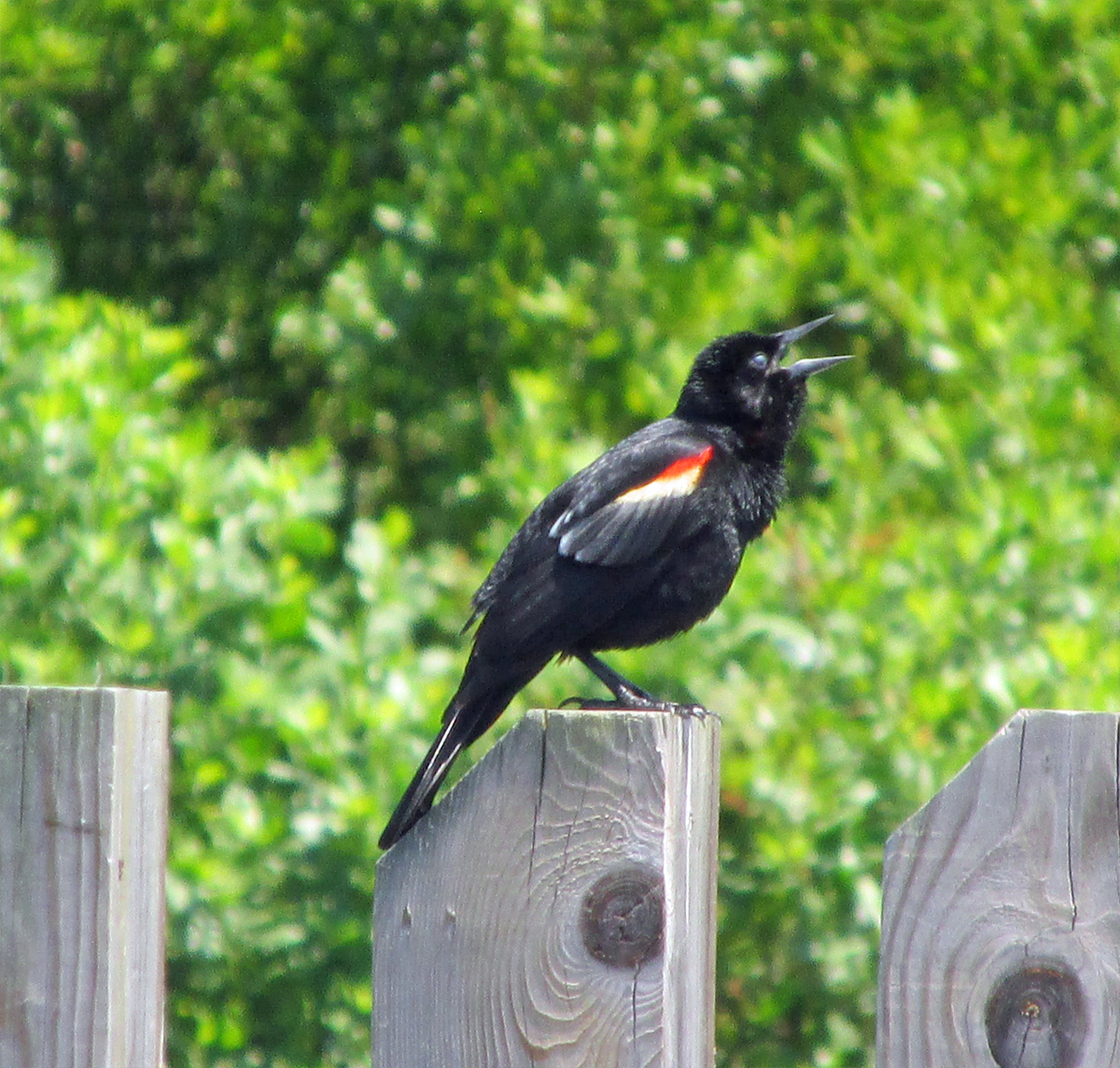
Two days later, I got another chance. The great egret made another appearance. Unfortunately for the tall bird, he attracted the ire of the resident red-winged blackbirds. In a most inhospitable manner, the blackbirds attacked and dived at the egret, which made some awkward attempts to evade the angry blackbirds. Blackbirds are protective of their territory and have swooped at me several times when I’ve ventured too close to their favored cattails.

More prepared on this occasion, I had my camera with me and managed to get a few photographs of the egret.

The next day, only a few miles from my home, Lauri Sneyd Vance took a photograph of a great egret that stopped at her home in Limestone Cove in Unicoi County, Tennessee. Having seen my Facebook post, she notified me that she had also received a visit from an egret. Was it the same bird? Perhaps.

Oddly enough, the bird is actually the second great egret to visit my fish pond. The first one made an unseasonable stop several years ago on a snowy December afternoon — hardly a time of year I might have expected a visit from an egret in the mountains of Northeast Tennessee.

The great egret stands 3.3 feet tall. With an all-white plumage, a long yellow bill and dark legs, this egret is often described as graceful and elegant. Its likeness was incorporated into the logo for the National Audubon Society, an organization formed to protect egrets and other wading birds from a wanton slaughter in the late 1800s when millions of the birds were killed so their feathers could be used in women’s fashions.

During the breeding season, adult great egrets sprout long plumes on their back. These frilly feathers are known as aigrettes, which are used to attract the attention of prospective mates in elaborate mating displays.

According to the All About Birds website, great egrets feed mostly on fish, but they also eat amphibians, reptiles, rodents, songbirds and crustaceans. On visits to the South Carolina coast, I’ve observed great egrets dining on frogs and small fish. In prime habitat, flocks of great egrets will gather to forage together in wetlands or around ponds. More sociable than some herons, great egrets also nest and roost communally.

The other North American egrets include snowy egret, reddish egret and cattle egret. Other egrets found around the world include the intermediate egret, little egret, slaty egret, black egret,dimorphic egret and Chinese egret.

As summer advances, keep your eye on area rivers, lakes and ponds. It’s the best time of year to see egrets, herons and other long-legged wading birds. In the case of the American flamingo, I realize that lightning rarely strikes twice, but if you do happen to see a gangly pink bird, let me know.

•••

Share sightings, ask questions or make comments by emailing me at ahoodedwarbler@aol.com.

Photo by Bryan Stevens
A Great Blue Heron moves stealthily through a wetland.

Great auk’s story ended 180 years ago this week

Although he never saw the species in person, famous naturalist and artist John James Audubon painted this pair of great auks about the time the species was heading toward extinction.

It’s summer and the birds are busy nesting in the mountains and valleys of the Southern Appalachians. Eighteen decades ago, during a summer nesting season far away in the North Atlantic, the story of an unusual seabird came to a brutal end.
The last pair of great auks was killed on Eldey, off the coast of Iceland, on June 3, 1844. This little-known tragedy ended the last known breeding attempt for the species 180 years ago this week.


The great auk, also known as the great Northern penguin, once inhabited the Atlantic coasts of both North America and Europe. This flightless bird achieved the status of “great” due to its size. Adult great auks reached a height of about 32 inches and could weigh as much as 11 pounds, making them much larger than any of their close relatives. This bird had a black back and a white belly in a two-tone plumage that does indeed resemble the appearance of many penguins. The bird’s black beak was heavy and hooked, with grooves on its surface, excellent for catching fish.


The great auk belonged to the bird family of Alcidae, which also includes such birds as auks, auklets, murres, murrelets, puffins, razorbills and guillemots. The family is not closely related to penguins, which are only found in the Southern Hemisphere. The great auk’s scientific name – Pinguinus impennis – has reinforced the misconception that penguins and the great auk were closely related.

Photo by Kevin/Pixabay • The razorbill, also known as the lesser auk, is probably the member of the Alcidae that most resembles the great auk, albeit on a diminished scale.


Today, one close relative of the great auk still swims in the North Atlantic off the coasts of both North America and Europe. The razorbill (Alca torda) is the sole species in the genus Alca since the extinction of the great auk in the mid-19th century.


Razorbills, as did their larger relative, nest in colonies. Razorbill nesting colonies exist off the coasts of Canada, Iceland, Norway, Wales and the United Kingdom. After the nesting season, razorbills abandon the land and spend the winter months at sea. Razorbills are occasionally spotted as far south as the Carolinas, Georgia and Florida during the winter season.
Razorbills have a body length of almost 17 inches and weigh from one to two pounds, placing them well shy of the size of their extinct relative.


Great auks figured prominently in the cultures of some native sea-going tribes. Although Native Americans did hunt the birds, their efforts had been sustainable.
The coming of European explorers and settlers threw the balance out of whack for this species, which nested in large colonies. Explorers in North America plundered the great auks as a food source and also used the flesh of the birds as fish bait. In Europe, a demand developed for the great auk’s down, those dense, insulating feathers that provided a warm, protective layer against the chill of North Atlantic waters.


These factors quickly led to a steep decline in numbers as early as the 1700s. Sadly, museums and private collectors began to clamor for specimens as the great auk became more rare. The collecting of the birds, as well as their eggs, for this purpose is blamed by some experts with the ultimate extinction of the species.


Pairs of great auk, which mated for life, focused their nesting efforts on raising one chick at a time, which made the species even more vulnerable. A report of a single great auk in 1852 off the Grand Banks of Newfoundland is accepted by some experts, which means this bird was the last known individual of its kind.


The bird’s legacy has lived on, especially with naturalists and birders. The scientific journal of the American Ornithological Society was titled “The Auk” in honor of the species until 2021 when the name of the publication changed to simply “Ornithology.”
The presence of skins and bones in museums around the world have encouraged speculation that modern technological advances in genetics and cloning could possibly revive the great auk from preserved DNA.


Such scenarios seem a little too Hollywood and reminiscent of the “Jurassic Park” and “Jurassic World” films. The reality is that the great auk is part of a lamentable extinction club with such members as Labrador duck, passenger pigeon, Carolina parakeet, Bachman’s warbler and many others, dating back to birds like the moas and the dodos.


It would be nice, especially for birders, if cruises in the North Atlantic could still offer the opportunity to view these fantastic birds swimming in the cold waters. It is still possible to view nesting colonies of birds like the Atlantic puffin, black guillemot and razorbill. If I do get the chance to view these sea-going birds some day, I’ll be thinking of the great auk when I do so.


•••


To share a sighting, make a comment or ask a question, please email me at ahoodedwarbler@aol.com.

Annual spring bird count finds 151 species


Photo by Hans Toom/Pixabay • A male common yellowthroat, a species of warbler, is resident in the region spring through fall. The black mask of the males makes this bird quite distinctive.

The 81st consecutive Elizabethton Spring Bird Count was held on Saturday, May 4, with 40 observers in 16 parties.

Participants covered Carter County plus parts of adjacent Johnson, Sullivan, Unicoi and Washington counties. Temperatures were mild with little wind;

however, light rain just before sunrise and light to moderate rain during much of the afternoon hampered birding to some degree. Despite these conditions, good numbers were counted.

This year’s count tallied 151 species, including 28 species of warblers. The average number of

species over the last 20 years was 153 species. The all-time high was 166 species in 2016.

These yearly spring counts provide an amazing snapshot of the birds that can be found living in or migrating through the region. Some exceptional finds for this year’s count included Virginia rail, green-winged teal, grasshopper sparrow, golden-winged warbler and dickcissel.

The most abundant birds included cliff swallow (790), American robisparrown (742), European starling (500), Canada goose (391), red-eyed vireo (343), song sparrow (338), Northern Cardinal (321), Common Grackle (315), Red-winged Blackbird (282), American Crow (280), American Goldfinch (279), Hooded warbler (231) and Mourning Dove (223).

The list:

Canada goose, 391; wood duck, 35; blue-winged teal, 4; mallard, 96; green-winged teal,1; and common merganser, 2. 

https://www.youtube.com/watch?v=hp-CrM–HSU

Wild turkey, 23; ruffed grouse, 1; pied-billed grebe, 1; rock pigeon, 117; Eurasian collared-dove, 1; mourning dove, 223; yellow-billed cuckoo, 4; chuck-will’s-widow, 8; Eastern whip-poor-will, 28; chimney swift, 168; and ruby-throated hummingbird, 9.

Virginia rail, 1; killdeer, 29; least sandpiper, 27; pectoral sandpiper, 2; semipalmated sandpiper, 3; spotted sandpiper, 49; solitary sandpiper, 27; lesser yellowlegs 5; and greater yellowlegs, 1.

Double-crested cormorant, 80; great blue heron, 76; great egret, 2; green heron, 21; and yellow-crowned night-heron, 4.

Black vulture, 111; turkey vulture, 96; osprey, 13;

Cooper’s hawk, 3; bald eagle, 7; red-shouldered hawk, 6; broad-winged hawk, 8; red-tailed hawk, 14; Eastern screech-owl, 11; great horned owl,1; and barred owl, 8.

Belted kingfisher, 25; red-headed woodpecker, 16; red-bellied woodpecker, 87; yellow-bellied sapsucker, 9; downy woodpecker, 31; hairy woodpecker, 8; Northern flicker, 52; and pileated woodpecker, 46.

American kestrel, 9; great crested flycatcher, 30; Eastern kingbird, 66; Eastern wood-pewee, 31; Acadian flycatcher, 16; least flycatcher, 15; and Eastern phoebe, 96.

White-eyed vireo, 18; yellow-throated vireo, 12; blue-headed vireo, 49; warbling vireo, 15; and red-eyed vireo, 343.

Blue jay, 151; American crow, 280; fish crow, 12;  common raven, 13. Carolina chickadee, 143; tufted titmouse, 158; tree swallow, 154; Northern rough-winged swallow, 49; purple martin, 68; barn swallow, 213; and cliff swallow, 780.

Ruby-crowned kinglet, 3; golden-crowned kinglet, 2; cedar waxwing, 64; red-breasted nuthatch, 8; white-breasted nuthatch, 27; brown creeper, 2; blue-gray gnatcatcher, 77; Carolina wren, 203; house wren, 50; winter wren, 5; and marsh wren, 1.

Gray catbird, 54; brown thrasher, 64; Northern nockingbird, 94; European starling, 500; Eastern bluebird, 134; veery, 14; gray-cheeked thrush, 2; Swainson’s thrush, 9; Hermit thrush, 1; Wood thrush, 118; and American robin, 742.

House sparrow 30; house finch, 79; pine siskin, 1; American goldfinch, 279; grasshopper sparrow, 1; chipping sparrow, 123; field sparrow, 43;

dark-eyed junco, 48; white-crowned sparrow, 1;

White-throated sparrow, 5; Savannah sparrow, 6; song sparrow, 338; swamp sparrow, 1; and Eastern towhee, 179.

Yellow-breasted chat, 11; Eastern meadowlark, 81; orchard oriole, 24; Baltimore oriole, 18; red-winged blackbird, 282; brown-headed cowbird, 61; and common grackle, 315.

Ovenbird, 162; worm-eating warbler, 28; Louisiana waterthrush, 34; Northern waterthrush, 4; golden-winged warbler, 1; black-and-white warbler, 103; Swainson’s warbler,15; Tennessee warbler, 15; Kentucky warbler, 7; common yellowthroat, 48; hooded warbler, 231; American redstart, 33; Cape May warbler, 9; Northern parula, 89; magnolia warbler, 4; bay-breasted warbler, 7; Blackburnian warbler, 24; yellow warbler, 15; chestnut-sided warbler, 30; blackpoll warbler, 8; black-throated blue warbler, 89; palm warbler, 3; pine warbler, 8; yellow-rumped warbler, 21; yellow-throated warbler, 54; prairie warbler, 1; black-throated green warbler, 81; and Canada warbler, 37.

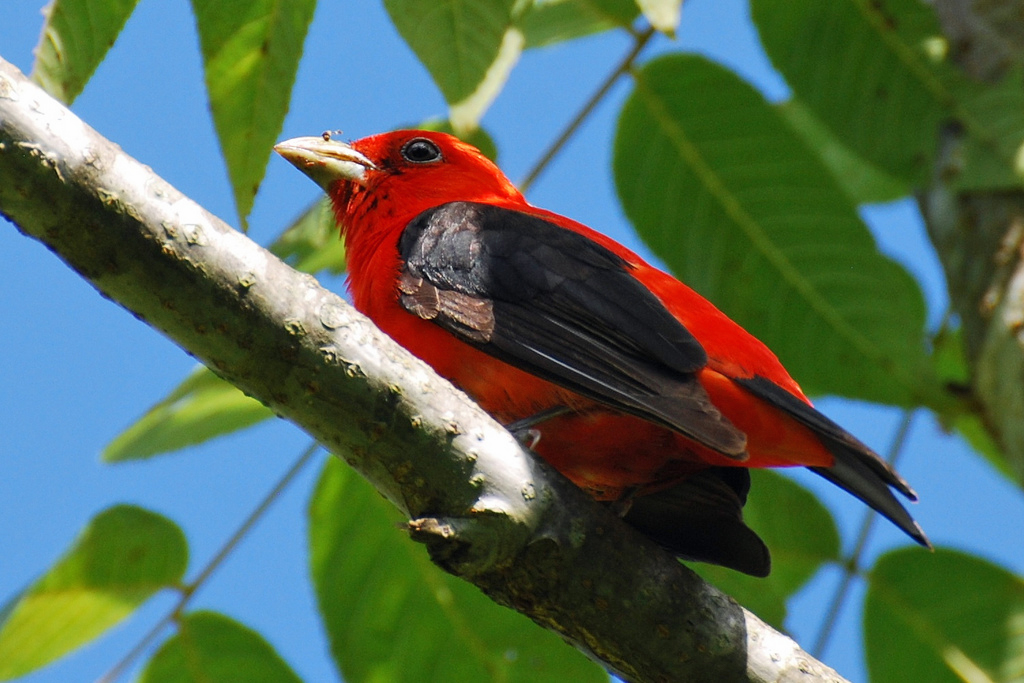
Summer tanager, 1; scarlet tanager, 97; Northern cardinal, 321; rose-breasted grosbeak, 30; blue grosbeak, 10; indigo bunting, 184; and dickcissel, 1.

https://www.youtube.com/watch?v=EI3pZ3t2i4E

•••

To share a sighting, ask a question or make a comment, email me at ahoodedwarbler@aol.com. 
Fish crow is the new bird in town at locations across region

Fish crows painted by John James Audubon.

Sharp-eared birders may be detecting some unfamiliar crow calls in downtown Erwin during strolls around town.

While the caws of American crows are rather harsh and raucous to the ear, the smaller and related fish crow has a caw with a higher, more nasal tone that is just different enough to stand out.

Fish crows have been expanding their presence in the region for several years, joining some other newcomers such as common mergansers and Eurasian collared doves.

The fish crow is a native species of the southeastern United States that has been pushing its range farther north and west.

I first got to know fish crows on visits to coastal South Carolina starting in the 1990s. These small crows can be quite abundant along the coastline of the Palmetto State.

It’s only been in the last six years that I’ve added fish crow to my list of birds observed in my home state.

I began to hear fish crows around the campus of East Tennessee State University in Johnson City during daily strolls while teaching in the literature and language department at ETSU back in late fall of 2018.

For months before that sighting, I’d begun to notice postings about the presence of fish crows on the campus of the Mountain Home Veterans Administration adjacent to the ETSU campus. I’d heard about the fish crows from some of my birding friends, too. I had not stirred myself to look for these slightly smaller relatives of the American crow. So, when I heard a familiar “caw” that was a bit too nasal for an American crow, I stopped for a closer look.

Photo by Pixabay • The American crow, pictured, is larger than the related fish crow and has a more raucous caw.

I heard the vocalizations again and found a couple of fish crows perched atop the parking garage behind the Carnegie Hotel, which is located between ETSU and the VA campus. With some surprise and delight, I realized that the birds were fish crows.

Fast-forward six years. In recent weeks I’ve been hearing fish crows in downtown Erwin on a fairly regular basis. This past week I heard the nasally caw of this crow as I approached the back door of the offices of The Erwin Record. I looked up and spotted a fish crow perched in one of the trees bordering the parking lot. I wonder how long before I get one of these small crows paying a visit to the fish pond at my home.

As I mentioned earlier, I’m familiar with fish crows from trips to coastal South Carolina, where these members of the corvid family are quite common. Fish crows have expanded inland away from coastal areas in recent decades. Fish crows showing up here in Northeast Tennessee originated from that expansion, which likely followed river systems like the Tennessee River.

The easiest way to detect a fish crow’s presence is to keep your ears open. Fish crows make a distinctive vocalization that is quite different from the typical “caw” of an American crow or the harsh croak of a common raven. The website All About Birds describes the call as a “distinctive caw that is short, nasal and quite different-sounding from an American crow.”

The website also makes note of the fact that the call is sometimes doubled-up with an inflection similar to someone saying “uh-uh.”

Although their name suggests a fondness for fish, they’re not finicky about their food and will eat about anything they can swallow. Fish crows are also known for raiding nests to steal the eggs of other birds. They will also dig up sea turtle eggs, which are buried in sand dunes by female turtles.

Fish crows don’t scruple at stealing food from other birds and have been observed harassing birds ranging from gulls to ospreys. Fish crows also harass American crows and, if they are successful, don’t hesitate to skedaddle with any morsel that they’re able to “persuade” their slightly larger relative to surrender.

The fish crow ranges in various coastal and wetland habitats along the eastern seaboard from Rhode Island south to Key West, and west along the northern coastline of the Gulf of Mexico.

It’s been fun to find these birds closer to home in Erwin and Johnson City.

It’s not been easy for crows in recent years. The West Nile virus has been particularly hard on American crows, which seem to have very little immunity to this mosquito-spread disease.

According to the research I’ve conduced, the fish crow, however, is more resistant to the virus, with close to half the birds exposed to the disease able to shake off the effects and fully recover.

According to the website Tennessee Watchable Wildlife, the first recorded sighting of a fish crow in Tennessee took place in 1931. Half a century later, the first nest record was documented in 1980. Both of these records took place in Shelby County.

The oldest known fish crow in the wild reached an age of 14 years 6 months old. Visit tnwatchablewildlife.com for more information about fish crows and other state birds.

Fish crows and other crows around the world are sometimes regarded more darkly than is usual for our fine feathered friends. We invent lore and superstition, mostly inspired by the crow’s dark plumage and some rather unsavory eating habits. Some people even consider crows a bad omen.

I’ve never been concerned personally with keeping crows, or any bird for that matter, at a distance. I always try to stay alert for any surprise these winged creatures bring my way.

Worldwide, there are about 50 species of crows in the Corvus genus. Some other crows include carrion crow, hooded crow, rook, small crow, white-necked crow, Eastern jungle crow, large-billed crow, violet crow and white-billed crow.

Why have fish crows expanded their range in recent decades? The answer is not clear, but it’s good to have them here. I’m glad to welcome them to the Valley Beautiful.

•••

To share a sighting, make a comment or ask a question, email me at ahoodedwarbler@aol.com. 

More readers share their hummingbird arrival stories

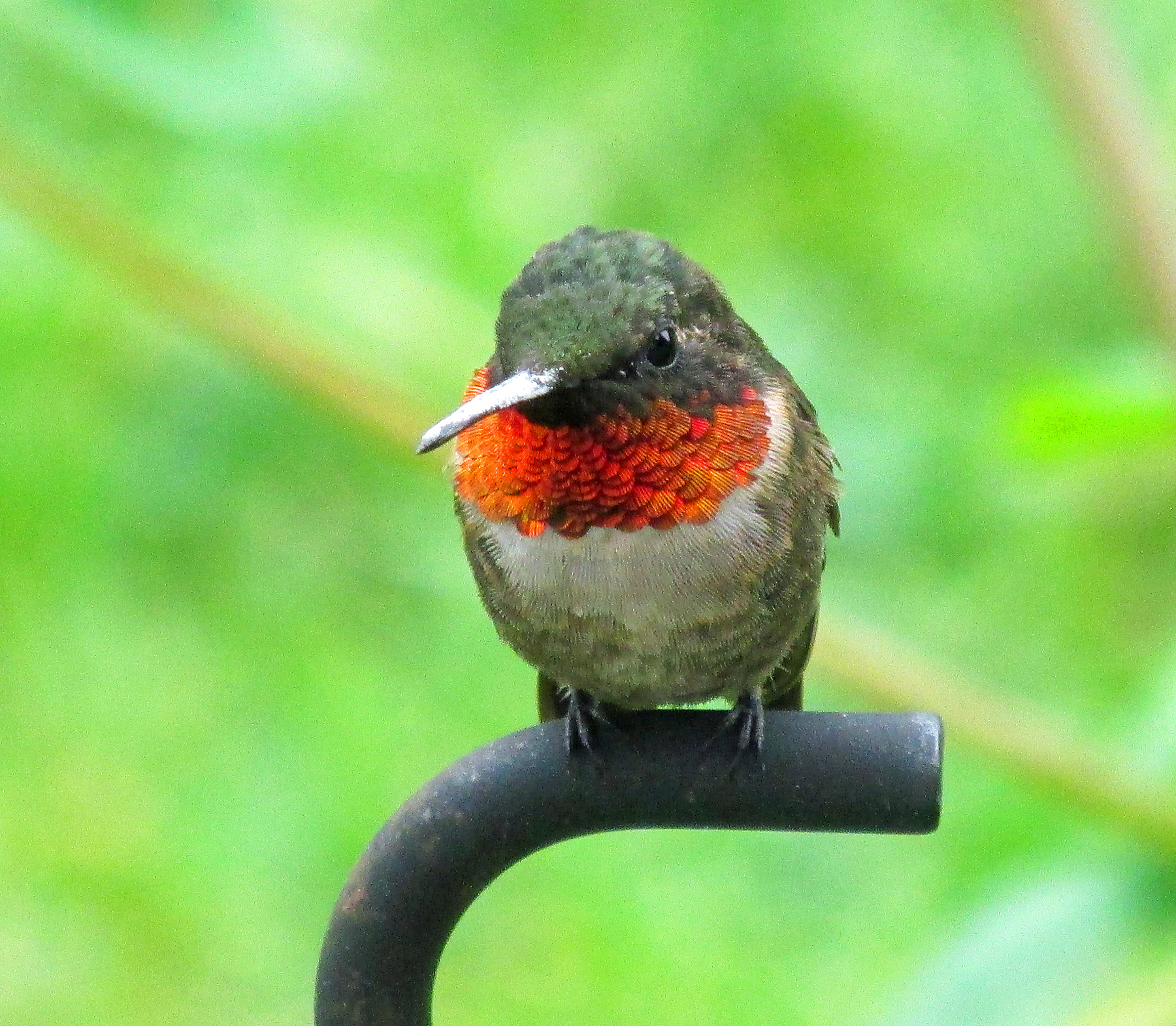
Photo by Bryan Stevens • A male ruby-throated hummingbird perches on a branch. These tiny birds returned to the region earlier this month.

Ruby-throated hummingbirds are back in the region for another season. This male takes a sip of nectar from the blooms of a potted plant.

I reported last week on a handful of people who saw the “early bird” ruby-throated hummingbirds making their return to local yards and gardens. Many more readers have contacted me this past week to share more hummingbird sightings.

For those who haven’t seen a hummingbird yet, just remain patient. They’re definitely arriving for another season with us. 

•••

Gina Kinney emailed me on behalf of her mom, Ginger Brackins, as she has done for several years, to share news of her mom’s hummingbird sighting.

“She said she saw her first hummingbird on Saturday, April 13, at around 5:30 p.m. in Erwin,” Ginger wrote.

•••

Only the male ruby-throated hummingbird shows the bright red throat patch.

“I put my feeder out on April 1 and took it down this morning (April 14) to clean it and put new feed in it,” wrote Joan Chipokas in an email. “About 30 minutes later, a male hummer came to the feeder. Didn’t see him again today, but I was busy so really wasn’t watching. Hopefully I’ll start seeing him on a regular basis and the female will show up too.”

Joan wrote that she lives on Suncrest Village Lane in Gray.

•••

Kingsport resident Ray Chandler reported a sighting of a first spring hummingbird on April 14 . “They are regular visitors to the feeders now,” he shared in an email.

•••

Lonnie Hale reported a first of spring hummingbird sighting in an email to me.

“We saw our first hummingbird yesterday (April 14),” Lonnie wrote. “I put the feeders out in the morning, bought four hanging baskets of flowers and BAM.”

Lonnie lives near Big Stone Gap, Virginia. “Love these little guys,” Lonnie added.

•••

April Fain in Unicoi also saw her first ruby-throated hummingbird of the season on April 14. “We had our first hummingbird this morning,” April wrote in a Facebook message to me. “I saw him three times.”

•••

Photo by Bryan Stevens • Despite a perceived disadvantage of size, ruby-throated hummingbirds are quite capable of thriving in a giant world.

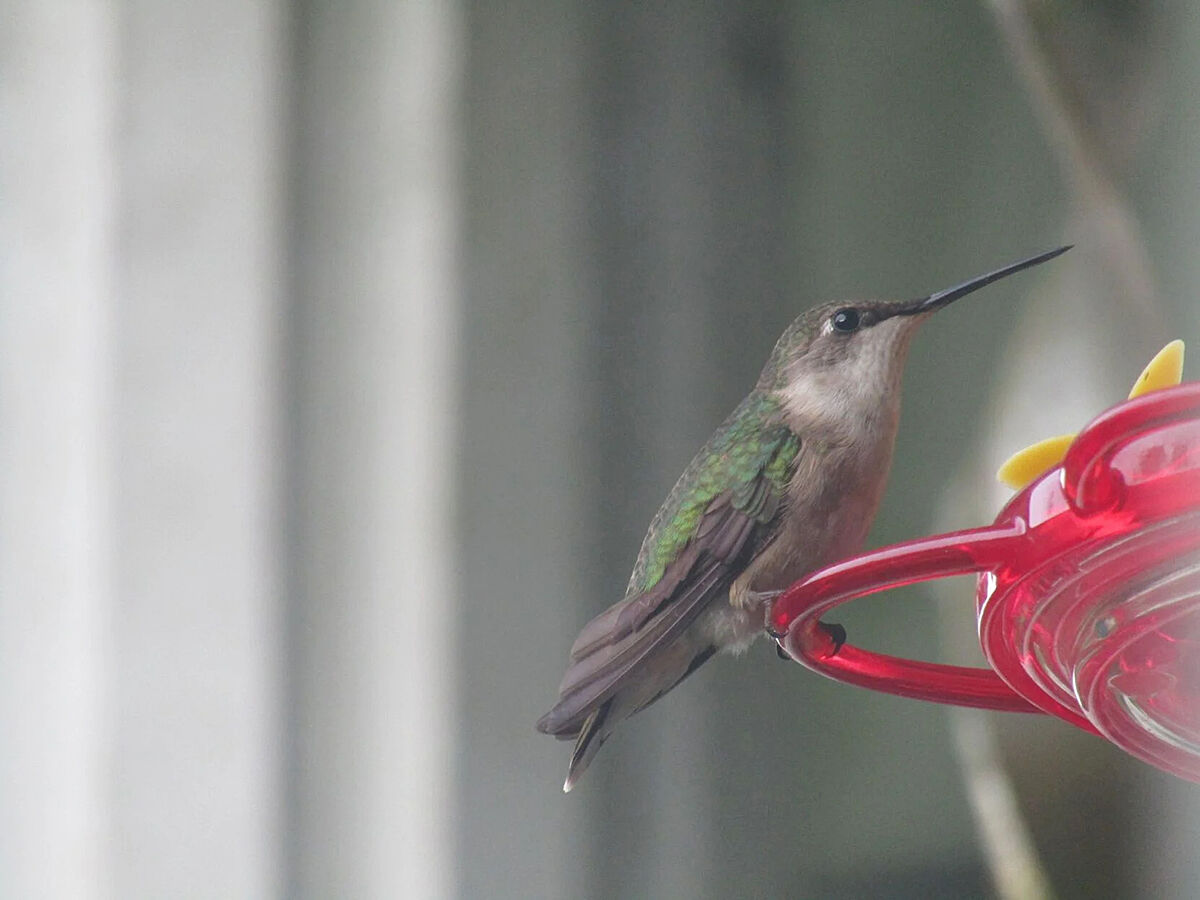
Amy Tipton sent me a message on Facebook to report that her parents had observed their first spring hummingbird.

“The hummingbirds are back in Unicoi County,” she wrote. “My parents, Edison and Emma Jean Wallin, spotted their first one of the season this evening (April 14) at 6:30 at the feeder on their front porch in Limestone Cove. Mama just put her feeder out today.”

•••

“My first hummer just came in,” Karen and Bobby Andis of Kingsport reported via Facebook Messenger on April 14. “A small female…very hungry.”

I got a followup message the following day. “A male showed this morning,” they wrote.

•••

Erwin resident Donna Barnes Kilday shared a post on my Facebook page to report the arrival of her first hummingbird. “Saw my first hummingbird today,” she wrote on April 15.

•••

Priscilla Gutierrez shared in a Facebook comment that she saw her first hummingbird of spring on April 16.

•••

“I’ve had my feeder out for 2 weeks,” Virginia Martin commented on a Facebook post. Virginia, who resides in East Carters Valley in Scott County, added that she saw her first ruby-throated hummingbird on April 13 at 3:15 p.m.

“I believe they are a couple of days behind schedule for my area, possibly weather-related since we’ve had a spell of cooler temperatures and a few very windy storms recently,” she added.

Virginia noted that she has fed hummers for years, and use only the homemade sugar water in a common inexpensive feeder.

“It’s located just outside my dining area window, so I have literally a ‘bird’s eye’ view,” she wrote. “There’s a dogwood tree close by, and other good perching places for them to monitor and protect their territory.”

•••

Jan Bostrom sent me an email to share her first spring hummingbird sighting. She wrote, “I saw my first hummingbird yesterday (April 17) around 6 p.m.” Jan wrote that she been on the lookout because her neighbor saw her first hummingbird on April 15.

“I’m thrilled to be retired and to have time to enjoy God’s beauty around me,” Jan shared.

•••

I’ve finally joined the ranks of those who have welcomed hummingbirds back for another season.

The hummingbirds returned to my own home on April 17 at 7:15 p.m. I heard the telltale buzz of the bird’s wings before I spotted him. I stayed still and he zipped to my feeders for a quick sip. He returned a few times before dusk. When I posted my success on Facebook, several other people commented to let me know that hummingbirds had returned at their homes on April 17.

The following day I enjoyed watching two male ruby-throated hummingbirds in a prickly standoff about control of the front porch feeders.

•••

Vivian C. Tester in Bristol, Tennessee, posted a comment on one of my Facebook posts to let me know of her first spring sighting.

“Just saw my first hummingbird of spring,” she wrote on April 17.

•••

Rosalie Sisson in Jackson, Tennessee, commented on my Facebook page that she saw her first hummingbird of the season at about 6 Central time on April 17.

•••

Lauri Sneyd Garland in Unicoi, also on April 17, noted in a comment on my Facebook page she has been seeing hummingbirds for the last couple of days.

•••

Tina Jefferson Reese in Bristol, Tennessee, reported via a comment on my Facebook page that she also saw her first hummingbird on April 17.

•••

Linda C. Robinette wrote, “Ours fluttered in around 11:30 this morning (April 17),” in a comment on my Facebook page.

•••

Kaylynn Sanford Wilster at Boone Lake saw her first spring hummingbird on April 18. “Saw my first one yesterday,” she wrote on April 19 in a Facebook comment on a post of mine.

•••

Spring migration is in full swing. At least six different species of warblers have returned to the woodlands around my home. A broad-winged hawk has also returned to a favorite field less than a quarter of a mile from my home. Keep your eyes open for new arrivals. Chimney swifts have been zipping over the rooftops of downtown Erwin since April 17.

To share a sighting, make a comment or ask a question, email me at ahoodedwarbler@aol.com.


Ruby-throated hummingbirds mark their spring return

Photo by Bryan Stevens • A male ruby-throated hummingbird surveys his surroundings.

I am still waiting (at the time this post was written) for the first ruby-throated hummingbird of spring. Every year I hope they will make an early appearance, but I am almost always disappointed. These tiny birds always arrive in their own good time and my home is apparently not located within their primary migratory path.

As a consolation prize, however, I have welcomed the first of the spring warblers. I had two black-and-white warblers singing at home on April 9. The black-and-white warbler sings a repetitive song that has been described as a “squeaky wheel” based on the rising pattern of the song’s notes.

Other recent arrivals have included brown thrasher and tree swallow.

Photo by Ken Thomas
The Brown Thrasher is an alert, sharp-eyed observer of its surroundings.

While I cannot claim to have seen my first spring hummingbird – yet – I can report that hummingbirds are officially back. Some of my Facebook friends have reported their first sightings. Other readers have emailed me to share their sightings.

Nancy Light welcomed back a ruby-throated hummingbird on Sunday, April 7. “I have my sugar water feeders hanging off my fruit trees in the front yard,” Nancy wrote in an email. “I live in Kingsport, but this sighting was at my farm in Duffield, Virginia, in the Fairview community.”

•••

Patricia Faye Wagers in Kingsport saw her first hummingbird of spring on April 8.

“With one, I know more are on the way,” she wrote in a Facebook post announcing her sighting.

•••

Dianne Draper in Jonesborough reported her first hummingbird sighting of spring on April 9 in a Facebook post.

“Never did get a picture of the bird,” she wrote. “Also saw the first broad-winged hawk in the yard,” she added.

Broad-winged hawks, like ruby-throated hummingbirds, are migratory and return to the region in late March and early April.

•••

It’s in Central and South America where the world’s more than 300 species of hummingbirds reach their greatest diversity. In Eastern North America, the only hummingbird known to nest is the ruby-throated hummingbird.

The western half of the United States and Canada can claim about a dozen nesting species, including rufous hummingbird, Allen’s hummingbird, Anna’s hummingbird, broad-tailed hummingbird, black-chinned hummingbird, calliope hummingbird, buff-bellied hummingbird, broad-billed hummingbird and violet-crowned hummingbird.

Hummingbirds, regardless of species, occupy a tough spot in the food chain. A bird not much bigger than many large insects is going to be a target for opportunistic predators that will attempt to kill and consume anything small enough for them to make the effort.

To make matters worse for ruby-throated hummingbirds, some large spiders and mantids, as well as bigger dragonflies, have also been documented as hummingbird predators. When ruby-throated hummingbirds retreat to Central America for the winter months, they also face threats from lizards and snakes.

The list of predators that have been known to eat ruby-throated hummingbirds extends to bullfrogs, as well as many raptors, including kestrels, merlins and sharp-shinned hawks. Blue jays and other birds will raid hummingbird nests for eggs or young. Squirrels and chipmunks are also nest predators.

Photo by Bryan Stevens • Every hummingbird that arrives at your feeder is a survivor.

In essence, every hummingbird visiting your feeders and gardens is a survivor.

And evading an assortment of predators is not their only obstacle. These tiny birds make an awesome yet grueling migratory flight – twice a year – across the Gulf of Mexico. This achievement is a grueling finale for such a tiny creature’s migration. This direct flight alone can take 18 to 22 hours of non-stop flying before reaching land on the other side of the Gulf in states like Mississippi and Texas.

Hummingbirds have fascinated for centuries. Early European explorers sent back reports of amazing little birds that seemed halfway between birds and insects.

In the 1550s, French explorer Jean de Léry published a journal of his travels in Brazil. His account provided the first written description of hummingbirds to reach readers back in the Old World.

This painting, “The Inspiration of Christopher Columbus” by José María Obregón, was painted in 1856 well after the explorer sailed the ocean blue. It’s a reminder that from the moment that European explorers arrived, they were amazed at many discoveries in the New World, including tiny birds that buzzed and hummed around their heads like insects.

Of course, the natives of North America also knew about hummingbirds. In fact, many native tribes held hummingbirds in high regard. Some regarded them as healers. An Aztec deity by the name of Huitzilopochtli had a physical form supposedly comprised of hummingbird feathers that fell from the sky. The Aztecs also believed that fallen warriors were reincarnated as hummingbirds, no doubt because of the feisty and often downright militant attitudes of these tiny birds. Anyone who has ever witnessed hummingbirds dueling at their feeders will know what I mean.

It won’t be long before we have these tiny flying jewels back with us. Once they return, their antics will entertain us for several months before it’s time for them to head south again this fall.

•••

Feel free to continue to share hummingbird sightings with me. Provide the time and date of their arrival. Email me at ahoodedwarbler@aol.com to share a sighting, ask a question or make a comment.

Photo by Bryan Stevens • A ruby-throated hummingbird sips from a sugar water feeder.


Region is home for several species of hawks

Tom Koerner/USFWS • An adult Cooper’s hawk, such as this individual, is a crow-sized woodland raptor that breeds throughout much of the United States, southern Canada and northern Mexico.

Barbara Lake, a resident in Hampton, emailed me recently to share a sighting of a large hawk in her yard.

“This hawk was in our yard today and flew up to a tree when I opened the door,” she wrote. “(Its) back and the back of the head are black and the rest appears to be white. He didn’t cooperate by turning around.”

Barbara enclosed some photos with her email. I’ve known Barbara for about 20 years. We first met when she invited me to her home to view some nesting bluebirds on a television screen. She had placed nest cams in some of her bluebird nesting boxes, capturing real-time footage of the nesting activity of these songbirds.

I’ve enjoyed some observations of the region’s larger raptors, including red-tailed hawks and red-shouldered hawks, as winter has settled in for the long haul. I’ve also spotted a few American kestrels.

Based on the raptor’s relatively long tail in the photos provided by Barbara, I hazarded a guess that her visiting raptor was a Cooper’s hawk.

Anyone who travels along the region’s Interstate Highway System has probably noticed hawks perched in trees or on utility lines adjacent to the roadway. The section of Interstate 26 that runs between Unicoi and Johnson City is often a productive area for keeping alert for raptors. The raptor I have most often observed along this stretch of road is the red-tailed hawk, although I have also observed Cooper’s hawk, sharp-shinned hawk and American kestrel. In the time of spring and fall migration, it’s also possible to observe broad-winged hawks.

Photo by Bryan Stevens • Raptors, like this red-tailed hawk, are  plentiful oin the region.

The red-tailed hawk is named for its prominent red tail. However, only adults show the characteristic red tail. The affinity red-tailed hawks demonstrate for roadsides is a double-edged sword. Viewing a large hawk from your car is an easy way to watch birds. For inexperienced or careless raptors, however, roadside living is often rife with the chance for a collision with a car or truck. The red-tailed hawk, which prefers open countryside, is attracted to the margins of roads and highways because these locations also attract their favorite prey, which includes rodents like rats, squirrels and mice and other small mammals such as rabbits.

Human behavior contributes to some of the problems that hawks encounter in the zone that brings them too close for comfort to motorized vehicles. When people toss trash from a car, the scent of the litter will lure curious and hungry rodents. In turn, hunting hawks are brought to the edges of roads in search of their preferred prey, increasing the likelihood of colliding with automobiles.

The Cooper’s hawk is a large accipiter hawk. A smaller relative, the sharp-shinned hawk, is also found in the region. The accipiter hawks are graceful and aerodynamic, designed to pursue prey through woodlands. Buteo hawks, such as the red-tailed hawk and red-shouldered hawk, are more of an ambush predator and not designed for the agile maneuvers that the accipiters can use to capture prey.

Some of the buteo species have adapted to life on islands, including the Galapagos hawk and the Hawaiian hawk. Some of these hawks have quite descriptive names, including the white-throated hawk, gray-lined hawk, zone-tailed hawk and short-tailed hawk. Outside the United States, raptors in the buteo genus are often known as “buzzards.” When the first European colonists came to the New World, they applied the term buzzard to types of native vultures as well as the large raptors like Swainson’s hawk and broad-winged hawk that reminded them of the ones back in Europe.

USFWS • An immature Cooper’s hawk perches on a branch in a tree located in the Klamath Basin National Wildlife Refuge Complex.

Accipiter hawks are also widespread. Accipiter is a genus of birds of prey in the family Accipitridae. With 49 recognized species, it is the most diverse genus in its family. Most species are called goshawks or sparrowhawks, although almost all New World species (excepting the Northern goshawk) are simply known as hawks.

Most accipiter hawks, including Cooper’s and sharp-shinned, prey mostly on other birds. The website All About Birds notes that small songbirds are usually safe around a Cooper’s hawk. Medium-sized birds, however, are not. Studies list European starlings, mourning doves and rock pigeons as common prey. Other birds that are often targeted by Cooper’s hawk include American robins, blue jay, Northern flicker, quail, grouse and pheasants. Cooper’s hawks sometimes rob nests and also eat chipmunks, rabbits, mice, squirrels and bats. According to All About Birds, mammals are more common in diets of Cooper’s hawks in the western United States.

Some of the more descriptively named accipiter hawks include crested goshawk, grey-bellied hawk, spot-tailed sparrowhawk, plain-brested hawk and little sparrowhawk.

All too often, our large hawks don’t receive the love they deserve from the public. They may even run afoul of misinformed individuals who may regard all predatory birds as “bad.” The reality is that all hawks are valuable components of a healthy, working ecosystem, with each species filling a certain niche.

•••

To share a sighting, ask a question or make a comment, email me at ahoodedwarbler@aol.com.