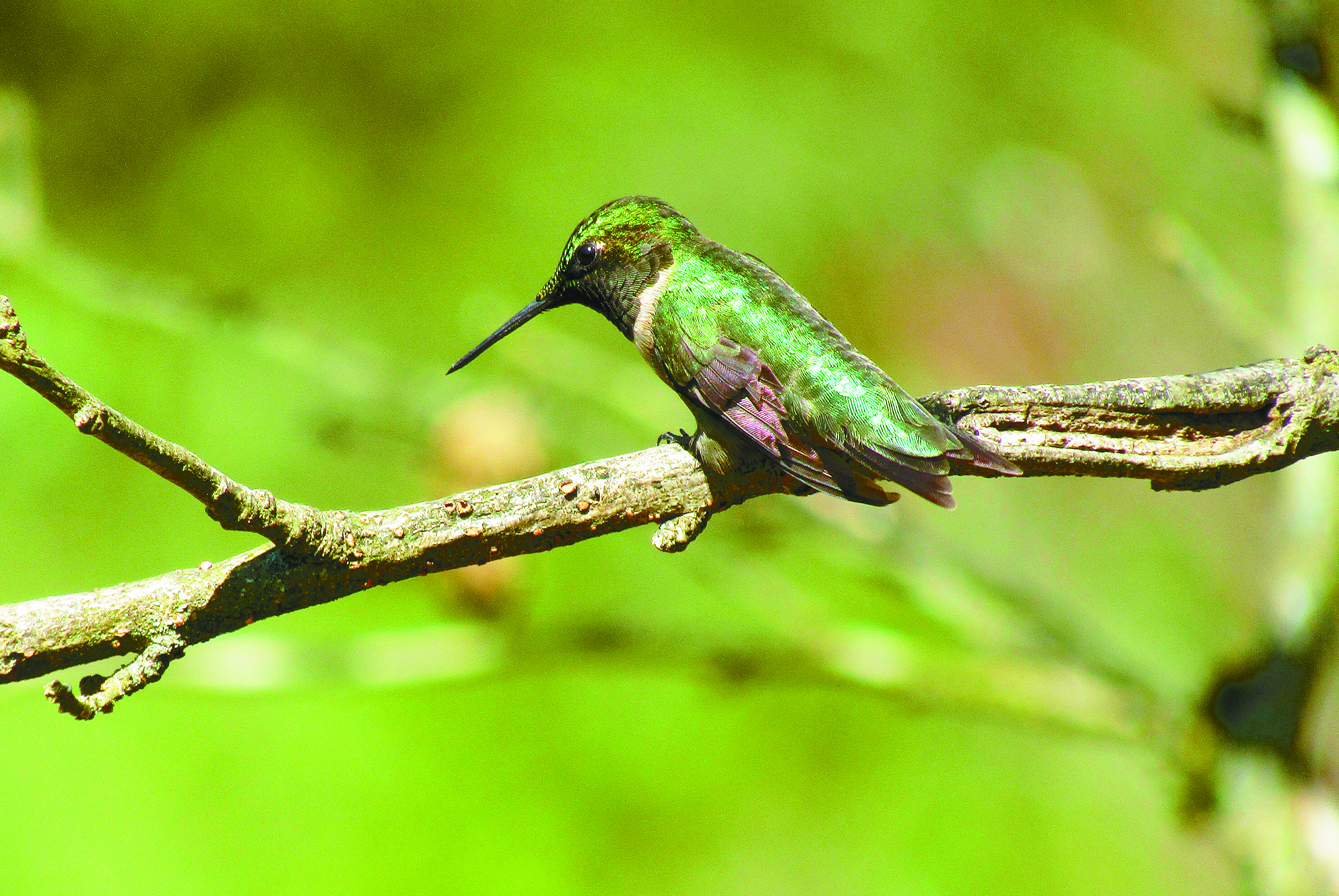
Tag Archives: Ruby-throated Hummingbird

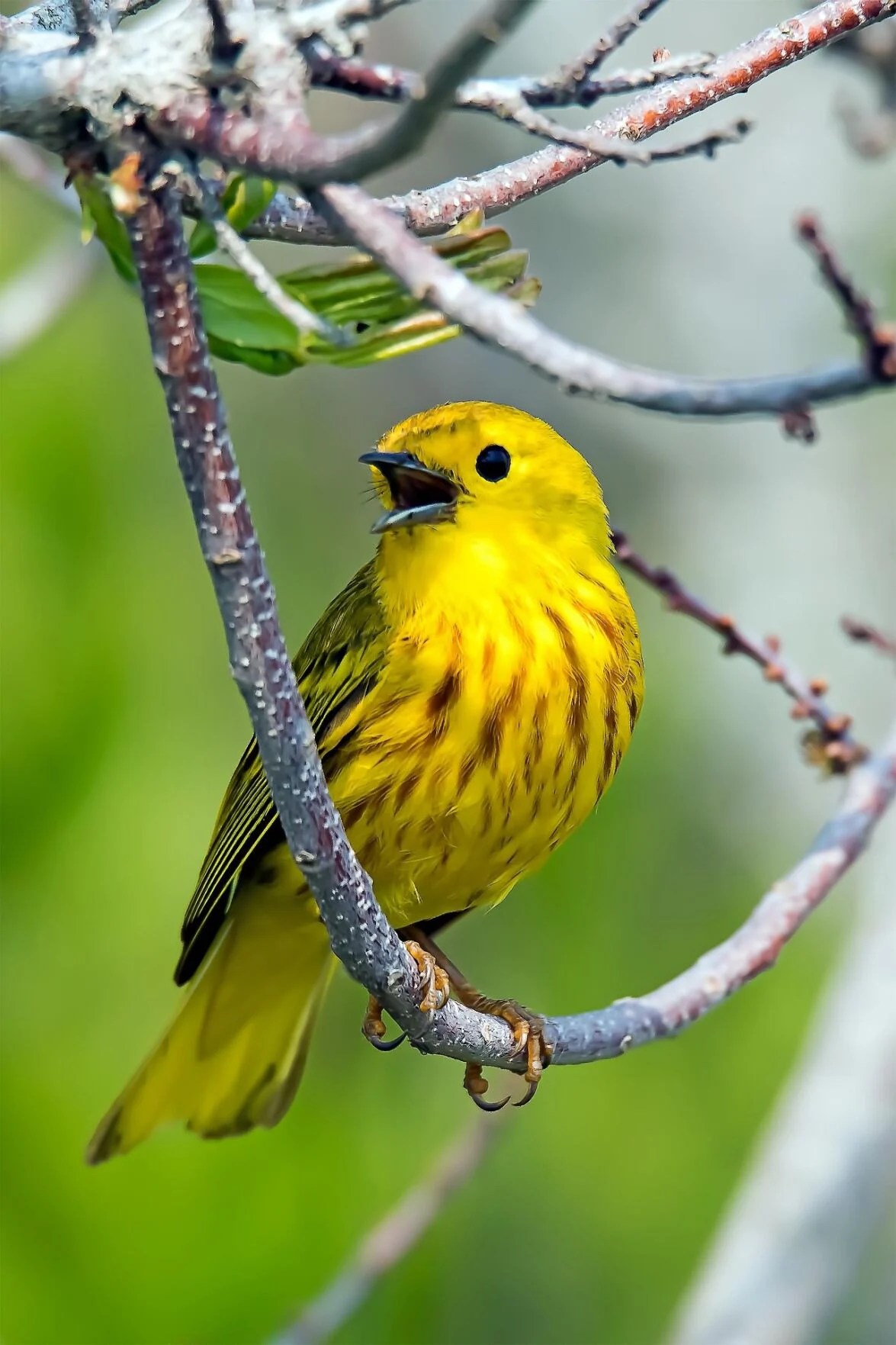
Yellow-breasted chat is a songbird that stands apart


Photo by Bryan Stevens • A yellow-breasted chat sings from the top of a tree.

I’ve always been a warbler fan, celebrating every opportunity that comes my way for seeing these colorful, energetic feathered sprites.

On May 9, the first indigo bunting (a male) showed up on at my home. A day later, I hosted a Baltimore oriole (a rare visitor at my home) and an even rarer visitor with a singing (more like caterwauling) male yellow-breasted chat.

I’ve had only one of these birds in the yard since I began birding in the mid-1990s. That one was a passing fall migrant that showed up in 2000 and then disappeared as soon as it came.

I had hopes that the persistently singing yellow-breasted chat that showed up May 10 might stay longer, and it did. For five days, he sang from dawn to dusk. Then the daily serendades ended. I assume he moved on, but it was fun hosting this bird, even for such a brief span.

Hans Toom/Pixabay • Yellow-breasted chats spend a great deal of their time skulking in thick tangles of vegetation.

According to the website All About Birds, male chats give display flights in the presence of females, other males or human intruders. According to the website, this behaviour entails descending from a high perch while singing, often with exaggerated wingbeats and a drooping tail. At the end of the flight they make a thumping sound, presumably with their wings.

While the yellow-breasted chat is no longer considered a member of the warbler family, my sentimental attachment to this oddball bird will always recall when this species was considered the largest member of the warbler family.

The chat’s declassification as a warbler took place back in 2017. I’ve always been a warbler fan, celebrating every opportunity that comes my way for seeking out these colorful, energetic feathered sprites.

The yellow-breasted chat, although no longer considered closely related to the New World wood-warblers, is still a bit of an oddity. Many experts always harbored doubts about whether chat is truly a warbler. Personally, I felt some disappointment at the reclassification. After all, what family doesn’t need its big, goofy oddball? If nothing else, the yellow-breasted chat is truly an the odd bird out among the little birds known as warblers that spend most of their time constantly on the move, flitting from branch to branch in hyperactive bursts of activity.

Yellow-breasted chats aren’t more sedate than other warblers, but they don’t dart about in the treetops in the same way as might a Northern parula or blackpoll warbler. During the spring ritual of attracting a mate, the males are obsessed with constant singing and performing. The performance portion of the program consists of awkward, drooping flights into the open before plunging back into thick cover. Males will also select an elevated perch in the open to proclaim their availability through song for any listening females.

There are many other ways they stand out on from other birds. For instance, yellow-breasted chats are bigger than all other warblers, as well as many of our songbirds. The chat reaches a length of 7.5 inches with a wingspan of almost 10 inches. The two sexes look alike, which is something else that separates them from many, but not all, warblers, which are generally known for the differences in appearance between males and females. The yellow-breasted chat has olive-green upperparts with white bellies and bright yellow throats and breasts. These chats also have long tails and heavy bills. A prominent characteristic is a spectacle-shaped white eye-ring.

Although only two have visited my home over the years, I have observed yellow-breasted chats in many locations in the region, but during my early years birding this was a very elusive bird for me. It took me a couple of years to get my first satisfactory look at this interesting bird in a tangle of vegetation along a walking trail at Persimmon Ridge Park in Jonesborough. I have also found chats in Unicoi County in the Sciota community. Some fields that comprise a part of Sycamore Shoals State Historic Park in Elizabethton have also been a reliable location for observing this species.

Chats prefer habitats such as dense thickets and other underbrush, which offers remarkable concealment from prying eyes. Chats are loud birds at most times, producing a variety of odd vocalizations, which means they are often heard before they are seen. The online Audubon Guide to North American Birds describes these sounds as “a bizarre series of hoots, whistles and clucks, coming from the briar tangles” and labels them a reliable means for determining the presence of a yellow-breasted chat. By learning these vocalizations, you’ll increase the chances of finding one of these birds during time spent outdoors.

The chat’s habitat preferences and its repertoire of vocalizations makes it easy to associate these birds with others that share the same dense, brushy habitats and a penchant for making unusual vocalizations. Birds often found in proximity to chats include brown thrashers, gray catbirds, white-eyed vireos and Eastern towhees.

Habitat loss has resulted in a steady decline of yellow-breasted chats in some parts of their range. It is a widely distributed bird, spending the nesting season from southern Canada to Mexico. Most chats retreat to Mexico and Central America for the winter months. This chat mostly feeds on insects, supplementing its diet with berries that ripen during the summer months.

Female chats usually lay three to four eggs, but both parents care for the young. Young chats are usually ready to leave the nest only eight days after hatching, but they will remain dependent on their parents for food for a couple of weeks. Chats usually nest twice each during the nesting season.

The yellow-breasted chat is usually a bird that I have to make a special effort to find. It’s worth the effort to gain a good look at this big, brash songbird.

Three other chats, all birds of tropical regions, were moved out of the warbler clan in 2009 by the American Ornithologists’ Union. Experts now believe that the rose-breasted chat of South America, the gray-throated chat of Mexico, Guatemala and Belize and the red-breasted chat of the Pacific slope of Mexico are more closely related to cardinals and tanagers than warblers. The yellow-breasted chat has been stuck in its own family, Icteriidae, not to be confused with New World blackbirds in the family Icteridae.

Even if we can no longer consider the yellow-breasted chat a warbler, the bird still remains unique enough to warrant its own family.

•••

To share a sighting, make a comment or ask a question, email me at ahoodedwarbler@aol.com.


Cardinals have long been considered feathered messengers

Photo by Bryan Stevens • Perhaps due to their vibrant appearance, cardinals have become symbols of certain aspects of the spiritual realm.

Watching birds offers a variety of benefits to the watcher. The activity offers solace and therapy, hope and optimism. There’s just something about our feathered friends that can be therapeutic and healing. I can’t begin to count the times a sighting of an unexpected bird has put a smile on my face. The website http://www.caringcardinals.com is dedicated to the spiritual symbolism that has come to be associated with a common bird known as the Northern cardinal.

The website identifies cardinals as spiritual messengers. Although many aspects of nature can deliver symbolic signs, the red cardinal has long been embraced as one of the most notable spiritual messengers, according to the website.

According to some theories, loved ones in Heaven send cardinals to watch over loved ones. Cardinals are one of the most common spiritual signs that people receive from Heaven. Cardinals are also thought to have a deep connection with departed souls. People have often reported that after the death of loved ones, they begin to see cardinals frequently. Seeing a cardinal for the first time or more frequently than usual can be an indication from a loved one that they will always feel your love and will be near you, according to the website.

This bird even got the name cardinal because its bright red feathers reminded some of the red garments worn by cardinals in the Catholic Church. The cardinal’s red plumage is definitely one of the driving forces that has helped these beliefs expand. The website notes that when a cardinal appears in nature, it serves as a gentle reminder that love never ends. These so-called “cardinal experiences” are defined as the moment a red cardinal appears unexpectedly after a loss. Quite often the soul needs more care and sometimes all it takes is a visit from one of God’s most adored creatures, the cardinal.

Jana Steward, one of my coworkers at The Erwin Record, recently lost her husband, Matt. She posted to Facebook on May 3 that her husband died peacefully right after his son got home from work the previous evening.

Photo by Bryan Stevens • Northern cardinals will visit feeders stocked with sunflower seeds at any season.

About midnight a cardinal entered the house as representatives from the funeral home arrived to take Matt out of the house.

“The cardinal sat on Matt’s chest, circled the staircase, came back and sat on his chest again and then went in Elliot’s cage,” Jana explained.

“Elliot is our dog, who loved Matt and he loved him,” Jana added.

CJ, Matt’s stepson, took the cage outside and released the cardinal. The bird, according to Jana, took Matt to his new home.

“My whole life my mom has always said a bird in the house means someone is going to die,” Jana said. “I always took that as a bad omen or something, so I hated when she said it.”

She added, “Little did I know it was actually an angel who helped Matt transition to a new phase of life.”

Even after the events of that day, the family has continued to see the cardinal around at times throughout the week. “I am sure Matt is watching over us,” Jana shared.

I can certainly attest to the fact that birds and simply watching them, observing their actions, can be immensely therapeutic. Call it feathered therapy, if you will.

In some Native American cultures, cardinals are considered harbingers of everything from rain and sun to good fortune and change. These birds have also come to represent such concepts as devotion, love and monogamy, most likely based on the strong pair bonds that develop between mated cardinal pairs. Although cardinals certainly look brilliant in muted winter conditions, males look their best in the spring, the season of courtship when the most vibrant plumage can capture a female cardinal’s attention.

Male cardinals also sing to attract and impress potential mates, but with this species, duets are possible. Only a few female North American songbirds sing, but the female Northern cardinal is quite the songstress, according to the website, All About Birds. She will often sing even while sitting on the nest. A profile of the species on All About Birds suggests her singing may give the male information about when to bring food to the nest.

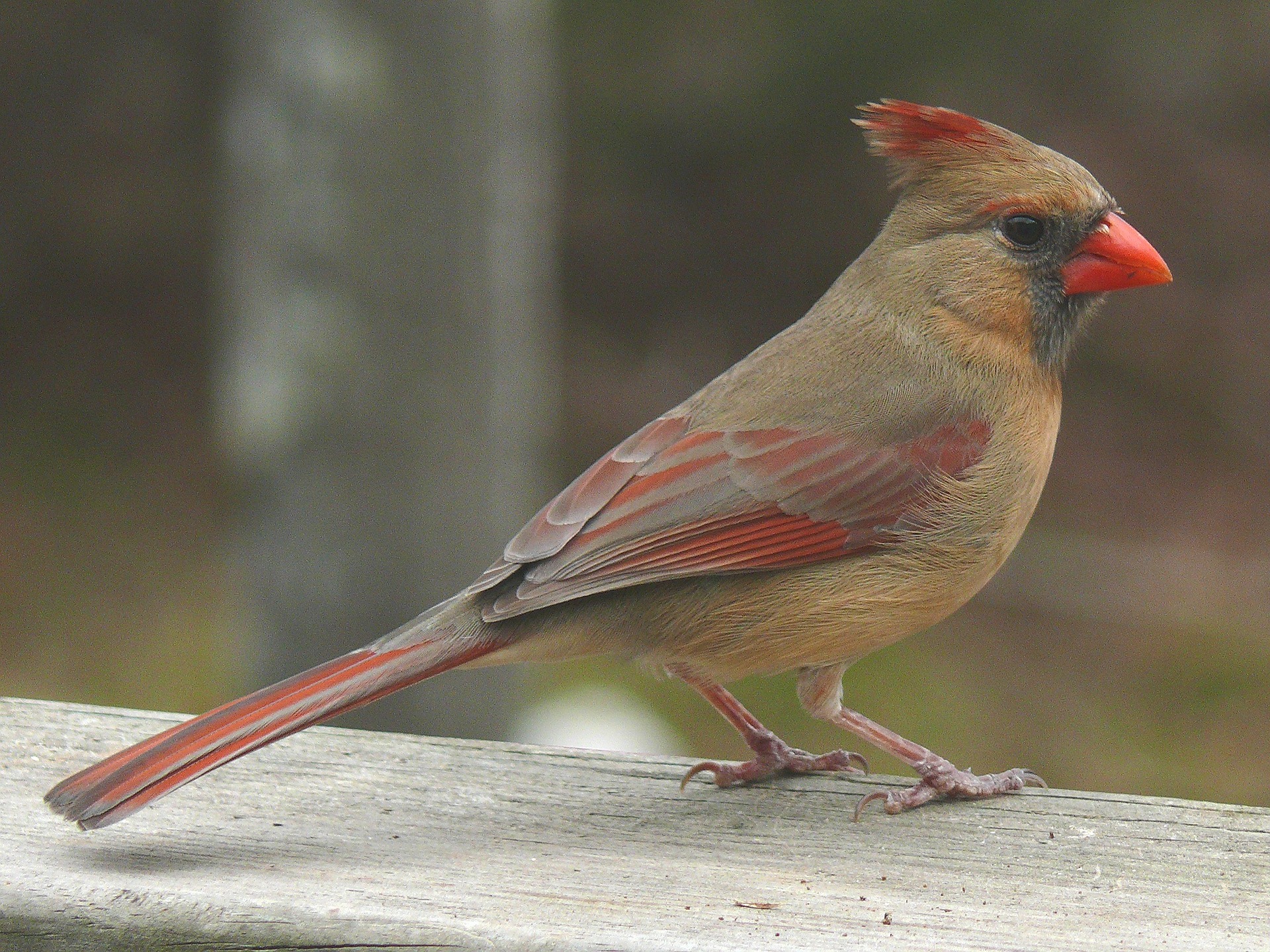
Photo by Skeeze/Pixabay.com • A female Northern cardinal lands on a deck railing. Female cardinals are not as brightly colorful as males, but they do have their own subtle beauty.

Cardinals eat a variety of insects, including crickets, beetles and moths, as well as fruit such as blackberries, wild grapes and mulberries. They’re also fond of seeds and wild about sunflower seeds, making them easy to attract to backyard feeders. If you’re having trouble attracting cardinals, provide some cover in the form of shrubs or hedges. These birds feel more secure if they can dart into a thick tangle of vegetation should a threat, real or imagined, surface suddenly.

Most songbirds are short-lived creatures, but a female Northern cardinal documented in Pennsylvania lived to the age of 15 years and nine months, according to All About Birds.

Over the years, cardinals have had many other common names. The name “redbird” is still widely used for this species, but other names for the Northern cardinal include Eastern cardinal, cardinal grosbeak, cardinal redbird and Virginia nightingale.

I enjoy watching cardinals at my feeders and getting glimpses into their lives away from those feeders. Seeing one of these beautiful and friendly birds can certainly brighten any day. The fact that they are rooted in so much of our lore is evidence that many other people feel the same way about cardinals.

•••

Share a sighting, make a comment or ask a question by emailing me at ahoodedwarbler@aol.com.

Photo by Bryan Stevens • A pair of Northern cardinals.

Black-and-white warbler won’t be confused with other birds

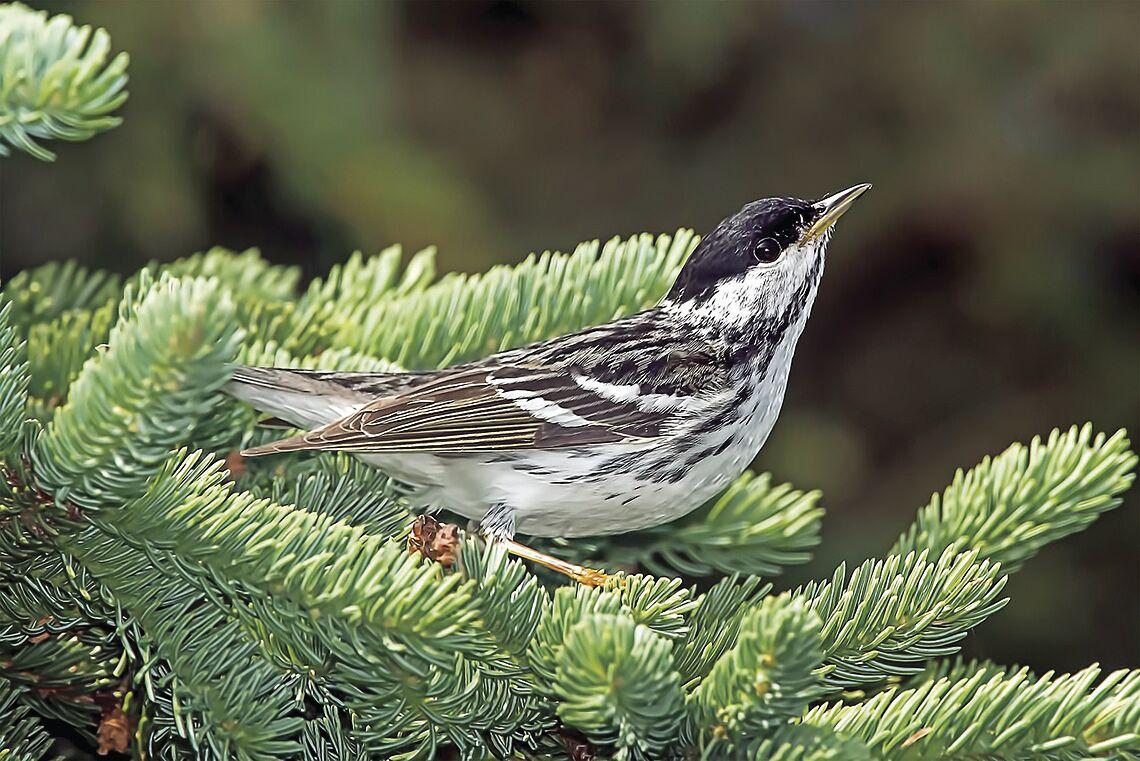
Photo by Hans Toom/Pxabay A black-and-white warbler would be almost impossible to confuse with any other bird.

I’m thinking that most people have probably heard of a “gaggle” of geese or a “murder” of crows as a way to describe a flock of these particular birds. Warblers also have their collective names. A flock of warblers is often referred to as a bouquet, a confusion, a fall, a cord or a wrench of warblers, according to the Birdorable Blog.

I personally like “wrench” of warblers. It has alliteration and describes how these amazing little songbirds can definitely “wrench” one’s attention from other matters. That’s been happening a lot at home. Since arriving in early April, the resident warblers have added their songs to the soundscape that makes the woodlands surrounding my home come alive every morning.

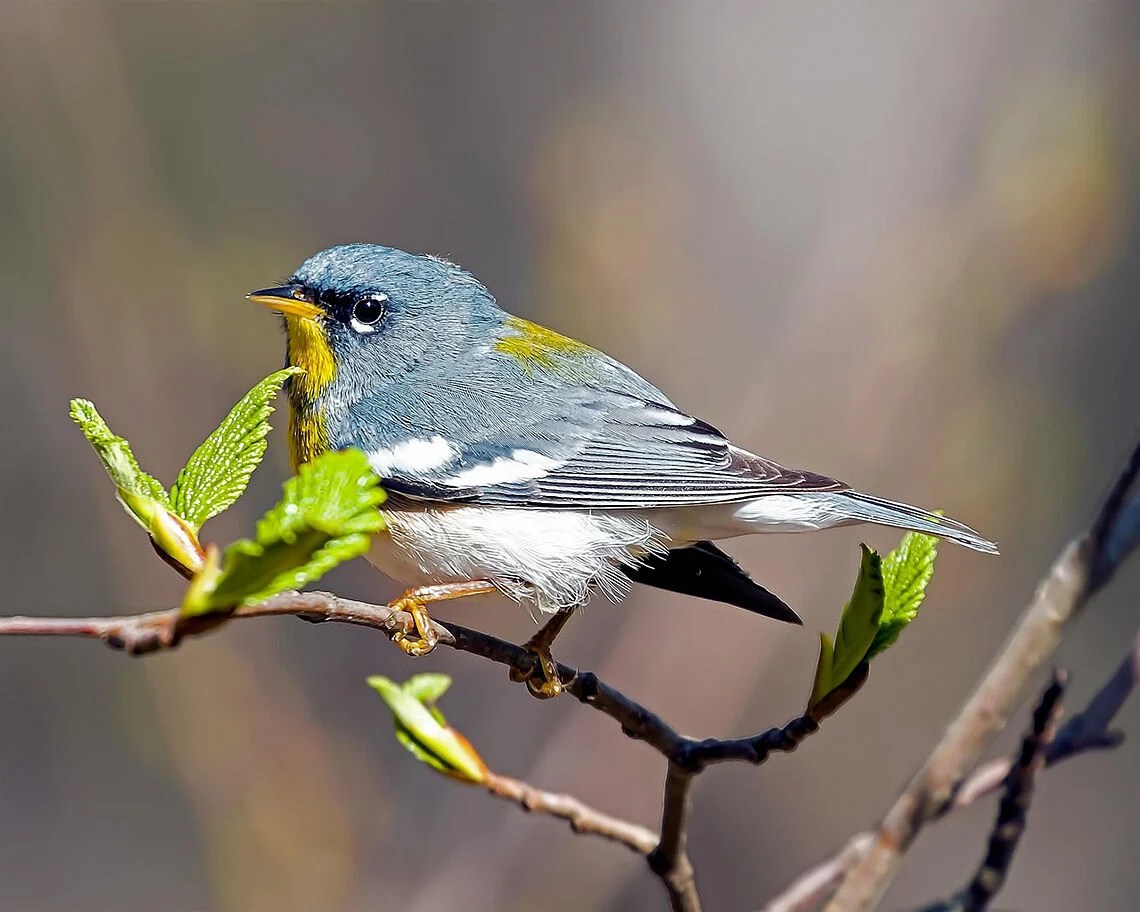
I wrote last week about the sad incident of a male Northern parula killed after an impact with a window. I wondered if I’d have to go the spring and summer season without hearing the excitable little trill of syllables that comprises this warbler’s song. I’m happy to report that less than a week passed before another male Northern parula showed up and began adding his song to the daily chorus. The circle of life continues.

On Saturday, May 3, I got to branch out from the handful of warbler species in residence around my home to warblers in other locations. I birded with Chris Soto, a Johnson City resident and fellow member of the Elizabethton Bird Club, on Holston Mountain and Sycamore Shoals State Historic Park as part of the annual Spring Bird Count conducted by the EBC. Despite some rain while conducting our survey of Holston Mountain, we encountered a variety of warbler species.

We didn’t observe any large warbler flocks, or wrenches, but we did find numerous species, including ovenbird, worm-eating warbler, Louisiana waterthrush, black-and-white warbler, Swainson’s warbler, hooded warbler, American redstart, Cape May warbler, Northern parula, yellow warbler, chestnut-sided warbler, black-throated blue warbler, yellow-throated warbler, black-throated green warbler and Canada warbler.

We added most of these species to the list by hearing them singing their springtime songs, including the “squeaky wheel” of the black-and-white warbler and the loud, ringing notes of the Louisiana waterthrush. If the latter wants to be heard, it is essential that it produce a loud song. The waterthrush resides near rushing mountain streams, which could easily overpower songs projected at a lower volume.

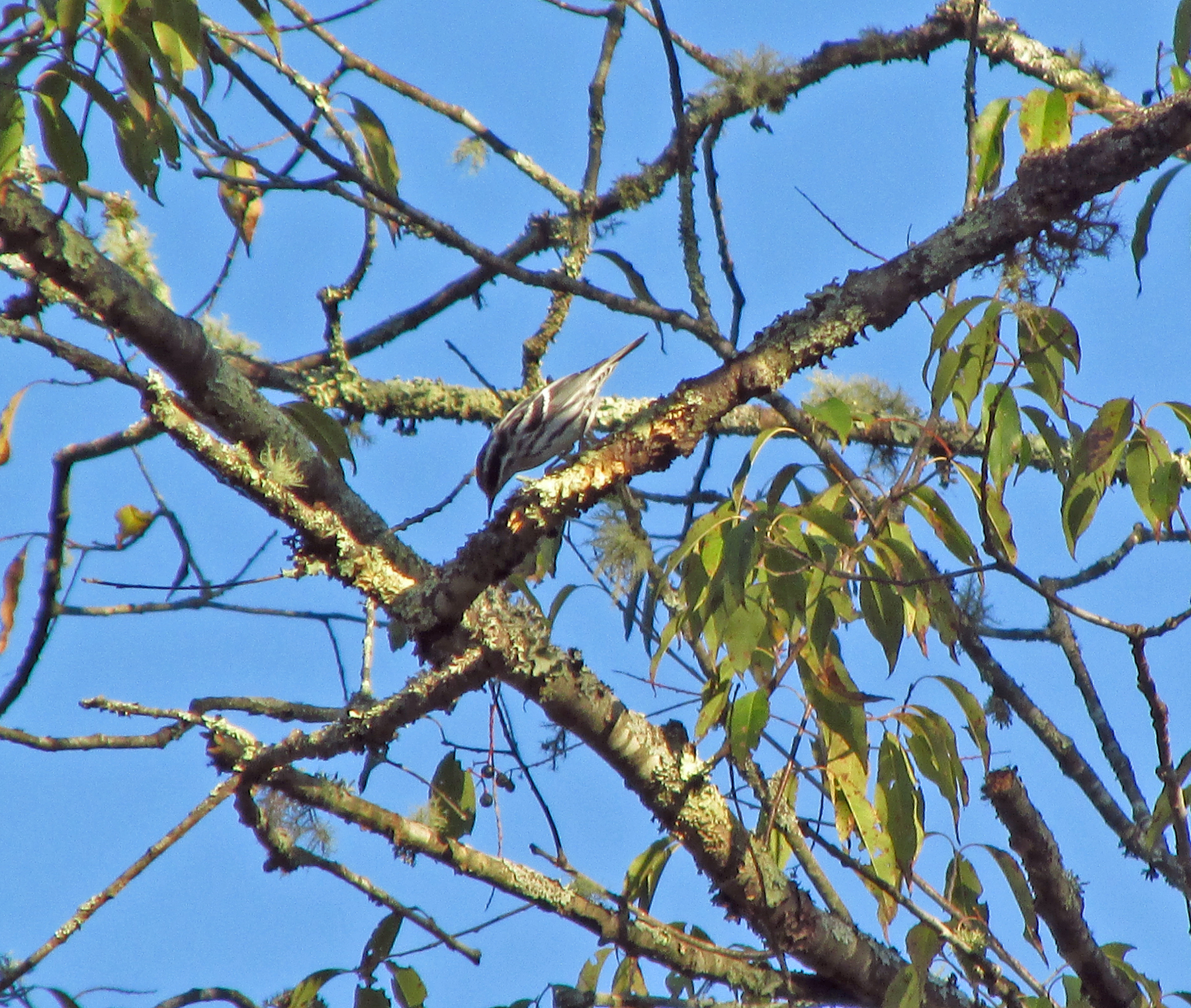
The black-and-white warbler is arguably the most aptly named of all the warblers. Both males and females have glossy black and white plumage. That’s it – there are no other colors present in the bird’s feathers.

Photo by Bryan Stevens • A black-and-white warbler creeps over the bark of a pine in search of insect prey.

The black-and-white warbler breeds in northern and eastern North America. It ranges from the Northwest Territories to the northwest and Newfoundland and Labrador to the northeast, to North Carolina to the southeast and Texas to the southwest. This species is migratory, wintering in Florida, Central America, the West Indies and northern South America down to Peru.

Once arriving for the spring, these warbler go about the business of nesting. The female black-and-white warbler selects a well-hidden nesting location at the base of a tree, rock, stump or fallen log, or under a bush or shrub, according to the website All About Birds. I discovered a black-and-white warbler nest, quite by accident, several years ago. The nest was wedged in a crevice beneath a large fallen pine resting on a steep ridge. Besides being rather inaccessible, I had no wish to disturb the nest so I enjoyed watching the birds through binoculars from a distance.

Photo by Hans Toom/Pxabay • A male black-and-white warbler sings its squeaky wheel song.

In its tendency to hug the trunk of trees as it seeks out insect prey, the black-and-white warbler is similar to unreleased species such as brown creeper and white-breasted nuthatch. In fact, an old common name for this bird was black-and-white creeper. It does venture farther out into a tree than the trunk, however, and will flit among branches as good as any other warbler.

For beginners just getting into the hang of birding, the black-and-white warbler is a dream when it comes to identification. It’s unlikely to be mistaken for any other bird. One good look through binoculars is usually all it takes to recognise the species. There’s no poring over the pages of a field guide for subtle field marks to help when trying to identify the black-and-white warbler. The same is true for the bird’s song, which is very similar in pattern to a squeaky wheel spinning round and round.

Enjoy the springtime and get outdoors and see what feathered friends are winging their way into your neighborhood.

Photo by Bryan Stevens
A Black-and-white Warbler forages along a branch.

Tiny songbird’s collision with window leaves gap in spring soundscape


Hans Toom/Pixabay • Male Northern paroles are a member of the warbler family. They are amazing vocalists producing an easily recognised trill of a song.

The male Northern parula is a persistent songster once arriving on its nesting territory each spring.

Since arriving in early April, a male Northern parula had been a tireless singer. I often heard the bird as I departed for work each weekday morning and was welcomed home in early evening by the bird’s song.

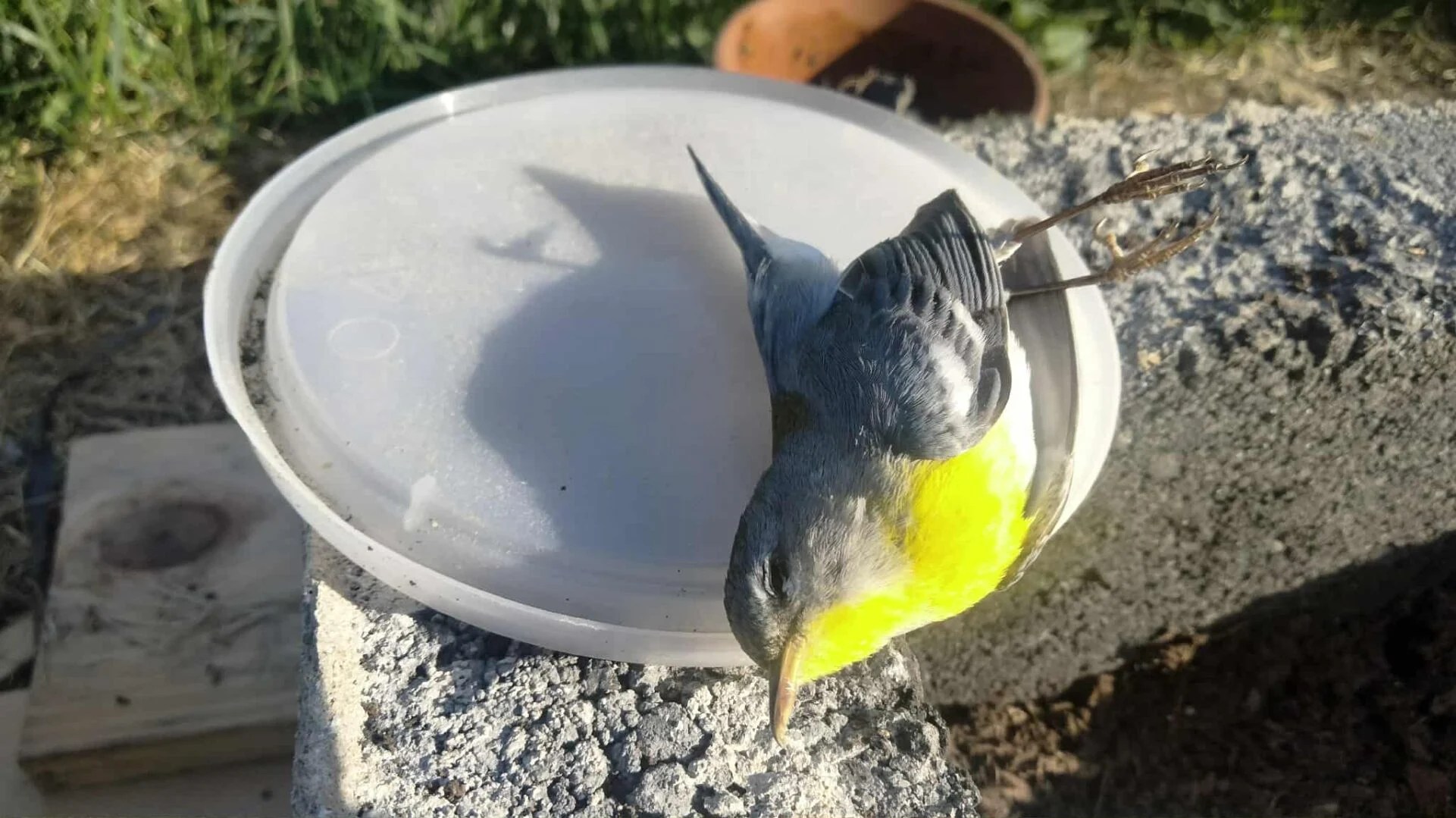
On April 29, I returned home. I followed my usual routine and dropped off my mother’s newspaper and mail at her home. Unfortunately, on her porch was the lifeless form of the Northern parula. I know it was “my” parula because the bird had been so faithful in its singing. I have not heard the song of a Northern parula in the days following the sad discovery.

Northern parulas sing two different types of songs, according to the website All About Birds. The most common is a rising buzzy trill with a final sharp note. This song rises up and pinches off sharply at the end. The second song has distinct pauses in between bouts of the rising buzzy trill. My parula had mostly sang the song best described as a rising buzzy trill, but it had also practiced at the second version, as well.

The tragic end for this little songster has really put a damper on my enjoyment of the spring season. Unlike many of our birds, this species of warbler has been thriving. Northern parulas are common, and their populations have actually increased by over 1% per year from 1966 to 2019 for a cumulative increase of about 47% according to the North American Breeding Bird Survey.

Bryan Stevens • This Northern parula died after a collision with a glass window.

But the incident is a reminder of the perils that our feathered friends face daily. An article titled “Getting Clear on Birds and Glass,” first published January 14, 2023, by Christine Sheppard and Bryan Lenz brings the detrimental impact glass has had on birds into focus.

The article noted that Smithsonian researches in 2014 attempted to determined how many birds are killed annually due to hitting windows. The study estimated, conservatively, that collisions with glass likely kill between 365 million and 1 billion birds annually in the United States. The authors of the article emphasized that they believe the number is closer to a billion birds, if not more, that die each year from hitting windows and other glass surfaces.

That’s a scary number, but also a testament to the resilience of birds. Of course, all living things have their limits, and we should try to do something to bring down this gruesome toll.

The little parula had struck a large picture window. We have placed decals in the window in an effort to break up the reflection, but the sun has bleached these over the years, and now it is evident they should be replaced. Clouds, sky or vegetation reflected in a window are perceived by birds as the real deal. A screen over a window or hanging strips or other items to break up the reflection will help birds avoid collision.

To examine a database with various possible solutions, please visit https://abcbirds.org/glass-collisions/products-database/

I am hopeful that another Northern parula will visit and find my yard to its liking. I’ve had Northern parulas residing consistently around my home from April to September for many years. The absence of this bird’s song from the daily soundscape has been distressing.

•••

Readers have continued to share their spring hummingbird sightings.

•••

Joe McGuiness in Erwin saw his first hummingbird back on April 9 at 5:45 p.m. Joe texted me that the bird came back to feed again around 7 p.m.

•••

Charlotte Carter, who resides in the Bloomingdale community in Kingsport, emailed me on Friday, April 25. “First hummingbird sighted at my home today at 12:45,” she wrote.

•••

Mack Hayes sent me a message on Facebook to report his first hummingbird arrived on Friday, April 25. “Saw first hummingbird this morning,” he wrote. He noted that he lives on the corner of Oakland Road and Bowmantown Road in Washington County.

•••

Hummingbirds are now back throughout the region. In the past couple of weeks the numbers have increased at my home. I have now seen as many as four hummingbirds at one time, and they duel all day long with each other, chasing each other from one corner of the yard to another. It’s good to have them back.

•••

Share sightings, ask questions or make comments by emailing me at ahoodedwarbler@aol.com.

Birder with ties to Northeast Tennessee plans Global Big Day

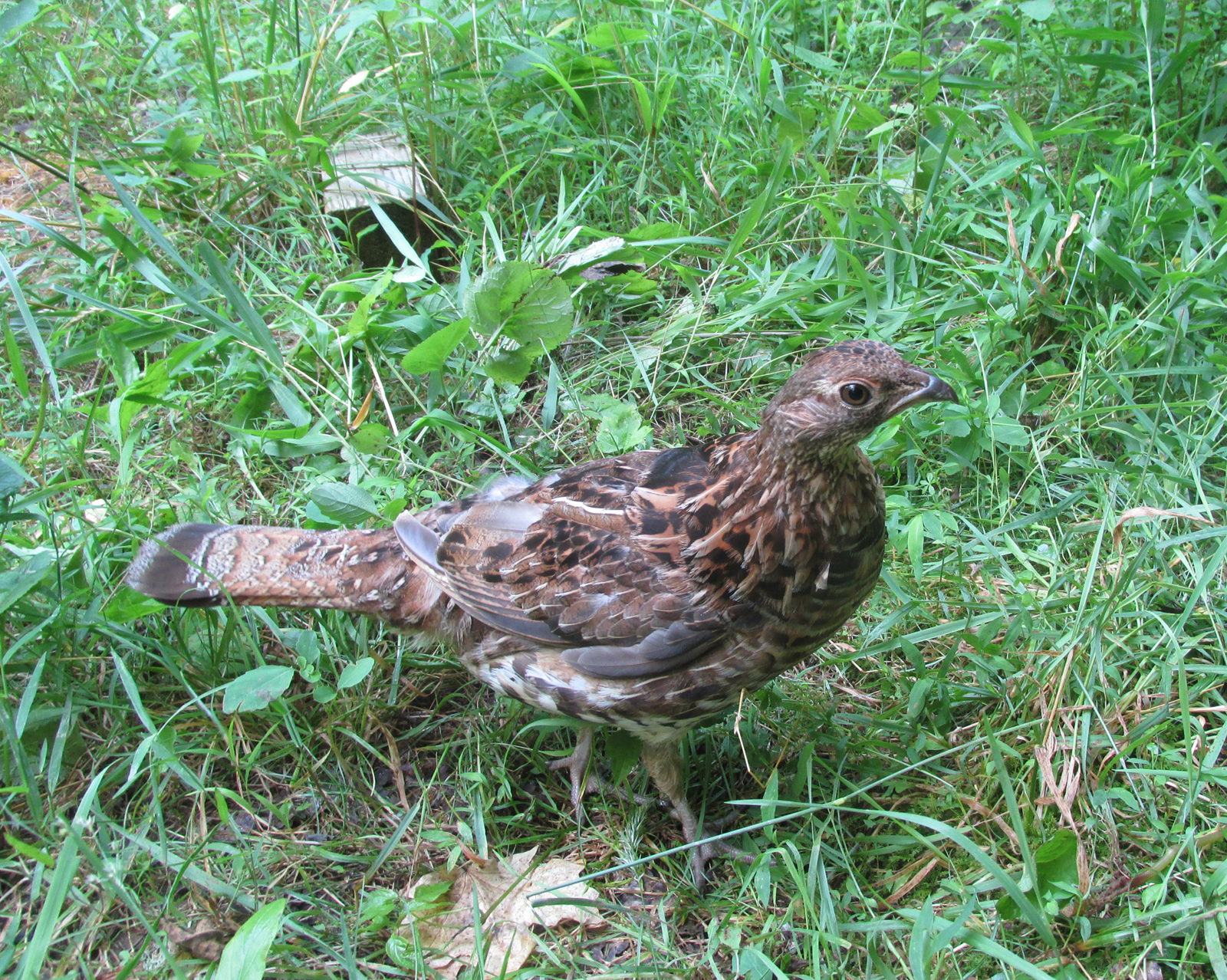
Photo by Bryan Stevens • Brayden Paulk introduces Rufous, a surprisingly tame ruffed grouse that lived on his grandfather’s farm for several years.

Brayden Paulk recently sent me an email to share some recent bird sightings he has made in Georgia.

As background, I’ve known Brayden since the summer of 2016. At the time, he was 17 years old and visiting with his grandparents in Flag Pond for the summer. We got acquainted thanks to an amazing ruffed grouse hanging out at a barn.

Brayden named the grouse Rufous who, as it turned out, was a remarkable bird. Ruffed grouse are, as a rule, shy and retiring birds. Not Rufous. He was an in-your-face sort of grouse. Getting to meet and observe this amazing bird was a privilege.

After we met so that I could make acquaintance with Rufous, Brayden and I did some birding at Rock Creek Recreation Area and then some stops on U.S. Forest Service lands along Highway 107 between Limestone Cove and the North Carolina line. Brayden wanted very much to add a black-throated blue warbler to his life list, and I very much wanted to help him find it.

We did manage to locate a singing veery, a scarlet tanager and a dark-eyed junco. We also found several warblers, including black-and-white warbler, worm-eating warbler and black-throated green warbler, but I began to fear we wouldn’t manage to locate his target bird.

But I am happy to report that we managed to find a male black-throated blue warbler. So, that productive morning back in 2016 resulted in my meeting with a grouse with a lot of personality and Brayden getting a new species for his life list of birds.

When we first met, Brayden was living with his family in Oxford, Alabama. During our first in-person meeting he made a point to tell me that his grandparents, Leon and Janice Rhodes, mailed him every one of my bird columns.

Photo by Bryan Stevens • The late Leon Rhodes teases Rufous the ruffed grouse.

These days he is living in Georgia, which is also providing the focus for most of his birding. He returns often to Tennessee. In fact, he has given a couple of talks to the Elizabethton Bird Club over the years, impressing his audience with his enthusiasm and engaging way of presenting information.

His talk were, surprisingly, not about birds. He spoke about his other passion, fishing, but still managed to make a few mentions of birds in the process.

Brayden has also worked for a couple of summers at Lamar Alexander Rocky Fork State Park in Flag Pond as a seasonal interpretive ranger.

Anyway, enough with the background and back to his recent email.

“I hope everything is going well with you and the bird club,” he wrote. “I wanted to contact you about some interesting recent sightings I have had that I thought you would be interested in. I have been able to put a lot of effort into birding so far this spring and it has turned up some fantastic finds.”

Photo by Bryan Stevens • Rufous, a rather tame ruffed grouse, who made his home in Unicoi County for several years.

His finds have even established some records in Laurens County in Georgia where he now lives.

His local birding loop in his home county has been very productive.

On April 7, his observations of common loons resulted in a county high count for the species. He found 14 loons on one lake and six on another nearby lake. The next highest count before his sighting had stood at two birds.

“That loop has also been very productive for shorebirds, as there are some flooded areas in nearby fields where I have seen lots of greater and lesser yellowlegs and snipe,” he wrote.

“I also got excellent views of a Swainson’s warbler within feet of me at an area on the loop with some swamp and cane thicket habitat,” Brayden added.

On April 7 while running his llocal birding loop in Laurens County, Georgia, Brayden Paulk saw the county high count for common loons with 14 on one lake and 6 on another nearby.

That sighting alone is something that would make many birders envious. I have been birding since 1993 and I can count on one hand the number of looks I’ve had of Swainson’s warbler. The species is often localized, meaning it takes some effort to locate. It’s easy to hear them. The Swainson’s warbler has a loud, ringing song similar to a Louisiana waterthrush. I’ve heard Swainson’s warblers much more frequently than I have seen them.

Brayden also shared his excitement about seeing his first first Horned Lark in the county. He saw the lark, a bird of open fields, at a different location. “It seems to be one of those birds you have to try to find by going to a sod farm or open country,” he noted.

“The Laurens County Loop has also been great for me in the past, and one particular pond turned up the first eBird county records for American avocet, white-rumped sandpiper and long billed dowitcher,” he wrote. “I have also found breeding painted buntings on the loop as well and had an excellent view of them with my dad.”

Brayden also wanted to share some more exciting news.

“I will be moving to Gulf Shores in coastal Alabama in a few weeks, which is one of my favorite places to go birding,” he wrote. “I plan on going to Dauphin Island on the Global Big Day because it is an incredible place to see migrants, and my goal is to find 150 species on that day.”

This year’s Global Big Day is scheduled for Saturday, May 10. Global Big Day is an annual birdwatching event hosted by eBird and Cornell Lab of Ornithology to celebrate and document bird migration. The event was created as a fun and engaging way for bird enthusiasts of all levels to contribute to science and conservation by reporting their bird sightings.

Brayden also hopes to visit Unicoi County again soon to do some birding there and look for some of the species he missed last Summer.

“Thank you for writing your bird articles,” he wrote at the conclusion of his email. “They have inspired me since I was young!”

It’s not easy to put into words how much that unexpected praise made me feel. I am incredibly gratified that I could have provide some inspiration to get such a gifted young man into the field looking for birds.

Readers may recall that I’ve had some deterioration of vision in recent years. With a pair of binoculars, I can still bring birds close enough to enjoy and appreciate their beauty and vivacity. Spotting birds, which is a skill that takes some practice to achieve, is no longer easy for me. Ah, the things we take for granted…

My hearing remains unimpaired. I have enjoyed making note of returning warblers and other birds simply by hearing their familiar songs ringing through the woodlands at my home for yet another spring.

For the past couple of weeks I’ve also had the pleasure of watching daily as a feisty male ruby-throated hummingbird visits the feeders arranged around my front porch.

In closing, I invite everyone to wish Brayden luck with his upcoming Global Big Day. I hope to update everyone with how he does.

•••

To share a sighting, ask a question or make a comment, email me at ahoodedwarbler@aol.com.

Ruby-throated hummingbirds stage their spring return to region

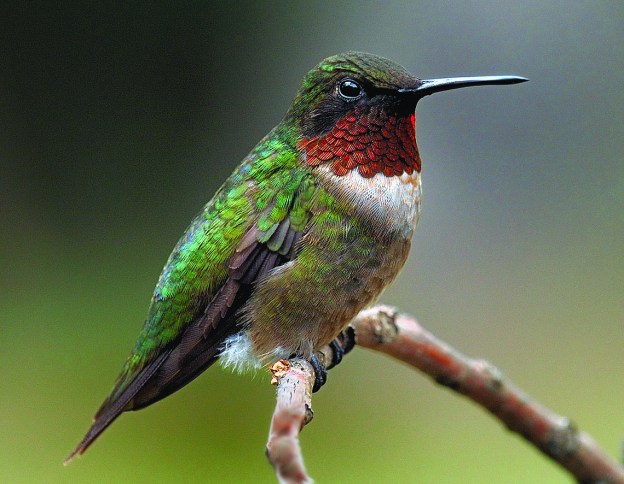
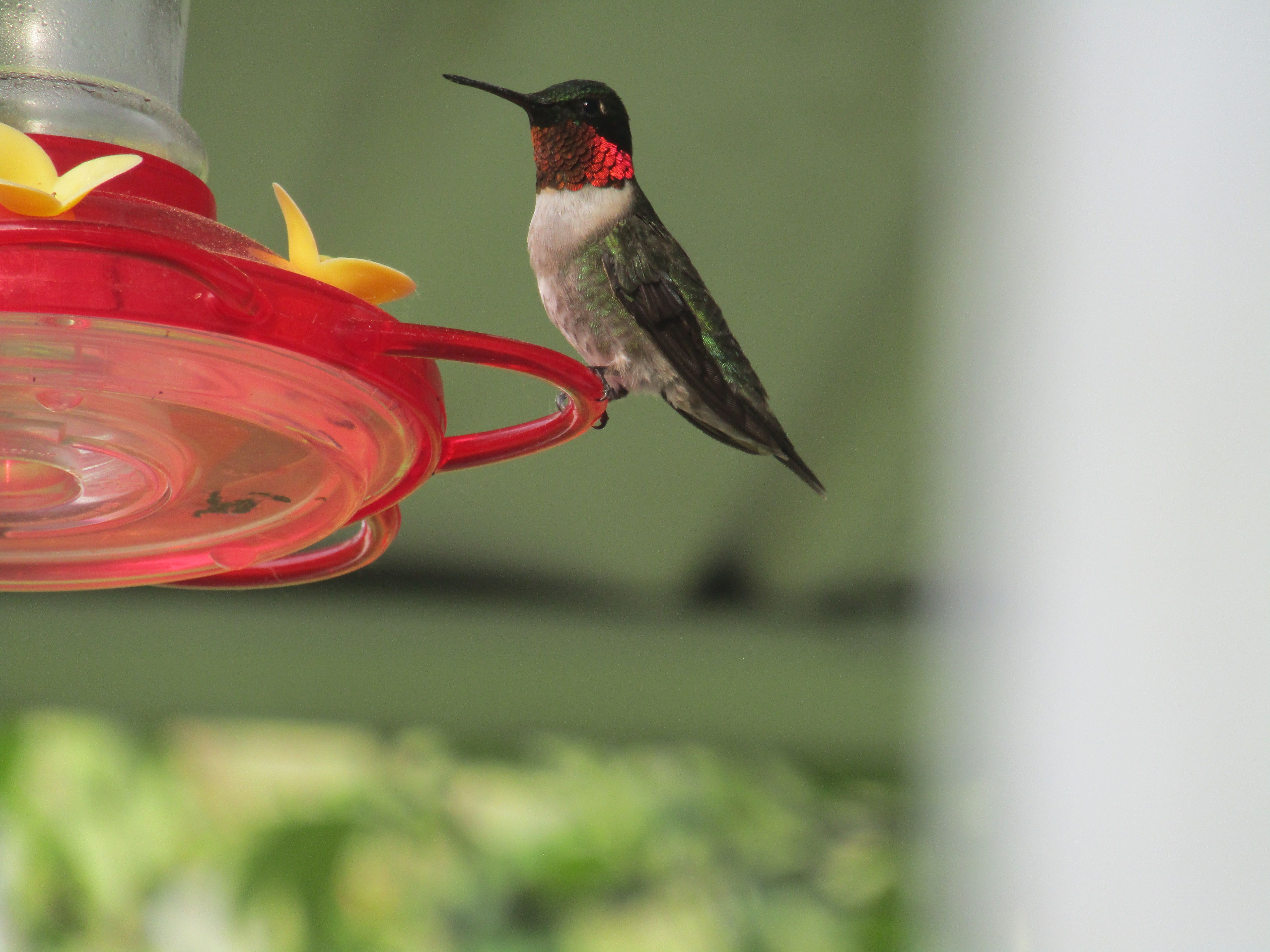
Bryan Stevens • A male ruby-throated hummingbird perches on a sugar water feeder.

In an article posted on March 27, Journey North, an organization and website that tracks migrating hummingbirds, announced that so far this spring, bird-watchers in 12 states had reported ruby-throated hummingbirds, but it’s still early in the season.

“So far, we have one sighting each in Kentucky and Tennessee and two in Arkansas, but we’re expecting more in the coming weeks,” noted the blog post by Journey North.

One week later, hummingbirds arrived in locations in Unicoi County, Carter County and Washington County in Northeast Tennessee.

Journey North is a citizen science project that engages citizen scientists in a global study of wildlife migration and seasonal change. It’s a fun way to track the migration of everything from hummingbirds to butterflies like monarchs.

•••

“Hummingbirds are here!” Beverly King, a resident on Marbleton Road in Unicoi, wrote in an email. “We saw our first hummingbird today, Saturday, April 5.”

Beverly noted that she was excited to see hummingbirds slightly early this year.

“We usually see them about the 15th of the month,” she added. “Well, my feeders are now up. We could not tell if it was a female or a male.”

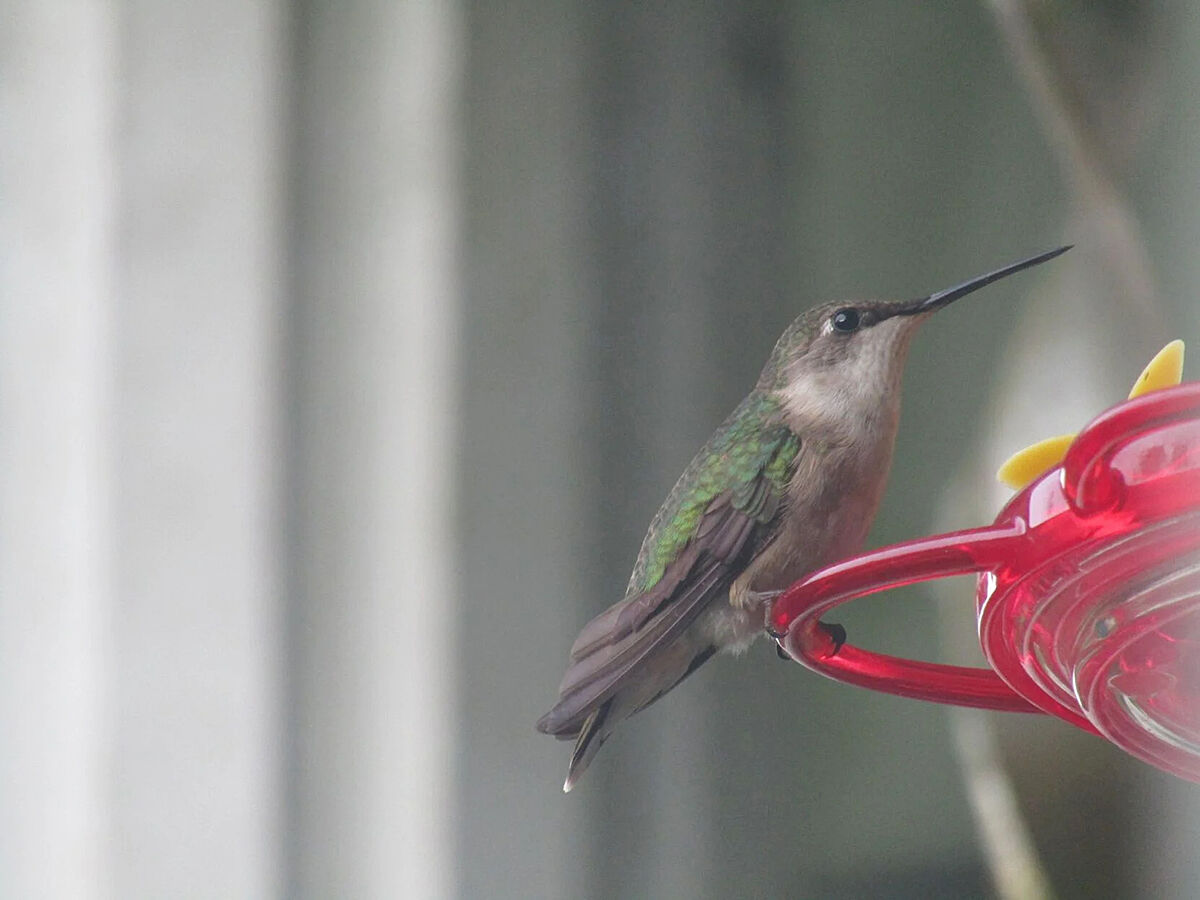
Bryan Stevens • A female ruby-throated hummingbird perches on a feeder.


•••

Erwin resident Amy Tipton sent me a Facebook message announcing that her parents had enjoyed a visit from a returning hummingbird.

“My parents, Edison and Emma Jean Wallin, had their first hummingbird of the season visit today, Saturday, April 5 at 4:30,” Amy wrote. “They live about a mile up Limestone Cove in Unicoi.”

•••

Dianne Draper in Jonesborough shared on my Facebook page about her first hummingbirds of the season.

“Our first ones showed up on April 5,” she noted. “We had two.”

•••

I’ve already seen my first hummingbird, as well. I have a bed of tulips blooming at my home. I planted them last fall and have been thrilled with their performance. I was outdoors admiring the tulips when I heard a brief but tantalizing buzzing noise. Although I scanned all around me, I failed to confirm that I’d heard a hummingbird.

A half hour later, however, while reading on my front porch, I saw my first hummingbird of 2025 when a male zipped up to one of my sugar water feeders. He returned twice while I stayed outdoors reading on a misty afternoon. He arrived at 4:14 p.m. on Sunday, April 6.

In 2024, I saw my first hummingbird on April 17 at 7:15 p.m. This year’s bird is certainly arriving earlier than is typical, but I was thrilled to see him.

•••

Gayle Riddervold, who lives only a few miles from my home on Simerly Creek Road in Hampton, reported that she and Becky Kinder saw their first spring hummingbird on April 8.

“We just saw our first hummingbird today,” Gayle wrote in a Facebook message. “Yesterday we saw a belted kingfisher on our road.”

•••

Brookie and Jean Potter, residents at Wilbur Lake in Elizabethton, sent me a text about the arrival of their first spring hummingbird on Wednesday, April 9, at 5:45 p.m.

They added, “It came back to feed again around 7 p.m.”

•••

Technically, TD, a follower of my “Our Fine Feathered Friends” blog, provided the earliest report of a hummingbird this spring. Of course, TD has the benefit of living in Texas, close to the Gulf of Mexico that these tiny birds must cross to return to the United States each spring.

The bird TD spotted arrived on Wednesday March 26, at 2:34 p.m. central time.

“A ruby-throated hummingbird male stopped at my feeder on my front porch a mile from Corpus Christi Bay after an hour of a rain shower,” TD wrote in a comment.

TD also reported that Corpus Christi has been in a drought so severe that residents have not been allowed to water outside since last fall.

TD’s hummingbird arrived with the first rainfall in more than two months.

“So I was watching the lovely rain when this hummingbird perched onto my hummingbird feeder,” TD wrote. “I have a very large window and hang four hummingbird feeders along the front porch.”

TD noted that the male’s iridescent ruby red around his neck resembled a scarf. “I named him Texas Tuxedo,” TD shared.

TD also saw a female hummingbird on Wednesday, April 2, at 7:15 a.m.

TD said the female hummer acted shy and fluttered around the feeder before feeling safe to perch for feeding.

It’s usually the case that females lag behind males in their annual migration back to the United States.

•••

Photo by Bryan Stevens • A male ruby-throated hummingbird perches at a feeder for a sip of sugar water.

The hummingbirds are an amazing family of birds. There are an estimated 330 species of hummingbirds, all of which are found in the New World. Consider that these dazzling little birds have been given vividly descriptive names, such as cinnamon-throated hermit, red-tailed comet, blue-chinned sapphire, lazuline sabrewing, sparkling violetear, fiery topaz, green-tailed goldenthroat, bronze-tailed plumeleteer, amethyst-throated mountain-gem, peacock coquette, red-billed emerald, empress brilliant, purple-backed sunbeam, green-backed hillstar, orange-throated sunangel, black metaltail, marvelous spatuletail and blue-tufted starthroat.

The only hummingbird species to inhabit the eastern United States from spring to fall each year is the ruby-throated hummingbird, which is currently arriving at various points from Florida to Maine and westward to states like Illinois, Minnesota and Oklahoma and north into Canada.

To return each year, ruby-throated hummingbirds make an awe-inspiring and non-stop crossing of the Gulf of Mexico. Even more incredible, they make the trip again in the fall when they return to warmer locations in Central America to spend the winter months.

Ruby-throated hummingbirds lead relatively brief lives. The oldest known ruby-throated hummingbird was a female, according to the website All About Birds. She was at least 9 years, 2 months old when she was recaptured and rereleased in 2014 during banding operations in West Virginia.

•••

These shared sightings represent some of the “early bird” sightings of hummingbirds. I welcome more reports as other people continue to observe returning hummingbirds. Email me at ahoodedwarbler@aol.com or find me on Facebook to share your sightings. Provide a date and time, if possible. Good luck with the hummingbird watching.

Projects can help welcome back spring arrivals

Photo by Pixabay.com • A well-stocked feeder is a first step toward attracting more birds to your yard.

I’ve welcomed March with open arms. I know it’s too early to guarantee we’ve seen the last of winter, but I’m hopeful that the worst is behind us.

While birds don’t follow calendars, they are punctual, and thanks to their boundless energies, the grand spectacle of spring migration is already upon us. The pace will quicken in April and early May as many of our favorite summer birds, including species ranging from hummingbirds and warblers to swifts and swallows, wing their way back to the region.

Now is the time to conduct some spring tasks to make our feathered friends feel more welcome when they do return.

Place birdhouses

Many birds are cavity-nesting species, which means they utilize natural nooks and crannies as locations for nests. Nesting in a natural tree cavity or in a human-provided birdhouse offers an extra degree of security not available to birds that build traditional cup-shape nests, not to mention all the birds that simply lay their eggs right on the ground without going to much effort to construct an actual nest.

Some of the cavity-nesting species in the region that will readily accept quarters in a bird house include Carolina chickadee, Eastern bluebird, white-breasted nuthatch, tree swallow, tufted titmouse, great crested flycatcher, prothonotary warbler and house wren.

Cavity-nesting isn’t restricted to songbirds. Wood ducks, Eastern screech-owls and American kestrels will make use of birdhouses built to their unique specifications. Plans for constructing your own bird houses tailored to individual species can be found at various online sites. For those not as good with do-it-yourself projects, department stores, gardening centers and other other shops sell pre-made houses.

Clean your feeders

Frigid cold snaps brought birds flocking to our feeders. As returning birds mingle with lingering winter visitors at our feeders this spring, the chance of spreading disease will increase.

Now is definitely the time to be proactive, cleaning feeders and bird baths regularly and keeping alert to any sign that ill birds might be among the visiting flocks.

Cleaning need not be laborious. Fill a spray bottle with a dilute solution of bleach water. A good ratio is no more than 1 part bleach to 9 parts water. Remove feeders, give them a quick rinse, and then spritz them with the bleach solution. Rinse thoroughly and allow to dry before refilling with seed for the birds.

Enhance brush piles

This past winter with its heavy snow and ice, as well as fierce winds, no doubt brought down many branches. When cleaning your yard of branches, consider adding them to an existing brush pile. I’ve long been a fan of keeping a brush pile in order to provide the resident songbirds with shelter and security from the elements, as well as from predators.

If you don’t have a brush pile, spring’s the perfect time to create one. If an unkempt pile of sticks offends your aesthetic sensibilities, tuck the brush pile into an obscure corner or locate it at the margins of the lawn or garden.

Personally, I like to locate brush piles near my busier feeders. A brush pile gives visiting birds a quick retreat if a predatory hawk arrives unexpectedly. For some birds, the need for dense cover is paramount.

Offering brush piles, as well as hedges and dense shrubbery, will help welcome visitors such as gray catbirds, Eastern towhees, brown thrashers and some sparrows. Wide, open spaces make many songbirds nervous.

Photo by Jean Potter • An American crow visits a bird bath.

Install water features

With a large fish pond, a flowing creek and a couple of mountain seeps on my property, I’ve never needed to introduce an additional water source. For those with properties that don’t offer ready access to water, adding an ornamental pool or fountain, or even a bird bath or artificial waterfall, will act as a magnet for many birds. American robins and cedar waxwings love a place to splish and splash, as well as take a refreshing sip. Migrating warblers, which for the most part ignore feeders, are almost magically drawn to water features. There is also something relaxing for the human psyche when it comes to water features.

Refurbish the landscape

Spring’s a great time to plan ahead. While a handout of sunflower seed is appreciated by many birds, there’s nothing that beats organic sources of food.

Add plants and trees to the landscape of your yard and garden with the express purpose of providing birds with seeds, fruits and berries. Most experts urge native plant varieties that meet the nutritional needs of many bird species.

Flowers can be chosen that provide that desired burst of color for an interval but then go on to produce fruit or seeds craved by many birds. Native flowers can also be planted that offer a natural source of nectar for ruby-throated hummingbirds. Do some homework. Some nurseries specialize in native plants.

Photo by Bryan Stevens • A ruby-throated hummingbird visits a feeder for a sip of sugar water.

Get hummingbird feeders out early

Various websites track the annual spring return of hummingbirds. Journey North is one site that relies on citizen scientists to share their first sightings of this tiny, beloved bird.

The first reports of ruby-throated hummingbirds usually surface in early March along the Gulf Coast after these tiny birds make their incredible non-stop flight across the Gulf of Mexico. This arduous journey is their first step to returning points all across eastern North America for the spring and summer nesting season. Those first arrivals are still hundreds of miles away from Northeast Tennessee. There will always be “early birds” even among hummingbirds. Increase the likelihood of seeing one of these tiny gems by putting out a sugar water feeder soon. I’d encourage anyone hoping to attract these birds to have feeders ready for them by the last week of March.

Treat Yourself

Now is also the perfect time to indulge in a purchase that will enhance your enjoyment of the returning birds. If you have been wanting some new birding field guides, a new pair of binoculars, a new software app to help identify birds or a camera to let you document bird sightings with photographs, there’s no time like the present.

Welcome spring and the returning birds at the same time while ensuring maximum enjoyment of both.

•••

Bryan Stevens has written about birds and birding since 1995. Email him at ahoodedwarbler@aol.com to share a sighting, ask a question or make a comment.


September brings spike in bird migration

Hans Toom/Pixabay • Few warblers make as great a journey as the blackpoll warbler. This small songbird makes a roundtrip flight of 12,400 miles for its seasonal migrations each year.

September’s arrival puts fall migration into sharp focus. The birds that returned this past spring — the warblers, vireos, tanagers, grosbeaks, flycatchers, hawks, hummingbirds and many more — have begun or are beginning to make their way back to the locations where they will spend the winter months far from the cold, bleak conditions over most of North America.

Every morning as I leave for work I hear the buzz of hummingbird wings. When I return in the evening, I am often greeted by the scolding calls of red-eyed vireos from the woodlands around my home.

Some of these birds migrate out of the tropics every spring to avoid competition. Others find North America a land of abundant, albeit temporary, resources. This land of plenty offers a wealth of insects, seeds, fruit and other nourishing, nutritious food to help parent birds keep their strength while they work to ensure their young thrive. Of course, once the bountiful period concludes, they return to the tropics of Central and South America to winter. Those that do so successfully will make the journey back to the United States and Canada in the spring. It’s an ongoing cycle, repeating year after year, season after season.

The phenomenon of migration isn’t exclusive to the neotropical migrants of the New World. Birds in other parts of the world migrate, too. Waterfowl, shorebirds and raptors are among some of the families of birds that stage impressive migrations.

Photo by Jonathan Cannon/Pixabay.com • The Arctic tern outdoes all other birds when it comes to migration. These seabirds journey from their Arctic nesting grounds to spend the winter around the Antarctic, a journey of some 50,000 miles a year.

The Arctic tern, for example, truly takes migration to extremes. This small seabird travels each year from its Arctic nesting grounds to the Antarctic region, where it spends the winter months. Put into terms of mileage, the Arctic tern can travel about 50,000 miles in a single year. For a bird with a body length of about 15 inches and a wingspan of about 28 inches, this incredible migration is an astonishing feat. These statistics permit the Arctic tern to easily lay claim to the title of champion migrant among our feathered friends.

According to the website for National Geographic, Arctic terns face a serious threat from climate change. In a profile on the tern at its website, National Geographic warns that Arctic terns are projected to lose 20 to 50 percent of their habitat due to the temperature changes linked to climate change. They also face loss of habitat due to encroachment by human activities such as oil drilling.

The ruby-throated hummingbird, a favorite of many bird enthusiasts living in the eastern United States, makes an impressive migration each year. Just to reach the United States, these tiny birds undertake a strenuous journey. They leave their wintering grounds in Central America to return to the United States and Canada for the nesting season. Most of these tiny birds, which are barely four inches long, make a non-stop flight of more than 500 miles across the Gulf of Mexico. The journey can take almost an entire day. With the end of summer, the entire population of ruby-throated hummingbirds, increased by a new generation of young birds, makes the Gulf crossing for a second time in a year to return to the American tropics for the winter months.

Photo by Bryan Stevens • A ruby-throated hummingbird perches at a feeder for a sip of sugar water.

Among North America’s buteo hawks, which includes raptors such as red-shouldered hawk and red-tailed hawk, the broad-winged hawk stands out as a dedicated migrant. These hawks form flocks that at times number in the hundreds or thousands as they sail and glide on thermals rising over various mountain ranges. These hawks and other raptors are well-known in the region for migrating past the Mendota Fire Tower in Southwest Virginia every September and early October.

The broad-winged hawk’s counterpart in the western United States is Swainson’s hawk, which shares the broad-winged hawk’s inclination for migrating in large flocks. Swainson’s hawk is named for William Swainson, the famous 19th century English naturalist for which Swainson’s thrush is also named.

The hooded warbler, my favorite member of the migratory New World warblers, migrates back to Mexico and Central America for the winter months after nesting during the spring and summer in a range concentrated in the southeastern United States. The males, after going quiet in late summer, have started singing on occasion from the shaded woods around my house. I think this has more to do with restlessness as they prepare for to depart on a migration flight that will take them to the balmy Caribbean, Mexico and Central America while we shiver through the months between October and April. It’s not a migration of an incredible distance, but it’s still quite an accomplishment for a bird only five inches long and weighing less than half an ounce.

Another warbler is a true migratory champion. Few warblers make as great a journey as the blackpoll warbler. Instead of migrating over land, this five-inch-long warbler undertakes a two-stage migration. The first half of the migration is a non-stop flight of about 1,500 miles. Every fall, these tiny birds fly over the Atlantic Ocean during this part of their migration, departing from Canada or the northern United States and not stopping until they reach various locations in the Caribbean. There they will spend some time recovering from the exhausting first half of their journey before they continue their way to such South American countries as Colombia and Venezuela. Once again, during the time they spend flying over open ocean, these tiny warblers do not feed.

Fall’s a great time to witness the variety of avian life. Look for some of these migrants passing through your yards, gardens or favorite birding spots.

For those wanting suggestions for seeking out migrating birds, the linear trail in Erwin, Rocky Fork State Park in Flag Pond and Limestone Cove Recreation Area are some good bets.

•••

To ask a question, make a comment or share a sighting, email me at ahoodedwarbler@aol.com. 

Surprise! Hummingbirds come in variety of sizes

This week’s column is about hummingbirds, the big and the small ones. Frances Lamberts in Jonesborough sent me an email earlier this month that got the ball rolling for this week’s hummingbird column.

“Two hummingbirds were here for a good week long,

at the end of April,” Frances wrote. “Then they were gone, and I haven’t seen any since. Despite the heat/drought (and with some watering), the

property has many favorite flowers in bloom, including the blue salvia, red pole beans, monarda, many others come and gone, the cardinal flowers about to bloom.”

Her question was a simple one: “Where are the hummers?”

She noted that she has kept a “first sightings” record for about 20 year. One year the hummingbirds didn’t arrive until mid June, which worried her at the time.

“What is happening now?” Frances asked.

The simple and honest answer is that it’s not really possible to land on any single answer. Birds have wings, and hummingbirds are capable to long-distance flights.

Still, a setting such as the one Frances described with such a wide variety of blooms should be teeming with hummingbirds.

Personally, it’s been a perplexing season. My hummingbirds arrived back in April, stuck around for perhaps a week, and then almost disappeared. They returned in mid-June, remained visible for a couple of weeks, but have since pulled another vanishing act.

In any given year, the numbers of hummingbirds passing thorough is going to fluctuate. Some years, these tiny flying gems will be present in good numbers on an almost daily basis. Other years, hummingbirds can become quite scarce.

I usually enjoy my best hummingbird numbers in the fall as these little birds begin their leisurely journey back south. Late August and the month of September is usually a great time to watch hummingbirds. I’m optimistic that the same will hold true this fall.

In some other hummingbird news, the world added another species of hummingbird this year when the giant hummingbird of South America got split into two distinct species.

Abi Cole, writing for Audubon Magazine, reported in an article on June 7, 2024, that scientists have considered two distinct populations of giant hummingbird — a migratory southern population in Chile, Argentina and Bolivia, and a non-migratory northern population in Chile, Ecuador and Peru — to be the same species.

Now, scientists have reconsidered that belief and learned that the two species have been able to fool scientists for so long by basically, as Cole’s article phrases it, by hiding in plain sight.

Cole’s article details the elaborate process by which giant hummingbirds were captured and fitted with geolocator devices. The article credits Jessie Williamson, lead author of the new study and a National Science Foundation postdoctoral research fellow, with unraveling the mystery.

Williamson did so by intensively studying the Chilean population. The resulting research also revealed some huge surprises.

For centuries, there has been speculation about where the Chilean giant hummingbirds go to spend the winter. Now we know – they make an astonishing, record-breaking 5,200-mile round trip to spend several months with their cousins in the Peruvian Andes.

Because the Chilean and Peruvian birds look so much alike, no one had ever realized that they were co-existing with each other during the winter season.

Of course, the name “giant hummingbird” is almost an oxymoron for a family of birds famous for their diminutive size. Now that we have two species of giant hummingbirds, they can’t both hold the title of world’s biggest hummingbird.

So, which is the bigger bird? As it turns out, the giant hummingbirds living year round in the Andes, now known as the northern giant hummingbird, is slightly bigger than the migratory southern giant hummingbird.

The article about these discoveries is fascinating. To read it for yourself, visit http://www.audubon.org/magazine/scientists-discover-worlds-largest-hummingbird-hiding-plain-sight.

The giant hummingbird does earn the right to that name. Both of the two species weigh between 18 and 24 grams and have a wingspan of about 8.5 inches. They have a body length of 9.1 inches. For a useful comparison, they are about equal to the size of a European starling or a Northern cardinal.

They are not the dazzling beauties most people associate with hummingbirds. Giant hummingbirds have a drab greenish plumage above with a whitish rump patch and dingy coloration below with variable rusty tones and dusky spotting. They do have the long bills and overall physical shape of other hummingbirds. The scientific name is Patagona gigas, roughly translated as the giant of Patagonia.

Photo by Bryan Stevens • Welcoming hummingbirds also involves making sure that they remain healthy and safe while spending time in our yards and gardens.

Count the giant hummingbird (either of the two species) as birds I’d like to see some day. The world’s diversity of hummingbirds is dazzling, but I feel fortunate to enjoy the ruby-throated hummingbird from April to October every year. As anyone knows who hosts these tiny birds, ruby-throated hummingbirds are dazzling and engaging guests during their all-too-brief.

•••

To ask a question, make a comment or share a sighting, email me at ahoodedwarbler@aol.com.


Indigo buntings speak to the summer season

Photo courtesy of George Stone • Indigo buntings range from southern Canada to northern Florida during the summer months, occasionally even expanding beyond this wide range.

George Stone emailed me after finding my weekly bird column online.

“I live approximately 90 miles west of Edmonton, Alberta, Canada,” he wrote in his email. “This morning (June 6) I had my first ever sighting of an indigo bunting at my feeder!”

He also asked a question, wanting to know if indigo buntings are rare in his location in Canada.

I did some digging online and found that indigo buntings range from southern Canada to northern Florida in the summer. I relayed this information to George in a reply to his email, congratulating him on his sighting.

I informed him that I reside in Northeast Tennessee, close to the borders with Virginia and North Carolina. I also told him that in summer, indigo bunting is not rare at all here in Northeast Tennessee. I saw and heard several while doing a summer bird count on June 8 in the Limestone Cove community of Unicoi County.

Photo by Bryan Stevens • The male indigo bunting is a resplendent bird.

The male indigo bunting is the only solid blue bird in the eastern United States, but it’s all an illusion — literally a trick of the light. The indigo bunting’s feathers are not really blue; the male’s brilliant azure plumage is caused by the process of diffraction of light around the structure of the bird’s feathers. This process scatters all but the blue light, and the resulting color shifts from black to blue to turquoise as the angle of reflected light changes. In bright light, it can even look unnaturally vivid blue. In poor light, however, an indigo bunting male can appear black. Fortunately, indigo buntings have both a characteristic body shape and song, so even if the birds are not seen in their best light, they can still be recognized.

For such a bright blue bird, indigo buntings are not easy to detect. Males like to find an elevated perch and sing to proclaim their territory and pitch their availability to potential mates. Learn the song, which consists of a burst of jumbled, high-pitched notes, and use that knowledge to help pinpoint singing males. Once you zero in on the singing bird’s location, it’s easy to focus binoculars and enjoy peeking at such a pretty bird.

The indigo bunting belongs to a genus of birds known as Passerina, which is included the family Cardinalidae, which includes birds like Northern cardinal and rose-breasted grosbeak. They are often lumped into a group known as North American buntings, although they are not closely related to such birds as snow bunting and lark bunting. The latter is even recognized as the official state bird for Colorado, a unique honor for this group of birds. The other members of the Passerina genus include lazuli bunting, varied bunting, painted bunting, rose-bellied bunting, orange-breasted bunting and blue grosbeak.

Photo by Bryan Stevens • Newly-returned neotropical migrants, such as this Indigo Bunting, increased the total number of species for the annual spring count.

Worldwide, other birds known as buntings include such descriptively named species as slaty bunting, corn bunting, white-capped bunting, gray-necked bunting, cinereous bunting, lark-like bunting, cinnamon-breasted bunting, chestnut-eared bunting, little bunting, yellow-throated bunting, golden-breasted bunting, black-headed bunting, red-headed bunting and yellow bunting.

For me, the indigo bunting has always been a bird of the summer season. Not even the heat of mid-day tires out a persistently singing male indigo bunting. They linger into the early October, but later in the season the bird begin to molt feathers and take on a more shabby look. Enjoy them while they’re here.

•••

To ask a question, make a comment or share a sighting, email me at ahoodedwarbler@aol.com.