Tag Archives: Songbirds

Bald eagles, always impressive, not an uncommon sight in region

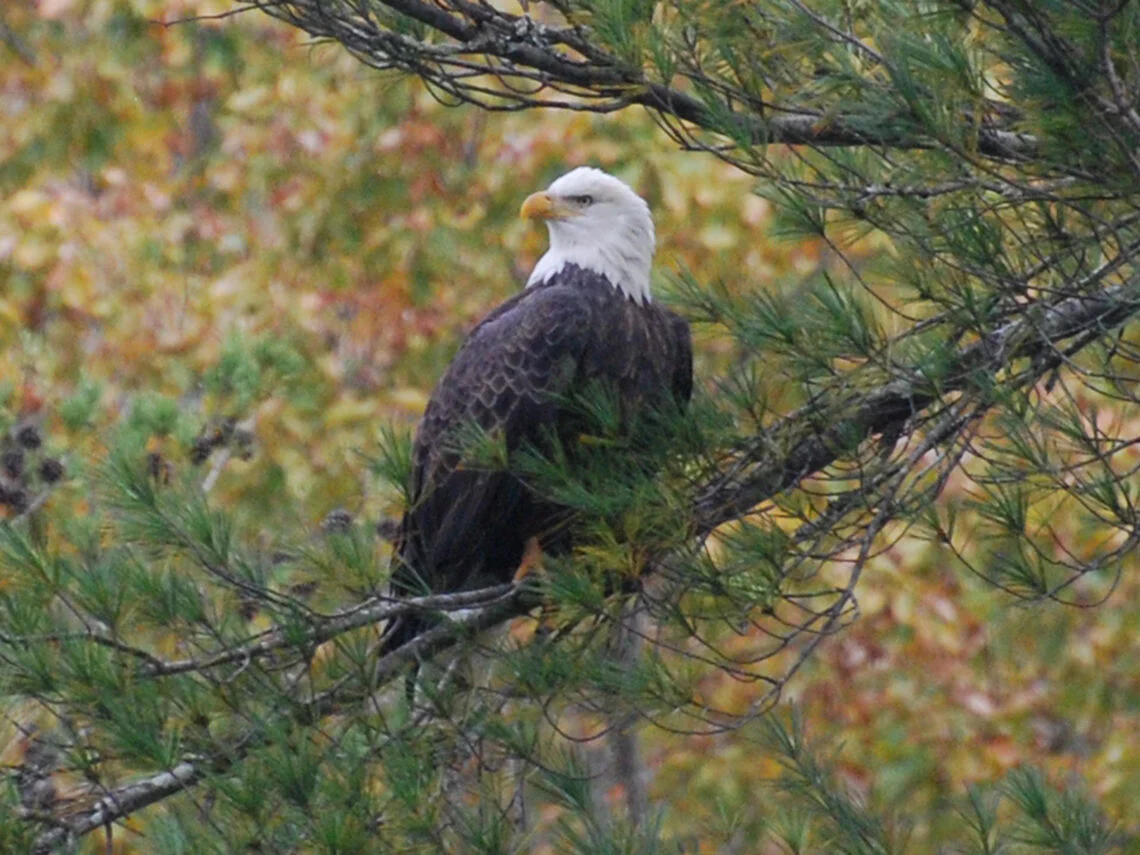
Photo by Jean Potter • A sighting of a bald eagle in the wild is always a memorable moment for the lucky observer.

I hope everyone had a wonderful Fourth of July filled with plenty of red, white and blue. For those who ventured onto area lakes and rivers, I’m hopeful that they perhaps got to glimpse the nation’s official bird.

The bald eagle been recognized as the penultimate bird in the United States of America since the latter decades of the 18th century. I’ve seen many bald eagles in my lifetime, and a sighting of one of these magnificent raptors never disappoints. The resurgence of the once-endangered bald eagle in the lower 48 states has been a laudable accomplishment that all Americans should view with pride.

Photo by Bryan Stevens • The Endangered Species Act has helped save birds like the Bald Eagle from possible extinction.

While the recent Independence Day remains fresh in memory, I thought it might be a good time to share some interesting information on our national bird, the American bald eagle, which officially became the national emblem in 1782 when the great seal of the United States was adopted. Although Benjamin Franklin famously expressed reservations about making the bald eagle our national bird, in hindsight it’s clear that Americans made the right choice.

Despite elevating this native bird to such lofty status, we have not always been kind to the bald eagle. We allowed habitat destruction and toxic pesticides to bring this eagle to the brink of extinction. With well-deserved protection, however, the bald eagle rebounded, and the Department of Interior finally took the eagle off the threatened species list on June 28, 2007.

The bald eagle has been more frequently observed by birders in Northeast Tennessee in recent years. Some of the region’s rivers and lakes are good places to look for bald eagles, particularly in the fall and winter. A few lakes even regularly host nesting bald eagles. I’ve observed bald eagles in Tennessee, South Carolina, Florida and Virginia.

The bald eagle (Haliaeetus leucocephalus) is a member of a genus known as Haliaeetus, or sea eagles. There are seven other living species in the genus: the white-bellied sea eagle, Sanford’s sea eagle, African fish eagle, Madagascar fish eagle, Pallas’s fish eagle, white-tailed eagle and Steller’s sea eagle. The eagles are incredibly majestic birds and important symbols of the value of natural places and creatures.

Steller’s sea eagle is named for the German naturalist Georg Wilhelm Steller, who is renowned for his work as a pioneer in the natural history of Alaska. The 49th state to join the union is also the stronghold for the bald eagle. On occasion, Steller’s sea eagle has strayed into U.S. territory at Alaskan locations including the Pribilof Islands and Kodiak Island. Steller’s sea eagle is bigger than the bald eagle. In fact, it is the largest member of the Haliaeetus genus of eagles, making this bird one of the largest raptors in the entire world.

Ben Franklin wasn’t enthusiastic about the bald eagle as the national bird, but perhaps, considering he favored the Wild Turkey, it’s best we don’t eat our national bird every Thanksgiving.

The naturalist for which this eagle is named has also been honored by the naming of other creatures, including Steller’s sea lion and the now-extinct Steller’s sea cow, as well as several birds, including Steller’s jay and Steller’s eider. He was the first naturalist to describe several creatures native to Alaska, although two of these, the sea cow (a relative of the manatees) and the spectacled cormorant, are now extinct. The latter, which was the largest cormorant to ever live, is a particularly sad story. These cormorants were basically eaten into extinction, exploited as a food source by sailors and fur traders. The last spectacled cormorants perished around 1850 on a Russian island off the coast of the Kamchatka Peninsula.

Fortunately, we have proven a little more far-sighted in our treatment of the bald eagle, which was removed from the U.S. government’s list of endangered species on July 12, 1995, and transferred to the list of threatened species. In 2007, bald eagle numbers had rebounded enough in the Lower 48 states to also allow for the bald eagle to be removed from the list of threatened species.

Male and female adult bald eagles have a blackish-brown back and breast; a white head, neck and tail; and yellow feet and bill. Juvenile bald eagles are a mixture of brown and white and reach full maturity in four to five years. The female bald eagle is 35 to 37 inches in length, slightly larger than the male, with a wingspan that ranges from 72 to 90 inches. Bald eagles weigh from 10 to 14 pounds. The bald eagle’s diet consists mostly of fish, some of which are scavenged, but these large raptors are also capable of preying on everything from muskrats and ducks to rabbits and snakes. The bald eagle will also feed on carrion.

More than 240 years after it was declared an official emblem of the United States, the bald eagle has become an instantly recognizable American symbol. Long may the eagles fly.

•••

Bryan Stevens has written about birds and birding since 1995. To ask a question, make a comment or share a sighting, email him at ahoodedwarbler@aol.com.

Cedar waxwings provide entertainment as they feast on mulberries

Photo by Jack Bulmer/Pixabay • A cedar waxwings strikes a stately pose on a branch.

Spring turned out to be a rainy season in Northeast Tennessee. As we move into the official summer season as of Friday, June 20, summer’s also looking like it might be wetter than usual.

Rainfall hasn’t stopped the rhythms of the seasons. For instance, two mulberry trees at home have produced a bonanza of ripening berries for our fruit-loving feathered friends.

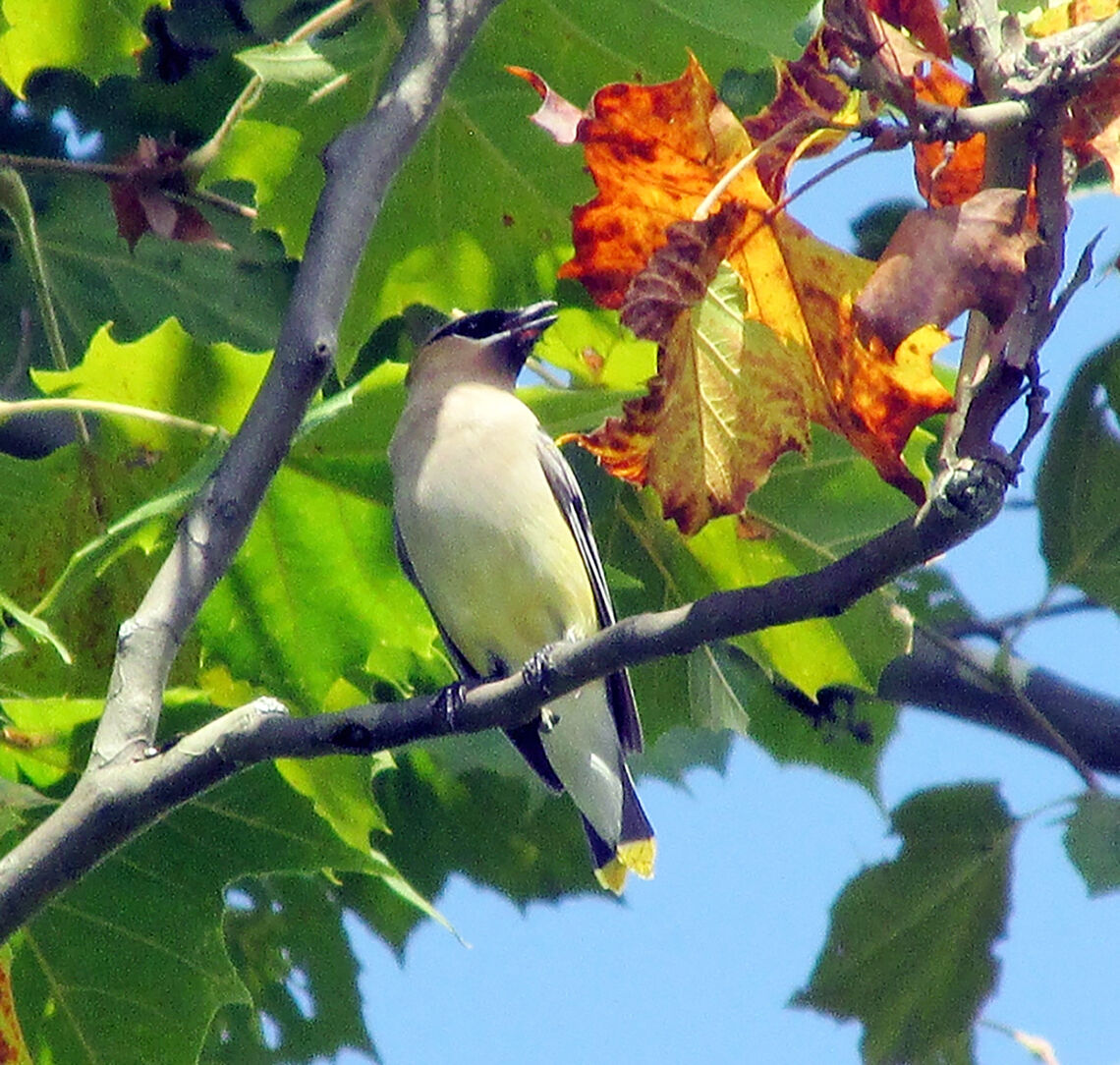
So far, the main beneficiaries of all this bounty has been the local cedar waxwings. These sleek and distinctive birds have a brown and gray silky plumage, a black mask and a perky crest. Some of the wing feathers show red tips. The similarity of these wing tips to melted drops of wax gives these birds the common name of waxwing.

There’s no absolute explanation of the purpose for these waxy tips. Experts have theorized that the colorful wingtips might help attract mates.

Other birds have competed for access to the berries, including American robins, gray catbirds and at least one scarlet tanager.

Cedar waxwings love their fruit. They’re not quite a frugivore, which is a scientific term for animals that depend mostly on raw fruits for sustenance. The website All About Bird recommends planting native trees and shrubs that bear small fruits, including such species as mulberry, dogwood, serviceberry, cedar, juniper, hawthorn and winterberry, to attract cedar waxwings.

Photo by Bryan Stevens • A cedar waxwing perches in the upper branches of a tree.

The cedar waxwing has few relatives. Worldwide, there are only two other species: the Bohemian waxwing, of the northern forests of Eurasia and North America; and the Japanese waxwing, found in such northeast Asian countries as Japan, Korea and China.

Although it’s classified as a songbird, the cedar waxwing does’t truly produce a vocalization that anyone would contend qualifies as a song. They are, however, very vocal birds, producing shrill, high-pitched notes as they pass through the upper branches of tall trees.

Early American naturalist and artist John James Audubon painted this pair of cedar waxwings.

As much as the waxwing has a fondness for fruit, it’s also a bird that would have made an excellent flycatcher. Flocks of these birds will often congregate in trees near the edge of a pond, garden or yard — anywhere winged insects might be found in good numbers — in order to hawk insects on the wing. A waxwing will sally forth from a branch, snatch its prey in mid-air, and return to its perch for a quick snack. Dragonflies often feed on mayflies and dragonflies but they will also forage on a wide array of other winged insects.

Waxwings are rather nomadic, coming and going with a maddening unpredictability. They often follow the available sources of food, whether that’s the multitude of flying insects attracted by pond and rivers or a particularly bountiful crop of fruit.

They can form large flocks. I once observed a flock that probably consisted of 100 individuals as they stripped berries in early winter from a holly tree. Adding some comic relief to the scene were two Northern mockingbirds making a futile attempt to disperse the waxwings and thus claim all the berries for themselves. The mockingbirds would chase off a dozen or so birds only for twice that number to descend on the vacated spot in the tree’s branches. It was a losing battle, but I am confident that once they settled down, the mockingbirds managed to enjoy the supply of berries alongside the overwhelming numbers of waxwings.

I’ve enjoyed the friendly flock of waxwings as they’ve feasted on mulberries. The only drawback has been that I am usually observing their antics in late evening when the sun is behind these birds. Fortunately, even a waxwing’s sleek silhouette is still a sight to behold and enjoy.

•••

To share a sighting, ask a question or make a comment, send me an email to ahoodedwarbler@aol.com.

Photo by Bryan Stevens • A pair of cedar waxwings hawk for insects near a pond.

Cardinals have long been considered feathered messengers

Photo by Bryan Stevens • Perhaps due to their vibrant appearance, cardinals have become symbols of certain aspects of the spiritual realm.

Watching birds offers a variety of benefits to the watcher. The activity offers solace and therapy, hope and optimism. There’s just something about our feathered friends that can be therapeutic and healing. I can’t begin to count the times a sighting of an unexpected bird has put a smile on my face. The website http://www.caringcardinals.com is dedicated to the spiritual symbolism that has come to be associated with a common bird known as the Northern cardinal.

The website identifies cardinals as spiritual messengers. Although many aspects of nature can deliver symbolic signs, the red cardinal has long been embraced as one of the most notable spiritual messengers, according to the website.

According to some theories, loved ones in Heaven send cardinals to watch over loved ones. Cardinals are one of the most common spiritual signs that people receive from Heaven. Cardinals are also thought to have a deep connection with departed souls. People have often reported that after the death of loved ones, they begin to see cardinals frequently. Seeing a cardinal for the first time or more frequently than usual can be an indication from a loved one that they will always feel your love and will be near you, according to the website.

This bird even got the name cardinal because its bright red feathers reminded some of the red garments worn by cardinals in the Catholic Church. The cardinal’s red plumage is definitely one of the driving forces that has helped these beliefs expand. The website notes that when a cardinal appears in nature, it serves as a gentle reminder that love never ends. These so-called “cardinal experiences” are defined as the moment a red cardinal appears unexpectedly after a loss. Quite often the soul needs more care and sometimes all it takes is a visit from one of God’s most adored creatures, the cardinal.

Jana Steward, one of my coworkers at The Erwin Record, recently lost her husband, Matt. She posted to Facebook on May 3 that her husband died peacefully right after his son got home from work the previous evening.

Photo by Bryan Stevens • Northern cardinals will visit feeders stocked with sunflower seeds at any season.

About midnight a cardinal entered the house as representatives from the funeral home arrived to take Matt out of the house.

“The cardinal sat on Matt’s chest, circled the staircase, came back and sat on his chest again and then went in Elliot’s cage,” Jana explained.

“Elliot is our dog, who loved Matt and he loved him,” Jana added.

CJ, Matt’s stepson, took the cage outside and released the cardinal. The bird, according to Jana, took Matt to his new home.

“My whole life my mom has always said a bird in the house means someone is going to die,” Jana said. “I always took that as a bad omen or something, so I hated when she said it.”

She added, “Little did I know it was actually an angel who helped Matt transition to a new phase of life.”

Even after the events of that day, the family has continued to see the cardinal around at times throughout the week. “I am sure Matt is watching over us,” Jana shared.

I can certainly attest to the fact that birds and simply watching them, observing their actions, can be immensely therapeutic. Call it feathered therapy, if you will.

In some Native American cultures, cardinals are considered harbingers of everything from rain and sun to good fortune and change. These birds have also come to represent such concepts as devotion, love and monogamy, most likely based on the strong pair bonds that develop between mated cardinal pairs. Although cardinals certainly look brilliant in muted winter conditions, males look their best in the spring, the season of courtship when the most vibrant plumage can capture a female cardinal’s attention.

Male cardinals also sing to attract and impress potential mates, but with this species, duets are possible. Only a few female North American songbirds sing, but the female Northern cardinal is quite the songstress, according to the website, All About Birds. She will often sing even while sitting on the nest. A profile of the species on All About Birds suggests her singing may give the male information about when to bring food to the nest.

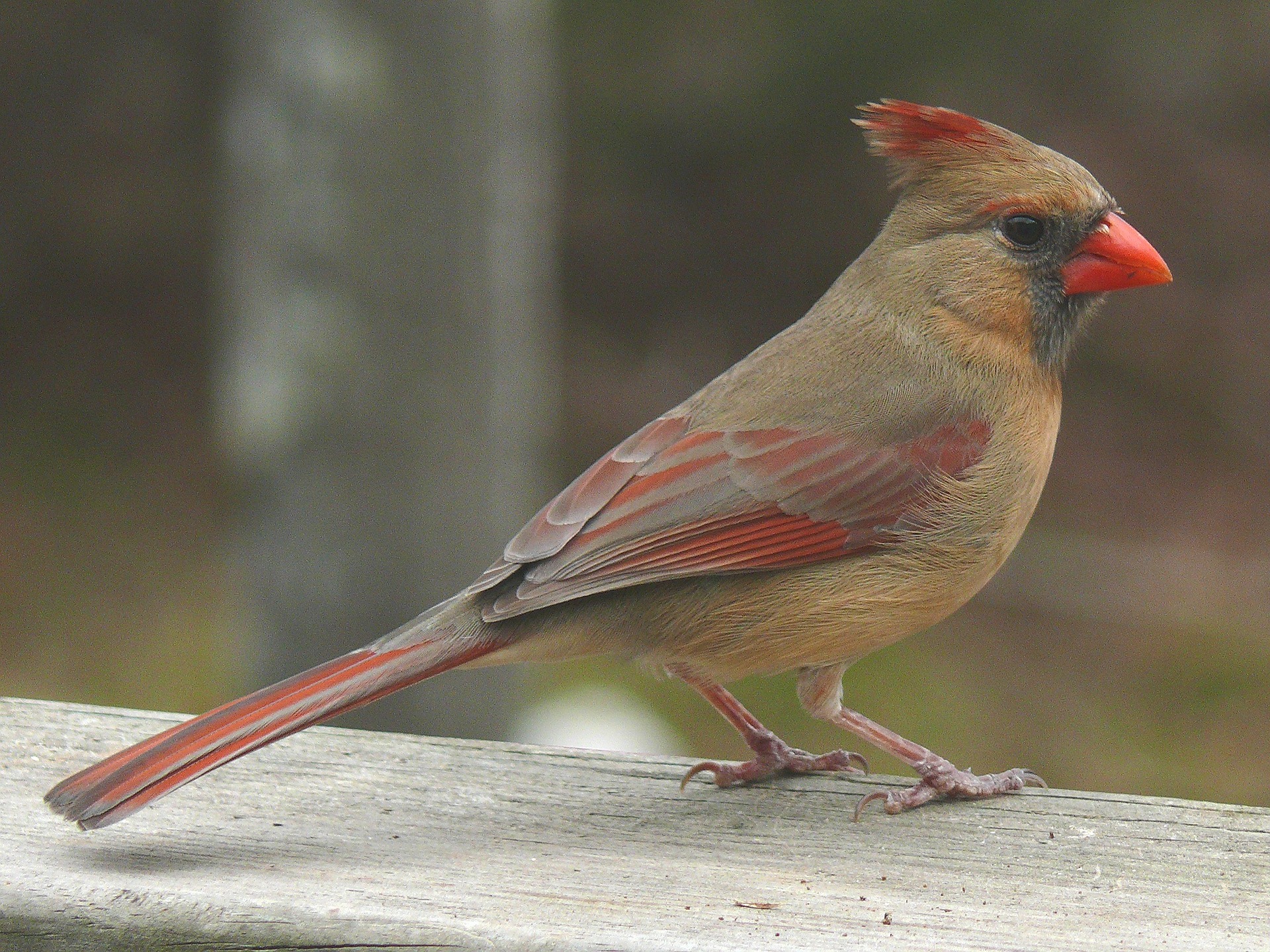
Photo by Skeeze/Pixabay.com • A female Northern cardinal lands on a deck railing. Female cardinals are not as brightly colorful as males, but they do have their own subtle beauty.

Cardinals eat a variety of insects, including crickets, beetles and moths, as well as fruit such as blackberries, wild grapes and mulberries. They’re also fond of seeds and wild about sunflower seeds, making them easy to attract to backyard feeders. If you’re having trouble attracting cardinals, provide some cover in the form of shrubs or hedges. These birds feel more secure if they can dart into a thick tangle of vegetation should a threat, real or imagined, surface suddenly.

Most songbirds are short-lived creatures, but a female Northern cardinal documented in Pennsylvania lived to the age of 15 years and nine months, according to All About Birds.

Over the years, cardinals have had many other common names. The name “redbird” is still widely used for this species, but other names for the Northern cardinal include Eastern cardinal, cardinal grosbeak, cardinal redbird and Virginia nightingale.

I enjoy watching cardinals at my feeders and getting glimpses into their lives away from those feeders. Seeing one of these beautiful and friendly birds can certainly brighten any day. The fact that they are rooted in so much of our lore is evidence that many other people feel the same way about cardinals.

•••

Share a sighting, make a comment or ask a question by emailing me at ahoodedwarbler@aol.com.

Photo by Bryan Stevens • A pair of Northern cardinals.

Black-and-white warbler won’t be confused with other birds

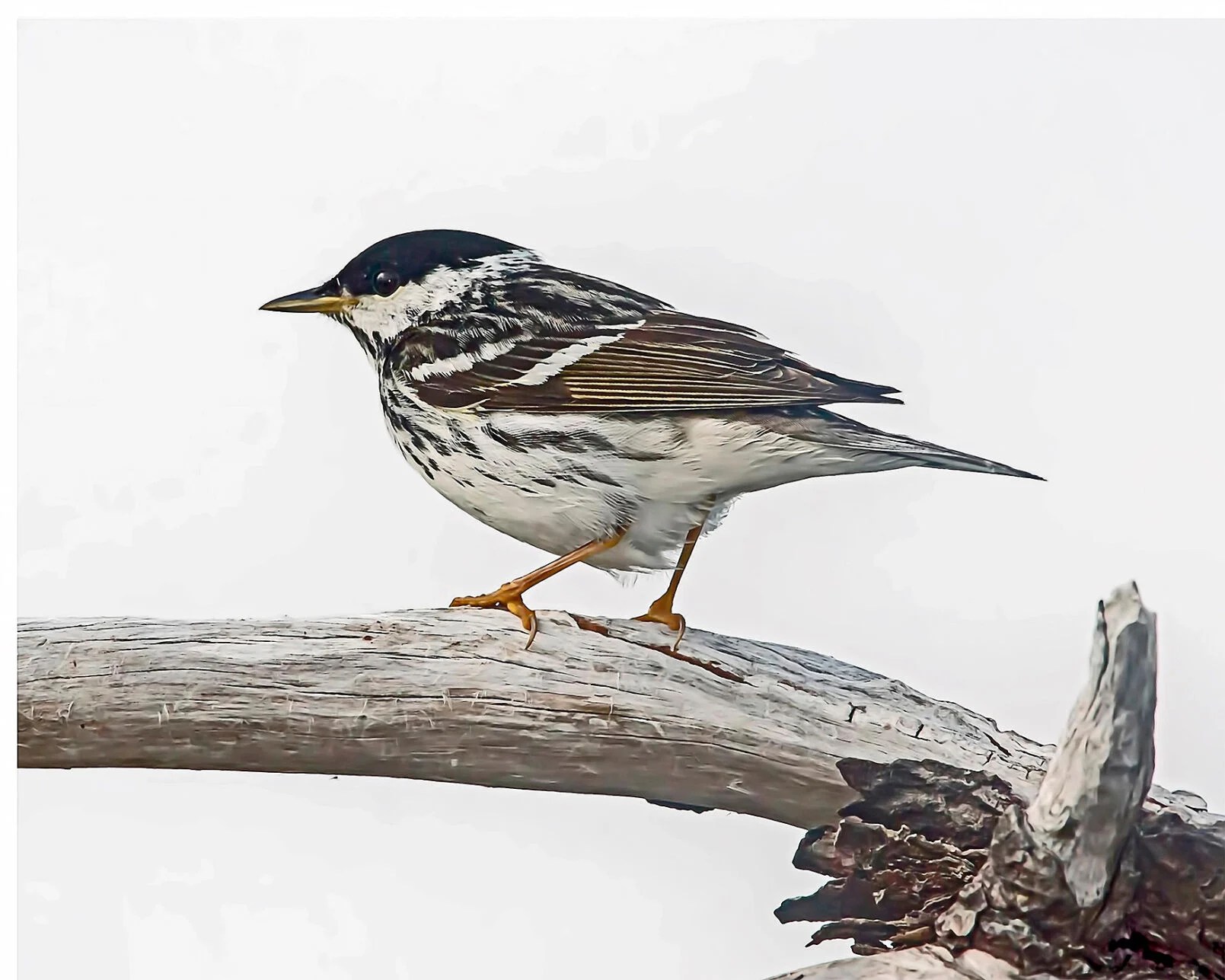
Photo by Hans Toom/Pxabay A black-and-white warbler would be almost impossible to confuse with any other bird.

I’m thinking that most people have probably heard of a “gaggle” of geese or a “murder” of crows as a way to describe a flock of these particular birds. Warblers also have their collective names. A flock of warblers is often referred to as a bouquet, a confusion, a fall, a cord or a wrench of warblers, according to the Birdorable Blog.

I personally like “wrench” of warblers. It has alliteration and describes how these amazing little songbirds can definitely “wrench” one’s attention from other matters. That’s been happening a lot at home. Since arriving in early April, the resident warblers have added their songs to the soundscape that makes the woodlands surrounding my home come alive every morning.

I wrote last week about the sad incident of a male Northern parula killed after an impact with a window. I wondered if I’d have to go the spring and summer season without hearing the excitable little trill of syllables that comprises this warbler’s song. I’m happy to report that less than a week passed before another male Northern parula showed up and began adding his song to the daily chorus. The circle of life continues.

On Saturday, May 3, I got to branch out from the handful of warbler species in residence around my home to warblers in other locations. I birded with Chris Soto, a Johnson City resident and fellow member of the Elizabethton Bird Club, on Holston Mountain and Sycamore Shoals State Historic Park as part of the annual Spring Bird Count conducted by the EBC. Despite some rain while conducting our survey of Holston Mountain, we encountered a variety of warbler species.

We didn’t observe any large warbler flocks, or wrenches, but we did find numerous species, including ovenbird, worm-eating warbler, Louisiana waterthrush, black-and-white warbler, Swainson’s warbler, hooded warbler, American redstart, Cape May warbler, Northern parula, yellow warbler, chestnut-sided warbler, black-throated blue warbler, yellow-throated warbler, black-throated green warbler and Canada warbler.

We added most of these species to the list by hearing them singing their springtime songs, including the “squeaky wheel” of the black-and-white warbler and the loud, ringing notes of the Louisiana waterthrush. If the latter wants to be heard, it is essential that it produce a loud song. The waterthrush resides near rushing mountain streams, which could easily overpower songs projected at a lower volume.

The black-and-white warbler is arguably the most aptly named of all the warblers. Both males and females have glossy black and white plumage. That’s it – there are no other colors present in the bird’s feathers.

Photo by Bryan Stevens • A black-and-white warbler creeps over the bark of a pine in search of insect prey.

The black-and-white warbler breeds in northern and eastern North America. It ranges from the Northwest Territories to the northwest and Newfoundland and Labrador to the northeast, to North Carolina to the southeast and Texas to the southwest. This species is migratory, wintering in Florida, Central America, the West Indies and northern South America down to Peru.

Once arriving for the spring, these warbler go about the business of nesting. The female black-and-white warbler selects a well-hidden nesting location at the base of a tree, rock, stump or fallen log, or under a bush or shrub, according to the website All About Birds. I discovered a black-and-white warbler nest, quite by accident, several years ago. The nest was wedged in a crevice beneath a large fallen pine resting on a steep ridge. Besides being rather inaccessible, I had no wish to disturb the nest so I enjoyed watching the birds through binoculars from a distance.

Photo by Hans Toom/Pxabay • A male black-and-white warbler sings its squeaky wheel song.

In its tendency to hug the trunk of trees as it seeks out insect prey, the black-and-white warbler is similar to unreleased species such as brown creeper and white-breasted nuthatch. In fact, an old common name for this bird was black-and-white creeper. It does venture farther out into a tree than the trunk, however, and will flit among branches as good as any other warbler.

For beginners just getting into the hang of birding, the black-and-white warbler is a dream when it comes to identification. It’s unlikely to be mistaken for any other bird. One good look through binoculars is usually all it takes to recognise the species. There’s no poring over the pages of a field guide for subtle field marks to help when trying to identify the black-and-white warbler. The same is true for the bird’s song, which is very similar in pattern to a squeaky wheel spinning round and round.

Enjoy the springtime and get outdoors and see what feathered friends are winging their way into your neighborhood.

Photo by Bryan Stevens
A Black-and-white Warbler forages along a branch.

Red-bellied woodpeckers, other birds raise their profile during recent snowstorm

Photo by Bryan Stevens • A red-bellied woodpecker makes a tentative approach to a feeder stocked with sunflower seeds. Red-bellied woodpeckers are fairly common in the region.

I’m sure many share my sentiment that with February almost in the rear-view mirror it could be hoped that winter might be nearly at an end.

That misguided hope was dashed last week when another winter storm struck the region, accompanied by another blast of Arctic chill. At least the birds didn’t seem to mind terribly.

Dark-eyed juncos, Eastern towhees, song sparrows and American goldfinches flocked to my feeders. Another bird’s persistent “churr” call made the presence of a red-bellied woodpecker known even before I managed to sight one visiting one of my feeders.

Among the woodpecker family, the red-bellied and red-headed woodpeckers are close cousins, belonging to a genus of those tree-clinging birds known as Melanerpes. The term, translated from Latin, means “black creeper.” Indeed, many of the two dozen members of the Melanerpes genus have an extensive amount of black feathers in their plumage.

Other members of the genus include woodpeckers from the Caribbean, as well as from Central and South America. Some of them have quite colorful names, such as yellow-tufted woodpecker, golden-cheeked woodpecker and the accurately named beautiful woodpecker, a native of Colombia.

Photo by Bryan Stevens • Red-bellied woodpeckers are common throughout the southeastern United States.

The red-bellied woodpecker is one of the most widespread members of this genus with a range that extends from southern Canada to northeastern Mexico, as well as the eastern United States as far south as Florida and as far west as Texas. A century ago the red-bellied woodpecker was almost exclusively a southeastern bird, but it has expanded its range northward and westward considerably in the last 100 years. Its southern origins are hinted at in its scientific name of Melanerpes carolinus, which can be roughly translated as “black creeper of the Carolinas.”

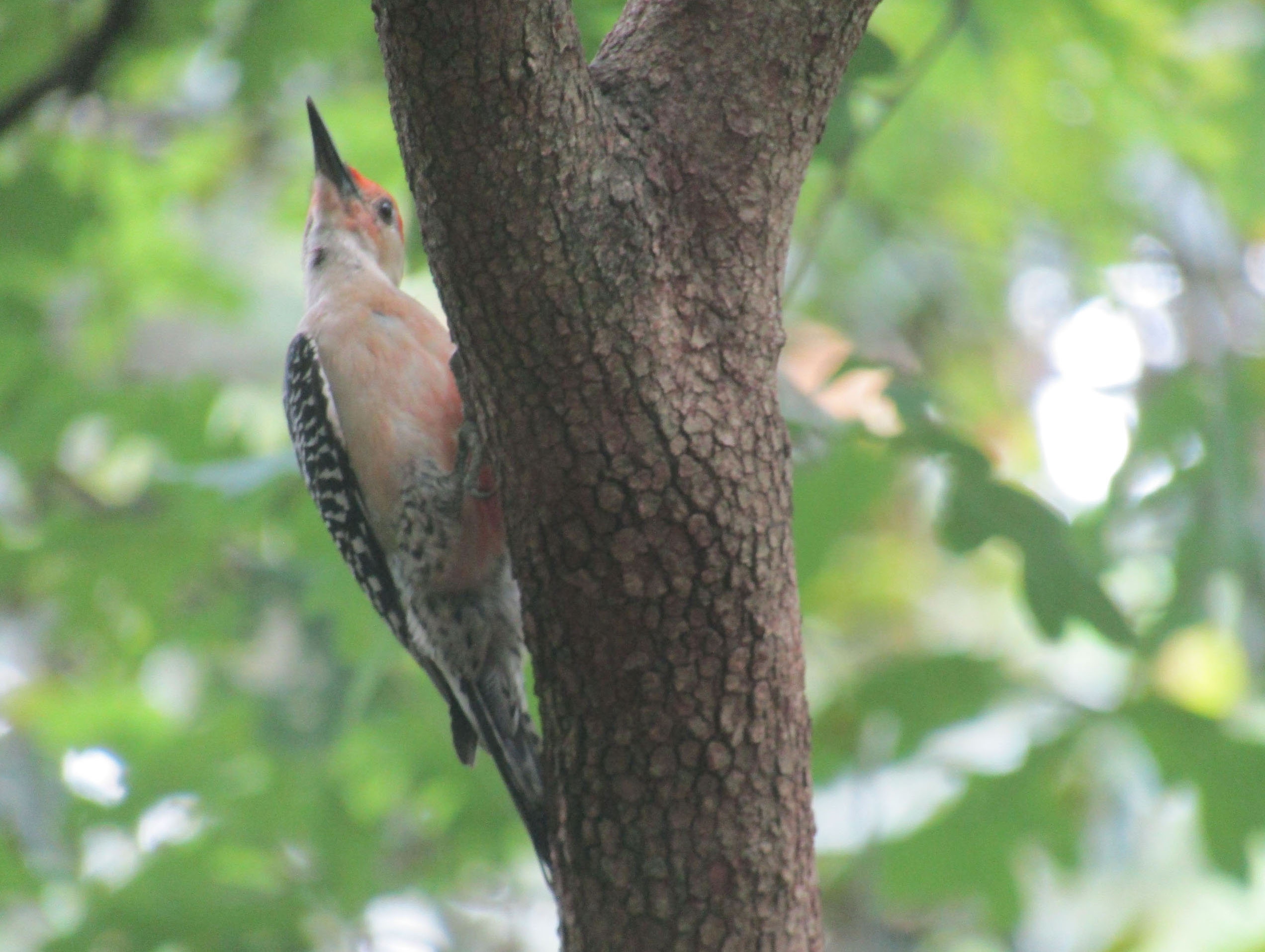
It’s also named for a characteristic of its appearance that is not particularly prominent and difficult to observe. The faint tint of red that tinges the white belly feathers is extremely difficult to observe when this woodpecker is hitching up the trunk of a large tree. Because males, and females to a certain extent, have a red cap, the species has been erroneously referred to as a “red-headed woodpecker” by many casual observers. The true red-headed woodpecker, however, has an entirely red head and a plumage pattern that, considering its color trio of red, white and blue-black, is downright patriotic. The red-headed woodpecker (Melanerpes erythrocephalus) is about the same size as the red-bellied woodpecker.

All woodpeckers are noisy when the mood strikes them, but the red-headed and red-bellied have always struck me as rather more clamorous than some of their relatives. The most common call of the red-bellied woodpecker is a sort of rolling “churr” repeated frequently while the bird is on the move from tree to tree.

To enjoy close views of the red-bellied woodpecker, provide plenty of peanuts, sunflower seeds and suet cakes. During the recent snowstorm I would no doubt have enjoyed even more views of the visiting red-bellied woodpecker if I hadn’t been out of suet cakes. The offerings of sunflower seeds and peanuts, I’m happy to report, were gratefully accepted.

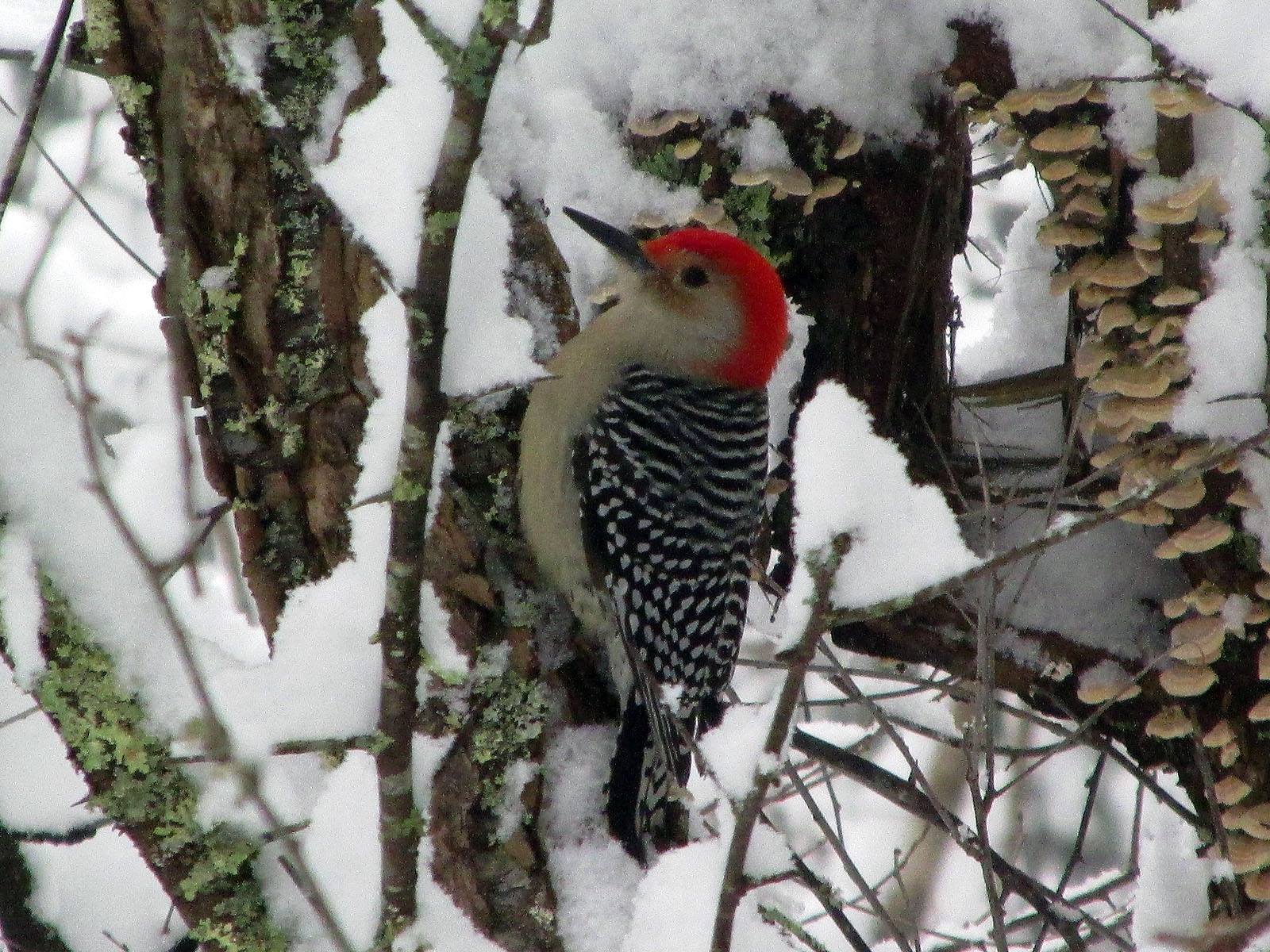
Photo by Bryan Stevens • A red-bellied woodpecker climbs snow-covered branches.

If there are any of these woodpeckers in the woods nearby, they will find these food offerings in short order. All my research indicates the same is true of red-headed woodpeckers, but I’ve never observed this woodpecker at my home. I’ve seen red-headed woodpeckers in Tennessee, Virginia and South Carolina, but their populations are somewhat localized. Woodlands dominated by oak trees are often inhabited by both these woodpeckers, which are fond of the acorns produced by these trees.

One reason the red-headed woodpecker may be less common than its cousin relates to its fondness for hawking for flying insects along roadsides. The woodpeckers are frequently struck by cars when swooping after their winged prey. Historically, the American chestnut and beech trees also provided much of the mast crops consumed by these birds. With the extermination of the chestnut and the scarcity of beech in some locations, the red-headed woodpecker now depends on oaks and acorns. In fact, this woodpecker is rarely encountered outside of woodlands with an abundance of oak trees.

At feeders, red-bellied woodpeckers are prickly customers that often refuse to play nice with other birds. I’ve seen them stare down other large feeder birds, including blue jays, mourning doves and evening grosbeaks. With its large bill, the red-bellied woodpecker commands some respect.

Anyone who has hosted these birds knows they are a welcome visitor to any yard. Who knows? Some day I may even get a visit from the elusive red-headed woodpecker, which is the only woodpecker that resides in the region to thus far avoid my yard.

•••

To ask a question, make a comment or share a bird sighting, email me at ahoodedwarbler@aol.com.

Hungry robins emerge during deep freeze to feast on berries

Robins – by the hundreds – poured into downtown Erwin last week. Most of them ended up on perches around the parking lot between the Clinchfield Senior Adult Center and the rear of the offices of The Erwin Record.

Photo by Bryan Stevens • While American robins like fruit when its available, they also spend a lot of time feeding on earthworms and insects.


The newspaper’s office manager Ken Silvers alerted me to the presence of the “huge flock” of robins. He even joked that he felt like he had stepped into a scene from the movie “The Birds.” Their arrival had been preceded by several nights of single digit temperatures.

In a few weeks, robins will likely be making their annual spring resurgence, but their mid-January appearance in such numbers was somewhat surprising. The fact is that, although we don’t think of robins very much in winter, they are still very much present in the region. The same is true of waxwings and is particularly true about European starlings.

While downtown Erwin would not usually be an ideal location for robins, there was something present to attract them: Berry-producing ornamental holly trees.

In the colder months of the year, robins form large, loosely organized flocks, often taking up residence in wooded lots. After several days of frigid weather, the robins were likely desperate to exploit an available food source. The flock spent a couple of hours gorging on holly berries. Even later in the day a few dozen robins lingered around the shrubs, gleaning the remaining berries from the branches.

The American robin is a large bird in the thrush family, which in North America also includes such birds as Eastern bluebird, wood thrush and Townsend’s solitaire. It’s probably a bird that is well-known to birders and non-birders alike.


In the British Isles, the European robin is simply known as “robin” or “robin redbreast.” When the first English colonists arrived in New England and other parts of colonial-era North America, they took pleasure in finding that some of the birdlife in the New World resembled familiar birds from their homeland. The red-breasted American robin looked like the bird they knew in the Old World as “robin,” which motivated them to name the New World bird “robin,” as well.

Sharkolot/Pixabay • Early American colonists from Europe, familiar with the European robin of their homeland, saw the red breast feathers on the American robin and named the large thrush robin as well.

Other than the red breast, however, the two robins are not all that similar. The American robin is the larger of the two birds. Farther separating these two birds is the fact that the European robin is not a thrush but rather a member of the family of Old World flycatchers.

In some other ways, the two robins are similar. Both are fond of earthworms, spending a great deal of their time on the ground foraging for worms. They will also follow human gardeners at their work, waiting patiently for the followed person to disturb the soil with a spade or hoe and expose earthworms for the waiting bird. They are also rather tolerant of humans and have learned to make their own homes close to human dwellings.

Some of the British transplants to North America must have felt homesick for familiar things because several unsuccessful attempts were made to introduce the European robin to the United States and Canada. European robins introduced in New York and Oregon failed to gain a foothold, unlike the introduction of such alien birds as the house sparrow and European starling.

On a few occasions, migrating American robins have overflown their destinations and ended up in the United Kingdom. For instance, an American robin became a first for London birdwatchers when one was found in that nation’s capital city in March of 2006. Whether of the European or American persuasion, robins have long been a favorite of birdwatchers and nature enthusiasts.

In a few weeks we will have more American robins pouring into our lawns, our gardens and our parks. The American robin has always been a perennial harbinger of spring. But it’s not always necessary to wait until winter’s waning to enjoy observation of this popular songbird.

•••

Bryan Stevens has written about birds and birding since 1995. To ask a question, make a comment or share a sighting, email him at ahoodedwarbler@aol.com.

Tiffany/Pixabay • The American robin keeps a lower profile but is still present in the region during the winter months.

Carolina chickadees are cheerful backyard birds

Photo by Bryan Stevens • A Carolina chickadee visits a feeder for sunflower seeds.

I’ve learned not to leave my house without an offering for the local birds. Should I neglect to bring sunflower seed to fill the feeders in the yard as I leave for work in the morning, I must face a scolding from the resident Carolina chickadees.

I think I’ve become familiar enough with these tiny black, white and gray birds that I can tell the difference between a disappointed scolding, the result of leaving the house empty handed, and their jubilant and excited chattering as they invite other birds near and far to come and partake of the bounty when I remember to fill the feeders.

Chickadees have a namesake scolding vocalization — a strident chick-a-dee-dee-dee — that they use to communicate with each other as the move through dreary winter woodlands.

They and the tufted titmice, a closely related species, are among the birds most easily acclimated to human presence and activity.

Photo by Bryan Stevens • A Carolina chickadee endures a cold winter’s day.

On the mornings when I remember their sunflower seeds, the waiting chickadees are doing tiny hoppity dances in the branches of nearby trees and shrubs, barely able to contain their excitement. They barely give me time to move away from the feeders before they dart in, grab a seed and carry it off to quickly shell on a safe perch.

In the spring, the Carolina chickadee has a familiar “fee-bee-fee-bo” song that rings out in the woodlands around my home. Cavity-nesters, chickadees readily take to nest boxes provided by human landlords. We are about five months away from spring of 2025, but that’s all right. Early winter is a great time to make the acquaintance of the Carolina chickadee.

This diminutive songbird is at home in mixed or deciduous woods in the United States from New Jersey west to southern Kansas and south to Florida and Texas. The Carolina chickadee also ranges along the Appalachian Mountains, but on some of the higher peaks they are replaced by their cousin, the black-capped chickadee. In Tennessee, birders need to visit some of the higher peaks in the Great Smoky Mountains National Park in order to find black-capped chickadees.

Sunflower seeds are a favorite offering. They are also attracted by peanuts, suet and other varieties of bird seed. They comprise the nucleus of mixed flocks of various species, so they will also bring other birds into your yard and within easy viewing range. Some other members of the flock might include wrens, nuthatches, titmice and perhaps a couple of kinglets or a downy woodpecker.

It’s easy to attract chickadees to your yard. Shrubs and small trees, feeders stocked with sunflower seeds and perhaps a mesh cage offering a suet cake are sure to make these small birds feel welcome. If you want to witness the family life of chickadees, build or buy a box suitable for wrens and other smaller birds. That task can wait until February of March of next year. Chickadees will happily take up residence in the offered nesting boxes.

Once a pair of chickadees settles down into domestic bliss in the spring, they almost at once start work on the construction of a nest. These little songbirds, looking quite smart in their handsome black, white and gray feathers, build an exquisite nest. The primary nesting material is green moss, which they stuff into a natural cavity or bird box in great quantities. The female chickadee fashions a depression in the collection of moss. She lines this shallow basin with plant fibers as well as strands of fur or hair to provide soft cushioning for her eggs.

A female chickadee can lay a large number of eggs, with the clutch size ranging between three and ten eggs. Once the young hatch, both parents are kept busy delivering food to a large brood of hungry, noisy chicks. The young grow quickly, but they take advantage of the safety of their cavity nest and don’t depart for the wider world until 20 days after their hatching.

North America’s other chickadees include the aforementioned black-capped chickadee, as well as boreal chickadee, chestnut-backed chickadee, grey-headed chickadee, Mexican chickadee, and mountain chickadee. On a trip to Utah in 2003 and 2006, I saw both black-capped chickadees and mountain chickadees.

In other parts of the world, chickadees are known as “tits,” which is from an Old English word denoting small size. Worldwide, there are about 60 species of chickadees and tits, which are classified collectively under the scientific family name, Paridae. Other members of this family range into Europe, Asia and Africa, including species with colorful names like fire-capped tit, yellow-bellied tit, azure tit, green-backed tit and cinnamon-breasted tit.

Alas, in Northeast Tennessee, western North Carolina and southwest Virginia, we have only the Carolina chickadee, but these entertaining birds are sure to become the star attractions in yard and garden once they discover your feeders and begin providing their cheerful antics.

•••

If you have a question, wish to make a comment or share a sighting, email me at ahoodedwarbler@aol.com.

Photo by Bryan Stevens • A young Carolina chickadee, not long out of the nest, explores the world.

Seasonal transitions raise profiles of flickers, other birds

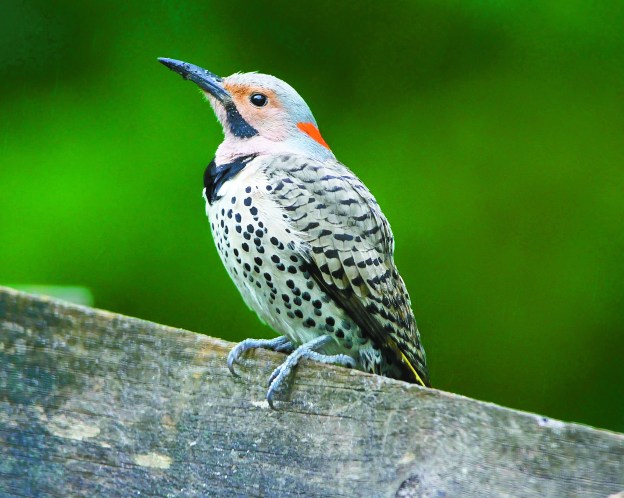
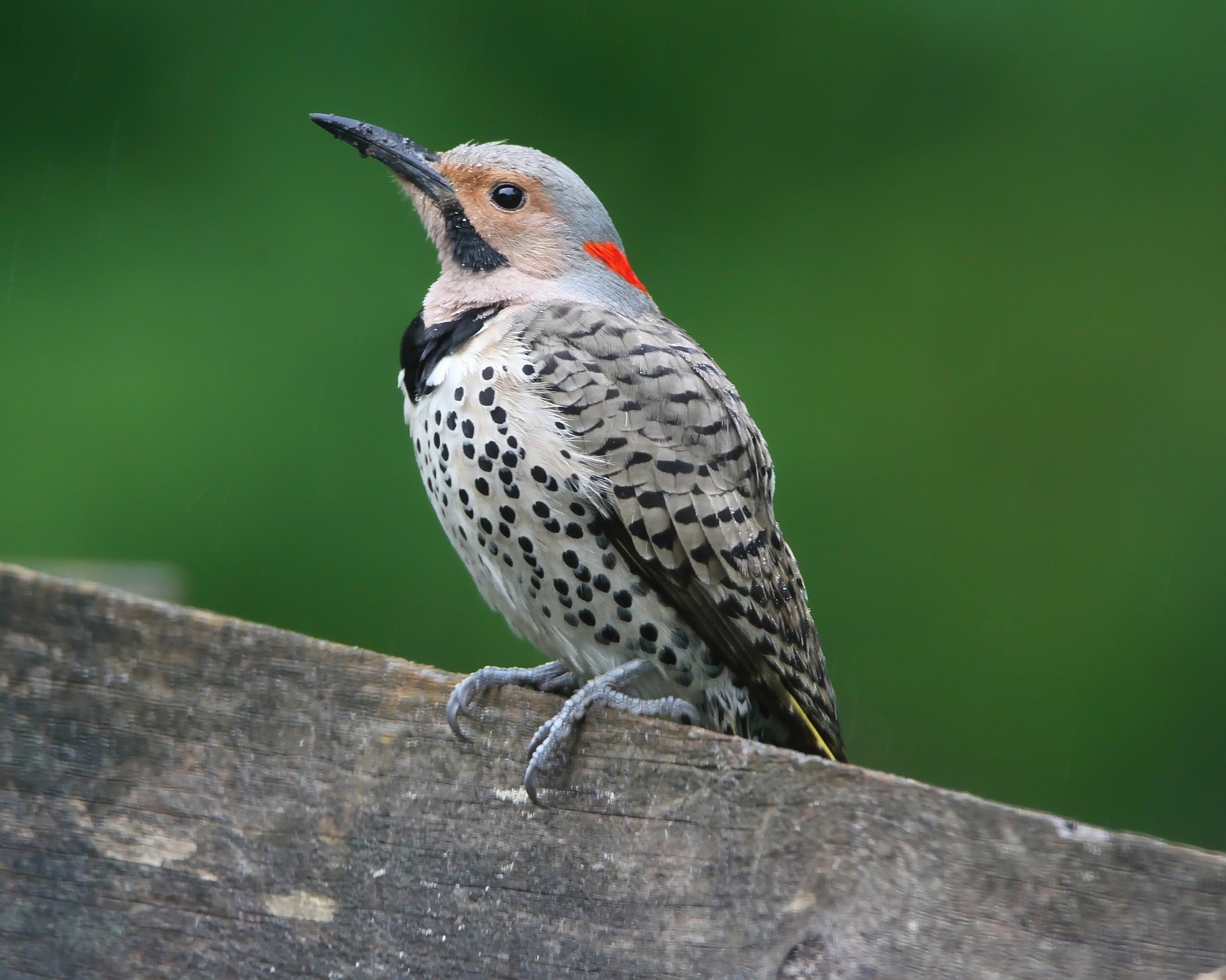
NatureLady/Pixabay • Northern flickers belong to the woodpecker family. Relatives living in the region include the pileated woodpecker, yellow-bellied sapsucker and downy woodpecker. Unlike most woodpeckers, flickers spend an extensive amount of time foraging on the ground for various insects.

Robin Free, a resident of Scott County, Virginia, emailed me after reading a recent column about owls. She told me she was interested in attracting more owls to her property, which she noted boasts an abundance of ground squirrels and mice.

I congratulated her on the fact that with all those ground squirrels and mice her home should make for happy hunting grounds for any owls in the vicinity.

I suggested she could play a recording of a screech-owl call at dusk to see if she can get a real owl to respond. These small owls are very curious and will readily respond.

Photo by Bryan Stevens
An Eastern Screech-Owl at rest in a roosting hole in a large sycamore tree.

The owl that Robin and most os us are likely to attract is the Eastern screech-owls. Since screech-owls are cavity-nesters, people can offer a roosting/nesting box. Obviously, these boxes have to be a little larger than for songbirds. Simply do a Google search to find screech-owl boxes for purchase.

Here’s some info I found online about screech-owl boxes. Placement is crucial. Mount the box at least 10 feet high in a tree, on a pole or on the edge of woods, fields or wetlands. Keep it away from trees where squirrels can jump to it. Add a couple of inches of wood chips or saw dust for nesting material.


•••

In this transition from fall to winter, some birds have adopted higher profiles around my home. I hear and see ruby-crowned kinglets and white-throated sparrows almost every morning as I leave for work. I am also seeing and hearing Northern flickers.

Flickers are woodpeckers, but there are some differences between them and other members of this clan. While flickers can be found during all seasons in the region, this woodpecker is one of the migratory ones. I see the most Northern flickers during fall migration. This woodpecker is one of the few of its kind that usually migrates to warmer climates during the colder months, although the species is not completely absent from the region in the winter season.

This species also has many other common names, including yellow-hammer — a popular name in the Deep South — and harry-wicket, heigh-ho and gawker bird. The Northern flicker is also the only woodpecker to serve a state — Alabama — as an official bird. The flicker earned this distinction back in 1927. Alabama soldiers who fought for the Confederacy were nicknamed “yellowhammers” because of their grey-and-yellow uniforms, which matched the colors of the bird. Incidentally, Alabama was one of the first states to ever name an official state bird.

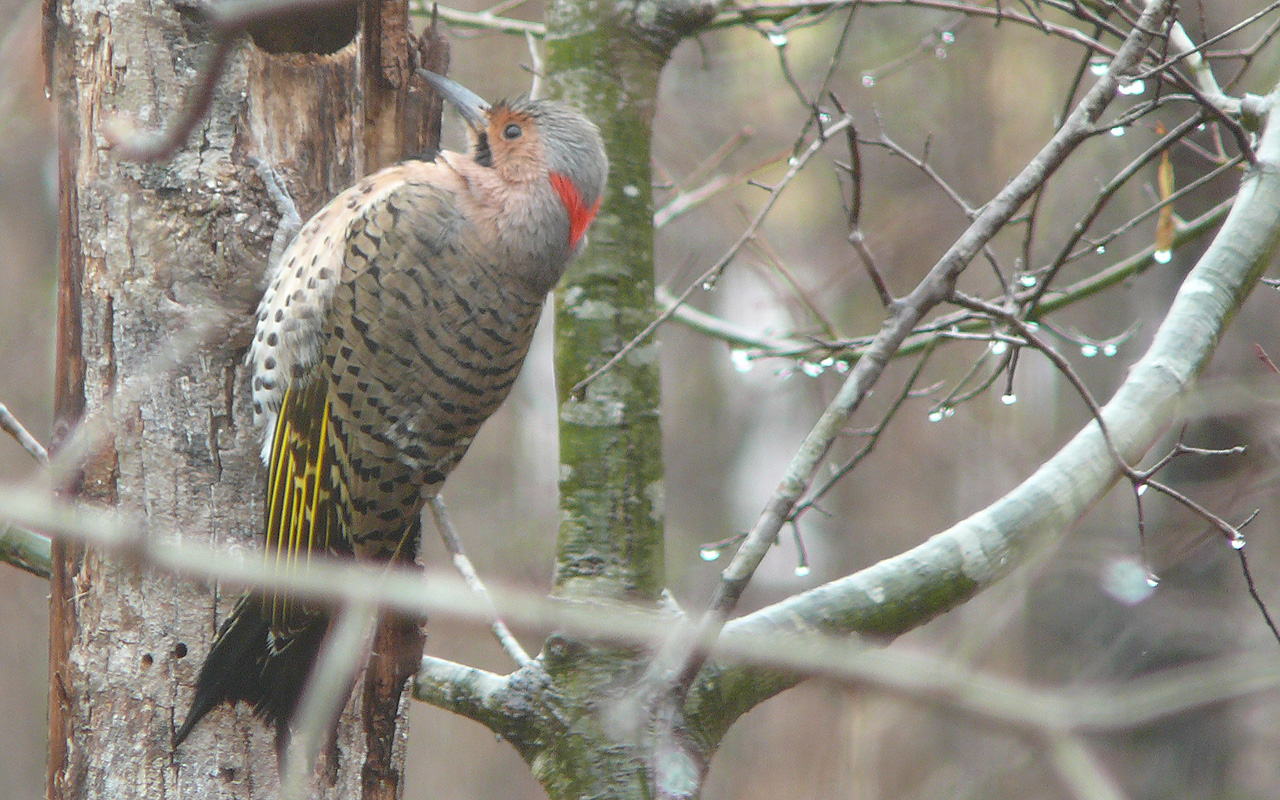
There are two races of Northern flicker — yellow-shafted and red-shafted — found in the United States. Eastern flickers show yellow feather shafts beneath the wings while western counterparts show red beneath the wings. A trip to Utah several years ago gave me a chance to also see the red-shafted race of this bird.

The Northern flicker is also not the only flicker in the United States. The gilded flicker inhabits many of the deserts — Sonoran, Yuma and Colorado — in the United States. Of course, trees are scarce in deserts, but that hasn’t proven an obstacle for this woodpecker. The bird is closely associated with saguaro cactus. Other desert dwellers depend on this woodpecker. Once the flickers are no longer making use of their nest and roost holes in the multi-armed cacti, other wildlife moved into the chambers.

The Northern flicker is an enthusiastic drummer, pounding loudly on the sides of trees with its stout bill. The purpose of the drumming is to communicate with mates and signal potential rivals that they’re intruding. Toward that objective, flickers sometimes substitute metal utility poles or the sides of buildings for the trunks of trees. In addition to drumming, the flicker also employs a variety of loud vocalizations that are fairly distinctive. A loud, repeated vocalization, often translated as “wicka-wicka-wicka,” is similar to the cluck-like call of the larger pileated woodpecker. The flicker is also known for emitting a sharp, loud “kleeer” call that can be heard from a considerable distance. It’s that call that I’ve been hearing most mornings in the woodlands around my home.

The adult flicker is a brown bird with black bars on the back and wings. A distinctive black patch occupies the upper breast, while the lower breast and belly are beige with black spots. Males can be identified by a black or red mustache stripe at the base of the beak. They also have a red stripe on the back of their gray heads. The flicker’s dark tail is set apart by a white rump patch that is conspicuous when the bird takes flight..

Look for Northern flickers in fields, orchards, city parks and well-planted suburban yards. These woodpeckers are usually not too shy around human observers and will sometimes allow for extended observation. If you’re even more fortunate, you could find one visiting your yard or garden. Just remember to scan the ground. This is one woodpecker that’s not a consistent tree-hugger like many of its kin.

•••

Bryan Stevens has written weekly about birds and birding since 1995. Email him at ahoodedwarbler@aol.com to share sightings, ask questions or make comments.


American oldfinch much more than another pretty bird

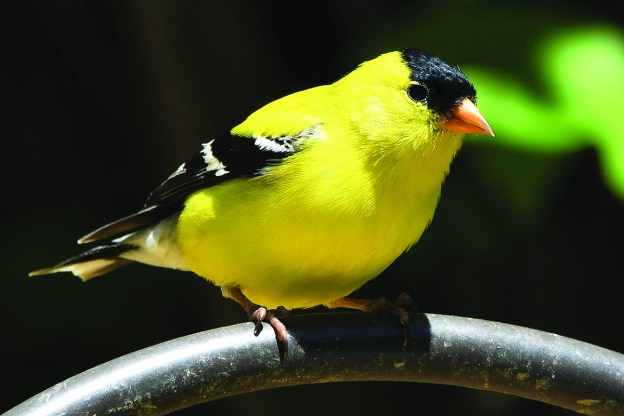
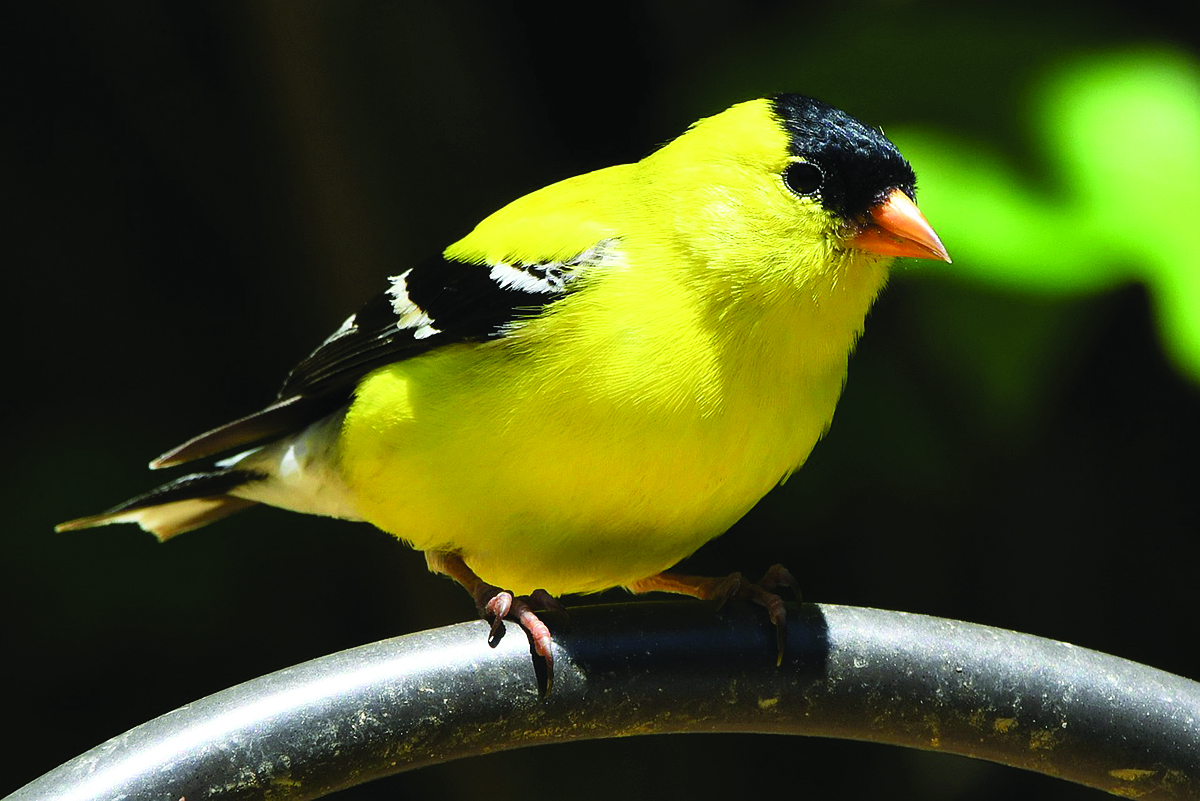
Miles Moody from Pixabay • A male American goldfinch in summer nesting plumage is one of the region’s most vibrant songbirds.

Johnson City resident Jo Wheeler posted a comment on Facebook on July 15 under a weekly posting promoting the “Feathered Friends” weekly column.

“We saw the American goldfinch in out backyard over the weekend,” Jo wrote. “It was amazing.”

I was so pleased to hear Jo’s excitement about the goldfinch. The American goldfinch is a commonplace bird, but once you take a close look at this bird it’s readily apparent that there’s really noting common about it at all.

Goldfinches are extraordinary in appearance, particularly at this time of the year. The plumage of the male goldfinch during the nesting season is a bold pattern of black and white against a backdrop of golden-yellow feathers. These birds also form fussy but sociable flocks that congregate at bird feeders or bird baths in many a backyard.

A sighting of a goldfinch can be memorable. I still retain vivid imagery of these birds from childhood, long before I could identify them by name. They would always appear in late summer, perching atop the three blue spruces in our yard. The trees are no longer standing, but the memories of those colorful yellow and black birds endure.

Photo by Bryan Stevens • A male American goldfinch perches on a barbed wire fence.

Summer is the season of plenty for American goldfinches. Roadside ditches are choked with chicory, evening primrose and other seed-producing plants often dismissed as “weeds.” Simply driving local roads can, and often does, produce sightings of flocks of American goldfinches as they forage for seeds.

These small, colorful finches are also regular visitors to my feeders, although they don’t really need my offering of black oil sunflower seeds to supplement the natural smorgasbord available to them.

Their fondness for seeds has inspired many of the common names for this bird, including lettuce bird, thistle-bird, yellow-bird and wild canary. My late grandmother, Bertha Sneyd, introduced me to the term “lettuce bird” as an alternative name for goldfinch. As she explained, the finches would come to gardens once lettuce had gone to seed.

This fondness and dependence on seeds for its dietary needs has even shaped the nesting habits of this species. The American goldfinch is also one of the last songbirds to nest each season.

According to a profile of the American goldfinch posted at the website for the Tennessee Wildlife Resources Agency, goldfinches don’t even start to think about nesting until late July and early August. Their nesting season is timed deliberately to coincide with this season of natural abundance. Goldfinches feed their young mostly on seeds, as opposed to most songbirds that work so hard to gather insects to feed their young a protein-rich diet.

It’s a satisfying irony that, although brown-headed cowbird females sometimes slip their eggs into a goldfinch nest, any cowbirds hatched in those nests rarely survive. While goldfinch hatchlings are adapted to thrive on a diet of seeds, the fostered young cowbirds fail to thrive on a diet so lacking in the protein derived from insects.

While the male American goldfinch during the breeding season is unmistakable in his bright yellow, black and white plumage, the female goldfinch is more subdued in coloration. Males also sing a bubbly, cheerful song when seeking to win the attention of a potential mate.

According to the profile on the TWRA website, the goldfinch’s song is a variable series of musical trills and twitters, often interspersed with a bay beephrase. The distinctive flight call is described as sounding like “potato chip” or “per chicory.”

For these and other reasons, goldfinches are favorites of many bird lovers. There are actually three species of goldfinches in North America. The two related species are Lawrence’s goldfinch of California and the lesser goldfinch, which ranges through the southwestern United States as well as Central and South America.

Lawrence’s goldfinch was named by John Cassin in 1850 for his colleague George Lawrence, a New York businessman and amateur ornithologist. His enthusiasm for birds must have impressed his colleagues. One bird genus and 20 species were named in his honor. Lawrence’s goldfinch, known by the scientific name Spinus lawrencei, honors him doubly with both the scientific and common names for the bird.

Photo by Bryan Stevens • The male American goldfinch is a striking bird in spring and summer. In late fall and for the winter, these birds have a dull plumage.

The American goldfinch is also known by other common names, including wild canary, yellowbird and willow goldfinch. I’ve also heard the goldfinch referred to as “lettuce bird.” This nickname, which was one my maternal grandmother applied to the bird, relates to the bird’s fondness for seeds. Apparently the goldfinches would flock to lettuce plants in the garden once they had gone to seed.

Come winter, this vibrant American goldfinch undergoes a transformation into a dull, drab bird with grayish feather. In fact, this annual molt usually begins in September. During the fall and winter, the American goldfinch looks almost like an entirely different bird.

It’s understandable why people love to entertain flocks of these finches in their yards and gardens. Three states — Washington, Iowa and New Jersey — have gone so far as to make the American goldfinch their official state bird.

The best strategy for attracting goldfinches is to provide some of their favorite foods. Black oil sunflower seed and the seeds of nyjer thistle are highly favored. The tiny thistle seeds require special feeders. Mesh “socks” can also be used to dispense the thistle seed.

An alternative is to plant a garden that offers an abundance of fresh seeds. A stand of sunflowers will attract goldfinches, as well as other birds such as indigo bunting and house finch. Liatris, also known as gay feather, produces flower spikes that are sought out by goldfinches for their seeds. Other favorites include asters and coneflowers. The bonus is that even after the beautiful blooms are past, the birds can still benefit from the seeds left behind after flowering.

To share an observation, make a comment or ask a question, email me at ahoodedwarbler@aol.com.

Male rose-breasted grosbeaks are always a stunning sight

Photo by Edbo23/Pixabay • A male rose-breasted grosbeak is arguably one of the most impressive of the migrating birds making spring stops at lucky households offering feeders stocked with an ample supply of sunflower and other seeds.

Susan Westall emailed me on Sunday, April 21, for help identifying a new bird at her feeders.

Susan wrote, “We spotted this bird today (April 21) around 2:45 p.m. This bird has never been to visit that we’re aware of. We didn’t find the identity.”

Susan, who noted that she resides in Marion, North Carolina, asked if I could help identify the bird. She helpfully enclosed three photographs.

Photo provided by Susan Westall • A male rose-breasted grosbeak at a feeder at the Westall home.

One glimpse at her snapshots of the feathered visitor showed me that her mystery bird was none other than a rose-breasted grosbeak, one of the many splashy and impressive migrants that travel through Northeast Tennessee, Southwestern Virginia and Western North Carolina every spring.

Other than ruby-throated hummingbirds, the one bird whose return in the spring is guaranteed to generate excitement is the rose-breasted grosbeak. Every spring, I get phone calls and emails from people wanting to share the thrill of seeing these vibrant birds in their back yards.

A few people, like Susan, are completely stumped that such a flamboyant feathered visitor has landed in their own yard like an out-of-place inhabitant of a tropical jungle.

For most of us, these spring visits by rose-breasted grosbeaks is a fleeting and temporary stay. After finding the local arrangements, which can consist of well-stocked feeders and perhaps a convenient water source, to their liking, these migrants may linger for several days.

However, rose-treated grosbeaks nest at higher elevations and are usually impatient to continue the journey to where they will spend the summer months tending to their young.

Single birds are occasionally the first to arrive, but rose-breasted grosbeaks do form flocks when migrating. Even if a scout shows up alone at your feeders, he will often soon be joined by other grosbeaks.

Photo provided by Byron Tucker • A male rose-breasted grosbeak has a showdown with a red-bellied woodpecker for access to a feeder.

Plenty of rose-breasted grosbeaks pass through the area, and a few even decide to make the region’s mountains their summer home. Rose-breasted grosbeaks spread out widely across the eastern half of the North American continent, ranging from northeastern British Columbia to Quebec and Nova Scotia in Canada. They also range south from New Jersey to Georgia. The rose-breasted grosbeak also reaches Colorado, Oklahoma and Kansas.

Farther west, the rose-breasted grosbeak is replaced by the closely related black-headed grosbeak. I saw black-headed grosbeaks on a trip to Salt Lake City, Utah, in 2006.

In many bird species males and females differ considerably. This is certainly true of male and female rose-breasted grosbeaks. The genders in this species are considered dimorphic, which is a scientific term which means that certain male and female birds of the same species may vary widely in size, plumage coloration, song or other secondary sexual traits.

They also have some things in common. Both sexes have a massive bill, which they use to hull sunflower seeds at feeders or glean insects from leaves and branches. It’s the heavy, blunt bill for which the term “grosbeak” is derived. “Gros” is a German term for large or big, so grosbeak simply means a large-beaked bird.

People who band birds to further the study of them will tell you that rose-breasted grosbeaks have a wicked bite and are capable of delivering quite a nip. Bird banders frequently encounter rose-breasted grosbeaks in their mist nets — and bear the scars to prove it.

Only the male rose-breasted grosbeak displays the namesake splash of rosy-red feathers across a white breast. The rest of the male’s plumage consists of a dramatic contrast of black and white feathers. The female grosbeak, however, doesn’t stand out in the same way. She is much less colorful than the male. With her brown and white plumage, she is often mistaken for a large sparrow or finch.

At our feeders, this bird’s extremely fond of sunflower seeds. Away from our feeders, grosbeaks feed on insects, seeds, fruit and even some leaf buds and flowers. I’ve seen these birds satisfying a sweet tooth — or should that be sweet beak? — by feeding on jewelweed flowers and apple blossoms. If sugar’s good for hummingbirds, I am sure it is a valuable energy source for rose-breasted grosbeaks, too.

The rose-breasted grosbeak is a cherished spring visitor that never fails to impress by bringing a hint of the tropics to the mountains of Northeast Tennessee. If you are disappointed in hopes of seeing the species this spring, take heart. The rose-breasted grosbeak migrates through the region again in the fall, often from mid-September to late October. The males sometimes look less vibrant by autumn, but it’s always a treat to see this bird.

I’m hoping many readers are also enjoying their own opportunities for hosting this delightful songbird.

Photo by Bryan Stevens • A male rose-breasted grosbeak perched in a tree on Holston Mountain in Tennessee.

Other songbirds are also on the move. Warblers, vireos, tanager, flycatchers, orioles and more are migrating through the region. Some will stay and make a home in the region for the summer. Others will push on beyond the Southern Appalachians. Keep your eyes open for what may show up next.

•••

Mark this on your schedule: Bristol Bird Club will host a presentation by Kera and George Brewster of Wild Birds Unlimited in Johnson City on Tuesday, May 21.

They couple had been scheduled to give a program at the club’s January meeting, but a snowstorm prevented it.

The club meeting will take place at 7 p.m. at The Summit at 1227 Volunteer Parkway in Bristol, Tennessee. Attendees can also join the meeting and view the program on Zoom. For a Zoom invite, email Larry McDaniel at bristolbirdclub2022@gmail.com.

•••

Share a sighting, ask a question or make a comment by emailing me at ahoodedwarbler@aol.com.
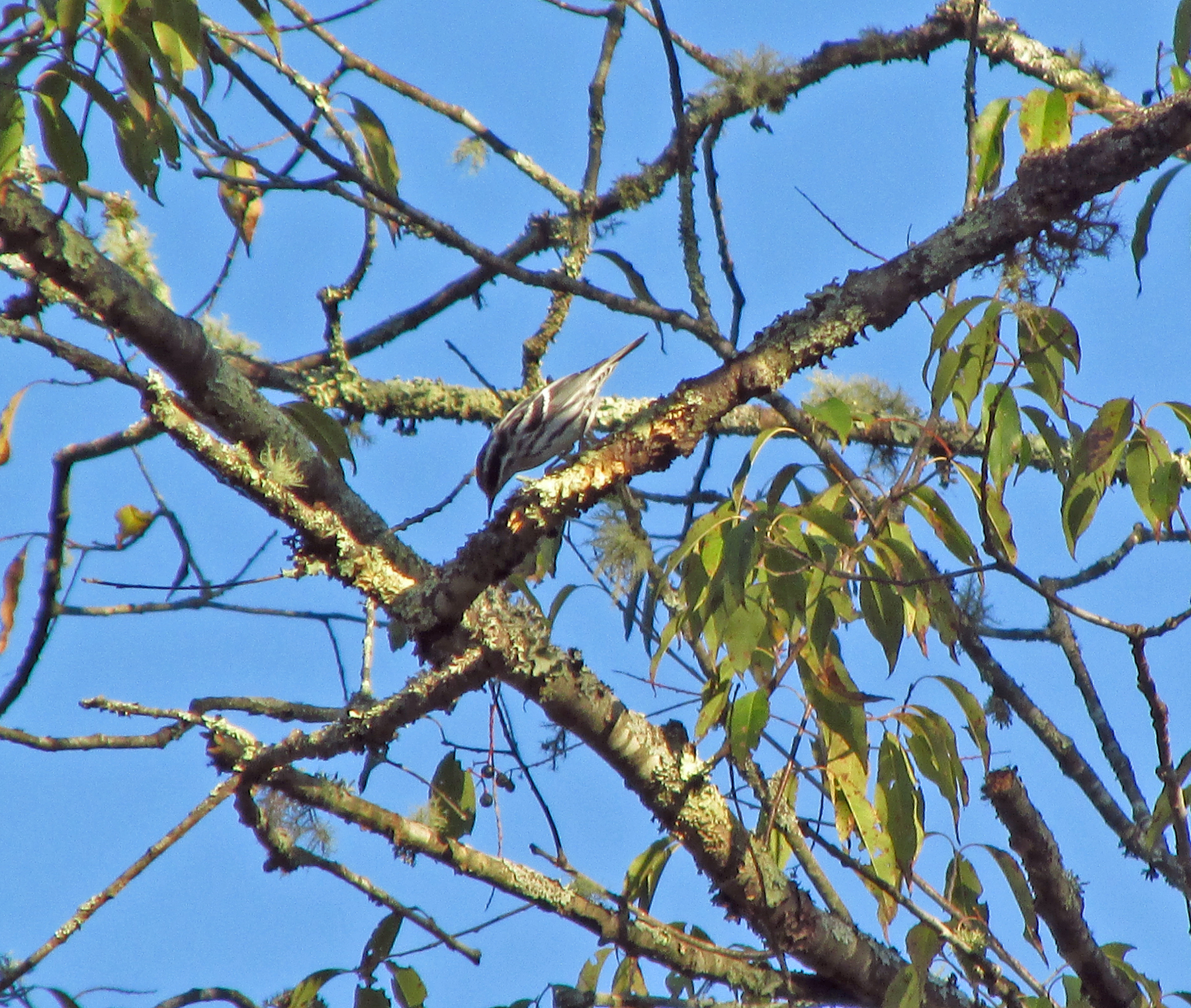
Photo by Pixabay.com • A well-stocked feeder is a first step toward attracting more birds to your yard.