Monthly Archives: May 2025

Yellow-breasted chat is a songbird that stands apart


Photo by Bryan Stevens • A yellow-breasted chat sings from the top of a tree.

I’ve always been a warbler fan, celebrating every opportunity that comes my way for seeing these colorful, energetic feathered sprites.

On May 9, the first indigo bunting (a male) showed up on at my home. A day later, I hosted a Baltimore oriole (a rare visitor at my home) and an even rarer visitor with a singing (more like caterwauling) male yellow-breasted chat.

I’ve had only one of these birds in the yard since I began birding in the mid-1990s. That one was a passing fall migrant that showed up in 2000 and then disappeared as soon as it came.

I had hopes that the persistently singing yellow-breasted chat that showed up May 10 might stay longer, and it did. For five days, he sang from dawn to dusk. Then the daily serendades ended. I assume he moved on, but it was fun hosting this bird, even for such a brief span.

Hans Toom/Pixabay • Yellow-breasted chats spend a great deal of their time skulking in thick tangles of vegetation.

According to the website All About Birds, male chats give display flights in the presence of females, other males or human intruders. According to the website, this behaviour entails descending from a high perch while singing, often with exaggerated wingbeats and a drooping tail. At the end of the flight they make a thumping sound, presumably with their wings.

While the yellow-breasted chat is no longer considered a member of the warbler family, my sentimental attachment to this oddball bird will always recall when this species was considered the largest member of the warbler family.

The chat’s declassification as a warbler took place back in 2017. I’ve always been a warbler fan, celebrating every opportunity that comes my way for seeking out these colorful, energetic feathered sprites.

The yellow-breasted chat, although no longer considered closely related to the New World wood-warblers, is still a bit of an oddity. Many experts always harbored doubts about whether chat is truly a warbler. Personally, I felt some disappointment at the reclassification. After all, what family doesn’t need its big, goofy oddball? If nothing else, the yellow-breasted chat is truly an the odd bird out among the little birds known as warblers that spend most of their time constantly on the move, flitting from branch to branch in hyperactive bursts of activity.

Yellow-breasted chats aren’t more sedate than other warblers, but they don’t dart about in the treetops in the same way as might a Northern parula or blackpoll warbler. During the spring ritual of attracting a mate, the males are obsessed with constant singing and performing. The performance portion of the program consists of awkward, drooping flights into the open before plunging back into thick cover. Males will also select an elevated perch in the open to proclaim their availability through song for any listening females.

There are many other ways they stand out on from other birds. For instance, yellow-breasted chats are bigger than all other warblers, as well as many of our songbirds. The chat reaches a length of 7.5 inches with a wingspan of almost 10 inches. The two sexes look alike, which is something else that separates them from many, but not all, warblers, which are generally known for the differences in appearance between males and females. The yellow-breasted chat has olive-green upperparts with white bellies and bright yellow throats and breasts. These chats also have long tails and heavy bills. A prominent characteristic is a spectacle-shaped white eye-ring.

Although only two have visited my home over the years, I have observed yellow-breasted chats in many locations in the region, but during my early years birding this was a very elusive bird for me. It took me a couple of years to get my first satisfactory look at this interesting bird in a tangle of vegetation along a walking trail at Persimmon Ridge Park in Jonesborough. I have also found chats in Unicoi County in the Sciota community. Some fields that comprise a part of Sycamore Shoals State Historic Park in Elizabethton have also been a reliable location for observing this species.

Chats prefer habitats such as dense thickets and other underbrush, which offers remarkable concealment from prying eyes. Chats are loud birds at most times, producing a variety of odd vocalizations, which means they are often heard before they are seen. The online Audubon Guide to North American Birds describes these sounds as “a bizarre series of hoots, whistles and clucks, coming from the briar tangles” and labels them a reliable means for determining the presence of a yellow-breasted chat. By learning these vocalizations, you’ll increase the chances of finding one of these birds during time spent outdoors.

The chat’s habitat preferences and its repertoire of vocalizations makes it easy to associate these birds with others that share the same dense, brushy habitats and a penchant for making unusual vocalizations. Birds often found in proximity to chats include brown thrashers, gray catbirds, white-eyed vireos and Eastern towhees.

Habitat loss has resulted in a steady decline of yellow-breasted chats in some parts of their range. It is a widely distributed bird, spending the nesting season from southern Canada to Mexico. Most chats retreat to Mexico and Central America for the winter months. This chat mostly feeds on insects, supplementing its diet with berries that ripen during the summer months.

Female chats usually lay three to four eggs, but both parents care for the young. Young chats are usually ready to leave the nest only eight days after hatching, but they will remain dependent on their parents for food for a couple of weeks. Chats usually nest twice each during the nesting season.

The yellow-breasted chat is usually a bird that I have to make a special effort to find. It’s worth the effort to gain a good look at this big, brash songbird.

Three other chats, all birds of tropical regions, were moved out of the warbler clan in 2009 by the American Ornithologists’ Union. Experts now believe that the rose-breasted chat of South America, the gray-throated chat of Mexico, Guatemala and Belize and the red-breasted chat of the Pacific slope of Mexico are more closely related to cardinals and tanagers than warblers. The yellow-breasted chat has been stuck in its own family, Icteriidae, not to be confused with New World blackbirds in the family Icteridae.

Even if we can no longer consider the yellow-breasted chat a warbler, the bird still remains unique enough to warrant its own family.

•••

To share a sighting, make a comment or ask a question, email me at ahoodedwarbler@aol.com.


Cardinals have long been considered feathered messengers

Photo by Bryan Stevens • Perhaps due to their vibrant appearance, cardinals have become symbols of certain aspects of the spiritual realm.

Watching birds offers a variety of benefits to the watcher. The activity offers solace and therapy, hope and optimism. There’s just something about our feathered friends that can be therapeutic and healing. I can’t begin to count the times a sighting of an unexpected bird has put a smile on my face. The website http://www.caringcardinals.com is dedicated to the spiritual symbolism that has come to be associated with a common bird known as the Northern cardinal.

The website identifies cardinals as spiritual messengers. Although many aspects of nature can deliver symbolic signs, the red cardinal has long been embraced as one of the most notable spiritual messengers, according to the website.

According to some theories, loved ones in Heaven send cardinals to watch over loved ones. Cardinals are one of the most common spiritual signs that people receive from Heaven. Cardinals are also thought to have a deep connection with departed souls. People have often reported that after the death of loved ones, they begin to see cardinals frequently. Seeing a cardinal for the first time or more frequently than usual can be an indication from a loved one that they will always feel your love and will be near you, according to the website.

This bird even got the name cardinal because its bright red feathers reminded some of the red garments worn by cardinals in the Catholic Church. The cardinal’s red plumage is definitely one of the driving forces that has helped these beliefs expand. The website notes that when a cardinal appears in nature, it serves as a gentle reminder that love never ends. These so-called “cardinal experiences” are defined as the moment a red cardinal appears unexpectedly after a loss. Quite often the soul needs more care and sometimes all it takes is a visit from one of God’s most adored creatures, the cardinal.

Jana Steward, one of my coworkers at The Erwin Record, recently lost her husband, Matt. She posted to Facebook on May 3 that her husband died peacefully right after his son got home from work the previous evening.

Photo by Bryan Stevens • Northern cardinals will visit feeders stocked with sunflower seeds at any season.

About midnight a cardinal entered the house as representatives from the funeral home arrived to take Matt out of the house.

“The cardinal sat on Matt’s chest, circled the staircase, came back and sat on his chest again and then went in Elliot’s cage,” Jana explained.

“Elliot is our dog, who loved Matt and he loved him,” Jana added.

CJ, Matt’s stepson, took the cage outside and released the cardinal. The bird, according to Jana, took Matt to his new home.

“My whole life my mom has always said a bird in the house means someone is going to die,” Jana said. “I always took that as a bad omen or something, so I hated when she said it.”

She added, “Little did I know it was actually an angel who helped Matt transition to a new phase of life.”

Even after the events of that day, the family has continued to see the cardinal around at times throughout the week. “I am sure Matt is watching over us,” Jana shared.

I can certainly attest to the fact that birds and simply watching them, observing their actions, can be immensely therapeutic. Call it feathered therapy, if you will.

In some Native American cultures, cardinals are considered harbingers of everything from rain and sun to good fortune and change. These birds have also come to represent such concepts as devotion, love and monogamy, most likely based on the strong pair bonds that develop between mated cardinal pairs. Although cardinals certainly look brilliant in muted winter conditions, males look their best in the spring, the season of courtship when the most vibrant plumage can capture a female cardinal’s attention.

Male cardinals also sing to attract and impress potential mates, but with this species, duets are possible. Only a few female North American songbirds sing, but the female Northern cardinal is quite the songstress, according to the website, All About Birds. She will often sing even while sitting on the nest. A profile of the species on All About Birds suggests her singing may give the male information about when to bring food to the nest.

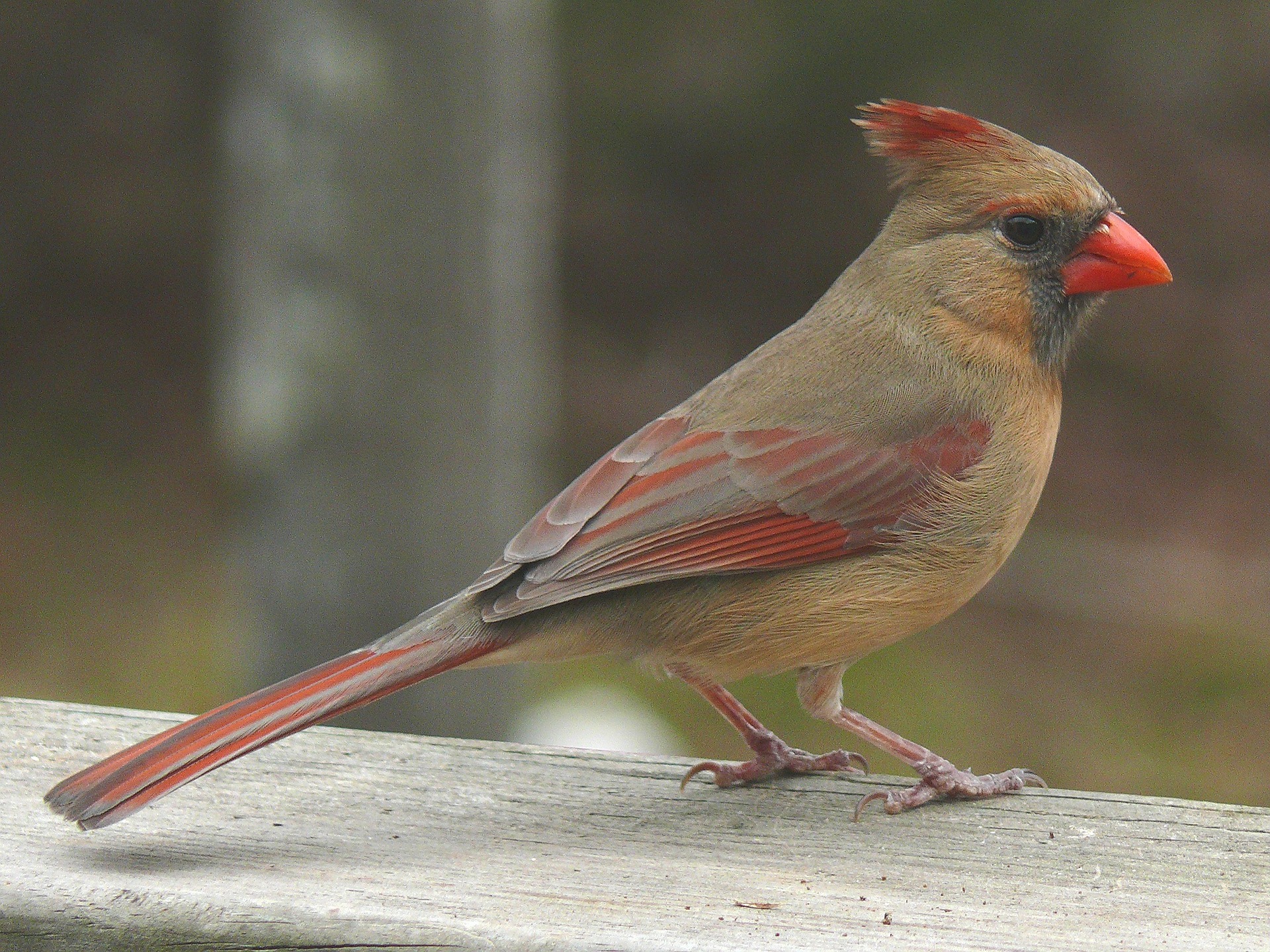
Photo by Skeeze/Pixabay.com • A female Northern cardinal lands on a deck railing. Female cardinals are not as brightly colorful as males, but they do have their own subtle beauty.

Cardinals eat a variety of insects, including crickets, beetles and moths, as well as fruit such as blackberries, wild grapes and mulberries. They’re also fond of seeds and wild about sunflower seeds, making them easy to attract to backyard feeders. If you’re having trouble attracting cardinals, provide some cover in the form of shrubs or hedges. These birds feel more secure if they can dart into a thick tangle of vegetation should a threat, real or imagined, surface suddenly.

Most songbirds are short-lived creatures, but a female Northern cardinal documented in Pennsylvania lived to the age of 15 years and nine months, according to All About Birds.

Over the years, cardinals have had many other common names. The name “redbird” is still widely used for this species, but other names for the Northern cardinal include Eastern cardinal, cardinal grosbeak, cardinal redbird and Virginia nightingale.

I enjoy watching cardinals at my feeders and getting glimpses into their lives away from those feeders. Seeing one of these beautiful and friendly birds can certainly brighten any day. The fact that they are rooted in so much of our lore is evidence that many other people feel the same way about cardinals.

•••

Share a sighting, make a comment or ask a question by emailing me at ahoodedwarbler@aol.com.
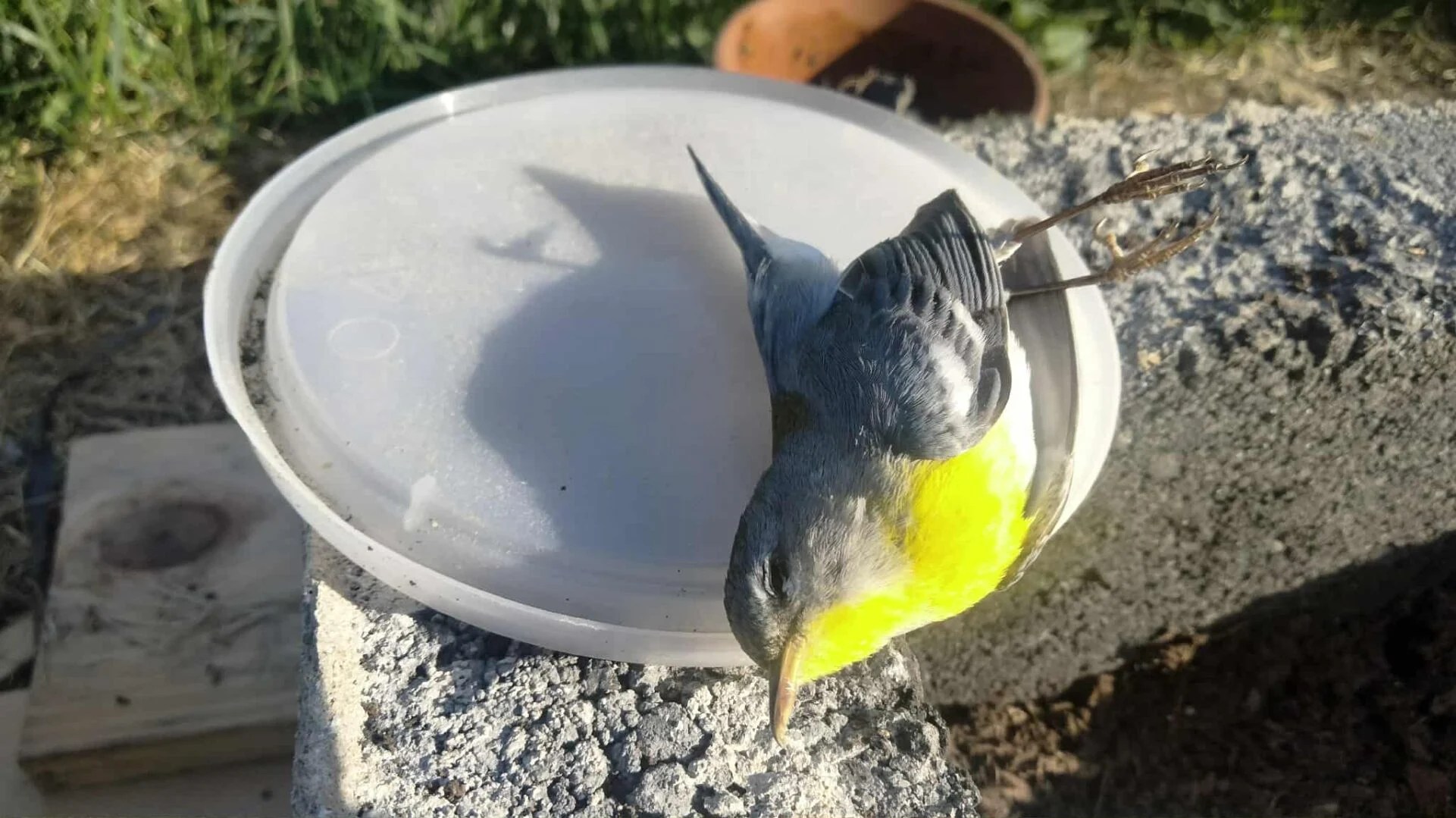
Photo by Bryan Stevens • A pair of Northern cardinals.

Black-and-white warbler won’t be confused with other birds

Photo by Hans Toom/Pxabay A black-and-white warbler would be almost impossible to confuse with any other bird.

I’m thinking that most people have probably heard of a “gaggle” of geese or a “murder” of crows as a way to describe a flock of these particular birds. Warblers also have their collective names. A flock of warblers is often referred to as a bouquet, a confusion, a fall, a cord or a wrench of warblers, according to the Birdorable Blog.

I personally like “wrench” of warblers. It has alliteration and describes how these amazing little songbirds can definitely “wrench” one’s attention from other matters. That’s been happening a lot at home. Since arriving in early April, the resident warblers have added their songs to the soundscape that makes the woodlands surrounding my home come alive every morning.

I wrote last week about the sad incident of a male Northern parula killed after an impact with a window. I wondered if I’d have to go the spring and summer season without hearing the excitable little trill of syllables that comprises this warbler’s song. I’m happy to report that less than a week passed before another male Northern parula showed up and began adding his song to the daily chorus. The circle of life continues.

On Saturday, May 3, I got to branch out from the handful of warbler species in residence around my home to warblers in other locations. I birded with Chris Soto, a Johnson City resident and fellow member of the Elizabethton Bird Club, on Holston Mountain and Sycamore Shoals State Historic Park as part of the annual Spring Bird Count conducted by the EBC. Despite some rain while conducting our survey of Holston Mountain, we encountered a variety of warbler species.

We didn’t observe any large warbler flocks, or wrenches, but we did find numerous species, including ovenbird, worm-eating warbler, Louisiana waterthrush, black-and-white warbler, Swainson’s warbler, hooded warbler, American redstart, Cape May warbler, Northern parula, yellow warbler, chestnut-sided warbler, black-throated blue warbler, yellow-throated warbler, black-throated green warbler and Canada warbler.

We added most of these species to the list by hearing them singing their springtime songs, including the “squeaky wheel” of the black-and-white warbler and the loud, ringing notes of the Louisiana waterthrush. If the latter wants to be heard, it is essential that it produce a loud song. The waterthrush resides near rushing mountain streams, which could easily overpower songs projected at a lower volume.

The black-and-white warbler is arguably the most aptly named of all the warblers. Both males and females have glossy black and white plumage. That’s it – there are no other colors present in the bird’s feathers.

Photo by Bryan Stevens • A black-and-white warbler creeps over the bark of a pine in search of insect prey.

The black-and-white warbler breeds in northern and eastern North America. It ranges from the Northwest Territories to the northwest and Newfoundland and Labrador to the northeast, to North Carolina to the southeast and Texas to the southwest. This species is migratory, wintering in Florida, Central America, the West Indies and northern South America down to Peru.

Once arriving for the spring, these warbler go about the business of nesting. The female black-and-white warbler selects a well-hidden nesting location at the base of a tree, rock, stump or fallen log, or under a bush or shrub, according to the website All About Birds. I discovered a black-and-white warbler nest, quite by accident, several years ago. The nest was wedged in a crevice beneath a large fallen pine resting on a steep ridge. Besides being rather inaccessible, I had no wish to disturb the nest so I enjoyed watching the birds through binoculars from a distance.

Photo by Hans Toom/Pxabay • A male black-and-white warbler sings its squeaky wheel song.

In its tendency to hug the trunk of trees as it seeks out insect prey, the black-and-white warbler is similar to unreleased species such as brown creeper and white-breasted nuthatch. In fact, an old common name for this bird was black-and-white creeper. It does venture farther out into a tree than the trunk, however, and will flit among branches as good as any other warbler.

For beginners just getting into the hang of birding, the black-and-white warbler is a dream when it comes to identification. It’s unlikely to be mistaken for any other bird. One good look through binoculars is usually all it takes to recognise the species. There’s no poring over the pages of a field guide for subtle field marks to help when trying to identify the black-and-white warbler. The same is true for the bird’s song, which is very similar in pattern to a squeaky wheel spinning round and round.

Enjoy the springtime and get outdoors and see what feathered friends are winging their way into your neighborhood.

Photo by Bryan Stevens
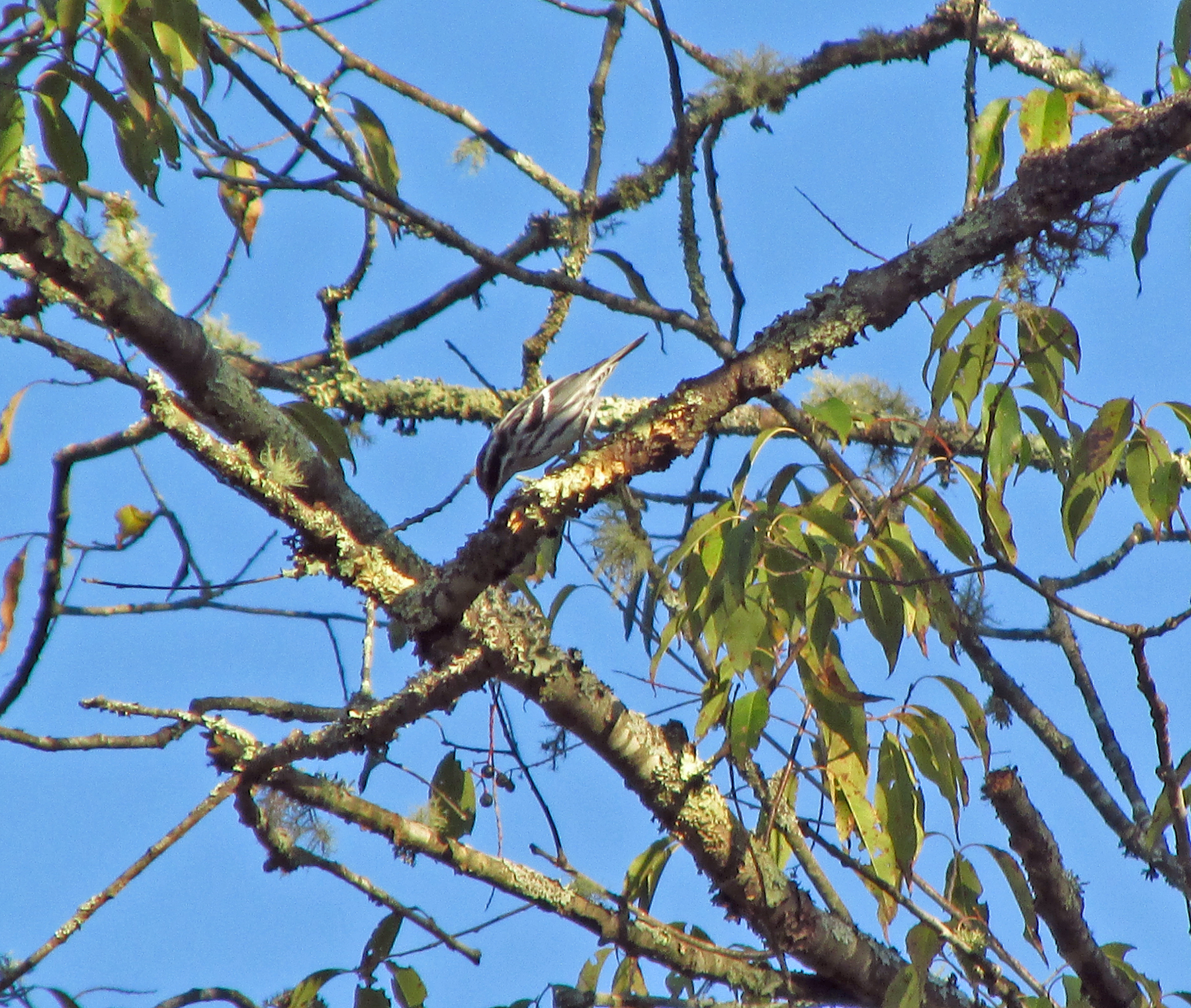
A Black-and-white Warbler forages along a branch.

Tiny songbird’s collision with window leaves gap in spring soundscape


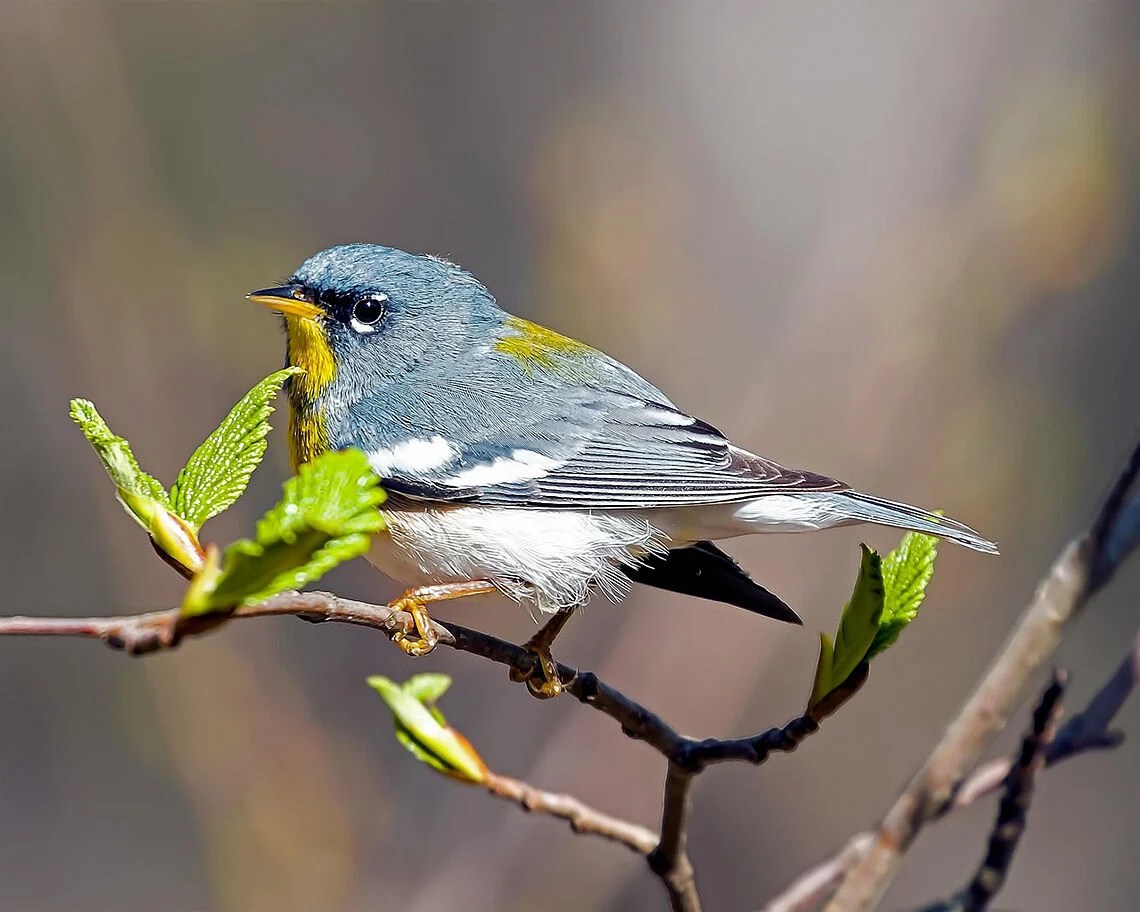
Hans Toom/Pixabay • Male Northern paroles are a member of the warbler family. They are amazing vocalists producing an easily recognised trill of a song.

The male Northern parula is a persistent songster once arriving on its nesting territory each spring.

Since arriving in early April, a male Northern parula had been a tireless singer. I often heard the bird as I departed for work each weekday morning and was welcomed home in early evening by the bird’s song.

On April 29, I returned home. I followed my usual routine and dropped off my mother’s newspaper and mail at her home. Unfortunately, on her porch was the lifeless form of the Northern parula. I know it was “my” parula because the bird had been so faithful in its singing. I have not heard the song of a Northern parula in the days following the sad discovery.

Northern parulas sing two different types of songs, according to the website All About Birds. The most common is a rising buzzy trill with a final sharp note. This song rises up and pinches off sharply at the end. The second song has distinct pauses in between bouts of the rising buzzy trill. My parula had mostly sang the song best described as a rising buzzy trill, but it had also practiced at the second version, as well.

The tragic end for this little songster has really put a damper on my enjoyment of the spring season. Unlike many of our birds, this species of warbler has been thriving. Northern parulas are common, and their populations have actually increased by over 1% per year from 1966 to 2019 for a cumulative increase of about 47% according to the North American Breeding Bird Survey.

Bryan Stevens • This Northern parula died after a collision with a glass window.

But the incident is a reminder of the perils that our feathered friends face daily. An article titled “Getting Clear on Birds and Glass,” first published January 14, 2023, by Christine Sheppard and Bryan Lenz brings the detrimental impact glass has had on birds into focus.

The article noted that Smithsonian researches in 2014 attempted to determined how many birds are killed annually due to hitting windows. The study estimated, conservatively, that collisions with glass likely kill between 365 million and 1 billion birds annually in the United States. The authors of the article emphasized that they believe the number is closer to a billion birds, if not more, that die each year from hitting windows and other glass surfaces.

That’s a scary number, but also a testament to the resilience of birds. Of course, all living things have their limits, and we should try to do something to bring down this gruesome toll.

The little parula had struck a large picture window. We have placed decals in the window in an effort to break up the reflection, but the sun has bleached these over the years, and now it is evident they should be replaced. Clouds, sky or vegetation reflected in a window are perceived by birds as the real deal. A screen over a window or hanging strips or other items to break up the reflection will help birds avoid collision.

To examine a database with various possible solutions, please visit https://abcbirds.org/glass-collisions/products-database/

I am hopeful that another Northern parula will visit and find my yard to its liking. I’ve had Northern parulas residing consistently around my home from April to September for many years. The absence of this bird’s song from the daily soundscape has been distressing.

•••

Readers have continued to share their spring hummingbird sightings.

•••

Joe McGuiness in Erwin saw his first hummingbird back on April 9 at 5:45 p.m. Joe texted me that the bird came back to feed again around 7 p.m.

•••

Charlotte Carter, who resides in the Bloomingdale community in Kingsport, emailed me on Friday, April 25. “First hummingbird sighted at my home today at 12:45,” she wrote.

•••

Mack Hayes sent me a message on Facebook to report his first hummingbird arrived on Friday, April 25. “Saw first hummingbird this morning,” he wrote. He noted that he lives on the corner of Oakland Road and Bowmantown Road in Washington County.

•••

Hummingbirds are now back throughout the region. In the past couple of weeks the numbers have increased at my home. I have now seen as many as four hummingbirds at one time, and they duel all day long with each other, chasing each other from one corner of the yard to another. It’s good to have them back.

•••

Share sightings, ask questions or make comments by emailing me at ahoodedwarbler@aol.com.