Monthly Archives: October 2025

Hollywood, not nature, casts feathered friends in villainous light

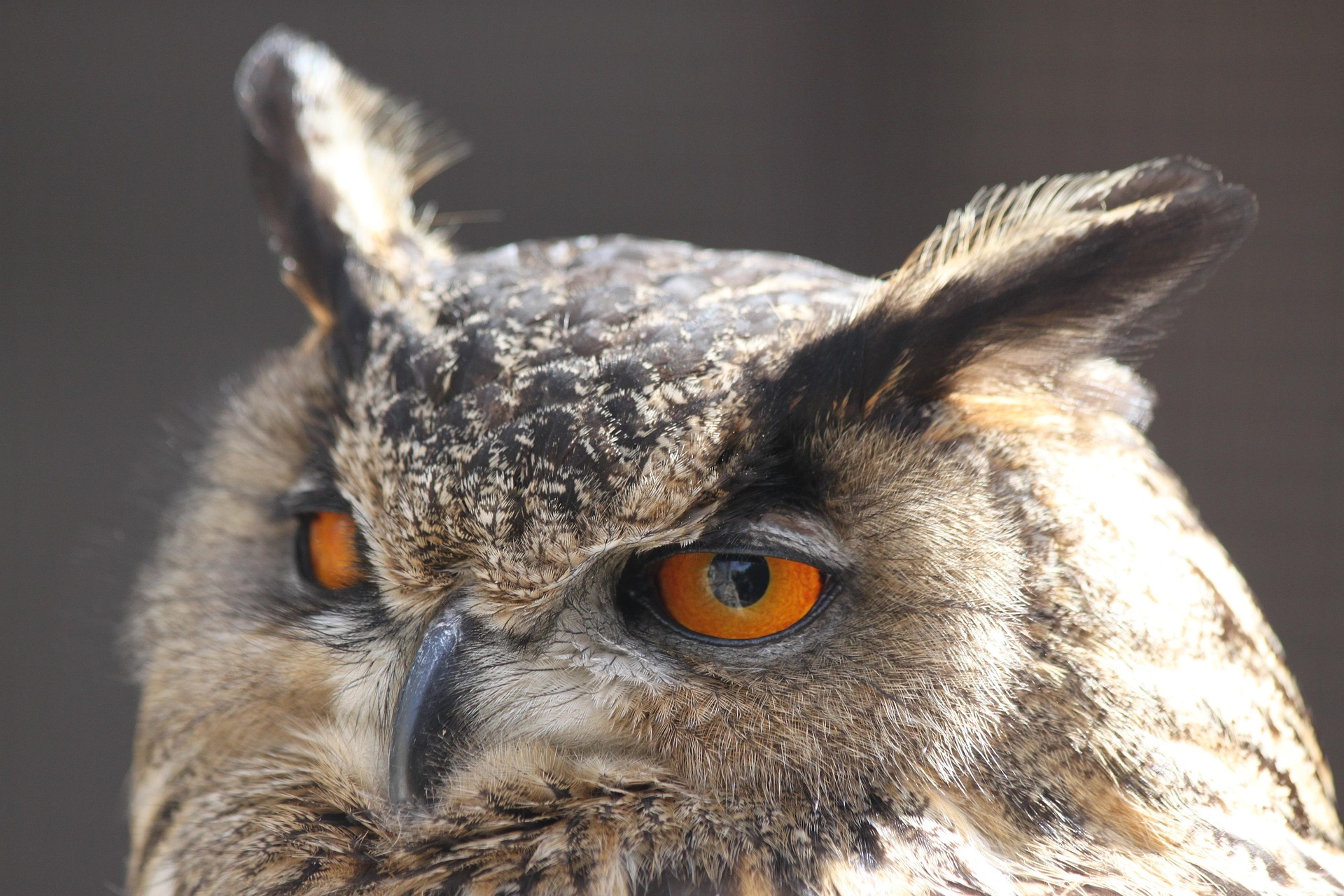
Willgard Krause from Pixabay

NOTE: This is a revised version of a column that originally ran in November of 2018.

The ultimate coma victim is the fabled zombie, but that’s not likely to afflict any of our feathered friends, right? Well, consider the great tits of Hungary, which are relatives of our tufted titmouse and Carolina chickadee. These birds — at least the Hungarian ones — have apparently acquired a taste for brains.

Not human brains, thankfully. The victims of these brain-hungry great tits are a species of bat — a flying creature often associated with the modern celebration of Halloween, as well as legends about vampires — that shared the habitat of these birds in the Bükk Mountains of Hungary. As it turns out, the tits only hunted bats, in this case a tiny species known as common pippistrelle, out of dire necessity.

Pixabay Great tits have been documented hunting, killing and then eating the brains of small bats.

Bat ecologists Péter Estók and Björn M. Siemers, after observing the odd behavior of the great tits during some winter seasons, conducted a study to see if great tits are consistent devourers of bats’ brains. They discovered that the birds did hunt the bats and had even learned to detect a special call the bats make as they emerge from hibernation. The ecologists conducted their study over two years and learned that the great tits teach others of their kind the special art of hunting bats. They also learned that the birds made efficient killers, dragging the bats from their roosts and cracking their skulls to get at their brains.

However, when provided with plenty of alternative food, including such favorite items as bacon and sunflower seeds, the great tits chose to eat these items rather than actively hunt bats. The researchers concluded that great tits only resort to harvesting the brains of small bats during times of scarcity during harsh winters. The bizarre story is even featured in the title of a fascinating book by Becky Crew titled “Zombie Birds, Astronaut Fish, and Other Weird Animals.”

So, if humans have nothing to fear from brain-hungry birds, are there any birds that we should fear? Some experts suggest that precautions might be in order if a person comes into close proximity with a southern cassowary, which is the third-tallest and second-heaviest living bird, smaller only than the ostrich and emu.

Photo by lailajuliana / Pixabay.com • The southern cassowary reaches a height of more than five feet and weighs 120 pounds. The bird has a fearsome but perhaps undeserved reputation for attacks on humans.

The cassowary, a native of New Guinea and northeastern Australia, has developed a reputation as a fearsome bird capable of injuring or killing humans. Cassowaries deserve their reputation, according to ornithologist Ernest Thomas Gilliard. In his 1958 book, “Living Birds of the World,” he explained that the second of the three toes of a cassowary is fitted with a long, straight, dagger-like claw which can sever an arm or eviscerate an abdomen with ease. According to Gilliard, there have been many records of natives being killed by this bird.

A thorough study, however, has partly exonerated the cassowary from these misdeeds. In a total of 150 documented attacks against humans, cassowaries often acted in self-defense or in defense of a nest or chicks. The only documented death of a human took place in 1926 when two teenaged brothers attacked a cassowary with clubs. The 13-year-old brother received a serious kick from the bird, but he survived. His 16-year old brother tripped and fell during the attack, which allowed the cassowary to kick him in the neck and sever the boy’s jugular vein.

So we can rest easier knowing that murderous birds that reach a height of almost six feet tall are unlikely to terrorize us should we travel to the lands down under. A more ancient relative of the cassowary, however, might have been a different story had humans lived during the same time period.

An illustration of Gastornis (Terror Bird) on a river’s edge. Gastornis are an extinct genus of large flightless birds that lived during the late Paleocene and Eocene epochs of the Cenozoic era. They grew to a height of 6.6 feet.

Phorusrhacids, also known as “terror birds,” were a group of large carnivorous flightless birds that once had some members reign as an apex predator in South America before they went extinct around two million years ago. The tallest of the terror birds reached a height of almost 10 feet. Titanis walleri, one of the larger species, even ranged into what is now the United States in Texas and Florida.

Terror birds were equipped with large, sharp beaks, powerful necks and sharp talons. Their beaks, which would have been used to kill prey, were attached to exceptionally large skulls. Despite their fearsome appearance, these birds probably fed on prey about the size of rabbits. Perhaps not knowing this, Hollywood has cast these birds as monsters in such films as 2016’s “Terror Birds” and 2008’s “10,000 BC.”

Regardless, the casting of birds as film villains had already been done back in 1963 when Alfred Hitchcock released his film, “The Birds,” based loosely on a short story by Daphne du Maurier. The film, which starred some big Hollywood names such as Rod Taylor, Tippi Hedren, Jessica Tandy, Suzanne Pleshette and Veronica Cartwright, cast a whole new light on a “murder” of crows. Today, the film has achieved the status of a Hollywood classic.

There’s also the tale of the ancient Greek playwright Aeschylus, who died around 456 BC in Sicily, possibly the only known victim of a bird dropping a heavy weight on a human being. According to ancient accounts mentioned by Pliny the Elder in his “Natural History,” Aeschylus was said to have been killed by a tortoise dropped by an eagle after the bird mistook the playwright’s bald head for a stone it could use to crack open the tortoise’s shell. However, this intriguing tale is, alas, likely only a myth. Most scholars have dismissed the account as an embellished, apocryphal story.

I guess we will have to look to Hollywood’s werewolves, zombies and other supernatural monsters for our Halloween chills and thrills instead of our fine feathered friends.

Photo by cocoparisienne/Pixabay.com • A crow lands on a spooky scarecrow at sunset.

56th annual Fall Bird Count finds 120 species in Northeast Tennessee

Photo by Jean Potter A single Wilson’s warbler made it onto the tally for this year’s Fall Bird Count

The 56th annual Elizabethton Fall Bird Count was held Saturday, Oct. 4. A total of 25 observers participated in about 13 parties. The weather was good, with clear skies, no wind and temperatures ranging from 42 to 82 degrees.

This year’s count tallied 120 species, plus two gull species and one Empidonax species of flycatcher. This total is slightly below the recent 30 year average of 124 species, according to compiler Rick Knight The all-time high on this count was 137 species in 1993.

The count is conducted in the Northeast Tennessee counties of Carter, Johnson, Sullivan, Unicoi and Washington.

Photo by Bryan Stevens A total of four pied-billed grebes were found during the recent Fall Bird Count. Numbers of this species will increase as the season advances.

The list:

Canada goose, 466; wood duck, 34; blue-winged teal, 21; mallard, 64; common merganser, 12; wild turkey, 15; and pied-billed grebe, 4.

Rock pigeon, 183; Eurasian collared-dove, 2; mourning dove, 145; yellow-billed cuckoo, 3; chimney swift, 176; and ruby-throated hummingbird, 1.

Killdeer, 41; spotted sandpiper, 3; solitary sandpiper, 2; and two gull species that could not be positively identified.

Double-crested cormorant, 30; green heron, 3; great egret, 5; great blue heron, 26; black vulture, 39; and turkey vulture, 195.

Osprey, 5; sharp-shinned hawk, 1; Cooper’s hawk, 6; bald eagle, 7; red-shouldered hawk, 6; broad-winged hawk, 1; red-tailed hawk, 17; American barn owl, 1; Eastern screech-owl, 24; great horned owl, 5; barred owl, 7; and Northern saw-whet owl, 3.

Belted kingfisher, 22; red-headed woodpecker, 5; red-bellied woodpecker, 71; yellow-bellied sapsucker, 9; downy woodpecker, 41; hairy woodpecker, 17; Northern flicker, 54; and pileated woodpecker, 17.

American kestrel, 14; merlin, 4; Eastern wood-pewee, 17; unidentifiable Empidonax species, 1; Eastern Phoebe, 82; yellow-throated vireo, 6; blue-headed vireo, 23; Philadelphia vireo, 4; red-eyed vireo, 10; and loggerhead shrike, 1.

Blue jay, 360; American crow, 416; fish crow, 4; and common raven, 21.

Carolina chickadee, 158; tufted titmouse, 140; tree swallow, 120; ruby-crowned kinglet, 13; golden-crowned kinglet, 4; cedar waxwing, 126; red-breasted nuthatch, 13; white-breasted nuthatch, 70; and brown creeper, 1.

Carolina wren, 135; house wren, 3; gray catbird, 27; brown thrasher, 9; Northern mockingbird, 74; and European starling, 560.

Photo by Jean Potter A Carolina wren creeps along a fence. A total of 135 of these wrens made it onto the recent Fall Bird Count.

Eastern bluebird, 157; veery, 1; gray-cheeked thrush, 5; Swainson’s thrush, 42; wood thrush, 7; American robin, 233.

House sparrow, 34; house finch, 50; red crossbill, 3; American goldfinch, 64; chipping sparrow, 51; field sparrow, 6; dark-eyed junco, 30; white-crowned sparrow, 1; white-throated sparrow, 2; savannah sparrow, 1; song sparrow, 98; swamp sparrow, 2; Eastern towhee, 47; and yellow-breasted chat, 1.

Eastern meadowlark, 20; red-winged blackbird, 70; brown-headed cowbird, 208; and common grackle, 24.

Ovenbird, 2; Northern waterthrush, 2; black-and-white warbler, 6; Tennessee warbler, 47; orange-crowned warbler, 1; Nashville warbler, 1; common yellowthroat, 12; hooded warbler, 5; American redstart, 21; Cape May warbler, 9; Northern parole, 21; magnolia warbler, 28; bay-breasted warbler, 47; Blackburnian warbler, 4; chestnut-sided warbler, 3; black-throated blue warbler, 11; palm warbler, 26; pine warbler, 4; yellow-rumped warbler, 4; yellow-throated warbler, 2; black-throated green warbler, 14; and Wilson’s warbler, 1.

Photo by Bryan Stevens • Male American redstarts are unmistakable warblers in their orange, black and white plumage.

Scarlet tanager, 9; Northern cardinal, 165; Rose-breasted grosbeak, 13; and indigo bunting, 9.

Some species were noteworthy in their absence. Notable misses included white-eyed vireo, blue-gray gnatcatcher, winter wren, hermit thrush and blue grosbeak.

The count was held a week later than usual due to the fall meeting of the Tennessee Ornithological Society in

Johnson City. This may have accounted for some of the misses or low numbers for some species , such as the single hummingbird. On the other hand, the later date may have contributed to finding some of the later migrants, including orange-crowned warbler and white-throated sparrow.

The count has been held on the first Saturday in October a few times previously.

•••

Bryan Stevens began writing about birds, birders and birding in 1995. To share a sighting, ask a question or make a comment, email him at ahoodedwarbler@aol.com.

Why do owls give a hoot? For many reasons

Dave Menke/USFWS Great horned owls, such as this individual, are effective predators after dark.

As September slid into October, the evening serenades began. At first, they consisted of a pair of Eastern screech-owls calling from the surrounding woodlands. On Oct. 2, the low hoots of a great horned owl joined the wailing calls of the two screech-owls.

I’ve gotten into the habit of 10-minute walks in the evening after dinner, and I posted about the owls on my Facebook account.

Several friends responded, including Tom McNeil, a fellow birders and an fellow alumna of Hampton High School.

“We’ve been hearing a pair (of great horned owls) hooting up on the ridge between you and us,” Tom wrote. “We also had a barred owl calling a few weeks ago, which was only the second time ever.”

Tom and his wife, Cathy, reside in the Piney Grove community of Hampton. As he indicated, only a steep mountain ridge separates his property from mine.

That ridge is a magnet for birds, ranging from pileated woodpeckers and wild turkeys to warblers, vireos, tanagers, flycatchers and many other songbirds. The bird population changes with the seasons, but there’s always a diversity of birds making their home on those wooded slopes.

Linda Cauley also responded to my Facebook post, sharing that she also had recently heard a great horned owl.

Larry A. Woodward/USFWS Eastern screech-owl chicks peer from the tree cavity that served as their first home.

Kaylynn Sanford Wilster has also been hearing a great horned owl. “First great horned owl I’ve had here in forever it seems like,” she wrote. “I think there’s just one but I’m not sure.”

Joanne Campbell commented on my post.

“We had a big hoot owl right outside our door last week,” Joanne wrote. “Closest I’ve ever been to one.”

I’d been surprised to hear screech-owls, which are considerably smaller than a great horned owl, calling at the same time as their larger kin. Great horned owls are not finicky and will dine on any smaller creature they can seize in their strong talons. I’d heard that smaller owls usually go silent in the presence of this large nocturnal predator.

Of course, the screech-owls were relatively close to my home while the great horned owl’s calls were notably distant. Perhaps they felt that enough space existed between them to ease any worries.

I also got to wondering why owls are so vocal. A little research came up with some answers.

First, it’s important to note that Eastern screech-owls produce different vocalizations for various purposes. One of my favorites is the “whinny,” a descending call that is, apparently, a territorial display to inform other owls that they have claimed a territory as their own.

At this time of the year, juvenile screech-owls are also striking out on their own away from parental care. These young owls deploy the whinny to establish their own territories. They will need a well-defined territory to ensure they can find enough prey during the lean, cold winter months.

The whinny itself is of short duration, lasting only a couple of seconds. Screech-owls also produce other sounds, which have been described as hoots, barks and squeal.

Another common screech-owl vocalization is an even-pitched trill, often called a “bounce song” or tremolo. I can do a decent job imitating this sound, and I’ve often stirred up songbirds by doing so. A flock will sometimes materialize as if from thin air, as the members of the flock scold and search for the owl. It’s a good way to draw some curious birds closer for observation.

Bryan Stevens Lucy, a rehabilitated owl, helps programmers at Brookgreen Gardens provide educational programs about owls to the public.

Great horned owls, or “hoot owls” as they are widely known, also produce their low, nocturnal calls for many of the same reasons as screech-owls do. These large owls hoot to communicate, with the most common reasons being to define and defend territory, locate and attract a mate during breeding season and stay in contact with their young. Hooting also helps them establish boundaries with other owls and signals their presence, making their calls particularly energetic and frequent in the autumn and winter months when territories are being set up.

Pairs of great horned owls will hoot together as part of their courtship to strengthen their bond. A female owl’s voice is notably higher in pitch than the male’s, according to the website All About Birds. I’m hoping I will soon hear the duet that Tom and Cathy are enjoying on the other side of the ridge. So far, I’ve only detected the one great horned owl. I have heard these mesmerizing duets in the past, however. Listening can produce shivers down the spine. Of course, that is also helped by the fact they most often hoot on evenings once the weather had become more chilly.

The days are shorter, nights are longer, so now is a great time to get familiar with the owls. It can be as easy as stepping onto the front porch and listening.

•••

Bryan Stevens has been writing about birds, birding and birders since 1995. To share a sighting, ask a question or make a comment, email him at ahoodedwarbler@aol.com.

Photo by Irene K-s/Pixabay.com
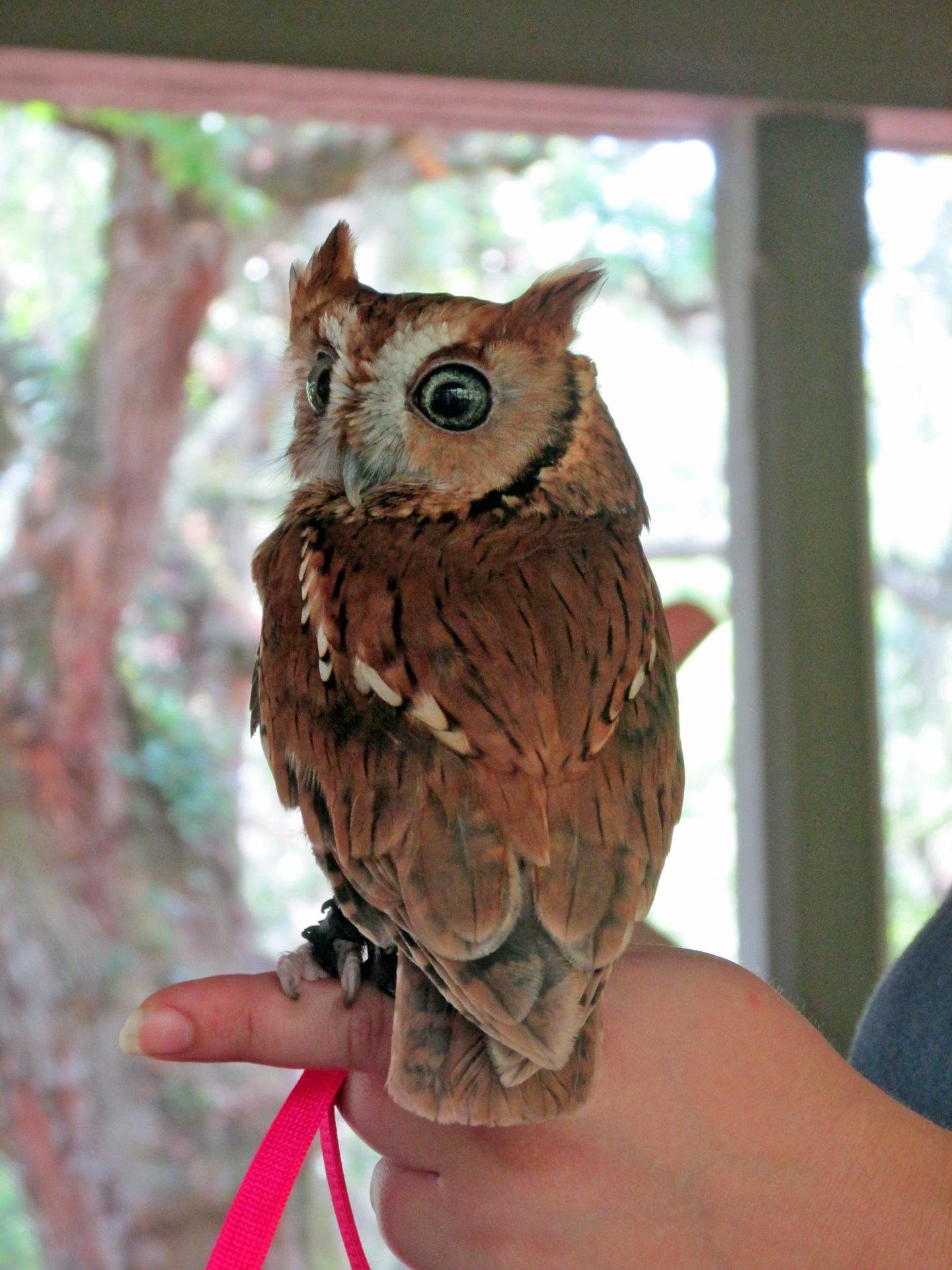
An Eastern screech owl keeps an eye on its surroundings.

Local couple comes to aid of injured hummingbird

Rex and Linda Mathes • Linda and Rex Mathes came to the aid of this injured hummingbird. Most ruby-throated hummingbirds, like other migratory birds, face many perils and obstacles during their migrations.

Erwin resident Linda Mathes emailed me recently to inquire about wildlife rehabilitators who might be able to help an injured ruby-throated hummingbird.

“We found a hummingbird in the backyard yesterday, alive, so brought into house and put in box,” Linda wrote. “We think its wing is damaged.”

Linda noted that she and her husband, Rex, also brought the hummingbird feeder inside.

“My husband picks it up and holds it up to feeder and it drinks,” Linda explained. “He does this several times a day.”

She added that the hummingbird regained enough strength to also sit on Rex’s finger.

“We were worried the bird would not have any nectar during the night,” she added.

The next morning, the bird still seemed fine other than for the injured wing.

“He is very perky,” Linda note. “He/she is a real fighter.”

I provided Linda with some suggestions on wildlife rehabilitaters, but she found one on her own with the help of a friend. Rex and Linda made a trip on Monday, Sept. 29, to deliver the hummingbird into the care of a licensed wildlife rehabilitation professional.

Bryan Stevens • Ruby-throated hummingbirds have usually departed from the region by early October.

“They gave me a patient number so I could call about the bird.”

When she called on the morning of Tuesday, Sept 30, she got a detailed report.

The vet had prescribed muscle relaxers for the hummingbird,” Linda said. “Her condition was listed as guarded but at least she might have a chance.”

As they were leaving the facility, someone brought in an injured chipmunk.

Linda added that there was no charge for caring for the bird but she planned to send a small donation.

I’m hopeful for the hummingbird’s recovery. Over the years, I’ve encountered several injured birds. Several of the birds stunned themselves after impacts with windows, an all-too-common hazard. Rose-breasted grosbeak and Swainson’s thrush have been among some of these. Most of the birds have recovered after a brief rest period in a shoe box covered with a towel. It’s always a relief when they can fly off under their own power.

Migration can be hazardous and arduous for our feathered friends. Birds face various hazards, including collisions with human-made structures like buildings and power lines, habitat loss and degradation, storms, disorienting light pollution and predation from other animals.

They also need to refuel to keep up their strength, and the lack of food along a migration route can deal the chances of their success a serious blow.

Even birds that cannot fly undertake migrations. For instance, flightless penguins swim hundreds or thousands of miles to reach preferred ranges for feeding or nesting. The Australian emu, a smaller relative of the ostrich, makes seasonal migrations on foot to ensure access to abundant food supplies at all seasons.

Ruby-throated hummingbirds make an awe-inspiring and non-stop crossing of the Gulf of Mexico every fall to reach their wintering grounds. Their flight across the waters of the Gulf can take these tiny birds 18 to 22 hours. Even more incredible, they make the trip in reverse in the spring when they return to their nesting grounds across the Eastern United States.

Photo by Bryan Stevens • A ruby-throated hummingbird visits a feeder for a sip of sugar water.

Ruby-throated hummingbirds lead relatively brief lives, which is understandable considering the perils they face and the incredible migrations they stage twice each year. The oldest known ruby-throated hummingbird was a female, according to the website All About Birds. She was at least 9 years, 2 months old when she was recaptured and rereleased in 2014 during banding operations in West Virginia.

The New World is home to about 360 species of hummingbirds. We’ve expended a lot of energy finding adjectives to provide names for all these hummingbirds. Sometimes, words fail. Mere adjectives are somewhat inadequate in providing common names for many of the world’s more hummingbirds, but that doesn’t keep us from trying to give descriptive names to each hummingbird species. For instance, we have the beautiful hummingbird of Mexico; the charming hummingbird of Costa Rica and Panama; the festive coquette of northwestern South America; and the magnificent hummingbird of the southwestern United States.

•••

To share a sighting, make a comment or ask a question, email me at ahoodedwarbler@aol.com.