Author Archives: Bryan Stevens

Unknown's avatar

About Bryan Stevens

Bryan Stevens lives in Northeast Tennessee. He is an editor, writer and columnist. He has written food columns for the Johnson City Press, Elizabethton Star and Carter County Compass since 2003.

Catbirds make noisy neighbors during the warmer months

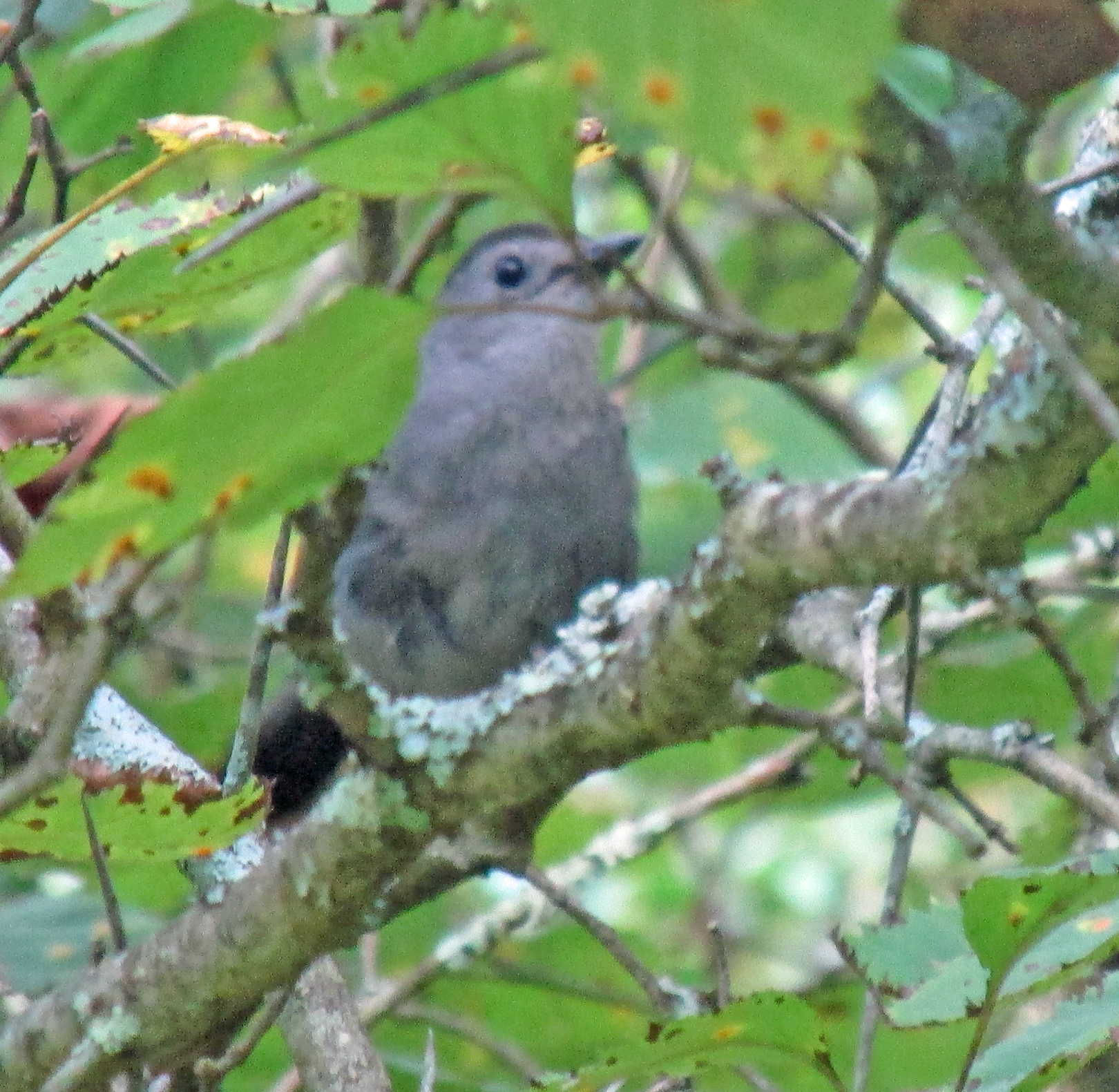
Photo by Bryan Stevens A curious Gray Catbird peeks from dense cover. Attendees at the fall rally can look for catbirds and other species at any of the offered bird hikes.

(NOTE: Hurricane Helene disrupted my weekly posting. I’ve still been writing, so catching up now on the posting.)

I wrote last week about brown thrashers. This week I’m turning the spotlight on a close relative of the thrashers, the gray catbird.

As summer has waned and autumn’s approach has become more inevitable with each passing day, I’ve become more aware of both thrashers and catbirds skulking around the edges of the yard and the nearby woodlands.

These birds have been lured closer by polk berries, wild grapes and pin cherries. Both thrasher and catbirds are fond of fruit. One summer my mom and I “trained” a catbird to come to the discards left behind when strawberries are “capped.” Not as picky as people, the catbird thought the discarded scraps of strawberries provided an unexpected treat.

Catbirds are part of a family related to thrushes that are known as “mimic thrushes.” Besides its surprisingly accurate rendition of a feline, the catbird has several other common vocalizations. Despite their shy nature, they’re extremely curious. Imitating their calls or simply producing a squeaky sound will usually persuade the bird to move out of cover and search for the source of the noise.

Catbirds are part of the annual fall exodus that includes species like rose-breasted grosbeaks, scarlet tanagers, Baltimore orioles and indigo buntings, but because they lack the brilliant plumages of these other birds their passage would probably go unnoticed if not for the fact they are extremely noisy.

Catbirds do get quieter during the nesting season when they take up the serious business of raising young, but after that annual task is completed they immediately slide back into their crotchety vocal habits.

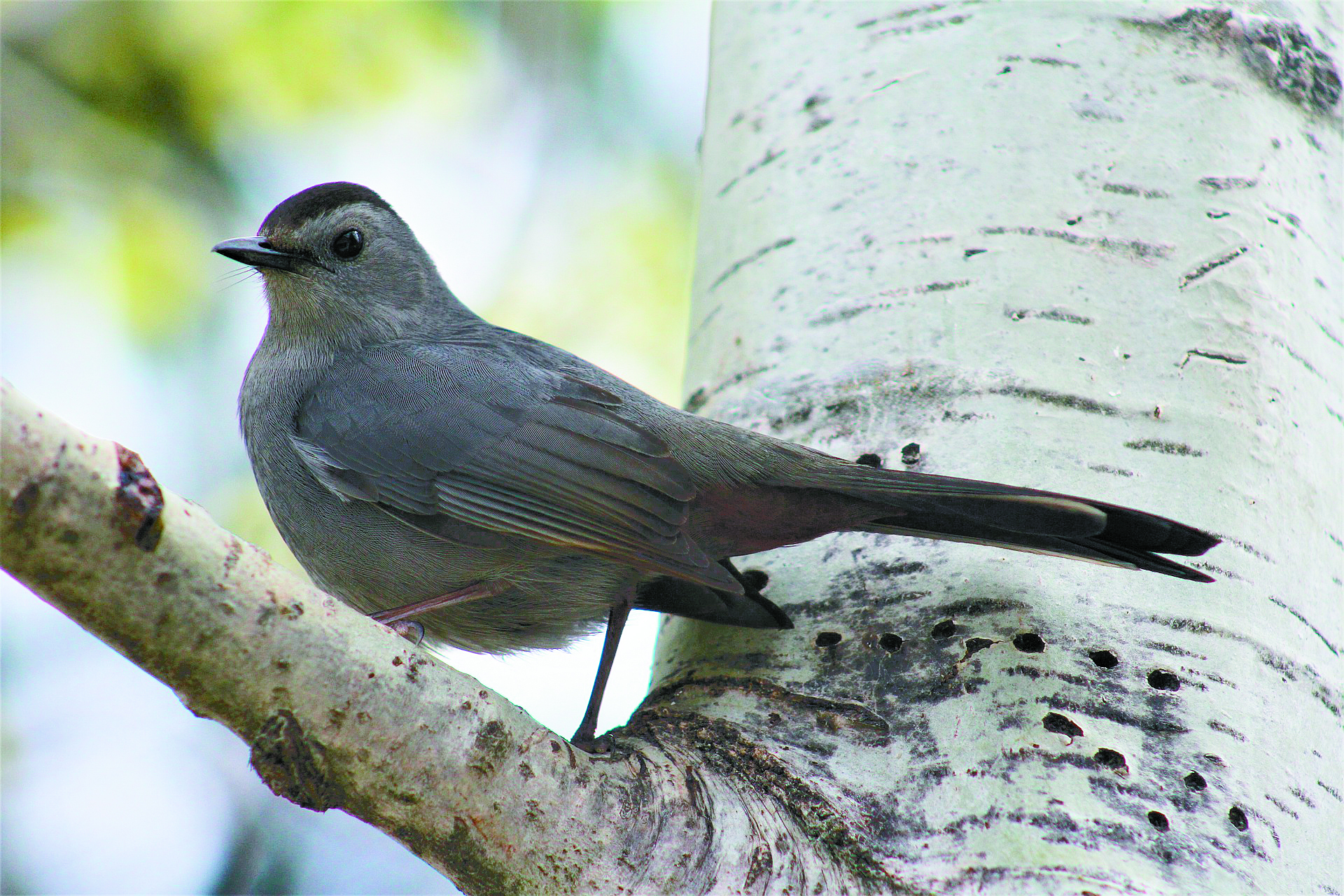
Catbirds are experts at concealing themselves from prying eyes. The bird’s charcoal gray plumage, unbroken except for a patch of maroon feathers beneath the tail, blends into the shadowy sections of the tangles and thickets where they like to lurk. However, even when gray catbirds are reluctant to be seen, they’re almost eager to be heard. As indicated, the catbird is extremely vocal with several calls and songs in its repertoire, including the rather faithful rendering of a fussy cat’s meow that provides this bird its common name.

They are related to thrashers and mockingbirds, but scientists find them just different enough to warrant placing the gray catbird in its own genus.

A relative known as the black catbird, which ranges throughout the Yucatan Peninsula of Mexico as well as northern Guatemala and northern Belize, also belongs to a genus of its own. Both catbirds are classified as “mimic thrushes,” or Mimidae, of which there are about 30 species in the New World.

There is also a totally unrelated family of catbirds that ranges through Australia, Asia and parts of Africa. Some of these birds include the ochre-breasted catbird, tooth-billed catbird and spotted catbird.

The gray catbird is not as an accomplished mimic as some of its relatives, such as the Northern mockingbird. Nevertheless, experts have documented that the gray catbird can produce more than 100 different sounds. Males have motivation to constantly expand their repertoire, however, as doing so increases the likelihood of attracting a mate. They imitate other birds, but some have been recorded imitating frogs and other non-avian singers.

An occasional catbird enjoys surprising longevity. The oldest known gray catbird was at least 17 years, 11 months old when it was recaptured and rereleased during banding operations in New Jersey in 2001, according to the website All About Birds. That individual had been banded originally in Maryland in 1984.

I will miss the catbirds once they depart farther south for the winter, although occasionally a few hardy individuals linger into November and December in the region.

Other birds, including warblers, hummingbirds and most flycatchers will soon take their leave until next spring. Try to enjoy them before they decamp.

•••

To share a sighting, ask a question or make a comment, please email me at ahoodedwarbler@aol.com.


Brown thrasher is a bird with a bold personality

Photo by Bryan Stevens
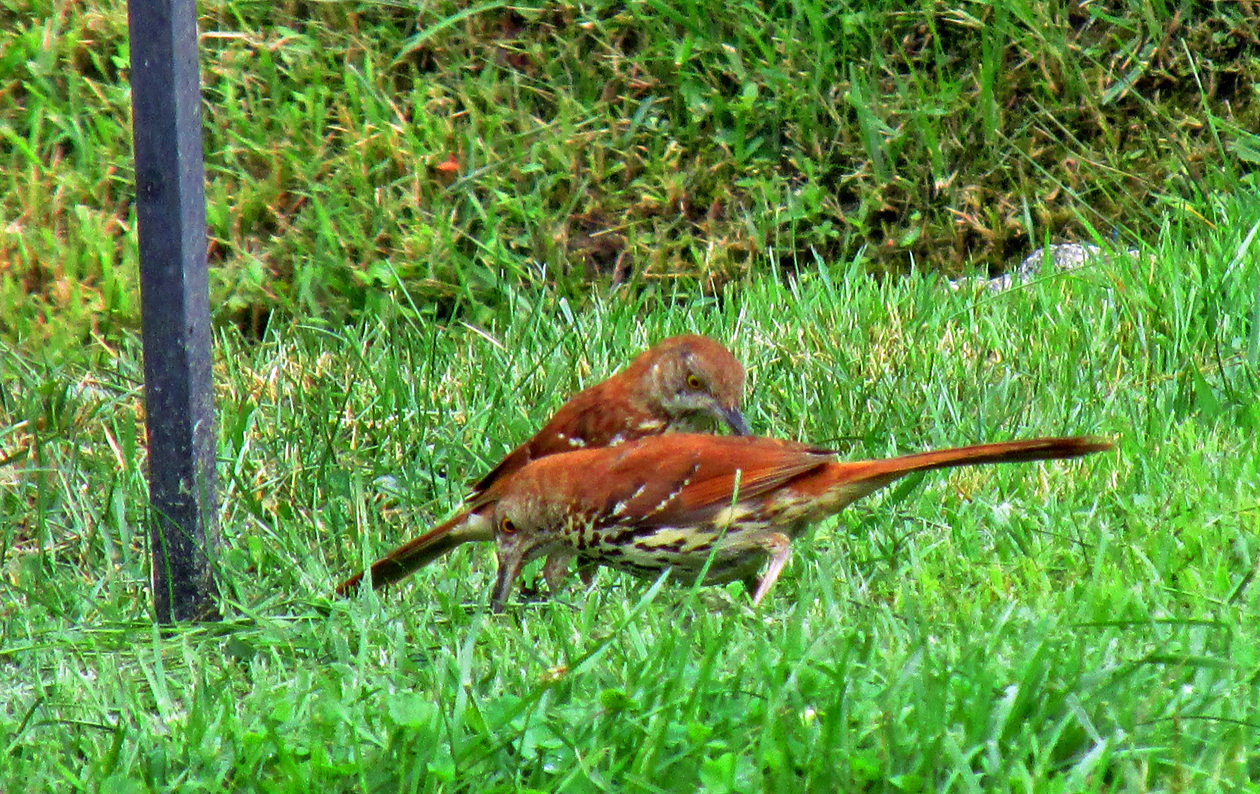
A pair of Brown Thrashers forage for food on the ground below a feeder.

I’ve been enjoying fall migration, but I’ve not seen as many species of birds as I would like. So far, I’ve observed a few warblers, including black-and-white warbler, common yellowthroat, magnolia warbler, Tennessee warbler and American redstart. Other interesting sightings have included wood thrush, several ruby-throated hummingbirds and a gray catbird. I’ve also observed brown thrashers after going most of the spring and summer without seeing any.

Brown thrashers are by nature both bold and reclusive. I was reminded of that fact during some recent lawn chair birding at home. I heard a quarrelsome thrasher calling from a thicket. I produced some squeaks to get the bird’s attention. As a result, the thrasher soon materialized like a feathered ghost deep in the branches of a shrub. I got a brief look in my binoculars at the bird and saw one baleful pale yellow eye staring back at me.

Photo by Ken Thomas
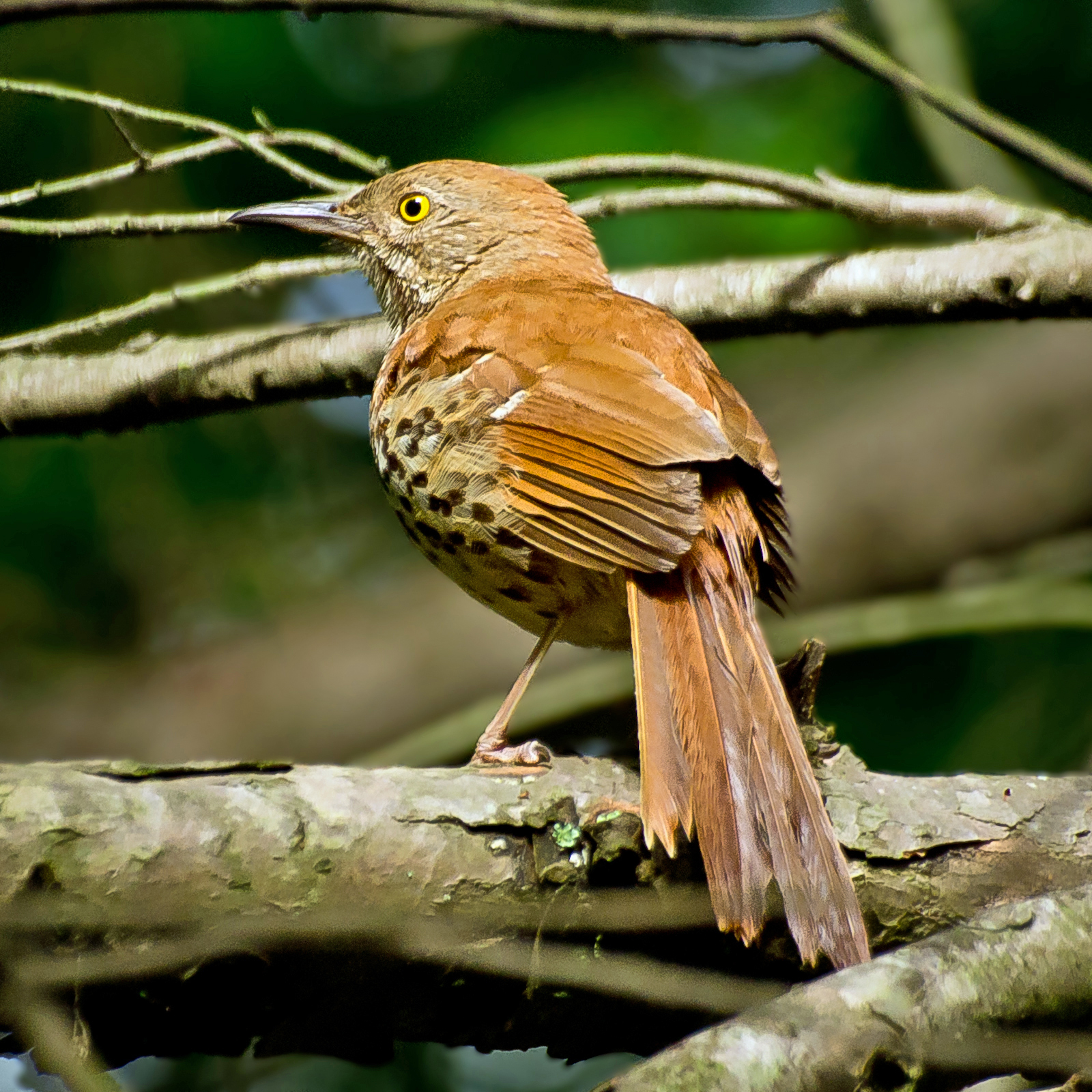
The Brown Thrasher is an alert, sharp-eyed observer of its surroundings.

A few years ago, quite by accident, I experienced a similar sighting when I came across a brown thrasher nest. I hadn’t gone looking for it. The nest, expertly woven into a thicket of honeysuckle vines, was tucked beneath a sheltering eave of an outdoor storage building. I don’t think anything but a fortunate accident could have ever revealed the nest. I still remember peeking into that tangle of vines and seeing a golden eye staring back. The bird didn’t look in the least pleased that I had accidentally stumbled across her nest.

The otherwise extroverted brown thrasher, which prefers to nest in difficult-to-access, tangled messes, found the cluster of vines a perfect location. For those not familiar with brown thrashers — relatives of the Northern mockingbird — they are known for their feisty and fearless protection of their nest and young. I’m probably fortunate the thrasher on her nest decided to choose stealth instead of attack. Sometimes, discretion is truly the better part of valor and the bird probably decided that, if she remained motionless, she would blend in well with her surroundings.

I was probably fortunate to escape with no more than a stern, unhappy glare from the nesting thrasher. According to th website All About Birds, brown thrashers are aggressive in defense of their nest. The birds are known to strike people and dogs hard enough to draw blood.

Brown Thrashers are accomplished songsters that may sing more than 1,100 different song types and include imitations of other birds, including chuck-will’s-widows, wood thrushes and Northern flickers.

The brown thrasher (Toxostoma rufum) belongs to the family of “mimic thrushes,” which provides a label for a group of songbirds capable of imitating the songs of other birds. Mimidae, the Latin root for “mimic,” provides the scientific name for the family, which includes mockingbirds and the New World catbirds, as well as thrashers. The Northern mockingbird is best known for the ability to mimic, but relatives like the gray catbird and brown thrasher are also talented mimics.

The thrasher is a fairly large songbird about 11.5 inches long with a wingspan of 13 inches. Much of the body length comes from the bird’s long tail feathers. A thrasher weighs, however, only about 2.5 ounces.

Early American naturalist and artist John James Audubon painted a dramatic scene of Brown Thrashers defending their nest from an attacking snake.

The brown thrasher is not a picky eater. It’s known to eat everything from berries and nuts to insects and small lizards. It’s also aggressive in defending its nest and young. John James Audubon, a French-American ornithologist, naturalist and painter, painted quite a dramatic scene of a group of brown thrashers valiantly defending a nest from an attacking snake. The painting is so detailed that one must imagine Audubon based his work on a real-life experience. His work, originally painted in the early decades of the 1800s, still holds up today. The scene comes almost alive to the viewer and confirms Audubon’s skill at capturing extremely accurate moment in the lives of the birds he painted.

Incidentally, Audubon knew the brown thrasher as the “ferruginous thrush.” Another former common name for this species was “brown thrush.”

The thrashers are familiar birds in southern gardens. In fact, the brown thrasher is the official state bird of Georgia and also provided the name for Atlanta’s National Hockey League team, the Atlanta Thrashers. The thrasher became Georgia’s state bird due to passage of a Joint Resolution of the Georgia General Assembly in 1970.

Returning to the expressive nature of brown thrashers, I think it’s the bird’s golden eyes that make them seem so alert and attentive. Once they feel secure in a lawn or garden, they become less shy. As one might expect from a large songbird, thrashers have voracious appetites. Among the feeder fare I offer, thrashers seem to prefer suet cakes. They’re not woodpeckers, however, so the awkward attempts of these long-tailed birds to access the suet offer some comic antics for observers.

As a larger songbird, brown thrashers also tend to live a little longer than smaller birds. The oldest brown thrasher on record was at least 10 years, 11 months old, according to All About Birds. This individual was found in Florida in 1978 where it was banded in 1967.

The brown thrasher is the only thrasher that ranges east of the Mississippi River. Other species occur in the western half of the nation, including sage thrasher, long-billed thrasher, California thrasher, Crissal thrasher, LeConte’s thrasher, curve-billed thrasher and Bendire’s thrasher.

As autumn progress, I wish everyone luck with their own birding.

•••

To ask a question, make a comment or share a sighting email me at ahoodedwarbler@aol.com.

Photo by Bryan Stevens
Brown Thrasher perched in a mimosa tree.

Birds share fall skies with migrating butterflies, dragonflies

During a stop at the Unicoi Walmart to visit the pharmacy on Wednesday, Sept. 3, I spied an energetic fluttering of wings in the garden center. Although I’ve spied various birds, including Carolina wrens and house sparrows, making themselves at home in this garden center, this winged creature was quite a bit smaller.

I watched the butterfly flit from marigold to zinnia to fall mums, feasting on the nectar the blooms provided. A closer look revealed the butterfly’s identity as a long-tailed skipper, a species more likely found in South Carolina, Georgia and Florida than Northeast Tennessee.

Photo by Bryan Stevens • A long-tailed skipper sips nectar from a marigold at the garden center at the Unicoi Walmart.

According to Wikipedia, the long-tailed skipper is a spread-winged skipper butterfly found throughout tropical and subtropical South America, south to Argentina and north into the eastern United States and southern Ontario. It cannot live in areas with prolonged frost. I have seen lots of them in South Carolina and Georgia; this is my second sighting of one in Northeast Tennessee. I found the first one in a garden in Elizabethton near the Covered Bridge.

The sighting reminded me that it’s not only birds using the skies for migration as we advance toward the autumn season. I also remembered a question I got from a reader back in 2014. Rhonda Eller of Chilhowie, Virginia, posted a question on my Facebook page about some dragonflies that appeared in her yard on Sept. 10.

“We have had a sudden breakout of dragonflies in our yard,” Rhonda explained. “We seldom see more than one or two at a time.”

Rhonda wondered if the dragonflies might have been drawn to her yard in pursuit of some sort of favorite insect prey. She also speculated that the recent dry conditions might have attracted the dragonflies.

Photo by Bryan Stevens • The wandering glider is a migratory species of dragonfly.

I responded at the time to her query by explaining that birds share the skies at this time of year with many other migrants. Some dragonflies, just like birds, migrate. A species known as green darner is one that migrates. These darners are rather large, for a dragonfly, and travel in swarms. A couple of years ago I observed thousands of these dragonflies swarming over a municipal swimming pool and a nearby fish pond at Erwin Fishery Park.

The WSLS Channel 10 television station out of Roanoke, Virginia, reported on swarms of dragonflies so large that they got picked up by local radar. Rhonda shared a link to the station’s story on my Facebook page.

Of course, swarms of migrating insects are bound to get the attention of predatory birds. The same day that Rhonda experienced the influx of migrating dragonflies, I witnessed dozens of common nighthawks and chimney swifts swooping through the skies over my home. With a little more attention to detail, I also noticed the dragonflies sharing the skies with these birds.

I suspect that the nighthawks were feeding on the large darners while the swifts, which are much smaller birds, focused their foraging efforts on smaller winged insects. Tom McNeil, a neighbor and fellow member of the Elizabethton Bird Club, reported seeing nighthawks and swifts, too. Tom lives on the other side of a mountain ridge that separates our homes.

Tim Morris, a Facebook friend from Australia, noted in a comment on my post about the nighthawks that his country is home to a bird known as the tawny frogmouth, a relative of the common nighthawk. Tim noted that frogmouths are big birds with camouflage markings that allow them to pretend to be dead tree boughs by day. “They feed not only on insects but mice and lizards, too,” he added.

Evidence of fall migration continued the next day when I detected a small wave of warblers foraging in trees at the edge of my yard. I saw five different species — American redstart, worm-eating warbler, Cape May warbler, Blackburnian warbler and Tennessee warbler — in the space of half an hour. Of the warblers in the flock, the Blackburnian and Cape May are some of the more vibrant ones.

So far in 2024, warblers have absented themselves from my yard this fall. It’s started to aggravate me, but I’ll try to be patient.

The Blackburnian warbler’s common name commemorates Anna Blackburne, an English naturalist who lived from 1726 to 1793. Her brother, Ashton, had immigrated to the United States, which made it possible for him to send his sister many specimens, especially birds. Their father, a salt merchant by trade, was also a well-respected amateur naturalist. In addition to the warbler that bears her name, Anna Blackburne also had a species of beetle named in her honor.

Both the Cape May and Tennessee warblers are named for the locations from which they were first collected. Neither of these small songbirds are closely affiliated with Cape May, New Jersey, or the Volunteer State. The Cape May warbler is also known as the “tiger warbler” for the dramatic black striping across its bright yellow breast. A green back and chestnut cheek patch make the Cape May warbler quite unlike any of its close kin. Even its former scientific name — Setophaga tigrina — paid homage to the striped big cat. The term “setophaga” translates to “moth eater” and is a reference to this warbler’s intense fondness for the caterpillars known as spruce budworms that occasionally produce outbreaks in the northern spruce forests that serve as the nesting range for the Cape May warbler.

According to the website, “All About Birds,” Cape May warblers have unusually shaped tongues that allow them to sip nectar from tropical flowers during the winter months spent in Central America and the Caribbean. Their unique tongues also make it possible for them to enjoy sips of sugar water from hummingbird feeders.

Whether its dragonflies, nighthawks, warblers, hummingbirds or a long-tailed skipper in a Walmart garden center, plenty of birds and other flying creatures will be moving through the region for the next few weeks. Now’s the time to get outdoors and look for some of these migrants.

•••

Bryan Stevens has been birding actively for about 30 years. He has written a weekly column on birds and birding since 1995. To ask a question, make a comment or share a sighting, email him at ahoodedwarbler@aol.com.

September brings spike in bird migration

Hans Toom/Pixabay • Few warblers make as great a journey as the blackpoll warbler. This small songbird makes a roundtrip flight of 12,400 miles for its seasonal migrations each year.

September’s arrival puts fall migration into sharp focus. The birds that returned this past spring — the warblers, vireos, tanagers, grosbeaks, flycatchers, hawks, hummingbirds and many more — have begun or are beginning to make their way back to the locations where they will spend the winter months far from the cold, bleak conditions over most of North America.

Every morning as I leave for work I hear the buzz of hummingbird wings. When I return in the evening, I am often greeted by the scolding calls of red-eyed vireos from the woodlands around my home.

Some of these birds migrate out of the tropics every spring to avoid competition. Others find North America a land of abundant, albeit temporary, resources. This land of plenty offers a wealth of insects, seeds, fruit and other nourishing, nutritious food to help parent birds keep their strength while they work to ensure their young thrive. Of course, once the bountiful period concludes, they return to the tropics of Central and South America to winter. Those that do so successfully will make the journey back to the United States and Canada in the spring. It’s an ongoing cycle, repeating year after year, season after season.

The phenomenon of migration isn’t exclusive to the neotropical migrants of the New World. Birds in other parts of the world migrate, too. Waterfowl, shorebirds and raptors are among some of the families of birds that stage impressive migrations.

Photo by Jonathan Cannon/Pixabay.com • The Arctic tern outdoes all other birds when it comes to migration. These seabirds journey from their Arctic nesting grounds to spend the winter around the Antarctic, a journey of some 50,000 miles a year.

The Arctic tern, for example, truly takes migration to extremes. This small seabird travels each year from its Arctic nesting grounds to the Antarctic region, where it spends the winter months. Put into terms of mileage, the Arctic tern can travel about 50,000 miles in a single year. For a bird with a body length of about 15 inches and a wingspan of about 28 inches, this incredible migration is an astonishing feat. These statistics permit the Arctic tern to easily lay claim to the title of champion migrant among our feathered friends.

According to the website for National Geographic, Arctic terns face a serious threat from climate change. In a profile on the tern at its website, National Geographic warns that Arctic terns are projected to lose 20 to 50 percent of their habitat due to the temperature changes linked to climate change. They also face loss of habitat due to encroachment by human activities such as oil drilling.

The ruby-throated hummingbird, a favorite of many bird enthusiasts living in the eastern United States, makes an impressive migration each year. Just to reach the United States, these tiny birds undertake a strenuous journey. They leave their wintering grounds in Central America to return to the United States and Canada for the nesting season. Most of these tiny birds, which are barely four inches long, make a non-stop flight of more than 500 miles across the Gulf of Mexico. The journey can take almost an entire day. With the end of summer, the entire population of ruby-throated hummingbirds, increased by a new generation of young birds, makes the Gulf crossing for a second time in a year to return to the American tropics for the winter months.

Photo by Bryan Stevens • A ruby-throated hummingbird perches at a feeder for a sip of sugar water.

Among North America’s buteo hawks, which includes raptors such as red-shouldered hawk and red-tailed hawk, the broad-winged hawk stands out as a dedicated migrant. These hawks form flocks that at times number in the hundreds or thousands as they sail and glide on thermals rising over various mountain ranges. These hawks and other raptors are well-known in the region for migrating past the Mendota Fire Tower in Southwest Virginia every September and early October.

The broad-winged hawk’s counterpart in the western United States is Swainson’s hawk, which shares the broad-winged hawk’s inclination for migrating in large flocks. Swainson’s hawk is named for William Swainson, the famous 19th century English naturalist for which Swainson’s thrush is also named.

The hooded warbler, my favorite member of the migratory New World warblers, migrates back to Mexico and Central America for the winter months after nesting during the spring and summer in a range concentrated in the southeastern United States. The males, after going quiet in late summer, have started singing on occasion from the shaded woods around my house. I think this has more to do with restlessness as they prepare for to depart on a migration flight that will take them to the balmy Caribbean, Mexico and Central America while we shiver through the months between October and April. It’s not a migration of an incredible distance, but it’s still quite an accomplishment for a bird only five inches long and weighing less than half an ounce.

Another warbler is a true migratory champion. Few warblers make as great a journey as the blackpoll warbler. Instead of migrating over land, this five-inch-long warbler undertakes a two-stage migration. The first half of the migration is a non-stop flight of about 1,500 miles. Every fall, these tiny birds fly over the Atlantic Ocean during this part of their migration, departing from Canada or the northern United States and not stopping until they reach various locations in the Caribbean. There they will spend some time recovering from the exhausting first half of their journey before they continue their way to such South American countries as Colombia and Venezuela. Once again, during the time they spend flying over open ocean, these tiny warblers do not feed.

Fall’s a great time to witness the variety of avian life. Look for some of these migrants passing through your yards, gardens or favorite birding spots.

For those wanting suggestions for seeking out migrating birds, the linear trail in Erwin, Rocky Fork State Park in Flag Pond and Limestone Cove Recreation Area are some good bets.

•••

To ask a question, make a comment or share a sighting, email me at ahoodedwarbler@aol.com. 

Elizabethton Bird Club announces speakers for fall programs

Brayden Paulk will speak to the Elizabethton Bird Club on Sept. 3 on the topic of microfishing.

The Lee and Lois Herndon Chapter of Tennessee Ornithological Society, also known as the Elizabethton Bird Club, will soon begin its schedule of monthly meetings for 2024-25.

The brief business meetings are always accompanied by an informative and entertaining program on birds, birding or other subjects from the natural world.

These programs are a great way to learn more about our feathered friends as well as other related subjects from the natural world. They are free, open to the public and hosted by a welcoming group of people.

Here’s the schedule for Fall 2024:

September

Brayden Paulk, a young naturalist with family ties in Unicoi County, will present the first program on Tuesday, Sept. 3, with a talk on “Microfishing,” which involves anglers focusing on a diverse array of tiny species of fish.

Paulk has also been working as a naturalist with Lamar Alexander Rocky Fork State Park this summer and fall. He gave a program a couple of years ago for the club on “Trash Fishing,” which explored other angling options other than the typical gamefish species. As both fishing and birding are among his interests, he will no doubt find a way to work something into his program about birds.

October

The guest speaker for the meeting on Tuesday, Oct. 1, will be Mark Stevens. A former publisher for The Erwin Record, he will present a program titled “Building a Birding Festival” that will focus on his development of the Hammock Coast Birding Festival in South Carolina. Stevens, who works as tourism director for the Georgetown County Chamber of Commerce, will be giving the program remotely from his home in South Carolina, but the hybrid meeting also offers a chance to attend in-person with other birding enthusiasts. The festival is organized by the South Carolina Hammock Coast, the marketing arm for the Georgetown County Chamber. The third annual Hammock Coast Birding Festival is scheduled for Feb. 6-9, 2025.

November

Vern Maddux, the treasurer for the club, will be the speaker on Tuesday, Nov. 5. Maddux is a world traveler when it comes to seeing birds and will present a program on one of his recent international birding adventures to South Georgia and Falklands. South Georgia is a mountainous barren island in the South Atlantic Ocean, 800 miles east-southeast of the remote South Atlantic archipelago that makes up the Falkland Islands. With rugged terrain and cliff-lined coasts, the hundreds of islands and islets in the Falklands are home to sheep farms and abundant birdlife.

December

In the busy month of December, yours truly will give the program. I will present a powerpoint presentation titled “What’s in a Name?” on North American birds named after people. Among our native birds, we have quail, woodpeckers, sparrows, finches, warblers, hawks and other birds are known by names of historical figures ranging from John James Audubon to William Clark and Meriwether Lewis.

My program will be held on Tuesday, Dec. 3. I will discuss the American Ornithological Society’s decision in 2023 to end what are known as eponyms, in which species names honor people. The renaming of dozens of species will be a gradual process.

The club’s 2025 schedule has not been completed, but will include a program by local naturalist Lewis Tester in the spring on dragonflies.

The public is always welcome to attend these programs. Programs begin at 7 p.m.

The club meets at the Elizabethton campus of Northeast State Community College in Room 135 when the school’s schedule permits. When school is not in session, meetings are held on Zoom or at other announced locations. To receive updates on the club’s schedule, events and activities, email elizabethtonbirtdingclub@gmail.com and ask to be placed on a free mailing list.

The Elizabethton Bird Club holds seasonal birds count in spring, summer, fall and winter. The club also organizes and sponsors regular field trips to destinations through Northeast Tennessee. These activities are also open to interested members of the public.

•••

To share a sighting, make a comment or ask a question, email me at ahoodedwarbler@aol.com.

Seeing Yellow: Visit from an odd cardinal surprises local couple

Photo by Bryan Stevens • A male Northern cardinal leads a young cardinal to food sources.

Unicoi resident Bobby Davis called me last week to share news about a sighting of a yellow cardinal. Bobby said that he and his wife, Tressa, have two bird baths and a hummingbird feeder in their yard and are in the habit of watching the comings and goings of their feathered friends. At 1 p.m. on Tuesday, Aug. 8, they noticed a yellow cardinal in the yard near some rhododendrons.

A “yellow” cardinal is simply a Northern cardinal that has inherited a rare genetic condition that causes the bird’s feathers to turn yellow instead of red.

A news item posted to a website for The Wood Thrush Shop in Nashville relates the story of a backyard feeding station in Harriman, Tennessee, in Roane County that was visited by a yellow Northern cardinal on a regular basis.

Yellow Northern cardinals have been seen in at least four different states the last 10 years but remain a rarity.

The article explained that the yellow coloration in affected cardinals is caused by a rare genetic mutation. The colors red, orange and yellow in a bird’s feathers are created with carotenoid pigments derived from the foods they eat. In the male Northern cardinal, yellow pigments from the diet apparently are converted to red by a specific enzyme. In a very rare genetic mutation, probably affecting fewer than one in a million cardinals, that enzyme is lacking, so the conversion to red doesn’t occur and the feathers are bright yellow instead.

Back in May of this year, a yellow cardinal given the name Maize was spotted in Alabama. That sighting took place less than 15 miles from a location that hosted another yellow cardinal in 2018. Was Maize a descendant of that yellow cardinal spotted six years ago?

Perhaps the yellow cardinal will stick around at Bobby and Tressa’s home. Bobby informed me that they have an ordinary pair of red cardinals that resides in their yard, but he noted that the three birds have not interacted.

•••

Interestingly enough, there is a bird with the actual name yellow cardinal, but it is not closely related to the Northern cardinal. This South American bird has the scientific name of Gubernatrix cristata and is a member of the tanager family.

The yellow cardinal was formally described in 1817 by the French ornithologist Louis Pierre Vieillot under the binomial name Coccothraustes cristata. The word “cristata” means crested or plumed.

This yellow cardinal ranges in Argentina, Brazil, Paraguay and Uruguay. Its natural habitats are dry savanna, temperate shrubland, subtropical or tropical moist shrubland and temperate grasslands. The yellow cardinal is threatened by habitat loss and from pet trade trappers for sale as exotic pets. Males are trapped at a higher rate than females, and the yellow cardinal is considered endangered due to the constant entrapment. If recent counts are accurate, only about 1,000 t0 2,000 of these birds still exist.

Photo by U.S. Fish & Wildlife Service
Pyrrhuloxia, also known as desert cardinal, is related to the Northern cardinal. 

The Northern Cardinal, on the other hand, is an abundant, beloved songbird. There’s additional evidence to put forward as testimony to the popularity of the Northern cardinal. It’s the official state bird of seven states: Virginia, North Carolina, West Virginia, Ohio, Illinois, Indiana and Kentucky. Only the Northern mockingbird, which represents five states as official state bird, even comes close to the Northern cardinal in this respect.

Cardinals are a widespread species, ranging westward to the Dakotas and south to the Gulf Coast and Texas. The southeastern United States was once the stronghold of the cardinal population. In the past century, however, cardinals have expanded their range into New England and Canada. These birds have even been introduced to Hawaii.

The Northern cardinal has only two close relative in the genus Cardinalis. The pyrrhuloxia, also known as the desert cardinal, ranges throughout Arizona, New Mexico and Texas, as well as in Mexico. The third relative is known as vermilion cardinal and is found in Colombia and Venezuela. This bird suffers some losses to the exotic pet trade, but its numbers have managed to remain fairly stable.

•••

I’ve been an active birder since the early 1990s. To share a sighting, ask a question or make a comment, email me at ahoodedwarbler@aol.com.

Native wading birds wander widely in late summer


Photo by Bryan Stevens • A great egret captures a frog from a pond’s edge in South Carolina.

The fish pond at my home has attracted a stalker. Amid the cattails and beneath the drooping branches of tall bald cypress trees, a lurking great blue heron has patiently been stalking fish, frogs and anything else that comes within striking reach of the bird’s sturdy dagger-shaped beak.

The heron’s visits have prompted me to dig into my archived columns this week. Please enjoy this column, which was previously published in July of 2019, about summer’s wading birds.

•••

North America’s stately wading birds — egrets, herons, bitterns, ibises and their kin — are well-known wanderers in late summer. As with all birds capable of flight, a pair of strong wings cannot be underestimated. Birds can show up in the most likely places.

Take for instance the first confirmed sighting of an American flamingo in Tennessee. This particular flamingo — an almost unthinkable bird for the Volunteer State — showed up along Highway 78 in Lake County on July 13, 2019.

Ruben Stoll and Alan Troyer found the flamingo, backing up their discovery with photographs of the large pink bird associating with great egrets and other wading birds. The flamingo created considerable buzz on rare bird alerts in several nearby states. Many birders rushed to add this exceptional visitor to their state and life lists.

Photo by Bryan Stevens • White ibises occasionally meander away from the coast in late summer. Immature birds will be brown instead of white.

In summers past, other exciting wading birds ranging from little blue herons to wood storks have excited the region’s birders. I recently celebrated my own sighting of one of these wanderers that made a stop at my fish pond on July 10.

I had stepped outside my house and let the door slam a little too loudly behind me, causing a stately great egret near my fish pond to take flight and fly over the roof of my house. I regretted instantly not having a camera with me.

Two days later, I got another chance. The great egret made another appearance. Unfortunately for the tall bird, he attracted the ire of the resident red-winged blackbirds. In a most inhospitable manner, the blackbirds attacked and dived at the egret, which made some awkward attempts to evade the angry blackbirds. Blackbirds are protective of their territory and have swooped at me several times when I’ve ventured too close to their favored cattails.

More prepared on this occasion, I had my camera with me and managed to get a few photographs of the egret.

The next day, only a few miles from my home, Lauri Sneyd Vance took a photograph of a great egret that stopped at her home in Limestone Cove in Unicoi County, Tennessee. Having seen my Facebook post, she notified me that she had also received a visit from an egret. Was it the same bird? Perhaps.

Oddly enough, the bird is actually the second great egret to visit my fish pond. The first one made an unseasonable stop several years ago on a snowy December afternoon — hardly a time of year I might have expected a visit from an egret in the mountains of Northeast Tennessee.

The great egret stands 3.3 feet tall. With an all-white plumage, a long yellow bill and dark legs, this egret is often described as graceful and elegant. Its likeness was incorporated into the logo for the National Audubon Society, an organization formed to protect egrets and other wading birds from a wanton slaughter in the late 1800s when millions of the birds were killed so their feathers could be used in women’s fashions.

During the breeding season, adult great egrets sprout long plumes on their back. These frilly feathers are known as aigrettes, which are used to attract the attention of prospective mates in elaborate mating displays.

According to the All About Birds website, great egrets feed mostly on fish, but they also eat amphibians, reptiles, rodents, songbirds and crustaceans. On visits to the South Carolina coast, I’ve observed great egrets dining on frogs and small fish. In prime habitat, flocks of great egrets will gather to forage together in wetlands or around ponds. More sociable than some herons, great egrets also nest and roost communally.

The other North American egrets include snowy egret, reddish egret and cattle egret. Other egrets found around the world include the intermediate egret, little egret, slaty egret, black egret,dimorphic egret and Chinese egret.

As summer advances, keep your eye on area rivers, lakes and ponds. It’s the best time of year to see egrets, herons and other long-legged wading birds. In the case of the American flamingo, I realize that lightning rarely strikes twice, but if you do happen to see a gangly pink bird, let me know.

•••

Share sightings, ask questions or make comments by emailing me at ahoodedwarbler@aol.com.

Photo by Bryan Stevens
A Great Blue Heron moves stealthily through a wetland.

American oldfinch much more than another pretty bird

Miles Moody from Pixabay • A male American goldfinch in summer nesting plumage is one of the region’s most vibrant songbirds.

Johnson City resident Jo Wheeler posted a comment on Facebook on July 15 under a weekly posting promoting the “Feathered Friends” weekly column.

“We saw the American goldfinch in out backyard over the weekend,” Jo wrote. “It was amazing.”

I was so pleased to hear Jo’s excitement about the goldfinch. The American goldfinch is a commonplace bird, but once you take a close look at this bird it’s readily apparent that there’s really noting common about it at all.

Goldfinches are extraordinary in appearance, particularly at this time of the year. The plumage of the male goldfinch during the nesting season is a bold pattern of black and white against a backdrop of golden-yellow feathers. These birds also form fussy but sociable flocks that congregate at bird feeders or bird baths in many a backyard.

A sighting of a goldfinch can be memorable. I still retain vivid imagery of these birds from childhood, long before I could identify them by name. They would always appear in late summer, perching atop the three blue spruces in our yard. The trees are no longer standing, but the memories of those colorful yellow and black birds endure.

Photo by Bryan Stevens • A male American goldfinch perches on a barbed wire fence.

Summer is the season of plenty for American goldfinches. Roadside ditches are choked with chicory, evening primrose and other seed-producing plants often dismissed as “weeds.” Simply driving local roads can, and often does, produce sightings of flocks of American goldfinches as they forage for seeds.

These small, colorful finches are also regular visitors to my feeders, although they don’t really need my offering of black oil sunflower seeds to supplement the natural smorgasbord available to them.

Their fondness for seeds has inspired many of the common names for this bird, including lettuce bird, thistle-bird, yellow-bird and wild canary. My late grandmother, Bertha Sneyd, introduced me to the term “lettuce bird” as an alternative name for goldfinch. As she explained, the finches would come to gardens once lettuce had gone to seed.

This fondness and dependence on seeds for its dietary needs has even shaped the nesting habits of this species. The American goldfinch is also one of the last songbirds to nest each season.

According to a profile of the American goldfinch posted at the website for the Tennessee Wildlife Resources Agency, goldfinches don’t even start to think about nesting until late July and early August. Their nesting season is timed deliberately to coincide with this season of natural abundance. Goldfinches feed their young mostly on seeds, as opposed to most songbirds that work so hard to gather insects to feed their young a protein-rich diet.

It’s a satisfying irony that, although brown-headed cowbird females sometimes slip their eggs into a goldfinch nest, any cowbirds hatched in those nests rarely survive. While goldfinch hatchlings are adapted to thrive on a diet of seeds, the fostered young cowbirds fail to thrive on a diet so lacking in the protein derived from insects.

While the male American goldfinch during the breeding season is unmistakable in his bright yellow, black and white plumage, the female goldfinch is more subdued in coloration. Males also sing a bubbly, cheerful song when seeking to win the attention of a potential mate.

According to the profile on the TWRA website, the goldfinch’s song is a variable series of musical trills and twitters, often interspersed with a bay beephrase. The distinctive flight call is described as sounding like “potato chip” or “per chicory.”

For these and other reasons, goldfinches are favorites of many bird lovers. There are actually three species of goldfinches in North America. The two related species are Lawrence’s goldfinch of California and the lesser goldfinch, which ranges through the southwestern United States as well as Central and South America.

Lawrence’s goldfinch was named by John Cassin in 1850 for his colleague George Lawrence, a New York businessman and amateur ornithologist. His enthusiasm for birds must have impressed his colleagues. One bird genus and 20 species were named in his honor. Lawrence’s goldfinch, known by the scientific name Spinus lawrencei, honors him doubly with both the scientific and common names for the bird.

Photo by Bryan Stevens • The male American goldfinch is a striking bird in spring and summer. In late fall and for the winter, these birds have a dull plumage.

The American goldfinch is also known by other common names, including wild canary, yellowbird and willow goldfinch. I’ve also heard the goldfinch referred to as “lettuce bird.” This nickname, which was one my maternal grandmother applied to the bird, relates to the bird’s fondness for seeds. Apparently the goldfinches would flock to lettuce plants in the garden once they had gone to seed.

Come winter, this vibrant American goldfinch undergoes a transformation into a dull, drab bird with grayish feather. In fact, this annual molt usually begins in September. During the fall and winter, the American goldfinch looks almost like an entirely different bird.

It’s understandable why people love to entertain flocks of these finches in their yards and gardens. Three states — Washington, Iowa and New Jersey — have gone so far as to make the American goldfinch their official state bird.

The best strategy for attracting goldfinches is to provide some of their favorite foods. Black oil sunflower seed and the seeds of nyjer thistle are highly favored. The tiny thistle seeds require special feeders. Mesh “socks” can also be used to dispense the thistle seed.

An alternative is to plant a garden that offers an abundance of fresh seeds. A stand of sunflowers will attract goldfinches, as well as other birds such as indigo bunting and house finch. Liatris, also known as gay feather, produces flower spikes that are sought out by goldfinches for their seeds. Other favorites include asters and coneflowers. The bonus is that even after the beautiful blooms are past, the birds can still benefit from the seeds left behind after flowering.

To share an observation, make a comment or ask a question, email me at ahoodedwarbler@aol.com.

Goldfinches much more than another pretty bird

Miles Moody from Pixabay • A male American goldfinch in summer nesting plumage is one of the region’s most vibrant songbirds. 

Johnson City resident Jo Wheeler posted a comment on Facebook on July 15 under a weekly posting promoting the “Feathered Friends” weekly column.

“We saw the American goldfinch in out backyard over the weekend,” Jo wrote. “It was amazing.”

I was so pleased to hear Jo’s excitement about the goldfinch. The American goldfinch is a commonplace bird, but once you take a close look at this bird it’s readily apparent that there’s really noting common about it at all. 

Goldfinches are extraordinary in appearance, particularly at this time of the year. The plumage of the male goldfinch during the nesting season is a bold pattern of black and white against a backdrop of golden-yellow feathers. These birds also form fussy but sociable flocks that congregate at bird feeders or bird baths in many a backyard. 

A sighting of a goldfinch can be memorable. I still retain vivid imagery of these birds from childhood, long before I could identify them by name. They would always appear in late summer, perching atop the three blue spruces in our yard. The trees are no longer standing, but the memories of those colorful yellow and black birds endure.

Summer is the season of plenty for American goldfinches. Roadside ditches are choked with chicory, evening primrose and other seed-producing plants often dismissed as “weeds.” Simply driving local roads can, and often does, produce sightings of flocks of American goldfinches as they forage for seeds.

These small, colorful finches are also regular visitors to my feeders, although they don’t really need my offering of black oil sunflower seeds to supplement the natural smorgasbord available to them.

Their fondness for seeds has inspired many of the common names for this bird, including lettuce bird, thistle-bird, yellow-bird and wild canary. My late grandmother, Bertha Sneyd, introduced me to the term “lettuce bird” as an alternative name for goldfinch. As she explained, the finches would come to gardens once lettuce had gone to seed. 

This fondness and dependence on seeds for its dietary needs has even shaped the nesting habits of this species. The American goldfinch is also one of the last songbirds to nest each season. 

According to a profile of the American goldfinch posted at the website for the Tennessee Wildlife Resources Agency, goldfinches don’t even start to think about nesting until late July and early August. Their nesting season is timed deliberately to coincide with this season of natural abundance. Goldfinches feed their young mostly on seeds, as opposed to most songbirds that work so hard to gather insects to feed their young a protein-rich diet.

It’s a satisfying irony that, although brown-headed cowbird females sometimes slip their eggs into a goldfinch nest, any cowbirds hatched in those nests rarely survive. While goldfinch hatchlings are adapted to thrive on a diet of seeds, the fostered young cowbirds fail to thrive on a diet so lacking in the protein derived from insects.

While the male American goldfinch during the breeding season is unmistakable in his bright yellow, black and white plumage, the female goldfinch is more subdued in coloration. Males also sing a bubbly, cheerful song when seeking to win the attention of a potential mate.  

According to the profile on the TWRA website, the goldfinch’s song is a variable series of musical trills and twitters, often interspersed with a bay beephrase. The distinctive flight call is described as sounding like “potato chip” or “per chicory.”

For these and other reasons, goldfinches are favorites of many bird lovers. There are actually three species of goldfinches in North America. The two related species are Lawrence’s goldfinch of California and the lesser goldfinch, which ranges through the southwestern United States as well as Central and South America.

Lawrence’s goldfinch was named by John Cassin in 1850 for his colleague George Lawrence, a New York businessman and amateur ornithologist. His enthusiasm for birds must have impressed his colleagues. One bird genus and 20 species were named in his honor. Lawrence’s goldfinch, known by the scientific name Spinus lawrencei, honors him doubly with both the scientific and common names for the bird.

The American goldfinch is also known by other common names, including wild canary, yellowbird and willow goldfinch. I’ve also heard the goldfinch referred to as “lettuce bird.” This nickname, which was one my maternal grandmother applied to the bird, relates to the bird’s fondness for seeds. Apparently the goldfinches would flock to lettuce plants in the garden once they had gone to seed.

Photo by Bryan Stevens • A male American goldfinch perched.

Come winter, this vibrant American goldfinch undergoes a transformation into a dull, drab bird with grayish feather. In fact, this annual molt usually begins in September. During the fall and winter, the American goldfinch looks almost like an entirely different bird.

It’s understandable why people love to entertain flocks of these finches in their yards and gardens. Three states — Washington, Iowa and New Jersey — have gone so far as to make the American goldfinch their official state bird.

The best strategy for attracting goldfinches is to provide some of their favorite foods. Black oil sunflower seed and the seeds of nyjer thistle are highly favored. The tiny thistle seeds require special feeders. Mesh “socks” can also be used to dispense the thistle seed.

An alternative is to plant a garden that offers an abundance of fresh seeds. A stand of sunflowers will attract goldfinches, as well as other birds such as indigo bunting and house finch. Liatris, also known as gay feather, produces flower spikes that are sought out by goldfinches for their seeds. Other favorites include asters and coneflowers. The bonus is that even after the beautiful blooms are past, the birds can still benefit from the seeds left behind after flowering.

To share an observation, make a comment or ask a question, email me at ahoodedwarbler@aol.com.

Surprise! Hummingbirds come in variety of sizes

This week’s column is about hummingbirds, the big and the small ones. Frances Lamberts in Jonesborough sent me an email earlier this month that got the ball rolling for this week’s hummingbird column.

“Two hummingbirds were here for a good week long,

at the end of April,” Frances wrote. “Then they were gone, and I haven’t seen any since. Despite the heat/drought (and with some watering), the

property has many favorite flowers in bloom, including the blue salvia, red pole beans, monarda, many others come and gone, the cardinal flowers about to bloom.”

Her question was a simple one: “Where are the hummers?”

She noted that she has kept a “first sightings” record for about 20 year. One year the hummingbirds didn’t arrive until mid June, which worried her at the time.

“What is happening now?” Frances asked.

The simple and honest answer is that it’s not really possible to land on any single answer. Birds have wings, and hummingbirds are capable to long-distance flights.

Still, a setting such as the one Frances described with such a wide variety of blooms should be teeming with hummingbirds.

Personally, it’s been a perplexing season. My hummingbirds arrived back in April, stuck around for perhaps a week, and then almost disappeared. They returned in mid-June, remained visible for a couple of weeks, but have since pulled another vanishing act.

In any given year, the numbers of hummingbirds passing thorough is going to fluctuate. Some years, these tiny flying gems will be present in good numbers on an almost daily basis. Other years, hummingbirds can become quite scarce.

I usually enjoy my best hummingbird numbers in the fall as these little birds begin their leisurely journey back south. Late August and the month of September is usually a great time to watch hummingbirds. I’m optimistic that the same will hold true this fall.

In some other hummingbird news, the world added another species of hummingbird this year when the giant hummingbird of South America got split into two distinct species.

Abi Cole, writing for Audubon Magazine, reported in an article on June 7, 2024, that scientists have considered two distinct populations of giant hummingbird — a migratory southern population in Chile, Argentina and Bolivia, and a non-migratory northern population in Chile, Ecuador and Peru — to be the same species.

Now, scientists have reconsidered that belief and learned that the two species have been able to fool scientists for so long by basically, as Cole’s article phrases it, by hiding in plain sight.

Cole’s article details the elaborate process by which giant hummingbirds were captured and fitted with geolocator devices. The article credits Jessie Williamson, lead author of the new study and a National Science Foundation postdoctoral research fellow, with unraveling the mystery.

Williamson did so by intensively studying the Chilean population. The resulting research also revealed some huge surprises.

For centuries, there has been speculation about where the Chilean giant hummingbirds go to spend the winter. Now we know – they make an astonishing, record-breaking 5,200-mile round trip to spend several months with their cousins in the Peruvian Andes.

Because the Chilean and Peruvian birds look so much alike, no one had ever realized that they were co-existing with each other during the winter season.

Of course, the name “giant hummingbird” is almost an oxymoron for a family of birds famous for their diminutive size. Now that we have two species of giant hummingbirds, they can’t both hold the title of world’s biggest hummingbird.

So, which is the bigger bird? As it turns out, the giant hummingbirds living year round in the Andes, now known as the northern giant hummingbird, is slightly bigger than the migratory southern giant hummingbird.

The article about these discoveries is fascinating. To read it for yourself, visit http://www.audubon.org/magazine/scientists-discover-worlds-largest-hummingbird-hiding-plain-sight.

The giant hummingbird does earn the right to that name. Both of the two species weigh between 18 and 24 grams and have a wingspan of about 8.5 inches. They have a body length of 9.1 inches. For a useful comparison, they are about equal to the size of a European starling or a Northern cardinal.

They are not the dazzling beauties most people associate with hummingbirds. Giant hummingbirds have a drab greenish plumage above with a whitish rump patch and dingy coloration below with variable rusty tones and dusky spotting. They do have the long bills and overall physical shape of other hummingbirds. The scientific name is Patagona gigas, roughly translated as the giant of Patagonia.

Photo by Bryan Stevens • Welcoming hummingbirds also involves making sure that they remain healthy and safe while spending time in our yards and gardens.

Count the giant hummingbird (either of the two species) as birds I’d like to see some day. The world’s diversity of hummingbirds is dazzling, but I feel fortunate to enjoy the ruby-throated hummingbird from April to October every year. As anyone knows who hosts these tiny birds, ruby-throated hummingbirds are dazzling and engaging guests during their all-too-brief.

•••

To ask a question, make a comment or share a sighting, email me at ahoodedwarbler@aol.com.