Category Archives: Bird names

Hooded warbler easily wins fans among birders

Photo by Jean Potter • A male hooded warbler flits through the foliage of a rhododendron thicket.

The woods surrounding my home have been alive with birdsong. We’re almost ready to turn the calendar to June, but there’s been no diminishment in the fervor of the daily chorus.

The main members of the feathered choir are warblers. I’ve heard yellow-throated warbler, black-throated green warbler, black-and-white warbler, Northern parula, ovenbird, common yellowthroat and, my favorite, hooded warbler, morning and evening.

During the winter months when the hooded warbler absents itself from Northeast Tennessee, the species resides in the forests of Mexico, as well as in Belize, Costa Rica and other Central American nations.

Like many of the ruby-throated hummingbirds that make their home in the United States for the summer, the hooded warbler’s seasonal migrations take it across the vast open waters of the Gulf of Mexico. After that amazing crossing, these small songbirds disperse throughout the southeastern United States.

That birds as small as hummingbirds and warblers make this incredible migration twice yearly is one of nature’s most phenomenal feats of endurance. In a presentation by Kenn and Kimberly Kaufman that I attended six years ago, I learned that these tiny birds put on incredible fat reserves to help fuel their valiant Gulf crossings.

The warblers, also known as wood-warblers, are an exclusively New World family, numbering approximately 116 species. About 50 of these species make their home in the eastern United States and Canada for the spring and summer, departing in the fall and returning to tropical wintering grounds. Some are extremely bright and colorful birds. The hooded warbler is somewhere in the middle in a sliding scale that goes from dull to wow.

Other colorful warblers that share similar tastes in range and habitat with the hooded warbler include the American redstart, black-throated blue warbler and black-throated green warbler.

Readers who make it to the end of this weekly column will know that even my email address is a testament to my enthusiasm for the hooded warbler.

Hooded warblers nest in the woodlands around my home. So, from the time my favorite warbler returns in April until the last individual departs in October, I enjoy regular glimpses of this colorful and interesting bird. Like all warblers, the hooded warbler is quite energetic, dashing after tiny insects in the branches of shrubs and trees. Hooded warblers often forage close to the ground, which makes observing them easier.

Of course, birds are free to break the rules. One of my most memorable sightings of a hooded warbler involved a male singing from the upper branches of a dead pine tree. I’d estimate that the bird was at least 40 feet off the ground, singing his little heart out to attract a mate. I was standing on an elevated rise of land while the tree providing the warbler its perch was lower in a gully that actually placed bird and observer on a roughly level playing field.

The bird sang for many moments, which is not always the case with warblers. These birds tend to dash for cover at the slightest disturbance, but this enthusiastic male didn’t seem to pay and heed to the fact that most of its kin prefer to skulk in shrubs and dense rhododendron thickets no more than a few feet off the ground.

Back in the late 1990s, when I had just started out in birding, I observed two adult hooded warblers feeding a couple of young birds only recently out of the nest.

I was enjoying observing the sweet scene as the parent birds carried foods to the young birds, which begged incessantly and loudly when, unexpectedly, a song sparrow wandered into the scene.

The sparrow was brutally beset by the parent warblers, which attacked the intruder from all sides. The poor sparrow, having no clue to the reason for their ire, beat a hasty retreat. Sparrows are no threat, but that didn’t matter to these zealous parents.

When I first began birding, I was only dimly aware there was a family of birds known as warblers, which are now hands-down my overall favorite birds. The hooded warbler was one of the first birds I managed to identify on my own.

It’s one bird unlikely to be mistaken for any other. Every time I behold a hooded warbler, I marvel at the bird’s exquisite appearance. The gold and green feathers seem to glow brightly in the dim light of the shadowy thickets of rhododendron they prefer to inhabit. The black hood and bib surrounding the male’s yellow face stands out by virtue of its stark contrast from the brighter feathers. Large coal-black eyes complete the effect. The appearance of the male bird provides this species with its common name. The female has an identical yellow-green coloration as the male, although she is slightly more drab. She lacks the black hood and bib, although older females may acquire some dark plumage on the head and around the face. Both sexes also show white tail feathers that they constantly fan and flick as they move about in thick vegetation and shrubbery.

The warblers are, in short, an incredible family of birds. I’ve seen all but a handful of the species that reside for part of the year in the eastern United States. I still want to see a Connecticut warbler and cerulean warbler, as well as the endangered Kirtland’s warbler of Michigan and the golden-cheeked warbler of Texas.

I’ve come to think of the hooded warblers at my home as “my warblers.” There may be a kernel of truth to my belief. The website All About Birds in a profile on the species notes that a seven-year study conducted in Pennsylvania gave evidence that male hooded warblers are faithful to nesting territories from previous years. Approximately 50% of banded males were shown to return to the same area to breed again year after year.

So, some of those hooded warblers singing from the rhododendron thickets at my home are probably birds returning for consecutive spring seasons. Some of the warblers that returned back in April could be great-great-great grandchildren of those warblers that attacked the unfortunate song sparrow. At the least, it gives me pleasure to think so.

•••

To share a sighting, ask a question or make a comment, email me at ahoodedwarbler@aol.com, an address that shows my profound fascination for this particular bird.

Photo by Bryan Stevens • A male hooded warbler peers from a tangle of branches.

Fish crow is the new bird in town at locations across region

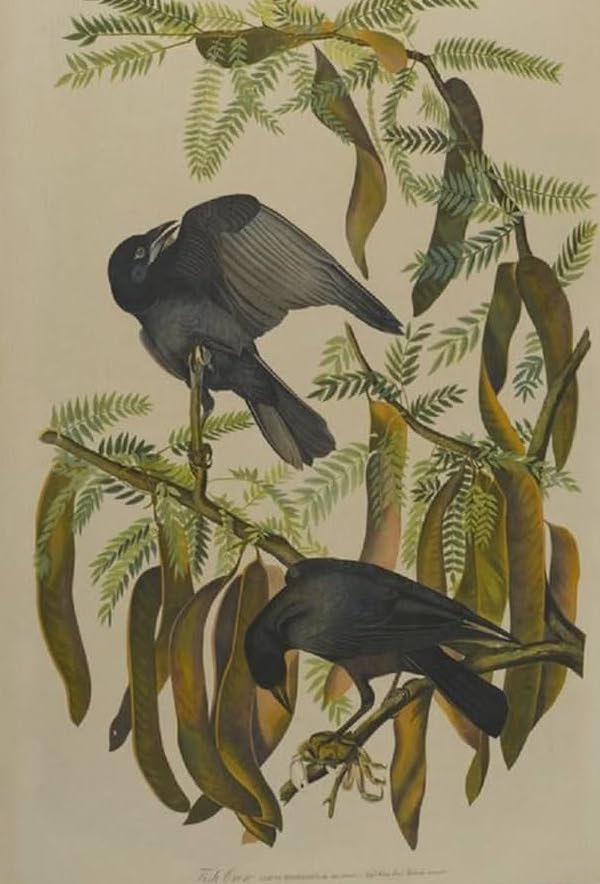
Fish crows painted by John James Audubon.

Sharp-eared birders may be detecting some unfamiliar crow calls in downtown Erwin during strolls around town.

While the caws of American crows are rather harsh and raucous to the ear, the smaller and related fish crow has a caw with a higher, more nasal tone that is just different enough to stand out.

Fish crows have been expanding their presence in the region for several years, joining some other newcomers such as common mergansers and Eurasian collared doves.

The fish crow is a native species of the southeastern United States that has been pushing its range farther north and west.

I first got to know fish crows on visits to coastal South Carolina starting in the 1990s. These small crows can be quite abundant along the coastline of the Palmetto State.

It’s only been in the last six years that I’ve added fish crow to my list of birds observed in my home state.

I began to hear fish crows around the campus of East Tennessee State University in Johnson City during daily strolls while teaching in the literature and language department at ETSU back in late fall of 2018.

For months before that sighting, I’d begun to notice postings about the presence of fish crows on the campus of the Mountain Home Veterans Administration adjacent to the ETSU campus. I’d heard about the fish crows from some of my birding friends, too. I had not stirred myself to look for these slightly smaller relatives of the American crow. So, when I heard a familiar “caw” that was a bit too nasal for an American crow, I stopped for a closer look.

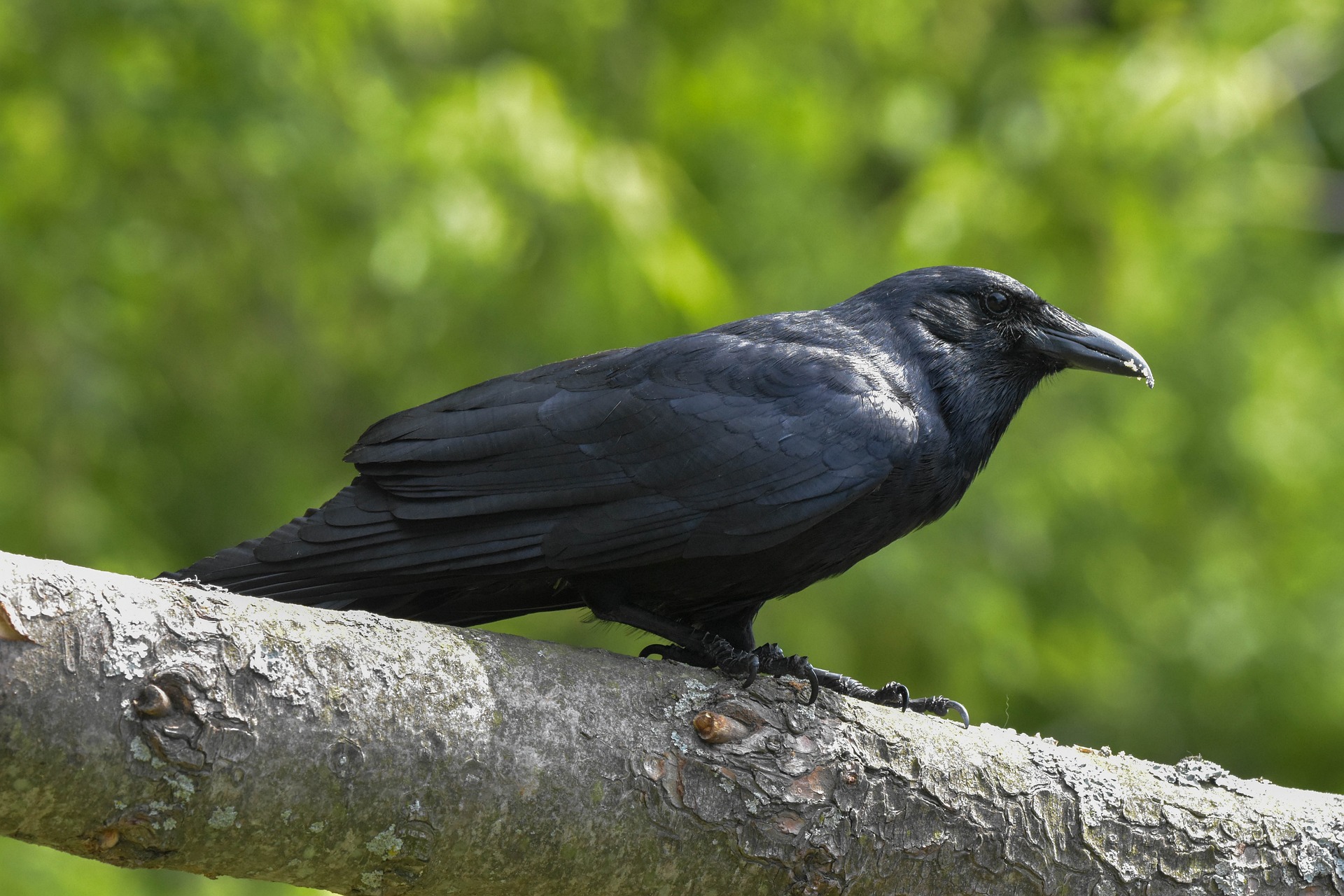
Photo by Pixabay • The American crow, pictured, is larger than the related fish crow and has a more raucous caw.

I heard the vocalizations again and found a couple of fish crows perched atop the parking garage behind the Carnegie Hotel, which is located between ETSU and the VA campus. With some surprise and delight, I realized that the birds were fish crows.

Fast-forward six years. In recent weeks I’ve been hearing fish crows in downtown Erwin on a fairly regular basis. This past week I heard the nasally caw of this crow as I approached the back door of the offices of The Erwin Record. I looked up and spotted a fish crow perched in one of the trees bordering the parking lot. I wonder how long before I get one of these small crows paying a visit to the fish pond at my home.

As I mentioned earlier, I’m familiar with fish crows from trips to coastal South Carolina, where these members of the corvid family are quite common. Fish crows have expanded inland away from coastal areas in recent decades. Fish crows showing up here in Northeast Tennessee originated from that expansion, which likely followed river systems like the Tennessee River.

The easiest way to detect a fish crow’s presence is to keep your ears open. Fish crows make a distinctive vocalization that is quite different from the typical “caw” of an American crow or the harsh croak of a common raven. The website All About Birds describes the call as a “distinctive caw that is short, nasal and quite different-sounding from an American crow.”

The website also makes note of the fact that the call is sometimes doubled-up with an inflection similar to someone saying “uh-uh.”

Although their name suggests a fondness for fish, they’re not finicky about their food and will eat about anything they can swallow. Fish crows are also known for raiding nests to steal the eggs of other birds. They will also dig up sea turtle eggs, which are buried in sand dunes by female turtles.

Fish crows don’t scruple at stealing food from other birds and have been observed harassing birds ranging from gulls to ospreys. Fish crows also harass American crows and, if they are successful, don’t hesitate to skedaddle with any morsel that they’re able to “persuade” their slightly larger relative to surrender.

The fish crow ranges in various coastal and wetland habitats along the eastern seaboard from Rhode Island south to Key West, and west along the northern coastline of the Gulf of Mexico.

It’s been fun to find these birds closer to home in Erwin and Johnson City.

It’s not been easy for crows in recent years. The West Nile virus has been particularly hard on American crows, which seem to have very little immunity to this mosquito-spread disease.

According to the research I’ve conduced, the fish crow, however, is more resistant to the virus, with close to half the birds exposed to the disease able to shake off the effects and fully recover.

According to the website Tennessee Watchable Wildlife, the first recorded sighting of a fish crow in Tennessee took place in 1931. Half a century later, the first nest record was documented in 1980. Both of these records took place in Shelby County.

The oldest known fish crow in the wild reached an age of 14 years 6 months old. Visit tnwatchablewildlife.com for more information about fish crows and other state birds.

Fish crows and other crows around the world are sometimes regarded more darkly than is usual for our fine feathered friends. We invent lore and superstition, mostly inspired by the crow’s dark plumage and some rather unsavory eating habits. Some people even consider crows a bad omen.

I’ve never been concerned personally with keeping crows, or any bird for that matter, at a distance. I always try to stay alert for any surprise these winged creatures bring my way.

Worldwide, there are about 50 species of crows in the Corvus genus. Some other crows include carrion crow, hooded crow, rook, small crow, white-necked crow, Eastern jungle crow, large-billed crow, violet crow and white-billed crow.

Why have fish crows expanded their range in recent decades? The answer is not clear, but it’s good to have them here. I’m glad to welcome them to the Valley Beautiful.

•••

To share a sighting, make a comment or ask a question, email me at ahoodedwarbler@aol.com. 

Red-breasted nuthatch helps couple achieve milestone

Photo by Bryan Stevens • A red-breasted nuthatch clings to the mesh of a feeding tube to get at the peanuts contained within.

Good friends and fellow members of the Elizabethton Bird Club, Brookie and Jean Potter achieved a personal birding milestone at the end of January.

Both Brookie and Jean managed to see 100 birds in the first month of 2024 in the five-county area. Brookie had already accomplished this feat many years ago, but Jean had never been able to do it – until now.

“We did it today on the last day of the month,” she shared in an email.

Brookie ended the month with 101 species of birds, and Jean reached 100.

Their final bird of the month was red-breasted nuthatch. They had to put in some effort to find the species, finally traveling to Carver’s Gap on the state line between North Carolina and Tennessee on Roan Mountain.

“We kept waiting for this bird to come to our feeder, but when it didn’t come, we had to go to Carver’s Gap, which had snow, fog and a temperature of 29 degrees,” she said.

According to Jean, they located two of these little nuthatches close to the parking area.

“The things we do to find birds,” Jean remarked.

If they can find another 100 or more species of birds in the remaining 11 months of 2024, the couple will be eligible for the Howard P. Langridge Award. The Elizabethton Bird Club presents this award to any member who manages to see 200 or more species in a single year in the five-county area. The award commemorates the contributions of the late Langridge to birding in the region. In 2000, Langridge broke the record for most species seen in a single year in Northeast Tennessee. The record was later broken again by Rick Knight.

Photo by Bryan Stevens • A red-breasted nuthatch picks through seeds and peanuts at a feeder.

In our region, the stubby red-breasted nuthatch is another member of a family that often finds its way to our yards. Smaller than the related white-breasted nuthatch and, as far as I can tell, complacent in the company of chickadees and titmice, the red-breasted nuthatch is always a welcome visitor.

This little feeder visitors has a tell-tale “yank yank” call that it produces when excited that sounds very much like a little tin horn. The red-breasted nuthatch, perhaps because it spends so much of the year in more remote areas, can also be amazingly tame when it pays a winter visit.

Both red-breasted and white-breasted nuthatches can be attracted to feeders by offering peanuts, sunflower seeds and suet. They are also cavity-nesting birds, but are more reluctant about accepting a nesting box as a place to rear young. They will gladly accept an old woodpecker hole or other natural cavity in a tree.

The website All About Birds notes that red-breasted nuthatches are common, and their populations have increased throughout most of their range between 1966 and 2019, according to the North American Breeding Bird Survey.

The website also points out that Partners in Flight estimates a global breeding population of 20 million and rates the species a 6 out of 20 on the Continental Concern Score, indicating a species of low conservation concern.

While the red-breasted nuthatch is a small bird, some members of its family aren’t so petite. On the other end of the size scale is the appropriately named giant nuthatch, which reaches a length of almost eight inches. The giant nuthatch ranges through China, Thailand and Burma and is bigger than a downy woodpecker, another of our more common visitors at backyard feeders in our region.

Worldwide, there are about 25 species of nuthatches, some of which have surprisingly descriptive names for birds that spend most of their lives creeping in obscurity along the trunks and branches of trees. Some of the more creative common names for these little birds include beautiful nuthatch, velvet-fronted nuthatch, sulphur-billed nuthatch, chestnut-bellied nuthatch, snowy-browed nuthatch and chestnut-vented nuthatch.

These birds are named “nuthatch” for the habit of some species to wedge a large seed in a crack and hack at it with their strong bills.

In some winters, red-breasted nuthatches can be quite common in the region. That’s not been the case this winter, as shown by the difficulty Brookie and Jean had in locating this bird.

•••

For those interested, there’s a great chance to get outdoors and look for red-breasted nuthatches and other birds. The annual Great Backyard Bird Count will be held Friday, Feb. 16, through Monday, Feb. 19.

It’s easy to take part in this global survey of bird populations all around the planet.

The first step is to choose a location for looking. A favorite park, walking trail or your own back yard will work.

Next, actively watch for birds for 15 minutes or more, at least once over the four days from February 16–19.

You will need to identify all the birds you see or hear within your planned time/location and use the best tool for sharing your bird sightings.

For a beginning bird admirer and those who are new to bird identification, try using the Merlin Bird ID app to pinpoint what birds you are seeing or hearing.

If you have participated in previous GBBCs before and want to record numbers of birds, try the eBird Mobile app or enter your bird list on the eBird website using a desktop/laptop computer.

If you already contribute to Merlin or eBird, continue what you are doing. All entries over the 4-day period count towards GBBC.

For more information on the GBBC, visit http://www.birdcount.org.

•••

To share a sighting, ask a question or make a comment, email me at ahoodedwarbler@aol.com.


Pileated woodpecker never fails to make spectacular first impression

Photo by Jason Gillman from Pixabay • The pileated woodpecker is the largest woodpecker in the region, reaching a length of about 19 inches. By comparison, the region’s smallest, the downy woodpecker, is only about 7 inches long.

The ivory-billed woodpecker barely escaped a declaration of extinction in 2023. Whether this woodpecker, the largest in North America, is still alive is a matter for debate, but a slightly smaller relative remains an abundant and rather visible bird.

Over the years, many readers have emailed me about their encounters with pileated woodpeckers, which can be impressive and even startling when a sighting is unexpected.

The pileated woodpecker has actually had an abundance of common names associated with it. English naturalist Mark Catesby, who died in 1749, gave this large bird the name of “large red-crested woodpecker.” The Swedish botanist Carl Linnaeus apparently gave the woodpecker the scientific name of Dryocopus pileatus.

Another English naturalist, John Latham, apparently gave the bird the common name of pileated woodpecker, basing the name on the scientific name established by Linnaeus. Beyond this history of how the bird eventually got the name pileated woodpecker, there are a lot of folk names for this particular bird, including such interesting ones as “king of the woods” and “stump breaker.”

The loud vocalization of this woodpecker has also inspired names such as “wood hen.” Other names along these lines include “Indian hen” and “laughing woodpecker.” If anyone knows of other common names for the pileated woodpecker, I’d enjoy hearing about them.

Depending on whether you believe that the ivory-billed woodpecker still exists somewhere in Cuba, Arkansas or some other remote pocket of its former range, the pileated woodpecker is the largest of North America’s woodpeckers.

Pileated woodpeckers are cavity-nesting birds, and they use their large, stout bills to efficiently excavate their own nesting cavities in dead or dying trees. These cavities can be used in later nesting seasons by other cavity-nesting birds, such as Eastern screech-owls and wood ducks, that are incapable of excavating their own nesting cavities.

Photo by Bryan Stevens • A pileated woodpecker perches on a branch of a walnut tree.

Male pileated woodpecker show a red whisker stripe on the side of the face that is absent in the female. Otherwise, they look similar.

These large woodpeckers — they can reach a length of about 19 inches — often forage close to the ground on old stumps or fallen logs.

The pileated woodpecker is widespread in the United States and Canada, favoring wooded areas in both countries. This woodpecker has proven adaptable, now thriving even in suburban areas offering sufficient woodland habitat.

•••

I wrote last week about the limpkin in Hampton. Over the Christmas holiday, I managed to observe this remarkable bird. My mom and I both watched the bird while it foraged for food in a yard at a trailer park. Usually not found beyond Florida, this winter visitor has created quite a sensation in the local birding community. Getting to observe this unusual visitor made our holidays a bit brighter.

•••

Share a sighting, ask a question or make a comment by emailing me at ahoodedwarbler@aol.com.

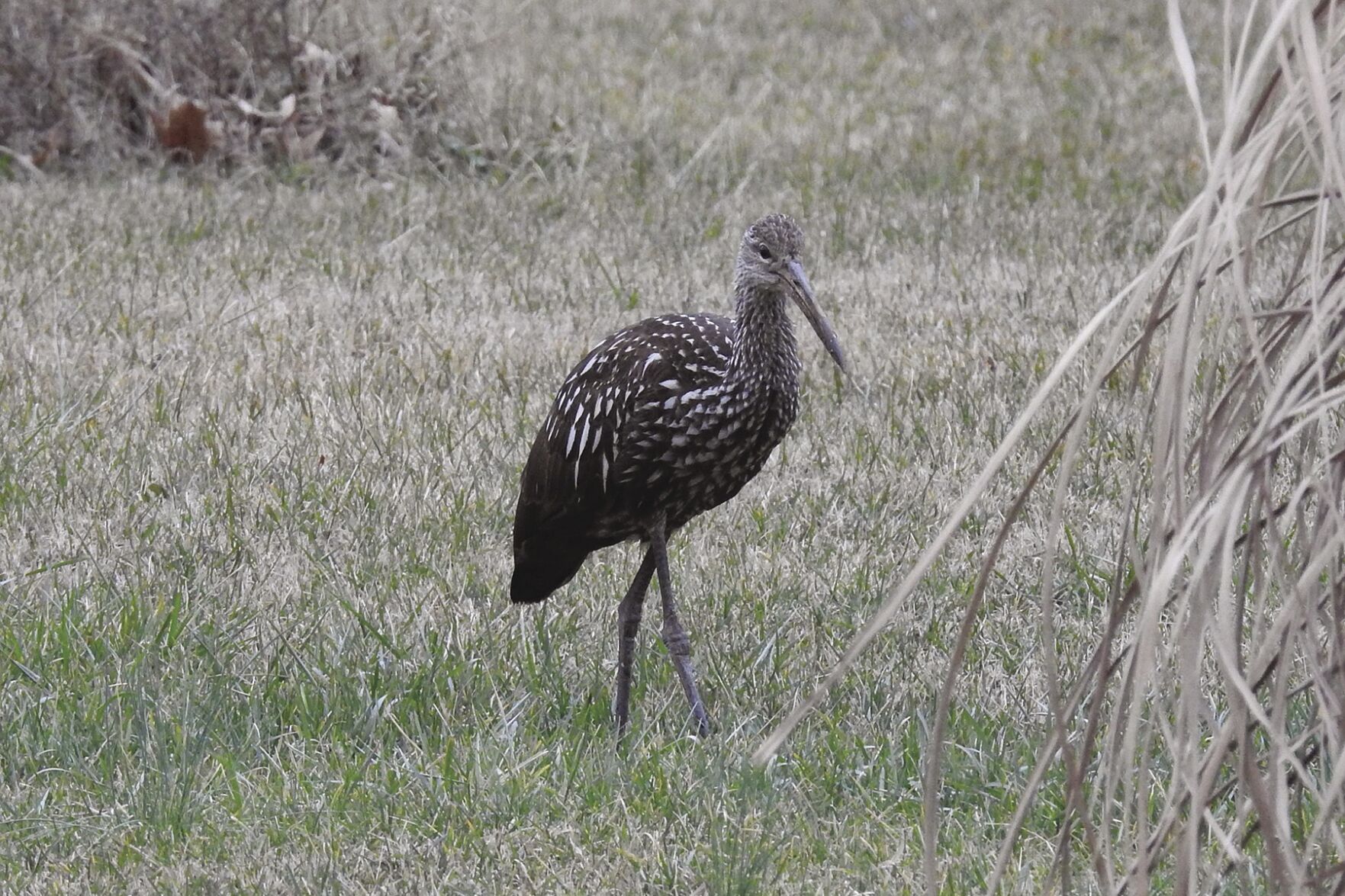
Photo by Bryan Stevens • A limpkin roams in a yard at the River’s Edge trailer park in Hampton, Tennessee, on Christmas Eve 2023.

Limpkin discovery in December caps off the year in birding

Photo courtesy of Tom and Cathy McNeil • A limpkin in Hampton, Tennessee, stunned the local birding community with its appearance in a most unlikely location.

At the end of the year, it’s a good time to look back. All years deliver some surprises when it comes to bird sightings, but 2023 seemed to truly produce some unusual and totally unexpected sightings for birders in Northeast Tennessee and beyond.

In the waning days of December, one of the biggest local bird surprises of the year took place in Hampton in Carter County when the birding community got word of a limpkin hanging out on the Doe River behind a trailer park. The bird, which usually ranges no farther north than Florida, is not exactly one that would be expected in Northeast Tennessee in the final days before Christmas.


Tom McNeil, a fellow birder, posted the news on his Facebook page.

“A big thanks to my brother, Ed McNeil, for alerting the Hampton community to keep an eye out for this limpkin that has been sneaking around since probably October,” Tom wrote.

Regular readers of this column will recall that Tom and his wife, Cathy, have seen several unusual birds this year, including storm-driven American flamingos in Tennessee and North Carolina, as well as an ancient murrelet at Chickamauga Dam near Chattanooga. Then, just as the year’s winding down, up pops a limpkin practically in their back yard.

According to Tom’s post, David Vines first reported the limpkin in November, but it has remained quite elusive.  However, Ashley Taylor spotted the bird on Dec. 17 and let Tom’s brother know that she saw it at the Rivers Edge community.

“I texted Brookie and Jean Potter,” Tom wrote. “They were on it in no time. Cathy and I rushed down and added it to our Carter County life list.”

Tom credited some awesome networking in the birding community and beyond in bringing the limpkin’s presence to light.

Photo by Bryan Stevens • A limpkin wanders near a canal in Orlando, Fla., in October-November of 2007.

The limpkin, known by the scientific Aramus guarauna, is also called carrao, courlan and crying bird. It’s a large wading bird related to rails and cranes, and the only species in the family Aramidae. Limpkins are found mostly in wetlands in warm parts of the Americas, from Florida to northern Argentina, but has been spotted as far north as Wisconsin.

These birds feed on mollusks, with the diet dominated by apple snails. Its name derives from its “limping” gait when it walks.

I’ve seen and heard limpkins on numerous occasions during visits to Florida. They are unique birds and can become so acclimated to humans that I have observed several limpkins at some of the busy Disney theme parks near Orlando, Florida.

Photo by Bryan Stevens • The limpkin remained present in the River’s Edge trailer park in Hampton on Christmas Eve, 2023. The bird has been spotted in different locations around the small town of Hampton since October.

My mom and I got to see the visiting limpkin on Christmas Eve. On a whim, we drove through the trailer park that had been the location for previous sightings. We drove all the way to the end of the road and were headed back out when we found the bird busy feeding in a yard of one of the trailers.

Why this bird is haunting the Doe River in Carter County, apparently for the past couple of months, is a bit of a mystery. It’s not likely to find apple snails in the Doe, but there are probably crayfish, small fish and plenty of aquatic invertebrates that will keep a limpkin nourished. The recent dip in temperatures hasn’t seemed to affect the bird, although it would not often be exposed to such cold in its usual range.

It’s like I’ve indicated many times in this column. Birds have wings, and they know how to use them. They can show up in some of the most unlikely places. Keep your eyes open and you may be surprised by what you find. Best wishes to all the readers of this column. I hope everyone sees plenty of good birds in 2024.

•••

To share a sighting, make a comment or ask a question, email ahoodedwarbler@aol.com.


What’s in a name? Many American birds will get renamed by AOS

Photo by Veronika Andrews from Pixabay • Anna’s hummingbird, a species of hummingbird native to the coastal regions of western North America, is named after a 19th-century duchess. The bird, as well as almost 80 other species, will be renamed by the American Ornithological Society in the future.

What’s in a name? To paraphrase the Bard, a bird’s tweet would still sound as sweet, regardless of the name of the bird.

That theory’s about to get tested. The American Ornithological Society has decided to rename about 80 species of birds named for people. The birds, which can be found in the United States and Canada, range from songbirds to shorebirds, as well as woodpeckers and jays.

The best I can determine after some research is that the new names for some of our birds will be based on appearance or habitat preferences. I’d be more optimistic if it wasn’t the AOS that gave us the boring name of Eastern towhee and took away the accurate and descriptive name of rufous-sided towhee for a familiar backyard bird.

The towhee was renamed in 1995. Some of my birding friends have long memories, because I still hear people refer to this bird as “rufous-sided towhee.”

Photo by Bryan Stevens • A male Eastern towhee forages in the grass beneath a feeder.

I’m sure I will miss some of the former names. I’ll be waiting to see what name is given to Anna’s hummingbird, a species named for Anna Masséna, Duchess of Rivoli. As far as I can determine, the duchess had no particular strikes against her character. A French princess, the duchess was married to amateur ornithologist Prince Victor Masséna, the owner of an impressive collection of bird specimens.

Even royalty needs its hobbies, and birding’s certainly a worthy pursuit in my eyes. I do think the trivia associated with birds named for people can make interesting reading. For example, the duchess served as the Mistress of Robes for the Empress Eugénie, wife of Napoleon III.

Be careful what you find when doing online research. I found one article claiming that the duchess met John James Audubon, the famous American naturalist and painter, in Paris in 1882.

If true, it would have been quite the feat as Audubon died in 1857 in New York.

Then there’s Nuttall’s woodpecker. As explained on the website All About Birds, William Gambel named the small black-and-white woodpecker after Thomas Nuttall, an English botanist and ornithologist, back in 1843.

Photo by Bryan Stevens • The Wilson’s snipe is one of many birds likely to be renamed in the near future.

Nuttall was perhaps better known as a botanist, according to All About Birds, but he also published an early field guide on birds titled “A Manual of the Ornithology of the United States and Canada.”

All About Birds also notes that Nuttall’s book and his passion for nature also inspired the formation of the first organization in North America dedicated to birds in 1873, the Nuttall Ornithological Club.

It seems a shame to me to remove the woodpecker’s name when it honors such a relevant figure in the early history of birding.

Even birds — Clark’s nutcracker and Lewis’s woodpecker — named for the famed Meriwether Lewis and William Clark of the historic Lewis and Clark Expedition will likely lose their long-standing names.

Gambel’s quail also faces renaming. This small desert quail is named for William Gambel, an American naturalist, ornithologist and botanist from Philadelphia. As a young man Gambel worked closely with the renowned naturalist Thomas Nuttall, basically becoming an apprentice to the older man.

Photo by AZArtist from Pixabay • Gambel’s quail is named after William Gambel, an American naturalist, ornithologist and botanist from Philadelphia.

At the age of 18, Gambel traveled to California, becoming the first botanist to collect specimens in Santa Fe, New Mexico, as well as many parts of California. In late 1838, Gambel and Nuttall traveled together on a collecting trip to the Carolinas and the southern Appalachians.

Gambel accomplished a lot in his short lifespan. He tried unsuccessfully to establish a medial practice in Philadelphia and decided, like many Americans, to head west. Shortly after reaching California, he tried to help miners afflicted with typhoid at a camp along the Yuba River. He became sick himself and died Dec. 13, 1849, at age 26.

Animals named in the young man’s honor include Gambel’s quail and Gambelia, a genus of lizards. Also in 1848, a genus of flowering plants, Gambelia, native to California and Mexico, was named after him.

I feel that Shakespeare had it right. The names may change, but the stories of the birds and their namesakes will still be there for anyone who wants to do a little digging.

Some of the stories you might uncover make for interesting reading.

•••

Email Bryan Stevens at ahoodedwarbler@aol.com to share a bird sighting, ask a question or make a comment.

Couple shares story about nesting mourning doves

Contributed Photo by Tim Barto • One of the mourning doves nesting atop a porch column at the home of Star and Tim Barton in Telford arrives with a sprig of nesting material held in its beak. Tim’s photo of the dove even impressed the editors at “Smoky Mountain Living.” The magazine published the photo earlier this year.

Star Barto, a resident of Telford in Washington County, contacted me after reading my column on the Eastern phoebes nesting on my  front porch. Incidentally, the phoebes have now successfully fledged their young.

Star began her email by sharing that she and her husband, Tim, have been blessed with mourning doves building their nests on the top of one of their porch columns.  

“This is our fifth year with a ring side seat,” Star wrote. “They usually have two nestings per season that produce two babies each time.”

This year, the birds changed things up and the Bartos are celebrating  a third nest — atop the same porch column.  

“We call it our special version of an Airbnb,” she noted.

At first, the doves would fly each time Star or Tim opened the front door, but the birds gradually grew accustomed to their human landlords.  

Star wrote that their nest is in such a ideal location — safe, dry, under cover, high up — that the doves return year after year and do not doubt the safety of their habitat.  

“We turn off the porch light, of course, and work hard at minimizing disruption,” she wrote.  

“And they thrive,” Star added. “It is beyond thrilling to be able to see so up close and personal the magic of Mother Nature.”

The mourning dove is a common backyard bird across the country. It’s also considered a game bird.

According to the website, All About Birds, the mourning dove is the most widespread and abundant game bird in North America. According to the website, hunters harvest more than 20 million of these birds every year, but the mourning dove remains one of the most abundant birds with a U.S. population estimated at 350 million. The mourning dove also ranges into Canada and Mexico. 

Photo by Bryan Stevens • A mourning dove stretches a wing while perched on a feeder.

The mourning dove gets its name from its mournful cooing, which has been likened to a lament. Birds are more vocal during the nesting season. 

Former common names for this dove include Carolina pigeon, rain dove and turtle dove. The mourning dove is a member of the dove family, Columbidae, which includes 344 different species worldwide.

From the standpoint of a scientist, there’s no real difference between doves and pigeons. In general, smaller members of the family are known as doves and the larger ones are classified as pigeons, but that’s not a firm rule.

Some of the more descriptively named doves and pigeons include blue-eyed ground dove, purplish-backed quail dove, ochre-bellied dove, red-billed pigeon, emerald-spotted wood dove, pink-necked green pigeon, sombre pigeon, topknot pigeon, white-bellied imperial pigeon, cinnamon ground dove, pheasant pigeon, crested cuckoo-dove and crowned pigeon.

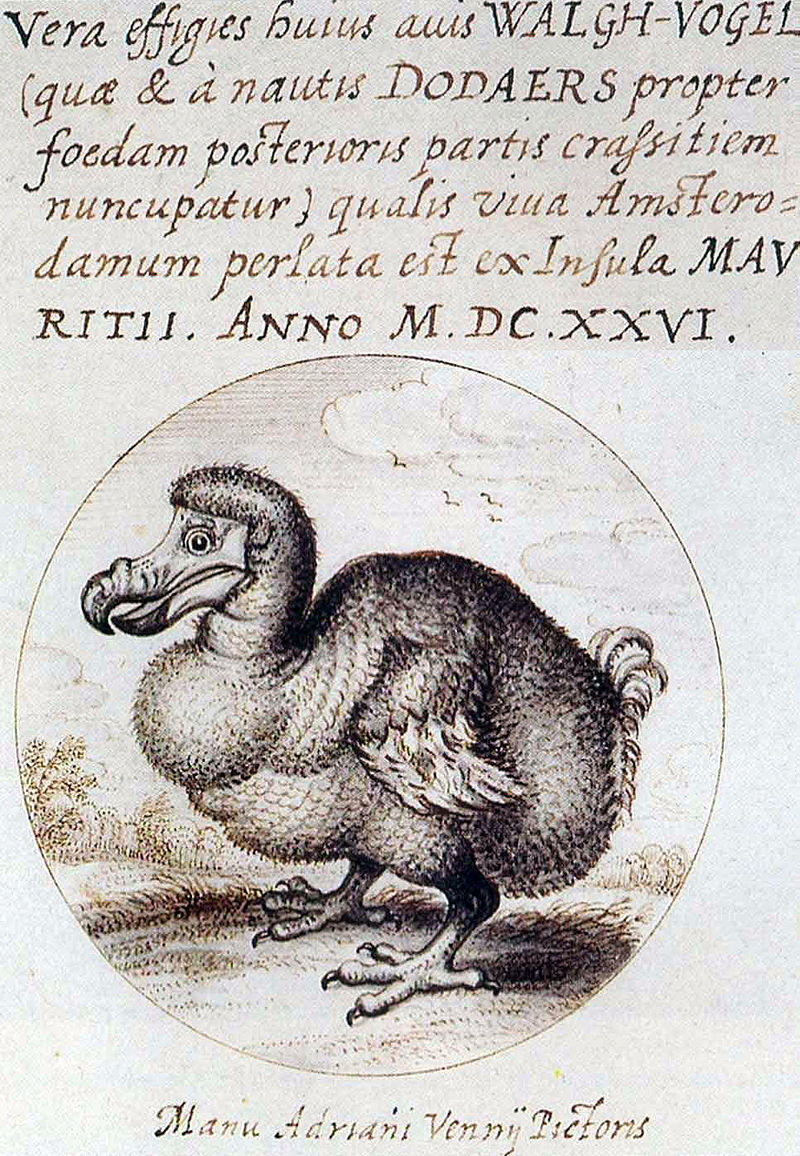
An early illustration of the dodo.

Arguably the most famous dove is the extinct dodo, a bird renowned as being  almost too stupid to live. The dodo almost certainly doesn’t deserve its reputation as a “bird brain.” The reason for the bird’s swift extinction after encountering humans can be explained by the fact that this large, flightless dove evolved on the island of Mauritius in the Indian Ocean. Largely defenseless, the dodo’s fate was sealed from the moment this bird was confronted with new arrivals — humans and affiliated animals such as rats, pigs and cats — at its home.  The results of these first encounters were catastrophic for the species.

The first mention of the three-foot-tall dodo in the historic record occurred in 1598 when Dutch sailors reached Mauritius. By 1662, the bird vanishes from the historic record. The bird disappeared so swiftly that for some time after it was often considered a mythical creature.

Other native doves in the United States include common ground-dove, Inca dove, white-winged dove and Key West quail-dove. The Eurasian collared-dove is an introduced species that has spread rapidly across the country and occurs in Northeast Tennessee. 

Doves are unusual among birds in feeding young a type of milk. Known as “crop milk,” both parents feed young in the nest with this substance produced in the crop, which is simply an enlargement of the bird’s esophagus. The crop is usually used for storage of surplus food, which is usually seeds. 

Young doves are known as squabs, and the crop milk they are fed early in life is rich in antioxidants, fats and proteins, allowing them to thrive and grow quickly. 

To share a sighting, make a comment or ask a question, please email me at ahoodedwarbler@aol.com. 

Common raven is no bird brain

Photo by Alexas-Fotos/Pixabay • Common ravens, although native to the region, were not so common only a few decades ago. This much larger relative of the American crow is slowly becoming more commonplace in the area once again.

Since back in November, a common raven has been lurking in the woodlands around my home. I even hear the raven’s loud croaking when I’m inside the house. The local American crows have not rolled out a warm welcome for the interloping raven, but there seems to be an uneasy truce between the crows and the much larger raven.

Ravens are vocal birds. I got reminded of the many unusual vocalizations a raven’s capable of when the resident bird flew over, croaking loudly, on a recent brisk and sunny late afternoon. Between the croaks, the raven produced an uncanny imitation of a tinkling bell. The bird produced this bell sound several times before flying out of sight.

I’m not pulling any legs. Among their vocal repertoire, ravens can produce, usually in flight, a “bell” call. I’m not sure if this is a common vocalization. I only remember ever hearing a raven’s “bell” on only one other occasion. I was with a group of more established birders at Roan Mountain State Park when a raven flew overhead. Someone called out, “Listen to that.” I listened and heard my first raven “bell” call.

The strange thing is that I can find little about this strange vocalization when I researched the subject. According to the website “All About Birds,” common ravens calls vary from a low, gurgling croak to harsh grating sounds and shrill alarm calls. Scientists have placed their vocalizations into as many as 33 different categories based on sound and context. The most commonly heard is the classic gurgling croak, rising in pitch and seeming to come from the back of the throat.

The croak is their standby vocalization, which they produce often. The raven’s croak can be heard from a mile away. And, in defense of the poet Edgar Allan Poe and his “ominous bird of yore,” ravens are accomplished mimics. According to “All About Birds,” ravens can imitate other birds. Raven raised in captivity can even learn words. “Nevermore?”

From the opening refrain of “once upon a midnight dreary” in his poem, “The Raven,” Edgar Allan Poe established a somber mood and also helped cement the dark reputation of one of North America’s most misunderstood birds. Poe describes the bird that provides the title of his famous poem with adjectives such as “grim, ungainly, ghastly, gaunt and ominous.” His raven also speaks, although it has the limited vocabulary of a single word, “Nevermore.”

How else does the real common raven resemble the “bird of yore” in Poe’s classic poem? For starters, the raven is an intelligent bird. Authors of a scientific study conducted about 15 years ago posited the claim that ravens and crows are just as intelligent as some of the great apes. Although parrots are more famous for the ability to mimic human speech, captive ravens have proven capable of learning more words than even the most impressive vocabulary-endowed parrots. So, Poe was not wide of the mark when he gave the gift of gab to the raven in his poem.

In the United States, the raven is quite common in Alaska. In the lower 48 states, raven populations are somewhat more sporadic. These large birds have established strongholds along the Appalachian Mountains and in the American Southwest. The raven is a cosmopolitan bird known to range from North America and Greenland to Europe and Asia, as well as North Africa and the Canary Islands.

The common raven is mainly a scavenger, but this bird is also an opportunistic predator and will prey on a wide variety of animals, including arthropods, amphibians, small mammals, birds, reptiles, and carrion. Ravens are attracted to carrion and are not finicky eaters. They adapt quickly and are known to even consume garbage.

Its black plumage has undoubtedly contributed to the raven’s sinister reputation and its affiliation with many dark superstitions. According to Laura C. Martin’s book, “The Folklore of Birds,” notes that the raven is “loathed throughout Europe as a symbol of impending death and war.” She explains that the raven probably acquired these connotations because these birds fed on battlefield corpses. As indicated earlier, the raven is not a picky eater. Martin also points out that legend maintains that England will remain a powerful nation as long as ravens live in the infamous Tower of London.

Establishing the raven’s closest relatives is helpful in fully becoming acquainted with this species. The raven is a member of the corvid family, which includes birds such as crows, magpies, nutcrackers and jackdaws. The common raven is the largest bird among the corvids. This bird can achieve a wingspan of almost four feet. The average raven weighs about two-and-a-half pounds. Large individuals have been recorded with a weight of slightly more than four pounds, making the raven a contender for the title of world’s largest songbird.

Poe’s poem offers a dramatic introduction to a bird that has once again become rather common in the region, particularly at higher elevations. This bird is well-known for nesting on inaccessible cliffs. However, ravens are proving adaptable. In recent years, a pair of ravens has repeatedly nested beneath the grandstands at Bristol Motor Speedway. Ravens have nested annually at this location at least since the spring of 2013.

Poe’s well-known poem, first published in 1845, is often cited as evidence for Poe’s genius for rhyme and his ability to create a believable supernatural universe populated by dark forces and one particularly persistent raven. It’s more than a little sad and ironic that the magazine that chose to publish Poe’s poem paid him a mere pittance of $9 for his brilliant contribution to literature.

The Bible also offers some interesting tales involving ravens. The prophet Elijah, after falling afoul of a wicked king, went into hiding and was provided food by cooperative ravens. In the story of the Biblical flood, Noah first released a raven to determine if the waters had receded. When the raven didn’t return to the ark, Noah next released a dove. This bird later returned to the ark clutching an olive leaf, which proved that the flood waters had subsided.

Many cultures also consider the raven as a “bringer of magic,” and the bird is associated with many creation stories in Native American cultures. Unlike the European custom of designating black as an “evil” color, Native Americans teach that black can hold various meanings, including resting, healing and prophetic dreaming, but evil is not one of them.

Ravens and crows are similar, but ravens are much larger birds. In addition, ravens have wedge-shaped tails and crows have fan-shaped tails. The common raven also has a well-developed ruff of feathers on the throat, commonly called its “hackles.”

A “murder of crows” is a fairly well known collective noun for a flock of these birds. On the other hand, a group of ravens has many collective nouns, including a “bazaar,” “constable” and “rant” of ravens. For its alliteration, I’m fond of “a rant of ravens” and think it’s a shame that Poe’s raven was apparently a solitary bird.

Other species of ravens found around the world include dwarf raven, thick-billed raven, fan-tailed raven, brown-necked raven, little raven and forest raven.

I like ravens. I find them fascinating, but there’s still something that causes some shivers when one hears the guttural, loud croak of a raven. It remains difficult to completely dismiss the raven’s long history of association with the darker niches of the world.

On that note, here’s one final tidbit regarding the raven taken from Martin’s book. Cherokee tribes believed that ravens would visit villages where ill or dying people were present. In the absence of a village shaman to drive away the bird, the raven would invariably snatch the life of the ailing individual.

••••••

To learn more about birds and other topics from the natural world, friend Bryan Stevens on Facebook at https://www.facebook.com/ahoodedwarbler. He is always posting about local birds, wildlife, flowers, insects and much more. If you have a question, wish to make a comment or share a sighting, email ahoodedwarbler@aol.com.
Sales of local calendar fund bird-worthy aims


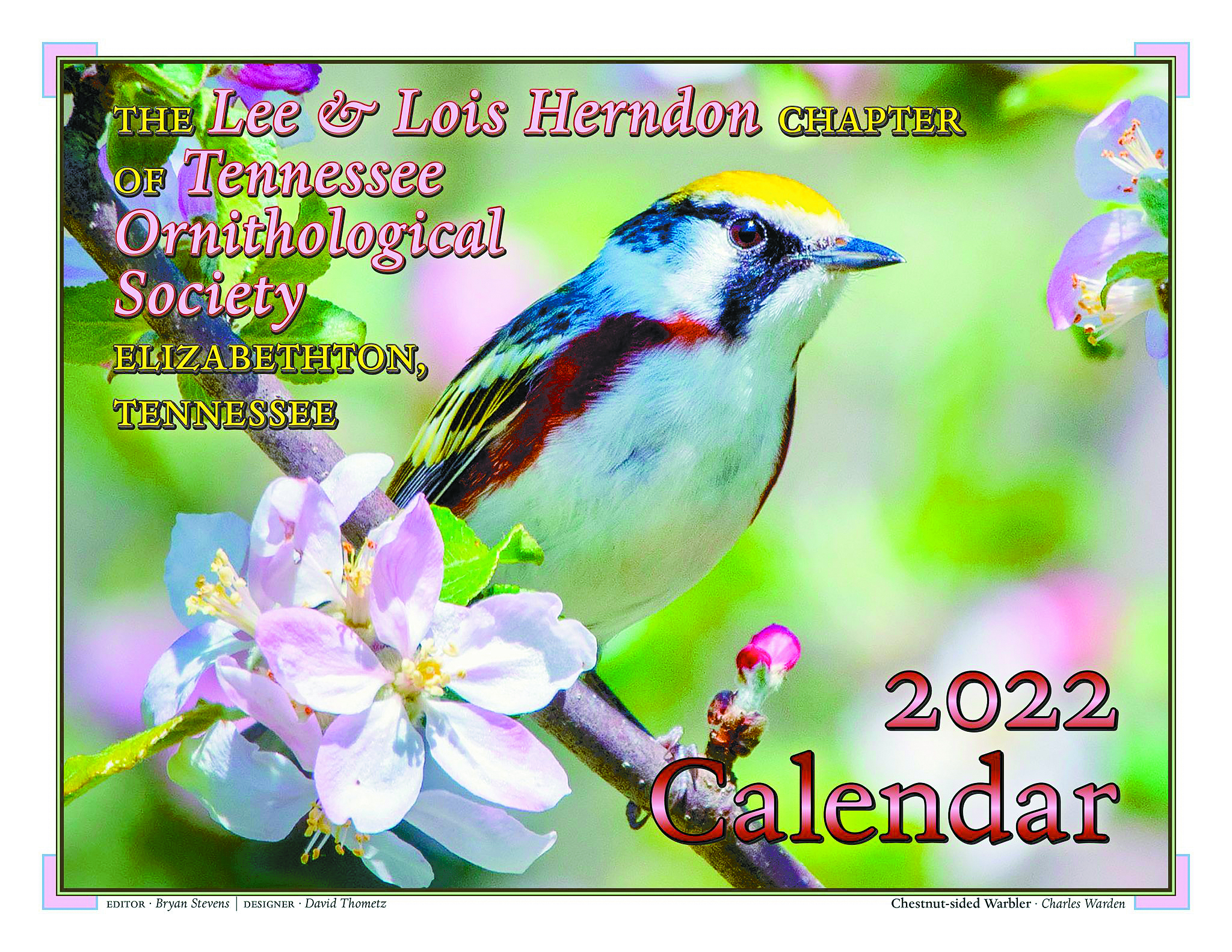
The front cover of the 2022 bird calendar produced by the Elizabethton Bird Club features a photo of a chestnut-sided warbler taken by club member Charles Warden. The calendar is available for purchase for $15, plus $2 for shipping and handling. They make great Christmas gifts for nature and bird enthusiasts. For more information, email ahoodedwarbler@aol.com. 
If you didn’t find all you needed on Black Friday for those on your shopping list, here’s a suggestion. The Lee and Lois Herndon Chapter of Tennessee Ornithological Society, also known as the Elizabethton Bird Club, has produced its annual calendar featuring bird photographs by its members and friends of the organization.

These calendars make wonderful Christmas gifts and stocking stuffers. This year’s front cover features a gorgeous photo of a chestnut-sided warbler taken by club member Charles Warden. This is Warden’s first year contributing photographs to the club’s yearly calendar project. More of his photos are on display through the calendar. He is a resident of Johnson City.

“I took the photo on the Spring Bird Count with Fred Alsop and Judi Sawyer on May 1 of this year at Hampton Creek Cove,” Warden said.

He said that the bird was among the blooms of what he thinks was an apple tree.

“We heard the warbler and chased it down,” he said. “It came out in the open and posed nicely for pictures.”

He has been interested in photography since he took a beginning photography class at East Tennessee State University on a lark in 1977.

“I am lucky enough to be making a living as a photographer for ETSU marketing.”

Bird photography is certainly a challenge, he said, and requires much patience, decent equipment and a lot of luck.

“It’s been a learning curve for sure, and it’s still a tough call when to take the binoculars down and put the camera up as it’s so mesmerizing to watch the birds,” Warden said.

The chestnut-sided warbler is a summer resident in the region and can be found at middle and higher elevations on many of the area’s mountains, including Unaka and Roan. Unlike many warblers, both males and females are brightly colored, with the female being slightly less so. Males during the summer nesting season show a yellow crown, black mask, white cheeks, throat and breast and the namesake chestnut flanking on his sides.

He’s also a cheery and persistent singer when he arrives on his nesting territory. His song is usually transcribed as “Pleased, pleased, pleased to meetcha!” For birders, it’s like a welcoming reintroduction each spring when this particular song is heard from the branches of trees in local woodlands.

For the singing male, there’s a more personal reason for singing his song. The “pleased, pleased, pleased to meetcha” refrain is a way of attracting the attention of potential mates. Males sing an entirely different song once settled into nesting activities with a mate. The song used to attract mates is more heavily accented, according to the website, All About Birds. Some males sing only unaccented songs and thus have a lower success rate at attracting mates.

Chestnut-sided warblers are classified by scientists as birds that favor successional habitats for nesting purposes. These sorts of habitats are usually disturbed by human activities such as logging. However, disturbed habitats can be created by natural occurrences, including fires, flooding and storm damage. During the winter months, this warbler withdraws into Central America with many individuals finding suitable habitat on shade-coffee plantations.

Female chestnut-sided warblers will weave a nest of bark, grass and other components all bound together with gathered spider silk. She will lay three to five eggs. These warblers make the most of the summer season, often nesting a second time after raising their first brood.

Chestnut-sided warblers feed largely on insects, but the birds also incorporate seeds and fruits into their diet. Young are fed by both parents on a diet of small insects, spiders and caterpillars. The chestnut-sided warbler’s scientific name, Setophaga pensylvanica, roughly translates as “eater of moths from Pennsylvania,” which is a nod to the bird’s insect-rich diet.

Other warblers that can be found in the mountains of Northeast Tennessee — and in the pages of the calendar — include black-throated blue warbler, golden-winged warbler, worm-eating warbler, hooded warbler, prairie warbler and common yellowthroat.

Like most small songbirds, the New World warblers, to which the chestnut-sided warbler belongs, don’t have long lifespans. A few individuals, however, defy the odds. According to the website, All About Birds, the longest-lived chestnut-sided warbler documented by scientists was a nearly seven-year-old bird banded in Rhode Island in 1980. The bird had been banded in the same state six years and 11 months earlier in 1973.

Of course, with the exception of the yellow-rumped warbler, most of the warblers don’t spend the winter months in the region. With one of these calendars, however, you can enjoy beautiful photos of some of our most lovely warblers while awaiting their return this spring in mid-April and early May.

The inside pages of the professionally-produced calendar feature dozens more full-color photographs and an informative and educational grid. These calendars sell for $15 plus $2 for shipping. All sales help the club fund birding programs, public park feeders, conservation efforts and other activities in upper Northeast Tennessee.

For more information on how to obtain a calendar, email me at ahoodedwarbler@aol.com.
 

Bird of mystery, black rail famed for eluding birders

Photo by AGAMA/Adobe Stock • Adult male black rail (Laterallus jamaicensis) standing in a swamp during the night in Brazoria County, Texas. The black rail is a  secretive, rarely seen bird of wetlands and marshes. Much smaller than other members of the rail family, the bird doesn’t offer even determined birders any easy observations.

On Wednesday morning, Oct. 13, I fetched my mom’s newspaper before heading to work. Scanning the front page headlines while walking back from the mailbox, I missed a tiny bird.

The bird flushed into a panicked flight at the last possible second from right under my feet. At a glance, I knew at once that I’d seen something incredibly different. I can only describe the bird as a black, somewhat pear-shaped bird, perhaps a little larger than a typical sparrow, with a less than elegant flight that took it a couple of feet into a stand of cattails and other wet-loving vegetation.

Then, just like that, the bird was gone. After that brief encounter, which may have lasted at best a second or two, the bird vanished. With sparrows or warblers, an observer can squeak some notes to persuade a curious bird to come back into sight. I tried and got no response.

Of course, I didn’t think I’d seen a warbler or a sparrow. In an instant, perhaps one of the most significant bird sightings I’ve ever had at my home was concluded but hardly resolved.

I remained standing, staring, trying to determine what I’d just seen. I had an idea, but it was almost too unexpected and too unsupported to entertain. I won’t be adding it to my life list of birds seen, but I am fairly confident that I saw a black rail, one of the tiniest representatives in a family of birds that also include sora rail, Virginia rail, clapper rail and king rail.

When I describe the bird as tiny, it’s not an exaggeration. Adults are bigger than most sparrows but smaller than an American robin. They are gray-black birds speckled with white on the back. They have a black crown and chestnut patch evident on the back of the neck. The bill is black.The legs range from pink to wine-colored. The most striking feature of this bird, if observed under favorable conditions, is its bright red eyes.

Many birders have probably enjoyed a flight of fancy while imagining a beady pair of red eyes staring back at them from dense marsh vegetation. The black rail is so difficult to observe that it has become a sort of feathered “holy grail” for birders. I was certainly not expecting the possibility of my path crossing with this tiny wanderer.

The black rail has not been extensively studied by scientists, which means much about this elusive bird of marshes and wetland is poorly understood. There are different reasons behind the mysteries surrounding the bird.

For instance, although it does vocalize, black rails call mostly after dark. Not many people go wandering through marshes at night, so black rails largely go unheard.

In addition, when these small birds perceive a threat, they prefer running through dense vegetation instead of taking flight. Some black rails in northern areas are migratory, so these birds are capable of sustained flight. They simply don’t like to fly unless circumstances dictate flight upon them. They’d prefer to scurry through wetland, much like a small rodent. They are even known to take advantage of trails blazoned through marshes by mice and other small rodents.

A few aspects of my observation work in favor of the bird being a black rail. I’ve seen other rails — sora, Virginia rail and clapper rail — on multiple occasions. Virginia rail and clapper rail can be ruled out. They’re too large and too different in appearance to be mistaken for a black rail. The sora bears a certain similarity to a black rail, but it is mostly brown and gray with a yellow bill. It’s also larger than a black rail.

Once the black rail’s close kin are eliminated, there aren’t any other likely suspects that might be confused with it. It’s frustrating. I will likely always refer to this sighing as “the bird that looked a lot like a black rail.” My hesitation stems partly from the simple fact that so many birders are unable to ever get a look at this bird. Why should I have had better luck, even if only for a split second?

Incidentally, two of my best rail sighings have taken place in Erwin.

Back in 2000, I observed a Virginia rail stepping delicately and deliberately though some cattails and other vegetation on the fringes of the wetland area adjacent to the large pond at Erwin Fishery Park. I watched the bird move carefully and deliberately through the vegetation. It was only for a moment or two, but it was of longer duration than my recent “blink-and-you-missed-it” observation of the black rail in my driveway.

My best observation of a sora took place in the spring a few years ago during a visit to the boardwalk over the wetlands near the industrial park in Erwin. The boardwalk is part of the extended linear trail in town. I was birding that day with Margaret Roy, the former manager of Mountain Inn & Suites of Erwin.

Margaret wanted to learn more about birds, and we really got lucky when we found such an uncommon bird only minutes after we stepped onto the boardwalk. It was as simple as looking down on the mudflats and noticing an odd, plump bird walking without concern beneath us. From our elevated viewing platform, we got excellent looks through binoculars and I took some photos.

Early naturalists, even without benefit of binoculars, were aware of the black rail. John James Audubon, the famous painter and naturalist, painted a black rail and its chick. Audubon referred to the elusive denizen of wetlands depicted in his painting as the “least water-rail.” Others have called the bird by such names as “least water-hen,” “little black rail” and “black crake.” In some parts of the world, rails are referred to as crakes, but they are basically all the same type of bird.

According to the website, All About Birds, black rails have been eliminated from many saltwater tidal habitats. The website even encourages people to listen for black rails in spring in freshwater wetlands. Although they favor tidal habitats on the coast, black rails will nest in a variety of wet meadows, marshy edges, and even along creeks and rivers. Some event attempt to nest around farm ponds or fields of hay with standing water.

Black rails are scarce, but they do range throughout the United States and Canada. The two states with the most black rails are Florida and California. Unfortunately, those two states feature habitats under siege from human encroachment.

Because of their small size, black rails are limited water that is more shallow than used by most rails. They feed on seeds, insects, crustaceans and mollusks. In 2015, the black rail was confirmed as a nesting species in South Carolina after long being classified as a non-breeding migrant to the state.

High tides that force these birds from their dense cover make them vulnerable to predators ranging from herons and hawks to foxes and cats.

Rails belong to the family of birds known as Rallidae, which includes not only crakes and rails, but coots and gallinules, too. The entire family consists of about 150 species, including bird with such descriptive names as grey-throated rail, ash-throated crake, snoring rail, invisible rail, chestnut rail and striped crake. Many species of rails, particularly those that evolved on isolated islands, have become flightless.

There’s a saying that lightning never strikes twice. I’m hoping the saying is wrong. I’ve learned a lot about this fascinating bird while researching the topic of black rails after my all-too-brief sighting. I’d very much like to get a more satisfying look at a black rail some day.

Fingers crossed.