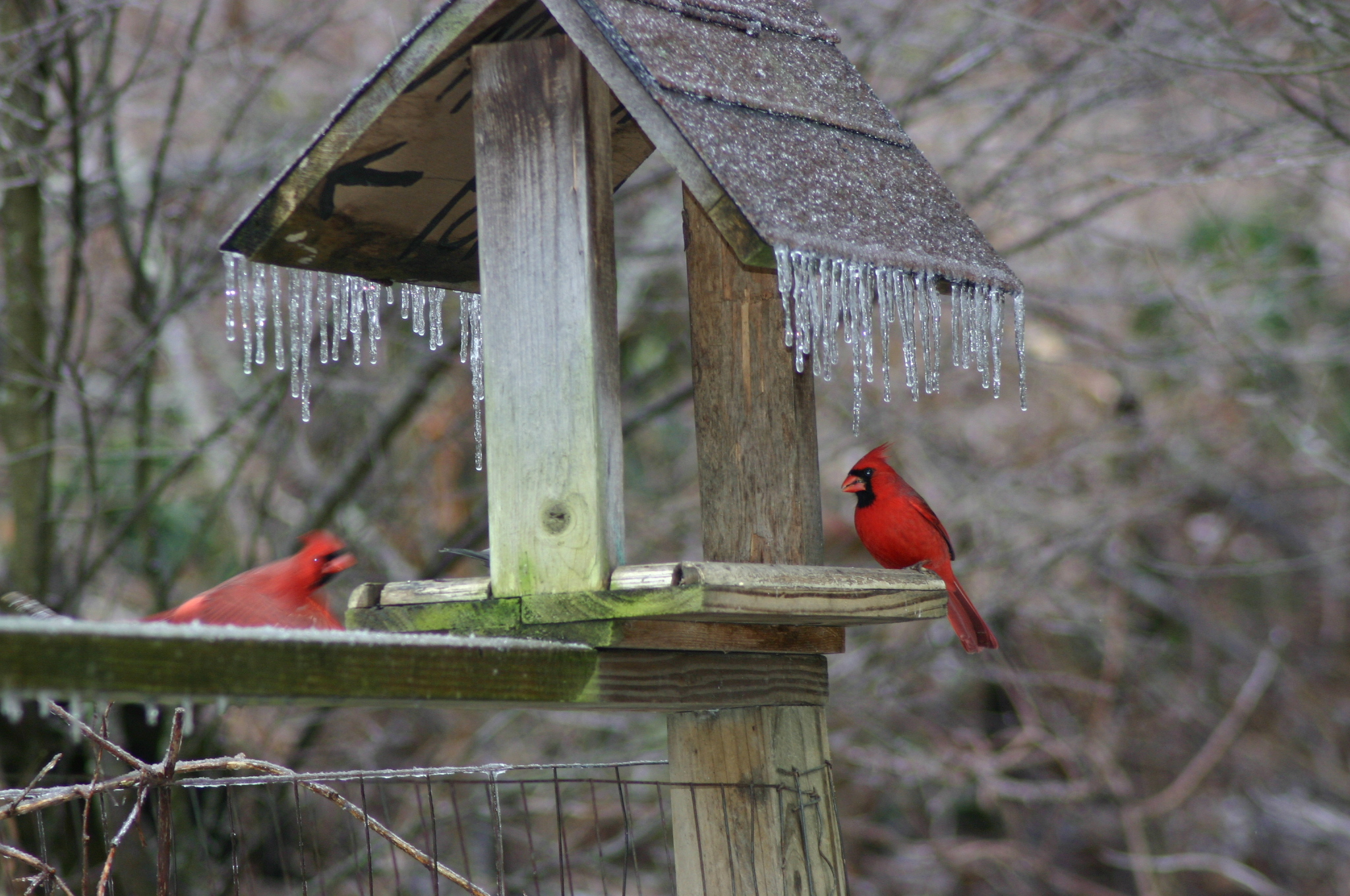
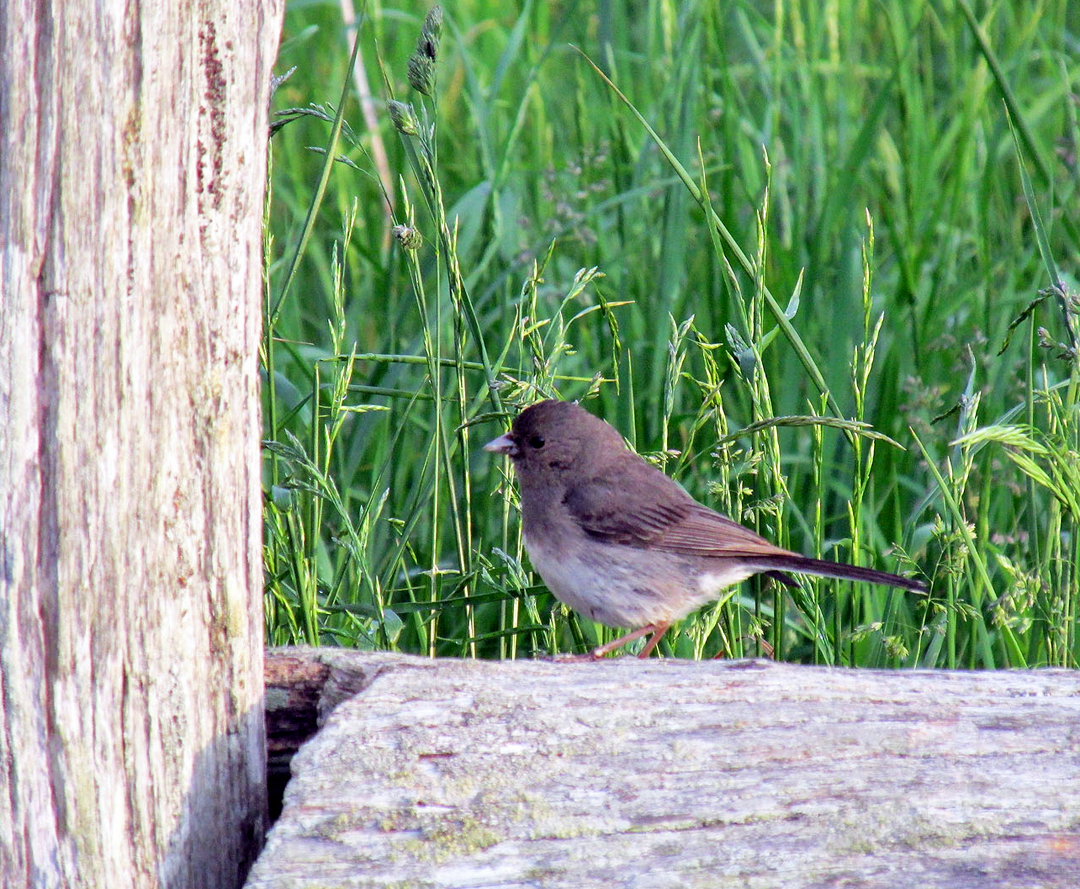
Category Archives: nature

Looking for fall migrating birds already underway

A male Wilson’s warbler perches in some branches. Many species of warbler migrate through the region each fall.

Summer’s waning. Just look at the calendar. We’re already approaching the midway point in August.

Birders track the transitions as one season merges into another, knowing that these are some of the best times to seek out birds. Fall migration doesn’t wait for a page to turn on a calendar. In fact, some birds are already on the move. I thought I’d devote this week’s column to some of the birds I hope to observe this fall as a mass migration draws many of our summer residents south toward warmer wintering grounds. In no particular order, here are some of the birds I’m hoping to see this autumn.

COMMON NIGHTHAWKS

The name common nighthawk is a misnomer. The species is not strictly nocturnal and it is certainly not a hawk. It’s actually a member of the nightjar family, which includes such birds as chuck-will’s-widow and whip-poor-will. The nighthawk doesn’t offer a serenade like these relatives, but it does produce a “pent” call that sounds much like an electric buzzer. It’s often the first indication of one of these birds swooping overhead. Nighthawks form impressive flocks, often numbering in the dozens or even hundreds. They are often active in evening hours, but I’ve seen large flocks of these migrating birds in mid-afternoon. August and September are the best time to look skyward to enjoy the spectacle of a large flock of swooping nighthawks as they pass overhead.

Photo by U.S. Fish and Wildlife Service
A Common Nighthawk finds a perch for a brief rest.


I didn’t host any of these colorful birds this spring, so I hope to get another opportunity this fall. The males in their vibrant black-and-white plumage and namesake breast patch of rosy-red feathers are slightly less colorful in the fall. I’ve actually had better luck in autumn hosting these birds at feeders. They love sunflower seeds, so keep your feeders stocked with their favorite foods to increase your chances. Females and young birds look different than adult males, but the heavy beak (the word “gros” is German for large) is a good indicator of their identity. Bird banders netting this species to document information for science can testify that these birds are also capable of a nasty nip at careless fingers with that stout bill.

Bryan Stevens • A pine warbler visits a suet feeder.

WARBLERS

These birds are undeniably at their most gorgeous during spring migration, but many species of warbler retain colorful plumage into the fall season. Young birds, often in a plumage entirely different than adult birds, are responsible for the term “confusing fall warblers.” I’ll be looking for the species that are harder to locate in the spring, including bay-breasted warbler, Cape May warbler, Blackburnian warbler and Tennessee warbler. I’ll also be hoping for a rarity such as cerulean warbler or mourning warbler. I will be sad when the parade of warblers produces a palm warbler or a yellow-romped warbler. These last two species are a sure sign that fall migration’s coming to a close for another season.

Photo by Bryan Stevens
A Great Egret resting on a spit of land in a lake at Murphy Candler Park in Brookhaven, Ga.

WADING BIRDS

Late summer and early fall can also be a fantastic time for scanning rivers, lakes and farm ponds for wading birds. Hurricanes in recent years have even forcibly relocated American flamingos to Tennessee and other unlikely locations. It’s slightly more reasonable to hope for something unexpected like a wood stork or roseate spoonbill. The more likely candidates for observing in the region are great egrets, tri-colored herons and snowy egrets. It’s also a last chance to view green herons before this small species retreats to warmer locations for the coming winter.
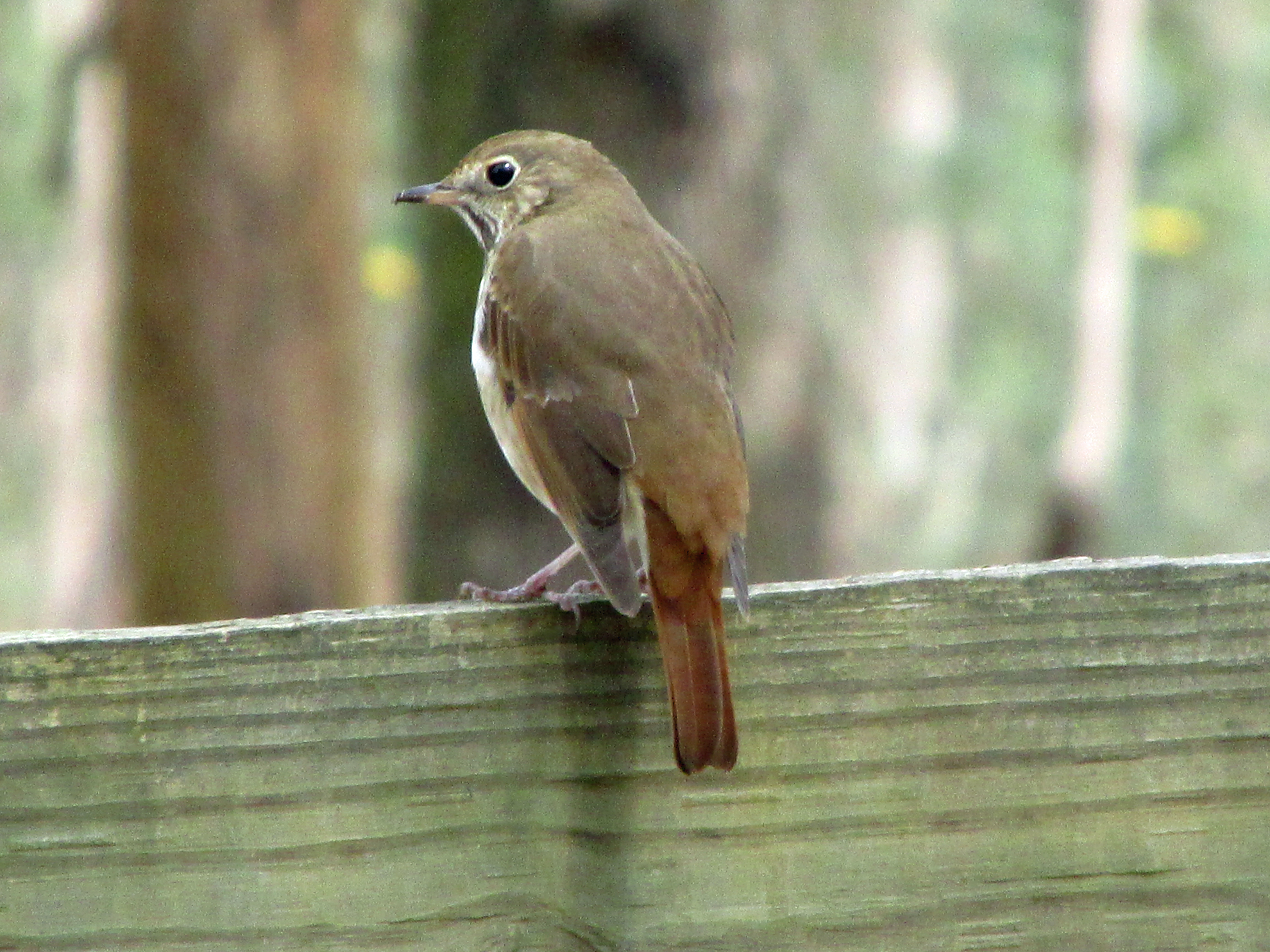
Bryan Stevens • A hermit thrush perches on a fence.

THRUSHES

These medium-sized songbirds are typically brown in plumage, often with spotted white breasts. They’re beautiful singers in spring and summer, but they’ve often cut back on their singing by fall. Nevertheless, they form large migrating flocks that will roam autumn woodlands to rest and refuel during short breaks from migrating. Swainson’s thrush is not difficult to find in the fall. This species is named in honor of 19th century artist and ornithologist William Swainson. Like most birders, I will be hoping for the more difficult species like Bicknell’s thrush and gray-cheeked thrush. Knowing their call notes can help alert you to their presence.

There will be a dazzling diversity of our feathered friends on the move this month. The seasonal phenomenon of migration extends into September and October. Pay attention to the visitors in your yards and gardens.

•••

Share sightings, ask questions or make comments by emailing me at ahoodedwarbler @aol.com.

Photo by Bryan Stevens • This migrating rose-breasted grosbeaks struck a window and spent some time recovering. Later, the bird flew safely back to a row of trees.
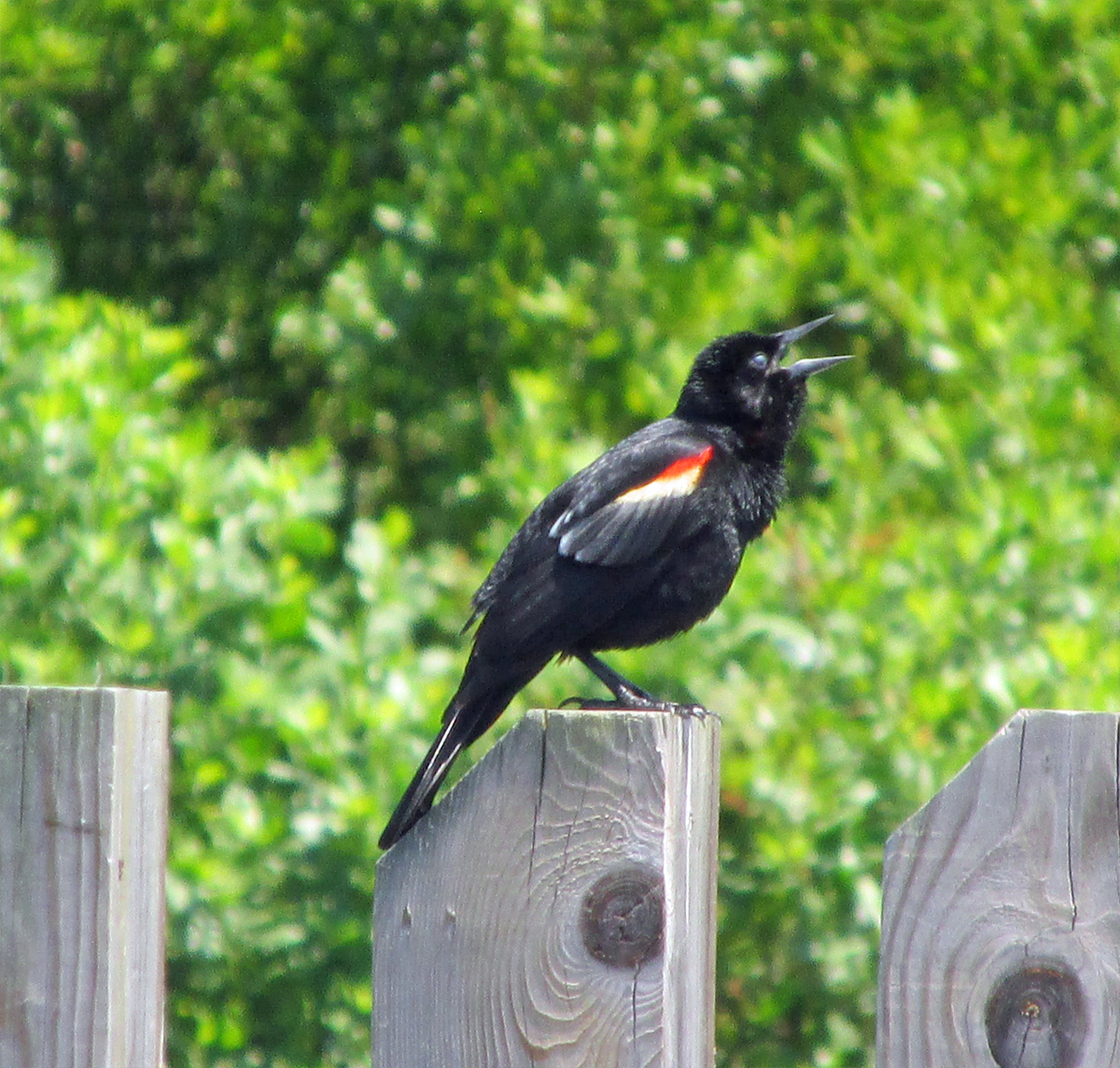
Red-winged blackbird, other birds set to return in coming weeks

Photo by Bryan Stevens • A male red-winged blackbird sings to attract mates and ward off rivals.

February’s the shortest month, and it is more than halfway over. There are already signs that some birds are ready to embrace the shift in seasons as winter advances, albeit in fits and starts, toward spring.

On Feb.11, three mallards visited my fish pond. The presence of mallards at any pond is not all that surprising. The mallard is arguably the most recognized of North America’s native ducks. But these were wild birds, as indicated by their wary behavior and their ability to spring into strong flight when I surprised them quite by accident.

Spring migration begins as early as February and March. Eastern bluebirds, which for the most part are not migratory, are already checking out nesting boxes.

The months of March, April and May will bring an influx of migrants. Ruby-throated hummingbirds will soon make their annual crossing of the Gulf of Mexico. These tiny birds usually make landfall in the United States as early as February, but they don’t usually venture as far north as Northeast Tennessee, Western North Carolina and Southwest Virginia until early April.

Bryan Stevens • On Feb.11, three mallards visited my fish pond. I am hoping they are the start of more migrating birds arriving in the coming weeks.

Warblers, orioles, thrushes, flycatchers, tanagers and many other migrants also return in April and May. A variety of waterfowl, raptors and shorebirds pass through the region during these months, as well.

March brings the early birds, including species such as brown thrasher, blue-gray gnatcatcher and red-winged blackbird.

Red-winged blackbirds return with a venegeance in early March or sometimes in late February.

I’m ready to hear their loud, familiar “kon-ke-ree” sounds again from the tops of the cypress trees at the fish pond. It’s always a fun moment to welcome these birds back.

Red-winged blackbirds return yearly in early spring and begin to seek out nesting habitat in local wetland areas, such as the cattail marshes near my fish pond.

My first returning male red-winged blackbird arrived on the evening of March 3 in 2022. The first red-winged blackbird arrived on the morning of March 6 the following year. I heard his unmistakable song from inside my house.

The showy and loud red-winged blackbird males soon take up residence at my fish pond and adjacent stands of cattails after their return.

Male blackbirds arrive ahead of the females. They immediately search out prominent perches and begin singing every day in anticipation of an intended audience. Female blackbirds lag a week or so behind the males in returning to their familiar territory.

Any wet field or marsh, especially those offering a stand of cattails, is almost certain to attract red-winged blackbirds at this time of year. I’d almost wager on that certainty.

The blackbirds arriving in spring behave much differently than the quiet, furtive flocks that often make brief visits to feeders during late winter snowstorms.

“The kon-ke-ree song of the male red-winged blackbird is a sure indication that spring is on the way,” according to a profile located at the Tennessee Watchable Wildlife website.

At this time of year, the male red-winged blackbirds seek elevated perches to display and vocalize. Their loud antics are not designed solely to attract mates. Male red-winged blackbirds also sing to warn rival males from intruding into their territories.

The male red-winged blackbird is a very aptly named bird. Glossy black males sport red wing patches that are often trimmed with a narrow band of yellow feathers. By contrast, female red-winged blackbirds are mostly brown birds that could easily be mistaken for large sparrows. Both sexes have sharply pointed bills.

Red-winged blackbirds are fond of wetlands. Any marsh or even a damp field or flooded pasture is likely to attract a few resident red-winged blackbirds. Females choose nesting locations in cattails or other marsh vegetation. She usually lays three or four eggs. Although she does receive some help from the male, most of the responsibility for raising the young is left to her.

There is a reason that male red-winged blackbirds are not always quite as engaged as females in feeding and tending their young. Males are often polygynous, which means that males will often court multiple mates. His time is often occupied defending females and their respective nests from the advances of other male red-winged blackbirds.

According to the website All About Birds, male red-winged blackbirds spend much of the breeding season sitting on a high perch over their territories and singing almost without ceasing from dawn to dusk.

The website also notes that female blackbirds shirk the high profile of the males. They tend to skulk in wetland vegetation as they collect food or nest material.

Bryan Stevens • Female red-winged blackbirds lack the showy plumage of males. They look more like an overgrown sparrow.

Both males and females defend nests from intruders and predators. They take this duty quite seriously, as I know personally from being dive-bombed by parent blackbirds when I have gotten a little too close to their nests.

Other relatives of the red-winged blackbird in the United States include the tricolored blackbird found along the Pacific Coast and the yellow-headed blackbird resident in wetlands west of the Great Lakes. Rusty blackbird, common grackle and brown-headed cowbird are other species of blackbirds found in Tennessee, Virginia and North Carolina.

For birders, the weeks ahead are an exciting time. In spirit, I think others often join our excitement if for no other reason than to celebrate that spring is just around the corner. These “early bird” arrivals are merely the harbingers of the season.

Share a sighting, ask a question or make a comment by emailing me at ahoodedwarbler@aol.com.

Bryan Stevens • In fall, male red-winged blackbird are bereft of the striking glossy plumage of spring.


Birds have developed ways of dealing with cold

David Ellis/USFWS • A common redpoll feasts on stiff goldenrod seed. These small finches can endure temperatures 100 degrees below freezing.

With the arrival of January, we can probably be assured of some cold weather. I’m not fond of the cold, but I can put on gloves and a thicker coat and I am good to go.

What about our feathered friends? How do birds cope when temperature plummet below freezing?

Birds actually employ a range of strategies and behaviors that keep them cozy even during the worst that winter can hurl at them.

Some birds avoid the necessity of coping with cold by migrating. All those tropical species that brighten the warmer seasons in the mountains of Southern Appalachia withdraw to warmer areas in Central and South America during the winter.

Those birds that elect not to put distance between themselves and cold temperatures must do something to stay warm. Feathers are one of a bird’s defining traits, and they can do a neat trick with their feathers to stay warm. You’ve probably seen them do this. They will fluff their feathers, trapping air between them to provide insulation. If you’ve ever noticed that some birds look “fatter” in extreme cold it’s likely because they have fluffed up to combat the cold.

Of course, feathers require good maintenance to help with the task of staying warm, and birds are diligent about such tasks. Preening feathers on a routine basis keeps them watertight and able to hold in heat. Some birds even grow extra feathers in autumn to prepare for cold temperatures. That’s similar to dogs or cats growing a denser coat of fur in anticipation of wintry temperatures.

Birds have different comfort levels when its comes to personal space, but many of the more sociable species will huddle together. You’ve probably seen nature documentaries of penguins in the Antarctic as they huddle together for weeks on end to endure the harsh conditions of the globe’s southernmost continent.

Larger species of birds, such as geese and grouse, eat more and gain weight, which is often achieved by the storage of body fat.

Other birds have also adopted the huddling strategy in a cozy cavity or nest box. My most vivid recollection of an observation of this strategy involved Eastern bluebirds. During a severe cold snap accompanied by snow and blustery winds, I watched multiple bluebirds enter one of my nesting boxes. I’m not sure how many entered the box, but it was likely about eight to 10 birds.

Necessity makes birds adaptable. The next day the aforementioned high winds took down the post that held the nest box. At dusk the bluebirds showed up again. They looked baffled to find the box had disappeared. Then I saw them fluttering into an old tire that I had used at the base of the pole to help anchor the box. Faced with oncoming darkness, they chose to huddle together inside the old tire.

Natural cavities in trees also provide cozy roosting spaces for birds. Chickadees and titmice, nuthatches and woodpeckers seek out such cavities ahead of time so they will always be ensured of a warm space during bouts of inclement weather.

The biological mechanism of torpor is one that’s probably familiar to fans of hummingbirds, but other small birds can also take steps to lower their body temperature. Chickadees and kinglets put this ability to good use. In these small birds, the adaptation being employed is known as controlled hypothermia. Chickadees can drop their body temperature by as much as 22 degrees below normal daytime body temperature.

Snakes and reptiles can enter a physical state called brumation, where they sleep more but still wake to eat, drink and enjoy the sun on warmer days, according to information on the Facebook page of the U.S. Fish and Wildlife Service. Since snakes are cold-blooded, they’re lethargic at these colder temperatures even when they’re on the move.

Hibernation, although a strategy widely used by mammals, is rare in birds. The common poorwill (a relative of whip-poor-will and chuck-will’s-widow – is the only bird known to go into torpor for extended periods that can range from weeks to months. On the southern edge of their range in the United States, poorwills spend much of the winter hibernating, usually concealed in rock piles.

There’s warmth in numbers. Crows, starlings, robins and other species will gather in communal roosts to use body warmth to stay warm overnight. Sometimes these roosts are quite large and can lead to conflict with nearby humans who may not want the noise and mess that comes with hosting a large flock of birds.

While warm socks and gloves protect human toes and fingers, birds don’t have to worry about frostbite. Quick circulation means that blood does not linger in their feet long enough to freeze. In addition, the legs and feet of birds are covered in scales. Like feathers, the scales provide excellent insulation.

Some birds will gather together in large stands of evergreens. I’ve observed house sparrows gathering in the holly trees outside the courthouse in downtown Erwin at dusk on cold evenings.

There are things we can do to help. Plant evergreen trees or construct a brush pile that will provide shelter from the elements, as well as a measure of safety from predators, for the birds that share our lawns and gardens.

Many people already feed birds. Try supplementing seeds with some food rich in fat. Birds, unlike us, will not be adversely affected by a high-fat diet. Their metabolism allows them to burn off the extra calories in an enviable amount of time. Some high-fat foods that birds will love include peanut butter and beef suet, as well as peanuts and other assorted nuts. While it’s relatively simple to render suet into a usable for for birds, most people cannot be blamed for turning to commercially made suet cakes. Many of these are also made even more appealing with a mix of peanuts or fruit into the suet cake. The extra calories derived from these foods will let birds better regulate their body temperature and tolerate the more frigid nights.

It’s also important to provide liquid water for birds. Outdoor heaters designed to fit into a birth bath can help prevent the water from freezing during cold snaps.

Birds will also appreciate a sunny spot. By basking in sunshine, they can also boost their internal temperature.

Some birds are just built for cold. For example, snowy owls have been observed in temperatures 80 degrees below zero. Species of redpolls, a type of finch, can endure temperatures 100 degrees below freezing.

Emperor penguins live and nest in some of the most inhospitable terrain on the planet. Those who have viewed the documentary film “March of the Penguins” will be familiar with the species. Their colonies on the ice in the Antarctic must endure temperatures than can plunge to -40 degrees Farenheit. They must also survive frigid winds that can reach 90 miles per hour.

Emperor penguins have several adaptation to help them survive such cold conditions, according to the World Wildlife Fund. These penguins have two layers of feathers, a reserve of fat and beaks and flippers that are proportionally smaller than those for other penguin species.

Lee Karney/USFWS • The common raven can live in a range of habitats, but these large and intelligent birds are especially adapted to cold.

The common raven is another bird that shrugs off cold and snow. They can survive and thrive in habitats as varied as Arctic tundra and scorching deserts. If temperatures drop below -4 degrees Farenheit, ravens can generate extra body heat.

All things considered, birds are simply better at coping with cold than we are.

•••

Bryan Stevens has written about birds since 1995. To ask a question, make a comment or share a bird sighting, email him at ahoodedwarbler@aol.com.

Hooded warbler easily wins fans among birders

Photo by Jean Potter • A male hooded warbler flits through the foliage of a rhododendron thicket.

The woods surrounding my home have been alive with birdsong. We’re almost ready to turn the calendar to June, but there’s been no diminishment in the fervor of the daily chorus.

The main members of the feathered choir are warblers. I’ve heard yellow-throated warbler, black-throated green warbler, black-and-white warbler, Northern parula, ovenbird, common yellowthroat and, my favorite, hooded warbler, morning and evening.

During the winter months when the hooded warbler absents itself from Northeast Tennessee, the species resides in the forests of Mexico, as well as in Belize, Costa Rica and other Central American nations.

Like many of the ruby-throated hummingbirds that make their home in the United States for the summer, the hooded warbler’s seasonal migrations take it across the vast open waters of the Gulf of Mexico. After that amazing crossing, these small songbirds disperse throughout the southeastern United States.

That birds as small as hummingbirds and warblers make this incredible migration twice yearly is one of nature’s most phenomenal feats of endurance. In a presentation by Kenn and Kimberly Kaufman that I attended six years ago, I learned that these tiny birds put on incredible fat reserves to help fuel their valiant Gulf crossings.

The warblers, also known as wood-warblers, are an exclusively New World family, numbering approximately 116 species. About 50 of these species make their home in the eastern United States and Canada for the spring and summer, departing in the fall and returning to tropical wintering grounds. Some are extremely bright and colorful birds. The hooded warbler is somewhere in the middle in a sliding scale that goes from dull to wow.

Other colorful warblers that share similar tastes in range and habitat with the hooded warbler include the American redstart, black-throated blue warbler and black-throated green warbler.

Readers who make it to the end of this weekly column will know that even my email address is a testament to my enthusiasm for the hooded warbler.

Hooded warblers nest in the woodlands around my home. So, from the time my favorite warbler returns in April until the last individual departs in October, I enjoy regular glimpses of this colorful and interesting bird. Like all warblers, the hooded warbler is quite energetic, dashing after tiny insects in the branches of shrubs and trees. Hooded warblers often forage close to the ground, which makes observing them easier.

Of course, birds are free to break the rules. One of my most memorable sightings of a hooded warbler involved a male singing from the upper branches of a dead pine tree. I’d estimate that the bird was at least 40 feet off the ground, singing his little heart out to attract a mate. I was standing on an elevated rise of land while the tree providing the warbler its perch was lower in a gully that actually placed bird and observer on a roughly level playing field.

The bird sang for many moments, which is not always the case with warblers. These birds tend to dash for cover at the slightest disturbance, but this enthusiastic male didn’t seem to pay and heed to the fact that most of its kin prefer to skulk in shrubs and dense rhododendron thickets no more than a few feet off the ground.

Back in the late 1990s, when I had just started out in birding, I observed two adult hooded warblers feeding a couple of young birds only recently out of the nest.

I was enjoying observing the sweet scene as the parent birds carried foods to the young birds, which begged incessantly and loudly when, unexpectedly, a song sparrow wandered into the scene.

The sparrow was brutally beset by the parent warblers, which attacked the intruder from all sides. The poor sparrow, having no clue to the reason for their ire, beat a hasty retreat. Sparrows are no threat, but that didn’t matter to these zealous parents.

When I first began birding, I was only dimly aware there was a family of birds known as warblers, which are now hands-down my overall favorite birds. The hooded warbler was one of the first birds I managed to identify on my own.

It’s one bird unlikely to be mistaken for any other. Every time I behold a hooded warbler, I marvel at the bird’s exquisite appearance. The gold and green feathers seem to glow brightly in the dim light of the shadowy thickets of rhododendron they prefer to inhabit. The black hood and bib surrounding the male’s yellow face stands out by virtue of its stark contrast from the brighter feathers. Large coal-black eyes complete the effect. The appearance of the male bird provides this species with its common name. The female has an identical yellow-green coloration as the male, although she is slightly more drab. She lacks the black hood and bib, although older females may acquire some dark plumage on the head and around the face. Both sexes also show white tail feathers that they constantly fan and flick as they move about in thick vegetation and shrubbery.

The warblers are, in short, an incredible family of birds. I’ve seen all but a handful of the species that reside for part of the year in the eastern United States. I still want to see a Connecticut warbler and cerulean warbler, as well as the endangered Kirtland’s warbler of Michigan and the golden-cheeked warbler of Texas.

I’ve come to think of the hooded warblers at my home as “my warblers.” There may be a kernel of truth to my belief. The website All About Birds in a profile on the species notes that a seven-year study conducted in Pennsylvania gave evidence that male hooded warblers are faithful to nesting territories from previous years. Approximately 50% of banded males were shown to return to the same area to breed again year after year.

So, some of those hooded warblers singing from the rhododendron thickets at my home are probably birds returning for consecutive spring seasons. Some of the warblers that returned back in April could be great-great-great grandchildren of those warblers that attacked the unfortunate song sparrow. At the least, it gives me pleasure to think so.

•••

To share a sighting, ask a question or make a comment, email me at ahoodedwarbler@aol.com, an address that shows my profound fascination for this particular bird.

Photo by Bryan Stevens • A male hooded warbler peers from a tangle of branches.

Common raven is no bird brain

Photo by Alexas-Fotos/Pixabay • Common ravens, although native to the region, were not so common only a few decades ago. This much larger relative of the American crow is slowly becoming more commonplace in the area once again.

Since back in November, a common raven has been lurking in the woodlands around my home. I even hear the raven’s loud croaking when I’m inside the house. The local American crows have not rolled out a warm welcome for the interloping raven, but there seems to be an uneasy truce between the crows and the much larger raven.

Ravens are vocal birds. I got reminded of the many unusual vocalizations a raven’s capable of when the resident bird flew over, croaking loudly, on a recent brisk and sunny late afternoon. Between the croaks, the raven produced an uncanny imitation of a tinkling bell. The bird produced this bell sound several times before flying out of sight.

I’m not pulling any legs. Among their vocal repertoire, ravens can produce, usually in flight, a “bell” call. I’m not sure if this is a common vocalization. I only remember ever hearing a raven’s “bell” on only one other occasion. I was with a group of more established birders at Roan Mountain State Park when a raven flew overhead. Someone called out, “Listen to that.” I listened and heard my first raven “bell” call.

The strange thing is that I can find little about this strange vocalization when I researched the subject. According to the website “All About Birds,” common ravens calls vary from a low, gurgling croak to harsh grating sounds and shrill alarm calls. Scientists have placed their vocalizations into as many as 33 different categories based on sound and context. The most commonly heard is the classic gurgling croak, rising in pitch and seeming to come from the back of the throat.

The croak is their standby vocalization, which they produce often. The raven’s croak can be heard from a mile away. And, in defense of the poet Edgar Allan Poe and his “ominous bird of yore,” ravens are accomplished mimics. According to “All About Birds,” ravens can imitate other birds. Raven raised in captivity can even learn words. “Nevermore?”

From the opening refrain of “once upon a midnight dreary” in his poem, “The Raven,” Edgar Allan Poe established a somber mood and also helped cement the dark reputation of one of North America’s most misunderstood birds. Poe describes the bird that provides the title of his famous poem with adjectives such as “grim, ungainly, ghastly, gaunt and ominous.” His raven also speaks, although it has the limited vocabulary of a single word, “Nevermore.”

How else does the real common raven resemble the “bird of yore” in Poe’s classic poem? For starters, the raven is an intelligent bird. Authors of a scientific study conducted about 15 years ago posited the claim that ravens and crows are just as intelligent as some of the great apes. Although parrots are more famous for the ability to mimic human speech, captive ravens have proven capable of learning more words than even the most impressive vocabulary-endowed parrots. So, Poe was not wide of the mark when he gave the gift of gab to the raven in his poem.

In the United States, the raven is quite common in Alaska. In the lower 48 states, raven populations are somewhat more sporadic. These large birds have established strongholds along the Appalachian Mountains and in the American Southwest. The raven is a cosmopolitan bird known to range from North America and Greenland to Europe and Asia, as well as North Africa and the Canary Islands.

The common raven is mainly a scavenger, but this bird is also an opportunistic predator and will prey on a wide variety of animals, including arthropods, amphibians, small mammals, birds, reptiles, and carrion. Ravens are attracted to carrion and are not finicky eaters. They adapt quickly and are known to even consume garbage.

Its black plumage has undoubtedly contributed to the raven’s sinister reputation and its affiliation with many dark superstitions. According to Laura C. Martin’s book, “The Folklore of Birds,” notes that the raven is “loathed throughout Europe as a symbol of impending death and war.” She explains that the raven probably acquired these connotations because these birds fed on battlefield corpses. As indicated earlier, the raven is not a picky eater. Martin also points out that legend maintains that England will remain a powerful nation as long as ravens live in the infamous Tower of London.

Establishing the raven’s closest relatives is helpful in fully becoming acquainted with this species. The raven is a member of the corvid family, which includes birds such as crows, magpies, nutcrackers and jackdaws. The common raven is the largest bird among the corvids. This bird can achieve a wingspan of almost four feet. The average raven weighs about two-and-a-half pounds. Large individuals have been recorded with a weight of slightly more than four pounds, making the raven a contender for the title of world’s largest songbird.

Poe’s poem offers a dramatic introduction to a bird that has once again become rather common in the region, particularly at higher elevations. This bird is well-known for nesting on inaccessible cliffs. However, ravens are proving adaptable. In recent years, a pair of ravens has repeatedly nested beneath the grandstands at Bristol Motor Speedway. Ravens have nested annually at this location at least since the spring of 2013.

Poe’s well-known poem, first published in 1845, is often cited as evidence for Poe’s genius for rhyme and his ability to create a believable supernatural universe populated by dark forces and one particularly persistent raven. It’s more than a little sad and ironic that the magazine that chose to publish Poe’s poem paid him a mere pittance of $9 for his brilliant contribution to literature.

The Bible also offers some interesting tales involving ravens. The prophet Elijah, after falling afoul of a wicked king, went into hiding and was provided food by cooperative ravens. In the story of the Biblical flood, Noah first released a raven to determine if the waters had receded. When the raven didn’t return to the ark, Noah next released a dove. This bird later returned to the ark clutching an olive leaf, which proved that the flood waters had subsided.

Many cultures also consider the raven as a “bringer of magic,” and the bird is associated with many creation stories in Native American cultures. Unlike the European custom of designating black as an “evil” color, Native Americans teach that black can hold various meanings, including resting, healing and prophetic dreaming, but evil is not one of them.

Ravens and crows are similar, but ravens are much larger birds. In addition, ravens have wedge-shaped tails and crows have fan-shaped tails. The common raven also has a well-developed ruff of feathers on the throat, commonly called its “hackles.”

A “murder of crows” is a fairly well known collective noun for a flock of these birds. On the other hand, a group of ravens has many collective nouns, including a “bazaar,” “constable” and “rant” of ravens. For its alliteration, I’m fond of “a rant of ravens” and think it’s a shame that Poe’s raven was apparently a solitary bird.

Other species of ravens found around the world include dwarf raven, thick-billed raven, fan-tailed raven, brown-necked raven, little raven and forest raven.

I like ravens. I find them fascinating, but there’s still something that causes some shivers when one hears the guttural, loud croak of a raven. It remains difficult to completely dismiss the raven’s long history of association with the darker niches of the world.

On that note, here’s one final tidbit regarding the raven taken from Martin’s book. Cherokee tribes believed that ravens would visit villages where ill or dying people were present. In the absence of a village shaman to drive away the bird, the raven would invariably snatch the life of the ailing individual.

••••••

To learn more about birds and other topics from the natural world, friend Bryan Stevens on Facebook at https://www.facebook.com/ahoodedwarbler. He is always posting about local birds, wildlife, flowers, insects and much more. If you have a question, wish to make a comment or share a sighting, email ahoodedwarbler@aol.com.

Odes add summer excitement when heat makes the birds scarce

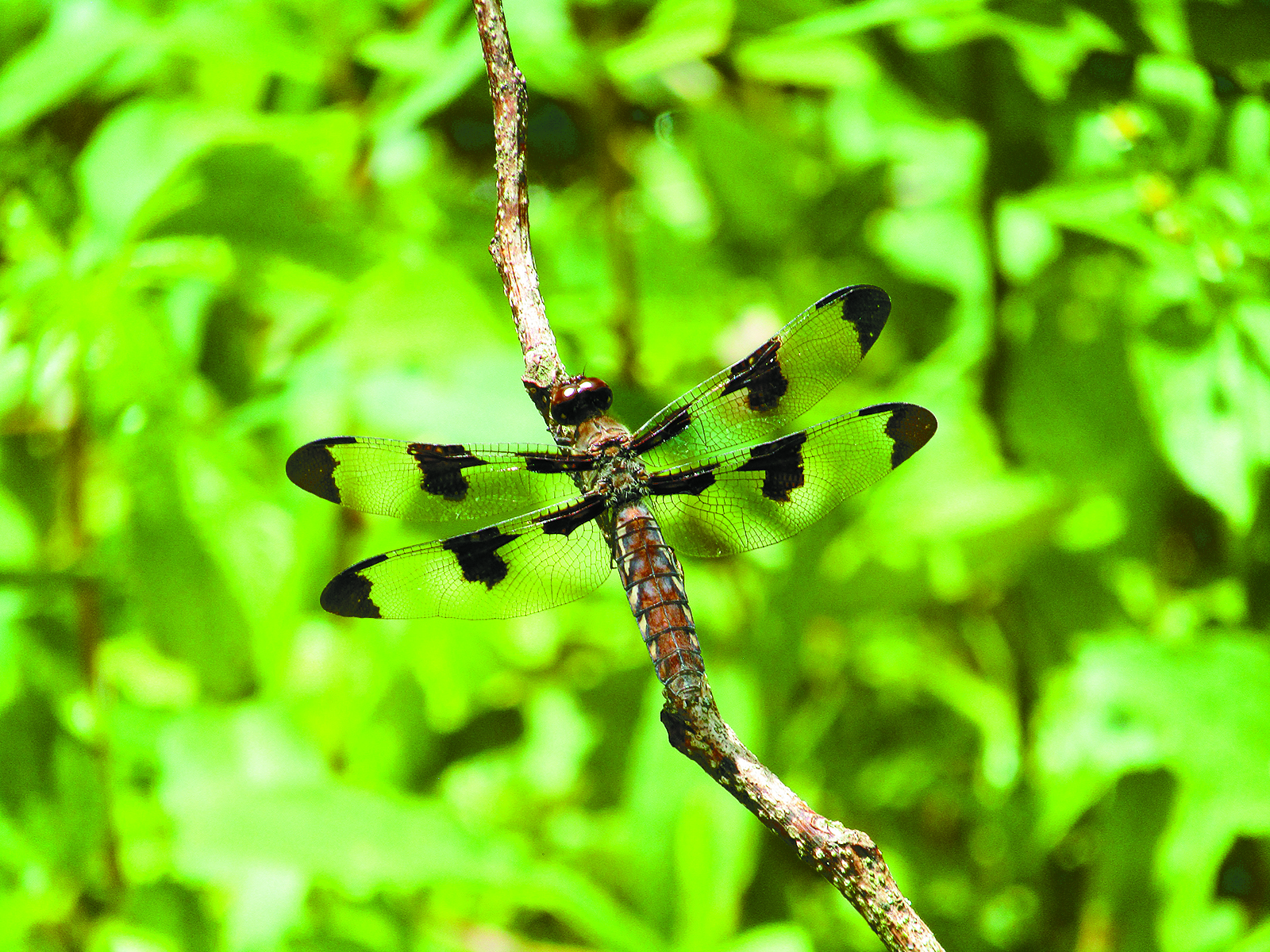
Photo by Bryan Stevens Photo by Bryan Stevens A female common skimmer, a species of dragonfly, basks in the sunshine to help boost her energy reserves for hunting. Dragonflies, with a kill rate of 90%, are one of the world’s most deadly and efficient predators.


I am taking a hiatus from the birds for one week to introduce readers to some “other things with wings.”

Specifically, I want to discuss dragonflies and damselflies, otherwise known as “odes,” or members of the insect order of Odonata. Surprisingly, beyond the fact that both have wings, the odes and birds have a lot in common.

When birds are scarce during the heat of the day, I find that other winged creatures get active and can provide some fun observations. In late summer I spend a great deal of time focused on the dragonflies and damselflies that live along the creek and at the fish pond at my home. The “odonates” are insects with long brightly colored bodies, two pairs of membranous wings and large compound eyes.

Photo by Bryan Stevens
A glimpse through the vegetation at one of the pond’s most voracious predators. Dragonflies consume many other species of insects, including some that are considered pests. Pictured is a female Blue Dasher.

Some of the more prevalent dragonflies in the region include widow skimmer, common whitetail, Eastern pondhawk, Eastern amberwing and slaty skimmer. There are less common odes that also put in appearances at my home along Simerly Creek Road. Gray petaltails and tiger spiketails, two larger dragonfly species, put in almost annual appearances.

I also often find the ebony jewelwing, a species of damselfly, fluttering along the creek. These delicate-looking insects like to find a sunny perch near flowing water. I’ve noticed the ebony jewelwings for many years because they are particularly difficult to miss. They have dark wings and a tapering body that glistens with a metallic blue-green sheen.

Damselflies, which are closely related to dragonflies, are usually smaller and less swift. A dragonfly at rest keeps its wings extended horizontally like an airplane’s wings, but damselflies fold their wings over their backs.

All odes are predators, feeding on other insects, but they are harmless to humans. Despite an enduring myth, they cannot sting. They are capable of biting, but will not do so unless they are handled in a careless manner.

Photo by Bryan Stevens
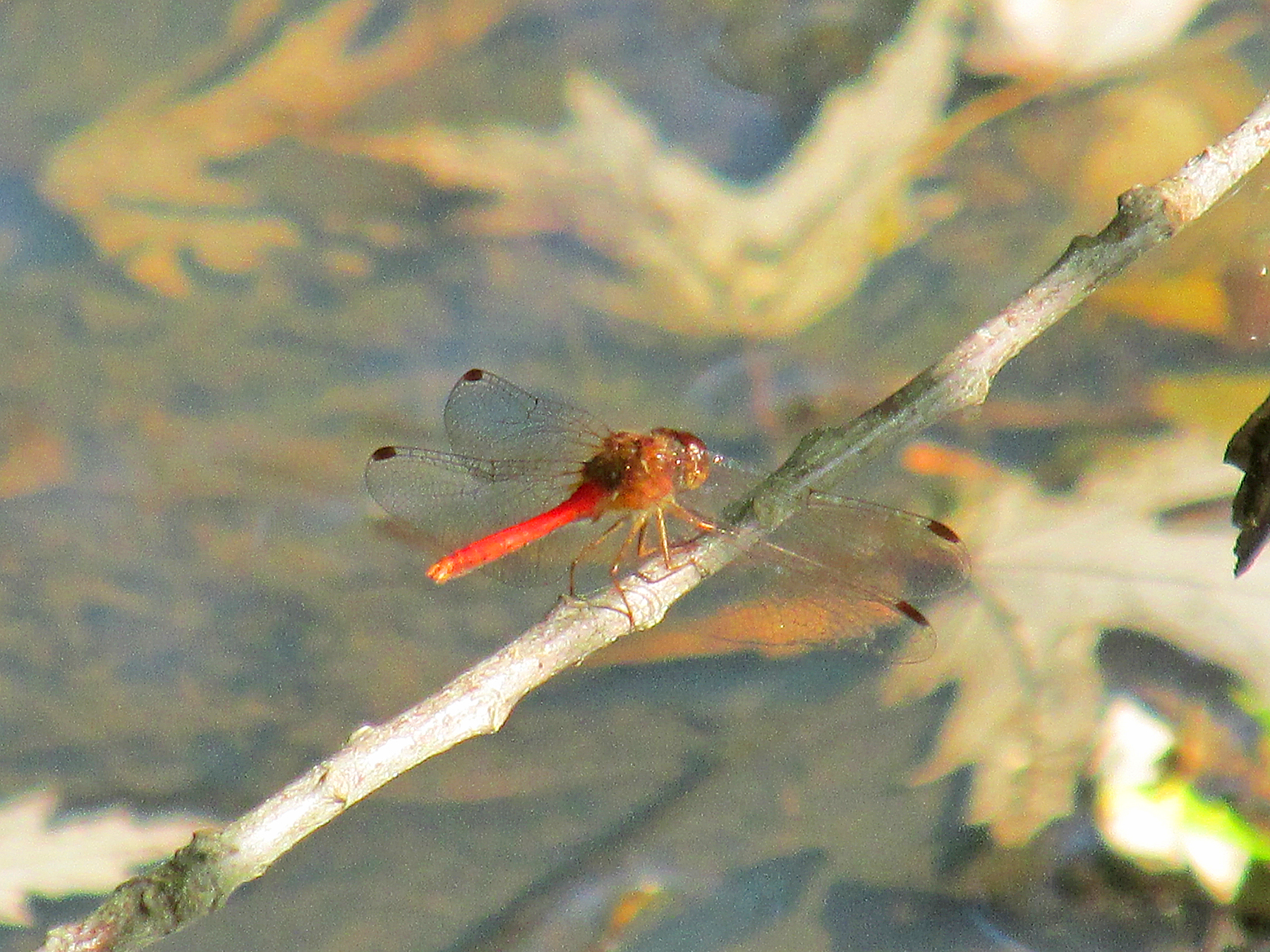
The aptly-named Autumn Meadowhawk is one of the last dragonflies to emerge each year.

If you observe dragonflies long enough, you will start to notice they share one trait with hummingbirds: they are intolerant of any intrusion into their personal space. Like feisty hummingbirds, dragonflies constantly chase rivals away from a favorite perch, restlessly patrolling the edge of a pond. They are unceasing in their chasing and harassing of rivals.

Some cultures consider a dragonfly landing on a person a sign of good fortune. My sister-in-law would disagree. She has an intense, if irrational, fear of dragonflies. Perhaps she learned too much of the misinformation handed down in various human cultures about dragonflies.

Europeans have long linked dragonflies with sinister forces. Some common names for dragonflies, such as darners, come down from older names such as “devil’s darning needle.” Swedes call dragonflies “troll spindles” and Norwegians refer to them as “eye pokers.” Some cultures in South America call dragonflies “horse killers” and others refer to them as caballito del diablo, or the “devil’s little horse.” Some residents of the Southern United States refer to dragonflies as “snake doctors,” believing these insects can stitch and repair any injuries that a serpent suffers. It’s no wonder some people fear a harmless and rather beneficial insect.

Native Americans as well as some Asian cultures have a more positive outlook on dragonflies. In Japan, dragonflies represent such concepts as strength, courage and joy. Dragonflies are often depicted in Zuni pottery, and the Navajo use the dragonfly as a symbol to represent “pure water,” which was an important resource for people living in very arid conditions. For both birds and dragonflies, water is also a crucial resource if they are to thrive.

The Hopi and Pueblo tribes also incorporate dragonflies into their art. Many Native Americans consider dragonflies a symbol of renewal. Many others see them as a symbol representing illusion and seeing through deception. I wonder if the use of the dragonfly as a renewal symbol evolved because of the life cycle of dragonflies.

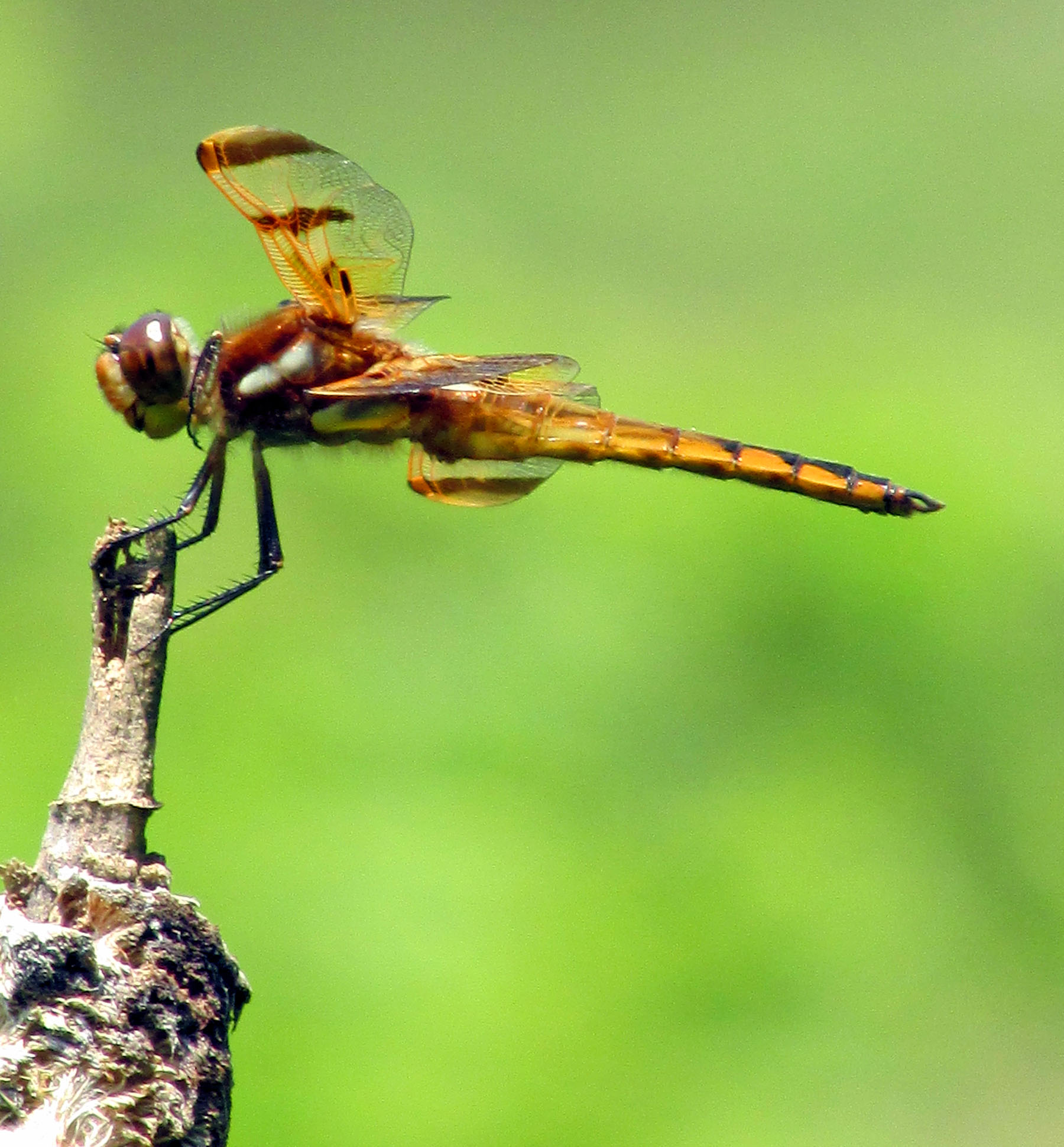
Photo by Bryan Stevens • A painted skimmer grasps the tip of a cattail.

Odes spend the first stage of life as aquatic larvae living below the surface of the water. Later, they emerge as adult dragonflies. During their time spent as larvae, or nymphs, they are voracious predators, tackling other aquatic organisms, including small fish. At the same time, these nymphs are important food sources for some larger fish. Nymphs may spend as long as three years living beneath the water, but adult dragonflies usually live only a few weeks or months.

Adult dragonflies continue to consume prey, which is mostly other insects. Among the odes, there are no vegetarians. “Mosquito hawk” is another common name for them because they catch and eat mosquitoes. They also consume gnats, flies and other insects. So, along with birds such as swallows and nighthawks, the dragonflies help keep in check the numbers of many nuisance insects.

Some of the larger dragonflies are also reputed to attack and eat hummingbirds. I tried to find conclusive evidence, but the jury’s still out in my opinion. However, some of the larger species of praying mantis have been documented capturing and consuming hummingbirds, so it is not too far-fetched to believe some of the larger dragonflies might be capable of preying on hummers.

Like many birds, some dragonflies migrate. Species such as Carolina saddlebags, green darners and wandering gliders are known to migrate hundreds of miles.

Photo by Bryan Stevens • An Eastern pond hawk perches on the bloom of an impatiens.

In recent years, dragonfly-watching has emerged as a nature pastime to rival the watching of birds and butterflies. Why watch dragonflies? Well, in many ways, they are just as fascinating as birds and other wildlife

Here’s some additional fun trivia about dragonflies:

• Odes have excellent eyesight. Their compound eyes have up to 30,000 facets, each of which is a separate light-sensing organ arranged to give nearly a 360 degree field of vision. Their vision also makes it difficult to sneak up on a dragonfly. I have learned this during my attempts to photograph them.

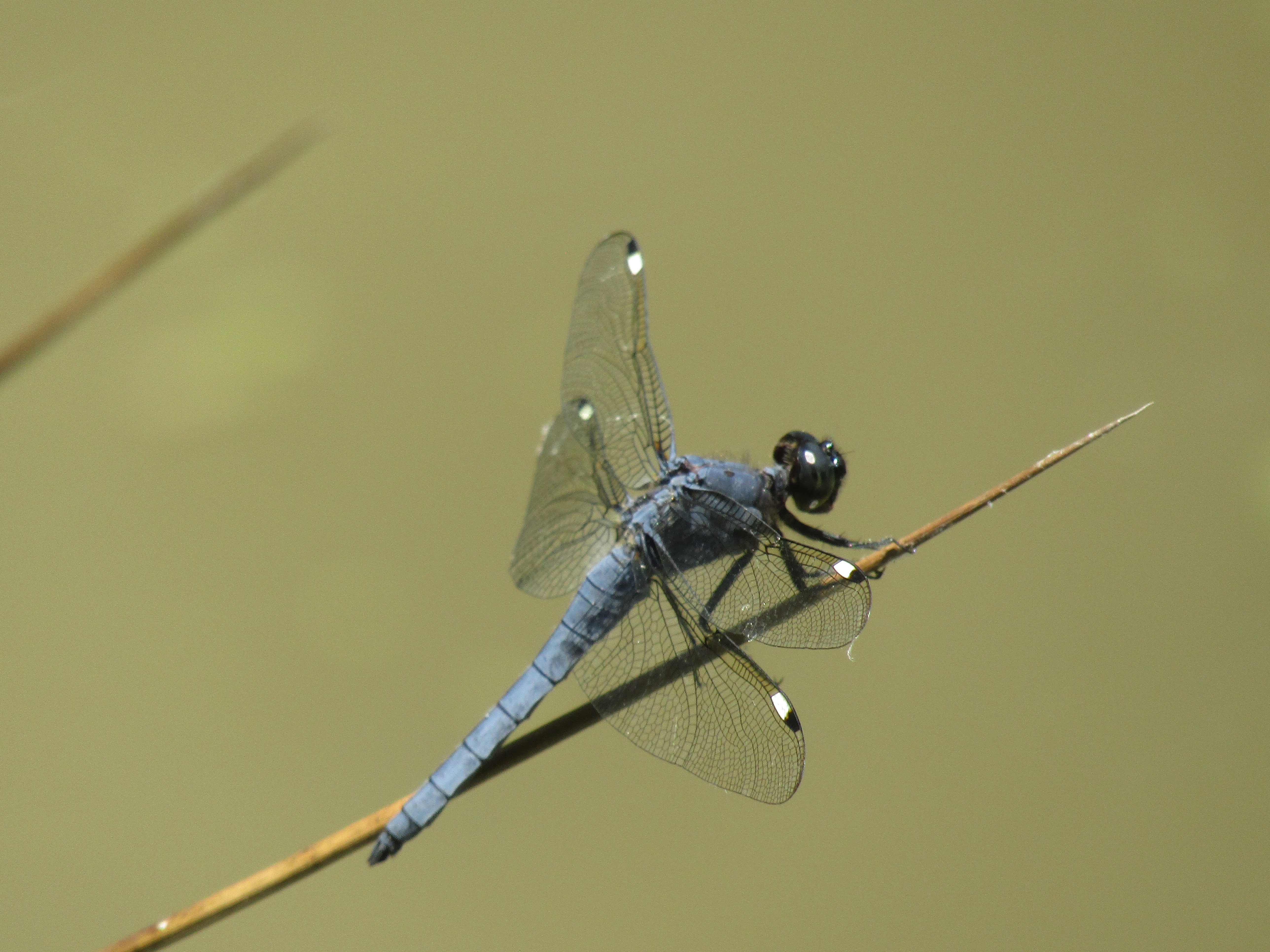
Photo by Bryan Stevens • A spangled skimmer at rest near the water’s edge.

• Dragonflies are built for speed. Many experts credit dragonflies with the ability to fly at speeds between 19 to 38 miles per hour. They have also been documented traveling as much as 85 miles in a single day.

• Dragonflies can hover and fly backwards, a feat achieved by only hummingbirds among our winged friends with feathers.

• Dragonflies are among the world’s most efficient predators, successfully capturing prey at a whopping 90% of their attempts. In other words, nine times out of 10, dragonflies capture and eat other insects.

• Dragonflies are ancient. They appeared 100 million years before dinosaurs and 150 million years before birds.

• The largest dragonfly to ever live was Meganeura monyi, which lived during the Carboniferous period about 300 million years ago. It resembled and was related to present-day dragonflies. With a wingspan of almost 26 inches, it is one of the largest known flying insect species.

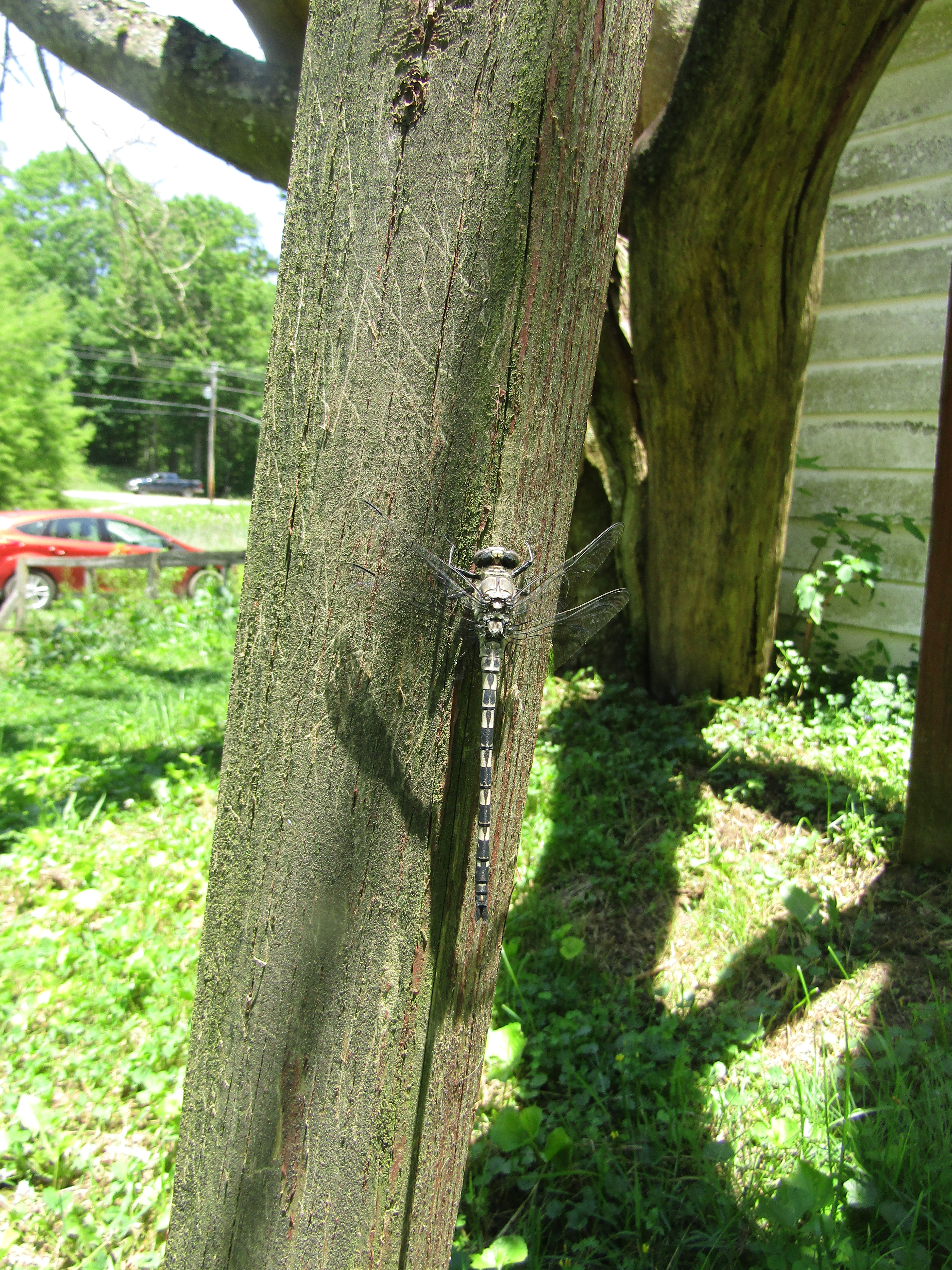
Photo by Bryan Stevens • A gray petaltail clings to the side of a post.

Sapsucker an odd bird out among woodpeckers

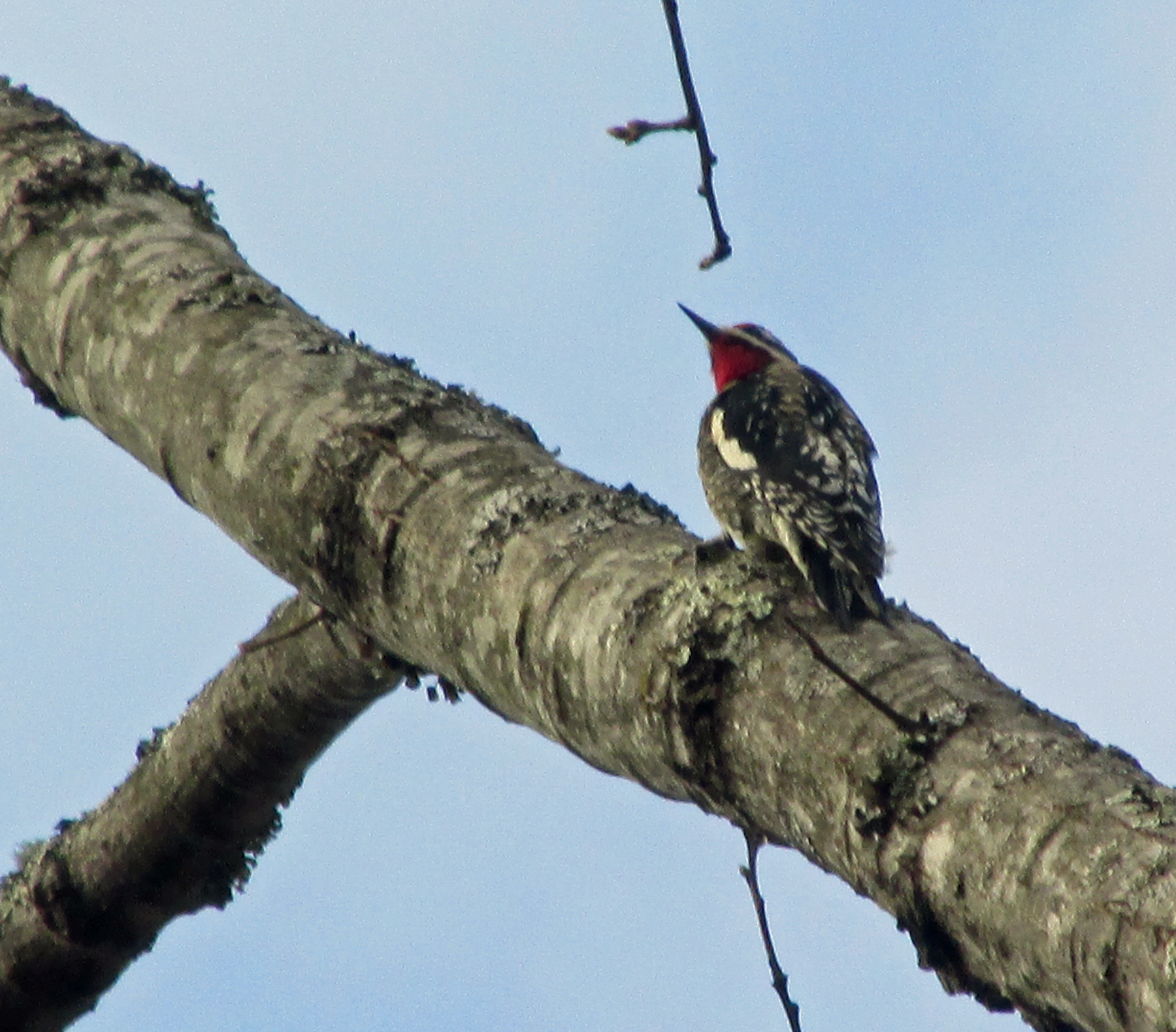
Photo by Jean Potter • A yellow-bellied sapsucker visits a suet feeder.

I heard the whiny “mews” coming from a nearby tree and scanned with binoculars until I located a calling yellow-bellied sapsucker. I always think sapsuckers sound whiny, but I still celebrated seeing one from my front porch on the afternoon of Jan. 11. The new year is still young, which makes me eager to see what other birding surprises may arrive.

I’ve kept track of the birds in my yard since the winter of 1992-1993, and my recent observation is only the second sapsucker I have seen at home. I’ve found the evidence of their presence in sapsucker rings drilled in bands of holes around tree trunks and branches, but the actual flesh and feather sapsuckers have been extremely evasive.

Photo by Bryan Stevens • A yellow-bellied sapsucker hitches its way up a tree trunk.

The aforementioned rings or bands are the visible evidence of a sapsucker’s penchant for drilling evenly spaced holes, or wells, into the trunk of a sap-bearing tree. These holes even form patterns completely encircling a tree’s trunk. The sticky wells trap insects. When sapsuckers return to the scene of the crime, they enjoy a sweet treat of oozing sap and a protein snack from the mired bugs.

I don’t think my lack of success with sapsuckers at home is for lack of effort. I heard the sapsucker the moment I stepped outside to fill up the feeders. The sapsucker blended almost perfectly into its surroundings, becoming almost invisible against the bark until making little hitching movements up the trunk. I wish I could report that I see yellow-bellied sapsuckers on a regular basis. I think they would be fascinating to observe in the same way I watch downy woodpeckers and red-bellied woodpeckers.


Worldwide, there are almost 10,000 species of birds. After awhile, one may begin to wonder if thinking of unique names for each of these species began to deplete creative reserves.

Then again, some of the names given to birds suggest someone really wanted just to have fun at the expense of birders and nature enthusiasts. After all, you have to be careful about shouting out bird names like blue-footed booby, great bustard and hoary redpoll in mixed company.

There are also bird names that just don’t make a lot of sense — dickcissel and phainopepla, for example — even to birders. Then there are names that are oxymoronic, including greater pewee and giant hummingbird.

There are some bird names that sound like fighting words that bring into question concepts like courage and honor. Indeed, I sometimes think people are waiting for a punchline when I inform them there truly is a species of bird known as the yellow-bellied sapsucker. This bird’s humorous name is only one of the ways the yellow-bellied sapsucker stands out as an oddball among the region’s clan of woodpeckers.

In profile clinging to the trunk of a tree, the yellow-bellied sapsucker is a rather pudgy, especially for a woodpecker. The sapsucker has black and white plumage enhanced by red foreheads in both sexes. Male sapsuckers also have a bright red throat patch. Both sexes also show a large white stripe on their black wings. And yes, there is enough of a pale yellow wash on the stomach of this odd woodpecker to justify the descriptive “yellow-bellied” as part of its common name.

As mentioned, sapsuckers harvest sap by using their bills to drill various sorts of holes into the bark of a tree. Some of the more shallow holes, which are usually made in a rectangular fashion, must be maintained on a frequent basis for the bird to continue to derive sap from the tree. These sap wells not only provide nourishment to the sapsucker but to other birds, including hummingbirds, that appreciate a quick sugar fix.

In the early 1800s, early naturalist and artist John James Audubon painted the yellow-bellied sapsucker, known during his time as the yellow-bellied woodpecker. Although they tend to prefer trees like maple and birch, sapsuckers are known to feed on more than 250 different varieties of trees. Indeed, they actually do feed on the trees. Not only do these birds subsist largely on sap, they also feed on the cambium layer in the bark of a tree. The sapsucker also supplements its diet with insects, fruits and seeds. Unlike other members of the woodpecker clan, sapsuckers do not visit feeders all that frequently. When a sapsucker does visit a feeder, it is often lured there by the promise of suet.


While most woodpeckers attempt to tough out the winter season in the same region where they spent the summer, the yellow-bellied sapsucker is migratory. Ahead of the coldest months of the year, sapsuckers migrate to the southeastern United States, as well as the West Indies and Central America. During the summer months, most sapsuckers nest in forests across Canada, Alaska and the northeastern U.S. states. There is also a small population of breeding sapsuckers in the Appalachian Mountains of Virginia, Tennessee and North Carolina.

The yellow-bellied sapsucker has a call that sounds amazingly like the meow of a cat. I know about this call from personal experience. While birding in South Carolina a few years ago, I searched diligently for the source of such a call. It sounded somewhat like a gray catbird — another mimic of the common household feline — but not quite. Now I know that when I hear this unusual call I can train my binoculars on the branches and trunks of nearby trees to scan for a sapsucker.

There are actually another three sapsucker species — Williamson’s, red-breasted and red-naped — in North America, but they are all birds of the western half of the continent.

It is true of many species of birds that males and females look different. In the case of the Williamson’s sapsucker, males and females look so different that early naturalists mistakenly believed the male and female were entirely different species! Only two decades after the initial discovery of this bird did scientists finally realize that both male and female Williamson’s sapsuckers were the same species. This particular sapsucker was named in honor of Lt. Robert Stockton Williamson, who led a surveying expedition that collected the first male. The intent of the expedition wasn’t focused on collecting birds. Williamson and his men had actually been assigned the job of identifying the best route west for a railway to the Pacific Ocean.

Although I haven’t been too lucky with this bird at my home, it isn’t too difficult to find this bird during fall migration and in the winter months at city and state parks in the region. If you observe a yellow-bellied sapsucker in your own yard, consider yourself lucky to get a glimpse of this oddball woodpecker.

Winter season wouldn’t be complete without the splendor of cardinals

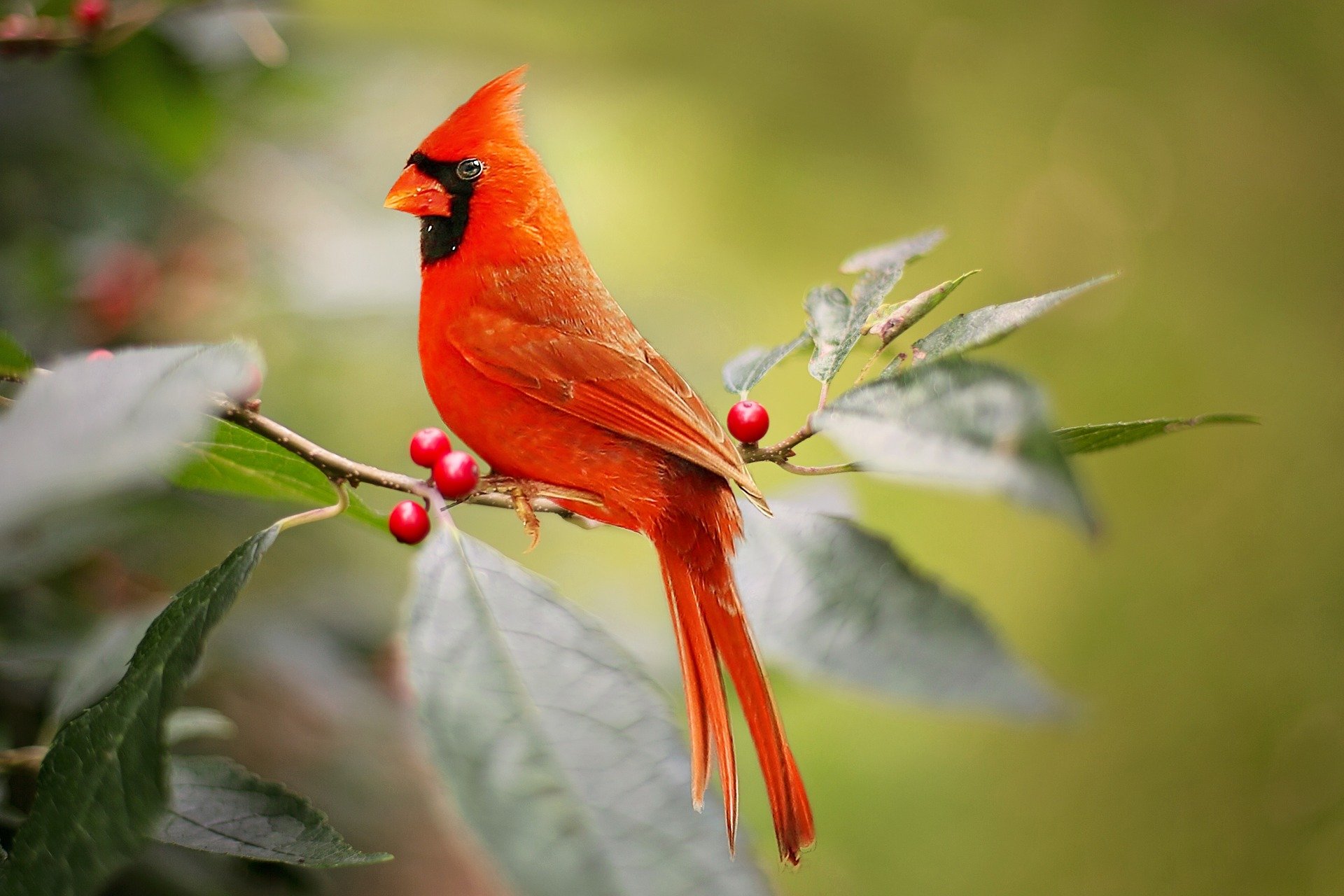
Photo by Jill Wellington/Pixabay.com • A male Northern cardinal grasps a branch of winter greenery.

I have enjoyed an opportunity to observe the many Northern cardinals visiting my feeders in recent weeks. The beauty of both male and female cardinals is undeniable, but it’s their behavior that’s worth a second look. Nervous, twitchy birds, they are always anxiously surveying their surroundings even as they linger on a feeder long enough to hull a sunflower kernel from its shell. It’s almost as if they know their bright plumage stands out in a drab winter landscape dominated by shades of gray.

The Northern cardinal, especially the brilliant red male, stands out against a winter backdrop of snow white, deep green or drab gray. Over the years, the cardinal has also become associated with the Christmas season. How many Christmas cards have you received this holiday season with a cardinal featured in the artwork? I’d wager that at least a few cards in any assortment of holiday greetings will feature the likeness of a Northern cardinal.

There’s some more evidence to put forward as testimony to the popularity of the Northern Cardinal. It’s the official state bird of seven states: North Carolina, West Virginia, Ohio, Illinois, Indiana, Kentucky and Virginia. Only the Northern mockingbird, which represents five states as official state bird, even comes close to the Northern cardinal in this respect.

The Northern cardinal belongs to a genus of birds known as Cardinalis in the family Cardinalidae. There are only two other species in this genus, and they range across North America and into northern South America.

The two relatives are the pyrrhuloxia, or Cardinalis sinuatus, of the southwestern United States, and the Vermilion cardinal, or phoeniceus, a bird found in Colombia and Venezuela. Two other South American birds — red-crested cardinal and yellow-billed cardinal — are more closely related to tanagers than to our familiar Northern cardinal. Both the Northern cardinal and red-crested cardinal have been introduced into the state of Hawaii, so two non-native birds from different parts of the globe are now resident in the Aloha State.

Photo by Jack Bulmer/Pixabay.com • A male cardinal grips a branch to make a quick survey of its surroundings.

The Northern cardinal is a native and abundant bird. Cardinals are a widespread species, ranging westward to the Dakotas and south to the Gulf Coast and Texas. The southeastern United States was once the stronghold of the cardinal population. In the past century, however, cardinals have expanded their range into New England and Canada.

The cardinal accepts a wide variety of food at feeders. Sunflower seed is probably their favorite, but they will also sample safflower seed, cracked corn, peanuts, millet, bakery scraps and even suet. While we may get the idea that cardinals feed largely on seed, that is a misconception based on our observation of the birds at our feeders. Cardinals away from our feeders eat insects and fruit, including the berries of mulberry, holly, pokeberry, elderberry, Russian olive, dogwood and sumac.

The cardinal uses its large beak to efficiently hull sunflower seeds or deal with other foods foraged in field and forest away from our feeders. The large, heavy beak hints at the cardinal’s kinship with birds such as tanagers and grosbeaks. In fact, some of America’s early naturalists referred to the bird as “cardinal grosbeak.” Other common names include the apt “redbird” moniker and “Virginia nightingale.”

Photo by Skeeze/Pixabay.com • A male Northern cardinal lands on a snowy perch. Cardinals are perfect symbols for the Christmas season with their bright red plumage.

Even once the holidays are past, there’s nothing like a glimpse of a Northern cardinal to add some cheer to a bleak winter day. People can also choose to further the cause of science by taking part in studies such as Project FeederWatch, a nationwide survey of bird populations focused on birds coming to feeders maintained by project participants.

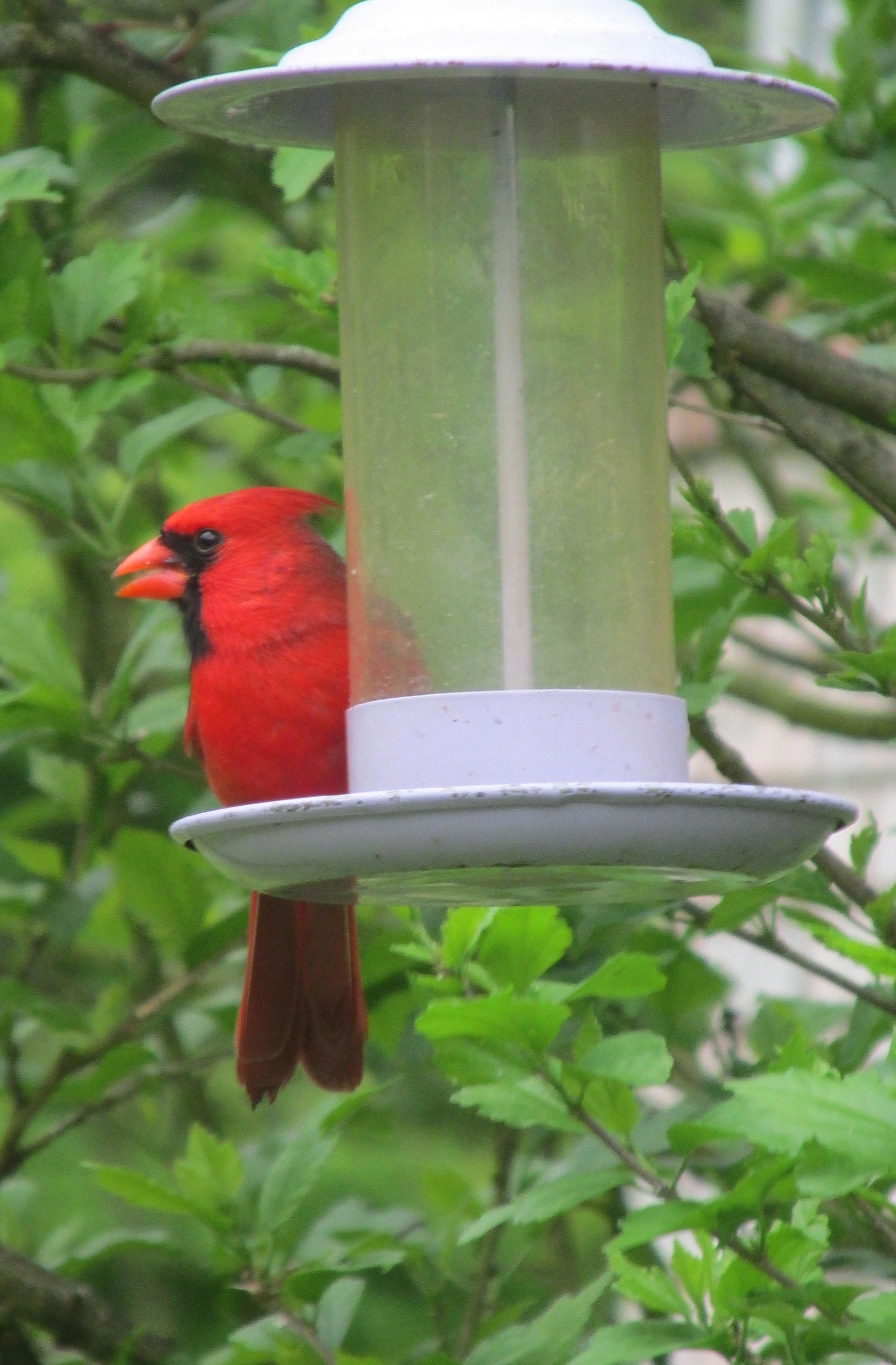
Photo by Bryan Stevens • A male Northern cardinal pays a visit to a feeder.

In the 2015-16 winter season, 1,373 individuals participated in Project FeederWatch in the southeastern United States. The most common birds reported by observers were Northern cardinal, Carolina chickadee, mourning dove, American goldfinch and tufted titmouse. Finishing out the Top 10 feeder birds in this section of the nation were Carolina wren, house finch, blue jay, red-bellied woodpecker and downy woodpecker. Almost 98 percent of participants reported Northern cardinals at their feeders, which means the cardinal has become an almost universal feeder visitor in the southeast.

It’s not surprising that such a popular bird has also become associated with many trappings of the Christmas season.

“You see cardinals on greeting cards, stationery, paper plates, paper napkins and tablecloths, doormats, light switch plates, candles, candle holders, coffee mugs, plates, glasses, Christmas tree ornaments and lights, bookmarks, mailboxes, Christmas jewelry,” writes June Osborne in her book The Cardinal. “And the list goes on. Cardinals have become an integral part of the way that many people celebrate the holiday season.”

I can be included among such people. My Christmas decorations include an assortment of cardinal figurines and ornaments. There are other birds — doves and penguins for example — associated with the holiday season, but for me the holidays magnify the importance of one of my favorite birds. The cardinal, in its festive red plumage, appears made to order for a symbol of the holiday season.

Photo by Bryan Stevens • Northern cardinal seems much less descriptive of this popular bird than such common names as Virginia nightingale and Kentucky redbird.

Here’s some additional cardinal trivia to increase your knowledge of this fascinating bird:

• Cardinals differ in appearance based on gender. The male boasts crimson plumage, a crest, a black face and orange bill. The female, although less colorful, is also crested. Female cardinals are soft brown in color, with varying degrees of a reddish tinge in their feathers, particularly in their wings.

• The cardinal’s preference for dense cover makes them likely neighbors for such birds as Carolina wrens, Eastern towhees and brown thrashers.

• The oldest recorded Northern Cardinal was a female, and she was 15 years, nine months old when she was found in Pennsylvania, according to the website, All About Birds.

• An uncommon genetic variation sometimes produces a cardinal with yellow or orange feathers instead of the typical red. The scientific name for the condition that produces yellow cardinals is known as xanthochroism. This condition also often occurs in house finches.

• Nests are built by the female cardinal, but her mate delivers food as she incubates her clutch of eggs, which usually numbers three or four.

Photo by Bryan Stevens • A female Northern Cardinal feeds during a snowstorm at a hanging tray filled with sunflower seeds.

Rufous hummingbirds appear after other hummers depart for the winter

Photo by Bryan Stevens • A young rufous hummingbird approaches a feeder for a sip of sugar water. These hummingbirds, which are native to the western United States and Canada, have become regular visitors throughout the eastern United States in late fall and early winter.

Almost every year since beginning to write this column, I have penned articles about the phenomenon of wintering hummingbirds. With the official 2020-21 winter season approaching, I have already gotten word of hummingbirds making themselves at a couple of homes in the region, as well as from such far-flung locales as Ohio and New York.

Photo by U.S. Fish & Wildlife Service/Dave Menke • The rufous hummingbird is increasingly becoming a migrant/winter resident in the eastern United States.

Katherine Noblet, a former resident of Johnson City, Tennessee, is hosting a rufous hummingbird at her home in Mount Vernon, Ohio. The tiny bird was banded and identified on Nov. 16. The verdict? The tiny visitor is a first-year female rufous hummingbird.

Noblet, who also hosted rufous hummingbirds when she lived in Tennessee, has posted on Facebook about her most recent winter hummingbird. She noted that the hummingbird, which she has named Reba, first appeared on Nov. 14. Temperatures have dipped into the 20s during the bird’s stay.

“Why a few of these tiny creatures want to hang around this far north is a mystery, but she looks happy and healthy and cannot be existing on just sugar water,” Noblet noted in a Facebook post on Nov. 24. “I have to trust she knows what she is doing.”

Closer to home, some Roan Mountain residents have reported lingering hummingbirds.

Leslie and Kathie Storie, who reside on Heaton Creek in Roan Mountain, Tennessee, posted to Facebook on Oct. 29 about a visiting hummingbird.

Photo by Bryan Stevens • A rufous hummingbird grasps a briar as a perch for a moment’s rest from its frantic activities.

“We had a hummingbird on Heaton Creek about 6 o’clock today,” they noted in a post on my Facebook page.

Although they had already taken down their feeders, they reported still having pineapple sage and lantana in bloom in their yard. These flowers are favorites of hummingbirds and would no doubt help attract one of these tiny birds.


Judi Sawyer, also a resident of Roan Mountain, has hosted not one but two rufous hummingbirds this fall. She noticed the birds in early October. One of the two birds was banded and documented on Oct. 4. One of the birds evaded the bander’s traps, but the one that was banded was identified as an immature male rufous hummingbird.

I also received an email recently from Susan Jensen, a resident of Carmel, New York, about a lingering hummingbird at her feeders. She had found one of my online articles about wintering hummingbirds and contacted me for more information.

“We have had ruby-throated hummingbirds for many years and I have three feeders for them during the season,” Jensen said. “I always leave one up until I know for sure everyone has passed through to their winter location.”

In October, she reported a feeder visitor that looked like a strange ruby-throated hummingbird. She described the bird as bronze and rusty with a bit of green.

Photo by Bryan Stevens • Rufous hummingbirds have been extensively documented as wintering throughout the southeastern United States. This male rufous hummingbird was documented in Hampton, Tennessee, a couple of years ago.

“For about two weeks I thought it was a ruby-throated hummingbird until I realized it wasn’t,” Susan wrote in her email.

After a quick Google search, I emailed Susan and put her in touch with Robert Yunick of Schenectady, New York. On Friday, Nov. 20, he traveled to Susan’s home. He banded the bird, which he identified as juvenile female rufous hummingbird, confirming Susan’s thoughts on the bird’s identity. Susan shared a video of the banding process at this link:

https://share.icloud.com/photos/0wh7RBoUKoPsxXBvQi39coTCQ

“It has been here since Oct. 10,” she informed me in an email. She noted that the bird has endured at several freezing nights when the temperature dipped down to 20 degrees.
“I change the feeder every three days and, if it is frozen like it was this morning, I change it again,” she said. “We are now going to bring the feeder in at night and put it out early the next morning.”

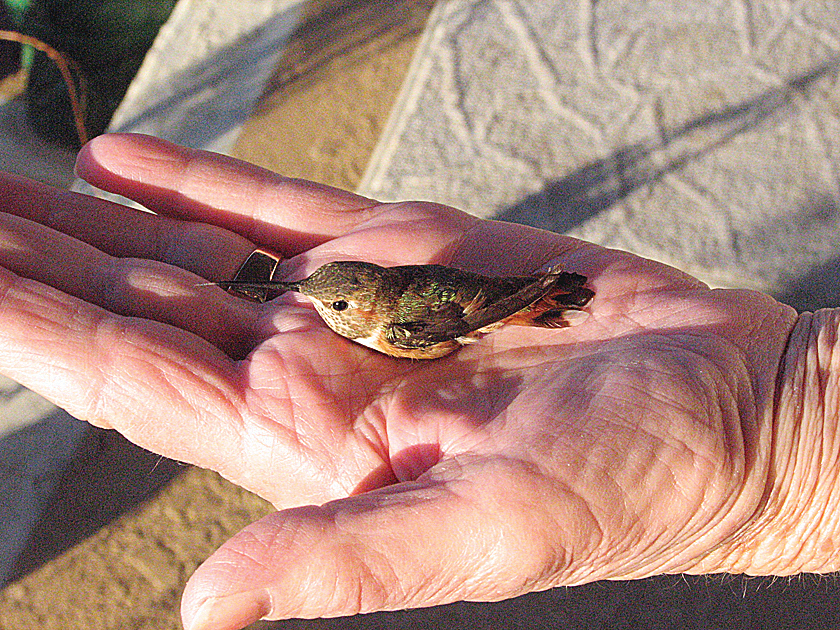
A rufous hummingbird hosts in a host’s hand after being banded and documented in Hampton, Tennessee, several years ago.

Susan enjoyed observing the banding process. “The whole process was surprising,” she wrote to me. “I had never witnessed anything like it.”

Susan said the visiting hummingbird got caught in the trap fairly quickly.

“Bob worked very quickly to measure and band her,” Susan added. “It took about 20 minutes and he fed her three times.”

At the conclusion of the process, she got to hold the tiny visitor. “I have held a hummingbird before, but it was still very special,” Susan said.

She also shared what she termed an “extra story” about hummingbirds.

“About three to four years ago, I was sitting on my deck, watching the babies (immature) hummingbirds buzz around later in the evening,” she said. “They chase each other, and do all kinds of acrobatics.”

During that evening’s antics, one of the hummingbirds flew right into the post used to hold Susan’s feeder.

“It knocked itself out, falling on the railing,” Susan explained. “I was stunned. I picked her up and proceeded to do everything wrong until my son came home. He looked up what to do, and we righted all the wrongs.”

They realized that the bird needed to be fed, so they took down the feeder and fed her twice.

“After that, she took off,” Susan noted. “It was amazing.”

Susan shared that she has been feeding the birds at her home in New York’s Hudson Valley for over 30 years.

“My parents got me interested,” she explained. “They took up bird watching when I was in high school and I have been bird watching ever since.”

Watching birds, she noted, is her all-time favorite thing. “Even when my husband and I are hiking we are always looking for something new,” she said. “It never gets old.”

Photo by Daniel Roberts/Pixabay.com • An adult male rufous hummingbird is a dazzling bird. Many of the winter rufous hummingbirds look much less vibrant.

Through the years, I have seen several of these seemingly out-of-place hummingbirds. Some of them remain at their host’s feeders for a brief stay of a few days or a couple of weeks, but some of these hummingbirds have extended their stay for several months, lingering throughout the winter months before eventually departing in February or March.

The big question concerns whether these hummingbirds are truly lost and out of place. The answer, based on everything I have managed to learn, is that these hummingbirds are precisely where they want to be. For still unknown reasons, some of these western hummingbirds make a migration swing through the eastern United States.

Many of the visiting winter hummingbirds turn out to be rufous hummingbirds, which is a species native to the western United States. The birds visiting at the homes of Katherine, Judi, and Susan all turned out to be rufous hummingbirds. It’s likely the visitor reported by the Storeys was also a rufous hummingbird.
In the summer months, the ruby-throated is the expected species of hummingbird in the eastern United States. In the winter months — not so much. However, in regions all across the Eastern United States, as well as along the Gulf Coast, a few ruby-throated hummingbirds are attempting to overwinter.

The rufous hummingbird has basically become an expected winter visitor each year in Southwest Virginia, East Tennessee, and western North Carolina. A few reports are received each winter. I have observed rufous hummingbirds in many different locations throughout East Tennessee and Southwest Virginia.

Winter hummingbirds, while always a delightful surprise for their hosts, no longer shock long-time birders. We’ve grown to expect them. If any readers are still hosting lingering hummingbirds at their feeders, I’d love to hear their stories. Email me at ahoodedwarbler@aol.com.

Twenty-five years ago this week, dark-eyed junco provided inspiration for first column

I wrote my first bird column on Sunday, Nov. 5, 1995, which means this weekly column is marking its 25th anniversary this week. This column has appeared over the last three decades in a total of six different newspapers, which I regard as a personal achievement, as well as an accomplishment for our feathered friends. It’s on their behalf that I pen these weekly efforts to promote conservation and good will toward all birds. I have also posted the column as a weekly blog posting since February of 2014 at ourfinefeatheredfriends.wordpress.com.

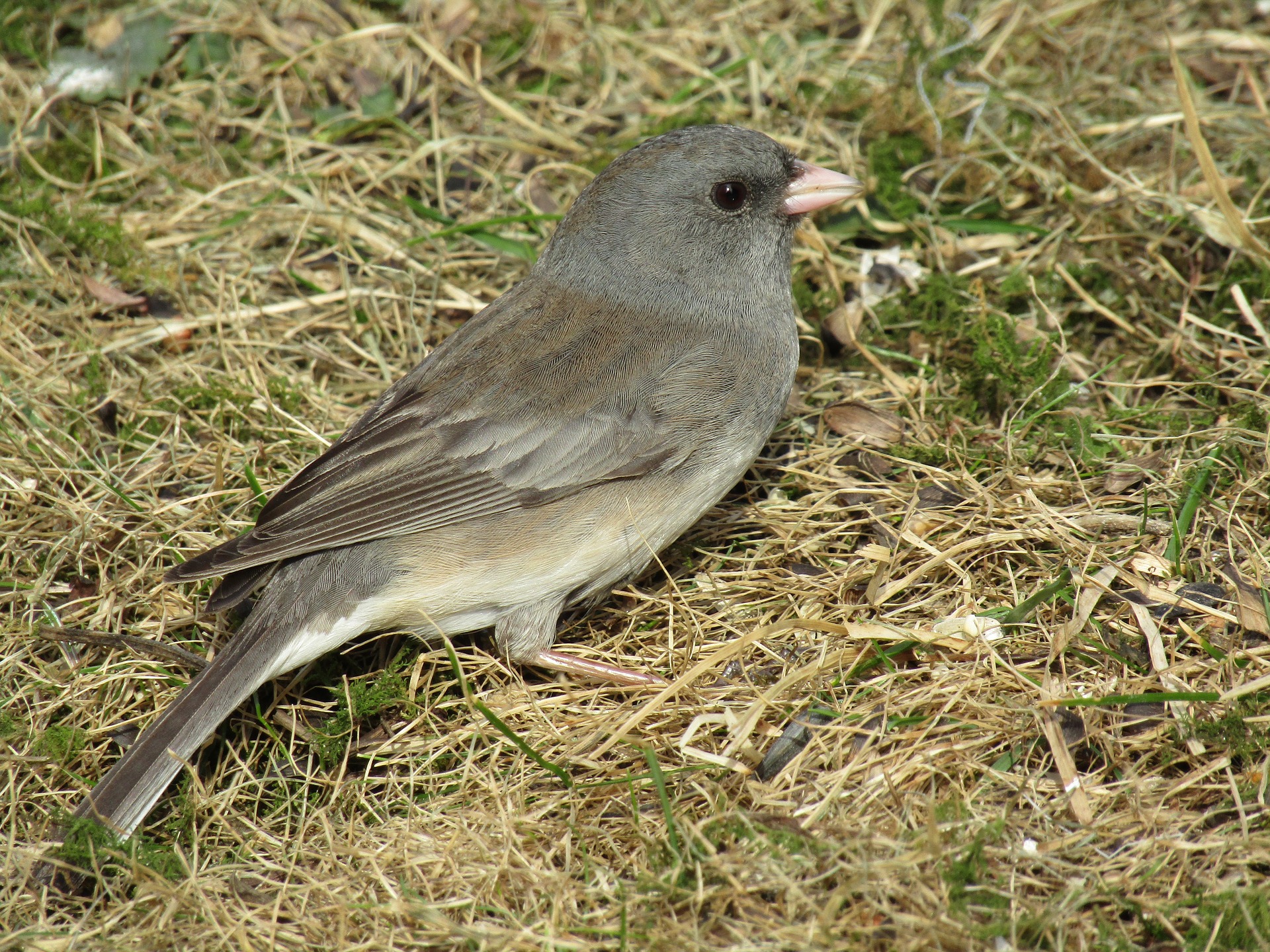
Photo by Steve McLeod/Pixabay.com • The dark-eyed junco is a fairly common winter resident in the region. Rather widespread, different races of the dark-eyed junco are found throughout the North American continent.

I’ve played detective, helping people identify everything from “rain crows,” or cuckoos, to Muscovy ducks and double-crested cormorants. I’ve observed unusual birds, including white pelican, brant and roseate spoonbill, in Northeast Tennessee and Southwest Virginia and spotlighted them in these columns. I still take delight in the kaleidoscopic parade of colorful warblers that pass through the region each spring and fall as well as the fast-paced duel of ruby-throated hummingbirds and the occasional rufous hummingbird straying through the region.At my home, I also provide sunflower seed and other supplemental food for the resident birds like Carolina chickadees, white-breasted nuthatches, song sparrows and downy woodpeckers.

Photo by Steve McLeod/Pixabay.com • The dark-eyed junco is a fairly common winter resident in the region. They are faithful feeder visitors during bouts of wintry weather.

Even as I write my silver anniversary column for “Feathered Friends,” local weather forecasters are predicting the winter’s first hard freeze. This prognostication of approaching winter weather is a perfect time to dust off this week’s column, which is a revision of the first bird column I ever wrote. This column focused on a common visitor to yards and feeders during the winter months. In fact, dark-eyed juncos should be returning to the region any day. Here, with some revisions I have made through the years, is that first column.

•••••

Of all the birds associated with winter weather, few are as symbolic as the dark-eyed junco, or “snow bird.” The junco occurs in several geographic variations.

John V. Dennis, author of “A Complete Guide to Bird Feeding,” captures the essence of the junco in the following description: “Driving winds and swirling snow do not daunt this plucky bird. The coldest winter days see the junco as lively as ever and with a joie de vivre that bolsters our sagging spirits.” The dark-eyed junco’s scientific name, hyemalis, is New Latin for “wintry,” an apt description of this bird.

Most people look forward to the spring return of some of our brilliant birds — warblers, tanagers and orioles — and I must admit that I also enjoy the arrival of these birds. The junco, in comparison to some of these species, is not in the same league. Nevertheless, the junco is handsome in its slate gray and white plumage, giving rise to the old saying “dark skies above, snow below.”

Photo by Bryan Stevens / A Dark-eyed Junco visits a hanging feeder.

Just as neotropical migrants make long distance journeys twice a year, the junco is also a migrating species. But in Appalachia, the junco is a special type of migrant. Most people think of birds as “going south for the winter.” In a basic sense this is true. But some juncos do not undertake a long horizontal (the scientific term) migration from north to south. Instead, these birds merely move from high elevations, such as the spruce fir peaks, to the lower elevations. This type of migration is known as vertical migration. Other juncos, such as those that spend their breeding season in northern locales, do make a southern migration and, at times, even mix with the vertical migrants.

During the summer months, a visit to higher elevations mountaintops is almost guaranteed to produce sightings of dark-eyed juncos. Juncos may nest as many three times in a season. A female junco usually lays three to six eggs for each nest, which she constructs without any assistance from her mate.

Photo by Bryan Stevens • Dark-eyed junco nests on high mountain slopes during the summer month. This dark-eyed junco was photographed at Carver’s Gap on Roan Mountain during the summer nesting season.

Juncos are usually in residence around my home by early November. Once they make themselves at home I can expect to play host to them until at least late April or early May of the following year. So, for at least six months, the snow bird is one of the most common and delightful feeder visitors a bird enthusiast could want.

 Juncos flock to feeders where they are rather mild-mannered — except among themselves. There are definite pecking orders in a junco flock, and females are usually on the lower tiers of the hierarchy. Females can sometimes be distinguished from males because of their paler gray or even brown upper plumage.

Since juncos are primarily ground feeders they tend to shun hanging feeders. But one winter I observed a junco that had mastered perching on a hanging “pine cone” feeder to enjoy a suet and peanut butter mixture.

Photo by Ken Thomas • A dark-eyed junco perches on some bare branches on a winter’s day.

Dark-eyed juncos often are content to glean the scraps other birds knock to the ground. Juncos are widespread. They visit feeders across North America. The junco is the most common species of bird to visit feeding stations. They will sample a variety of fare, but prefer such seeds as millet, cracked corn or black oil sunflower.

There’s something about winter that makes a junco’s dark and light garb an appropriate and even striking choice, particularly against a backdrop of newly fallen snow.

Of course, the real entertainment from juncos come from their frequent visits to our backyard feeders. When these birds flock to a feeder and began a furious period of eating, I don’t even have to glance skyward or tune in the television weather forecast. I know what they know. Bad weather is on the way!

•••••

If you’d like to share your first sighting this season of dark-eyed juncos as the temperatures get colder, email me at ahoodedwarbler@aol.com. As always, the column is also a line of communication with fellow bird enthusiasts. I’ve enjoyed sharing stories about birds with countless readers over the past 25 years. I can also be reached on Facebook at https://www.facebook.com/ahoodedwarbler.