Category Archives: Thrushes

Looking for fall migrating birds already underway

A male Wilson’s warbler perches in some branches. Many species of warbler migrate through the region each fall.

Summer’s waning. Just look at the calendar. We’re already approaching the midway point in August.

Birders track the transitions as one season merges into another, knowing that these are some of the best times to seek out birds. Fall migration doesn’t wait for a page to turn on a calendar. In fact, some birds are already on the move. I thought I’d devote this week’s column to some of the birds I hope to observe this fall as a mass migration draws many of our summer residents south toward warmer wintering grounds. In no particular order, here are some of the birds I’m hoping to see this autumn.

COMMON NIGHTHAWKS

The name common nighthawk is a misnomer. The species is not strictly nocturnal and it is certainly not a hawk. It’s actually a member of the nightjar family, which includes such birds as chuck-will’s-widow and whip-poor-will. The nighthawk doesn’t offer a serenade like these relatives, but it does produce a “pent” call that sounds much like an electric buzzer. It’s often the first indication of one of these birds swooping overhead. Nighthawks form impressive flocks, often numbering in the dozens or even hundreds. They are often active in evening hours, but I’ve seen large flocks of these migrating birds in mid-afternoon. August and September are the best time to look skyward to enjoy the spectacle of a large flock of swooping nighthawks as they pass overhead.

Photo by U.S. Fish and Wildlife Service
A Common Nighthawk finds a perch for a brief rest.


I didn’t host any of these colorful birds this spring, so I hope to get another opportunity this fall. The males in their vibrant black-and-white plumage and namesake breast patch of rosy-red feathers are slightly less colorful in the fall. I’ve actually had better luck in autumn hosting these birds at feeders. They love sunflower seeds, so keep your feeders stocked with their favorite foods to increase your chances. Females and young birds look different than adult males, but the heavy beak (the word “gros” is German for large) is a good indicator of their identity. Bird banders netting this species to document information for science can testify that these birds are also capable of a nasty nip at careless fingers with that stout bill.

Bryan Stevens • A pine warbler visits a suet feeder.

WARBLERS

These birds are undeniably at their most gorgeous during spring migration, but many species of warbler retain colorful plumage into the fall season. Young birds, often in a plumage entirely different than adult birds, are responsible for the term “confusing fall warblers.” I’ll be looking for the species that are harder to locate in the spring, including bay-breasted warbler, Cape May warbler, Blackburnian warbler and Tennessee warbler. I’ll also be hoping for a rarity such as cerulean warbler or mourning warbler. I will be sad when the parade of warblers produces a palm warbler or a yellow-romped warbler. These last two species are a sure sign that fall migration’s coming to a close for another season.

Photo by Bryan Stevens
A Great Egret resting on a spit of land in a lake at Murphy Candler Park in Brookhaven, Ga.

WADING BIRDS

Late summer and early fall can also be a fantastic time for scanning rivers, lakes and farm ponds for wading birds. Hurricanes in recent years have even forcibly relocated American flamingos to Tennessee and other unlikely locations. It’s slightly more reasonable to hope for something unexpected like a wood stork or roseate spoonbill. The more likely candidates for observing in the region are great egrets, tri-colored herons and snowy egrets. It’s also a last chance to view green herons before this small species retreats to warmer locations for the coming winter.
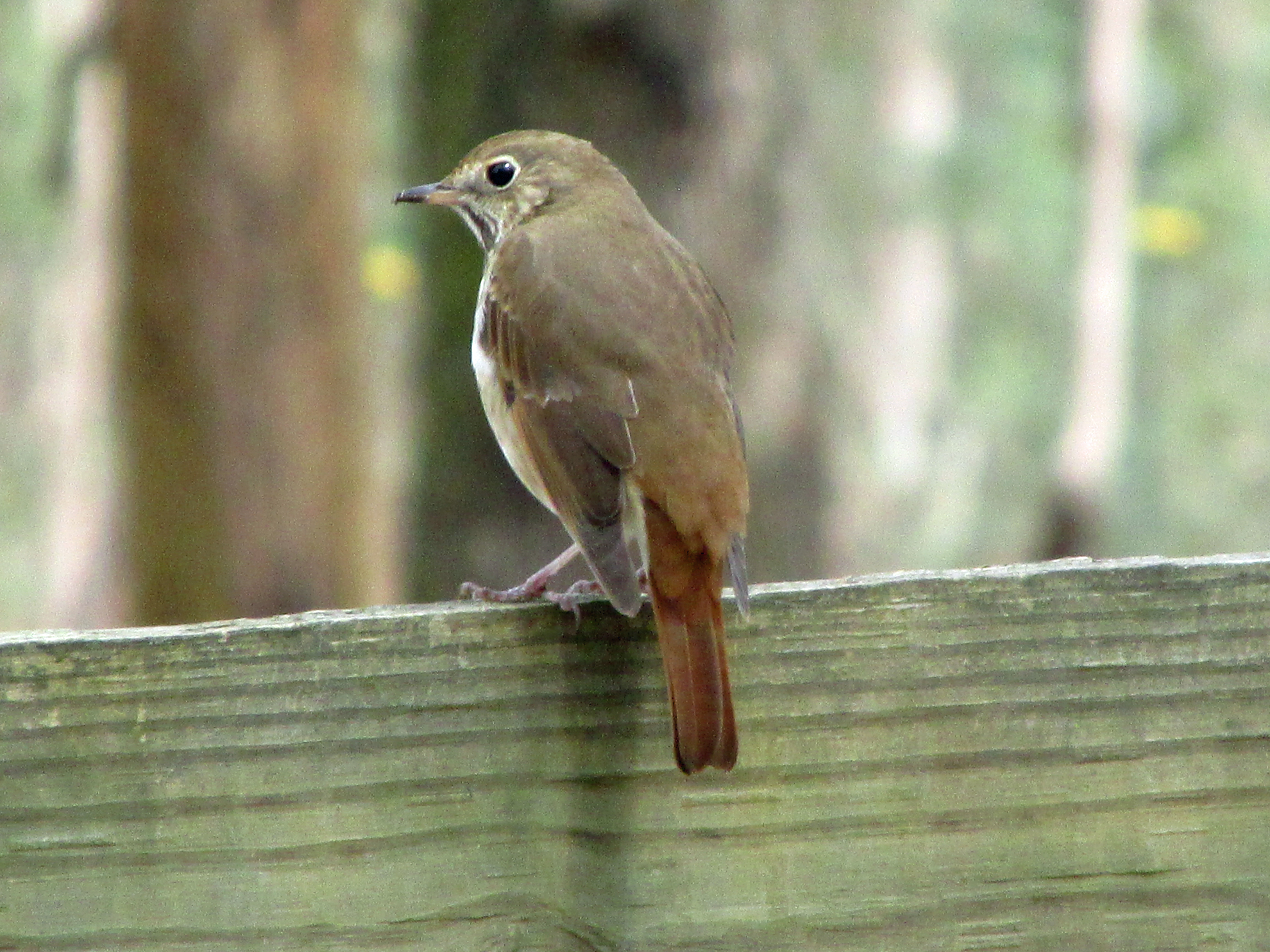
Bryan Stevens • A hermit thrush perches on a fence.

THRUSHES

These medium-sized songbirds are typically brown in plumage, often with spotted white breasts. They’re beautiful singers in spring and summer, but they’ve often cut back on their singing by fall. Nevertheless, they form large migrating flocks that will roam autumn woodlands to rest and refuel during short breaks from migrating. Swainson’s thrush is not difficult to find in the fall. This species is named in honor of 19th century artist and ornithologist William Swainson. Like most birders, I will be hoping for the more difficult species like Bicknell’s thrush and gray-cheeked thrush. Knowing their call notes can help alert you to their presence.

There will be a dazzling diversity of our feathered friends on the move this month. The seasonal phenomenon of migration extends into September and October. Pay attention to the visitors in your yards and gardens.

•••

Share sightings, ask questions or make comments by emailing me at ahoodedwarbler @aol.com.

Photo by Bryan Stevens • This migrating rose-breasted grosbeaks struck a window and spent some time recovering. Later, the bird flew safely back to a row of trees.

Hungry robins emerge during deep freeze to feast on berries

Robins – by the hundreds – poured into downtown Erwin last week. Most of them ended up on perches around the parking lot between the Clinchfield Senior Adult Center and the rear of the offices of The Erwin Record.

Photo by Bryan Stevens • While American robins like fruit when its available, they also spend a lot of time feeding on earthworms and insects.


The newspaper’s office manager Ken Silvers alerted me to the presence of the “huge flock” of robins. He even joked that he felt like he had stepped into a scene from the movie “The Birds.” Their arrival had been preceded by several nights of single digit temperatures.

In a few weeks, robins will likely be making their annual spring resurgence, but their mid-January appearance in such numbers was somewhat surprising. The fact is that, although we don’t think of robins very much in winter, they are still very much present in the region. The same is true of waxwings and is particularly true about European starlings.

While downtown Erwin would not usually be an ideal location for robins, there was something present to attract them: Berry-producing ornamental holly trees.

In the colder months of the year, robins form large, loosely organized flocks, often taking up residence in wooded lots. After several days of frigid weather, the robins were likely desperate to exploit an available food source. The flock spent a couple of hours gorging on holly berries. Even later in the day a few dozen robins lingered around the shrubs, gleaning the remaining berries from the branches.

The American robin is a large bird in the thrush family, which in North America also includes such birds as Eastern bluebird, wood thrush and Townsend’s solitaire. It’s probably a bird that is well-known to birders and non-birders alike.


In the British Isles, the European robin is simply known as “robin” or “robin redbreast.” When the first English colonists arrived in New England and other parts of colonial-era North America, they took pleasure in finding that some of the birdlife in the New World resembled familiar birds from their homeland. The red-breasted American robin looked like the bird they knew in the Old World as “robin,” which motivated them to name the New World bird “robin,” as well.

Sharkolot/Pixabay • Early American colonists from Europe, familiar with the European robin of their homeland, saw the red breast feathers on the American robin and named the large thrush robin as well.

Other than the red breast, however, the two robins are not all that similar. The American robin is the larger of the two birds. Farther separating these two birds is the fact that the European robin is not a thrush but rather a member of the family of Old World flycatchers.

In some other ways, the two robins are similar. Both are fond of earthworms, spending a great deal of their time on the ground foraging for worms. They will also follow human gardeners at their work, waiting patiently for the followed person to disturb the soil with a spade or hoe and expose earthworms for the waiting bird. They are also rather tolerant of humans and have learned to make their own homes close to human dwellings.

Some of the British transplants to North America must have felt homesick for familiar things because several unsuccessful attempts were made to introduce the European robin to the United States and Canada. European robins introduced in New York and Oregon failed to gain a foothold, unlike the introduction of such alien birds as the house sparrow and European starling.

On a few occasions, migrating American robins have overflown their destinations and ended up in the United Kingdom. For instance, an American robin became a first for London birdwatchers when one was found in that nation’s capital city in March of 2006. Whether of the European or American persuasion, robins have long been a favorite of birdwatchers and nature enthusiasts.

In a few weeks we will have more American robins pouring into our lawns, our gardens and our parks. The American robin has always been a perennial harbinger of spring. But it’s not always necessary to wait until winter’s waning to enjoy observation of this popular songbird.

•••

Bryan Stevens has written about birds and birding since 1995. To ask a question, make a comment or share a sighting, email him at ahoodedwarbler@aol.com.

Tiffany/Pixabay • The American robin keeps a lower profile but is still present in the region during the winter months.

Swainson’s thrush kicks off fall migration season

Photo by Hans Toom/Pixabay • The Swainson’s thrush is named for 19th-century naturalist William Swainson. A yearly visitor to the region, the bird’s appearance provides visible evidence that fall migration has started in earnest.

I like to kick off fall migration with a warbler sighting, but for a change of pace, a Swainson’s thrush showed up in my yard on Labor Day weekend.

I usually see more Swainson’s thrushes in the autumn rather than spring, so the sighting wasn’t anything out of the ordinary. My observation did provide the visible evidence that fall migration, an annual phenomenon among our feathered friends, has started in earnest.

The Swainson’s thrush does not nest in the region. These birds spend the summer breeding season in Canada, Alaska and the northern United States. They also nest in areas of the mountainous western United States.

In migration, this small thrush can be quite widespread, with sightings possible from coast to coast and all points between in the continental United States.

Thrushes that do nest during the summer in the region include wood thrush and veery, as well as the hermit thrush, which is also a winter resident.

William Swainson, the namesake of the Swainson’s thrush, was a famous English naturalist living in the 19th century. Swainson, who grew up in London but spent much of his adult life in New Zealand, excelled as an English ornithologist, malacologist, conchologist, entomologist and artist. Besides the thrush, eight other species of birds are named in his honor.

Two of the other birds — Swainson’s warbler and Swainson’s hawk — are resident in the United States for at least the spring and summer months.

The other six species include Swainson’s francolin, Swainson’s sparrow, Swainson’s antcatcher, Swainson’s fire-eye, Swainson’s flycatcher and Swainson’s toucan.


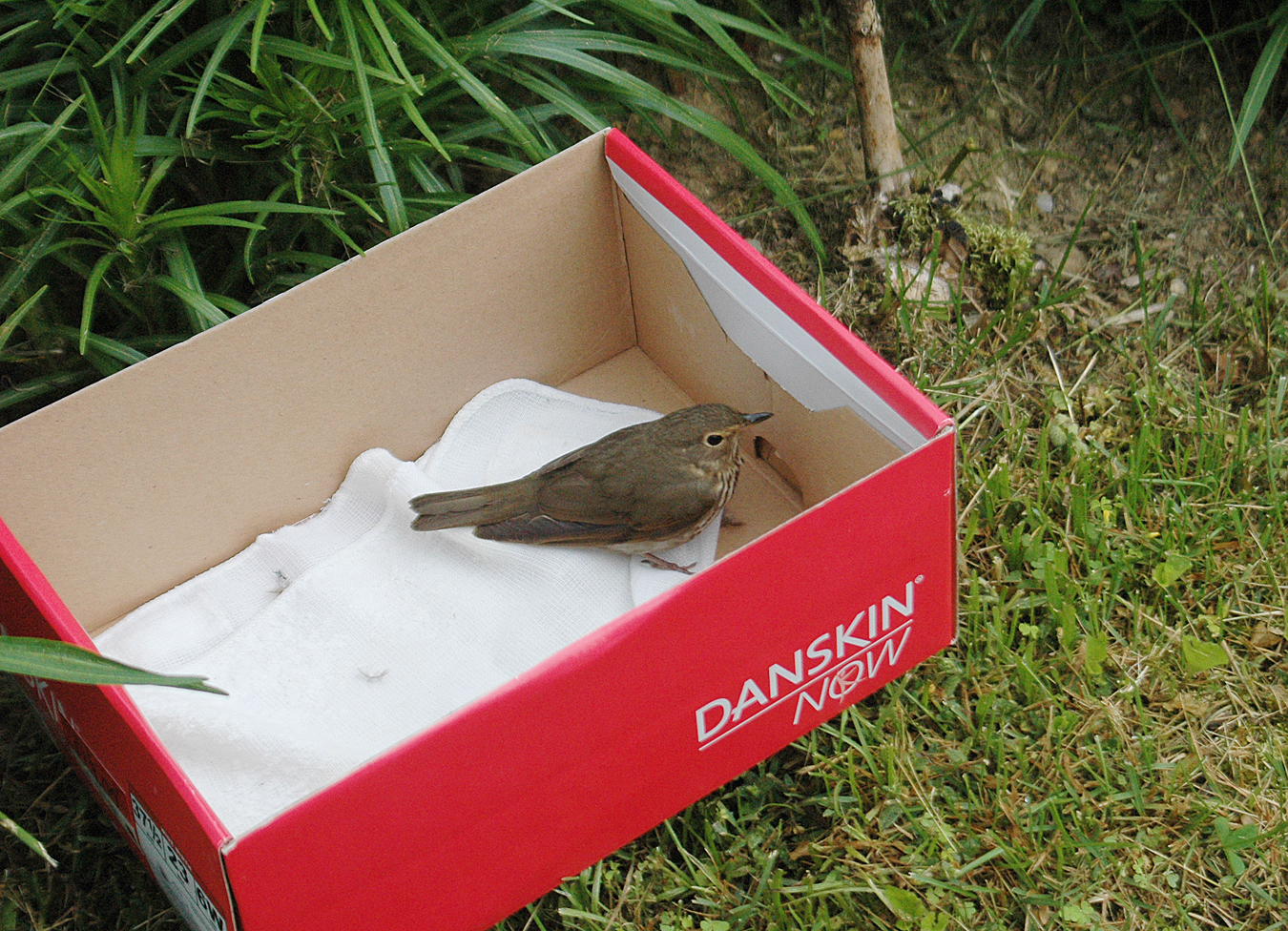
Photo by Bryan Stevens • After striking a window, this Swainson’s thrush was given time to recover in a box in a dark, quiet place before being released to continue its migration.

In what I find a surprising twist, Swainson never visited the United States of America, but in 1806, he accompanied the English explorer Henry Koster to Brazil in South America. Swainson and his family emigrated to New Zealand in 1841. Swainson settled near the New Zealand city of Wellington, only to have earthquakes in 1848 and 1855 devastate the shoreline near his estate, which he called Hawkshead. He found the pioneer life in New Zealand difficult, especially when a native Maori chief pushed his own claims to Swainson’s estate. Swainson died of bronchitis on Dec. 6, 1855, at the age of 66.

I usually see Swainson’s thrushes every fall, but some members of the family have been harder for me to observe. I’ve only twice seen a gray-cheeked thrush. My last sighting of one took place in 2018, 18 years after my first sighting.

The species is aptly named.

The gray-cheeked thrush lacks an eye ring, and its most prominent feature is the grayish plumage around the bird’s face. No evidence of brown or buff coloration intrude into the face region.

Gray-cheeked thrushes nest far from Tennessee and Virginia. In fact, they nest almost to the very edge of the tundra region in the far north. Because of this tendency to nest in remote regions, experts have had difficulty determining population trends for this species.

Most thrush migration actually takes place at night. The daytime observations of thrushes involve individuals that have stopped for a brief respite to refuel and rest.

Both the gray-cheeked thrush and Swainson’s thrush belong to the genus Catharus, a term derived from Ancient Greek that can be described as “pure” or “clean” in reference to the plumage of some of the members of the genus.

Most of this family of talented singers, which also includes the veery and the wood thrush, will depart the borders of the United States until next spring. When they get ready to leave, most thrushes will make a remarkable non-stop journey that will take them to the region where they will wait out the cold winter months. Enjoy them before they depart.

•••

To share a sighting, ask a question or make a comment, email me at ahoodedwarbler@aol.com.