Tag Archives: thrushes.

Unseen wood thrushes still make lovely music

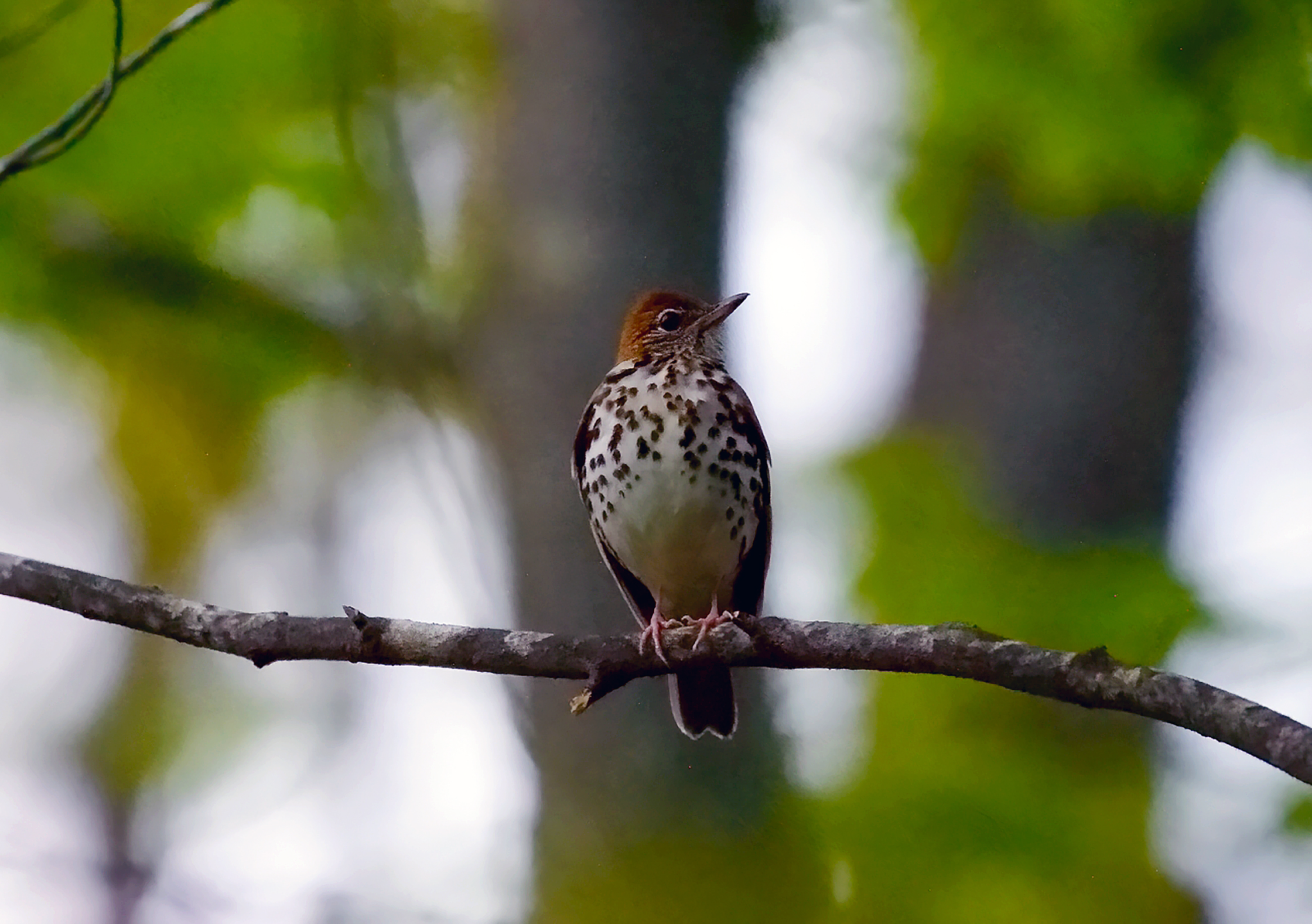
Photo by Jake Bonello/USFWS • A wood thrush sings at dusk from dense woodland cover.

The wood thrush, one of the most talented avian songsters in North America, returned this past week. I guess it’s now safe to plant corn. I’ve heard that many area gardeners hesitate to plant their corn until this native bird has given the “all clear” to signal that danger of a late freeze is past.

I haven’t seen a wood thrush yet, but I know that several of these birds have taken up residence in the woods around my home. I know because I’ve been hearing them singing mornings and evenings.

The wood thrush has a well-developed organ called a syrinx, which is the human equivalent of a larynx or voice box. For many songbirds, such as the thrushes, this specialized organ is more like a double voice box that permits a bird to produce two notes simultaneously while singing its song.

I think more people would take up the challenging pastime of birdwatching if not for the intimidation of trying to identify dozens of species that often demand attention to some specific details to contrast some birds from similar species.

But it is possible to enjoy birds even with looking at them. The wood thrush produces an elegant song that I never tire of hearing. Many other birds are vocal. They’re not all as musical as members of the thrush family, but its’s not necessary to ever lift a pair of binoculars to enjoy the birds in your own backyard. The sweet serenade of a wood thrush from woodland shadows is one of my favorite front porch evening activities every summer.

The wood thrush is one of the larger brown thrushes, which also includes such related birds as Swainson’s thrush, veery, gray-cheeked thrush and hermit thrush. Other less closely related members of the thrush family in North America include the American robin, Eastern bluebird and Townsend’s solitaire.
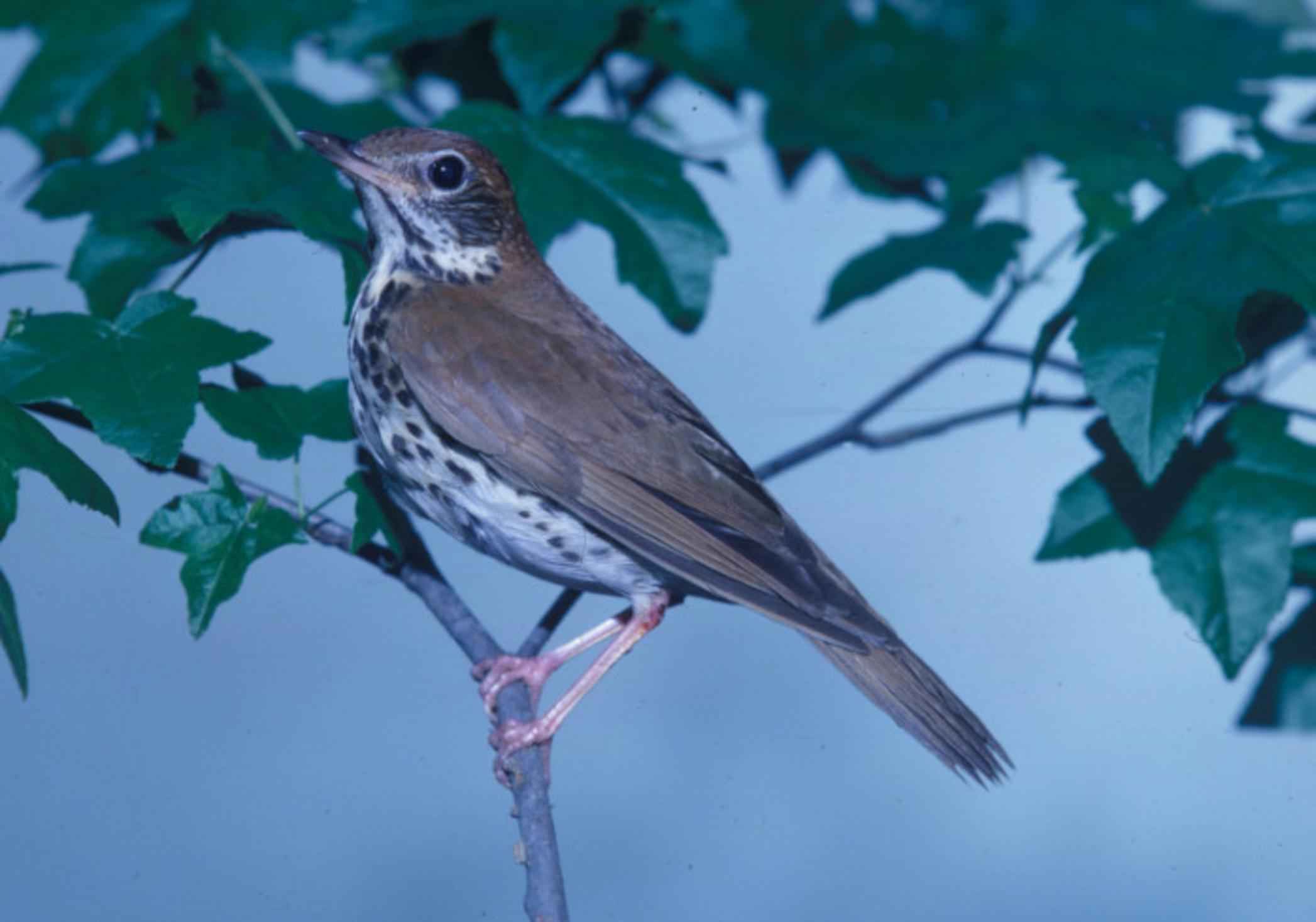
Photo by U.S. Fish & Wildlife Service • The Wood Thrush often sings its flute-like song from deep under cover in dense woodlands.

The wood thrush is a fairly common bird in the region from April to October. Wood thrushes migrate south in the fall, dispersing to Mexico and Central America for the winter months, and then they reverse the route to return each spring.

The shy wood thrush does not usually venture too far from its preferred woodland habitat, but freshly disturbed soil in a garden will attract these birds as they seek out earthworms and insect larvae. Wood thrushes also feed on various fruits and berries, which means they can be attracted by plantings of suitable trees and shrubs.

The wood thrush, like many of its relatives, sings mainly in the early morning and again in the evening hours. They will also often sing after the tumult of an afternoon thunderstorm in the summer. I encourage anyone who lives near woods to pull up a comfortable seat outdoors and let the relaxing song of a wood thrust provide a great conclusion to the the day.

Naturalists often point to one of the wood thrush’s close kin — the hermit thrush — as the most gifted singer in this clan of gifted songsters. For discerning listeners, the hermit thrush’s flute-like notes are somewhat more melancholy, haunting and ethereal than even the incredibly enchanting notes of the wood thrush’s song.

The poet Walt Whitman employed a thrush as a symbol in his poem, “When Lilacs Last in the Dooryard Bloom’d,” a moving pastoral elegy in honor of the assassinated President Abraham Lincoln.
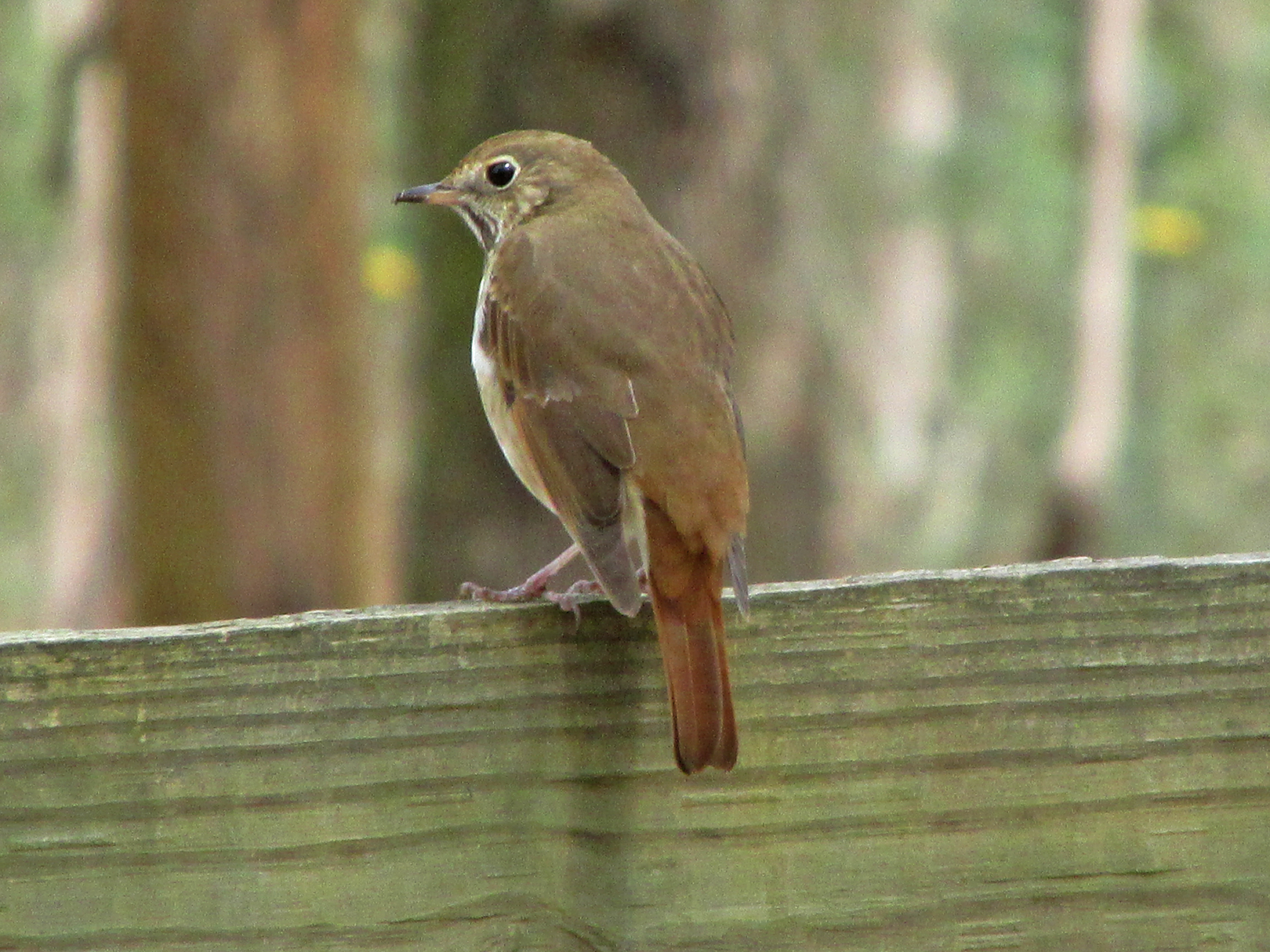
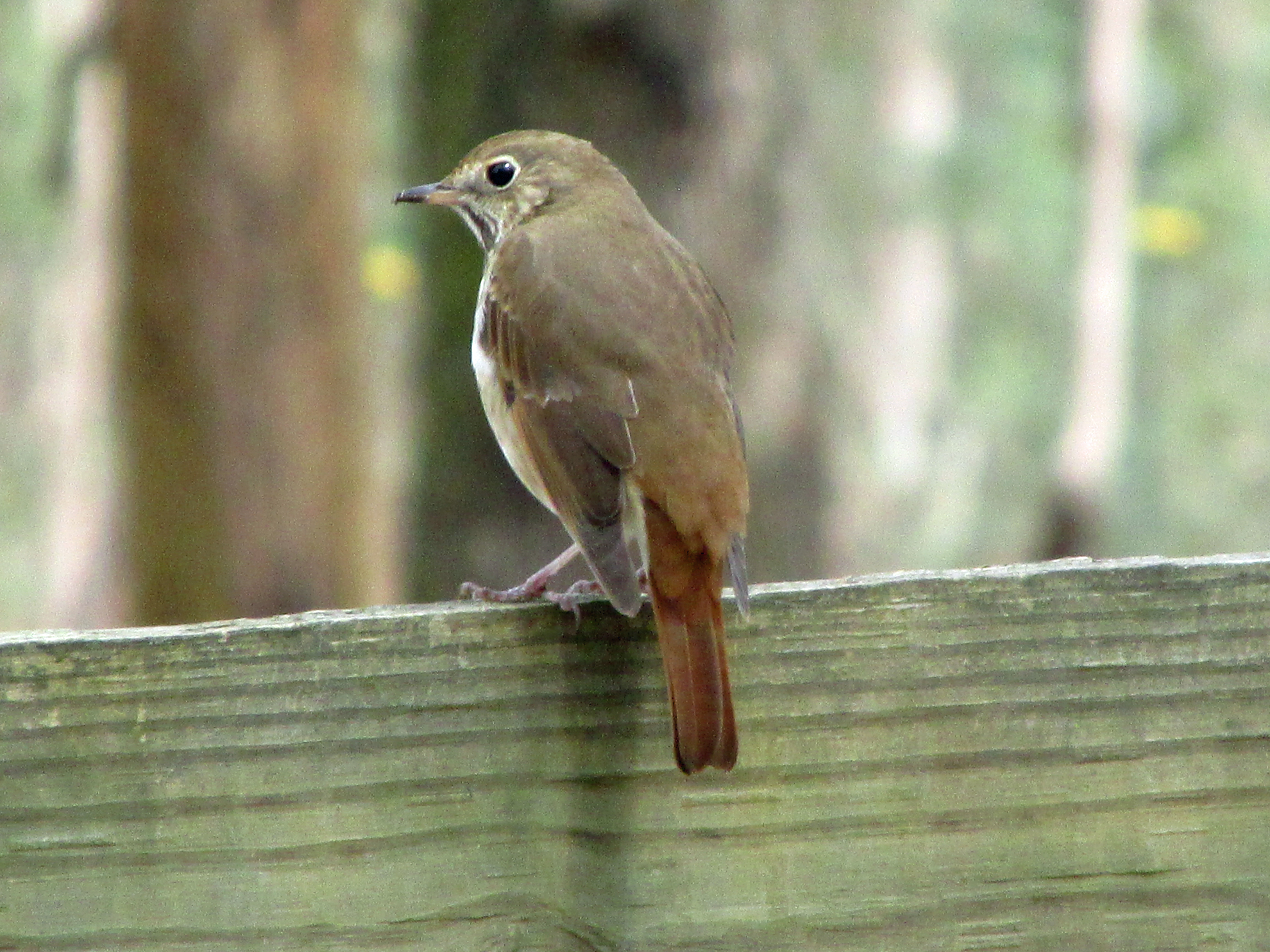
Photo by Bryan Stevens • A hermit thrush perches on a wooden fence rail. The bird’s rusty-red tail is evident in the photo.

Whitman evidently knew his birds, and it’s not difficult to identify that he referred to the hermit thrush when he wove this songbird as a symbol into his stanzas honoring Lincoln.

“Sing on there in the swamp,” Whitman wrote in his poem. “O singer bashful and tender, I hear your notes, I hear your call. I hear, I come presently, I understand you…”

Whitman and many other Americans have been made fans of this gifted songbird. In fact, the citizens of Vermont even proclaimed the hermit thrush as their official state bird.

In Northeast Tennessee, hermit thrushes are mostly a winter bird, but the wood thrush stays with us from spring to early fall. Enjoy the free music of resident wood thrushes this season. I don’t think you’ll be disappointed.
•••
To learn more about birds and other topics from the natural world, friend Stevens on Facebook at https://www.facebook.com/ahoodedwarbler. He often posts about local birds, wildlife, flowers, insects and much more. If you have a question, wish to make a comment or share a sighting, email him at ahoodedwarbler@aol.com.

Photo by Jean Potter • The wood thrush is a common summer resident of woodlands in Northeast Tennessee, Southwest Virginia and Western North Carolina.

Swainson’s thrush kicks off fall migration season

Photo by Hans Toom/Pixabay • The Swainson’s thrush is named for 19th-century naturalist William Swainson. A yearly visitor to the region, the bird’s appearance provides visible evidence that fall migration has started in earnest.

I like to kick off fall migration with a warbler sighting, but for a change of pace, a Swainson’s thrush showed up in my yard on Labor Day weekend.

I usually see more Swainson’s thrushes in the autumn rather than spring, so the sighting wasn’t anything out of the ordinary. My observation did provide the visible evidence that fall migration, an annual phenomenon among our feathered friends, has started in earnest.

The Swainson’s thrush does not nest in the region. These birds spend the summer breeding season in Canada, Alaska and the northern United States. They also nest in areas of the mountainous western United States.

In migration, this small thrush can be quite widespread, with sightings possible from coast to coast and all points between in the continental United States.

Thrushes that do nest during the summer in the region include wood thrush and veery, as well as the hermit thrush, which is also a winter resident.

William Swainson, the namesake of the Swainson’s thrush, was a famous English naturalist living in the 19th century. Swainson, who grew up in London but spent much of his adult life in New Zealand, excelled as an English ornithologist, malacologist, conchologist, entomologist and artist. Besides the thrush, eight other species of birds are named in his honor.

Two of the other birds — Swainson’s warbler and Swainson’s hawk — are resident in the United States for at least the spring and summer months.

The other six species include Swainson’s francolin, Swainson’s sparrow, Swainson’s antcatcher, Swainson’s fire-eye, Swainson’s flycatcher and Swainson’s toucan.


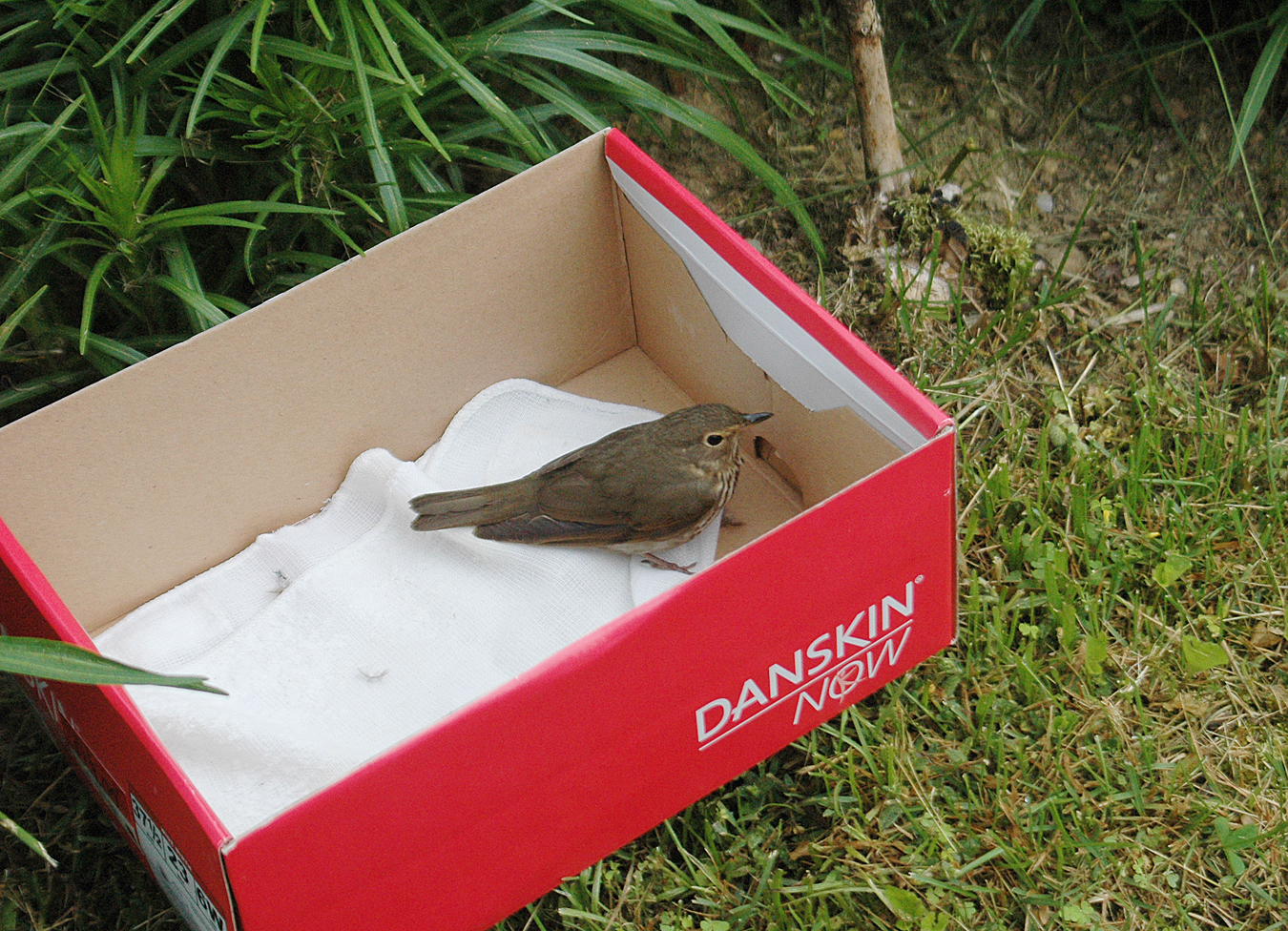
Photo by Bryan Stevens • After striking a window, this Swainson’s thrush was given time to recover in a box in a dark, quiet place before being released to continue its migration.

In what I find a surprising twist, Swainson never visited the United States of America, but in 1806, he accompanied the English explorer Henry Koster to Brazil in South America. Swainson and his family emigrated to New Zealand in 1841. Swainson settled near the New Zealand city of Wellington, only to have earthquakes in 1848 and 1855 devastate the shoreline near his estate, which he called Hawkshead. He found the pioneer life in New Zealand difficult, especially when a native Maori chief pushed his own claims to Swainson’s estate. Swainson died of bronchitis on Dec. 6, 1855, at the age of 66.

I usually see Swainson’s thrushes every fall, but some members of the family have been harder for me to observe. I’ve only twice seen a gray-cheeked thrush. My last sighting of one took place in 2018, 18 years after my first sighting.

The species is aptly named.

The gray-cheeked thrush lacks an eye ring, and its most prominent feature is the grayish plumage around the bird’s face. No evidence of brown or buff coloration intrude into the face region.

Gray-cheeked thrushes nest far from Tennessee and Virginia. In fact, they nest almost to the very edge of the tundra region in the far north. Because of this tendency to nest in remote regions, experts have had difficulty determining population trends for this species.

Most thrush migration actually takes place at night. The daytime observations of thrushes involve individuals that have stopped for a brief respite to refuel and rest.

Both the gray-cheeked thrush and Swainson’s thrush belong to the genus Catharus, a term derived from Ancient Greek that can be described as “pure” or “clean” in reference to the plumage of some of the members of the genus.

Most of this family of talented singers, which also includes the veery and the wood thrush, will depart the borders of the United States until next spring. When they get ready to leave, most thrushes will make a remarkable non-stop journey that will take them to the region where they will wait out the cold winter months. Enjoy them before they depart.

•••

To share a sighting, ask a question or make a comment, email me at ahoodedwarbler@aol.com.

Hermit thrushes brave East Tennessee winters

Photo by Bryan Stevens • A hermit thrush perched on a fence rail shows the reddish tail, a reliable field mark to separate this species from close relatives. The tail contrasts from the rest of the bird’s plumage.

Karen Miller sent me an email about a winter visitor in her yard at her home in Parrottsville, Tennessee. “I have seen a hermit thrush eating holly berries for 10 days,” Karen wrote. “Is he migrating or is he perhaps a winter visitor here in Parrottsville?”

To answer her question, I replied and informed her that the thrush is a winter visitor. The hermit thrush takes up residence after its kin have already departed the region in the fall, making it one of the few thrushes to remain in Northeast Tennessee during the winter months. I’ve always thought a good nickname for this bird would be the “winter thrush” because of its presence during the colder months of the year. Of course, for those who know where to look, a few hermit thrushes spend the summer nesting season at high elevation peaks such as Roan Mountain on the Tennessee and North Carolina border.

The hermit thrush is one of the larger brown thrushes, which also includes such related birds as Swainson’s thrush, veery, gray-cheeked thrush and wood thrush. Other less closely related members of the thrush family include the American robin, Eastern bluebird and Townsend’s solitaire.

USFWS • Hermit thrushes like to keep to the shadows.

The poet Walt Whitman employed a hermit thrush as a symbol in his poem, “When Lilacs Last in the Dooryard Bloom’d,” a moving pastoral elegy in honor of the assassinated President Abraham Lincoln. Whitman evidently knew his birds, and it’s not difficult for naturalists and bird enthusiasts to identify that he referred to the hermit thrush when he wove this songbird as a symbol into his stanzas honoring Lincoln. “Sing on there in the swamp,” Whitman wrote in his poem. “O singer bashful and tender, I hear your notes, I hear your call. I hear, I come presently, I understand you…”

Whitman evidently knew of this bird’s bashful, retiring habits, and he had obviously enjoyed the flute-like notes of the hermit thrush’s call. Whitman and many other Americans have been made fans of this gifted songbird. In fact, the citizens of Vermont even proclaimed the hermit thrush as their official state bird. The hermit thrush is well known for its song — a series of clear, musical notes, each on a different pitch, consisting of a piping introductory note and a reedy tremolo. The song had often been described as melancholy by various bird experts. The birds don’t usually sing in winter, but they do produce a call note when disturbed or alarmed that is described as a low “chuck.”

The visiting hermit thrush at her home has allowed Karen Miller to get to know this somewhat reclusive bird better. “He sits on the ground, cocks his head, spies a berry and then jumps up and gets it,” she wrote. She noted that her visitor has a good appetite. “He eats four or five at a time,” she said. “I’m so glad to see him.”

Photo by USFWS • Like many thrushes, the hermit thrush is fond of fruit and berries, especially during the winter.

According to the Smoky Mountains Visitors Guide website, the hermit thrush forages for most of its food from the ground. This bird’s diet includes insects, spiders, snails, and earthworms, plus considerable amounts of wild fruits during the fall and winter. Hermit thrushes may join up with mixed flocks of birds during the winter, often associating with such songbirds as kinglets, brown creepers, chickadees and titmice. For those not fortunate enough to host a wintering hermit thrush, this bird can be found during the summer months atop some high-elevation peaks. Close to home, look for this thrush in the Roan Mountain Rhododendron Gardens. The hermit thrush is also found at some locations in the Great Smoky Mountain National Park.

Female hermit thrushes collect nesting materials and construct the nest, within which she will lay three to six eggs. These thrushes nest once or twice a season. According to the website All About Birds, nesting habits differ between hermit thrushes in the western North America and their counterparts in the eastern half of the continent. Eastern thrushes tend to nest on the ground, but those in the west often place their nests in shrubs or tree branches.

At home on Simerly Creek Road, my first hermit thrush of the winter arrived in early November of last year. During a woodland stroll with neighbor Beth McPherson, the resident thrush put on an impressive show, hopping and scraping on the woodland floor beneath a rhododendron thicket bordering a mountain spring. In such surroundings, it’s not difficult to fathom why this bird has developed such a subtle plumage of muted browns and grays. Even when foraging actively, the bird blended remarkably with the background of fallen leaves and other woodland debris.

The hermit thrush is known by the scientific name, Catharus guttatus. The term guttatus is Latin for “spotted,” which seems appropriate. Surprisingly, the hermit thrush is not closely related to the other North American migrant species of Catharus thrushes. Instead, the hermit thrush is more closely related to the russet nightingale-thrush, a Mexican songbird. The hermit thrush could accurately be called the “red-tailed thrush” for the fact that this species has a rusty-red tail that stands apart from the warm brown-gray tones of the rest of its plumage. A white eye ring, pink legs and a heavily spotted breast complete the rest of this bird’s understated appearance.

Photo by Bryan Stevens • A hermit thrush perches on a branch in a winter woodland.

The wintering hermit thrushes in the region will likely stay put for the next couple of months, but they will mostly depart the area in April or early May. If you want to look for them, now’s the time.

••••• Bryan Stevens lives near Roan Mountain, Tennessee. To learn more about birds and other topics from the natural world, friend Stevens on Facebook at https://www.facebook.com/ahoodedwarbler. He is always posting about local birds, wildlife, flowers, insects and much more. If you have a question, wish to make a comment or share a sighting, email ahoodedwarbler@aol.com.


American robins become more prominent with shifting of seasons


Robins-ETSU-Feb

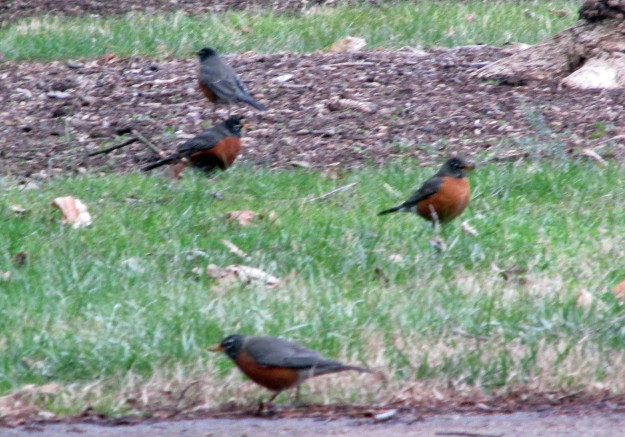
Photo by Bryan Stevens • Returning American robins, prominent in lawns and gardens during their annual spring migration, will soon turn their attention to nesting duties.

I don’t think I’m alone in doing what I can to speed along the process of spring’s arrival. I’ve heard from different people, all eager to share their observations of one of the sure signals — the arrival of flocks of American robins — of the shifting of the winter season to spring.

Bobby Howser phoned me to let me know of a large flock of American Robins he encountered at the Sullins College building in Bristol, Virginia.

He said the flock “swarmed like bees” into a tall holly tree. He was surprised to see so many robins in a single tree and asked if it was an unusual occurrence.

Houghton_MS_Am_21_(46)_-_John_James_Audubon,_robin 3

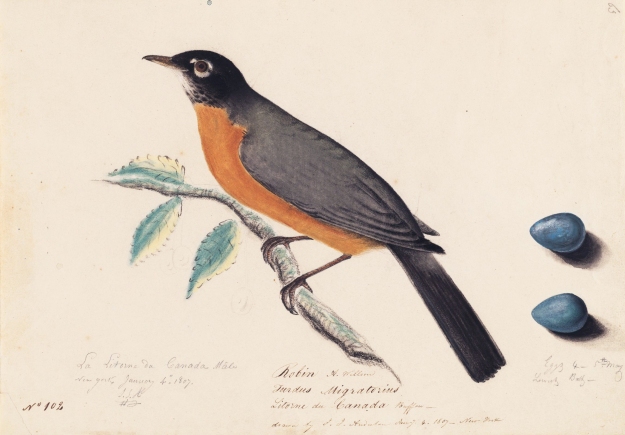
Early American naturalist and painter John James Audubon painted this American robin with a couple of the bird’s eggs.

Ernie Marburg in Abingdon, Virginia, emailed me about the same time.

“I just wanted to report that we have been inundated with a huge flock of mostly robins,” he wrote. He estimated that the flock contained 300 to 500 individuals.

“They ate all the red berries from my neighbor’s large holly tree yet appear to avoid other holly trees with many red berries just a short distance away,” Ernie wrote. The flock remained active in the tree from morning into early afternoon.

Not long after he first emailed me, Ernie contacted me again. “I wanted to give you an update on the robin invasion,” he wrote. “They have been here two additional mornings since I first reported to you. Their pattern is different now though. They are spaced apart and appear to be ground feeding individually.”

Robin-OnNest

Photo by Bryan Stevens • American robin sitting on its nest in the shelter of a side of a bridge spanning the Doe River in Elizabethton, Tennessee.

Ernie proposed a theory about the behavior of the robins.

“I think they followed the south to north weather pattern we had recently that provided significant rainfall,” he explained. “The rainfall, in turn, caused the ground to thaw and the earth worms to come to the surface thus providing a food source for the robins. In summary, the robins are following their food source.”

I responded to Ernie and congratulated him on what I thought was an excellent theory.

Ernie also wrote me that he had read an article some time ago that said robins would eat cooked elbow macaroni if put out for them.

“We did that, but not one robin ate the macaroni,” he said. “Moral of the story is, as you would expect, don’t believe everything you read.”

I’ve read similar suggestions of unusual items to try to tempt birds not prone to visit feeders. I told Ernie that I wasn’t too surprised that the robins ignored the macaroni. The observations of robin feeding habits made by Bobby and Ernie also correspond to the changing seasons. Holly trees retain their berries into late winter, which provide an abundant food source for robins, as well as other birds. As the temperatures begin to rise in early spring, the birds switch their diet in favor of earthworms. This protein-rich food source fuels the impressive migration made by robins each year.

Robin-Hunter

Photo by Bryan Stevens • An American robin scans for prey in the grass and clover of a lawn.

I posted on my Facebook page about the flocks of robins I’d observed, which resulted in several comments on my original post.

Johnny Mann, who lives in Bristol, Tennessee, shared on my Facebook page after I posted about seeing flocks of robins almost everywhere I have gone recently. He noted that he has been seeing Eastern bluebirds, which are a smaller relative of robins. He noted in his comment that the bluebirds are feeding on suet.

Jackie Lynn, who lives in Wytheville, Virginia, also posted a comment on my Facebook page. Jackie saw a large flock of robins feeding in a field, enjoying the worms brought to the surface by recent rains. “Dinner was served,” Jackie reported.

Several other people responded optimistically on my Facebook page, sharing the hope that the influx of robins does indeed signal the approach of spring.

The American robin is known by the scientific name Turdus migratorius, which can be translated as “migratory thrush.” Indeed, this well-known American bird is related to other thrushes, including the Eastern bluebird, wood thrush and veery. The relationship to other thrushes is quite visible in young birds, which display a spotted breast until they mature and acquire the familiar red breast associated with robins.

There are 82 other species in the genus, which ranges not only in the Americas, but Europe, Asia, Africa and Australia, as well. Some of the American robin’s fellow genus members include the olive thrush, the bare-eyed thrush, pale thrush, great thrush, black-billed thrush and cocoa thrush.

AmericanRobin

Photo by Bryan Stevens • While American robins like fruit when its available, they also spend a lot of time feeding on earthworms and insects.

When the first European settlers arrived in North America, the robin was still a bird living in the forests. Robins proved incredibly capable of adapting to the presence of humans. Soon enough, these once shy forest birds began to frequent lawns and city parks. The robin soon became one of America’s most popular songbirds. Three states — Connecticut, Michigan and Wisconsin — have conferred official state bird status on the American robin.

Robins begin nesting almost as soon as they return each spring. Nesting success in a previous season instills fidelity to the location where the birds nested, resulting in many robins returning to the same nesting area year after year. Although some robins invariably spent the entire winter season in the region, it is still a welcome sight to see migrating flocks of these birds in February and early March. The sudden resurgence of the American robin each spring is a reminder that another winter will soon be history. I know I’m always pleased to welcome them back.

•••••

Bryan Stevens lives near Roan Mountain, Tennessee. To learn more about birds and other topics from the natural world, friend him on Facebook at https://www.facebook.com/ahoodedwarbler. If you have a question, wish to make a comment or share a sighting, email ahoodedwarbler@aol.com.

american_robin

Early American naturalist and painter John James Audubon captured this family of American robins in one of his masterful paintings.