Category Archives: Uncategorized

Among feathered friends, catbirds are individuals

Photo by Bryan Stevens • Although often considered shy, skulking birds, some catbirds show a great deal of curiosity about and trust in humans.

I received an email on June 15 from Linda Durette, who lives in Townsend, Massachusetts, which is on the New Hampshire border.

“I live in a country environment with thickets and fields,” she noted.

Linda informed me that she had run across an article I wrote in 2019 about gray catbirds.
“I have always been mildly intrigued by the catbird,” she wrote. ‘Working around the yard and having a cat myself, I always got a kick out of their vocal annoyance with my cat.”

She said the catbirds begin squawking at her cat the minute he steps out the door.
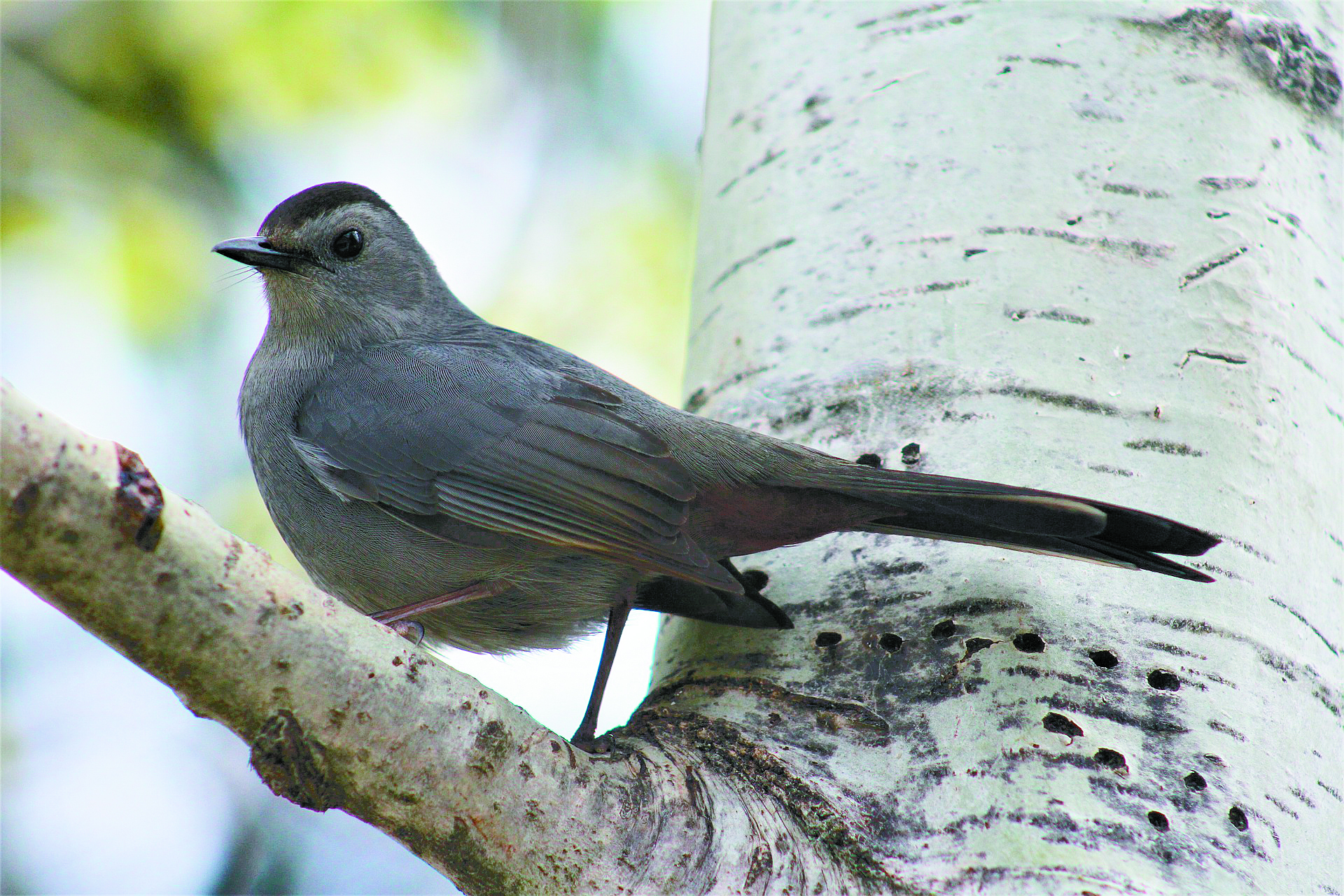
Photo by by Jennifer Beebe from Pixabay • Gray catbirds have a reputation for being either shy skulkers or bold scolders. In fact, these birds are known for being individuals with unique and distinctive personalities. Like mockingbirds and thrashers, the gray catbird is considered a mimic thrush and can imitate snippets of the songs of other birds.

“I always kept him away from any nesting area, although he isn’t a particularly adventurous cat, anyway,” she noted.

“This year was the same,” she said. “My cat seemed to almost ignore the bird. He just sat there and allowed the bird to squawk loudly. I think the bird was miffed.”

She said she finally put her cat back in the house.

“But I have been noticing that the bird comes very close to me,” she wrote.

She wrote that the catbird appears to watch what she does when she is outdoors.

“I have been talking with him, chattering while I garden,” she wrote. “It’s a riot. He lands on the wheelbarrow handle after I walk away or allows me to walk pretty close to him as he watches.”
Linda concluded that this individual catbird, at least, seems to have quite the personality.
I’d mentioned in my previous column on catbirds about the fondness of these birds for fruit and how I occasionally offered berries to them.

“I will attempt some fruit, too,” she said. “It is so interesting. We’ll see what happens.”
Perhaps readers will recall the folksy expression “sitting in the catbird’s seat” that denotes self-satisfaction and perhaps a degree of smugness. As expressions go, it’s not a bad fit for this charming, somewhat eccentric bird.
Photo by Bryan Stevens A curious Gray Catbird peeks from dense cover. Attendees at the fall rally can look for catbirds and other species at any of the offered bird hikes.

The gray catbird is a baffling bird with a personality that runs the gamut from introverted to extroverted, sometimes depending on the season and at other times seemingly just on a whim. With some gentle persuasion, however, people can gain a catbird’s trust – as Linda has done with the bird in her Massachusetts garden – and develop a fun friendship with these clever songbirds.

One summer, all I needed to do to win over the catbirds was to offer some less-than-perfect strawberries and blueberries. A few blemishes on the fruit didn’t bother the resident catbirds at all, and they soon became accustomed to receiving such treats.

A person’s first introduction to the catbird is likely going to occur when one hears what sounds like an irritable feline hiding in a hedge, thicket or dense shrub. Upon closer examination, observers may get a glimpse of a charcoal gray bird roughly the shape of a Northern mockingbird but smaller. A black cap and a patch of rusty-red feathers under the tail are the only exceptions to this bird’s overall gray plumage.

The catbird is related to thrashers and mockingbirds, but scientists find the gray catbird just different enough to warrant placing it in its own genus. The genus name Dumetella means “small thicket.” It’s an apt name for this secretive skulker. Catbirds only feel secure in dense cover such as hedges, brush piles and dense thickets.

A relative known as the black catbird, which ranges throughout the Yucatan Peninsula of Mexico, as well as northern Guatemala and northern Belize, also belongs to a genus of its own. The genus name Melanoptila for this close relative is a compound word created from two Greek words: melas, meaning “black” and ptilon, meaning “plumage.” Both of these catbirds are classified as “mimic thrushes,” or Mimidae, of which there are about 30 species in the New World. There is a totally unrelated family of catbirds that ranges through Australia, Asia and parts of Africa.

The gray catbird is not as an accomplished mimic as some of its relatives, such as the Northern mockingbird. Males have motivation to constantly expand their repertoire, however, as doing so increases the likelihood of attracting a mate. They imitate other birds, but some have been recorded imitating frogs and other non-avian singers.

The website All About Birds also offers some helpful advice for attracting gray catbirds. To entice these birds, plant native fruit-bearing trees and shrubs such as dogwood, winterberry and serviceberry.

While the closely related brown thrasher and Northern mockingbird have both been honored with recognition as official state birds, this designation has never been bestowed on the gray catbird.

The female catbird constructs the nest, but her mate may helpfully provide some of the nesting materials. She may spend as long as a week building a rather bulky nest. She usually lays one to six eggs, which require an incubation period of about two weeks. Once the young hatch, both parents are kept busy bringing food to the young. Hatchlings will remain in the nest for about 10 days, but parents continue to care for and feed young even after they have fledged and departed the nest. Catbirds nest two or three time in a season.

According to the website All About Birds, the oldest known gray catbird was at least 17 years and 11 months old when it was recaptured and rereleased during banding operations in New Jersey in 2001. That individual had been banded in Maryland in 1984. So, if you do manage to strike up your own friendship with a catbird, there’s a good possibility that it could become a long-term relationship, especially since many birds like to return to a home territory year after year.

To share an observation, make a comment or ask a question, please send email to ahoodedwarbler@aol.com. I enjoy hearing from readers about shared interests in birds.

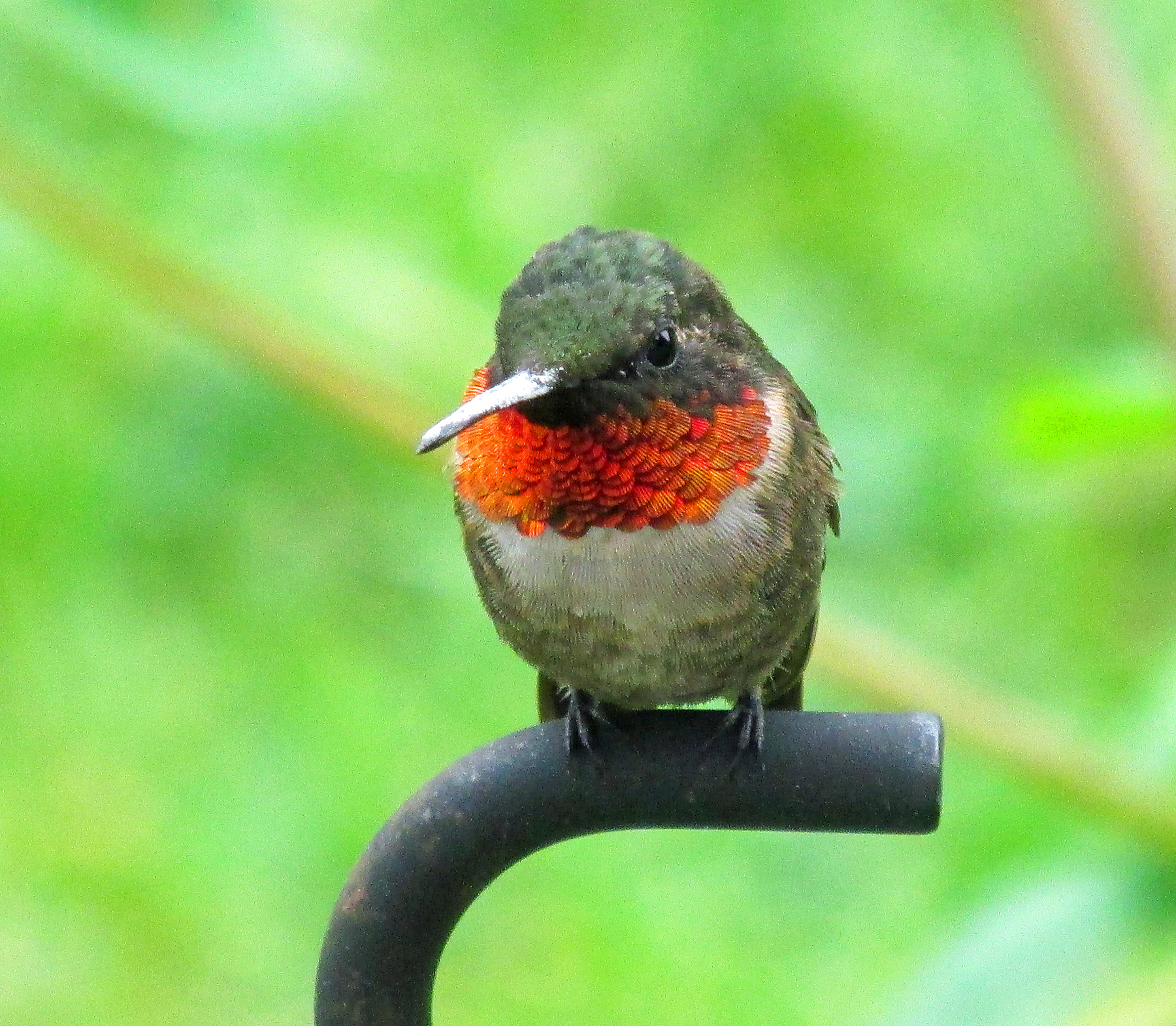
Hummingbird numbers normally fluctuate from year to year

Photo by Bryan Stevens • A ruby-throated hummingbird perches at a feeder for a sip of sugar water.

Russ MacIntyre, Jonesborough, Tennessee, emailed me recently with a question about hummingbirds.

“Are there fewer around this year?” Russ wrote in his email. “My neighbor hasn’t seen any for a month and neither have we. Both of us have feeders and usually have hummingbirds all summer.”

I responded to Russ’s question by sharing with him that I have not seen as many hummingbirds as usual myself.

It’s important to note, however, that hummingbird numbers always fluctuate from year to year. While Russ and I may not be seeing as many hummingbirds, someone else in Jonesborough, Erwin or other small towns might be overwhelmed with these tiny gems. For instance, numbers might appear down in Northeast Tennessee but could be booming across the border in Western North Carolina.

I get these questions every year. Last year was a great year for hummingbirds based on my personal experience. I was also staying at home a lot more last year due to COVID-19, so I might simply have had more leisure time to observe the hummingbirds in my yard and garden.

Photo by Bryan Stevens • Despite a perceived disadvantage of size, ruby-throated hummingbirds are quite capable of thriving in a giant world.

I usually tell people a decline in numbers one year doesn’t mean hummingbird numbers might not boom next year. Quite simply, all the hummingbirds could be a few miles down the road having a great time in someone else’s yard and garden. One thing that all hummingbird enthusiasts should do is plant more nectar-providing flowers, in addition to providing sugar water feeders. Flowers can help persuade hummers to stay put.

To recognize the importance of native, nectar-bearing flowers, simply consider a few facts about hummingbirds from an article by Lisa M. Genier for the Adirondack Council.

“Hummingbirds have a very high metabolism and must eat all day long just to survive,” wrote Genier, a program analyst for the Adirondack Council. “They consume about half their body weight in bugs and nectar, feeding every 10 to 15 minutes and visiting 1,000 to 2,000 flowers throughout the day.”

It’s not just the sugary treat that waits in each bloom that draws in hummingbirds.

“In addition to nectar from flowers and feeders, these birds eat small insects, beetles, ants, aphids, gnats, mosquitoes and wasps,” Genier wrote in her article, which was published on July 3, 2018, on the website for the Adirondack Council. The organization was founded in 1975 with a mission to ensure the ecological integrity and wild character of the Adirondack Park near Lake Placid in New York.

Photo by Bryan Stevens • Ruby-throated hummingbirds such as this male make themselves at home in yards and gardens throughout the eastern United States from spring to fall each year. .

If you’re disappointed with seemingly low numbers of hummingbirds this spring, my best advice is to wait until late July and early August when young birds are out of the nest and parents and young start the slow-paced migration back south. Invariably, I see more hummingbirds in late summer and early fall than in the spring.

Hummingbirds are a lovely diversion for nature enthusiasts, but they also play a crucial role in the ecosystems where they make their homes. Hummingbirds are pollinators. Every time they visit a flower, they will carry away some pollen on their bills or foreheads. If they carry the pollen to the correct plant, they fulfill their role as one of nature’s many pollinators.

There’s even an entire week dedicated to pollinators and their importance in nature. Pollinator Week was initiated in 2007 when the United States Senate unanimously approved a week in June to be designated as “National Pollinator Week”. This decision was a critical step to address the decline in pollinators across the globe.

Now an international celebration, Pollinator Week raises awareness on the plight of pollinators and celebrates all of the benefits provided by the thousands of insect, bird, and small mammal pollinator species. As people learn more about pollinators, they become advocates – indeed voices – for the pollinators they come to love and understand. We can all play our part to secure a healthier, more sustainable future for pollinators. Pollinator week was started and is managed by the Pollinator Partnership. For more information explore the Pollinator Partnership website.

According to the website, Pollinator Week was initiated and is managed by Pollinator Partnership, and fourteen years ago the U.S. Senate’s unanimous approval and designation of a week in June as “National Pollinator Week” marked a necessary step toward addressing the urgent issue of declining pollinator populations. Pollinator Week has now grown into an international celebration, promoting the valuable ecosystem services provided by bees, birds, butterflies, bats and beetles.

While this year might not be a typical Pollinator Week due to the COVID-19 pandemic, people across the planet have pledged to continue promoting pollinator health and well-being through socially distant and responsible events. Through the numerous virtual gatherings, webinars, responsible planting sessions, socially distant garden and farm walks and monument lightings, Pollinator Week 2021 is geared to be the busiest and best one yet.

This year, Pollinator Week is being observed Monday-Sunday, June 21–27. For more information, email info@pollinator.org.

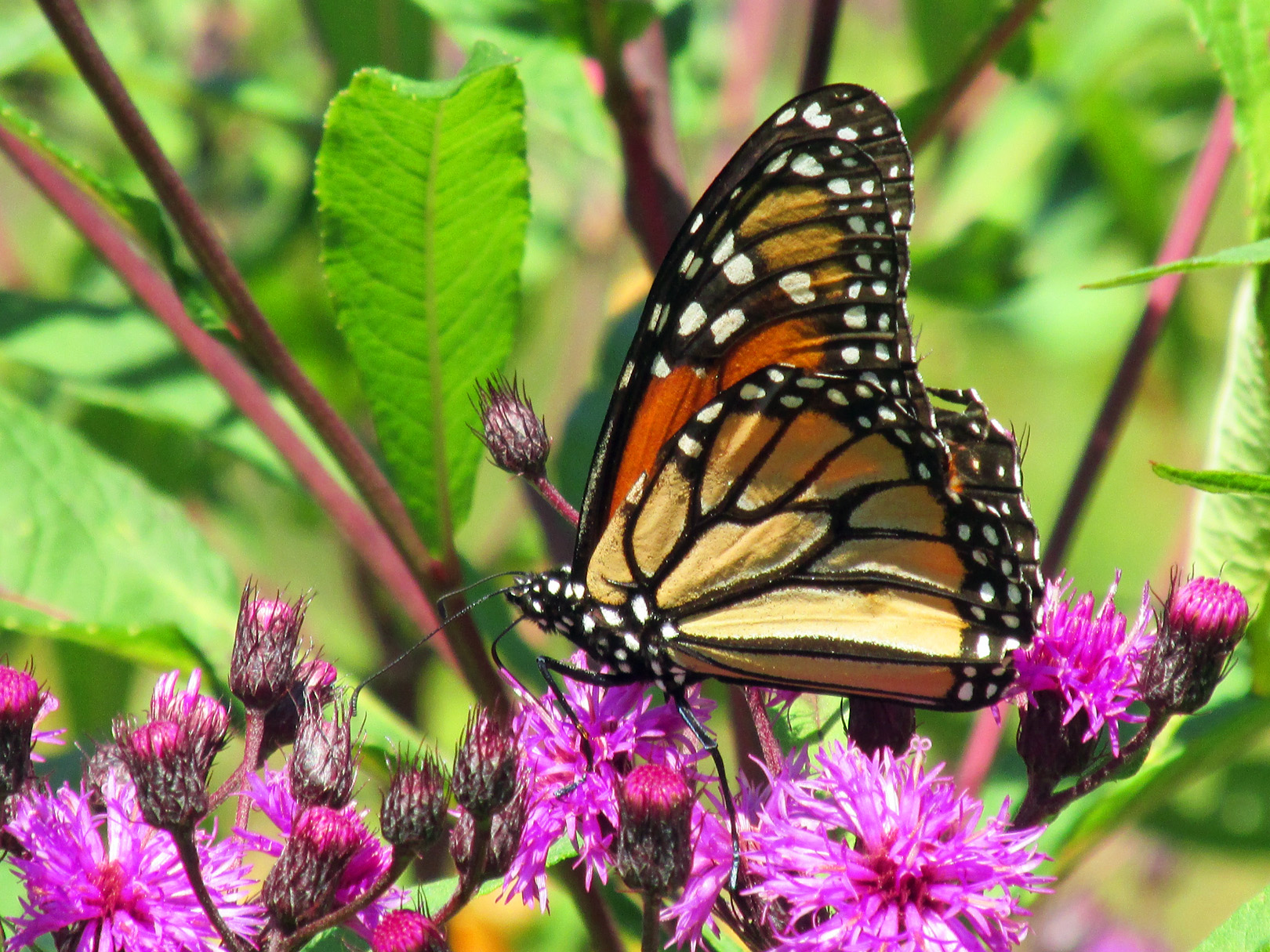
Photo by Bryan Stevens
A Monarch sips nectar from blooming Ironweed. Butterflies are important pollinators for many plants.

Tri-Cities Young Naturalists looks to help kids of all ages engage with nature

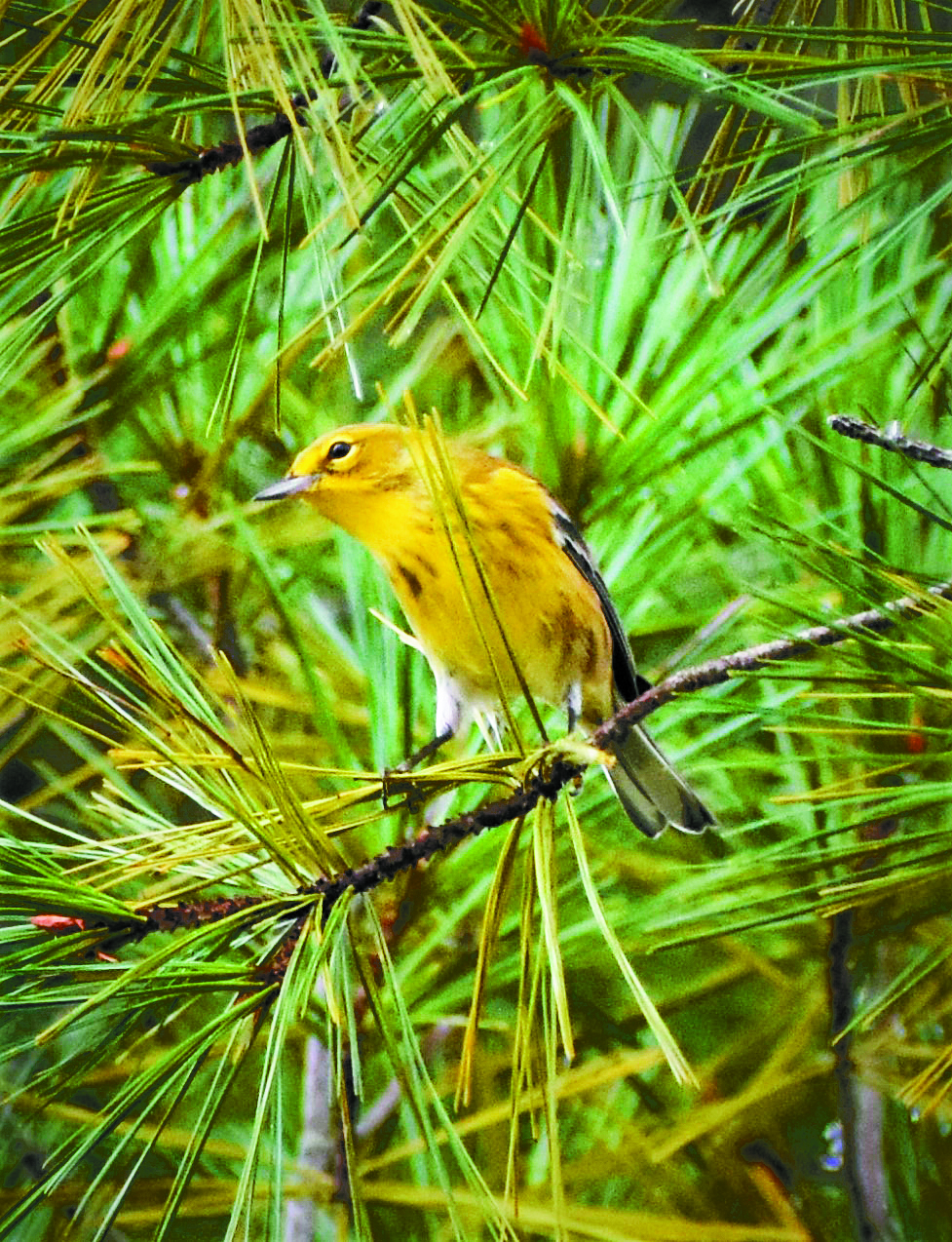
Photo by Larry McDaniel • This pine warbler was photographed during a field trip conducted by the Tri-Cities Young Naturalists to Rocky Mount State Historic Site in Piney Flats.

I’m glad that my parents introduced me to nature. I also had grandparents who also loved to get outdoors.

My paternal grandfather knew the name of every tree in the woods. I always got his help when time came for those perennial “leaf collection” assignments in elementary classes.

My maternal grandparents loved to fish, so I learned about bluegills, walleyes and other local fishes from them. My grandmother was also quite knowledgeable about natural edibles, including wild-growing branch lettuce and morel mushrooms.

So, I’m all for efforts to introduce young people to nature. I met a boy named Gunnar at a bird walk that I led at Sycamore Shoals State Historic Park last month. This young attendee wanted to see a killdeer, which unfortunately were absent from the park that day. I did help him see such birds as a yellow warbler and a nesting American robin, so I hope the day wasn’t a total bust for him.

I learned with great interest last year that there was a new group being formed to introduce younger people to nature. Unfortunately, the group had just gotten off the ground in July of 2020 when the COVID-19 pandemic began to spike.

A year later, Larry McDaniel, the organizer of Tri-Cities Young Naturalists and the administrator of the group’s Facebook page, is trying again to attract more members to the group and hold in-person field trips.

McDaniel retired five years ago from a position at Steele Creek Park in Bristol. That job, he noted, let him interact with young visitors to the park curious to learn more about different aspects of nature.

“I was taking a walk and it popped into my head that I could still do that,” he said. “I could form something to let kids learn about and enjoy nature.”

McDaniel, a resident of Jonesborough, started the Tri-Cities Young Naturalists as a project with iNaturalist, but it didn’t gain momentum.

He changed course and created a Facebook group a couple of months later, which has produced better results.

“Facebook has been a lot of fun,” he said. “We’ve got people on the Facebook group who like to share photos and stories about nature.”

He has been assisted by Cade Campbell, who serves as a moderator for TCYN and helped get the Facebook group up and running.

“As a naturalist, my passion is largely founded in the Southern Appalachians,” Campbell shared. “Growing up here, in one of the world’s great biodiversity hotspots, it’s hard for me to focus on just one group of species.

“As a result, I try to learn about as many different kinds of animals, plants and fungi as I can at intervals, learning how they all work together to build verdant, natural habitats,” he continued.

Campbell said he personally became involved in TCYN because he wanted to give young nature enthusiasts an opportunity to learn how amazing the natural world can be.

“As a young naturalist myself, I understand how exciting it can be to have a community of other young people to share exciting finds and learn new ways to find wildlife with,” he said. “It’s awesome to find a toad in the backyard every time one makes an appearance.

“However, visiting a ‘secret’ bend of the river full of lime-green map turtles, egrets perched on driftwood, and limestone bluffs full of colorful clumps of rare wildflowers and neon-green tiger beetles, with friends who can experience this same excitement and knowledgeable naturalists who can share detailed accounts about what you’re seeing, is an unforgettable experience,” he continued.

“I see TCYN as a way this frontier of discovery can be strengthened in our Appalachian Highlands region to really give local children an opportunity to form a strong connection with nature; something desperately needed in today’s time where nature deficit disorder is rampant,” Campbell added.

Campbell, who currently lives in Bristol, once lived in Indian Springs just outside of Kingsport.

“I spent a great deal of time learning about nature at Warriors Path State Park from Marty Silver, and many other mentors while I was still in elementary school,” he said. “That’s actually how I met Larry McDaniel, and he’s taught me how to better explore, appreciate and know the region’s wildlife ever since.”

Campbell said that his best advice for young naturalists is to simply appreciate nature.

“Appreciate the beauty of nature, learn thoroughly and intentionally, and be sure to have great adventures in the process,” he said. “You will never run out of things to learn about wildlife, and remember, that’s what makes this pursuit so exciting and rewarding.”

He also noted that things learned about nature can stick with people for a lifetime.

He noted that TCYN is designed to offer an opportunity to make the most out of this connection with nature, and share that experience with others.

Now that summer’s kicked off for 2021, McDaniel has made a renewed effort to offer more field trips. Helping in that effort is the fact that the pandemic seems to be lessening in intensity, perhaps thanks for an increase in vaccinations.

“We were going to have field trips last year, but then the pandemic worsened,” he said.

This summer, the outlook seems brighter. The Tri-Cities Young Naturalists held their first field trip at Rocky Mount State Historic Site in Piney Flats. Several events were held last fall at this location.

McDaniel said that Melanie Kelley has been working hard to promote more nature events at Rocky Mount.

A more recent gathering was held at Twin Springs Picnic Area on Roan Mountain on April 29.

“It was a great time at Twin Springs Picnic Area on Roan Mountain yesterday,” McDaniel posted on the group’s Facebook page. “We held an event for the Northeast Tennessee City Nature Challenge. I was especially pleased to see three young naturalists participating and representing Tri-Cities Young Naturalists.”

The group has held other field trips, including a bird walk at Sycamore Shoals State Historic Park in Elizabethton on June 7. McDaniel noted that Jennifer Bauer, the park manager for Sycamore Shoals, has helped immensely in recruiting memberships for the Tri-Cities Young Naturalists.

Upcoming events include a snake talk/walk at Winged Deer Park in Johnson City at 9 a.m. on July 5 that will be led by Connie Deegan, who was recently honored as top Conservation Educator by the Tennessee Wildlife Federation.

McDaniel said that the Tri-Cities Young Naturalists boasts 175 memberships on Facebook, but noted that some of those memberships include multi-member families.

McDaniel said that Tri-Cities Young Naturalists started primarily as an “environmentally conscious” effort to introduce young people to various aspects of the natural world.

“It’s good for kids to get outdoors and away from gadgets,” McDaniel said, explaining his primary motivation for starting Tri-Cities Young Naturalists.

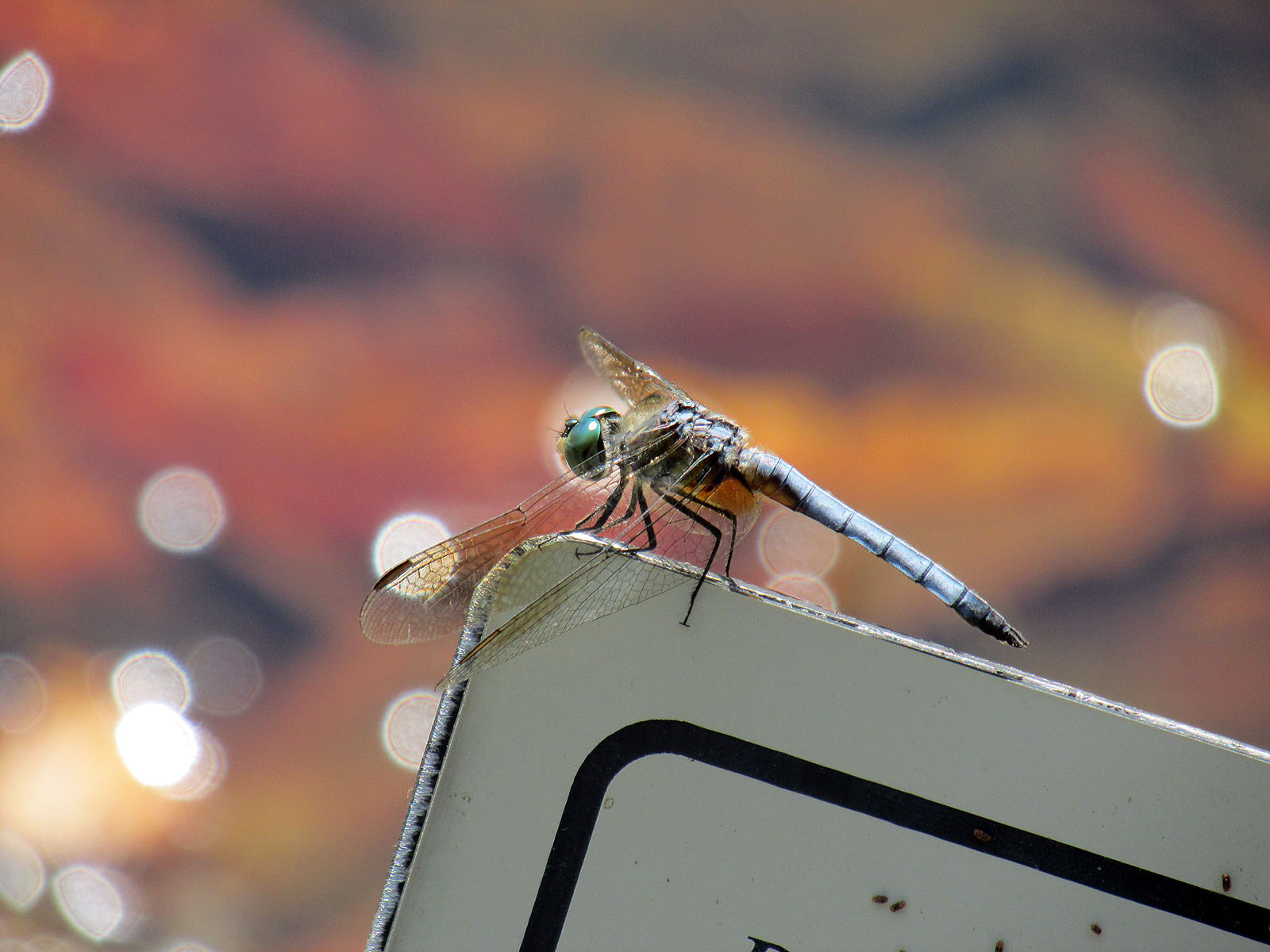
Photo by Bryan Stevens • Blue Dasher photographed during a trip to South Carolina.

He also wants to instill a love of nature in the younger generation. “We need the upcoming generation to make changes, or else things for the planet will continue to go downhill.”

To join the group, search Tri-Cities Young Naturalists on Facebook. The group is set to private but is visible for searches. Requests to join can be sent to McDaniel for approval.

Whether your interest rests with birds, frogs, lizards, dragonflies, wild orchids or bees, Tri-Cities Young Naturalists will help you learn more about these topics and many others related to the natural world.

Photo by Bryan Stevens • Large Maple Spanworm Moth on a wall.

Orioles are among the region’s most colorful birds

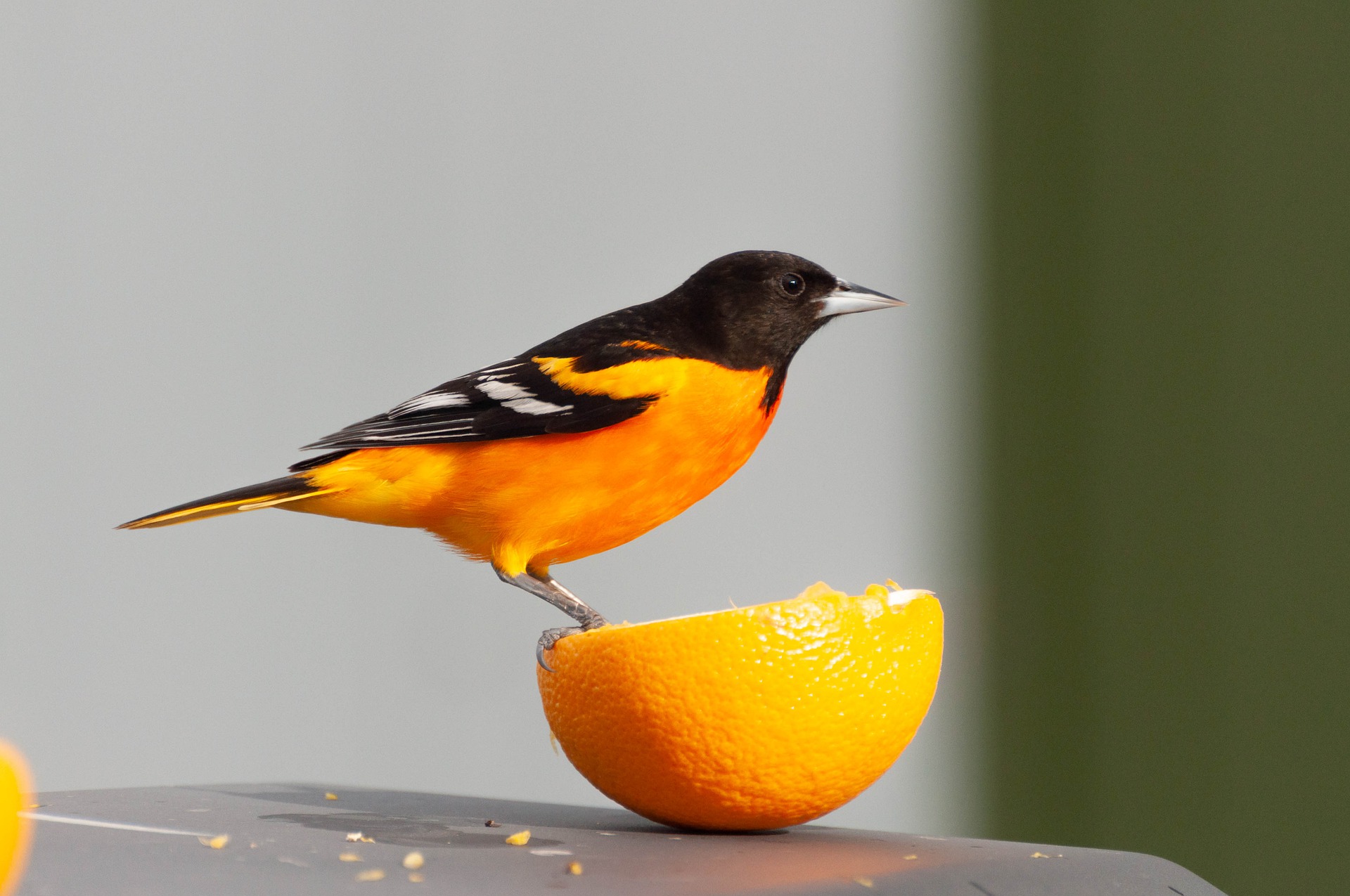
Photo by Michael McGough from Pixabay • The Baltimore oriole is a bird with a taste for sweets. Citrus fruits, grape jelly and even specialty feeders for dispensing sugar water are ways to draw these birds closer. Otherwise, they can be difficult to observe as they prefer to spend their time in the tops of tall trees.

The Baltimore oriole would stand out among North American birds even without its colorful plumage and its long association with the city of Baltimore and its affiliated major league baseball team.

For instance, few other birds can match the Baltimore oriole for the sheer elaborate nature of the woven nest these birds construct for the purpose of sheltering eggs and young. The nests resemble hanging baskets that the female oriole weaves from a variety of collected strips of grass. The lining inside is even more elaborate and features soft materials such as plant down, feathers or even wool that can insulate and cushion the eggs. The nest itself is anchored securely in the fork of a tree branch. 

A family of tropical birds known as oropendolas are native to Central America, with some ranging as far north as southern Mexico and some as far south as Ecuador and Brazil. Some of their fantastic hanging nests put those constructed by Baltimore orioles to shame. Not surprisingly, orioles and oropendolas are closely related and claim kinship among the extensive family of New World blackbirds. Many species of oropendolas also nest in colonies, which makes their intricate nests even more prominent.

Orioles also have a tendency to indulge a sweet tooth or, I suppose, a sweet beak in their case. Slices of citrus fruits, as well as specially designed feeders to suit their size and shape can offer these birds sugar water that they will sip as eagerly as any hummingbird. Dispensers of grape jelly can also be set out to lure these birds.

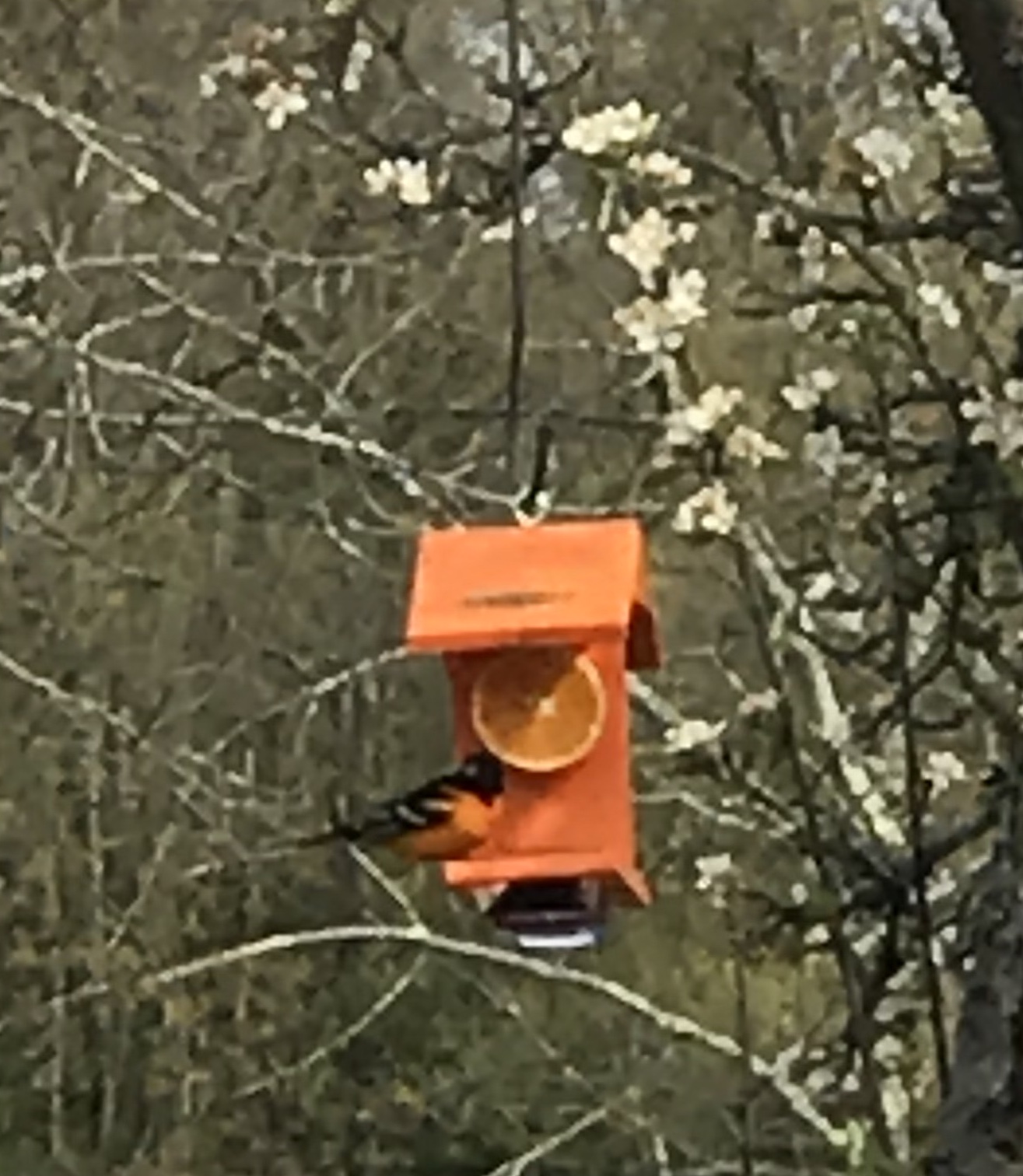
Photo Courtesy of Helen Whited • A Baltimore Oriole visits a feeder “baited” with an orange slice.

Baltimore orioles have been changing their usual habits almost from the time the first Europeans arrived in North America. Instead of migrating south each fall, more of these birds are staying behind at some northern locations, especially along the Atlantic Coast, and successfully overwintering, often at backyard feeders.

For many year s, I have helped unwittingly perpetuate the myth that the oriole derived its common name from an association with history’s first Lord Baltimore, also known as George Calvert, Baron Baltimore. 

As it turns out, the bird and the English nobleman may not be as closely affiliated with each other as popular lore would have us believe. According to an article published by Hervey Brackbill in 1949 in the Wilson Bulletin, the origins of the Baltimore oriole’s vernacular, or common, name is not authentically tied to Lord Baltimore.

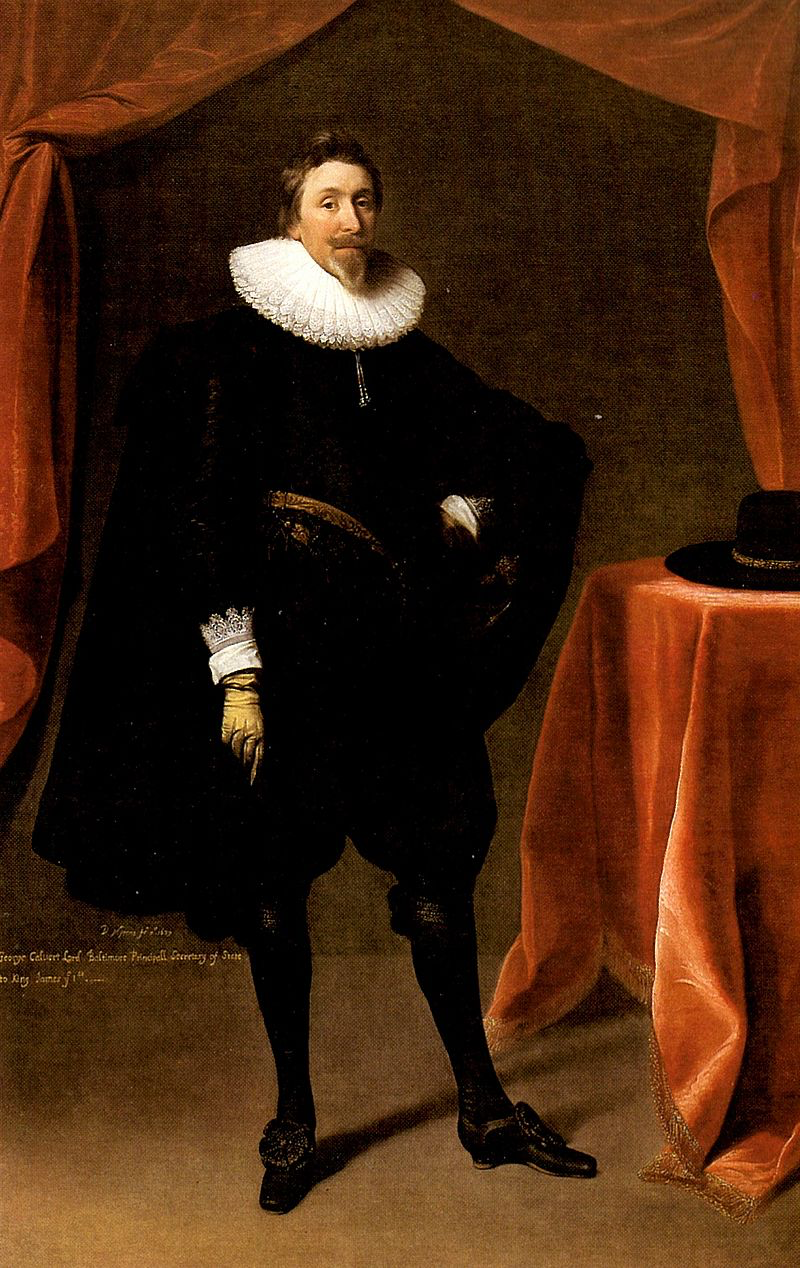
George Calvert by the artist Daniël Mijtens. In this portrait, the family colors of black and orange are clearly visible.

On a side note, there should be a bird named “Brackbill,” just because that seems a ready-made term for describing some sort of odd bird. Alas, I can’t find any evidence that Mr. Brackbill ever had a bird named after him. 

In summarizing the myth of the man and the bird, the article states that Calvert visited Chesapeake Bay in 1628. He saw the oriole and, impressed with the bird’s orange and black plumage, adopted those colors as his own, incorporating them into his family’s coat of arms. 

The historic record turns up several inaccuracies with this charming but perhaps misleading tale. First and foremost, the Calvert family coat of arms of gold (orange) and black had already been established before the first Lord Baltimore ever visited the New World. A statement regarding the coat of arms was published in England in 1622, six years prior to Calvert’s visit to the Chesapeake Bay.

Calvert did eventually (in 1629) visit the Chesapeake Bay, but there’s no actual account of his ever observing the bird that we know as a Baltimore oriole. Calvert’s son, the second Lord Baltimore, never ventured to the New World.

The famous Carl Linnaeus is often given credit for bestowing the common name on the oriole, but he was apparently a bit late to the game. The Swedish botanist, zoologist, taxonomist and physician famous for his binomial nomenclature, which is the basis for the modern system of naming organisms, first gave the bird the scientific name of Coracias Galbula in  1758. In 1766, with the publication of an updated version of his Systema Naturae, Linnaeus got around to giving the oriole the scientific name Oriolus Baltimore, or more simply “the oriole of Baltimore.”

Unfortunately, credit does not really belong to Linnaeus. A century before Linnaeus got around to giving the oriole its enduring name, colonists in America were calling the bird in question “the Baltimore bird.”

The famous naturalist, writer and artist Mark Catesby referred to the bird as “the Baltimore bird.” Catesby, who lived from 1683 to 1749, was famous for his studies of the flora and fauna of the New World. Catesby also was the first to refer to the bird as an oriole because he was reminded of the unrelated orioles of the Old World. He gave the bird its “icterus” designation that today is used to describe an array of New World blackbirds, orioles, and other related birds. By the time people began to suspect the New World orioles were not at all like their Old World counterparts, Catesby’s classification stuck.

So, ordinary colonists, not noblemen, naturalists or ornithologists, actually provided the name “Baltimore bird,” but due to a mistake on the part of the experts who should have known better, the erroneous “oriole” was also attached to the bird’s name.

All in all, I like the name oriole. Baltimore blackbird, while it does have some alliteration and is more scientifically accurate, just doesn’t have the same ring to it. 

The region is home during the summer to another oriole, the smaller orchard oriole. Other New World orioles include Audubon’s oriole, orange oriole, Altamira oriole, Bullock’s oriole, hooded oriole and white-edged oriole. 

Bullock’s oriole is the western counterpart to the Baltimore oriole.  The two birds were once considered the same species and lumped together under the unimaginative name of Northern oriole. I got the pleasure of observing many Bullock’s orioles during a May visit to Salt Lake City, Utah, in 2008.

Some of the Old World orioles, the birds with the rightful claim to be “orioles,” include the brown oriole, green oriole, white-lored oriole, Eurasian golden oriole, green-headed oriole,  black oriole, maroon oriole and silver oriole. The Old World orioles are also closely related to the figbirds of Indonesia and Australia and the pitohuis of New Guinea. 

Incidentally, I have tried the trick of offering orange slices, as well as grape jelly, to attract Baltimore orioles to my yard. Unfortunately, this oriole remains definitely “hit or miss” at my home on Simerly Creek Road. I’ve only ever observed them at my home during spring and fall migration. Thanks to gray catbirds, the orange slices didn’t go to waste, and the ants loved the grape jelly. 

Photo by Bryan Stevens • A male Baltimore oriole in tall trees at Winged Deer Park in Johnson City, Tennessee.

To find orioles, keep your gaze directed upward. Larry McDaniel with Tri-Cities Young Naturalists was recently asked on Facebook whether there are orioles in the area. He gave a good answer, so I’ve borrowed it. He explained that while orioles do nest in the region, they are surprisingly hard to spot high up in the thick foliage of tall trees.

Some good locations to look for Baltimore orioles are the waterfront along Winged Deer Park in Johnson City and in tall trees around the lake at Warriors Path State Park in Kingsport.

Blue of indigo bunting’s plumage is a trick of the light

Photo by Bryan Stevens • The male indigo bunting is a resplendent bird.

The indigo bunting is one of the reasons I love to pay attention to the clientele visiting my feeders. This small songbird likes to reside in the boundary region where forests and woodlands meet fields and pastures. Personally, the indigo bunting has always been a bird that is suggestive of the long, hot days of summer.

One of my earliest and still quite vivid birding memories is a recollection of a shockingly blue bird atop a blue spruce tree in my yard. Several decades later, the tree is no longer standing, but these beautiful birds — I now know these summer visitors were indigo buntings — still return each year to my yard and gardens.

Indigo buntings usually arrive in the region in late April, and I’ve seen them linger until late October, although most indigo buntings have left the region by late September.

Upon arrival, male indigo buntings become tenacious singers, repeating their jumbled notes even during the hottest hours of summer afternoons. The preference of this small songbird is to sing from the tops of tall trees, where they are often concealed by the green leaves. When I do get a glimpse of the obscured songster, often all I see is a dark shape silhouetted against the bright sky. Sometimes, if he plunges from the upper branches into the woodland understory, I get that telltale glimpse of blue feathers.

Photon by Bryan Stevens • Indigo Buntings will perch on wires and sing for hours even during hot summer days.

The male indigo bunting is the only solid blue bird in the eastern United States, but it’s all an illusion — literally a trick of the light. The indigo bunting’s feathers are not really blue; the male’s brilliant azure plumage is caused by the process of diffraction of light around the structure of the bird’s feathers. This process scatters all but the blue light, and the resulting color shifts from black to blue to turquoise as the angle of reflected light changes. In bright light, it can even look unnaturally vivid blue. In poor light, however, an indigo bunting male can appear black. Fortunately, indigo buntings have both a characteristic body shape and song, so even if the birds are not seen at their best, they can still be recognized.

Soon after returning to the eastern United States each spring, female buntings begin to gather materials to construct a well-crafted, cup-shaped nest. The male usually stays close to her, but he offers no assistance with nest building. She usually lays a clutch of three to four eggs, but she may nest another two times in a single season. She will incubate the eggs for almost two weeks, but the young remain in the nest another two weeks after being hatched as featherless, blind and helpless young completely dependent on the care of attentive parents. The task of raising so many broods in the space of only a few months requires the participation of both the female and her mate, who must work hard to bring enough insects to the nest to keep the young fed.

Like many species of songbirds, the male is by far the most colorful. In this instance, the male is also responsible for the species’ name. Indigo is a blue dye that was once an important crop in the South. The drab female may boast some blue highlights in her plumage. Juvenile birds just out of the nest also resemble the female. Pay close attention to any indigo buntings you observe as summer progresses. Juvenile birds will look mostly brown with just a hint of blue in the wings and the tail. These will be the young buntings that were hatched in spring and early summer. They will often accompany their parents to feeders.

Photo by Dan Sudia/USFWS • Female and young indigo bunting do not show the intense blue of adult males.

Indigo buntings are particularly fun birds to observe in late summer. Indigo bunting juveniles, like the young of many other birds, beg for tidbits from parents by “bowing,” spreading their wings and shivering. These actions usually prompt a parent to pop some morsel into an impatient youngster’s open bill. Indigo buntings are relatively easy to view. They frequent weedy fields and roadside brush. During the breeding season, males can also be seen singing from prominent perches. The song, a distinctive jumble of notes, can help observers find these dedicated singers.

The indigo bunting belongs to a genus of birds known as Passerina, which is included the family Cardinalidae, which includes birds like Northern cardinal and rose-breasted grosbeak. They are often lumped into a group known as North American buntings, although they are not closely related to such birds as snow bunting and lark bunting. The latter is even recognized as the official state bird for Colorado, a unique honor for this group of birds. The other members of the Passerina genus include lazuli bunting, varied bunting, painted bunting, rose-bellied bunting, orange-breasted bunting and blue grosbeak.

Worldwide, other birds known as buntings include such descriptively named species as slaty bunting, corn bunting, white-capped bunting, gray-necked bunting, cinereous bunting, lark-like bunting, cinnamon-breasted bunting, chestnut-eared bunting, little bunting, yellow-throated bunting, golden-breasted bunting, black-headed bunting, red-headed bunting and yellow bunting.

Photo by Bryan Stevens • Although bright blue, a male indigo bunting will often blend with its surroundings.

The male indigo bunting is one of the most colorful birds to visit feeders in the region. This species is also extremely fond of millet seed. I like to have some feeders stocked with millet when the buntings begin to return each spring. They will also feed on thistle and sunflower seeds. Away from our feeders, they also devour plenty of seeds from various noxious weeds. Because of the indigo bunting’s appetite for the seeds of destructive weeds, it is considered a beneficial bird.

Barred owls at home in southern swamps and Appalachian mountains

Photo by Bryan Stevens • A barred owl rests on a perch during an educational raptor program offered at Callaway Gardens in Pine Mountain, Ga.

Tom McNeil, a fellow birder who lives just over the ridge from me in the community of Piney Grove off Simerly Creek Road in Hampton, sent me a Facebook message on May 12.

“Barred owl about 200 yards down the creek from your place,” he wrote. He also posted the time (7:50 a.m.) and made note that he found the owl on the same side of the road as my house.

Unfortunately, I received the message after I’d already left for work in Erwin.

The owl is one I would have liked to have seen. Great horned owls and Eastern screech-owls have long been resident in the woods around my home, but I’ve never seen or heard a barred owl on Simerly Creek Road.

I wrote Tom a message telling him as much and got as a reply, “We have seen one a couple of times at the Fairview turn,” he wrote. “On the wires.”

I’ve always known that the wires over a small field next to the exit to the Fairview community is a great place for broad-winged hawks, but I’d never spotted a barred owl. I’ll have to keep my eyes open.

Although barred owl is missing from my yard list, I have seen plenty of these owls over the years. I saw my first barred owl during a 1997 trip to Black Bayou Refuge, which is a 1,350 acre management area adjacent to Reelfoot Lake in Lake County, Tennessee.

My father and I were driving one of the access road in the management area around 7 a.m. when we came across a barred owl perched on a fencepost that provided the bird an excellent vantage of a canal below. We rolled down the windows and enjoyed a leisurely observation of the owl, which never acknowledged our presence. The vehicle acted as a “blind” that camouflaged us quite effectively. Even when we drove off, the owl continued to scan the canal.

At the time, I thought it strange to find an owl during daylight hours. I eventually learned that the barred owl is not strictly nocturnal. That same trip also yielded observations of yellow-crowned night-herons, which also added to my confusion by being active during the day despite the “night-heron” part of their name. Combined with a visit to Memphis, the visit to Reelfoot Lake produced some fantastic sightings, including dickcissels and my first-ever sighting of a prothonotary warbler.

I would soon learn more about barred owls due to frequent visits to the Low Country of South Carolina. During a visit to Hilton Head, South Carolina, I encountered barred owls in late afternoon producing resonant “Who cooks for you? Who cooks for you-all? calls. These owls resided in a protected area within the remnants of an old rice plantation. I got several good looks at these vocal owls and began to learn that the barred owl is not a “phantom of the night” like many other owls.

Southern forests, particularly wooded swamps, have long been a stronghold for this owl. Closer to home, however, the barred owl is not an uncommon bird among the ridges and hollows of the Southern Appalachians. The mountains of Holston, Roan and Unaka are good places to look for these owls. They are more apt to remain active during the daylight on overcast, cloudy days.

On a trip to Carver’s Gap on Roan Mountain years ago to see a smaller relative of the barred owl known as the Northern saw-whet owl, some friends and I stopped at Twin Springs Recreation Area. The incorrigible Howard Langridge suggested we play a barred owl recording to see if we could add another owl to our tally.

At first, we thought we had failed. No sooner had we ended the recording and stepped back into the car than an irate barred owl whooshed through the darkness and began calling loudly from a hidden perch directly overhead. Howard, who had had extensive experience with these owls, said we were lucky to be back inside the vehicle. We had apparently triggered a territorial response. He said he had experienced some barred owls doing more than whooshing overhead. These owls possess impressive talons that a smart person would rather avoid.

The barred owl was first described by Philadelphia naturalist Benjamin Smith Barton in 1799. That seems a little late considering that Europeans first arrived in the New World in 1492. Of course, for the first couple of centuries, early settlers probably had matters on their minds other than the cataloging of fauna and flora.

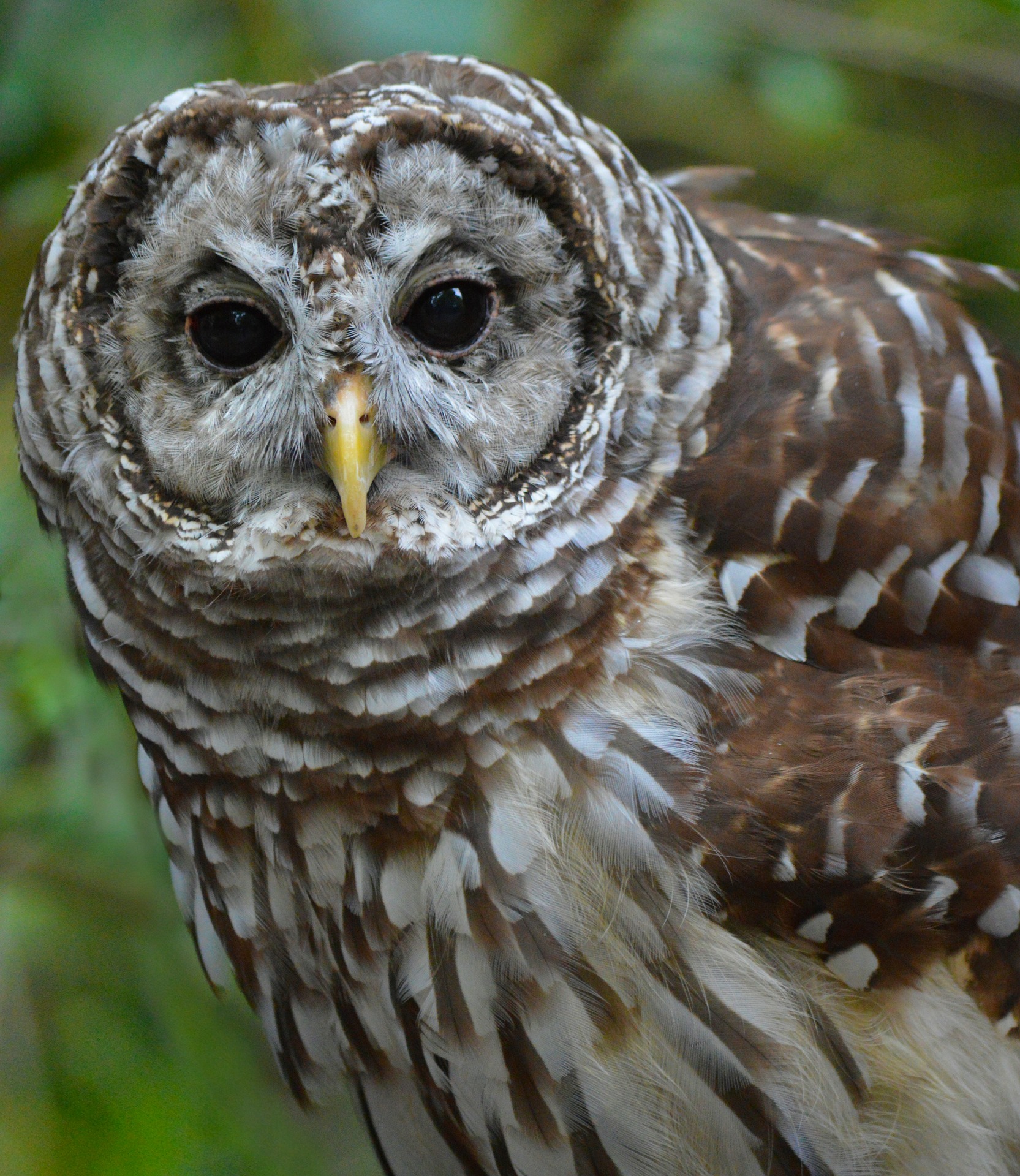
Photo by blue gate/Pixabay • A barred owl peers at its surroundings.

The Chattahoochee Nature Center in Roswell, Georgia, list some interested barred owl facts on its website. For instance:

• The barred owl lives an average of eight years in the wild.

• The barred owl has had many different common names including Northern barred owl, swamp owl, striped owl, hoot owl, eight hooter, round-headed owl and Le Chat-huant du Nord (French for “the hooting cat of the north”) and rain owl.

• Barred Owls get their name from the vertical bars on their abdomen and horizontal bars on their chest.

• Barred owls are not finicky eaters. They prey mostly on small mammals, but they are also fond of fish, snakes, frogs and crawfish.

Perhaps it’s their diet that usually means these owls like to make their home near a source of water, whether it’s a creek, swamp, pond, river or lake.

I’ll keep alert for any future visits from a barred owl. In the meantime, my cattail marsh and fish pond continue to attract visitors of the feathered variety. I’ve observed wood ducks on the pond several times in recent weeks. A green heron has also lurked around the edges of the pond. Raptors – red-shouldered hawk and broad-winged hawk – like to perch near the pond, most likely to keep an eye out for frogs, snakes and other potential prey.


78th annual Spring Bird Count for NE Tennessee finds 153 species

Photo by Ray Miller/Pixabay • One of my more exciting finds during the recent Spring Bird Count was a male red-breasted merganser from the TVA Overlook at Watauga Lake. Other count participants managed to locate another four red-breasted mergansers in the count area.

The 78th consecutive Elizabethton Spring Bird Count was held Saturday, May 1, covering Carter County plus parts of the adjacent counties of Johnson, Sullivan, Unicoi and Washington.

With 40 observers in 13 parties, plus four feeder watchers, coverage of the count areas was extensive. Participants enjoyed a beautiful sunny day, although most areas had temperatures that had dipped into the upper 30s at sunrise. The day gradually warmed and got into the 70s.

Participants tallied 153 species, which is slightly above the recent 30 year average of 150 species. The all-time high on this count was 166 species and was set in 2016.

Some exceptional finds in Unicoi County included a red-headed woodpecker along the section of the linear trail near the McDonald’s. Each of the five counties in the region produced some good birds for this long-running survey.

Count participants included Fred Alsop, Rob Armistead, Betty Bailey, Gary Bailey, Jerry Bevins, Rob Biller, Ron Carrico, Catherine Cummins, Todd Eastin, Glen Eller, Harry Lee Farthing, Bambi Fincher, Dave Gardner, Tammy Griffey, Jean Henson, Neal Henson, Jacki Hinshaw, Lance Jessee, Jennifer Kennedy, David Kirschke, Rick Knight, Roy Knispel, Richard Lewis, Dianna Lynne, Vern Maddux, Frank McCollum, Larry McDaniel, Joe McGuiness, Cathy McNeil, Tom McNeil, Harry Norman, Susan Peters, Brookie Potter, Jean Potter, Sherrie Quillen, Pete Range, Judi Sawyer, Chris Soto, Michele Sparks, Bryan Stevens, Peggy Stevens, Kim Stroud, Charles Warden and Rex Whitfield.

Rick Knight, the long-time compiler for the count, made note of some of the misses, which included pied-billed grebe, common nighthawk, Acadian flycatcher (just the seventh miss in last 50 years), loggerhead shrike, horned lark, summer tanager and bobolink.

He also made some observations about other count finds.

• One species – brown-headed nuthatch – made its official count debut. Another – evening grosbeak – returned to the count after being absent since the spring of 2000.

• The American robin edged out the European starling for most common bird. Counters tallied 801 robins compared to 618 starlings.

• For only the sixth time in the last 18 years, Northern bobwhite made it onto the count. A single ruddy duck became only the second record for this waterfowl on the spring count. Also making only its second appearance on the spring count was willet, a species of shorebird that only migrates through the region.

• Some species appear to have moved into the region for good. Fish crows have been found the last five of the past six years, and Eurasian collared-doves have been found every year for the past 15 years.

• An amazing 29 species of New World warblers were found this year, including prothonotary warbler for only the third time in the last 15 years.

The total follows:

Canada goose, 412; wood duck, 31; mallard, 89; blue-winged teal, 13; bufflehead, 6; hooded merganser, 1; red-breasted merganser, 5; and ruddy duck; 1.

Ruffed grouse, 4; wild turkey, 28; common loon, 2; double-crested cormorant, 48; great blue heron, 69; green heron, 17; black-crowned night-heron, 2; and yellow-crowned night-heron, 5.

Black vulture, 60; turkey vulture, 128; osprey, 10; sharp-shinned hawk, 1; Cooper’s hawk, 6; bald eagle, 11; broad-winged hawk, 11; and red-tailed hawk, 21.

Virginia rail, 2; sora, 2; killdeer, 32; spotted sandpiper, 32; solitary sandpiper, 31; greater yellowlegs, 3; willet, 10; lesser yellowlegs, 2; and Wilson’s snipe, 1.

Bonaparte’s gull, 9; ring-billed gull, 6; rock pigeon, 106; Eurasian collared-dove, 6; mourning dove, 284; and yellow-billed cuckoo, 4.

Eastern screech owl, 13; great horned owl, 1; barred owl, 2; Whip-poor-will, 27; and chuck-will’s-widow, 16.

Chimney swift, 92; ruby-throated hummingbird, 34; belted kingfisher, 14; red-headed woodpecker, 4; red-bellied woodpecker, 125; yellow-bellied sapsucker, 7; downy woodpecker, 44; hairy woodpecker, 9; Northern flicker,41; and pileated woodpecker, 55.

American kestrel, 9; Eastern wood-pewee, 6; least flycatcher, 5; Eastern phoebe 119; great crested flycatcher, 12; and Eastern kingbird, 59.

White-eyed vireo, 15; yellow-throated vireo, 15; blue-headed vireo, 76; warbling vireo, 1; red-eyed vireo, 228; blue jay, 329; American crow, 358; fish crow, 1; and common raven, 20.

Northern rough-winged swallow, 95; purple martin, 71; tree swallow, 235; barn swallow, 218; and cliff swallow, 473.

Carolina chickadee, 139; tufted titmouse, 199; red-breasted nuthatch, 10; white-breasted nuthatch, 43; brown-headed nuthatch, 2; and brown creeper, 5.

House wren, 60; winter wren, 5; marsh wren, 1; Carolina wren, 202; blue-gray gnatcatcher, 75; golden-crowned kinglet, 6; and ruby-crowned kinglet, 4.

Eastern bluebird, 157; veery, 17; hermit thrush, 3; wood thrush, 80; American robin, 801; gray catbird, 80; brown thrasher, 66; Northern mockingbird, 121; European starling, 618; and cedar waxwing, 15.

Photo by Jean Potter • A male hooded warbler flits through the foliage of a rhododendron thicket.

Ovenbird, 157; worm-eating warbler, 35; Louisiana waterthrush, 29; Northern waterthrush, 5; golden-winged warbler, 2; black-and-white warbler, 79; prothonotary warbler, 1; Swainson’s warbler, 7; Nashville warbler, 1; Kentucky Warbler, 2;  common yellowthroat, 20; hooded warbler, 163; American redstart, 11; Cape May warbler, 6; Northern parula, 53; magnolia warbler, 4; bay-breasted warbler, 1; Blackburnian Warbler, 13; yellow warbler, 16;  chestnut-sided warbler, 17; black-throated blue warbler, 77; palm warbler,  5; pine warbler, 15; yellow-rumped warbler, 16; yellow-throated warbler, 25; prairie warbler, 4; black-throated green warbler, 95; Canada warbler, 18; and yellow-breasted chat, 9.

Photo by Bryan Stevens • The male indigo bunting is a resplendent bird.


Eastern towhee, 213; chipping sparrow, 117; field sparrow, 79; Savannah sparrow, 4; grasshopper sparrow, 1; song sparrow, 299; swamp sparrow, 9; white-throated sparrow, 27; white-crowned sparrow, 8; dark-eyed junco, 68; scarlet tanager, 96; Northern cardinal, 359; rose-breasted grosbeak, 36; blue grosbeak, 2; and indigo bunting, 62.

Red-winged blackbird, 550; Eastern meadowlark, 82; common grackle, 324; brown-headed cowbird, 99; orchard oriole, 29; and Baltimore oriole, 18.

House finch, 84; pine siskin, 31; American goldfinch, 283; evening grosbeak, 48; and house sparrow, 70.

Original group of Tuesday birders now down to one

Photo by Mark Edwards/Pixabay • Birds, such as this great horned owl, can stir powerful emotions.

It’s never a good feeling to realize one is the last man standing.

Larry McDaniel made a Facebook post on Saturday, April 10, to share with friends the news of his father-in-law’s death.

“Janet’s dad, Gil, passed away late this afternoon. He had been very ill, and we knew it was coming but it’s still hard,” Larry wrote in his post.

“I had to go home to put up the chickens this evening,” Larry added. “When I got there, there was a beautiful rainbow followed by a beautiful sunset. Then I saw a great horned owl perched in the top of a nearby tree. It dropped and flew right over my truck and toward the barn.

“I thought, ‘see you Gil,’” he wrote at the post’s conclusion.

I know many of Gil’s other birding friends were really touched by Larry’s sweet post.

I got acquainted with Gil Derouen, Larry’s father-in-law, back in the late 1990s. I realize now, trying to think back, that I cannot even remember the origins of a weekly birding group that went out almost every Tuesday afternoon to look for birds.

I do know that the group’s founders consisted of myself, Gil and two other good friends: Howard P. Langridge and Reece Jamerson.

Photo by Bryan Stevens • From left, Gil Derouen, Howard Langridge, David Thometz and Reece Jamerson are pictured while birding Holston Mountain in 2004.

Birders often prefer to get started with field trips in the mornings. The afternoon timing of the weekly excursion was a kind concession to my work schedule that made Tuesday afternoons my one opportunity to bird with Gil and our fellow birders, Howard and Reece.

We visited various hotspots around the area looking for birds every Tuesday. We would visit Rock Creek Park in Erwin; Sycamore Shoals State Historic Park, Holston Mountain and Wilbur Lake in Elizabethton; Winged Deer Park, as well as the fields and shoreline at Austin Springs, in Johnson City near Boone Lake; Musick’s Campground and Osceola Island Recreation Area in Bristol near South Holston Lake; and Shady Valley’s Orchard and Quarry Bogs in Johnson County.

These were only a few favorite places. We saw some fantastic birds over the years. We were like the four musketeers of our birding group.

Howard passed away on Nov. 14, 2004, at age 81, during an already difficult time in my life. The unexpected loss of this great birder with tons of birding tales who also loved to play tennis and crack jokes really affected me deeply.

I remember a birding trip I made with Howard a couple of months before his death to Holston Lake. We timed the trip to coincide with the passage of Hurricane Frances. Sometimes such ventures are rewarded, and this was one of those times. I added a life bird and Howard increased his list of birds seen in Tennessee when the storm blew in a sooty tern, a bird more often found in the Caribbean.

Then as we prepared to depart for home, we discovered Howard’s car had gotten stuck in the mud. With me pushing, we got the car out of the mud. I ruined a pair of jeans in the process. Northeast Tennessee clay does not come out of denim.

Weekly birding trips continued after Howard’s passing, but my work schedule became less flexible as the years progressed and I eventually had to drop out. I did make some sporadic attempts to join some of the weekly rambles, which almost always drew the participation of Gil and Reece.

Reece died at age 83 on Aug. 1, 2017. Again, I had some memories of some wonderful years to reflect on.

One bird-related memory of Reece involved us standing on the bridge that spans Wilbur Lake when an unexpected gust of air blew his fisherman’s hat off his head. I made an unsuccessful grab for the hat, which fluttered down onto the water’s surface and was swiftly carried off by a current that I didn’t even realize existed in what looks deceptively like a placid little mountain lake.

The next week Reece had a new hat and was ready for another birding adventure.

Gilbert Derouen was 90 years old when he passed away last month. I didn’t realize he’d reached that milestone. I do know that he lived a good life and had a great family. He and his wife, Marinel, moved to Northeast Tennessee from Louisiana. Gil often entertained us while we were driving between birding spots with tales of his life in Louisiana.

He surprised me once when during a rambling discussion of television shows he informed us he was a fan of “The Big Bang Theory.” The long-running CBS comedy about a group of highly-educated nerds was one of my favorites. Even with a generation’s difference in our ages, we had that much in common. Gil even laughed while admitting that he, too, liked to follow the antics of Sheldon Cooper and his friends.

Gil and his wife also hosted the annual Christmas party for the Lee and Lois Herndon Chapter of the Tennessee Ornithological Society. They had a wonderful home with a cozy basement perfect for hosting small parties. They were impeccable hosts, and I’ll always cherish the memories of those parties. We always compiled the results of the chapter’s two Christmas Bird Counts after everyone finished snacking and socializing.

At some point, the baton got passed. There’s still a weekly birding excursion every Tuesday afternoon. Another great birder, Roy Knispel, is the organizing force behind this weekly excursion. I’ve joined them on a few occasions, but as I’ve mentioned, my work schedule hasn’t allowed me to do that too often.

I saw Gil last at a meeting of the Herndon Chapter on the campus of East Tennessee State University in Johnson City. I think it was in the fall of 2019. Again, my memory’s a bit hazy.

Now, thanks to Larry’s post, which is such a fantastic tribute to his father-in-law, I’ll think of Gil every time I hear a great horned owl breaking the stillness of a dark night with its loud hoots.

I have great horned owls as well as Eastern screech-owls living in the woodlands around my home. My yard and the surrounding woods are my favorite birding locations, but I still enjoy getting “out in the field” when an opportunity arises. It’s been more than a year since I’ve really traveled anywhere to bird. I hope that changes sooner rather than later.

I’ve become more solitary in my birding, but that’s all right, too. I enjoyed the time I got to spend with Howard, Reece and Gil every Tuesday afternoon while it lasted.

Nothing lasts forever. On the other hand, nothing can take away fun memories.

I’ll focus more on the birds next week.


Ruby-throated hummingbirds return to region

The ruby-throated hummingbirds are back, and I hope everyone joins me in the utmost appreciation of these tiny birds.

Every hummingbird that visits your feeders or sips from flowers in your garden has endured an arduous migratory journey from its tropical wintering grounds to return to spend the summer months, whether in the mountains near Flag Pond or down in the valleys of Unicoi and Erwin.

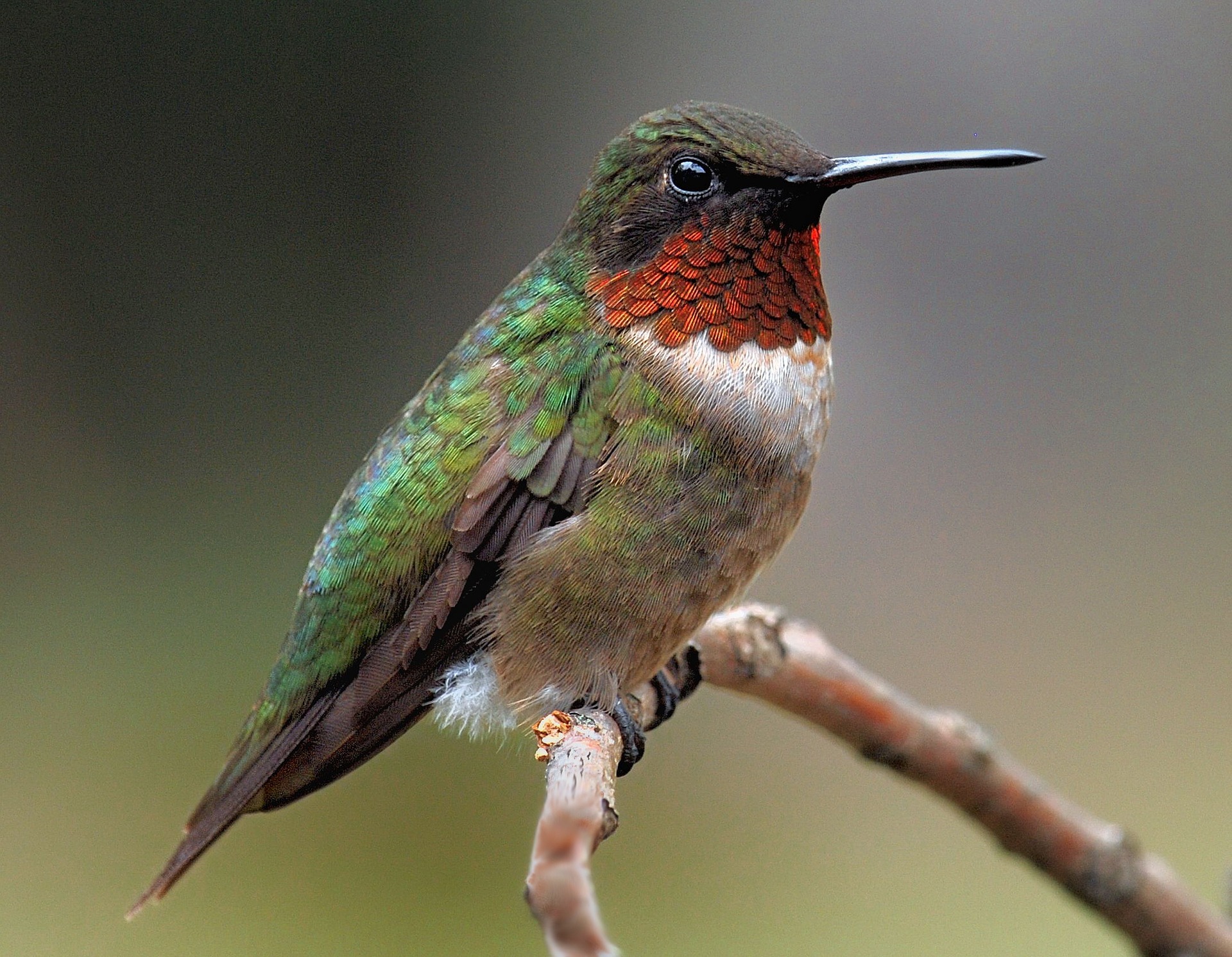
Photo by Bryan Stevens • A male ruby-throated hummingbird perches attentively. These tiny birds began returning to the region in early April.

According to the website for Perkypet.com, a retailer  of bird feeders, ruby-throated hummingbirds spend the winter months in Central America and southern Mexico. When the weather begins to turn warm, they will start to make their northern trip up to the United States. As the website points out, this can be a grueling journey for such a tiny creature, as many of them choose to fly over the Gulf of Mexico. This flight alone, the website points out, can take 18 to 22 hours of non-stop flight before reaching land on the other side of the gulf.

Simply crossing the Gulf of Mexico is only the first stage. Most of the hummingbirds must still travel hundreds of miles to reach locations where they will spend the summer. Males, after some time courting females, will not do much more than sip nectar and duel with other male hummers during the summer.

It’s the female hummingbirds that will work diligently all summer long as she constructs a nest, incubates eggs and feeds hungry young, all without any assistance from her erstwhile mate.

Knowing a little more about this tiny treasure of a bird, I hope you’ll look on them with increased admiration.

Below are the readers who shared with me the dates of their first spring hummingbird sightings for 2021:

Susie Parks in North Cove in McDowell County, North Carolina, had the earliest date of any of the sightings reported to me this year.

“We saw our first hummingbird of the season at 9:30 this morning, April 1,” Susie wrote in an email to me. “I assure you this is not an April Fool’s joke. We are indeed thrilled to have seen this amazing little creature on such a chilly morning.”

Patricia Faye Wagers, Kingsport, posted on Facebook that she saw her first hummingbird of spring on April 6. Her one word comment about how she felt welcoming back hummingbirds: “Happy!”

Amanda Austwick shared on Facebook that she saw her first spring hummingbird at her Flag Pond home on April 6.

Wanda Scalf Daniels reported her first spring hummingbird at her home in Bob White, West Virginia, on April 7. She informed me of her observation via Facebook.

Photo by Bryan Stevens • A male ruby-throated hummingbird perches at a feeder for a sip of sugar water.

Janee Townsend of Dysartsville, North Carolina, notified me by email that she enjoys my column in the McDowell News in Marion, North Carolina. “I saw my first hummingbird on Tuesday, April 8, at noon,” she wrote. “I had put a new feeder out on Monday.  I was glad it was there.”

Pat Stakely Cook wrote in a post to my Facebook page that she saw her first spring hummingbird – a male – on April 9 at her home in Marion, North Carolina. The next day she made an additional post to report that a female arrived. “She fed at our feeder for a long time about 6 p.m.

April Kerns Fain saw her first spring hummingbird at 1 p.m. on  April 11. “We saw our first hummingbird today in Unicoi,” she wrote in a Facebook post on my page. “It was a male.”

Donna Barnes Kilday shared on my Facebook page that she saw her first spring hummer in Erwin on the morning of April 9.

Paula Elam Booher, Bristol, Tennessee, saw her first hummingbird of the season at 5:15 p.m. on April 10. Two days later, she saw her second hummingbird of spring at 11:45 a.m.

Larry McDaniel, Jonesborough, saw his first spring hummingbird on Saturday, April 10. “It visited the feeder briefly before dark,” he wrote. He didn’t see it the following day, but he noted he wasn’t home much that day.

Don Holt and Dianne Draper, Jonesborough, posted on Facebook about seeing their first spring ruby-throated Hummingbird at their feeder on April 10.

Darlene Kerns also shared her first spring sighting on my Facebook page. “Just saw our first hummingbird of the season here in Unicoi,” she wrote. The bird arrived at 8:30 on Sunday, April 11. Darlene said that the first hummingbird also arrived on April 11 in 2020.

Dot and Wayne Ballard, Marion, North Carolina, saw their first spring hummingbirds (yes, they saw two at the same time) on Sunday, April 11, at 2 p.m. The little birds lingered and were also seen feeding early on the morning of Monday, April 12. The Ballards sent me an email about their sighting.

Philip Laws of Limestone Cove used Facebook Messenger to report his first spring sighting took place April 11 about 12:15 p.m. The next day more hummingbird arrived. “Two disputed ownership of a tube feeder,” Philip noted in his message.

Charles and Karen O’Cain emailed me to report their first sighting. “We saw our first humming bird of 2021 on Monday, April 12, at 10 a.m. at our home on top of Coal Pit Mountain in the southern tip of McDowell County,” they wrote. “We have seen a hummingbird every day since.”

Nellene Woodby called to report that she saw her first hummingbird of spring in Limestone Cove on April 12.

Brookie and Jean Potter, who reside at Wilbur Lake near Elizabethton, reported in a phone call that they saw their first hummingbird of the season on April 12.

Karen and Bobby Andis in Kingsport contacted me in Facebook Messenger to report they saw their first ruby-throated hummingbird at 5:56 p.m. on April 13.

Glen Eller emailed me to report that he and his daughter, Lia, had their first ruby-throated hummingbird show up at their home in Fall Branch on April 14. In  followup email, Glen reported another impressive observation. “We had two adult bald eagles show up the next afternoon,” he wrote. “Life is good.”

Anne Rolfe sent me an email to report that thanks to husband Peter’s watchful eyes, she saw the first visit of “our” male ruby-throated hummingbird, Jimmy, on April 14 at about 11 am.  “We are hoping he brings lots of friends,” she added. The Rolfes lives at Lake James in Nebo, North Carolina.

Felicia Mitchell notified me through my Facebook page that the first hummingbird arrived at the feeder at her home in Washington County, Virginia, at 12:24 p.m. on April 14.

Gina Kinney and her mom, Ginger Brackins, both Erwin residents, saw their first hummingbird of spring at 11:25 a.m. on April 14.

Helen Whited posted on my Facebook page that she saw her first hummingbird of 2021 at 1 p.m. on April 15 at her home in Richlands, Virginia.

Judi Sawyer in Roan Mountain also took to Facebook to report that she saw her first hummingbird of spring at about 8 p.m. on April 15.

Carolyn Grubb, Bristol, Virginia, reported on Facebook about the arrival of her first spring hummingbird on April 15.

Pattie Rowland, Erwin, also posted on Facebook about seeing her first hummingbird of 2021 on April 15.

Leslie and Kathie Storie notified me on Facebook that they saw their first hummingbird of 2021 at their home on Heaton Creek in Roan Mountain on April 25.

Peggy Stevens on Simerly Creek in Hampton saw her first spring hummingbird at 9:34 a.m. on April 16.

Photo by Bryan Stevens • Despite a perceived disadvantage of size, ruby-throated hummingbirds are quite capable of thriving in a giant world.

Barbara Jean Boyd, Bristol, Tennessee, saw her first spring hummingbird on April 16. She reported the sighting on Facebook.

Amy Wallin Tipton, Erwin, made a Facebook post about her first spring sighting. “We saw our first hummingbird today (April 16) around 6 p.m.,” she wrote in the post.

Fredna Ollis, Erwin, had a single hummingbird show up Saturday, April 17, around lunch time. “I got pictures when I saw it again around 6,” Fredna shared in an email. “It was back on Sunday afternoon.”

Donna Rea, who is an Erwin resident and a retired Erwin Record employee, reported on Facebook that she saw her first hummingbird on April 17. The following day she got photos of the visiting hummingbird.

John Whinery, Fall Branch, gave notice in an email of the arrival of the first spring ruby-throated hummingbird at his feeder at 7 p.m. on April 17.

Gayle Riddervold and Becky Kinder of Hampton saw their first hummingbird of spring on April 18. Gayle reported the sighting through Facebook Messenger.

Phyllis Moore notified me on my Facebook page that she saw her first hummingbird at her home in Bristol, Virginia, at 10:53 a.m. on April 18.

Karen Lioce, who lives in Harrogate, Tennessee, sent me an email about tree swallows, but also reported a hummer sighting. “You mentioned that you wanted to know when we sight a hummingbird,” she wrote. “I saw my first one today (April 18).”

Julie Lee emailed me to inform me her first spring hummingbird showed up on a very windy day on April 21 at her home at Lake James in North Carolina.

•••••

In case you’re wondering, I saw my first ruby-throated hummingbird of spring 2021 at 6:30 p.m. on Thursday, April 22. A somewhat hesitant little male hummingbird flitted to each of my feeders before finally taking a long sip of sugar water. As I watched him on a rather brisk evening, it felt good to welcome him back.

To share sightings, make a comment or ask questions, email me at ahoodedwarbler@aol.com or call 423-743-4112.

Photo by TheSOARnet / Pixabay.com • Male ruby-throated hummingbirds usually migrate ahead of females. These tiny birds must cross the Gulf of Mexico, without stopping, to reach their nesting grounds in the eastern United States. The journey across the Gulf can take them 18 to 22 hours, dependent on weather conditions.

Ovenbird part of the returning warbler lineup

Photo by U.S. Fish & Wildlife Service • Ovenbirds are content to spend most of their time near the forest floor.

It’s been a week of arrivals at my home. Several species of warblers made their spring debuts, including a handful of male ovenbirds.

These warblers arrived on April 14 and immediately began singing their loud and ringing “Teacher! Teacher! Teacher!” song from concealment within the woodlands surrounding my home.

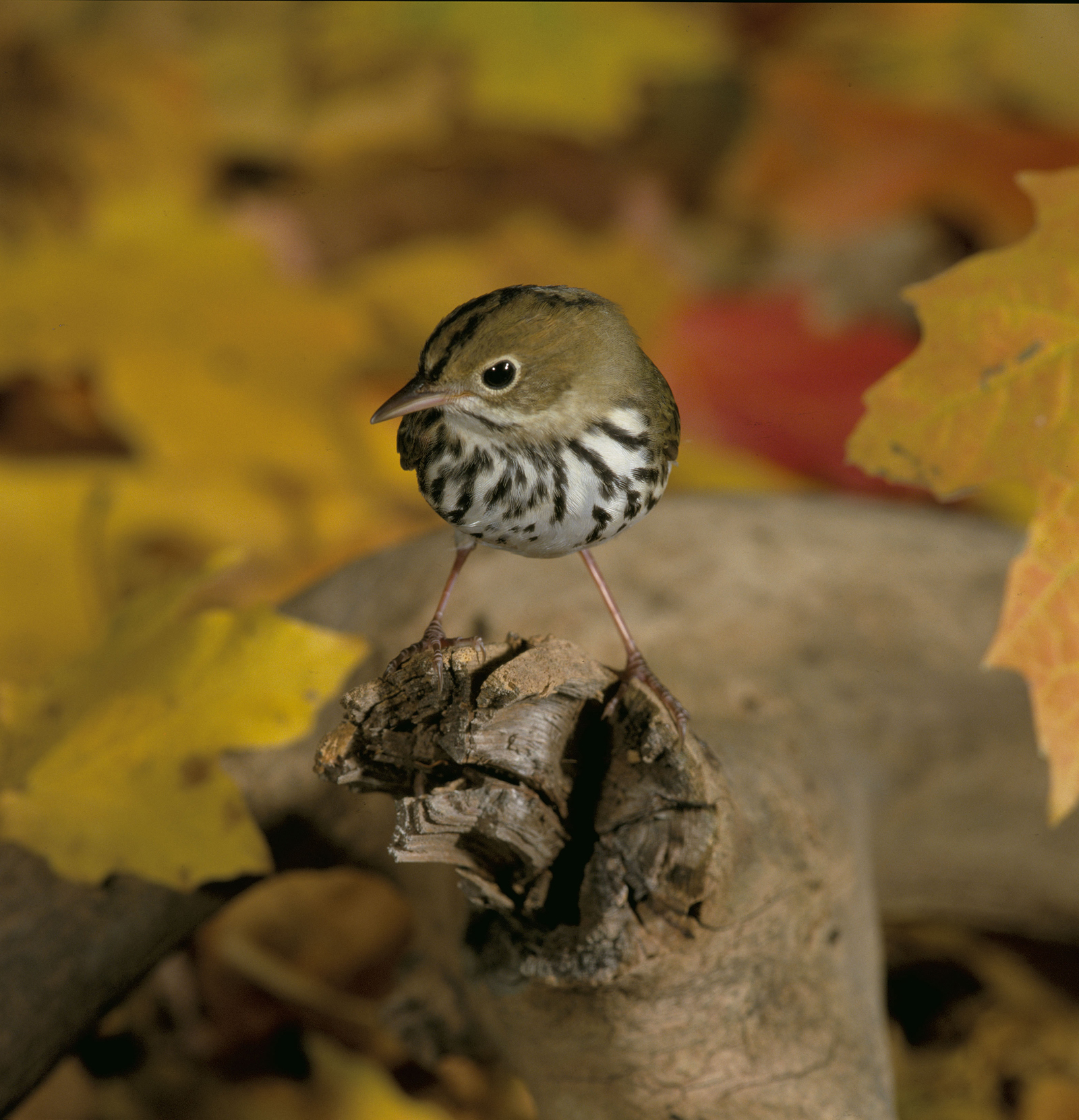
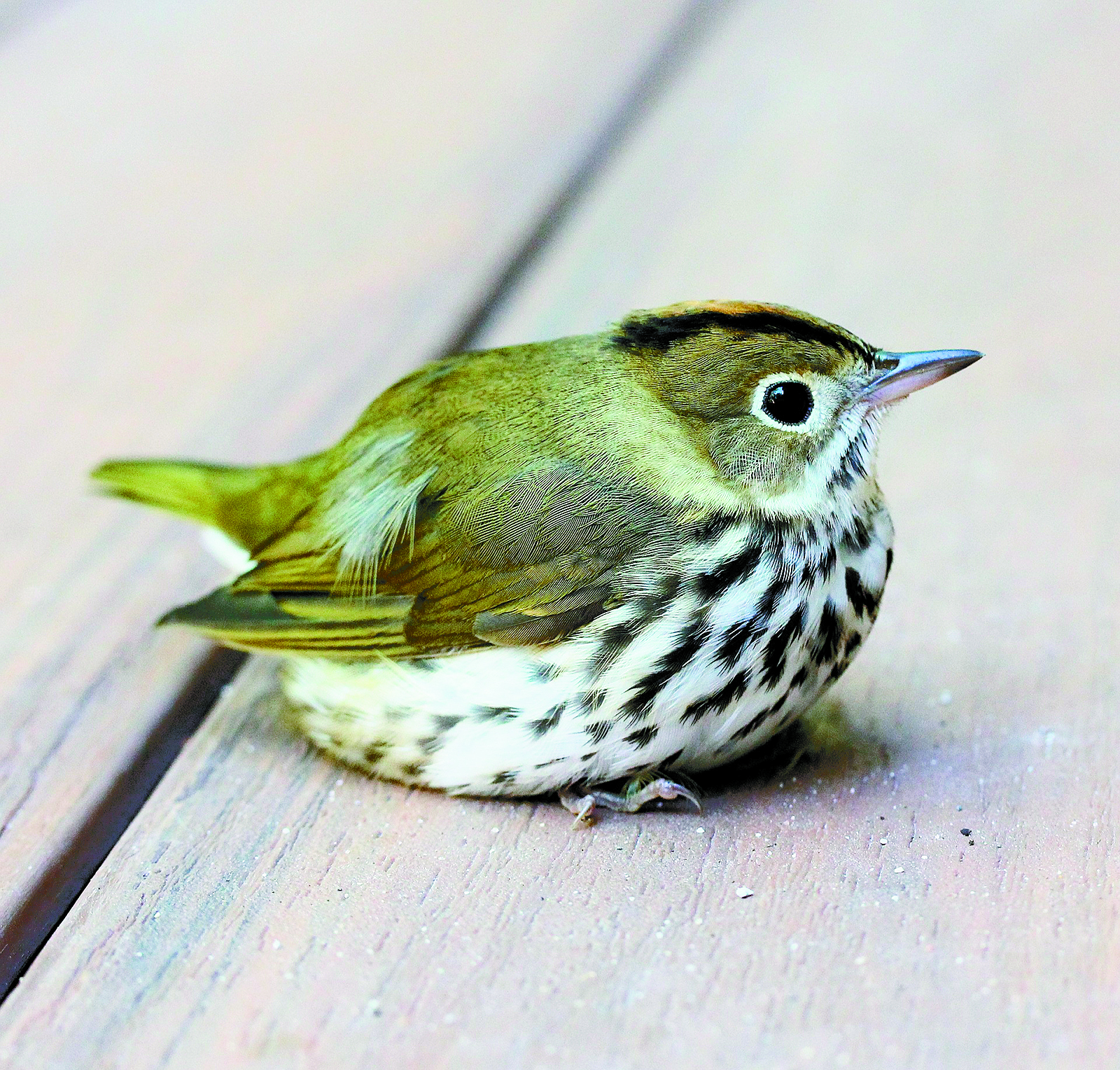
The ovenbird is not one of the brightly colored warblers, such as black-throated blue warbler or yellow warbler. The ovenbird is a small brown bird with a white breast with dark streaking — an appearance that bears a superficial resemblance to the larger thrushes that share the same woodland habitat. The only hint of color is an orange crown bordered by dark stripes atop the bird’s head. Even this orange crown patch is not easily seen. When agitated, an ovenbird may raise its head feathers, which makes this orange mark easier to detect. The ovenbird also shows a distinct white ring around each eye, as well as pink legs and a pinkish bill.

The resemblance to North America’s brown thrushes didn’t go unnoticed by some early American naturalists. Painter and famous naturalist John James Audubon painted a pair of ovenbirds, which he knew as “golden-crowned thrushes.” When comparing the two names, one can’t help but wish that the inaccurate but more romantically descriptive golden-crowned thrush had stuck.

While not likely to take an observer’s breath away with an unexpected explosion of vibrant plumage, the ovenbird’s not a drab bird. These warblers possess a subtle beauty all their own that is worth taking the time to behold.

Photo by Peggy Dyar from Pixabay • Despite the oliver-brown plumage, a closer look shows that the overbird is a bird with a subtle beauty, including an inconspicuous orange crown.

Unfortunately, ovenbirds are stubborn about letting themselves be seen. They’re easily heard. The males begin singing a loud, rollicking “Teacher! Teacher! Teacher” song almost as soon as they arrive on potential nesting grounds.

The ovenbird, unlike many warblers, is not named for its appearance. Instead, the bird’s name derives from the shape of the nest it builds. The nest is a domed structure placed on the ground, woven from vegetation and containing a side entrance. Early European settlers in North America thought the nest looked like a Dutch oven, hence the name “ovenbird” for the small warbler with the intricate nest.

Rather than hopping along the length of a branch or limb, an ovenbird walks in a deliberate fashion. This bird feeds on insects, spiders and other small prey items foraged from the woodland floor. On rare occasions, a lingering ovenbird shows up at feeders during the winter months.

Again, the most persistent characteristic of this warbler is the fact that it’s shy. It’s not as notoriously shy as warblers like mourning warbler of Connecticut warbler, but the ovenbird spends much of the time near the woodland floor and out of sight. The best time to catch a look at this warbler is once they begin nesting. Parents are extremely protective and defensive of their nest and young. Intruding too close is sure to bring some sharp alarm notes. The parents will often confront an intruder, flitting from branch to branch in nearby trees, utterly neglecting their usual preference for remaining unseen if not unheard.

Photo by Jean Potter • An ovenbird sings from a perch in the leaf canopy.

Ovenbirds spend the summer nesting season in mature deciduous and mixed forests across Canada and the eastern United States. They do not make as lengthy a migration as that undertaken by some of their relatives. Ovenbirds migrate each fall to the southeastern United States, the West Indies and also spreads out from Mexico to northern South America for the winter season.

It’s one of several warblers that nest in Northeast Tennessee and Western North Carolina. Others include Louisiana waterthrush, Kentucky warbler, common yellowthroat, Swainson’s warbler, black-throated blue warbler and American redstart, among others.

•••••

My mom saw her first hummingbird of spring on April 16 at 9:34 a.m. Of course, the bird waited until I’d left for work to make an appearance.

My solace has been an influx of other migrants in the past week. A blue-gray gnatcatcher’s fussy buzz alerted me to its return on April 10. I eventually got binoculars focused on the fidgety bird as it flitted in the upper branches of a cherry tree.

I heard the familiar chittering cries overhead while walking in downtown Erwin on April 14. Looking skyward, I watched a flock of chimney swifts flying gracefully over the rooftops of downtown buildings.

New warblers at home this week, other than the ovenbird, have included hooded warbler and black-throated green warbler, both of which put in their first spring appearance on April 15.

•••••

As noted, hummingbirds are returning. I’ve had reports from Western North Carolina and all across Northeast Tennessee. I will compile a listing of those who have shared their first sightings with me for next week’s column.
Keep sharing your hummingbird observations at ahoodedwarbler@aol.com or post them on my Facebook page. Please include the date and the approximate time of your sighting.