Category Archives: Virginia

Dark-eyed junco heralds winter’s approach and marks milestone in weekly bird musings

junco-feb9

Photo by Bryan Stevens • A dark-eyed junco, usually a harbinger of wintry weather and snowy days, shells sunflower seeds beneath a feeder.

I wrote my first column about our “feathered friends” on Sunday, Nov. 5, 1995, which means this column will soon celebrate its 23rd anniversary.

This column has appeared on a weekly basis for the last 23 years in a total of five different newspapers, and in recent years it has been syndicated to several more. The column has also been a great conduit for getting to know other people interested birds and birding. I always enjoy hearing from readers, and I hope to continue to do so in the coming years as well. Since February 2014, I’ve also been posting the column as a weekly blog on birds and birding.

I saw my first swamp sparrow of the fall on Oct. 23. Autumn’s a time when many of those so-called “little brown birds,” also known as the sparrows, return to live in the fields, gardens, yards and woodlands around our home. Two of the other anticipated arrivals are white-throated sparrows and dark-eyed juncos.
SwampSparrow-April11

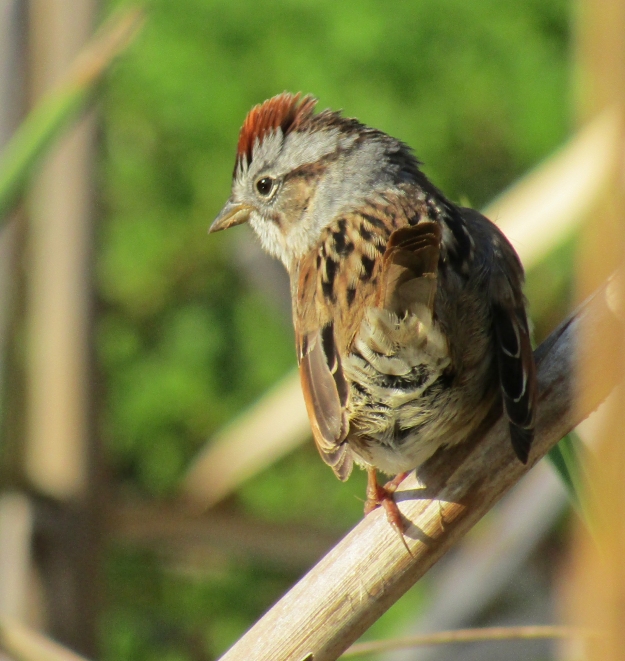
Photo by Bryan Stevens • Sparrows, like this swamp sparrow, often spend the winter months in fields, woods, and wetlands, sometimes visiting feeders in our homes and gardens.

In fact, that first column I wrote back in 1995 focused on one of the region’s most prevalent winter residents— the dark-eyed junco. Experts place juncos among the varied sparrow family. All juncos are resident of the New World, ranging throughout North and Central America. Scientists are continually debating precisely how many species of junco exist, with estimates ranging from a mere three species to about a dozen species.

Some of the other juncos include the volcano junco, yellow-eyed junco, Chiapas junco, Guadalupe junco, pink-sided junco, Oregon junco and Baird’s junco, which is named in honor Spencer Fullerton Baird, a 19th century American naturalist and a former Secretary of the Smithsonian Institution.

With that introduction and with some revisions I have made through the years, here is that very first column that I ever wrote about birds.
dark-eyed-junco-Skeeze-Pixabay

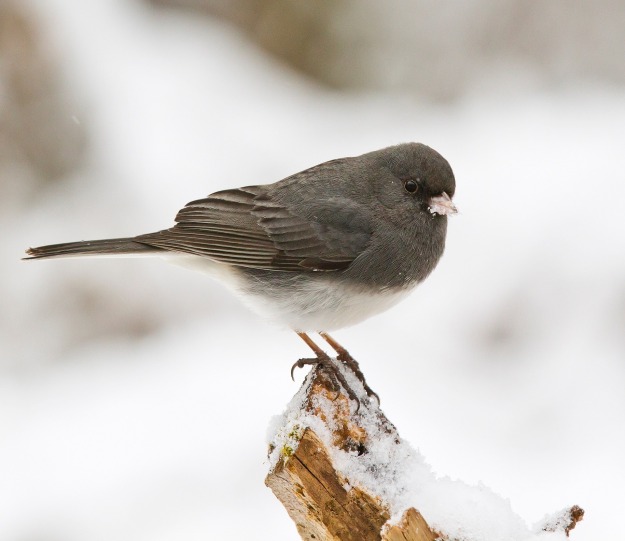
Photo by Skeeze-Pixabay • A dark-eyed junco clings to a snowy perch.

…..

Of all the birds associated with winter weather, few are as symbolic as the dark-eyed junco, or “snow bird.” The junco occurs in several geographic variations.

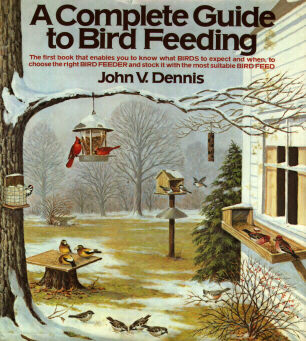
John V. Dennis, author of “A Complete Guide to Bird Feeding,” captures the essence of the junco in the following description: “Driving winds and swirling snow do not daunt this plucky bird. The coldest winter days see the junco as lively as ever and with a joie de vivre that bolsters our sagging spirits.” The dark-eyed junco’s scientific name, hyemalis, is New Latin for “wintry,” an apt description of this bird.
dennisjl 2

Most people look forward to the spring return of some of our brilliant birds — warblers, tanagers and orioles — and I must admit that I also enjoy the arrival of these birds. The junco, in comparison to some of these species, is not in the same league. Nevertheless, the junco is handsome in its slate gray and white plumage, giving rise to the old saying “dark skies above, snow below.”

Just as neotropical migrants make long distance journeys twice a year, the junco is also a migrating species. But in Appalachia, the junco is a special type of migrant. Most people think of birds as “going south for the winter.” In a basic sense this is true. But some juncos do not undertake a long horizontal (the scientific term) migration from north to south. Instead, these birds merely move from high elevations, such as the spruce fir peaks, to the lower elevations. This type of migration is known as vertical migration. Other juncos, such as those that spend their breeding season in northern locales, do make a southern migration and, at times, even mix with the vertical migrants.

Juncos are usually in residence around my home by early November. Once they make themselves at home I can expect to play host to them until at least late April or early May of the following year. So, for at least six months, the snow bird is one of the most common and delightful feeder visitors a bird enthusiast could want.

Juncos flock to feeders where they are rather mild-mannered — except among themselves. There are definite pecking orders in a junco flock, and females are usually on the lower tiers of the hierarchy. Females can sometimes be distinguished from males because of their paler gray or even brown upper plumage.
Junco

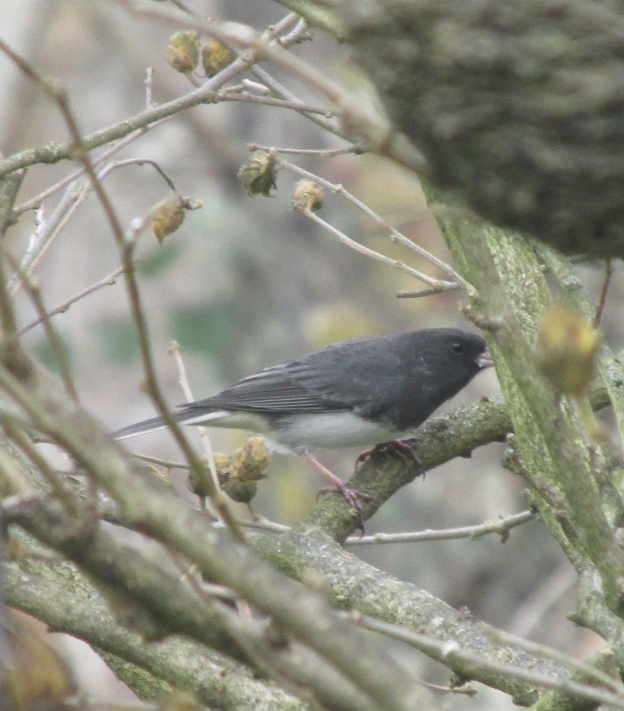
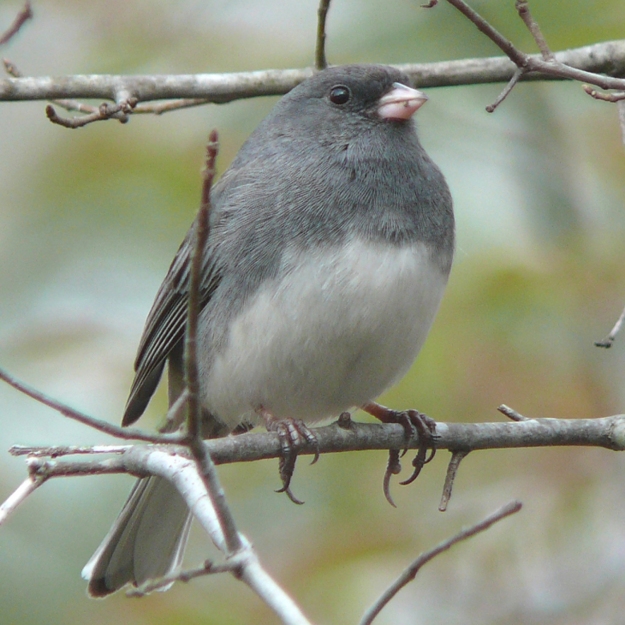
Photo by Ken Thomas • A dark-eyed junco perches on some bare branches on a winter’s day.

Since juncos are primarily ground feeders, they tend to shun hanging feeders. But one winter I observed a junco that had mastered perching on a hanging “pine cone” feeder to enjoy a suet and peanut butter mixture.

Dark-eyed juncos often are content to glean the scraps other birds knock to the ground. Juncos are widespread. They visit feeders across North America. The junco is the most common species of bird to visit feeding stations. They will sample a variety of fare, but prefer such seeds as millet, cracked corn or black oil sunflower.

There’s something about winter that makes a junco’s dark and light garb an appropriate and even striking choice, particularly against a backdrop of newly fallen snow.
Junco-Carver

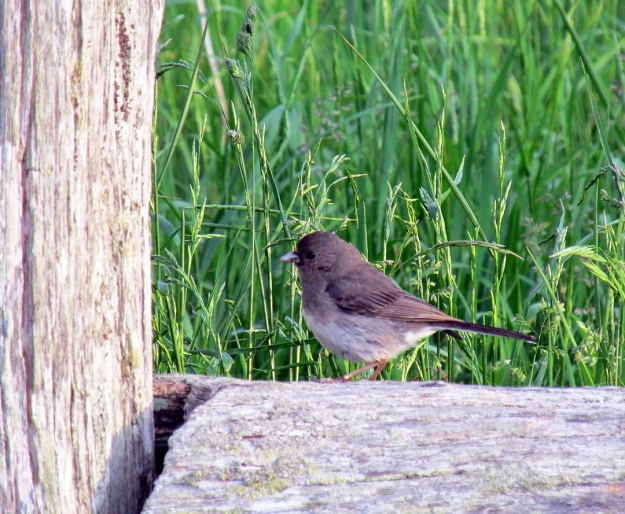
Photo by Bryan Stevens • Dark-eyed junco nests on high mountain slopes during the summer month. This dark-eyed junco was photographed at Carver’s Gap on Roan Mountain during the summer nesting season.

Of course, the real entertainment from juncos come from their frequent visits to our backyard feeders. When these birds flock to a feeder and begin a furious period of eating, I don’t even have to glance skyward or tune in the television weather forecast. I know what they know. Bad weather is on the way!

•••••

Back when I wrote that original column, juncos often returned each fall in the final days of October or first days of November. In the last few years, however, their arrival times have grown consistently later in November. At times, it takes a serious snowfall to drive these hardy birds to seek out easy fare at my feeders. I’m hoping they’ll return soon. In the meantime, if you want to share your first dark-eyed junco sighting of the fall, I’d love to hear from you. If you want to share a sighting, have a question or wish to make a comment, email ahoodedwarbler@aol.com.
dark-eyedjunco-female

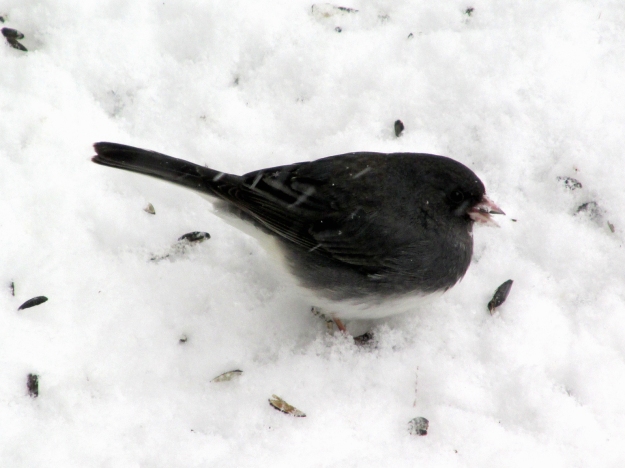
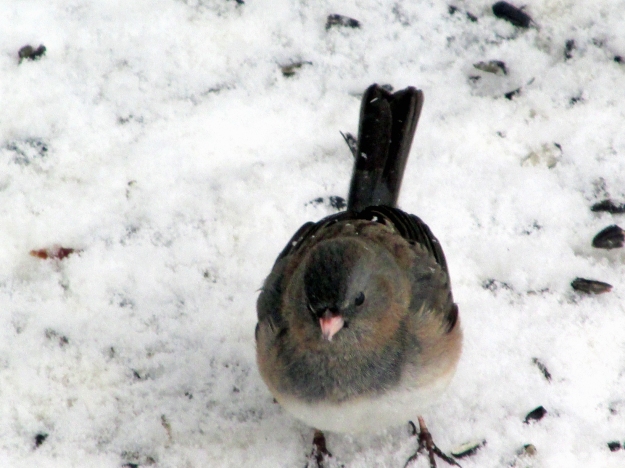
Photo by Bryan Stevens • A female dark-eyed junco scrambles for sunflowers seeds in the snow.

Indigo bunting one of summer’s common songbirds

IMG_6700

Photo by Bryan Stevens • The male indigo bunting is a resplendent bird.

Two recent summer bird counts emphasized some of the more commonplace birds in the region. While American robins and European starlings were extremely abundant, these two birds are permanent residents and are present year-round. A few other summer songbirds also helped swell the ranks of some of the seasonally common birds. For instance, the Unicoi County Summer Bird Count found a total of 141 indigo buntings while the Elizabethton Summer Bird Count tallied 82 of these little blue beauties. Both of these Northeast Tennessee surveys are conducted by members of the Lee and Lois Herndon Chapter of Tennessee Ornithological Society.

The indigo bunting likes to reside in the boundary region where forests and woodlands meet fields and pastures. Personally, the indigo bunting has always been a bird that is suggestive of the long, hot days of summer. One of my earliest and still quite vivid birding memories is a recollection of a shockingly blue bird atop a blue spruce tree in my yard. Several decades later, the tree is no longer standing, but these beautiful birds — I now know these summer visitors were indigo buntings — return year after year to my yard and gardens.

Count-IndigoBunting

Photo by Bryan Stevens • Neotropical migrants, such as this Indigo Bunting, increase the variety of bright and colorful birds in eastern North America from spring until fall each year.

These birds usually arrive in the region in late April and I’ve seen them in late October, although most indigo buntings have left the region by late September.

Male indigo buntings are persistent singers, and in the past couple of weeks one very enthusiastic male has been singing even during the hottest hours of recent July afternoons. The preference of this small songbird is to sing from the tops of tall trees. They are often concealed by the green leaves. When I do get a glimpse of the obscured songster, often all I see is a dark shape silhouetted against the bright sky. Sometimes, if he plunges from the upper branches into the woodland understory, I get that telltale glimpse of blue feathers.

The indigo bunting is the only solid blue bird in the eastern United States. It’s all an illusion, of course. The indigo bunting’s feathers are not really blue. The male’s brilliant azure plumage is caused by the process of refraction. This process absorbs all but blue light, which explains why the indigo bunting appears blue. In bright light, it can even look unnaturally vivid blue. In poor light, however, an indigo bunting male can appear black. Fortunately, indigo buntings have both a characteristic body shape and song, so even if the birds are not seen at their best, they can still be recognized.

Indigo-Count

Photon by Bryan Stevens • Indigo Buntings will perch on wires and sing for hours even during hot summer days.

Like many species of songbirds, the male is by far the most colorful. In this instance, the male is also responsible for the species’ name. Indigo is a blue dye that was once an important crop in the South. The drab female may boast some blue highlights in her plumage. Juvenile birds just out of the nest also resemble the female. Pay close attention to any indigo buntings you observe as summer progresses. Juvenile birds will look mostly brown with just a hint of blue in the wings and the tail. These will be the young buntings that were hatched this spring and early summer. They will often accompany their parents to feeders.

Indigo buntings are particularly fun birds to observe in late summer. Although some books indicate that males are not very active in rearing young, I have on numerous occasions witnessed male buntings feeding fledglings at feeders. Indigo bunting juveniles, like the young of many other birds, beg for tidbits from parents by “bowing,” spreading their wings and shivering. These actions usually prompt a parent to pop some morsel into an impatient youngster’s open bill. Indigo buntings are relatively easy to view. They frequent weedy fields and roadside brush. During the breeding season, males can also be seen singing from prominent perches. The song, a distinctive jumble of notes, can help observers find these dedicated singers.
IndigoBunt

Photo by Bryan Stevens • Although bright blue, a male indigo bunting will often blend with its surroundings.

The male indigo bunting is one of the most colorful birds to visit feeders in the region. This species is also extremely fond of millet seed. I like to have some feeders stocked with millet when the buntings begin to return each spring. They will also feed on thistle and sunflower seeds. Away from our feeders, they also devour plenty of seeds from various noxious weeds. Because of the indigo bunting’s appetite for the seeds of destructive weeds, it is considered a very beneficial bird.

One of the most attractive summer scenes is to observe American goldfinches and indigo buntings feeding together on the nodding heads of summer sunflowers. The goldfinch males, resplendent in their bright yellow and black plumage, compete with the blue indigo bunting males for the fresh sunflower seeds. When bright red male Northern cardinals join in, observers have a complete artists’s palette for summer viewing.

The indigo bunting will usually respond to human squeaks that imitate a bird’s call. When a flock or family group of buntings are disturbed by a human observer, they usually begin a chorus of alarmed “chipping.”indigo-bunting-john-james-audubon

As I indicated earlier, indigo buntings remain in the region until late September. Although this bird typically winters in Mexico, Panama and the Caribbean, in recent decades some indigo buntings have only gone as far south as Florida to spend the winter. There in the Sunshine State, the indigo buntings may mingle with a close relative, the splendidly multi-colored painted bunting. I usually see these vibrant songbirds whenever I visit coastal South Carolina in spring or summer. Male painted buntings are probably one of the most colorful birds in the United States with hues of red, green, purple and blue in their feathers.

PaintedBunting-Male (1)

Photo by Bryan Stevens • The male painted bunting is one of North America’s most colorful birds.

Other North American buntings include the snow bunting, the lazuli bunting and the lark bunting, which is also the official state bird for Colorado. Some of the common but descriptive names for some of the world’s other buntings include striolated bunting, cinnamon-breasted bunting, cinereous bunting, white-capped bunting, lark-like bunting, ochre-rumped bunting, golden-breasted bunting, chestnut-bunting, red-headed bunting, yellow bunting, little bunting, brown-rumped bunting, meadow bunting, corn bunting and crested bunting.

Keep your feeders stocked with millet and sunflower seeds if you want to increase your chances of seeing indigo buntings. They will need some dependable places to re-fuel and rest during their upcoming fall migration.

No cowbird ever knows its biological parents

While many birds are excellent parents, others lack any maternal or paternal instincts altogether. The common cuckoo, a nesting bird in Europe and Asia, is a well-known brood parasite that would rather slip its eggs into the nest of other bird than raise its own young. In scientific terms, “brood parasite” refers to creatures that rely on others to raise their young. In addition to some birds, this tactic is also employed by some species of insects and fish.

COWBIRD-Female

Photo by Bryan Stevens • Female brown-headed cowbirds stay alert to observe bird leaving or coming to a nest. Once they have located a nest, these birds slip their own eggs into the nests of other birds.

The strategy is effective, if, in the human way of thinking, rather heartless. In biological terms, however, this “foster parenting” allows brood parasites to ensure a new generation without expending much energy on the part of the actual parents. Some recent contacts with readers have reminded me that not all of our feathered friends would qualify for “parent of the year.”

Mike Dickenson of Bristol, Tennessee, contacted me on Facebook about a discovery he made in a nest built under the steps of his house.

Cowbird-Female

Photo by Bryan Stevens • A female brown-headed cowbird visits a feeder.

“I noticed two blue eggs,” he said. “I checked a few days later and noticed two gray eggs also. Did another bird sneak her eggs into the nest?” Mike also informed me that some of the eggs hatched shortly after he discovered them.

James Rowland of Erwin, Tennessee, sent me a message on Facebook asking me to identify a bird in a photograph he had taken. “What is this bird?” James asked. “It’s larger than a sparrow.”

He added that he observed and photographed the bird near the Covered Bridge in Elizabethton, Tennessee. A study of the bird in the photo revealed a very nondescript bird in largely gray plumage. Few of our birds are this plain and gray with almost no standout characteristics.

36043826_277373272833221_1274549914663124992_n

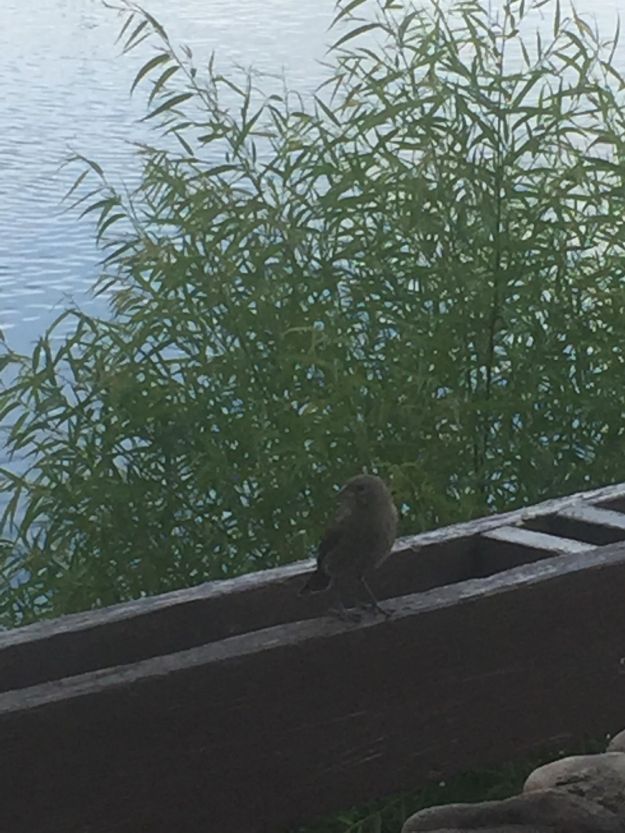
Photo by James Rowland • A brown-headed cowbird, probably a young bird or a female, near the Covered Bridge in Elizabethton, Tennessee.

In both cases, one of North America’s most successful brood parasites was involved. I responded to Mike and told him that is was entirely possible that a female brown-headed cowbird slipped some eggs into the nest beneath his steps. I likewise informed James that the bird in his photo looked like a brown-headed cowbird. I added that the bird was either a female or a young bird, since a male would have the brown head that gives the species its common name.

In North America, one of the best-known feathered brood parasites is the brown-headed cowbird. While many brood parasites are specialists, with females slipping their eggs into the nest of a specific species of host bird, the brown-headed cowbird approaches brood parasitism in a less discriminating manner. Female cowbirds have been known to lay their eggs in the nests of at least 221 different species of birds. No baby brown-headed cowbird ever knows its biological parents.

How did the brown-headed cowbird turn to a life of foisting eggs onto unsuspecting foster parents? The answer is connected with the American bison, also known as buffalo. When the bison roamed the Great Plains of the United States by the millions, flocks of brown-headed cowbirds followed the great herds, feeding on the insects flushed by the hooves of millions of bison. As the herds stayed on the move constantly, the cowbirds also developed a nomadic lifestyle. After the bison herd diminished, the cowbirds survived a potential crisis by simply transferring their bovine affinity from bison to domesticated cattle.

Brown-headedCowbird-Male

Photo by Bryan Stevens • A male brown-headed cowbird displays the brown head that gives this bird its common name.

At times, this random and undiscriminating approach to reproduction fails. Some finches feed their young a diet that consists of a great deal of vegetable matter. Young cowbirds fed this protein deficient diet fail to thrive and ultimately perish.

Other birds blissfully bring a rich assortment of protein snacks — insects, spiders and other small invertebrates — that permits the young foster bird to thrive, at times at the expense of the host bird’s own young. About 20 years ago I observed a willow flycatcher bringing food to a young brown-headed cowbird at least twice the size of the “parent” trying to feed it. I’ve also seen song sparrows, dwarfed by a cowbird changeling, trying to keep their enormous baby bird well fed.

Cowbirds are members of the blackbird family, which includes such relations as orioles, meadowlarks and grackles. All cowbirds are confined to the New World and include species such as the screaming cowbird of Argentina, Bolivia and Brazil, as well as the bronzed cowbird of Central America and the southern United States, especially the states of California, Arizona, New Mexico, Texas, and Louisiana. Other cowbird family members include giant cowbird and the shiny cowbird.

Brown-headed-Cowbird-Audubon-1-726x400

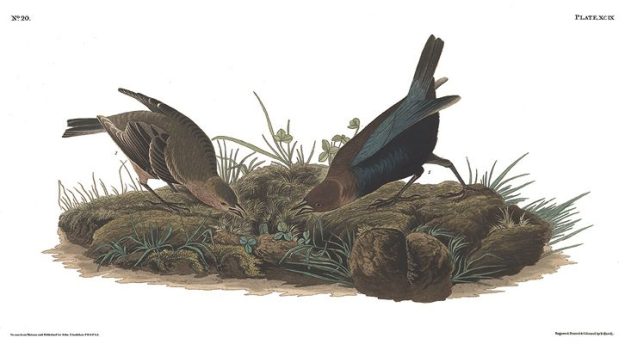
Early naturalist and painter John James Audubon painted this pair of brown-headed cowbirds.

White-faced ibis creates birding stir with rare visit to region

When I awoke on April 19, I didn’t expect that I’d end up seeing a new state bird before the day ended. Thanks to timely notices of a new bird sighting by email, I used my work break to drive to Elizabethton, Tennessee, to see a white-faced ibis at the Carter County Rescue Squad pond. The opportunity for unexpected appearances by birds like the white-faced ibis is why I love spring migration.

White-FacedIbis

Photo by Bryan Stevens • The red eye of this white-faced ibis allowed observers to confirm the identity of the bird. The similar glossy ibis does not have red eyes.

Tom McNeil spotted the bird at a much larger pond on the campus of Northeast State Community College in Elizabethton. After he reported the bird, I was able to use a work break to travel to the location and find the bird nearby at the smaller pond, where several area birders had already arrived. The ibis had moved to this smaller pond after departing the larger pond where it was first detected.

This is only the second record of a white-faced ibis for Northeast Tennessee.

The white-faced ibis is a widespread wading bird, nesting from the western United States and Canada south through Mexico, as well as from southeastern Brazil and southeastern Bolivia south to central Argentina, and along the coast of central Chile.

I saw white-faced ibises for the first time during a trip to Utah in May of 2006. The state had enjoyed a spring with ample rainfall, and every flooded field and pasture contained flocks of these distinctive wading birds. These flooded fields provided temporary habitat for numerous other birds, including cinnamon teal and Wilson’s phalarope.

UtahIbis

Photo by Bryan Stevens • A flooded field in northern Utah near the border with Wyoming provided foraging habitat for this white-faced ibis.

The white-faced ibis is almost identical in appearance to the glossy ibis, which is the most widespread ibis in the world. The glossy ibis ranges across six continents, absent only from Antarctica. In the United States, the glossy ibis ranges mostly along the southern Atlantic coastal area. I have observed this bird at several locations in South Carolina.

The similar appearances of white-faced and glossy ibis presents challenges to identification, which was the case with this recent visitor. The bird found in Elizabethton lacked the white plumage in the face that gives the species its common name. Fortunately, the bird did plainly show one physical trait — red eyes — that easily distinguishes it from the related glossy ibis. Sometimes, all it takes to clinch an identification is a simple physical characteristic such as, in this case, a red eye.

A third ibis native to North America is the white ibis. The Audubon Society identifies the white ibis as one of the most numerous wading birds in Florida, but the bird is common also in other parts of the southeast with appropriate wetland habitat. Like the wood stork, the ibis has declined in Florida in recent decades largely as a result of human encroachment.

BRYAN-IBIS

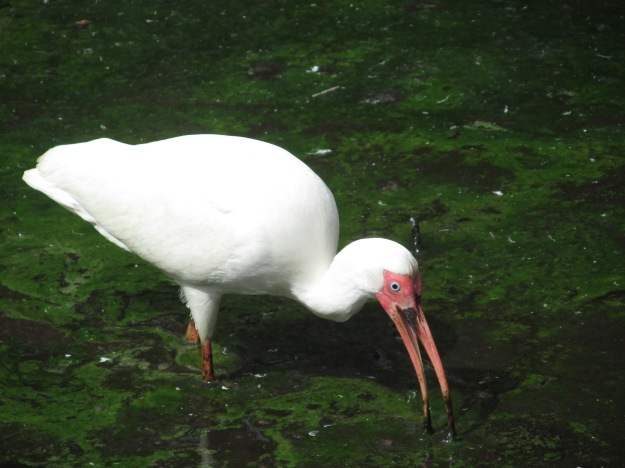
Photo by Bryan Stevens • A white ibis forages for food by probing in water and mud.

The white ibis looks like a humorously absurd bird that could have been invented by Dr. Seuss. The extravagant, all-white plumage is contrasted by pinkish-orange legs, an extremely long, downcurved, reddish-pink bill and bright blue eyes. In flight, the white ibis shows black feathers on the edges of its wings.

I’ve seen white ibises in Tennessee as well as in South Carolina and Florida. In the Sunshine State, another relative — the unmistakable scarlet ibis — is sometimes observed in the wild. The scarlet ibis inhabits tropical South America and islands of the Caribbean, but the species if often held in zoos and other attractions. Escaped birds rather than strays are often the source of sightings in Florida of this vibrant scarlet-feathered ibis.

Glossy-Flock

Photo by Bryan Stevens • A glossy ibis flock feeds in a wetland located at Huntington Beach State Park in South Carolina.

All ibises have long, downcurved bills. These birds usually feed in small flocks, probing wetlands for prey such as crustaceans, small fish, amphibians, insects, and various invertebrates. Worldwide, there are about 34 species of ibis, including the red-naped ibis, black-faced ibis, green ibis, straw-necked ibis and African sacred ibis, which is the bird often depicted in tombs and other monuments of ancient Egypt. This ibis was associated with the Egyptian god, Thoth, who was often depicted as a man with the head of an ibis.

The brief visit from the white-faced ibis provides a good reminder that we’re in the midst of spring migration. Stay alert for those unexpected birds. You never know what you might see.

IMG_5931

Photo by Bryan Stevens • The white-faced ibis found in Elizabethton, Tennessee, is shown walking past a domestic duck and a mallard.

Readers continue to report hummer arrivals

A few other readers have shared their first spring hummingbird sightings.
• Bunny Medeiros of Abingdon, Virginia sent me an email to announce her first sighting. “To my delight, the day after I put out my feeder a hummer appeared,” she wrote. The bird, a male, made his appeared on April 14.
• Rhonda Eller of Chilhowie, Virginia, saw her first ruby-throated hummingbird of spring on April 18. “Surely spring is going to come and stay!” Rhonda predicted on her post of my Facebook page.

Bird survey seeks volunteers

The Virginia Breeding Bird Atlas is getting ready for a third year of surveying the state’s birds. The atlas is a citizen science project, and volunteers conduct most of the key data collection. Organizers are hopeful that Virginia’s strong birding community will partner with the Virginia Ornithological Society and Virginia Department of Game and Inland Fisheries to accomplish the largest bird conservation effort in the state to date.
“This is our third year, and we can always use more volunteers to participate,” said Steven Hopp with Environmental Studies at Emory and Henry College. “Our region down here in the corner is one of the least-covered areas of the state.”
Anyone interested in participating and learning more about the atlas is welcome to email Hopp at shopp@ehc.edu.

IMG_5909

Photo by Bryan Stevens • The white-faced ibis probed the edge of a pond in its search for food, occasionally catching and consuming tadpoles.

Hummingbirds are back, and readers share first spring sightings

30425329_10214061548565156_3810521485761143823_o 3

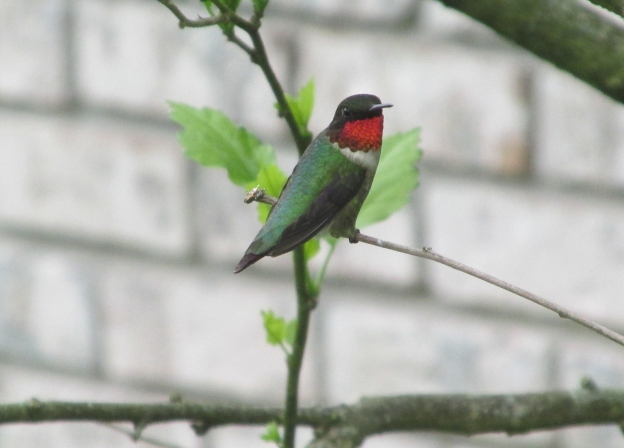
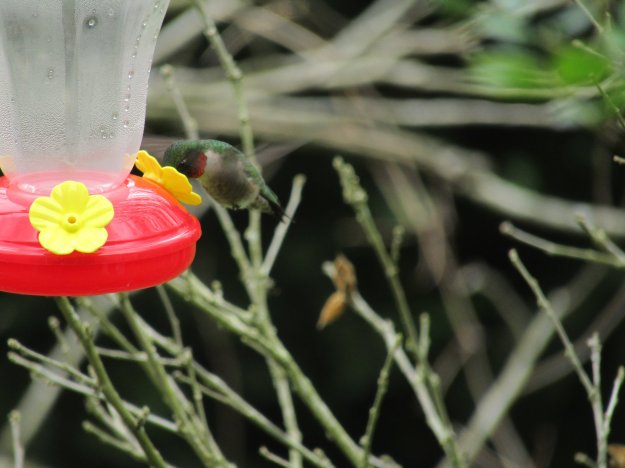
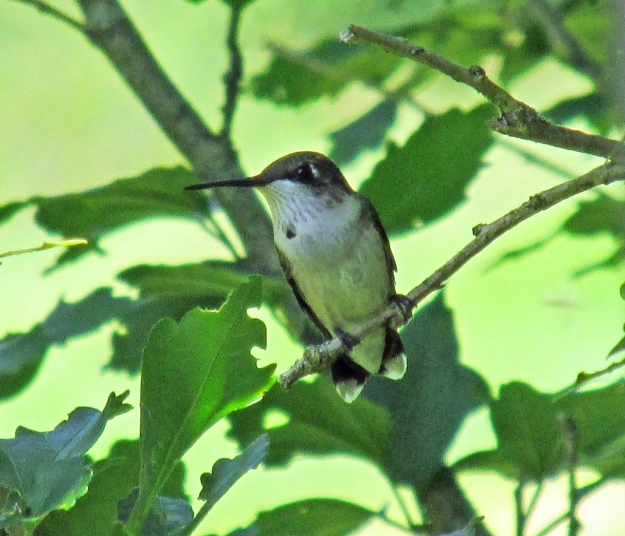
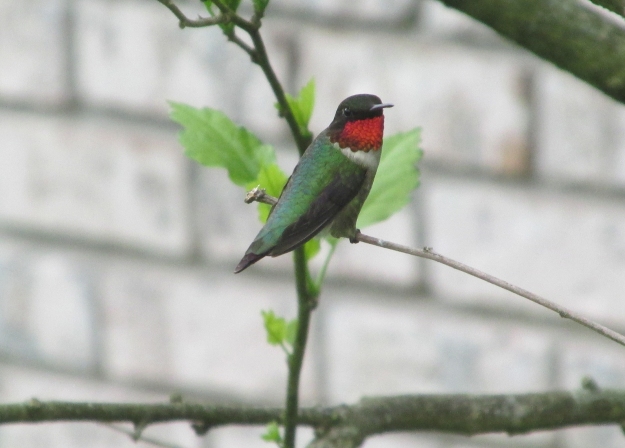
Photo by Bryan Stevens • Ruby-throated hummingbirds returned to the region earlier this month. This male, sipping sugar water from a feeder, shows its namesake red throat patch.

As many readers have already noticed, the ruby-throated hummingbirds are back. These tiny flying gems began returning to the region in the first days of April, but reports of their arrival spiked during the second week of April.

What do the hummingbirds that make their homes in our yards from April to October do during the five months they are absent from the region?

Most ruby-throated hummingbirds retreat to southern Mexico and Central America, some winging their way as far south as extreme western Panama, as well as the West Indies and southern Florida. They utilize a variety of habitats, ranging from citrus groves and forest edges to tropical deciduous forests and the edges of rivers and wetlands.

Those ruby-throated hummingbirds that make it as far south as Panama may find that they must compete with 59 other species of hummingbirds that call the Central America country home. In their winter home, the ruby-throated hummingbirds are definitely just another face in the crowd when its comes to their kin. In Panama, a ruby-throated hummingbird might encounter violet-headed hummingbirds, white-necked jacobins, black-throated mangos and green violet ears.

Ruby-OneSpot

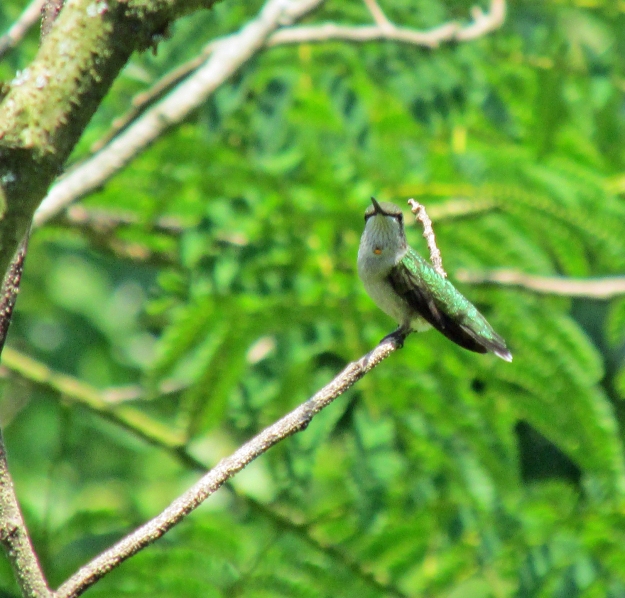
Photo by Bryan Stevens • A young ruby-throated hummingbird shows a hint of the red throat gorget that gives this bird its common name.

It must be nice to live among so many hummingbirds. Closer to home, the ruby-throated hummingbird is the only one of its kind to nest in the eastern United States. Some of the ones arriving at our feeders now will speed their way farther north, but some will settle in our yards and gardens as they bring forth the next generation of ruby-throated hummingbirds.

Dianne Draper reported the earliest observation of which I am aware. A friend on Facebook and a fellow birder, Dianne posted that the first hummingbird of spring arrived at her home in Jonesborough, Tennessee, on the morning of April 4. Her sighting was seven days earlier than any of the others I received.

Harold and Elizabeth Willis in Marion, North Carolina, reported their first hummingbird at 5 p.m. on Wednesday, April 11.

Helen Whited in Richland, Virginia, saw her first hummingbird at 12:40 p.m. on Thursday, April 12.

Judy and Bill Beckman saw their first spring hummer at 7:25 p.m. on April 12 at their home in Unicoi, Tennessee.

Ruby-throatedFemale-EYE

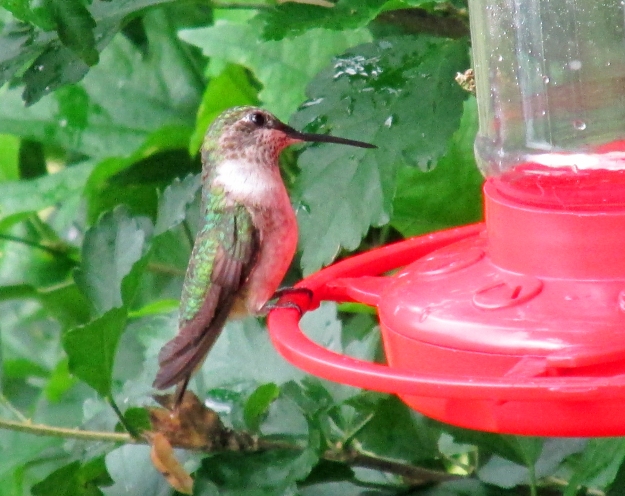
Photo by Bryan Stevens • A female ruby-throated hummingbird settles onto the perch of a sugar water feeder.

Lois Wilhelm, who lives on Little Bald Creek Road on Spivey Mountain in Erwin, Tennessee, saw her first hummingbird of 2018 at 3:30 p.m. on April 12.

Glen Eller in Kingsport, Tennessee, saw his first spring hummingbird around 5 p.m. on April 12. The bird — a male — drank for about four minutes. “I guess he needed a good fill up,” Glen commented.

Nola Martin from Nebo, North Carolina, reported her first hummer arrived just before 11 a.m. on April 12.

“He was a little green bird….not sure which kind or which sex,” she wrote in her email. “It certainly remembered where one of my feeders was last year, though, as it was looking for it in that spot, I didn’t have that one out yet.”

Nola said she now has five of her seven feeders filled and placed out for the returning hummingbirds.

Betty Poole saw her first male hummingbird of spring when the bird arrived at 9:05 a.m. on Friday, April 13, at her home in Bristol, Virginia. Her daughter, Jane P. Arnold, emailed me the information about her mother’s sighting. Jane is still awaiting her own first spring sighting of a hummingbird.

Ruby-WingLift

Photo by Bryan Stevens • A ruby-throated hummingbird lifts its wings to shake water droplets off its back.

Debbie Oliver, while watching Wheel of Fortune on the evening of April 12, got her first glimpse of a spring hummer at her deck feeders in Bristol, Tennessee.

“I couldn’t observe if it was male or female due to the dimming light,” she wrote in an email.

“It was a curious ruby-throated hummingbird just flying around the feeder without taking a sip of nectar,” she added.  Around 9 a.m. the following morning, she spotted a male ruby-throated hummer drinking nectar at the feeder.

She speculated about whether the bird was the same individual that visited the previous evening. “We’ll never know,” she decided.

Joneen Sargent emailed me to let me know that her husband, Dale, saw a ruby-throated hummingbird on April 12 at 7 a.m. The Sargents live off of Booher Drive in Bristol, Tennessee.

Bob Cheers of Bristol, Virginia, saw his first ruby-throated hummingbird at 6:45 a.m. on April 13. Bob keeps a record of the arrival dates for this tiny bird. In 2015, he saw the first hummer on April 9. Last year, he saw his first hummer on April 11. In 2016, the first bird arrived on April 13. In 2014, he had to wait until April 14 to see the first hummer of spring.

RubyRed

Photo by Bryan Stevens • A male ruby-throated hummingbird perches near a feeder that he is ready to defend from all comers.

Mark Hurt, who lives on Glenway Avenue in Bristol near Virginia High School, said that his “little buddy,” the ruby-throated hummingbird, returned about 1 p.m. on April 13.

Sandra Loving reported that her first hummer sighting took place at 6:17 p.m. on April 13 at South Holston Lake in Tennessee.

Peggy Oliver saw her first male ruby-throated hummingbird of spring at 6:15 p.m. on April 13.

Ashley Russ of Abingdon, Virginia, emailed me to share that she spotted her first hummingbird of the season at 7:20 p.m. on April 13.

Terry Fletcher saw her first male ruby-throated hummingbird at her feeder at 6:50 a.m. on April 14 at home in the First Colony subdivision in Bristol, Tennessee. Away from home the previous day, Terry was told by a next-door neighbor that the hummingbirds actually showed up on April 13.

Janice Denton, who lives on Canthook Hill Road in Bristol, Tennessee, emailed me news of her first sighting.

“I’m excited to let you know that I saw my first ruby-throated hummingbird on Friday, April 13,” she wrote. “I have had my feeders out for about two weeks and was sitting on my front porch in the afternoon hoping to see a hummingbird.”

On April 15 around noon, Janice also reported that she saw a male ruby-throated on a feeder outside her kitchen window, and another one came along and chased it off.  “I hope they all stick around for the summer,” she wrote.

Ruby-Spot-Two

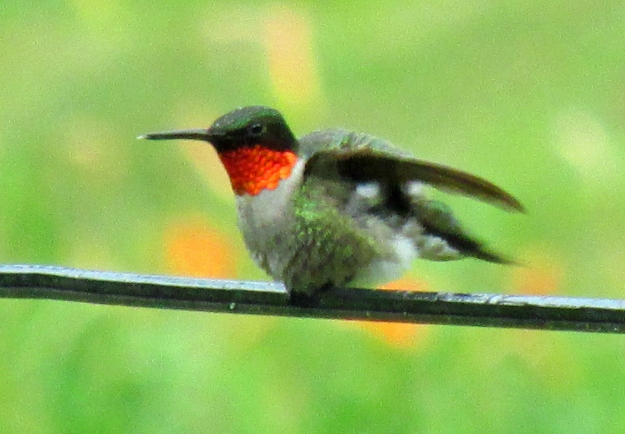
Photo by Bryan Stevens • Only adult male ruby-throated hummingbirds show the namesake ruby-red throat patch.

Lynne Reinhard reported via Facebook that she had her first hummingbird sighting at her home on the upper end of South Holston Lake on April 14. She noted that the hummingbird arrived a day earlier than last spring.

Linda Sproles, who lives on Hunter Hills Circle in Bristol, Tennessee, observed the first arrival of a hummingbird at her deck feeder at 10:43 a.m. on April 14. “It was a female, I believe, because it did not have a red throat patch,” she added.

Kathy Maggio, who lives between Benhams and Mendota in Washington County, Virginia, spotted her first hummingbird of spring at 1:15 p.m. on April 14.

Phyllis Moore of Bristol, Virginia, saw her first ruby-throated hummingbird of the spring at 4 p.m. on April 14.

Pat Stakely Cook, who resides in Marion, North Carolina, reported two ruby-throated hummingbirds at her feeders on April 14. The two male hummers stayed busy feeding and chasing each other.

32183fcb801d3cdbd206582ffb25517d 2

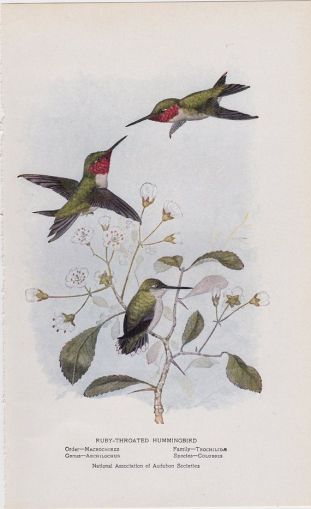
Early American naturalist and painter John James Audubon painted this work featuring the ruby-throated hummingbird. From the moment New World explorers arrived in the New World from Europe, they were impressed by the tiny, dazzling hummingbirds, a family of birds unknown in the Old World.

Amy Wallin Tipton, a resident of Erwin, Tennessee, saw her first hummingbird, a male, at 4 p.m. on April 14. She shared her sighting via Facebook.

Judi Sawyer, a resident of Roan Mountain, Tennessee, saw her first spring hummingbird, a male, at her home on the morning of April 14. Some house wrens decided to make their arrival the same day, she reported on Facebook.

Ginger Wertz-Justis in Baileyton, Tennessee, saw a male hummingbird at 6:30 p.m. on April 14.

Richard Trinkle emailed me to report that he saw a male ruby-throated hummingbird at 6:15 p.m. on April 14 at his Bristol home near Friendship Ford.

Robin Small saw the first hummer at 6:15 p.m. on April 14. “As I was looking at the snow falling and the cardinals, woodpeckers and regular visitors to my deck feeders, I saw my first hummingbird of 2018,” Robin wrote in an email. Robin put the feeder out the previous day when temperatures had been in the 80s and added that the hummer visited several times as the snow fell the evening of its arrival.

Janice Humble, who lives near South Holston Lake, put out her feeder on April 14. “It wasn’t 15 minutes until I had a hummingbird,” she wrote in her email.  “I saw two others that same evening.”

Lewis Spicer of Abingdon, Virginia, had both a male and female hummingbird visit his home for the first time this spring on the same day on April 15. He saw the male at 9:35 a.m. The female hummer arrived during afternoon rain at 12:45.

Frank and Myra Renault of Abingdon, Virginia, saw their first hummingbird of spring — a female — at 12:06 p.m. on April 16.

Sheila Myers, who lives on Porter Valley Road in Marion, Virginia, saw her first hummer at noon on April 16.

Rhonda Eller in Chilhowie, Virginia, saw her first spring hummingbird at 4:53 p.m. on April 18.

I am pleased to report that my own first hummingbird sighting for 2018 took place when a feisty male zipped into the yard while I was seated on the front porch. He sipped at four different feeders before he zoomed off. He arrived at 5:40 p.m. on April 14, one day earlier than last year’s first arrival. My feeders had been waiting for the arrival of hummingbirds for about a week when he first appeared.

Ruby-throated-WILLOWS

Photo by Bryan Stevens • Numbers of Ruby-throated Hummingbird in the region tend to fluctuate each year, but people should see a spike in their numbers as the hummingbirds end summer nesting and start migrating south again.


Timely arrival of blue-gray gnatcatcher signals the rush of spring migration

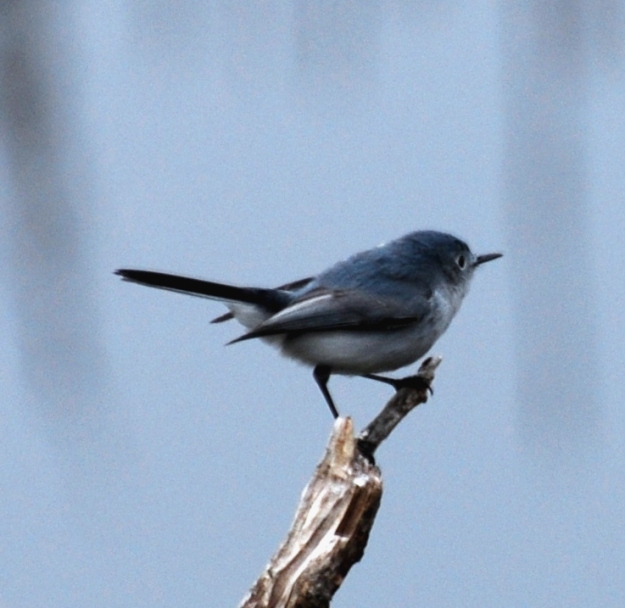
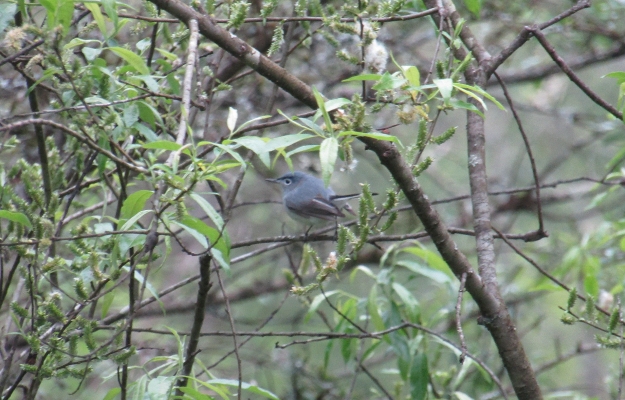
A blue-gray gnatcatchers finally put in a first spring appearance at my home on April 11. Most likely, these tiny birds had already arrived, but my schedule hadn’t yet allowed me a glimpse of this punctual songbird. Back in March, I saw and heard dozens of them during a trip to the South Carolina Low Country.

Gnatcatcher

Photo Courtesy of Jean Potter • Blue-gray Gnatcatchers are tiny, energetic bundles of feathers.


Birds are as dependable as clocks and calendars when it comes to noting the passage of time. I can keep track of the changing seasons based on the composition of the birds in my yard. The gnatcatcher has long been my signal to the start of the frenzied pace of spring migration for many of the birds returning to the region after sojourns much farther south. For example, the first gnatcatcher arrived in my yard in 2014 on April 4. Two days earlier, I had observed my first blue-grey gnatcatcher of the spring while visiting Winged Deer Park in Johnson City, Tennessee. It doesn’t hurt that the arrival of gnatcatchers coincides with the annual blooming of bluebells, a wildflower for which this local park is famous.

Once again, Winged Deer Park provided me with my first spring sighting of this bird when I finally saw one this year on April 6. Over the years I’ve kept track of such matters, blue-gray gnatcatchers reliably return every year in the final days of March and first days of April. A blue-gray gnatcatcher put in its first appearance at my home on April 2 in 2011. In 2009, I also saw my first gnatcatcher on April 2, although in 2008 I had to wait until April 5 for my first spring sighting of a gnatcatcher. In 2007, the blue-gray gnatcatcher was an “April Fool’s” bird, arriving on the first day of April. Arrival dates in March are a little less frequent. For instance, in 2003, a blue-gray gnatcatcher arrived on March 28. I saw my first spring gnatcatcher on March 30 in 1998. In 2006, the arrival date was March 31.

Gnatcatcher 2

The blue-gray gnatcatcher is a tiny, active bird with noisy habits that make it fairly easy to detect in early spring before foliage has grown dense in the branches of trees. This gnatcatcher ranks with the kinglets and hummingbirds as one of the smallest birds to range within the United States. This tiny bird tips the scales at only a fourth of an ounce. A gnatcatcher is an incredible bundle of feathered energy, seemingly always on the move as it snatches small winged insects out of the air or plucks other prey items from leaves or branches. Gnatcatchers are also quite curious birds that, more than once, have given me the distinct impression that I am the one being observed while watching their antics.

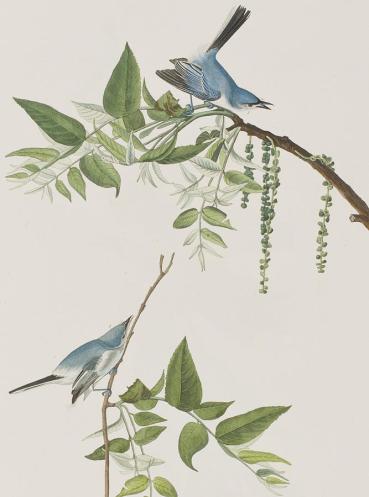
So, as the name suggests, do gnatcatchers truly eat gnats? The website All About Birds contends that, despite its name, the gnatcatcher does not concentrate its feeding efforts on gnats. This tiny bird does, however, prey on a variety of small insects and spiders. Winged insects, such as small flies and gnats, are part of the menu for a gnatcatcher, but this bird is also capable of plucking spiders from their webs or snatching tiny caterpillars from the underside of leaves.1-blue-grey-flycatcher-john-james-audubon

Like the hummingbirds, the gnatcatchers are an exclusively New World family of birds. They lack the diversity of the hummingbirds. Instead of several hundred species, there are only about a dozen species of gnatcatchers worldwide. Of that number, four — blue-gray gnatcatcher, California gnatcatcher, black-tailed gnatcatcher and black-capped gnatcatcher — range within the United States. The blue-gray gnatcatcher is the only member of this family to reside in the eastern United States. Other representatives of this family of small songbirds include the Cuban gnatcatcher, white-lored gnatcatcher, creamy-bellied gnatcatcher, tropical gnatcatcher and masked gnatcatcher.

The blue-gray gnatcatcher builds an exquisite and compact nest using such materials as spider silk and lichens. I have found many nests over the years by listening for the scolding notes of the parents which, even near their nest, have not learned the virtue of silence. The blue-gray gnatcatcher is one of the birds that, in my mind, truly kicks off the arrival season of many of my favorite neotropical migrants. With the arrival of gnatcatchers, I can now expect to enjoy the arrival of birds like hummingbirds, warblers, tanagers, vireos, thrushes, and grosbeaks.

BGGnatcatcher

••••••

Bryan Stevens lives near Roan Mountain, Tennessee. To learn more about birds and other topics from the natural world, friend Stevens on Facebook at https://www.facebook.com/ahoodedwarbler. He is always posting about local birds, wildlife, flowers, insects and much more.

Carolina chickadees are easy birds to befriend and bring into your daily life

Winter-Chickadee-Confused

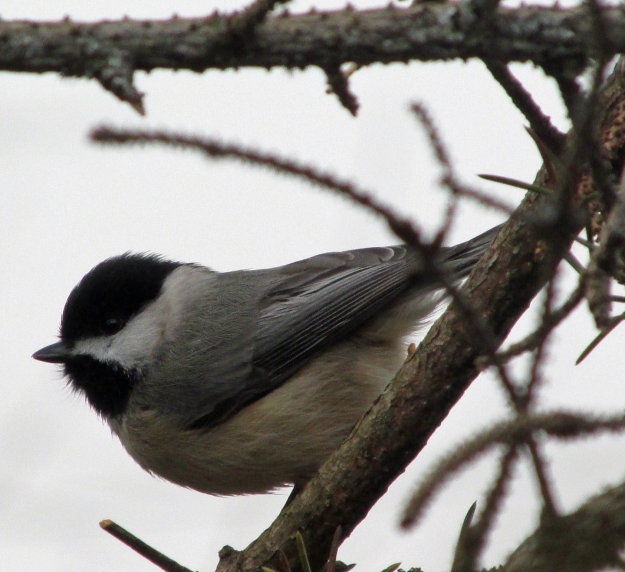
Photo by Bryan Stevens • A Carolina chickadee perches on a branch.

In last week’s post, I pointed out that Eastern bluebirds have already started seeking nesting locations for the upcoming spring nesting season. They’re hardly the only cavity-nesting birds already checking out every nook and cranny for the perfect place to raise a family of young.

I’ve been hearing the familiar “fee-bee-fee-bo” song of the Carolina chickadee from the woodlands around my home. With the recent turn in the weather, the male chickadees are persistent singers, making the woods ring with their attempts to woo a mate.

The Carolina chickadee is at home in mixed or deciduous woods in the United States from New Jersey west to southern Kansas and south to Florida and Texas. The Carolina chickadee also ranges along the Appalachian Mountains, but on some of the higher peaks they are replaced by their cousin, the black-capped chickadee. In Tennessee, birders need to visit some of the higher peaks in the Great Smoky Mountains National Park to find black-capped chickadees.

Winterchickadee

Photo by Bryan Stevens • A Carolina chickadee visits a feeder for sunflower seeds.

Once a pair of chickadees settles down into domestic bliss, they almost at once start work upon constructing a nest. These little songbirds, looking quite smart in their handsome black, white and gray feathers, build an exquisite nest. The primary nesting material is green moss, which they stuff into a natural cavity or bird box in great quantities. The female chickadee fashions a depression in the collection of moss. She lines this shallow basin with plant fibers as well as strands of fur or hair to provide soft cushioning for her eggs.

Chickadee-Feb9

Photo by Bryan Stevens • A Carolina chickadee endures a cold winter’s day.

A female chickadee can lay a large number of eggs, with the clutch size ranging between three and ten eggs. Once the young hatch, both parents are kept busy delivering food to a large brood of hungry, noisy chicks. The young grow quickly, but they take advantage of the safety of their cavity nest and don’t depart for the wider world until 20 days after their hatching.

Energetic chickadees, birds of the most engaging antics, make wonderful feeder visitors. With their tame and trusting natures, chickadees are one of the birds I welcome to my feeders. Chickadees are daily visitors to my feeders in the winter season as well as other times of the year. I love to watch a chickadee land on a feeder, snatch a single sunflower seed and fly to a perch close at hand to hack open the seed’s shell and devour the kernel before they repeat the entire process again.

Chickadee-FeedTwo

Photo by Bryan Stevens • A Carolina chickadee makes a food delivery to nestlings.

North America’s other chickadees include the aforementioned black-capped chickadee, as well as boreal chickadee, chestnut-backed chickadee, grey-headed chickadee, Mexican chickadee, and mountain chickadee. On a trip to Utah in 2003 and 2006, I saw both black-capped chickadee and mountain chickadee.

In other parts of the world, chickadees are known as “tits,” which is from an Old English word denoting small size. Worldwide, there are about 60 species of chickadees and tits, which are classified collectively under the scientific family name, Paridae. Other members of this family range into Europe, Asia and Africa, including species with colorful names like fire-capped tit, yellow-bellied tit, azure tit, green-backed tit and cinnamon-breasted tit.

CarolinaChickadee-1

Photo by Bryan Stevens • Caroline chickadee waits for a chance to visit a crowded feeder.

It’s easy to attract chickadees to your yard. Shrubs and small trees, feeders stocked with sunflower seeds and perhaps a mesh cage offering a suet cake are sure to make these small birds feel welcome. If you want to witness the family life of chickadees, build or buy a box suitable for wrens and other smaller birds. Chickadees will happily take up residence. These birds often comprise the nucleus of mixed flocks of various species, so they will also bring other birds into your yard and within easy viewing range.

••••••

If you have a question, wish to make a comment or share a sighting, email ahoodedwarbler@aol.com.

CaroChickadee-Three

Photo by Bryan Stevens • A Carolina chickadee grasps a branch near a feeder.


America’s lost parakeet remains poignant symbol of need to protect our birds

A century ago this week, a caged bird died in Cincinnati, Ohio. However, this was not simply a case of an untimely death of a beloved family pet. Instead, that bird represented the last of its kind.

The bird belonged to the Psittacidae, a family of tropical birds that includes macaws, parrots, caiques, amazons and parrotlets. The bird, a male named Incas, was the last captive Carolina parakeet (the only species of parrot native to the eastern United States) in existence when he died at the Cincinnati Zoo on Feb. 21, 1918, in the same aviary where Martha, the last passenger pigeon, had died four years earlier.


The demise of Incas came about a year after the death of his mate, who had been named Lady Jane by their zookeepers. In a time before the forces of social media and round-the-clock mass media, the death of Incas likely went unnoticed by other than a few people.

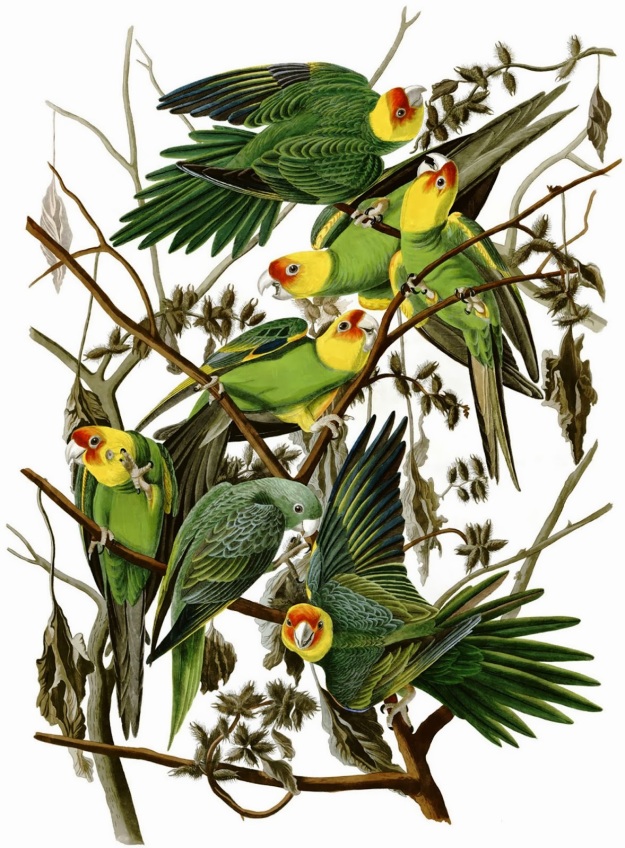
Carolina parakeets, John James Audubon


If few noticed the passing of Incas at the time, surely today we can mourn the loss of one of the most abundant birds to ever roam the continent. Few people even realize that North America was once home to its own species of parakeet. A few individuals — all that remained of once massive flocks of colorful, noisy native parakeets — made it into the 20th century. Despite the death of Incas in 1918, the Carolina parakeet as a species was not officially declared extinct until 1939. It was a classic example of going out with a whimper, not a bang, when the entire population of the Carolina parakeet crashed suddenly and for reasons still not fully understood.

For instance, large flocks of these birds still flew free until the final years of the 1800s, but in the first decade of the 1900s, these flocks disappeared. The only other native parrot — the thick-billed parrot of the American southwest — no longer flies north of the Mexican border. An attempt to re-introduce this parrot to Arizona in the 1980s ended in disappointing failure. Of course, thick-billed parrots still fly free south of the border.

il_fullxfull.603620894_qnpu

It would be wonderful to have native parrots still flying free. The extinct Carolina parakeet ranged throughout the eastern United States, including the states of Virginia, Tennessee and North Carolina. These parrots strayed on occasion as far north as Wisconsin and New York and ranged as far west as Colorado. Florida provided a stronghold for this colorful species, which also made its last stand in the Sunshine State. The last flock of thirteen wild birds was documented in Florida in 1904.

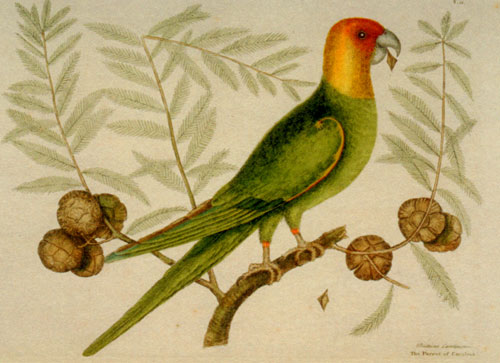
These birds have attracted attention since the arrival of the first Europeans. English explorer George Peckham mentioned the presence of Carolina parakeets in an account he wrote of his 1583 expedition in Florida. In the 1700s, English naturalist Mark Catesby described the species for science in a two-volume work titled “The Natural History of Carolina, Florida and the Bahama Islands.”

The parrots were evidently numerous, often encountered in large flocks. Few early naturalists attempted to properly study them, resulting in a sad dearth of knowledge. Much of what we do know is quite intriguing. The diet of these parakeets made them toxic, as early naturalist and artist John James Audubon observed when cats sickened and died after dining on fresh parakeets. One of the parakeet’s favorite foods — cockleburs —imparted the toxicity into the flesh of the birds.

wilsondummy

Alexander Wilson

An unusual empathy and loyalty may have contributed to the downfall of the species. Early naturalist Alexander Wilson wrote of an 1808 encounter with a large flock of these parakeets. After noting how the bird covered almost every twig in a tree, Wilson raised a gun and shot several of the birds. Some of the shot birds were only wounded. “The whole flock swept repeatedly around their prostrate companions, and again settled on a low tree, within twenty yards of the spot where I stood,” Wilson wrote. “At each successive discharge, although showers of them fell, yet the affection of the survivors seemed rather to increase.”

The same tendency to rally to the side of fallen companions made Carolina parakeets easy targets for people capturing them in the late 1800s for the exotic pet trade. This flocking together and unwillingness to abandon wounded members made the birds easy targets when farmers shot them. It certainly didn’t help matters that the parakeets were also hunted for their brightly colored feathers, which were used to adorn women’s hats. It remains unclear what exactly annihilated a once abundant bird, although it was likely a combination of all of the aforementioned factors.

Changes to the landscape encouraged the parakeets to shift their diet from weed seeds to cultivated fruit, which won them the ire of farmers. Logging of extensive forests may have impacted their numbers, too. Experts have even theorized that the parakeets fell victim to some sort of epidemic spread by domestic fowl.

carolina-parakeet-ii

Painting by Alexander Wilson of a Carolina Parakeet.

If only the dawning of a more environmentally aware age had arrived slightly sooner, the Carolina parakeet might have been saved along with species like the bald eagle and whooping crane. This native parakeet, if it had endured, might today be considered an ordinary backyard bird jostling for space at your feeders with birds like blue jays and purple finches.

Incas and his fellow Carolina parakeets may be gone, but they’ve not been forgotten. Their story is a reminder of why it remains crucial to protect all birds. Let that devotion to preservation be the legacy of America’s lost parakeets.

•••••

Bryan Stevens lives near Roan Mountain, Tennessee. To learn more about birds and other topics from the natural world, friend Stevens on Facebook at https://www.facebook.com/ahoodedwarbler. If you have a question, wish to make a comment or share a sighting, email ahoodedwarbler@aol.com.

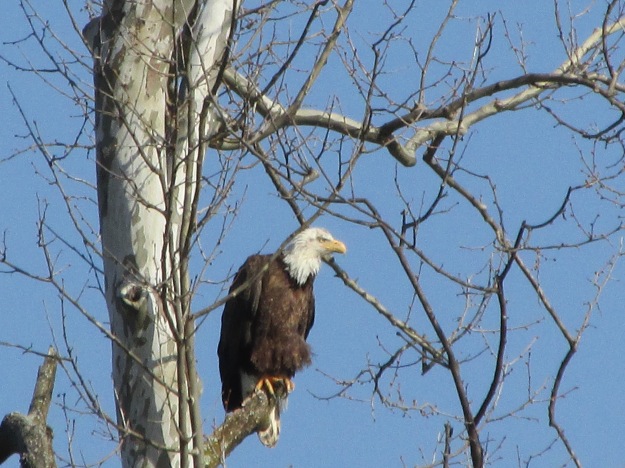
BaldEagle-February

Photo by Bryan Stevens • Although protections came too late to help the Carolina Parakeet, laws like the Endangered Species Act did save birds like the Bald Eagle from possible extinction.


Vultures aren’t typical poster birds for ecological awareness, but perhaps they should be

vultures-tree

Photo by Bryan Stevens • A flock of vultures gathers in a dead pine tree on a gloomy winter afternoon.

Cougars have returned to eastern mountains, white-tailed deer numbers are out of control and hungry black bears sometimes wander into towns. Encounters between humans and wildlife are nothing new. I was reminded of this fact when I received a recent email from Gene Sturgeon on the subject of vultures. Gene and his wife, Catheryn, reside in Abingdon, Virginia. The town, it would seem, has experienced a recent invasion.

“In our new neighborhood, the black vultures are ever-present,” Gene wrote. “They circle endlessly, and never seem to land on the carrion that attracts them. Turkey vultures typically are seen on the carrion, but these blacks never appear to be feeding. Also, I can’t imagine this neighborhood has more than the normal number of dead animals.”

Gene has also observed that the black vultures, starting in mid-afternoon, begin to gather in selected trees. Usually two nearby trees, he noted, will contain dozens of them for the night.

vulture-tower

Photo by Bryan Stevens • Vultures gather atop an industrial building in downtown Erwin, Tennessee.

Gene asked if the behavior he has observed is fairly typical. I replied to his email that I believe that his observations are accurate and typical. While the birds seem to be roosting in his neighborhood, they are probably not finding their food there. Vultures are capable of soaring long distance in search of food, so they may actually be dining far away from Gene’s Abingdon neighborhood.

bryan-vulture

Photo by Bryan Stevens • A turkey vulture perches on a branch in a South Carolina woodland.

I asked him if there were pine trees or other types of evergreens because it’s my understanding that vultures are often fond of thick stands of pine. I am guessing this is because such trees offer protection and shelter from the elements. Gene wrote back to inform me that both pine trees and leafless trees are present near his home. “The leafless tree attracts the larger cloud of black vultures,” he added.

Doubtless, some residents are uneasy when these uninvited neighbors swell the neighborhood. I was somewhat surprised by Gene’s observation, but I was also taken aback to learn that Abingdon has for years boasted an extremely substantial population of vultures. In fact, the Abingdon Police Department has even compiled a fact sheet to educate the public about these large birds. According to the release, it is around this time of year that Abingdon sees an increase in the number of vultures due to weather patterns. The APD has apparently received complaints from some citizens about the vultures roosting in their neighborhoods.

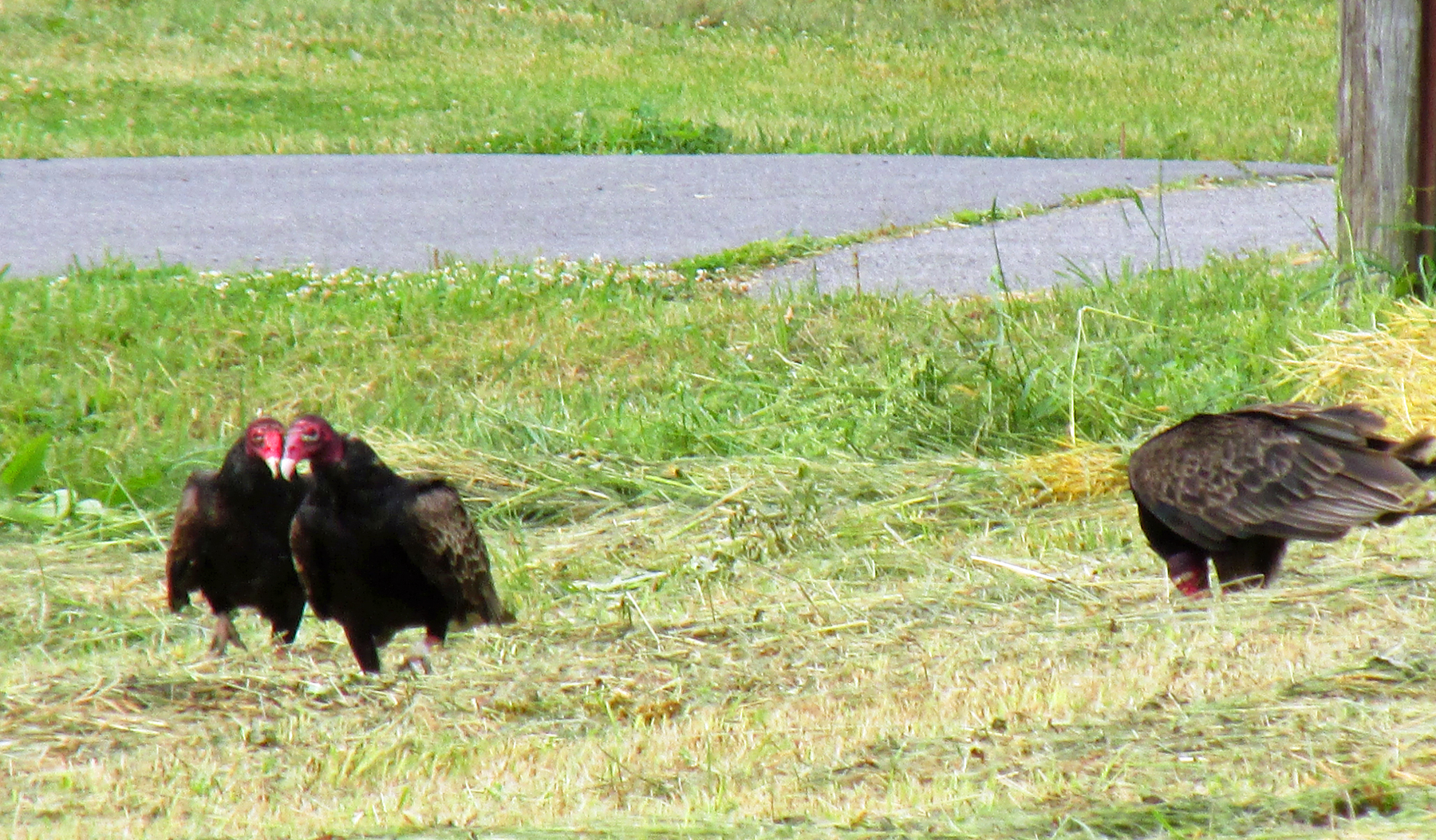
tvultures

Photo by Bryan Stevens • Turkey vultures forage in a freshly mowed field near Abingdon, Virginia. As scavengers, vultures play a vital but often unappreciated role in the environment.

I was glad to note that the fact sheet recognizes the important of vultures in the ecosystem. These large birds serve an important function. Without vultures, local yards and roads would be littered with rotting, stinking, animal carcasses — and the health risks that accompany them.

Nothing prohibits a private land owner from contacting a professional wildlife specialist to disturb the roosts at owner expense. If I might offer unsolicited advice, however, I’d recommend against wasting your money. The tactics, while they may make a temporary difference, don’t usually solve anything in the long run.

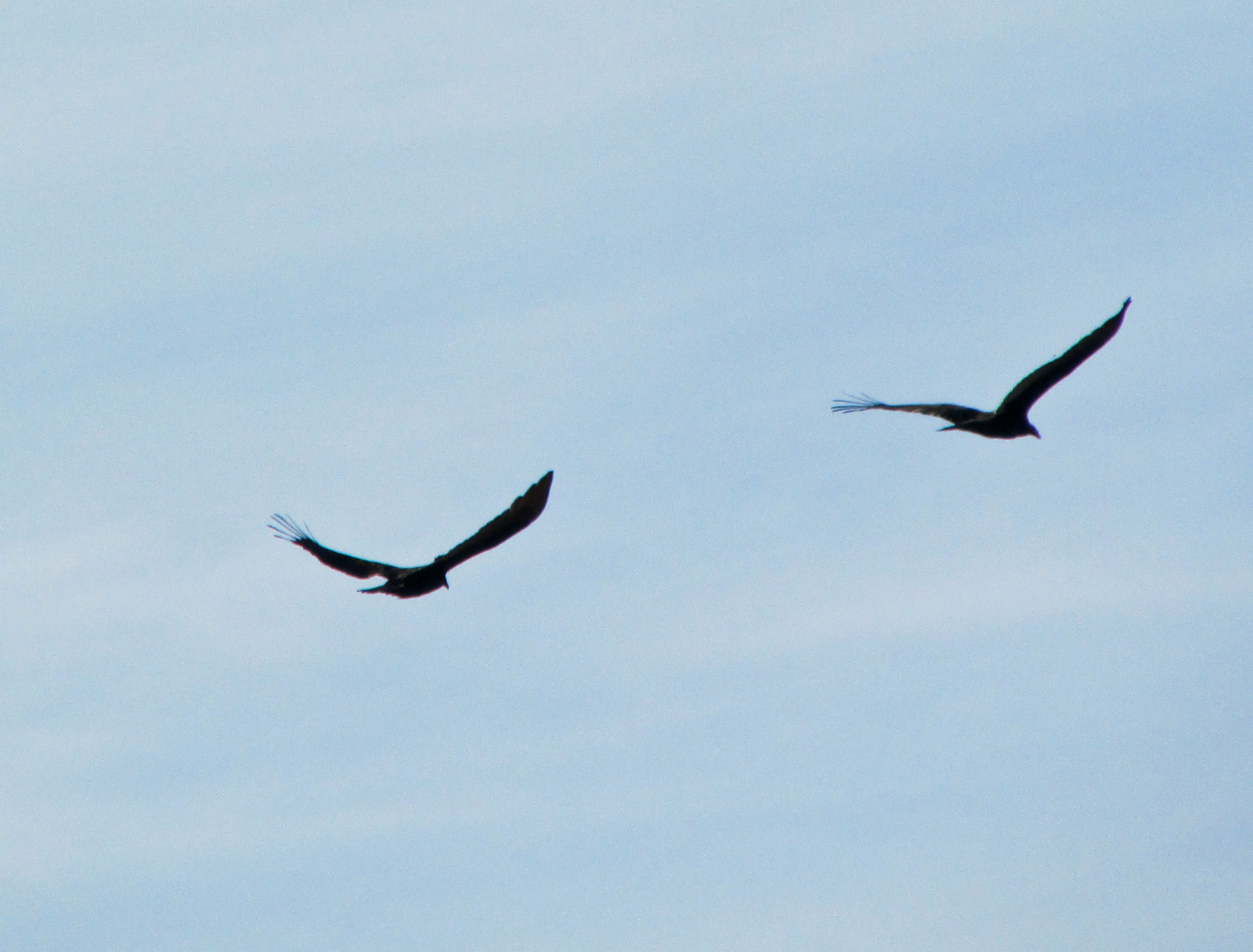
vultures-soaring

Photo by Bryan Stevens • Turkey vultures in their usual V-shaped silhouette characteristic of a soaring vulture.

Abingdon’s government, for both ethical and legal reasons, cannot kill vultures. Private citizens are also forbidden by law to kill vultures or hire exterminators to do so. Vultures are protected by the Migratory Bird Treaty Act. The birds, their nests and eggs cannot be killed or destroyed without a permit from the U.S. Department of the Interior’s Fish and Wildlife Service. Private citizens are also not legally permitted to use fireworks to try to disperse vulture flocks.

The best thing to do is make your home and yard less attractive to these large, scavenging birds. While reading some tips put forward by the APD, I was struck by how some of the advice, if followed, can protect homes from other potential nuisance wildlife ranging from raccoons and opossums to black bears and skunks. According to the APD, there are several things people can do to make their yards less attractive as a roosting place for vultures:
• Ensure that you are not inadvertently attracting the vultures. Common attractions include open containers of pet food, uncovered garbage cans, and pet food bowls.
• Remove any dead trees that make convenient perches for vultures.
• Use humane perch deterrents, like motion-activated sprinklers or lights.

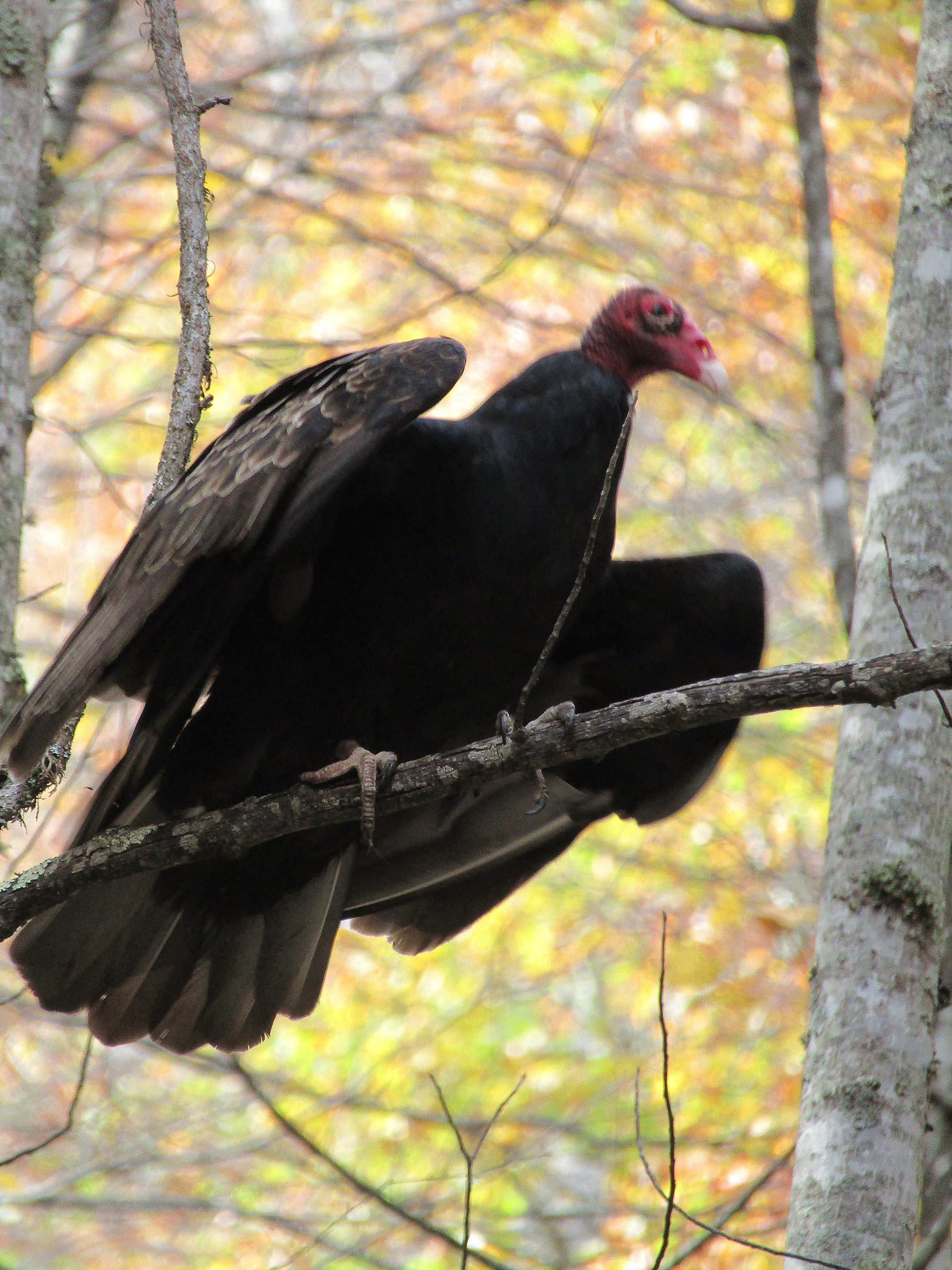
vulture-halloween

Photo by Bryan Stevens • A Turkey Vulture perches in a woodland in Roan Mountain, Tennessee, during late fall.

The APD also pointed those wishing for more information to the Cornell Lab of Ornithology website, which has excellent information about both species of vulture, including conservation information.

I was very pleased to see that the APD tried to dispel misinformation about these valuable birds. People are, naturally enough, concerned for their pets because of the presence of these large birds. Vultures are carrion eaters, which means eat animals that are already dead, preferring animals that have been dead for two to four days. While there are no accounts of turkey vultures preying upon live animals, there have been occasional reports of black vultures preying upon small, live and relatively defenseless animals.

That tells most, but not all, of the story. Black vultures occasionally will attack newborn livestock, but these birds are not likely to go after the family dog or cat, especially if the pet is mobile and in good health. Nevertheless, it is still a good idea to keep cherished pets indoors. While vultures pose little danger to them, plenty of other animals, such as coyotes, are much more opportunistic than vultures. Keeping cats and dogs confined indoors also protects wild birds and other wildlife from the instinctive predatory notions of our precious pets.

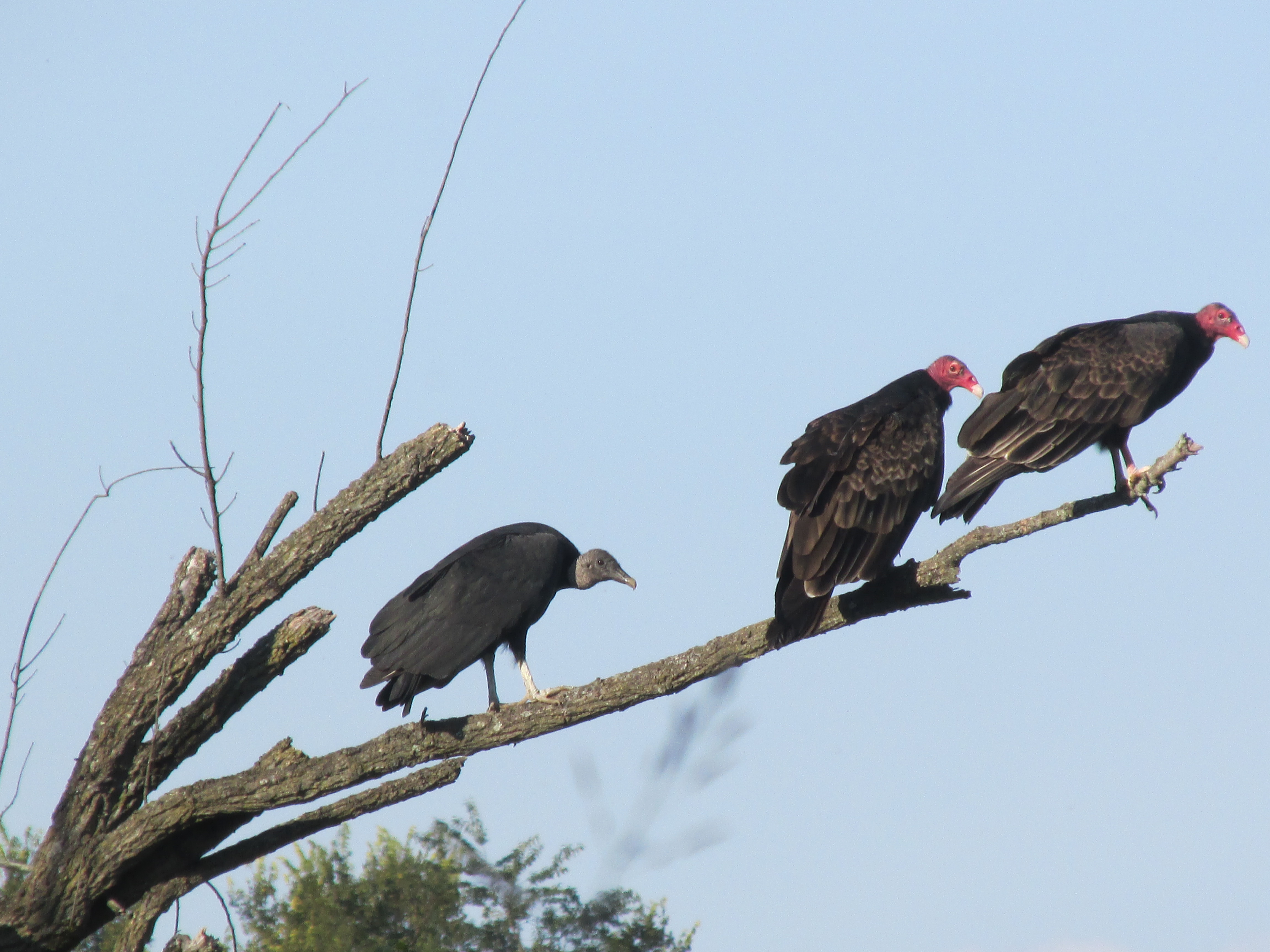
BS-VULTURES

Photo by Bryan Stevens • A black vulture and two turkey vultures share a perch near Boone Lake in Sullivan County, Tennessee.

While both vultures are migratory birds, their numbers have always fluctuated and will continue to do so. As their populations increase, their range has increased as well. Both species are present in the Abingdon area year-round. Because of the town’s location, their numbers increase from November through early February as they follow the weather patterns. In colder periods, they move farther south, in warmer periods, farther north. Abingdon’s climate makes for a good wintering location. As it gets warmer, non-resident flocks tend to move farther north.

Like many other species of birds, some vultures have learned to co-exist near humans, just like such birds as Canada geese, Eastern bluebirds, American robins and mallards. Like these birds, vultures are highly adaptive creatures. Unlike some types of wildlife that shy away from human contact, vultures and some other birds have adapted to the human environment – perhaps a bit too well. Vulture behavior can be destructive. In recent years, some of these destructive tendencies have become quite infamous among birders. This new behavior apparently first surfaced among vultures wintering in south Florida.

TurkeyVulturesClean

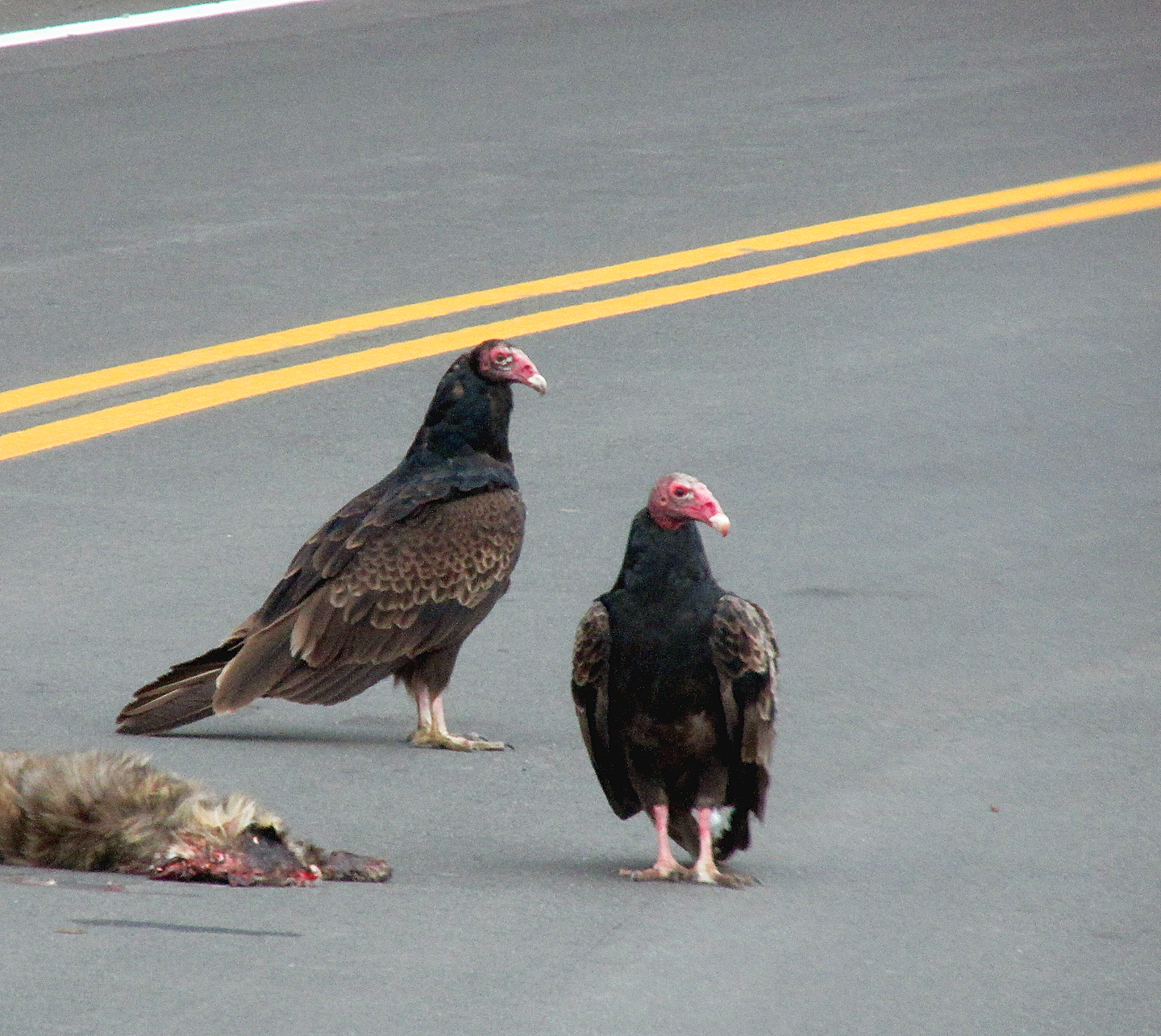
Photo by Bryan Stevens • Turkey vultures regularly dispose of road-killed animals.

They have been known to tear window and roof caulking, vent seals, shingles, rubber seals on car windshields, windshield wipers and other soft, rubbery materials. In addition, their excrement is acidic and may damage painted surfaces and landscaping. The birds also regurgitate a smelly, acidic vomit. Unfortunately, vultures apparently pass on these bad habits to others of their kind and such aberrant behavior is now being seen outside of the Sunshine State.

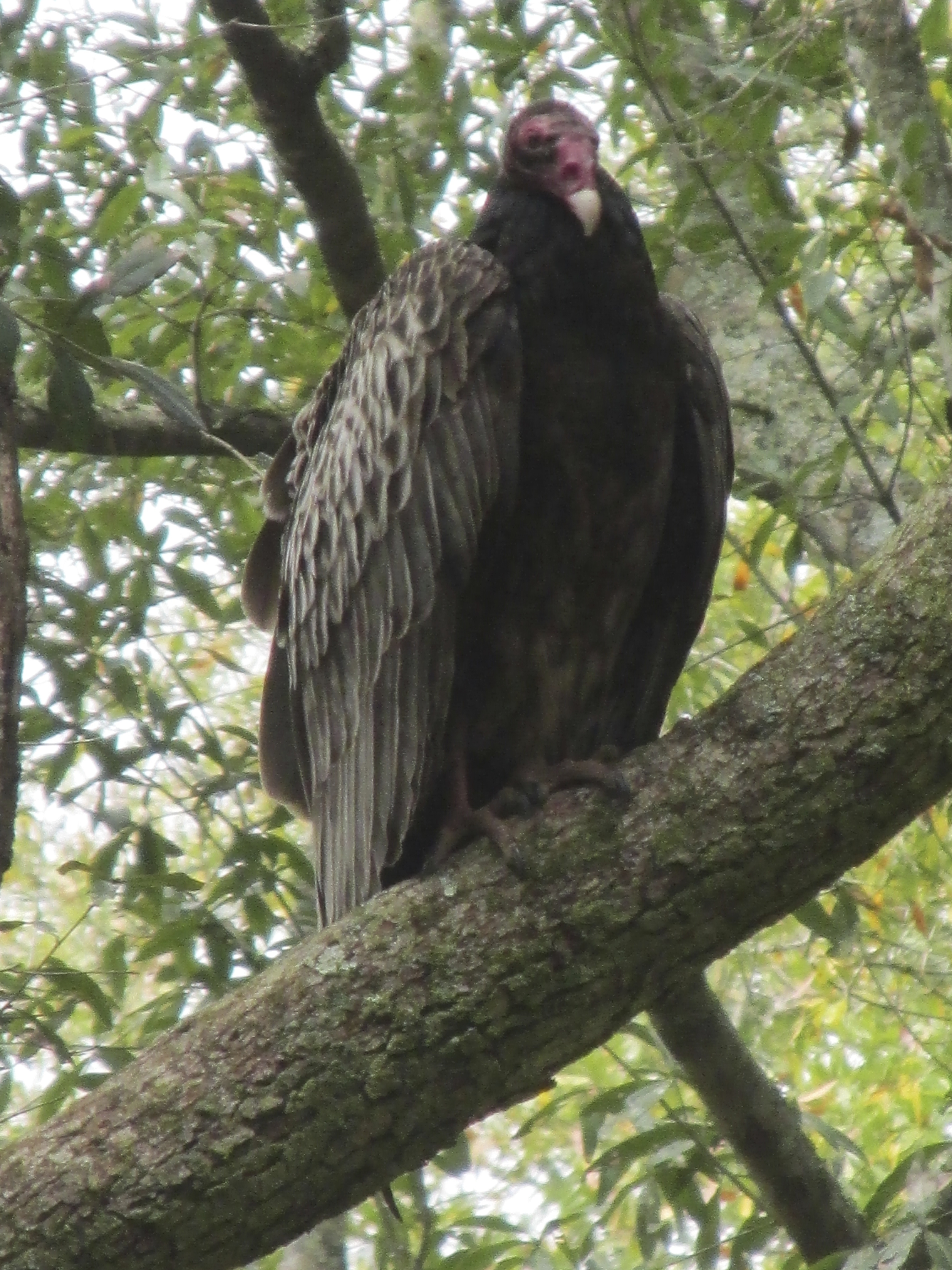
According to the APD, flocks of as many as 100 vultures have been documented in Abingdon. This number may rise and fall, depending on conditions. Vultures are part of the web of life, which connects them and their fellow creatures to our own lives. Turkey vultures are larger than black vultures, weighing about four to five pounds, with a wingspan of six feet. The turkey vulture’s most distinctive feature is its bright red, featherless head. In flight, a turkey vulture often appears to be “wobbling” and, from underneath, all of the flight feathers are light colored.

Turkey_Vulture_edited-1

Photo by U.S. Fish & Wildlife Service • Turkey vultures have bare red heads, as opposed to the black heads of the related black vulture. While larger than black vultures, turkey vultures are less aggressive than their smaller relatives.

On the other hand, black vultures are smaller, weighing less than four pounds, with a wingspan of five feet or less. The black vulture’s head is grey and featherless, but larger in proportion than the turkey vultures. Viewed in flight, only the outer flight feathers of the black vulture are white.

Although smaller in size, black vultures are feisty and aggressive birds. They often outcompete turkey vultures at carcasses. They will also only reluctantly abandon a feeding site at a carcass. My family almost learned this the hard way during a trip to South Carolina when my father almost ran his car into a flock of black vultures feeding on a road-killed deer. I warned him that the vultures might not get out of the way, and he slowed the car’s speed. The vultures hopped back from the edge of the road as our car traveled past them. Looking back, I noticed they immediately hopped back onto the carcass after we had passed. If we had sped past at full speed, one of the bird’s could easily have panicked and flown into our path. A four-pound bird can do a lot of damage if it hits the windshield of a car traveling at 40 to 50 miles per hour. Trust me! You don’t want to put this to the test.

Perhaps that’s the moral of the story. Give vultures a wide berth and, in theory, they will do the same for you. Let’s face it. Vultures aren’t going to be cute and cuddly faces for ecological awareness. A polar bear or penguin, vultures simply are not. They still have a role to play, and we should be grateful they were created for just that purpose.