Category Archives: Warblers

Yellow-breasted chat is a songbird that stands apart


Photo by Bryan Stevens • A yellow-breasted chat sings from the top of a tree.

I’ve always been a warbler fan, celebrating every opportunity that comes my way for seeing these colorful, energetic feathered sprites.

On May 9, the first indigo bunting (a male) showed up on at my home. A day later, I hosted a Baltimore oriole (a rare visitor at my home) and an even rarer visitor with a singing (more like caterwauling) male yellow-breasted chat.

I’ve had only one of these birds in the yard since I began birding in the mid-1990s. That one was a passing fall migrant that showed up in 2000 and then disappeared as soon as it came.

I had hopes that the persistently singing yellow-breasted chat that showed up May 10 might stay longer, and it did. For five days, he sang from dawn to dusk. Then the daily serendades ended. I assume he moved on, but it was fun hosting this bird, even for such a brief span.

Hans Toom/Pixabay • Yellow-breasted chats spend a great deal of their time skulking in thick tangles of vegetation.

According to the website All About Birds, male chats give display flights in the presence of females, other males or human intruders. According to the website, this behaviour entails descending from a high perch while singing, often with exaggerated wingbeats and a drooping tail. At the end of the flight they make a thumping sound, presumably with their wings.

While the yellow-breasted chat is no longer considered a member of the warbler family, my sentimental attachment to this oddball bird will always recall when this species was considered the largest member of the warbler family.

The chat’s declassification as a warbler took place back in 2017. I’ve always been a warbler fan, celebrating every opportunity that comes my way for seeking out these colorful, energetic feathered sprites.

The yellow-breasted chat, although no longer considered closely related to the New World wood-warblers, is still a bit of an oddity. Many experts always harbored doubts about whether chat is truly a warbler. Personally, I felt some disappointment at the reclassification. After all, what family doesn’t need its big, goofy oddball? If nothing else, the yellow-breasted chat is truly an the odd bird out among the little birds known as warblers that spend most of their time constantly on the move, flitting from branch to branch in hyperactive bursts of activity.

Yellow-breasted chats aren’t more sedate than other warblers, but they don’t dart about in the treetops in the same way as might a Northern parula or blackpoll warbler. During the spring ritual of attracting a mate, the males are obsessed with constant singing and performing. The performance portion of the program consists of awkward, drooping flights into the open before plunging back into thick cover. Males will also select an elevated perch in the open to proclaim their availability through song for any listening females.

There are many other ways they stand out on from other birds. For instance, yellow-breasted chats are bigger than all other warblers, as well as many of our songbirds. The chat reaches a length of 7.5 inches with a wingspan of almost 10 inches. The two sexes look alike, which is something else that separates them from many, but not all, warblers, which are generally known for the differences in appearance between males and females. The yellow-breasted chat has olive-green upperparts with white bellies and bright yellow throats and breasts. These chats also have long tails and heavy bills. A prominent characteristic is a spectacle-shaped white eye-ring.

Although only two have visited my home over the years, I have observed yellow-breasted chats in many locations in the region, but during my early years birding this was a very elusive bird for me. It took me a couple of years to get my first satisfactory look at this interesting bird in a tangle of vegetation along a walking trail at Persimmon Ridge Park in Jonesborough. I have also found chats in Unicoi County in the Sciota community. Some fields that comprise a part of Sycamore Shoals State Historic Park in Elizabethton have also been a reliable location for observing this species.

Chats prefer habitats such as dense thickets and other underbrush, which offers remarkable concealment from prying eyes. Chats are loud birds at most times, producing a variety of odd vocalizations, which means they are often heard before they are seen. The online Audubon Guide to North American Birds describes these sounds as “a bizarre series of hoots, whistles and clucks, coming from the briar tangles” and labels them a reliable means for determining the presence of a yellow-breasted chat. By learning these vocalizations, you’ll increase the chances of finding one of these birds during time spent outdoors.

The chat’s habitat preferences and its repertoire of vocalizations makes it easy to associate these birds with others that share the same dense, brushy habitats and a penchant for making unusual vocalizations. Birds often found in proximity to chats include brown thrashers, gray catbirds, white-eyed vireos and Eastern towhees.

Habitat loss has resulted in a steady decline of yellow-breasted chats in some parts of their range. It is a widely distributed bird, spending the nesting season from southern Canada to Mexico. Most chats retreat to Mexico and Central America for the winter months. This chat mostly feeds on insects, supplementing its diet with berries that ripen during the summer months.

Female chats usually lay three to four eggs, but both parents care for the young. Young chats are usually ready to leave the nest only eight days after hatching, but they will remain dependent on their parents for food for a couple of weeks. Chats usually nest twice each during the nesting season.

The yellow-breasted chat is usually a bird that I have to make a special effort to find. It’s worth the effort to gain a good look at this big, brash songbird.

Three other chats, all birds of tropical regions, were moved out of the warbler clan in 2009 by the American Ornithologists’ Union. Experts now believe that the rose-breasted chat of South America, the gray-throated chat of Mexico, Guatemala and Belize and the red-breasted chat of the Pacific slope of Mexico are more closely related to cardinals and tanagers than warblers. The yellow-breasted chat has been stuck in its own family, Icteriidae, not to be confused with New World blackbirds in the family Icteridae.

Even if we can no longer consider the yellow-breasted chat a warbler, the bird still remains unique enough to warrant its own family.

•••

To share a sighting, make a comment or ask a question, email me at ahoodedwarbler@aol.com.


Black-and-white warbler won’t be confused with other birds

Photo by Hans Toom/Pxabay A black-and-white warbler would be almost impossible to confuse with any other bird.

I’m thinking that most people have probably heard of a “gaggle” of geese or a “murder” of crows as a way to describe a flock of these particular birds. Warblers also have their collective names. A flock of warblers is often referred to as a bouquet, a confusion, a fall, a cord or a wrench of warblers, according to the Birdorable Blog.

I personally like “wrench” of warblers. It has alliteration and describes how these amazing little songbirds can definitely “wrench” one’s attention from other matters. That’s been happening a lot at home. Since arriving in early April, the resident warblers have added their songs to the soundscape that makes the woodlands surrounding my home come alive every morning.

I wrote last week about the sad incident of a male Northern parula killed after an impact with a window. I wondered if I’d have to go the spring and summer season without hearing the excitable little trill of syllables that comprises this warbler’s song. I’m happy to report that less than a week passed before another male Northern parula showed up and began adding his song to the daily chorus. The circle of life continues.

On Saturday, May 3, I got to branch out from the handful of warbler species in residence around my home to warblers in other locations. I birded with Chris Soto, a Johnson City resident and fellow member of the Elizabethton Bird Club, on Holston Mountain and Sycamore Shoals State Historic Park as part of the annual Spring Bird Count conducted by the EBC. Despite some rain while conducting our survey of Holston Mountain, we encountered a variety of warbler species.

We didn’t observe any large warbler flocks, or wrenches, but we did find numerous species, including ovenbird, worm-eating warbler, Louisiana waterthrush, black-and-white warbler, Swainson’s warbler, hooded warbler, American redstart, Cape May warbler, Northern parula, yellow warbler, chestnut-sided warbler, black-throated blue warbler, yellow-throated warbler, black-throated green warbler and Canada warbler.

We added most of these species to the list by hearing them singing their springtime songs, including the “squeaky wheel” of the black-and-white warbler and the loud, ringing notes of the Louisiana waterthrush. If the latter wants to be heard, it is essential that it produce a loud song. The waterthrush resides near rushing mountain streams, which could easily overpower songs projected at a lower volume.

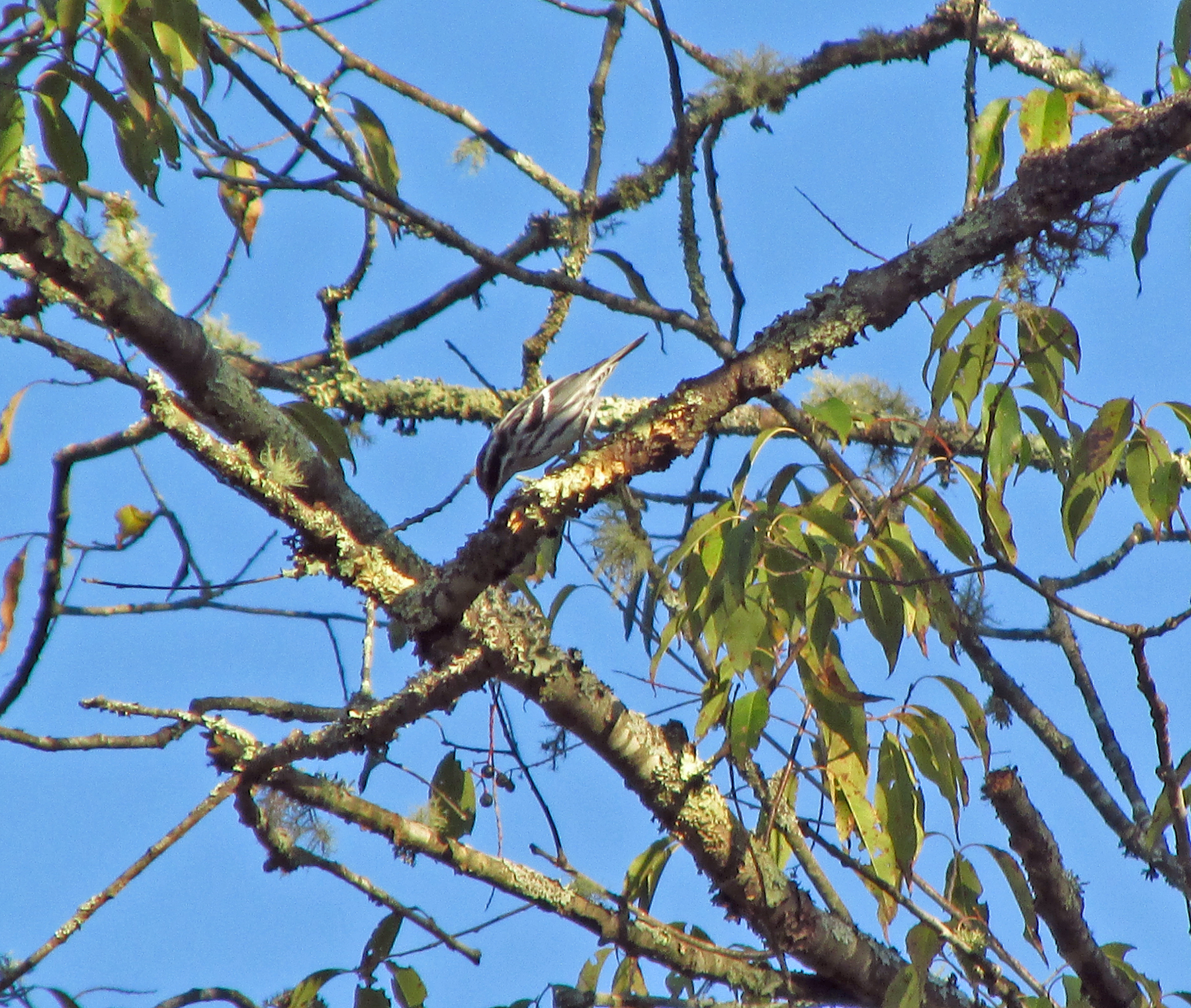
The black-and-white warbler is arguably the most aptly named of all the warblers. Both males and females have glossy black and white plumage. That’s it – there are no other colors present in the bird’s feathers.

Photo by Bryan Stevens • A black-and-white warbler creeps over the bark of a pine in search of insect prey.

The black-and-white warbler breeds in northern and eastern North America. It ranges from the Northwest Territories to the northwest and Newfoundland and Labrador to the northeast, to North Carolina to the southeast and Texas to the southwest. This species is migratory, wintering in Florida, Central America, the West Indies and northern South America down to Peru.

Once arriving for the spring, these warbler go about the business of nesting. The female black-and-white warbler selects a well-hidden nesting location at the base of a tree, rock, stump or fallen log, or under a bush or shrub, according to the website All About Birds. I discovered a black-and-white warbler nest, quite by accident, several years ago. The nest was wedged in a crevice beneath a large fallen pine resting on a steep ridge. Besides being rather inaccessible, I had no wish to disturb the nest so I enjoyed watching the birds through binoculars from a distance.

Photo by Hans Toom/Pxabay • A male black-and-white warbler sings its squeaky wheel song.

In its tendency to hug the trunk of trees as it seeks out insect prey, the black-and-white warbler is similar to unreleased species such as brown creeper and white-breasted nuthatch. In fact, an old common name for this bird was black-and-white creeper. It does venture farther out into a tree than the trunk, however, and will flit among branches as good as any other warbler.

For beginners just getting into the hang of birding, the black-and-white warbler is a dream when it comes to identification. It’s unlikely to be mistaken for any other bird. One good look through binoculars is usually all it takes to recognise the species. There’s no poring over the pages of a field guide for subtle field marks to help when trying to identify the black-and-white warbler. The same is true for the bird’s song, which is very similar in pattern to a squeaky wheel spinning round and round.

Enjoy the springtime and get outdoors and see what feathered friends are winging their way into your neighborhood.

Photo by Bryan Stevens
A Black-and-white Warbler forages along a branch.

Summer bird count finds 114 species

Hans Toom/Pixabay • A chestnut-sided warbler was one of 18 species of warblers tallied on the annual survey.

The 31st Carter County Summer Bird Count was held on the first day of June with 23 observers in nine parties. The weather was generally favorable, but somewhat cool early in the morning and breezy at times.

Participants tallied 114 species, which is exactly the 30 year average, but slightly below the average of the last decade of 117 species. The all-time high was 123 species in 2017.

Abundant birds included European starling (471), American robin (372), cliff swallow (330), Canada goose (270), song sparrow (240) and American crow, 208.

The list:

Canada goose, 270; wood duck, 5; mallard, 52; and wild turkey, 13.

Photo by Bryan Stevens • Five wood ducks were found on count day.

Rock pigeon, 61; Eurasian collared-dove, 1; mourning dove, 130; yellow-billed cuckoo, 1; and chuck-will’s-widow, 1.

Eastern whip-poor-will, 13; chimney swift, 61; and ruby-throated hummingbird, 15.

Killdeer, 11; American woodcock, 4; double-crested cormorant, 7; great blue heron, 18; and green heron, 4.

Black vulture, 14; turkey vulture, 59; sharp-shinned hawk, 3; Cooper’s hawk, 1; bald eagle, 3; red-shouldered hawk 1; broad-winged hawk, 8; red-tailed hawk, 12; Eastern screech-owl 8; and barred owl, 2.

Belted kingfisher, 11; red-bellied woodpecker, 31; yellow-bellied sapsucker, 6; hairy woodpecker, 6; Northern flicker, 13; pileated woodpecker, 22; and American kestrel, 1.

Great crested flycatcher, 5; Eastern kingbird, 24; Eastern wood-pewee, 28;

Acadian flycatcher, 19; alder flycatcher, 1; least flycatcher, 10; and Eastern phoebe, 65.

White-eyed vireo, 6; blue-headed vireo, 47; warbling vireo, 1; and red-eyed vireo, 205.

Blue jay, 80; American crow, 208; fish crow, 5; and common raven, 14.

Photo by Bryan Stevens • A young titmouse visits a suet feeder.

Carolina chickadee, 49; tufted titmouse, 91; tree swallow, 88; Northern rough-winged swallow, 32; purple martin, 21; barn swallow, 135; and cliff swallow, 330.

Golden-crowned kinglet, 20; cedar waxwing, 58; Red-breasted nuthatch, 16 white-breasted nuthatch, 17; brown creeper, 6; and blue-gray gnatcatcher, 15.

Carolina wren, 126; house wren 48; and winter wren, 7.

Gray catbird, 36; brown thrasher, 34; Northern mockingbird, 62; European starling, 471; Eastern bluebird, 86; veery, 21; hermit thrush, 5; wood thrush, 56; and American robin, 372.

House sparrow, 40; house finch 86; pine siskin, 8; and American goldfinch, 77.

Chipping sparrow, 85; field sparrow, 25; dark-eyed junco, 51; song sparrow, 240; Eastern towhee, 135; yellow-breasted chat, 9; Eastern meadowlark, 9; orchard oriole, 7; Baltimore oriole, 7; red-winged blackbird, 68; brown-headed cowbird, 27; and common grackle, 87.

Ovenbird, 73; worm-eating warbler, 12; Louisiana waterthrush, 6; black-and-white warbler, 44; Swainson’s warbler, 9; common yellowthroat, 27; hooded warbler, 145; American redstart, 9; Northern parula, 48; blackburnian warbler, 4; yellow warbler, 5; chestnut-sided warbler, 30; black-throated blue warbler, 61; pine warbler, 4; yellow-rumped warbler, 4; yellow-throated warbler, 18; black-throated green warbler, 50; and Canada warbler, 20.

Scarlet tanager 28; Northern cardinal, 135; rose-breasted grosbeak, 13 blue grosbeak, 4; and indigo bunting, 141.

According to long-time count compiler Rick Knight, a few species were missed on count day, usually because they are very localized in distribution or occur in very low densities. And sometimes, he noted, the birds just don’t cooperate.

Some exciting observations include a family group of four American woodcocks at Carvers Gap on Roan Mountain. In addition, 18 species of warblers were found on the count.

Missed species: Common merganser – although a female with a brood of ducklings was seen the day prior to the count – as well as ruffed grouse, common niighthawkhawk, yellow-crowned night-heron, great horned owl, yellow-throated vireo, grasshopper sparrow, golden-winged warbler, Kentucky warbler, magnolia warbler and prairie warbler.

•••

To share a sighting, ask a question or make a comment, email ahoodedwarbler@aol.com. 


Hooded warbler easily wins fans among birders

Photo by Jean Potter • A male hooded warbler flits through the foliage of a rhododendron thicket.

The woods surrounding my home have been alive with birdsong. We’re almost ready to turn the calendar to June, but there’s been no diminishment in the fervor of the daily chorus.

The main members of the feathered choir are warblers. I’ve heard yellow-throated warbler, black-throated green warbler, black-and-white warbler, Northern parula, ovenbird, common yellowthroat and, my favorite, hooded warbler, morning and evening.

During the winter months when the hooded warbler absents itself from Northeast Tennessee, the species resides in the forests of Mexico, as well as in Belize, Costa Rica and other Central American nations.

Like many of the ruby-throated hummingbirds that make their home in the United States for the summer, the hooded warbler’s seasonal migrations take it across the vast open waters of the Gulf of Mexico. After that amazing crossing, these small songbirds disperse throughout the southeastern United States.

That birds as small as hummingbirds and warblers make this incredible migration twice yearly is one of nature’s most phenomenal feats of endurance. In a presentation by Kenn and Kimberly Kaufman that I attended six years ago, I learned that these tiny birds put on incredible fat reserves to help fuel their valiant Gulf crossings.

The warblers, also known as wood-warblers, are an exclusively New World family, numbering approximately 116 species. About 50 of these species make their home in the eastern United States and Canada for the spring and summer, departing in the fall and returning to tropical wintering grounds. Some are extremely bright and colorful birds. The hooded warbler is somewhere in the middle in a sliding scale that goes from dull to wow.

Other colorful warblers that share similar tastes in range and habitat with the hooded warbler include the American redstart, black-throated blue warbler and black-throated green warbler.

Readers who make it to the end of this weekly column will know that even my email address is a testament to my enthusiasm for the hooded warbler.

Hooded warblers nest in the woodlands around my home. So, from the time my favorite warbler returns in April until the last individual departs in October, I enjoy regular glimpses of this colorful and interesting bird. Like all warblers, the hooded warbler is quite energetic, dashing after tiny insects in the branches of shrubs and trees. Hooded warblers often forage close to the ground, which makes observing them easier.

Of course, birds are free to break the rules. One of my most memorable sightings of a hooded warbler involved a male singing from the upper branches of a dead pine tree. I’d estimate that the bird was at least 40 feet off the ground, singing his little heart out to attract a mate. I was standing on an elevated rise of land while the tree providing the warbler its perch was lower in a gully that actually placed bird and observer on a roughly level playing field.

The bird sang for many moments, which is not always the case with warblers. These birds tend to dash for cover at the slightest disturbance, but this enthusiastic male didn’t seem to pay and heed to the fact that most of its kin prefer to skulk in shrubs and dense rhododendron thickets no more than a few feet off the ground.

Back in the late 1990s, when I had just started out in birding, I observed two adult hooded warblers feeding a couple of young birds only recently out of the nest.

I was enjoying observing the sweet scene as the parent birds carried foods to the young birds, which begged incessantly and loudly when, unexpectedly, a song sparrow wandered into the scene.

The sparrow was brutally beset by the parent warblers, which attacked the intruder from all sides. The poor sparrow, having no clue to the reason for their ire, beat a hasty retreat. Sparrows are no threat, but that didn’t matter to these zealous parents.

When I first began birding, I was only dimly aware there was a family of birds known as warblers, which are now hands-down my overall favorite birds. The hooded warbler was one of the first birds I managed to identify on my own.

It’s one bird unlikely to be mistaken for any other. Every time I behold a hooded warbler, I marvel at the bird’s exquisite appearance. The gold and green feathers seem to glow brightly in the dim light of the shadowy thickets of rhododendron they prefer to inhabit. The black hood and bib surrounding the male’s yellow face stands out by virtue of its stark contrast from the brighter feathers. Large coal-black eyes complete the effect. The appearance of the male bird provides this species with its common name. The female has an identical yellow-green coloration as the male, although she is slightly more drab. She lacks the black hood and bib, although older females may acquire some dark plumage on the head and around the face. Both sexes also show white tail feathers that they constantly fan and flick as they move about in thick vegetation and shrubbery.

The warblers are, in short, an incredible family of birds. I’ve seen all but a handful of the species that reside for part of the year in the eastern United States. I still want to see a Connecticut warbler and cerulean warbler, as well as the endangered Kirtland’s warbler of Michigan and the golden-cheeked warbler of Texas.

I’ve come to think of the hooded warblers at my home as “my warblers.” There may be a kernel of truth to my belief. The website All About Birds in a profile on the species notes that a seven-year study conducted in Pennsylvania gave evidence that male hooded warblers are faithful to nesting territories from previous years. Approximately 50% of banded males were shown to return to the same area to breed again year after year.

So, some of those hooded warblers singing from the rhododendron thickets at my home are probably birds returning for consecutive spring seasons. Some of the warblers that returned back in April could be great-great-great grandchildren of those warblers that attacked the unfortunate song sparrow. At the least, it gives me pleasure to think so.

•••

To share a sighting, ask a question or make a comment, email me at ahoodedwarbler@aol.com, an address that shows my profound fascination for this particular bird.

Photo by Bryan Stevens • A male hooded warbler peers from a tangle of branches.

Ovenbird is season’s first returning warbler

By Hans Toom from Pixabay • A patch of orange feathers on the crown of an overbid’s head often goes unseen. This shy and retiring bird is more often heard than seen.

It’s gotten to be a bit of a guessing game every spring about which of the warblers will be the first to return to my home.

In 2021, the first warbler to return in the spring was a male Northern parula that arrived on April 9. In 2022, this same species was the first to return, albeit a few days later than the previous year’s date.

The Northern parula didn’t used to be one of the first returning warblers at my home. That honor used to go to hooded warbler or black-throated green warbler. This year, an ovenbird beat all of its kin to arrive on Friday, April 7, in the woodlands around my home, followed a few days later by a black-throated green warbler. This year’s first hooded warbler was a bit tardy and didn’t return until April 23.

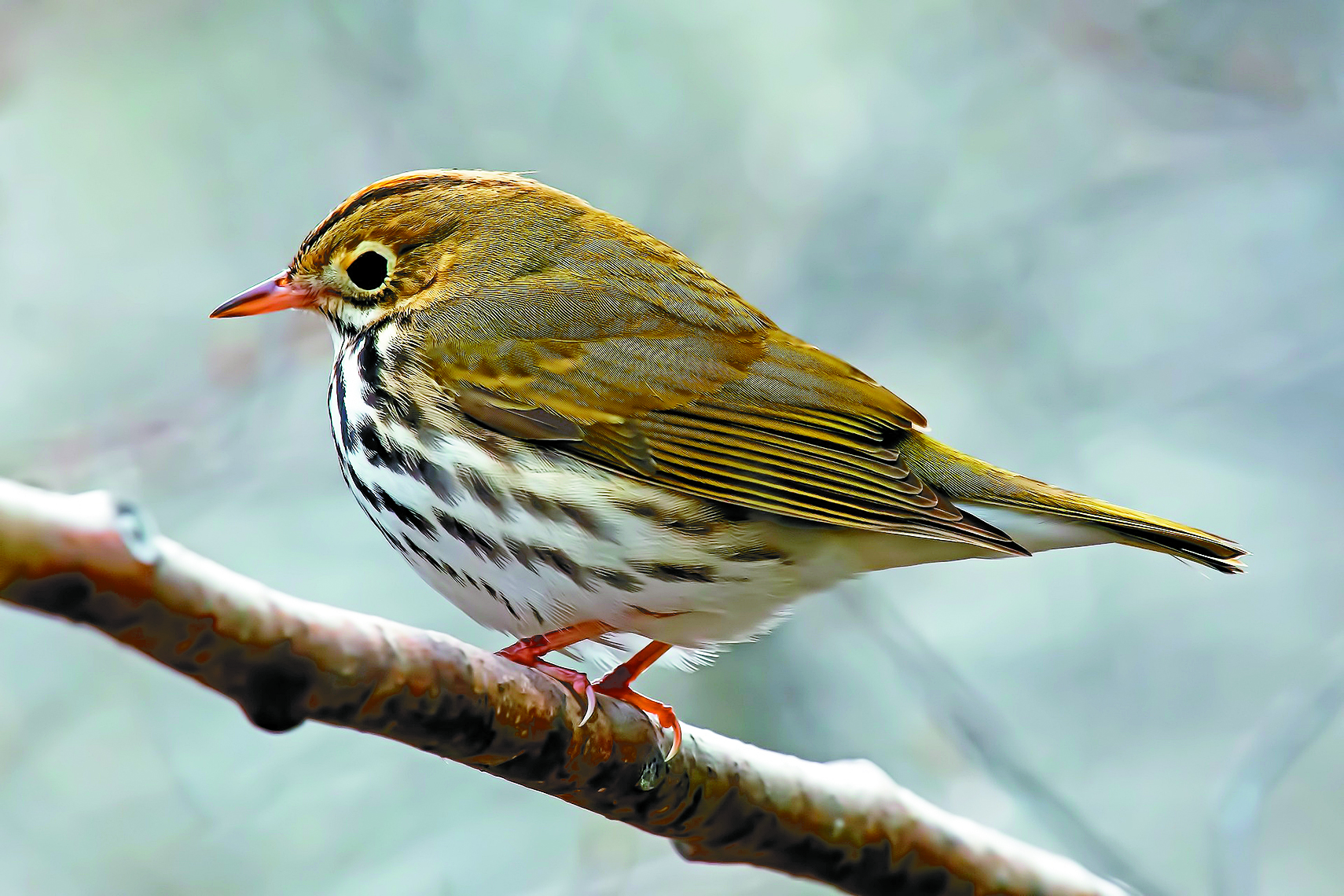
The ovenbird is not one of the brightly colored warblers, such as black-throated blue warbler or yellow warbler. The ovenbird is a small brown bird with a white breast marked with dark streaking — an appearance that bears a superficial resemblance to the larger thrushes that share the same woodland habitat. The only hint of color is an orange crown patch bordered by dark stripes atop the bird’s head. Even this orange crown patch is not easily seen. When agitated, an ovenbird may raise its head feathers, which makes this orange mark easier to detect. The ovenbird also shows a distinct white ring around each eye, as well as pink legs and a pinkish bill.

By Hans Toom from Pixabay • The ovenbird gets its name from the shape of its nest, which is said to resemble an old-fashioned Dutch oven.

The resemblance to North America’s brown thrushes didn’t go unnoticed by some early American naturalists. Painter and famous naturalist John James Audubon painted a pair of ovenbirds, which he knew as “golden-crowned thrushes.” When comparing the two names, one can’t help but wish that the inaccurate but more romantically descriptive golden-crowned thrush had stuck.

Unfortunately, ovenbirds are stubborn about letting themselves be seen. They’re easily heard. The males begin singing a loud, rollicking “Teacher! Teacher! Teacher” song almost as soon as they arrive on potential nesting grounds.

The ovenbird, unlike many warblers, is not named for its appearance. Instead, the bird’s name derives from the shape of the nest it builds. The nest is a domed structure placed on the ground, woven from vegetation and containing a side entrance. Early European settlers in North America thought the nest looked like a Dutch oven, hence the name “ovenbird” for the small warbler with the intricate nest.

In April and continuing into May, a couple of dozen warbler species will pass through Tennessee. Some of these warblers find area woodlands and other habitats to their liking. They will pause, explore and perhaps decide to spend their summer nesting season in Northeast Tennessee and Western North Carolina rather than continue migrating farther north.

Many of the warblers that pass through each spring, however, are destined to travel a much longer distance before settling down in their favored habitats for the summer nesting season. These warblers include the Tennessee warbler, Nashville warbler, Cape May warbler, blackpoll warbler and Connecticut warbler. Most of these species nest as far north as New England and Canada.

Others find the Southern Appalachians to their liking. Some of the first warblers to return each year include the Louisiana waterthrush, which favors rushing mountain streams, as well as species such as black-throated green warbler, hooded warbler, ovenbird, black-and-white warbler, worm-eating warbler and common yellowthroat.

The Northern parula offers an abundance of identifying characteristics. Adult males are bluish gray overall with a yellow-green patch on the back and two white wingbars. A chestnut band separates the male’s bright yellow throat and chest. Adult females are often a bit paler and typically lack the male’s breast band. Both males and females have distinctive white eye crescents.

Most warblers lead frenetic lives. They often sing high in the tops of trees, but they do occasionally venture closer to the ground, particularly when foraging for prey, which consists of a variety of insects and small spiders. The Northern parula is even more restless than most of its kin.

The more reliable means of locating a Northern parula is to listen for the male’s buzzy, ascending song. He is a persistent singer from the time of his arrival until mid-summer.

A quirk involving nesting material is somewhat unique to this warbler. In much of the southern United States, the Northern parula conceals its nest inside strands of Spanish moss draped from the limbs of live oaks and other trees. In the Southern Appalachians and other locations farther to the north, the absence of Spanish moss means that the birds rely on various Usnea lichens, which are sometimes referred to as “Old Man’s Beard.”

A pair of Northern parulas will attempt to raise two broods in a nesting season. The female lays two to seven eggs and does most of the nest construction.

Look for spring’s warblers in the coming weeks. Feel free to share any sightings with me by emailing ahoodedwarbler@aol.com.

Photo by Bryan Stevens • The Northern parula’s geographic location during the nesting season determines its use of nesting materials.


Prairie warbler bears a name unrelated to bird’s habits and habitat

Photo by Noppadol Paothong/Missouri Department of Conservation • A prairie warbler forages in a cedar.

I took part in the annual Fall Bird Count conducted Saturday, Sept. 24, by members and friends of the Elizabethton Bird Club. Some highlights of the count were migrating warblers that made for some exciting observations.

The 50 or so species of warblers that make their home in the eastern parts of the United States and Canada during the spring and summer months are now winging their way south.
The blackpoll warbler, which holds the distinction for the longest migration of any species of New World warbler, will journey from the forests of Canada to spend the colder months in northern South America. Because of a peculiarity of this bird’s fall migratory habits, birders in Northeast Tennessee are far more likely to see this late-arriving warbler in May than in the autumn.

A few warblers — pine warbler, magnolia warbler and palm warbler —are named for trees for the simple reason that their European discoverers happened to first observe them in the branches of their namesake trees.

For most of these warblers named to honor various trees, their common names are, at best, a misnomer. Throughout most of its life, the palm warbler doesn’t even encounter palm trees. Johann Friedrich Gmelin, a German naturalist who lived from 1748 to 1804, saddled the palm warbler with its inappropriate name. Gmelin based his naming of the bird on the fact that a specimen had been collected on Hispaniola, an island in the Caribbean with an abundance of palm trees. Gmelin published several textbooks in the fields of chemistry, pharmaceutical science, mineralogy and botany. He also had a hand in publishing a catalog of scientific names for various species, including some birds that had until that point never been given a species classification. Thanks to his efforts, the palm warbler has forever been linked with a type of tree that is, at best, entirely incidental to the bird’s life cycle.

The same is true for the magnolia warbler, which would have been more suitably named the spruce or fir Warbler, as the species is highly dependent on northern coniferous forests as nesting habitat. The pine warbler, at least, restores credibility to some of the early experts who have these tiny birds their common names. The pine warbler does indeed prefer stands of pine trees, showing particular favor for pitch pines.

While counting birds with Rob Armistead at Sycamore Shoals State Historic Park, as well as the linear walking trail along the linear trail in Elizabethton, we spotted and watched a striking and cooperative male prairie warbler. The prairie warbler is another warbler with a common name that doesn’t truly reflect any accuracy about the bird.

For instance, the prairie warbler is not affiliated with the vast plains and grasslands of the United States and Canada. According to the Tennessee Watchable Wildlife website, Alexander Wilson named the prairie warbler in 1810 from specimens collected in Kentucky in a habitat that was then called a prairie. The habitat is now referred to as a “barrens,” which are a mixture of scrubby vegetation and trees. Prairies, fin the generally accepted sense, are grassland habitats.

According to the website All About Birds, some prairie warblers in Florida have become non-migratory and differ in some subtle ways from other prairie warblers, including being slightly larger.

Photo by U.S. F&WS • A prairie warbler perches on a branch amid thick cover.

Black-throated green warbler a success story for New World warbler family

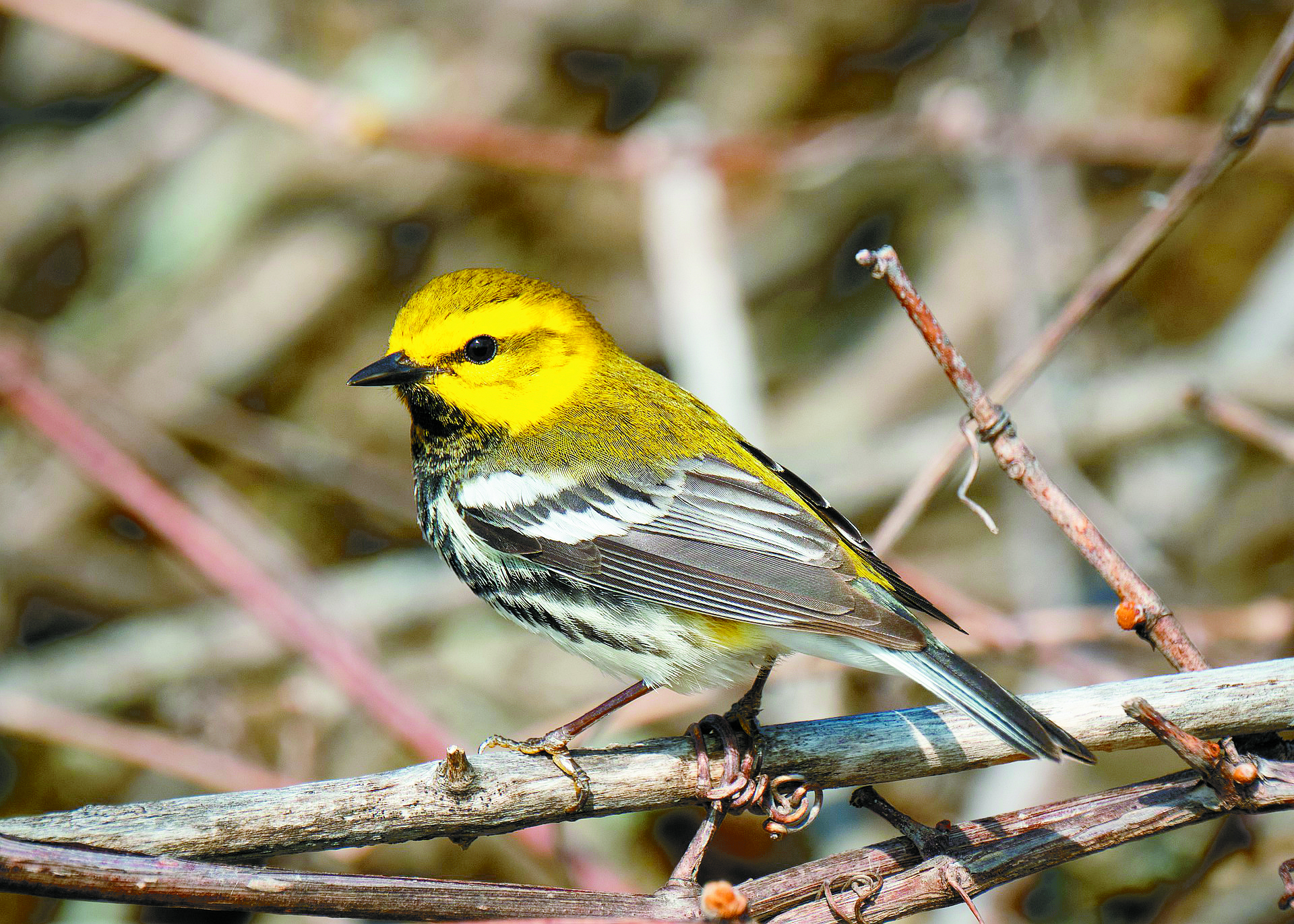
Photo by Howard Walsh/Pixabay • The black-throated green warbler nests in local mountains in coniferous and mixed woodlands during the summer months. Once the nesting season concludes, these warblers wing their way back to wintering grounds in Mexico and Central America, as well as the West Indies and southern Florida.

How can it be August already?

Yes, the pace of summer seems to have quickened. Tomatoes are ripening in the gardens, late summer flowers are blooming, and the birds have pushed their young out of the nest and are teaching them to fend for themselves.

I heard a chip note sound from a mimosa tree in my front yard on the evening of July 26. I scanned the foliage and saw the darting movements of a warbler. Without binoculars, I couldn’t determine the bird’s identity. Fortunately, my binoculars were in my parked car, so retrieving them was easy enough. With binoculars trained on the mimosa tree, I relocated the bird and identified a young black-throated green warbler. The faint black coloration on the bird’s throat pointed to the bird’s young age.

I’m hopeful that the successful nesting represented by the bird’s presence is extended farther into the future. I hope the bird makes its first fall migration without incident, spends the winter in a warmer climate and then returns to Simerly Creek Road in Northeast Tennessee next spring.

I watched as the bird successfully snapped up some caterpillars hidden in the green foliage of the mimosa tree. This young bird had the look of a survivor in my eyes.

Male black-throated green warblers are persistent singers. The website “All About Birds” describes the song, which is a series of buzzy notes, as “trees, trees, I love trees!” For a bird so associated with the treetops, I feel that’s an apt description.

Perhaps a couple of months earlier, the mother of this young black-throated green warbler constructed a nest of twigs, bark and spider silk. She would have carefully lined the nest with hair and moss before laying three to five eggs. She would then have incubated her eggs for 12 days. 

Once the eggs hatched, she and her mate would spend the next 10 to 11 days feeding hungry chicks until the chicks mature enough to leave the nest. Even after departing the nest, the young would remain with the parents for help in gleaning their food of insects and their larvae. 

The black-throated green warbler is a fortunate member of the family of New World warblers. Between 1970 and 2014, according to Partners in Flight, the population of black-throated green warblers actually increased. The group estimates a global population of 8.7 million individuals for the species.

Many of their warbler kin face declining numbers, and even black-throated green warblers face the consequences of habitat destruction on their wintering grounds and in their nesting range throughout the eastern United States. 

A lot of work goes into completing a bird’s journey from egg to young adult. Seeing any bird is a treat. Seeing a young bird through a pair of binoculars brings all that potential up close.

The black-throated green warbler’s closest kin consist of the hermit warbler and Townsend’s warbler of the western United States and the endangered golden-cheeked warbler of Texas. The warblers consist of more 120 different species. 

These small birds lead active, fast-paced lives. They typically don’t enjoy a lengthy life span. The oldest documented black-throated green warbler was a male that reached the age of at least four years and 11 months. He was banded and found in Nova Scotia, according to All About Birds.

We’re about a month out from the flurry of fall migration. I’ll be keeping my binoculars at the ready the closer we get to September.

To share a sighting, make a comment or ask a question, email me at ahoodedwarbler@aol.com.


Common yellowthoat, other birds help make migration exciting time

Photo by Pixabay • With a black mask, the male common yellowthroat resembles a tiny feathered bandit as he goes about his daily routine interrupted by bouts of singing his “witchety! witchety! witchety!” song.

Photo by Pixabay
With a black mask, the male common yellowthroat resembles a tiny feathered bandit as he goes about his daily routine interrupted by bouts of singing his “witchety! witchety! witchety!” song.

A hummingbird flew in to one of my porch feeders at 6:28 p.m. on April 23. The arrival made this bird the first hummingbird I have seen this spring. Although quite a bit later than expected, I decided that it’s better late than never. The bird, a male with a dazzling red throat, flew right to the feeder hanging on the porch. I had switched out the water in all three of my feeders only a few minutes prior to the bird’s initial appearance. The bird knew exactly where the feeder was hanging, so I am confident he had already been around for a few days.

There have been other new arrivals, too. A hooded warbler announced its return in song, singing from the shaded woodlands the same day the first hummingbird arrived. On April 28, a common yellowthroat made sure to get noticed by singing from some willows near the creek before popping into view as I watched through binoculars.

In the past week, flocks of chimney swifts have also begun twittering and swooping over the streets of Erwin.

A few more people have shared their stories of first spring sightings of hummingbirds.

Ann Windsor in Selmer, Tennessee, posted on my Facebook page on April 23 that her hummingbirds had returned a few days earlier. “He has set up his sole ownership of our feeder,” she noted.
•••
“I just now saw my first hummingbird of the season here in Abingdon,” Mary Ragland commented on my Facebook page on April 23.
•••
Betty Lacy in Elizabethton has also welcomes back hummingbirds.
“My hummingbirds are here daily,” she wrote. “I love to watch them.”
•••
Dawn Peters in Jonesborough saw her first hummingbird on April 23.
“I saw my first one about 5 p.m. today,” she wrote on my Facebook page.
•••
Linda Cauley noted that she is hosting two of the tiny birds.
“Two showed up in Unicoi at my feeders,” she wrote on my Facebook page.
•••
The hummingbirds at Kaylynn Wilster’s home at Boone Lake played a bit coy.
“I didn’t see mine at first but the level in the feeders was dropping so I knew they were here,” she wrote on my Facebook page on April 23. “Saw my first one about four days ago — a beautiful male.”
She also saw one at a greenhouse that she visited recently. “The greenhouses go to great effort to get them out,” she added in her comment.
•••
Donna Barnes Kilday in Erwin saw her first on April 14.
“Now I have at least two that want control of both feeders,” she wrote on my Facebook page. “So much fun to watch!”

•••
Philip Laws in Limestone Cove wrote a comment on my Facebook page on April 27 about his hummingbirds.
“We have had them for several days,” Philip wrote.
“My favorite story was when I returned to a former house that we had been out of a couple of years,” he wrote. “A male came up and flew to and circled the spot where a feeder had hung two years before. Needless to say, I quickly returned with a feeder and kept it going for the rest of that summer.”
•••
Mack Hayes, who resides in the Bowmantown community in Washington County, saw his first male ruby-throated hummingbird on April 22. In another comment on my Facebook page, he added a few days later, a female hummingbird has also arrived.
“Glad to see they made it back,” Mack wrote.
•••
As I mentioned at the start of the column, warblers have been putting in sporadic appearances this spring.

I thought I’d spotlight the common yellowthroat this week. The male common yellowthroat looks like a dapper feathered bandit with his black mask with a silvery-gray eye stripe, brown upper parts and a bright yellow throat. Females have the yellow throat but lack the black mask.
The website All About Birds notes in a profile on the species that male common yellowthroats arrive first on breeding grounds in the spring and begin defending territories.

According to the profile, fighting among males grows more intense once the female birds arrive. Researchers have also found that the black mask of male yellowthroats acts as a trigger for some of this fighting. Some enterprising researchers added a black paper mask to a stuffed female yellowthroat. When placed within view of male yellowthroats, the stuffed bird weathered attacks from territorial males.

Photo by USFWS • The male common yellowthroat wears a mask like a feathered bandit.

The common yellowthroat at my home was probably one of these eager males ready to get a head start on the summer’s nesting season. Common yellowthroats are one of the many warblers that nest in the Northeast Tennessee during the summer months. They can be found from lower elevation to higher ones, but they will usually not be found outside of a habitat that offers dense vegetation to their particular liking. A weedy slope in a backyard, a marshy stand of cattails, or overgrown fields are some places suitable for this noisy if “under the radar” bird.
The common yellowthroat is one of the birds that benefits from a lawn and garden that are not kept trimmed and manicured. They will only thrive in habitats that offer dense thickets and other tangles of vegetation. To attract birds like the common yellowthroat, keep some corners of your property in a more “natural” state. The neighbors may look askance, but the birds will thank you.

It’s the female yellowthroat that will build the nest. She lays one to six eggs. She will often locate the nest close to the ground, but it’s always well hidden.

The common yellowthroat belongs to a genus of warblers known as Geothlypsis. Three other members – MacGillivray’s warbler, mourning warbler and Kentucky warbler – in the genus are resident in the United States and Canada for part of the year.

It’s easy to detect the presence of this warbler in the springtime. The male invariably gives himself away by singing his ringing syllables of “Witchety! Witchety! Witchety!” In fact, my recent visitor alerted me to his presence by doing just that. As with many warblers, the male’s song helps attract mates and also establishes the boundaries of his territory.

Although this warbler would prefer to skulk under a weedy canopy, it has one weakness. Common yellowthroats are incredibly curious birds. They will respond to squeaking or mechanical bird calls. Unlike some birds that pop into view for a brief look before diving back into cover, common yellowthroats can often be called into view several times during an observation.

There will no doubt be plenty of migrant sightings as we continue into May. Look for such vibrant visitors as orioles, tanagers, indigo buntings and rose-breasted grosbeaks in the coming days.  To share a sighting, make a comment or ask a question, email me at ahoodedwarbler@aol.com.


Northern parula ushers in rush of spring’s colorful tropical migrants

Photo by  Hans Toom/Pixabay • A male Northern parula looks splendid in spring plumage. These warblers attract attention with their buzzy songs, which is useful for spotting them since these birds spend much of the time in the treetops.

NOTE: As I am posting this week’s bird feature, I am hearing the dueling songs of two male Northern parulas in the woods outside the office window. 

Last year, the first warbler to return in the spring was a male Northern parula that arrived on April 9. This year’s return was a few days later than that, but it was once again a Northern parula at the vanguard of the spring migration.

In April and continuing into May, a couple of dozen warbler species will pass through Tennessee. Some of these warblers find area woodlands and other habitats to their liking. They will pause, explore and perhaps decide to spend their summer nesting season in Northeast Tennessee and Western North Carolina rather than continue migrating farther north.

Many of the warblers that pass through each spring, however, are destined to travel a much longer distance before settling down in their favored habitats for the summer nesting season. These warblers include the Tennessee warbler, Nashville warbler, Cape May warbler, blackpoll warbler and Connecticut warbler. Most of these species nest as far north as New England and Canada.

Others find the Southern Appalachians to their liking. Some of the first warblers to return each year include the Louisiana waterthrush, which favors rushing mountain streams, as well as species such as black-throated green warbler, hooded warbler, ovenbird, worm-eating warbler and common yellowthroat.

The Northern parula didn’t used to be one of the first returning warblers at my home. That honor used to go to hooded warbler or black-throated green warbler.

Spring has been returning in fits and starts, which could have some sort of overall effect on bird migration. 

I’ve still not seen a ruby-throated hummingbird, although some readers are still sharing stories of their first spring hummingbird sightings. 

•••

Lynne Reinhard of Abingdon, Virginia, reported her first hummingbird of spring on the morning of April 7. She shared the sighting in a Facebook comment to my page.

•••

Pat Stakely Cook in Marion, North Carolina, posted on Facebook at 5:33 p.m. on April 11 about seeing her first spring hummingbird. 

•••

Beth Barron Wolfe shared her first sighting with a comment on a post of mine on April 7. 

“I saw one last week, but it hasn’t returned,” Beth wrote.

•••

Karen Fouts of Marion, Virginia, also shared her first sighting via Facebook Messenger.

“We have our first hummingbird of the year this morning (April 13) in Marion,” she wrote. “Perhaps it was the angle of my view, but it looked like a female, which is unusual.”

•••

Nancy Vernon in Bristol, Virginia, posted about her first sighting. “Saw one yesterday (April 13) at my feeder in Bristol right after I put it up,” she wrote.

•••

Tammy Jones Adcock in Erwin shared her first sighting via Facebook comment. She reported that she saw her first hummingbird of spring on April 13 at her Erwin home.

•••

Karen and Bobby Andis in Kingsport sent me a Facebook message about their first hummer of spring. 

“Our first hummingbird was seen at 12:37 p.m. on April 14,” they wrote in the message. “Got our feeder hung awaiting the others.”

•••

Donna Barnes Kilday reported with a Facebook comment that she saw her first spring hummingbird at her home in Erwin on April 14. “First hummingbird of the year!” Donna reported in her comment. 

•••

Nan Hidalgo in Jonesborough posted her sighting as a comment on my Facebook page. 

“First hummingbird just now in Jonesborough,” she wrote around 1 p.m. on April 14.

•••

Phyllis Moore in Bristol, Virginia, also reported a hummingbird arrival. “Just saw our first hummingbird in Bristol,” she wrote just after noon on April 14.

•••

Rhonda and Randall Eller in Chilhowie, Virginia, posted a comment on April 14.

“Just had that first hummingbird,” they wrote. “He was early this year! Last year he didn’t come until April 24.”

•••

Paula Elam Booher in Bristol, Virginia, reported on Facebook that she saw her first hummingbird of spring on April 14.

•••

Steph Anie shared via a Facebook comment that she has been seeing hummingbirds since late March at her home northeast of Atlanta. 

“We have had them for two weeks now,” she wrote on April 7. Again, people residing farther south usually get to welcome back hummingbirds before those of us in Northeast Tennessee, Southwest Virginia and Western North Carolina.

•••

So, my Northern parula is my consolation for not yet seeing a ruby-throated hummingbird. This warbler has an abundance of identifying characteristics. Adult males are bluish gray overall with a yellow-green patch on the back and two white wingbars. A chestnut band separates the male’s bright yellow throat and chest. Adult females are often a bit paler and typically lack the male’s breast band. Both males and females have distinctive white eye crescents.

Like most warblers, they lead frenetic lives. They often sing high in the tops of trees, but they do occasionally venture closer to the ground, particularly when foraging for prey, which consists of a variety of insects and small spiders. 

The more reliable means of locating a Northern parula is to listen for the male’s  buzzy, ascending song. He is a persistent singer from the time of his arrival until mid-summer. 

A quirk involving nesting material is somewhat unique to this warbler.

In much of the southern United States, the Northern parula conceals its nest inside strands of Spanish moss draped from the limbs of live oaks and other trees.

In the Southern Appalachians and other locations farther to the north, the absence of Spanish moss means that the birds rely on various Usnea lichens, which are sometimes referred to as “Old Man’s Beard.” 

Overall, the population of this warbler is in good shape. According to Partners in Flight, numbers of this warbler have increased by 62% since 1970. Unfortunately, some populations in states like Michigan, Wisconsin and Missouri have been affected by logging and the drainage of bogs. 

Once paired up, Northern parulas may attempt to raise two broods in a nesting season. The female lays two to seven eggs and does most of the nest construction. 

Photo by Bryan Stevens • A male Northern parula perched next to a cluster of Spanish moss.

Two warblers have names connected with the Volunteer State

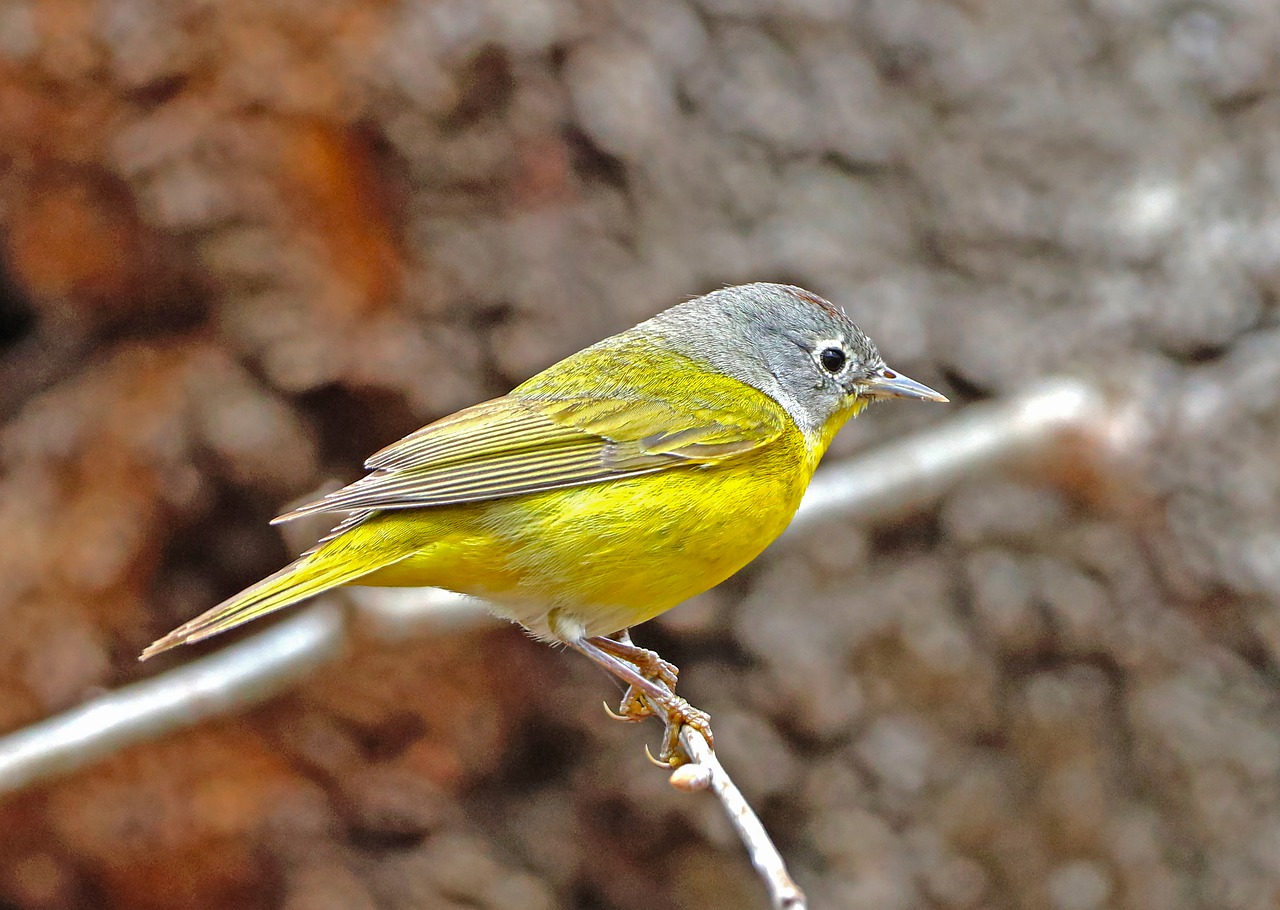
Photo by GeorgeB2/Pixabay.com • The Nashville warbler is an attractive bird with more color than the Tennessee warbler.

Tennessee once represented the western frontier for many people in the United States, so the state acted as a beacon for naturalists wanting to make new discoveries. Some of those early naturalists, men such as Alexander Wilson, spent a lot of time in the Volunteer State.

Two of Wilson’s ornithological “discoveries” in Tennessee involved two species of warblers that were  given names to honor the state and its capital after the birds were first observed in Tennessee and near Nashville.

Those birds were both members of one of my absolute favorite bird families — the warblers. It’s necessary to differentiate the New World wood-warblers from a grouping of birds in Europe, Asia and Australia that are also called warblers.

What is a warbler? The Wikipedia entry for these birds describes the New World warblers or wood-warblers as a group of small, often colorful, passerine birds that make up the family Parulidae and are restricted to the New World. They are not closely related to Old World warblers or Australian warblers.

That’s an adequate description, from a scientific standpoint. But warblers are magic. To do them justice, I’m compelled to wax a little more eloquent. They are a combination of color, movement and energy wrapped in a tiny bundle of feathers. Warblers are constantly on the go, hardly ever staying still for long.

The frenetic lifestyle of warblers challenges new birders. These birds don’t often stop and pose long enough for someone to get binoculars focused on them. One doesn’t exactly watch warblers. Following a warbler through tangled vines or the leafy tree canopy isn’t watching so much as anticipating. One gets a “feel” for where the warbler will appear next while tracking them through binoculars. By getting familiar with the way these avian sprites behave is the best way to learn how to observe these birds.

It’s not for nothing that some birders suffer from a malady, particular during the migration seasons, called “warbler neck.” The direct cause is the strain on the neck and back from always looking upward toward the treetops where many warblers like to stay.

Some, but not all, warblers are suffused with bright colors: yellows, oranges, blacks, blues and whites. A few — ovenbird, worm-eating warbler, Northern waterthrush — are various shades of brown. Some of my favorite warblers are the hooded warbler, Blackburnian warbler and black-throated blue warbler.

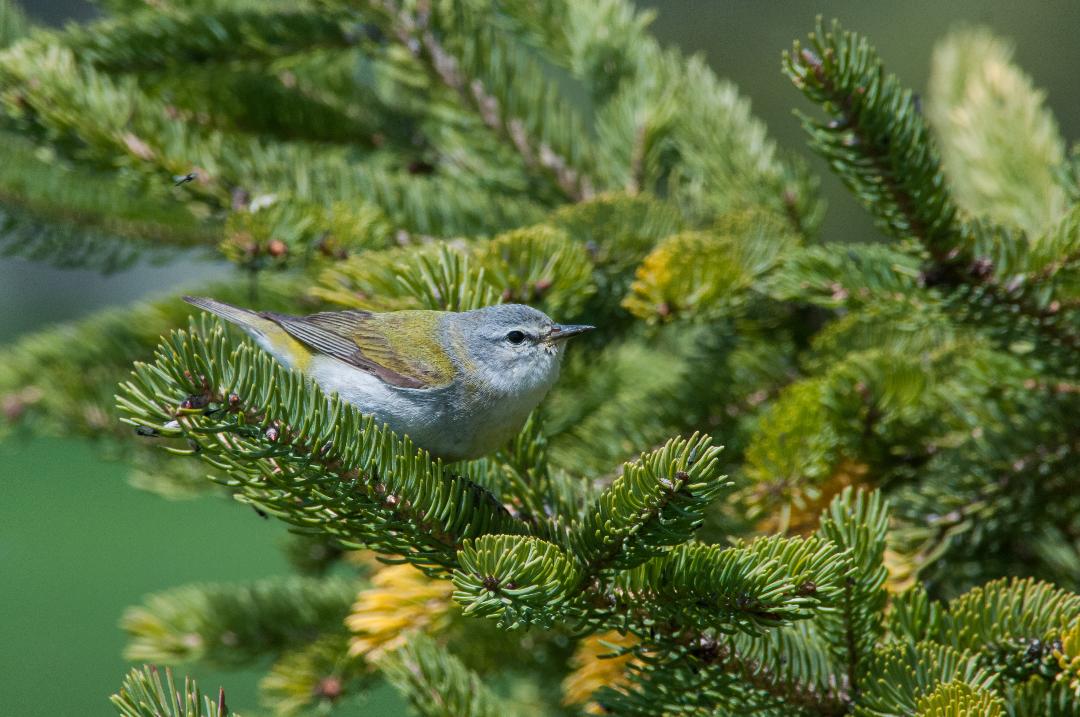
Then we have the warblers I mentioned earlier, which were discovered in the Volunteer State and to this day bear names honoring the state and its capital city. These two birds are the Tennessee warbler and the Nashville warbler.

Photo by Paul Spark/Adobe Stock • The Tennessee warbler, while named for the Volunteer State, spends very little time within Tennessee. These warblers migrate through the region each spring and fall but nest much farther north in the boreal forests.

The appearance of the Tennessee warbler varies greatly depending on the season. In autumn, most Tennessee warblers are greenish-yellow birds with whitish-gray underparts. Sometimes that green color ranges into vivid chartreuse territory.

In the spring, the basic green and white pattern remains evident, but both males and females sport a gray head and a black line that runs through the eye and along the side of the bird’s face. The plumage — at least in illustrations and photographs — is shown as more crisp and distinct with spring birds.

The pioneering American ornithologist Alexander Wilson gave the Tennessee warbler its name, which, unfortunately, is not an accurate moniker. Don’t blame Wilson too harshly for the mistake. Even after he “discovered” the first Tennessee warblers back in 1811, it would be almost another century before scientists finally located the bird’s nesting grounds in Canada in 1901. The remote and inaccessible nature of the the region helped prolong this mystery about the Tennessee warbler’s life cycle.

Wilson was an interesting figure in the natural history of the United States. Born in Paisley, Scotland, in 1766. As a young man, he learned the trade of weaving. At the same time, he became interested in poetry and claimed inspiration in particular from the Scottish poet Robert Burns.

In 1794, after not succeeding at poetry or weaving, he departed Scotland for a new life in the United States of America. He settled with a nephew in Pennsylvania, but he found opportunities limited for poet-weavers.

To make a living, he took up teaching. He met the famous naturalist William Bartram, who encouraged Wilson’s interest in ornithology and painting. These two passions took off for Wilson.

He made his life’s work the undertaking of publishing the nine-volume “American Ornithology” that featured his own illustrations of American birds. The work featured 268 species with 26 of them having never previously been described for science.

His fame as an ornithologist grew, and several species of birds were named in his honor, including the Wilson’s storm-petrel, Wilson’s plover, Wilson’s phalarope, Wilson’s snipe and Wilson’s warbler. Wilson’s work probably inspired John James Audubon’s own more extensive and famous collection depicting the birds of North America.

Every autumn I see some of the birds Wilson documented and painted as they stage their fall migration through the Volunteer State to reach destinations farther south.

Our capital city of Nashville also provides a common name to one of the warbler clan. The Nashville warbler is a small bird with a rounded head and short tail. The plumage of this warbler consists of yellow below and olive above. The birds have a white eye-ring that stands out against a gray head. The Nashville warbler also has a thin chestnut-brown crown patch, but a really exceptional look is required to see this feature. Most guides don’t mention that the Nashville warbler has a white patch of feathers surrounding the area where its legs join the body. This section of white is completely surrounded by yellow feathers. This is a helpful feature to know when trying to distinguish this warbler from some similar species.

Once again, Wilson bestowed a rather inaccurate name on this species, as the bird in question is only a visitor to Nashville and the surrounding territories during a limited window of time each year. The same is true of the Tennessee warbler. At best, these birds can only be found in the Volunteer State in April and May and again in September and October. Otherwise, Tennesseans would have to travel a good distance to see these birds at other times of the year.

Fortunately, these birds come to us. I’ve already seen the first Tennessee warblers for fall migration, but I’ve not been lucky enough this fall to get binoculars on a Nashville warbler — yet! There’s still time. Migration continues, so get outdoors and see what you can find.

••••

To share an observation, make a comment or ask a question, email me at ahoodedwarbler@aol.com.