Tag Archives: Our Fine Feathered Friends

Hollywood, not nature, casts feathered friends in villainous light

Willgard Krause from Pixabay

NOTE: This is a revised version of a column that originally ran in November of 2018.

The ultimate coma victim is the fabled zombie, but that’s not likely to afflict any of our feathered friends, right? Well, consider the great tits of Hungary, which are relatives of our tufted titmouse and Carolina chickadee. These birds — at least the Hungarian ones — have apparently acquired a taste for brains.

Not human brains, thankfully. The victims of these brain-hungry great tits are a species of bat — a flying creature often associated with the modern celebration of Halloween, as well as legends about vampires — that shared the habitat of these birds in the Bükk Mountains of Hungary. As it turns out, the tits only hunted bats, in this case a tiny species known as common pippistrelle, out of dire necessity.

Pixabay Great tits have been documented hunting, killing and then eating the brains of small bats.

Bat ecologists Péter Estók and Björn M. Siemers, after observing the odd behavior of the great tits during some winter seasons, conducted a study to see if great tits are consistent devourers of bats’ brains. They discovered that the birds did hunt the bats and had even learned to detect a special call the bats make as they emerge from hibernation. The ecologists conducted their study over two years and learned that the great tits teach others of their kind the special art of hunting bats. They also learned that the birds made efficient killers, dragging the bats from their roosts and cracking their skulls to get at their brains.

However, when provided with plenty of alternative food, including such favorite items as bacon and sunflower seeds, the great tits chose to eat these items rather than actively hunt bats. The researchers concluded that great tits only resort to harvesting the brains of small bats during times of scarcity during harsh winters. The bizarre story is even featured in the title of a fascinating book by Becky Crew titled “Zombie Birds, Astronaut Fish, and Other Weird Animals.”

So, if humans have nothing to fear from brain-hungry birds, are there any birds that we should fear? Some experts suggest that precautions might be in order if a person comes into close proximity with a southern cassowary, which is the third-tallest and second-heaviest living bird, smaller only than the ostrich and emu.

Photo by lailajuliana / Pixabay.com • The southern cassowary reaches a height of more than five feet and weighs 120 pounds. The bird has a fearsome but perhaps undeserved reputation for attacks on humans.

The cassowary, a native of New Guinea and northeastern Australia, has developed a reputation as a fearsome bird capable of injuring or killing humans. Cassowaries deserve their reputation, according to ornithologist Ernest Thomas Gilliard. In his 1958 book, “Living Birds of the World,” he explained that the second of the three toes of a cassowary is fitted with a long, straight, dagger-like claw which can sever an arm or eviscerate an abdomen with ease. According to Gilliard, there have been many records of natives being killed by this bird.

A thorough study, however, has partly exonerated the cassowary from these misdeeds. In a total of 150 documented attacks against humans, cassowaries often acted in self-defense or in defense of a nest or chicks. The only documented death of a human took place in 1926 when two teenaged brothers attacked a cassowary with clubs. The 13-year-old brother received a serious kick from the bird, but he survived. His 16-year old brother tripped and fell during the attack, which allowed the cassowary to kick him in the neck and sever the boy’s jugular vein.

So we can rest easier knowing that murderous birds that reach a height of almost six feet tall are unlikely to terrorize us should we travel to the lands down under. A more ancient relative of the cassowary, however, might have been a different story had humans lived during the same time period.

An illustration of Gastornis (Terror Bird) on a river’s edge. Gastornis are an extinct genus of large flightless birds that lived during the late Paleocene and Eocene epochs of the Cenozoic era. They grew to a height of 6.6 feet.

Phorusrhacids, also known as “terror birds,” were a group of large carnivorous flightless birds that once had some members reign as an apex predator in South America before they went extinct around two million years ago. The tallest of the terror birds reached a height of almost 10 feet. Titanis walleri, one of the larger species, even ranged into what is now the United States in Texas and Florida.

Terror birds were equipped with large, sharp beaks, powerful necks and sharp talons. Their beaks, which would have been used to kill prey, were attached to exceptionally large skulls. Despite their fearsome appearance, these birds probably fed on prey about the size of rabbits. Perhaps not knowing this, Hollywood has cast these birds as monsters in such films as 2016’s “Terror Birds” and 2008’s “10,000 BC.”

Regardless, the casting of birds as film villains had already been done back in 1963 when Alfred Hitchcock released his film, “The Birds,” based loosely on a short story by Daphne du Maurier. The film, which starred some big Hollywood names such as Rod Taylor, Tippi Hedren, Jessica Tandy, Suzanne Pleshette and Veronica Cartwright, cast a whole new light on a “murder” of crows. Today, the film has achieved the status of a Hollywood classic.

There’s also the tale of the ancient Greek playwright Aeschylus, who died around 456 BC in Sicily, possibly the only known victim of a bird dropping a heavy weight on a human being. According to ancient accounts mentioned by Pliny the Elder in his “Natural History,” Aeschylus was said to have been killed by a tortoise dropped by an eagle after the bird mistook the playwright’s bald head for a stone it could use to crack open the tortoise’s shell. However, this intriguing tale is, alas, likely only a myth. Most scholars have dismissed the account as an embellished, apocryphal story.

I guess we will have to look to Hollywood’s werewolves, zombies and other supernatural monsters for our Halloween chills and thrills instead of our fine feathered friends.

Photo by cocoparisienne/Pixabay.com • A crow lands on a spooky scarecrow at sunset.

Broad-winged hawk is region’s migratory raptor

COURTNEY CELLEY/USFWS • A broad-winged hawk perches with a snake in its talons.

I’ve been seeing a few birds that qualify as fall migrants, but there have been some other birds in the mix, such as red-shouldered hawk.

In the last five years or so, red-shouldered hawk has become a year-round resident. But I hadn’t seen or heard one of these hawk since early summer, so I’m not sure if this individual was a resident or simply one passing through during this time of flux for our feathered friends.

Migration by its nature stirs up birds, which may pop into some unexpected places for a pit-stop on their travel route.

Other birds I’ve seen or heard recently include broad-winged hawk, Eastern wood-pewee, Northern waterthrush, hooded warbler, gray catbird, blue jay, American goldfinch, American crow, common raven, great blue heron and Eastern phoebe, as well as ruby-throated hummingbird and three woodpecker species: Downy, pileated and red-bellied.

The hawks, however, got my attention. The broad-winged hawk, known scientifically as Buteo platypterus, thrills onlookers every September by staging phenomenal migratory flights that can include hundreds or thousands of individual birds. The term “platypterus” translates from Greek as “wide winged.”

Outside of birding circles, however, the broad-winged hawk is not nearly as widely known for its migratory feats as, for example, the monarch butterfly or Eastern North America’s ruby-throated hummingbird. When time to migrate, these hawks form large flocks, which also include other raptor species. “Hawk watches” are held at some famous peaks. A Mendota Hawk Watch is conducted ever fall on Clinch Mountain near an abandoned fire tower close to Mendota, Virginia.

Larry McDaniel with the Bristol Bird Club reported that the watch this season has been productive.

“The Mendota Hawk Watch is going strong with good coverage and lots of raptors,” he wrote in a Facebook post on Sept. 19. “There have already been over 3.600 broad-wings reported and we are just now getting into the statistical peak. The show will be over by late September, so get up there while the birds are still flying.”

Other famous “hawk watch” locations in the eastern United States include Whitefish Point in Michigan and Hawk Ridge, Minnesota. Closer to home, I’ve seen sizeable flocks, or kettles, of broad-winged hawks, on occasion in the company of other raptors, on Holston Mountain and Roan Mountain.

The genus Buteo includes the broad-winged hawk’s larger kin, including red-tailed hawk, rough-legged hawk, red-shouldered hawk and ferruginous hawk. Outside the United States, raptors in the buteo genus are often known as “buzzards.” When the first European colonists came to the New World, they applied the term buzzard to both types of native vultures as well as the large raptors like Swainson’s hawk that reminded them of the ones back in Europe such as the common buzzard.

Some of the buteo species have adapted to life on islands, including the Galapagos hawk and the Hawaiian hawk. There’s an endangered sub-species of broad-winged hawk known as the Puerto Rican broad-winged hawk that resides in forests on the island of Puerto Rico.

Some of these hawks have quite descriptive names, including the white-throated hawk, gray-lined hawk, zone-tailed hawk and short-tailed hawk, as well as long-legged buzzard, jackal buzzard and red-necked buzzard.

The broad-winged hawk, like all of its kin, is a predatory bird. These medium-sized hawks prey primarily on rodents, amphibians and insects, but they will also capture and eat snakes. They take some time to prepare prey after making a capture. In the case of snakes and frogs, these hawks “skin” their victims.

Many of our hawks are resident throughout the year, but the broad-winged hawk only spends the spring and summer. Look for them now. They won’t return until late April and early May in 2026.

•••

Bryan Stevens has written about birds, birders and birding since 1995. Share a sighting, ask a question or make a comment by emailing him at ahoodedwarbler@aol.com.

Use autumn to get ready for bird-feeding season

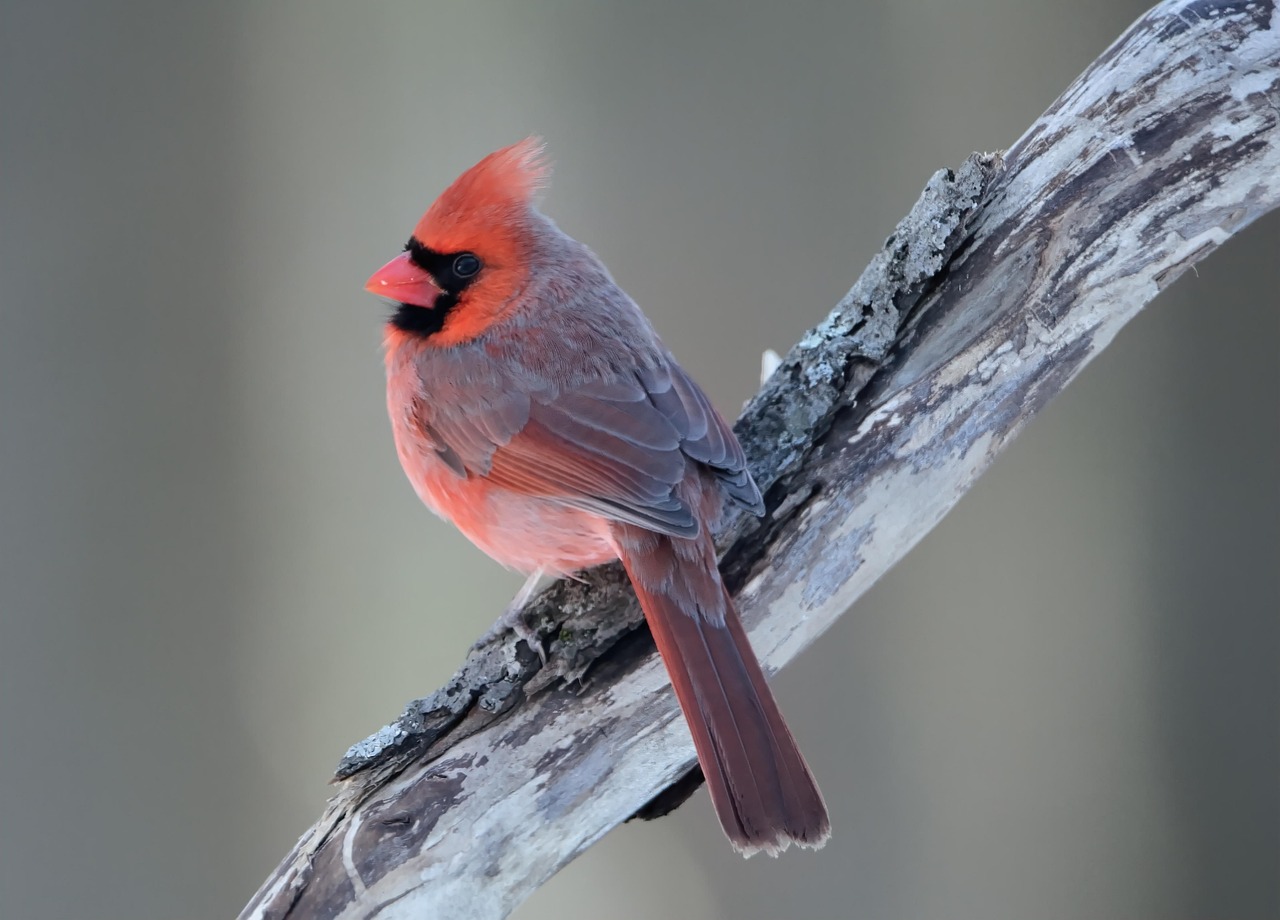
Bryan Stevens • A female Northern cardinal visits a hanging platform feeder for a winter meal of sunflower seeds.

I’ve enjoyed a decent amount of activity in my yard this fall, enjoying visits from ruby-throated hummingbirds and American goldfinches as well as brown thrashers and gray catbirds. I’ve also glimpsed a few warblers. As much as I enjoy fall, crowding into my awareness is the fact that cold weather will soon be with us again.

Even that fact, however, is not totally unwelcome. Winter’s a fine season for peering through the windows at the birds that flock to feeders. So, with the winter season looming just around the corner, now might be a good time to take some steps to make your yard and feeders more attractive and welcoming to our feathered friends.

Photo Courtesy of Byron Tucker
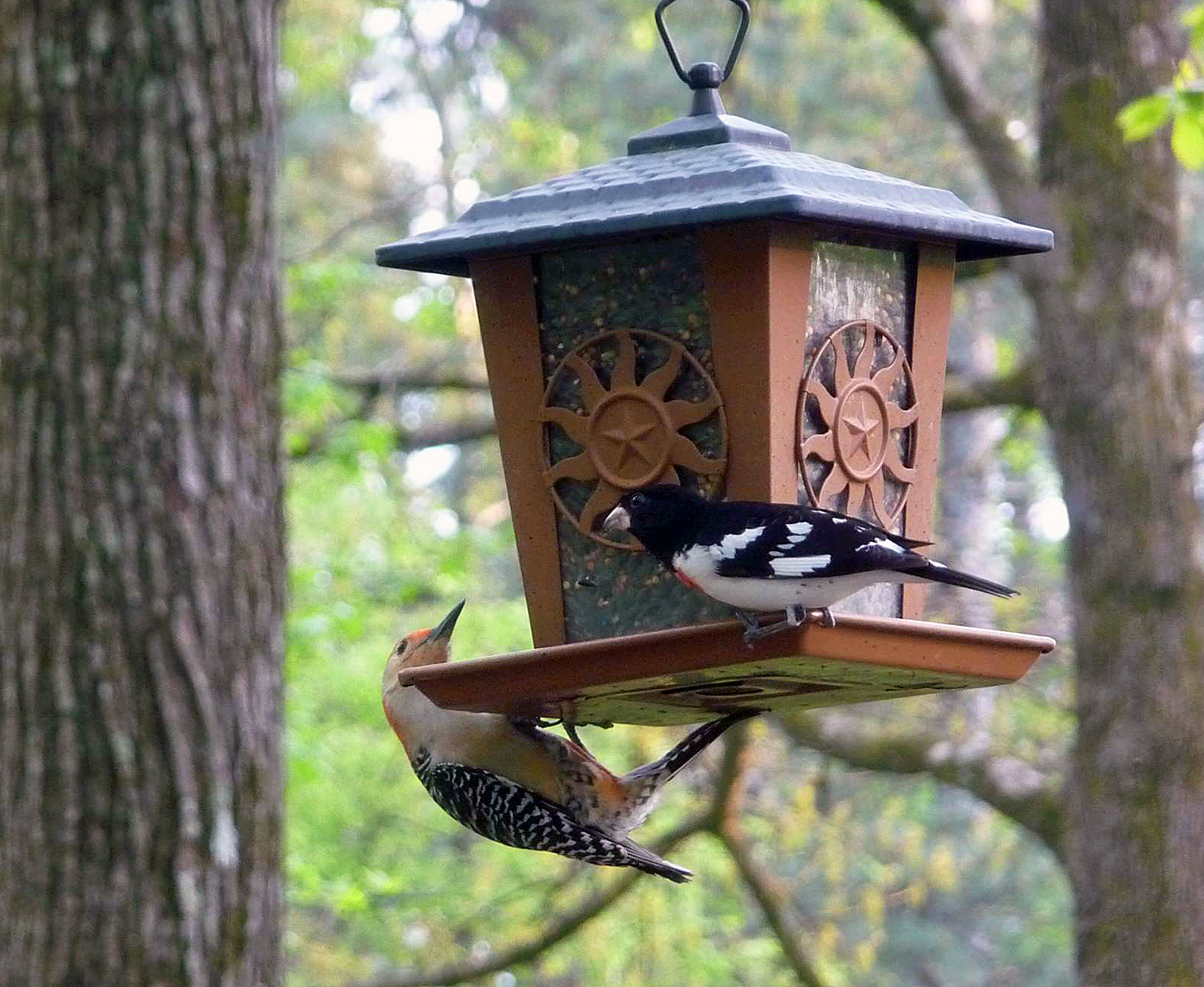
A Rose-breasted Grosbeak joins a Red-bellied Woodpecker at a feeder in Atlanta.

Seeing all the activity in my yard during fall migration made me want to ensure that it remains attractive for those birds that choose to eke out a living during the colder months of the year in our region.

Here are a few suggestions of things to do this fall to make your winter bird feeding more productive. It’s better to do these outdoor chores now before winter truly put a nip in the air.

• Plant native trees that bear fruit. Autumn’s a recommended planting time for many trees, so consider checking with a local nursery about the selection of such native trees as American holly, serviceberry and red mulberry. It’s always good to select trees that provide fruit at different seasons to maximize the appeal of your plantings to birds. A flock of American robins or cedar waxwings, or even a pair of Northern mockingbirds, can quickly strip berries from a holly tree when conditions turn snowy and icy.

• Build or refurbish a brush pile. Fall’s a season for pruning, so take those discarded limbs and twigs to construct a protective shelter for songbirds. Shy birds that naturally avoid open spaces can be coaxed closer to feeders by having access to a tangle of sticks and brush. A brush pile offers a degree of protection should songbirds at your feeder need to find a quick hiding place when a hawk or other predator makes an unexpected appearance.

• Evaluate feeders. The winter season brings snow, ice and a flurry of renewed interest in bird feeders, so now is the time to clean and replace feeders. The elements are not always kind on feeders, so when it becomes apparent that a feeder is in poor condition, consider replacing it with a new one. It’s also important to give feeders a thorough cleaning. Using a mild bleach solution will help disinfect them and make feeding from them safe for our feathered friends. Just be sure to rinse throughly and then dry the feeder before hanging it back out.

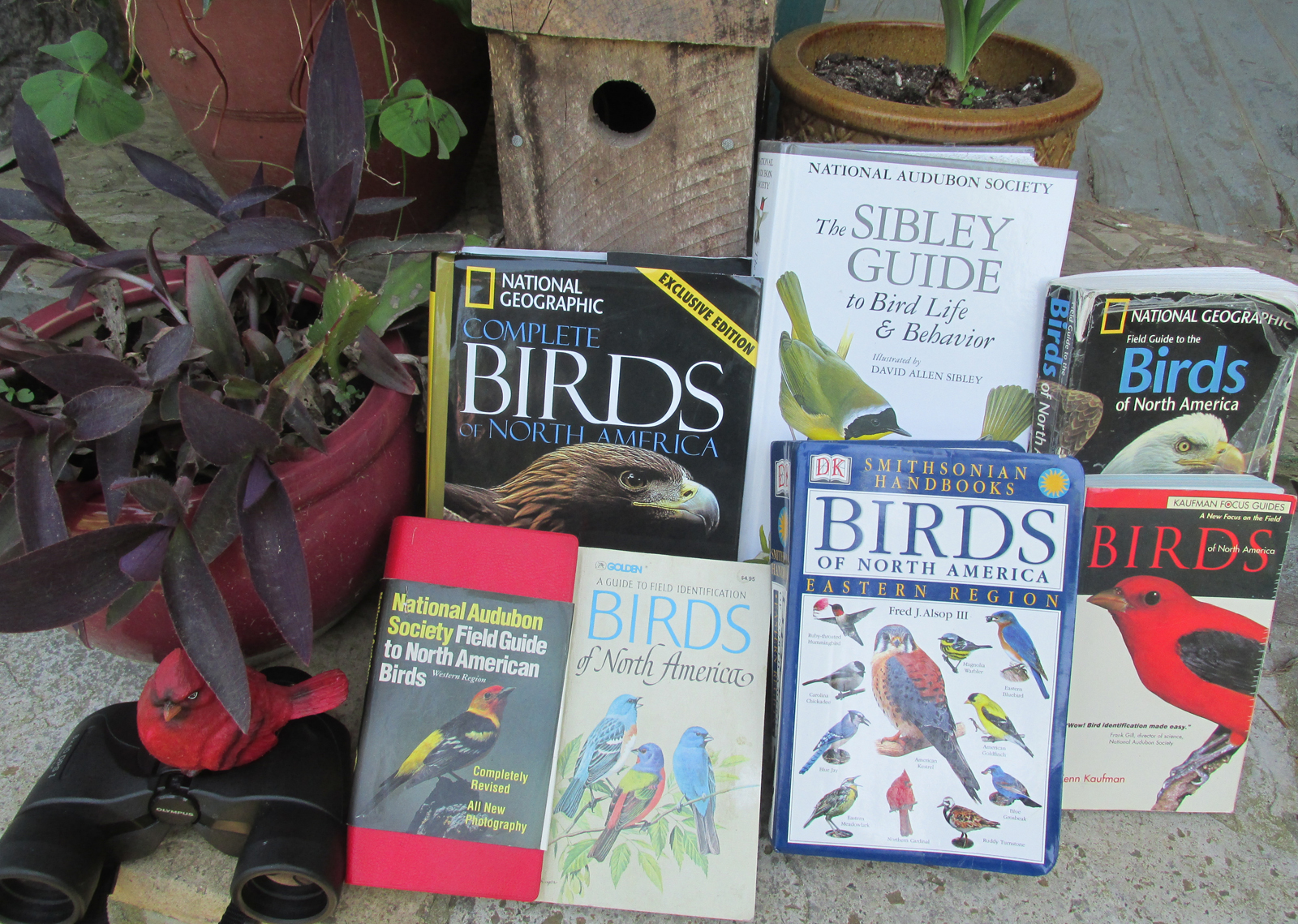
Photo by Bryan Stevens • Field guides are an essential tool for bird identification.

• Take some steps to increase your enjoyment of the birds coming to your feeders. Invest in a good bird identification guide or app. I am a fan of a good field guide that I can hold in my hands while thumbing through the pages, but I know that many people prefer the convenience of an app that’s accessible through their smartphone. Some popular apps would include the Audubon Bird Guide, eBird and Merlin Bird ID. Some of my recommended field guides include Peterson Field Guide to Birds of North America and The Sibley Field Guide to Birds of Eastern North America. Identifying birds congregated in the winter at a feeder is often easier than trying to track them through the green canopy during the other seasons. Of course, you’ll want to be aware that some birds wear different plumages during the winter months. The guides and apps can help with these identification challenges.

• Upgrade your optics. Place a pair of binoculars on your Christmas list. Bring the birds closer to you with a reliable pair of binoculars. It will make all the difference.

• Don’t take down the sugar water feeders just yet. Although ruby-throated hummingbirds almost all depart in early October, other species of hummingbirds normally found in the western United States have reliably made appearances in the region in October, November and other winter months. Through the years, I have seen several of these seemingly out-of-place hummingbirds. Some of them remain at their host’s feeders for a brief stay of a few days or a couple of weeks, but some of these hummingbirds have extended their stay for several months, lingering throughout the winter months before eventually departing in February or March. The big question concerns whether these hummingbirds are truly lost and out of place. The answer, based on everything I have managed to learn, is that these hummingbirds are precisely where they want to be. For still unknown reasons, some of these western hummingbirds make a migration swing through the eastern United States. One thing is certain: You won’t see one of these “strays” unless you keep out a feeder with fresh sugar water. It’s not that difficult. After all, the ants and wasps that made a nuisance of themselves during warmer temperatures are no longer active. If it gets too cold, you can always move your feeders inside at night and put back outdoors at daylight. If you do happen to attract a winter hummingbird, please let me know. I love helping to document these rare visitors.

•••

Bryan Stevens has written about birds, birders and birding since 1995. Share sightings, ask questions or make a comment by emailing him at ahoodedwarbler@aol.com.

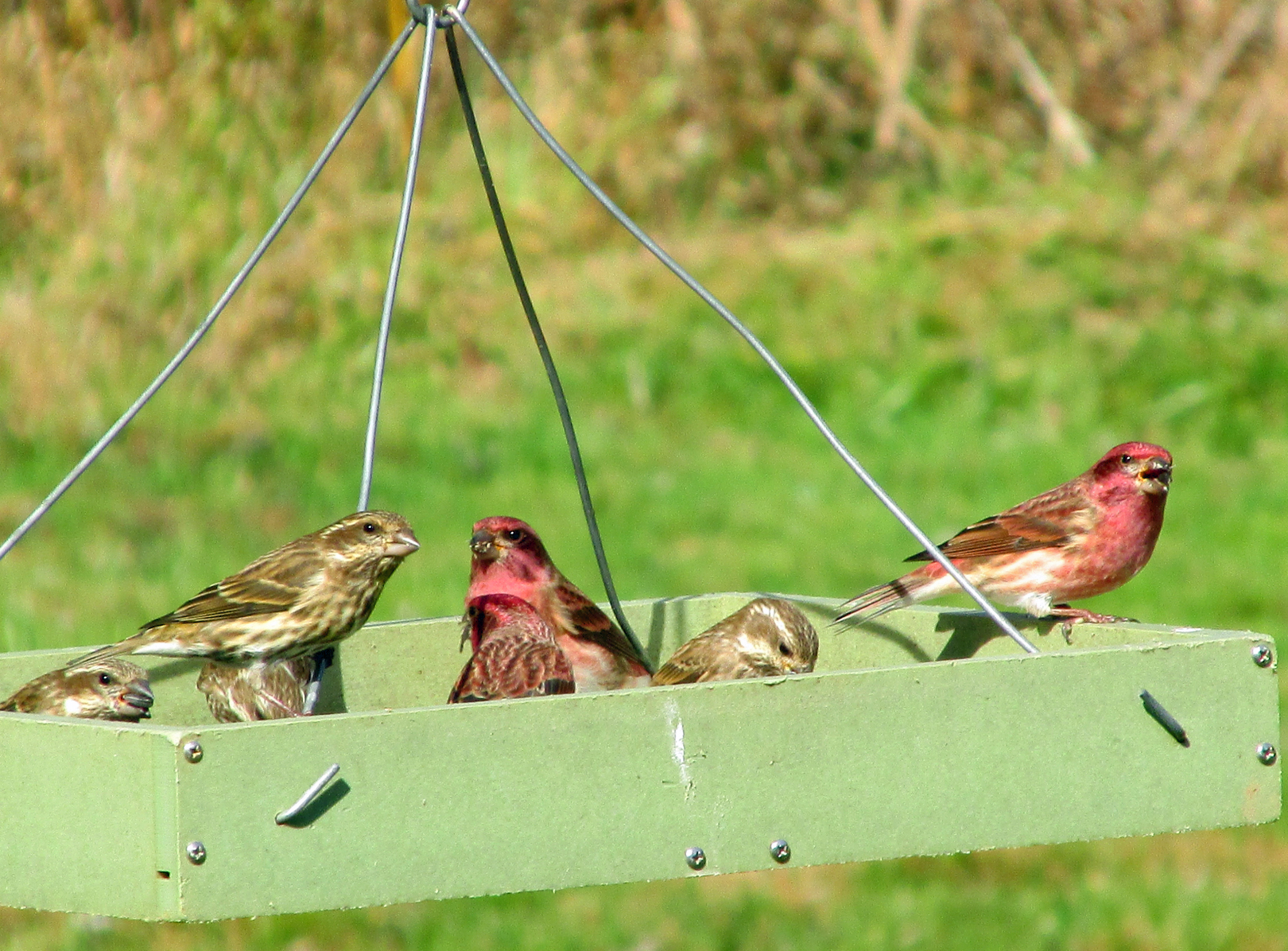
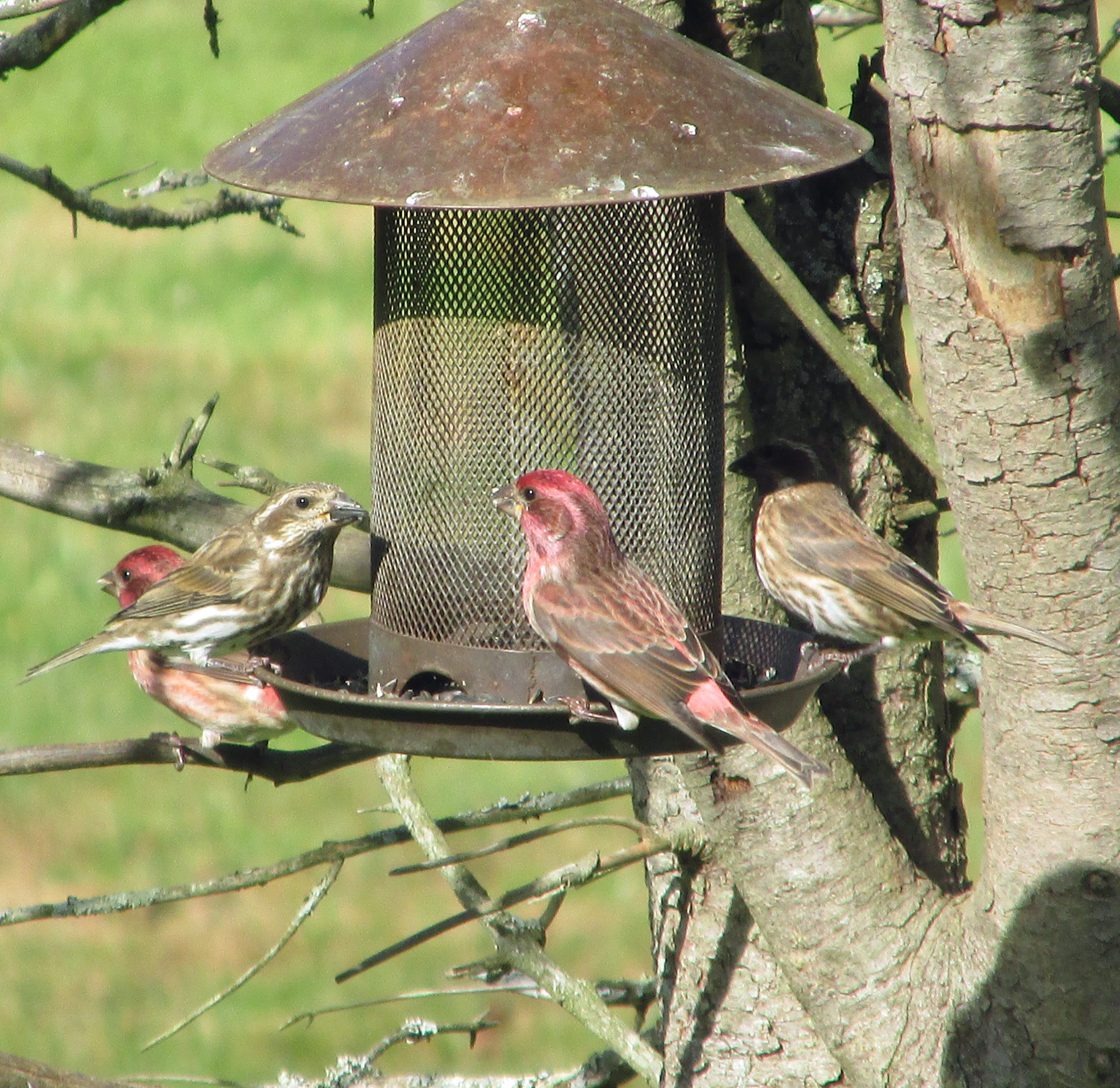
Photo by Bryan Stevens • Male and female purple finches share space at a feeder.

Birds with different spring and fall looks challenge birders

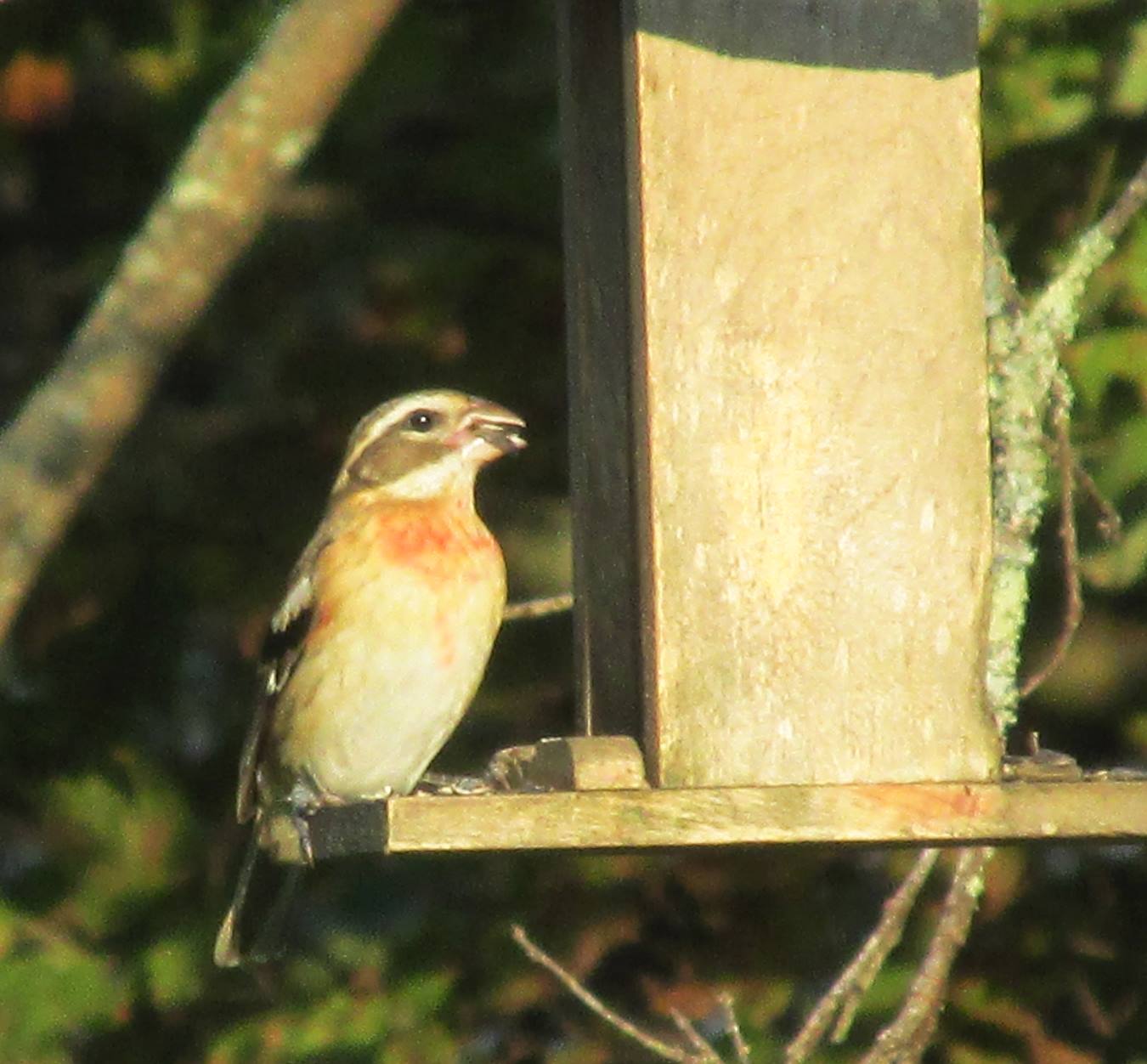
Photo by Bryan Stevens • A young male Rose-breasted Grosbeak visits a feeder in September of 2013. Young males resemble females but show a splash of orange on the breast that will be replaced the following spring by the familiar rosy-red patch.

My favorite season is fall. I’m always excited when birds return in the spring, but I have better luck observing fall migrants.
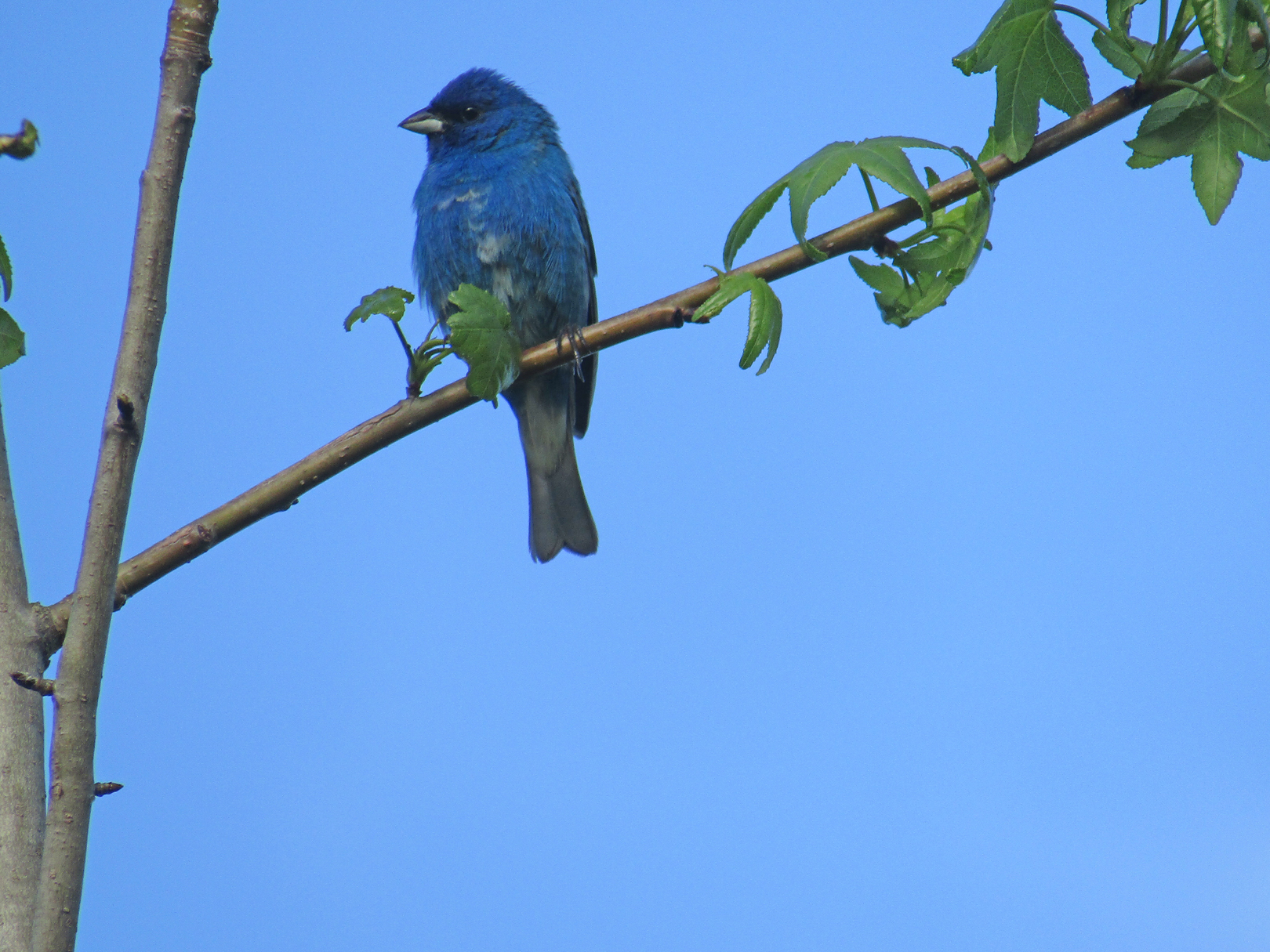
There’s a trade-off, however. Many birds don’t look their best by the time autumn migration rolls around. Take the male indigo bunting, for instance. This species is the only solid blue bird in the eastern United States, but it’s all an illusion — literally a trick of the light.

The indigo bunting’s feathers are not really blue; the male’s brilliant azure plumage is caused by the process of diffraction of light around the structure of the bird’s feathers. This process scatters all but the blue light, and the resulting color shifts from black to blue to turquoise as the angle of reflected light changes. In bright light, it can even look unnaturally vivid blue. In poor light, however, an indigo bunting male can appear black. Fortunately, indigo buntings have both a characteristic body shape and song, so even if the birds are not seen in their best light, they can still be recognized.

Photo by Bryan Stevens • Male indigo buntings look their best when they arrive each spring. They most over the summer, giving fall males a blotchy plumage of brown with some hints of blue remaining..

For such a bright blue bird, indigo buntings are not easy to detect. When that plumage gets mottled with brown patches in fall, these birds blend even better with their backgrounds.

The indigo bunting belongs to a genus of birds known as Passerina, which is included the family Cardinalidae, which includes birds like Northern cardinal and rose-breasted grosbeak. They are often lumped into a group known as North American buntings, although they are not closely related to such birds as snow bunting and lark bunting. The latter is even recognized as the official state bird for Colorado, a unique honor for this group of birds. The other members of the Passerina genus include lazuli bunting, varied bunting, painted bunting, rose-bellied bunting, orange-breasted bunting and blue grosbeak.

Indigo buntings linger into early October, but they also molt feathers and take on a less showy look in late summer and fall. Even the males can end up looking rather shabby compared to a spring counterpart in electric blue plumage.

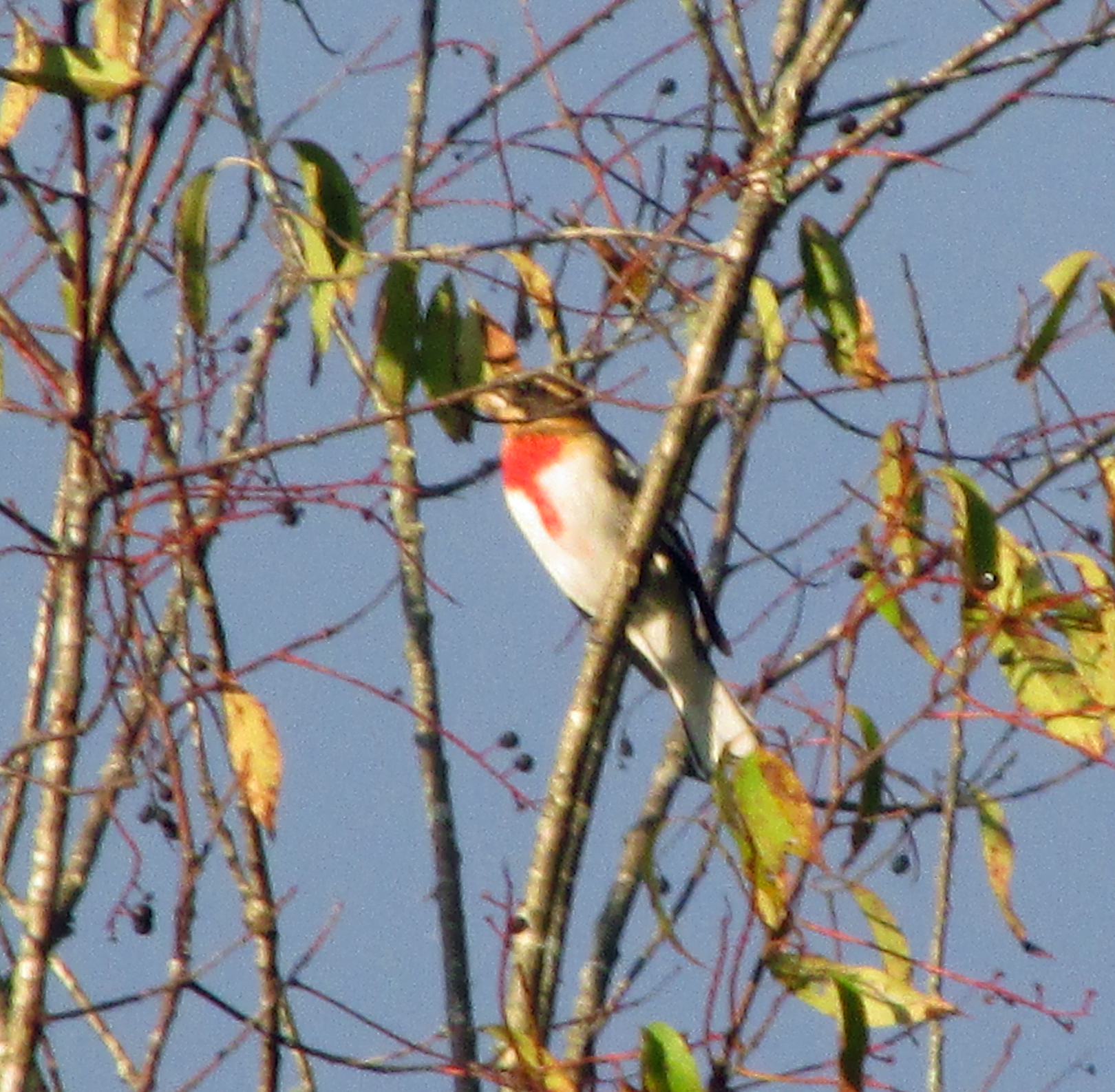
The rose-breasted grosbeak, or at least adult males of the species, are birds that can take one’s breath away when observed in spring when the birds first return from their tropical wintering grounds. By fall, however, even adult males have lost some of the crisp black-and-white plumage and the rosy coloration on the breast often fades to dull orange.

In fall, the rose-breasted grosbeak migrates south to a winter range that spans central Mexico, Central America and northern South America. As they depart, many will make stops in yards with feeders to partake of offerings of sunflower seeds. So, if you didn’t get to see these showy birds in the spring, local bird enthusiasts get another chance to see them in this month and into October.

Photo by Bryan Stevens • Some of the Rose-breasted Grosbeaks migrating through this fall still retain some of their rosy color.

The male rose-breasted grosbeak gives this species it name. Males are the epitome of the birds that make their home for part of the year in the American tropics. The contrasting black and white plumage is emphasized by a triangular slash of rosy-red color on the breast. Put all those elements together and the male rose-breasted grosbeak is not a bird that would be mistaken for any other.

The female grosbeak, however, doesn’t stand out in the same way. She is much less colorful than the male. With her brown and white plumage, she is often mistaken for a large sparrow or finch. At this time of year, however, all rose-breasted grosbeaks: Adult males, adult females and young birds born this past summer can look dull. The best way to identify them is by focusing on the beak. That large, sturdy beak gives this species the other part of its name. “Gros” is a German word for big, so the name basically means “big beak.”

A fall appearance at odds with how a bird looks in the spring is also true of the scarlet tanager. The vibrant red and black spring males may look yellow or greenish-yellow once the acquire their fall and winter plumage. It’s not all that surprising. The males no longer have to impress females with their splendid coloration once the nesting season’s concluded.

The warblers, my absolute favorite family of birds, are famous for looking different in the fall. Long ago, someone coined the phrase “confusing fall warblers” since many young birds and even adult birds in fall plumage can look different than spring birds.

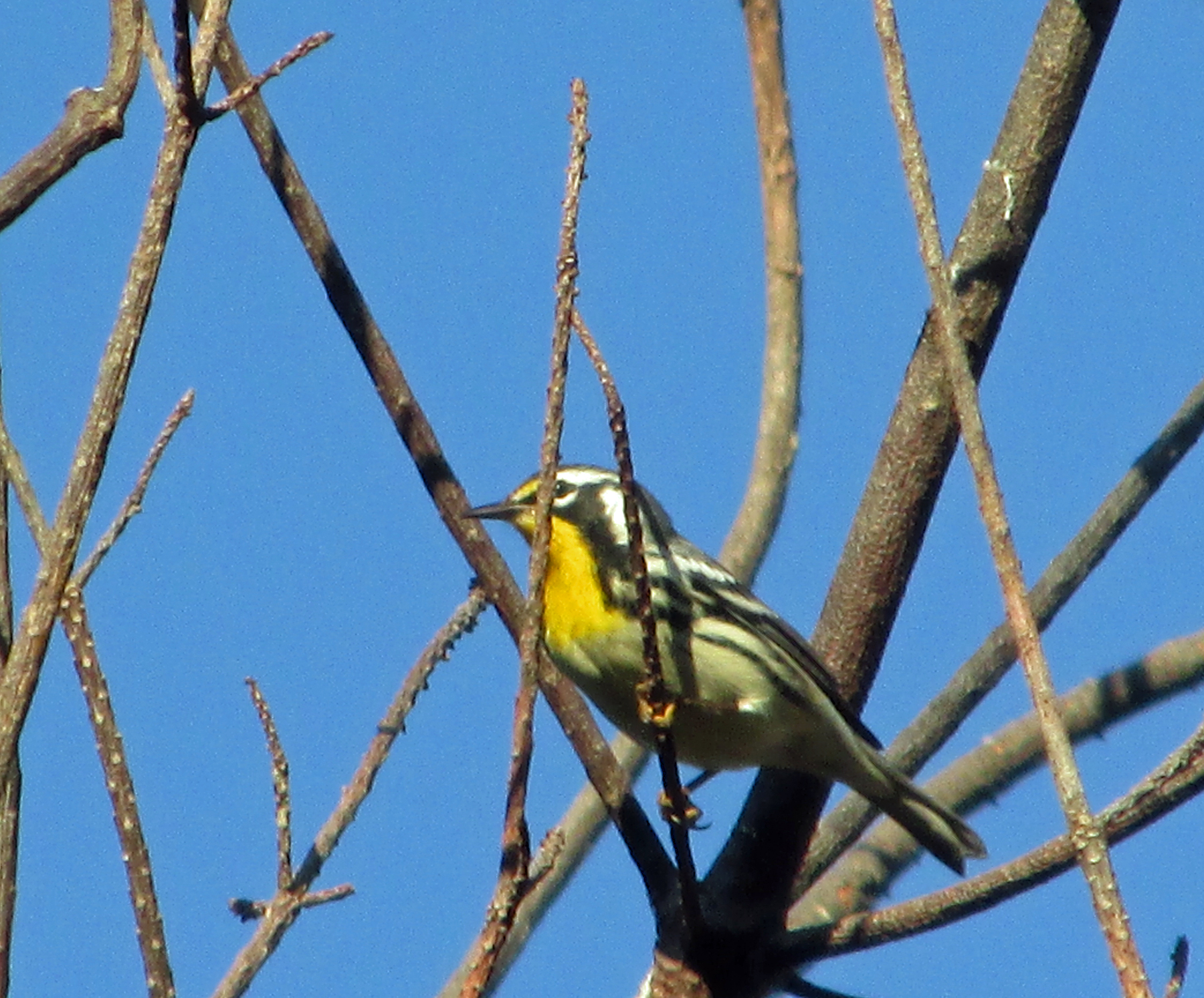
Photo by Bryan Stevens • The appearance of yellow-throated warblers does not change much from spring to autumn.

To identify confusing fall warblers, focus on features that remain consistent in their drabber autumn plumage, such as bill shape, leg color, tail patterns, wing bars and subtle facial markings. Learning the foraging behaviors of the various species can also be helpful.

Some of the warblers that look much different in fall includes species like magnolia warbler, Tennessee warbler, chestnut-sided warbler and Cape May warbler. Other species, such as hooded warbler, ovenbird and Northern waterthrush don’t change all that much with the seasons.

•••

Bryan Stevens is the managing editor of The Erwin Record. He has written about birds, birders and birding since 1995. To ask a question, make a comment or share a sighting, email him at ahoodedwarbler@aol.com.

Hummingbirds, other summer birds get ready to depart

Photo by Bryan Stevens • A ruby-throated hummingbird visits a feeder for a sip of sugar water.

I always feel some reluctance and regret when I turn the calendar page from August to September.

I don’t have anything against fall – it’s my favorite season. But I know that our ruby-throated hummingbirds, which returned only five months ago in early April, will soon be departing.

It won’t be only the hummingbirds. Warblers, orioles, tanagers and other migrants will also fly south to spend the winter season somewhere more hospitable.

Most of the hummingbirds that visited our gardens over the summer are getting ready to migrate back to their winter homes in Central America.

I’m seeing only a few adult male hummingbirds with the namesake red throat. They are outnumbered by females and young hummingbirds that hatched in late spring and throughout the summer. It’s fun to watch young hummingbirds. They often have something to prove. In many ways, they’re even more feisty than adult birds.

Photo by Bryan Stevens • A male ruby-throated hummingbird perches at a feeder for a sip of sugar water.

In any given year, the numbers of hummingbirds passing thorough is going to fluctuate. Some years, these tiny flying gems will be present in good numbers on an almost daily basis. Other years, hummingbirds can become quite scarce.

I usually enjoy my best hummingbird numbers in the fall as these little birds begin their leisurely journey back south. Late August and the month of September is usually a great time to watch hummingbirds.

During August, the feeders at my home and my mother’s home saw a great deal of activity. Blooms of wildflowers and cultivated flowers also attracted them. Earlier in the summer the hummingbirds went gaga for the crocosmia blooms and the flowering bee balm. For the past month, the tube-shaped flowers of orange jewelweed has kept them coming back for more.

The New World is home to about 360 species of hummingbirds. We’ve expended many adjectives in finding names of them all. Sometimes, words fail. Mere adjectives are somewhat inadequate in providing common names for many of the world’s more hummingbirds, but that doesn’t keep us from trying to give descriptive names to each hummingbird species. For instance, we have the beautiful hummingbird of Mexico; the charming hummingbird of Costa Rica and Panama; the festive coquette of northwestern South America; and the magnificent hummingbird of the southwestern United States.

Photo by Bryan Stevens • A ruby-throated hummingbird sips from a sugar water feeder.

Other names are even more elaborate and occasionally outlandish, such as the white-tufted sunbeam of Peru; the violet-throated metaltail of Ecuador; the violet-throated starfrontlet of Peru and Bolivia; the hyacinth visorbearer of Brazil; and the rainbow-bearded thornbill of Colombia and Ecuador.

As for our own ruby-throated hummingbirds, wish them well as they begin that long trek back to their wintering grounds. For the young birds, this will be their first epic crossing of the Gulf of Mexico, something the species must do twice a year to get to and from their summer home in eastern North America.

•••

Bryan Stevens has written about birds, birding and birders since 1995.

Diminutive green heron flies beneath the radar but is not uncommon

Photo by Bryan Stevens • A green heron captures a tadpole at a pond’s edge.

Retrieving the mail from my mailbox requires a slight trek, but there’s always something to see in the few minutes it takes to complete this task six out of seven days every week.

On a recent stroll to fetch the mail I startled a green heron from the vegetation surrounding the fish pond. The heron made a startled cry and flew to a horizontal branch in a tree adjacent to the pond.

It’s been so long since I’ve seen this small wading bird up close that I’d forgotten its diminutive nature. Although the official name is green heron, I’ve almost always referred to this species as “little green heron” or simply “little green.” It’s not completely uncalled for. After all, there’s a little blue heron. As far as my research tells me, however, there is no great green heron.

Photo by Bryan Stevens • Upcoming programs in the region will focus on topics such as songbirds, raptors and the basics of beginning birdwatching. Plan to attend one or more of the programs to learn more about birds, such as this green heron.

Green herons are not restricted to coastal areas, but it was still somewhat unexpected. I’m hoping I didn’t frighten the bird too badly and it will continue to haunt the edges of the fish pond. The vegetation around the pond makes it easy for this heron to conceal itself. The pond is also a great place for the heron to forage. There’s an abundance of some of its favorite prey, including tadpoles and dragonflies.

Green herons and other wading birds are usually quite abundant in wetlands across the country in late summer. The scientific name — Butorides virescens – of this bird comes from a mix of Middle English and Ancient Greek and roughly translates as “greenish bittern.”

There are only two other species in the genus Butorides — the lava heron, which occurs on some of the Galapagos Islands of Ecuador, and the striated heron, which is found in wetlands throughout the Old World tropics from West Africa to Japan and Australia. This heron, which is also known as the mangrove heron, also occurs in South America.

The green in the bird’s plumage appears as a dark green cap, as well as a greenish back and wings. Adult birds also have chestnut-colored neck feathers and a line of white feathers along the throat and belly. These herons often assume a hunched position, making them look smaller than they actually are.

It’s been a good summer for wading birds. In addition to the green heron, a great blue heron has been lurking in the creekand at the fish pond. Much larger than the green heron, it’s not as easy for the great blue heron to escape notice.

Other locations to look for both these herons are at the pond at Erwin Fishery Park. You’ll also want to keep alert when walking along the linear trail in Erwin. This is the time of year when interesting herons or egrets are not all that scarce.

Farm ponds in the countryside around Jonesborough, as well as wetland habitat around the town’s Persimmon Ridge Park, are also good places to look for green herons. The wetlands at Sugar Hollow Park in Bristol, Virginia, is another dependable location for seeing this small heron. Most green herons will depart in late September and early October. This small heron retreats from the United States during the winter season but returns each spring in April and May.

Photo by Bryan Stevens • A green heron finesses a captured tadpole in its bill.

The green heron’s range during the nesting season includes Canada and much of the United States. Green herons will sometimes form loose nesting colonies, but at other times a pair will choose a secluded location as a nest site. The female will usually lay from three to five eggs. Snakes, raccoons and other birds such as crows and grackles are potential threats to eggs.

For the most part, the population migrates to Central and South America for the winter months. A few herons — great blue heron and black-crowned night heron — remain in the region throughout the year, even enduring the cold winter months in Northeast Tennessee, Southwest Virginia and Western North Carolina.

Green herons are probably more common than we realize. They are skilled at blending with their surroundings, but sharp eyes can find these herons around almost any body of water, whether it is pond, marsh, river, creek or lake.

Keep looking for green herons and their larger kin for the next few months. To share a sighting, ask a question or make a comment, send me an email at ahoodedwarbler@aol.com.

•••

Bryan Stevens is the managing editor of The Erwin Record. He has written about birds, birding and birders since 1995.

Photo by Bryan Stevens • A green heron hunches next to a pond.


Looking for fall migrating birds already underway

A male Wilson’s warbler perches in some branches. Many species of warbler migrate through the region each fall.

Summer’s waning. Just look at the calendar. We’re already approaching the midway point in August.

Birders track the transitions as one season merges into another, knowing that these are some of the best times to seek out birds. Fall migration doesn’t wait for a page to turn on a calendar. In fact, some birds are already on the move. I thought I’d devote this week’s column to some of the birds I hope to observe this fall as a mass migration draws many of our summer residents south toward warmer wintering grounds. In no particular order, here are some of the birds I’m hoping to see this autumn.

COMMON NIGHTHAWKS

The name common nighthawk is a misnomer. The species is not strictly nocturnal and it is certainly not a hawk. It’s actually a member of the nightjar family, which includes such birds as chuck-will’s-widow and whip-poor-will. The nighthawk doesn’t offer a serenade like these relatives, but it does produce a “pent” call that sounds much like an electric buzzer. It’s often the first indication of one of these birds swooping overhead. Nighthawks form impressive flocks, often numbering in the dozens or even hundreds. They are often active in evening hours, but I’ve seen large flocks of these migrating birds in mid-afternoon. August and September are the best time to look skyward to enjoy the spectacle of a large flock of swooping nighthawks as they pass overhead.

Photo by U.S. Fish and Wildlife Service
A Common Nighthawk finds a perch for a brief rest.


I didn’t host any of these colorful birds this spring, so I hope to get another opportunity this fall. The males in their vibrant black-and-white plumage and namesake breast patch of rosy-red feathers are slightly less colorful in the fall. I’ve actually had better luck in autumn hosting these birds at feeders. They love sunflower seeds, so keep your feeders stocked with their favorite foods to increase your chances. Females and young birds look different than adult males, but the heavy beak (the word “gros” is German for large) is a good indicator of their identity. Bird banders netting this species to document information for science can testify that these birds are also capable of a nasty nip at careless fingers with that stout bill.

Bryan Stevens • A pine warbler visits a suet feeder.

WARBLERS

These birds are undeniably at their most gorgeous during spring migration, but many species of warbler retain colorful plumage into the fall season. Young birds, often in a plumage entirely different than adult birds, are responsible for the term “confusing fall warblers.” I’ll be looking for the species that are harder to locate in the spring, including bay-breasted warbler, Cape May warbler, Blackburnian warbler and Tennessee warbler. I’ll also be hoping for a rarity such as cerulean warbler or mourning warbler. I will be sad when the parade of warblers produces a palm warbler or a yellow-romped warbler. These last two species are a sure sign that fall migration’s coming to a close for another season.

Photo by Bryan Stevens
A Great Egret resting on a spit of land in a lake at Murphy Candler Park in Brookhaven, Ga.

WADING BIRDS

Late summer and early fall can also be a fantastic time for scanning rivers, lakes and farm ponds for wading birds. Hurricanes in recent years have even forcibly relocated American flamingos to Tennessee and other unlikely locations. It’s slightly more reasonable to hope for something unexpected like a wood stork or roseate spoonbill. The more likely candidates for observing in the region are great egrets, tri-colored herons and snowy egrets. It’s also a last chance to view green herons before this small species retreats to warmer locations for the coming winter.

Bryan Stevens • A hermit thrush perches on a fence.

THRUSHES

These medium-sized songbirds are typically brown in plumage, often with spotted white breasts. They’re beautiful singers in spring and summer, but they’ve often cut back on their singing by fall. Nevertheless, they form large migrating flocks that will roam autumn woodlands to rest and refuel during short breaks from migrating. Swainson’s thrush is not difficult to find in the fall. This species is named in honor of 19th century artist and ornithologist William Swainson. Like most birders, I will be hoping for the more difficult species like Bicknell’s thrush and gray-cheeked thrush. Knowing their call notes can help alert you to their presence.

There will be a dazzling diversity of our feathered friends on the move this month. The seasonal phenomenon of migration extends into September and October. Pay attention to the visitors in your yards and gardens.

•••

Share sightings, ask questions or make comments by emailing me at ahoodedwarbler @aol.com.

Photo by Bryan Stevens • This migrating rose-breasted grosbeaks struck a window and spent some time recovering. Later, the bird flew safely back to a row of trees.

Late summer offers interesting birding opportunities for birders

Photo by Steven Arnold/Pixabay • A great blue heron attempts to get a handle on a snake in preparation for swallowing its serpentine prey.

A pair of Carolina wrens has taken advantage of what was meant to be the temporary storage of some boxes on the front porch to claim the interior of one of the cardboard containers as a nesting location.

In the latter days of summer, usually a lackluster period for birdwatching, there are still some interesting behaviors or actions on the part of our feathered friends to provide some points of interest.

Wrens already have a reputation for nesting in some unusual locations. My introduction to the Carolina wren took place in my childhood when a pair of these wrens nested in an old apron my grandmother used as a bag for her clothespins. Other unusual locations for wren nests that I have found over the years included the interior of a plastic shopping bag hanging from a nail in my garage and an attempt to nest in the exhaust vent for my clothes dryer. I’ve also seen them nest in hanging flower baskets.

Photo by Jean Potter • A Carolina wren creeps along a fence.

The world’s 88 species of wrens are, for the most part, the quintessential “little brown birds,” but that hasn’t kept them from acquiring some interesting and descriptive common names. Some examples include the tooth-billed wren, flutist wren, riverside wren, whiskered wren, happy wren, musician wren, timberline wren, speckle-breasted wren, white-breasted wood wren and giant wren. The last species on the list resides in Mexico and is indeed a “giant” among a family of tiny birds, reaching a length of almost nine inches and weighing all of 1.8 ounces.

I’ve also been monitoring a great blue heron lurking along the creek that flows past my home. A collapsed foot bridge (thanks to Helene) still spans the creek and provided, at least from the heron’s perspective, a means of concealment from my prying eyes when I stepped onto the front porch. The heron ducked under the bridge and slowly stepped downstream, out of sight and presumably what the bird thought would be out of mind. But I tricked the heron, stepping back inside the house and waiting for It to reappear. I stepped into view again and the heron, instead of taking flight, repeated its earlier actions, skirting beneath the bridge and wading downstream. I could probably have continued this game of peek-a-boo, but I felt that I had imposed on the heron long enough. The bird evidently desired to try its luck fishing upstream beneath a shady overhang of branches from trees growing along the creek banks. I stepped back inside, peeked out a window and watched the heron move in a slow, stately manner, but this time the bird headed up the creek.

All herons are skillful anglers, so I am confident that the bird probably managed to catch an unwary frog or fish. As the tallest heron in North America, the great blue heron boasts a diverse diet. These birds, armed with a dagger-shaped bill, excellent vision and quick reflexed, prey on rodents, amphibians, snakes, fish and even small alligators. Basically, a great blue heron will eat anything it can swallow.

Photo by Bryan Stevens • A great blue heron’s quick reflexed and dagger-like bill make it a formidable predator.

Other herons around the world with descriptive names include purple heron, white-bellied heron, black-headed heron, great-billed heron, whistling heron, pied heron and Goliath heron. The latter, as its name suggests, is a giant among herons.

There’s more to report on the birding front. Hummingbird numbers are on the rise again. After the usual summer lull, the resident ruby-throated hummingbirds have raised their profile, visiting daily at feeders as well as blooming flowers. Female hummingbirds have had time to raise their young. In fact, many of the hummingbirds visiting your yards and gardens at this time of year are probably birds born earlier in the season. In a couple of months these young birds will make their inaugural migration across the Gulf of Mexico to reach winter grounds in Central America. Until that time, hang a sugar water feeder, grab a lawn chain and enjoy the hours of no-cost entertainment provided by these feisty, flying gems.

So, although the summer doldrums do make birds scarce at times, just know that they’re still out there. In the meantime, nature offers plenty of other engaing wildlife. During the day, it’s fun to look for butterflies and dragonflies. After dark, there’s always moths and lightning bugs.

Keep in mind, it’s not always the visuals. For instance, the past couple of nights I’ve enjoyed listening to an Eastern screech-owl’s nocturnal serenade with its trembling wailing call that gives this small owl its name.

•••

Bryan Stevens has been writing about birds and birding since 1995. Email him at ahoodedwarbler@aol.com to share a sighting, make a comment or ask a question.

Photo by Bryan Stevens • A ruby-throated hummingbird visits a feeder for a sip of sugar water.


Carter County Summer Bird Count tallies 117 species

Hans Toom/Pixabay • A couple of Canada warbler got tallied with this year’s Carter County Summer Bird Count.

The Lee and Lois Herndon Chapter of Tennessee Ornithological Society, also known as the Elizabethton Bird Club, held its 32nd annual Carter County Summer Bird Count on Saturday, June 7 with 20 observers in nine parties.

Participants tallied 117 species, which is slightly above the average of 114 species.

Most unusual was a Mississippi kite seen for the first time on one of the chapter’s summer bird count. The kite was seen in the Toll Branch vicinity, according to the count’s longtime compiler Rick Knight. He also indicated that other notable finds included common merganser and red crossbill. In addition, counter found 18 species of warblers.

The list:

Canada goose, 90; wood duck, 8; mallard, 56; and common merganser, 2.

Wild turkey, 13; rock Pigeon, 36; Eurasian collared-dove, 3; mourning dove, 142; yellow-billed cuckoo, 5; chuck-will’s-widow, 4; Eastern whip-poor-will, 8; chimney swift, 55; and ruby-throated hummingbird, 20.

Killdeer, 8; double-crested cormorant, 5; green heron, 2; great blue heron, 10; black vulture, 14; and turkey vulture, 46.

Osprey, 3; sharp-shinned hawk, 1; Cooper’s hawk, 3.

Bald eagle, 2; Mississippi kite, 1; red-shouldered hawk, 4; broad-winged hawk, 5; red-tailed hawk, 14; Eastern screech owl, 3; great horned owl, 1; and barred owl, 1.

Belted kingfisher, 9; red-bellied woodpecker, 18; downy woodpecker, 10; hairy woodpecker, 1; Northern flicker, 24; and pileated woodpecker, 16.

Simard Francois/Pixabay • A great crested flycatcher perches on a horizontal branch.

American kestrel, 2; great crested flycatcher, 8; Eastern kingbird, 16; Eastern wood-pewee, 26; Acadian flycatcher, 23; alder flycatcher, 1; least flycatcher, 9; and Eastern phoebe, 46.

White-eyed vireo, 11; yellow-throated vireo, 1; blue-headed vireo, 20; warbling vireo, 4; red-eyed vireo, 130; blue jay, 104; American crow, 180; fish crow, 4; and common raven, 2.

Carolina chickadee, 57; tufted titmouse, 78; tree swallow, 101; Northern rough-winged swallow, 58; purple martin, 23; barn swallow, 106; and cliff swallow, 127.

Golden-crowned kinglet, 2; cedar waxwing, 69; red-breasted nuthatch, 3; white-breasted nuthatch, 13; blue-gray gnatcatcher, 13; Carolina wren, 78; house wren, 23; and winter wren, 1.

Gray catbird, 34; brown thrasher, 31; Northern mockingbird, 83; European starling, 660; Eastern bluebird, 102; veery, 10; hermit thrush, 1; wood thrush, 35; and American robin, 417.

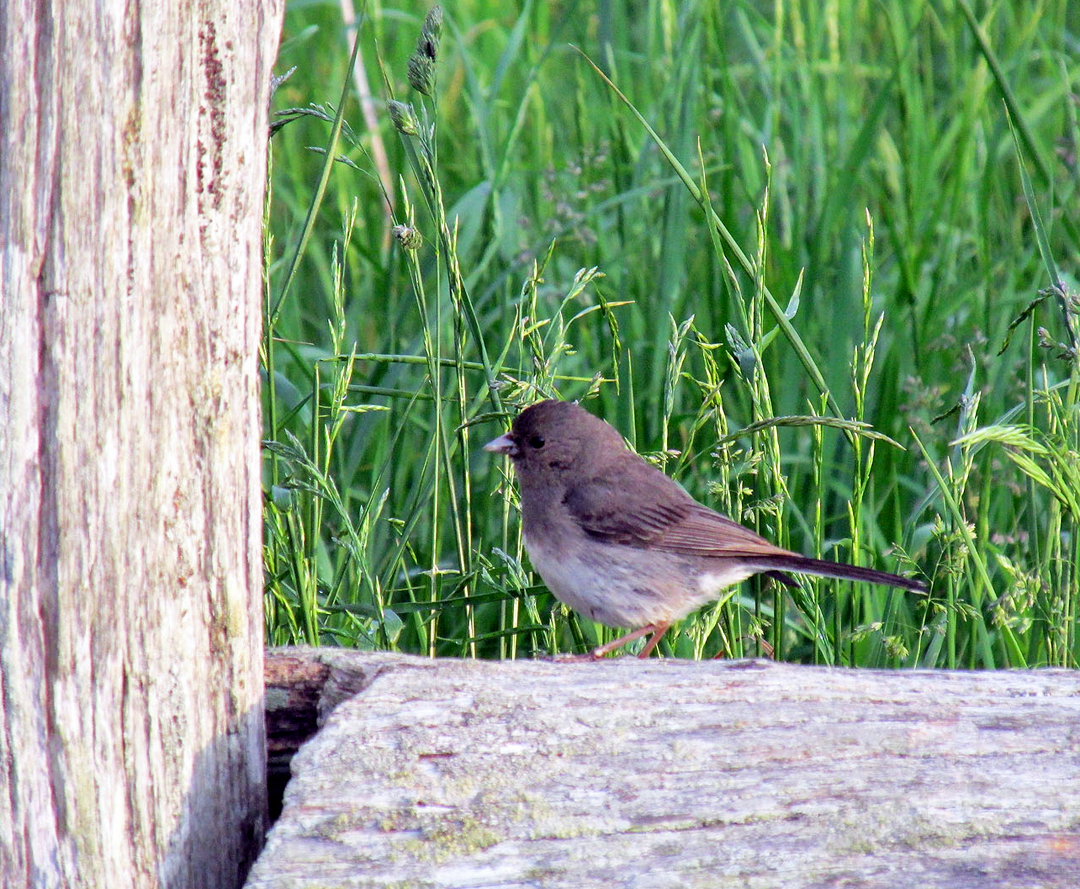
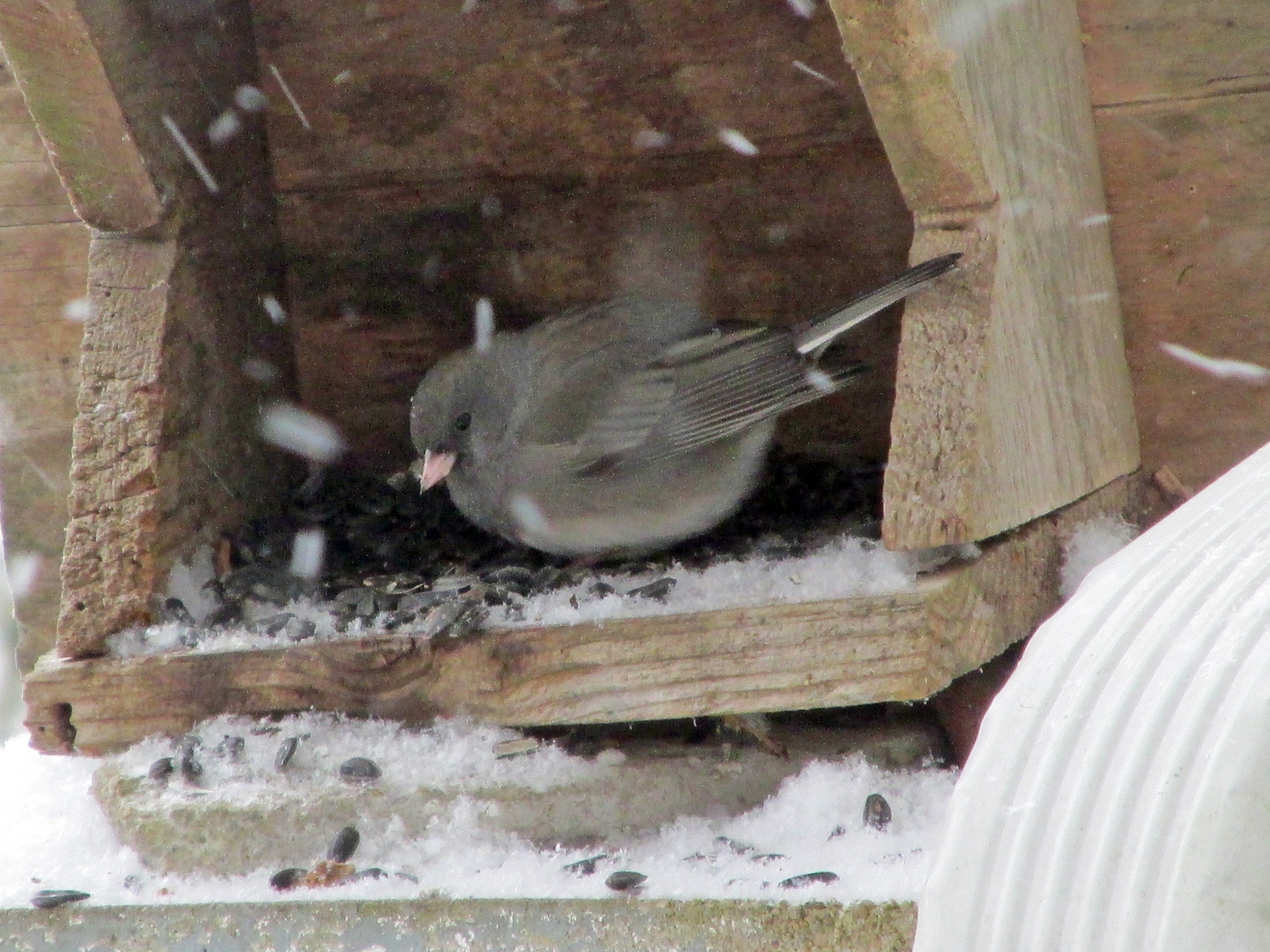
House sparrow, 27; house finch, 84; red crossbill, 3; pine siskin, 5; American goldfinch, 117; chipping sparrow, 91; field sparrow, 26; dark-eyed junco, 34; song sparrow, 204; and Eastern towhee, 105.

Yellow-breasted chat, 4; Eastern meadowlark, 11; orrchard oriole, 8; Baltimore oriole, 6; red-winged blackbird, 88; brown-headed cowbird, 43; and common grackle, 109.

Ovenbird, 65; worm-eating warbler, 5; Louisiana waterthrush, 15; golden-winged warbler, 3; black-and-white warbler, 34; Swainson’s warbler, 9; common yellowthroat, 19; hooded warbler, 104; American redstart, 24; Northern parula, 65; Blackburnian warbler, 6; Yellow warbler, 9; chestnut-sided warbler, 31; black-throated blue warbler, 33; pine warbler, 3; yellow-throated warbler, 20; black-throated green warbler, 27; and Canada warbler, 2.

Scarlet tanager, 34; Northern cardinal, 160; rose-breasted grosbeak, 7; blue grosbeak, 6; and indigo bunting, 154.

Knight noted that it seems like a few species are often missed on a one-day count. He explained that these misses are usually low-density or localized species. Weather or other circumstances may contribute to these misses, as well.

Several species of herons were found for this year’s Summer  Bird Count, but yell0w crowned night-heron was missed. 

Missed species this year included ruffed grouse, common nighthawk, America woodcock, yellow-crowned night-heron, yellow-bellied sapsucker, brown creeper, Kentucky warbler and magnolia warbler.

The chapter will resume meeting in September for its 2025-2026 calendar year. Meetings are usually held the first Tuesday of each month on the Elizabethton campus of Northeast State Community College. Meetings are accompanied by a program on birds, birding and other nature-related topics and begin at 7 p.m. For details, or to share a sighting, ask a question or make a comment, email me at ahoodedwarbler@aol.com.

•••

Bryan Stevens has written about birds and birding since 1995. His weekly “Feathered Friends” column will celebrate its 30th anniversary this year.

Scissor-tailed flycatchers making Jonesborough a summer home

Photo Courtesy of Lowell Christian • The female scissor-tailed flycatcher in Jonesborough shows the namesake tail feathers and some colorful plumage while in flight.

It’s been a good while since I’ve seen a new life bird to add to my species list.

“Life birds” are simply a new species that a birder has never encountered. Many birders list their “lifers,” which I do in a casual manner. My “lifers” are always documented in my weekly birding column.

I encountered my last life bird back in May 2020 during the pandemic when I observed my first-ever Mississippi Kite at Sycamore Shoals State Historic Park in Elizabethton.

Now, after a trip to Jonesborough, I’ve added scissor-tailed flycatcher. It’s a bird that I’ve wanted to see since I began birding back in the 1990s. I figured I’d have to make a trip to Texas or Oklahoma to add this to my list, however. I never imagined seeing this bird so close to home.

Photo by Bryan Stevens • The tail of the scissor-tailed flycatcher makes it difficult to confuse this bird with any other.

I actually saw two birds, a mated pair, tending their nest in Tennessee’s oldest town. The scissor-tailed flycatcher is the official state bird of Oklahoma, where this species would normally be expected.

This is the third consecutive summer season that this flycatcher’s been confirmed in Washington County. This streak of annual sightings started in 2023 when Dan Huffine, a sharp-eyed birder, saw one while baling hay.

A profile of the species on the Tennessee Wildlife Resources Agency website observes that the scissor-tailed flycatcher has significantly expanded its breeding range in the past several decades and now nests in Tennessee.

The first scissor-tailed flycatcher was reported in the state in 1964, the first nesting attempt was discovered in 1978 and the first successful nest was documented in 1983 in Rutherford County, according to the TWRA website.

I want to thank fellow birder Lowell Christian for providing great directions for finding the parents and their nest. He’s also a fantastic bird photographer. Check out his photos on his Facebook page.

The scissor-tailed flycatcher feeds largely on winged insects, earning its place within the flycatcher family. However, this species will also eat fruit when its available.

Photo Courtesy of Lowell Christian • The female scissor-tailed flycatcher forages in a parking lot.

This flycatcher is placed by experts within the genus Tyrannus, which includes the kingbirds. Other relatives in North America include Eastern kingbird, Western kingbird, tropical kingbird, Couch’s kingbird and Cassin’s kingbird. There’s also a giant kingbird native to Cuba and a loggerhead kingbird that is found throughout the Caribbean and on rare occasions in Florida.

Kingbirds are famous for their pugnacious behavior, not hesitating to attack larger birds such as hawks, vultures and crows in defense of their territory. Scissor-tailed flycatchers are also considered aggressive toward a variety of other birds.

Photo by Bryan Stevens • An Eastern kingbird perches on a fence post.

According to the website All About Birds, scissor-tailed flycatcher numbers declined by about 31% between 1966 and 2014. The estimate comes from statistics gathered by the North American Breeding Bird Survey.

The website also noted that Partners in Flight estimates a global breeding population of 9.5 million scissor-tailed flycatchers, with 92% breeding in the United States, and 50% spending some part of the year in Mexico.

A scissor-tailed flycatcher is unlikely to be confused with any other bird. Adult males are pale gray birds with blackish wings and black tails with white edges. Adults show salmon-pink flanks that extend to underwing patches that are very conspicuous in flight.

As is the case with so many species of birds, males are more colorful than females. The bird’s body is about the size of an American robin, but it looks bigger due to the long tail that gives this species its common name.

The All About Birds website notes that the scissor-tailed flycatcher isn’t always content to stay within its expected range. As I’ve mention on previous occasions in this column, birds have wings and will fly where they wish to fly.

The species tends “to wander widely on their way to and from the wintering grounds, a habit they share with relatives like the fork-tailed flycatcher and tropical kingbirds,” according to a profile of the species on the website.

Scissor-tailed flycatchers may makes appearances almost anywhere in North America, according to the website. I’m delighted to report that evidently also holds true for Northeast Tennessee.

One place that the bird is definitely expected is Oklahoma. Since May 26, 1951, the scissor-tailed flycatcher has been the officially designated Oklahoma state bird.

Jonesborough is known for storytelling, and I hope you agree that these Oklahoma migrants making a new home for themselves and their young in Tennessee’s oldest town is a terrific tale.

•••

Bryan Stevens has written about birds and birding since 1995. To ask a question, make a comment or share a sighting, email him at ahoodedwarbler@aol.com.