Tag Archives: Owls

Eastern screech-owls are ‘beautiful little hunters’

Courtesy of Carl Peters • An Eastern screech owl perches on a shepherd’s hook holding bird feeders in an Erwin yard.

I received an email from Susan Peters, an Elizabethton resident, along with a photo taken of a small owl by her brother, Erwin resident Carl Peters.

The photo was taken at a friend’s home in Erwin when the owl perched on a shepherd’s hook used for holding a hanging bird feeder.
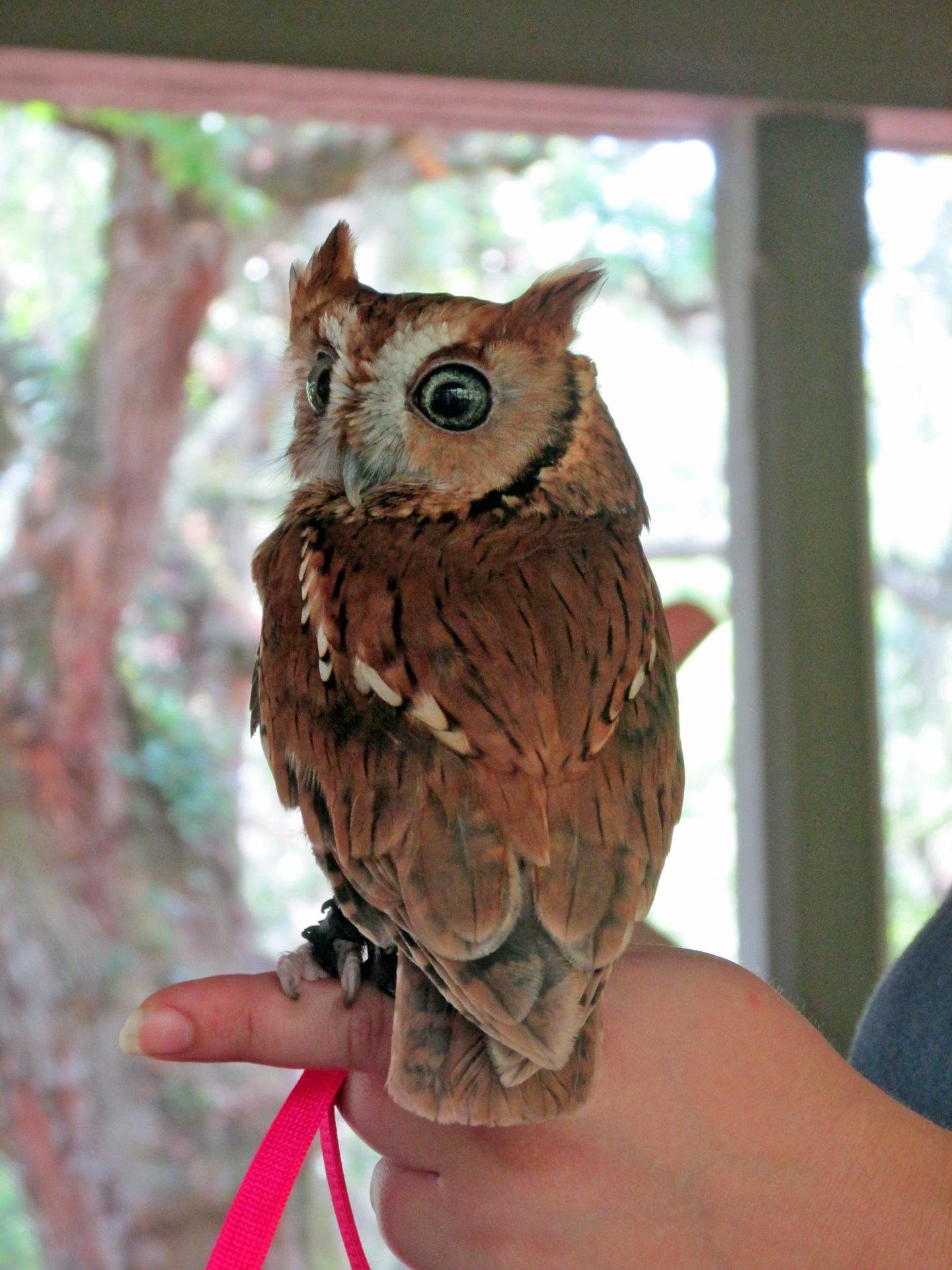
Photo by Bryan Stevens • Lucy, a rehabilitated owl living in captivity at Brookgreen Gardens in South Carolina, educates the public about her fellow owls.

“It’s a beautiful little hunter,” Susan remarked in her email, adding that she would love to have the owl identified. She speculated that the visitor might be a Northern saw-whet owl or boreal owl. The latter would have been far out of range. Saw-whet owl was a possibility considering these tiny owls are known to reside on Unaka Mountain, but a closer study pointed to the identity of the visitor being an Eastern screech-owl.

As Susan pointed out in her email, no ear tufts are prominently visible on the bird in the photo. But any number of reasons could explain the absence of the ear tufts. These tufts, which are actually feathers that the ow can control, help with camouflage or to signal an individual owl’s mood. They can raise their tufts if they want to appear larger and more intimidating or flatten them to blend in with a tree trunk, and they may also flatten them when agitated or in a state of attentiveness.

There’s not a lot in the photo for a size comparison with the bird, but it seemed more the size of a screech-owl than the slightly smaller saw-whet owl. I’ve seen both owls and the saw-whet always strikes me as more dainty than a screech-owl.

An adult Eastern screech-owl is about 10 inches long, which is about the same size as an American robin. The owl, however, is much more sturdily built than the robin. This owl’s wingspan is usually between 18 and 24 inches. Weight varies, but a heavy screech owl weighs only 6 to 8 ounces. That’s equivalent to a cup of water.

Eastern screech-owls come in two color variations, sometimes referred to as “morphs.” These are red or rufous and gray. There is a rare brown variation that may be a hybrid of a red owl and a gray owl. The highest percentage of red screech owls occurs in Tennessee, of all places, with an estimated 79 percent of owls in the Volunteer State being of the red variety. I’ve actually not seen a red morph in many years. My recent sightings have been of gray individuals. The owl in Carl’s photo appears to be a red morph.

Eastern screech-owls are effective predators, or as Susan described them, “beautiful little hunters,” but they mostly tackle small prey, such as house sparrows, mice and large insects.

Owls are more common than we think; we simply don’t encounter them often because of their nocturnal lifestyle. The Eastern screech-owl has proven very adaptable to living in close proximity to human beings.

Many myths have taken root about owls. Some of these are more grounded in reality than others.

Photo by Bryan Stevens
An Eastern Screech-Owl at rest in a roosting hole in a large sycamore tree.

A prevalent belief is that owls are wise. Of course, that’s a relative term. Is it meant they are wiser than other birds or wiser than human beings. According to the website for the International Owl Center, owls are probably seen as wise due to their large eyes, resolute posture and relatively silent behavior. The website acknowledges that owls are good at being owls, but they are stubborn birds when people attempt to train captive specimens to perform tasks.

Not all owls, despite persistent claims, are nocturnal. It’s true, according to the International Owl Center, that a large proportion of owls are nocturnal, meaning they are active at night.

But there are always exceptions. According to the International Owl Center, a few owls are diurnal, meaning they are active during the day, and some others are crepuscular, meaning they are most active at dawn and dusk.

There are approximately 230 to 250 species of owls. There’s some debate among the experts about the exact number. Here are some interesting common names for some of those species: Golden masked owl, ashy-faced owl, white-fronted scops owl, black-capped screech-owl, cinnamon screech owl, snowy owl, Eurasian eagle owl, spectacled owl, mottled wood owl, great grey owl, pearl-spotted owlet, little owl, barking owl, powerful owl, Tasmanian boobook, chocolate boobook, laughing owl, long-eared owl and short-eared owl.

I’ve been hearing two species of owl – Eastern screech-owl and great horned owl – at home this fall. That’s the other thing. You’re much more likely to hear an owl than see one. I don’t mind. It makes this little bird a bit more mysterious, and there’s something to be said to being able to put on an air of mystery.

•••

Share a sighting, ask a question or make a comment by emailing me at ahoodedwarbler@aol.com.

Photo by Bryan Stevens
An Eastern Screech-Owl perches in the branches of an Eastern hemlock.

Celebrating 30 years of birds, birding and birders

Photo by Bryan Stevens A burrowing owl perches on a sign at Antelope Island State Park in Utah in May 2006.

For the past 29 years, I’ve published my first bird column as close to the anniversary date of its initial publication as possible.

I’m not doing that this year. Instead, in a celebration of writing “Feathered Friends” on a weekly basis for the past 30 years, I am devoting this week’s column to personal reflection.

Has it truly been 30 years? It’s the question I’ve asked myself as the date on the calendar approached, marking 30 years since I began writing my weekly “Feathered Friends” column. The column made its debut in the Elizabethton Star’s Sunday lifestyles section, but since that debut on Nov. 5, 1995, the column has appeared in most of the newspapers in the region, plus a couple in North Carolina.

The column ran from 1999 to 2003 in the Herald & Tribune in Jonesborough and began running in The Erwin Record in 2003. It has mostly run each week in Unicoi County’s weekly newspaper since that time. The column began another run in the Elizabethton Star from 2008 to 2014, followed by a run in the Bristol Herald Courier, as well as in Six Rivers Media publications such as The Tomahawk in Mountain City, as well as Johnson City Press and Kingsport Times.

The column went online via WordPress in 2014 and is still posted weekly on Sundays at ourfinefeatheredfriends.com. I’m still staggered by the fact I’ve been writing this column on a weekly basis for 30 years. Readers have followed my accomplishments in birding, including detailed columns every time I’ve added a new species to my life list.

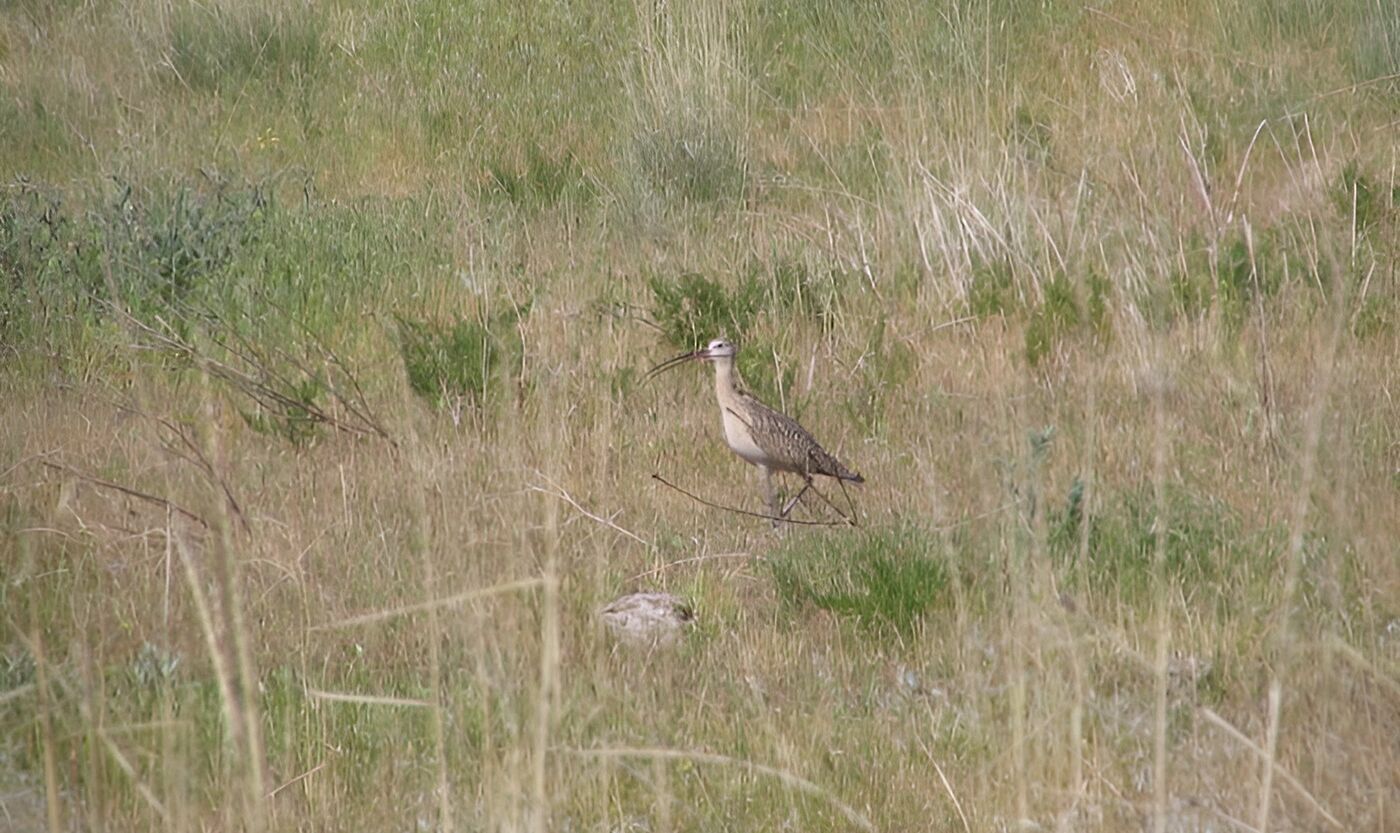
Photo by Bryan Stevens A long-billed curlew calls in a grassland at Utah’s Antelope Island State Park in May 2006.

Those special columns have included birds such as burrowing owl, long-billed curlew, roseate spoonbill, black-necked stilt, Nelson’s sparrow, black rail, swallow-tailed kite, Mississippi kite, grey-cheeked thrush, limpkin, least bittern, American bittern, painted bunting, lazuli bunting, golden eagle, American dipper, Townsend’s solitaire, mourning warbler, clay-colored sparrow, black-headed grosbeak, Western tanager, Northern saw-whet owl, bananaquit and many other memorable species. Just this past summer I added scissor-tailed flycatcher when I observed a female of this species nesting in Jonesborough.

I’ve added several hummingbirds to my list over the years, including Cuban emerald and Bahama woodstar from a trip to the Bahamas in 2000, and black-chinned hummingbird and broad-winged hummingbird from a trip to Utah. I saw a far out-of-range green-breasted mango in Charlotte, North Carolina, and traveled to Nashville to see a Calliope hummingbird, which is also the smallest of North American birds. In Northeast Tennessee, I’ve seen numerous rufous hummingbirds and a couple of Allen’s hummingbirds, both of which are western species with a perplexing habit of migration through the region and showing up in unlikely locations.

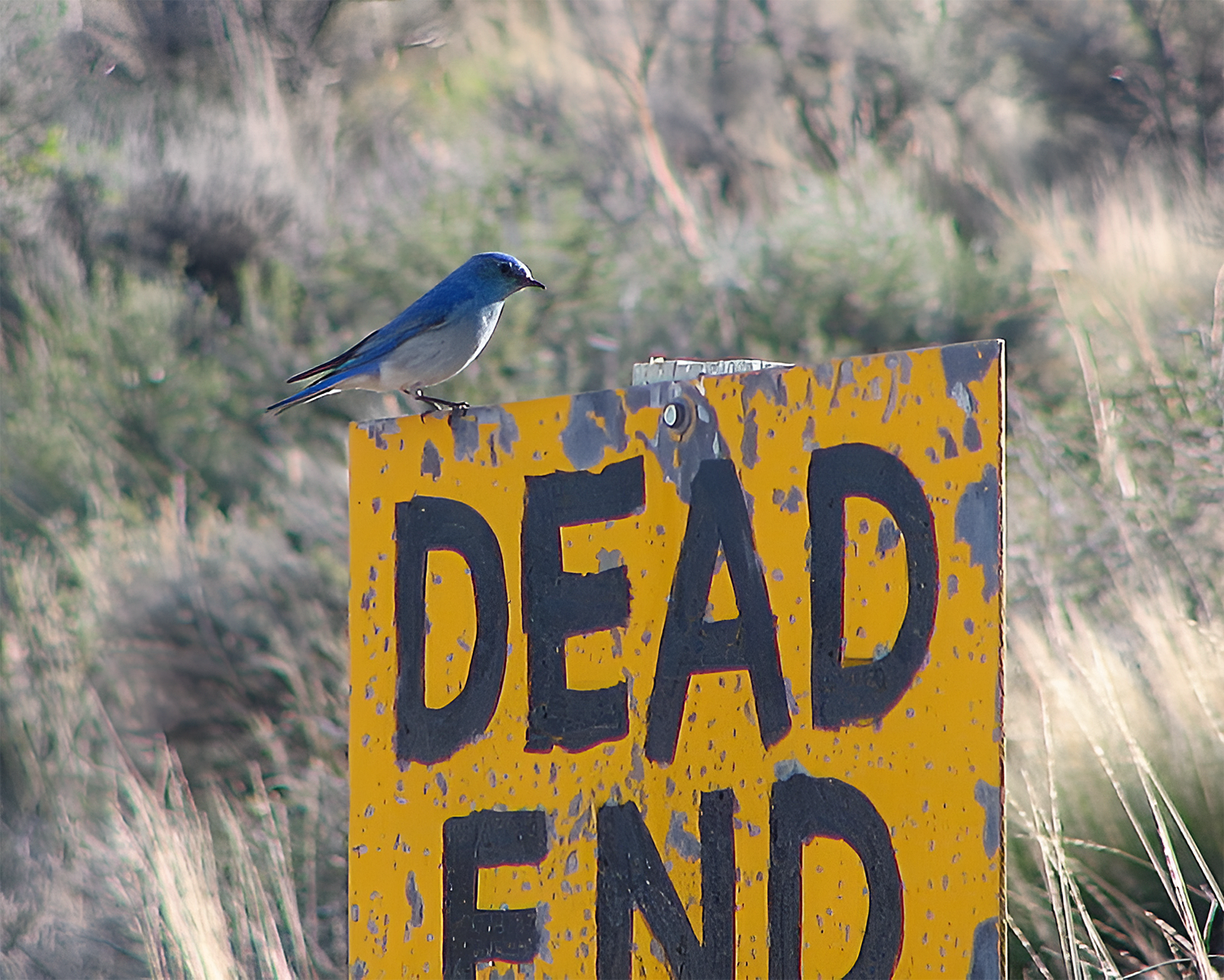
Photo by Bryan Stevens A mountain bluebird at Sweetwater Trailer Park and Campground at Garden City, Utah, on the shores of Bear Lake. Despite the sign, this location was certainly no “dead end” when it came to birding.

Even more than the birds, however, are the people I’ve met through this weekly column. I’ve been able to share stories about birding with people like Howard Langridge, Reece Jamerson, Gilbert Derouen and Wallace Coffey. They’re all gone now, but I have my memories of our time together looking for and finding some memorable birds.

I’ve met people like Brookie and Jean Potter, Tess Cumbie, Gary Wallace, Barbara Lake, Rick Knight, Joe McGuinness, Charles Moore, Fred Alsop, Allan Trently, Brenda Richards, Chris Soto, Rob Biller and Brayden Paulk. I’ve left out names because in all honesty there are too many to list. I’ve shared stories about Tom and Cathy McNeil, a couple who have chased rare birds such as buff-breasted sandpiper, snowy owl and hurricane-displaced American flamingos.

I’ve had adventures. I got stuck in mud at Musick’s Campground with Howard Langridge at Holston Lake as Hurricane Frances passed through the region in 2004, but we got a sooty tern!

Photo by Bryan Stevens A least bittern slips through marsh vegetation at Huntington Beach State Park in South Carolina.

While birding with Reece Jamerson at Austin Springs on Boone Lake, an American bittern walked up to us from a flooded ditch, absolutely fearless, and got so close we didn’t even need binoculars. Of course, we also hadn’t brought cameras.

I stood in freezing conditions for hours with dozens of birders in 2009 Springfield, Tennessee, scanning a field littered with plastic and other debris hoping for a glimpse of a reported snowy owl. Just as everyone was ready to give up hope, the owl, present all along, transformed from a white plastic bag into a fully feathered owl. It even made a short flight as if to reward everyone for their patience.

Visiting Antelope Island State Park in the middle of the Great Salt Lake in May 2006 with David Thometz and his parents, we saw many birds, the highlight being a long-billed curlew. We were driving on a road bordering a huge expanse of grassland facing the Great Salt Lake. I remarked that this looked like great habitat — I had done my homework in advance – for long-billed curlews. The words had barely left my mouth when we heard some whistled notes and saw my first-ever (and, to date, only) long-billed curlew. Even better, I managed to get a photo of the bird. We also saw thousands of horned grebes, as well as a photogenic burrowing owl, Western meadowlarks, chukars, lark sparrows and many other interesting species. Later during that same trip while traveling through Logan Canyon near Salt Lake City, I was mesmerized by an American dipper and then some Townsend’s solitaires that crowded into the scene.

Photo by Bryan Stevens A painted bunting visits feeders at Huntington Beach State Park.

On a November visit to Boone Dam with Wallace Coffey, we scanned a flock of gulls on a sandbar. When these white birds suddenly dispersed, one larger white bird that stayed behind became my first-ever sighting of a snow goose. I think Wallace’s excitement that I had gotten a life bird was even greater than my own.

Of course, my birding memories go farther back than these 30 years I’ve been writing this column. I remember the yellow birds (American goldfinches), the red birds (Northern cardinals) and blue birds (Indigo buntings) that visited each summer of my childhood. I can still hear the nocturnal serenades of whip-poor-wills that called from the woodlands while I saw on the front porch with my paternal grandparents at their home. The headlights of passing vehicles would silence them momentarily, but then one would begin calling again, and soon others rejoined the chorus. When lighting bugs added their visuals to the audio, we had all the makings of a perfect evening in the pre-Internet era.

To offer perspective, my column got its start with a feature on dark-eyed juncos, also known as “snowbirds.” With the recent dip in temperatures, I have a feeling it won’t be long before we start seeing these winter visitors.

I’ve got some plans for digging up some vintage columns as I celebrate 30 years of writing this column during 2026. There may be some other special surprises. Stay tuned and thanks to all who have read these columns over the years.

Photo by Bryan Stevens
Two Black-necked Stilts forage along the causeway wetland at Huntington Beach State Park.


Why do owls give a hoot? For many reasons

Dave Menke/USFWS Great horned owls, such as this individual, are effective predators after dark.

As September slid into October, the evening serenades began. At first, they consisted of a pair of Eastern screech-owls calling from the surrounding woodlands. On Oct. 2, the low hoots of a great horned owl joined the wailing calls of the two screech-owls.

I’ve gotten into the habit of 10-minute walks in the evening after dinner, and I posted about the owls on my Facebook account.

Several friends responded, including Tom McNeil, a fellow birders and an fellow alumna of Hampton High School.

“We’ve been hearing a pair (of great horned owls) hooting up on the ridge between you and us,” Tom wrote. “We also had a barred owl calling a few weeks ago, which was only the second time ever.”

Tom and his wife, Cathy, reside in the Piney Grove community of Hampton. As he indicated, only a steep mountain ridge separates his property from mine.

That ridge is a magnet for birds, ranging from pileated woodpeckers and wild turkeys to warblers, vireos, tanagers, flycatchers and many other songbirds. The bird population changes with the seasons, but there’s always a diversity of birds making their home on those wooded slopes.

Linda Cauley also responded to my Facebook post, sharing that she also had recently heard a great horned owl.

Larry A. Woodward/USFWS Eastern screech-owl chicks peer from the tree cavity that served as their first home.

Kaylynn Sanford Wilster has also been hearing a great horned owl. “First great horned owl I’ve had here in forever it seems like,” she wrote. “I think there’s just one but I’m not sure.”

Joanne Campbell commented on my post.

“We had a big hoot owl right outside our door last week,” Joanne wrote. “Closest I’ve ever been to one.”

I’d been surprised to hear screech-owls, which are considerably smaller than a great horned owl, calling at the same time as their larger kin. Great horned owls are not finicky and will dine on any smaller creature they can seize in their strong talons. I’d heard that smaller owls usually go silent in the presence of this large nocturnal predator.

Of course, the screech-owls were relatively close to my home while the great horned owl’s calls were notably distant. Perhaps they felt that enough space existed between them to ease any worries.

I also got to wondering why owls are so vocal. A little research came up with some answers.

First, it’s important to note that Eastern screech-owls produce different vocalizations for various purposes. One of my favorites is the “whinny,” a descending call that is, apparently, a territorial display to inform other owls that they have claimed a territory as their own.

At this time of the year, juvenile screech-owls are also striking out on their own away from parental care. These young owls deploy the whinny to establish their own territories. They will need a well-defined territory to ensure they can find enough prey during the lean, cold winter months.

The whinny itself is of short duration, lasting only a couple of seconds. Screech-owls also produce other sounds, which have been described as hoots, barks and squeal.

Another common screech-owl vocalization is an even-pitched trill, often called a “bounce song” or tremolo. I can do a decent job imitating this sound, and I’ve often stirred up songbirds by doing so. A flock will sometimes materialize as if from thin air, as the members of the flock scold and search for the owl. It’s a good way to draw some curious birds closer for observation.

Bryan Stevens Lucy, a rehabilitated owl, helps programmers at Brookgreen Gardens provide educational programs about owls to the public.

Great horned owls, or “hoot owls” as they are widely known, also produce their low, nocturnal calls for many of the same reasons as screech-owls do. These large owls hoot to communicate, with the most common reasons being to define and defend territory, locate and attract a mate during breeding season and stay in contact with their young. Hooting also helps them establish boundaries with other owls and signals their presence, making their calls particularly energetic and frequent in the autumn and winter months when territories are being set up.

Pairs of great horned owls will hoot together as part of their courtship to strengthen their bond. A female owl’s voice is notably higher in pitch than the male’s, according to the website All About Birds. I’m hoping I will soon hear the duet that Tom and Cathy are enjoying on the other side of the ridge. So far, I’ve only detected the one great horned owl. I have heard these mesmerizing duets in the past, however. Listening can produce shivers down the spine. Of course, that is also helped by the fact they most often hoot on evenings once the weather had become more chilly.

The days are shorter, nights are longer, so now is a great time to get familiar with the owls. It can be as easy as stepping onto the front porch and listening.

•••

Bryan Stevens has been writing about birds, birding and birders since 1995. To share a sighting, ask a question or make a comment, email him at ahoodedwarbler@aol.com.

Photo by Irene K-s/Pixabay.com
An Eastern screech owl keeps an eye on its surroundings.

Vocal screech owls are pint-sized predators

Photo by Bryan Stevens • An Eastern screech owl perches on a hemlock branch. These owls are much smaller than such relatives as great horned owl and barred owl.

It’s been my pleasure to enjoy almost daily serenades by an Eastern screech owl residing in the woods around my home. The small owl’s shivery wailing calls usually start around dusk and can continue at intervals throughout the night.

Back in September while I watched almost daily for migrants from a lawn chair, I heard on a couple of occasions the “early bird” owls calling occasionally from shady wooded areas. The owls tended to call more often during the daytime when conditions were overcast.

I always pause and listen when I hear the wailing and haunting vocalizations of the screech-owls that make their home in the woodlands that surround my home. I’m glad to have this small owl as a neighbor, but I fully realize that owls have suffered from a dark reputation in certain corners. The fact is, unless you are a small rodent or some sort of insect-sized prey, the Eastern screech-owl makes an excellent addition to the neighborhood.

On the verge of Halloween, a closer look at this small owl is warranted. An adult Eastern screech owl is usually only between six and nine inches in length. Many people upon first seeing a screech-owl assume it’s a baby owl. During past trips to Brookgreen Gardens in South Carolina, I have enjoyed attending the daily educational programs conducted by the zoo staff at Brookgreen. These programs are designed to introduce visitors to various examples of native wildlife. The presenter usually introduced a couple of animals to the audience. On several occasions, the show featured birds of prey, including hawks and owls.

Photo by Irene K-s/Pixabay.com • An Eastern screech owl keeps an eye on its surroundings.

Two of the shows during my visit to Brookgreen back in 2019 featured Lucy, an Eastern screech-owl, and people in the audience invariably asked if she was a baby owl. To their astonishment, they learned that Lucy was an adult screech-owl and unlikely to grow any bigger.

There are larger owls in our region, including the great horned owl and barred owl. Lucy and her kin must avoid these much larger owls, which would not scruple at making a meal of the much smaller owl.

Because of their small size, screech-owls prey on some comparatively small creatures, including insects, small rodents, amphibians, songbirds and reptiles. The Eastern screech-owl is also a cavity-nesting bird and will accept bird boxes provided by humans so long as the box’s entrance hole is customized to their size.

The screech owl is the owl most likely to encounter human beings. It’s an adaptable little feathered predator, just as much at home in the backyard and garden as it is in parks and woodlands. In addition to nesting in cavities, this owl roosts in them during the daytime hours. Look for roosting screech-owls in knotholes of trees or in unoccupied wood duck boxes. Although they come in two color phases — red and gray — both variations are quite capable of camouflage. When perched or roosting, these small owls blend remarkably with their surroundings.

The Eastern screech owl also produces a variety of odd wails and other vocalizations including a distinctive, trembling “whinny” call that is often made when the owl feels curious or alarmed. It’s a wavering, haunting call that is made after dark, most often at the hours closer to dawn and dusk. Imitating the call of a screech-owl or playing a recording is also a trick for getting some shy songbirds to show themselves. Screech owls are not-so-welcome co-habitants among my yard’s songbirds, which will flock to this owl’s call and band together to “mob” the predator and try to convince it to depart the immediate area.

As small as the Eastern screech-owl is, the United States is home to several other pint-sized owls, including Western screech-owl, Northern pygmy-owl, Northern saw-whet owl, flammulated owl and elf owl, which at six inches tall and a weight of less than an ounce qualifies as the world’s smallest owl.

Photo by U.S. Fish and Wildlife Service • The tiny Northern Saw-whet Owl nests on several of the region’s higher mountains.

Any time I finish listening to a calling owl and go back indoors for the evening, I reflect on the fact that screech-owls make good neighbors. Their prey preferences remove many nuisance insects and rodents from the habitat they share with humans as well as other wildlife. If you’re hearing an odd, winnowing call from the edge of the woods at your own home, there’s a good chance that you have one of these small owls as a neighbor.

Keep alert for these small owls and their larger kin as we observe this year’s Halloween holiday, as well as other days and nights throughout the year.

•••

To learn more about birds and other topics from the natural world, friend Bryan Stevens on Facebook at https://www.facebook.com/ahoodedwarbler. He enjoys posting about local birds, wildlife, flowers, insects and much more. If you have a question, wish to make a comment or share a sighting, email him at ahoodedwarbler@aol.com.

Holly Keepers/USFWS • A red Eastern screech owl peeks from a perch among some evergreen branches.

Great horned owls become feathered phantoms after sunset

Photo by HMaria from Pixabay • A great horned owl is capable of almost silent flight, which helps this predatory bird take prey by surprise. Many myths and superstitions surround the world’s owls, but the truth about owls is often more fascinating.

Great horned owls become feathered phantoms after sunset

In late September, I began hearing a great horned owl near my home. The sonorous hoots resonated from a distant ridge the other side of the road. The ridge was logged this year and many of the large white pines are gone. I wasn’t at all optimistic the owl would return.

There’s nothing to send shivers traveling along your spine like listening to these haunting hoots from a creature that’s well hidden from human eyes by the cloak of darkness.

Or a cloak of fog and mist, as the case may be. This returning owl calls most often near dawn and dusk. On foggy mornings, of which there has been plenty, the owl’s still been calling as I leave for work.

It’s no wonder that owls have also become popular motifs for the celebration of the Halloween holiday. Just remember there’s more to these creatures of the night than perhaps meets the eye. Owls may be our neighbors, but we’ll never truly belong to their world, which must be why they continue to intrigue us.

While human culture has turned owls into beloved creatures, keep in mind these birds are fierce and ferocious predators. For young American crows in their nests, this owl is the stuff of their avian nightmares. It’s no wonder that crows, some of their numbers no doubt having witnessed their peers taken by the great horned owl as prey when young and helpless, grow up with an abiding hatred of this large nocturnal raptor.

Flocks of adult crows form quickly when an owl is discovered at a roost during the daylight hours. With safety in numbers, the crows mercilessly hound and harry the unlucky owls.

Quite often, a crow’s sharp vision is required to detect a motionless owl at its daytime roost. Great horned owls have a plumage of mottled grays and browns, as well as some white feathers on the chin and throat. This plumage helps them blend into their surroundings. Even when on the move, the great horned owl rarely attracts attention. They can fly in almost perfect silence on wide wings that can stretch out to a wingspan of 4.6 feet.

I know about their silent flight from firsthand experience. Back in the early 2000s I visited Orchard Bog in Shady Valley in Johnson County in early spring for a chance to witness the evening display of American woodcocks. While waiting with other birders for the evening show, I noticed a large shadow moving low over the fields heading toward us. As the bird got closer, it became recognizable as a great horned owl. The owl barely diverted from its flight. In fact, it flew just over our heads, gliding silently on wide wings. I still marvel at how the owl’s wings made no noise whatsoever. The owl continued to glide over the fields until we lost it in the dusk.

On another occasion I also witnessed how, when they want to do so, great horned owls can be absolutely silent. While vacationing on Fripp Island, South Carolina, in the 1990s, I would accompany my family for dusk golf cart excursions. We liked to pull off the side of the road on a causeway that crossed a series of tidal creeks and marsh. On that occasion, a great horned owl flew from nearby woodlands to land on a gnarled snag that rose above the marshland vegetation. Although the owl arrived on silent wings, it soon interrupted the silence with resonant hoots that carried over the marshes. The owl returned to the same snag for two additional evenings during our vacation stay.

I’ve seen other great horned owls over the years in locations from South Carolina and Florida to Utah and and Virginia. I’ve heard many more of these large owls than I have ever been able to get into focus in my binoculars. It’s still a thrill to get even a brief sighting of these impressive birds.

I’ve always thought about trying to locate the owls in residence at my home. I’ve scanned the silhouettes of the tree line in the direction of their hoots, but I’ve not ventured forth on a more methodical search. Perhaps I’ll save that as a Halloween activity this year. I’ll more likely continue to enjoy the owl’s haunting serenade and let a cloak of mystery continue to shroud this fascinating bird.

Photo by Bryan Stevens • A captive rehabilitated great horned owl at Calloway Gardens in Georgia.

Man’s enthusiasm for bald eagles expanding the knowledge of region’s nesting birds

Photo Courtesy of Ryan Rice • Nesting bald eagles becoming a regular occurrence is a dream come true for local resident and photographer Ryan Rice. He has been an enthusiastic fan of bald eagles since childhood.

Ryan Rice loves bald eagles. He’s loved the nation’s official bird since he was a child.

As an adult, he’s channeled that enthusiasm into helping collect valuable data on nesting eagles in the region. Along the way, he’s also managed to capture some impressive photos of bald eagles. Ryan and his photos have even recently been featured in Blue Ridge Country Magazine for his work on bald eagles.

The fact that eagles are nesting again in Northeast Tennessee and the surrounding areas is a dream come true for Rice.

All told, he has located about 10 nests in the Tennessee counties of Carter, Washington, Sullivan, Johnson and Hawkins. He has also found nests in Scott County, Virginia, and in Watauga County, North Carolina.

He has also learned of a nest along the Nolichucky River in Erwin.

“The adult eagles have been seen around the area of the nest pretty regularly,” he said. “I have not personally seen that pair — just the nest.”

From drawing eagles when he was a kid to picking up a camera and getting actual photos of his dream bird, Rice said he has always been interested in bald eagles.

“They were talked about a lot in the ’80s,” Rice said. “About how they were endangered and almost extinct in the lower 48 states. I used to dream of seeing them here in Northeast Tennessee but didn’t think it would ever actually happen.”

He explained that by the early 1960s, the bald eagle was nearly extinct in the continental U.S. The bald eagle had also been almost wiped out in Northeast Tennessee. Rice noted that prior to the 1980s bald eagles had not been seen in the region for decades. Now he is happy to report that the area’s eagle population is flourishing and sightings are becoming commonplace. In Northeast Tennessee, Rice noted, reports of bald eagle sightings on ebird.org date back to 2005. By 2010, the bald eagle population truly rebounded in the region.

Rice said he has conducted a lot of research in an attempt to locate nesting eagles.
“I talked to a lot of people to learn more about their nesting habits,” he said. “I research a lot of eagle sightings people post to ebirds. I use that info to search for nests.
Rice said that getting good photos of eagles isn’t easy. Patience and hard work are key. Even tracking down a nesting site is not a guarantee. He has often gone to a lot of effort to get close enough to photograph the birds only for the eagles to decide to stay away from the nest during his visit.

However, eagles are creatures of habit, according to Rice.

One simple trick he has learned is to always locate their favorite trees for perching. Armed with that knowledge, his photography ventures have become much more successful.

Rice admitted that some nests are simply difficult to reach. Some are accessible only by water, so he said he gets out his kayak and loads up his camera equipment. Other nests are located in trees on steep terrain. On occasion, he must seek permission from landowners in order to observe and photograph a nest on private property.

To get his photos of eagles, he use a Canon 90d camera. “That is a cropped frame DSLR,” he said. He noted that he uses a telephoto lens (Sigma 150-600 mm lens) to get his shots. “On my cropped frame camera that is the equivalent of 960mm on a full frame camera,” Rice said.

Rice and a friend have also formed Above Ground Media, which uses drones for photography for real estate, advertising and special events. He does not use the drones to photograph eagles or their nests. For more information, Rice invites the public to visit http://www.facebook.com/AboveGroundDrones.

His photography remains a hobby for the moment, but he likes to devote all the time he possibly can to it.

“I have gotten into watching and searching out other birds, too,” Rice said. “At the start of COVID I started working from home and I put up bird feeders and started photographing all the different birds that would come to my feeders,” he said. “Then I started going out to bird hot spots to get photos.”

An Eastern screech-owl perches in the entrance to a house Ryan Rice fashioned out of a fallen log.

He also recently built an owl house out of a section of a fallen hollow tree.

“I hung it in a tree in my yard,” he said. “I live in a neighborhood so wasn’t real optimistic I would get any owls. About a month after hanging it, an Eastern screech-owl has appeared to move in.”
Rice said most people built owl houses out of plywood.

“I choose to use an actual section of a tree so that I could get more natural looking photos,” he explained. “The owl has been around for four or five days now. It often spends six to eight hours sitting in the opening of the house.”

He posted some of the photos of the owl house and the screech-owl on social media. “They have gotten a huge response on Facebook,” Rice said.

He recently did a presentation on local bald eagles for the Bristol Bird Club.

“I got a lot of great information from that group on bald eagle nests in the area that I didn’t know about,” Rice said. “That is where I got the information for the Erwin nest. The members of that group have been a huge help. They really appreciated what I was doing in trying to document as many of the local bald eagles as I could.”

Rice said his work is important to help eagles continue to thrive.

As an example, he pointed to a nest he located in the Hunter community of Carter County along the Watauga River.

“The land owners didn’t even know the nest was there,” he explained. “The day I found the nest I found out the land owners were planning to log the area the nest was in.”

Rice reached out to local wildlife officials so that a happy accommodation could be reached with the landowners to protect the eagles and their nest.

He noted that logging is not an option at a site of an active nest because of federally protections.

After all, it seems only fitting that the federal government take steps to protect the nation’s official bird and ensure that bald eagles continue to soar for many years to come.\

Barn owl helps kin earn ghostly reputation

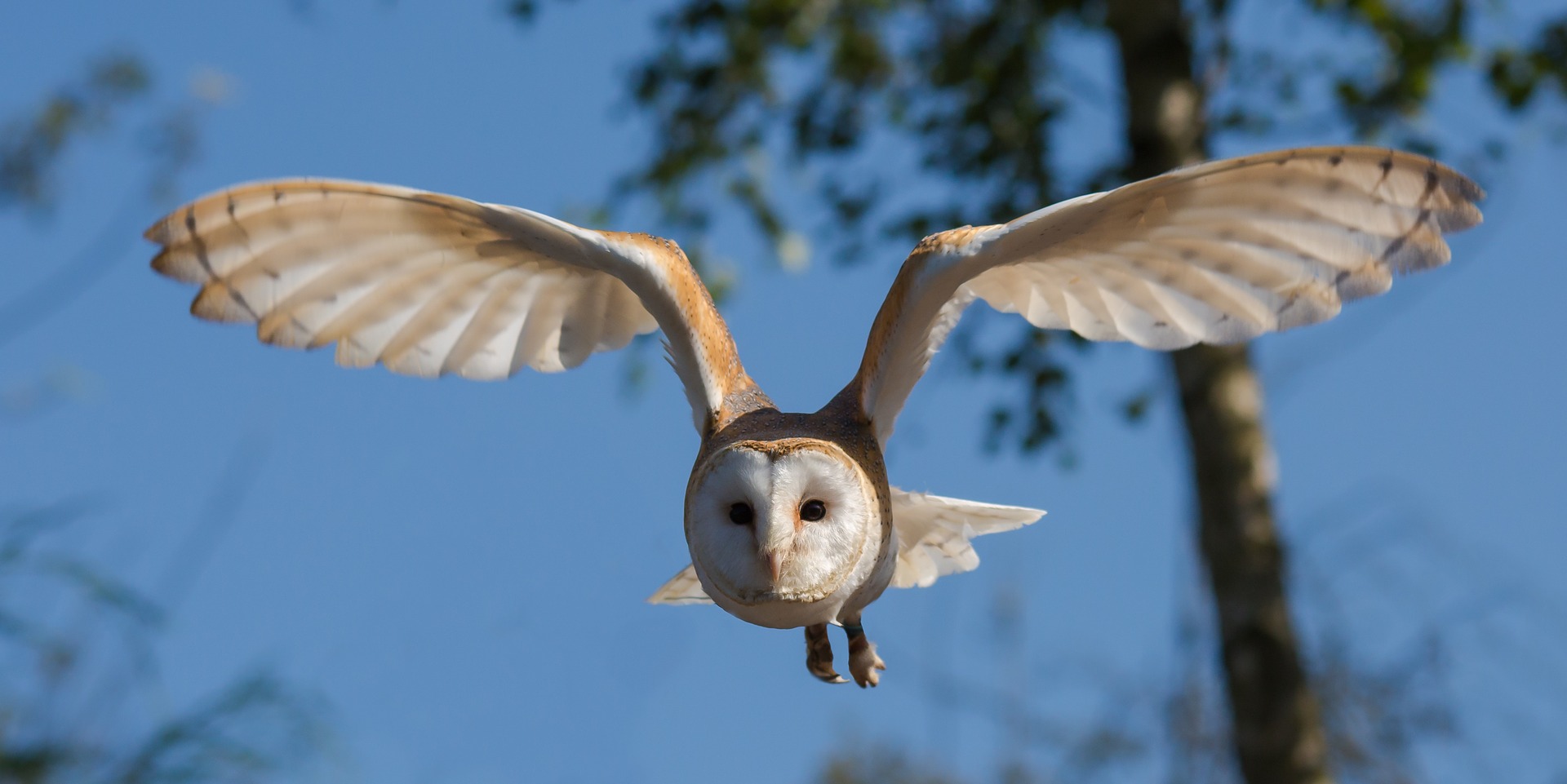
Photo by Kevinsphotos by Pixabay • A barn owl flies through the darkness without any difficulty whatsoever. Special adaptations make barn owls a silent, highly efficient predator on rodents, some songbirds, and some reptiles and amphibians.

Halloween is drawing closer, and it’s definitely the one night of the year that we become acutely aware of things that go bump in the night.

While goblins and ghouls can be dismissed as mere apparitions of the imagination, some real-life feathered phantoms do roam the darkness, perhaps even in your own backyard. If so, you are more likely to have heard them than to have seen them.

If you do hear anything unusual Halloween night, chances are the sounds may have been produced by an owl.

Several species of owl reside in Northeast Tennessee, including the Eastern screech-owl, the barred owl, the great horned owl and the barn owl. A fifth owl, the tiny Northern saw-whet owl, can be found at some high-elevation locations, including Unaka Mountain in Unicoi County. A few other owls have made sporadic appearances in the region, including long-eared owl, short-eared owl and even snowy owl.

The barn owl is an owl that has adapted its ways to co-exist with humans. Even its common name refers to the fact that these owls will roost and nest in barns and other structures. They are also known to select natural tree cavities, caves and other human structures, including recesses build into sports stadiums and arenas. My most recent sightings of barn owls took place at a grain silo in Sullivan County a few years ago, a large barn located on Antelope Island State Park in Utah in 2006 and under the eaves of the old theatre on the campus of the Mountain Home Veterans Administration near East Tennessee State University back in 2000. These sporadic sightings are testimony to the overall elusive nature of this owl.

I was surprised to learn during my background research that the barn owl is the most widely distributed species of owl as well as one of the most widespread birds on the planet. This owl is also referred to as common barn owl, to distinguish it from other species in the barn-owl family Tytonidae. Owls in this family comprise one of two main lineages of living owls, the other being the typical owls in the Strigidae family. The barn owl, known by the scientific name, Tyto alba, is found almost worldwide except in polar and desert regions, Asia north of the Alpide belt, most of Indonesia, and the Pacific islands.

The genus name for this owl is Tyto, a variation of the ancient Greek word, “tutō,” which meant “owl.” The barn owl family, Tytonidae, consists of true barn owls, as well as grass owls and masked owls.

All owls are carnivores, but the barn owl specializes on rodents more than many of its kin. However, this owl will also eat other birds and insects.

Because of their pale plumage and nocturnal habits, barn owls have been saddled with such common names as demon owl, death owl, night owl and ghost owl.

Other common names include rat owl, inspired by one of its major prey items, and barnyard owl and church owl, which are two haunts where these owls often roost or perch. I also liked the name scritch owl and hissing owl, which were acquired because of vocalizations from this bird.

Barn owls have several adaptations that allow them to hunt in complete darkness. These owls have excellent hearing, allowing them to pinpoint prey even when the absence of light renders vision useless. The characteristic facial disc of the barn owl helps channel sounds toward the bird’s ears.

Even the feathers of owls have adapted to the need to stalk wary prey without revealing their presence. Specialized feathers permit owls to fly almost silently. Their feathers absorb flight noises and even alter air turbulence to keep the flight smooth and quiet. Most prey never suspect the owl’s approach until it’s far too late.

For the average person the term “owl” is representative of what is actually an extremely diverse family of birds. Worldwide, there are about 220 species of owls varying in size and habits.

Humans have come up with some descriptive names for various owls around the world. A sampling of these names includes fearful owl, pharaoh eagle-owl, collared owlet, pearl-spotted owlet, least pygmy-owl, red-chested owlet, buff-fronted owl, Stygian owl, vermiculated fishing-owl, black-and-white owl, bare-legged owl, maned owl, bearded screech-owl, spectacled owl and golden-masked owl.

Owls, according to Linda Spencer, author of “Knock on Wood: A Serendipitous Selection of Superstitions,” have inspired a mixed bag of superstitions ever since humans stood up. Owls have long been associated with the forces of both good and evil. The “hoot” or call of an owl is believed by people of many cultures to foretell death. There are some interesting ways to counter the ominous hoot of an owl, according to Spencer. Means of warding off the evil owl power include putting irons back in the fire, throwing salt, pepper and vinegar on the fire, tying a knot or taking one’s clothes off, turning them inside out and putting them back on.

According to Laura Martin, author of “The Folklore of Birds,” one of the earliest human drawings depicting owls dates back to the early Paleolithic period. The scene is of a family of snowy owls painted on a cave wall in France.

Owls have also entered the culture as symbols of wisdom and goodness. The wise old owl, Martin writes, dates back to the time of King Arthur. The sorcerer Merlin was always shown with an owl on his shoulder. During the Middle Ages owls became symbols of learning and intelligence. The Greeks didn’t fear owls as did the Romans. In fact, the owl was the sacred mascot of the Greek goddess Athena.

There’s one more owl-related myth I forgot to mention. There is a Chinese belief that owls snatch the souls of unwary people — just something you should know if you are out and about after dark on Halloween night.

Photo by skitter photos/Pixabay • Look for owls on Halloween and every other dark night.


Screech-owls are tiny terrors in the dark

Photo by Irene K-s/Pixabay.com • An Eastern screech owl keeps an eye on its surroundings.

I’ve been listening to almost daily serenades by an Eastern screech-owl in the woods around my home. The wailing, trembling vocalization usually starts around dusk and can continue at intervals throughout the night. As a half moon rose in the darkening sky on the evening of Oct. 22, I paused a few moments to listen to the wailing and haunting vocalizations of two different screech-owls from the edges of the woods.

I’m glad to have this small owl as a neighbor, but I fully realize that owls have suffered from a dark reputation in certain corners. The fact is, unless you are a small rodent or some sort of insect-sized prey, the Eastern screech-owl makes an excellent neighbor.

Photo by Bryan Stevens • An Eastern screech-owl perches in the branches of an Eastern hemlock.
On the verge of Halloween, a closer look at this small owl is warranted. An adult Eastern screech-owl is usually only between six and nine inches in length. Many people upon first seeing a screech-owl assume it’s a baby owl. During past trips to Brookgreen Gardens in South Carolina, I have enjoyed attending the daily educational programs conducted by the zoo staff at Brookgreen. These programs are designed to introduce visitors to various examples of native wildlife. The presenter usually introduced a couple of animals to the audience. On several occasions, the show featured birds of prey, including hawks and owls.

Two of the shows during my visit to Brookgreen back in 2019 featured Lucy, an Eastern screech-owl, and people in the audience invariably asked if she was a baby owl. To their astonishment, they learned that Lucy was an adult screech-owl and unlikely to grow any bigger. There are larger owls in our region, including the great horned owl and barred owl. Lucy and her kin must avoid these much larger owls, which would not scruple at making a meal of the much smaller owl.

Photo by Bryan Stevens • Lucy, a red Eastern screech-owl at Brookgreen Gardens.

Because of their small size, screech-owls prey on some comparatively small creatures, including insects, small rodents, amphibians, songbirds and reptiles. The Eastern screech-owl is also a cavity-nesting bird and will accept bird boxes provided by humans so long as the box’s entrance hole is customized to their size.

The screech-owl is the owl most likely to encounter human beings. It’s an adaptable little feathered predator, fully as at home in the backyard and garden as it is in parks and woodlands. In addition to nesting in cavities, this owl roosts in them during the daytime hours. Look for roosting screech-owls in knotholes of trees or in unoccupied wood duck boxes. Although they come in two color phases — red and gray — both variations are quite capable of camouflage. When perched or roosting, these small owls blend remarkably with their surroundings.

The Eastern screech owl also produces a variety of odd wails and other vocalizations including a distinctive, trembling “whinny” call that is often made when the owl feels curious or alarmed. It’s a wavering, haunting call that is made after dark, most often at the hours closer to dawn and dusk. Imitating the call of a screech-owl or playing a recording is also a trick for getting some shy songbirds to show themselves. Screech-owls are not-so-welcome neighbors among my yard’s songbirds, which will flock to this owl’s call and band together to “mob” the predator and try to convince it to depart the immediate area.

In addition to the Eastern screech-owl, the United States is also home to several other small owls, including Western screech-owl, Northern pygmy-owl, Northern saw-whet owl, flammulated owl and elf owl, which at six inches tall and a weight of less than an ounce qualifies as the world’s smallest owl.

When I finished listening to the recent owl duet and returned indoors for the evening, I reflected on the fact that screech-owls make good neighbors. Their prey preferences remove many nuisance insects and rodents from the habitat they share with humans as well as other wildlife. If you’re hearing an odd, winnowing call from the edge of the woods at your own home, there’s a good chance that you have one of these small owls as a neighbor. Keep alert for these small owls as we approach this year’s Halloween.

•••••

To learn more about birds and other topics from the natural world, friend Stevens on Facebook at https://www.facebook.com/ahoodedwarbler. He is always posting about local birds, wildlife, flowers, insects and much more. If you have a question, wish to make a comment or share a sighting, email ahoodedwarbler@aol.com.

Photo by Bryan Stevens • An Eastern screech-owl at rest in a roosting hole in a large sycamore tree.

Mysterious owl retains a low profile even during Halloween season

Photo by jeanvdmeulen/Pixabay.com • The barn owl’s heart-shaped face helps this bird, which is also known by such names as death owl, ghost owl, and hobgoblin owl, stand out from the other owls that share the domain of night.

With common names such as cave owl, death owl, ghost owl, night owl and hobgoblin owl, the nocturnal hunter more widely known as the barn owl provides a fitting focus for exploration as the calendar counts down toward Halloween.

Barn owls lurk in the shadows of night, but most people would never know it unless they happen to hear some of the spine-tingling vocalizations produced by this poorly known predatory bird. Shiver-inducing shrieks and screams quite capable of piercing the veil of darkness are often produced by the barn owl. This owl doesn’t utter loud hoots like the great horned owl. Instead, the call of the barn owl is not likely one to be soon forgotten because of its raspy, nails-on-the-chalkboard nature. A hearer could easily be misled into misinterpreting the shrill vocalizations as originating from something far more ghoulish.

According to the website for the Owl Research Institute in Charlo, Montana, barn owls are the most widely distributed owl in the world, and they may be one of the most common, as well. In Montana, where ORI is located, barn owls observations are rather sparse. ORI has documented 12 barn owl nests and made numerous observations in the last 12 years, according to its website. Likewise, the barn owl is not too often observed in Northeast Tennessee and Southwest Virginia.

Photo by dannymoore1973/Pixabay.com A barn owl’s wings and feathers provide almost silent flight for this efficient predatory bird.

The barn owl is often associated with rural, agricultural areas, which is one reason they can often be found in old barns, sheds and farm silos. However, the first barn owl I ever saw in the wild was living beneath the eaves of a building on the campus of Mountain Home Veterans Administration in Johnson City, Tennessee, within walking distance of commercial buildings and the campus of East Tennessee State University.

The barn owl has no close relatives among the other owls found in the region. The barn owl is in its own unique family known as Tytonidae. The family name comes from a Greek word, Tuto, which translates as “night owl.”

Photo by Bryan Stevens • An Eastern Screech Owl, pictured, is considered a member of the family called Strigidae, which consists of the owls described as “typical owls” by experts.

Other owls in our region — great horned owl, barred owl, Eastern screech-owl, short-eared owl— belong to a family called Strigidae, which are often described as “typical owls” by ornithologists and other experts.

The barn owl is one of nature’s most perfect predators. Among animals tested by scientists, the barn owl shows an almost uncanny ability to detect prey animals by sound alone. Prey, which is often small voles or other rodents, often doesn’t know of the danger until it’s too late. The structure of the barn owl’s wings and feathers is such that these predatory birds can fly through the darkness in almost perfect silence.

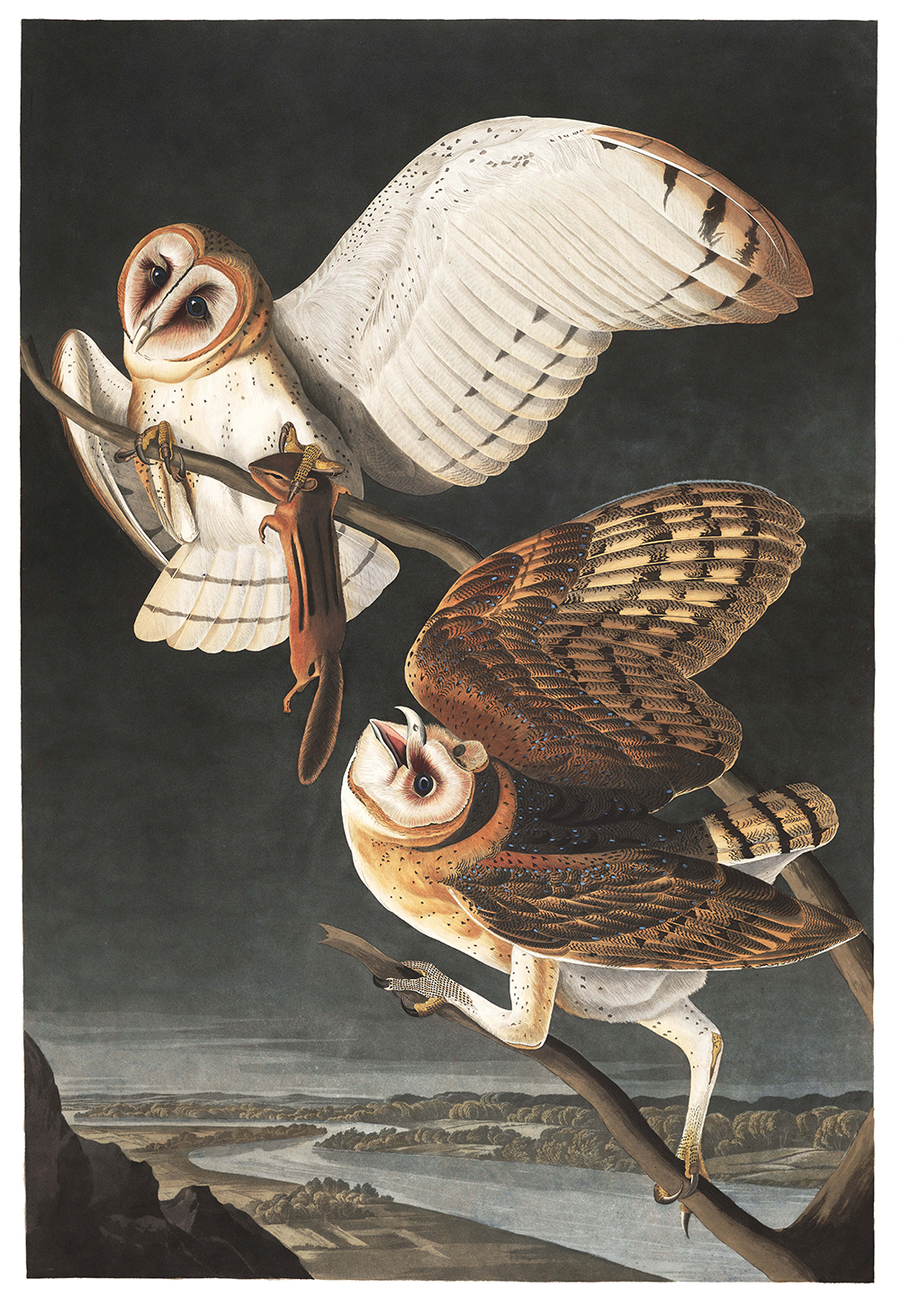
Early American painter John James Audubon captured this dynamic scene of barn owls with a capture chipmunk.

There’s a heavy cost that the owl must pay for these special adaptations. According to the Barn Owl Trust, an organization founded in 1988 in the United Kingdom to conserve one of the most beautiful birds on Earth, a barn owl’s specially adapted feathers are not particularly waterproof. In addition, barn owls are unable to store a lot of body fat. The Trust’s website notes that barn owls are unable to hunt in heavy rain and are particularly prone to starvation during prolonged periods of severe weather and/or prey shortage.

Much myth and legend have arisen around the world’s owls, including the barn owl. A native tribe in California known as the Newuks believed that warriors who proved courageous and virtuous became great horned owls after death. Men who practiced wicked ways, however, were thought to become barn owls.

This owl with the white heart-shaped face has long spooked humans. The bird’s head and upper body typically vary between pale brown and various shade of gray. Especially in flight, the barn owl can look rather pale.

The barn owl is the most widespread terrestrial bird species in the world, occurring on every continent except Antarctica. In addition to its various spooky common names, barn owls are also known by such descriptive monikers as monkey-faced owl, silver owl and golden owl. Some other common names include church owl and steeple owl. This owl acquired this name for its habit of utilizing steeples or bell towers in churches as roosting locations when barns or caves were lacking.

For a bird so closely associated with people and their dwellings and related structures, the barn owl remains an enigma to many. YouTube offers a variety of videos that showcase the creepy vocalizations of barn owls. Familiarize yourself with their calls, and you’ll be more likely to distinguish a barn owl calling after dark from the more sinister specters on the prowl this Halloween.

To learn more about barn owls or to make a contribution toward their conservation, visit www.barnowltrust.org.uk

Photo by mochawalk/Pixabay.com • A barn owl gives a penetrating stare to the camera.

Great horned owl reigns as ‘feathered tiger of the night’ among birds


owl-Alexas-Fotos-Pixabay

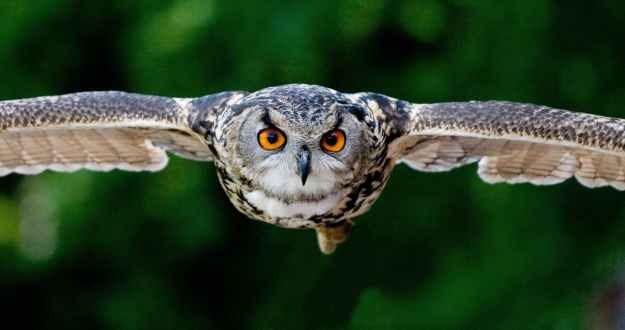
Photo by Alexas-Fotos/Pixabay • A great horned owl is capable of almost silent flight, which helps the predatory bird take prey by surprise. Many myths and superstitions surround the world’s owls, but the truth about owls is often more fascinating.

I’ve been so focused on migrating warblers and other songbirds of late that I felt some surprise when outside near dark on Oct. 10 when I heard the low hoots of a feathered phantom from the woodlands on the ridge behind my home.

The hooting of a great horned owl is an instantly recognizable sound and always sends shivers traveling along the spine. The after-dark calls of this large predatory bird also got me to thinking about previous encounters with this owl, such as watching one glide silently over wetlands in Shady Valley, Tennessee, many years ago. I had traveled to the bogs in Shady Valley maintained by The Nature Conservancy in the hope of witnessing the mating displays of the American woodcock. Before those avian rituals began, a great horned owl kicked off the evening in style. I still remember the large owl passing like a dark shadow only a couple of feet over my head. The wings did not even appear to flap as the owl’s silent flight propelled the bird out of sight within seconds.

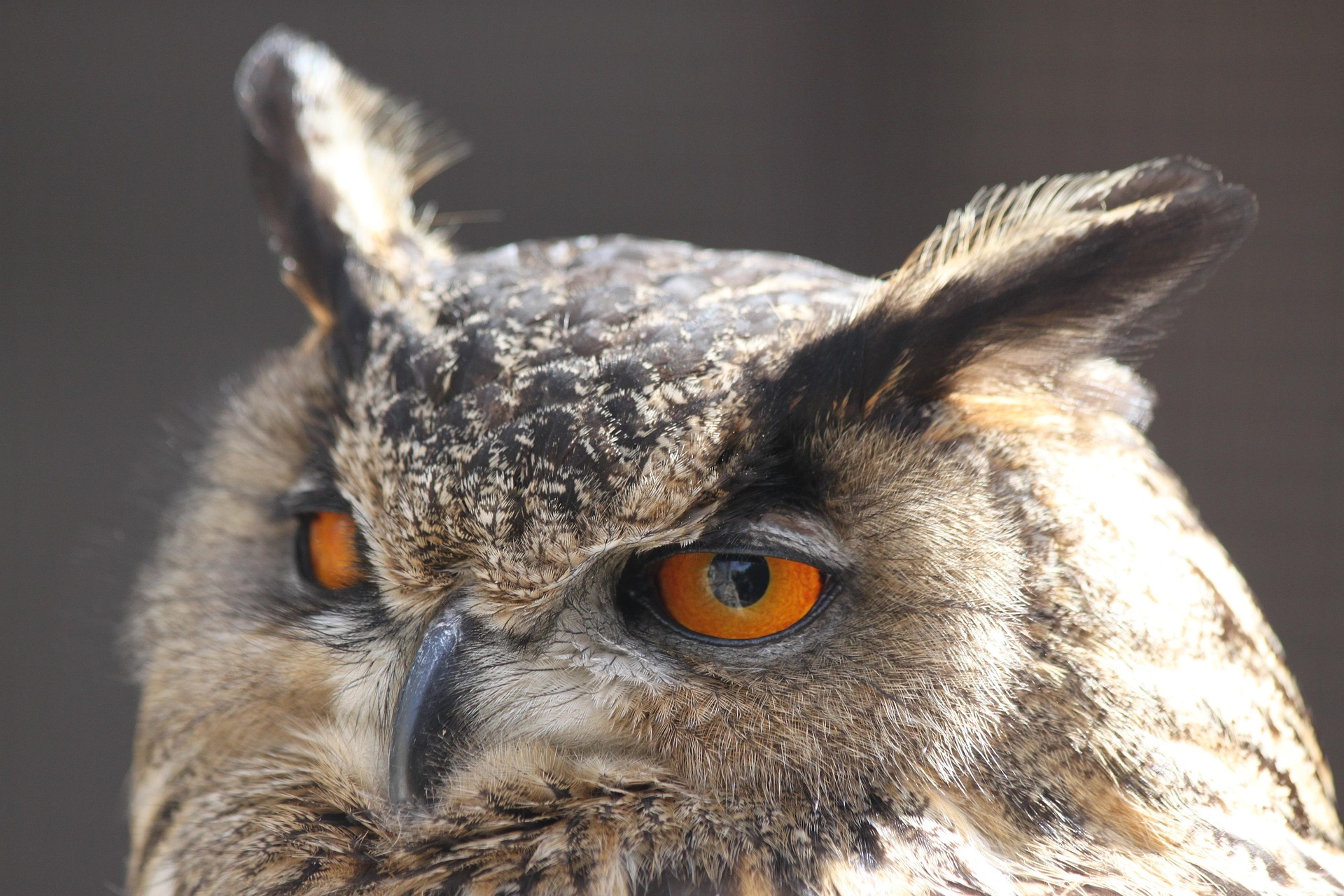
gray owl showing orange and black left eye

Photo by Flickr on Pexels.com

I also remembered another occasion while driving on a wet and stormy night, rounding a curve, and finding an owl, upright in the road, standing over fresh roadkill. The owl’s eyes reflected the beams of my headlights before it seized its meal in powerful talons and flew off into the darkness. I’ve always wondered if the owl had killed something in the road or came along at just the right moment to scavenge a meal after some creature had been killed by a passing car.

Owls have been around for a long time, according to “Owls: The Silent Hunters,” an episode of National Geographic’s series, “Wildlife Wonders.” The narrator for the episode reveals that the first recognizable owls first showed up in the fossil record about 40 million years ago. Since that time, owls have evolved into a fantastic, widespread and diverse group of about 135 different species. North America is home to several species, including the far-ranging great horned owl, which ranks as one of continent’s largest owls. It’s not the largest owl in North America, but it is the most widespread of the continent’s large owls. The snowy owl — popularized in J.K. Rowling’s fiction as Harry Potter’s loyal companion owl, Hedwig — is one of the largest owls in the Northern Hemisphere, bigger than such large owls as great horned owl and barred owl. The aptly named great gray owl is larger in body size than the great horned owl, but the snowy owl is heavier and more massive than either of these two contenders.

Snowy_Owl

Photo by U.S. Fish & Wildlife Service • A captive snowy owl educates the public about owls and some of the perils they face in an environment shared by humans.

Nevertheless, the great horned owl is large enough, ferocious enough, and lethal enough to have been described by many ornithologists as a “feathered tiger of the night.” The great horned owl lives and hunts in the woodlands of northeast Tennessee, southwest Virginia and western North Carolina. They thrive in rural areas, but these adaptable owls have also learned to make their way in the suburbs and even city parks. Not by any stretch of the imagination, however, is this owl confined to the southern Appalachians. These owls also make their home in the wetlands along the southern Atlantic coast, as well as arid deserts of the American southwest.

During a September vacation many years ago to Fripp Island, South Carolina, a solitary great horned owl provided several days of entertainment for my parents and me. We took a golf cart at dusk each evening to park at a spot that offered a good view of the marshes and tidal creeks in the interior of the island. For several consecutive days, the owl flew to a perch on a piece of driftwood as the sun sank below the horizon. We would wait patiently for only a brief interval before the owl entertained us with its low hoots that resonated across the marsh.

animal animal photography avian beak

Photo by Pixabay on Pexels.com

The great horned owl is capable of taking a wide variety of prey, including many rodents ranging in size from mice and voles to rabbits and squirrels. Although various mammals form the most part of its diet, the great horned owl will kill adult birds as large as a Canada goose, wild turkey and great blue heron. This owl also preys on fish, reptiles, amphibians and even insects. The great horned owl is one of the few predators that preys regularly on skunks. Lacking a well-defined sense of smell, owls aren’t bothered in the least by the skunk’s powerful arsenal of stink. That ability to fly and glide using almost completely silent wings has given this nocturnal predator an enormous advantage over many of its prey species.

A wild great horned owl’s longevity peaks at around 13 years of age. Captive owls, however, have been reported reaching ages of more than 30 years old.

Various Native American tribes have held owls in high respect. Dwight G. Smith, author of “Great Horned Owl,” a book in the “Wild Bird Guides” series, noted that members of the Zuni tribe of the southwestern United States often hold owl feathers in their mouths to impart the owl’s ability to hunt silently onto their own hunting abilities.

bird night forest owl

Photo by Pixabay on Pexels.com

The main fascination humans hold for owls rests in their mystery. Owls, being mainly nocturnal creatures, rarely cross paths with humans. These predatory birds have many adaptations that help them stake out their claim on the night hours. Owls possess large eyes with binocular vision and extremely accurate depth perception — which also make them seem more expressive to human observers and perhaps helped establish the reputation of the “wise” owl.

Owls cannot completely rotate their heads, but they come close. Owls are flexible enough, however, to be able to turn their heads in a 270-degree arc, or three-quarters of the way around. Owls have keen hearing to go with their excellent eyesight. In fact, owls don’t even need to see their prey to capture it. Tests with barn owls in total darkness have shown that they are capable of catching mice by hearing alone. An owl’s prominent facial disk directs sounds toward their ears. The “ear tufts” on the great horned owl and some other relatives are ornamental feathers, and not actual ears.

greathornedowl-2

Photo by Bryan Stevens / A great horned owl perches on a post during its part in a wild bird show at Callaway Gardens in Pine Mountain, Georgia.

Around the world, the world’s owls have earned some rather descriptive common names. Examples include pharoah eagle-owl, vermiculated fishing owl, fearful owl, pearl-spotted owlet, chestnut-backed owlet, spectacled owl, black-and-white owl, crested owl, cinereous owl, tawny owl, whiskered screech owl, greater sooty owl and desert owl.

Americans will observe Halloween on Wednesday, Oct. 31, which brings me to one other piece of owl trivia. There’s an ancient Chinese belief that owls snatch the souls of incautious people — just something I thought you might want to know if you find yourself out and about after dark on Halloween night and hear the hoots of a nearby owl.

great_horned_owl_and_chick-2

Photo by George Gentry/U.S. Fish and Wildlife Service • A great horned owl is shown on the nest with one of her chicks.