

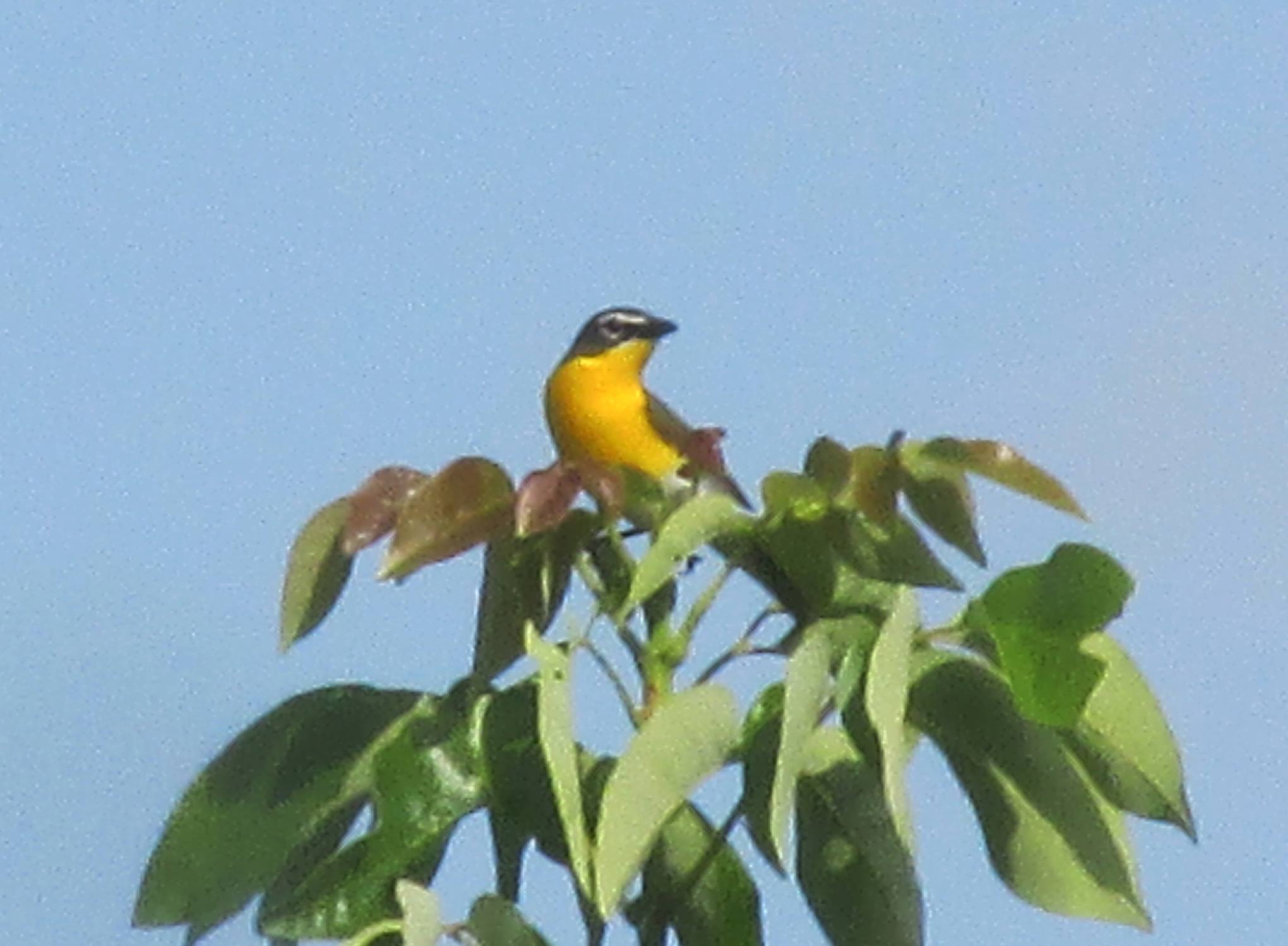
Photo by Bryan Stevens • A yellow-breasted chat sings from the top of a tree.
I’ve always been a warbler fan, celebrating every opportunity that comes my way for seeing these colorful, energetic feathered sprites.
On May 9, the first indigo bunting (a male) showed up on at my home. A day later, I hosted a Baltimore oriole (a rare visitor at my home) and an even rarer visitor with a singing (more like caterwauling) male yellow-breasted chat.
I’ve had only one of these birds in the yard since I began birding in the mid-1990s. That one was a passing fall migrant that showed up in 2000 and then disappeared as soon as it came.
I had hopes that the persistently singing yellow-breasted chat that showed up May 10 might stay longer, and it did. For five days, he sang from dawn to dusk. Then the daily serendades ended. I assume he moved on, but it was fun hosting this bird, even for such a brief span.

Hans Toom/Pixabay • Yellow-breasted chats spend a great deal of their time skulking in thick tangles of vegetation.
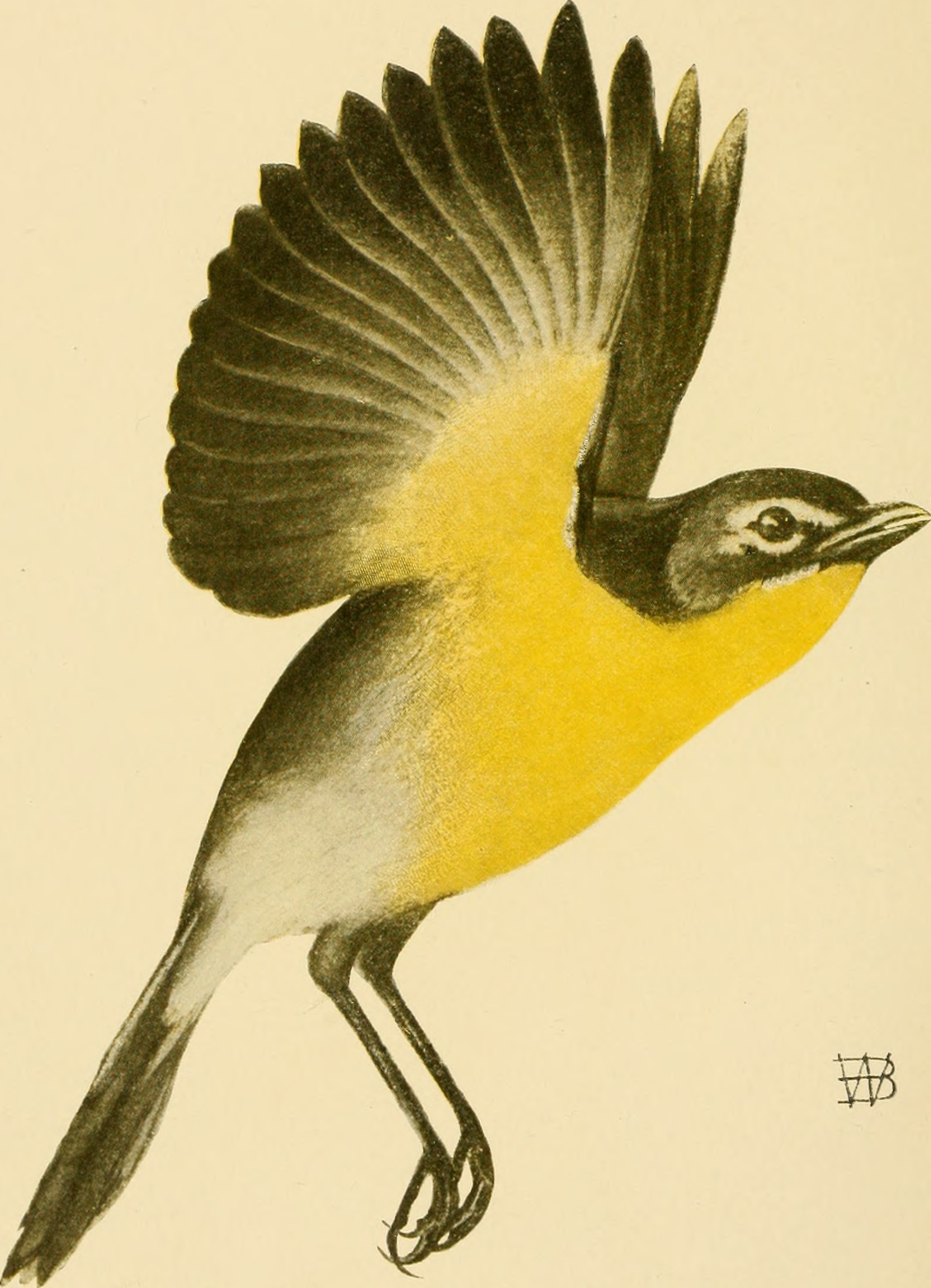
According to the website All About Birds, male chats give display flights in the presence of females, other males or human intruders. According to the website, this behaviour entails descending from a high perch while singing, often with exaggerated wingbeats and a drooping tail. At the end of the flight they make a thumping sound, presumably with their wings.
While the yellow-breasted chat is no longer considered a member of the warbler family, my sentimental attachment to this oddball bird will always recall when this species was considered the largest member of the warbler family.

The chat’s declassification as a warbler took place back in 2017. I’ve always been a warbler fan, celebrating every opportunity that comes my way for seeking out these colorful, energetic feathered sprites.
The yellow-breasted chat, although no longer considered closely related to the New World wood-warblers, is still a bit of an oddity. Many experts always harbored doubts about whether chat is truly a warbler. Personally, I felt some disappointment at the reclassification. After all, what family doesn’t need its big, goofy oddball? If nothing else, the yellow-breasted chat is truly an the odd bird out among the little birds known as warblers that spend most of their time constantly on the move, flitting from branch to branch in hyperactive bursts of activity.
Yellow-breasted chats aren’t more sedate than other warblers, but they don’t dart about in the treetops in the same way as might a Northern parula or blackpoll warbler. During the spring ritual of attracting a mate, the males are obsessed with constant singing and performing. The performance portion of the program consists of awkward, drooping flights into the open before plunging back into thick cover. Males will also select an elevated perch in the open to proclaim their availability through song for any listening females.
There are many other ways they stand out on from other birds. For instance, yellow-breasted chats are bigger than all other warblers, as well as many of our songbirds. The chat reaches a length of 7.5 inches with a wingspan of almost 10 inches. The two sexes look alike, which is something else that separates them from many, but not all, warblers, which are generally known for the differences in appearance between males and females. The yellow-breasted chat has olive-green upperparts with white bellies and bright yellow throats and breasts. These chats also have long tails and heavy bills. A prominent characteristic is a spectacle-shaped white eye-ring.
Although only two have visited my home over the years, I have observed yellow-breasted chats in many locations in the region, but during my early years birding this was a very elusive bird for me. It took me a couple of years to get my first satisfactory look at this interesting bird in a tangle of vegetation along a walking trail at Persimmon Ridge Park in Jonesborough. I have also found chats in Unicoi County in the Sciota community. Some fields that comprise a part of Sycamore Shoals State Historic Park in Elizabethton have also been a reliable location for observing this species.
Chats prefer habitats such as dense thickets and other underbrush, which offers remarkable concealment from prying eyes. Chats are loud birds at most times, producing a variety of odd vocalizations, which means they are often heard before they are seen. The online Audubon Guide to North American Birds describes these sounds as “a bizarre series of hoots, whistles and clucks, coming from the briar tangles” and labels them a reliable means for determining the presence of a yellow-breasted chat. By learning these vocalizations, you’ll increase the chances of finding one of these birds during time spent outdoors.
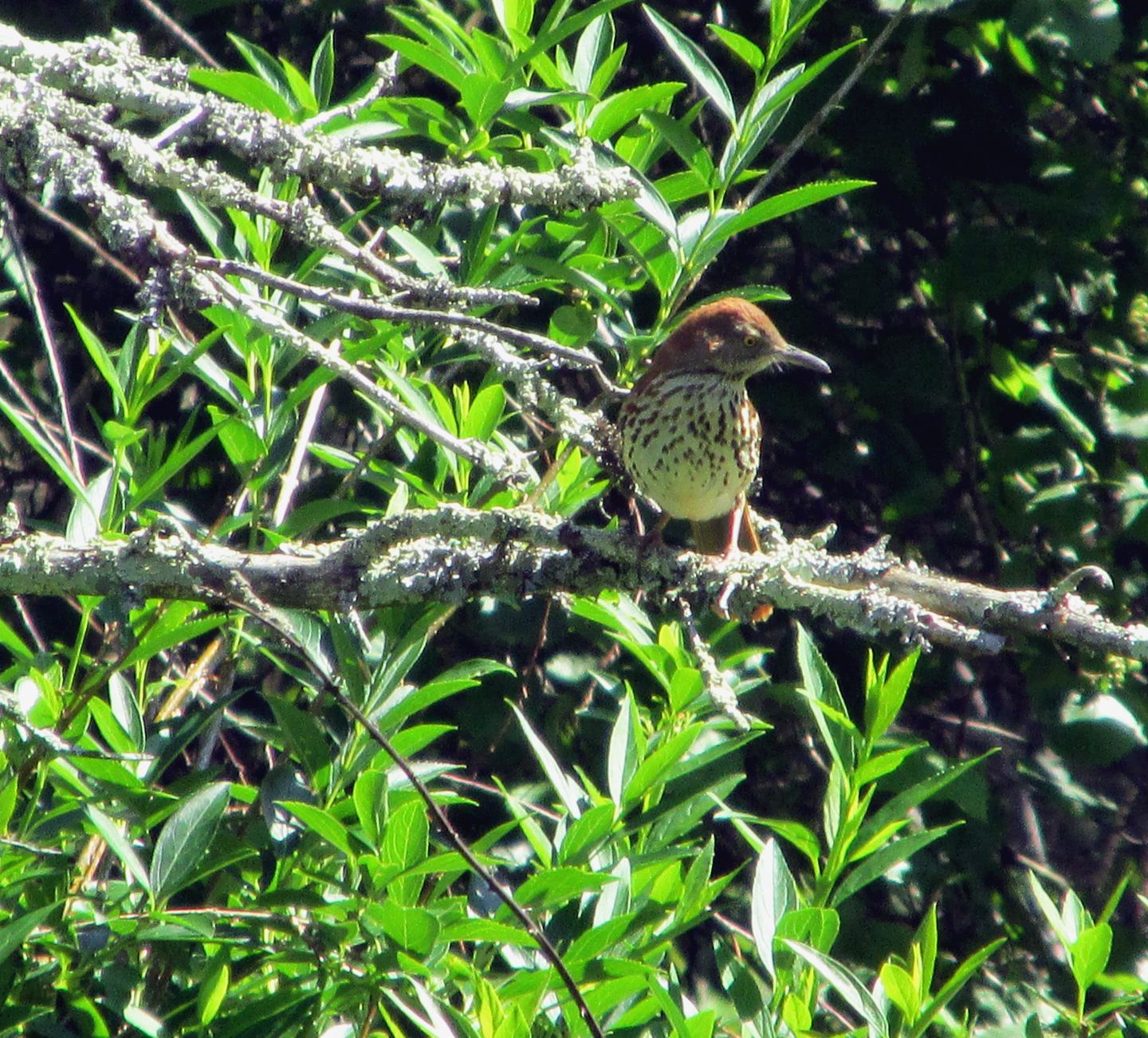
The chat’s habitat preferences and its repertoire of vocalizations makes it easy to associate these birds with others that share the same dense, brushy habitats and a penchant for making unusual vocalizations. Birds often found in proximity to chats include brown thrashers, gray catbirds, white-eyed vireos and Eastern towhees.
Habitat loss has resulted in a steady decline of yellow-breasted chats in some parts of their range. It is a widely distributed bird, spending the nesting season from southern Canada to Mexico. Most chats retreat to Mexico and Central America for the winter months. This chat mostly feeds on insects, supplementing its diet with berries that ripen during the summer months.
Female chats usually lay three to four eggs, but both parents care for the young. Young chats are usually ready to leave the nest only eight days after hatching, but they will remain dependent on their parents for food for a couple of weeks. Chats usually nest twice each during the nesting season.
The yellow-breasted chat is usually a bird that I have to make a special effort to find. It’s worth the effort to gain a good look at this big, brash songbird.
Three other chats, all birds of tropical regions, were moved out of the warbler clan in 2009 by the American Ornithologists’ Union. Experts now believe that the rose-breasted chat of South America, the gray-throated chat of Mexico, Guatemala and Belize and the red-breasted chat of the Pacific slope of Mexico are more closely related to cardinals and tanagers than warblers. The yellow-breasted chat has been stuck in its own family, Icteriidae, not to be confused with New World blackbirds in the family Icteridae.
Even if we can no longer consider the yellow-breasted chat a warbler, the bird still remains unique enough to warrant its own family.
•••
To share a sighting, make a comment or ask a question, email me at ahoodedwarbler@aol.com.



 Our Fine Feathered Friends