Category Archives: Bryan Stevens Feathered Friends

Here are a few birds to look for this spring

Photo by Bryan Stevens • A male hooded warbler perches in a cluster of branches.

Has it been a slow spring? I have felt that it’s been one step forward, two steps back. But April has finally arrived. Although we’re now two days into the month, I’m still waiting on some of my first arrivals among our fine feathered friends.

That’s not an unusual situation. I think the birds like to drag out their springtime arrivals. They know that being tardy is sure to aggravate me as I’m not known for patience.

The first male red-winged blackbird returned to the fish pond in mid-March and has been singing persistently from the tops of the bald cypress trees bordering the pond. I haven’t seen a female red-winged blackbird yet, but they tend to arrive later than males.

Of course, and I don’t think I’m alone in this hope, I’m also eager to welcome back ruby-throated hummingbirds. These tiny flying gems should be back any day now. My sugar water feeders are waiting for them.

I hope readers will once again share the first arrival dates of hummingbirds at their own feeders. Jot down the date and time, as well as any other details you’d like to share, and email me at ahoodedwarbler@aol.com or message me on Facebook at http://www.facebook.com/ahoodedwarbler/

With those preliminary thoughts shared, what else will I look for as the spring advances? Longtime readers will know of my enthusiasm for warblers, also known as New World warblers or wood-warblers.

They’re a group of small, often colorful, passerine birds that make up the family Parulidae. The family, which occurs only in the New World, contains 120 species. They are not closely related to Old World warblers or Australian warblers.

About half of the 120 species reside in Central and South America, but the others migrate north each spring to nest in the United States and Canada. In Northeast Tennessee, we have about two dozen nesting species that make their home with us from April to October.

The warbler I look forward most to seeing is the hooded warbler, partly due to individuals belonging to this species nesting in the woodlands around my home.

Photo by USFWS/A female hooded warbler stays put on her nest.

So, from the time my favorite warbler returns in April until the last individual departs in October, I enjoy regular glimpses of this colorful and interesting bird. Like all warblers, the hooded warbler is quite energetic, dashing after tiny insects in the branches of shrubs and trees. Hooded warblers often forage close to the ground, which makes observing them easier.

Of course, birds are free to break the rules. One of my most memorable sightings of a hooded warbler involved a male singing from the upper branches of a dead pine tree. I’d estimate that the bird was at least 40 feet off the ground, singing his little heart out to attract a mate. I was standing on an elevated rise of land while the tree providing the warbler its perch was lower in a gully that actually placed bird and observer on a roughly level playing field.

That sighting took place 25 years ago, but the image of that male hooded warbler singing so enthusiastically has remained emblazoned in my memory.

This particular bird sang for several moments, which is not always the case with warblers. These birds tend to dash for cover at the slightest disturbance, but this enthusiastic male didn’t seem to pay any heed to the fact that most of its kin prefer to skulk in shrubs and dense rhododendron thickets no more than a few feet off the ground.

It’s one bird unlikely to be mistaken for any other. Every time I behold a hooded warbler, I marvel at the bird’s exquisite appearance. The gold and green feathers seem to glow brightly in the dim light of the shadowy thickets of rhododendron they prefer to inhabit. The black hood and bib surrounding the male’s yellow face stands out by virtue of its stark contrast from the brighter feathers. Large coal-black eyes complete the effect. The appearance of the male bird provides this species with its common name.

The female hooded warbler has an identical yellow-green coloration as the male, although she is slightly more drab. She lacks the black hood and bib, although older females may acquire some dark plumage on the head and around the face. Both sexes also show white tail feathers that they constantly fan and flick as they move about in thick vegetation and shrubbery.
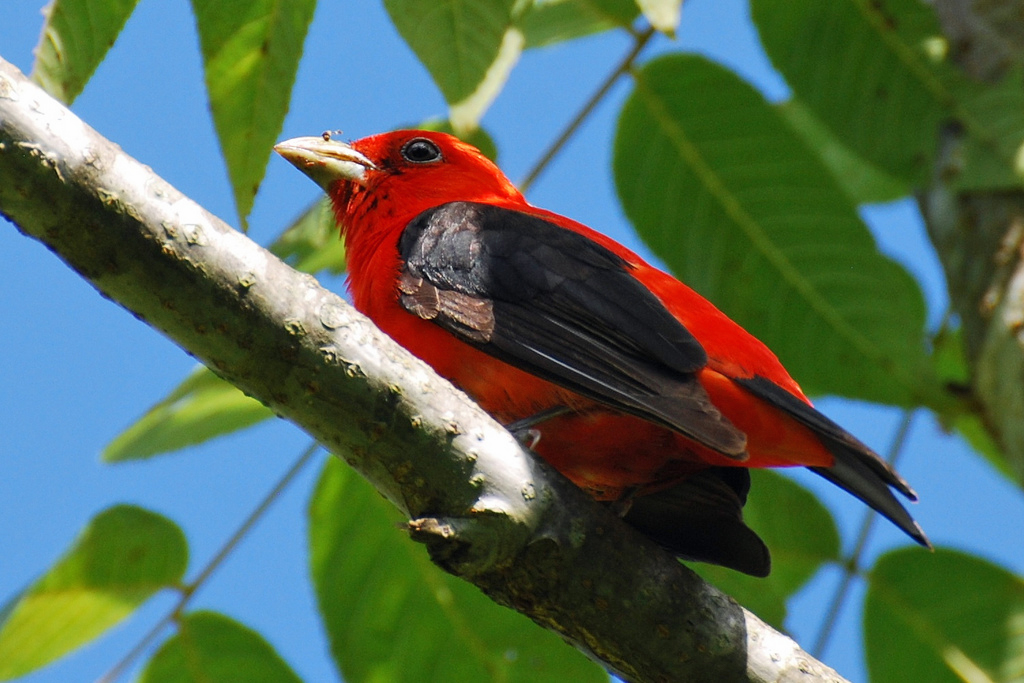
Photo Courtesy of Jean Potter
A male scarlet tanager brightens shadowy woodlands with a flash of tropical colors yet remains mostly inconspicuous in the forest canopy.

In addition to warblers, I also look forward to the return of scarlet tanagers. Males are unmistakable in their bright red plumage accented by black wings. This is one bird that is truly breathtaking when lured into the open for an observation through a pair of binoculars.

During their summer stay in the region, scarlet tanagers largely prey on insects. Although renowned as a fruit-eating bird, the scarlet tanager primarily feeds on fruit during its migration flights and on its wintering range in the tropics. This tanager breeds in deciduous and mixed deciduous-evergreen woodlands across the eastern half of North America. It’s my understanding that oaks are a favorite tree for this woodland dweller.

It’s unlikely that you’ll run across the nest of a scarlet tanager. These birds nest high in trees, often locating their nests 50 feet or more above the ground. After building a nest, a female tanager will incubate her three to five eggs for about two weeks. It’s during this time that her inconspicuous appearance is a plus, helping her blend well with her surroundings.

So, as I wait for warblers, hummingbirds and tanagers, I’ll just have to be a little more patient. I’m also hopeful that the fish pond will attract some nesting birds such as tree swallows and wood ducks. Fingers crossed!

•••

Remember to let me know about your first hummingbird sightings. Email me at ahoodedwarbler@aol.com to notify me of a sighting, ask a question or share a comment.
Red-winged blackbird, other birds set to return in coming weeks

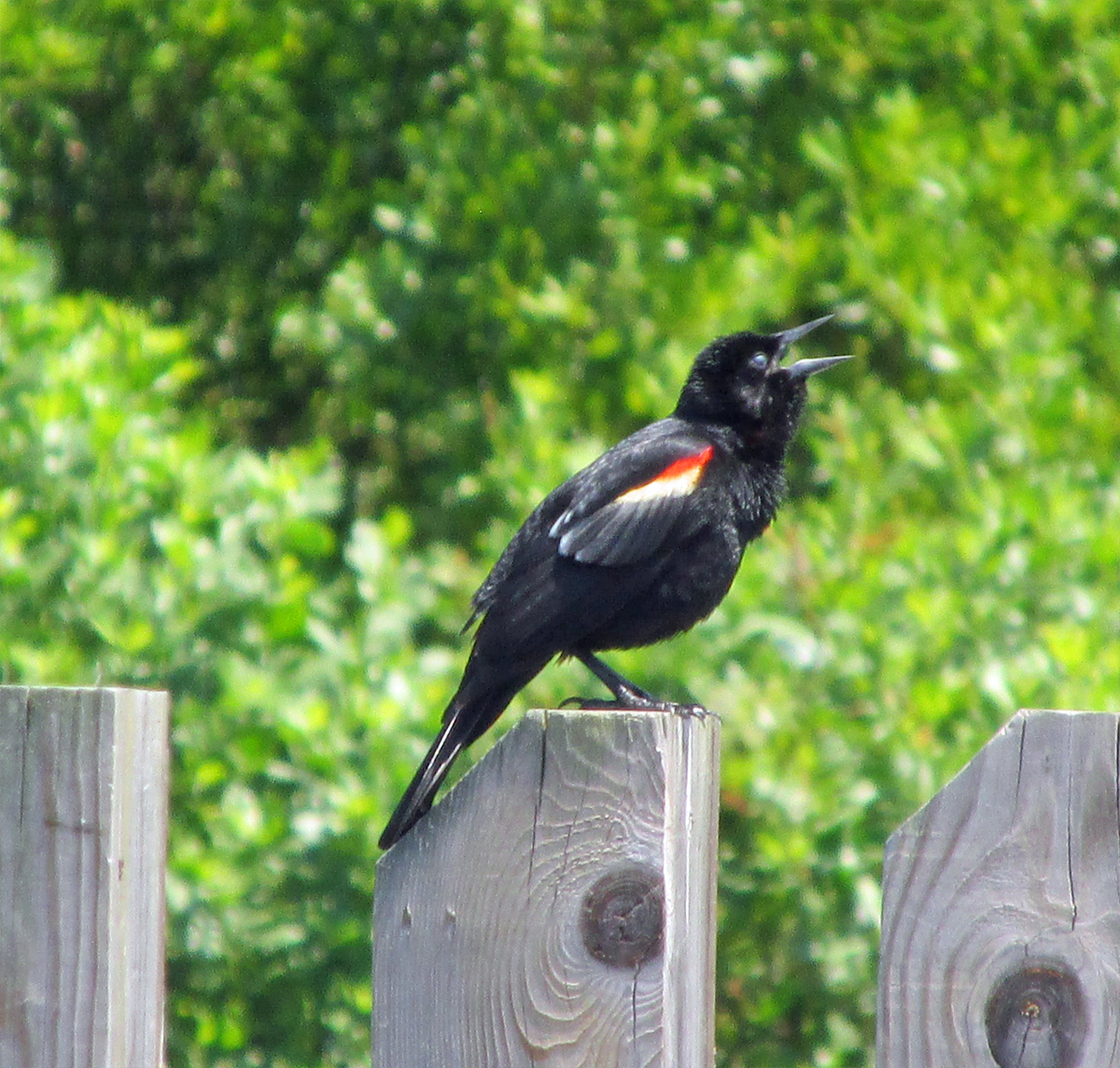
Photo by Bryan Stevens • A male red-winged blackbird sings to attract mates and ward off rivals.

February’s the shortest month, and it is more than halfway over. There are already signs that some birds are ready to embrace the shift in seasons as winter advances, albeit in fits and starts, toward spring.

On Feb.11, three mallards visited my fish pond. The presence of mallards at any pond is not all that surprising. The mallard is arguably the most recognized of North America’s native ducks. But these were wild birds, as indicated by their wary behavior and their ability to spring into strong flight when I surprised them quite by accident.

Spring migration begins as early as February and March. Eastern bluebirds, which for the most part are not migratory, are already checking out nesting boxes.

The months of March, April and May will bring an influx of migrants. Ruby-throated hummingbirds will soon make their annual crossing of the Gulf of Mexico. These tiny birds usually make landfall in the United States as early as February, but they don’t usually venture as far north as Northeast Tennessee, Western North Carolina and Southwest Virginia until early April.

Bryan Stevens • On Feb.11, three mallards visited my fish pond. I am hoping they are the start of more migrating birds arriving in the coming weeks.

Warblers, orioles, thrushes, flycatchers, tanagers and many other migrants also return in April and May. A variety of waterfowl, raptors and shorebirds pass through the region during these months, as well.

March brings the early birds, including species such as brown thrasher, blue-gray gnatcatcher and red-winged blackbird.

Red-winged blackbirds return with a venegeance in early March or sometimes in late February.

I’m ready to hear their loud, familiar “kon-ke-ree” sounds again from the tops of the cypress trees at the fish pond. It’s always a fun moment to welcome these birds back.

Red-winged blackbirds return yearly in early spring and begin to seek out nesting habitat in local wetland areas, such as the cattail marshes near my fish pond.

My first returning male red-winged blackbird arrived on the evening of March 3 in 2022. The first red-winged blackbird arrived on the morning of March 6 the following year. I heard his unmistakable song from inside my house.

The showy and loud red-winged blackbird males soon take up residence at my fish pond and adjacent stands of cattails after their return.

Male blackbirds arrive ahead of the females. They immediately search out prominent perches and begin singing every day in anticipation of an intended audience. Female blackbirds lag a week or so behind the males in returning to their familiar territory.

Any wet field or marsh, especially those offering a stand of cattails, is almost certain to attract red-winged blackbirds at this time of year. I’d almost wager on that certainty.

The blackbirds arriving in spring behave much differently than the quiet, furtive flocks that often make brief visits to feeders during late winter snowstorms.

“The kon-ke-ree song of the male red-winged blackbird is a sure indication that spring is on the way,” according to a profile located at the Tennessee Watchable Wildlife website.

At this time of year, the male red-winged blackbirds seek elevated perches to display and vocalize. Their loud antics are not designed solely to attract mates. Male red-winged blackbirds also sing to warn rival males from intruding into their territories.

The male red-winged blackbird is a very aptly named bird. Glossy black males sport red wing patches that are often trimmed with a narrow band of yellow feathers. By contrast, female red-winged blackbirds are mostly brown birds that could easily be mistaken for large sparrows. Both sexes have sharply pointed bills.

Red-winged blackbirds are fond of wetlands. Any marsh or even a damp field or flooded pasture is likely to attract a few resident red-winged blackbirds. Females choose nesting locations in cattails or other marsh vegetation. She usually lays three or four eggs. Although she does receive some help from the male, most of the responsibility for raising the young is left to her.

There is a reason that male red-winged blackbirds are not always quite as engaged as females in feeding and tending their young. Males are often polygynous, which means that males will often court multiple mates. His time is often occupied defending females and their respective nests from the advances of other male red-winged blackbirds.

According to the website All About Birds, male red-winged blackbirds spend much of the breeding season sitting on a high perch over their territories and singing almost without ceasing from dawn to dusk.

The website also notes that female blackbirds shirk the high profile of the males. They tend to skulk in wetland vegetation as they collect food or nest material.

Bryan Stevens • Female red-winged blackbirds lack the showy plumage of males. They look more like an overgrown sparrow.

Both males and females defend nests from intruders and predators. They take this duty quite seriously, as I know personally from being dive-bombed by parent blackbirds when I have gotten a little too close to their nests.

Other relatives of the red-winged blackbird in the United States include the tricolored blackbird found along the Pacific Coast and the yellow-headed blackbird resident in wetlands west of the Great Lakes. Rusty blackbird, common grackle and brown-headed cowbird are other species of blackbirds found in Tennessee, Virginia and North Carolina.

For birders, the weeks ahead are an exciting time. In spirit, I think others often join our excitement if for no other reason than to celebrate that spring is just around the corner. These “early bird” arrivals are merely the harbingers of the season.

Share a sighting, ask a question or make a comment by emailing me at ahoodedwarbler@aol.com.

Bryan Stevens • In fall, male red-winged blackbird are bereft of the striking glossy plumage of spring.


Birds make use of various strategies to attract and keep mates

Shauna Fletche/Pixabay • Some birds, like waxwings, like to present tasty treats to their potential mates.


With Valentine’s Day around the corner, it’s an opportune time to see how courtship is handled among our fine feathered friends. Most birds don’t bring a box of chocolates or a bouquet of roses when they take up courtship of a prospective mate, but birds have several equivalent behaviors that they employ to attract the attentions of the opposite sex. In honor of Valentine’s Day I thought a look at some of the more unusual courtship rituals of some of our feathered friends would be appropriate.

Aerial acrobatics designed to impress

In late winter and early spring, a true oddball begins courting. The American woodcock, also known by such whimsical names as “bog sucker” and “timberdoodle,” is a shorebird that has completely abandoned the shore in favor of woodlands and fields. Beginning as early as February, American woodcocks in the region conduct nightly courtship displays, starting at dusk, that combine aerial acrobatics with an assortment of unusual acoustical flourishes. Any wet field adjacent to a wooded area could offer a stage for these evening displays, but unless you know where to look and make an effort to do so, the American woodcock might as well remain a phantom of the night.

These mating rituals provide almost the only time of the year during which this bird makes itself available for observation. It’s only during this brief window that opens into their lives that we can be assured a glimpse. Even then, our peeks at woodcocks often consist of a fuzzy twilight escapade as the bird flings itself heavenward only to make a spiraling descent a few seconds later. The displays begin with a distinct vocalization, a type of “pent,” that also has the quality of sounding like some sort of mechanical buzzer.

Once the displays conclude for the season, the birds assume nesting duties, usually unobserved by humans. The rest of the year, almost nothing but blind, sheer luck would allow a birder to stumble across an American woodcock. It’s almost as if they disappear after these spring flights of fancy.

Birds bearing gifts

Many birds present small trinkets to a prospective mate. For instance, many male penguins make a present of a stone or pebble to female penguins. There could be more than a simple bribe behind this gift. Female penguins don’t build elaborate nests. In fact, a scrape on the bare ground, perhaps encircled by a collection of pebbles, marks the extent of their nest construction. So, the perfect pebble could be the way to winning a female penguin’s heart.

The way to the heart is through the stomach

Observant birders may have witnessed a male Northern cardinal slip a female a morsel of food, such as a peanut or a shelled sunflower kernel. It’s a marked change for this bird. During the winter months, a male cardinal is more likely to chase a female away from a feeder rather than share food with her. However, as spring approaches, his behavior undergoes a change and he becomes content to feed next to a female cardinal, often slipping her some choice tidbits.

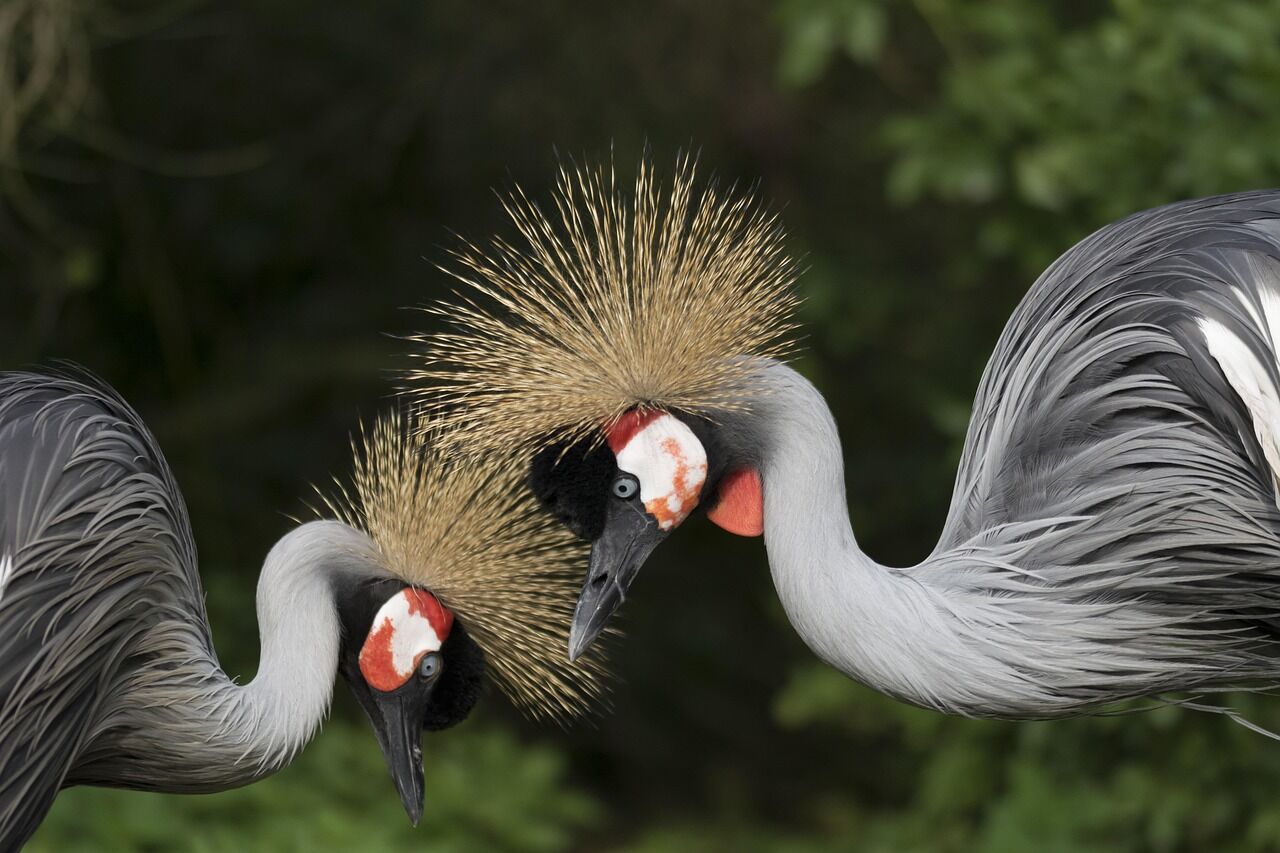
Sabine van Erp/Pixabay • Bow to your partner: Grey-crowned cranes perform an elaborate dance designed to strengthen their bond.

May I have this dance?

Many species of birds perform elaborate and ritualistic dance displays. Among birds known for tripping the light fantastic are flamingoes, cranes, grouse and grebes. Cranes are one of the oldest families of birds on earth. They’re also some of the most accomplished dancers in the animal kingdom. Pairs perform very ritualistic dances that, if the performers were human, would no doubt require the services of an accomplished choreographer. Cranes mate for life and the ritual of dancing is a way to strengthen the bonds between a mated pair. The ability to dance is, apparently, not instinctive. Young cranes must practice their dance moves, a process that can take years before they master the elaborate dance.

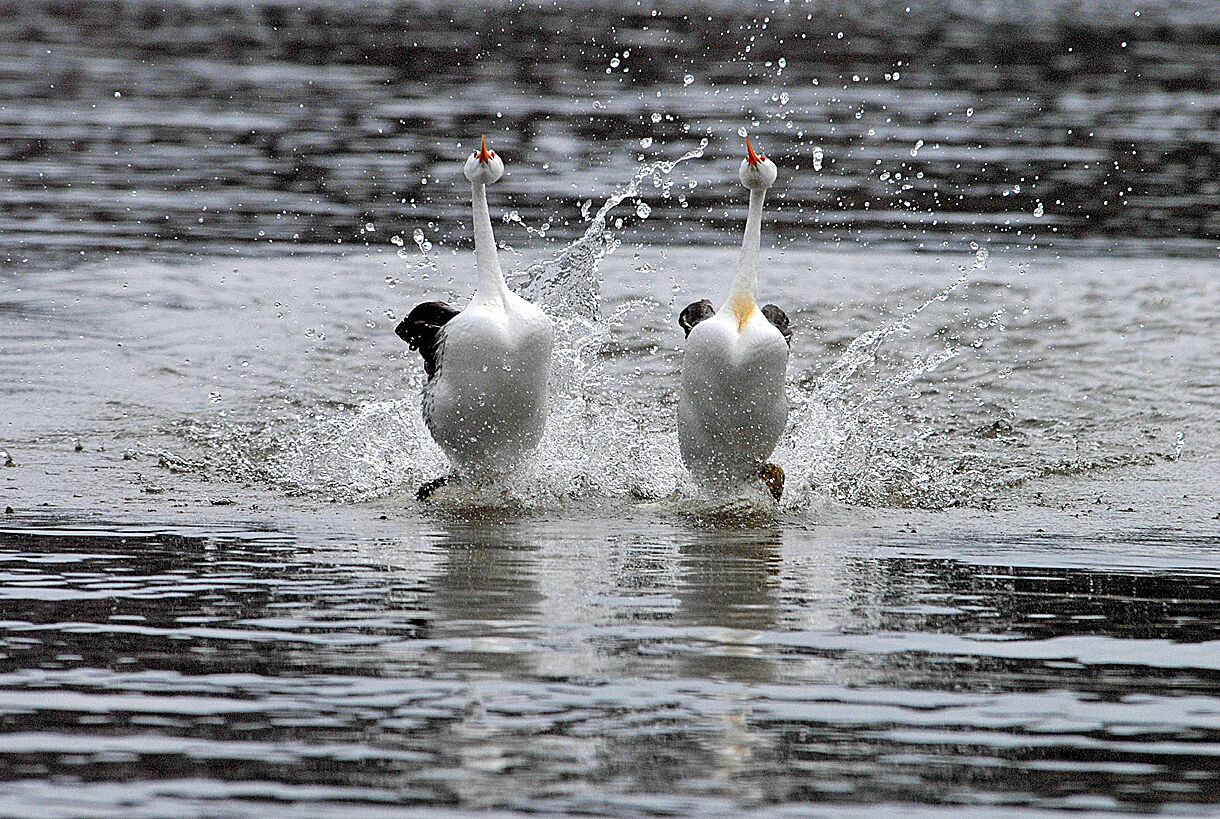
Dave Menke/U.S. Fish & Wildlife Service • A pair of Clark’s Grebes displays in a courtship ritual known as “rushing” or “weed dance.” Birds use a variety of strategies to attract and keep mates.

Synchronized swimming

While many birds dance to impress a mate or strengthen pair bonds, grebes perform a dance that takes place completely on the surface of the water. A pair will engage in this intricate performance, perfectly mirroring the moves of the other as they literally race across the surface of the water. These dances by grebes are also known as “rushing” or “weed dance.” It’s called as a weed dance because at the culmination of the ritual, the birds usually hold some type of aquatic plants in their bills while racing swiftly over the surface of the water. Pairs that perform well together stay together, building a nest and raising young.

Good housekeeping seal of approval

The tropical family of bowerbirds are famous for complex nests built by males and then decorated with bright and colorful objects to catch the eye of a potential mate. The nests of these birds are actually referred to as a “bower.” Usually constructed on the ground, the male will line the approachs to the bower with items such as shells, leaves, flowers, feathers, stones, berries, and even discarded garbage, including plastic scraps or bits of glass. Unusually odd items pressed into these decorative displays have included coins and spent rifle shells. This habit of male bowerbirds must rank as the ultimate in trying to impress a mate with shiny bling.

These are just a few of the inventive ways that birds go about attracting and keeping mates. Perhaps you can pick up some pointers from our feathered friends to ensure you have a great Valentine’s Day this year.

•••

If you have a question, wish to make a comment or share a sighting, email me at ahoodedwarbler@aol.com.

Hungry robins emerge during deep freeze to feast on berries

Robins – by the hundreds – poured into downtown Erwin last week. Most of them ended up on perches around the parking lot between the Clinchfield Senior Adult Center and the rear of the offices of The Erwin Record.

Photo by Bryan Stevens • While American robins like fruit when its available, they also spend a lot of time feeding on earthworms and insects.


The newspaper’s office manager Ken Silvers alerted me to the presence of the “huge flock” of robins. He even joked that he felt like he had stepped into a scene from the movie “The Birds.” Their arrival had been preceded by several nights of single digit temperatures.

In a few weeks, robins will likely be making their annual spring resurgence, but their mid-January appearance in such numbers was somewhat surprising. The fact is that, although we don’t think of robins very much in winter, they are still very much present in the region. The same is true of waxwings and is particularly true about European starlings.

While downtown Erwin would not usually be an ideal location for robins, there was something present to attract them: Berry-producing ornamental holly trees.

In the colder months of the year, robins form large, loosely organized flocks, often taking up residence in wooded lots. After several days of frigid weather, the robins were likely desperate to exploit an available food source. The flock spent a couple of hours gorging on holly berries. Even later in the day a few dozen robins lingered around the shrubs, gleaning the remaining berries from the branches.

The American robin is a large bird in the thrush family, which in North America also includes such birds as Eastern bluebird, wood thrush and Townsend’s solitaire. It’s probably a bird that is well-known to birders and non-birders alike.


In the British Isles, the European robin is simply known as “robin” or “robin redbreast.” When the first English colonists arrived in New England and other parts of colonial-era North America, they took pleasure in finding that some of the birdlife in the New World resembled familiar birds from their homeland. The red-breasted American robin looked like the bird they knew in the Old World as “robin,” which motivated them to name the New World bird “robin,” as well.

Sharkolot/Pixabay • Early American colonists from Europe, familiar with the European robin of their homeland, saw the red breast feathers on the American robin and named the large thrush robin as well.

Other than the red breast, however, the two robins are not all that similar. The American robin is the larger of the two birds. Farther separating these two birds is the fact that the European robin is not a thrush but rather a member of the family of Old World flycatchers.

In some other ways, the two robins are similar. Both are fond of earthworms, spending a great deal of their time on the ground foraging for worms. They will also follow human gardeners at their work, waiting patiently for the followed person to disturb the soil with a spade or hoe and expose earthworms for the waiting bird. They are also rather tolerant of humans and have learned to make their own homes close to human dwellings.

Some of the British transplants to North America must have felt homesick for familiar things because several unsuccessful attempts were made to introduce the European robin to the United States and Canada. European robins introduced in New York and Oregon failed to gain a foothold, unlike the introduction of such alien birds as the house sparrow and European starling.

On a few occasions, migrating American robins have overflown their destinations and ended up in the United Kingdom. For instance, an American robin became a first for London birdwatchers when one was found in that nation’s capital city in March of 2006. Whether of the European or American persuasion, robins have long been a favorite of birdwatchers and nature enthusiasts.

In a few weeks we will have more American robins pouring into our lawns, our gardens and our parks. The American robin has always been a perennial harbinger of spring. But it’s not always necessary to wait until winter’s waning to enjoy observation of this popular songbird.

•••

Bryan Stevens has written about birds and birding since 1995. To ask a question, make a comment or share a sighting, email him at ahoodedwarbler@aol.com.

Tiffany/Pixabay • The American robin keeps a lower profile but is still present in the region during the winter months.

Winter’s ducks begin arriving in region

Photo by USFWS • A pair of green-winged teal swim together through a wetland.

Some interesting waterfowl have spent at least part of the winter at the pond at Erwin Fishery Park and a nearby fenced lagoon at the back of the park.

Some of the visitors since the start of the new year have included green-winged teal, American black duck, lesser scaup and Northern pintail. The scaup is a species of diving duck while the others are what are referred to as “dabbling” ducks. Diver and dabbler refers basically to the manner in which these ducks forage for their food.

The familiar mallard is probably the best known dabbling duck, but other dabblers include American wigeon, gadwall and Northern shoveler. Dabbling ducks generally feed in shallow water.

The green-winged teal is the smallest of North America’s dabbling ducks. There are two other close relatives of the green-winged teal in North America – the blue-winged teal and cinnamon teal. I’ve seen the green-winged and blue-winged at many locations in the region. I saw my only cinnamon teal during a trip to Utah and Idaho in 2003.

The Northern pintail that spent some time at Erwin Fishery Park was a hen with a more subtle appearance than adult male pintails.

This can be a species difficult to find in Northeast Tennessee. The website All About Birds notes that Northern Pintails are common, but their populations declined by about 2.6% per year resulting in a cumulative decline of about 75% between 1966 and 2019, according to the North American Breeding Bird Survey. The Partners in Flight organization estimates the global breeding population at 5.1 million.

Photo by Bryan Stevens • The Northern pintail is a dabbling duck, so classified due to its way of foraging for food in shallow water.


Elegant is a useful word for describing pintails. Both sexes have blue-grey bills and grey legs and feet. The drake is more striking, having a thin white stripe running from the back of its chocolate-brown head down its neck to its mostly white undercarriage. The drake also has attractive gray, brown and black patterning on its back and sides. The hen’s plumage is more subtle and subdued, with drab brown feathers similar to those of other female dabbling ducks. She has the same slender shaper as the male. Her tail feathers are long but don’t match the male’s namesake tapered tail feathers.

The Northern pintail is a cosmopolitan duck that also ranges into Europe, the Middle East, India and Asia. Other pintails include white-cheeked pintail, yellow-billed pintail and Eaton’s pintail. The latter species is restricted to the island groups of Kerguelen and Crozet in the southern Indian Ocean. The species was named after the English explorer, naturalist and entomologist Alfred Edwin Eaton. He served as the vicar of Shepton Montague in Somerset in England. Born in 1944, he died in 1929 at age 84.

Our region offers some dependable locations for looking for winter ducks, as well as other wintering waterfowl such as geese, grebes and loons. Accessible locations for looking for ducks during the winter season include Wilbur Lake near Elizabethton and Osceola Island Recreation Area below the tailwaters of Holston Dam in Bristol. Of course, any farm pond not frozen over is a potential location attractive to wandering waterfowl.


A duck known as the common merganser has expanded its summer nesting range to include the Nolichucky River and Watauga River. Twenty years ago this species, despite its name, was far from common in the region. It’s too early to tell whether changes wrought by last fall’s flooding from Hurricane Helene will affect this duck’s nesting attempts along these two rivers.

One difficulty in finding ducks in recent weeks has been the deep freeze gripping the region and turning almost all open water into ice. The widespread cold could help convince waterfowl from farther north to head south in the hope of less frigid conditions. My hope is that at least a few of those ducks will stop off at places like the pond at Erwin Fishery Park.

Ducks that aren’t too difficult to locate during winter in the region include bufflehead, ring-necked duck and hooded merganser. Other possible visitors include redhead and canvasback. If the Northern pintail is the most elegant of the dabbling ducks, the canvasback ranks as the most majestic of the diving ducks.

Ducks are interesting to observe. Binoculars and spotting scopes can make the process easier. Most ducks are social birds. Flocks, or rafts, of ducks display interesting interactions. In addition to the familiar “quack” of the mallard, different ducks produce a variety of hoots, whistles, hisses and other vocalizations.

•••

I’ve written about birds and birding since 1995. To ask a question, make a comment or share a sighting, email me at ahoodedwarbler@aol.com.

Photo by Bryan Stevens • The male mallard is probably the most recognized duck in the United States.

Birds made headlines in 2024 for various reasons

Photo from Pixabay • The bald eagle became official with President Joe Biden’s signature on Dec. 24, 2024.

As we move into a new year, I thought it might be a good time to look back at some bird-related headlines from 2024.

Status delayed

Who knew? For nearly two and a half centuries, Americans have believed that the bald eagle was the official bird of the United States.

Such status, at least officially, was never actually bestowed on the bald eagle.

On Monday, Dec. 16, the U.S. House of Representatives passed a bill amending the U.S. Code to officially designate the bald eagle (Haliaeetus leucocephalus) as the country’s national bird. It only took 242 years to get around to making the eagle’s status official. The bald eagle has been considered the national bird of the United States since 1782, when it was placed with outspread wings on the Great Seal of the nation. The bird had always seemed official, appearing in many government institutions and on official documents, making it the most pictured bird in all of America. But until the recent House vote, nothing had ever been done legislatively to sanction the eagle’s status.

President Joe Biden signed into law the legislation sent to him by Congress that amended the U.S. Code to correct what had long gone unnoticed. At the stroke of a pen, Biden’s signature now officially designates the bald eagle as the official national bird. He took the action on Christmas Eve, Dec. 24.

A man named Preston Cook discovered the oversight regarding the eagle’s lack of government sanction and spearheaded the push to belatedly provide the bald eagle with official status as the national bird. For the full story on how this came about, visit https://www.audubon.org/magazine/bald-eagle-about-officially-become-our-national-bird-thanks-man.

Common murres and The Blob

A seabird common in coastal Alaska suffered the biggest die-off in recorded history, according to a report issued late this year. An estimated 4 million common murres died in Alaska due to a climate phenomenon dubbed “The Blob.” The number represents about half the population of the species in Alaska. The Blob was a large mass of relatively warm water in the Pacific Ocean off the coast of North America that was first detected in late 2013 and continued to spread throughout 2014 and 2015. Now, ten years later, studies on the extent of the devastation to common murres and other marine life is becoming more apparent.

Bird Flu

Bird flu spreads. Some of its latest victims, other than domestic chickens and cattle, include wild cougars in Oregon. This could very well become a major bird-related story in 2025 as well.

Another curlew lost

North America’s Eskimo curlew has not been seen since 1987 when one was sighted in Nebraska. The species was declared endangered in 1966. Most expert believe the species is gone.

Now, a close relative in Europe has also joined the Eskimo curlew in that bleak oblivion. The slender-billed curlew was declared extinct in 2024, although the last confirmed sighting of the species probably took place as far back as 1995.

It’s the first mainland European species to go extinct in more than 500 years. Hunting and habitat loss were cited in some reports as the main cause for the decline of a species that was also apparently never abundant to begin with.

New species

While birds seem to be declining, it’s still possible to discover new species. Three new species of bird were recognized by science in 2024, These species are Timor nightjar, white-tailed tityra and Ascension night heron. The tityra was first discovered in Brazilian rainforest bordering Peru in 1829, and then promptly vanished. In 2006 and 2022, however, new sightings were documented of the species.

Wisdom and perseverance

Wisdom, a Laysan albatross documented as the oldest known banded bird in the wild, returned to familiar territory on March 18, 2024, being spotted on Midway Atoll National Wildlife Refuge. She had also returned without her longtime mate to the Refuge in November of 2021. Since that time, she appears to have been seeking a replacement mate.

She is at least 74 years old. She was first identified in 1956 by wildlife biologist Chandler Robbins, who banded her with the number Z333. In November 2024, Wisdom was spotted with a new mate and incubating another egg.

Biologists estimated that Wisdom has laid some 30 to 40 eggs in her lifetime. Most hatched successfully and and she has been a mother to at least 30 to 36 chicks.

Wisdom defied the odds when she and her chick survived the 2011 Tōhoku earthquake and tsunami that killed an estimated 2,000 adult Laysan and black-footed albatrosses and an estimated 110,000 chicks at the Refuge. Here’s hoping that Wisdom continues to prevail despite what life has seen fit to throw her way.

•••

Best wishes in 2025. To ask me a question, share a sighting or make a comment, email me at ahoodedwarbler@aol.com.

Cardinal a natural symbol for Christmas

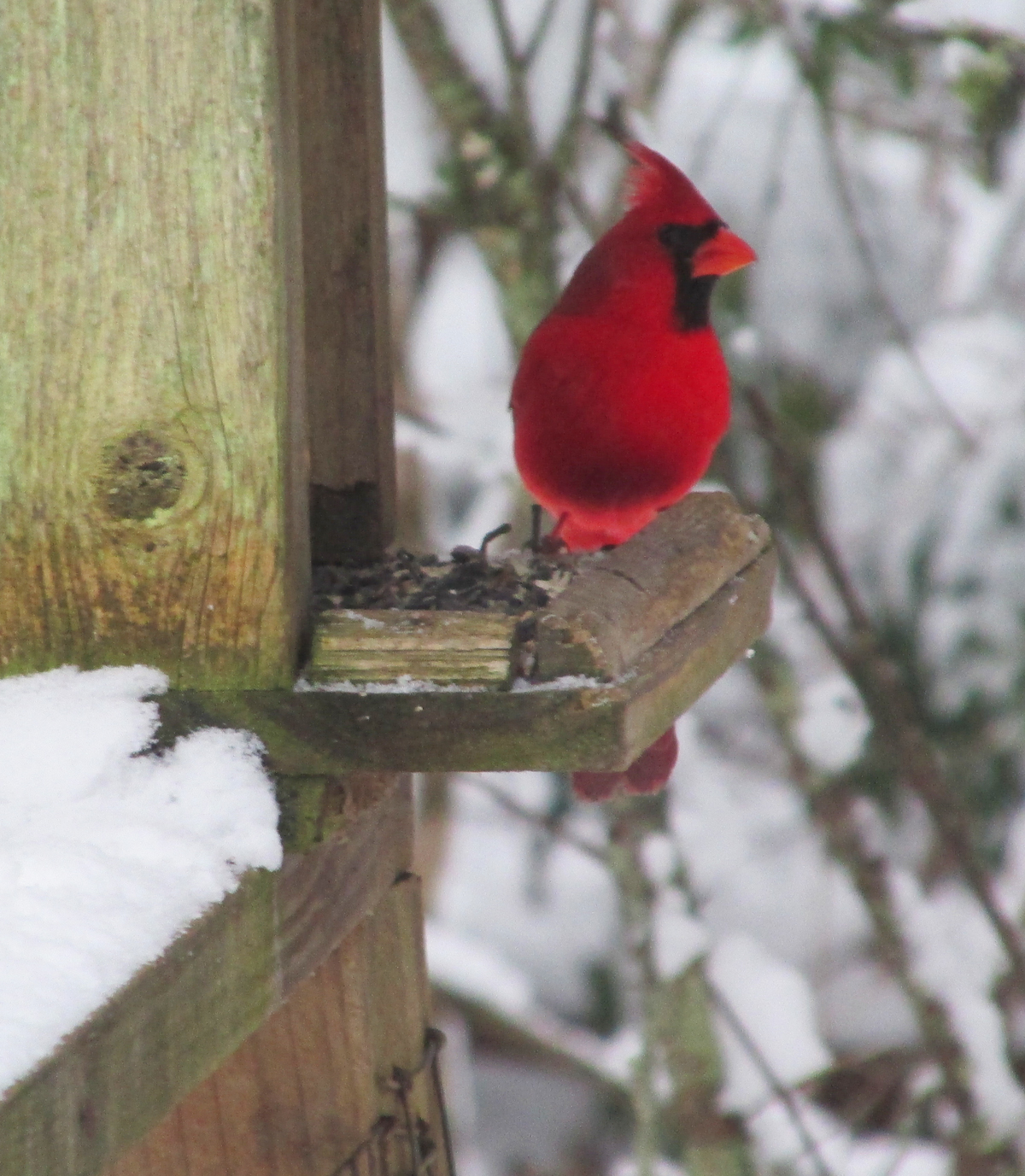
Photo by Bryan Stevens • A male Northern cardinal visits a feeder on a snowy afternoon.

Merry Christmas. This week’s newspaper is coming out on Christmas Day and, as is my usual custom on this holiday, I want to share my enthusiasm for the Northern cardinal, one of my favorite birds.

I’ve also come to believe that the cardinal is also an excellent feathered symbol for the Christmas holiday. Anyone who provides sunflower seeds at a bird feeder has most likely received visits from this bird.

Individual cardinals around my home have become very accustomed to my presence. Some of them have even learned my routine and know when to anticipate my daily stocking of the feeders with sunflower seeds.

I have always enjoyed watching cardinals. The beauty of both male and female cardinals is undeniable. They’re usually nervous, twitchy birds, so it has been fun watching some of the resident cardinals grow accepting of my presence.

The Northern cardinal, especially the brilliant red male, stands out against a winter backdrop of snow white, deep green or drab gray. Over the years, the cardinal has also become associated with the Christmas season.

How many Christmas cards have you received this holiday season with a cardinal featured in the artwork? I’d wager that at least a few cards in any assortment of holiday greetings will feature the likeness of a Northern cardinal.

There is a possible reason that male cardinals try to outshine each other when it comes to their bright red plumage. According to the website Tennessee Watchable Wildlife, brighter red male cardinals are able to hold territories that have denser vegetation, feed young at higher rates and have greater reproductive success than males with feathers of a duller hue.

The Northern cardinal belongs to a genus of birds known as Cardinalis in the family Cardinalidae. There are only two other species in this genus, and they range across North America and into northern South America. The two relatives are the pyrrhuloxia, or Cardinalis sinuatus, of the southwestern United States, and the Vermilion cardinal, or phoeniceus, a bird found in Colombia and Venezuela.

The Northern cardinal is a native and abundant bird. Cardinals are a widespread species, ranging westward to the Dakotas and south to the Gulf Coast and Texas. The southeastern United States was once the stronghold of the cardinal population. In the 20th century, however, cardinals have expanded their range into New England and Canada.

The cardinal accepts a wide variety of food at feeders. Sunflower seed is probably their favorite, but they will also sample safflower seed, cracked corn, peanuts, millet, bakery scraps and even suet. While we may get the idea that cardinals feed largely on seed, that is a misconception based on our observation of the birds at our feeders. Cardinals away from our feeders eat insects and fruit, including the berries of mulberry, holly, pokeberry, elderberry, Russian olive, dogwood and sumac.

The cardinal uses its large beak to efficiently hull sunflower seeds or deal with other foods foraged in field and forest away from our feeders. The large, heavy beak hints at the cardinal’s kinship with birds such as tanagers and grosbeaks.

In fact, some of America’s early naturalists referred to the bird as “cardinal grosbeak.” Other common names include the apt “redbird” moniker and “Virginia nightingale.”

Even once the holidays are past, there’s nothing like a glimpse of a Northern cardinal to add some cheer to a bleak winter day. It’s not surprising that such a popular bird has also become associated with many trappings of the Christmas season.

“You see cardinals on greeting cards, stationery, paper plates, paper napkins and tablecloths, doormats, light switch plates, candles, candle holders, coffee mugs, plates, glasses, Christmas tree ornaments and lights, bookmarks, mailboxes, Christmas jewelry,” writes June Osborne in “The Cardinal,” a book about this popular bird.

“And the list goes on,” Osborne writes. “Cardinals have become an integral part of the way that many people celebrate the holiday season.”

I can be included among such people. My Christmas decorations include an assortment of cardinal figurines and ornaments. There are other birds — doves and penguins for example — associated with the holiday season, but for me the holidays magnify the importance of one of my favorite birds. The cardinal, in its festive red plumage, appears made to order for a symbol of the holiday season.

I’m hoping you enjoy your Christmas and that at least a few cardinals and other birds fly your way.

•••

Bryan Stevens has written about birds and birding since 1995. Email him at ahoodedwarbler@aol.com to share a sighting, ask a question or make a comment.
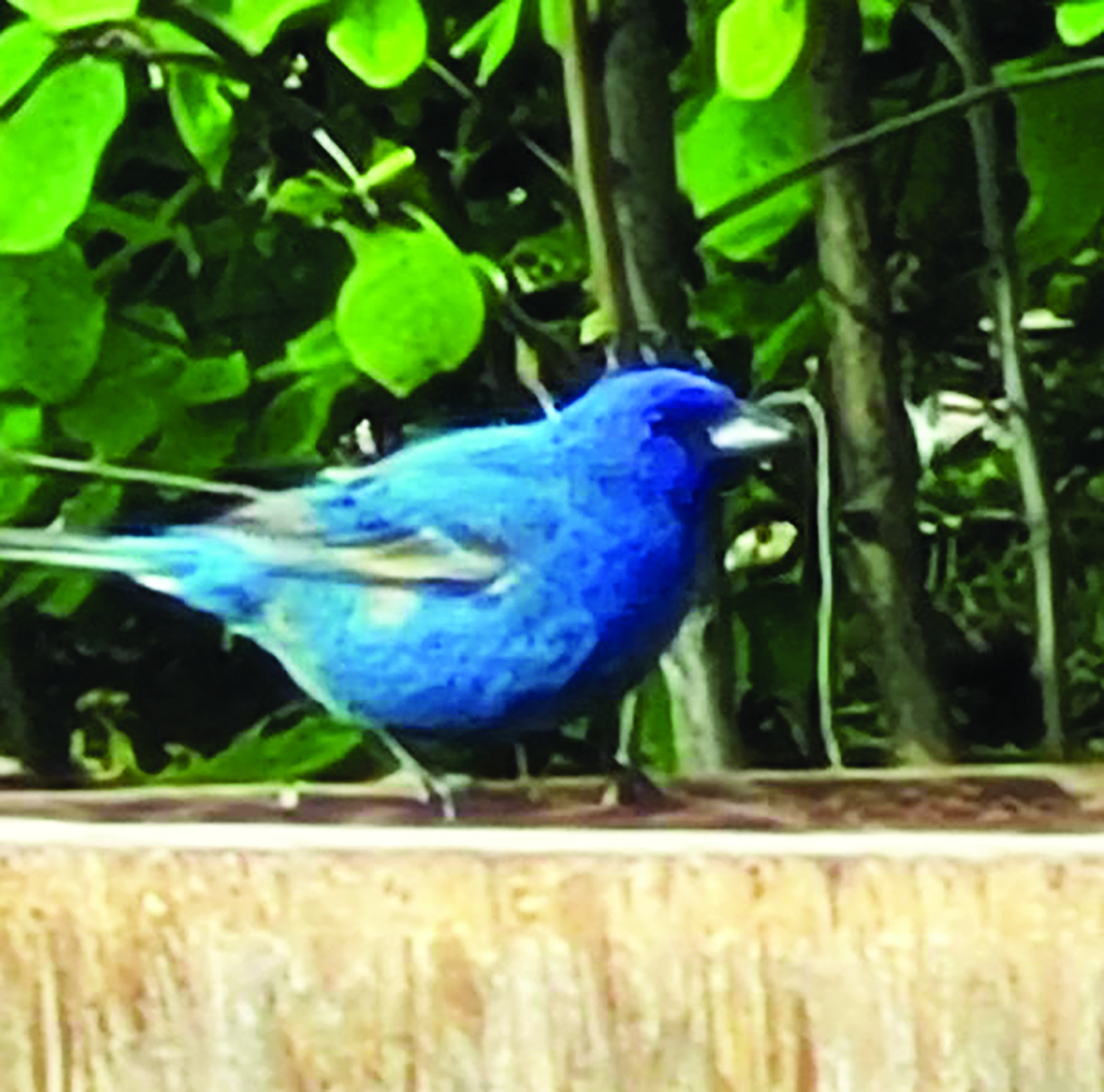
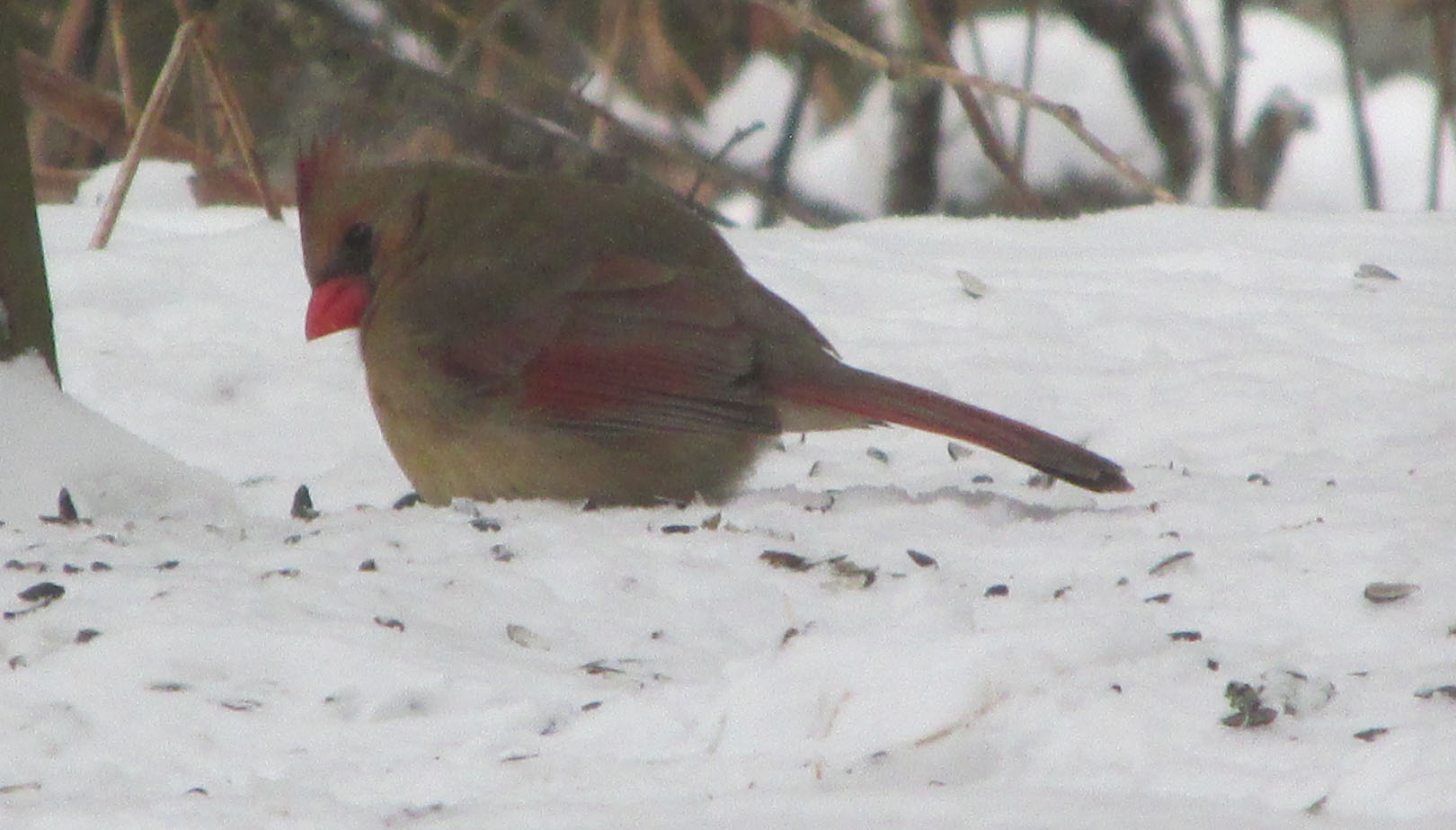
Photo by Bryan Stevens • A female Northern cardinal forages for seeds in the snow.


Elizabethton Bird Club announces speakers for fall programs

Brayden Paulk will speak to the Elizabethton Bird Club on Sept. 3 on the topic of microfishing.

The Lee and Lois Herndon Chapter of Tennessee Ornithological Society, also known as the Elizabethton Bird Club, will soon begin its schedule of monthly meetings for 2024-25.

The brief business meetings are always accompanied by an informative and entertaining program on birds, birding or other subjects from the natural world.

These programs are a great way to learn more about our feathered friends as well as other related subjects from the natural world. They are free, open to the public and hosted by a welcoming group of people.

Here’s the schedule for Fall 2024:

September

Brayden Paulk, a young naturalist with family ties in Unicoi County, will present the first program on Tuesday, Sept. 3, with a talk on “Microfishing,” which involves anglers focusing on a diverse array of tiny species of fish.

Paulk has also been working as a naturalist with Lamar Alexander Rocky Fork State Park this summer and fall. He gave a program a couple of years ago for the club on “Trash Fishing,” which explored other angling options other than the typical gamefish species. As both fishing and birding are among his interests, he will no doubt find a way to work something into his program about birds.

October

The guest speaker for the meeting on Tuesday, Oct. 1, will be Mark Stevens. A former publisher for The Erwin Record, he will present a program titled “Building a Birding Festival” that will focus on his development of the Hammock Coast Birding Festival in South Carolina. Stevens, who works as tourism director for the Georgetown County Chamber of Commerce, will be giving the program remotely from his home in South Carolina, but the hybrid meeting also offers a chance to attend in-person with other birding enthusiasts. The festival is organized by the South Carolina Hammock Coast, the marketing arm for the Georgetown County Chamber. The third annual Hammock Coast Birding Festival is scheduled for Feb. 6-9, 2025.

November

Vern Maddux, the treasurer for the club, will be the speaker on Tuesday, Nov. 5. Maddux is a world traveler when it comes to seeing birds and will present a program on one of his recent international birding adventures to South Georgia and Falklands. South Georgia is a mountainous barren island in the South Atlantic Ocean, 800 miles east-southeast of the remote South Atlantic archipelago that makes up the Falkland Islands. With rugged terrain and cliff-lined coasts, the hundreds of islands and islets in the Falklands are home to sheep farms and abundant birdlife.

December

In the busy month of December, yours truly will give the program. I will present a powerpoint presentation titled “What’s in a Name?” on North American birds named after people. Among our native birds, we have quail, woodpeckers, sparrows, finches, warblers, hawks and other birds are known by names of historical figures ranging from John James Audubon to William Clark and Meriwether Lewis.

My program will be held on Tuesday, Dec. 3. I will discuss the American Ornithological Society’s decision in 2023 to end what are known as eponyms, in which species names honor people. The renaming of dozens of species will be a gradual process.

The club’s 2025 schedule has not been completed, but will include a program by local naturalist Lewis Tester in the spring on dragonflies.

The public is always welcome to attend these programs. Programs begin at 7 p.m.

The club meets at the Elizabethton campus of Northeast State Community College in Room 135 when the school’s schedule permits. When school is not in session, meetings are held on Zoom or at other announced locations. To receive updates on the club’s schedule, events and activities, email elizabethtonbirtdingclub@gmail.com and ask to be placed on a free mailing list.

The Elizabethton Bird Club holds seasonal birds count in spring, summer, fall and winter. The club also organizes and sponsors regular field trips to destinations through Northeast Tennessee. These activities are also open to interested members of the public.

•••

To share a sighting, make a comment or ask a question, email me at ahoodedwarbler@aol.com.

Native wading birds wander widely in late summer


Photo by Bryan Stevens • A great egret captures a frog from a pond’s edge in South Carolina.

The fish pond at my home has attracted a stalker. Amid the cattails and beneath the drooping branches of tall bald cypress trees, a lurking great blue heron has patiently been stalking fish, frogs and anything else that comes within striking reach of the bird’s sturdy dagger-shaped beak.

The heron’s visits have prompted me to dig into my archived columns this week. Please enjoy this column, which was previously published in July of 2019, about summer’s wading birds.

•••

North America’s stately wading birds — egrets, herons, bitterns, ibises and their kin — are well-known wanderers in late summer. As with all birds capable of flight, a pair of strong wings cannot be underestimated. Birds can show up in the most likely places.

Take for instance the first confirmed sighting of an American flamingo in Tennessee. This particular flamingo — an almost unthinkable bird for the Volunteer State — showed up along Highway 78 in Lake County on July 13, 2019.

Ruben Stoll and Alan Troyer found the flamingo, backing up their discovery with photographs of the large pink bird associating with great egrets and other wading birds. The flamingo created considerable buzz on rare bird alerts in several nearby states. Many birders rushed to add this exceptional visitor to their state and life lists.

Photo by Bryan Stevens • White ibises occasionally meander away from the coast in late summer. Immature birds will be brown instead of white.

In summers past, other exciting wading birds ranging from little blue herons to wood storks have excited the region’s birders. I recently celebrated my own sighting of one of these wanderers that made a stop at my fish pond on July 10.

I had stepped outside my house and let the door slam a little too loudly behind me, causing a stately great egret near my fish pond to take flight and fly over the roof of my house. I regretted instantly not having a camera with me.

Two days later, I got another chance. The great egret made another appearance. Unfortunately for the tall bird, he attracted the ire of the resident red-winged blackbirds. In a most inhospitable manner, the blackbirds attacked and dived at the egret, which made some awkward attempts to evade the angry blackbirds. Blackbirds are protective of their territory and have swooped at me several times when I’ve ventured too close to their favored cattails.

More prepared on this occasion, I had my camera with me and managed to get a few photographs of the egret.

The next day, only a few miles from my home, Lauri Sneyd Vance took a photograph of a great egret that stopped at her home in Limestone Cove in Unicoi County, Tennessee. Having seen my Facebook post, she notified me that she had also received a visit from an egret. Was it the same bird? Perhaps.

Oddly enough, the bird is actually the second great egret to visit my fish pond. The first one made an unseasonable stop several years ago on a snowy December afternoon — hardly a time of year I might have expected a visit from an egret in the mountains of Northeast Tennessee.

The great egret stands 3.3 feet tall. With an all-white plumage, a long yellow bill and dark legs, this egret is often described as graceful and elegant. Its likeness was incorporated into the logo for the National Audubon Society, an organization formed to protect egrets and other wading birds from a wanton slaughter in the late 1800s when millions of the birds were killed so their feathers could be used in women’s fashions.

During the breeding season, adult great egrets sprout long plumes on their back. These frilly feathers are known as aigrettes, which are used to attract the attention of prospective mates in elaborate mating displays.

According to the All About Birds website, great egrets feed mostly on fish, but they also eat amphibians, reptiles, rodents, songbirds and crustaceans. On visits to the South Carolina coast, I’ve observed great egrets dining on frogs and small fish. In prime habitat, flocks of great egrets will gather to forage together in wetlands or around ponds. More sociable than some herons, great egrets also nest and roost communally.

The other North American egrets include snowy egret, reddish egret and cattle egret. Other egrets found around the world include the intermediate egret, little egret, slaty egret, black egret,dimorphic egret and Chinese egret.

As summer advances, keep your eye on area rivers, lakes and ponds. It’s the best time of year to see egrets, herons and other long-legged wading birds. In the case of the American flamingo, I realize that lightning rarely strikes twice, but if you do happen to see a gangly pink bird, let me know.

•••

Share sightings, ask questions or make comments by emailing me at ahoodedwarbler@aol.com.

Photo by Bryan Stevens
A Great Blue Heron moves stealthily through a wetland.

Indigo buntings speak to the summer season

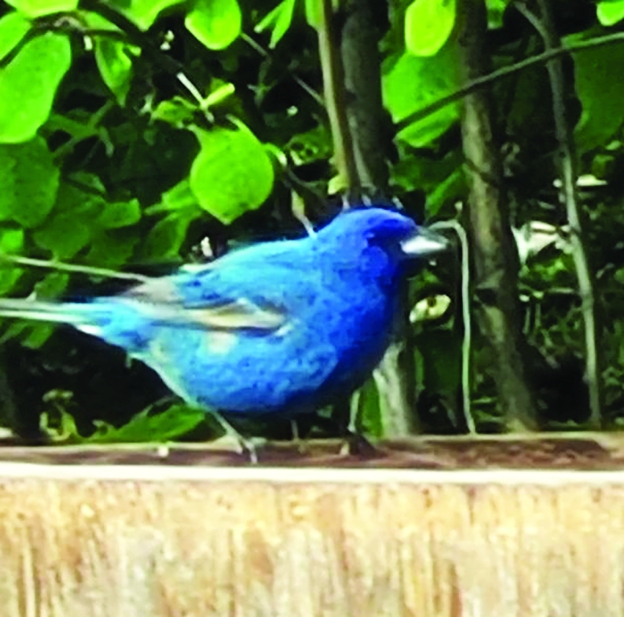
Photo courtesy of George Stone • Indigo buntings range from southern Canada to northern Florida during the summer months, occasionally even expanding beyond this wide range.

George Stone emailed me after finding my weekly bird column online.

“I live approximately 90 miles west of Edmonton, Alberta, Canada,” he wrote in his email. “This morning (June 6) I had my first ever sighting of an indigo bunting at my feeder!”

He also asked a question, wanting to know if indigo buntings are rare in his location in Canada.

I did some digging online and found that indigo buntings range from southern Canada to northern Florida in the summer. I relayed this information to George in a reply to his email, congratulating him on his sighting.

I informed him that I reside in Northeast Tennessee, close to the borders with Virginia and North Carolina. I also told him that in summer, indigo bunting is not rare at all here in Northeast Tennessee. I saw and heard several while doing a summer bird count on June 8 in the Limestone Cove community of Unicoi County.

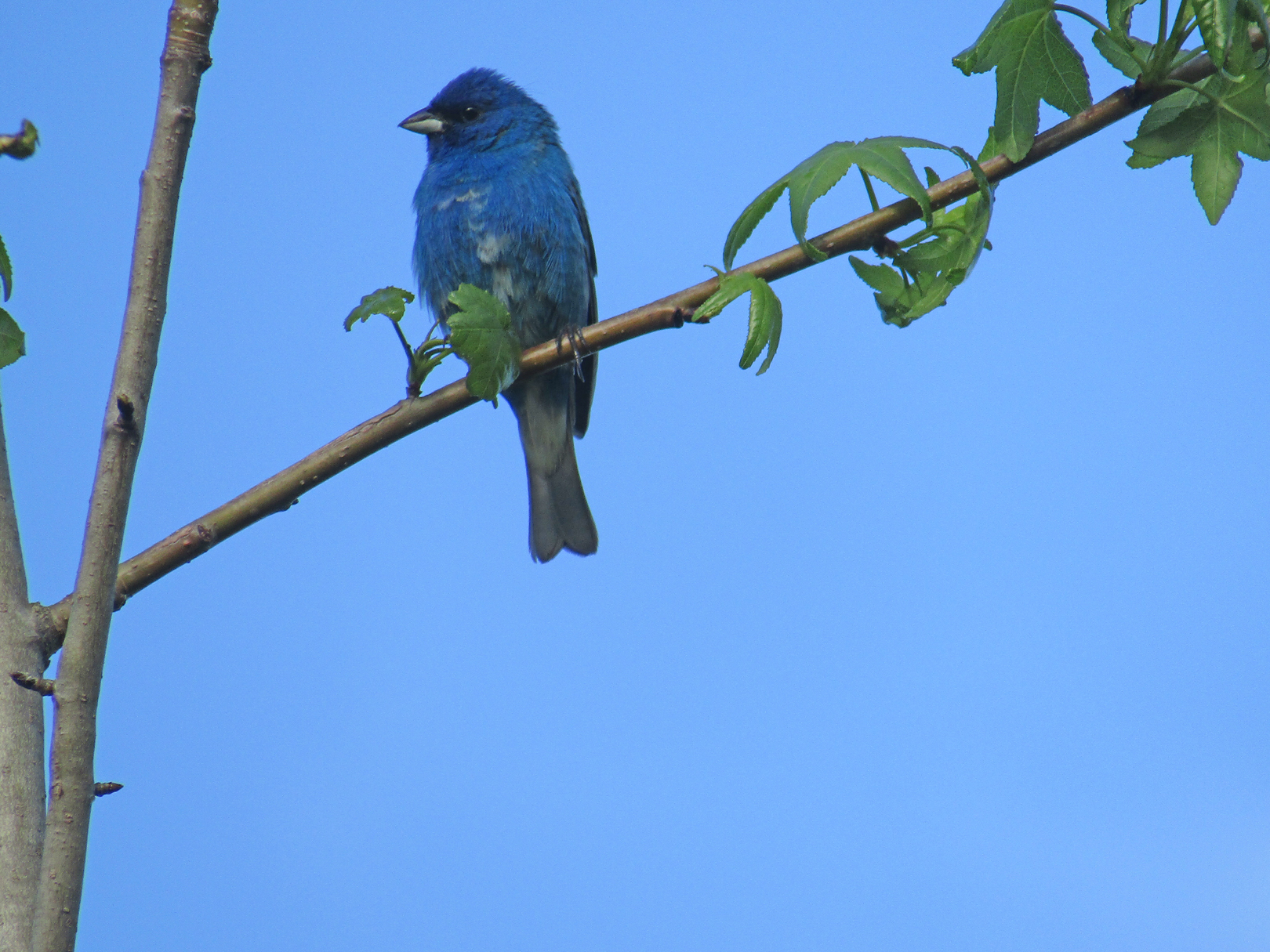
Photo by Bryan Stevens • The male indigo bunting is a resplendent bird.

The male indigo bunting is the only solid blue bird in the eastern United States, but it’s all an illusion — literally a trick of the light. The indigo bunting’s feathers are not really blue; the male’s brilliant azure plumage is caused by the process of diffraction of light around the structure of the bird’s feathers. This process scatters all but the blue light, and the resulting color shifts from black to blue to turquoise as the angle of reflected light changes. In bright light, it can even look unnaturally vivid blue. In poor light, however, an indigo bunting male can appear black. Fortunately, indigo buntings have both a characteristic body shape and song, so even if the birds are not seen in their best light, they can still be recognized.

For such a bright blue bird, indigo buntings are not easy to detect. Males like to find an elevated perch and sing to proclaim their territory and pitch their availability to potential mates. Learn the song, which consists of a burst of jumbled, high-pitched notes, and use that knowledge to help pinpoint singing males. Once you zero in on the singing bird’s location, it’s easy to focus binoculars and enjoy peeking at such a pretty bird.

The indigo bunting belongs to a genus of birds known as Passerina, which is included the family Cardinalidae, which includes birds like Northern cardinal and rose-breasted grosbeak. They are often lumped into a group known as North American buntings, although they are not closely related to such birds as snow bunting and lark bunting. The latter is even recognized as the official state bird for Colorado, a unique honor for this group of birds. The other members of the Passerina genus include lazuli bunting, varied bunting, painted bunting, rose-bellied bunting, orange-breasted bunting and blue grosbeak.

Photo by Bryan Stevens • Newly-returned neotropical migrants, such as this Indigo Bunting, increased the total number of species for the annual spring count.

Worldwide, other birds known as buntings include such descriptively named species as slaty bunting, corn bunting, white-capped bunting, gray-necked bunting, cinereous bunting, lark-like bunting, cinnamon-breasted bunting, chestnut-eared bunting, little bunting, yellow-throated bunting, golden-breasted bunting, black-headed bunting, red-headed bunting and yellow bunting.

For me, the indigo bunting has always been a bird of the summer season. Not even the heat of mid-day tires out a persistently singing male indigo bunting. They linger into the early October, but later in the season the bird begin to molt feathers and take on a more shabby look. Enjoy them while they’re here.

•••

To ask a question, make a comment or share a sighting, email me at ahoodedwarbler@aol.com.