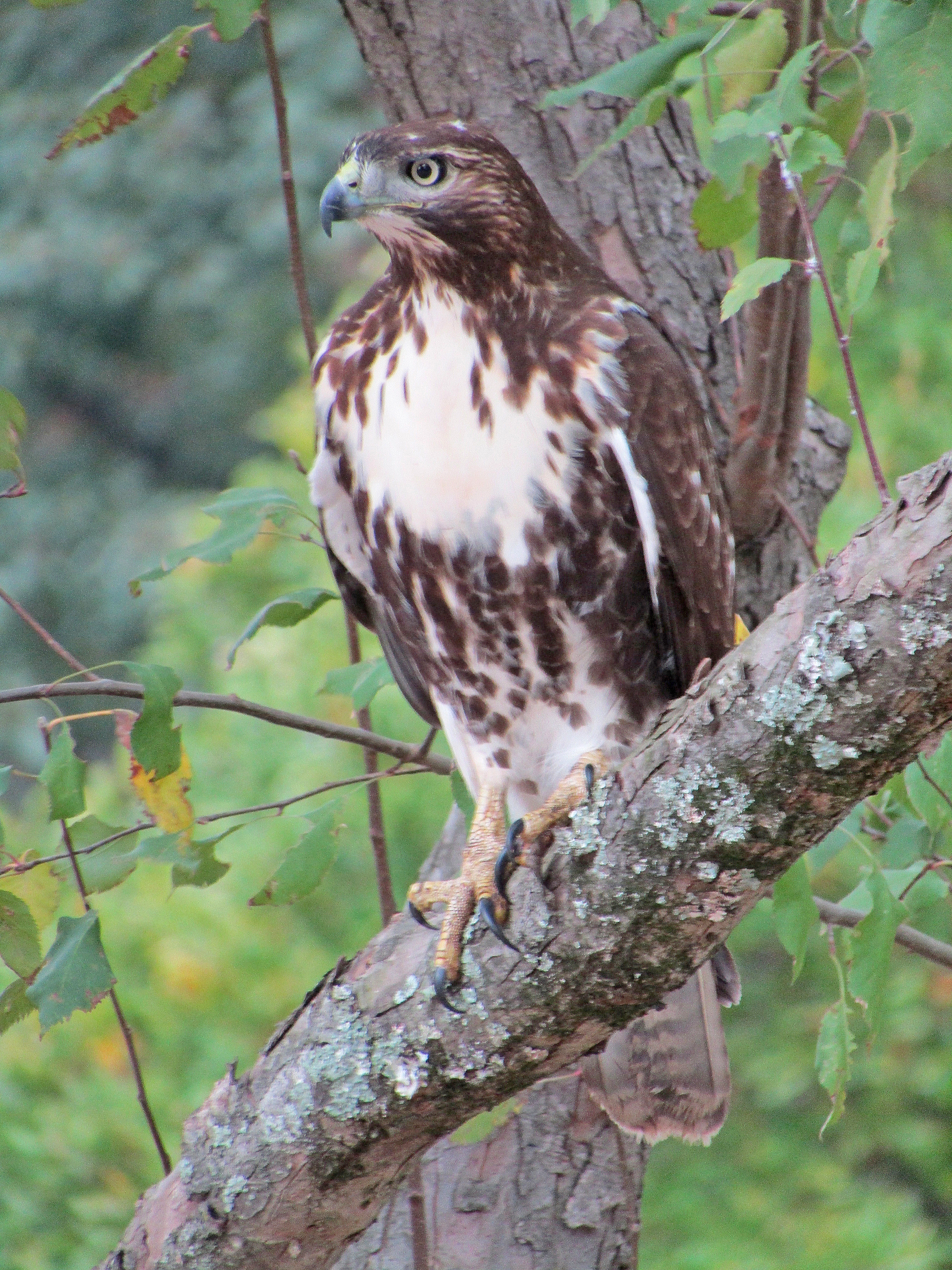
Category Archives: Erwin Record

BRR!-ding: Couples tackle the deep freeze of northern Minnesota for hard-to-find species

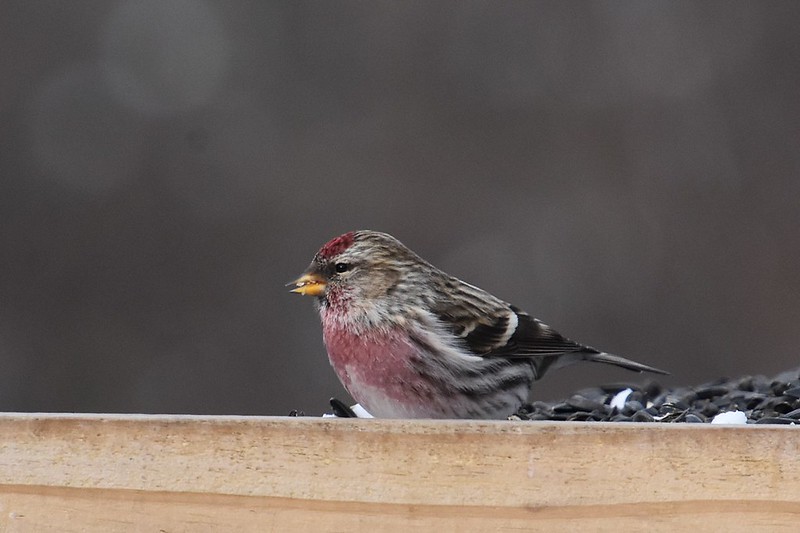
Jean Potter • A redpoll at a feeder in Sax-Zim Bog in Minnesota.

Like postal carriers, birders endure the elements, including snow and cold. Elizabethton couple Brookie and Jean Potter took this up a notch during a sub-zero birding expedition to northern Minnesota back in January to expand their list of life birds.

They were accompanied by another Elizabethton couple, David and Connie Irick. While coping with temperatures far below zero with a recorded wind chill of -34 degrees Fahrenheit, the Potters managed to add five news species to their life lists. The Iricks saw nine new species.

They enjoyed three full days of birding from Jan. 19 to Jan. 22, but it took two days of driving each way. They left Tennessee on Saturday, Jan. 17, and returned Jan. 24.
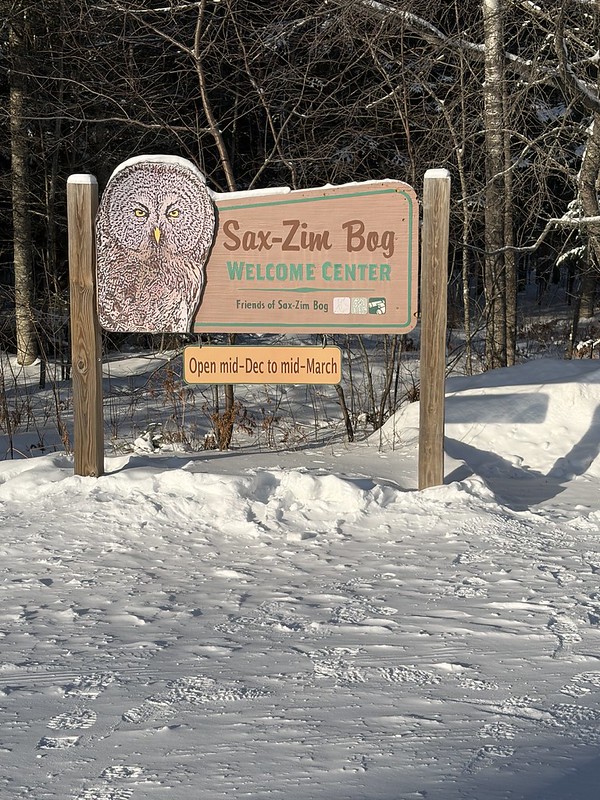
Photo by Jean Potter • Sax-Zim Bog offers specialty habitats for cold-weather species.

I’ve been friends with Brookie and Jean, and birded with them, since the late 1990s when I visited their home to observe a nesting great crested flycatcher. They’ve traveled the country to add species to their growing life lists.

They have long had a bucket list target of seeing 500 species, according to Jean. With their recent excursion to Sax-Zin Bog in northern Minnesota, they surpassed this goal.

Sax-Zin Bog is about an hour north of Duluth, Minnesota, and Lake Superior. It’s also about 100 miles north from Minneapolis.

“It’s a very popular winter destination for birders,” Jean said. “It offers cold weather habitats you can find anywhere else.”

Those habitats attract some specialty birds, including Northern finches, several owls and some other hard-to-find birds.

Their five new bird species were: Northern hawk-owl, boreal chickadee, Northern shrike, Canada jay and black-backed woodpecker.
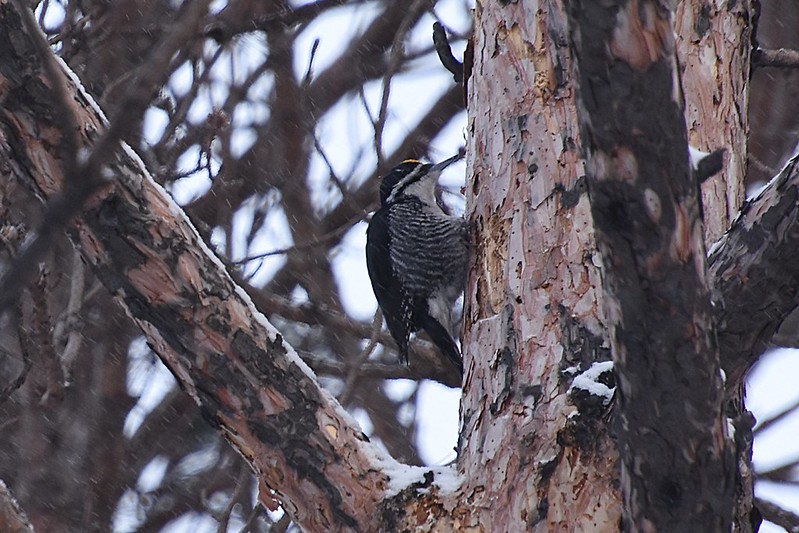
Photo by Jean Potter • A black-backed woodpecker spotted in Minnesota by two visiting couples from Tennessee.

Some of their target birds failed to appear.

“We hoped to see a great gray owl and boreal owl, but this year they were not present,” Jean noted. “They had an irruption there last year.”

A bird irruption is a large-scale southward migration of northern-breeding birds (finches, nuthatches and owls) moving far beyond their typical winter range. Triggered by food scarcity in the boreal forest, these massive, sporadic movements often bring unusual species to unexpected locations.
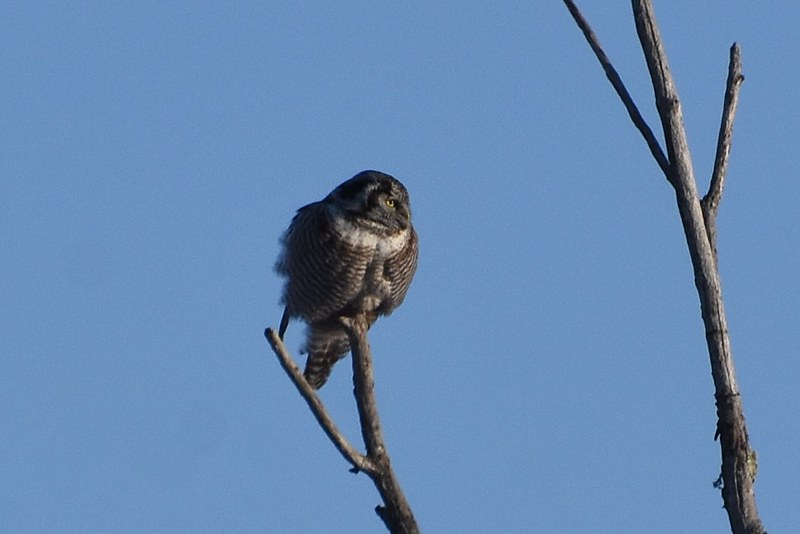
Photo by Jean Potter • The trip to Sax-Zim Bog produced sightings of two individual Northern hawk-owls.

They did see short-eared owl and the Northern hawk-owls.

“We saw a total of 25 species, and we were very happy with it,” Jean said.

She added that most the birds were different than what they would normally see in Northeast Tennessee in winter.

They’re used to getting 100 species on some of their birding trips.

“It was quality over quantity,” Brookie said of their January trip to Minnesota.
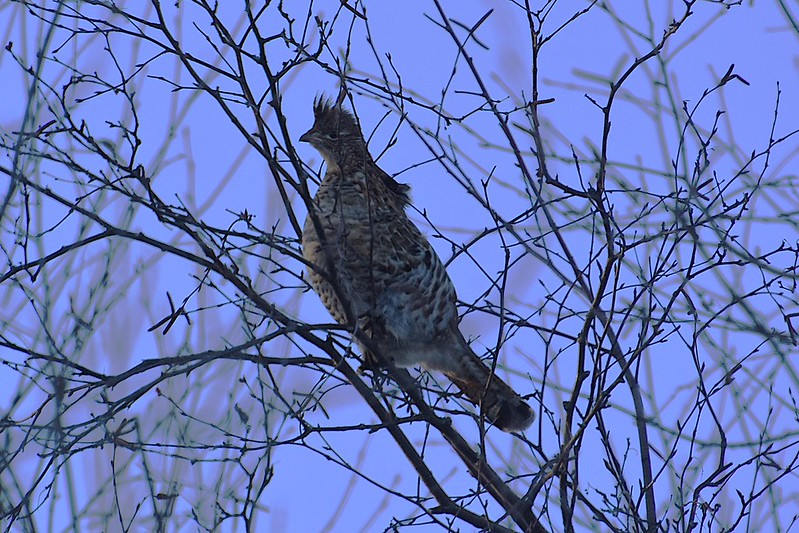
Photo by Jean Potter • A ruffed grouse in the branches of a tree.

The same five species that were new for the Potters were also new to the Iricks. The Potters, however, had already seen in different locations four other birds that were new for the Iricks.

David and Connie also added Northern goshawk, black-capped chickadee, pine grosbeak and redpoll to their life list.

Birds that are rare in winter here were common there.

We had tons of evening grosbeaks,” Jean said. “People put out feeders in the bog. There are houses located in the bog. There is also a welcome center.”
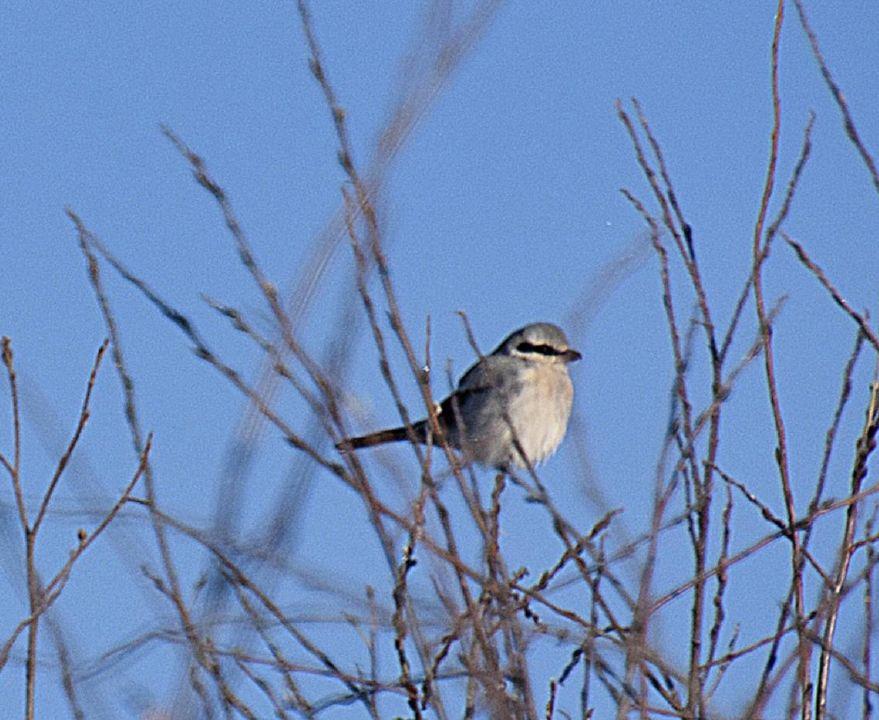
Photo by Jean Potter • A Northern shrike spotted at Sax-Zim Bog.

At some stops, they saw as many as 75 evening grosbeaks at a time crowded around some of the feeders.

“The owners used big buckets to fill up feeders,” Brookie said.

They found all their birds in the 300-square-mile Sax-Zim Bog, except for the black-backed woodpecker.

The woodpecker they found in Superior National Forest in Duluth.

“We went looking for it on the boardwalks in the bog, but we met some other birders and a woman told me that she had got it the day before,” Jean said.

She wrote down the coordinates provided by the woman, who guaranteed they’d see the woodpecker.

“We drove snow-covered roads in big pine forests to find it,” Brookie said.

“A big truck had the road blocked with a module home,” Brookie added. From the backseat, Connie Irick actually saw the bird while their vehicle was stopped and alerted everyone to its presence.

Contributed • Brookie and Jean Potter on a snow-covered boardwalk at Sax-Zim Bog.

“It stayed there and we studied it for awhile,” Brookie said.

Birding in such extreme temperatures took some adjustment.

“The first day we were there, our endurance was tested,” Jean reported. “We got up well before sunrise. It was -16 degrees and a windchill of -34.”

Most of their birding was done from inside a vehicle.

She reported that they were prepared, clothing wise. “But it was still a shock,” she added.

“All the roads were white. No blacktop,” she explained. “We had a four-wheel drive. They had well-maintained roads. The land is flat, so that helps.”

The big challenge when driving was avoiding snow-covered ditches.

“We saw a truck stuck in a deep ditch,” Jean said. “People in trouble got into ditches at turn-offs.”

They did venture outside of the car occasionally.

“We walked half-mile on the boardwalk in sub-zero weather,” Jean said. “That was about the longest we were outdoors.”

They also birded outside of Sax-Zin Bog.

“We drove through the North Woods of Wisconsin and saw Rough-legged Hawks,” Jean said.

“We could see Lake Superior, but it was frozen,” Jean said. “It just looked like a big white field.”

They might have seen more, but they had to cut the trip short.

“We had to come home a day early to get ahead of Winter Storm Vern,” Jean said.

They stayed in Hibbing, Minnesota, a town northwest of the bog.

They ate their meals in Cotton, Minnesota.

“It just had gas station and a restaurant called Wilbert Cafe,” Brookie said. “It had a good variety of home-cooked food.”

Jean added, “We met other birders from all over. Everyone comes here at the coldest time of the year.”

Brookie added, “The manager said birders keep the restaurant going in winter.”

Brookie also noted one other pertinent fact. “Bob Dylan was raised in Hibbing, Minnesota,” he said.

Sax-Zin Bog has no bathroom facilities, other than Port-o-johns, so the restaurant also provided restrooms.

Dealing with the cold was simple.

“We had Arctic coats and boots, and we dressed in many layers,” Jean said. “It was a challenge just to use a camera in my heavy gloves. I didn’t take as many pics as I normally do.”

They did most of their birding in daylight hours, but they did venture out after dark to look for owls.

“We were so proud to get Northern hawk-owl on our first day,” Jean said.

They also spotted a second of these owls in another part of the bog.

“We saw ruffed grouse in the trees,” she said.

Spruce grouse and sharp-tailed grouse had been target birds, but like the great gray owl they never showed themselves.

“We missed Bohemian waxwings,” Brookie said. “We might have gone looking for them if we’d had one more day. There was a report of them near Lake Erie.”

They found the landscape of northern Minnesota interesting.

“I saw enough windmills to last me a lifetime,” Brookie said.

“I added four new states: Wisconsin, Illinois, Indiana and Minnesota,” Jean said, noting she has now visited 35 states.

Brookie has visited 36 states. He was stationed in San Diego, California, during his time in the U.S. Marine Corps in the Vietnam Era, which gives him one more state than his wife.

Jean, who likes lighthouses, did see one from the car near Lake Superior.

They would have liked to have seen a couple of mammals that reside in that region.

Brookie wanted to see pine martens while Jean hoped to see a snowshoe hare, but those will have to wait for a future trip.

They also traveled past Monoquet, Indiana. “We passed hundreds of sandhill cranes in that area, but we didn’t stop,” Jean said.

By the time they departed, they were handling the cold like pros.

“On that first day, I wondered what in the world am I doing here?” Jean said. “But by the time we left, I figured we can do it again some time.”


Feathered harbingers: New bird sightings prove spring is here

Photo by Bryan Stevens • The American robin is widely hailed as a harbinger of spring.

Crocuses are blooming, spring peepers are peeping and the birds are starting to feel the approach of spring. Increasing daylight helps trigger changes among many of the birds that are widely considered signs of spring.

Among the other harbingers of the season are several species that have gained reputations for signalling the transition from winter into spring by their presence alone.

Here are some of the top candidates among our feather friends for the honor of being a genuine symbol of spring’s imminent arrival.

American robins
Robins are widely considered harbingers of spring. They appear to become more common overnight, but for the most part, it’s only a shift in behavior.
While robins are present in winter, they shift from eating berries in large, quiet flocks to foraging for worms on lawns in smaller groups as the ground thaws. With increasing daylight, they also begin to feel the urge to partner with potential mates. The robin’s song, often interpreted as “cheerily, cheer up,” is a distinct sound of early spring and is used to signal availability to those prospective mates.

Photo by Bryan Stevens • Wilson’s snipes return to much of their range in early spring.

Wilson’s snipe
The snipe, a type of shorebird, is a real bird despite a common belief that this bird, the subject of futile snipe hunts, is mythical. Haunting wetlands with their distinctive “winnowing” (drumming) courtship flights, they are heralds for the advancing spring season. These migratory, long-billed shorebirds typically reappear in marshy areas and wet pastures in early spring, often arriving by early March to begin breeding in northern regions. While some individuals may winter in warmer parts of the United States, their widespread arrival and intense courtship activity are widely recognized as a sign of spring.

American woodcock
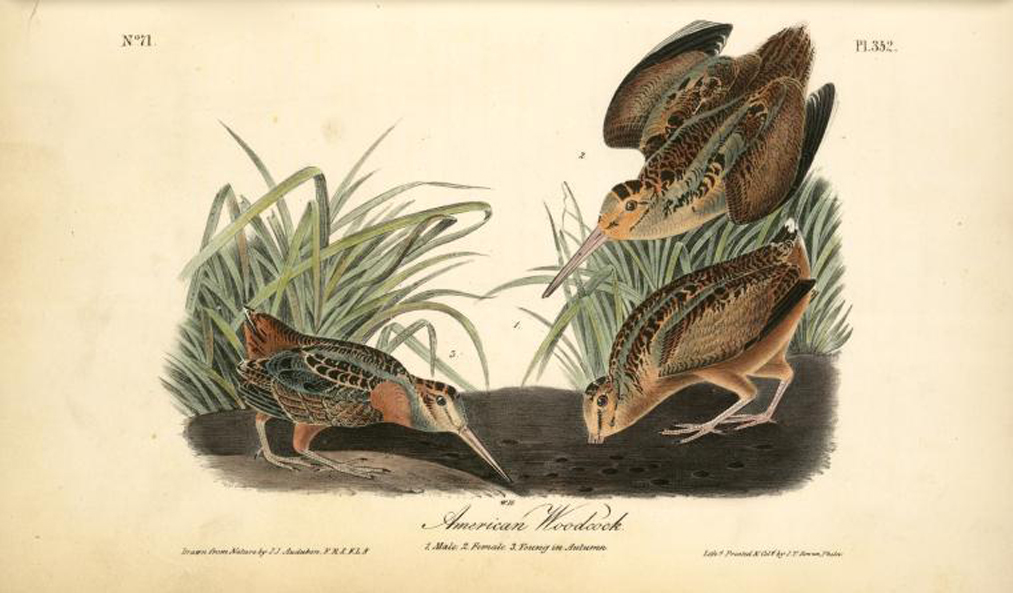
A snipe relative, the American woodcock is a premier, early-spring harbinger known for its dramatic “sky dance” courtship displays performed at dawn and dusk, often commencing as early as February or March. On the ground, the male produces a loud, buzzing, nasal sound — frequently described as “peent” — roughly every two seconds. These birds have a long bill equipped with a flexible tip, perfect for foraging for earthworms after the spring thaw has lured them to the earth’s surface. Males put on impressive display flights, using specialized wing feathers to produce a strange twitter as they descend back to earth in wide spirals. Other nicknames for this most unusual shorebird are timberdoodle and bog sucker.

Early American naturalist John James Audubon painted this trio of American woodcocks.

Eastern phoebe
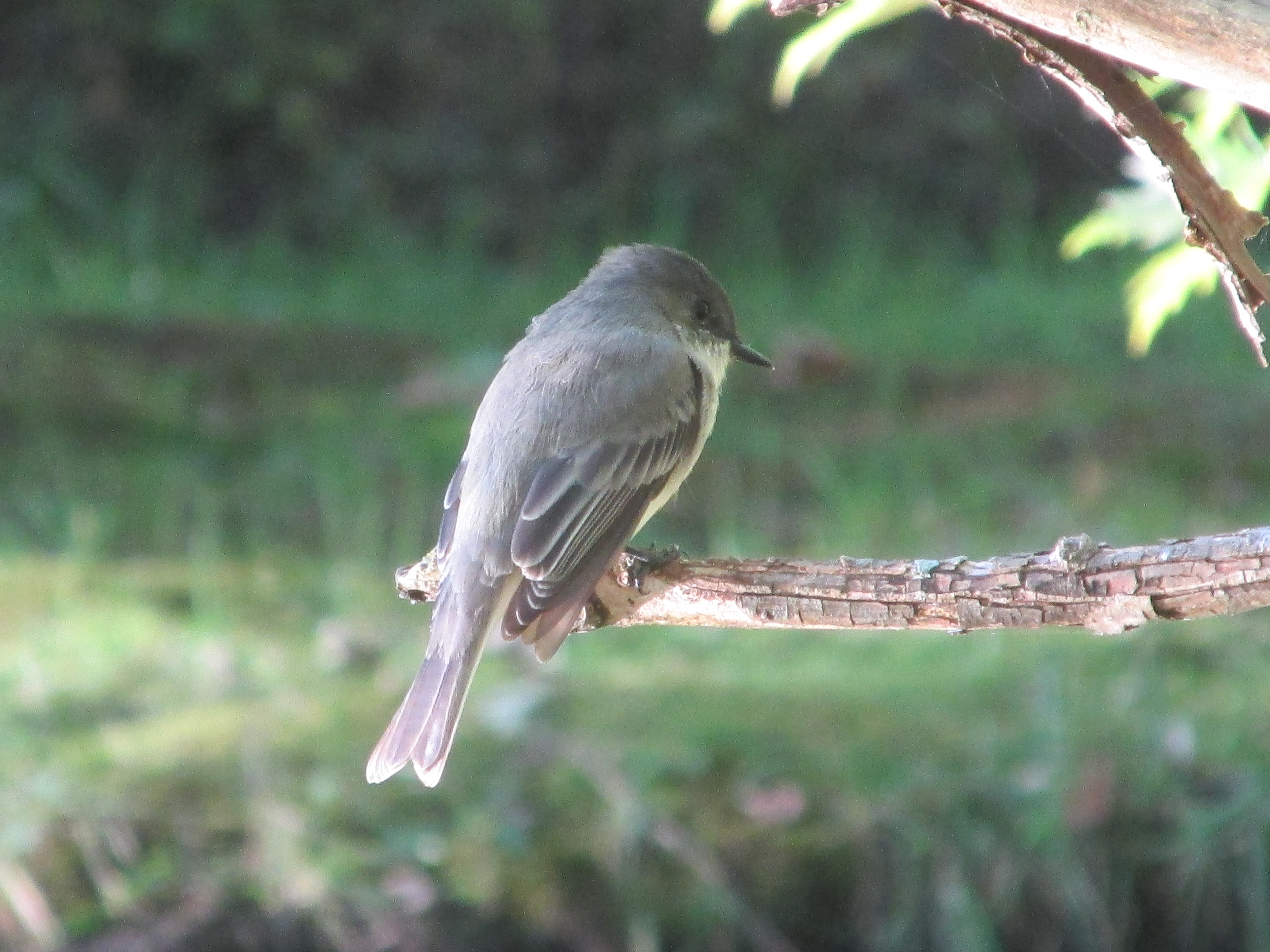
Eastern phoebes belong to the flycatcher family and are among the earliest migratory birds to return to their breeding grounds, often arriving before many other species. Eastern phoebes are more reliable indicators of the actual start of spring migration than American robins because they fly north to catch bugs while robins often overwinter and get a head start without even migrating. Henry David Thoreau detailed spring arrival for many species around Walden Pond in Concord, Massachusetts, in the 1850s. He recorded the Eastern Phoebe arriving in early April and the Eastern Wood-Pewee in late May. Across the migration data for 22 consistently observed species in Concord’s historical bird data, the average timing of spring arrival has not changed significantly from Thoreau’s time to the present. However, there are a few exceptions, such as yellow warbler and Baltimore oriole, that now return to Walden significantly earlier than when Thoreau observed them.

Photo by Bryan Stevens • The Eastern phoebe is a flycatcher and a bird that reliably returns early in the spring season.

Eastern bluebird
Bluebirds are a widely recognized early harbinger of spring, often arriving in northern locations by February or March, signalling the end of winter. Seeing bluebirds in pairs, checking out nesting boxes or perched on low branches in open, rural areas are classic signs of early spring. The well-known writer and naturalist Henry David Thoreau famously wrote that the bluebird “carries the sky on his back,” documenting their arrival as a vital seasonal marker in Northern regions and Canada. Locally, many bluebirds overwinter, but they still begin exploring potential nest locations in early spring, often as early as February.

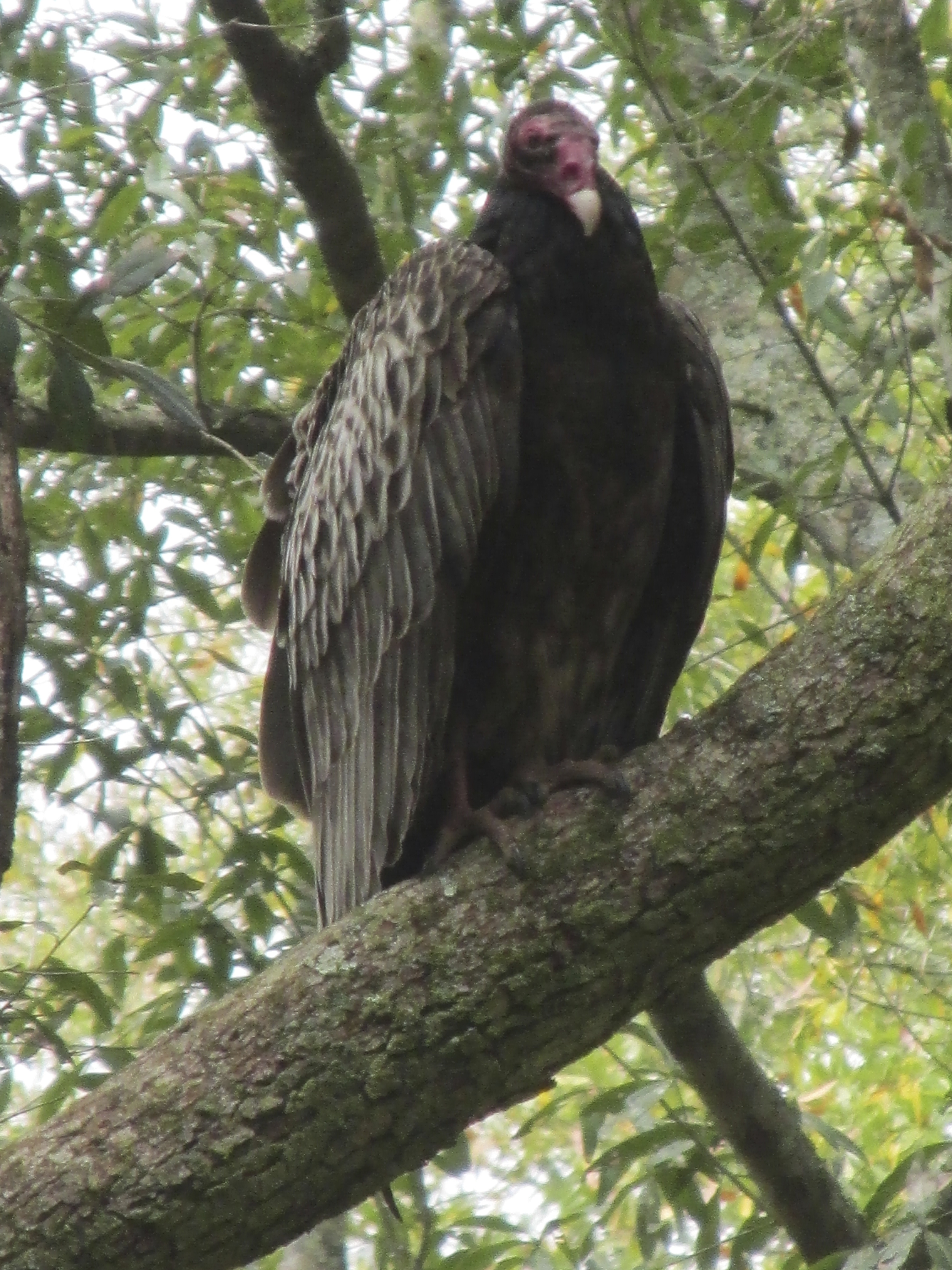
Photo by Bryan Stevens • Turkey vultures are a signal of spring’s arrival in some parts of the United States.

Turkey vulture
The return of turkey vultures is a significant, early sign of spring in many parts of North America, often appearing between February and March. As migratory scavenger birds, they return north to feed on animals that perished during the winter, often appearing in flocks. Hinckley, Ohio, celebrates the annual return of turkey vultures (locally called buzzards) to the Hinckley Reservation every March 15, a tradition dating back to 1957. Known as “Buzzard Day,” this event features a pancake breakfast, vendor fairs and spotter-led viewing of the birds returning to their roosts.

Louisiana waterthrush
Birders usually have to wait until April and May for most warblers to venture back to East Tennessee. The Louisiana waterthrush is a premier, early-arriving harbinger of spring in Eastern North America, often appearing in early March along fast-flowing, wooded streams. Known as one of the first migrant warblers to return, their arrival is signaled by a loud, ringing song that mimics the sound of rushing water. They typically arrive on breeding grounds weeks before many other migrant species, particularly other warblers. The loud, ringing song of the Louisiana waterthrush is often heard near streams before leaves have fully returned to the trees.

Photo by Bryan Stevens • The tiny blue-gray gnatcatcher returns to East Tennessee in late March.

Blue-gray gnatcatcher
This tiny bundle of feathers is an energetic, noisy songbird that arrives in the region in the final days of March. I often hear this bird’s raspy, scolding vocalizations before I detect their nonstop movements in newly-emerged leaves. They don’t arrive quite as early as the other birds on this list, but I’ve always held this bird as one of my personal birds of spring. Once the feisty blue-gray gnatcatcher is back, the spring season can truly commence. The gnatcatcher, which is one of our smallest birds, feeds on more than gnats. The only local birds as comparably small as the gnatcatcher are kinglets and hummingbirds.

What bird do you look forward to seeing again every spring? What’s something provided by nature that provides assurance that spring is just around the corner?

Feel free to write to me to share your answers by emailing ahoodedwarbler@aol.com.


Move over robins: Red-winged blackbird is the real sign of sprinfg

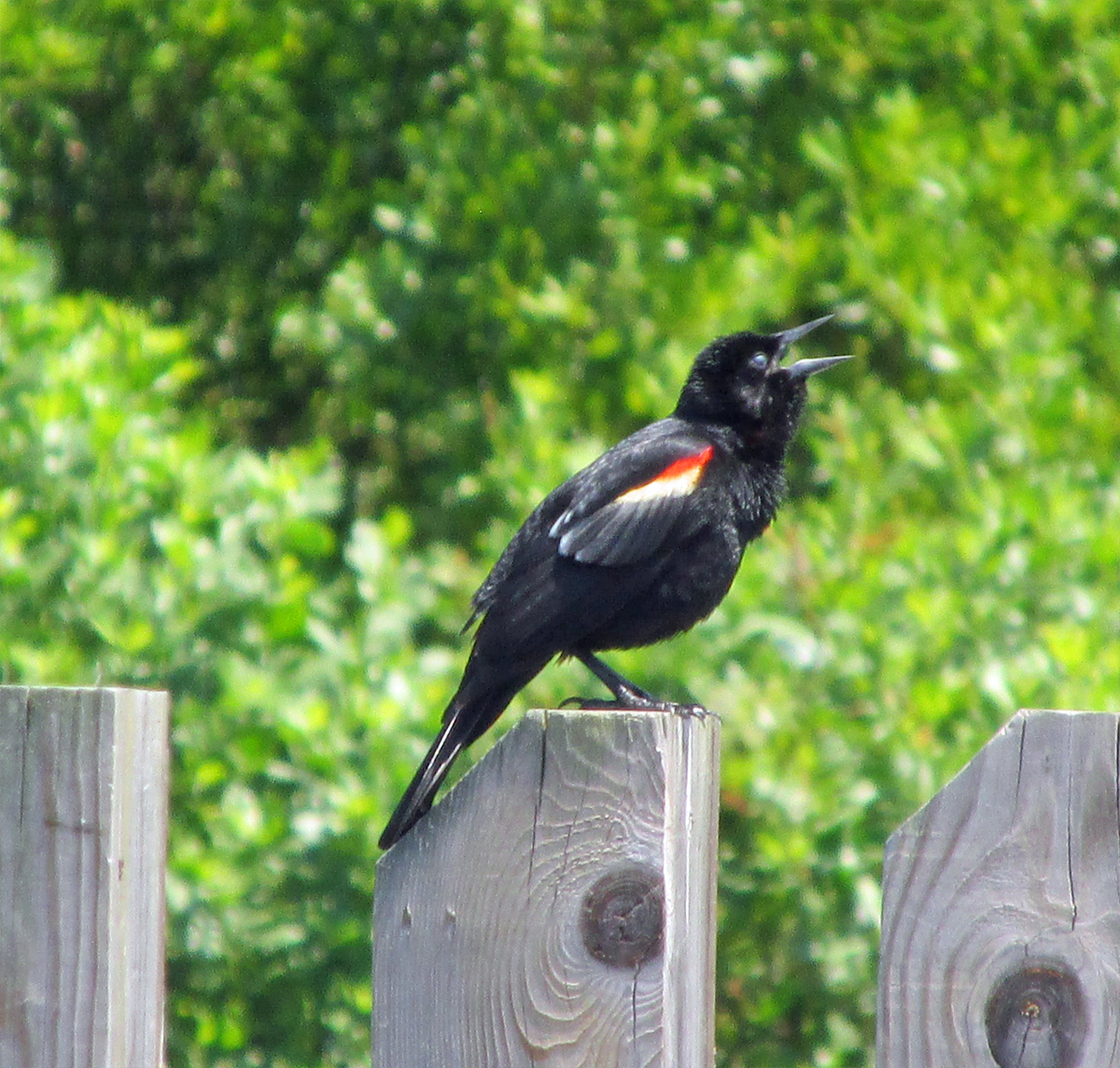
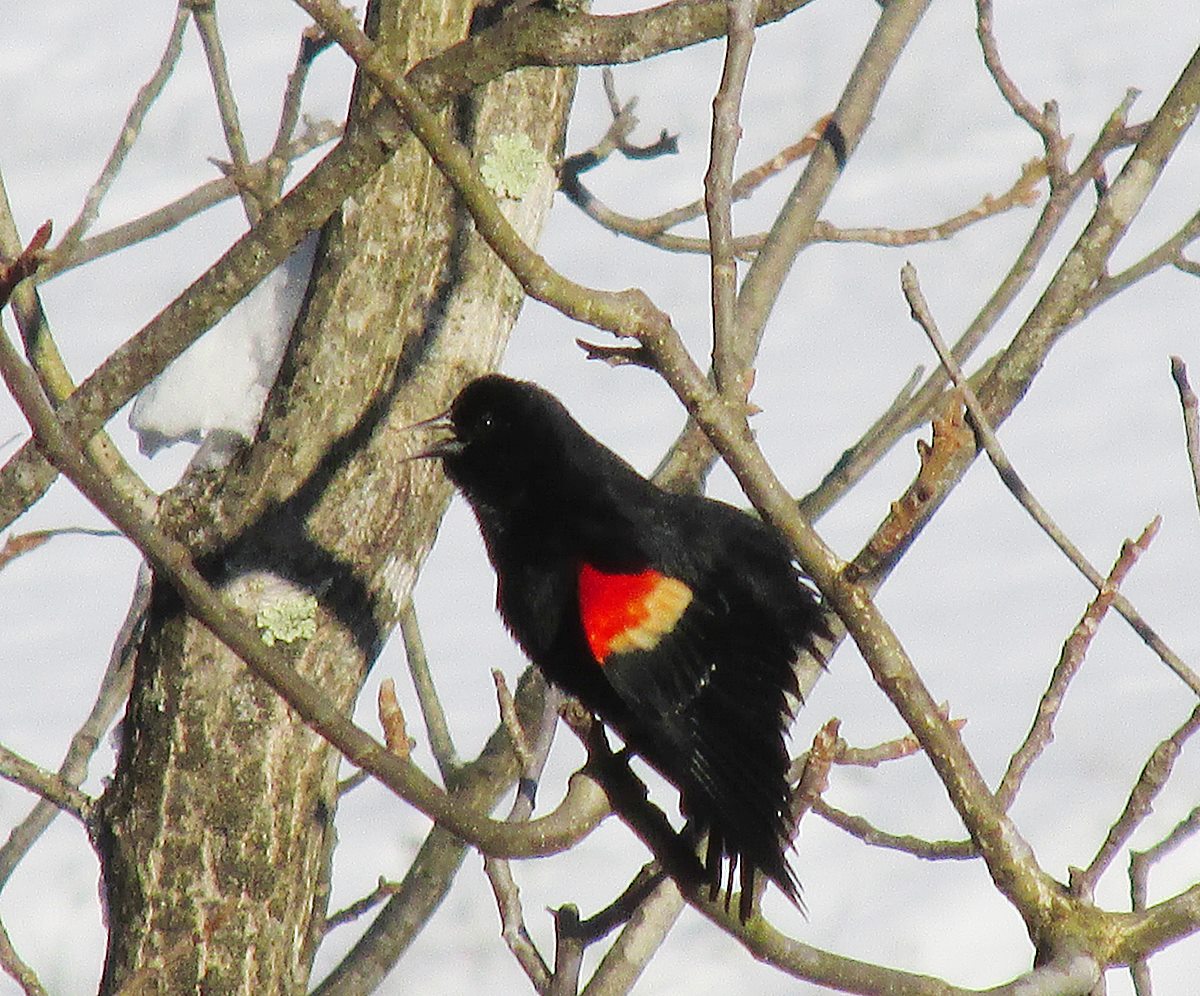
Photo by Bryan Stevens • A male red-winged blackbird sings to attract mates and ward off rivals.

When the red-winged blackbirds put in their first appearance this year, they picked a really bad day to make their return.

I heard the instantly recognizable “konk-ka-ree” vocalization as I walked from the house to my car on the morning of Feb. 22. It didn’t take long to spot the birds making the sound: four male red-winged blackbirds perched atop a cypress tree at the fish pond. The temperature hovered around 21 degrees, snow covered the ground, and a brisk breeze made everything feel even colder.

Despite the miserable weather, I gladly welcomed back the red-winged blackbirds. I imagine that the day improved for the birds as temperatures gradually rose. By the time I got home, the snow that had fallen the previous night had almost melted, but the blackbirds had departed.

Spring is getting closer. The red-winged blackbirds are proof, one that I’m greedily grasping as I continue wishing for warmer weather and more spring arrivals among our feathered friends. Everyone thinks the first American robin is the herald of spring. I’ve always depended on red-winged blackbirds as spring harbingers.

After posting about my sighting of the blackbirds on Facebook, Erwin resident Amy Tipton commented on my post.

“We spotted some in our backyard over the weekend and then again today,” she wrote. “A very welcome sight!”

Bryan Stevens • The male red-winged blackbird has an apt common name.

I’ve long associated red-winged blackbirds as a sign indicating progress toward spring. The visitors I saw recently are probably the vanguard of large numbers of red-winged blackbirds that return in impressive numbers every March.

The showy and loud red-winged blackbirds make themselves at home at my fish pond and adjacent stands of cattails, producing quite a commotion. “The kon-ke-ree song of the male red-winged blackbird is a sure indication that spring is on the way,” according to a profile of the species located at the Tennessee Watchable Wildlife website. At this time of year, the male red-winged blackbirds seek elevated perches to display and vocalize.

Red-winged blackbirds are tied to the rhythms of wetlands. In these environments, they are common birds. In Northeast Tennessee, any stands of cattails in a marshy area is likely to attract at least a few members of this species.

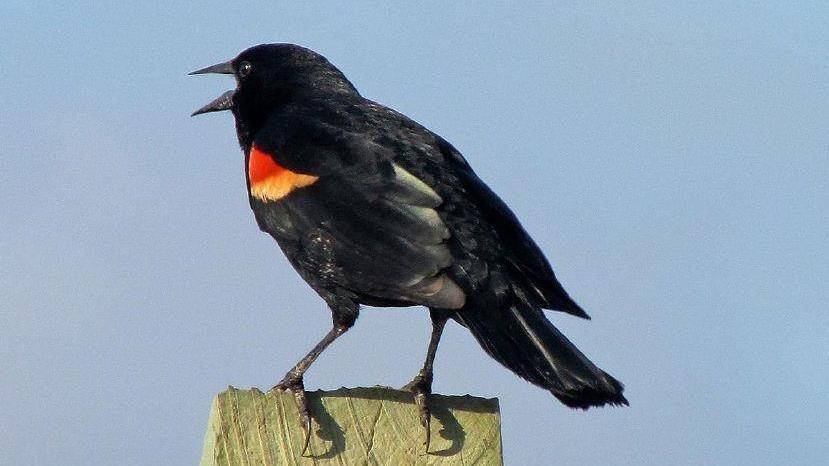
The male red-winged blackbird is a very aptly named. Glossy black males sport red wing patches that are often trimmed with a narrow band of yellow feathers. By contrast, female red-winged blackbirds are mostly brown birds that could easily be mistaken for large sparrows. Both sexes have sharply pointed bills.

Bryan Stevens • A male red-winged blackbird sings from a post.

At my home, red-winged blackbirds are fond of visiting my feeders. They will feast on sunflower, suet cakes, or both when they’re available.

These active, noisy birds apparently love company. Red-winged blackbirds roost in flocks throughout the year, according to the website All About Birds. The website also noted that winter flocks can be especially impressive, consisting of congregations of several million birds, including other blackbird species and starlings.

All About Birds also noted that the oldest red-winged blackbird on record lived to be at least 15 years and nine months old. The bird, originally banded in New Jersey in 1967, was found alive, but injured in 1983. The good news? The bird recovered from its injuries and, in all likelihood, continued to live in U.S. wetlands, adding some more longevity to its lengthy lifespan.

•••

Bryan Stevens has written about birds, birding and birders since 1995. Email him at ahoodedwarbler@aol.com to share a sighting, ask a question or make a comment.


Nuthatches live topsy-turvy existence among fellow backyard birds

The power of flight gives most birds a perfectly valid reason to disregard the law

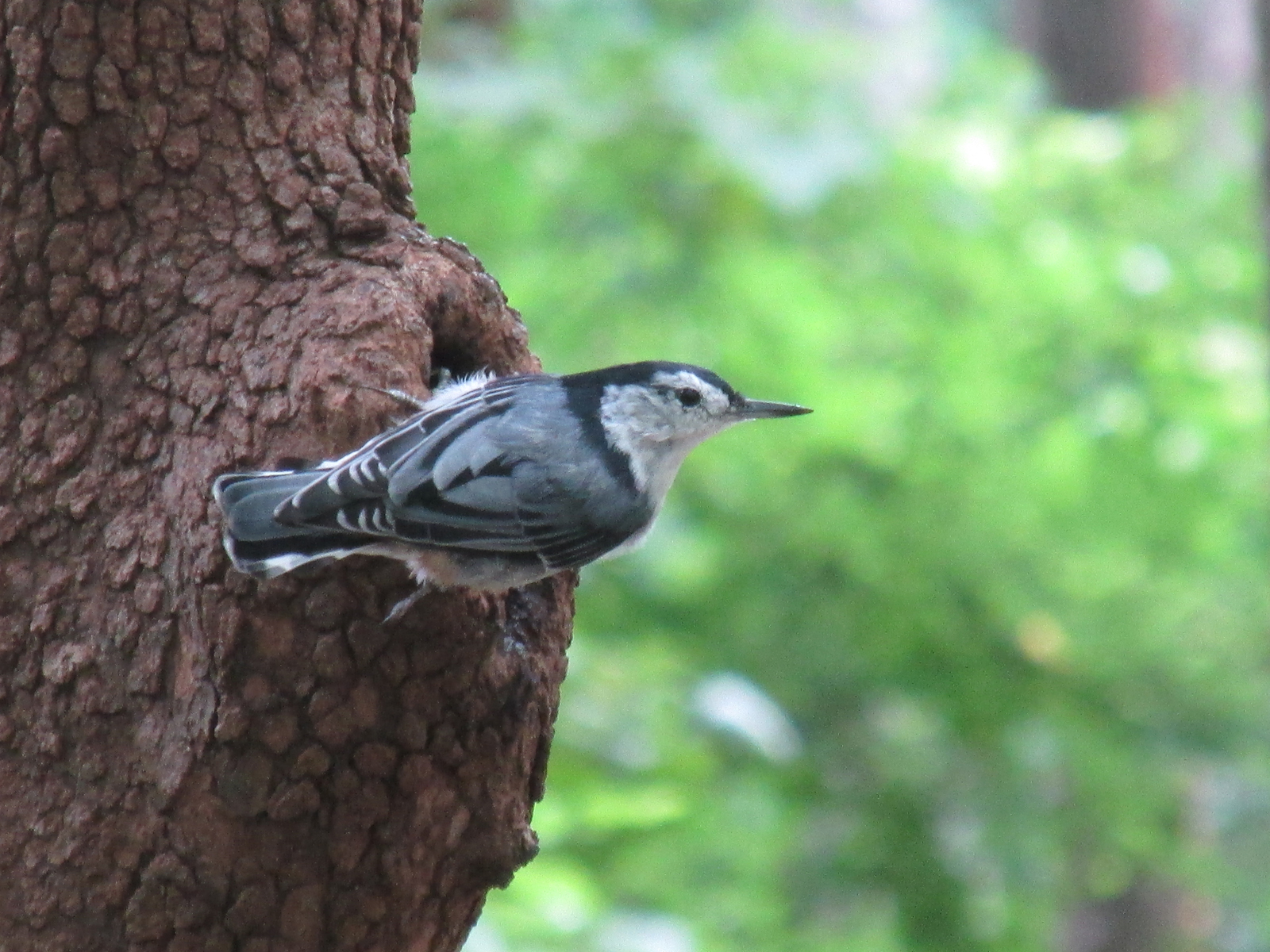
Photo by Bryan Stevens • A white-breasted nuthatch clings to the bark of a tree.

of gravity. A tree-clinging family of birds known as nuthatches live an even more topsy-turvy lifestyle than many other of their winged kin. Nuthatches often prefer a headfirst stance as they search for food in the nooks and crannies of tree trunks and branches.

The United States is home to four species of nuthatches: white-breasted, red-breasted, brown-headed and pygmy. White-breasted nuthatches are probably the most familiar nuthatch to backyard birders in this area.

These birds are named “nuthatch” for the habit of some species to wedge a large seed in a crack and hack at it with their strong bills. I like to refer to them as “upside-down birds” because gravity doesn’t seem much of a factor in their daily lives. They are content to walk headfirst down a tree trunk or probe the underside of a large branch. It must give them an interesting perspective on the world around them.

Photo by Bryan Stevens • A white-breasted nuthatch grabs a single seed from a feeder.

Because of their gravity-defying antics, the white-breasted nuthatch and other members of the family can provide hours of entertainment at our bird feeders. That was certainly the case during the recent bouts of snow, ice and cold temperatures inflicted on our region by successive winter storms.

White-breasted nuthatches will follow a single-minded path along the trunk of a tree or a branch on the way to a feeder. An individual nuthatch rarely varies from this path. It’s amusing to watch the jerky progress along the trunk as this bird prepares for a flight to a feeder holding sunflower seeds or a hanging wire basket of suet.

At my home, nuthatches typically remain aloof from the rivalry always ongoing between the chickadees and titmice. The white-breasted nuthatch is mostly a no-nonsense visitor. Rarely distracted by disturbances among other birds, this nuthatch is content to grab a seed and go or hang on to the wire frame of a suet basket and peck off chunks of suet.

Photo by Bryan Stevens • A window strike left this white-breasted nuthatch temporarily grounded.

The stubby red-breasted nuthatch is another member of the family that occasionally finds its way to our yards. Smaller than the related white-breasted nuthatch and, as far as I can tell, complacent in the company of chickadees and titmice, the red-breasted nuthatch is always a welcome visitor. It has a tell-tale “yank yank” call that it produces when excited that sounds very much like tiny tin horns. The red-breasted nuthatch, perhaps because it spends so much of the year in more remote areas, can also be amazingly tame when it pays a winter visit.

Both of these nuthatches can be attracted to feeders by offering peanuts, sunflower seeds and suet. They are also cavity-nesting birds, but are more reluctant about accepting a nesting box as a place to rear young. They will gladly accept an old woodpecker hole or other natural cavity in a tree.

The brown-headed nuthatch is a specialist of pine woodlands throughout the southeastern United States, favoring loblolly-shortleaf pines and longleaf-slash pines. This nuthatch requires standing dead trees for nesting and roosting. They forage for food, however, on live pines. The birds are more abundant in older pine stands. This small nuthatch is not at all common in the region, but there are some records. I’ve had much better luck finding the brown-headed nuthatch during visits to coastal South Carolina or suburban Atlanta in Georgia. In these southern locations, it can be a quite common bird.

I also want to complete my list of North American nuthatches by adding the fourth species — pygmy nuthatch — to my life list. I have made two trips to western North America, where this species ranges, but haven’t managed to find this bird. Both the pygmy and brown-headed are among the smallest members of the nuthatch family.

On the other end of the size scale is the appropriately named giant nuthatch, which reaches a length of almost eight inches. The giant nuthatch ranges through China, Thailand and Burma. This nuthatch is bigger than a downy woodpecker, another common visitor at backyard feeders in our region.

Photo by Bryan Stevens • White-breasted nuthatches are faithful feeder visitors.

Worldwide, there are about 25 species of nuthatches, some of which have surprisingly descriptive names for birds that spend most of their lives creeping in obscurity along the trunks and branches of trees. Some of the more creative common names for these little birds include beautiful nuthatch, blue nuthatch, velvet-fronted nuthatch, sulphur-billed nuthatch, chestnut-bellied nuthatch, snowy-browed nuthatch and chestnut-vented nuthatch.

•••

Bryan Stevens has written about birds, birding and birders since 1995. Email him at ahoodedwarbler@aol.com to make a comment, ask a question or share a sighting.

Canvasback visits often correspond with frigid temperatures

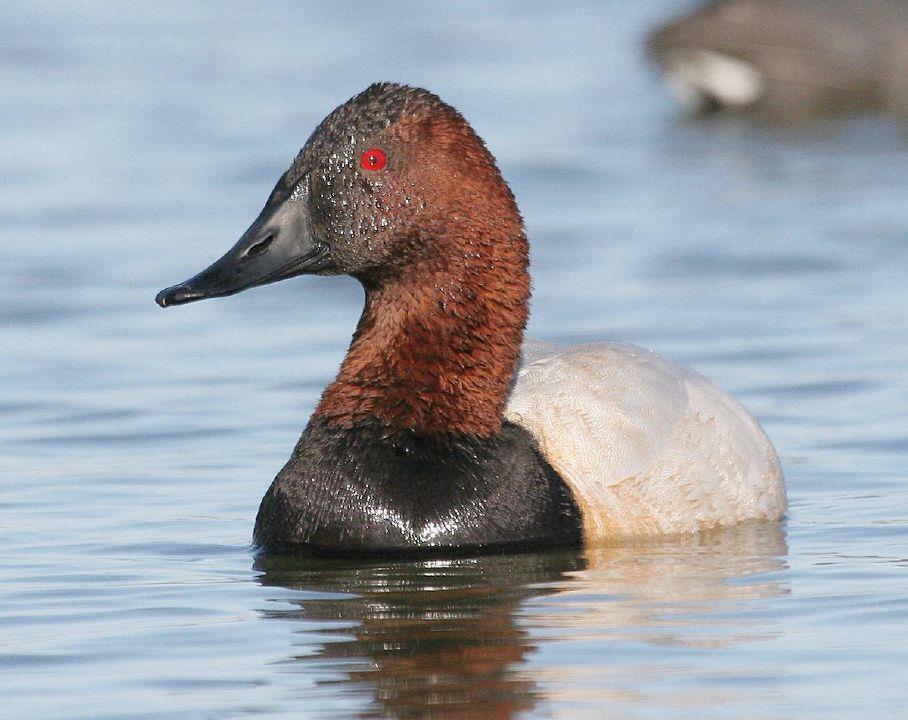
Clayton Ferrell/USFWS • Male canvasbacks cut a regal profile that makes them quite distinct from other species of ducks. Several of these impressive ducks made a recent winter stopover at the pond at Erwin Fishery Park.

The one-two punch of recent winter storms that slammed through the region appears to have brought some unusual ducks with them.

At an online meeting of the Elizabethton Bird Club, Rick Knight noted that a species of duck know as a canvasback has turned up in numerous locations throughout the region.

Erwin resident Joe McGuiness, a fellow member of the Elizabethton Bird Club, called me on Feb. 10 to let me know that some of those visiting canvasbacks have made a stopover at the large pond at Erwin Fishery Park. These majestic ducks remained at the pond long enough for me to see them for myself on Feb. 11.

Over the years this pond had been a magnet for waterfowl. I’ve seen numerous ducks, including bufflehead, ring-necked duck, green-winged teal, blue-winged teal, redhead, American wigeon, Northern pintail, scaup and gadwall, as well as several species of geese, including Canada goose, cackling goose, snow goose and Ross’s goose. I’ve also observed pied-billed grebe, horned grebe, double-crested cormorant, belted kingfisher and other birds that are associated with water.

Photo by Bryan Stevens • Canvasbacks on the Watauga River during a previous winter season.

Canvasbacks can fairly be described as rare visitors.The last time I saw canvasbacks at this pond was in February of 2024. I recall a small flock of canvasbacks and redheads also spent several weeks at this pond in January and February of 2014.

Some birds hold special meaning with me. Although it is a natural question for a bird lover to be asked, I have difficulty pinpointing a single bird as my favorite. One of my overall favorite birds is the Northern cardinal. Among the summer-visiting warblers, the hooded warbler has long been my favorite. With shorebirds, the marbled godwit has long been at the top of my rankings. My favorite bird of prey is the American kestrel or, as I first learned of this raptor in the little “Golden Guide to Birds,” the sparrow hawk. Among owls, I have a soft spot for Eastern screech-owls. I have a favorite duck, too. It’s the canvasback.

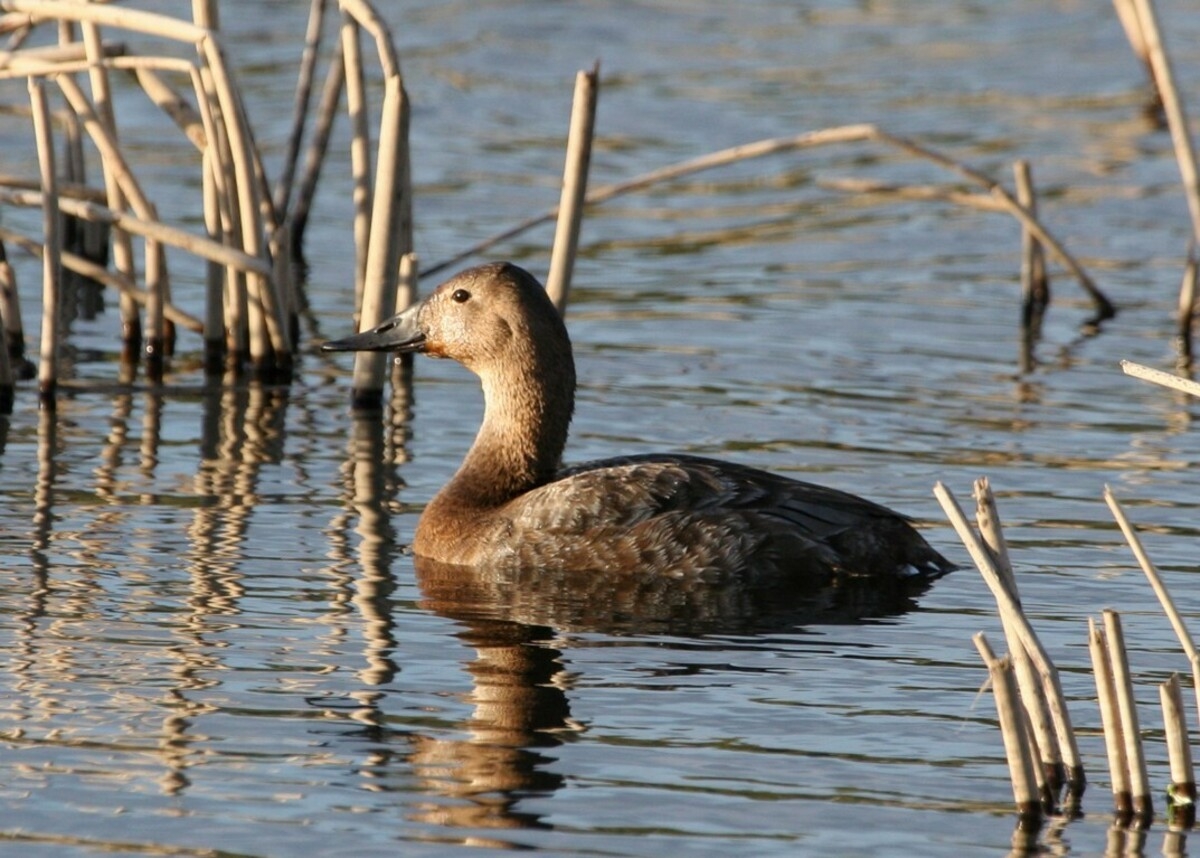
I think several factors make canvasbacks special. First and foremost, they don’t show up every winter. It often takes some seriously cold weather to force them into landlocked Tennessee. A male canvasback is also one of our more regal birds. The male has a distinctive profile enhanced by a sloping bill that instantly distinguishes it from other ducks. Males, or drakes, have chestnut-red heads, white bodies, black breasts and rears and bright red eyes. The distinctive bill is also black. Females, like many other ducks, are drab and brown but they share the male’s distinctive sloping bill, helping to separate them from such relatives as female redheads.

I saw my first canvasback in the mid 1990s during a winter visit with my parents to Wilbur Lake near Elizabethton, Tennessee. We always liked visiting this small reservoir during the colder months to view the buffleheads and any other ducks that happened to visit this small mountain lake. On this particular occasion, a flock of redheads had also arrived. While viewing these ducks, we noticed a member of the flock that looked different from the others. Specifically, it was larger and whiter than the redheads. After a brief consultation with my copy of Roger Tory Peterson’s “A Field Guide to the Birds of Eastern and Central North America,” I identified my very first canvasback.

Since that time, I’ve observed canvasbacks at other locations in northeast Tennessee and southwest Virginia. It’s been awhile, but I have observed these ducks at Osceola Island Recreation Area below Holston Dam and at Musick’s Campground at South Holston Lake. I’ve also observed canvasbacks on the Watauga River in Elizabethton and on the Holston River in Kingsport. I saw eight canvasbacks on Feb. 22, 2015, on the Watauga River, not very far from where I saw my very first one back in the 1990s. The flock, which consisted of all males, represented a rather high number for this duck in the region.

Donna A. Dewhurst/USFWS • While lacking a male’s distinctive coloration, a female canvasback does bear the dark sloping bill.

Canvasback nest in North American prairie potholes across the United States, including Alaska, as well as Canada. I encountered canvasbacks during a visit to Utah in 2008. A rainy season in the state had produced an abundance of flooded fields and temporary ponds that attracted these ducks and other waterfowl.

•••

Bryan Stevens has written about birds, birding and birders since 1995. Email him at ahoodedwarbler@aol.com to share a sighting, ask a question or make a comment.

Sighting a Siberian Superstar: Local birder secures rare red-flanked bluetail for life list

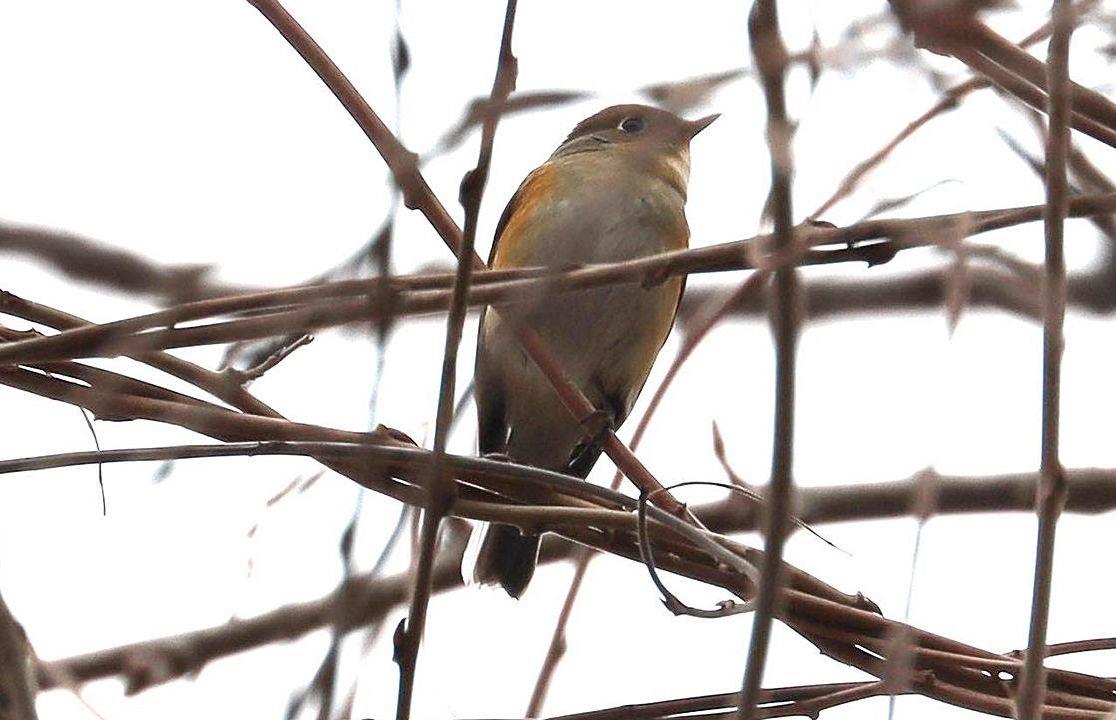
Photo by Tom McNeil • This red-flanked bluetail created quite a stir when it showed up in Fairfax County, Virginia, along the Potomac River.

Here’s confirmation that birds have wings and know how to use them to travel to some totally unexpected places. A good birding friend, fellow member of the Elizabethton Birding Club and, like me, an alumni of Hampton High School, has added a new bird – a species that I’d never even heard of – to his life list.

Tom McNeil posted on his Facebook page on Jan. 4 that he departed Winston-Salem, North Carolina, at 3 a.m. and drove to the Washington, D.C., Metro Area for a chance at seeing a little 5-inch-long bird.

From long acquaintance with Tom, I know he doesn’t hesitate to go after these “rare birds.” This particular bird – a red-flanked bluetail – had been generating a lot of excitement, Tom noted, since making its unlikely appearance in Fairfax County, Virginia.

The bird had already been present for four days when McNeil made his scramble to get binoculars on the bird.

I got the chance to discuss his sighting after he returned home just ahead of Winter Storm Fern after he had gone on another quick trip to add one of the common ground doves spotted in Sampson County to his North Carolina list.

“I came home to make sure the pipes didn’t freeze,” Tom said.

His wife, Cathy, works as a travel nurse and was working in Winston-Salem, North Carolina, for the weekend. “Unfortunately she is probably going to have to stay overnight at the hospital,” Tom said, explaining that the storm was expected to be really bad there.

North American Rarity

The rarity of the red-flanked bluetail is mind-boggling. Most sightings of this bird in North America have taken place in Alaska, but there are also 2023 records from California and New Jersey.

“This is only the second record in the eastern United States,” Tom said. “The first was in New Jersey, two years ago.”

He added, “I heard some people speculating that it was the same bird that was in New Jersey. I can’t even begin to speculate how it wound up here.”

This Eurasian species, according to Tom, should be hanging out around China, not just outside the capital of the United States. Tom noted that the bird represents only the second record of this species in the eastern United States.

That’s more than I knew. Thank goodness for Google. A little research and I soon learned that the red-flanked bluetail belongs to a group of insect-eating birds known as chats. Formerly, chats were thought to be thrushes. Genetic analysis has proven, however, that they are in fact a type of Old World flycatcher.

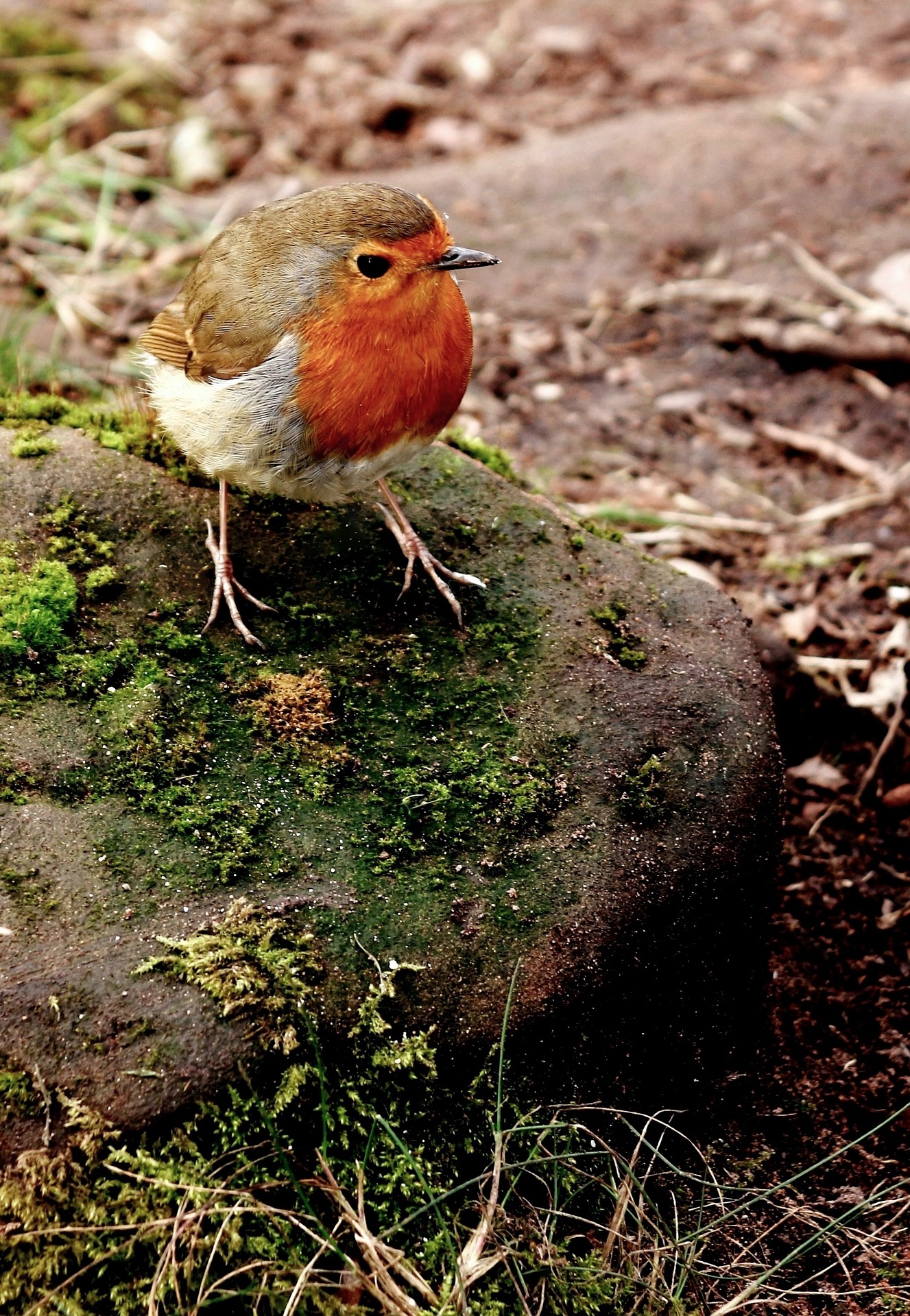
Photo by Andrew Poynton/Pixabay.com • The European robin is actually an Old World flycatcher and a relative of the red-flanked bluetail.

The fact that chats resemble Old World thrushes can be attributed to convergent evolution, which is the independent evolution of similar features and appearances in species of different lineages. Flycatchers and thrushes are birds, but that’s where the similarities end.

The red-flanked bluetail, known by the scientific name (Tarsiger cyanurus) is a small bird that breeds in mixed coniferous forests in northern Asia, parts of central Asia and northeastern Europe. It is migratory, nesting in Siberia and wintering mainly in southeast Asia, in the Indian subcontinent, the Himalayas, Taiwan and northern Indochina. In other words, it’s not supposed to be close to Washington. D.C.

What’s in a Name

You have to love this bird’s extremely descriptive common name. It was previously known as the orange-flanked bush-robin, which is also quite descriptive. Considering the bird is a flycatcher, however, calling it a bush-robin would not be accurate.

Tom added the bird to his life list with relative ease. His wife, Cathy, is a travel nurse and was working in Winston-Salem, North Carolina, when Tom learned that the bird was present in Great Falls Park in Virginia.

“From Winston-Salem, that is about 5.5 hours,” he said. “I left at 3 a.m. and got there about 8:30 a.m.,” he explained. “I only had to walk less than a quarter-mile to the area where it had been seen the most.”

He soon discovered that 75 or more people were already gathered and looking for the bird.

“They were spread out over a distance of about 200 yards,” he said. “After about an hour, someone spotted it and everyone converged on it. It was pretty exciting and humorous to watch.”

While the bird shows a blue tail and rump, it lacks the bright blue upperparts of an adult male red-flanked bluetail.

Based on the bird’s appearance, Tom said most observers have identified the bird as a female. “But it could be an immature male,” he added.

Birding Surprises

“Needless to say, it was a lifer,” he noted.

A “lifer” is birder slang for a species a birder has observed for the first time and added to a cumulative life list of species seen.

The bird has spent much of its time close to the Potomac River since its arrival in Fairfax County in Virginia.

“Apparently the Maryland state line passes very close to the shore,” Tom said. “Some folks were standing out in the river trying to add the bird to their Maryland lists.”

The red-flanked bluetail has certainly been his best bird so far in 2027.

“Back in December I picked up Swainson’s hawk, MacGillivray’s warbler and Brewer’s blackbird for my North Carolina life list,” Tom said.

“Cathy and I both went down to Chattanooga and got a great cormorant and Franklin’s gull for Tennessee,” he added.

He posted on Facebook that his biggest personal milestone for 2025 was getting his American Birding Association area 600th bird – a Townsend’s warbler – in a backyard in Charlotte, North Carolina.

Cathy had to work and didn’t get to go with Tom on the trip to get the bluetail.

“So if it’s still around in the next few days, we will probably go up and try for it together,” Tom said.

Here’s a recording someone made of a red-flanked bluetail in California in 2023.

Winging It

Birds have wings, as I’ve pointed out many times, and they know how to use them. It’s just more evidence that one never knows when an unexpected bird might make an appearance. This is the magic that keeps birding exciting.

•••

Bryan Stevens has written about birds, birding and birders since 1995. Email him at ahoodedwarbler@aol.com to share a sighting, ask a question or make a comment.

Chasing Zunzun: Bahamas cruise resulted in sightings of flying gems

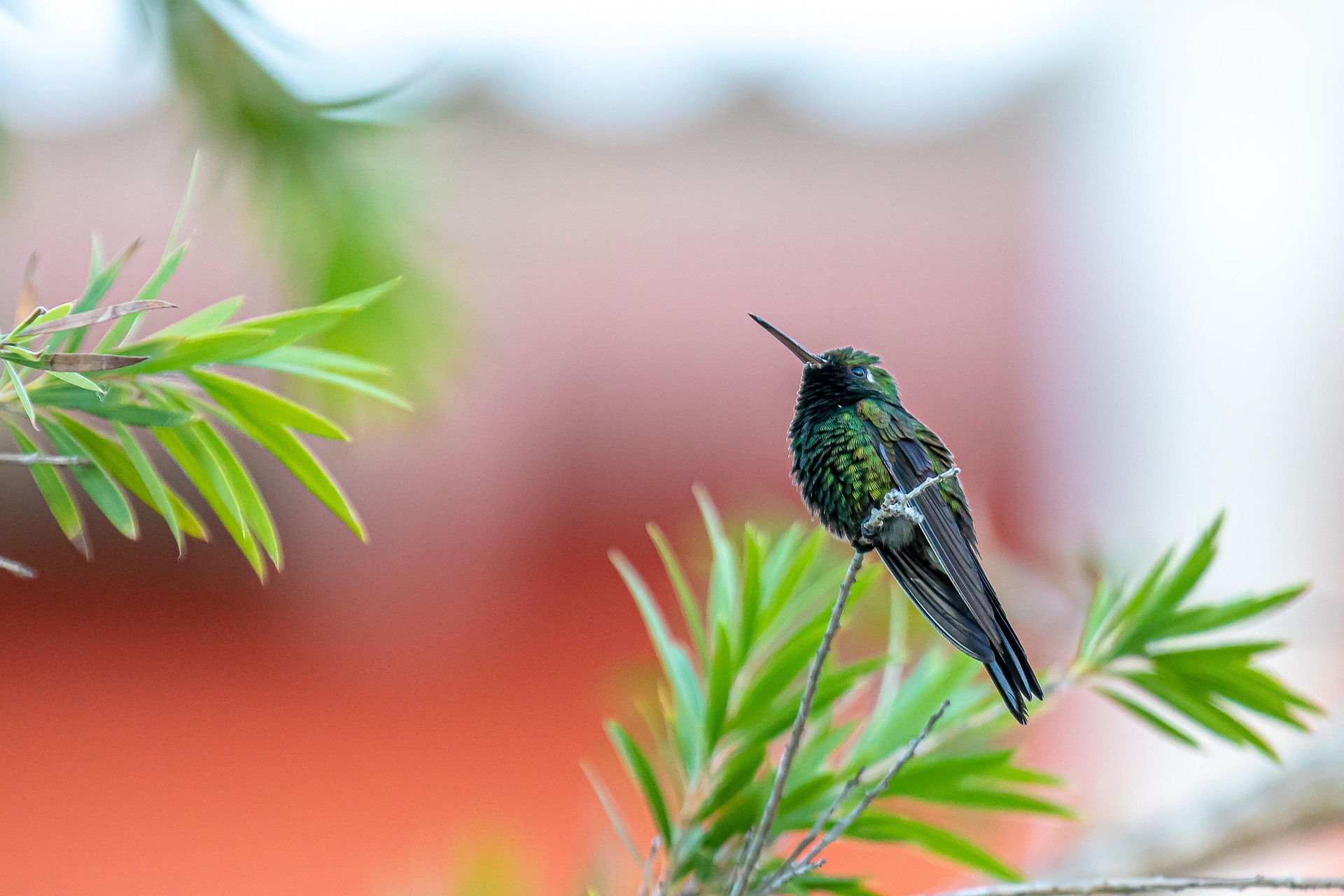
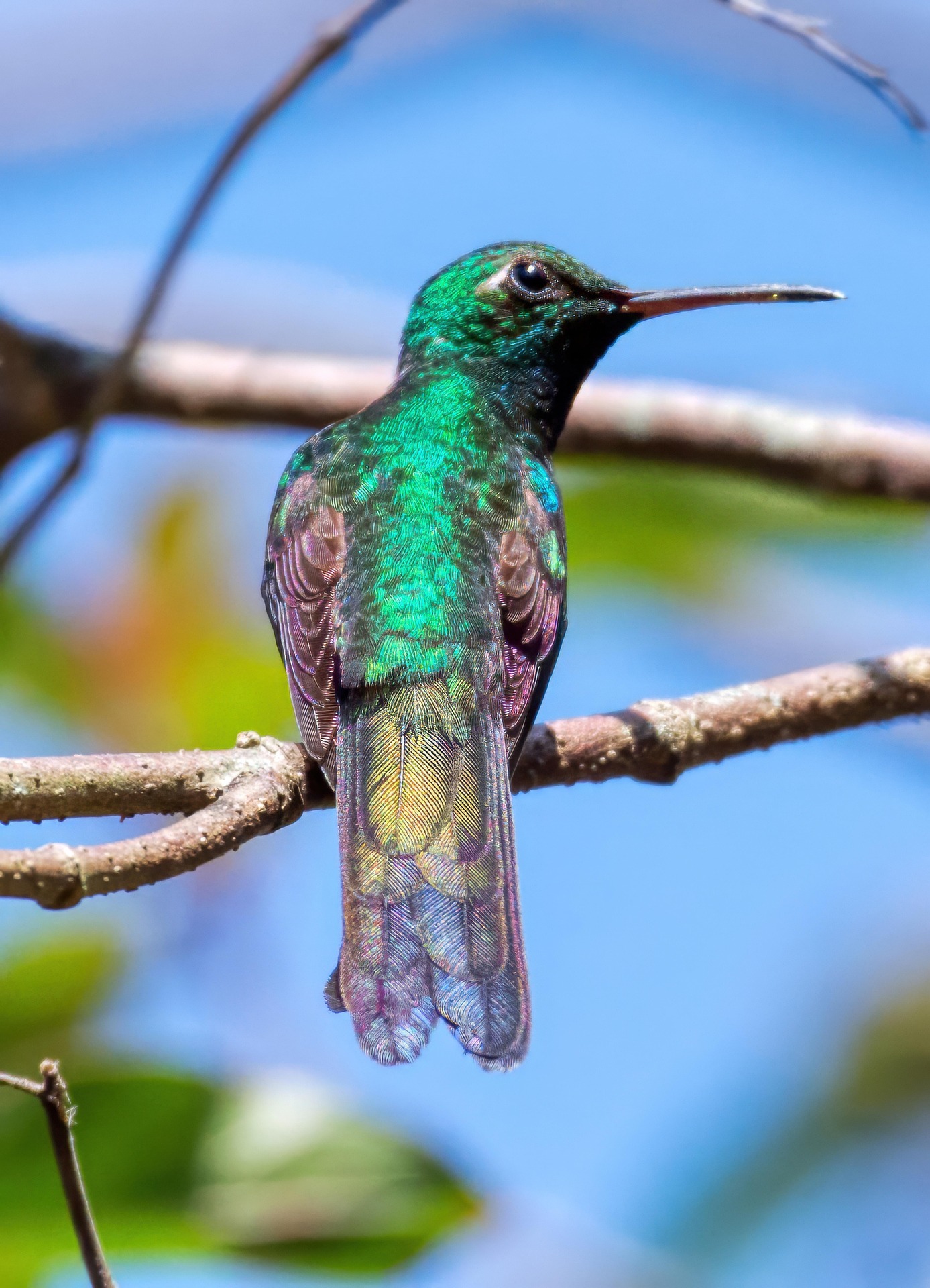
Photo by Pixabay • A Cuban emerald, a species of hummingbird native to Cuba and the Bahamas, perches and surveys its surroundings.

Continuing to bring you some vintage columns, I dug deep into my archives. I’ve traveled outside the United States on only one occasion from Jan. 22-24, 1999, during a family vacation. Sightseeing and shopping took a backseat to birding during a three-day cruise in the Bahamas. I fully documented my sightings in a “Feathered Friends” column published Feb. 14, 1999.

Two scheduled shore excursions during the cruise gave me opportunities to search for birds.

Two hummingbird species can be found in the Bahamas. The Cuban emerald, as its name suggests, is found in Cuba. It’s also found on several islands in the Bahamas. These dazzling birds are found in thickets and woodlands, as well as parks and gardens.

Another hummingbird species, the Bahama woodstar, is found nowhere else in the world.

Without much difficulty, I observed both species during my visit to the Bahamas. My observation of Cuban emeralds took place on Castaway Cay, a small island owned by Disney and reserved for use by those traveling aboard its cruise ships. Much of the island had been kept in a natural state with walking trails perfect for looking for birds. While others enjoyed the beach, I set off with my binoculars on the trails.

My mother and I observed a pair of Cuban emeralds that appeared to be a mother and her male offspring. On two occasions, we watched the female approach the young male for a feeding session. The young bird opened his bill in a wide gape and the female plunged her own long bill into his throat. The spectacle looked rather fearsome, but that’s how hummingbirds feed their young. I’ve observed one of our native ruby-throated hummingbird feeding her young in the same manner. Experts who have researched hummers insist there’s no danger that a mother hummingbird will skewer her offspring.

Photo by Daniel Stuhlpfarrer/Pixabay • The Cuban emerald is a vibrant hummingbird of the Caribbean.

The young male being fed put on quite a show. He appeared almost completely lacking in fear and allowed me to approach within inches of his perch. At times, he also exhibited his own curiosity and buzzed around my head and face for a better look of his own.

His mother, not quite as confiding, kept her distance. She perched on branches about 15 feet off the ground. She observed us, but she never descended to feed the young male unless we withdrew to a comfortable distance.

I learned later that my brother and sister-in-law saw some Cuban emeralds at another location on the island, leading me to suspect that the Cuban emerald may be quite common on Castaway Cay in the Bahamas.

Male Cuban emeralds sport an iridescent green throat and breast with a long forked tail, white undertail feathers, and a long thin bill that is black on top and reddish-pink on the underside. Females look similar to males except with green upperparts along with a grayish throat and breast, and a slightly shorter and less forked tail.

The term “emerald” describes many different species of hummingbirds. In the Caribbean, this family includes Hispaniolan emerald and Puerto Rican emerald. These hummingbirds belong to the genus Chlorostilbon, which is Greek for “green glitter,” a perfect description of the metallic green appearance of their feathers. Since my writing of the original column, experts have reconsidered the classification of the Cuban emerald. Based on a molecular phylogenetic study published in 2014 and a 2017 publication, the North American Classification Committee of the American Ornithological Society moved the species to the resurrected genus Riccordia. The Cuban emerald’s scientific name is now Riccordia ricordii.

Prior to seeing the Cuban emeralds I got a brief but close look at a male Bahama woodstar visiting hibiscus and other flowers in a garden surrounding a swimming pool at a resort in Nassau, the capital of the Bahamas located on New Providence Island.

The Bahama woodstar bears a resemblance to our own ruby-throated hummingbird. Male Bahama wood stars boast a reddish-purple throat, green upperparts and a white breast bordered by a tinge of rufous. The bird’s forked tail feathers are also trimmed with rufous color. Males and females have a white spot behind each eye. They also have black bills that curved downward slightly at the tip.

The Bahama woodstar, which is roughly the same size as a ruby-throated hummingbird, is a member of the genus Calliphlox, which is Greek for “beautiful flame.” Since my original writing of this column, the classification of the Bahama woodstar changed after a 2014 study.

A former subspecies of the Bahama woodstar has been made its own species. The Bahama woodstar itself was moved into a new genus and given the scientific name Nesophlox evelynae. That former subspecies was upgraded to full species status and is known as the Inagua woodstar (Nesophlox lyrura), also called the lyre-tailed hummingbird. The species is endemic to the two islands of the Inagua district of the Bahamas.

It’s the Bahama woodstar that occurs in Nassau, so the species I saw in 1999 was truly the Bahama woodstar. The good news is that if I ever travel to the Great or Little Inagua islands in the Bahama archipelago I will have a chance to add a third species of Bahama hummingbird to my life list.

There are many other species of woodstars, including the little woodstar of South America, the purple-throated woodstar restricted to the west slope of the Andes in Colombia and Ecuador, and the endangered Chilean woodstar.

There are about 360 species of hummingbirds, all found in the New World and reaching their greatest diversity in Central and South America.

Both Cuban emeralds and Bahama Woodstars have strayed into nearby Florida, so it is possible to observe these two species outside of the Bahamas. Experts have speculated that the Inagua woodstar had very likely also strayed into Florida.

I’ll always remember my trip to the Bahamas and the opportunity to chase after zunzún, which is a Spanish word, particularly used in the Caribbean, for hummingbird. I greatly enjoyed my observations of the two hummingbird species I observed in the Bahamas. These sightings remain among my most memorable in my nearly four decades of birding.

•••

Bryan Stevens has written about birds, birding and birders since 1995. Email him at ahoodedwarbler@aol.com to ask a question, make a comment or share a sighting. 


Waterfowl numbers help increase Elizabethton Christmas Bird Count total


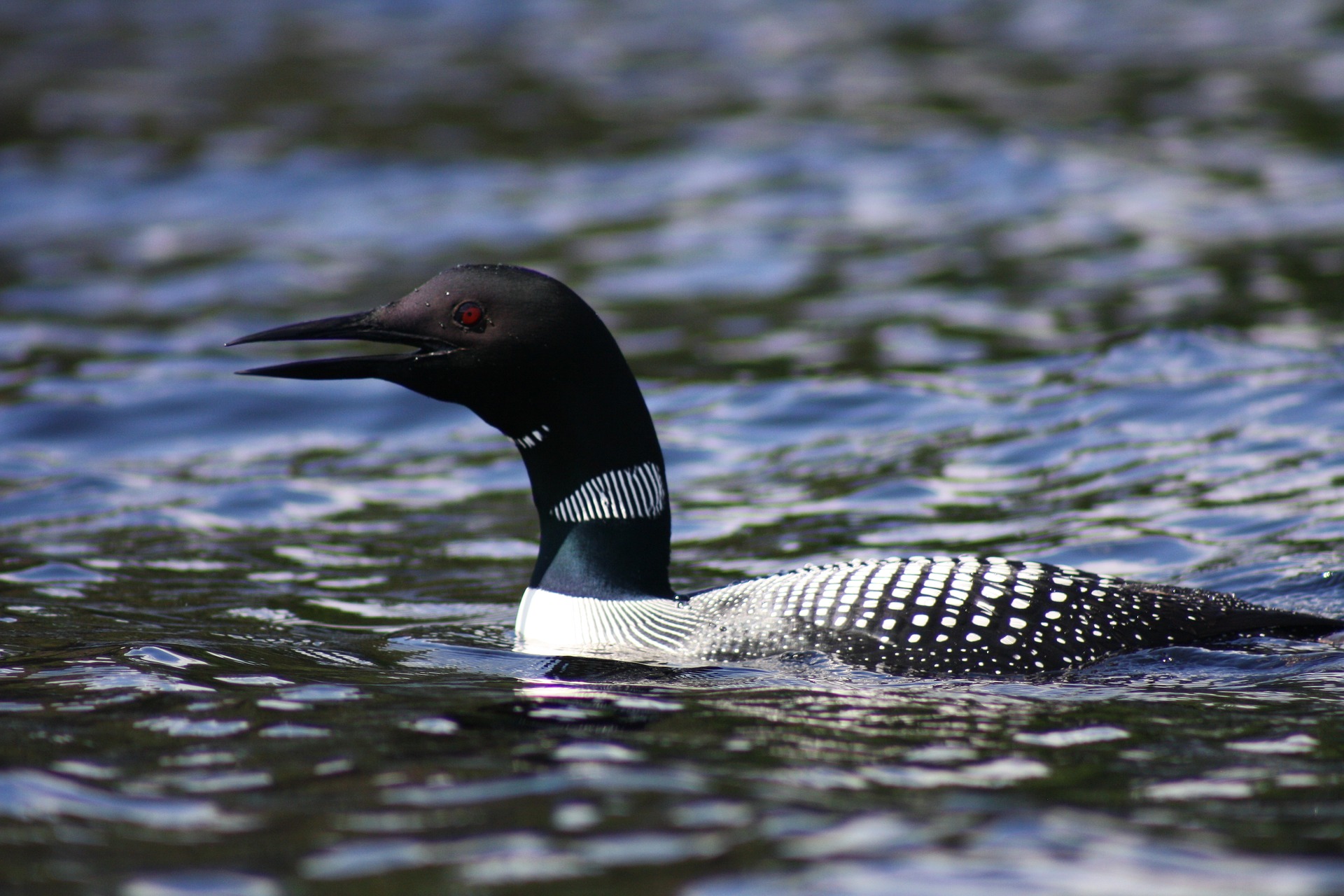
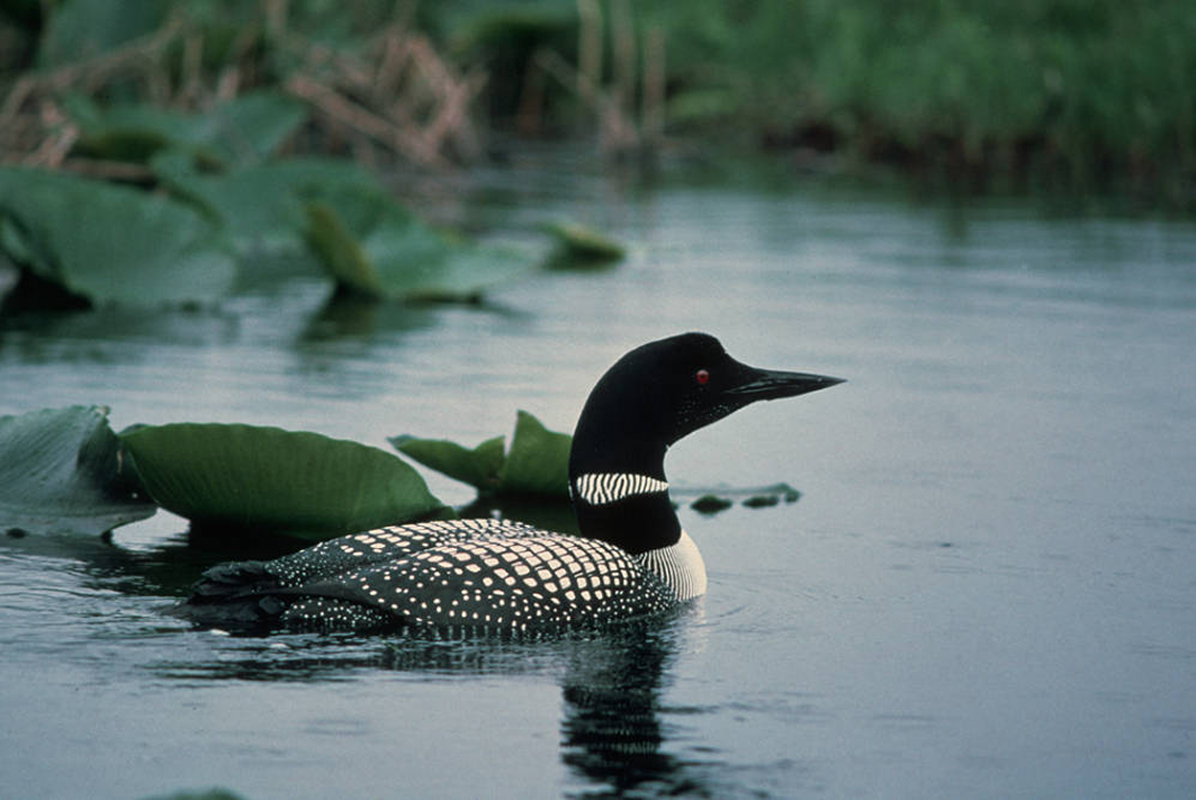
Photo by Krista-269/Pixabay.com • Common loons in summer breeding plumage are strikingly handsome birds that show much grace and agility in the water.

The 83rd consecutive Elizabethton Christmas Bird Count was held Saturday, Dec. 20, 2025. Twenty-four observers participated in seven parties found a total of 73 species, plus an additional species found during count week.

Compiler Rick Knight noted that the annual survey benefitted from good weather with a temperature range from 23 to 66 degrees coupled with clear and calm conditions.
The species total is right on the recent 30-year average for this CBC. The all-time high for the Elizabethton CBC was 85 species in 2017.

The list:
Canada goose, 372; mallard, 81; redhead, 3; ring-necked duck, 17; greater scaup, 2; lesser scaup, 1; bufflehead, 109; and hooded merganser, 26.

Wild turkey, 18; pied-billed grebe, 10; horned grebe, 14; rock pigeon, 208; mourning dove, 72; killdeer, 3; Wilson’s snipe, 7; ring-billed gull, 3; common loon, 1; and great blue heron, 11.

Black vulture, 26; turkey vulture, 131; sharp-shinned hawk, 1; Cooper’s hawk, 2; bald eagle, 4; red-shouldered hawk, 1; red-tailed hawk, 14; Eastern screech owl, 5; and great horned owl, 2.

Photo by Bryan Stevens
A flock of Wild Turkeys make their way across a snowy field.

Belted kingfisher, 17; red-bellied woodpecker, 28; yellow-bellied sapsucker, 19; downy woodpecker, 15; hairy woodpecker, 4; Northern flicker, 27; pileated woodpecker, 15; American kestrel, 14; and Eastern phoebe, 13.

White-eyed vireo, 1; blue jay, 130; American crow, 343; common raven, 9; Carolina chickadee, 101; tufted titmouse, 66; ruby-crowned kinglet, 11; golden-crowned Kinglet, 24; and cedar waxwing, 18.

White-breasted nuthatch, 29; brown creeper, 1; Carolina wren, 74; and winter wren, 11.

Brown thrasher, 1; Northern mockingbird, 58; Eurasian starling, 1058; Eastern bluebird, 117; hermit thrush, 8; and American robin, 236.

Photo by Bryan Stevens • A white-breasted nuthatch grabs a sunflower seed.

House sparrow, 28; house finch, 135; purple finch, 4; American goldfinch, 74; and pine siskin. The siskin was listed as a count week find. Birds seen within the same count circle but outside of the specific count day are noted as “count week” birds and still tallied with the species found on the actual count day.

Chipping sparrow, 1; field sparrow, 20; fox sparrow, 1; dark-eyed junco, 24; white-throated sparrow, 87; Savannah sparrow, 1; song sparrow, 83; Swamp Sparrow, 3; and
Eastern towhee, 14.

Eastern meadowlark, 67; common grackle, 1; pine warbler, 3; yellow-rumped warbler, 55; and Northern cardinal, 102.

Knight singled out the white-eyed vireo as a species worthy of elaboration. The vireo was seen in Hampton at the watershed trail among a stand of pines. It was the third instance for this species on this particular CBC; white-eyed vireos were also seen in 1997 and 2001.

Notable misses, according to Knight, included barred owl, red-breasted nuthatch and white-crowned sparrow.

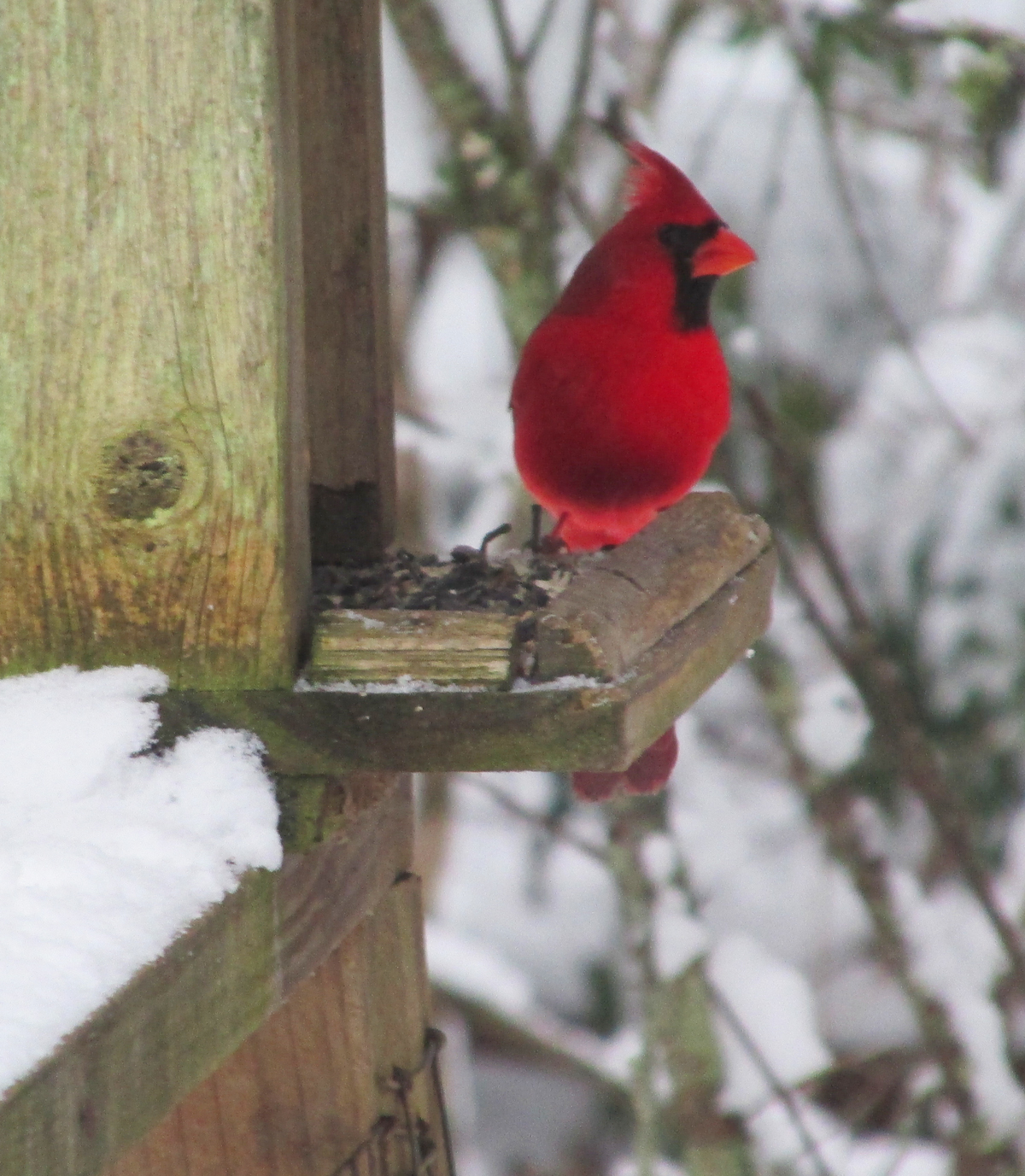
Photo by Bryan Stevens • A male Northern cardinal visits a feeder on a snowy afternoon.


Roan Mountain Christmas Bird Count finds 43 species plus another during ‘count week’

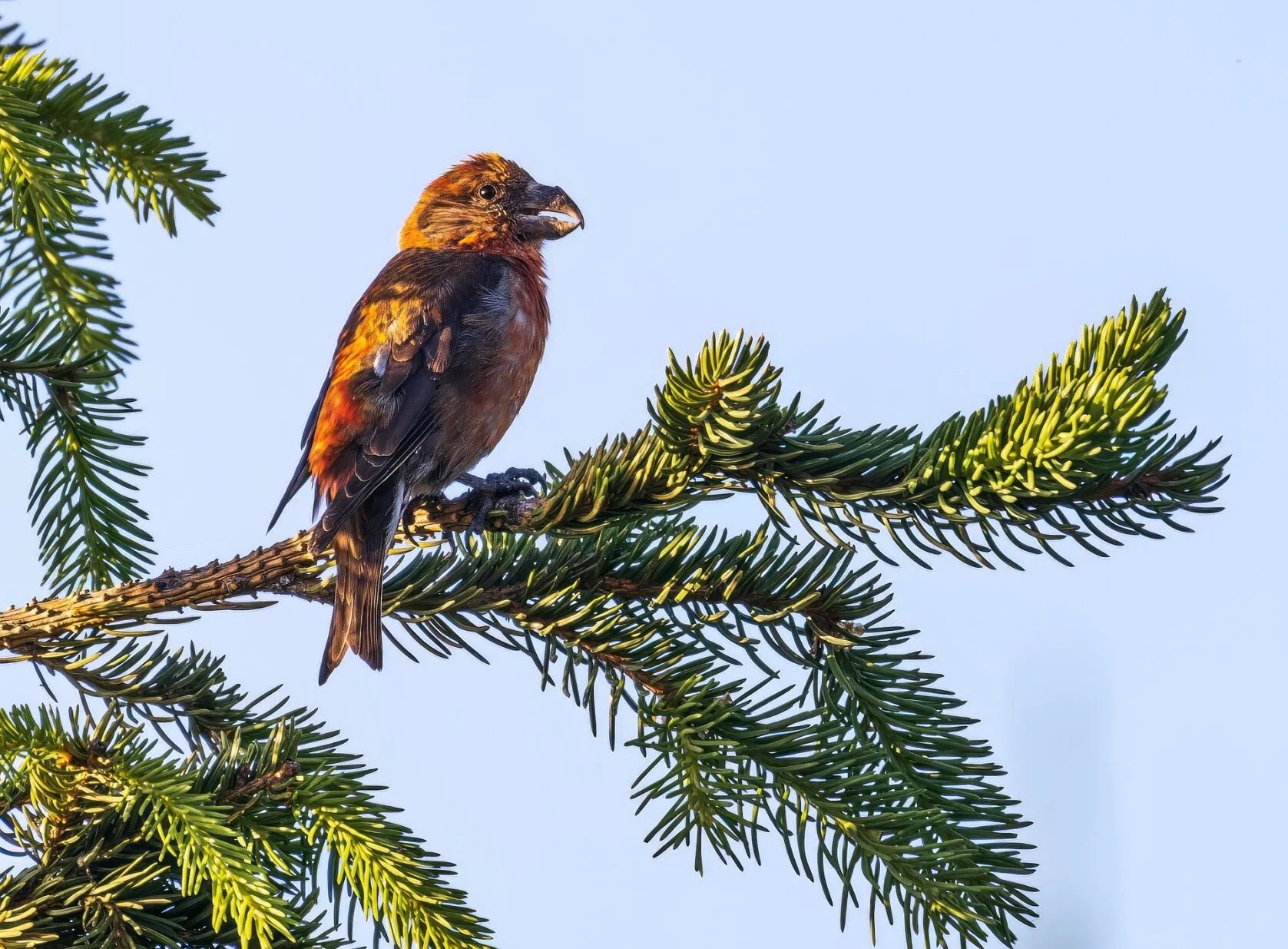
GYRLI1981/Pixabay • With its high elevation and unique habitats, Roan Mountain often produces good birds, such as red crossbills, for Christmas Bird Counts. Many of the species are difficult to find in other locations.

Unpredictable December weather makes the Roan Mountain Christmas Bird Count one of Tennessee’s most challenging surveys. This year was no exception, and the count had to postponed to a later date when a winter storm impacted the region.

The 73rd Roan Mountain Christmas Bird Count was eventually held Tuesday, Dec. 16, with six observers in two parties.

Count compiler Rick Knight noted that weather for this count was generally favorable (clear conditions and a temperature range from 17 to 46 degrees), but it was quite windy on top of the mountain making bird-finding difficult. At lower elevations, the winds were light. One to four inches of snow covered the ground, but roads were clear.

Participants tallied 43 species, plus one species added during the count week.

The list:

Canada goose, 30; American black duck, 17; wild turkey, 11; mourning dove, 17.

Sharp-shinned hawk, 1; Cooper’s hawk, 1; red-shouldered hawk, 2; and red-tailed hawk, 2.

Photo by Bryan Stevens • Two red-tailed hawks made this year’s Roan Mountain CBC. 

Red-bellied woodpecker, 6; yellow-bellied sapsucker, 1; downy woodpecker, 4; hairy woodpecker,1; Northern flicker, 1: and pileated woodpecker, 3.

Eastern phoebe, 1; blue jay, 25; American crow, 120; and common raven, 8.

Carolina chickadee, 21; tufted titmouse, 24; golden-crowned kinglet, 6; red-breasted nuthatch, 3; white-breasted nuthatch, 14; brown creeper, 1; Carolina wren, 5; and winter wren, 2.

Northern mockingbird, 7; Eurasian starling, 23; Eastern bluebird, 8; and American robin, 2.

House sparrow, 5; house finch, 5; red crossbill, 2; pine siskin, 2; and American goldfinch, 119.

Field sparrow, 7; fox sparrow, 4; dark-eyed junco, 25, white-throated sparrow, 5; song sparrow, 35; Eastern towhee, 5; yellow-rumped warbler, 1; and Northern cardinal, 22.

In addition, a purple finch was found during the count week. CBC circles do accept birds seen during “Count Week, which is defined as the three days before and after the official count day, but they are recorded separately as count week birds and do not count towards the official count day totals. Their inclusion still provides important data.

The first Christmas Bird Counts were conducted on Christmas Day (Dec. 25) in 1900. The annual census arose from a proposal made by famed ornithologist Frank M. Chapman. According to Audubon.org, these yearly counts, conducted throughout the country, have provided a wealth of data over the past century.

Observations made due to CBCs have helped Audubon researchers, conservation biologists, wildlife agencies and other interested individuals to study the long-term health and status of bird populations across North America. When combined with other surveys such as the Breeding Bird Survey, the data provides a picture of how the continent’s bird populations have changed in time and space over the past hundred years.

Frank W. Chapman

The concept of the Christmas Bird Count, according to the website for the National Audubon Society, arose from a less than bird-friendly custom prevalent at the turn of the 20th century. So-called sportsmen would conduct a “Side Hunt,” a rather blood-thirsty Christmas custom that saw hunters competing to see who could score the largest amount of feathered and furred corpses.

The annual holiday bird survey may even have arisen from an earlier custom with roots in Europe that came to the United States of America with early colonists. The “Side Hunt” has some similarity to a peculiar celebration in Ireland and other European countries known as “Wren Day” or “Hunt the Wren Day.” The event was conducted the day after Christmas, the date of Dec. 26 being consigned as Saint Stephen’s Day. By the 20th century, the hunt consisted of tracking down a fake wren carried atop a decorated pole. Crowds would parade through towns in masks and colorful attire. These groups were referred to as “wren boys.”

Whether or not the “Side Hunt and “Wren Hunt” shared any connections, it was a huge step forward for conservation when Chapman, the preeminent ornithologist of his day, proposed a new holiday tradition. His radical idea was to count birds during the Christmas season rather than hunting and killing them.

I will report on the total for the Elizabethton Christmas Bird Count in next week’s column.

•••

Bryan Stevens has written about birds, birders and birding since 1995. Email him at ahoodedwarbler@aol.com.

Christmas Bird Count produces grebes, other finds

Photo by Bryan Stevens
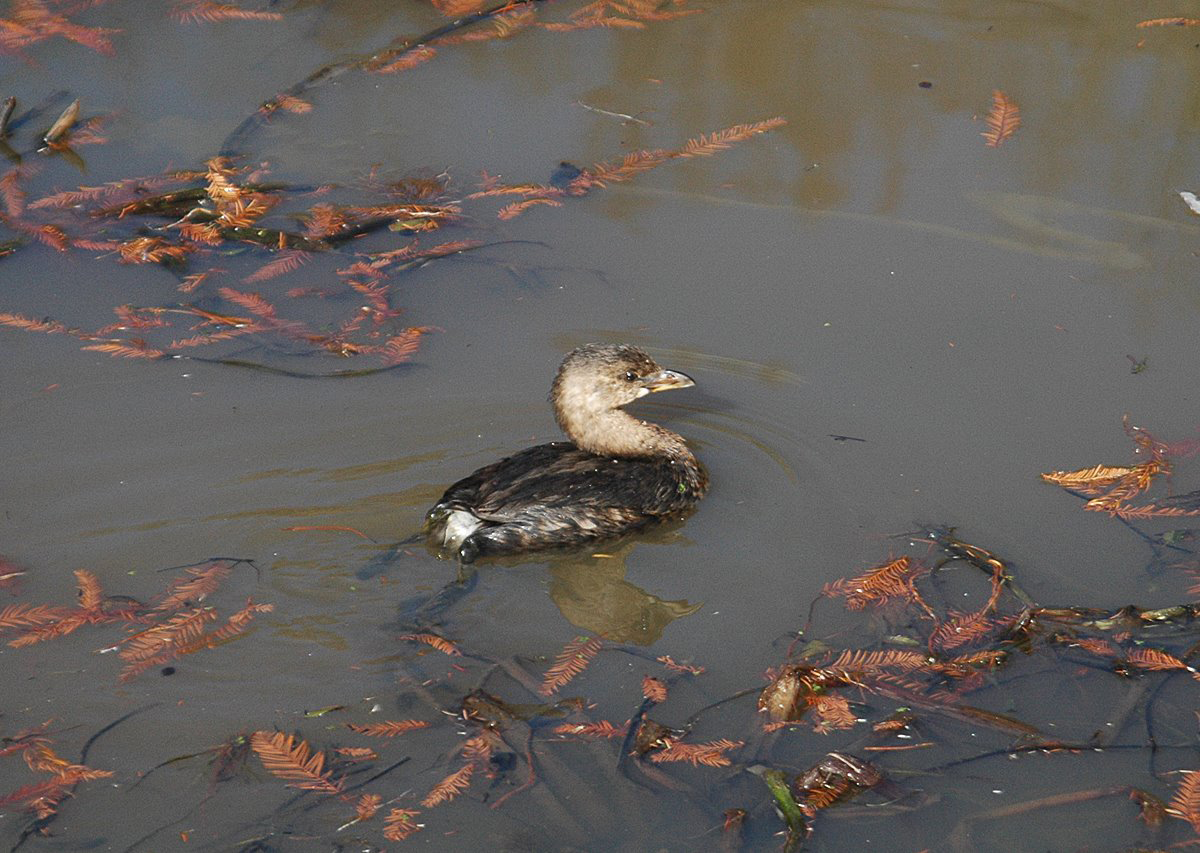
The pied-billed grebe paddles through the water after it was rescued after a stranding on a lawn.

I took part in the Elizabethton Bird Club’s 83rd annual Elizabethton Christmas Bird Count on Dec. 20.

The count focuses on a circle within Carter County with Elizabethton serving as the center. Consider the circle as a pie sliced into six pieces. Different groups bird within those “slices” of terrain. The groups rotate each year to vary the participation. As a result, it had been six years since I last led the count effort for the Butler/Little Milligan area that includes a great deal of Watauga Lake.

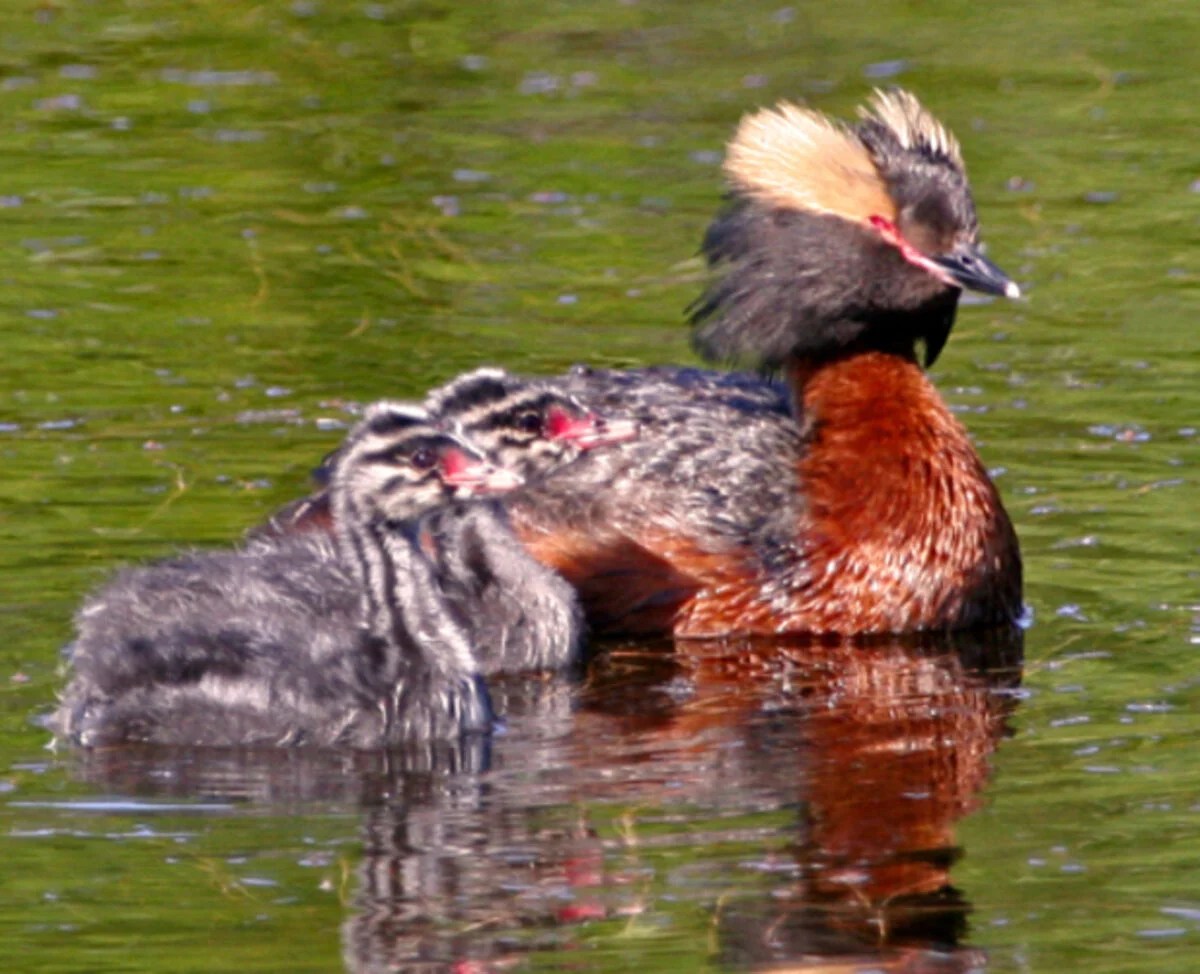
Donna Dewhurst/USFWS • A horned grebe parent tends chicks.

One of my favorite reasons for taking part in this particular count is the great mid-day lunch break at the Dry Run General Store and Deli in Butler. This marked my third time over the last 18 years having lunch at this great spot. The lunch break also gives the participants a chance to study the list of birds seen and calculate what other species can be added and where to best look for those species.

The counts conducted in areas with access to water have the potential for the most species, so it’s always a little more fun to bird around Watauga Lake or Wilbur Lake. The Watauga River in Elizabethton is also good.

We had good weather for this most recent count, but it was a slow effort to add birds to our list. Without a doubt, spring and fall bird counts are much more exciting than a Christmas Bird Count.

Below is the list for my group, which included Rob Armistead, Brookie and Jean Potter, David and Connie Irick and Chris Soto. This is only the list for Little Milligan and Butler. I hope to provide the complete list at a later date.

We found a total of 46 species:

Canada goose, 32; mallard, 7; greater scaup, 2; hooded Merganser, 4; wild turkey, 18; pied-billed grebe, 8; horned grebe, 14; rock pigeon, 52; mourning dove,1; ring-billed gull, 1; common loon, 1; and great blue heron, 2.

Photo by U.S. Fish & Wildlife Service • Common loons are quite at home in the air and on the water, but these birds are awkward if weather forces them to set down on land.

Red-tailed hawk, 3; belted kingfisher, 3; red-bellied woodpecker, 3; downy woodpecker, 2; Northern flicker, 1; pileated woodpecker, 3; American kestrel, 2; and Eastern phoebe, 1.

Blue jay: 14; American crow, 68; common raven, 2; Carolina chickadee, 2; tufted titmouse, 11; white-breasted nuthatch, 4; winter wren, 1; Carolina wren, 5; golden-crowned kinglet, 1; and ruby-crowned kinglet, 1.

Eastern bluebird, 14; hermit thrush, 1; American robin, 5; brown thrasher, 1; Northern mockingbird, 3; European starling, 43; and cedar waxwing, 2.

House finch, 2; American goldfinch, 25; dark-eyed junco, 5; white-throated sparrow, 8; song sparrow, 3; Eastern towhee, 3; Eastern meadowlark, 1; pine warbler, 1; and Northern cardinal, 7.

While birding in Little Milligan and Butler, we had plenty of views of Watauga Lake and opportunities for spotting birds often affiliated with water. The umbrella term of waterfowl can include such birds as ducks, geese, loons and grebes. We had representatives from all of these groups on our list. I was pleased to finally see some ducks and grebes this winter.

The grebes are a grouping of birds lumped together as waterfowl. Worldwide, there are 22 grebe species. This family also includes three extinct species — Alaotra grebe, Atitlán grebe and Colombian grebe.

Many people are unaware of the grebes. After all, they are oddball birds with not a lot in common with other waterfowl such as loons and ducks. In eastern Tennessee, southwestern Virginia and western North Carolina, the pied-billed grebe is the member of the grebe family most likely to come into contact with humans.

The pied-billed grebe’s scientific name, Podilymbus podiceps, can be roughly translated as “rear-footed diver.” The reference is to the fact that this grebe, as well as others of its kind, have their feet positioned so far back on their bodies that movement on land is difficult and awkward.

In winter, however, horned grebes can be somewhat abundant on area lakes. The common name of horned grebe refers to a yellow crest of feathers located above and behind the eyes, reminiscent of “horns” in the eyes of an imaginative observer. In winter these horns are absent and the colorful horned grebe of the nesting season is replaced by a bird in a dull white and dark gray plumage.

Grebes range in size from the least grebe, which weighs only about six ounces, to the great grebe, which can tip the scales at four pounds. North American grebes include red-necked grebe, horned grebe, eared grebe, Clark’s grebe and Western grebe. In extreme southern Texas, birders can find least grebes in suitable wetland habitats.

Other grebes found around the world include birds with such descriptive names as the great crested grebe, hooded grebe and silvery grebe.

Photo by Bryan Stevens • Brookie Potter spots a “bumble,” otherwise known as an abominable snowman, near Watauga Lake during the Christmas Bird Count.

With the exception of the least grebe, I’ve seen all of North America’s grebes. During visits to Utah in 2003 and 2006, I observed the sleek, long-necked Clark’s grebe and Western grebe. On a 2006 trip to Utah, I visited Antelope Island State Park and observed tens of thousands of eared grebes gathered on the Great Salt Lake for the nesting season. In Tennessee, one of the most reliable locations to find eared grebes is from viewing areas at Musick’s Campground on South Holston Lake, where a small number of these grebes have wintered for many years.

My Christmas Bird Count excursion proved a fun time with friends. We didn’t find a lot of birds, but we enjoyed finding the ones that we did see. Happy New Year to readers. I hope everyone finds some good birds in 2026.

•••

Bryan Stevens has written about birds, birding and birders since 1995.