Category Archives: Ravens

Birds have developed ways of dealing with cold

David Ellis/USFWS • A common redpoll feasts on stiff goldenrod seed. These small finches can endure temperatures 100 degrees below freezing.

With the arrival of January, we can probably be assured of some cold weather. I’m not fond of the cold, but I can put on gloves and a thicker coat and I am good to go.

What about our feathered friends? How do birds cope when temperature plummet below freezing?

Birds actually employ a range of strategies and behaviors that keep them cozy even during the worst that winter can hurl at them.

Some birds avoid the necessity of coping with cold by migrating. All those tropical species that brighten the warmer seasons in the mountains of Southern Appalachia withdraw to warmer areas in Central and South America during the winter.

Those birds that elect not to put distance between themselves and cold temperatures must do something to stay warm. Feathers are one of a bird’s defining traits, and they can do a neat trick with their feathers to stay warm. You’ve probably seen them do this. They will fluff their feathers, trapping air between them to provide insulation. If you’ve ever noticed that some birds look “fatter” in extreme cold it’s likely because they have fluffed up to combat the cold.

Of course, feathers require good maintenance to help with the task of staying warm, and birds are diligent about such tasks. Preening feathers on a routine basis keeps them watertight and able to hold in heat. Some birds even grow extra feathers in autumn to prepare for cold temperatures. That’s similar to dogs or cats growing a denser coat of fur in anticipation of wintry temperatures.

Birds have different comfort levels when its comes to personal space, but many of the more sociable species will huddle together. You’ve probably seen nature documentaries of penguins in the Antarctic as they huddle together for weeks on end to endure the harsh conditions of the globe’s southernmost continent.

Larger species of birds, such as geese and grouse, eat more and gain weight, which is often achieved by the storage of body fat.

Other birds have also adopted the huddling strategy in a cozy cavity or nest box. My most vivid recollection of an observation of this strategy involved Eastern bluebirds. During a severe cold snap accompanied by snow and blustery winds, I watched multiple bluebirds enter one of my nesting boxes. I’m not sure how many entered the box, but it was likely about eight to 10 birds.

Necessity makes birds adaptable. The next day the aforementioned high winds took down the post that held the nest box. At dusk the bluebirds showed up again. They looked baffled to find the box had disappeared. Then I saw them fluttering into an old tire that I had used at the base of the pole to help anchor the box. Faced with oncoming darkness, they chose to huddle together inside the old tire.

Natural cavities in trees also provide cozy roosting spaces for birds. Chickadees and titmice, nuthatches and woodpeckers seek out such cavities ahead of time so they will always be ensured of a warm space during bouts of inclement weather.

The biological mechanism of torpor is one that’s probably familiar to fans of hummingbirds, but other small birds can also take steps to lower their body temperature. Chickadees and kinglets put this ability to good use. In these small birds, the adaptation being employed is known as controlled hypothermia. Chickadees can drop their body temperature by as much as 22 degrees below normal daytime body temperature.

Snakes and reptiles can enter a physical state called brumation, where they sleep more but still wake to eat, drink and enjoy the sun on warmer days, according to information on the Facebook page of the U.S. Fish and Wildlife Service. Since snakes are cold-blooded, they’re lethargic at these colder temperatures even when they’re on the move.

Hibernation, although a strategy widely used by mammals, is rare in birds. The common poorwill (a relative of whip-poor-will and chuck-will’s-widow – is the only bird known to go into torpor for extended periods that can range from weeks to months. On the southern edge of their range in the United States, poorwills spend much of the winter hibernating, usually concealed in rock piles.

There’s warmth in numbers. Crows, starlings, robins and other species will gather in communal roosts to use body warmth to stay warm overnight. Sometimes these roosts are quite large and can lead to conflict with nearby humans who may not want the noise and mess that comes with hosting a large flock of birds.

While warm socks and gloves protect human toes and fingers, birds don’t have to worry about frostbite. Quick circulation means that blood does not linger in their feet long enough to freeze. In addition, the legs and feet of birds are covered in scales. Like feathers, the scales provide excellent insulation.

Some birds will gather together in large stands of evergreens. I’ve observed house sparrows gathering in the holly trees outside the courthouse in downtown Erwin at dusk on cold evenings.

There are things we can do to help. Plant evergreen trees or construct a brush pile that will provide shelter from the elements, as well as a measure of safety from predators, for the birds that share our lawns and gardens.

Many people already feed birds. Try supplementing seeds with some food rich in fat. Birds, unlike us, will not be adversely affected by a high-fat diet. Their metabolism allows them to burn off the extra calories in an enviable amount of time. Some high-fat foods that birds will love include peanut butter and beef suet, as well as peanuts and other assorted nuts. While it’s relatively simple to render suet into a usable for for birds, most people cannot be blamed for turning to commercially made suet cakes. Many of these are also made even more appealing with a mix of peanuts or fruit into the suet cake. The extra calories derived from these foods will let birds better regulate their body temperature and tolerate the more frigid nights.

It’s also important to provide liquid water for birds. Outdoor heaters designed to fit into a birth bath can help prevent the water from freezing during cold snaps.

Birds will also appreciate a sunny spot. By basking in sunshine, they can also boost their internal temperature.

Some birds are just built for cold. For example, snowy owls have been observed in temperatures 80 degrees below zero. Species of redpolls, a type of finch, can endure temperatures 100 degrees below freezing.

Emperor penguins live and nest in some of the most inhospitable terrain on the planet. Those who have viewed the documentary film “March of the Penguins” will be familiar with the species. Their colonies on the ice in the Antarctic must endure temperatures than can plunge to -40 degrees Farenheit. They must also survive frigid winds that can reach 90 miles per hour.

Emperor penguins have several adaptation to help them survive such cold conditions, according to the World Wildlife Fund. These penguins have two layers of feathers, a reserve of fat and beaks and flippers that are proportionally smaller than those for other penguin species.

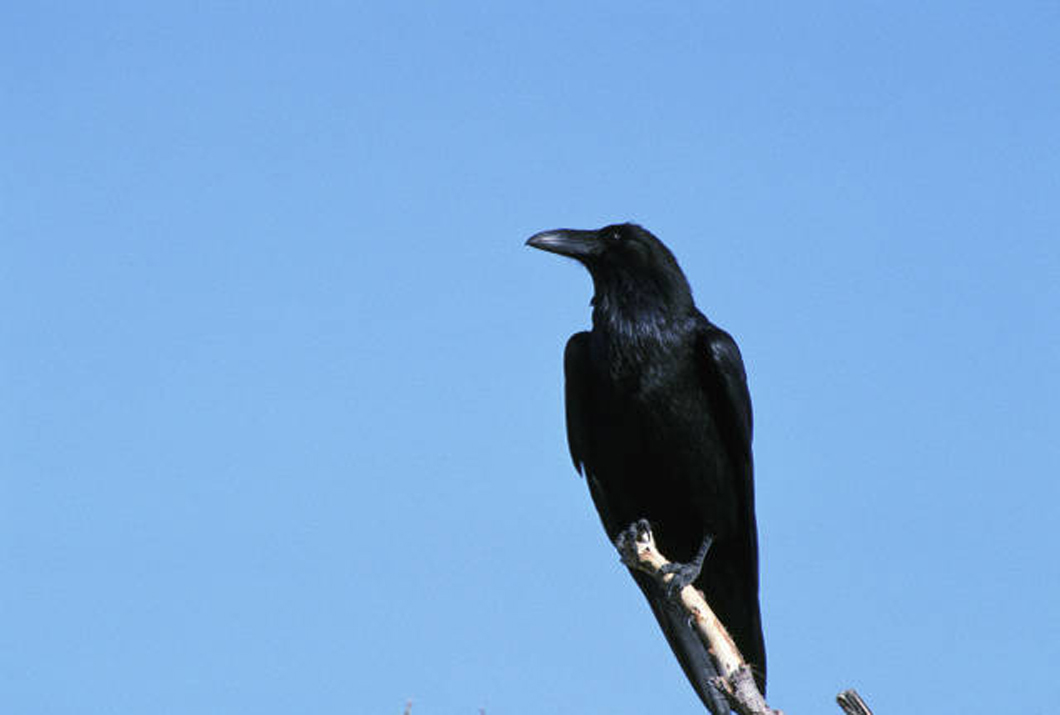
Lee Karney/USFWS • The common raven can live in a range of habitats, but these large and intelligent birds are especially adapted to cold.

The common raven is another bird that shrugs off cold and snow. They can survive and thrive in habitats as varied as Arctic tundra and scorching deserts. If temperatures drop below -4 degrees Farenheit, ravens can generate extra body heat.

All things considered, birds are simply better at coping with cold than we are.

•••

Bryan Stevens has written about birds since 1995. To ask a question, make a comment or share a bird sighting, email him at ahoodedwarbler@aol.com.

Raucous ravens, hooting owls and more contribute to the autumn soundscape

Photo by LoggaWiggler from Pixabay • Ravens are extremely vocal birds. Captive-raised ravens have even learned words.

The spring bird chorus is deservedly famous, but the birds don’t exactly go silent in the autumn.

Although recent mornings have started out with a definite chill over the past couple of weeks since the calendar officially turned the page into fall, the birds have simply fluffed their feathers and continued with business as usual.

The birds have been active despite these morning chills that I have been somewhat reluctant to acknowledge. Carolina wrens scold from tangles of vines and weeds. As of Oct. 5, I am still hearing the soft whirr of hummingbird wings, too, although I know that the curtain’s closing on their yearly stay. Other vocalizations I’ve detected early in the day have included the rattle of a belted kingfisher at the fish pond, the quarrelsome mews of a gray catbird plucking pokeberries one at a time from an overladen plant and a vigorous Eastern Phoebe repeating its “fee-bee” name continuously from the edge of the woods.

Some other birds also make their presence known while remaining concealed from direct visual observation, including a great horned owl that regularly produces resonant, distant hoots from a nearby ridge. From the ridge behind my home, the croaks of common ravens have added a bit of a spooky vibe to fog-shrouded mornings.

Photo by Bryan Stevens • A great horned owl grasps a post with its talons. This bird was part of a show at Callaway Gardens in Georgia featuring rehabilitated raptors.

Ravens are extremely vocal birds. In addition to the harsh croaks usually associated with these birds, raven can also produce an uncanny imitation of a tinkling bell.

I’m not pulling any legs. Among their vocal repertoire, ravens can produce, usually in flight, a “bell” call. I’m not sure if this is a common vocalization. I only remember ever hearing a raven’s “bell” on a few occasions. I was with a group of more established birders at Roan Mountain State Park when a raven flew overhead. Someone called out, “Listen to that.” I listened and heard my first raven “bell” call.

The strange thing is that I can find little about this unusual vocalization when I researched the subject. According to the website All About Birds, common ravens calls vary from a low, gurgling croak to harsh grating sounds and shrill alarm calls. Scientists have placed their vocalizations into as many as 33 different categories based on sound and context. The most commonly heard is the classic gurgling croak, rising in pitch and seeming to come from the back of the throat.

The croak is their standby vocalization, which they produce often. The raven’s croak can be heard from a mile away. And, in defense of the poet Edgar Allan Poe and his “ominous bird of yore,” ravens are accomplished mimics. According to All About Birds, ravens can imitate other birds. Raven raised in captivity can even learn words. “Nevermore?”

This is the time of year when departures appear to outpace new arrivals, but there are some birds that will soon make their return after a lengthy absence, including white-throated sparrows, dark-eyed juncos and winter wrens. The local ravens, on the other hand, appear to have chosen to reside near my home year-round.

From the opening refrain of “once upon a midnight dreary” in his poem, “The Raven,” Edgar Allan Poe established a somber mood and also helped cement the dark reputation of one of North America’s most misunderstood birds. Poe describes the bird that provides the title of his famous poem with adjectives such as “grim, ungainly, ghastly, gaunt and ominous.” His raven also speaks, although it has the limited vocabulary of a single word, “Nevermore.”

How else does the real common raven resemble the “bird of yore” in Poe’s classic poem? For starters, the raven is an intelligent bird. Authors of a scientific study conducted about 15 years ago posited the claim that ravens and crows are just as intelligent as some of the great apes. Although parrots are more famous for the ability to mimic human speech, captive ravens have proven capable of learning more words than even the most impressive vocabulary-endowed parrots. So, Poe was not wide of the mark when he gave the gift of gab to the raven in his poem.

The sounds of autumn are definitely richer for having the croaking calls of ravens in the mix. Keep your eyes (and ears) open for new arrivals as the transition of seasons continues.

•••

To share a sighting, ask a question or make a comment, email me at ahoodedwarbler@aol.com.

Common raven is no bird brain

Photo by Alexas-Fotos/Pixabay • Common ravens, although native to the region, were not so common only a few decades ago. This much larger relative of the American crow is slowly becoming more commonplace in the area once again.

Since back in November, a common raven has been lurking in the woodlands around my home. I even hear the raven’s loud croaking when I’m inside the house. The local American crows have not rolled out a warm welcome for the interloping raven, but there seems to be an uneasy truce between the crows and the much larger raven.

Ravens are vocal birds. I got reminded of the many unusual vocalizations a raven’s capable of when the resident bird flew over, croaking loudly, on a recent brisk and sunny late afternoon. Between the croaks, the raven produced an uncanny imitation of a tinkling bell. The bird produced this bell sound several times before flying out of sight.

I’m not pulling any legs. Among their vocal repertoire, ravens can produce, usually in flight, a “bell” call. I’m not sure if this is a common vocalization. I only remember ever hearing a raven’s “bell” on only one other occasion. I was with a group of more established birders at Roan Mountain State Park when a raven flew overhead. Someone called out, “Listen to that.” I listened and heard my first raven “bell” call.

The strange thing is that I can find little about this strange vocalization when I researched the subject. According to the website “All About Birds,” common ravens calls vary from a low, gurgling croak to harsh grating sounds and shrill alarm calls. Scientists have placed their vocalizations into as many as 33 different categories based on sound and context. The most commonly heard is the classic gurgling croak, rising in pitch and seeming to come from the back of the throat.

The croak is their standby vocalization, which they produce often. The raven’s croak can be heard from a mile away. And, in defense of the poet Edgar Allan Poe and his “ominous bird of yore,” ravens are accomplished mimics. According to “All About Birds,” ravens can imitate other birds. Raven raised in captivity can even learn words. “Nevermore?”

From the opening refrain of “once upon a midnight dreary” in his poem, “The Raven,” Edgar Allan Poe established a somber mood and also helped cement the dark reputation of one of North America’s most misunderstood birds. Poe describes the bird that provides the title of his famous poem with adjectives such as “grim, ungainly, ghastly, gaunt and ominous.” His raven also speaks, although it has the limited vocabulary of a single word, “Nevermore.”

How else does the real common raven resemble the “bird of yore” in Poe’s classic poem? For starters, the raven is an intelligent bird. Authors of a scientific study conducted about 15 years ago posited the claim that ravens and crows are just as intelligent as some of the great apes. Although parrots are more famous for the ability to mimic human speech, captive ravens have proven capable of learning more words than even the most impressive vocabulary-endowed parrots. So, Poe was not wide of the mark when he gave the gift of gab to the raven in his poem.

In the United States, the raven is quite common in Alaska. In the lower 48 states, raven populations are somewhat more sporadic. These large birds have established strongholds along the Appalachian Mountains and in the American Southwest. The raven is a cosmopolitan bird known to range from North America and Greenland to Europe and Asia, as well as North Africa and the Canary Islands.

The common raven is mainly a scavenger, but this bird is also an opportunistic predator and will prey on a wide variety of animals, including arthropods, amphibians, small mammals, birds, reptiles, and carrion. Ravens are attracted to carrion and are not finicky eaters. They adapt quickly and are known to even consume garbage.

Its black plumage has undoubtedly contributed to the raven’s sinister reputation and its affiliation with many dark superstitions. According to Laura C. Martin’s book, “The Folklore of Birds,” notes that the raven is “loathed throughout Europe as a symbol of impending death and war.” She explains that the raven probably acquired these connotations because these birds fed on battlefield corpses. As indicated earlier, the raven is not a picky eater. Martin also points out that legend maintains that England will remain a powerful nation as long as ravens live in the infamous Tower of London.

Establishing the raven’s closest relatives is helpful in fully becoming acquainted with this species. The raven is a member of the corvid family, which includes birds such as crows, magpies, nutcrackers and jackdaws. The common raven is the largest bird among the corvids. This bird can achieve a wingspan of almost four feet. The average raven weighs about two-and-a-half pounds. Large individuals have been recorded with a weight of slightly more than four pounds, making the raven a contender for the title of world’s largest songbird.

Poe’s poem offers a dramatic introduction to a bird that has once again become rather common in the region, particularly at higher elevations. This bird is well-known for nesting on inaccessible cliffs. However, ravens are proving adaptable. In recent years, a pair of ravens has repeatedly nested beneath the grandstands at Bristol Motor Speedway. Ravens have nested annually at this location at least since the spring of 2013.

Poe’s well-known poem, first published in 1845, is often cited as evidence for Poe’s genius for rhyme and his ability to create a believable supernatural universe populated by dark forces and one particularly persistent raven. It’s more than a little sad and ironic that the magazine that chose to publish Poe’s poem paid him a mere pittance of $9 for his brilliant contribution to literature.

The Bible also offers some interesting tales involving ravens. The prophet Elijah, after falling afoul of a wicked king, went into hiding and was provided food by cooperative ravens. In the story of the Biblical flood, Noah first released a raven to determine if the waters had receded. When the raven didn’t return to the ark, Noah next released a dove. This bird later returned to the ark clutching an olive leaf, which proved that the flood waters had subsided.

Many cultures also consider the raven as a “bringer of magic,” and the bird is associated with many creation stories in Native American cultures. Unlike the European custom of designating black as an “evil” color, Native Americans teach that black can hold various meanings, including resting, healing and prophetic dreaming, but evil is not one of them.

Ravens and crows are similar, but ravens are much larger birds. In addition, ravens have wedge-shaped tails and crows have fan-shaped tails. The common raven also has a well-developed ruff of feathers on the throat, commonly called its “hackles.”

A “murder of crows” is a fairly well known collective noun for a flock of these birds. On the other hand, a group of ravens has many collective nouns, including a “bazaar,” “constable” and “rant” of ravens. For its alliteration, I’m fond of “a rant of ravens” and think it’s a shame that Poe’s raven was apparently a solitary bird.

Other species of ravens found around the world include dwarf raven, thick-billed raven, fan-tailed raven, brown-necked raven, little raven and forest raven.

I like ravens. I find them fascinating, but there’s still something that causes some shivers when one hears the guttural, loud croak of a raven. It remains difficult to completely dismiss the raven’s long history of association with the darker niches of the world.

On that note, here’s one final tidbit regarding the raven taken from Martin’s book. Cherokee tribes believed that ravens would visit villages where ill or dying people were present. In the absence of a village shaman to drive away the bird, the raven would invariably snatch the life of the ailing individual.

••••••

To learn more about birds and other topics from the natural world, friend Bryan Stevens on Facebook at https://www.facebook.com/ahoodedwarbler. He is always posting about local birds, wildlife, flowers, insects and much more. If you have a question, wish to make a comment or share a sighting, email ahoodedwarbler@aol.com.
Crows show intelligence yet can’t shake dark reputation

Crow-Waxwings

Photo by Bryan Stevens
Red-winged blackbirds mob an American crow. In turn, crows often mob large raptors,           such as red-tailed hawks and great horned owls.

There’s something rather autumnal about watching a flock of American crows glean the last scattered kernels of corn from a harvested field as a sentry stands guard ready to utter the alarm with some guttural “caws” should anything potentially threatening appear on the scene. Crows are such a part of the landscape that they would almost escape our notice if they didn’t come with centuries of accumulated baggage that makes us distrust them and suspect their every action.

The crow, largely thanks to its black plumage, but perhaps also with a nod to its avian intelligence, has long been associated with Halloween. Greeting cards and decorations for the holiday often feature depictions of bats, owls and black cats, as well as the inevitable crow and the accompanying scarecrow. It’s not like the straw-filled sentries that stand guard over a farmer’s fields do anything to intimidate or even discourage crows. With a brain about as big as a man’s thumb, the crow is renowned among ornithologists and other scientists for its keen intelligence. Crows are not fooled for a second by the masquerade of a scarecrow propped in a field.

crows-dec-21

Photo by Bryan Stevens / Wary American crows survey their surroundings.

The intelligence of this bird has long been known. Early American naturalist William Bartram wrote about a crow named Tom in a unique naturalist essay titled “Anecdotes of an American Crow.” Bartram, who lived from 1739 to 1823, brought humor and insight to his subject as he wrote about the joys, as well as tribulations, of living with Tom, a crow that enjoyed tormenting Bartram’s dog and stealing the writer’s spectacles and trying to hide them.

The essay demonstrates that almost as soon as Europeans arrived in North America, some of those with a bent toward the natural world recognized the intelligence and amazing adaptability of the American crow. As well as writing about the natural world, Bartram earned widespread acclaim for his drawings of botanical and ornithological subjects. Tom, the featured crow in Bartram’s brief essay, certainly exhibited intelligence of an impressive degree. Not only did the crow steal his owners eyeglasses, he foiled Bartram’s first attempt to reclaim them. Noting Bartram’s attention to his efforts to hide the purloined spectacles, Tom snatched the eyeglasses a second time when Bartram made a premature attempt to reclaim them. The situation makes very humorous reading.

What else have crows done down through the ages to gain such a dark and much undeserved reputation? It probably doesn’t help matters that a flock of crows is known as a “murder.” Ancient Greeks considered crows as omens, which often foretold death and other disasters. On the positive side, many Native American tribes revere crows as communicators between worlds. Crows have been documented using tools and solving problems, which shows an uncanny ability to analyze and strategize. Early Celtic people also noted and admired these traits in crows.

sclaudubon_sclib_audubon_v2_2_p156_full_5398_8151__0_native

Early naturalist and artist John James Audubon painted this American crow.

In addition, crows forage beyond the cornfield for their food. Many crows scavenge road-killed wildlife, such as squirrels, opossums and rabbits. While they eat carrion, they do so less often than birds such as turkey vultures, black vultures and the crow’s fellow corvid, the common raven.

The kinship to the raven is evident, but even moderately experienced birders rarely confuse these similar species. The raven is a large bird with a heavy beak, a distinctive profile and a wedge-shaped tail. In a direct comparison with a raven, a crow looks downright puny. Both are members of the corvid family, which consists of 120 species including jays, rooks, magpies and jackdaws.

Many years ago I fed a flock of ducks that took up residence at my fish pond. Before long, the crows arrived within minutes after I tossed shelled corn on the ground for the benefit of the ducks. If the ducks took too long consuming the corn, the impatient crows crowded closer and competed directly with the ducks for the kernels. The crows that live around my home are usually too cautious and wary to visit feeders situated near my home. Feeders set farther from the house receive occasional hurried visits by crows.

Crow-Trio

Photo by Bryan Stevens / A trio of American crows forages on a grassy lawn.

American author and abolitionist Henry Ward Beecher summed up the American crow in the frequently quoted remark, “If men had wings and bore black feathers, few of them would be clever enough to be crows.” It’s an apt tribute and comes from the man whose sister, Harriet Beecher Stowe, wrote “Uncle Tom’s Cabin,” a book often credited with helping to launch the American Civil War.

Crows, perhaps more than any other North American bird, have learned to co-exist with human beings. Make an effort to get past some pre-supposed superstitions about these interesting birds and learn to appreciate them for their many good qualities.

••••••

To ask a question, make a comment or share a sighting, send an email to ahoodedwarbler@aol.com.
funny-pumpkin-head-scare-crow-halloween-wallpaper

Edgar Allan Poe’s raven much like the real-world bird

Raven

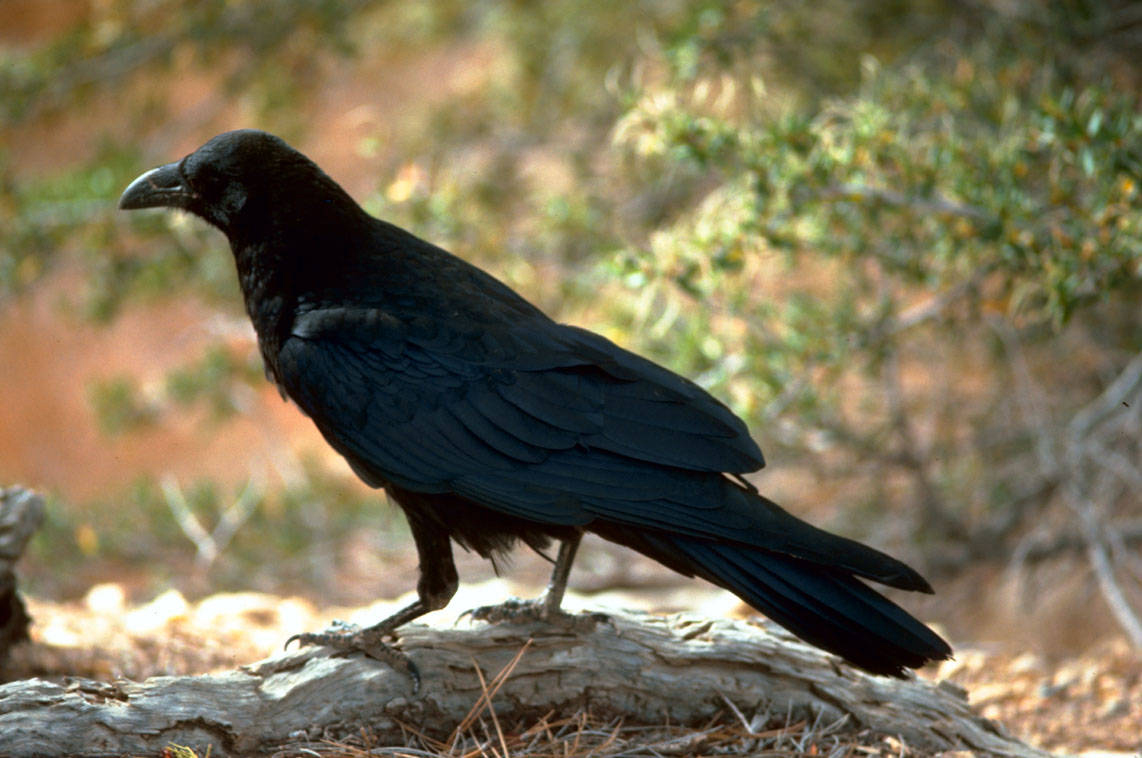
Photo by U.S. Fish & Wildlife Service                      A Common Raven turns a fallen log into a perch.

From the opening refrain of “once upon a midnight dreary” in his poem, “The Raven,” Edgar Allan Poe established a somber mood and also helped cement the dark reputation of one of North America’s most misunderstood birds.


The common raven seems an apt bird for this week’s column since we will be celebrating Halloween this coming Saturday. Poe’s poem offers a dramatic introduction to a bird that has once again become rather common in the region, particularly at higher elevations. This bird is well-known for nesting on inaccessible cliffs. However, this past year a pair of ravens chose a more unusual location when they built a nest beneath the grandstands at Bristol Motor Speedway. Ravens have nested annually at this location at least since the spring of 2013.

Poe’s well-known poem, first published in 1845, is often cited as evidence for Poe’s genius for rhyme and his ability to create a believable supernatural universe populated by dark forces and one particularly persistent raven.

url

Edgar Allan Poe, author of “The Raven.”

Poe describes the bird that provides the title of his famous poem with adjectives such as “grim, ungainly, ghastly, gaunt and ominous.” His raven also speaks, although it has the limited vocabulary of a single word, “Nevermore.”

How closely does the real common raven resemble the “bird of yore” in Poe’s classic poem?

Establishing the raven’s closest relatives is helpful. The raven is a member of the corvid family, which includes birds such as crows, magpies, nutcrackers and jackdaws. The common raven is the largest bird among the corvids. This bird can achieve a wingspan of almost four feet. The average raven weighs about two-and-a-half pounds. Large individuals have been recorded with a weight of slightly more than four pounds, making the raven a contender for the title of world’s largest songbird.

Plate-101-Raven-(610)-final

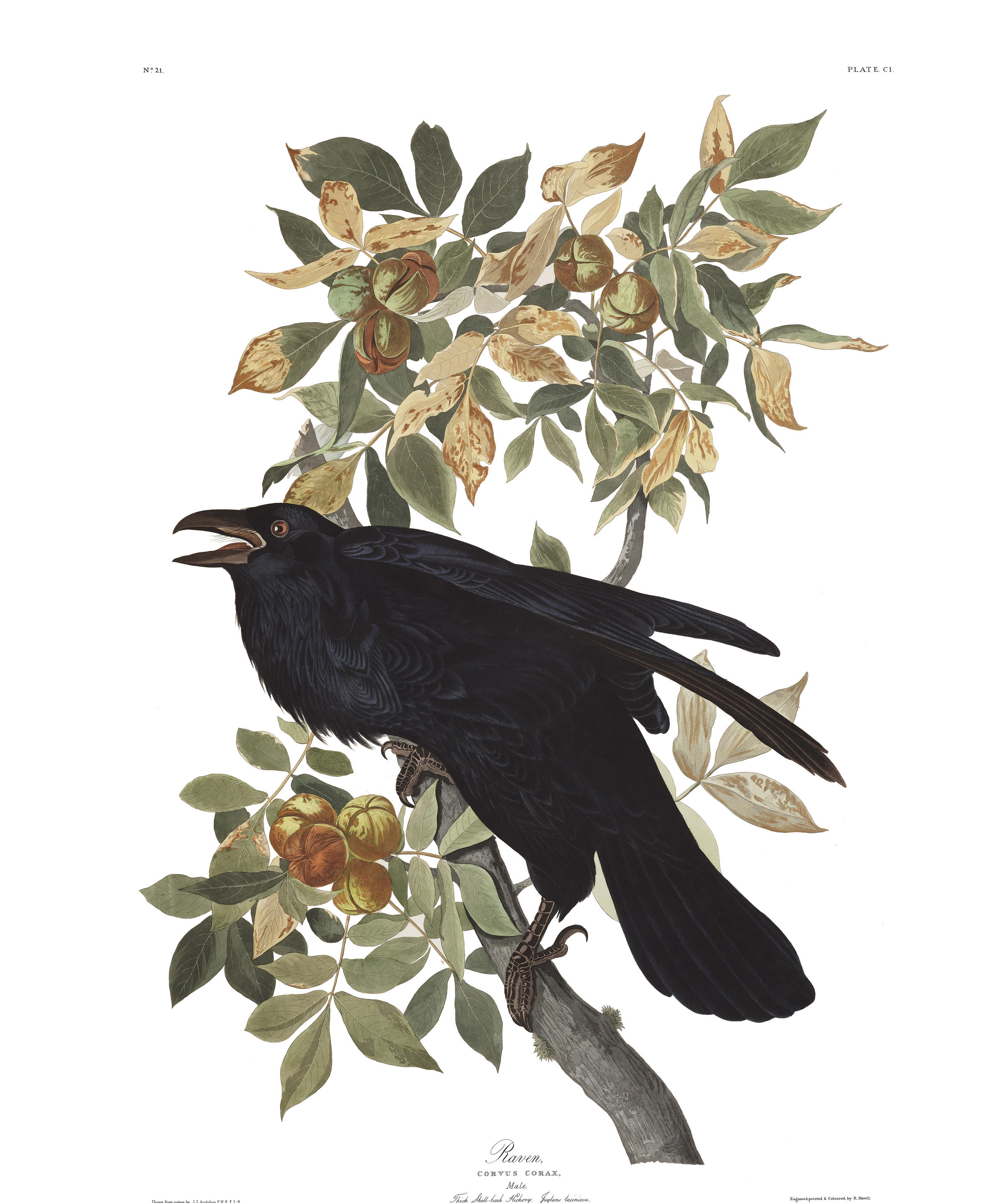
John James Audubon painted the Common Raven as part of his ground-breaking “Birds of America.”

It’s also an intelligent bird. Authors of a scientific study conducted about 10 years ago posited the claim that ravens and crows are just as intelligent as some of the great apes. Although parrots are more famous for the ability to mimic human speech, captive ravens have proven capable of learning more words than even the most impressive vocabulary-endowed parrots. So, Poe was not wide of the mark when he gave the gift of gab to the raven in his poem.

In the United States, the raven is quite common in Alaska. In the lower 48 states, raven populations are somewhat more sporadic. These large birds have established strongholds along the Appalachian Mountains and in the American Southwest. The raven is a cosmopolitan bird known to range from North America and Greenland to Europe and Asia, as well as North Africa and the Canary Islands.

The common raven is mainly a scavenger, but this bird is also an opportunistic predator and will prey on a wide variety of animals, including arthropods, amphibians, small mammals, birds, reptiles, and carrion. Ravens are attracted to carrion and are not finicky eaters. They adapt quickly and are known to even consume garbage.

Its black coloration has undoubtedly contributed to the raven’s sinister reputation and its affiliation with many dark superstitions. According to Laura C. Martin’s book, “The Folklore of Birds,” notes that the raven is “loathed throughout Europe as a symbol of impending death and war.” She explains that the raven probably acquired these connotations because these birds fed on battlefield corpses. As indicated earlier, the raven is not a picky eater.71GJJF6G3WL._UY250_

Martin also points out that legend maintains that England will remain a powerful nation as long as ravens live in the infamous Tower of London.

AV9UD00Z

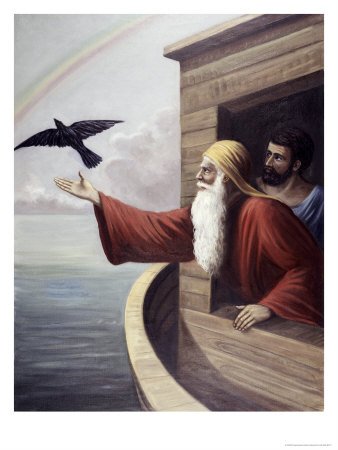
Noah release a raven prior to setting free a dove.

The Bible offers a rich source of tales involving ravens. The prophet Elijah, after falling afoul of a wicked king, went into hiding and was provided food by cooperative ravens. In the story of the Biblical flood, Noah first released a raven to determine if the waters had receded. When the raven didn’t return to the ark, Noah next released a dove. This bird later returned to the ark clutching an olive leaf, which proved that the flood waters had subsided.

Common_raven

Photo by U.S. Fish & Wildlife Service The Common Raven, like most other corvids, is known for intelligence.

Many cultures also consider the raven as a “bringer of magic,” and the bird is associated with many creation stories in Native American cultures. Unlike the European custom of designating black as an “evil” color, Native Americans teach that black can hold various meanings, including resting, healing and prophetic dreaming, but evil is not one of them.

Ravens and crows are similar, but ravens are much larger birds. In addition, ravens have wedge-shaped tails and crows have fan-shaped tails. The common raven also has a well-developed ruff of feathers on the throat, commonly called its “hackles.”
A “murder of crows” is a fairly well known collective noun for a flock of these birds. On the other hand, a group of ravens has many collective nouns, including a “bazaar,” “constable” and “rant” of ravens. For its alliteration, I am fond of “a rant of ravens” and think it’s a shame that Poe’s raven was apparently a solitary bird.

Other species of ravens found around the world include dwarf raven, thick-billed raven, fan-tailed raven, brown-necked raven, little raven and forest raven.

parable-raven-dove

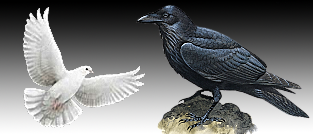
Doves, by virtue of their light plumage, are often associated with good, while dark-feathered ravens are associated with darkness and evil.

If you hear the guttural, low caw of a raven this Halloween, beware of this bird’s long history of association with the darker niches of the world. Here’s one final tidbit regarding this bird from Martin’s book. Cherokee tribes believed that ravens would visit villages to seek out ill or dying people. In the absence of a village shaman to drive away the bird, the raven would invariably snatch the life of the ailing individual. It’s something I wanted to make you aware of in advance of the year’s most spooky holiday.

••••••

Bryan Stevens lives near Roan Mountain, Tennessee. To learn more about birds and other topics from the natural world, friend Stevens on Facebook at https://www.facebook.com/ahoodedwarbler. He is always posting about local birds, wildlife, flowers, insects and much more. If you have a question, wish to make a comment or share a sighting, email ahoodedwarbler@aol.com.