Category Archives: Songbirds

Here are a few birds to look for this spring

Photo by Bryan Stevens • A male hooded warbler perches in a cluster of branches.

Has it been a slow spring? I have felt that it’s been one step forward, two steps back. But April has finally arrived. Although we’re now two days into the month, I’m still waiting on some of my first arrivals among our fine feathered friends.

That’s not an unusual situation. I think the birds like to drag out their springtime arrivals. They know that being tardy is sure to aggravate me as I’m not known for patience.

The first male red-winged blackbird returned to the fish pond in mid-March and has been singing persistently from the tops of the bald cypress trees bordering the pond. I haven’t seen a female red-winged blackbird yet, but they tend to arrive later than males.

Of course, and I don’t think I’m alone in this hope, I’m also eager to welcome back ruby-throated hummingbirds. These tiny flying gems should be back any day now. My sugar water feeders are waiting for them.

I hope readers will once again share the first arrival dates of hummingbirds at their own feeders. Jot down the date and time, as well as any other details you’d like to share, and email me at ahoodedwarbler@aol.com or message me on Facebook at http://www.facebook.com/ahoodedwarbler/

With those preliminary thoughts shared, what else will I look for as the spring advances? Longtime readers will know of my enthusiasm for warblers, also known as New World warblers or wood-warblers.

They’re a group of small, often colorful, passerine birds that make up the family Parulidae. The family, which occurs only in the New World, contains 120 species. They are not closely related to Old World warblers or Australian warblers.

About half of the 120 species reside in Central and South America, but the others migrate north each spring to nest in the United States and Canada. In Northeast Tennessee, we have about two dozen nesting species that make their home with us from April to October.

The warbler I look forward most to seeing is the hooded warbler, partly due to individuals belonging to this species nesting in the woodlands around my home.

Photo by USFWS/A female hooded warbler stays put on her nest.

So, from the time my favorite warbler returns in April until the last individual departs in October, I enjoy regular glimpses of this colorful and interesting bird. Like all warblers, the hooded warbler is quite energetic, dashing after tiny insects in the branches of shrubs and trees. Hooded warblers often forage close to the ground, which makes observing them easier.

Of course, birds are free to break the rules. One of my most memorable sightings of a hooded warbler involved a male singing from the upper branches of a dead pine tree. I’d estimate that the bird was at least 40 feet off the ground, singing his little heart out to attract a mate. I was standing on an elevated rise of land while the tree providing the warbler its perch was lower in a gully that actually placed bird and observer on a roughly level playing field.

That sighting took place 25 years ago, but the image of that male hooded warbler singing so enthusiastically has remained emblazoned in my memory.

This particular bird sang for several moments, which is not always the case with warblers. These birds tend to dash for cover at the slightest disturbance, but this enthusiastic male didn’t seem to pay any heed to the fact that most of its kin prefer to skulk in shrubs and dense rhododendron thickets no more than a few feet off the ground.

It’s one bird unlikely to be mistaken for any other. Every time I behold a hooded warbler, I marvel at the bird’s exquisite appearance. The gold and green feathers seem to glow brightly in the dim light of the shadowy thickets of rhododendron they prefer to inhabit. The black hood and bib surrounding the male’s yellow face stands out by virtue of its stark contrast from the brighter feathers. Large coal-black eyes complete the effect. The appearance of the male bird provides this species with its common name.

The female hooded warbler has an identical yellow-green coloration as the male, although she is slightly more drab. She lacks the black hood and bib, although older females may acquire some dark plumage on the head and around the face. Both sexes also show white tail feathers that they constantly fan and flick as they move about in thick vegetation and shrubbery.
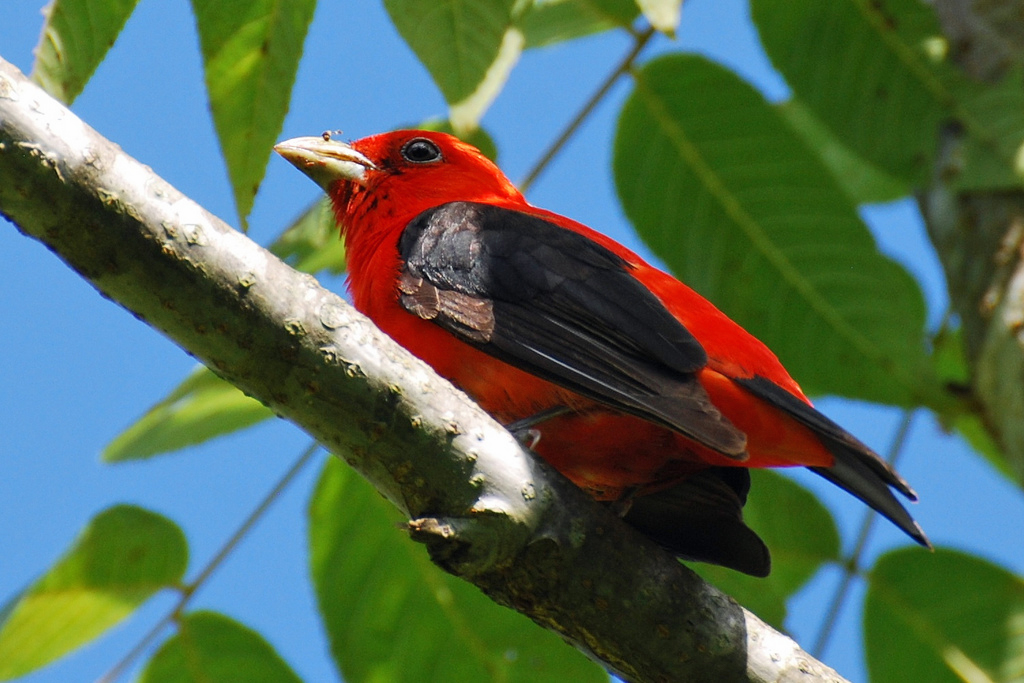
Photo Courtesy of Jean Potter
A male scarlet tanager brightens shadowy woodlands with a flash of tropical colors yet remains mostly inconspicuous in the forest canopy.

In addition to warblers, I also look forward to the return of scarlet tanagers. Males are unmistakable in their bright red plumage accented by black wings. This is one bird that is truly breathtaking when lured into the open for an observation through a pair of binoculars.

During their summer stay in the region, scarlet tanagers largely prey on insects. Although renowned as a fruit-eating bird, the scarlet tanager primarily feeds on fruit during its migration flights and on its wintering range in the tropics. This tanager breeds in deciduous and mixed deciduous-evergreen woodlands across the eastern half of North America. It’s my understanding that oaks are a favorite tree for this woodland dweller.

It’s unlikely that you’ll run across the nest of a scarlet tanager. These birds nest high in trees, often locating their nests 50 feet or more above the ground. After building a nest, a female tanager will incubate her three to five eggs for about two weeks. It’s during this time that her inconspicuous appearance is a plus, helping her blend well with her surroundings.

So, as I wait for warblers, hummingbirds and tanagers, I’ll just have to be a little more patient. I’m also hopeful that the fish pond will attract some nesting birds such as tree swallows and wood ducks. Fingers crossed!

•••

Remember to let me know about your first hummingbird sightings. Email me at ahoodedwarbler@aol.com to notify me of a sighting, ask a question or share a comment.
Melodic song sparrow makes a good neighbor in any season

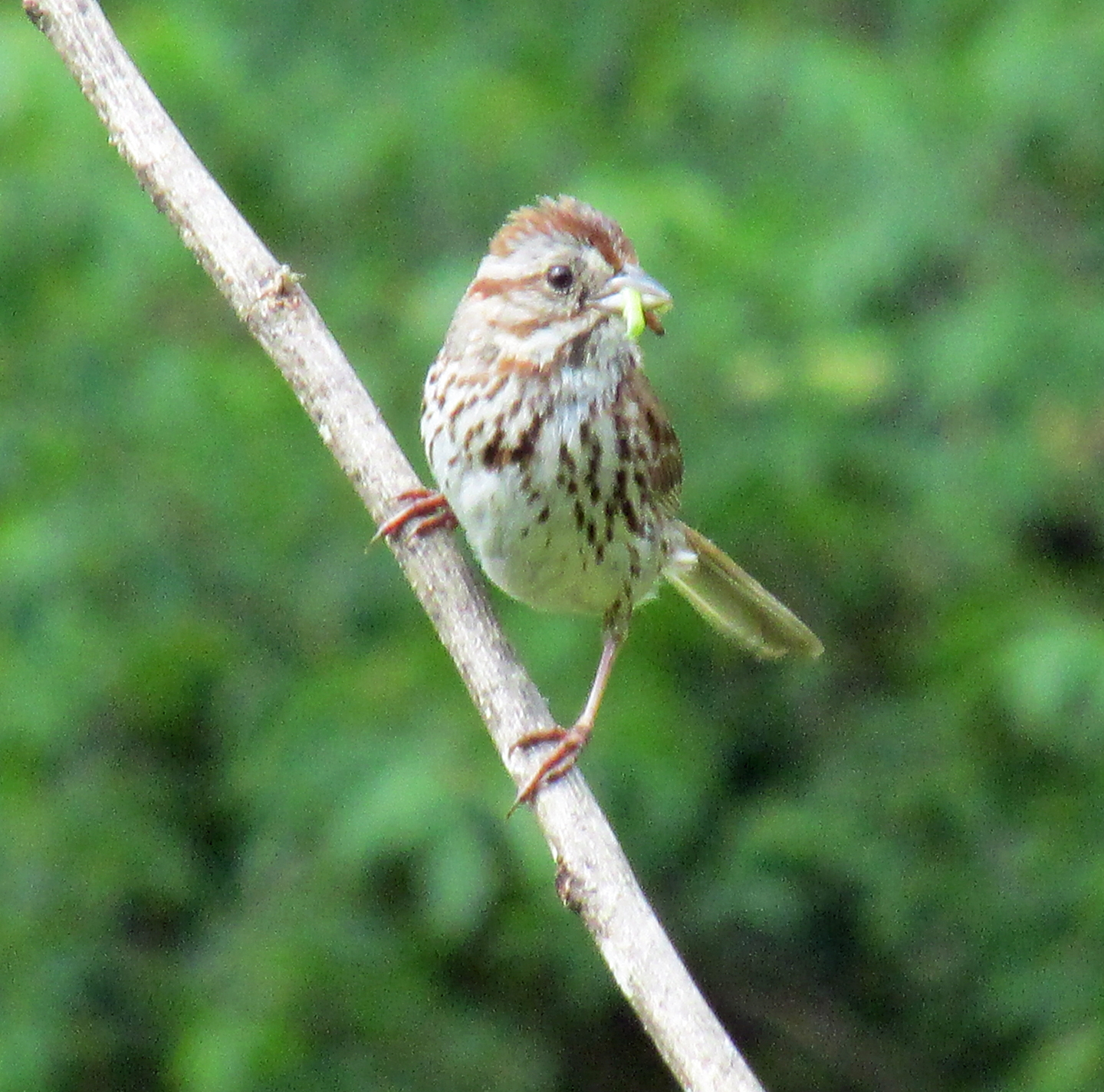
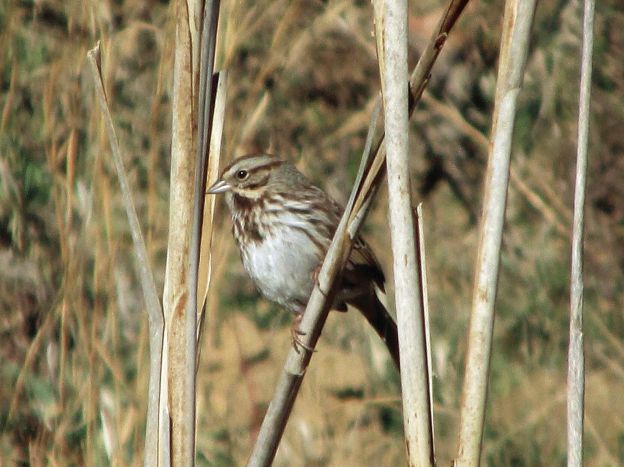
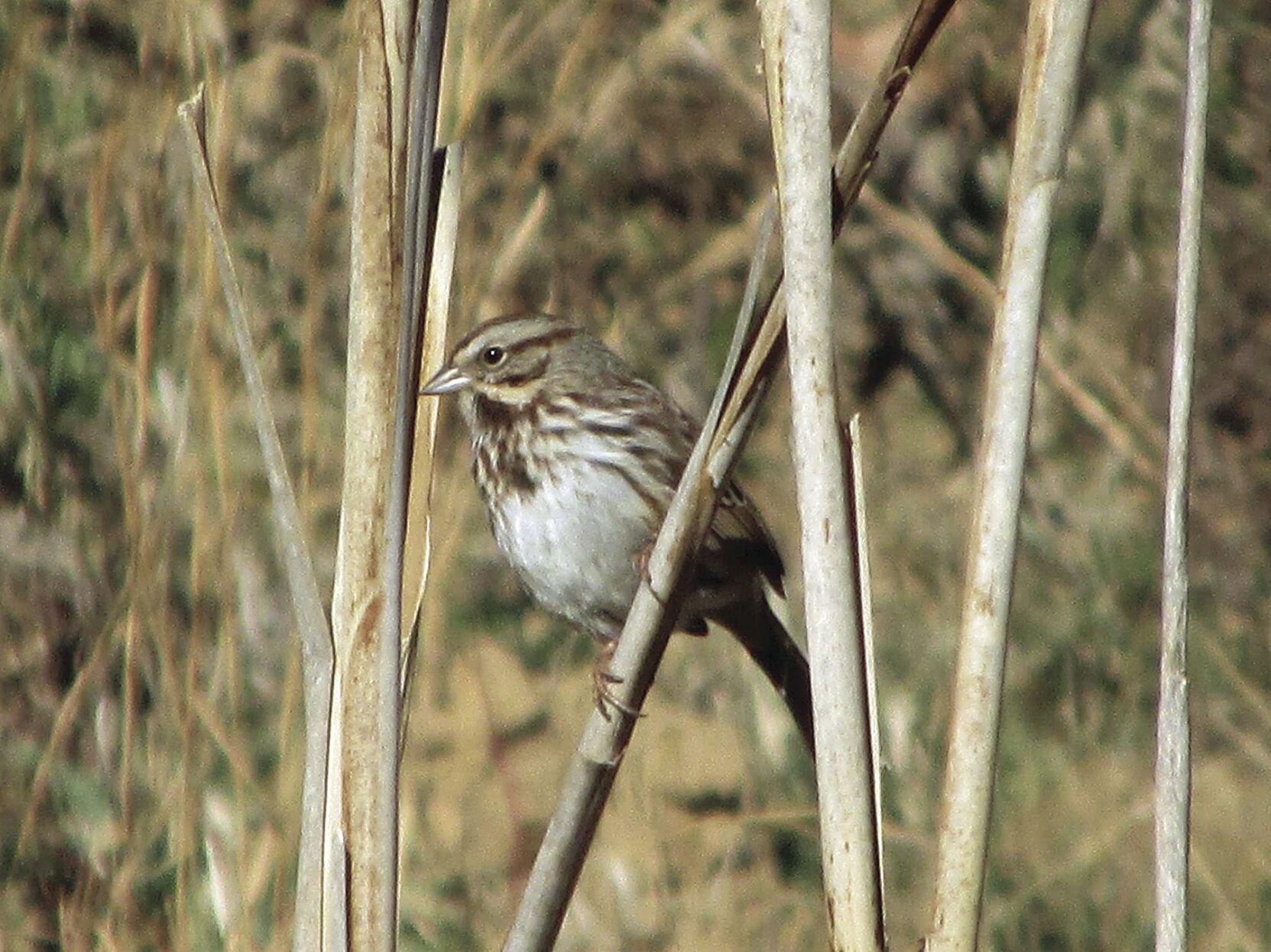
Photo by Bryan Stevens • Song sparrows show a stripe breast that comes together in a large, central dot. This field mark is diagnostic in distinguishing the song sparrow from other little brown birds.

Recent cold and snow meant elevated activity at my bird feeders. Among the birds flocking to my feeders were several species of sparrows, including white-throated sparrow, song sparrow and dark-eyed junco.

Other sparrows in the region include field sparrow, chipping sparrow, swamp sparrow and white-crowned sparrow.

The white-crowned sparrow and the white-throated sparrow are both members of the genus known as Zonotrichia, which refers to two ancient Greek words for zone and hair, which refers to the pattern of streaks on the backs of these five sparrow species. The Zonotrichia sparrows belong to a large group of birds known as Passerellidae, or American sparrows, which also includes birds such as juncos, towhees and brush finches.

The song sparrow, unlike some of the other sparrows that made appearances at my feeders, is a year-round resident in the region.

Song sparrows, according to the website All About Birds, eat many insects and other invertebrates in the summer, as well as seeds and fruits in all seasons.

All About Birds also makes note of the fact that this widespread sparrow occurs in a variety of habitats, including tidal marshes, arctic grasslands, desert scrub, pinyon pine forests, aspen parklands, prairie shelterbelts, Pacific rainforest, chaparral, agricultural fields, overgrown pastures, freshwater marsh and lake edges, forest edges and suburbs.

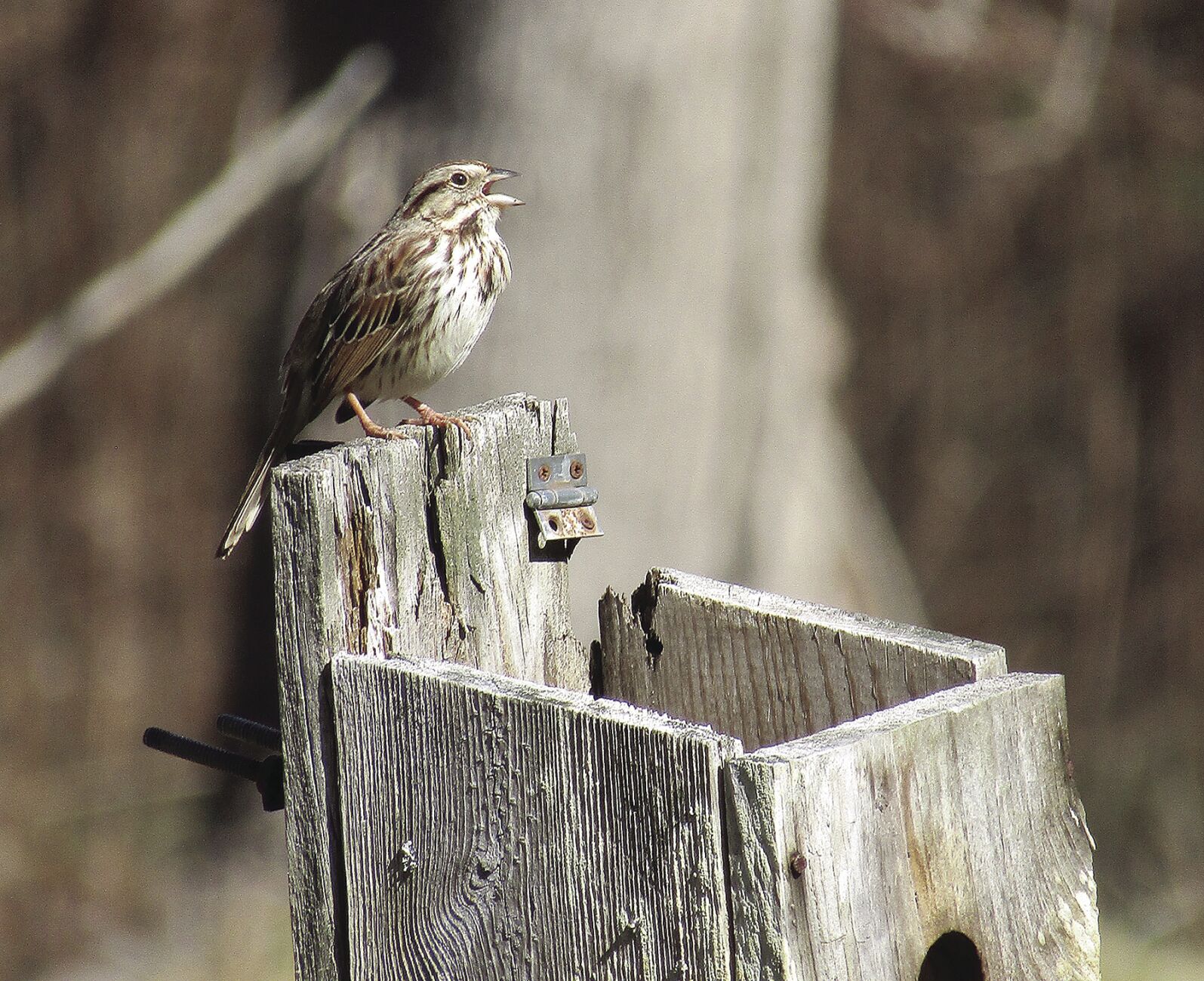
Photo by Bryan • A song sparrow sings from the perch of a dilapidated bird box.

The scientific name for the song sparrow is Melospiza melodia, which translated from the Greek means “melodic song-finch.” It’s an apt name for a persistent, enthusiastic singer. The commonplace nature of the bird also makes it easy to learn to detect and identify the bird by its song alone.

According to All About Birds, male song sparrow use song to attract mates as well as defend territory. Laboratory studies have shown that the female song sparrow is attracted not just to the song itself, but to how well it reflects the ability of the male to learn.

Other sparrows produce well-known songs. Many Americans render the song of the white-throated sparrow as “Ol’ Sam Peabody, Peabody, Peabody.” For those living north of the border, however, the white-throated sparrow sings “O Canada, O Canada, O Canada.”

No matter how you translate this sparrow’s song, it’s a sweet and welcome addition to the spring aural landscape.

Some of the more descriptive names for American sparrows include orange-billed sparrow, white-eared ground sparrow, green-backed sparrow, olive sparrow, cinnamon-tailed sparrow, five-striped sparrow and golden-winged sparrow.

Many sparrows prefer to forage for food on the ground. It’s often helpful to purchase a supply of millet seed. When filling feeders with sunflower seeds, scatter a couple of handfuls of millet seed on the ground beneath the feeders or at the edge of a brushy area. Sparrows like to have quick access to dense cover, so they will feed more securely if the scattered seeds are within quick reach of shelter.

Although they are fairly common winter visitors in the region, white-throated sparrows, dark-eyed juncos and white-crowned sparrows depart the area in spring.

With the song sparrow, it’s not difficult to realize why the sparrows are often lumped together under the categorization of “little brown birds.”

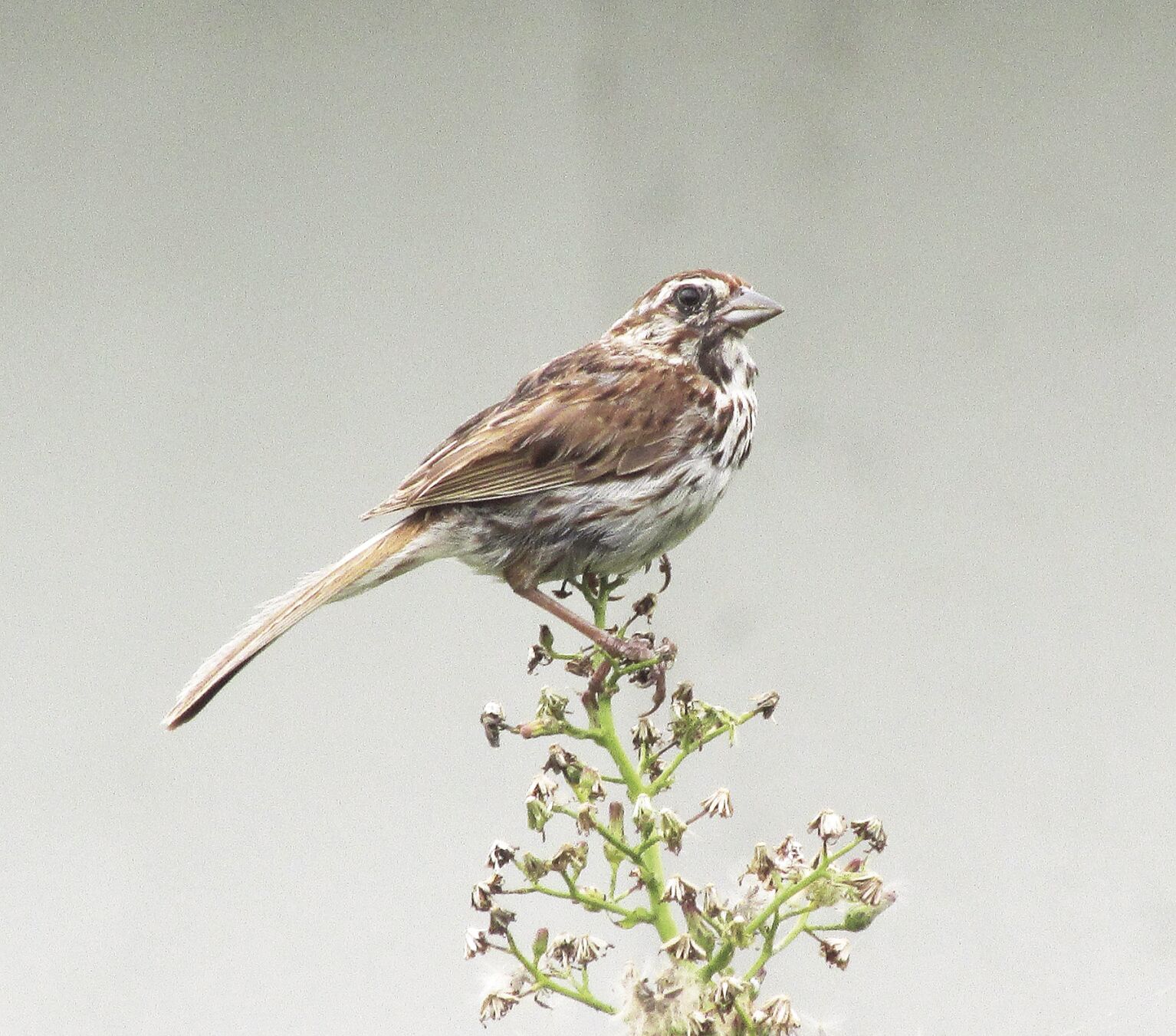
The adult song sparrow has brown upperparts with dark streaks on the back and are white underneath with dark streaking and a dark brown spot in the middle of the breast. That dark spot is often considered a field mark that makes identifying this bird easier in the field. The song sparrow has a brown cap and a long brown rounded tail. Their face is gray with a brown streak through each eye.

White-crowned sparrows, in contrast to the song sparrow, are medium-sized birds with considerable gray on the breast and back of the neck. Adults of both sexes are adorned with bold black and white head stripes, which gives this bird its common name. Thanks to this distinctive feature, this sparrow truly stands out among a family of rather drab birds.

The white-crowned sparrow is known by the scientific name Zonotrichia leucophrys, which translates into English from Ancient Greek as “white eyebrow.”

Sparrows can be a challenge for beginners, but the winter season is a good time to learn how to differentiate these feeder visitors. The lure of food makes it possible to draw the sparrows in close for observation.

The sparrows will eat a variety of seeds, but I’ve had the best luck with black oil sunflower seeds. Just keep in mind that sparrows are ground feeders. It pays to also scatter some seeds directly on the ground for them. They will scratch and kick with their legs as they forage for the seeds we provide them during wintry days.

Once spring arrives, song sparrows will remain in your yards and gardens. They nest several times a season, so there’s the added opportunity of watching these little birds tend their young. They’re never going to compete with our more colorful birds, but song sparrows make great neighbors.

•••

Mary Anna Wheat will present a program on a trip to Arizona, Utah, Colorado and New Mexico in late September and early October 2023 at the next meeting of the Elizabethton Bird Club.

She traveled with a friend and former co-worker from Sept. 19 to Oct. 16, 2023, in those four states. Their focus was on scenery, archeology (Wheat’s friend is an archaeologist with experience doing archaeological work at Canyon de Chelly National Monument) and the annular solar eclipse. Birding was incidental, although Wheat noted that they saw or heard more than 60 species.

The club’s meeting will be held Tuesday, Feb. 6, at the Northeast State Community College’s Elizabethton campus at 7 p.m. The front desk can direct visitors to the meeting room.

•••

Photo by Bryan Stevens • A song sparrow perches on a weed stalk near a river.

Bryan Stevens has been writing about birds and birding since 1995. Email him at ahoodedwarbler@aol.com to ask a questing, share a sighting or make a comment.

Tennessee and neighboring states hosting exceptional rare birds this winter

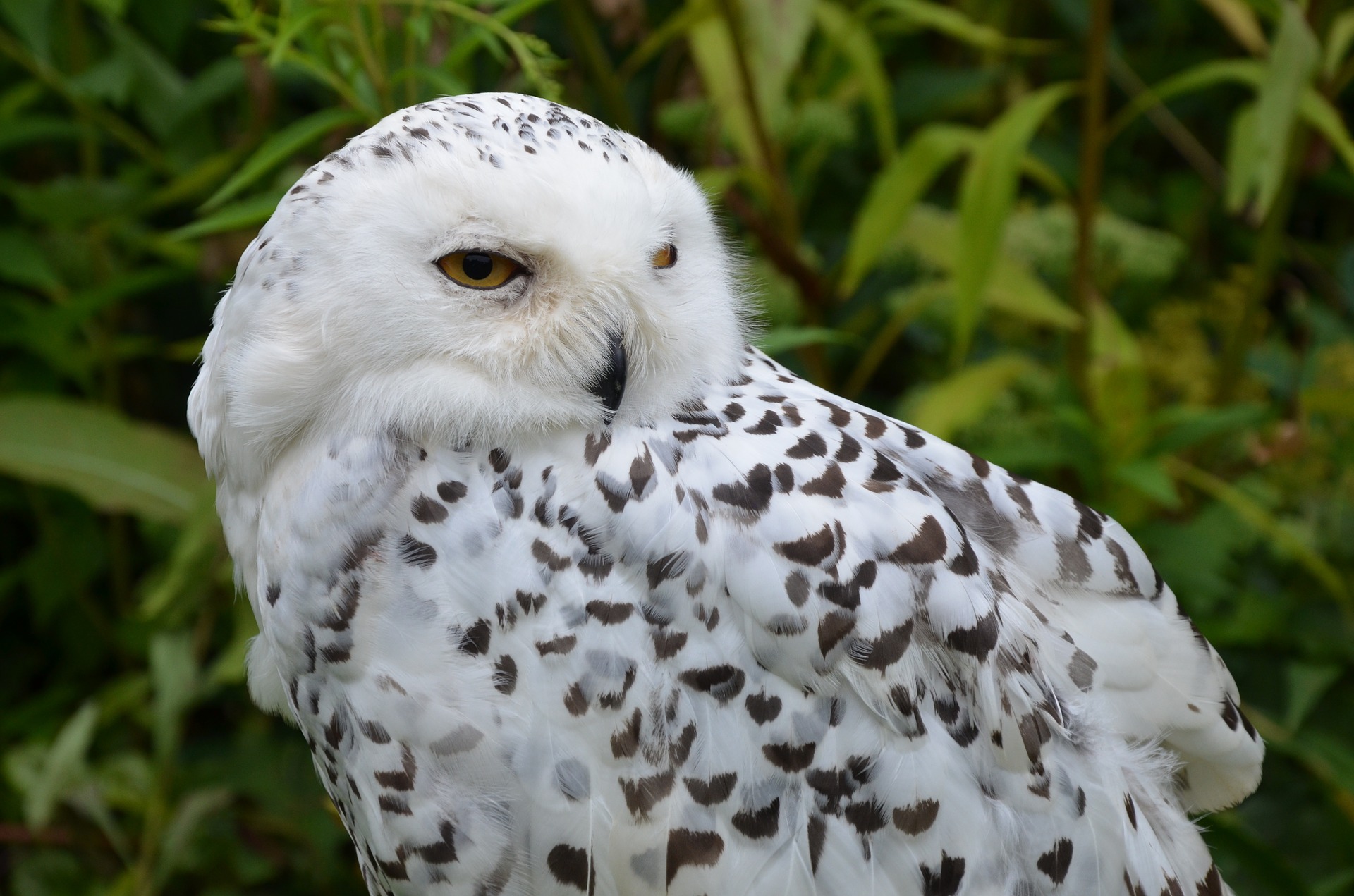
Photo by LoneWombatMedia from Pixabay • Among the unusual avian visitors to the Volunteer State this winter has been a snowy owl that has delighted observers in Chattanooga. Snowy owls, such as the individual pictured, are more commonly found on the tundra regions of the Arctic.

Birds have wings. Birds can fly. Birds confound our expectations.

Perhaps the mobility of birds is part of the human fascination with them. An unexpected bird can pop up at any time at almost any place. In fact, with 2021 less than a month old, the Volunteer State has already hosted some absolutely incredible birds.

For example, birder Evan Kidd found a Pacific Slope Flycatcher in Maryville on Jan. 7. 

A couple of weeks later, a snowy owl, which is a bird most people have only become acquainted with in the pages of J.K. Rowlings Harry Potter novels, made an appearance on Zephyr Lane near Lake Chickamauga in Chattanooga. 

Chattanoogas been a real hot spot so far this year. In addition to the snowy owl, Chattanoogas hosted such unlikely visitors as white-throated swift and Bullocks oriole. 

All of these birds quickly achieved celebrity status and attracted birders from near and far hoping for a glimpse of these rarities to Tennessee. 

Birder Michael Todd posted on Facebook on Jan. 13 about his own observation of the white-throated swift. This particular sighting came with a bit of an unnerving twist for all the people who had flocked to see the swift.

Luckily, the swift narrowly avoided being a snack for a marauding merlin that tried its best to have some swift for lunch today, Todd revealed in his Facebook post. 

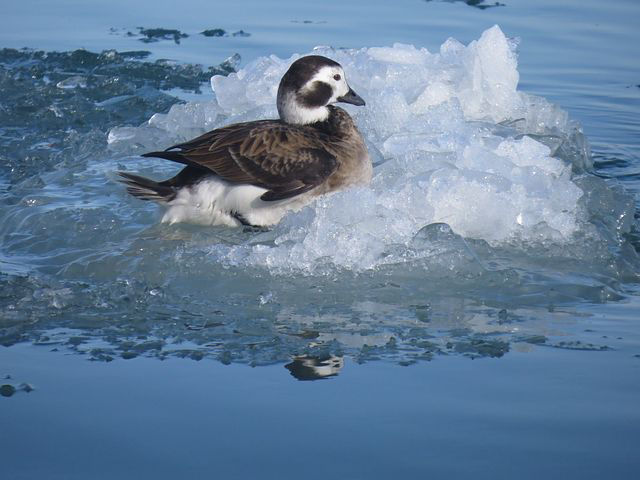
Closer to home, a long-tailed duck has been hanging out with buffleheads and other ducks at the weir dam at Osceola Recreation Area in Bristol. 

Ray Miller from Pixabay • Long-tailed ducks, such as this individual, favor colder waters, but they occasionally venture into Tennessee.

The winter invasion of evening grosbeaks, a finch that usually inhabits the forests of Canada and the northern United States, continued into 2021 as well.

What brings birds to locations far beyond their typical range? Obviously, their wings and the associated power of flight makes it possible for birds to travel surprising distances.

But on a more down-to-earth level, some of these birds such as the snowy owl and evening grosbeaks have ventured far south of their normal ranges because their usual food sources are scarce. Climate change may be exacerbating those scarcities. On occasion, a major weather phenomenon like hurricanes or other strong storms will force birds into unfamiliar territory. And whos to say that an occasional bird doesnt succumb to the temptation of wanderlust and decide to explore greener pastures? Or maybe some of these birds are simply stubborn, lost, and reluctant to ask for directions.

The reasons an unexpected bird might grace any given location are myriad. Whats easily explained is the excitement that they can generate. Back in the winter of 2009 I traveled with some friends to Spring Hill, Tennessee, in the hope of getting a look at a snowy owl. After several hours staking out some large fields with dozens of other birders on property owned by General Motors at the time, we got our owl. Incidentally, that particular owl got the nickname Chevy due to its association with the GM production facilities in Spring Hill. The moment that owl unfurled its wing and made a short but majestic flight over the field remains a birding thrill of a lifetime. 

Making the moment even more memorable was the fact that I got to see my first (and so far only) snowy owl in my home state of Tennessee instead of traveling to the edge of the Arctic tundra during the summer to look for this awesome owl on its native turf. Its not that I would say no to a tundra tour, but it hasnt been in the cards yet.

I have a short list of some other exceptional birds that have made their way to Tennessee rather than forcing me to venture across the country and around the globe to see. I observed monk parakeets and a green-breasted mango hummingbird in North Carolina, as well as a harlequin duck and Virginias warbler along Netherland Inn Drive in Kingsport from the greenbelt that meanders along the Holston River. Earlier this year while birding alone, I felt a moment of thats different when a raptor took flight over the parking lot at Sycamore Shoals State Historic Park in Elizabethton and materialized as a Mississippi kite once I got my binoculars on it. 

I think its part of the reason some birders are addicted to the chase. Theres nothing wrong with the cardinals and sparrows in the backyard, but a rare bird can truly generate a powerful jolt of excitement. 

Photo by Edbo23/Pixabay.com • During the winter months, a yellow-rumped warbler is a dull bird in mostly brown and gray plumage except for the rump patch of bright yellow feathers that provides the bird its common name. Although not a rare bird, these common resident make winter days more lively for observers.

Technology, including social media and GPS, has helped pinpoint these rarities when they stray into unfamiliar terrain. For instance, the snowy owl near Chattanooga is hardly the only one of its kind straying south of the Arctic this winter. These owls have made a major push south with individuals spotted in Lee, Illinois; Cumberland, Pennsylvania; Wood, Ohio; and Clinton, Iowa. A snowy owl has even been spending the winter on Ocracoke Island along the Outer Banks of North Carolina. Theres even dramatic photographs online of the owl against the backdrop of the famous Cape Hatteras Lighthouse. 

Whats the best way to spot a rare bird? Keep your eyes open and learn to recognize the birds that arent part of the familiar local flocks. One word of warning: Looking for those rarities can become addictive.

Unicoi County’s Summer Bird Count finds 110 species

Photo by Bryan Stevens • A trio of Northern Rough-winged Swallows perch on a branch. A total of 39 of these swallows were found on the seventh annual Unicoi County Summer Bird Count.

For the past seven summers, the members of the Elizabethton Bird Club have conducted a Summer Bird Count for Unicoi County.

The seventh annual survey of Unicoi County’s bird life was made more memorable due to the fact it was conducted during a global pandemic with counters practicing social distancing protocols. The Unicoi County Summer Count was held on Saturday, June 6, with 26 observers in 10 parties. The weather was favorable with a temperature range between 62 and 82, mostly to partly cloudy skies, and little wind.

Photo by Bryan Stevens
A Song Sparrow brings a beakful of caterpillars back to the nest to feed young.

 Counters tallied 110 species, which is near the six-year average of 109. Total species for this count has ranged from 104 to 112 species. Participants included Joe McGuiness, Vern Maddux, Kim Stroud, Dave Gardner, Don Holt, Dianne Draper, Debi and J.G. Campbell, Bryan Stevens, Brookie and Jean Potter, Eric Middlemas, Ken Rea, Roy Knispel, Jerry Bevins, Michele Sparks, Tammy Griffey, Jim Anderson, Pete Range, Harry Lee Farthing, Tom McNeil, Cathy McNeil, Fred Alsop, Catherine Cummins, Larry McDaniel and long-time count compiler Rick Knight. 

The bird found in most abundance was the European Starling with 536 individuals counted. Other common birds included Red-eyed Vireo (226) and Song Sparrow (245). A few birds went undetected, including Great Horned Owl.

This annual count covers territory such as Unaka Mountain, the Lamar Alexander Rocky Fork State Park, Limestone Cove, the Erwin Linear Trail, and much more. Unicoi County offers many natural treasures, not the least of which being the varied and interesting birds that reside within its borders.

 The List:

 Canada Goose, 54; Wood Duck, 23; Mallard, 42; Ruffed Grouse, 3; Wild Turkey, 5; Great Blue Heron, 5; and Green Heron, 4.

Black Vulture, 6; Turkey Vulture, 45; Sharp-shinned Hawk, 2; Cooper’s Hawk, 1; Broad-winged Hawk, 6; and Red-tailed Hawk, 9.

Photo by Skeeze/Pixabay.com • The Cooper’s hawk, like this individual, is a larger relative of the sharp-shinned hawk. It’s larger size allows this raptor to prey on larger birds, such as mourning doves.

Killdeer, 14; Rock Pigeon, 111; Mourning Dove, 152; Yellow-billed Cuckoo, 6; Eastern Screech-Owl, 3; Barred Owl, 1; Chuck-will’s-widow, 5; and Eastern Whip-poor-will, 9.

Chimney Swift, 45; Ruby-throated Hummingbird, 8; Belted Kingfisher, 2; Red-bellied Woodpecker, 33; Yellow-bellied Sapsucker, 1; Downy Woodpecker, 14; Hairy Woodpecker, 2; Northern Flicker, 13; and Pileated Woodpecker, 26.

American Kestrel,1; Eastern Wood-Pewee, 13; Acadian Flycatcher, 56; Least Flycatcher, 6; Eastern Phoebe, 81; Great Crested Flycatcher, 2; and Eastern Kingbird, 11.

White-eyed Vireo, 2; Yellow-throated Vireo, 1; Blue-headed Vireo, 35; Warbling Vireo, 3; Red-eyed Vireo, 226; Blue Jay, 108; American Crow, 122; and Common Raven, 8.

Northern Rough-winged Swallow, 39; Purple Martin, 30; Tree Swallow, 65; Barn Swallow, 79; and Cliff Swallow, 106.

Carolina Chickadee, 102; Tufted Titmouse; 100; Red-breasted Nuthatch, 3; White-breasted Nuthatch, 17; Brown Creeper, 4; House Wren, 54; Winter Wren, 1; Carolina Wren, 146; Blue-gray Gnatcatcher, 15; and Golden-crowned Kinglet, 12.

Photo by Bryan Stevens
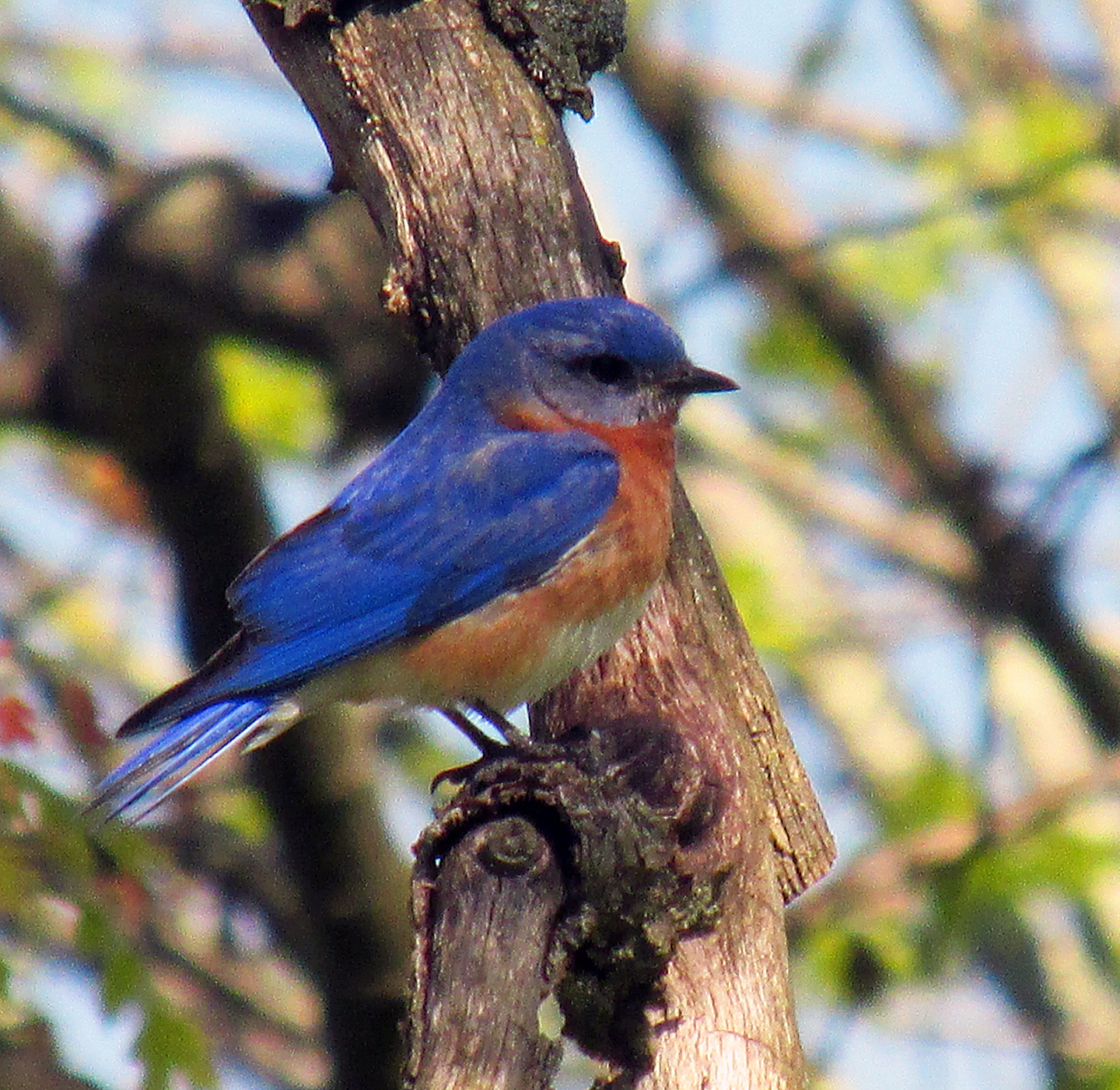
The male Eastern Bluebird is beloved by many bird enthusiasts.

Eastern Bluebird, 94; Veery, 15; Hermit Thrush, 3; Wood Thrush, 57; American Robin, 397; Gray Catbird, 27; Brown Thrasher, 24; Northern Mockingbird, 48; European Starling, 536; and Cedar Waxwing, 48.

Ovenbird, 63; Worm-eating Warbler, 40; Louisiana Waterthrush, 14; Black-and-white Warbler, 34; Swainson’s Warbler, 3; Common Yellowthroat, 3; Hooded Warbler, 64; American Redstart, 8; Northern Parula, 39; Magnolia Warbler, 1; Blackburnian Warbler, 3; Yellow Warbler, 9; Chestnut-sided Warbler, 32; Black-throated Blue Warbler, 29; Pine Warbler, 5; Yellow-throated Warbler, 30; Prairie Warbler, 4; Black-throated Green Warbler, 52; Canada Warbler, 6; and Yellow-breasted Chat, 2.

Eastern Towhee, 80; Chipping Sparrow, 68; Field Sparrow,  21; Song Sparrow, 245; Dark-eyed Junco,  33; Scarlet Tanager, 33; Northern Cardinal, 163; Rose-breasted Grosbeak, 6; Blue Grosbeak, 4; and Indigo Bunting, 131.

Red-winged Blackbird, 71; Eastern Meadowlark, 15; Common Grackle, 156; Brown-headed Cowbird, 23; Orchard Oriole, 6; Baltimore Oriole, 2; House Finch, 70; Red Crossbill, 1; American Goldfinch, 110; and House Sparrow,  33.

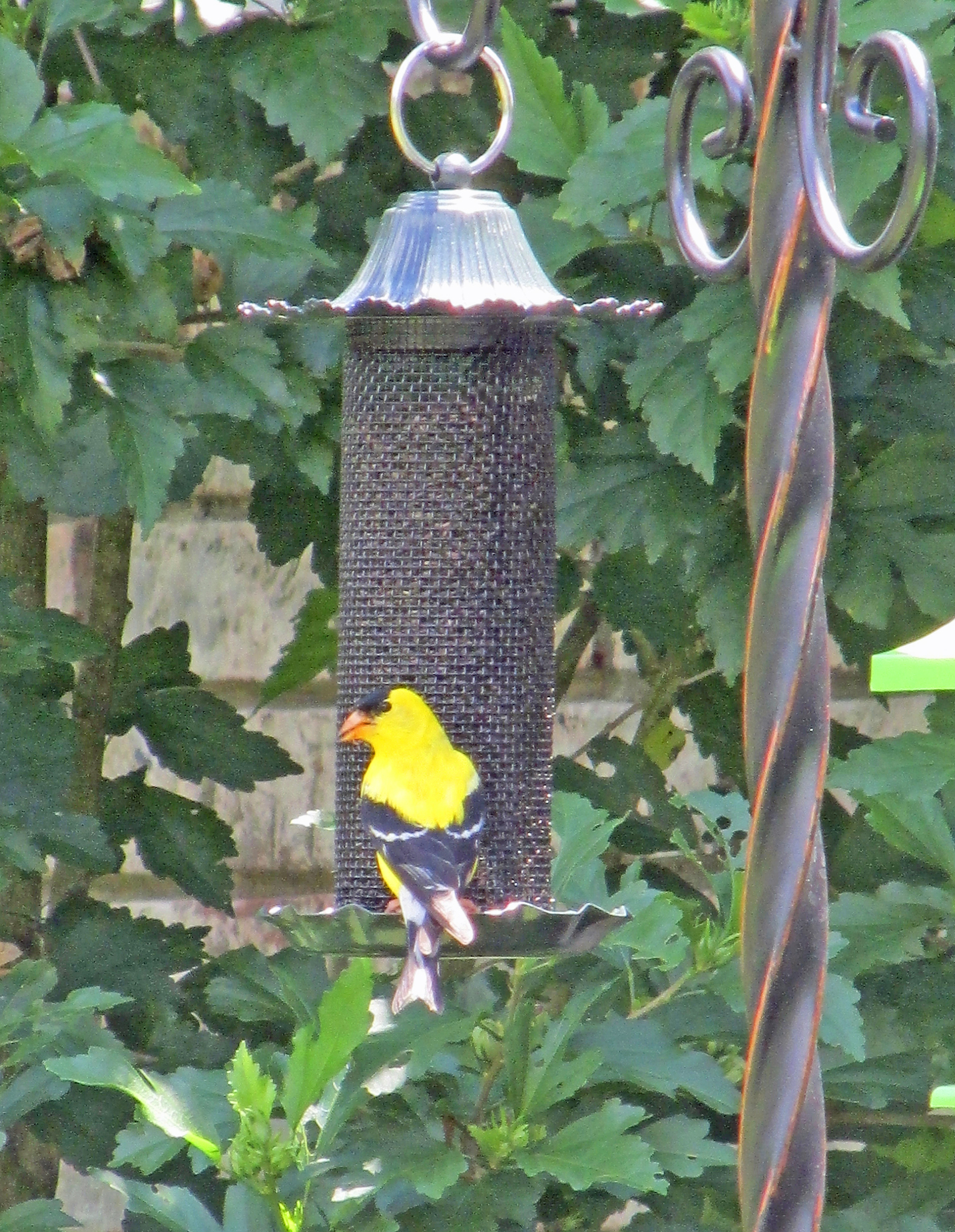
Photo by Bryan Stevens • An American goldfinch visits a feeder for a meal of thistle seeds.

Brown thrashers make first spring appearance


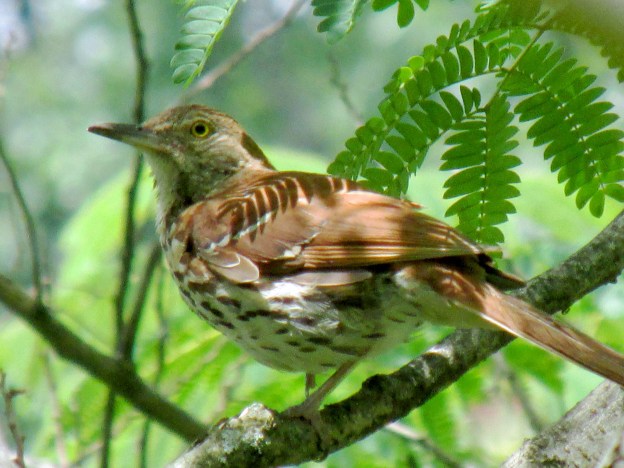
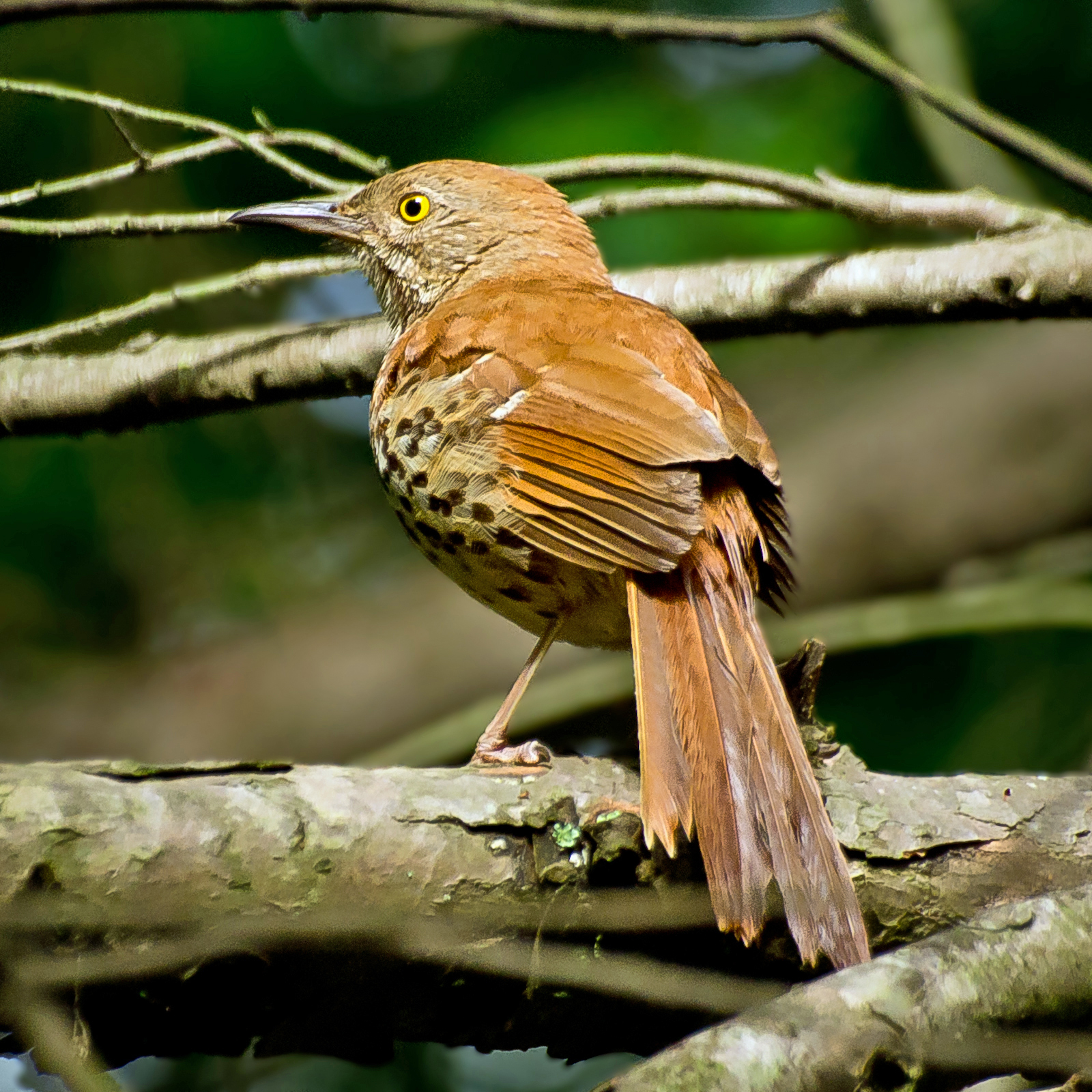
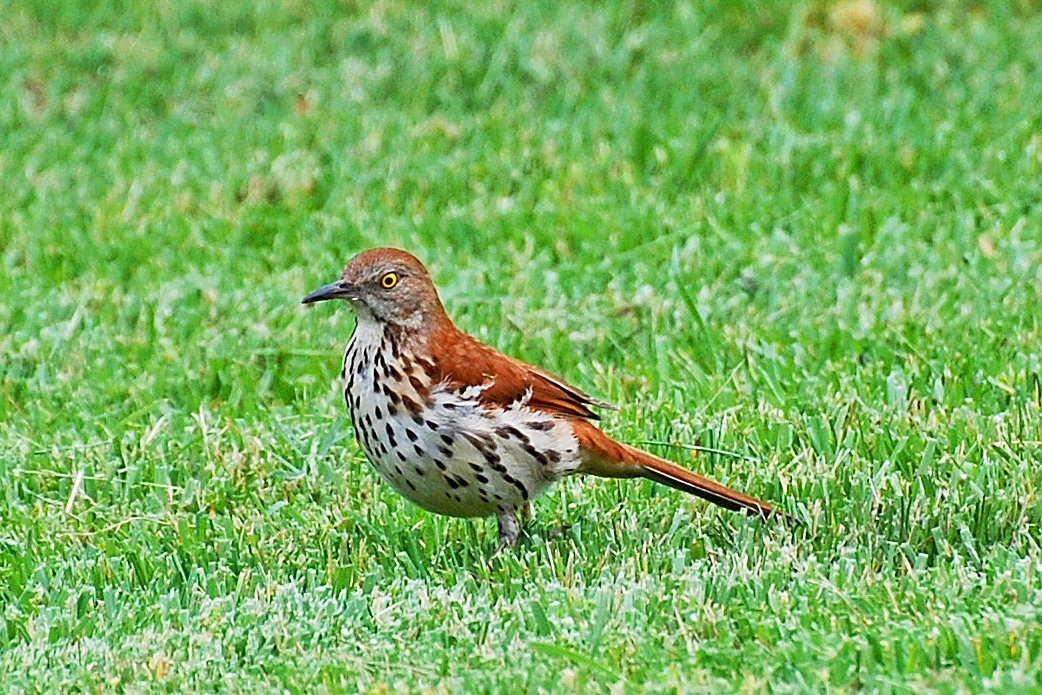
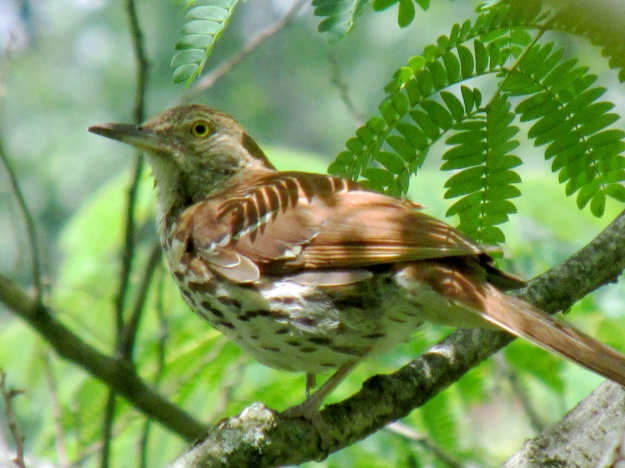
Photo by Bryan Stevens • A brown thrasher visits a feeder for a helping of suet. These large songbirds are usually among spring’s early arrivals.

In this time of social distancing when the daily routine can become flat and dull, I’m rejoicing that many of my favorite birds are returning after their long winter absence. One of the first to return has been brown thrashers, which made a first spring appearance on March 25. I suppose I should use the word “appearance” with reservations since I only heard a thrasher singing from deep in the concealment of a brushy thicket. A few days, later, however, a pair of brown thrashers began visiting my suet feeders.

I posted about the return of this large songbird on Facebook and immediately discovered that the brown thrashers must have returned to the region en masse.

Aubrie Abernethy, a resident of Johnson City, Tennessee, posted that her brown thrasher has arrived a day earlier than mine.

Dianne Draper, a resident of Jonesborough, Tennessee, posted, too. “Ours is back also,” Dianne wrote.

Photo by Ken Thomas
The Brown Thrasher is an alert, sharp-eyed observer of its surroundings.

Michelle Sparks in Bristol, Tennessee, posted on my Facebook page that she had seen her first spring brown thrasher earlier that same week.

Diane Gonzalves from Abingdon, Virginia, responded on the post about brown thrashers by asking about another imminent arrival. “I assume the hummingbirds should be here soon?” Diane asked.

I responded that the first ruby-throated hummingbirds should be arriving at any time. Please watch out for these tiny birds and get your sugar water feeders outside to welcome them. I will do my annual round-up on first hummingbird sightings of the spring again this year. Share your sighting by emailing the time and date of the arrival to ahoodedwarbler@aol.com. Readers can also contact me via Facebook.

The brown thrasher (Toxostoma rufum) belongs to the family of “mimic thrushes,” which provides a label for a group of songbirds capable of imitating the songs of other birds. Mimidae, the Latin root for “mimic,” provides the scientific name for the family, which includes mockingbirds and the New World catbirds, as well as thrashers. The Northern mockingbird is best known for the ability to mimic, but relatives like the gray catbird and brown thrasher are also talented mimics.

The thrasher is a fairly large songbird about 11.5 inches long with a wingspan of 13 inches. Much of the body length comes from the bird’s long tail feathers. A thrasher weighs, however, only about 2.5 ounces.

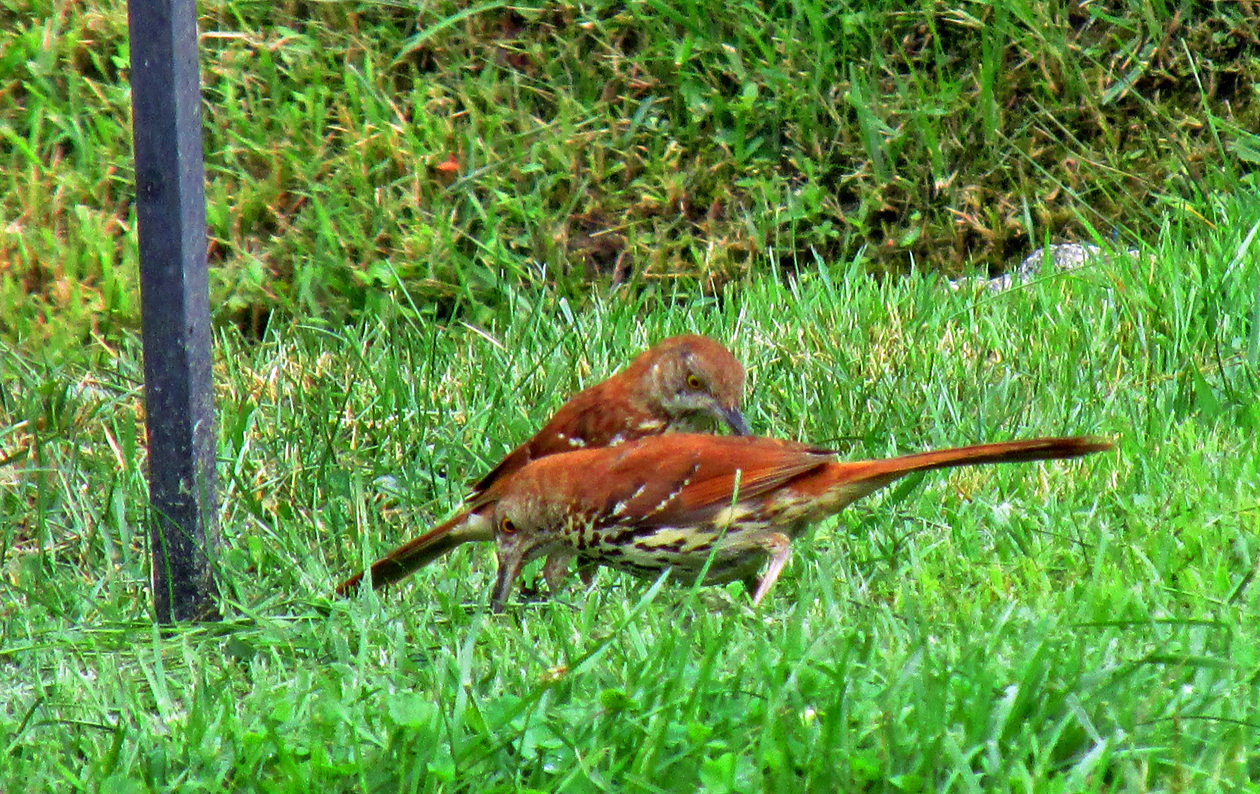
Photo by Bryan Stevens • A pair of Brown Thrashers forage for food on the ground below a feeder.

The brown thrasher is not a picky eater. It’s known to eat everything from berries and nuts to insects and small lizards. It’s also aggressive in defending its nest and young. John James Audubon, a French-American ornithologist, naturalist and painter, painted quite the dramatic scene of a group of brown thrashers valiantly defending a nest from an attacking snake. The painting is so detailed that one has to imagine Audubon based his work on a real-life experience. His work, originally painted in the early decades of the 1800s, still holds up today.

Early American naturalist and artist John James Audubon painted a dramatic scene of brown thrashers defending their nest from an attacking snake.

Incidentally, Audubon knew the brown thrasher as the “ferruginous thrush.” Another former common name for this species was “brown thrush.” The brown thrasher breeds across the United States and Canada east of the Rocky Mountains. Thrashers withdraw from the northern part of their range in the winter months, spending the season in the southeastern United States.

They are familiar birds in southern gardens. In fact, the brown thrasher is the official state bird of Georgia and also provided the name for Atlanta’s National Hockey League team, the Atlanta Thrashers. The thrasher became Georgia’s state bird due to passage of a Joint Resolution of the Georgia General Assembly in 1970.

Other new arrivals in the closing days of March included blue-gray gnatcatcher, blue-headed vireo and broad-winged hawk. So, what are you seeing? Let me know when the hummingbirds arrive.

Photo Courtesy of Jean Potter • A brown thrasher scans the grass for insect prey.

People report American robins lingering this winter

Photo by fotocitizen/Pixabay.com • An American robin fluffs its feathers to stay warm on a cold, wintry day. While the robin is a migratory bird, it’s not unusual for many individuals to forego migration in order to stay on their nesting range the whole year.

A stroll on some walking trails through the woods on Jan. 11 near my home resulted in my first 2020 observation of American robins. The presence of robins during the winter can be a hit-or-miss affair. After I posted my sighting on Facebook, I received plenty of anecdotal evidence to support my belief that many robins decided to skip migration this past fall and spend the winter in the region.

Jennifer Bauer, park superintendent for Sycamore Shoals State Historic Park in Elizabethton, Tennessee, posted that she saw a flock of about 25 robins at the park on Jan. 10.

Anne Powell Cowan, a resident of Bristol, Tennessee, commented that she has seen robins in Bristol all winter. “They never left,” Anne wrote in her comment. “We also have a red-headed woodpecker at our farm in Sullivan County.”

Betty Lacy in Elizabethton, Tennessee, posted that she is hosting a “swarm” of robins. “They love my tall hemlock hedges,” Betty wrote. “I know there was well over 100 of them. They have made little openings all over the hedge where they go in and out!”

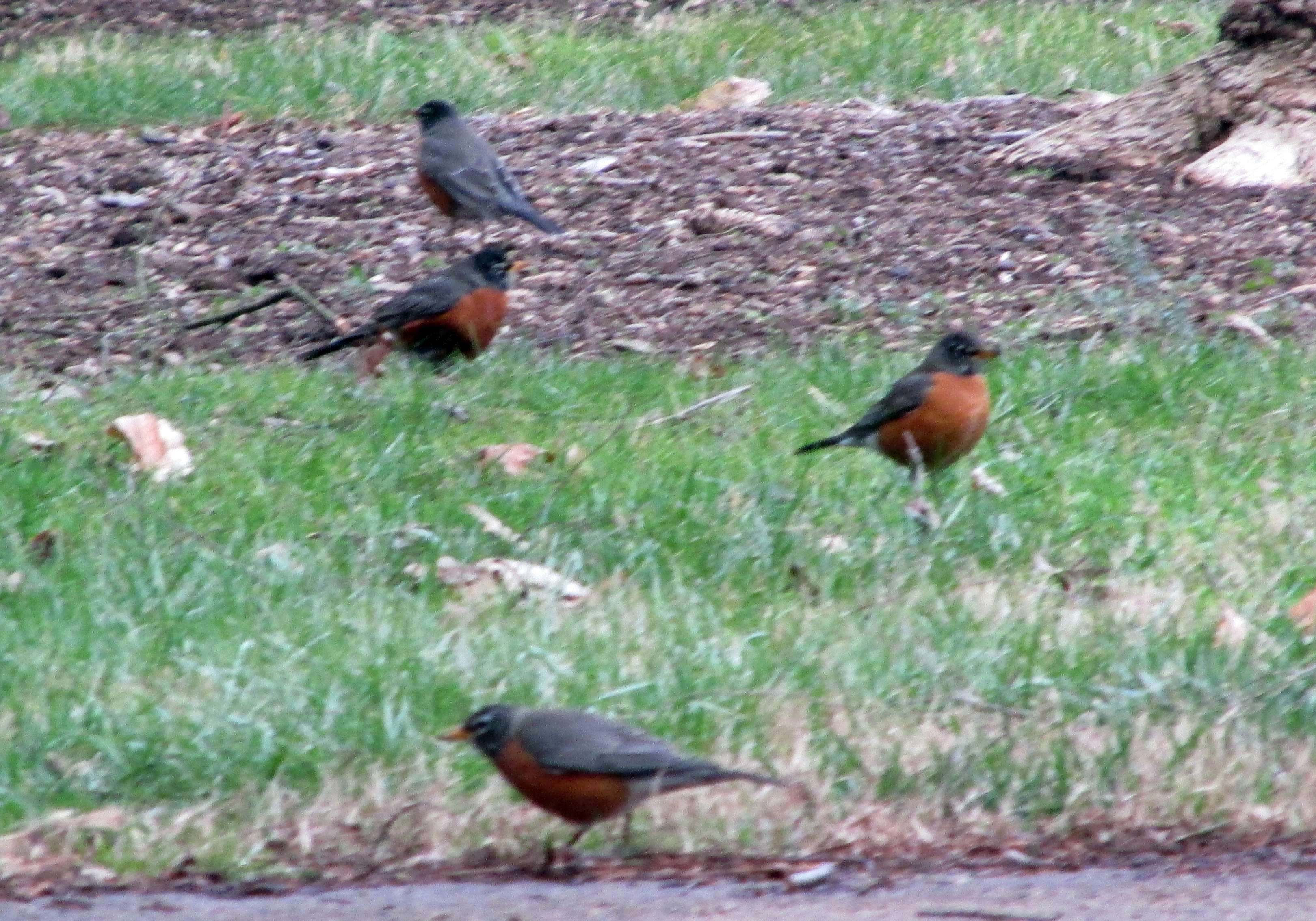
Photo by Bryan Stevens •  American robins, prominent in lawns and gardens during their annual spring migration, will turn their attention to nesting duties as soon as spring arrives. For now, some are content to spend the cold winter season a little farther north than some of their kin.

Vivian Hicks has noticed plenty of robins, too. “Robins have been hopping around and feeding in my yard in Southwest Virginia,” Vivian posted.

Mimi Hale has noticed the same in Elizabethton, Tennessee. “Robins have been all over my yard for the last several weeks,” she commented on my post.

Dawn Peters, who resides in Jonesborough, Tennessee, posted that robins have been present at her home since before Christmas.

Gloria Walton Blevins in Damascus, Virginia, also indicated the robins haven’t flown south. “They have been in Damascus all winter,” Gloria commented.

Teresa Treadway in Elizabethton, Tennessee, offered a humorous take on the abundance of robins. “Mine were so confused, they never left,” Teresa posted.

It was left to Catherine Romaine Henderson of Greer, South Carolina, to leave a question on my post. “Does that mean an early spring?” Catherine wondered in reaction to this winter’s abundance of robins.

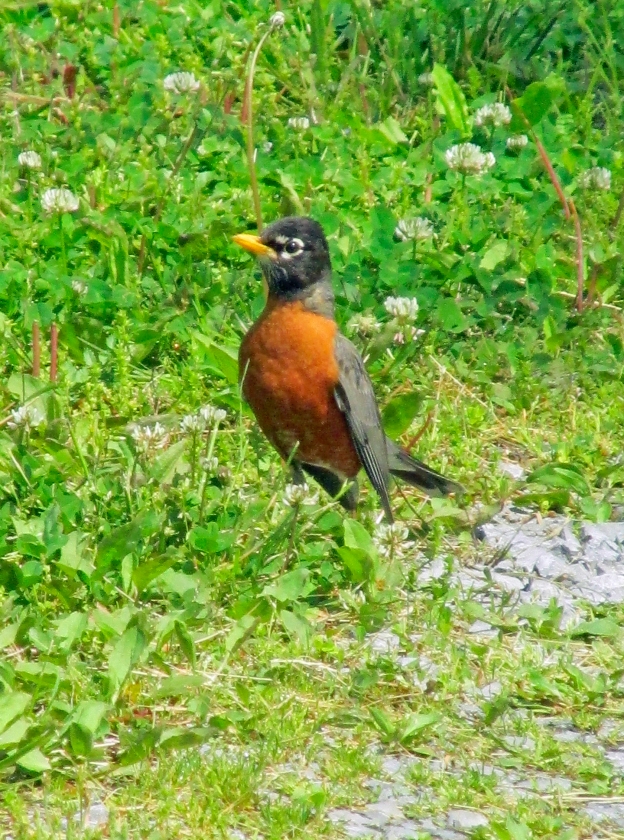
Photo by Bryan Stevens • An American robin perches on a branch. The robin is one of the best-known song birds in the United States.

The American robin is indeed widely held to be a harbinger of spring. Furthermore, the robin is a popular American bird. In fact, this bird has been designated the official state bird by Wisconsin and Michigan.

In truth, many robins forego migration to endure a few months of cold weather. Their ability to shift their diet from earthworms and insects to fruit and feeder fare helps robins eke out a living. Robins remain an abundant bird but their fondness for co-existing with humans can leave them vulnerable to pesticides applied to lawns and gardens.

According to the website, “All About Birds,” the American robin nests three times a year. On average, however, only 40 percent of robin nests succeed at fledging young. Even once out of the nest, young robins are vulnerable. The website estimates that only 25 percent of each year’s fledged robins will reach November. So, the young robins that join some of the large flocks people are seeing in the region are birds that have beaten the odds.

Photo by Bryan Stevens • Even once out of the nest, young robins, such as the one pictured here, are vulnerable. Experts estimate that only 25 percent of each year’s fledged robins will reach November.

Even the robins that do depart the region each fall don’t migrate far. Many robins that spend the summer in Canada or the United States only migrate as far as the Gulf States, southern Florida, southern California, Baja California and Mexico.

Robins are such friendly and engaging birds. If we can have them near us for 12 months of the year, who’s going to complain? They have even adapted to take food at feeders. If you’d like to try your luck at attracting robins to feeders, know that they like their sunflower seeds hulled. They will also eat mealworms, fruit, peanut hearts and suet. Robins prefer to feed on the ground or on an open platform feeder.

Photo by Bryan Stevens • While American robins like fruit when its available, they also spend a lot of time feeding on earthworms and insects.

Water a magnet for waxwings, other birds

Photo by Patrice_Audet/Pixabay.com • Cedar waxwings feed extensively on various fruits and insects, forming large nomadic flocks that can quickly deplete local resources.

The extended spell of dry, hot weather we’ve experienced for the past several weeks threatens to spoil fall colors, but if you’re a person who can offer a water feature or bird bath, this might be the perfect time to observe thirsty flocks of birds. In particular, cedar waxwings, which often travel in large flocks, embrace water with an exceptional avian enthusiasm.

I still remember my first look at a cedar waxwing. Sleek as silk, wearing a mask like a bandit, with a jaunty crest atop its head, this fairly common bird commands attention when making an appearance in a yard or garden. Of course, it’s usually not alone, more often traveling as a member of a larger flock that can number as high as dozens or even hundreds of individuals.

Flocks of these sociable birds win fans almost anywhere they go. Chances of luring these birds to your home and property can increase by offering some essential requirements. Tall trees, especially those that bear fruit, are attractive to these sociable birds. It’s more often water, not food, however, that will bring a flock of these birds close. They love a good splash in a bath, whether the source is a shallow stream or an ornamental pool set into the landscape.

Photo by Bryan Stevens • A pair of cedar waxwings hawk for insects near a pond.

As noted, they travel in often sizable flocks, usually in search of new food sources. The many members comprising a flock can deplete resources in a remarkably short time. During the winter season, I’ve watched a flock of waxwings make short work of a harvest of berries from a holly tree. Their nomadic lifestyles make it nearly impossible to predict where cedar waxwings might make an appearance.

In most years, the wild cherry trees scattered around the edges of my yard are fully laden with berries. As they ripen in late August and into September, waxwings appear and commence harvesting the fruit. Once again, they arrived at just the right time last month to catch the wild cherries at their peak.

As much as the waxwing has a fondness for fruit, it’s also a bird that would have made an excellent flycatcher. Flocks of these birds will often congregate in trees near the edge of a pond, garden or yard — anywhere winged insects might be found in good numbers — in order to hawk insects on the wing. A waxwing will sally forth from a branch, snatch its prey in mid-air, and return to its perch for a quick snack.

Early American naturalist and artist John James Audubon painted this pair of cedar waxwings.

Perhaps because of the late-summer abundance of bugs and berries, cedar waxwings are known for nesting late into the summer. They’re certainly not among the birds impatient to begin nesting as soon as temperatures turn mild in the spring. Some fellow birders recently reported seeing cedar waxwings feeding fledgling just out of the nest as the calendar flipped from September of October.

Why is the term “waxwing” applied to this bird? According to the website All About Birds, the name comes from the waxy red secretions found on the tips of wing feathers. The site also notes that the precise function of these waxy tips is not known. There’s speculation among some experts that the bright red tips on the feathers could play a role in helping waxwings attract mates.

The cedar waxwing has few relatives. Worldwide, there are only two other species: the Bohemian waxwing, of the northern forests of Eurasia and North America; and the Japanese waxwing, found in such northeast Asian countries as Japan, Korea and China.

Although it’s classified as a songbird, the cedar waxwing does’t truly produce a vocalization that anyone would contend qualifies as a song. They are, however, very vocal birds, producing shrill, high-pitched notes as they pass through the upper branches of tall trees. The excitable commotion of an active flocks of these sleek and elegant birds is always a welcome sound at my home.

Photo by Bryan Stevens • The waxy tips to the wing feathers are evident in this photograph of a cedar waxwing.

Feeding birds can draw some unwelcome guests

Squirrel-AttackPhoto by Dianna Lynne • Leaping onto a fully stocked feeder, an Eastern gray squirrel scatters seeds in all directions. The unconquerable squirrel is one of the most unwanted guests at many bird-feeding stations.


The winter bird-feeding season is coming to a close, but there’s no need to pull the welcome mat completely. Some of our summer visitors appreciate some supplemental food. Of course, there’s less need for our offerings during warm weather when insects and other food sources are readily available.

People in Great Britain spend 200 million pounds per year on wild bird food. In the United States, people are spending $4 billion each year on feed for the birds. Another $800 million in spending goes to feeders, bird baths and other accessories used to attract wild birds.

People have been feeding birds in the United States of America since before it was a nation. The father of our country, George Washington, fed wild birds at his home, Mount Vernon. The great writer and thinker Henry David Thoreau fed the birds and learned to identify many of the birds around Walden Pond in Massachusetts. Poet Emily Dickinson tossed crumbs to sparrows and then turned those special moments with her feathered friends into poetry.

Since the time of Washington, Thoreau and Dickinson, if not before, Americans have been supplying food, as well as shelter and water, to persuade birds to bring themselves closer. In return, we enjoy their color, their interesting behavior, their songs, and much more.

I continue feeding during the warmer months, although I do cut back on the quantity of my offerings. One of the best bonuses for engaging in year-round bird feeding is the chance to see parent birds bring their offspring to feeders to introduce them to human-offered fare. Be aware, however, that when you put out a table offering free food, you’re bound to attract some unexpected guests. Sometimes those unanticipated visitors can wreak havoc on the smooth management of a feeding station for your birds.

Here is my version of the Top 5 candidates for a “Not Welcome” list of the wildlife most people would prefer not to entertain at their feeders.

Hawks

The raptors are, of course, birds themselves. Therein rests the irony. Flocks of birds active around feeders are like ringing a dinner bell for some raptors, which have learned that songbirds in such situations on occasion make easy pickings.

It’s not any single raptor that can be identified as the most obvious threat to songbirds. Species such as American kestrel, sharp-shinned hawk, Cooper’s hawk, red-shouldered hawk, merlin, peregrine falcon and red-tailed hawk will prey on their fellow birds if given ample opportunity.

rthawk-one

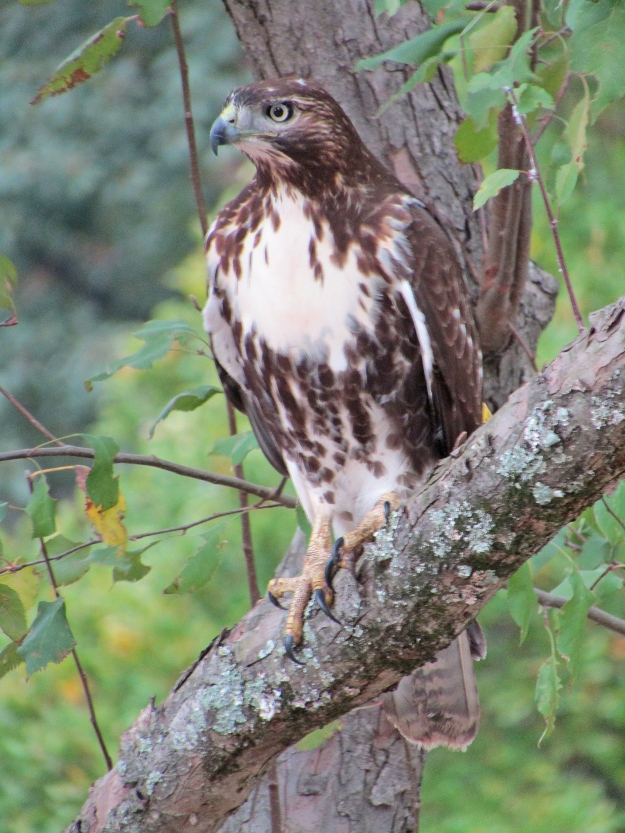
Photo by Bryan Stevens • Raptors, like this red-tailed hawk, can cause concern when they take up residence near a feeder in a yard or garden.

If a hawk does begin to show interest in your feeders, it may be necessary to curtail or even cease feeding songbirds until after the raptor loses interest and moves on to other hunting grounds.

I hesitate to even place raptors on this list because I believe that every bird is a wonderful creation. It’s best to remember that hawks view smaller birds flocking to a feeder in the same way those small songbirds view the abundance of seeds. For both hawks and songbirds, our offerings represent easy meals. It’s not easy, but the best choice is to co-exist — if not at peace, then at terms with nature’s reality.

Opossums

The Virginia opossum, also known as the North American opossum, or simply “possum,” is often overlooked because its raids on feeders take place after dark. Although the opossum has 50 teeth (that’s more than any other North American mammal has) in its jaws, it shares the night with other active omnivores, including bears and raccoons.

Regardless of its toothy grin, the possum is not adept as hulling sunflower seeds. The telltale sign that a possum is raiding your feeders involves the discovery of little piles of pulped sunflower seeds, hull and all, in your feeder or on the ground beneath it. The possum pulverizes the sunflower seed and evidently tries to extract what nutritional content it can. Of course, suet, nuts and other feeder fare are on the possum’s menu.

This particular possum is the only marsupial found north of Mexico. The continent of Australia is more famous for its marsupials, which include kangaroos, wallabies and wombats.

black brown and white animal

Photo by Pixabay on Pexels.com • Although the opossum has 50 teeth (that’s more than any other North American mammal has) in its jaws, it shares the night with other active omnivores, including bears and raccoons.

Raccoons

These masked, ring-tailed bandits are the bane of many a person who enjoys feeding birds. While they primarily restrict their raids to the hours between sunset and dawn, some emboldened raccoons will occasionally become brazen enough to stake a claim to feeders in broad daylight. A couple of years ago, a trio of young raccoons arrived early in the evening with plenty of daylight remaining to feed in the feeders while I watched from a nearby lawn chair with my binoculars.

Raccoons will also spirit away feeders. I’ve found hummingbird feeders, suet feeders and small plastic feeders carried a good distance into the woods before the thieving raccoon dropped them. The stolen items are usually damaged but, on occasion, I’ve recovered some of my items that were more or less no worse for the wear.

On one occasion, a crafty raccoon managed to remove a sunflower seed feeder from its branch on a tree outside one of my windows, I later found the portly critter reclining lazily on his back wedged between the trunk and a branch high on a nearby tree, holding the feeder in one arm and reaching into it with the other like a person eating popcorn.

Raccoons are highly intelligent and inquisitive, which only makes them more difficult to discourage from raiding feeders. They can be amusing and entertaining in their own right, but it’s best not to encourage their visits. If they prove too persistent, cease feeding birds until the raccoons have moved to a new location.

Raccoon-Contest

Photo by Bryan Stevens • Curious and intelligent, raccoons can think of many ways of ransacking a feeding station meant for birds.


Bears

A visit from a black bear is hard to miss. With their brute strength, bears are capable of mangling and destroying even the most sturdily constructed of bird feeders. While there are many other unwanted feeder guests, none can match the bear for its sheer capacity for destruction. Black bears can weigh between 200 to 600 pounds, so it’s not hard to imagine their potential for wreaking havoc.

Amanda Austwick lives in Flag Pond, Tennessee. She is a dedicated feeder of our feathered friends, which has led to repeated incidents with problem bears over the years. Amanda lives within the official boundaries of the Cherokee National Forest. Black bears have been thriving in the Cherokee National Forest, as well as throughout the southeastern United States.

When I first corresponded with Amanda several years ago, she was writing to me about a bear attack on her feeders. “One feeder was completely bent over on the ground,” she wrote. I also pointed out that the bear is actually just feeding on the seed. The damage to the feeder is a by-product caused by the fact bears probably don’t know their own strength.

I’ve not gone completely unscathed when it comes to bears and my feeders. Several years ago I owned a nice feeder with a metal meshwork used for holding shelled peanuts, which are loved by birds such as chickadees, titmice, nuthatches and woodpeckers. I woke one morning to find the feeder had been mangled into the equivalent shape of a pretzel.

Compared to the stories told by Amanda, as well as other people who have shared their own bear tales over the years, I got off lucky to only lose a single feeder to a bear. Brookie and Jean Potter, friends who live near Wilbur Lake in Carter County, Tennessee, have had to innovate to stay one step ahead of the bears living in proximity to them. Brookie managed to raise their feeders beyond a bear’s reach using a complicated system of poles and pulleys.

If such proactive measures are not something one wishes to do, there’s one simple step that can be taken. People can bring in their feeders at night to ensure there’s nothing left outdoors to attract the attention of a meandering bear. Bears are omnivores, eating a varied diet ranging from insects and fish to amphibians and bird eggs. When a bear finds a bird feeder, they’re happy to include sunflower seeds or other such fare in their diet. When such food is no longer available, they’re likely to move on.

Bear-FeederPole

Photo Courtesy of Amanda Austwick • This bear caused considerable damage to the Austwick feeders.

Squirrels

They may not match a black bear for sheer destructive capability, but I regard the Eastern gray squirrel as Public Enemy Number One when it comes to having peace and tranquility at a bird-feeding station. What justifies this ranking? It’s simple, really. I know of no sure-fire way to deny a hungry and determined squirrel access to any type of feeder. It’s possible to slow them down, but I think the best we can do is maintain an uneasy truce of co-existence with squirrels.

I wouldn’t begrudge the squirrels some bird seed if they didn’t show such ingratitude by gnawing on feeders. With their sharp incisors, squirrels can chew up and spit out plastic and even wood feeders. More expensive feeders made of ceramics, metal and glass are immune to the same type of squirrel vandalism.

Although I’ve not tried it, I’ve heard that sunflower seed laced with capsaicin will deter squirrels. This spicy substance is even used to deter such large mammals as elephants and grizzly bears. Capsaicin, which is derived from hot peppers, reacts entirely differently with birds. While many mammals will avoid food containing even minute amounts of capsaicin, birds will readily consume it. The difference seems to be that bird receptor cells are largely insensitive to capsaicin.

nature animal cute fur

Photo by Pixabay on Pexels.com • The gray squirrel is a cunning and often destructive guest at feeders intended for the benefit of birds.

••••••

To be sure, I could have added some other wildlife species to the list. White-tailed deer can graze on flowers planted for the benefit of hummingbirds. Deer have even been documented eating the eggs of songbirds, perhaps more for the calcium shell than any other reason. Chipmunks are almost as wily as squirrels, but they’re cuter and non-destructive. Insects, such as bees and hornets, can overwhelm sugar water feeders intended for hummingbirds.

Don’t even get me started on stray cats! A few years back, a study by researchers from the Smithsonian’s Migratory Bird Center and the U.S. Fish and Wildlife Center found that between 1.4 to 3.7 billion birds lose their lives to cats each year in the United States. In addition to birds, cats kill billions of small mammals — shrews, voles, mice, rabbits — every year. Most of the carnage is committed by feral or stray cats, not house cats. My own two cats are kept indoors to avoid contributing to the problem.

photography of brown chipmunk eating on top of rock

Photo by Adriaan Greyling on Pexels.com • A chipmunk accepts crumbs. The cute factor usually works in preventing this rodent from being considered a pest.

Hummingbirds not the only birds returning to region as spring migration advances

Hummer-Morning

Photo by Bryan Stevens • A Ruby-throated Hummingbird perches on a sugar water feeder.

A voiceover for a promotional trailer for an upcoming movie in the Jurassic Park franchise asks the question “Do you remember the first time you saw a dinosaur?” and answers it with the sentence “The first time you see them, it’s like a miracle!”

Obviously, dinosaurs aren’t walking the earth — except in this highly successful movie franchise — although experts maintain that dinosaurian descendants (birds) still roam the world.

Dinosaurs, of course, have impressed humans with immense size ever since their enormous fossils began to be uncovered. Hummingbirds also impress with size, or rather the lack of it. It’s that tiny size that has prompted people to describe them as “miracles” from the time the first European explorers sailed to the New World in the late 1400s. When Spanish explorers first encountered them, they had no equivalent birds in Europe to use as a reference. They referred to hummingbirds as “joyas voladoras,” or flying jewels.

So, how many remember their first sighting of a hummingbird? These tiny birds, still accurately and often described as flying gems, are worthy of the word “miracle” being used to define them. When we see the ruby-throated hummingbirds return to the region every spring, our belief in miracles is strengthened.

I still have readers sharing reports of their first hummingbird sightings this spring.

• Marty Huber and Jo Ann Detta in Abingdon, Virginia, sent me an email about their first spring hummingbird sighting.

They reported that they got their first look at a spring hummingbird on April 18 at 5:04 p.m. “We were excited and have been looking since the beginning of the month,” they wrote. “Last year we didn’t see our first until April 23.”

• Ed and Rebecca Feaster of Piney Flats, Tennessee, put out their feeders after reading one of my columns earlier in April.

“We are happy to report that we saw a little female ruby-throated hummer on the morning of April 20,” they wrote in their email. “We were thankful to offer her nectar as she seemed very, very hungry!”

The Feasters noted that they have been in the Tri-Cities area for three years.

They had previously lived more than 20 years in the Roanoke Valley. “Birders in that area said to look for the hummers to arrive when the azaleas bloom,” they wrote. “The same seems to hold true here as the ones around our home began to blossom just a couple days ago.”

• Jane Arnold, a resident of Bristol, Virginia, sent me an email about her first hummer sighting.

“Just wanted to let you know that my first hummer of the year arrived at 10:20 a.m. Saturday, April 21,” she wrote. “I was so excited to see him! I had taken my feeder out to hang (it was sitting on a table) and [the hummingbird] flew to it.”

• Don and Donna Morrell emailed me with their first hummingbird sighting of spring. “My wife Donna and I saw our first hummingbirds on April 22,” Don wrote.

The Morrells saw both a male and female hummingbird. “We are located behind South Holston Dam,” Don added. “We are glad our friends are back. Also on that same day we saw an eagle and white crane.”

Egretta

Photo by Bryan Stevens • A migrating Great Egret makes a stop at a golf course pond.

Most likely the white crane was a great egret, which is also migrating through the region right now. Although often called cranes, egrets are part of the family of wading birds that includes herons. North America’s true cranes are the endangered whooping crane and the sandhill crane.

• Facebook friend Sherry Thacker reported a first sighting of a ruby-throated hummingbird on April 22.

IMG_0927

Photo Courtesy of Helen Whited • A Baltimore Oriole visits a feeder “baited” with an orange slice.

“It came looking at the thistle seed feeder that is red,” she reported. “I had not put up the sugar water feeder, but I did today.”

Sherry reported seeing some beautiful hummingbirds last year.

Of course, we are in the midst of spring migration, which means hummingbirds are hardly the only new arrivals.

• Helen Whited in Abingdon, Virginia, has seen two very brightly-colored species of birds pass through her yard this spring. On April 17, her feeders were visited by male rose-breasted grosbeaks. “I am so excited to see my first grosbeaks,” she shared in an email that also contained a photo featuring two of the visiting grosbeaks. On April 21, Helen sent me another email with a photo of a male Baltimore oriole visiting a specially designed feeder made to hold orange slices to attract fruit-loving orioles. Grosbeaks and orioles are two migrant species of birds that deliver splashes of tropical color to the region each year.

Helen had prepared for the visit by the Baltimore oriole. In an email from last year, she had told me that her husband had promised her an oriole feeder for her birthday. I’m glad she’s been able to report success in bringing one of these bright orange and black birds to her yard.

DDB1466C-233A-4CB8-8C73-BD7C30B4E4A3 (1)

Photo Courtesy of Helen Whited • A pair of Rose-breasted grosbeaks take turns visiting a feeder.

• Anita Huffman of Rugby, Virginia, saw a male rose-breasted grosbeak on April 22. She reported her sighting on Bristol-Birds, a network for sharing postings about bird observations in the region.

• John Harty, a resident of Bristol, Tennessee, sought my help with identifying a new bird in his yard. Based on his description of the bird — the shape of a robin, reddish-brown coloration and a taste for suet cakes at John’s feeder — I suggested that his bird was probably a brown thrasher.

Brown thrashers returned to my home in late March and almost immediately sought out my suet feeders. Other recent arrivals have included several warblers — hooded, black-throated green and black-and-white — as well as tree swallows, which immediately got down to the business of selecting a nesting box. All of these birds nest in the gardens and woods around my home.

BrownThrasher-MIMOSA

Photo by Bryan Stevens • Brown Thrasher perched in a Mimosa Tree.

Some birds, however, announce their arrival not with bright colors but with beautiful songs. On April 23, I listened as a wood thrush sang its flute-like song from the edge of the woods just outside my bedroom window. The sweet song of this thrush is one of my favorite sounds of spring.

Every bird is a miracle, whether you’re seeing or hearing them for the first time or welcoming them back for another spring and summer season.

wood-thrush-songbird-hylocichla-mustelina-looks-up-while-it-perches-on-a-branch

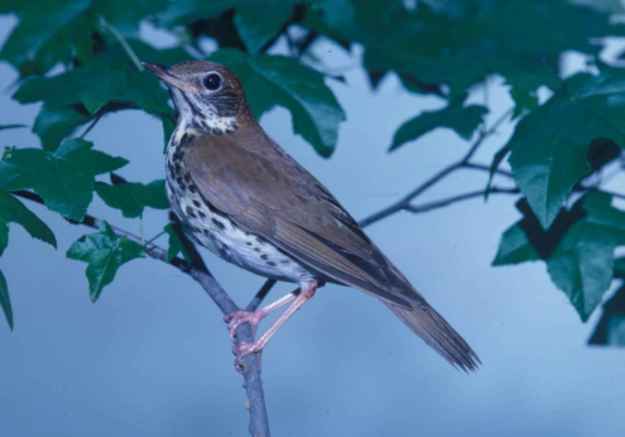
Photo by U.S. Fish & Wildlife Service • The Wood Thrush often sings its flute-like song from deep under cover in dense woodlands.

Timely arrival of blue-gray gnatcatcher signals the rush of spring migration

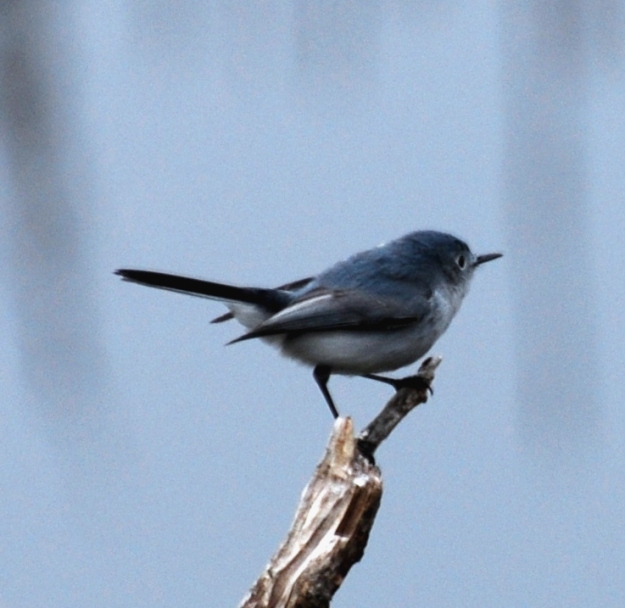
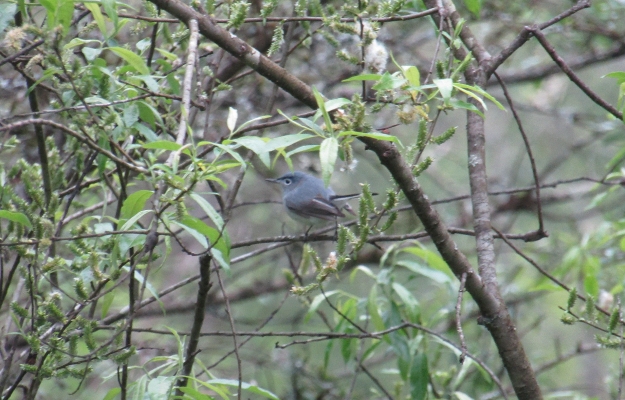
A blue-gray gnatcatchers finally put in a first spring appearance at my home on April 11. Most likely, these tiny birds had already arrived, but my schedule hadn’t yet allowed me a glimpse of this punctual songbird. Back in March, I saw and heard dozens of them during a trip to the South Carolina Low Country.

Gnatcatcher

Photo Courtesy of Jean Potter • Blue-gray Gnatcatchers are tiny, energetic bundles of feathers.


Birds are as dependable as clocks and calendars when it comes to noting the passage of time. I can keep track of the changing seasons based on the composition of the birds in my yard. The gnatcatcher has long been my signal to the start of the frenzied pace of spring migration for many of the birds returning to the region after sojourns much farther south. For example, the first gnatcatcher arrived in my yard in 2014 on April 4. Two days earlier, I had observed my first blue-grey gnatcatcher of the spring while visiting Winged Deer Park in Johnson City, Tennessee. It doesn’t hurt that the arrival of gnatcatchers coincides with the annual blooming of bluebells, a wildflower for which this local park is famous.

Once again, Winged Deer Park provided me with my first spring sighting of this bird when I finally saw one this year on April 6. Over the years I’ve kept track of such matters, blue-gray gnatcatchers reliably return every year in the final days of March and first days of April. A blue-gray gnatcatcher put in its first appearance at my home on April 2 in 2011. In 2009, I also saw my first gnatcatcher on April 2, although in 2008 I had to wait until April 5 for my first spring sighting of a gnatcatcher. In 2007, the blue-gray gnatcatcher was an “April Fool’s” bird, arriving on the first day of April. Arrival dates in March are a little less frequent. For instance, in 2003, a blue-gray gnatcatcher arrived on March 28. I saw my first spring gnatcatcher on March 30 in 1998. In 2006, the arrival date was March 31.
Gnatcatcher 2

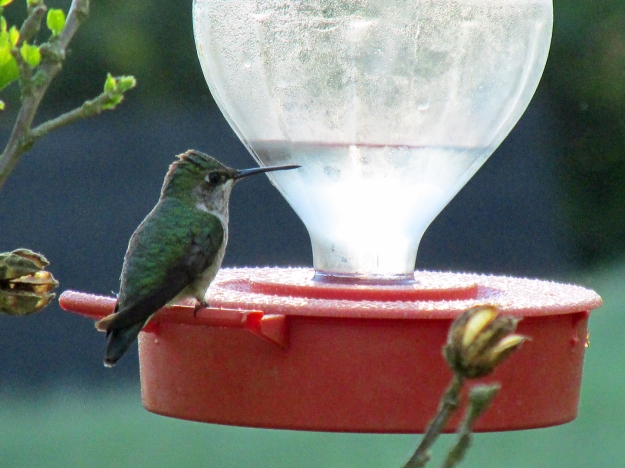
The blue-gray gnatcatcher is a tiny, active bird with noisy habits that make it fairly easy to detect in early spring before foliage has grown dense in the branches of trees. This gnatcatcher ranks with the kinglets and hummingbirds as one of the smallest birds to range within the United States. This tiny bird tips the scales at only a fourth of an ounce. A gnatcatcher is an incredible bundle of feathered energy, seemingly always on the move as it snatches small winged insects out of the air or plucks other prey items from leaves or branches. Gnatcatchers are also quite curious birds that, more than once, have given me the distinct impression that I am the one being observed while watching their antics.

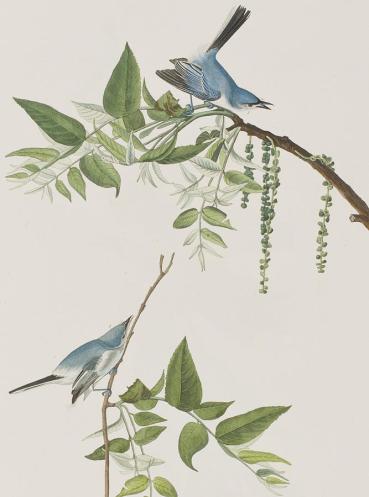
So, as the name suggests, do gnatcatchers truly eat gnats? The website All About Birds contends that, despite its name, the gnatcatcher does not concentrate its feeding efforts on gnats. This tiny bird does, however, prey on a variety of small insects and spiders. Winged insects, such as small flies and gnats, are part of the menu for a gnatcatcher, but this bird is also capable of plucking spiders from their webs or snatching tiny caterpillars from the underside of leaves.1-blue-grey-flycatcher-john-james-audubon

Like the hummingbirds, the gnatcatchers are an exclusively New World family of birds. They lack the diversity of the hummingbirds. Instead of several hundred species, there are only about a dozen species of gnatcatchers worldwide. Of that number, four — blue-gray gnatcatcher, California gnatcatcher, black-tailed gnatcatcher and black-capped gnatcatcher — range within the United States. The blue-gray gnatcatcher is the only member of this family to reside in the eastern United States. Other representatives of this family of small songbirds include the Cuban gnatcatcher, white-lored gnatcatcher, creamy-bellied gnatcatcher, tropical gnatcatcher and masked gnatcatcher.

The blue-gray gnatcatcher builds an exquisite and compact nest using such materials as spider silk and lichens. I have found many nests over the years by listening for the scolding notes of the parents which, even near their nest, have not learned the virtue of silence. The blue-gray gnatcatcher is one of the birds that, in my mind, truly kicks off the arrival season of many of my favorite neotropical migrants. With the arrival of gnatcatchers, I can now expect to enjoy the arrival of birds like hummingbirds, warblers, tanagers, vireos, thrushes, and grosbeaks.

BGGnatcatcher

••••••

Bryan Stevens lives near Roan Mountain, Tennessee. To learn more about birds and other topics from the natural world, friend Stevens on Facebook at https://www.facebook.com/ahoodedwarbler. He is always posting about local birds, wildlife, flowers, insects and much more.