Tag Archives: Bird

Spotlight on dark-eyed junco launched weekly column 29 years ago

Pixabay • A dark-eyed junco visits a deck for birdseed.

I wrote my first bird column on Sunday, Nov. 5, 1995, which means this weekly column is marking its 29th anniversary this week.

Looking back, it seems almost unbelievable that I’ve written anything on a regular weekly basis for almost 30 years. This column has appeared in a total of six different newspapers, which I regard as a personal achievement, as well as an accomplishment for our feathered friends. It’s on their behalf that I pen these weekly efforts to promote conservation and good will toward all birds. I have also posted the column as a weekly blog posting since February 2014 at http://www.ourfinefeatheredfriends.com.

I’ve played detective, helping people identify everything from “rain crows,” or cuckoos, to Muscovy ducks, rose-breasted grosbeaks and house finches. I’ve observed unusual birds, including white pelicans, brants and roseate spoonbills, in Northeast Tennessee, Southwest Virginia and Western North Carolina and spotlighted them in these columns.

Photo by Ken Thomas • A dark-eyed junco perches on some bare branches on a winter’s day.

While my vision challenges remain, I find that looking through binoculars works just fine, allowing me to spin the focus wheel and still take delight in the kaleidoscopic parade of colorful warblers that pass through the region each spring and fall as well as the fast-paced duels of ruby-throated hummingbirds. My main problem these days is the inability to spot movement, especially in treetops where many birds like to hang out.

At my home, I continue to provide sunflower seed and other supplemental food for the resident birds like Carolina chickadees, white-breasted nuthatches, song sparrows and downy woodpeckers.

Even as I tweak my anniversary column for “Feathered Friends,” I’m looking forward to the winter bird feeding season. The prognostication of approaching winter weather is a perfect time to dust off this week’s column, which is a revision of the first bird column I ever wrote. This column focused on a common visitor to yards and feeders during the winter months. In fact, dark-eyed juncos should be returning to the region any day. Here, with some revisions I have made through the years, is that first column.

•••

Of all the birds associated with winter weather, few are as symbolic as the dark-eyed junco, or “snow bird.” The junco occurs in several geographic variations.

John V. Dennis, author of “A Complete Guide to Bird Feeding,” captures the essence of the junco in the following description: “Driving winds and swirling snow do not daunt this plucky bird. The coldest winter days see the junco as lively as ever and with a joie de vivre that bolsters our sagging spirits.” The dark-eyed junco’s scientific name, hyemalis, is New Latin for “wintry,” an apt description of this bird.

Most people look forward to the spring return of some of our brilliant birds — warblers, tanagers and orioles — and I must admit that I also enjoy the arrival of these birds. The junco, in comparison to some of these species, is not in the same league. Nevertheless, the junco is handsome in its slate gray and white plumage, giving rise to the old saying “dark skies above, snow below.”

Just as neotropical migrants make long distance journeys twice a year, the junco is also a migrating species. But in Appalachia, the junco is a special type of migrant. Most people think of birds as “going south for the winter.” In a basic sense this is true. But some juncos do not undertake a long horizontal (the scientific term) migration from north to south. Instead, these birds merely move from high elevations, such as the spruce fir peaks, to the lower elevations. This type of migration is known as vertical migration. Other juncos, such as those that spend their breeding season in northern locales, do make a southern migration and, at times, even mix with the vertical migrants.

During the summer months, a visit to higher elevations mountaintops is almost guaranteed to produce sightings of dark-eyed juncos. Juncos may nest as many as three times in a season. A female junco usually lays three to six eggs for each nest, which she constructs without any assistance from her mate.

Juncos are usually in residence around my home by early November. Once they make themselves at home I can expect to play host to them until at least late April or early May of the following year. So, for at least six months, the snow bird is one of the most common and delightful feeder visitors a bird enthusiast could want.

Juncos flock to feeders where they are rather mild-mannered — except among themselves. There are definite pecking orders in a junco flock, and females are usually on the lower tiers of the hierarchy. Females can sometimes be distinguished from males because of their paler gray or even brown upper plumage.

Since juncos are primarily ground feeders they tend to shun hanging feeders. But one winter I observed a junco that had mastered perching on a hanging “pine cone” feeder to enjoy a suet and peanut butter mixture.

Dark-eyed juncos often are content to glean the scraps other birds knock to the ground. Juncos are widespread. They visit feeders across North America. The junco is the most common species of bird to visit feeding stations. They will sample a variety of fare, but prefer such seeds as millet, cracked corn or black oil sunflower.

The juncos are a small branch of the sparrow clan. Some of the other juncos include the endangered Guadalupe junco, yellow-eyed junco, Baird’s junco and volcano junco. The last one on the list is endemic to the Talamancan montane forests of Costa Rica and western Panama. Baird’s junco is named for Spencer Fullerton Baird, an American ornithologist and naturalist.

Baird served as secretary for the Smithsonian Institution from 1878 until his death in 1887. He greatly expanded the natural history collections of the Smithsonian from 6,000 specimens in 1850 to over two million by the time of his death.

I hope you’ve enjoyed this introduction to juncos. There’s something about winter that makes a junco’s dark and light garb an appropriate and even striking choice, particularly against a backdrop of newly fallen snow.

Of course, the real entertainment from juncos comes from their frequent visits to our backyard feeders. When these birds flock to a feeder and began a furious period of eating, I don’t even have to glance skyward or tune in the television weather forecast. I know what they know. Bad weather is on the way!

•••

I’ve already seen the first of the season’s white-throated sparrows, a reliable precursor to juncos. If you’d like to share your first sighting this season of dark-eyed juncos, email me at ahoodedwarbler@aol.com. As always, the column is open as a line of communication with fellow bird enthusiasts. I’ve enjoyed sharing stories about birds with countless readers over the past 29 years. I can also be reached on Facebook at https://www.facebook.com/ahoodedwarbler.


Vocal screech owls are pint-sized predators

Photo by Bryan Stevens • An Eastern screech owl perches on a hemlock branch. These owls are much smaller than such relatives as great horned owl and barred owl.

It’s been my pleasure to enjoy almost daily serenades by an Eastern screech owl residing in the woods around my home. The small owl’s shivery wailing calls usually start around dusk and can continue at intervals throughout the night.

Back in September while I watched almost daily for migrants from a lawn chair, I heard on a couple of occasions the “early bird” owls calling occasionally from shady wooded areas. The owls tended to call more often during the daytime when conditions were overcast.

I always pause and listen when I hear the wailing and haunting vocalizations of the screech-owls that make their home in the woodlands that surround my home. I’m glad to have this small owl as a neighbor, but I fully realize that owls have suffered from a dark reputation in certain corners. The fact is, unless you are a small rodent or some sort of insect-sized prey, the Eastern screech-owl makes an excellent addition to the neighborhood.

On the verge of Halloween, a closer look at this small owl is warranted. An adult Eastern screech owl is usually only between six and nine inches in length. Many people upon first seeing a screech-owl assume it’s a baby owl. During past trips to Brookgreen Gardens in South Carolina, I have enjoyed attending the daily educational programs conducted by the zoo staff at Brookgreen. These programs are designed to introduce visitors to various examples of native wildlife. The presenter usually introduced a couple of animals to the audience. On several occasions, the show featured birds of prey, including hawks and owls.

Photo by Irene K-s/Pixabay.com • An Eastern screech owl keeps an eye on its surroundings.

Two of the shows during my visit to Brookgreen back in 2019 featured Lucy, an Eastern screech-owl, and people in the audience invariably asked if she was a baby owl. To their astonishment, they learned that Lucy was an adult screech-owl and unlikely to grow any bigger.

There are larger owls in our region, including the great horned owl and barred owl. Lucy and her kin must avoid these much larger owls, which would not scruple at making a meal of the much smaller owl.

Because of their small size, screech-owls prey on some comparatively small creatures, including insects, small rodents, amphibians, songbirds and reptiles. The Eastern screech-owl is also a cavity-nesting bird and will accept bird boxes provided by humans so long as the box’s entrance hole is customized to their size.

The screech owl is the owl most likely to encounter human beings. It’s an adaptable little feathered predator, just as much at home in the backyard and garden as it is in parks and woodlands. In addition to nesting in cavities, this owl roosts in them during the daytime hours. Look for roosting screech-owls in knotholes of trees or in unoccupied wood duck boxes. Although they come in two color phases — red and gray — both variations are quite capable of camouflage. When perched or roosting, these small owls blend remarkably with their surroundings.

The Eastern screech owl also produces a variety of odd wails and other vocalizations including a distinctive, trembling “whinny” call that is often made when the owl feels curious or alarmed. It’s a wavering, haunting call that is made after dark, most often at the hours closer to dawn and dusk. Imitating the call of a screech-owl or playing a recording is also a trick for getting some shy songbirds to show themselves. Screech owls are not-so-welcome co-habitants among my yard’s songbirds, which will flock to this owl’s call and band together to “mob” the predator and try to convince it to depart the immediate area.

As small as the Eastern screech-owl is, the United States is home to several other pint-sized owls, including Western screech-owl, Northern pygmy-owl, Northern saw-whet owl, flammulated owl and elf owl, which at six inches tall and a weight of less than an ounce qualifies as the world’s smallest owl.

Photo by U.S. Fish and Wildlife Service • The tiny Northern Saw-whet Owl nests on several of the region’s higher mountains.

Any time I finish listening to a calling owl and go back indoors for the evening, I reflect on the fact that screech-owls make good neighbors. Their prey preferences remove many nuisance insects and rodents from the habitat they share with humans as well as other wildlife. If you’re hearing an odd, winnowing call from the edge of the woods at your own home, there’s a good chance that you have one of these small owls as a neighbor.

Keep alert for these small owls and their larger kin as we observe this year’s Halloween holiday, as well as other days and nights throughout the year.

•••

To learn more about birds and other topics from the natural world, friend Bryan Stevens on Facebook at https://www.facebook.com/ahoodedwarbler. He enjoys posting about local birds, wildlife, flowers, insects and much more. If you have a question, wish to make a comment or share a sighting, email him at ahoodedwarbler@aol.com.

Holly Keepers/USFWS • A red Eastern screech owl peeks from a perch among some evergreen branches.

Grosbeaks are migrating back south

Photo by Bryan Stevens
A young male Rose-breasted Grosbeak visits a feeder in September of 2013. Young males resemble females but show a splash of orange on the breast that will be replaced the following spring by the familiar rosy-red patch.

Kaylynn Sanford Wilster hosted some refugees from Hurricane Helene at her feeders on Sept. 27. She notified me of their arrival with a post to my Facebook page.

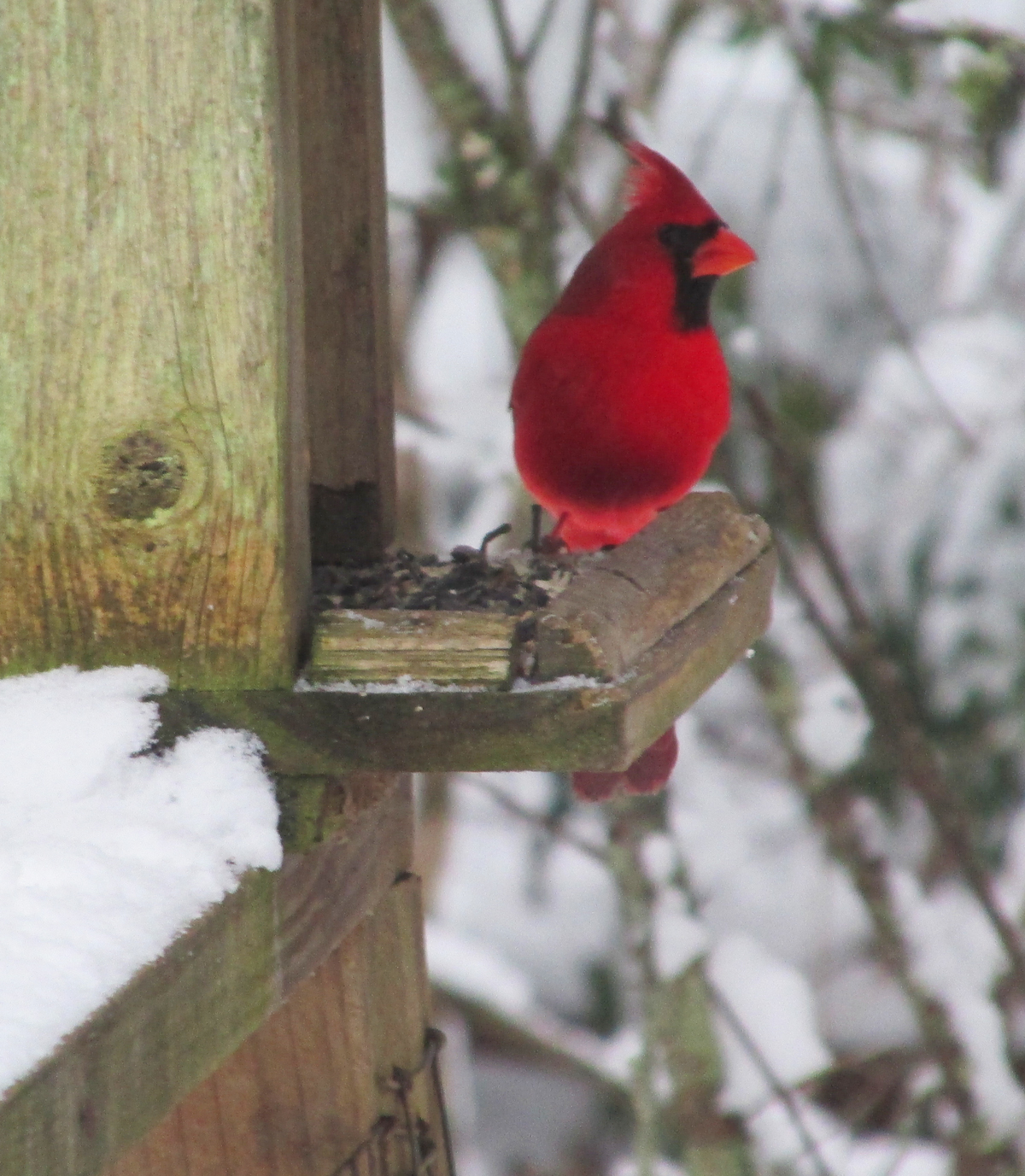
Kaylynn lives in Piney Flats near Boone Lake and sees plenty of birds and other wildlife at her home. She shared photos on my Facebook page of Northern cardinals sharing a feeder with rose-breasted grosbeaks. While the cardinals are found here throughout the year, rose-breasted grosbeaks are mostly spring and fall migrants in the region.

The photos captured the dark and rain of the early part of the day on Sept. 27 as remnants of Hurricane Helene barreled through the region. I suspect that the rose-breasted grosbeaks that landed on her feeders were hoping to ride out the storm with easy access to food.

Photo Courtesy of Kaylynn Sanford Wilster • A young male rose-breasted grosbeak, right, shares space on a feeder with an adult male Northern cardinal.

Plenty of rose-breasted grosbeaks pass through northeast Tennessee, southwest Virginia and western North Carolina every spring and fall. These songbirds also make their summer home on local mountains. Rose-breasted grosbeaks birds spread out widely across the eastern half of the North American continent, ranging from northeastern British Columbia to Quebec and Nova Scotia in Canada. They also range south from New Jersey to Georgia. The rose-breasted grosbeak also reaches Colorado, Oklahoma and Kansas.

For the most part, however, the rose-breasted grosbeak is replaced in the western United States by the closely related black-headed grosbeak.

As fall approaches, the rose-breasted grosbeak migrates south to a winter range that spans central Mexico, Central America and northern South America. As they depart, many of these migrating birds will make autumn visits to again partake of offerings of sunflower seeds at backyard feeders. So, if you didn’t get to see these showy birds in the spring, local bird enthusiasts get another chance to see them in September and October.

The male rose-breasted grosbeak gives this species it name. Males are the epitome of the birds that make their home for part of the year in the American tropics. The contrasting black and white plumage is emphasized by a triangular slash of rosy-red color on the breast. Put all those elements together and the male rose-breasted grosbeak is not a bird that would be mistaken for any other.

The female grosbeak, however, doesn’t stand out in the same way. She is much less colorful than the male. With her brown and white plumage, she is often mistaken for a large sparrow or finch.

Both sexes have a massive bill, which they use to hull sunflower seeds at feeders or glean insects from leaves and branches. It’s the heavy, blunt bill for which the term “grosbeak” is derived. “Gros” is a German term for large or big, so grosbeak simply means a large-beaked bird. People who band birds to further the study of them will tell you that rose-breasted grosbeaks can inflict a wicked nip. In Northeast Tennessee, bird banders frequently encounter rose-breasted grosbeaks in their mist nets — and bear the scars to prove it.

With some birds, males play only a minor role in the nesting process. That’s not the case with the rose-breasted grosbeak male. The males help with nest-building chores and share responsibility with the female for incubating the eggs.

The female lays three to five eggs in a cup-shaped nest. It’s not easy to locate the nests since the birds usually place them in trees at least 20 feet above the ground. Within two weeks, the eggs have hatched and the parents are kept extremely busy finding enough food to satisfy the voracious nestlings. Well fed by both parents, the young grow quickly and usually are ready to leave the nest within 12 days.

Often, when a first brood of young departs the nest, the male will care for the rowdy group of fledglings as the female starts a second nest to capitalize on the long days of summer.

Away from our feeders, rose-breasted grosbeaks feed on insects, seeds, fruit and even some leaf buds and flowers. I’ve seen these birds satisfying a sweet tooth — or should that be sweet beak? — by feeding on jewelweed flowers and apple blossoms. If sugar’s good for hummingbirds, I am sure it is a valuable energy source for rose-breasted grosbeaks, too.

Some of the grosbeaks in Kaylynn’s photos were young male grosbeaks that didn’t yet have the stunning plumage of an adult male. They were making their first migration, heading south to spend the winter on the same wintering grounds as their parents. An interruption of that migration by a hurricane must have been an unwelcome one, but the birds at her feathers didn’t appear to have even a feather out of place.

Like people, birds can be extremely resilient, even in the face of something like a hurricane. Whether you see rose-breasted grosbeaks in the spring or the fall, these songbirds are cherished visitors that can add some excitement to a gloomy day.

Photo by Bryan Stevens • A migrating rose-breasted grosbeak rests and recuperates after a collision with a. window.

Mockingbird has been Tennessee state bird since 1933

By George/Pixabay • The Northern mockingbird serves as the state bird for Tennessee, as well as four other states. These songbirds are renowned for having a spirited nature.

We know some birds by their colorful feathers and others by a distinctive song. The Northern mockingbird demands attention not so much from brilliant plumage or a unique song — this bird actually copies the songs of other birds — but from an indomitable spirit all out of proportion to its size.

The mockingbird is a relatively common bird in most of the region, but it has always been rather scarce bird at my home. This year has been no exception. I’ve observed gray catbirds and brown thrashers as summer transitioned into autumn, but there’s been no sign of any Northern mockingbirds.

Mockingbirds don’t usually visit my yard and gardens outside of late fall and early winter. Close relatives like the gray catbird and brown thrasher, however, are usually fairly common birds in spring, summer and fall. I’ve even had thrashers visit during the winter months, as well as an unexpected December sighting of a catbird in 2015.

These three species are lumped together in a family of birds known as the “mimic thrushes,” so named because of their talent for mimicry. The group provides a convenient umbrella for some related songbirds capable of imitating the songs of other birds.

Mimidae, the Latin root for “mimic,” provides the scientific name for the family, which includes mockingbirds and the New World catbirds, as well as thrashers. The Northern mockingbird is best known for the ability to mimic, but relatives like the gray catbird and brown thrasher are also talented mimics.

The varied repertoire of a mockingbird has always impressed human listeners. Laura C. Martin notes in her book, “The Folklore of Birds,” that the Choctaw Indians referred to the mockingbird as hushi balbaha, or “the bird that speaks a foreign language.”

Mockingbirds will break into song — their own and those of other birds — at almost any time of day or night. Both sexes sing. Biologists have speculated that there might not be a limit to the songs mockingbirds can learn to imitate, while other experts believe that the mockingbird’s mimicry might not be quite so extensive.

The Northern mockingbird is the only mockingbird found in North America, but Central America, South America and some of the Caribbean islands are also home to 16 other species of mockingbirds. Several endemic species of mockingbirds also inhabit some of the islands in the Galápagos archipelago.

Some of these other mockingbirds include brown-backed mockingbird, white-banded mockingbird, blue mockingbird, blue-and-white mockingbird, chalk-browed mockingbird, Bahama mockingbird and tropical mockingbird.

Anyone with much experience with mockingbirds would probably agree that these birds are bold, courageous and sometimes fiercely assertive.

The aggression of the mockingbird was on full display on an occasion when I observed a pair of these birds attempting to defend a berry-laden holly tree from a voracious flock of cedar waxwings. Badly outnumbered, the two mockingbirds would successfully chase off several waxwings only for another dozen or so waxwings to take the place of their vanquished flock mates. Although the flock of waxwings consisted of about 80 individual birds, the mockingbird pair put up a valiant struggle to defend the food represented by those holly berries.

Nesting mockingbirds are also very defensive of both their nest and young. They will attack anything that moves in the vicinity, including domestic cats and dogs, as well as humans.

I once observed a young red-tailed hawk perched in a tree while crows and blue jays were screaming in protest at the large raptor’s presence. The only bird to actually make contact with the hawk, however, was a single mockingbird that swiped the back of the hawk’s head in a persuasive effort to convince the raptor to move along.

Perhaps not surprisingly, these aggressive songbird can reach a ripe old age. According to the website All About Birds, the oldest Northern mockingbird on record was at least 14 years, 10 months old when it was found in Texas.

Early American naturalist and artist John James Audubon painted a famous depiction of mockingbirds attacking a rattlesnake. He painted the dramatic scene to demonstrate the fearless nature of the mockingbird in defending its young.

It’s that feisty attitude that impresses most people about mockingbirds. Even people who don’t like this bird — some consider it a bully — usually give grudging credit that the bird doesn’t lack in courage or spirit.

Perhaps that’s the reason five states — Tennessee, Texas, Florida, Arkansas and Mississippi — have made the mockingbird their official state bird. The southern makeup of these states reflects that the mockingbird has always been a bird of the southern United States even as it has expanded its range northward and westward.

The mockingbird was designated the state bird by the Tennessee General Assembly in 1933. The mockingbird’s designation had been decided earlier that same year in an election conducted by the Tennessee Ornithological Society. Florida and Texas both selected the mockingbird in 1927, Arkansas in 1929, and Mississippi in 1944. The mockingbird was once the official state bird of South Carolina but was replaced by the Carolina wren in 1948.

I find mockingbirds fascinating, partly because they remain a bit of a rarity at my home. I realize that the militant nature of this bird may distress those wanting peace and harmony among the feathered occupants of their yards and gardens.

If the mockingbird had a slogan, it might be something like “don’t mess with me.” The mockingbird in your yard or garden considers the territory its own little kingdom. Intruders beware.

•••

To share a sighting, make a comment or ask a question, email me at ahoodedwarbler@aol.com.


Rare birds are occasional silver linings after hurricanes

Kaleomanuiwa Wong/USFWS • A sooty tern clings to a rocky perch. Hurricane Frances blew a sooty tern to Holston Lake in Bristol on Sept. 8, 2004.

During a program I presented on birds and birding at the Elizabethton/Carter County Public Library many years ago, an attendee asked me if I knew what happens to birds in a hurricane?

The question, no doubt prompted by the 2017 hurricanes Harvey and Irma, is of particular concern now that many of our favorite birds are migrating south along paths that could take them into harm’s way.

Hurricanes are often a factor that fall migrants must face. In 2004, Hurricane Frances blew some unusual tropical birds to Holston Lake in Bristol. Severe storms also present devastating obstacles for other birds.

Well-known birder and author Kenn Kaufman shared his knowledge about birds and hurricanes when interviewed back in 2011 on the Audubon website. Among some fascinating insight he shared, Kaufman noted that the way intense storms affect birds depends on the species. He noted that a whimbrel, a large shorebird, would be more likely to fly through a major hurricane and live to tell the tale. On the other hand, such a storm would likely prove lethal for songbirds like warblers and thrushes.

To the questioner at my program, I also admitted that dedicated birders are, at times, rather atypical people. For a birder looking to find a totally unexpected bird, every hurricane comes with a proverbial silver lining. In the case of birders, that lining involves some of those stronger flyers — birds like whimbrels, noddies, terns, jaegers or tropicbirds — that get swept into the eye of the storm, carried far inland and dropped onto large lakes as the storm weakens.

My first direct observation of one of these hurricane-transported displaced birds took place back on Sept. 8, 2004. I had been drawn to Musick’s Campground on South Holston Lake by reports of an incredible fallout of such birds, which included species like whimbrel and red knot. More than a dozen fellow birders were present in the swirl of wind, mist and rain when a graceful bird with a dramatic two-toned black and white plumage flew overhead.

I had no idea of the bird’s identity, but I knew instantly it was a species I’d never observed. I heard someone yell “sooty tern” — the identity of the shouter turned out to be area birding legend Rick Knight — and then pandemonium broke out as birders in rain gear got their binoculars into position to track the bird before it flew out of sight.

We needn’t have worried. The bird lingered long enough for all those present to get a good look. I was accompanied that day by the late Howard P. Langridge, a well-known birder in both Florida and Tennessee. Howard had seen sooty terns, but he had found them when visiting the islands of the Dry Tortugas, west of the Florida Keys.

Ronald Plett/Pixabay • Royal terns, like the individual pictured, usually stay close to coastlines. In 1989, Hurricane Hugo blew a royal tern all the way to Watauga Lake, establishing the first record for the species in the state.

Two months after the exciting observation of that sooty tern, Howard passed away at age 81. So, even to this day, memories of that bird are tinged with some bittersweetness from the fact it was one of my last birding adventures with a man who served as a bit of a birding mentor for me.

On our drive back home after that exciting encounter with the storm-driven tern, Howard talked excitedly about sooty terns and some of the other rare birds he had seen in a birding career that spanned more than 50 years.

In addition, we learned a valuable lesson that day. It’s an accepted fact that no bird is worth risking life or limb. It’s also a good idea to be careful where you park when going out to a rain-drenched lakeshore to look for birds from a diminished hurricane. Howard and I lingered after the other birders departed. When we started to leave, he discovered his car’s back tires had gotten stuck in the clay mud. With Howard behind the wheel, I pushed his car as the tires spun madly for traction. I ruined a new pair of denim jeans, but I got the car out of the mud. It’s one more memory that will put a smile on my face to this day.

The sooty tern, blown to a Bristol lake in 2004 by Hurricane Frances, remains a highlight of my birding; however, it’s hardly the only unusual bird to be dumped on area lakes thanks to hurricanes that formed in tropic waters.

Hurricane Hugo back in 1989 remains one of the most legendary storms in the minds of most long-time birders in the area. I hadn’t yet taken up birding at that time, but birders like Howard made sure I knew all about the bird bounty stirred up by Hugo. Two species of jaegers — parasitic and pomarine — were among the birds blown inland to Watauga Lake in Carter County. Seeing these birds usually requires a seat on a boat capable of traveling far out to sea to look for birds that hardly ever venture near the shoreline except for nesting.

Hurricane Hugo also blew more than 50 Forster’s terns — a record number for the region — to Watauga Lake. In addition, a single royal tern — a first record for Tennessee — was also detected by birders looking for birds displaced by Hurricane Hugo.

Much farther back, a high count of Caspian terns was recorded Sept. 5, 1964, at Boone Lake in the wake of Hurricane Cleo. The late Wallace Coffey, a well-known birder in Bristol, was present to witness those 130 Caspian terns. Both Caspian and royal terns are birds usually found along the Atlantic Coast in places like Florida, Georgia and the Carolinas.

As I write this week’s post, I did some digging online to see if Hurricane Helene caused any problems for migrating birds.

It’s possible that the storm did drive some unusual species inland. Common gallinules have been spotted in Oak Ridge, as well as Roane County and Anderson County in the days after the storm. American avocets have also shown up in locations across the Volunteer State in the same time period.

Cornell Laboratory of Ornithology did report some displaced birds in the wake of Hurricane Helene, but the reports came mostly from coastal areas that saw some off-shore species like sooty shearwater, Audubon’s shearwater, magnificent frigatebird, brown noddy, bridled tern, sooty tern, Bermuda petrel and American flamingo driven closer to coastlines.

I haven’t heard of any regional migrant fallouts, but then Helene was a rather horrific storm. Even dedicated birders know when to hunker down and look for birds another day.

•••

Email me at ahoodedwarbler@aol.com to share a sighting, make a comment or ask a question.

Catbirds make noisy neighbors during the warmer months

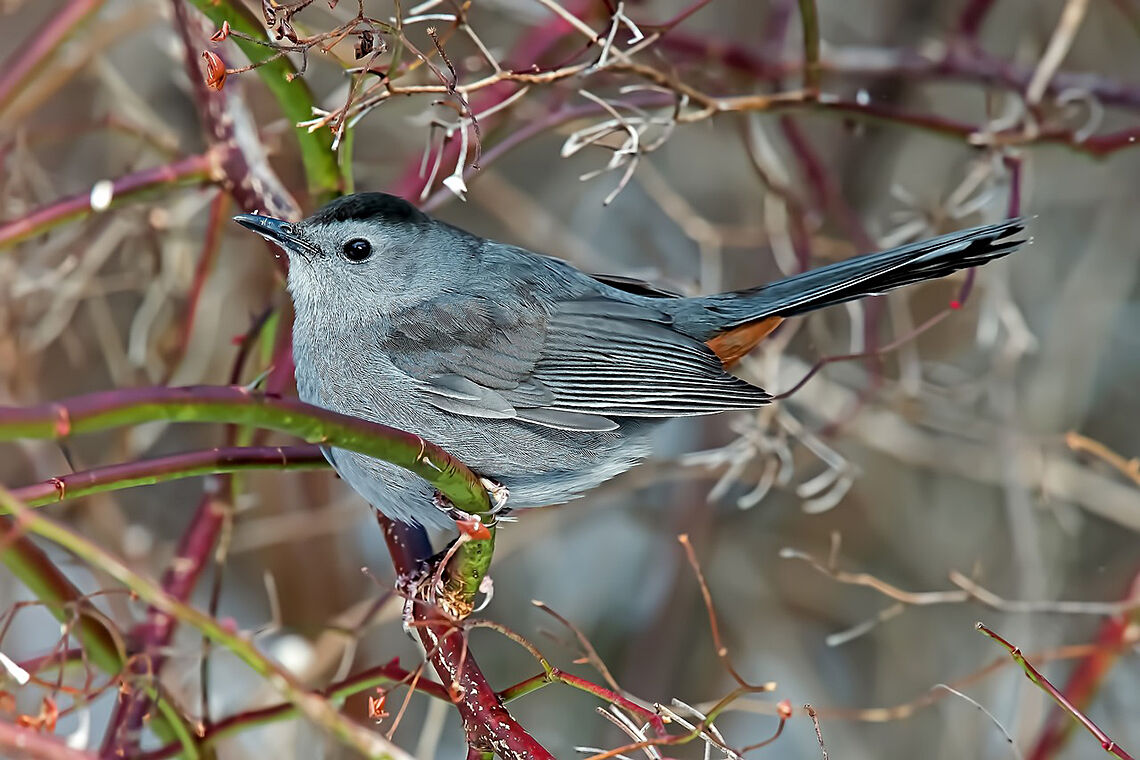
Photo by Bryan Stevens A curious Gray Catbird peeks from dense cover. Attendees at the fall rally can look for catbirds and other species at any of the offered bird hikes.

(NOTE: Hurricane Helene disrupted my weekly posting. I’ve still been writing, so catching up now on the posting.)

I wrote last week about brown thrashers. This week I’m turning the spotlight on a close relative of the thrashers, the gray catbird.

As summer has waned and autumn’s approach has become more inevitable with each passing day, I’ve become more aware of both thrashers and catbirds skulking around the edges of the yard and the nearby woodlands.

These birds have been lured closer by polk berries, wild grapes and pin cherries. Both thrasher and catbirds are fond of fruit. One summer my mom and I “trained” a catbird to come to the discards left behind when strawberries are “capped.” Not as picky as people, the catbird thought the discarded scraps of strawberries provided an unexpected treat.

Catbirds are part of a family related to thrushes that are known as “mimic thrushes.” Besides its surprisingly accurate rendition of a feline, the catbird has several other common vocalizations. Despite their shy nature, they’re extremely curious. Imitating their calls or simply producing a squeaky sound will usually persuade the bird to move out of cover and search for the source of the noise.

Catbirds are part of the annual fall exodus that includes species like rose-breasted grosbeaks, scarlet tanagers, Baltimore orioles and indigo buntings, but because they lack the brilliant plumages of these other birds their passage would probably go unnoticed if not for the fact they are extremely noisy.

Catbirds do get quieter during the nesting season when they take up the serious business of raising young, but after that annual task is completed they immediately slide back into their crotchety vocal habits.

Catbirds are experts at concealing themselves from prying eyes. The bird’s charcoal gray plumage, unbroken except for a patch of maroon feathers beneath the tail, blends into the shadowy sections of the tangles and thickets where they like to lurk. However, even when gray catbirds are reluctant to be seen, they’re almost eager to be heard. As indicated, the catbird is extremely vocal with several calls and songs in its repertoire, including the rather faithful rendering of a fussy cat’s meow that provides this bird its common name.

They are related to thrashers and mockingbirds, but scientists find them just different enough to warrant placing the gray catbird in its own genus.

A relative known as the black catbird, which ranges throughout the Yucatan Peninsula of Mexico as well as northern Guatemala and northern Belize, also belongs to a genus of its own. Both catbirds are classified as “mimic thrushes,” or Mimidae, of which there are about 30 species in the New World.

There is also a totally unrelated family of catbirds that ranges through Australia, Asia and parts of Africa. Some of these birds include the ochre-breasted catbird, tooth-billed catbird and spotted catbird.

The gray catbird is not as an accomplished mimic as some of its relatives, such as the Northern mockingbird. Nevertheless, experts have documented that the gray catbird can produce more than 100 different sounds. Males have motivation to constantly expand their repertoire, however, as doing so increases the likelihood of attracting a mate. They imitate other birds, but some have been recorded imitating frogs and other non-avian singers.

An occasional catbird enjoys surprising longevity. The oldest known gray catbird was at least 17 years, 11 months old when it was recaptured and rereleased during banding operations in New Jersey in 2001, according to the website All About Birds. That individual had been banded originally in Maryland in 1984.

I will miss the catbirds once they depart farther south for the winter, although occasionally a few hardy individuals linger into November and December in the region.

Other birds, including warblers, hummingbirds and most flycatchers will soon take their leave until next spring. Try to enjoy them before they decamp.

•••

To share a sighting, ask a question or make a comment, please email me at ahoodedwarbler@aol.com.


Brown thrasher is a bird with a bold personality

Photo by Bryan Stevens
A pair of Brown Thrashers forage for food on the ground below a feeder.

I’ve been enjoying fall migration, but I’ve not seen as many species of birds as I would like. So far, I’ve observed a few warblers, including black-and-white warbler, common yellowthroat, magnolia warbler, Tennessee warbler and American redstart. Other interesting sightings have included wood thrush, several ruby-throated hummingbirds and a gray catbird. I’ve also observed brown thrashers after going most of the spring and summer without seeing any.

Brown thrashers are by nature both bold and reclusive. I was reminded of that fact during some recent lawn chair birding at home. I heard a quarrelsome thrasher calling from a thicket. I produced some squeaks to get the bird’s attention. As a result, the thrasher soon materialized like a feathered ghost deep in the branches of a shrub. I got a brief look in my binoculars at the bird and saw one baleful pale yellow eye staring back at me.

Photo by Ken Thomas
The Brown Thrasher is an alert, sharp-eyed observer of its surroundings.

A few years ago, quite by accident, I experienced a similar sighting when I came across a brown thrasher nest. I hadn’t gone looking for it. The nest, expertly woven into a thicket of honeysuckle vines, was tucked beneath a sheltering eave of an outdoor storage building. I don’t think anything but a fortunate accident could have ever revealed the nest. I still remember peeking into that tangle of vines and seeing a golden eye staring back. The bird didn’t look in the least pleased that I had accidentally stumbled across her nest.

The otherwise extroverted brown thrasher, which prefers to nest in difficult-to-access, tangled messes, found the cluster of vines a perfect location. For those not familiar with brown thrashers — relatives of the Northern mockingbird — they are known for their feisty and fearless protection of their nest and young. I’m probably fortunate the thrasher on her nest decided to choose stealth instead of attack. Sometimes, discretion is truly the better part of valor and the bird probably decided that, if she remained motionless, she would blend in well with her surroundings.

I was probably fortunate to escape with no more than a stern, unhappy glare from the nesting thrasher. According to th website All About Birds, brown thrashers are aggressive in defense of their nest. The birds are known to strike people and dogs hard enough to draw blood.

Brown Thrashers are accomplished songsters that may sing more than 1,100 different song types and include imitations of other birds, including chuck-will’s-widows, wood thrushes and Northern flickers.

The brown thrasher (Toxostoma rufum) belongs to the family of “mimic thrushes,” which provides a label for a group of songbirds capable of imitating the songs of other birds. Mimidae, the Latin root for “mimic,” provides the scientific name for the family, which includes mockingbirds and the New World catbirds, as well as thrashers. The Northern mockingbird is best known for the ability to mimic, but relatives like the gray catbird and brown thrasher are also talented mimics.

The thrasher is a fairly large songbird about 11.5 inches long with a wingspan of 13 inches. Much of the body length comes from the bird’s long tail feathers. A thrasher weighs, however, only about 2.5 ounces.

Early American naturalist and artist John James Audubon painted a dramatic scene of Brown Thrashers defending their nest from an attacking snake.

The brown thrasher is not a picky eater. It’s known to eat everything from berries and nuts to insects and small lizards. It’s also aggressive in defending its nest and young. John James Audubon, a French-American ornithologist, naturalist and painter, painted quite a dramatic scene of a group of brown thrashers valiantly defending a nest from an attacking snake. The painting is so detailed that one must imagine Audubon based his work on a real-life experience. His work, originally painted in the early decades of the 1800s, still holds up today. The scene comes almost alive to the viewer and confirms Audubon’s skill at capturing extremely accurate moment in the lives of the birds he painted.

Incidentally, Audubon knew the brown thrasher as the “ferruginous thrush.” Another former common name for this species was “brown thrush.”

The thrashers are familiar birds in southern gardens. In fact, the brown thrasher is the official state bird of Georgia and also provided the name for Atlanta’s National Hockey League team, the Atlanta Thrashers. The thrasher became Georgia’s state bird due to passage of a Joint Resolution of the Georgia General Assembly in 1970.

Returning to the expressive nature of brown thrashers, I think it’s the bird’s golden eyes that make them seem so alert and attentive. Once they feel secure in a lawn or garden, they become less shy. As one might expect from a large songbird, thrashers have voracious appetites. Among the feeder fare I offer, thrashers seem to prefer suet cakes. They’re not woodpeckers, however, so the awkward attempts of these long-tailed birds to access the suet offer some comic antics for observers.

As a larger songbird, brown thrashers also tend to live a little longer than smaller birds. The oldest brown thrasher on record was at least 10 years, 11 months old, according to All About Birds. This individual was found in Florida in 1978 where it was banded in 1967.

The brown thrasher is the only thrasher that ranges east of the Mississippi River. Other species occur in the western half of the nation, including sage thrasher, long-billed thrasher, California thrasher, Crissal thrasher, LeConte’s thrasher, curve-billed thrasher and Bendire’s thrasher.

As autumn progress, I wish everyone luck with their own birding.

•••

To ask a question, make a comment or share a sighting email me at ahoodedwarbler@aol.com.

Photo by Bryan Stevens
Brown Thrasher perched in a mimosa tree.

Birds share fall skies with migrating butterflies, dragonflies

During a stop at the Unicoi Walmart to visit the pharmacy on Wednesday, Sept. 3, I spied an energetic fluttering of wings in the garden center. Although I’ve spied various birds, including Carolina wrens and house sparrows, making themselves at home in this garden center, this winged creature was quite a bit smaller.

I watched the butterfly flit from marigold to zinnia to fall mums, feasting on the nectar the blooms provided. A closer look revealed the butterfly’s identity as a long-tailed skipper, a species more likely found in South Carolina, Georgia and Florida than Northeast Tennessee.

Photo by Bryan Stevens • A long-tailed skipper sips nectar from a marigold at the garden center at the Unicoi Walmart.

According to Wikipedia, the long-tailed skipper is a spread-winged skipper butterfly found throughout tropical and subtropical South America, south to Argentina and north into the eastern United States and southern Ontario. It cannot live in areas with prolonged frost. I have seen lots of them in South Carolina and Georgia; this is my second sighting of one in Northeast Tennessee. I found the first one in a garden in Elizabethton near the Covered Bridge.

The sighting reminded me that it’s not only birds using the skies for migration as we advance toward the autumn season. I also remembered a question I got from a reader back in 2014. Rhonda Eller of Chilhowie, Virginia, posted a question on my Facebook page about some dragonflies that appeared in her yard on Sept. 10.

“We have had a sudden breakout of dragonflies in our yard,” Rhonda explained. “We seldom see more than one or two at a time.”

Rhonda wondered if the dragonflies might have been drawn to her yard in pursuit of some sort of favorite insect prey. She also speculated that the recent dry conditions might have attracted the dragonflies.

Photo by Bryan Stevens • The wandering glider is a migratory species of dragonfly.

I responded at the time to her query by explaining that birds share the skies at this time of year with many other migrants. Some dragonflies, just like birds, migrate. A species known as green darner is one that migrates. These darners are rather large, for a dragonfly, and travel in swarms. A couple of years ago I observed thousands of these dragonflies swarming over a municipal swimming pool and a nearby fish pond at Erwin Fishery Park.

The WSLS Channel 10 television station out of Roanoke, Virginia, reported on swarms of dragonflies so large that they got picked up by local radar. Rhonda shared a link to the station’s story on my Facebook page.

Of course, swarms of migrating insects are bound to get the attention of predatory birds. The same day that Rhonda experienced the influx of migrating dragonflies, I witnessed dozens of common nighthawks and chimney swifts swooping through the skies over my home. With a little more attention to detail, I also noticed the dragonflies sharing the skies with these birds.

I suspect that the nighthawks were feeding on the large darners while the swifts, which are much smaller birds, focused their foraging efforts on smaller winged insects. Tom McNeil, a neighbor and fellow member of the Elizabethton Bird Club, reported seeing nighthawks and swifts, too. Tom lives on the other side of a mountain ridge that separates our homes.

Tim Morris, a Facebook friend from Australia, noted in a comment on my post about the nighthawks that his country is home to a bird known as the tawny frogmouth, a relative of the common nighthawk. Tim noted that frogmouths are big birds with camouflage markings that allow them to pretend to be dead tree boughs by day. “They feed not only on insects but mice and lizards, too,” he added.

Evidence of fall migration continued the next day when I detected a small wave of warblers foraging in trees at the edge of my yard. I saw five different species — American redstart, worm-eating warbler, Cape May warbler, Blackburnian warbler and Tennessee warbler — in the space of half an hour. Of the warblers in the flock, the Blackburnian and Cape May are some of the more vibrant ones.

So far in 2024, warblers have absented themselves from my yard this fall. It’s started to aggravate me, but I’ll try to be patient.

The Blackburnian warbler’s common name commemorates Anna Blackburne, an English naturalist who lived from 1726 to 1793. Her brother, Ashton, had immigrated to the United States, which made it possible for him to send his sister many specimens, especially birds. Their father, a salt merchant by trade, was also a well-respected amateur naturalist. In addition to the warbler that bears her name, Anna Blackburne also had a species of beetle named in her honor.

Both the Cape May and Tennessee warblers are named for the locations from which they were first collected. Neither of these small songbirds are closely affiliated with Cape May, New Jersey, or the Volunteer State. The Cape May warbler is also known as the “tiger warbler” for the dramatic black striping across its bright yellow breast. A green back and chestnut cheek patch make the Cape May warbler quite unlike any of its close kin. Even its former scientific name — Setophaga tigrina — paid homage to the striped big cat. The term “setophaga” translates to “moth eater” and is a reference to this warbler’s intense fondness for the caterpillars known as spruce budworms that occasionally produce outbreaks in the northern spruce forests that serve as the nesting range for the Cape May warbler.

According to the website, “All About Birds,” Cape May warblers have unusually shaped tongues that allow them to sip nectar from tropical flowers during the winter months spent in Central America and the Caribbean. Their unique tongues also make it possible for them to enjoy sips of sugar water from hummingbird feeders.

Whether its dragonflies, nighthawks, warblers, hummingbirds or a long-tailed skipper in a Walmart garden center, plenty of birds and other flying creatures will be moving through the region for the next few weeks. Now’s the time to get outdoors and look for some of these migrants.

•••

Bryan Stevens has been birding actively for about 30 years. He has written a weekly column on birds and birding since 1995. To ask a question, make a comment or share a sighting, email him at ahoodedwarbler@aol.com.

September brings spike in bird migration

Hans Toom/Pixabay • Few warblers make as great a journey as the blackpoll warbler. This small songbird makes a roundtrip flight of 12,400 miles for its seasonal migrations each year.

September’s arrival puts fall migration into sharp focus. The birds that returned this past spring — the warblers, vireos, tanagers, grosbeaks, flycatchers, hawks, hummingbirds and many more — have begun or are beginning to make their way back to the locations where they will spend the winter months far from the cold, bleak conditions over most of North America.

Every morning as I leave for work I hear the buzz of hummingbird wings. When I return in the evening, I am often greeted by the scolding calls of red-eyed vireos from the woodlands around my home.

Some of these birds migrate out of the tropics every spring to avoid competition. Others find North America a land of abundant, albeit temporary, resources. This land of plenty offers a wealth of insects, seeds, fruit and other nourishing, nutritious food to help parent birds keep their strength while they work to ensure their young thrive. Of course, once the bountiful period concludes, they return to the tropics of Central and South America to winter. Those that do so successfully will make the journey back to the United States and Canada in the spring. It’s an ongoing cycle, repeating year after year, season after season.

The phenomenon of migration isn’t exclusive to the neotropical migrants of the New World. Birds in other parts of the world migrate, too. Waterfowl, shorebirds and raptors are among some of the families of birds that stage impressive migrations.

Photo by Jonathan Cannon/Pixabay.com • The Arctic tern outdoes all other birds when it comes to migration. These seabirds journey from their Arctic nesting grounds to spend the winter around the Antarctic, a journey of some 50,000 miles a year.

The Arctic tern, for example, truly takes migration to extremes. This small seabird travels each year from its Arctic nesting grounds to the Antarctic region, where it spends the winter months. Put into terms of mileage, the Arctic tern can travel about 50,000 miles in a single year. For a bird with a body length of about 15 inches and a wingspan of about 28 inches, this incredible migration is an astonishing feat. These statistics permit the Arctic tern to easily lay claim to the title of champion migrant among our feathered friends.

According to the website for National Geographic, Arctic terns face a serious threat from climate change. In a profile on the tern at its website, National Geographic warns that Arctic terns are projected to lose 20 to 50 percent of their habitat due to the temperature changes linked to climate change. They also face loss of habitat due to encroachment by human activities such as oil drilling.

The ruby-throated hummingbird, a favorite of many bird enthusiasts living in the eastern United States, makes an impressive migration each year. Just to reach the United States, these tiny birds undertake a strenuous journey. They leave their wintering grounds in Central America to return to the United States and Canada for the nesting season. Most of these tiny birds, which are barely four inches long, make a non-stop flight of more than 500 miles across the Gulf of Mexico. The journey can take almost an entire day. With the end of summer, the entire population of ruby-throated hummingbirds, increased by a new generation of young birds, makes the Gulf crossing for a second time in a year to return to the American tropics for the winter months.

Photo by Bryan Stevens • A ruby-throated hummingbird perches at a feeder for a sip of sugar water.

Among North America’s buteo hawks, which includes raptors such as red-shouldered hawk and red-tailed hawk, the broad-winged hawk stands out as a dedicated migrant. These hawks form flocks that at times number in the hundreds or thousands as they sail and glide on thermals rising over various mountain ranges. These hawks and other raptors are well-known in the region for migrating past the Mendota Fire Tower in Southwest Virginia every September and early October.

The broad-winged hawk’s counterpart in the western United States is Swainson’s hawk, which shares the broad-winged hawk’s inclination for migrating in large flocks. Swainson’s hawk is named for William Swainson, the famous 19th century English naturalist for which Swainson’s thrush is also named.

The hooded warbler, my favorite member of the migratory New World warblers, migrates back to Mexico and Central America for the winter months after nesting during the spring and summer in a range concentrated in the southeastern United States. The males, after going quiet in late summer, have started singing on occasion from the shaded woods around my house. I think this has more to do with restlessness as they prepare for to depart on a migration flight that will take them to the balmy Caribbean, Mexico and Central America while we shiver through the months between October and April. It’s not a migration of an incredible distance, but it’s still quite an accomplishment for a bird only five inches long and weighing less than half an ounce.

Another warbler is a true migratory champion. Few warblers make as great a journey as the blackpoll warbler. Instead of migrating over land, this five-inch-long warbler undertakes a two-stage migration. The first half of the migration is a non-stop flight of about 1,500 miles. Every fall, these tiny birds fly over the Atlantic Ocean during this part of their migration, departing from Canada or the northern United States and not stopping until they reach various locations in the Caribbean. There they will spend some time recovering from the exhausting first half of their journey before they continue their way to such South American countries as Colombia and Venezuela. Once again, during the time they spend flying over open ocean, these tiny warblers do not feed.

Fall’s a great time to witness the variety of avian life. Look for some of these migrants passing through your yards, gardens or favorite birding spots.

For those wanting suggestions for seeking out migrating birds, the linear trail in Erwin, Rocky Fork State Park in Flag Pond and Limestone Cove Recreation Area are some good bets.

•••

To ask a question, make a comment or share a sighting, email me at ahoodedwarbler@aol.com. 

Elizabethton Bird Club announces speakers for fall programs

Brayden Paulk will speak to the Elizabethton Bird Club on Sept. 3 on the topic of microfishing.

The Lee and Lois Herndon Chapter of Tennessee Ornithological Society, also known as the Elizabethton Bird Club, will soon begin its schedule of monthly meetings for 2024-25.

The brief business meetings are always accompanied by an informative and entertaining program on birds, birding or other subjects from the natural world.

These programs are a great way to learn more about our feathered friends as well as other related subjects from the natural world. They are free, open to the public and hosted by a welcoming group of people.

Here’s the schedule for Fall 2024:

September

Brayden Paulk, a young naturalist with family ties in Unicoi County, will present the first program on Tuesday, Sept. 3, with a talk on “Microfishing,” which involves anglers focusing on a diverse array of tiny species of fish.

Paulk has also been working as a naturalist with Lamar Alexander Rocky Fork State Park this summer and fall. He gave a program a couple of years ago for the club on “Trash Fishing,” which explored other angling options other than the typical gamefish species. As both fishing and birding are among his interests, he will no doubt find a way to work something into his program about birds.

October

The guest speaker for the meeting on Tuesday, Oct. 1, will be Mark Stevens. A former publisher for The Erwin Record, he will present a program titled “Building a Birding Festival” that will focus on his development of the Hammock Coast Birding Festival in South Carolina. Stevens, who works as tourism director for the Georgetown County Chamber of Commerce, will be giving the program remotely from his home in South Carolina, but the hybrid meeting also offers a chance to attend in-person with other birding enthusiasts. The festival is organized by the South Carolina Hammock Coast, the marketing arm for the Georgetown County Chamber. The third annual Hammock Coast Birding Festival is scheduled for Feb. 6-9, 2025.

November

Vern Maddux, the treasurer for the club, will be the speaker on Tuesday, Nov. 5. Maddux is a world traveler when it comes to seeing birds and will present a program on one of his recent international birding adventures to South Georgia and Falklands. South Georgia is a mountainous barren island in the South Atlantic Ocean, 800 miles east-southeast of the remote South Atlantic archipelago that makes up the Falkland Islands. With rugged terrain and cliff-lined coasts, the hundreds of islands and islets in the Falklands are home to sheep farms and abundant birdlife.

December

In the busy month of December, yours truly will give the program. I will present a powerpoint presentation titled “What’s in a Name?” on North American birds named after people. Among our native birds, we have quail, woodpeckers, sparrows, finches, warblers, hawks and other birds are known by names of historical figures ranging from John James Audubon to William Clark and Meriwether Lewis.

My program will be held on Tuesday, Dec. 3. I will discuss the American Ornithological Society’s decision in 2023 to end what are known as eponyms, in which species names honor people. The renaming of dozens of species will be a gradual process.

The club’s 2025 schedule has not been completed, but will include a program by local naturalist Lewis Tester in the spring on dragonflies.

The public is always welcome to attend these programs. Programs begin at 7 p.m.

The club meets at the Elizabethton campus of Northeast State Community College in Room 135 when the school’s schedule permits. When school is not in session, meetings are held on Zoom or at other announced locations. To receive updates on the club’s schedule, events and activities, email elizabethtonbirtdingclub@gmail.com and ask to be placed on a free mailing list.

The Elizabethton Bird Club holds seasonal birds count in spring, summer, fall and winter. The club also organizes and sponsors regular field trips to destinations through Northeast Tennessee. These activities are also open to interested members of the public.

•••

To share a sighting, make a comment or ask a question, email me at ahoodedwarbler@aol.com.