Tag Archives: Birdwatching

Spring Bird Count participants deal with unseasonal cold snap

The 74th annual Elizabethton Spring Bird Count was held on Saturday, May 6. A total of 43 observers in nine parties took part in the annual survey, which consists Carter County and parts of adjacent Johnson, Sullivan, Unicoi and Washington counties. In addition to Elizabethton, the count includes territory in such cities as Elizabethton, Erwin, Kingsport, Bristol and Johnson City.

Count-Gobbler

Photo by Bryan Stevens • A male gobbler seeks the attention of hens, as all these Wild Turkeys add to the number of this species found during the count.

The most unusual aspect of this year’s count involved rather cold conditions, according to long-time count compiler Rick Knight. Although held nearly a week into May, this was one of the coldest days ever experienced on a spring count. The temperature range was 36 to 54 degrees. Light rain fell before sunrise; the morning was partly cloudy to cloudy, then the afternoon saw light rain, with light snow showers at the higher elevations and a half-inch accumulation of snow on Roan Mountain.

Knight noted that previous cold spring counts included: 32 to 55 degrees in 1979, 44 to 52 degrees in 1987, and 27 to 54 degrees in 1992. Despite the weather, participants managed to find 148 species, which is exactly the average over the last 30 years, but below the average over the last decade, which stands at 154 species.

The most common species on this year’s Spring Bird Count was the Cliff Swallow with 1,046 individuals — a new record for this species — found this year. Other common species include European Starling (704), American Robin (693) and Tree Swallow (526).

A Stilt Sandpiper found in Washington County represented only the third time this species has been observed during the Elizabethton Spring Bird Count. As always, Knight said there were a few notable misses, such as Northern Bobwhite, Ruffed Grouse, Pied-billed Grebe, Brown Creeper, Winter Wren, Swamp Sparrow and Pine Siskin. In addition, no gulls were found on any of the area lakes.

Count-MaleMartin

Photo by Bryan Stevens • Purple Martins, like this male, were sluggish on the day of the count thanks to cold temperatures and steady rainfall.

In addition, several species of warblers that nest in the region showed rather low numbers. Some of the low numbers for some species may be attributable to the weather. Nevertheless, the count produced observations of 28 different warbler species.

The total is listed below:
Canada Goose, 390; Wood Duck, 27; Mallard, 93; Blue-winged Teal, 5; and Hooded Merganser, 2.
Wild Turkey, 54; Common Loon, 2; Double-crested Cormorant, 42; Great Blue Heron, 115; Great Egret, 1; Green Heron, 13; Yellow-crowned Night-Heron, 8; and Black-crowned Night-heron, 1.
Black Vulture, 74; Turkey Vulture, 108; Osprey, 10; Sharp-shinned Hawk, 1; Cooper’s Hawk, 5; Bald Eagle, 13; Broad-winged Hawk, 5; Red-winged Hawk, 25; and American Kestrel, 11.
Virginia Rail, 4; Killdeer, 35; Spotted Sandpiper, 27; Solitary Sandpiper, 19; Greater Yellowlegs, 1; Lesser Yellowlegs, 1; Stilt Sandpiper, 1; and Least Sandpiper, 6.
Forster’s Tern, 1; Rock Pigeon, 155; Eurasian Collared-Dove, 3; Mourning Dove, 224; Yellow-billed Cuckoo, 4; Black-billed Cuckoo, 1; Eastern Screech-owl, 6; Great Horned Owl, 1; Barred Owl, 2; Common Nighthawk, 1; Chuck-will’s-widow, 2; Whip-poor-will, 10.
Chimney Swift, 66; Ruby-throated Hummingbird, 23; Belted Kingfisher, 23; Red-headed Woodpecker, 5; Red-bellied Woodpecker, 54; Yellow-bellied Sapsucker, 3; Downy Woodpecker, 23; Hairy Woodpecker, 5; Northern Flicker, 30; and Pileated Woodpecker, 34.

Count-NightHeron

Several species of herons, including this Yellow-crowned Night Heron, were found for this year’s Spring Bird Count.

Eastern Wood-pewee, 1; Acadian Flycatcher, 5; Willow Flycatcher, 1; Least Flycatcher, 6; Eastern Phoebe, 42; Great Crested Flycatcher, 13; Eastern Kingbird, 43; and Loggerhead Shrike, 1.
White-eyed Vireo, 5; Yellow-throated Vireo, 10; Blue-headed Vireo, 41; Warbling Vireo, 9; Red-eyed Vireo, 122; Blue Jay, 138; American Crow, 301; Fish Crow, 2; and Common Raven, 22.
Northern Rough-winged Swallow, 345; Purple Martin, 36; Tree Swallow, 526; Barn Swallow, 259; and Cliff Swallow, 1,046.
Carolina Chickadee, 82; Tufted Titmouse, 140; Red-breasted Nuthatch, 3; White-breasted Nuthatch, 13; House Wren, 30; Marsh Wren, 1; Carolina Wren, 99; Blue-gray Gnatcatcher, 39; Golden-crowned Kinglet, 11; and Ruby-crowned Kinglet, 2.
Eastern Bluebird, 136; Veery, 44; Swainson’s Thrush, 5; Hermit Thrush, 1; Wood Thrush, 82; American Robin, 693; Gray Catbird, 35; Brown Thrasher, 51; Northern Mockingbird, 95; European Starling, 704; and Cedar Waxwing, 272.
Ovenbird, 117; Worm-eating Warbler, 19; Louisiana Waterthrush, 18, Northern Waterthrush, 1; Golden-winged Warbler, 3; Black-and-White Warbler, 47; Swainson’s Warbler, 2; Tennessee Warbler, 1; Kentucky Warbler, 1; Common Yellowthroat, 17; Hooded Warbler, 95; American Redstart, 6; Cape May Warbler, 7; Northern Parula, 25; Bay-breasted Warbler, 4; Blackburnian Warbler, 1; Yellow Warbler, 3; Chestnut-sided Warbler, 9; Blackpoll Warbler, 1; Black-throated Blue Warbler, 25; Palm Warbler, 1; Pine Warbler, 15; Yellow-rumped Warbler, 18; Yellow-throated Warbler, 20; Prairie Warbler, 4; Black-throated Green Warbler, 53; Canada Warbler, 1; and Yellow-breasted Chat, 11.

SolitarySandpiper-One

Photo by Bryan Stevens • Migrating shorebirds, such as this Solitary Sandpiper, added diversity to this year’s Spring Bird Count in Northeast Tennessee.

Eastern Towhee, 132; Chipping Sparrow, 67; Field Sparrow, 35; Savannah Sparrow, 4; Grasshopper Sparrow, 1; Song Sparrow, 166; White-throated Sparrow, 4; White-crowned Sparrow, 2; Dark-eyed Junco, 28; Summer Tanager, 2; Scarlet Tanager, 60; Northern Cardinal, 212; Rose-breasted Grosbeak, 19; Blue Grosbeak, 5; Indigo Bunting, 79; Bobolink, 22; Red-winged Blackbird, 271; Eastern Meadowlark, 89; Common Grackle, 327; Brown-headed Cowbird, 97; Orchard Oriole, 21; Baltimore Oriole, 16; House Finch, 64; American Goldfinch, 228; and House Sparrow, 52.

•••••

To learn more about birds and other topics from the natural world, friend Stevens on Facebook at https://www.facebook.com/ahoodedwarbler. He is always posting about local birds, wildlife, flowers, insects and much more. If you have a question, wish to make a comment or share a sighting, email ahoodedwarbler@aol.com.

Count-IndigoBunting

Photo by Bryan Stevens • Newly-returned neotropical migrants, such as this Indigo Bunting, increased the total number of species for the annual spring count.

Grosbeaks, bluebirds focus of questions from readers arising from spring sightings

I’m hearing from readers on a range of subjects relating to birds. Although I am still hearing from readers about their hummingbirds returning after a lengthy absence, other readers have contacted me about other birds, ranging from rose-breasted grosbeaks to “blue” birds of differing varieties.

RB-Grosbeak-BOYD

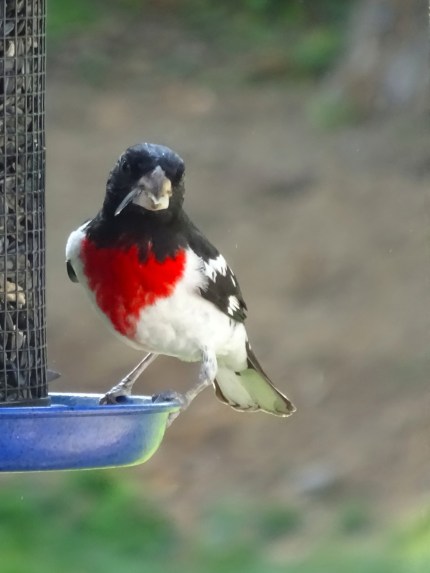
Photo by Rebecca Boyd • A male rose-breasted grosbeak shells sunflower seeds with his large, heavy beak. Rose-breasted grosbeaks, especially the more colorful males, never fail to impress observers.

These shared observations reinforce my theory on birds. They have wings, and they know how to use them. There’s nothing to stop an unexpected bird from making a migration layover in your yard. Keep your eyes open, especially during the remaining weeks of May. A surprise could be winging its way toward you!
•••••
Constance Tate, who lives in Bristol, Tennessee, sent me a Facebook message on April 24. “I just saw a rose-breasted grosbeak at my feeder,” she wrote. “I had to look it up as this is the first one I have ever seen. Are they uncommon in our area?”
Rebecca Boyd of Knoxville, Tennessee, emailed me, also on the subject of rose-breasted grosbeaks.
Rebecca said at least two pairs made frequent visits to her feeder last month, but the visits stopped abruptly on Sunday, April 30.
“Should I assume they have moved on already to cooler areas north of here?” Rebecca asked.
In my response, I congratulated Constance and Rebecca on seeing this stunning bird. The rose-breasted grosbeak is one of our many neotropical migrants, which are birds that winter in the American tropics but migrate to North America for the summer nesting season.
These grosbeaks are not exactly uncommon. However, they usually just migrate through the area for a few weeks in spring and fall, limiting the window of opportunity for seeing them. It’s possible to find rose-breasted grosbeaks nesting on some of our higher mountains during the summer season.
Rebecca took photos of her visiting grosbeaks. In addition, she shared with me that the Tennessee Wildlife Resource Agency’s Watchable Wildlife web page is featuring some of her bird photos this month.
View the gallery by visiting tnwatchablewildlife.org/gallery.cfm. Among the photos by Rebecca on the page are some beautiful photos of American goldfinches.
•••••
Anne and Ben Cowan contacted me to share an observation of a close relative of the rose-breasted grosbeak.
“My husband and I live about three-fourths of a mile from Tennessee High School in Bristol,” Anne wrote. “On April 30 we had the most amazing bird sighting.”
Anne described herself and her husband as avid birdwatchers and bicyclists.
They had been hoping to see a hummer at their feeder (none had shown up as of the date she wrote to me) when they saw a “blue” bird fly into an oak tree near their driveway.

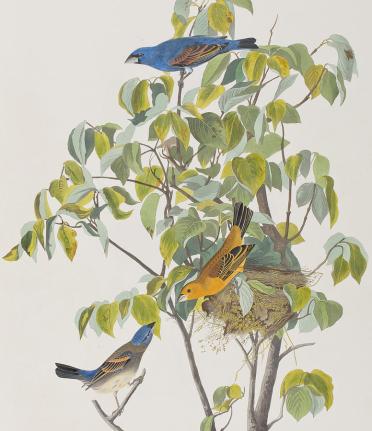
1-blue-grosbeak-john-james-audubon

Early naturalist and artist John James Audubon painted this family of blue grosbeaks.

“It seemed too large to be an indigo bunting and clearly wasn’t a bluebird, so out came the binoculars and there it was, a blue grosbeak,” she wrote. “What a gorgeous bird!”
They looked it up in their trusty bird book, where they found images of the blue grosbeak in all his splendor. The bird also had all the necessary field marks, including the large grosbeak beak, rusty coloration in the wing bars, and a patch of black feathers between the eye and beak.
“It was a definite,” she said of their identification. “His range is not far off here, but it was definitely a rare one for us. We have never seen one.”
The Cowans also informed me they finally saw their first spring hummingbird on a cold, rainy Saturday, May 5.
I wrote the Cowans back, congratulating them on their sightings.  In all the years I have been watching birds, only a single blue grosbeak has visited my feeders, so I know what an unexpected treat a visit from one of these birds can be.
Blue grosbeaks are somewhat uncommon, so it’s definitely a sighting the Cowans can cherish.
This grosbeak is a bird of fields featuring lots of shrubs and small trees. Although fairly widespread, this bird isn’t considered abundant anywhere in its range. The bird is another neotropical migrant and will stop at feeders or birth baths to refuel or rehydrate during their seasonal migration journeys.
•••••
Rhonda Eller of Chilhowie, Virginia, contacted me on Facebook with a question about bluebirds.
“Have you ever heard of changing a bluebird’s nest after the eggs hatch?” Rhonda asked. “We have five baby bluebirds and someone told us maggots get in the nest after the eggs hatch and will eat the babies if you don’t alter the nest.”
In my response, I told Rhonda that I have always made a habit of cleaning out nest boxes after bluebirds are finished nesting. Their nests are so smashed down and dirty after a nesting, it just makes sense to clean out the old nest.

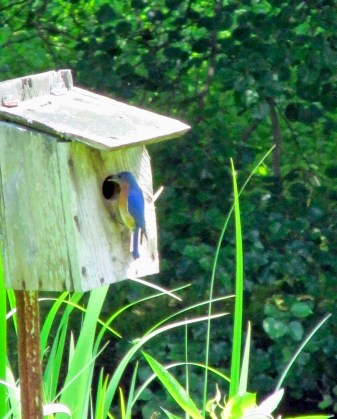
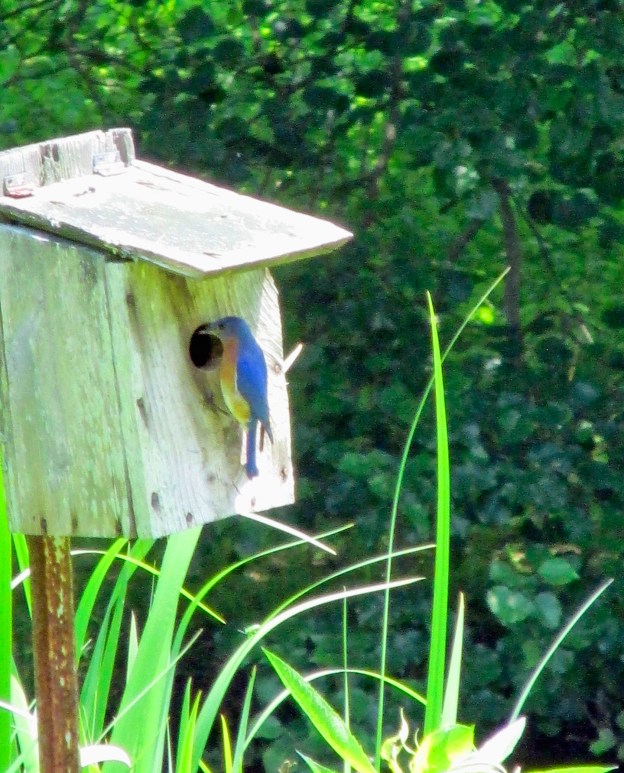
Bleubird-One

Photo by Bryan Stevens • As a rule of thumb, clean out a nest box after bluebirds or other cavity-nesting birds have fledged their young.

I heard back from Rhonda, who had good news. The first nesting attempt by her bluebirds proved a success and five young bluebirds left the nest box in early May.
“We will be cleaning out that nest and hoping for another brood,” she added.
•••••
A few more readers have also shared their first-of-season hummingbird sightings.
Susan Gossett sent me details about her parents and their hummingbird sighting in a Facebook message. “My parents, Harold and Elizabeth Willis, just read your article today in The McDowell News and they saw their first hummingbird April 12 around 5 p.m. They live at 80 Willis Drive in Marion, N.C.”
Guy Davies shared information about his father’s first spring hummingbird sighting. “My father Is Richard “Bud” Davies, Retired 1st Sgt., U.S. Army,” Guy wrote in his message. “He saw his first hummingbird April 14 at 7:10 p.m. at his home in Bluff City, Tennessee. They’re back!”
David and Judy Brown live in Damascus, Virginia. They saw their first spring hummingbird back on April 18 at 11 a.m. at their home they informed me in a Facebook message.
Dee Sims also contacted me by Facebook. “I saw my first hummingbird April 20,” she wrote. “live in Belfast, Virginia, which is between Lebanon and Richlands.”
Jane Arnold sent me an email to let me know her mom, Betty Poole, saw her first spring hummer at 1 p.m. on Sunday, April 23. Betty lives on Lincoln Road in Bristol, Virginia.
As for Jane, who lives on Hearst Road in Bristol, Virginia, she’s still waiting for the hummers to arrive, although she has had a feeder waiting for them since April 1.
Wilma Sexton messaged me on Facebook in regards to my article in the McDowell newspaper about sightings on hummingbirds. “I had just finished your article and I had already put out a fresh hummingbird feeder the weekend before,” she said. “My husband and I really enjoy watching and waiting for them to return. We saw our first one April 26.”
Wilma and her husband live in Union Mills, N.C.
••••••
To learn more about birds and other topics from the natural world, friend Stevens on Facebook at http://www.facebook.com/ahoodedwarbler. He is always posting about local birds, wildlife, flowers, insects and much more.


Readers share arrival stories about spring’s hummingbirds

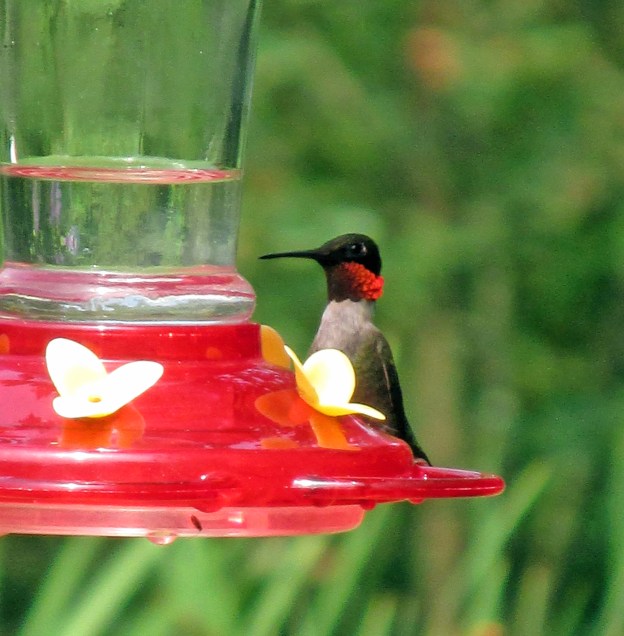
Ruby-throated hummingbirds have returned. The annual first sighting of a hummingbird is one of my most cherished spring moments. Invariably, the first hummingbird to show up in my yard is a male with the gorget — or throat patch — of red, iridescent feathers that gives his species its common name.

4934219635_1db9c900c4_o

Photo by Bryan Stevens • Ruby-throated Hummingbirds swarm to a feeder filled with a sugar water mixture.

As I indicated in a recent column, the ruby-throated hummingbird is one of more than 300 species of hummingbirds. All hummingbirds are found in the New World and are absent from the Old World. Male ruby-throated hummingbirds launch their spring migration about 10 days prior to female hummingbirds.

Based on the number of people who shared hummingbird sightings with me, these tiny birds have a lot of big fans. If you would like to host your own hummingbirds, here are some crucial tips.

• Make your yard a zone that’s free of insecticides and pesticides. Residues of these chemicals can remain on blossoms, which then run the risk of sickening a hummingbird. In addition, hummingbirds subsist on more than nectar. They consume many tiny insects and spiders. Eating bugs that have been contaminated with dangerous chemicals can also sicken or kill hummingbirds.

• Provide shrubs and trees to your landscape to make your yard more inviting. Hummingbirds claim favorite posts and perches, where they will rest when they are not visiting our gardens or feeders. Shrubs and trees can also provide locations for concealing nests built by female hummingbirds.

• Cultivate plants that offer nectar-producing blooms. While hummingbirds are known to favor the color red, these nectar-sipping birds will also visit blooms of other colors. Some favorite spring blooms include the flowers of red buckeye, wild columbine, crossvine and native varieties of azaleas. As spring advances into summer, the diversity of flowers available to lure hummingbirds into your garden will increase dramatically.

Ruby-throated

Photo by Bill Buchanan/U.S. Fish & Wildlife Service • Hummingbirds visit flowers for nectar, so be sure your garden offers a variety of blooms.


Thursday, April 6

Eddie and Delores Phipps of Bluff City, Tennessee, reported seeing their first hummingbird.

“We were excited to see our first hummingbird at the feeder on the morning of April 6,” the couple wrote in an email.  “It was the earliest we have ever seen one. He has been back every day since!”

Eddie and Delores provided me with the report of the earliest arriving hummingbird. Soon after the couple reported their hummingbird, I began to receive more sightings from throughout northeast Tennessee and southwest Virginia.

Sunday, April 9

Monica Black, a resident of Unicoi, Tennessee, saw her first hummingbird of the season about 5 p.m.

“Near the chairs in the back garden there is a spillway created from the koi pond down to the frog pond,” Monica said in the email she sent me. “The hummers like to drink and bathe in it.”

The visiting hummingbird also treated her to a viewing of the first bathing hummingbird of the season.

“The male is the only hummer spotted so far,” she added.

•••••

Facebook friend Phyllis Moore informed me that her friend, Janie Compton, saw her first hummingbird at 6:34 p.m. on Sunday, April 9, in Chesterfield, Virginia.

•••••

Nata Jackson, a resident of Greene County, Tennessee, shared details about her first sighting of spring. In her email, she said she had just put up her feeder when the bird arrived.

IMG_2786

Photo by Bryan Stevens • Only the male Ruby-throated Hummingbird has the brilliant red throat patch, or gorget, that gives the species its common name.

Tuesday, April 11

Nancy and Walt Vernon, of Bristol, Tennessee, emailed details of their first sighting. “We saw it about 12:30 while having lunch,” Nancy wrote in her email. “We have three feeders which we keep filled all summer.”

•••••

Jeanie Campbell, who lives on Mendota Road in Abingdon, Virginia, also sent me an email. Her first spring hummer — a tiny female — wasn’t very active at first. “Then she began drinking away,” Jeanie wrote.

A few days later on April 15, a male — or “Mr. Red Throat” as Jeanie described him — appeared. “He buzzed around all day,” she said.

•••••

Glen Eller, a fellow member of the Lee and Lois Herndon Chapter of Tennessee Ornithological Society, posted on Bristol-Birds — a mailing list archive for area bird sightings — that his daughter, Lia, saw her first hummingbird at 6:55 a.m. Glen’s daughter lives in Fall Branch, Tennessee.

“It’s seemingly a little bit late in this warm spring,” Glen wrote in his post.

Wednesday, April 12

Philip Laws saw his first hummingbird of spring at 4:15 p.m. in the Limestone Cove community in Unicoi County. In his Facebook post to my page, Philip said the arrival served as a reminder that he had meant to put his feeders out a few days earlier, but had failed to do so. He quickly got out feeders to welcome the birds.

•••••

Amy Wallin Tipton, in Erwin, posted on her Facebook page about the return of her hummingbirds.

•••••

Kristy Dunn, who lives in Johnson City, sent me an email to share her first hummingbird sighting of spring.

•••••

Bill and Judith Beckman sent me an email to report their first hummingbird of the season. The hummer arrived around 4 p.m. at their home on Spivey Mountain in Unicoi County.

••••••

Preston Bowers emailed to let me know he saw his first hummingbird at about 5:30 p.m.

“I have lived in Blountville since 1970,” he wrote. “Oddly enough, I never noticed hummingbirds on this property until about three years ago.”

A creek in front of his house has an abundance of jewelweed, which the ruby-throat seems to like quite well.

“So I installed a hummingbird feeder at the corner of my porch where I sit in the porch swing and play ukulele,” he added. “What a joy to watch these amazing birds as they fly by at lightning speeds or hover ever so gracefully.” Preston noted that some of their antics seem like an aerial battle. “I hear sounds that are so similar to the sound of a World War II fighter plane in tactical operations,” he wrote.

Rubythroat

Photo by Bryan Stevens • A male Ruby-throated Hummingbird perches on the tip of a garden post.

•••••

Sandra Loving sent an email notifying me that she got her first sighting of a spring hummer at her feeders at her home on South Holston Lake at 7:50 p.m.

•••••

Sharon Foster, who lives on Friendship Drive at South Holston Lake, emailed me about the date of her first hummer’s arrival. “We’ve had hummingbirds at our feeders all week,” she added.

Friday, April 14

Lynne Reinhard saw her first hummingbird at 8:15 a.m. near the upper end of South Holston Lake in Bristol. She posted the news of her sighting on my Facebook page.

•••••

Jill Henderson, who lives on Poor Valley Road in Saltville, Virginia, emailed about her first hummer sighting: “Just wanted to let you know that I saw my first hummingbird of the spring season at approximately 9:15 a.m. at my home.”

•••••

Beverly Puerckhauer in the Graystone area of Bristol, Tennessee,

RT-Male-April15

Photo by Bryan Stevens • A Ruby-throated Hummingbird must share a feeder with hungry honeybees.

saw her first hummingbird and shared news of the arrival in a comment on my Facebook page.

Saturday, April 15

Linda Quinn Cauley posted on my Facebook page that she saw her first hummingbird at 9:30 a.m. Linda lives off Sciota Road near Unicoi, Tennessee.

•••••

Karen Fouts, of Marion, Virginia, saw her first hummingbird of spring — a male — and posted a comment on my Facebook page. Karen said she refers to these early arrival hummingbirds as the “advance scouts.”

•••••

Mary Beierle, a resident of the Stoney Creek community in Elizabethton, Tennessee, sent me an email telling me she saw her first hummingbird around 3 p.m. “Only one so far, but we’re excited,” she added.

•••••

Don and Shirley Cook, who reside on the upper end of South Holston Lake in Washington County, Virginia, sent me an email to notify me that they saw their first hummer at 3 p.m.

•••••

Glenna Kiser, who lives near Lebanon, Virginia, informed me in an email of her first hummingbird this spring at 1 p.m.

••••••

Several readers enjoyed their first spring sightings of hummingbirds on Easter Sunday.

Sunday, April 16

Nancy Estes emailed me just after she saw her first hummingbird of the season.

“I didn’t get a close look since I was inside my house, but I am assuming it is a ruby-throated hummingbird,” Nancy wrote. “I live in Bristol’s Middlebrook subdivision.”

•••••

Reva Russell, who lives in the Lynnwood Hills subdivision in Bristol, Virginia, notified me in an email that she saw her first hummingbird of the season at 2 p.m.

•••••

Terry Fletcher, who lives at First Colony Condominiums near the Bristol Country Club, sent an email about the first hummingbird of spring. Terry also photographed the hummingbird through a screen door and shared the photo in an email.

•••••

Debbie Oliver, who resides in Bristol, Tennessee, emailed me about her first sighting.

“It wasn’t a visit from the Easter Bunny but a delightful visit from a ruby-throated hummingbird at our deck feeders around 2:30 in the afternoon,” she wrote in her email.

•••••

Cheryl Jones in Damascus, Virginia, saw her first hummingbird of spring at 5:02 p.m. In her email, she said she was beginning to wonder what was keeping them.

Hummer-Farm

Photo by Bryan Stevens • Ruby-throated Hummingbirds have officially returned to the region as of the first week of April.

•••••

The first hummingbird of spring showed up at at the home of Ken Croghan on Walden Road east of Abingdon, Virginia, while he was sitting on the front deck having dinner. He shared news of the arrival in an email.

•••••

Lynn Heller and her husband were having dinner at their home in Holston Hills in Bristol, Tennessee, when they looked out the window at their hummingbird feeder. “I was telling my husband about your article and that you asked readers to share sightings of their first hummingbird,” she wrote in her email.  “About five minutes later, there he was — a ruby throated hummingbird at 6:31 p.m. on Easter Sunday. What a treat!”

•••••

Donald Elliott Rice of Elizabethton, Tennessee, filled up his feeders on Easter Sunday. “Within a half hour, they showed up,” he posted on Facebook.

•••••

Julie Carter Grason saw her first hummingbird at her home in the Clear Creek community of Bristol, Virginia. She shared the news in a comment on my Facebook page.

•••••

Shirley Jenkins of Bluff City, Tennessee, saw her first ruby-throated hummingbird this spring and shared details in an email. “My family and I were sitting on the back porch about 3:30 when out of nowhere, a ruby red throat came zooming by,” she wrote in her email.

Shirley added that the bird checked out a wind chime hanging on the porch before he went on his way.

“I was thrilled to see it, since I love those adorable little creatures,” she noted. “I will definitely be putting my feeder out pronto.”

•••••

I saw my own first ruby-throated hummingbird — a male — on Saturday, April 15. Although he acted somewhat tentative at first, he became more at ease with me as I watched him at the feeders during repeated visits throughout the day. In 2016, the first hummingbird arrived on April 12, so the arrival date was slightly later this year.

Grade school encounter with killdeer provides memorable teaching moment

With the arrival of April, the pace of migration will quicken. Throughout the month of March, the “early birds” made their return to my yard, including species like tree swallow, brown thrasher, chipping sparrow and blue-gray gnatcatcher.

Birders know they have a narrow window of opportunity to enjoy the arriving birds in the spring. Some will linger briefly and continue to points farther north, while others will take up residence but turn secretive quickly as they get down to the important business of building nests, incubating eggs and raising young.

Killdeer-CHICK

A young killdeer — looking like a fuzzy golfball on toothpics, is born precocial. They can leave the nest and feed themselves, all while wearing a coat of downy feathers. Photo by Krista Lundgren/U.S. Fish & Wildlife


The task of producing young is the most important one that birds undertake. Even with the most dedicated parents, many birds born this spring will never reach the age of one. Eggs in the nest are vulnerable to opportunist predators, including snakes, mice, squirrels, raccoons and even other birds. Many of the birds that nest in our yards, gardens and woodlands produce altricial young. The term “altricial” is a scientific one meaning the young birds are born helpless and blind, without feathers, with almost non-existent mobility. However, they grow quickly. Since just as many creatures would like to gobble up hatchling birds as like to consume eggs, it doesn’t pay to remain in a nest for any longer than absolutely necessary.

Birds hatched in cup-shaped nests placed in trees, shrubs or even on the ground usually leave their nests within a couple of weeks. On the other hand, cavity-nesting birds produce young that can afford to linger a little longer. Some of their hatchlings may remain inside a nesting cavity for as long as a month. Even after altricial young leave their nests, they will remain dependent on their parents for some time.

kildeer_plover

Painting by John James Audubon of what he called the “Killdeer Plover.”

On the opposite side of the equation, many birds produce precocial young, which are born with their eyes open, bodies with feathers or down, and the mobility to follow their parents almost from the time they leave the egg. Precocial young can also find their own food, although parents may escort them to good foraging areas. Well-known precocial birds include ducks and chickens. Anyone who has ever observed ducklings or chicks following a mother hen is familiar with the attributes of precocial young.

Many wild birds produce precocial young, including shorebirds, grouse and quail, wild turkeys, loons and grebes. The ostrich, the world’s largest bird, also produces precocial young. Closer to home, one of my earliest bird memories involves a bird quite famous for the care and keeping of its precocial young. The killdeer is a North American shorebird that is at home in a variety of habitats, including rooftops, parking lots, golf courses, pastures and, in the case of my remembrance, an elementary school playground.

I don’t remember who discovered the nest, but I know that my teacher at Hampton Elementary School and her fellow faculty members protected the nest once they became aware of it. My teacher also had the wisdom to incorporate the nesting killdeer into her lessons. In other words, she made the discovery of these nesting birds a “teachable moment” for her young students.

Killdeer-Eggs

Photo by Bryan Stevens • Four eggs in a killdeer nest, which is assembled right on the ground.

I can’t think of a better bird for teaching some lessons about the strategies birds use to raise young. The killdeer doesn’t make much of a nest. The female often lays her amazingly well-camouflaged eggs — usually four, but occasionally three or five — in a shallow depression in dirt or gravel. On occasion, they may line the nest with plant materials or other items. I once observed a killdeer nest in a gravel parking lot of a mobile home dealership. The ingenious female killdeer, using an abundant material, had lined her nest with discarded cigarette butts — dozens of them. I’ve always joked that I hoped the young weren’t born with a nicotine addiction.

Killdeer parents are zealous parents in safeguarding their young. Adults are famous for feigning a “broken wing” to distract potential predators away from nests and offspring. They will also call loudly while faking their injury to keep the predator’s attention diverted. It’s the loud call — an exuberant “kill-deer” — that has given this member of the plover family its common name.

Like many memories from childhood, some details of that killdeer family’s fate are a little hazy. As far as I know, the parent killdeers succeeded at raising their young family. Perhaps that moment of learning, which let me glimpse into the private life of a fascinating family of birds, pointed me toward my eventual interest in birds.

Killdeer_AgainstLog

Photo by Bryan Stevens • An adult killdeer is usually a conspicuous, loud bird. 

Later, as an adult and during my early years as a birder, I had an encounter with a baby killdeer. I found the tiny bird limp and lifeless on the ground. Saddened, I reached down to pick up the young bird — it looked like a fuzzy golf ball on matchstick legs — for a closer look. As my fingers started to close around the bird, the baby revived and sprinted off with an impressive display of speed. That’s when I learned that killdeer young have one last defense against would-be predators; they can play possum!

While shorebirds, killdeers are not tied to the shoreline. Although I have observed them along beaches in South Carolina, these birds are just as much at home in cattle pastures, muddy edges of rivers and lakes or even baseball fields. Such terrestrial habitats provide these birds with plenty of food, which includes insects, spiders, centipedes, earthworms and the occasional seed. While many people remain unaware of the world’s shorebirds, the killdeer is the one member of the family that is probably frequently encountered by many Americans. Their fondness for habitats created by humans, from parking lots to gravel-covered rooftops, bring these birds close to us.

••••••

Remember to share your first hummingbird sightings with me. Simply jot down the time and date that you first notice these tiny birds have returned. You can email me at ahoodedwarbler@aol.com or though Facebook. I am increasingly impatient to see my first hummingbirds of the season.

Writer and artist Julie Zickefoose to share wisdom at Abingdon program, nature walk


With the nesting season for some of our favorite birds kicking off, the timing is especially fortuitous for an upcoming program. Acclaimed nature writer and wildlife illustrator Julie Zickefoose will be the a featured speaker for Sunday with Friends at the Washington County Public Library in Abingdon, Virginia, later this month. Her talk will be followed by a book sale and signing.

JulieZickefoose

Julie Zickefoose and a feathered friend. — Photo Contributed

In addition, Zickefoose will take part in a bird walk along the Virginia Creeper Trail at 8 a.m. on Saturday, April 22. Those wishing to participate in this Earth Day event are invited to meet at the trailhead in downtown Abingdon. I’m planning on attending the walk, which I hope will produce many interesting migrant birds. The walk is free and open to the public.

Zickefoose, the author of the new book, “Baby Birds: An Artist Looks into the Nest,” will speak Sunday, April 23, at 3 p.m. at the Washington County Public Library. Her event is free and will be held in the Conference Room at the Main Library in Abingdon, Virginia.

The public is invited to meet Zickefoose on the day after Earth Day to celebrate her new book. Life-sized baby birds wriggle, crawl and flutter off the pages of this beautiful book, the product of 13 years of deep involvement and close observation of nesting birds. Lively writing describes the development of 17 bird species from egg to fledgling, with the wonder, humor and relentless curiosity that Zickefoose is known for. She provided commentary on National Public Radio’s “All Things Considered” for five years and for 12 years has written a thrice-weekly natural history blog.

She has written several other books, including “The Bluebird Effect: Uncommon Bonds with Common Birds,” “Natural Gardening for Birds: Create a Bird-friendly Habitat in Your Backya26312954._UY1628_SS1628_rd,” and “The Young Birder’s Guide to Birds of North America,” a co-writing venture with Bill Thompson.
 

According to Zickefoose’s website, she began her career as a field biologist for The Nature Conservancy. She became a magazine and book illustrator. Eventually, she began illustrating her own stories. She writes and paints from Indigo Hill, her 80-acre sanctuary in Appalachian Ohio. Zickefoose also writes a blog. To read entries, visit juliezickefoose.blogspot.com.

Ben Jennings helped secure Zickefoose’s lecture. He has worked for the past 15 years organizing “Sunday with Friends,” a series of book and author events hosted by the Washington County Public Library’s Friends of the Library organization.

“I get tips from lots of folks about writers, as well as doing research on my own,” Jennings said.

He also noted that Kate Foreman persuaded him to invite Zickefoose to take part in the series. “Kate is a longtime friend, and currently the director of advancement at Barter Theatre,” Jennings said. “I certainly trust her judgment. Kate had to remind me — but I did remember — Julie’s commentary on NPR several years ago. Julie was thrilled to come to be with Kate for the weekend.”

The Friends of the Washington County Public Library is a voluntary, non-profit organization whose purpose is to help strengthen the resources of the library and to make it a dynamic force in the community. Friends’ activities generally fall into four main categories— advocacy, fundraising, programming and volunteerism. First organized in the mid-1960s, the Friends groups has made an important contribution over the years by helping to raise funds to improve library facilities and providing financial support for special projects. The Washington County Public Library is located at 205 Oak Hill St., Abingdon, Virginia. For more information, visit http://www.wcpl.net.

Bluebird-Box

A female bluebird checks out a potential nesting box. — Photo by Bryan Stevens

••••••

A pair of Eastern bluebirds, a species of birds often featured in Zickefoose’s writings, has been exploring the nest box options available at my home. The bluebirds actually started checking the boxes in late February. With the arrival of March, the pair has had to contend with as many as three tree swallow interlopers. I’m not sure of the status of the third tree swallow, but it definitely gives the swallows an edge in numbers.

While bluebirds are not totally loyal to previous nesting locations, studies indicate that as many as 30 percent of bluebirds return to previous nesting sites the following season. So, if you can attract a pair of bluebirds to your yard, that’s half the battle. The same pair, or perhaps some of their offspring, will quite possibly return to yard in future years.

Habitats with spacious areas of short grass are perfect for bluebirds. So, homes with large lawns or that are located adjacent to fields, will attract bluebirds looking for a place to nest. If you lack any trees with natural cavities, a bluebird nesting box is necessary to secure their extended stay. Nesting box plans are easily obtained online if you want to build your own boxes, or you can purchase boxes at many farm supply stores and garden centers.

To keep the bluebirds happy and safe, avoid using herbicides or pesticides on your lawn to prevent accidental poisoning of adult bluebirds and their young. A few small trees and shrubs spaced throughout the yard will provide convenient perches for bluebirds as they hunt for insects to feed themselves and their young.

Get ready to welcome spring’s returning hummingbirds

All bird enthusiasts have their personal favorites among our feathered friends. Cardinals, bluebirds, robins and chickadees would certainly find a place in any Top 10 lists. What bird would top the list? I have no qualms predicting that the ruby-throated hummingbird would be a frontrunner for such a ranking.

rubythroated_hummingbird

A male Ruby-throated Hummingbird seeks nectar at tiny blooms. — Photo by U.S. Fish & Wildlife Service


The popularity of hummingbirds in general, and the ruby-throated hummingbird specifically, is simple to understand. These tiny birds are perfectly willing to insert themselves into our lives, offering hours of fascinating entertainment as they visit our gardens, duel at our sugar water feeders and occasionally even nest in trees and shrubs in our yards.

Individuals who feed birds know that it can be an expensive undertaking. The cost of providing sunflower seeds and suet cakes for hungry flocks during the winter months can nibble at the monthly budget, but hardly anyone would begrudge the sparrows, finches, wrens and woodpeckers. After all, they return the favor, putting on daily shows just outside our windows.

Attracting hummingbirds is generally much less expensive than feeding other birds. After all, you need only a mixture of sugar water — four parts water to one part sugar — to fill a feeder and catch the attention of a visiting hummer. A few pounds of sugar will last a lot longer than that bag of sunflower seeds and it’s much less expensive to purchase at the grocery store.

If you do want to take extra steps to attract these diminutive, feathered saccharine junkies, consider supplementing your landscape with a variety of flowering plants. To explore some of the best choices for flowers to tempt hummingbirds, visit the website of The Hummingbird Society at http://www.hummingbirdsociety.org.

Hummer-CloserUp

A male ruby-throated hummingbird surveys his territory from a convenient perch. — Photo by Bryan Stevens

Nevertheless, few bird enthusiasts are truly frugal when it comes to our feathered friends. Even if the cost of bringing hummingbirds and other birds was much higher, I don’t think we would abandon the undertaking. Quite simply, the birds mean too much to us. They fascinate us with their speed and agility, their pugnacious relations with each other, and of course their tiny size. The irony is that, although hummingbirds are so small, they don’t seem to recognize that fact as they zig and zag through yard and garden.

While the ruby-throated hummingbird is the only hummer that nests in the eastern United States, which is what brings these tiny birds into our lives every year from April to October, there are more than 300 species of hummingbirds. Much creativity has gone into giving each of these hummingbirds a descriptive common name.

Sometimes, words fail. Mere adjectives are somewhat inadequate in providing common names for many of the world’s more than 300 hummingbirds, but that doesn’t keep us from trying to give descriptive names to each hummingbird species. For instance, we have the beautiful hummingbird of Mexico; the charming hummingbird of Costa Rica and Panama; the festive coquette of northwestern South America; and the magnificent hummingbird of the southwestern United States.

Other names are even more elaborate and occasionally outlandish, such as the white-tufted sunbeam of Peru; the violet-throated metaltail of Ecuador; the violet-throated starfrontlet of Peru and Bolivia; the hyacinth visorbearer of Brazil; and the rainbow-bearded thornbill of Colombia and Ecuador.

RT-Male-April15

A male ruby-throated hummingbird ignores honeybees for a sip of sugar water. — Photo by Bryan Stevens

It would seem then that our own ruby-throated hummingbird is in good company. After spending the winter months in Central America, ruby-throated hummingbirds are already streaming north. Just to reach the United States, these tiny birds undertake an arduous journey. Most of these tiny birds, which are barely four inches long, make a non-stop flight of more than 500 miles across the Gulf of Mexico. The journey can take almost an entire day!

Sightings are already being reported, and ruby-throats typically arrive in the region in early April. In fact, a male ruby-throated hummingbird showed up at my feeders on Saturday, April 15.

If you don’t have your feeders outdoors and waiting for them, it’s time to do so. As always, I love to hear from readers about their first hummingbird sighting of the year. Jot down the time and date and contact me by email at ahoodedwarbler@aol.com. I can hardly wait for one of our favorite birds to get back. Let’s give them a hearty welcome.

••••••

To learn more about birds and other topics from the natural world, friend Bryan Stevens on Facebook at https://www.facebook.com/ahoodedwarbler. He is always posting about local birds, wildlife, flowers, insects and much more.


Arrival of tree swallows one of season’s firsts among spring’s returning birds

Photo by Bryan Stevens • Tree swallows are among the different species of birds returning to the region after spending the winter months farther south. These birds will be looking for nesting boxes or natural cavities in the coming weeks.

Waiting for spring? Join the club. Between alternating bouts of unseasonably warm temperatures and frigid blasts, the weather cannot seem to decide if winter’s hanging in there a little longer or if it’s time to proceed with spring’s arrival.

You might think that would translate into a messy arrival timetable for some of our returning birds, but so far my own personal observations indicate a different story. For instance, a pair of tree swallows arrived at my home on March 8. Curious, I explored my Facebook newsfeed and discovered that the first tree swallows returned in 2016 on the very same date! These punctual arrivals never cease to amaze me. It’s almost like clockwork for some of the birds that I have observed for many years at my home.

When John James Audubon painted these tree swallows, he knew them as “white-bellied swallows.”

When I posted about the arrival of the swallows on Facebook, some other people shared their own arrival stories. Paul Elmore in Bristol, Tennessee, mentioned the arrival of the first brown-headed cowbirds at his home. “Their sounds got my attention first,” he noted in his reply to my post, describing the sound as similar to “a marble being dropped into a pail of water.”

In addition to tree swallows and brown-headed cowbirds, other recent returns have included red-winged blackbirds and American robins, which have both been hailed as traditional harbingers of spring. Over the next few weeks, I look for the pace to pick up as returning birds like chipping sparrows, brown thrashers, blue-gray gnatcatchers and yellow-throated warblers mingle with lingering winter birds such as dark-eyed juncos, purple finches and yellow-rumped warblers.

The pair of swallows that returned on March 8 probably regretted the timing. Arriving during a warm spell that saw temperatures climb into the high 70s, the swallows were soon enduring a chilly blast that saw the mercury in outdoor thermometers dipping into the 20s. The swallows are insect-eating birds, so extended cold spells often force them to retreat to the area’s lakes and larger rivers, where they can swoop over the water and have an easier time plucking cold-numbed flying insects out of the air.

Photo by Bryan Stevens • Tree swallows usually return to the region in late February and early March. Look for other birds, such as brown thrashers and chipping sparrows, to return in the coming weeks.

Once milder spring temperatures prevail, the flocks of swallows forced into these necessary habitats will disperse as pairs begin seeking nesting sites. Tree swallows are cavity-nesting birds, which often puts them into competition with Eastern bluebirds. The two species usually manage to work out a truce and settle down to nest in close proximity to each other.

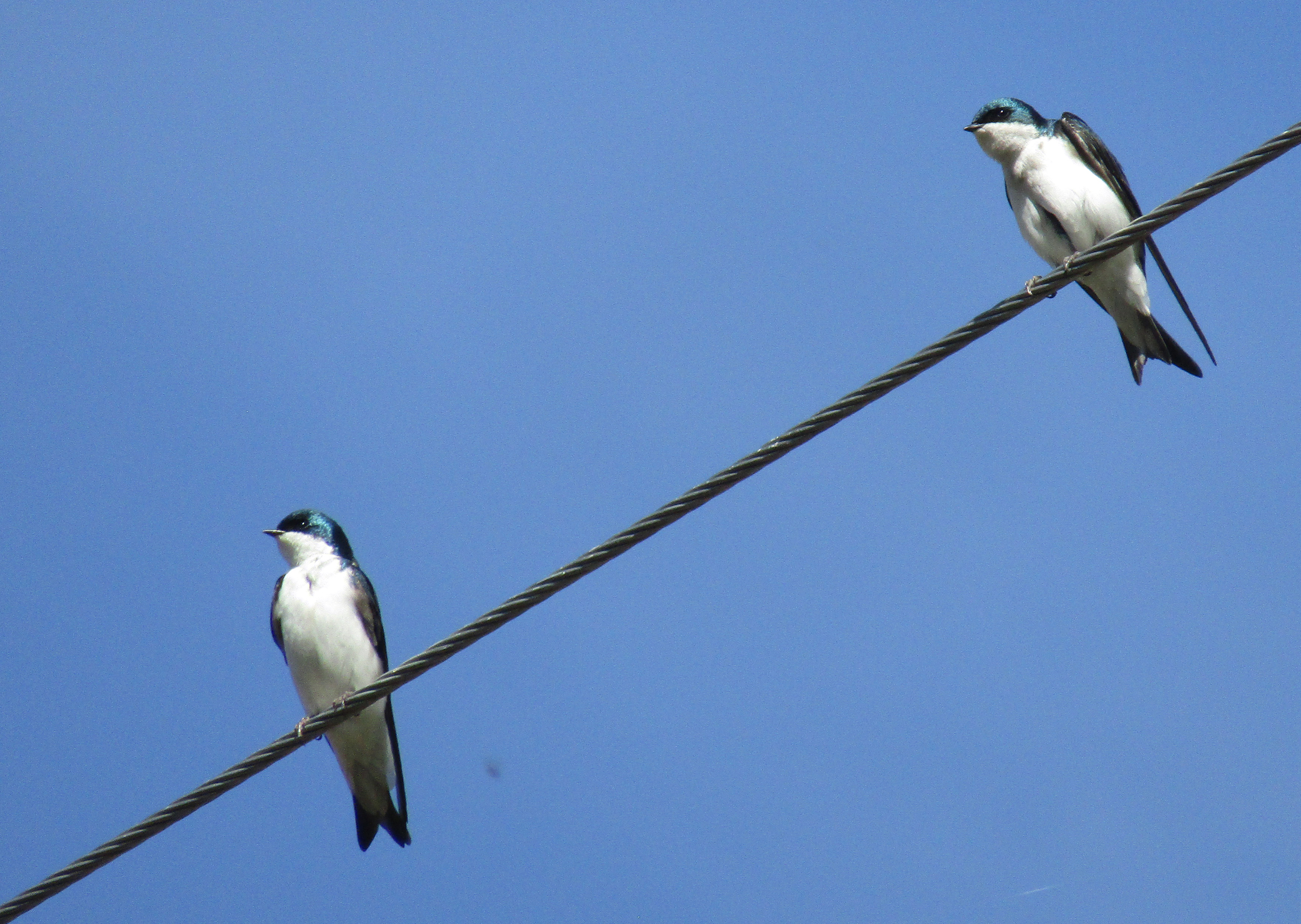
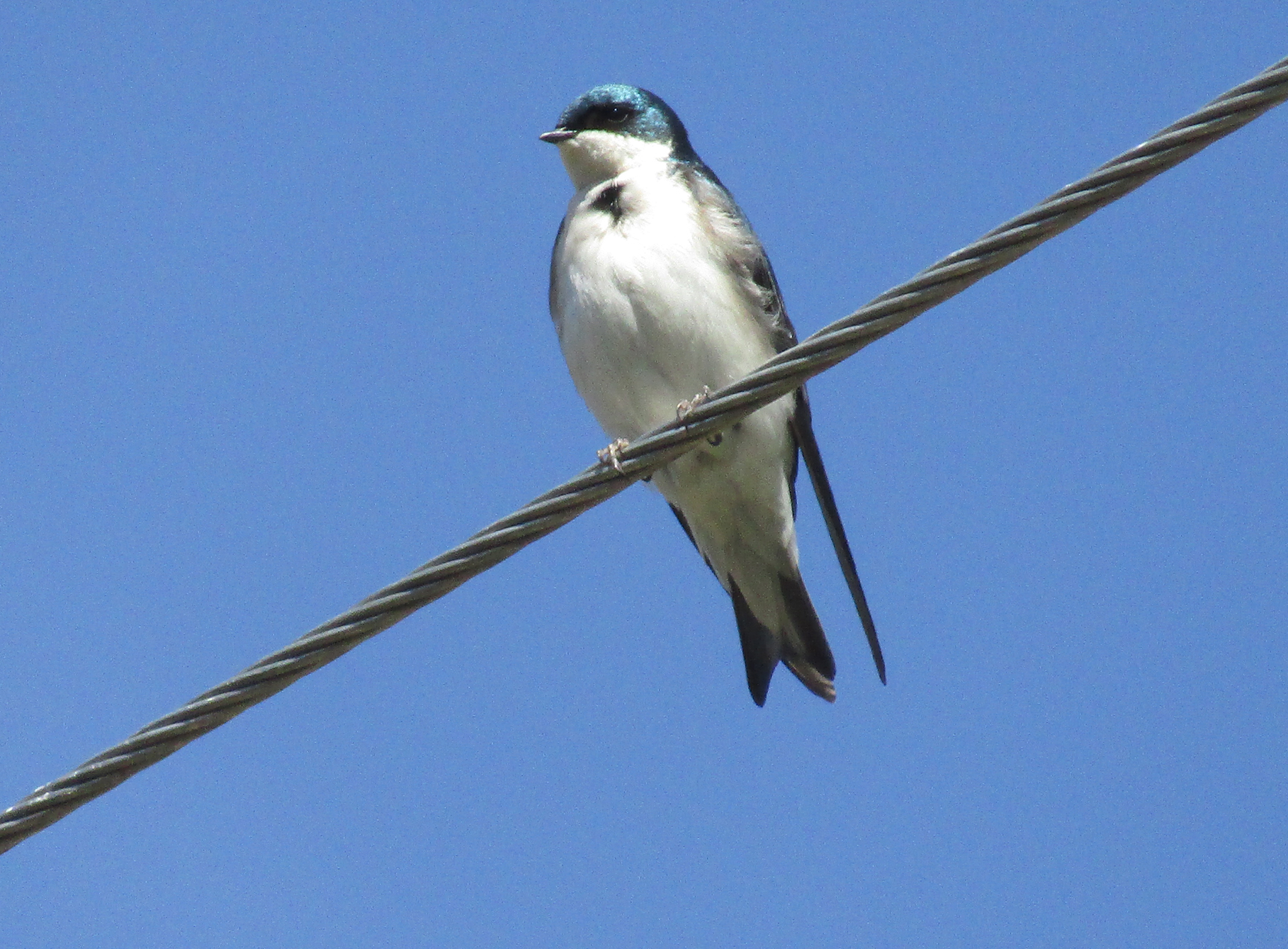
The iridescent blue-green male tree swallow, complete with white underparts and a forked tail, is a handsome bird and a welcome addition to the bird population in any yard or garden. Tree swallows enjoy water, so a nearby pond or creek is a boon for attracting these birds.

Tree swallows nesting in southwest Virginia are a relatively recent happening. According to Tony Decker’s The Birds of Smyth County, Virginia, tree swallows have only been common summer residents since about 1975. Some of the early records of these birds nesting in the region took place at locations like the ponds in Saltville, Virginia, and Laurel Bed Lake in Russell County, Virginia.

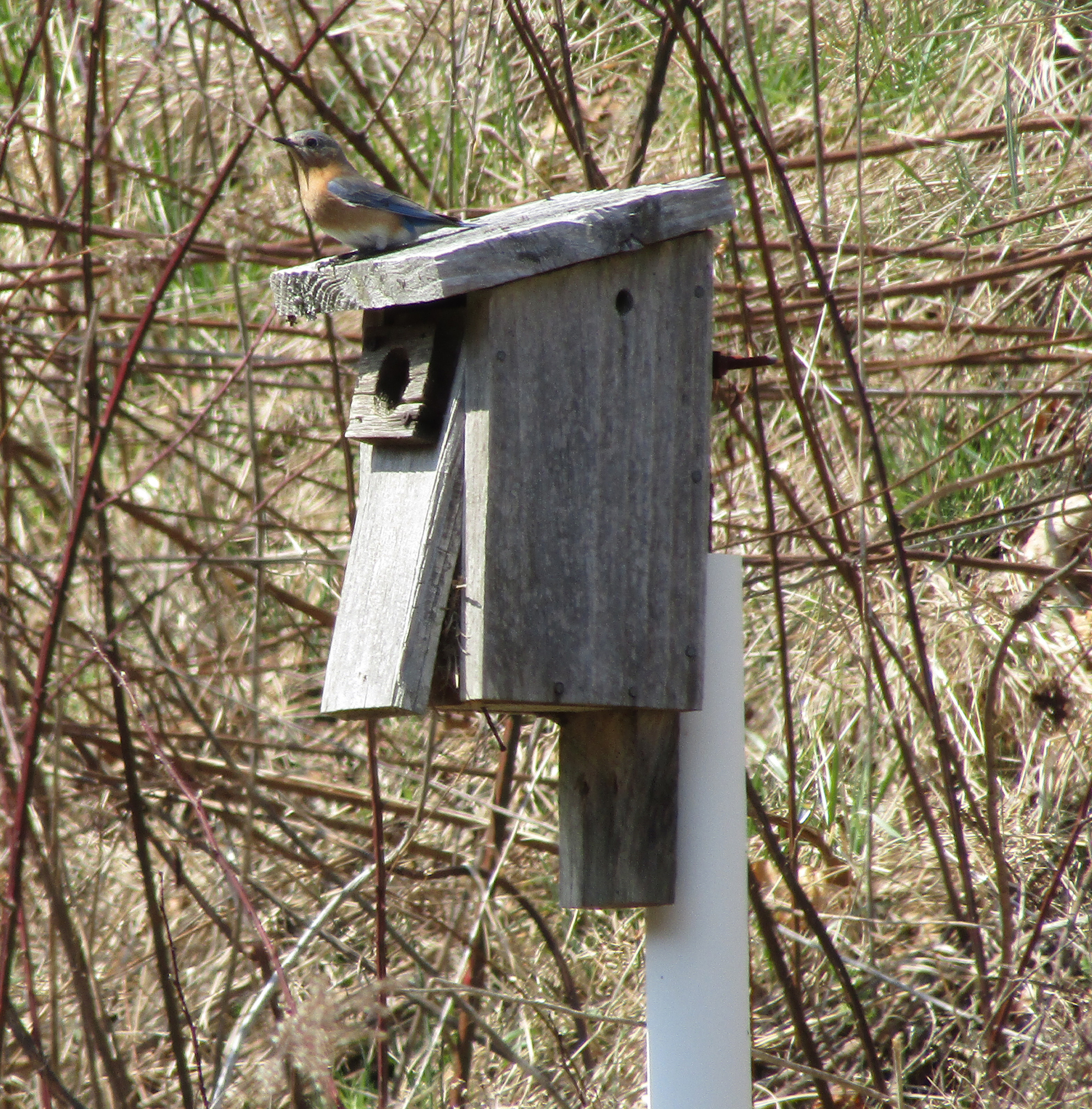
Photo by Bryan Stevens • A female Eastern bluebird stakes claim to a box to ward off inquisitive tree swallows. The two cavity-nesting species are often competitors for prime nesting real estate.

A decade later, tree swallows began nesting in northeast Tennessee. The first nesting record took place at Austin Springs on Boone Lake in Washington County, Tennessee, according to The Birds of Northeast Tennessee by Rick Knight. Tree swallows soon became regular nesting birds every summer in all five counties that comprise Northeast Tennessee.

It’s usually not too difficult to find five of the six species of swallows that are known to make Northeast Tennessee and Southwest Virginia their home from spring to fall. In addition to tree swallows, other swallows such as barn swallows, purple martins, cliff swallows and northern rough-winged swallows are fairly common summer birds in the region. The barn swallow and tree swallow are the two members of the family that are probably best known to people. They have adapted to life in both suburban and rural areas, which brings them into frequent contact with people.

The golden swallow, which today exists only on the island of Hispaniola.

While only a few swallows range into the United States and Canada, a total of 83 species of swallows can be found worldwide. Some of the common names for these different swallows (also called martins in other parts of the world) are quite descriptive. A sampling includes white-eyed river martin, grey-rumped swallow, white-backed swallow, banded martin, blue swallow, violet-green swallow, golden swallow, brown-throated martin, brown-bellied swallow, pale-footed swallow, white-bibbed swallow, pearl-breasted swallow, red-breasted swallow, mosque swallow, fairy martin and streak-throated swallow.

Photo by Bryan Stevens • A male tree swallow perches on a utility wire extending over a fish pond.

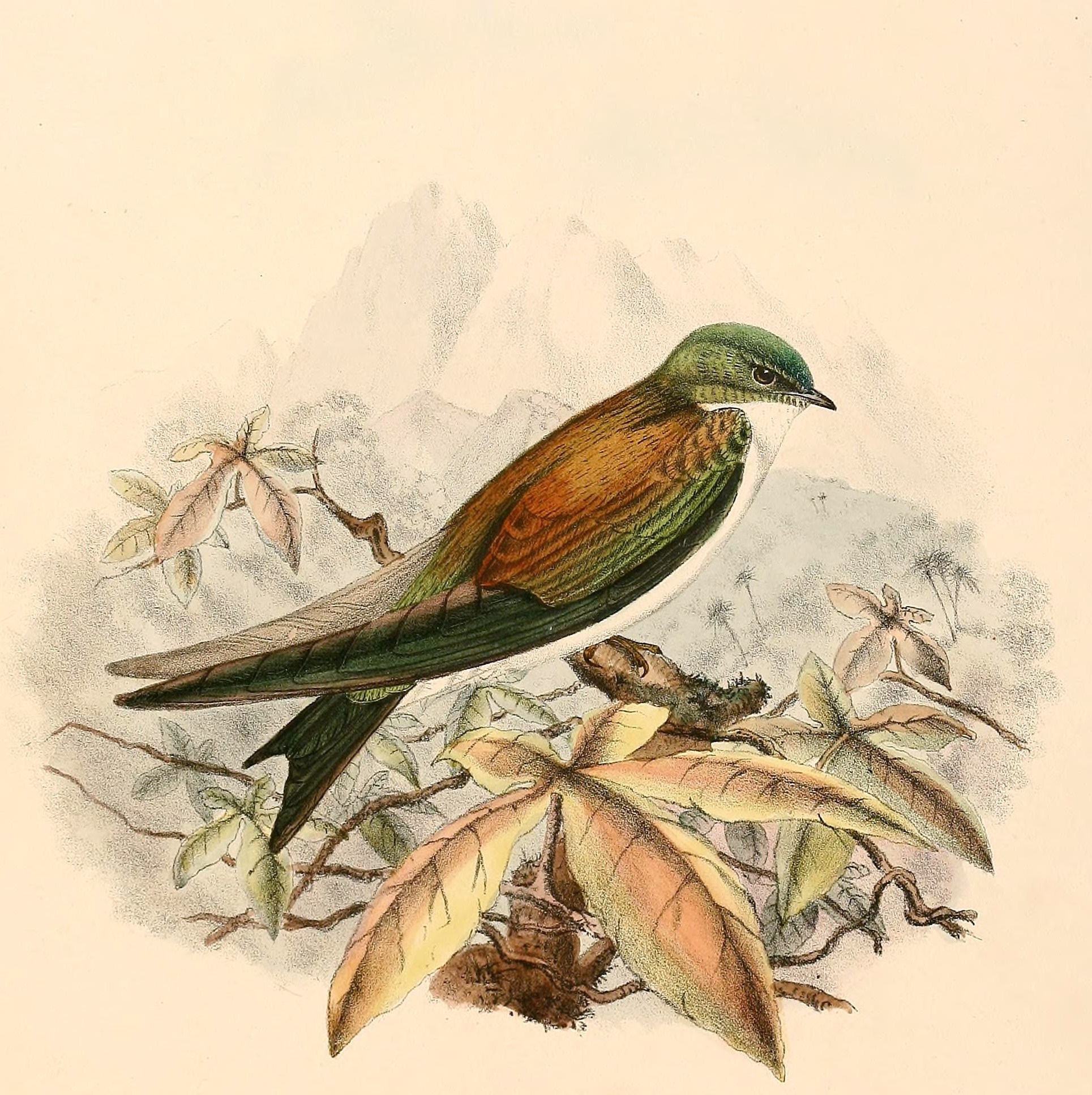
While many swallows and martins have proven highly adaptive when faced with human disturbances to their habitat, a few species have experienced declines. One species — the white-eyed river martin — was last seen in Thailand in the 1980s and very well may be extinct. Closer to home, the golden swallow is now found only on the island of Hispaniola after disappearing from Jamaica in the 1980s. The Bahama swallow, which nests on only four islands in the Bahamas, is also vulnerable. Incidentally, both these swallows are closely related to the tree swallow, with all of them belonging to the genus Golden Swallow. Translated from Greek, the genus name means “fast mover,” a quite accurate description of these graceful and agile flyers.

With their enthusiastic twittering to each other, tree swallows make for friendly neighbors. It’s also a pleasant diversion to watch them swoop over fields and ponds. To increase your chances of hosting your own tree swallows, offer a bird box placed in an open area. Right now is the time to attract their attention with some prime real estate.

•••••

To learn more about birds and other topics from the natural world, friend Stevens on Facebook at https://www.facebook.com/ahoodedwarbler. He is always posting about local birds, wildlife, flowers, insects and much more. If you have a question, wish to make a comment or share a sighting, email ahoodedwarbler@aol.com.

Count sets new records while gathering data on world’s birds

Photo by Bryan Stevens • The downy woodpecker ranked among the 10 most frequently reported birds on the 2017 Great Backyard Bird Count. A record number of 173,826 people took part in this year’s GBBC, which was held Feb. 17-20.

In announcing the results of this year’s Great Backyard Bird Count, organizers of the annual global bird survey shared an anecdote about a second-grade student in Memphis, Tennessee. The girl, who obviously enjoyed making a contribution as a citizen scientist for the GBBC, made a real connection with the birds she was being asked to count.

Calling her participation the “best day of her life,” the girl went on to share her excitement about seeing a downy woodpecker. She was hardly alone in seeing this small woodpecker. A total of 38,760 checklists across the country included downy woodpecker with their totals.

The girl’s joy at discovering a downy woodpecker — a bird that was completely new to her — all but guarantees that she will look forward to taking part in the 2018 GBBC. If her interest in birds continues to develop, she just may catch the birding bug herself.

Photo by Bryan Stevens • Counting crows and other birds at Shook Branch at Watauga Lake during the recent GBBC.

The 2017 Great Backyard Bird Count is now part of the history books, and thanks to participants from around the world, this year’s GBBC ranked as the biggest count in its 20-year history. Participants set a new high bar for number of checklists submitted and total number of species reported.

An estimated 214,018 participants took part this year, compared to the 2016 final total estimate of 163,763 individuals. An incredible total of 5,940 different species was tallied by GBBC participants, which is a dramatic spike from last year’s total of 5,689 species. That record number of participants also turned in a record number of completed checklists — 173,826, compared to the final total of 162,052 in 2016.

The three states with birders submitting the most checklists were, in descending order, New York, Pennsylvania and California. Incidentally, Virginia came in sixth, with 5,190 checklists submitted during the 2017 GBBC. North Carolina came in ninth with 4,220 checklists submitted by 2017 GBBC participants. Birders in Tennessee will need to step up for future counts. The Volunteer State ranked 20th on the list with 2,215 checklists submitted.

The states seeing the most species of birds reported were, in descending order, California (370 species), Texas (360 species) and Florida (309 species). North Carolina checklists indicated a total of 213 species to land the Tar Heel State at No. 8 on the list of states with most species reported. Virginia, in 12th place, tallied a total of 196 species. Tennessee came in 32nd place with 136 species, which isn’t too bad for a landlocked state.

In North America, the most numerous birds reported on the count included several species of geese, as well as blackbirds, starlings and crows. A total of 4,793,261 snow geese made this bird the most numerous North American species reported on the GBBC. Other common birds, in descending order, included red-winged blackbird with 2,464,572 individual birds tallied, as well as Canada goose, 1,895,077; European starling, 919,038; mallard, 715,594; ring-billed gull, 647,950; American coot, 500,261; greater white-fronted goose, 426,040; common grackle, 416,720; and American crow, 378,483. During my participation this year, I saw several of these species, including red-winged blackbird, Canada goose, European starling, mallard, ring-billed gull and American crow.

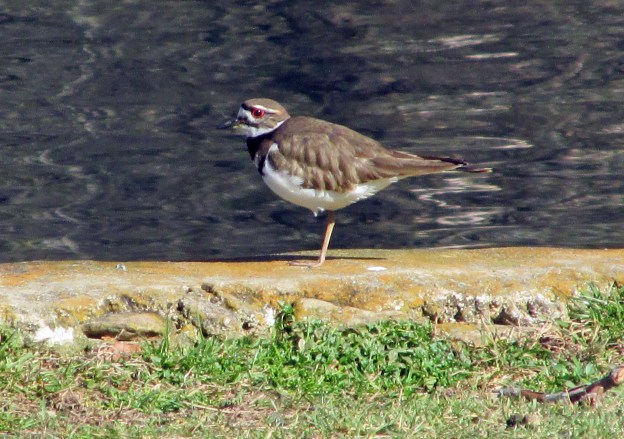
Photo by Bryan Stevens • Killdeer in Limestone Cove during the Great Backyard Bird Count held last month.

The ten most frequently reported species, in descending order, were Northern cardinal, American crow, mourning dove, dark-eyed junco, downy woodpecker, blue jay, black-capped chickadee, house finch, house sparrow and white-breasted nuthatch. While taking part in the GBBC last month, I saw all these species with the exception of the black-capped chickadee. Instead, my submitted checklists featured Carolina chickadees.

The birds on the most frequently reported list are almost without exception birds of yards and gardens, making them more likely to be counted by more individual participants. On the other hand, the most numerous, or abundant, birds are those that join together to form large flocks. They’re widespread, but less likely to be encountered in yards and gardens.

I counted at home and at several favorite birding locations. During a visit to Watauga Lake in Carter County, Tennessee, my mother and I observed an immature bald eagle and a yellow-bellied sapsucker, which turned out to be among my personal GBBC highlights this year. I always enjoy looking for birds during the four-day count period. I also like to feel that I am contributing to a shared knowledge about birds and their populations.

Photo by Bryan Stevens • Buffleheads on the Watauga River during the recent GBBC.

If you would like to view photos of birds from around the world that were taken during this year’s GBBC, visit gbbc.birdcount.org/photo-subs-2017/.

If you didn’t get to take part this year, be sure to plan ahead for next year when the GBBC will be held Feb. 16-19, 2018. Help make next year’s count another one for the record books.

•••••

To learn more about birds and other topics from the natural world, friend Stevens on Facebook at https://www.facebook.com/ahoodedwarbler. He is always posting about local birds, wildlife, flowers, insects and much more. If you have a question, wish to make a comment or share a sighting, email ahoodedwarbler@aol.com.


Birds, other wildlife deserve protection of Endangered Species Act

Photo by Lisa Hupp/USFWS • A bald eagle has an average of 7,000 feathers. Bald eagles are protected under the Bald and Golden Eagle Protection Act. For instance, it is against the law to possess their feathers or other remains. Eagles are abundant enough they no longer qualify for listing under the Endangered Species Act.

The Endangered Species Act serves as one of the strongest, most effective wildlife protection laws in the world. Although the ESA was not meant to protect only birds — the law actually protects everything from bats and whales to wolves and shellfish — it has done an outstanding job ensuring that our feathered friends continue to fly free and thrive in a world they must increasingly share with human beings.

According to Earthjustice — an environmental law organization that uses the power of the law to fight for the earth and its inhabitants — the ESA was passed with overwhelming bipartisan support more than 40 years ago to provide a legal safety net for wildlife, fish and plant species that are in danger of extinction.

Photo by Scott Flaherty/USFWS • The California condor is an example of a species saved from the brink of extinction thanks to the Endangered Species Act. Much work remains to be done to protect this large bird.

Earthjustice and other environmental groups are warning that some members of the current Congress want to slash the Endangered Species Act, threatening the very existence of the imperiled wildlife and ecosystems the Act protects. Some politicians from the state of Utah seem to be leading this effort, which is a sad irony considering the wealth of natural majesty the unique lands of Utah has to offer.

None other than President Richard Nixon, a Republican, signed the ESA into law back on Dec. 28, 1973, and it was an effort that crossed political party lines that made the legislation a reality. Biologists warn that our planet is facing a sixth wave of mass extinction, according to a release from Earthjustice. The Endangered Species Act, which has prevented 99 percent of the species under its care from vanishing, is precisely the kind of effective tool needed today. It has revived the bald eagle, the American alligator, the California condor and many others.

House Natural Resources Chairman Rob Bishop (R-UT) has said he wants to “repeal and replace” the Endangered Species Act. Others are supporting legislative proposals that would make it harder for the U.S. Fish and Wildlife Service to resolve Endangered Species Act lawsuits. The ESA is truly a prime example of the old saying, “If it’s not broke, don’t try to fix it.” Bishop and his allies, to put it plainly, are wrong.

Photo by Lou George/USFWS • The Kirtland’s Warbler is an endangered songbird that has seen its numbers slowly increase thanks to the protection of the Endangered Species Act.

If there’s ever been a government regulation that has done what it set out to do, it has been the Endangered Species Act. Without the ESA, many of our birds, including the nation’s official bird, might no longer still exist on the planet. The bald eagle had been reduced to a mere 417 pairs in 1963. With the passage of the ESA, the eagle began to rebound. In 2007, in a highly publicized success story, the existence of 11,040 pairs of bald eagles in the United States allowed this majestic bird to be removed from its listing under the ESA in 2007.

Photo by USFWS • Whooping cranes still exist largely due to protections afforded them by the Endangered Species Act.

The bald eagle is only one of the many birds to benefit from the protection of the ESA. The tall and stately whooping crane and the beautiful and tiny Kirtland’s warbler are some of the other birds that are slowly showing population increases once they were afforded intensive protection under the ESA. The nene, or Hawaiian goose, and the peregrine falcon — the world’s fastest bird — have also received much needed protection.

Lest anyone think that eagles and other formerly endangered species are completely out of the woods, just consider the recent rash of bald eagle shootings in Tennessee. Two eagles, one in Rhea County and one in Meigs County, were victims of shootings. The severity of their injuries resulted in both birds being euthanized.

It’s heartbreaking to think that anyone would shoot a bald eagle, a bird that all patriotic Americans should revere as a lofty symbol of the nation’s majesty. The shootings are a reminder that it’s still not a safe world for many of the birds and other creatures that share the planet with us. The ESA is a marvelous piece of legislation that gives a measure of protection to the helpless. The law allows all Americans to share in the responsibility of being wise stewards of God’s diverse and wonderful creatures.

Photo by Steve Maslowski/U.S. Fish and Wildlife Service • The golden-cheeked warbler, a beautiful but endangered songbird that nests in Texas, is one of many birds that benefits from protections provided by the Endangered Species Act.

Demanding that the government keep the ESA strong and intact is not and should not be mere politics. It’s showing that Americans still value wildlife and the rights of future generations to enjoy that wildlife over money and short-term profits. Left or right, Republican or Democrat, the Endangered Species Act should be immune to political differences.

On a purely personal level, I hope to one day see such endangered songbirds as the golden-cheeked warbler and the black-capped vireo, and I want the same for future generations. That’s not likely to happen without the protections of the ESA remaining strong and intact.

Let your state and federal representatives know that you support continued protections for birds and other wildlife. We can co-exist with the amazing variety of wild creatures that share our planet. It’s just a matter of priorities. Our congressional representatives and senators need to know Americans aren’t willing to tolerate attacks on the ESA. Our president and his administration need to receive the same message.

Photo by Ted Heuer/U.S. Fish and Wildlife Service • The Nene, or Hawaiian goose, has gradually increased in numbers thanks to the Endangered Species Act.

If you enjoy birds, keep visiting local and state parks. Continue planning trips to National Parks and Wildlife Refuges. Don’t stop feeding your backyard birds. Most importantly, fight to make sure the wildlife that makes the world a richer place continues to find that humans do make good neighbors.

For information on how to contact your government officials to express your thoughts on the value of the Endangered Species Act, visit http://www.usa.gov/elected-officials.

••••••

To learn more about birds and other topics from the natural world, friend Stevens on Facebook at https://www.facebook.com/ahoodedwarbler. He is always posting about local birds, wildlife, flowers, insects and much more.


Vultures aren’t typical poster birds for ecological awareness, but perhaps they should be

vultures-tree

Photo by Bryan Stevens • A flock of vultures gathers in a dead pine tree on a gloomy winter afternoon.

Cougars have returned to eastern mountains, white-tailed deer numbers are out of control and hungry black bears sometimes wander into towns. Encounters between humans and wildlife are nothing new. I was reminded of this fact when I received a recent email from Gene Sturgeon on the subject of vultures. Gene and his wife, Catheryn, reside in Abingdon, Virginia. The town, it would seem, has experienced a recent invasion.

“In our new neighborhood, the black vultures are ever-present,” Gene wrote. “They circle endlessly, and never seem to land on the carrion that attracts them. Turkey vultures typically are seen on the carrion, but these blacks never appear to be feeding. Also, I can’t imagine this neighborhood has more than the normal number of dead animals.”

Gene has also observed that the black vultures, starting in mid-afternoon, begin to gather in selected trees. Usually two nearby trees, he noted, will contain dozens of them for the night.

vulture-tower

Photo by Bryan Stevens • Vultures gather atop an industrial building in downtown Erwin, Tennessee.

Gene asked if the behavior he has observed is fairly typical. I replied to his email that I believe that his observations are accurate and typical. While the birds seem to be roosting in his neighborhood, they are probably not finding their food there. Vultures are capable of soaring long distance in search of food, so they may actually be dining far away from Gene’s Abingdon neighborhood.

bryan-vulture

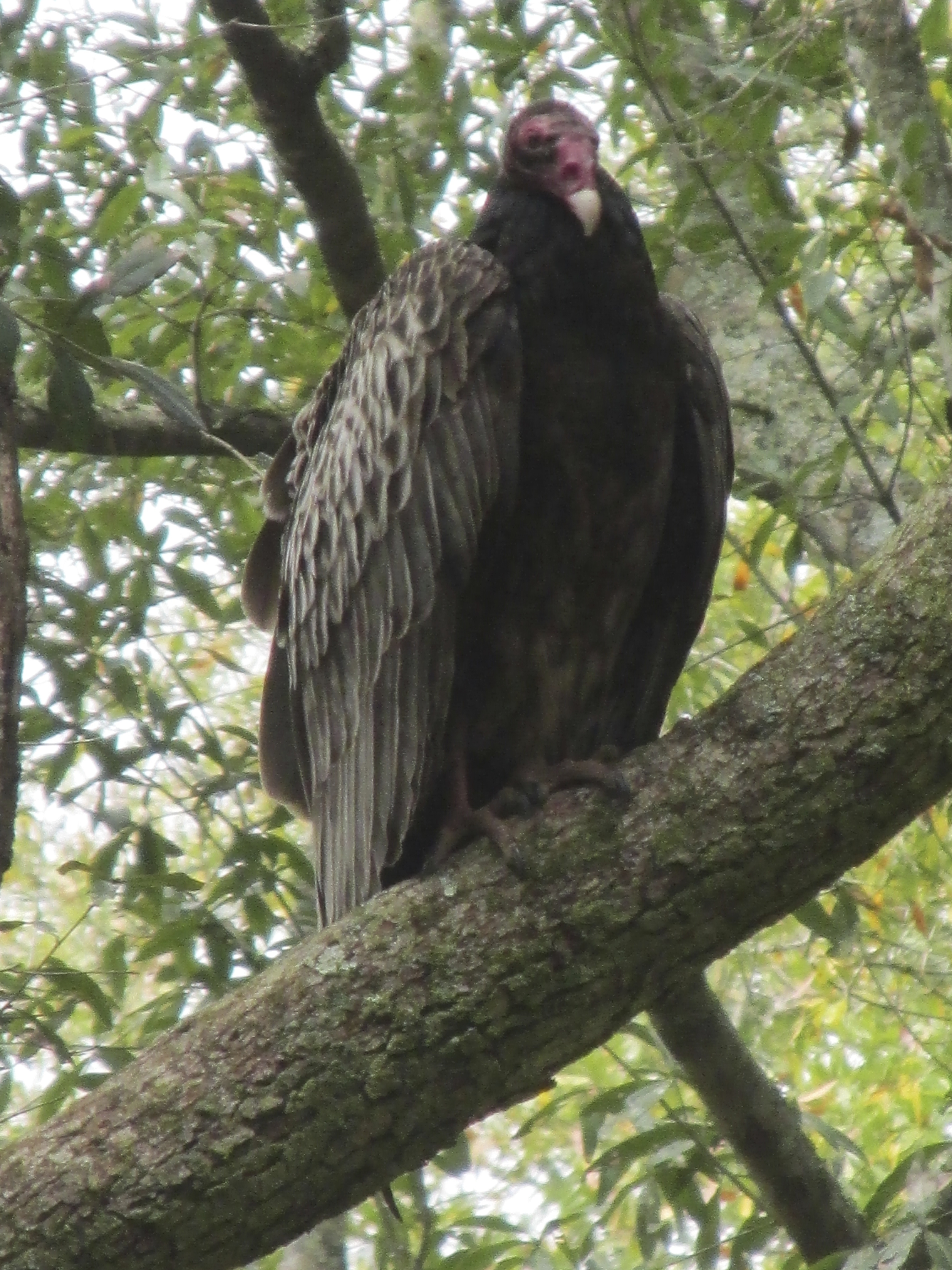
Photo by Bryan Stevens • A turkey vulture perches on a branch in a South Carolina woodland.

I asked him if there were pine trees or other types of evergreens because it’s my understanding that vultures are often fond of thick stands of pine. I am guessing this is because such trees offer protection and shelter from the elements. Gene wrote back to inform me that both pine trees and leafless trees are present near his home. “The leafless tree attracts the larger cloud of black vultures,” he added.

Doubtless, some residents are uneasy when these uninvited neighbors swell the neighborhood. I was somewhat surprised by Gene’s observation, but I was also taken aback to learn that Abingdon has for years boasted an extremely substantial population of vultures. In fact, the Abingdon Police Department has even compiled a fact sheet to educate the public about these large birds. According to the release, it is around this time of year that Abingdon sees an increase in the number of vultures due to weather patterns. The APD has apparently received complaints from some citizens about the vultures roosting in their neighborhoods.

tvultures

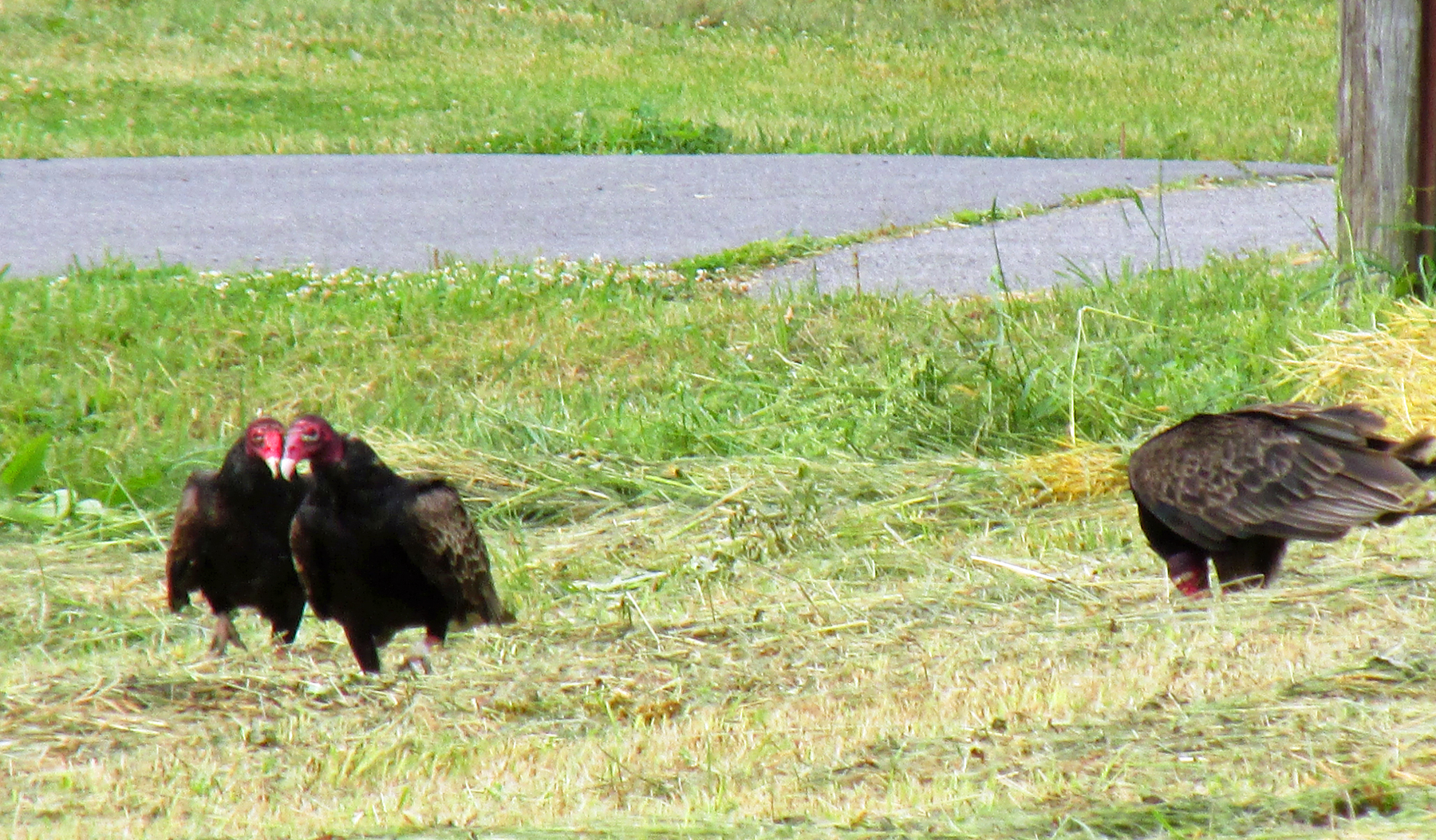
Photo by Bryan Stevens • Turkey vultures forage in a freshly mowed field near Abingdon, Virginia. As scavengers, vultures play a vital but often unappreciated role in the environment.

I was glad to note that the fact sheet recognizes the important of vultures in the ecosystem. These large birds serve an important function. Without vultures, local yards and roads would be littered with rotting, stinking, animal carcasses — and the health risks that accompany them.

Nothing prohibits a private land owner from contacting a professional wildlife specialist to disturb the roosts at owner expense. If I might offer unsolicited advice, however, I’d recommend against wasting your money. The tactics, while they may make a temporary difference, don’t usually solve anything in the long run.

vultures-soaring

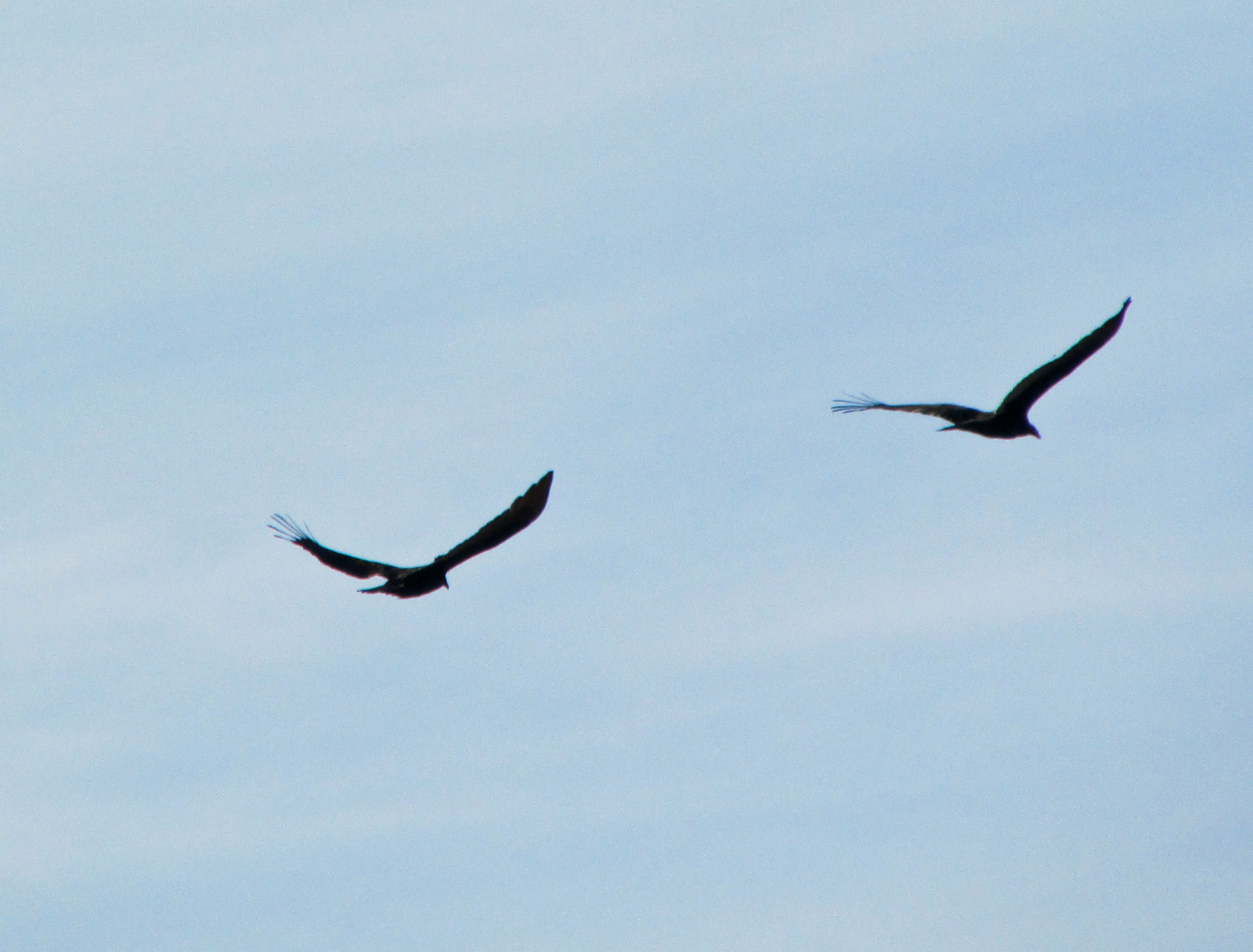
Photo by Bryan Stevens • Turkey vultures in their usual V-shaped silhouette characteristic of a soaring vulture.

Abingdon’s government, for both ethical and legal reasons, cannot kill vultures. Private citizens are also forbidden by law to kill vultures or hire exterminators to do so. Vultures are protected by the Migratory Bird Treaty Act. The birds, their nests and eggs cannot be killed or destroyed without a permit from the U.S. Department of the Interior’s Fish and Wildlife Service. Private citizens are also not legally permitted to use fireworks to try to disperse vulture flocks.

The best thing to do is make your home and yard less attractive to these large, scavenging birds. While reading some tips put forward by the APD, I was struck by how some of the advice, if followed, can protect homes from other potential nuisance wildlife ranging from raccoons and opossums to black bears and skunks. According to the APD, there are several things people can do to make their yards less attractive as a roosting place for vultures:
• Ensure that you are not inadvertently attracting the vultures. Common attractions include open containers of pet food, uncovered garbage cans, and pet food bowls.
• Remove any dead trees that make convenient perches for vultures.
• Use humane perch deterrents, like motion-activated sprinklers or lights.

vulture-halloween

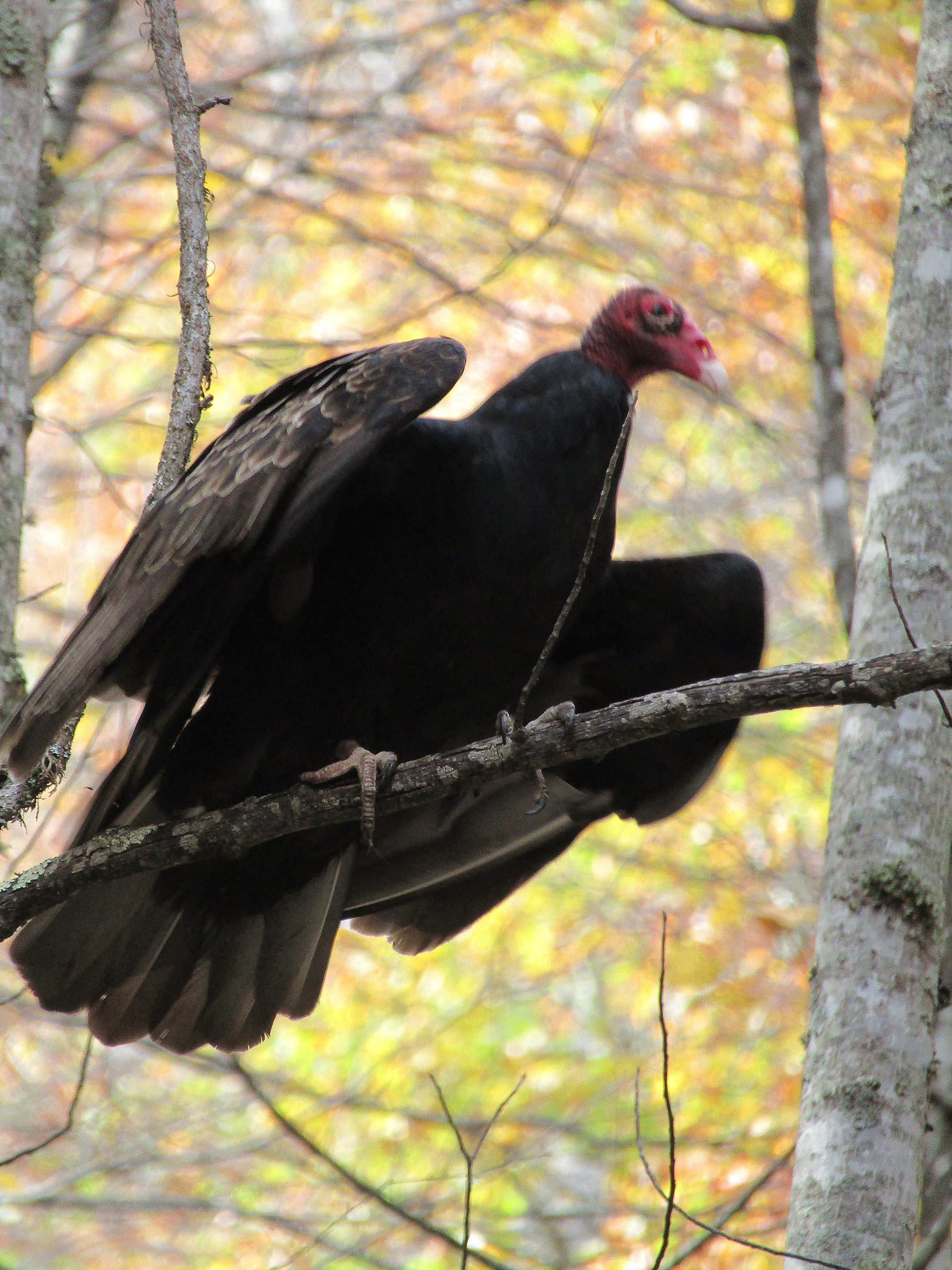
Photo by Bryan Stevens • A Turkey Vulture perches in a woodland in Roan Mountain, Tennessee, during late fall.

The APD also pointed those wishing for more information to the Cornell Lab of Ornithology website, which has excellent information about both species of vulture, including conservation information.

I was very pleased to see that the APD tried to dispel misinformation about these valuable birds. People are, naturally enough, concerned for their pets because of the presence of these large birds. Vultures are carrion eaters, which means eat animals that are already dead, preferring animals that have been dead for two to four days. While there are no accounts of turkey vultures preying upon live animals, there have been occasional reports of black vultures preying upon small, live and relatively defenseless animals.

That tells most, but not all, of the story. Black vultures occasionally will attack newborn livestock, but these birds are not likely to go after the family dog or cat, especially if the pet is mobile and in good health. Nevertheless, it is still a good idea to keep cherished pets indoors. While vultures pose little danger to them, plenty of other animals, such as coyotes, are much more opportunistic than vultures. Keeping cats and dogs confined indoors also protects wild birds and other wildlife from the instinctive predatory notions of our precious pets.

BS-VULTURES

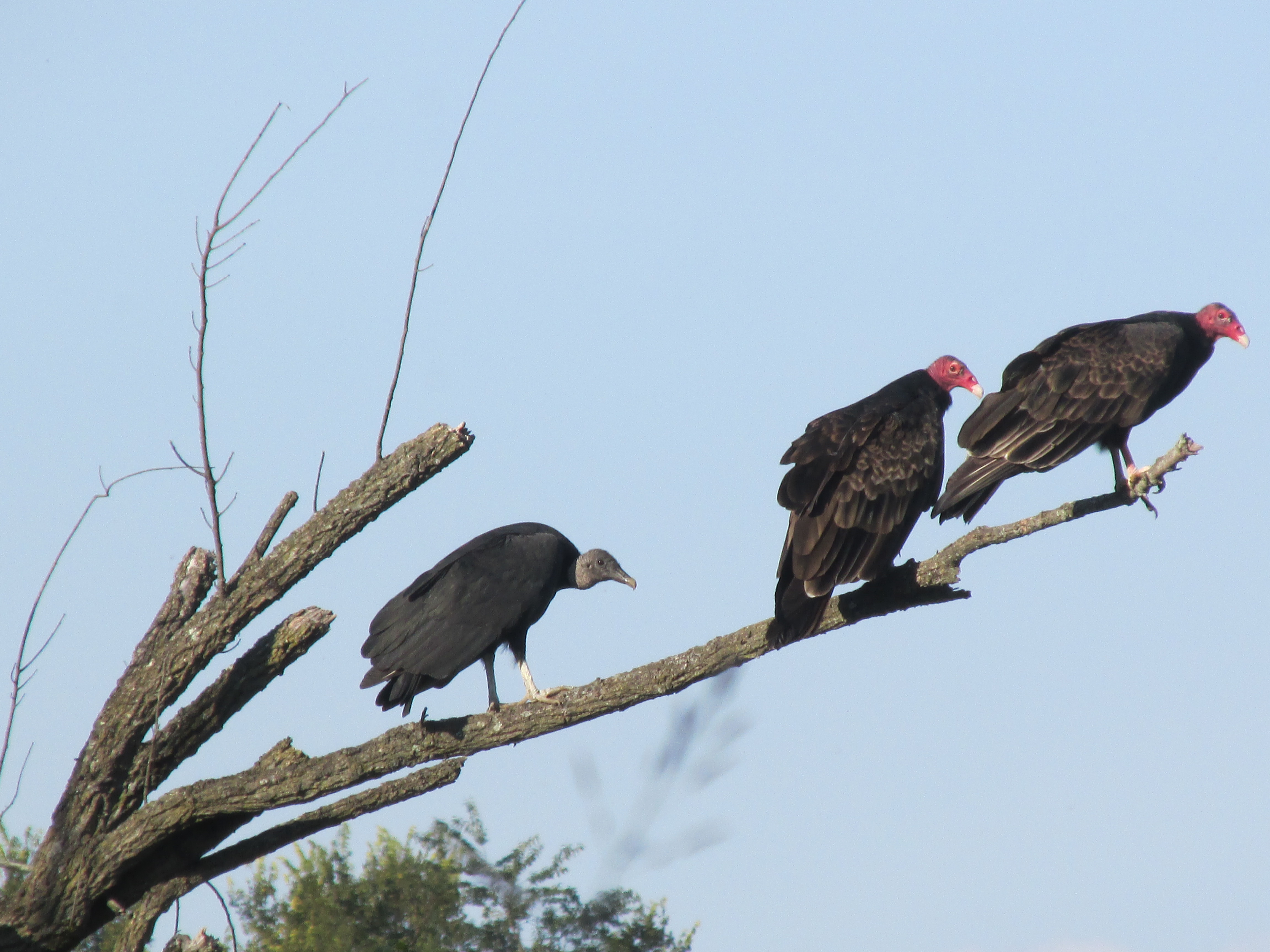
Photo by Bryan Stevens • A black vulture and two turkey vultures share a perch near Boone Lake in Sullivan County, Tennessee.

While both vultures are migratory birds, their numbers have always fluctuated and will continue to do so. As their populations increase, their range has increased as well. Both species are present in the Abingdon area year-round. Because of the town’s location, their numbers increase from November through early February as they follow the weather patterns. In colder periods, they move farther south, in warmer periods, farther north. Abingdon’s climate makes for a good wintering location. As it gets warmer, non-resident flocks tend to move farther north.

Like many other species of birds, some vultures have learned to co-exist near humans, just like such birds as Canada geese, Eastern bluebirds, American robins and mallards. Like these birds, vultures are highly adaptive creatures. Unlike some types of wildlife that shy away from human contact, vultures and some other birds have adapted to the human environment – perhaps a bit too well. Vulture behavior can be destructive. In recent years, some of these destructive tendencies have become quite infamous among birders. This new behavior apparently first surfaced among vultures wintering in south Florida.

TurkeyVulturesClean

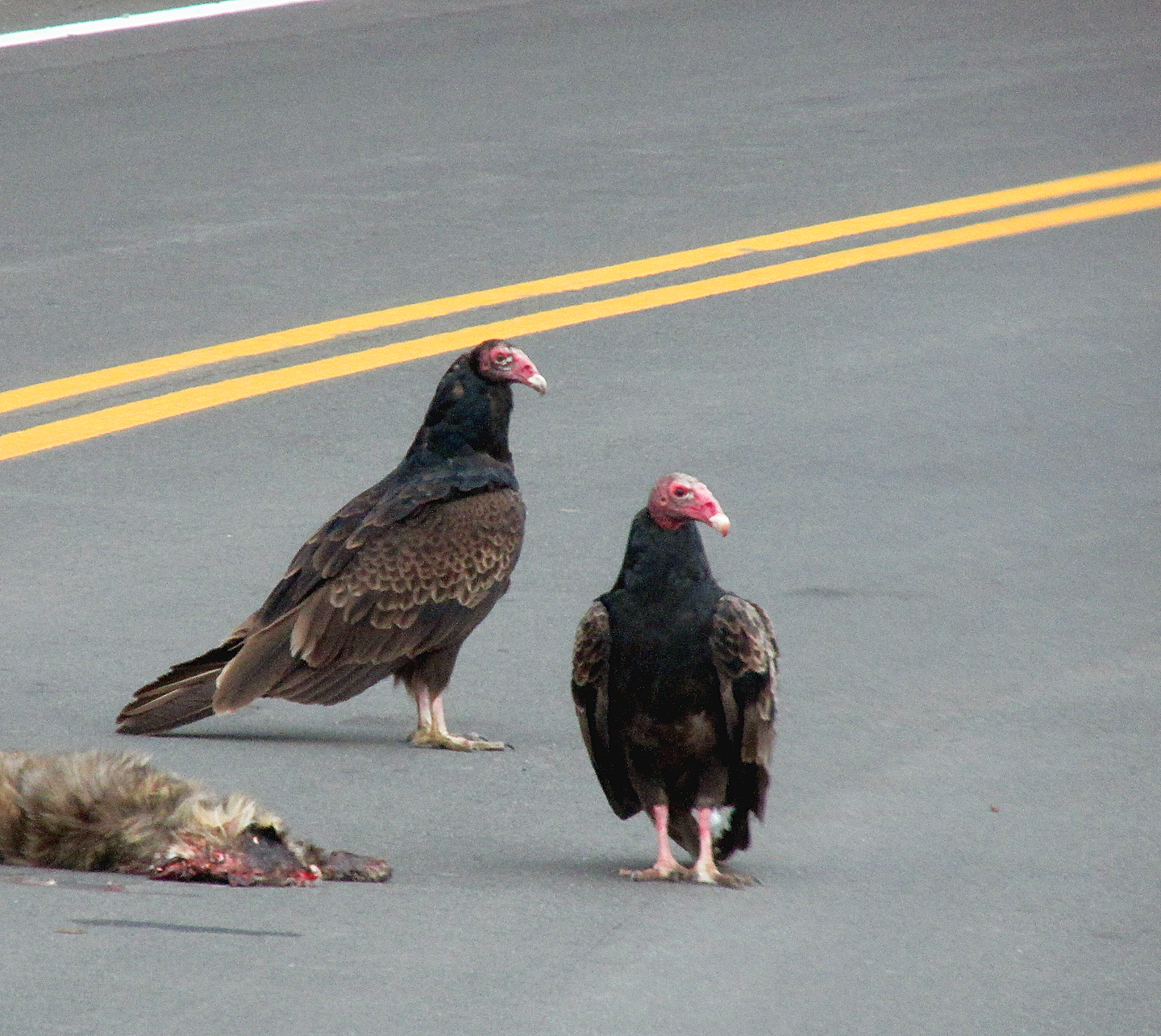
Photo by Bryan Stevens • Turkey vultures regularly dispose of road-killed animals.

They have been known to tear window and roof caulking, vent seals, shingles, rubber seals on car windshields, windshield wipers and other soft, rubbery materials. In addition, their excrement is acidic and may damage painted surfaces and landscaping. The birds also regurgitate a smelly, acidic vomit. Unfortunately, vultures apparently pass on these bad habits to others of their kind and such aberrant behavior is now being seen outside of the Sunshine State.

According to the APD, flocks of as many as 100 vultures have been documented in Abingdon. This number may rise and fall, depending on conditions. Vultures are part of the web of life, which connects them and their fellow creatures to our own lives. Turkey vultures are larger than black vultures, weighing about four to five pounds, with a wingspan of six feet. The turkey vulture’s most distinctive feature is its bright red, featherless head. In flight, a turkey vulture often appears to be “wobbling” and, from underneath, all of the flight feathers are light colored.

Turkey_Vulture_edited-1

Photo by U.S. Fish & Wildlife Service • Turkey vultures have bare red heads, as opposed to the black heads of the related black vulture. While larger than black vultures, turkey vultures are less aggressive than their smaller relatives.

On the other hand, black vultures are smaller, weighing less than four pounds, with a wingspan of five feet or less. The black vulture’s head is grey and featherless, but larger in proportion than the turkey vultures. Viewed in flight, only the outer flight feathers of the black vulture are white.

Although smaller in size, black vultures are feisty and aggressive birds. They often outcompete turkey vultures at carcasses. They will also only reluctantly abandon a feeding site at a carcass. My family almost learned this the hard way during a trip to South Carolina when my father almost ran his car into a flock of black vultures feeding on a road-killed deer. I warned him that the vultures might not get out of the way, and he slowed the car’s speed. The vultures hopped back from the edge of the road as our car traveled past them. Looking back, I noticed they immediately hopped back onto the carcass after we had passed. If we had sped past at full speed, one of the bird’s could easily have panicked and flown into our path. A four-pound bird can do a lot of damage if it hits the windshield of a car traveling at 40 to 50 miles per hour. Trust me! You don’t want to put this to the test.

Perhaps that’s the moral of the story. Give vultures a wide berth and, in theory, they will do the same for you. Let’s face it. Vultures aren’t going to be cute and cuddly faces for ecological awareness. A polar bear or penguin, vultures simply are not. They still have a role to play, and we should be grateful they were created for just that purpose.