Tag Archives: Fall migration

Summer’s swallows are graceful, aerodynamic birds

Tom Koerner/USFWS • A perched tree swallow surveys its surroundings..

They took their time this year, but the tree swallows are finally putting in appearances almost daily, especially on the string of sunny, hot days the region has experience lately. This pair of swallows has become frequent visitors since the middle of last month.

Based on their behavior, which primarily consists of aerial foraging over fields and a pond at my home, I’m convinced they are feeding young. They don’t, however, appear to be residing in any of my nest boxes. I’m simply glad they are nesting close enough to ensure frequent visits. It probably won’t be long before their young are soaring over the fields with them.

No matter where you live, you probably don’t have to go far to see one of the members of the bird family known as swallows. These graceful, aerodynamic birds are quite familiar to most people. If you spend much time at all outdoors during the summer months, chances are you’ve observed some members of this family.

Vincent Simard from Pixabay. • A tree swallow peeks from a nest box.

It’s usually not too difficult to find five of the six species that are known to make Northeast Tennessee and Southwest Virginia their home from spring to fall. The more commonplace swallows are barn swallow and tree swallows, but during the summer months purple martins, cliff swallows and northern rough-winged swallows also call the region home.

Barn swallow and tree swallow are the two members of the family that are probably best known to people. They have adapted to life in both suburban and rural areas, which brings them into frequent contact with people.

These days, the barn swallow is as apt to nest in a parking garage or on an apartment balcony as inside a barn in the countryside. Once young swallows leave the nest, parents will park them on a perch as they continue to feed the still dependent young. Adults fly over nearby fields, foraging for insects that they catch on the wing and deliver back to the waiting, always hungry, young birds.

A freshly mown field is a magnet for swallows. I don’t know how the word spreads so quickly among these birds, but I’ve observed dozens of these birds descending on fields soon after they have been mowed for hay. At times, the birds arrive while the mowing is still taking place, swooping after insects stirred up in the tractor’s wake.

I haven’t observed any bank swallows in the region this year, but these members of the swallow family are rather hit-or-miss in the region. Because of their specialized nesting needs, bank swallows are localized in their distribution and not as widespread as their kin.

Cliff swallows nest beneath many local bridges. These swallows, which at one time nested primarily on rocky cliffs, hence their name, now frequently nest under man-made structures. These swallows make their jug-shaped nests out of mud and clay. These nesting “jugs” are all located in clusters beneath bridges and other structures. It’s a wonder that the parents flying in with food are able to tell their nests apart from the nearby seemingly identical nests of their neighbors.
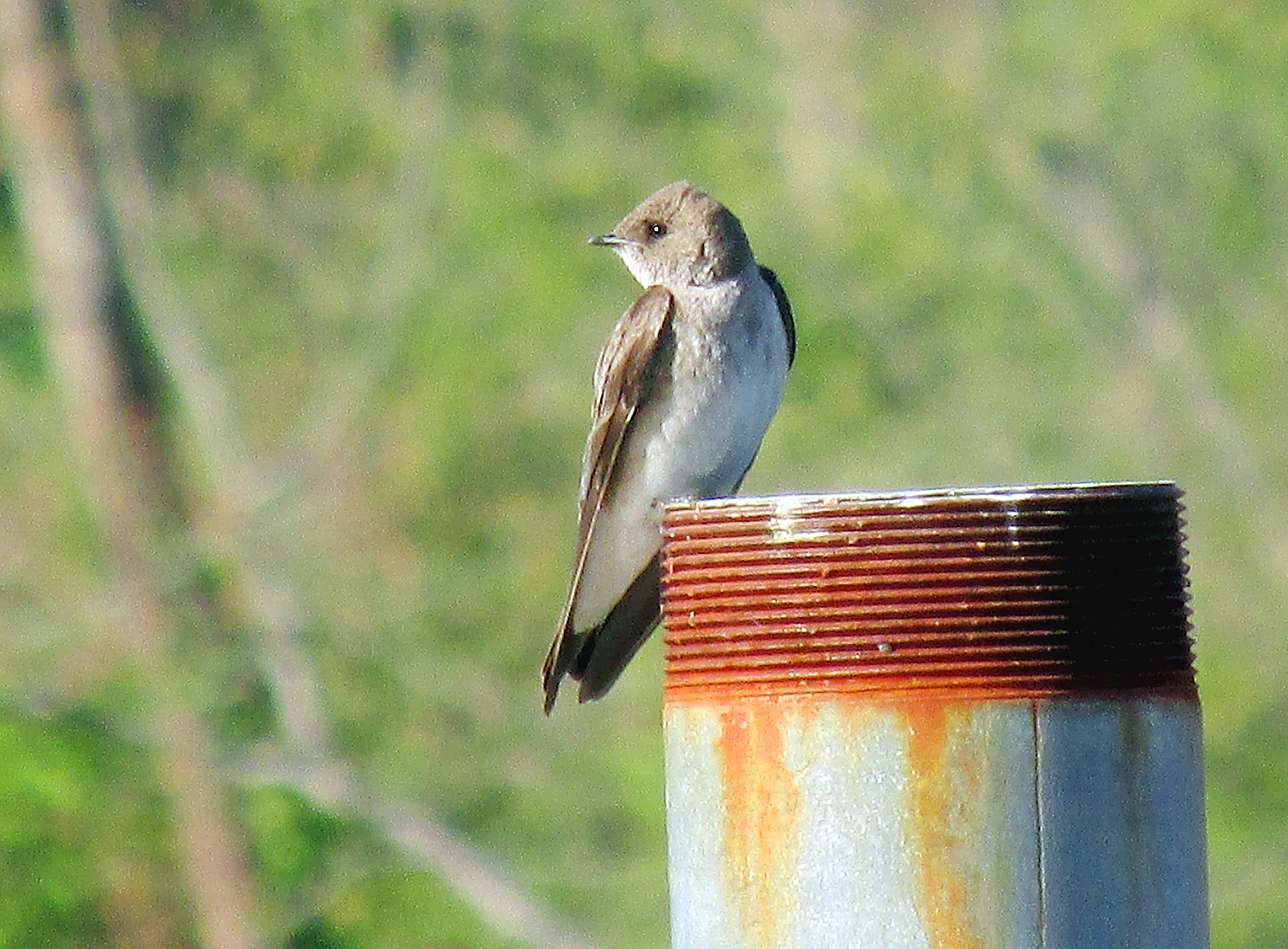
Photo by Bryan Stevens • A Northern rough-winged swallow perches on a rusty pole.

Northern rough-winged swallows are opportunists when it comes to nesting. According to a profile written by Mark Johns with North Carolina Wesleyan College, this small swallow nests near rocky gorges, shale banks, stony road cuts, railroad embankments, gravel pits, eroded margins of streams and other exposed banks of clay, sand or gravel. They will also nest in old kingfisher burrows, protruding drainpipes, crevices in brick or stone structures such as dams, bridges or tunnels, gutters and culverts. Their nests are often built near open water.

The Northern rough-winged swallow ranks as one of the species with the longest common names in North America. It’s name consists of 26 letters and a hyphen, which ranks it one letter below both the Northern beardless-tyrannulet and a recently-created species — the saltmarsh sharp-tailed sparrow — which each have 27 letters and a hyphen. Formerly known as sharp-tailed sparrow, the species was renamed with “salt marsh” added to distinguish it from a relative, Nelson’s sparrow.

Purple martins, which rank as the largest member of the swallow family in North America, are famous for nesting in large colonies. Nesting facilities range from groupings of natural or artificial gourds fashioned into a nesting chamber, as well as large, multi-level condominium dwellings tailored for the specific needs of this communal bird. A colony can consist of several dozen to several hundred pairs of these birds. Only the adult male purple martin shows the iridescent, dark blue-purple plumage that provides the species with its name.

The tree swallow is my favorite, probably because a pair of these birds has nested in my yard for many years. Unlike other swallows, these cavity-nesting birds will readily accept nesting boxes. They compete with Eastern bluebirds for boxes, but the two species usually can work out a truce and settle down to nest in close proximity to each other. The iridescent blue-green male tree swallow, complete with white underparts and a forked tail, is a handsome bird and a welcome addition to the bird population in any yard or garden. Tree swallows enjoy water, so a nearby pond or creek is a boon for attracting these birds.

While only a few swallows range into the United States and Canada, a total of 83 species of swallows can be found worldwide. Some of the common names for these different swallows (and martins) are quite descriptive. A sampling includes white-eyed river martin, square-tailed saw-wing, white-headed saw-wing, grey-rumped swallow, white-backed swallow, banded martin, violet-green swallow, golden swallow, brown-chested martin, brown-bellied swallow, pale-footed swallow, white-bibbed swallow, pearl-breasted swallow, greater striped swallow, mosque swallow, fairy martin and chestnut-collared swallow.

Enjoy swallows while you can. They depart earlier than most of our other summer nesting birds. Once their young are out of the nest, they are soon forming large flocks in preparation for flying south.

•••

To share a sighting, ask a question or make a comment, email me at ahoodedwarbler@aol.com.
 

Fall Bird Count detects 121 species

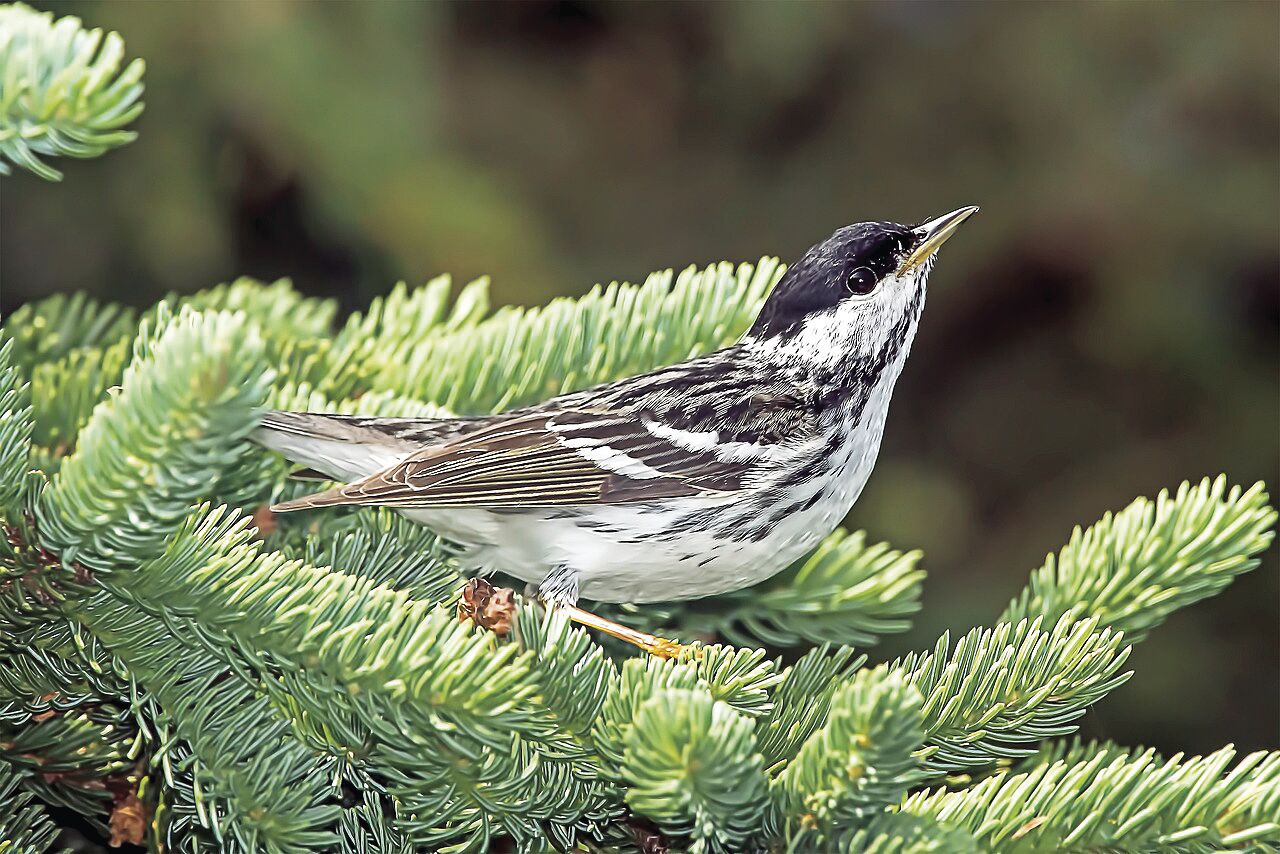
Photo by Hans Room/Pixabay • A blackpoll warbler found during the Fall Bird Count represented a rare appearance by this species on the seasonal count, which has been held for 53 consecutive years. A purple gallinule found in Washington County represented another extremely rare find.

The 53rd consecutive Elizabethton Fall Bird Count was held Saturday, Sept. 30, with 30 observers in about 12 parties. The count area included Carter County, as well as the surrounding counties of Johnson, Sullivan, Unicoi and Washington.

The weather was good, with a temperature range between 54 and 82 F. Participants tallied 121 species, plus one unidentified Empidonax species. The Empidonax flycatchers, or “Empids,” as birders fondly lump them, are birds so similar in appearance they cannot reliably identified in the field unless they are vocalizing. Unfortunately, the Empids are largely silent in autumn.

This total is slightly below the recent 30-year average of 125 species, according to longtime compiler Rick Knight. He noted that the all-time high was 137 species in 1993.

Knight said that a count highlight was a lingering immature purple gallinule in Washington County.

The list:

Canada goose, 850; wood duck, 40; mallard, 179; common merganser, 6; northern bobwhite, 3; ruffed grouse, 1; and wild turkey, 37.

Pied-billed grebe, 4; rock pigeon, 362; Eurasian collared dove, 1; and mourning dove,172.

Yellow-billed cuckoo, 5; black-billed cuckoo, 1; common nighthawk, 2; chimney swift, 246; and ruby-throated hummingbird, 17.

Virginia rail, 1; purple gallinule, 1; killdeer, 45; Wilson’s snipe, 1; and spotted sandpiper, 2.

Double-crested cormorant, 84; great blue heron, 34; great egret, 3; green heron, 3; black vulture, 29; and turkey vulture, 141.

Osprey, 7; northern harrier, 1; sharp-shinned hawk, 5; Cooper’s hawk, 4; bald eagle, 7; red-shouldered hawk, 6; broad-winged hawk, 1; and red-tailed hawk,19.

Barn owl, 2; Eastern screech-owl, 17; great horned owl, 4; barred owl, 4; and Northern saw-whet owl, 1.

Belted kingfisher, 26; red-headed woodpecker, 3; red-bellied woodpecker, 69; yellow-bellied sapsucker, 7; downy woodpecker, 39; hairy woodpecker, 12; northern flicker, 54; and pileated woodpecker, 30.

American kestrel, 16; merlin, 1; great crested flycatcher, 1; Eastern wood pewee, 18; Empidonax species, 1; and Eastern phoebe, 97.

Yellow-throated vireo, 2; blue-headed vireo, 31; red-eyed vireo, 5; blue jay, 438; American crow, 505; fish crow, 7; and common raven, 20.

Tree swallow, 220; barn swallow, 1; Carolina chickadee, 195; tufted titmouse, 168; red-breasted nuthatch, 17; white-breasted Nuthatch, 64; and brown creeper, 3.

House wren, 3; Carolina wren, 177; blue-gray gnatcatcher, 1; golden-crowned kinglet, 5; and ruby-crowned kinglet, 4.

Eastern bluebird, 152; veery, 1; gray-cheeked thrush, 6; Swainson’s thrush, 43; wood thrush, 5; and American robin, 113.

Gray catbird, 38; brown thrasher, 9; Northern mockingbird, 80; European starling, 615; cedar waxwing, 106; and house sparrow, 37.

House finch, 42; pine siskin, 2; American goldfinch, 123; chipping sparrow, 95; field sparrow, 11; dark-eyed junco, 83; Savannah sparrow, 3; song sparrow, 84; and Eastern towhee, 62.

Eastern meadowlark, 17; red-winged blackbird, 10; brown-headed cowbird, 2; and common grackle, 10.

https://www.nps.gov/articles/blackpollmigration.htm

Ovenbird, 6; Northern waterthrush, 3; black-and-white warbler, 2; Tennessee warbler, 73; common yellowthroat, 12; hooded warbler, 13; American redstart, 10; Cape May warbler, 23; northern parula, 11; magnolia warbler, 20; bay-breasted warbler, 28; Blackburnian warbler, 5; chestnut-sided warbler, 6; blackpoll warbler, 1; black-throated blue warbler, 21; palm warbler, 21; pine warbler, 14; yellow-rumped warbler, 6; and black-throated green warbler, 15.

Scarlet tanager, 9; Northern cardinal, 169; rose-breasted grosbeak, 26; blue grosbeak, 3; and indigo bunting, 12.

Observers in this year’s Fall Bird Count included Fred Alsop, Jerry Bevins, Rob Biller, Tammy Bright, Debi and J.G. Campbell, Ron Carrico, Bill and Linda Cauley, Catherine Cummins, Dave Gardner, David and Connie Irick, Rick and Jacki Knight, Roy Knispel, Vern Maddux, Joe McGuiness, Tom McNeil, Alson Ovando, Susan Peters, Brookie and Jean Potter, Lia Prichard, Pete Range, Judith Reid, Judi Sawyer, Bryan Stevens, Kim Stroud and Charlie Warden.

•••

To ask a question, share a sighting or make a comment, email me at ahoodedwarbler@aol.com.
Annual fall bird count tallies 129 species for Northeast Tennessee

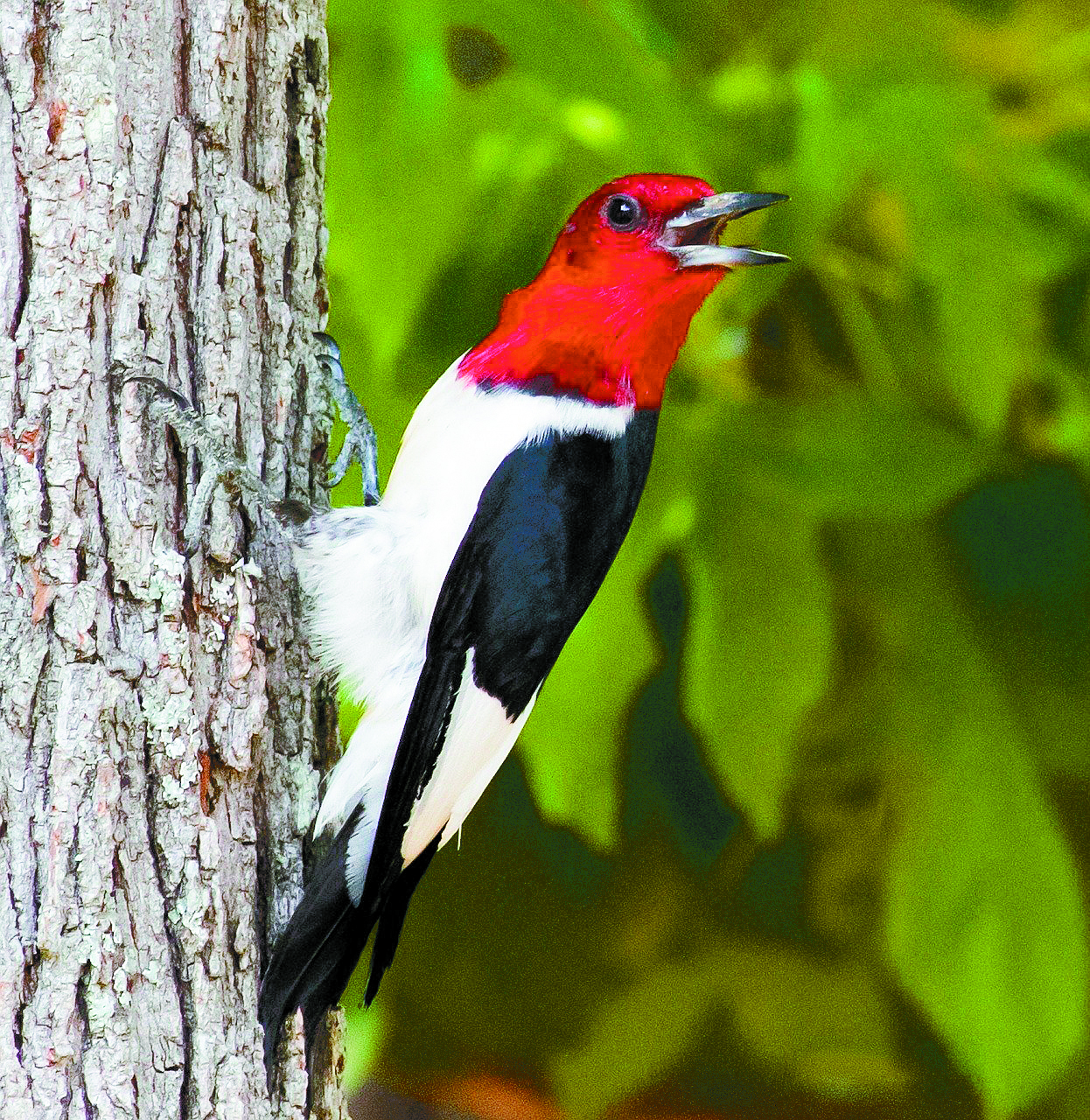
Photo from Pixabay • A red-headed woodpecker clings to the trunk of a tree. During the recent Fall Bird Count for Northeast Tennessee, all the region’s seven woodpecker species were tallied. The medium-sized red-headed woodpecker is found only in isolated locations in the region. They prefer more open country than most of their kin. Habitat containing dead or dying trees is vital if these woodpeckers are to thrive.

I wrote last week about my participation in the recent 52nd annual Fall Bird Count conducted by the Elizabethton Bird Club.

This week I want to dive into the results of what turned out to be a great count. The five-county tally of the birds in Northeast Tennessee was held on Saturday, Sept. 25, with 34 observers in 14 parties, plus two feeder watchers. Participants covered Carter County, as well as parts of adjacent Johnson, Sullivan, Unicoi and Washington counties.

This year’s count tallied 129 species, which is slightly above the recent 30 year average of 125 species. The all-time high was reached in 1993 when 137 species were tallied.

Participants for this year’s count included Fred Alsop, Jerry Bevins, Rob Biller, Debi Campbell, J.G. Campbell, Ron Carrico, Catherine Cummins, Dianne Draper, Cindy Ehrhardt, Harry Lee Farthing, Dave Gardner, Tammy Griffey, Don Holt, Connie Irick, David Irick, David Kirschke, Rick Knight, Roy Knispel, Richard Lewis, Dianne Lynne, Vern Maddux, Joe McGuiness, Tom McNeil, Eric Middlemas, Susan Peters, Brookie Potter, Jean Potter, Pete Range, Judith Reid, Judi Sawyer, Chris Soto, Bryan Stevens, Peggy Stevens, Kim Stroud, Charles Warden and Rex Whitfield.

The four most commonly observed species, in descending order, included European starling, 838; Canada goose, 744; American crow, 502; and blue jay, 437. No surprises there.

Somewhat surprising was the total of 222 brown-headed cowbirds. Other abundant birds that numbered more than 200 individuals included mourning dove (316), rock pigeon (285), chimney swift (227), Eastern bluebird (208), American robin (222), cedar waxwing (230) and American goldfinch (216).

A total of 24 species of warblers was found, including 172 individual Tennessee warblers. These greenish-yellow warblers can be quite abundant as they pass through the region each autumn.

Some families of birds, such as falcons and woodpeckers, were well represented on this count with all the expected species being found by count participants.

Five Empidonax species, often referred to as “empids” by birders were found during the count but do not contribute to the total. These small flycatchers are nearly identical in appearance and silent during the fall. Faced with an inability to positive identify them, birders simply noted that they were seen.

The list follows:

Canada goose, 744; wood duck, 42; mallard, 182; blue-winged teal, 4; Northern shoveler, 2; and common merganser, 4.

Wild turkey, 18; pied-billed grebe, 3; double-crested cormorant, 43; great blue heron, 39; great egret, 4; green heron, 1; black vulture, 61; and turkey vulture, 183.

Osprey, 7; bald eagle, 9; sharp-shinned hawk, 3; Cooper’s hawk, 8; red-shouldered hawk, 6; broad-winged hawk, 11; and red-tailed hawk, 25.

American coot, 1; killdeer, 45; spotted sandpiper, 2; rock pigeon, 285; Eurasian collared-dove, 22; mourning dove,  316; and yellow-billed cuckoo, 2.

Eastern screech-owl, 11; great horned owl  7; barred owl, 3; American kestrel, 28; merlin, 8; and peregrine falcon, 3.

Common nighthawk, 3; chimney swift, 227; ruby-throated hummingbird, 23; and belted kingfisher, 32.

Red-headed woodpecker, 2; red-bellied woodpecker, 83; yellow-bellied sapsucker, 1; downy woodpecker, 51; hairy woodpecker, 11; Northern flicker, 54; and pileated woodpecker, 39.

Eastern wood-pewee, 31; Acadian flycatcher, 1; Eastern phoebe, 92; Eastern kingbird, 1; and loggerhead shrike, 1.

White-eyed vireo, 7; yellow-throated vireo, 5; blue-headed vireo, 21; Philadelphia vireo, 1; and red-eyed vireo, 6.

Blue jay, 437; American crow, 502; fish crow, 3; common raven, 13; tree swallow, 160; barn swallow, 29; and cliff swallow, 1.

Carolina chickadee, 145; tufted titmouse, 109; red-breasted nuthatch, 9; white-breasted nuthatch, 52; brown-headed nuthatch, 3; and brown creeper, 1.

House wren, 8; winter wren, 4; Carolina wren, 179; blue-gray gnatcatcher, 6; golden-crowned kinglet, 5; ruby-crowned kinglet, 9.

Eastern bluebird, 208; veery, 2; gray-cheeked thrush, 2; Swainson’s thrush, 46; wood thrush, 19; American robin, 222; gray catbird, 34; brown thrasher, 14; Northern mockingbird, 80; European starling, 838; and cedar waxwing, 230.

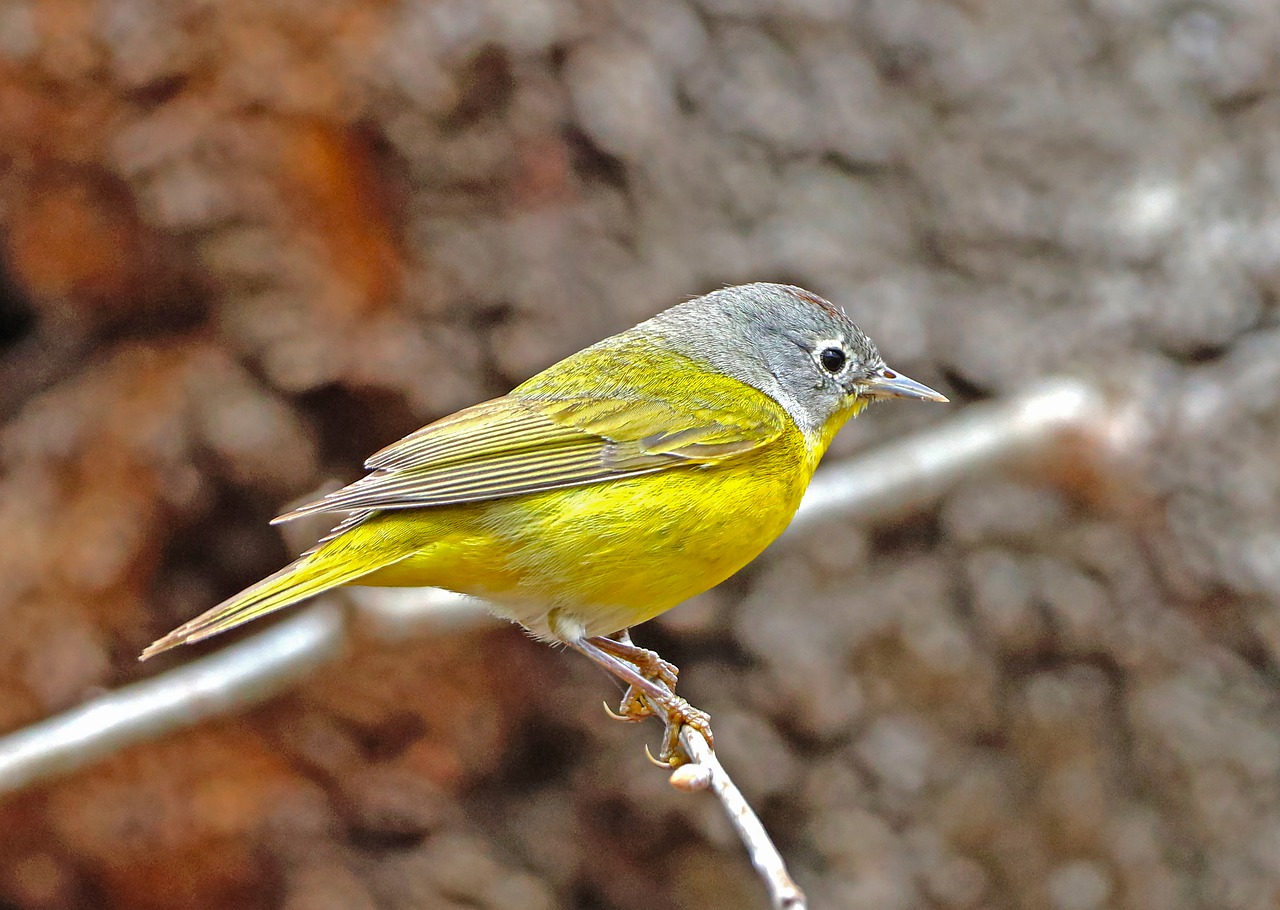
Ovenbird, 2; worm-eating warbler, 4; Northern waterthrush, 1; black-and-white warbler, 3; prothonotary warbler, 1; Tennessee warbler, 172; Nashville warbler, 3; common yellowthroat, 19; hooded warbler, 4; American redstart,  29; Cape May warbler,  40; Northern parula, 5; magnolia warbler, 24; bay-breasted warbler, 76; Blackburnian warbler, 9; chestnut-sided warbler,  9; black-throated blue warbler,  10; palm warbler,  171; pine warbler, 30; yellow-rumped warbler, 2; yellow-throated warbler, 5; prairie warbler  1; black-throated green warbler, 11; and Wilson’s warbler,  1.

Eastern towhee, 71; chipping sparrow, 76; field sparrow, 14; Savannah sparrow, 1; song sparrow, 131; and dark-eyed junco, 45.

Summer tanager, 1; scarlet tanager, 36; Northern cardinal, 160; rose-breasted grosbeak, 89; Blue Grosbeak,  2; and indigo bunting, 13.

Red-winged blackbird  61; Eastern meadowlark, 6; common grackle,  66; and brown-headed cowbird, 222.

House finch, 100; red crossbill, 2; American goldfinch, 216; and house sparrow, 114.

Many of the species observed on this county will be taking a temporary leave of Northeast Tennessee until next spring. Tanagers, warblers, vireos and other birds will seek out locations farther south to spend the winter months.

They’ll be back, though, and just in time for the 2022 Spring Bird Count. To make a comment, ask a question or share an observation, send an email to ahoodedwarbler@aol.com.

Two warblers have names connected with the Volunteer State

Photo by GeorgeB2/Pixabay.com • The Nashville warbler is an attractive bird with more color than the Tennessee warbler.

Tennessee once represented the western frontier for many people in the United States, so the state acted as a beacon for naturalists wanting to make new discoveries. Some of those early naturalists, men such as Alexander Wilson, spent a lot of time in the Volunteer State.

Two of Wilson’s ornithological “discoveries” in Tennessee involved two species of warblers that were  given names to honor the state and its capital after the birds were first observed in Tennessee and near Nashville.

Those birds were both members of one of my absolute favorite bird families — the warblers. It’s necessary to differentiate the New World wood-warblers from a grouping of birds in Europe, Asia and Australia that are also called warblers.

What is a warbler? The Wikipedia entry for these birds describes the New World warblers or wood-warblers as a group of small, often colorful, passerine birds that make up the family Parulidae and are restricted to the New World. They are not closely related to Old World warblers or Australian warblers.

That’s an adequate description, from a scientific standpoint. But warblers are magic. To do them justice, I’m compelled to wax a little more eloquent. They are a combination of color, movement and energy wrapped in a tiny bundle of feathers. Warblers are constantly on the go, hardly ever staying still for long.

The frenetic lifestyle of warblers challenges new birders. These birds don’t often stop and pose long enough for someone to get binoculars focused on them. One doesn’t exactly watch warblers. Following a warbler through tangled vines or the leafy tree canopy isn’t watching so much as anticipating. One gets a “feel” for where the warbler will appear next while tracking them through binoculars. By getting familiar with the way these avian sprites behave is the best way to learn how to observe these birds.

It’s not for nothing that some birders suffer from a malady, particular during the migration seasons, called “warbler neck.” The direct cause is the strain on the neck and back from always looking upward toward the treetops where many warblers like to stay.

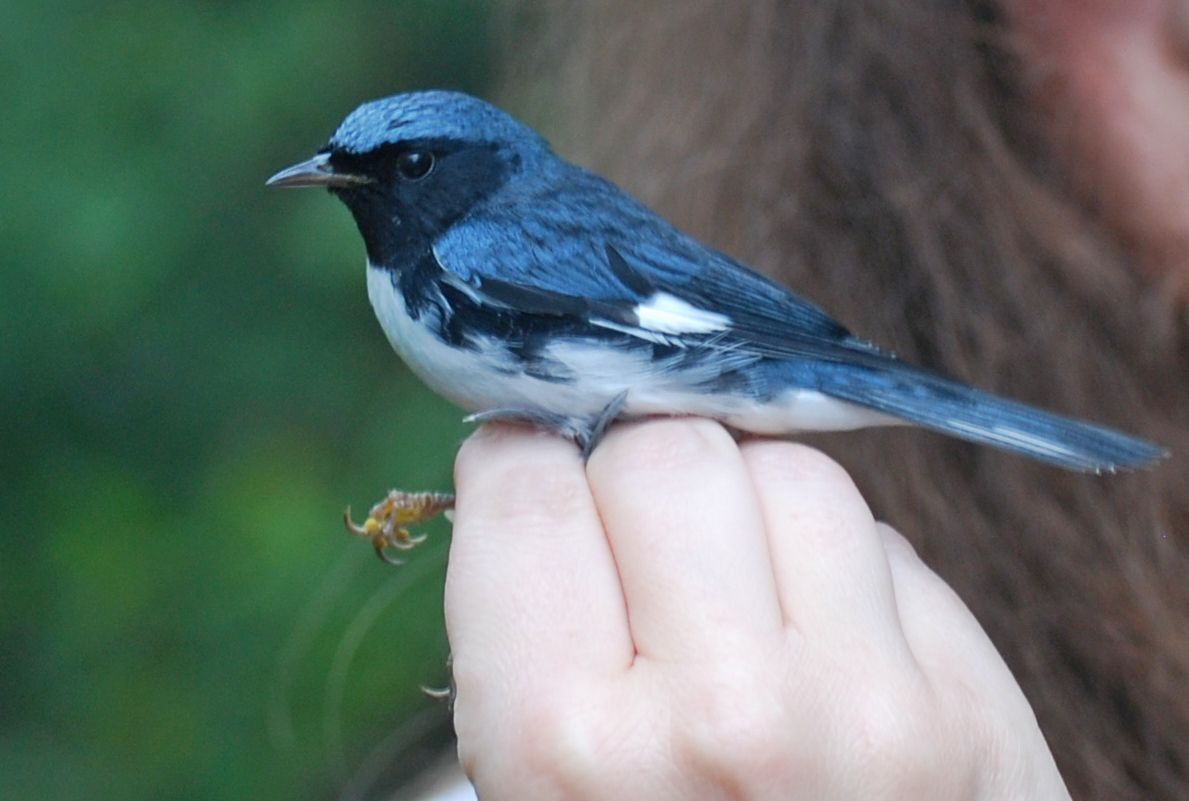
Some, but not all, warblers are suffused with bright colors: yellows, oranges, blacks, blues and whites. A few — ovenbird, worm-eating warbler, Northern waterthrush — are various shades of brown. Some of my favorite warblers are the hooded warbler, Blackburnian warbler and black-throated blue warbler.

Then we have the warblers I mentioned earlier, which were discovered in the Volunteer State and to this day bear names honoring the state and its capital city. These two birds are the Tennessee warbler and the Nashville warbler.

Photo by Paul Spark/Adobe Stock • The Tennessee warbler, while named for the Volunteer State, spends very little time within Tennessee. These warblers migrate through the region each spring and fall but nest much farther north in the boreal forests.

The appearance of the Tennessee warbler varies greatly depending on the season. In autumn, most Tennessee warblers are greenish-yellow birds with whitish-gray underparts. Sometimes that green color ranges into vivid chartreuse territory.

In the spring, the basic green and white pattern remains evident, but both males and females sport a gray head and a black line that runs through the eye and along the side of the bird’s face. The plumage — at least in illustrations and photographs — is shown as more crisp and distinct with spring birds.

The pioneering American ornithologist Alexander Wilson gave the Tennessee warbler its name, which, unfortunately, is not an accurate moniker. Don’t blame Wilson too harshly for the mistake. Even after he “discovered” the first Tennessee warblers back in 1811, it would be almost another century before scientists finally located the bird’s nesting grounds in Canada in 1901. The remote and inaccessible nature of the the region helped prolong this mystery about the Tennessee warbler’s life cycle.

Wilson was an interesting figure in the natural history of the United States. Born in Paisley, Scotland, in 1766. As a young man, he learned the trade of weaving. At the same time, he became interested in poetry and claimed inspiration in particular from the Scottish poet Robert Burns.

In 1794, after not succeeding at poetry or weaving, he departed Scotland for a new life in the United States of America. He settled with a nephew in Pennsylvania, but he found opportunities limited for poet-weavers.

To make a living, he took up teaching. He met the famous naturalist William Bartram, who encouraged Wilson’s interest in ornithology and painting. These two passions took off for Wilson.

He made his life’s work the undertaking of publishing the nine-volume “American Ornithology” that featured his own illustrations of American birds. The work featured 268 species with 26 of them having never previously been described for science.

His fame as an ornithologist grew, and several species of birds were named in his honor, including the Wilson’s storm-petrel, Wilson’s plover, Wilson’s phalarope, Wilson’s snipe and Wilson’s warbler. Wilson’s work probably inspired John James Audubon’s own more extensive and famous collection depicting the birds of North America.

Every autumn I see some of the birds Wilson documented and painted as they stage their fall migration through the Volunteer State to reach destinations farther south.

Our capital city of Nashville also provides a common name to one of the warbler clan. The Nashville warbler is a small bird with a rounded head and short tail. The plumage of this warbler consists of yellow below and olive above. The birds have a white eye-ring that stands out against a gray head. The Nashville warbler also has a thin chestnut-brown crown patch, but a really exceptional look is required to see this feature. Most guides don’t mention that the Nashville warbler has a white patch of feathers surrounding the area where its legs join the body. This section of white is completely surrounded by yellow feathers. This is a helpful feature to know when trying to distinguish this warbler from some similar species.

Once again, Wilson bestowed a rather inaccurate name on this species, as the bird in question is only a visitor to Nashville and the surrounding territories during a limited window of time each year. The same is true of the Tennessee warbler. At best, these birds can only be found in the Volunteer State in April and May and again in September and October. Otherwise, Tennesseans would have to travel a good distance to see these birds at other times of the year.

Fortunately, these birds come to us. I’ve already seen the first Tennessee warblers for fall migration, but I’ve not been lucky enough this fall to get binoculars on a Nashville warbler — yet! There’s still time. Migration continues, so get outdoors and see what you can find.

••••

To share an observation, make a comment or ask a question, email me at ahoodedwarbler@aol.com.
Common nighthawks share autumn skies with many other migrants

Autumn’s a chance for me to indulge my passion for warblers, with a few dozen species of these songbirds passing through the region in the span of a few weeks. I always try to keep in mind, however, that the warblers are not the only migrating birds winging through the region.

The Elizabethton Bird Club had planned a “nighthawks and hot dogs” party at the home of Larry McDaniel near Jonesborough, but that event had to be cancelled because of the recent surge in COVID-19 cases in the region.

My silver lining was that I saw a large flock of common nighthawks at my home on Aug. 29. It was an evening of birding dominated by insect-eaters and fruit-eaters.

Cedar waxwings and one American robin perched in the wild cherry trees and plucked ripening fruit from the branches.

Swooping overhead a handful of Chimney Swifts and about 30 Common Nighthawks (the first I have seen this fall) collected insects just over the treetops. Flycatching from a dead blue spruce was an Eastern Wood-Pewee, another fall first.

Other birds included a pair of Northern cardinals feeding three young, an Eastern towhee and one hooded warbler. At one point an irritable ruby-throated hummingbird chased the pewee round and round the trunk of the dead spruce. They almost looked like they were characters in a zany cartoon.

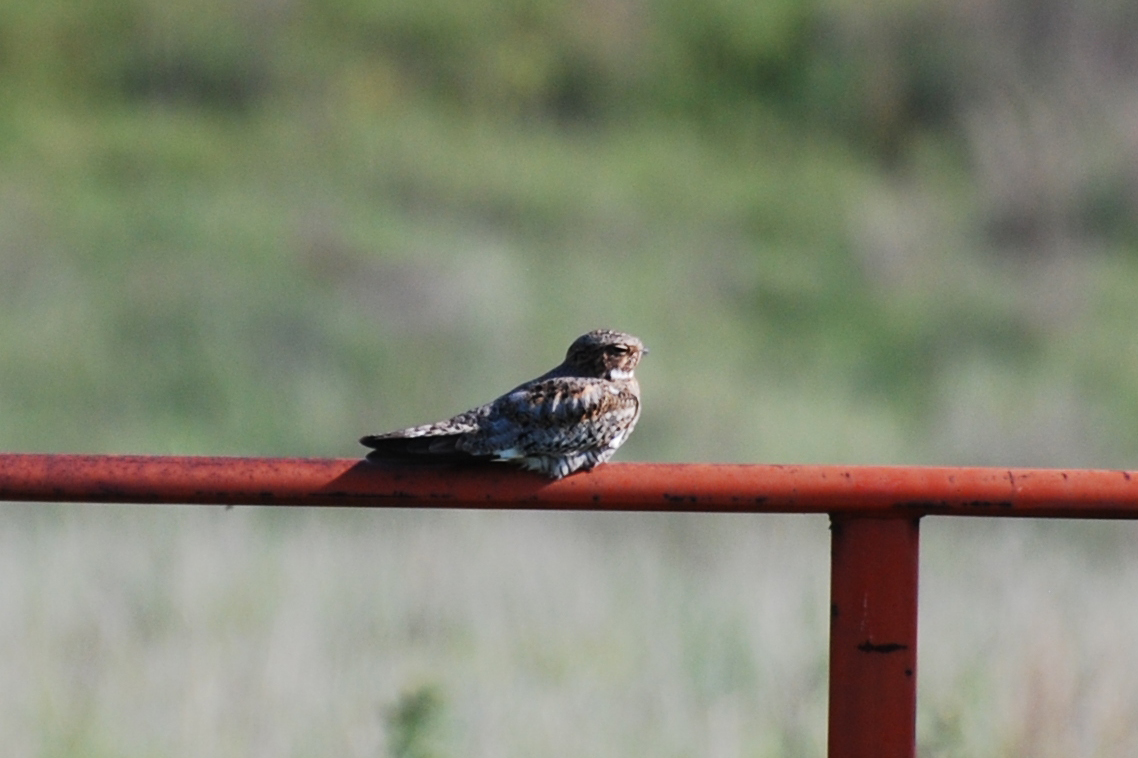
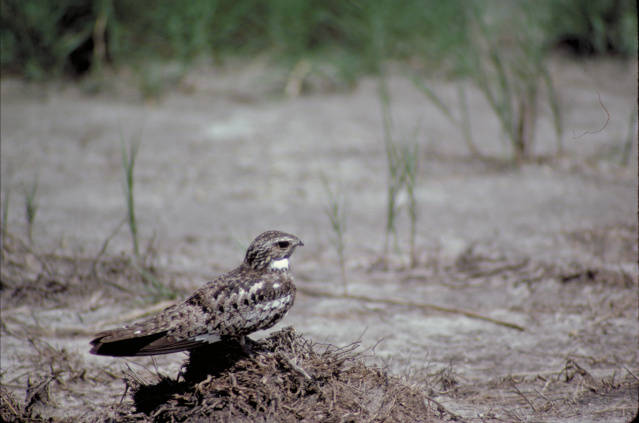
Photo by Jean Potter • A common nighthawk rests on a metal railing.

Like such birds as warblers, vireos, thrushes, tanagers, flycatchers and hummingbirds, the common nighthawk is a neotropical migrant. In addition, this nighthawk has one of the longest migration routes of any North American bird. Twice a year, these birds migrate for distances ranging from 1,600 to 4,200 miles. Nighthawks that spend the spring and summer in Canada travel to southern South America for the winter months.

With September advancing on the calendar, I have been keeping an eye on the treetops for passing warblers, vireos and tanagers, but I also remember to direct my gaze to the skies. Forgetting to look skyward could result in missing the passage of such varied migrants as chimney swifts, broad-winged hawks and common nighthawks.

So, what is a common nighthawk? First, this bird, despite what is implied by its name, is not a hawk. It’s also not strictly nocturnal. Particularly in the fall, nighthawks are active during daylight hours when engaged in catching winged insects. Outside of fall migration, these birds can often be observed over large parking lots or well-lit streets, snatching up insects swarming around the light poles.

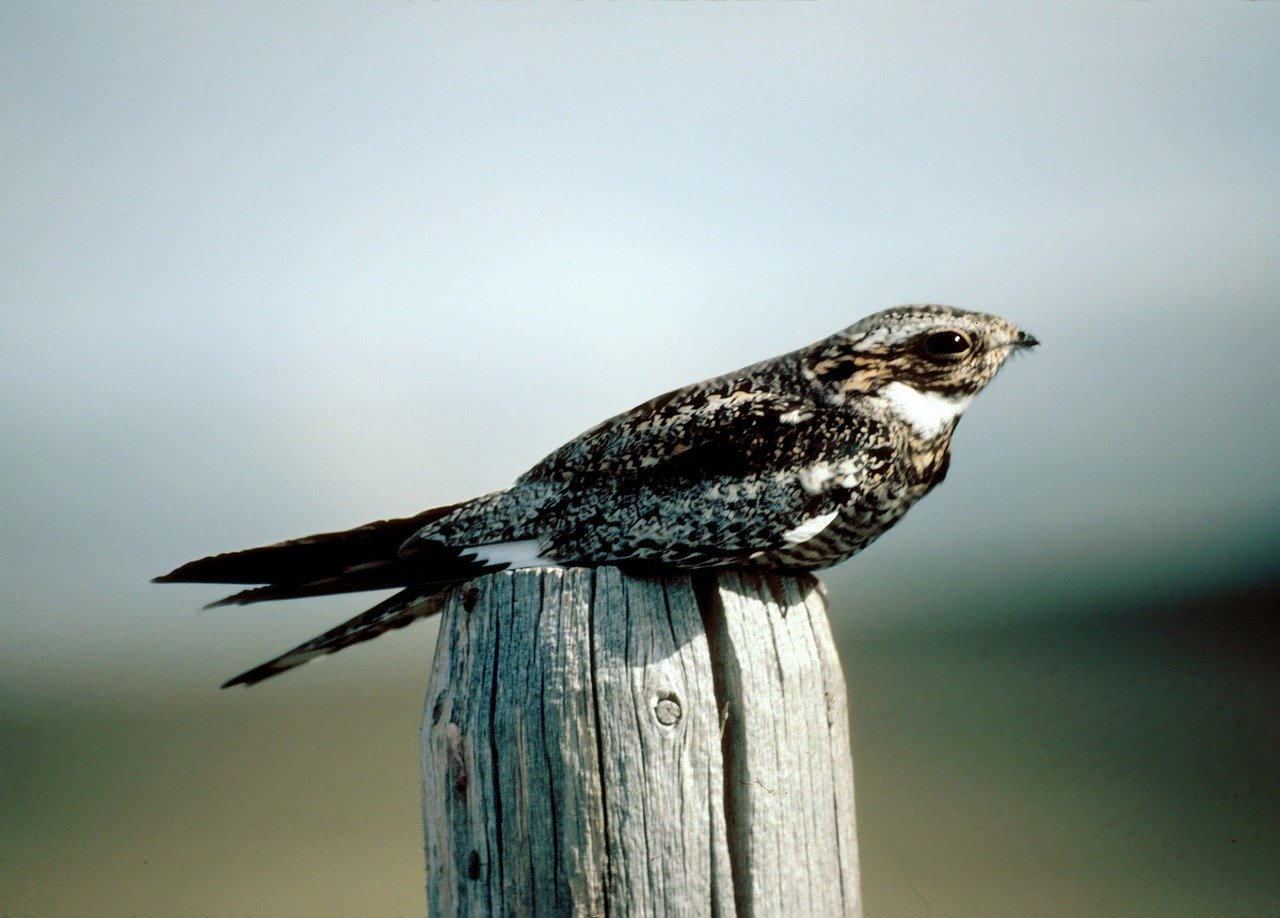
Photo by Skeeze/Pixabay • A common nighthawk adopts an elongated pose atop a fencepost.

The common nighthawk is one of three members of the nightjar family found in the region during the summer months. The other two nightjars are the whip-poor-will and chuck-will’s-widow, birds that produce their namesake vocalizations in the nocturnal hours. Both of these species migrate, but they don’t take the dramatic approach employed by nighthawks. Each fall, common nighthawks form large flocks, ranging in size from dozens to hundreds or even thousands of individuals, as they migrate south for the winter.

Unlike whips and chucks, the common nighthawk isn’t active only after dark, which makes it much easier to observe these birds. They look somewhat like swifts and swallows but are much larger. They are brownish-gray birds with pointed wings and forked tails. They are easily identified by distinctive white patches on the underside of their wings.

A perplexing nickname for the common nighthawk is “bull-bat.” This merger of the words “bull” and “bat” makes sense when you explore a little deeper. The common nighthawk earned the nickname “bull-bat” because of its perceived “bat-like” flight and a “bull-like” boom produced by its wings as it pulls out of a dive.

The nightjar, or Caprimulgidae, family of birds is also sometimes known as “goatsuckers.” Apparently, in trying to explain the nocturnal tendencies of these birds, the Greeks came up with the imaginative but erroneous idea that birds like nighthawks liked to sneak into barns and have a meal of fresh goat’s milk. In reality, nighthawks feed almost exclusively on insects, including ants, wasps, beetles, caddisflies, moths, mayflies, flies, crickets, grasshoppers, and other insects. They capture much of their insect prey on the wing.

There are almost 80 species of nightjars in the world. Less than 10 occur in North America. Many of the common nighthawk’s relatives have been given descriptive names, such as long-trained nightjar, collared nightjar, spot-tailed nightjar, red-necked nightjar, golden nightjar, fiery-necked nightjar, swamp nightjar, pennant-winged nightjar, lyre-tailed nightjar, little nightjar, sickle-winged nightjar, rufous-bellied nighthawk, short-tailed nighthawk, sand-coloured nighthawk and least nighthawk.

So, keep looking skyward. The next flock of migrating common nighthawks may fly over your home. These flocks are usually on the move in August and throughout September.

I will keep watching the skies. Nighthawks can also appear almost magically, as if out of thin air. First, observers may see one of two birds, then several, followed quickly by dozens or sometimes hundreds as they wheel and cavort in the skies overhead with impressive grace and agility. I’ve seen flocks that would easily number more than 500 birds in locations throughout the region, although flocks often number only a couple of dozen birds.

To share a sighting, ask a question or make a comment, email me at ahoodedwarbler@aol.com.
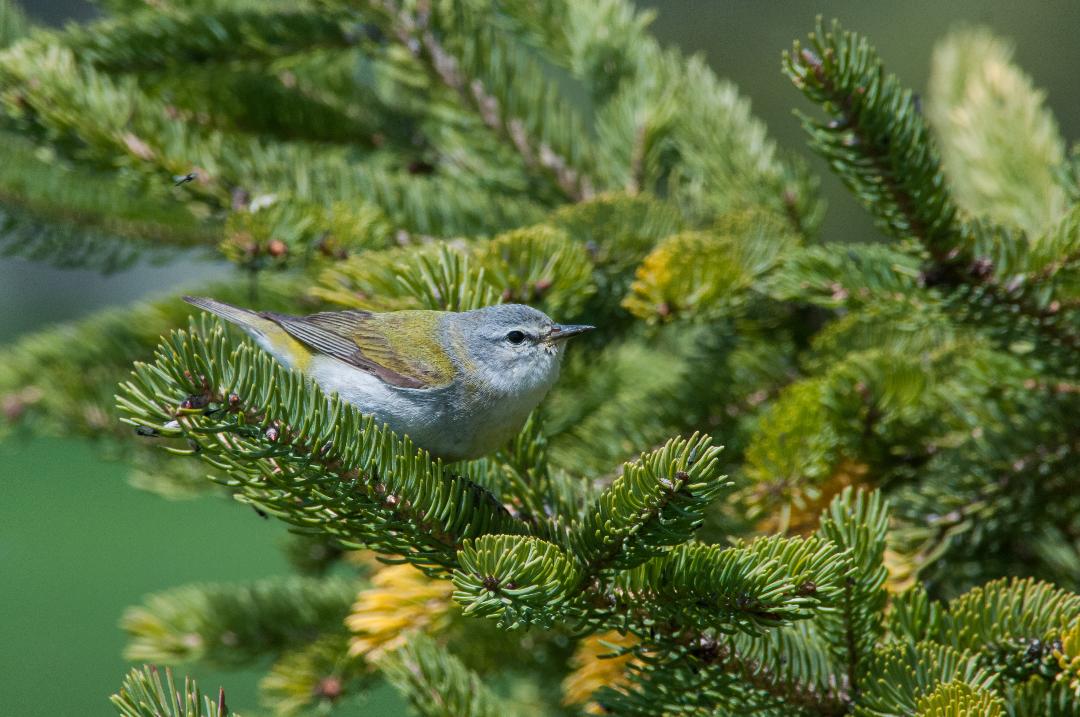
Photo by Bryan Stevens • Rising clouds provide a backdrop for a flock of migrating nighthawks.

Common grackles part of November’s changing bird lineup


Photo by Bernell MacDonald/Pixabay.com • Common grackles are quite accomplished at foraging for food in a variety of habitats.

November is a month of transition. The birds of summer have all “flown the coop,” returning to warmer climes to the south in Central and South America, as well as the Caribbean. Of course, even as hummingbirds, warblers, tanagers, vireos, and others have fled North America in advance of winter’s imminent arrival, other birds are arriving to take their place.

Many of the newcomers don’t offer the vibrant plumage of a scarlet tanager or a rose-breasted grosbeak, but they make up for the lack of striking feathers by remaining quite faithful to our feeders during the bleak, short days of winter. A hermit thrush and a dark-eyed junco represented some first-of-autumn arrivals when they showed up Nov. 6, followed the next day by a swamp sparrow. In addition to the sparrow, three ravenous common grackles descended on my suet feeders that same day.

For many bird enthusiasts, the “common” in this particular bird’s name is particularly apt. Tending to form large, noisy flocks, common grackles can easily wear out even the most generous welcome. Perhaps because I live at a mid-elevation area, common grackles are extremely infrequent visitors to my yard. I can be a little more welcoming to a bird that I know is not likely to linger.

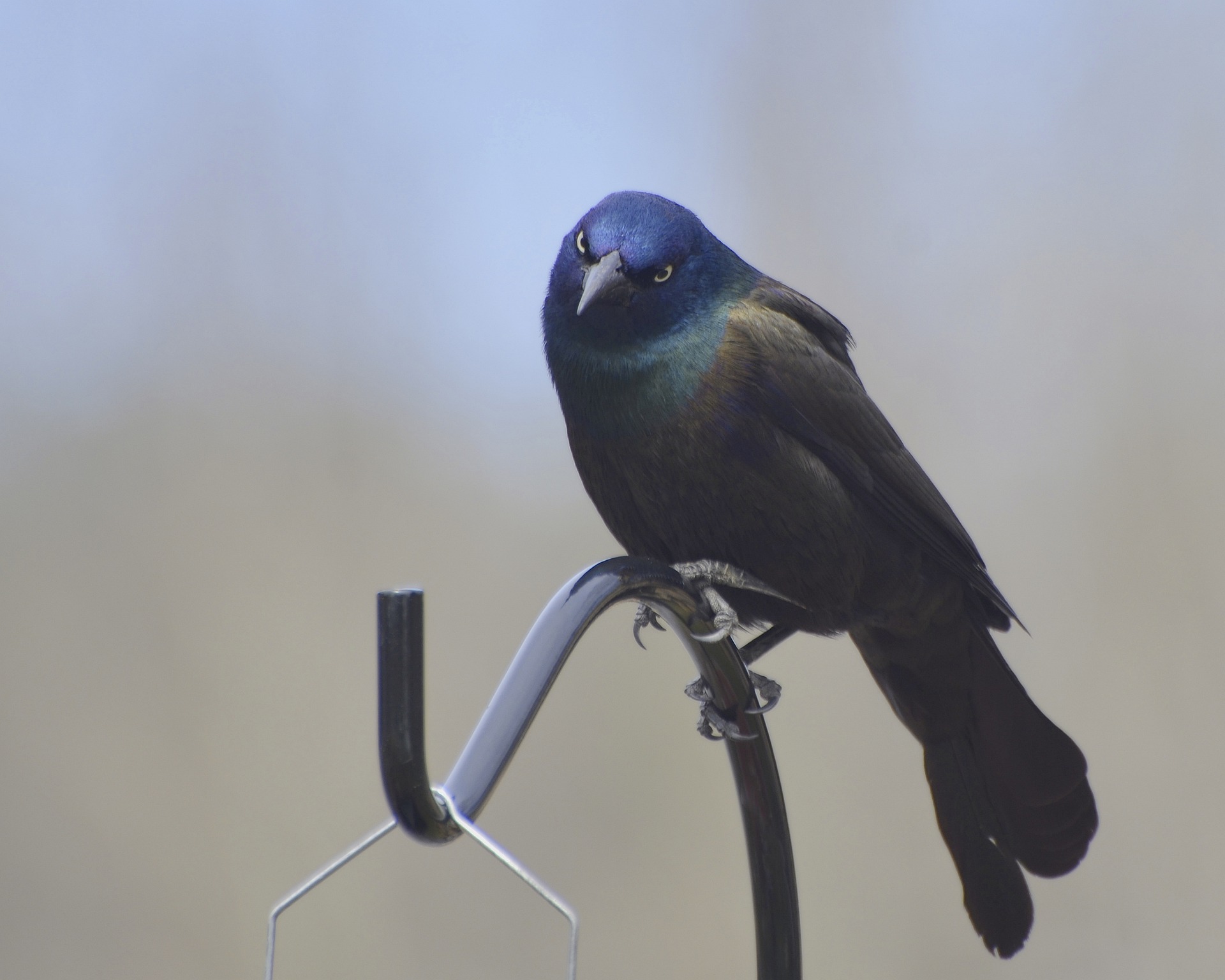
Photo by diapicard/Pixabay.com • A common grackle perches on a shepherd’s hook in a garden. These large birds, which are part of the blackbird family, form flocks and bring big appetites to feeders during migratory stops.

Nevertheless, that same evening these three grackles must have spread the word because a flock of about 30 of these birds arrived. If I needed a reminder, the flock provided a quick one. A handful of grackles isn’t too disruptive, but a large flock can quickly overwhelm and intimidate smaller feeder birds.

Even so, I remain inclusive in my embrace of all feathered friends. A much maligned bird if ever there was one, the common grackle is worth a second look. For those who are able to overlook the occasional bad habits of birds such as Northern mockingbirds, mourning doves, or even cantankerous ruby-throated hummingbirds, there may be hope for this large member of the diverse family of blackbirds, known by scientific types as a member of the family Icteridae. This grouping of New World species, also known as New World blackbirds, includes such members as orioles, meadowlarks, cowbirds, bobolinks, marshbirds, orependolas, caciques and, of course, blackbirds.

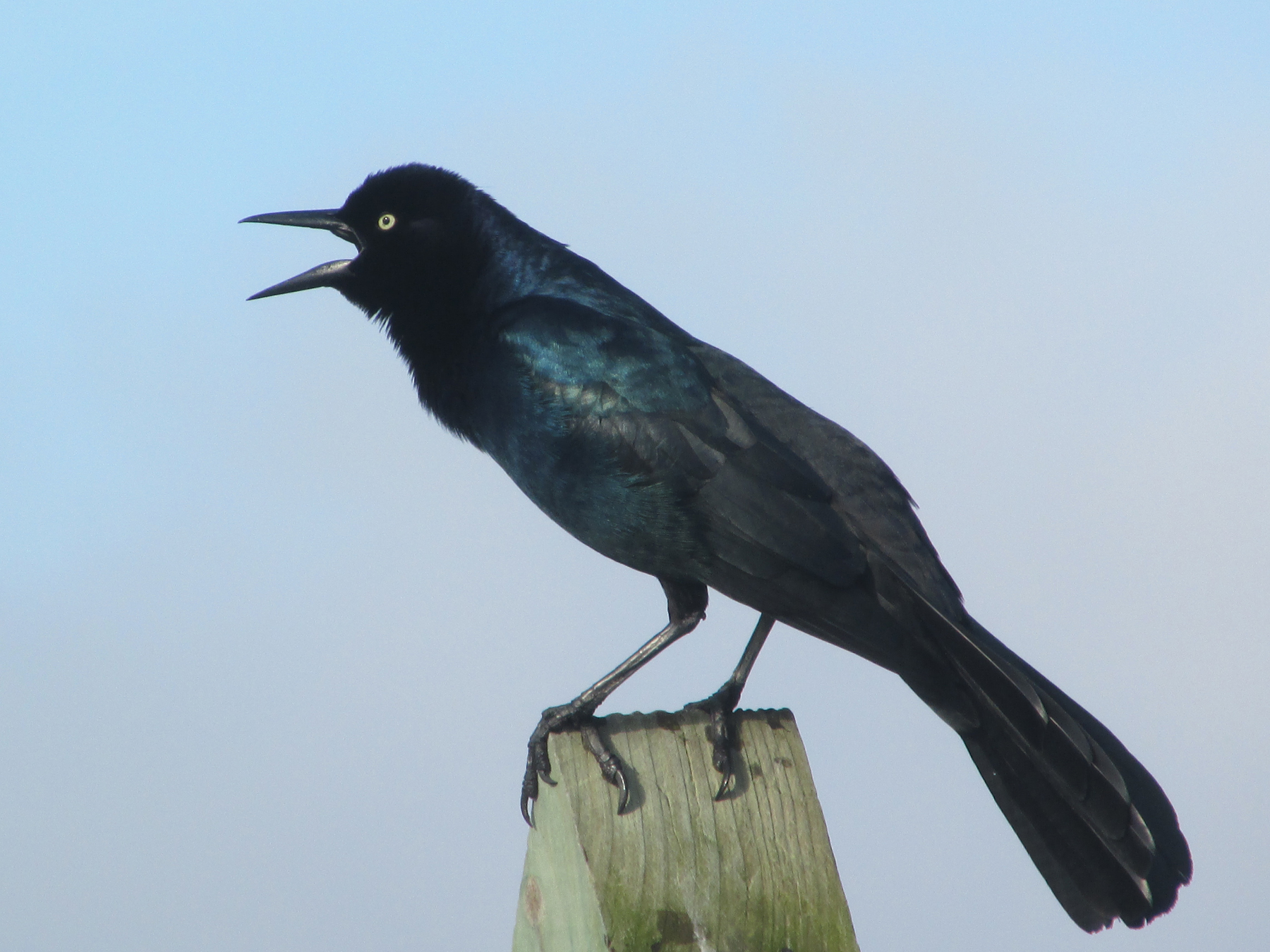
Photo by Bryan Stevens • A boat-tailed grackle sings, if the bird’s harsh, grating notes can be considered a song, from a perch in a wetland in South Carolina.

The common grackle is known by the scientific name Quiscalus quiscula. In the southeast, in particular along the coast and in wetland areas, a common and related species is the boat-tailed grackle. Other species of grackles found in the New World include the great-tailed grackle, Nicaraguan grackle, Great Antillean grackle and the Carib grackle. A little more distantly related are the South American species golden-tufted mountain grackle and the Colombian mountain grackle.

One species — the slender-billed grackle of Mexico — suffered extinction at the dawn of the 20th century. Reasons for this bird’s disappearance are not clearly understood, but habitat destruction of Mexican wetlands and hunting pressures have been theorized as causes. Like others of its kind, the slender-billed grackle may also have been persecuted as an agricultural pest.

Like many other birds dependent on wetlands, common grackles have experienced population declines in recent decades. Although it seems odd to refer to a bird with a population estimated at around 73 million individuals in North America as on the decline, common grackles have suffered an estimated population loss of about 60 percent from historic highs.

Male grackles stand out from other blackbirds due to their sheer size. Males can reach a length of 13 inches, although much of that can be measured in an exceptionally long tail. A grackle’s plumage has a black sheen that can shine with brilliant iridescence that tends to appear purple, green or blue when the sun shines just right on the feathers. Females tend to be smaller than males and are a muted black and brown. Both sexes have long, sturdy bills and yellow eyes.

Most rural residents don’t have to worry about common grackles overwhelming their feeders, but some people living in urban and suburban settings have found grackles to be difficult guests. The birds have bottomless appetites and are aggressive toward more desirable feeder birds. Fortunately, migrating flocks in the fall tend not to linger. After a brief visit, which can still deplete supplies of seed and suet cakes, the grackles continue migrating.

Grackles are usually one of the earliest birds to return each spring. In fact, it’s not at all unusual for these large birds to make their way back to the region as early as late February. I am usually glad to welcome them back since I know that their return is a strong indication that some more favored species are certain to follow in their wake and that winter’s grip is waning.

Are you seeing new arrivals in your yard or at your feeders? Let me know by emailing ahoodedwarbler@aol.com.

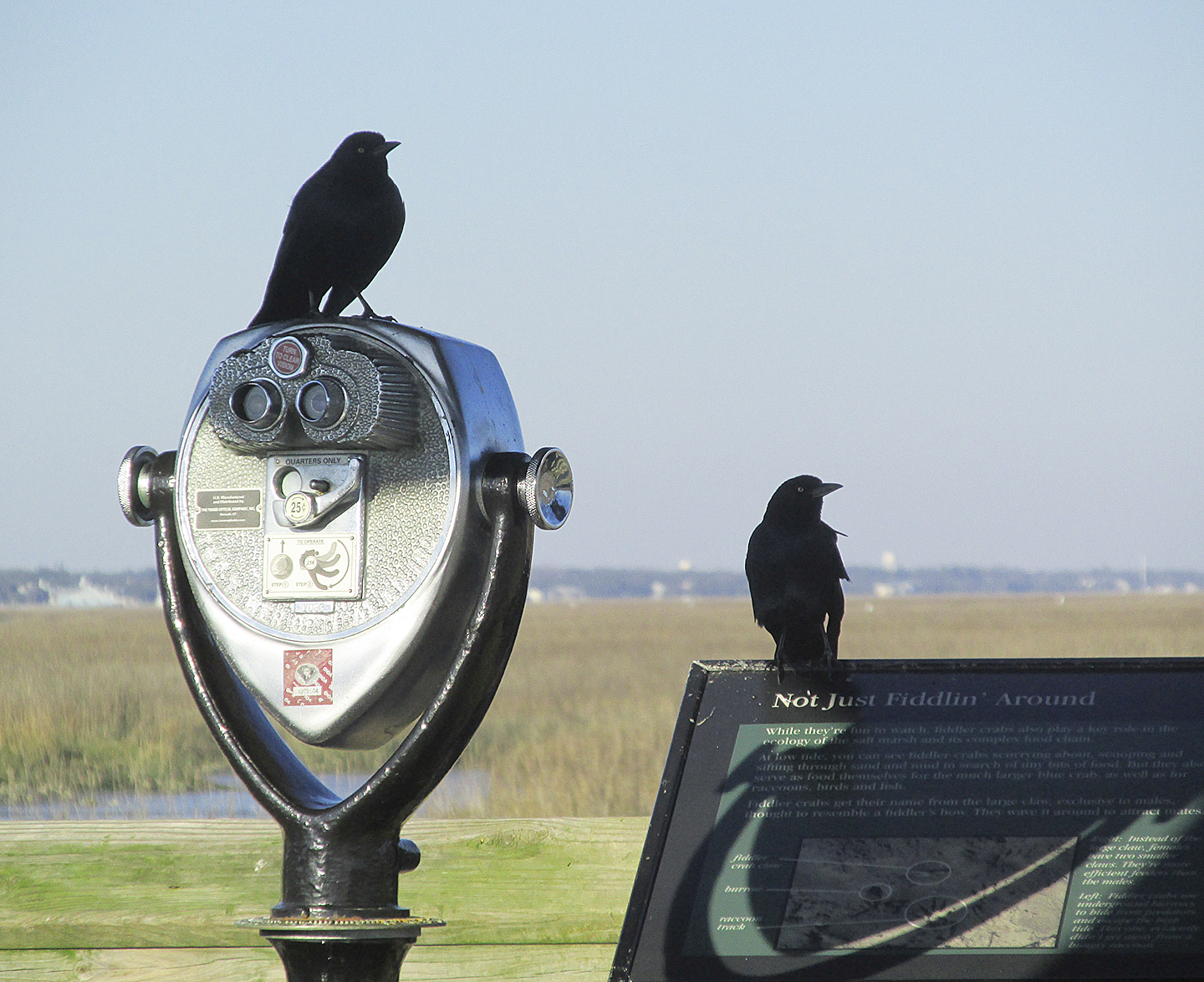
Photo by Bryan Stevens • Boat-tailed grackles perch on viewing equipment at an observation platform at Huntington Beach State Park in South Carolina.

Club holds 51st annual Fall Bird Count

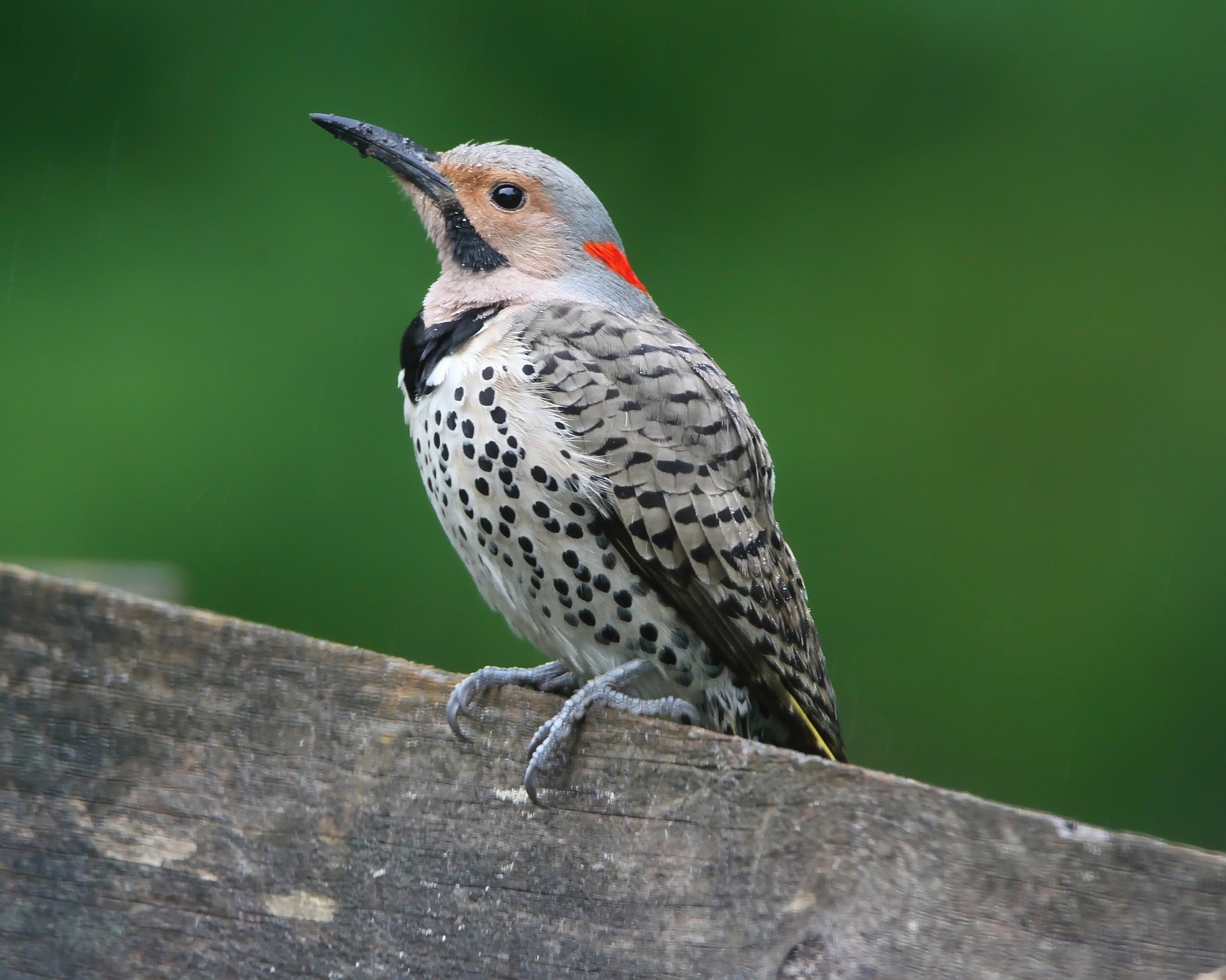
Photo by NatureLady/Pixabay.com • Northern flickers made a strong showing on the 51st consecutive Fall Bird Count. Eighty of these woodpeckers were found by count participants spread across the five-county area of Northeast Tennessee.

The 51st  consecutive Elizabethton Fall Count was held on Saturday, Sept. 26, with 48 observers in 18 parties. The participants were dispersed more than normal due to social distancing protocols. This is the third seasonal count conducted since the start of the Covid 19 pandemic.

The area covered included all of Carter County, as well as parts of the adjacent counties of Johnson, Sullivan, Unicoi and Washington.

A total of 132 species were tallied, which is above the recent 30-year average of 125 species. The all-time high on this count was 137 species set in 1993.

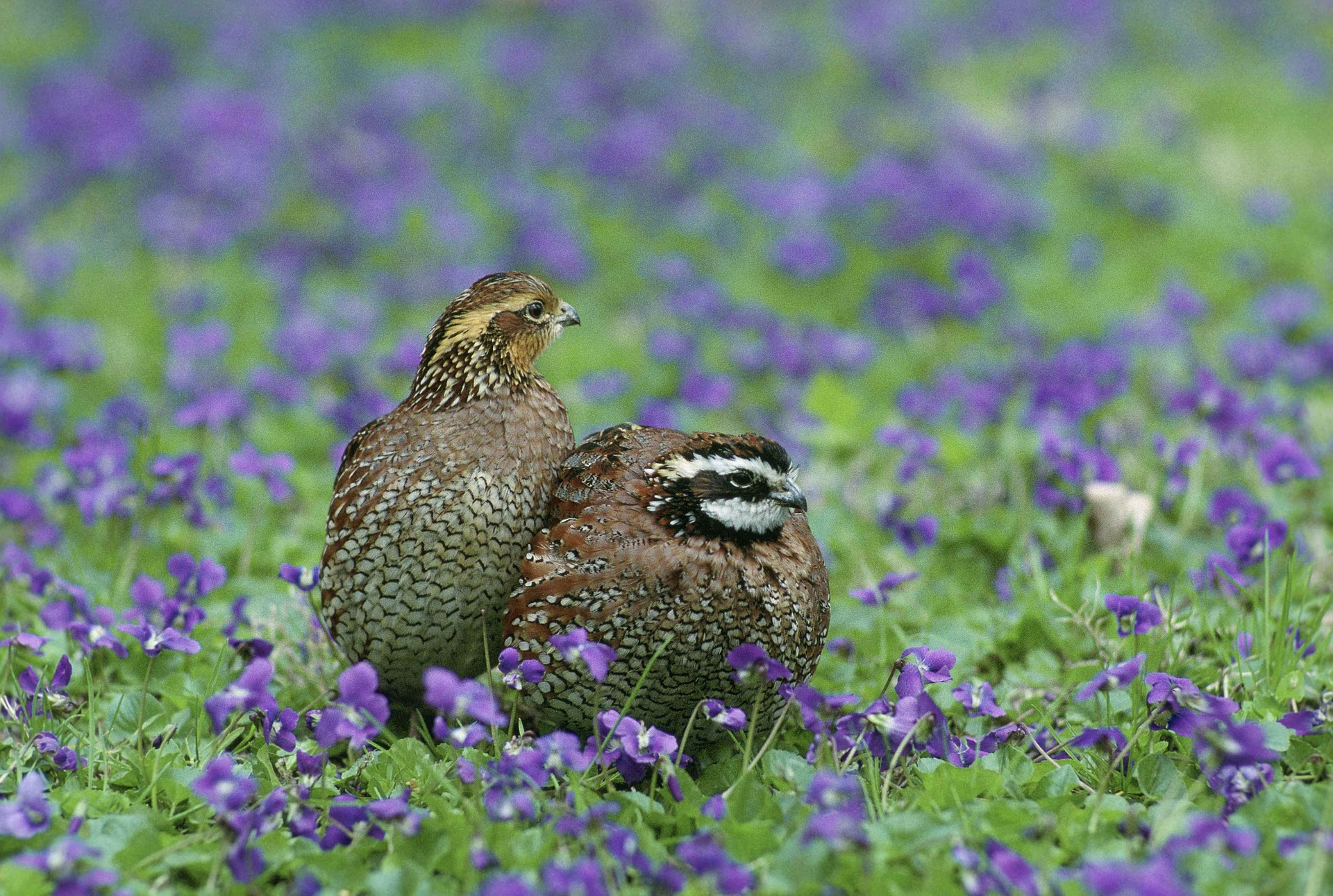
Photo by U.S. FWS   Many birds, such as Northern bobwhites, have seen alarming population crashes in the last half century.

Some interesting finds included a Northern bobwhite covey near the community of Bowmantown in Washington County. Such high numbers of bobwhites have become increasingly rare in recent years.Thirteen unidentified species of Empidonax flycatchers were found, but these birds do not count into the total of species. These small flycatchers are so similar in appearance that their song is usually needed to confirm identification. In fall migration, however, these flycatcher go silent for the most part. A yellow-bellied flycatcher and two least flycatchers were identified.

A total of 23 species of warblers were found, including such interesting finds as golden-winged warbler, blackpoll warbler and Wilson’s warbler.

European starling proved the most abundant bird with 1,757b individuals counted. Other common birds for the count included Canada goose (1,220), Rock Pigeon (629) and Chimney Swift (478).

Photo by Jean Potter • The rock pigeon is one of the most successful members of the bird family Columbidae, which is comprised of some 310 species of doves and pigeons. One of the most famous representatives of the family is the dodo, an extinct relative of such common birds as the mourning dove and rock pigeon.

The participants for the 2020 Fall Bird Count included: Fred Alsop, Rob Armistead, Betty Bailey, Gary Bailey, Jerry Bevins, Rob Biller, Debi Campbell, J.G. Campbell, Ron Carrico, Robin Cooper, Catherine Cummins, Dianne Draper, Glen Eller, Harry Lee Farthing, Bambi Fincher, Dave Gardner, Tammy Griffey, Bill Grigsby, Jean Henson, Neal Henson, Jacki Hinshaw, Don Holt, David Kirschke, Rick Knight, Roy Knispel, Richard Lewis, Dianna Lynne, Vern Maddux, Joe McGuiness, Cathy McNeil, Tom McNeil, Eric Middlemas, Harry Norman, Susan Peters, Brookie Potter, Jean Potter, Sherrie Quillen, Pete Range, Ken Rea, Judith Reid, Judi Sawyer, Chris Soto, Michele Sparks, Bryan Stevens, Kim Stroud, Scott Turner, Charles Warden, Joyce Watson; plus Connie Irick, David Irick, and Peggy Stevens as feeder watchers.

There were no glaring misses, but shorebirds were scarce with not much available habitat this year. Birds that might have been expected for a fall count but were not found included Loggerhead Shrike, Winter Wren, Yellow-rumped Warbler, Savannah Sparrow, Blue Grosbeak and Bobolink.

“All in all, it was a very good count,” said long-time compiler Rick Knight. “Thanks to all who participated.”

The list:

Canada Goose, 1,220; Wood Duck, 71; Mallard, 219; Blue-winged Teal, 27, Northern Bobwhite, 10; Ruffed Grouse, 2; and Wild Turkey, 66.

Common Loon, 1; Pied-billed Grebe, 11; Double-crested Cormorant, 62; Great Blue Heron, 37; Great Egret, 5; Green Heron  4; Black-crowned Night-Heron, 2; and Yellow-crowned Night-Heron, 1.

Black Vulture, 141; Turkey Vulture, 191; Osprey, 14; Northern Harrier, 1; Sharp-shinned Hawk, 3; Cooper’s Hawk, 11; Bald Eagle, 15; Red-shouldered Hawk, 2; Broad-winged Hawk, 4; and Red-tailed Hawk, 14.

Killdeer, 54; Greater Yellowlegs, 1; American Woodcock, 1; Caspian Tern, 3; Rock Pigeon, 629; Eurasian Collared-Dove, 11; and Mourning Dove, 355.

Yellow-billed Cuckoo, 4; Eastern Screech-Owl, 28; Great Horned Owl, 2; Barred Owl, 6; Northern Saw-whet Owl, 1; and Common Nighthawk, 46.

Chimney Swift, 478; Ruby-throated Hummingbird, 34; Belted Kingfisher, 29; Red-headed Woodpecker, 2; Red-bellied Woodpecker, 103; Yellow-bellied Sapsucker,  6; Downy Woodpecker, 82; Hairy Woodpecker, 18; Northern Flicker, 80; and Pileated Woodpecker, 36.

American Kestrel, 17; Merlin, 2; Peregrine Falcon, 1; Eastern Wood-Pewee, 34; Yellow-bellied Flycatcher, 1; Least Flycatcher, 2; Empidonax species, 13; Eastern Phoebe, 124; and Eastern Kingbird, 4.

White-eyed Vireo, 3; Yellow-throated Vireo, 5; Blue-headed Vireo, 16; Warbling Vireo, 1; Philadelphia Vireo, 1; Red-eyed Vireo, 34; Blue Jay, 578; American Crow, 503; Common Raven, 14.

Tree Swallow, 274; Barn Swallow, 15; Carolina Chickadee,  251; Tufted Titmouse, 208; Red-breasted Nuthatch, 18; White-breasted Nuthatch, 80; and Brown Creeper, 1.

House Wren, 10; Carolina Wren, 285; Blue-gray Gnatcatcher, 10; Golden-crowned Kinglet, 7; and Ruby-crowned Kinglet.

Eastern Bluebird, 246; Veery, 3; Gray-cheeked Thrush, 10; Swainson’s Thrush, 193; Hermit Thrush, 1; Wood Thrush, 19; American Robin,  574; Gray Catbird,  85; Brown Thrasher, 27; Northern Mockingbird, 126; European Starling, 1,757; American Pipit, 2; and Cedar Waxwing, 312.

Ovenbird, 2; Northern Waterthrush, 12; Golden-winged warbler, 1; Black-and-white warbler, 2; Tennessee warbler, 52; Common Yellowthroat, 32; Hooded warbler, 9; American Redstart, 90; Cape May Warbler, 32; Northern Parula,12; Magnolia  warbler, 29; Bay-breasted warbler, 45; Blackburnian Warbler,16; Chestnut-sided warbler, 15; Blackpoll warbler, 3; Black-throated Blue  Warbler, 4; Palm warbler,  65; Pine warbler, 16; Yellow-throated warbler, 7; Prairie warbler, 2; Black-throated Green warbler, 18; Canada warbler,  2; and Wilson’s warbler,  2.

Eastern Towhee, 80; Chipping Sparrow,  41; Field Sparrow, 26; Song Sparrow, 116; Swamp Sparrow, 1; and Dark-eyed Junco, 26.

Summer Tanager,  3; Scarlet Tanager. 40; Northern Cardinal, 251; Rose-breasted Grosbeak, 119; and Indigo Bunting, 37.

Red-winged Blackbird, 209; Eastern Meadowlark,  17; Common Grackle,  54; Brown-headed Cowbird,  8; House Finch, 76; Pine Siskin, 4; American Goldfinch, 303; and House Sparrow, 18.

Two types of black-throated warblers number among New World bird family

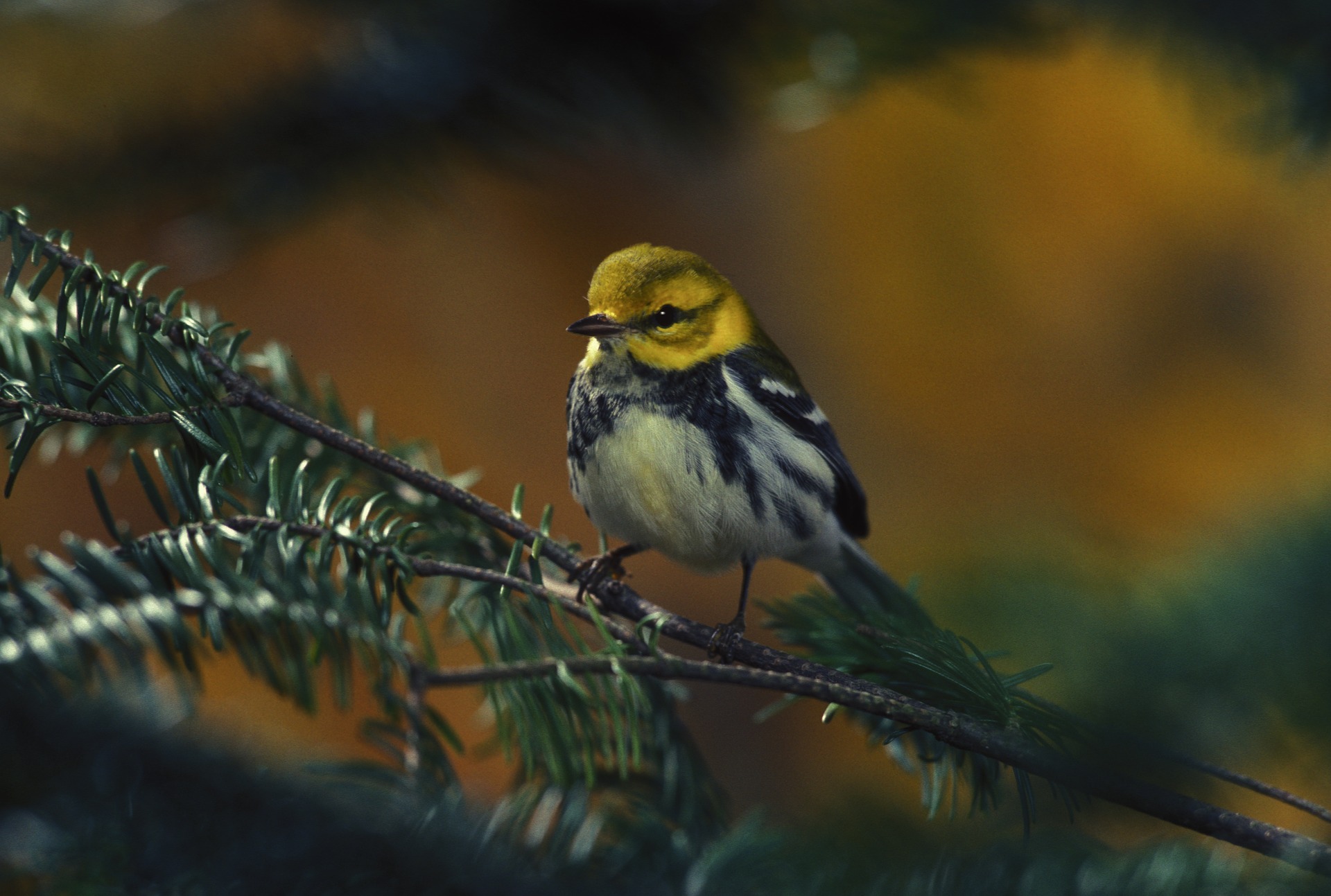
Photo by Skeeze/Pixabay.com The female black-throated green warbler lacks the male’s all-black throat, but she is a striking bird in her own right. Black-throated green warblers and the related black-throated blue warbler are common birds in the Southern Appalachians from April to October.

I’ve enjoyed some lawn chair birding on recent September evenings, delighting in my observations of birds ranging from flycatchers and catbirds to warblers, vireos and hummingbirds. I enjoy my casual study of the daily changes in the bird population present in my yard and adjacent woods. The parade of warblers hasn’t been as productive as in past autumns, but I have managed to spot and identify hooded warbler, American redstart, chestnut-sided warbler, magnolia warbler, Northern parula, and black-throated green warbler visitors.


The black-throated green appeared suddenly in a fast-paced burst of foraging in a cherry tree. Alongside birds such as an Eastern wood-pewee and red-eyed vireo, the warbler gleaned the leaves of the trees for concealed caterpillars. I watched the bird swallow with gusto several of the caterpillars so skillfully plucked with its thin, pointed bill.

The black-throated green warbler and one other species, the black-throated blue warbler, share the appellation of “black-throated,” and rightfully so. Males in the spring look their best with a dark black throat in striking contrast to the rest of their plumage. The female black-throated green shows some black on the throat, but female black-throated blue warblers exhibit no black throat patch. In fact, black-throated blue males and females are extremely different in appearance. Scientists call such dramatic appearances differences “sexual dimorphism.” Among the warblers, this species provides the most striking example of sexual dimorphism of any of the warblers. The male and female do share one identifying mark — a white square near the outer edge of the middle of each wing. This square is usually more pronounced in the male, but it stands out enough that it helps distinguish the female black-throated blue from similar dull-plumaged birds such as vireos. 


German naturalist Johann Friedrich Gmelin described the black-throated blue warbler in 1789. I noted in last week’s column that Gmelin woefully misnamed such warblers as palm warbler and magnolia warbler. With the black-throated blue warbler, Gmelin did a better job. This bird’s scientific name name is the Latin term caerulescens, which translates into English as “turning blue.” The male is a stunning bird. Arguably, the black-throated blue warbler is one of the most distinctive members of the family of wood warblers. The adult male has a black face and cheeks, deep blue upperparts and a clean white underbelly. In contrast, the adult female is olive-brown above and light yellow below. 


When one’s binoculars first focus on a black-throated green warbler, the first impression is likely to be the black, yellow and white feathers in the bird’s plumage. The greenish-yellow coloration that gives this species part of its common name is mostly limited to the bird’s back, which is often not as evident when the bird’s being watched through binoculars.  
Both of the black-throated warblers nest in northeast Tennessee, western North Carolina, and southwestern Virginia. In the spring, the males of both these warblers are persistent singers from prominent perches in the green woodland canopy. Male black-throated greens contribute to the avian chorus by frequently singing a high-pitched song often described as a buzzy zee-zee-zee-zooo-zeet. Male black-throated blues produce a buzzy zee-zee-zeeee. 

The black-throated green warblers currently departing the region will likely travel as far as Mexico, Central America, the West Indies and southern Florida for the colder winter months. Black-throated blue warblers, on the other hand, migrate to the Caribbean for the winter, making their homes on Cuba, Jamaica, Hispaniola and Puerto Rico, as well as other islands. 
Nearly half of the world’s New World warblers spend the months between spring and fall in North America. The other half reside exclusively in Central and South Americas, as well as the Caribbean. Some of the more descriptively named individuals residing in the tropical areas south of North America include flame-throated warbler, crescent-chested warbler, arrowhead warbler, white-rimmed warbler, buff-rumped warbler, golden-bellied warbler, fan-tailed warbler, pink-headed warbler and pale-legged warbler. 


The warblers bring some exciting tropical flair into the hills and hollows of Southern Appalachia for several months every year. I miss them once they’re gone for the winter season, but the promise of their return keeps my spirits buoyed during the cold, darker months until spring. 

Nighthawks share the skies with many other migrants

Photo by Dr. Thomas G. Barnes/ USFWS • A common nighthawk perches on a low clump of vegetation during a rest period. Nighthawks are known for migrating in large flocks.

Autumn’s a chance for me to indulge my passion for warblers, with a few dozen species of these songbirds passing through the region in the span of a few weeks. They’re not the only migrating birds worth watching, however, as a recent Facebook post reminded me.

John Whinery, a fellow birder who resides in Fall Branch, Tennessee, reported some interesting observations Sept. 6 on Facebook.

“Been watching several hundred common nighthawks the last few nights fly down the valley next to the farm,” John wrote in his post. He also reported that he saw a female Northern harrier fly by at eye level about 20 feet from him as he watched the migrating nighthawks. The Northern harrier, once known as the “marsh hawk,” is one of many raptors known to migrate. 

Like such birds as warblers, vireos, thrushes, tanagers, flycatchers and hummingbirds, the common nighthawk, is a neotropical migrant. In addition, the common nighthawk has one of the longest migration routes of any North American bird. Twice a year, these birds migrate for distances ranging from 1,600 to 4,200 miles. Nighthawks that spend the spring and summer in Canada travel to southern South America for the winter months. 

With September advancing on the calendar, I have been keeping an eye on the treetops for passing warblers, vireos and tanagers, but I also remember to direct my gaze to the skies. Forgetting to look skyward could result in missing the passage of such varied migrants as chimney swifts, broad-winged hawks and common nighthawks.

So, what is a common nighthawk? First, this bird, despite what is implied by its name, is not a hawk. It’s also not strictly nocturnal. Particularly in the fall, nighthawks are active during daylight hours when engaged in catching winged insects. Outside of fall migration, these birds can often be observed over large parking lots or well-lit streets, snatching up insects swarming around the light poles.

The common nighthawk is one of three members of the nightjar family found in the region during the summer months. The other two nightjars are the whip-poor-will and chuck-will’s-widow, birds that produce their namesake vocalizations in the nocturnal hours. Both of these species migrate, but they don’t take the dramatic approach employed by nighthawks. Each fall, common nighthawks form large flocks, ranging in size from dozens to hundreds or even thousands of individuals, as they migrate south for the winter.

Photo by Skeeze/Pixabay.com • A common nighthawk chooses a perch atop a fence post for a survey of its surroundings.

Unlike whips and chucks, the common nighthawk isn’t active only after dark, which makes it much easier to observe these birds. They look somewhat like swifts and swallows but are much larger. They are brownish-gray birds with pointed wings and forked tails. They are easily identified by distinctive white patches on the underside of their wings.

The nightjar, or Caprimulgidae, family of birds is also sometimes known as “goatsuckers.” Apparently, in trying to explain the nocturnal tendencies of these birds, the Greeks came up with the imaginative but erroneous idea that birds like nighthawks liked to sneak into barns and have a meal of fresh goat’s milk. In reality, nighthawks feed almost exclusively on insects, including ants, wasps, beetles, caddisflies, moths, mayflies, flies, crickets, grasshoppers, and other insects. They capture much of their insect prey on the wing.

There are almost 80 species of nightjars in the world. Less than 10 occur in North America. Many of the common nighthawk’s relatives have been given descriptive names, such as long-trained nightjar, collared nightjar, spot-tailed nightjar, red-necked nightjar, golden nightjar, fiery-necked nightjar, swamp nightjar, pennant-winged nightjar, lyre-tailed nightjar, little nightjar, sickle-winged nightjar, rufous-bellied nighthawk, short-tailed nighthawk, sand-coloured nighthawk and least nighthawk.

So, keep looking skyward. The next flock of migrating common nighthawks may fly over your home. These flocks are usually on the move throughout September.  I’ve managed only three sightings of solitary nighthawks so far this migration season, which falls far short of the number John Whinery reported at his farm. 

I will keep watching the skies. Nighthawks can also appear almost magically, as if out of thin air. First, observers may see one of two birds, then several, followed quickly by dozens or sometimes hundreds as they wheel and cavort in the skies overhead with impressive grace and agility. I’ve seen flocks that would easily number more than 500 birds in locations throughout the region, although flocks often number only a couple of dozen birds. 

Photo by Jean Potter • A common nighthawk rests on a metal railing.

Warbler parade imminent as September advances

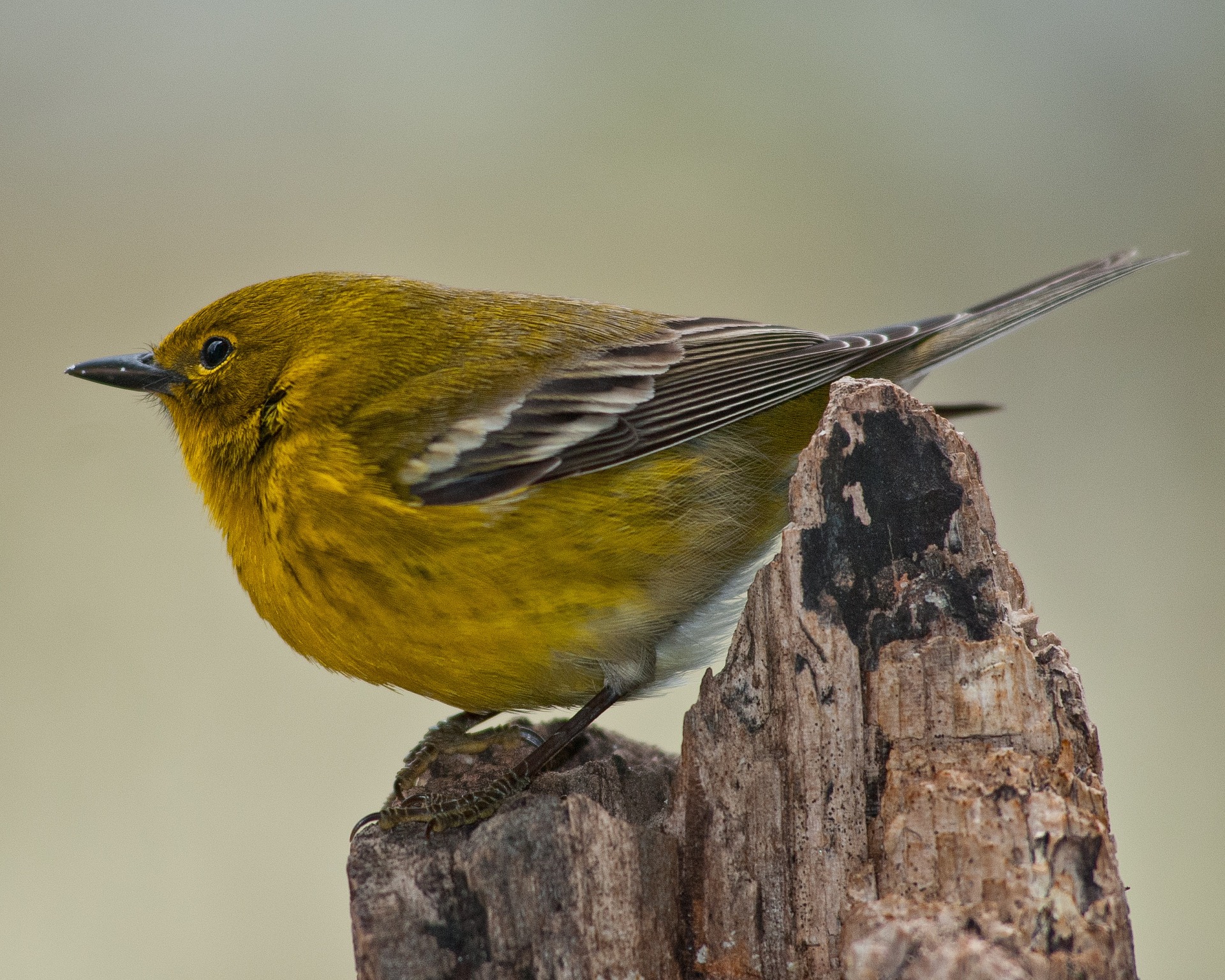
Photo by Mickey Estes/Pixabay.com • A pine warbler takes a brief rest on a perch during a break from foraging for insects.

I detected some signs of migration during a backyard lawn chair birding session on Thursday, Sept. 3. A croaking great blue heron circling the property, the shrill cries of cedar waxwings, scolding vireos, and the intermittent buzz of hummingbird wings all contributed to the background noise. 

The first warbler of the season, a quick blur of yellow and white, disappeared into the green and thus escaped identification. That’s the way of it: Sometimes, you identify the bird, but at other times it slips past without lingering enough for that moment of confidence. You have to love September, even if the birds are entirely ignorant of pages on a calendar. As summer wanes, the pace of migration has spiked. If that first warbler got away, I know others will follow behind it.

Some of them will have fanciful names like blue-winged warbler, black-throated blue warbler, Blackburnian warbler and American redstart. Each of the warblers exists as a sort of magnet to induce me to keep binoculars always close at hand.


The 50 or so species of warblers that make their home in the eastern parts of the United States and Canada during the spring and summer months are now winging their way south.  The blackpoll warbler, which holds the distinction for the longest migration of any species of New World warbler, will journey from the forests of Canada to spend the colder months in northern South America. Because of a peculiarity of this bird’s fall migratory habits, birders in Northeast Tennessee are far more likely to see this late-arriving warbler in May than in the autumn.

A few warblers — pine warbler, magnolia warbler and palm warbler — are named for trees for the simple reason that their European discoverers happened to first observe them in the branches of their namesake trees.

Photo by Bryan Stevens • A Palm Warbler forages along a chain-link fence.

For most of these warblers named to honor various trees,  their common names are, at best, a misnomer. Throughout most of its life, the palm warbler doesn’t even encounter palm trees. Johann Friedrich Gmelin, a German naturalist who lived from 1748 to 1804, saddled the palm warbler with its inappropriate name. Gmelin based his naming of the bird on the fact that a specimen had been collected on Hispaniola, an island in the Caribbean with an abundance of palm trees. Gmelin published several textbooks in the fields of chemistry, pharmaceutical science, mineralogy, and botany. He also had a hand in publishing a catalog of scientific names for various species, including some birds that had until that point never been given a species classification. Thanks to his efforts, the palm warbler has forever been linked with a type of tree that is, at best, entirely incidental to the bird’s life cycle.

The same is true for the Magnolia Warbler, which would have been more suitably named the spruce or fir Warbler, as the species is highly dependent on northern coniferous forests as nesting habitat. The pine warbler, at least, restores credibility to some of the early experts who have these tiny birds their common names. The pine warbler does indeed prefer stands of pine trees, showing particular favor for pitch pines.

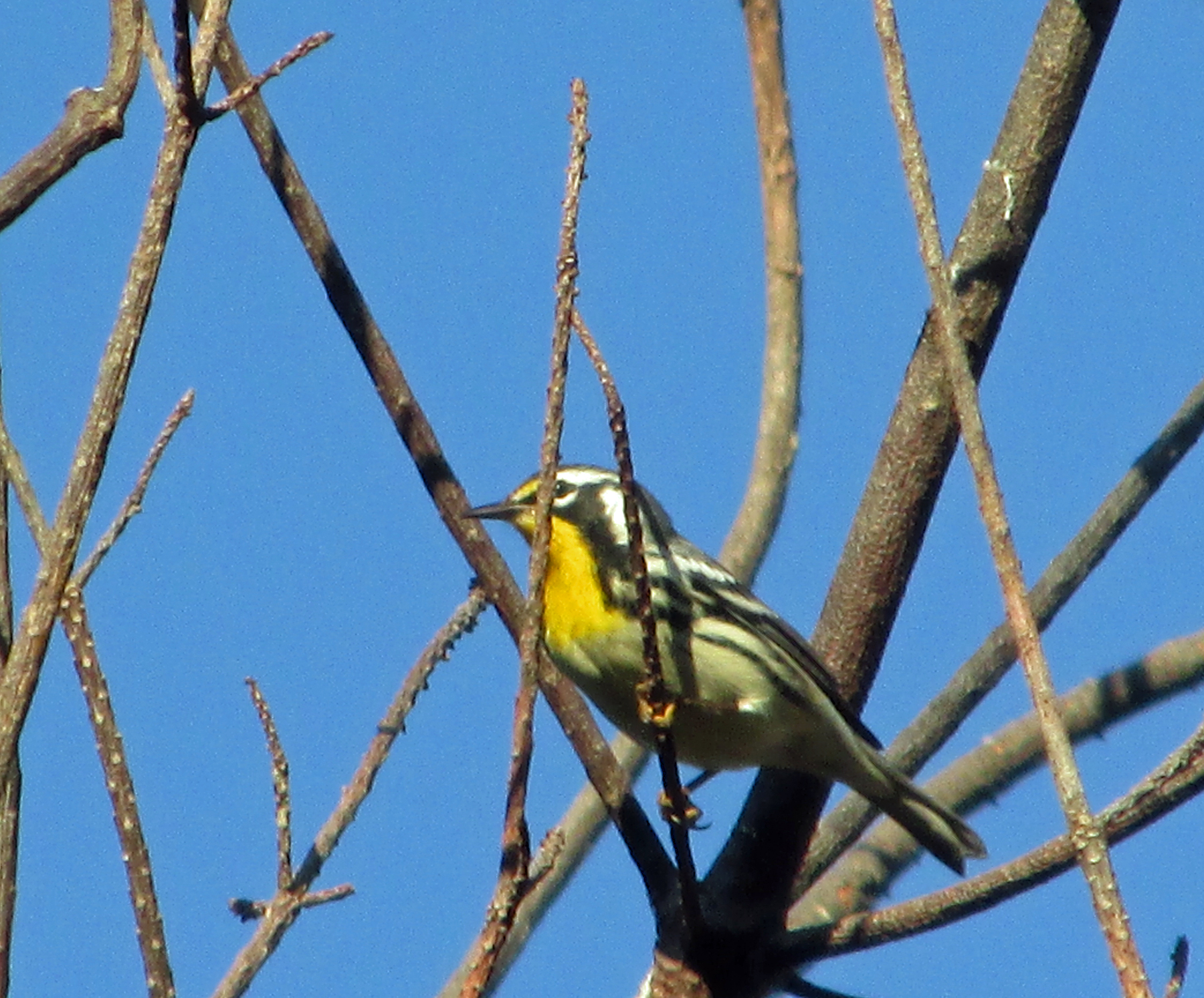
Photo by Bryan Stevens A Yellow-throated Warbler makes a migratory stop in my yard on the first day of September.

These three “tree warblers” are all fairly common fall migrants, making stops in gardens, backyards and woodland edges throughout Northeast Tennessee, southwest Virginia, and western North Carolina. They and their relatives will make the remaining weeks of September and early October an exciting time for warbler enthusiasts.