Tag Archives: Jonesborough Herald and Tribune

Hummingbird numbers normally fluctuate from year to year

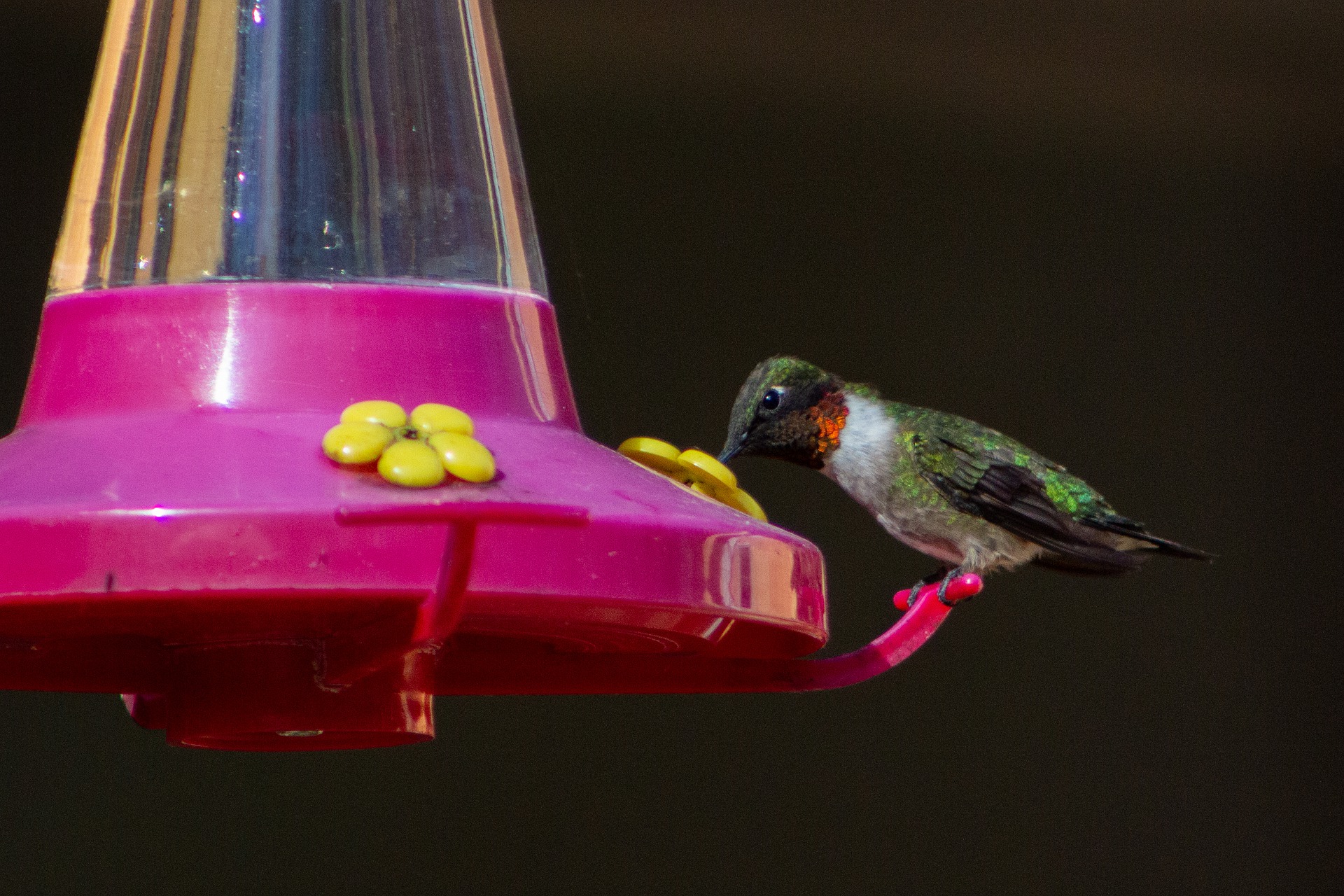
Photo by Bryan Stevens • A ruby-throated hummingbird perches at a feeder for a sip of sugar water.

Russ MacIntyre, Jonesborough, Tennessee, emailed me recently with a question about hummingbirds.

“Are there fewer around this year?” Russ wrote in his email. “My neighbor hasn’t seen any for a month and neither have we. Both of us have feeders and usually have hummingbirds all summer.”

I responded to Russ’s question by sharing with him that I have not seen as many hummingbirds as usual myself.

It’s important to note, however, that hummingbird numbers always fluctuate from year to year. While Russ and I may not be seeing as many hummingbirds, someone else in Jonesborough, Erwin or other small towns might be overwhelmed with these tiny gems. For instance, numbers might appear down in Northeast Tennessee but could be booming across the border in Western North Carolina.

I get these questions every year. Last year was a great year for hummingbirds based on my personal experience. I was also staying at home a lot more last year due to COVID-19, so I might simply have had more leisure time to observe the hummingbirds in my yard and garden.
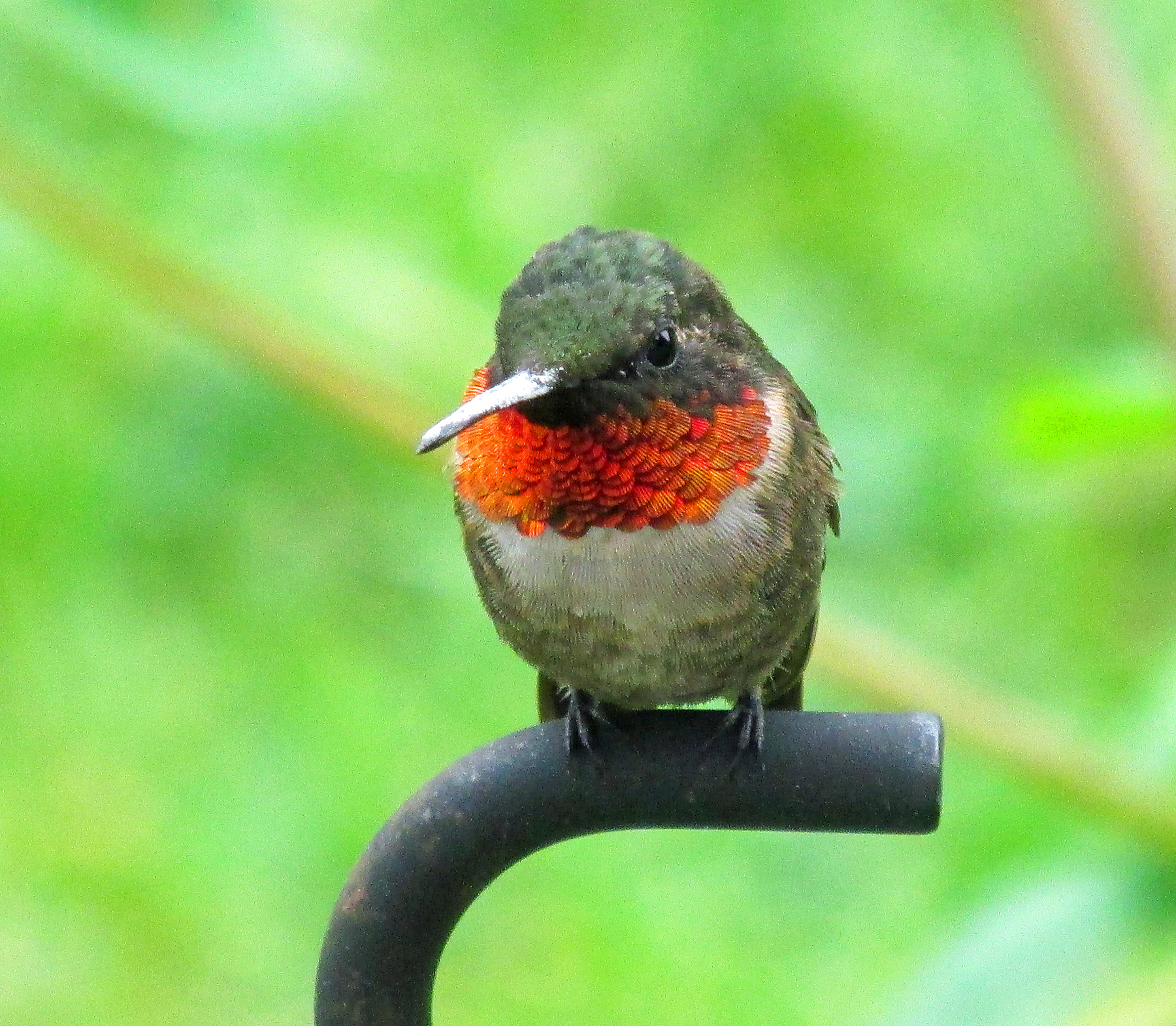
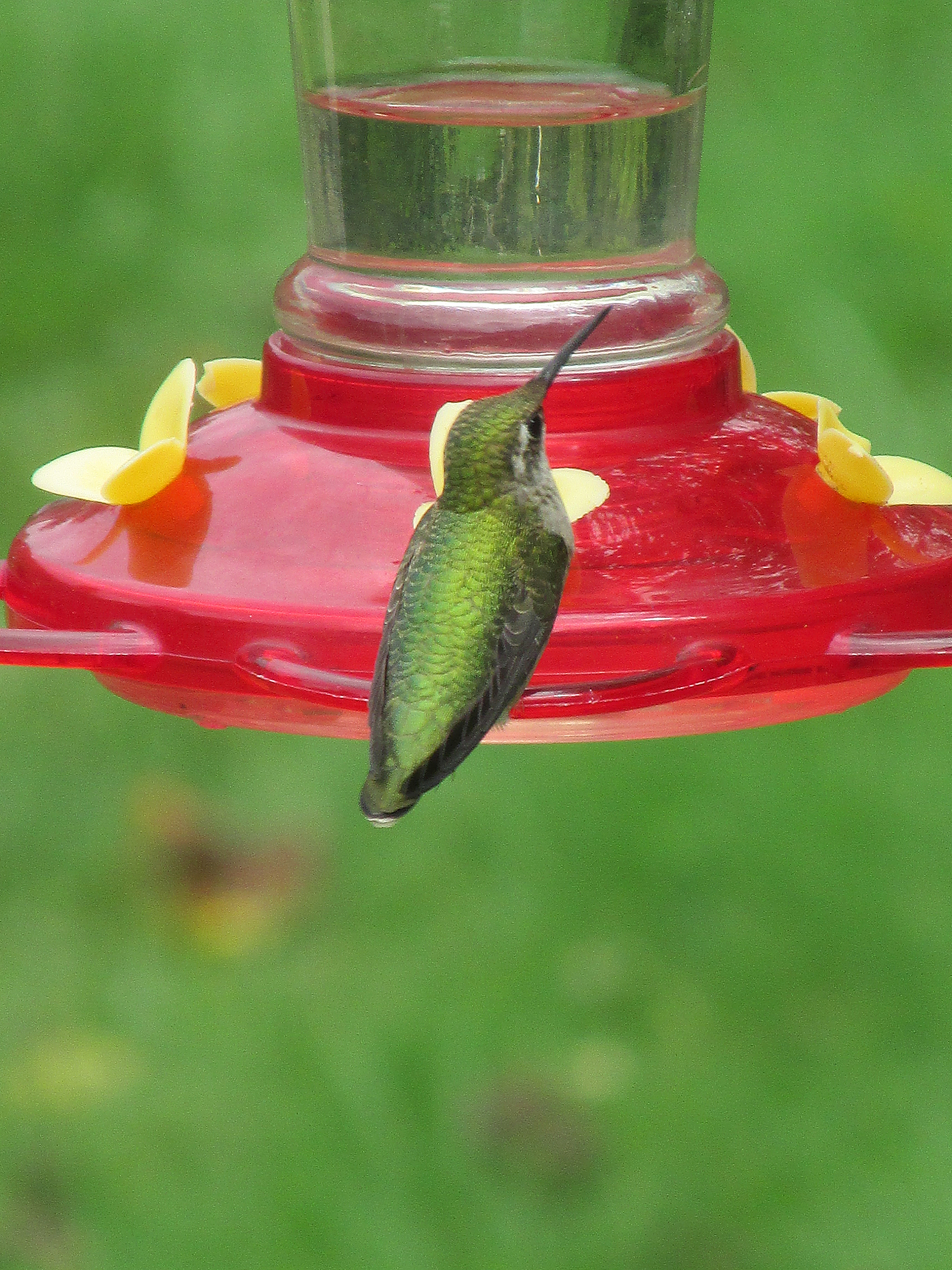
Photo by Bryan Stevens • Despite a perceived disadvantage of size, ruby-throated hummingbirds are quite capable of thriving in a giant world.

I usually tell people a decline in numbers one year doesn’t mean hummingbird numbers might not boom next year. Quite simply, all the hummingbirds could be a few miles down the road having a great time in someone else’s yard and garden. One thing that all hummingbird enthusiasts should do is plant more nectar-providing flowers, in addition to providing sugar water feeders. Flowers can help persuade hummers to stay put.

To recognize the importance of native, nectar-bearing flowers, simply consider a few facts about hummingbirds from an article by Lisa M. Genier for the Adirondack Council.

“Hummingbirds have a very high metabolism and must eat all day long just to survive,” wrote Genier, a program analyst for the Adirondack Council. “They consume about half their body weight in bugs and nectar, feeding every 10 to 15 minutes and visiting 1,000 to 2,000 flowers throughout the day.”

It’s not just the sugary treat that waits in each bloom that draws in hummingbirds.

“In addition to nectar from flowers and feeders, these birds eat small insects, beetles, ants, aphids, gnats, mosquitoes and wasps,” Genier wrote in her article, which was published on July 3, 2018, on the website for the Adirondack Council. The organization was founded in 1975 with a mission to ensure the ecological integrity and wild character of the Adirondack Park near Lake Placid in New York.

Photo by Bryan Stevens • Ruby-throated hummingbirds such as this male make themselves at home in yards and gardens throughout the eastern United States from spring to fall each year. .

If you’re disappointed with seemingly low numbers of hummingbirds this spring, my best advice is to wait until late July and early August when young birds are out of the nest and parents and young start the slow-paced migration back south. Invariably, I see more hummingbirds in late summer and early fall than in the spring.

Hummingbirds are a lovely diversion for nature enthusiasts, but they also play a crucial role in the ecosystems where they make their homes. Hummingbirds are pollinators. Every time they visit a flower, they will carry away some pollen on their bills or foreheads. If they carry the pollen to the correct plant, they fulfill their role as one of nature’s many pollinators.

There’s even an entire week dedicated to pollinators and their importance in nature. Pollinator Week was initiated in 2007 when the United States Senate unanimously approved a week in June to be designated as “National Pollinator Week”. This decision was a critical step to address the decline in pollinators across the globe.

Now an international celebration, Pollinator Week raises awareness on the plight of pollinators and celebrates all of the benefits provided by the thousands of insect, bird, and small mammal pollinator species. As people learn more about pollinators, they become advocates – indeed voices – for the pollinators they come to love and understand. We can all play our part to secure a healthier, more sustainable future for pollinators. Pollinator week was started and is managed by the Pollinator Partnership. For more information explore the Pollinator Partnership website.

According to the website, Pollinator Week was initiated and is managed by Pollinator Partnership, and fourteen years ago the U.S. Senate’s unanimous approval and designation of a week in June as “National Pollinator Week” marked a necessary step toward addressing the urgent issue of declining pollinator populations. Pollinator Week has now grown into an international celebration, promoting the valuable ecosystem services provided by bees, birds, butterflies, bats and beetles.

While this year might not be a typical Pollinator Week due to the COVID-19 pandemic, people across the planet have pledged to continue promoting pollinator health and well-being through socially distant and responsible events. Through the numerous virtual gatherings, webinars, responsible planting sessions, socially distant garden and farm walks and monument lightings, Pollinator Week 2021 is geared to be the busiest and best one yet.

This year, Pollinator Week is being observed Monday-Sunday, June 21–27. For more information, email info@pollinator.org.
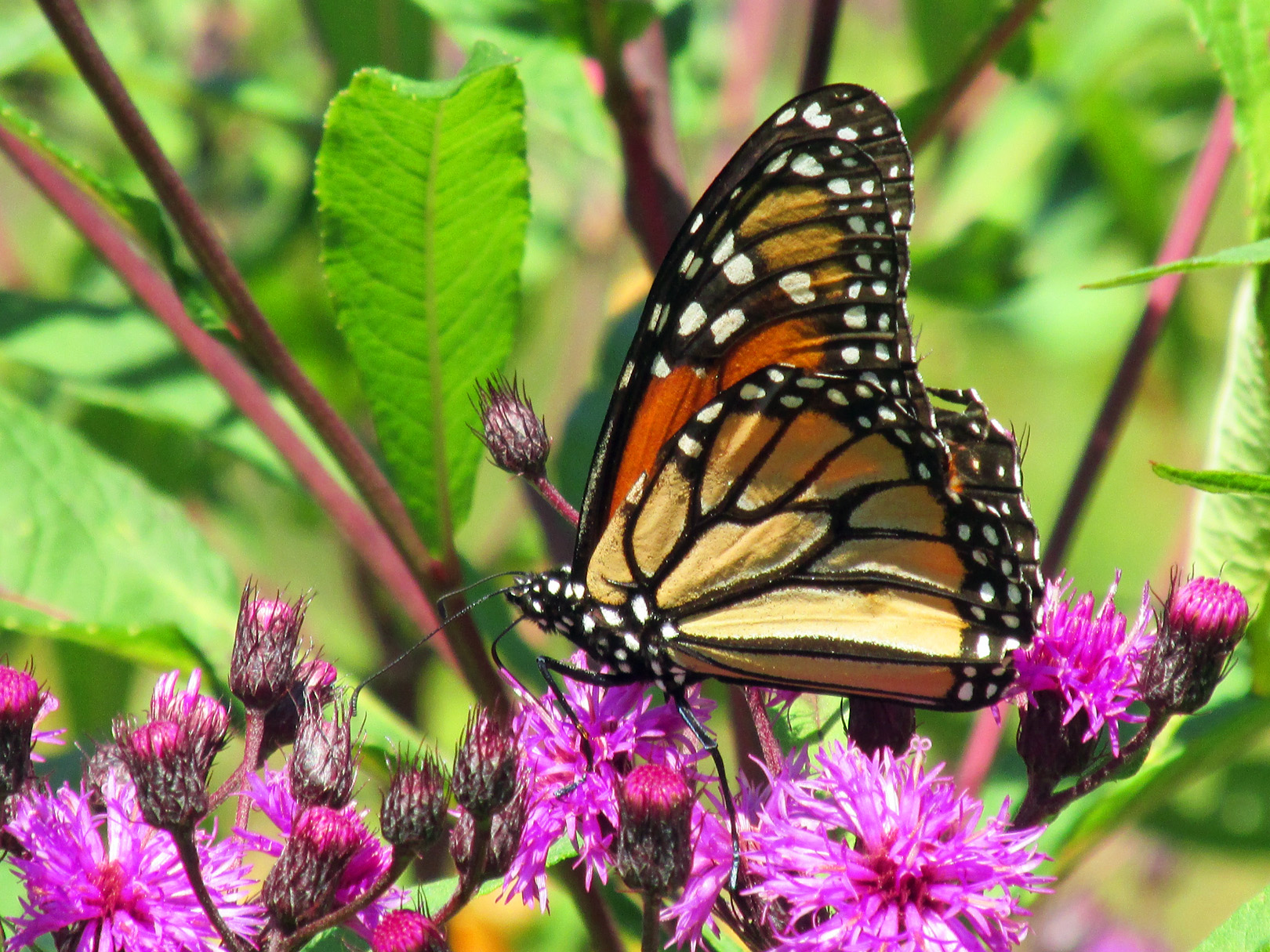
Photo by Bryan Stevens
A Monarch sips nectar from blooming Ironweed. Butterflies are important pollinators for many plants.

Blue of indigo bunting’s plumage is a trick of the light

Photo by Bryan Stevens • The male indigo bunting is a resplendent bird.

The indigo bunting is one of the reasons I love to pay attention to the clientele visiting my feeders. This small songbird likes to reside in the boundary region where forests and woodlands meet fields and pastures. Personally, the indigo bunting has always been a bird that is suggestive of the long, hot days of summer.

One of my earliest and still quite vivid birding memories is a recollection of a shockingly blue bird atop a blue spruce tree in my yard. Several decades later, the tree is no longer standing, but these beautiful birds — I now know these summer visitors were indigo buntings — still return each year to my yard and gardens.

Indigo buntings usually arrive in the region in late April, and I’ve seen them linger until late October, although most indigo buntings have left the region by late September.

Upon arrival, male indigo buntings become tenacious singers, repeating their jumbled notes even during the hottest hours of summer afternoons. The preference of this small songbird is to sing from the tops of tall trees, where they are often concealed by the green leaves. When I do get a glimpse of the obscured songster, often all I see is a dark shape silhouetted against the bright sky. Sometimes, if he plunges from the upper branches into the woodland understory, I get that telltale glimpse of blue feathers.

Photon by Bryan Stevens • Indigo Buntings will perch on wires and sing for hours even during hot summer days.

The male indigo bunting is the only solid blue bird in the eastern United States, but it’s all an illusion — literally a trick of the light. The indigo bunting’s feathers are not really blue; the male’s brilliant azure plumage is caused by the process of diffraction of light around the structure of the bird’s feathers. This process scatters all but the blue light, and the resulting color shifts from black to blue to turquoise as the angle of reflected light changes. In bright light, it can even look unnaturally vivid blue. In poor light, however, an indigo bunting male can appear black. Fortunately, indigo buntings have both a characteristic body shape and song, so even if the birds are not seen at their best, they can still be recognized.

Soon after returning to the eastern United States each spring, female buntings begin to gather materials to construct a well-crafted, cup-shaped nest. The male usually stays close to her, but he offers no assistance with nest building. She usually lays a clutch of three to four eggs, but she may nest another two times in a single season. She will incubate the eggs for almost two weeks, but the young remain in the nest another two weeks after being hatched as featherless, blind and helpless young completely dependent on the care of attentive parents. The task of raising so many broods in the space of only a few months requires the participation of both the female and her mate, who must work hard to bring enough insects to the nest to keep the young fed.

Like many species of songbirds, the male is by far the most colorful. In this instance, the male is also responsible for the species’ name. Indigo is a blue dye that was once an important crop in the South. The drab female may boast some blue highlights in her plumage. Juvenile birds just out of the nest also resemble the female. Pay close attention to any indigo buntings you observe as summer progresses. Juvenile birds will look mostly brown with just a hint of blue in the wings and the tail. These will be the young buntings that were hatched in spring and early summer. They will often accompany their parents to feeders.

Photo by Dan Sudia/USFWS • Female and young indigo bunting do not show the intense blue of adult males.

Indigo buntings are particularly fun birds to observe in late summer. Indigo bunting juveniles, like the young of many other birds, beg for tidbits from parents by “bowing,” spreading their wings and shivering. These actions usually prompt a parent to pop some morsel into an impatient youngster’s open bill. Indigo buntings are relatively easy to view. They frequent weedy fields and roadside brush. During the breeding season, males can also be seen singing from prominent perches. The song, a distinctive jumble of notes, can help observers find these dedicated singers.

The indigo bunting belongs to a genus of birds known as Passerina, which is included the family Cardinalidae, which includes birds like Northern cardinal and rose-breasted grosbeak. They are often lumped into a group known as North American buntings, although they are not closely related to such birds as snow bunting and lark bunting. The latter is even recognized as the official state bird for Colorado, a unique honor for this group of birds. The other members of the Passerina genus include lazuli bunting, varied bunting, painted bunting, rose-bellied bunting, orange-breasted bunting and blue grosbeak.

Worldwide, other birds known as buntings include such descriptively named species as slaty bunting, corn bunting, white-capped bunting, gray-necked bunting, cinereous bunting, lark-like bunting, cinnamon-breasted bunting, chestnut-eared bunting, little bunting, yellow-throated bunting, golden-breasted bunting, black-headed bunting, red-headed bunting and yellow bunting.

Photo by Bryan Stevens • Although bright blue, a male indigo bunting will often blend with its surroundings.

The male indigo bunting is one of the most colorful birds to visit feeders in the region. This species is also extremely fond of millet seed. I like to have some feeders stocked with millet when the buntings begin to return each spring. They will also feed on thistle and sunflower seeds. Away from our feeders, they also devour plenty of seeds from various noxious weeds. Because of the indigo bunting’s appetite for the seeds of destructive weeds, it is considered a beneficial bird.

78th annual Spring Bird Count for NE Tennessee finds 153 species

Photo by Ray Miller/Pixabay • One of my more exciting finds during the recent Spring Bird Count was a male red-breasted merganser from the TVA Overlook at Watauga Lake. Other count participants managed to locate another four red-breasted mergansers in the count area.

The 78th consecutive Elizabethton Spring Bird Count was held Saturday, May 1, covering Carter County plus parts of the adjacent counties of Johnson, Sullivan, Unicoi and Washington.

With 40 observers in 13 parties, plus four feeder watchers, coverage of the count areas was extensive. Participants enjoyed a beautiful sunny day, although most areas had temperatures that had dipped into the upper 30s at sunrise. The day gradually warmed and got into the 70s.

Participants tallied 153 species, which is slightly above the recent 30 year average of 150 species. The all-time high on this count was 166 species and was set in 2016.

Some exceptional finds in Unicoi County included a red-headed woodpecker along the section of the linear trail near the McDonald’s. Each of the five counties in the region produced some good birds for this long-running survey.

Count participants included Fred Alsop, Rob Armistead, Betty Bailey, Gary Bailey, Jerry Bevins, Rob Biller, Ron Carrico, Catherine Cummins, Todd Eastin, Glen Eller, Harry Lee Farthing, Bambi Fincher, Dave Gardner, Tammy Griffey, Jean Henson, Neal Henson, Jacki Hinshaw, Lance Jessee, Jennifer Kennedy, David Kirschke, Rick Knight, Roy Knispel, Richard Lewis, Dianna Lynne, Vern Maddux, Frank McCollum, Larry McDaniel, Joe McGuiness, Cathy McNeil, Tom McNeil, Harry Norman, Susan Peters, Brookie Potter, Jean Potter, Sherrie Quillen, Pete Range, Judi Sawyer, Chris Soto, Michele Sparks, Bryan Stevens, Peggy Stevens, Kim Stroud, Charles Warden and Rex Whitfield.

Rick Knight, the long-time compiler for the count, made note of some of the misses, which included pied-billed grebe, common nighthawk, Acadian flycatcher (just the seventh miss in last 50 years), loggerhead shrike, horned lark, summer tanager and bobolink.

He also made some observations about other count finds.

• One species – brown-headed nuthatch – made its official count debut. Another – evening grosbeak – returned to the count after being absent since the spring of 2000.

• The American robin edged out the European starling for most common bird. Counters tallied 801 robins compared to 618 starlings.

• For only the sixth time in the last 18 years, Northern bobwhite made it onto the count. A single ruddy duck became only the second record for this waterfowl on the spring count. Also making only its second appearance on the spring count was willet, a species of shorebird that only migrates through the region.

• Some species appear to have moved into the region for good. Fish crows have been found the last five of the past six years, and Eurasian collared-doves have been found every year for the past 15 years.

• An amazing 29 species of New World warblers were found this year, including prothonotary warbler for only the third time in the last 15 years.

The total follows:

Canada goose, 412; wood duck, 31; mallard, 89; blue-winged teal, 13; bufflehead, 6; hooded merganser, 1; red-breasted merganser, 5; and ruddy duck; 1.

Ruffed grouse, 4; wild turkey, 28; common loon, 2; double-crested cormorant, 48; great blue heron, 69; green heron, 17; black-crowned night-heron, 2; and yellow-crowned night-heron, 5.

Black vulture, 60; turkey vulture, 128; osprey, 10; sharp-shinned hawk, 1; Cooper’s hawk, 6; bald eagle, 11; broad-winged hawk, 11; and red-tailed hawk, 21.

Virginia rail, 2; sora, 2; killdeer, 32; spotted sandpiper, 32; solitary sandpiper, 31; greater yellowlegs, 3; willet, 10; lesser yellowlegs, 2; and Wilson’s snipe, 1.

Bonaparte’s gull, 9; ring-billed gull, 6; rock pigeon, 106; Eurasian collared-dove, 6; mourning dove, 284; and yellow-billed cuckoo, 4.

Eastern screech owl, 13; great horned owl, 1; barred owl, 2; Whip-poor-will, 27; and chuck-will’s-widow, 16.

Chimney swift, 92; ruby-throated hummingbird, 34; belted kingfisher, 14; red-headed woodpecker, 4; red-bellied woodpecker, 125; yellow-bellied sapsucker, 7; downy woodpecker, 44; hairy woodpecker, 9; Northern flicker,41; and pileated woodpecker, 55.

American kestrel, 9; Eastern wood-pewee, 6; least flycatcher, 5; Eastern phoebe 119; great crested flycatcher, 12; and Eastern kingbird, 59.

White-eyed vireo, 15; yellow-throated vireo, 15; blue-headed vireo, 76; warbling vireo, 1; red-eyed vireo, 228; blue jay, 329; American crow, 358; fish crow, 1; and common raven, 20.

Northern rough-winged swallow, 95; purple martin, 71; tree swallow, 235; barn swallow, 218; and cliff swallow, 473.

Carolina chickadee, 139; tufted titmouse, 199; red-breasted nuthatch, 10; white-breasted nuthatch, 43; brown-headed nuthatch, 2; and brown creeper, 5.

House wren, 60; winter wren, 5; marsh wren, 1; Carolina wren, 202; blue-gray gnatcatcher, 75; golden-crowned kinglet, 6; and ruby-crowned kinglet, 4.

Eastern bluebird, 157; veery, 17; hermit thrush, 3; wood thrush, 80; American robin, 801; gray catbird, 80; brown thrasher, 66; Northern mockingbird, 121; European starling, 618; and cedar waxwing, 15.

Photo by Jean Potter • A male hooded warbler flits through the foliage of a rhododendron thicket.

Ovenbird, 157; worm-eating warbler, 35; Louisiana waterthrush, 29; Northern waterthrush, 5; golden-winged warbler, 2; black-and-white warbler, 79; prothonotary warbler, 1; Swainson’s warbler, 7; Nashville warbler, 1; Kentucky Warbler, 2;  common yellowthroat, 20; hooded warbler, 163; American redstart, 11; Cape May warbler, 6; Northern parula, 53; magnolia warbler, 4; bay-breasted warbler, 1; Blackburnian Warbler, 13; yellow warbler, 16;  chestnut-sided warbler, 17; black-throated blue warbler, 77; palm warbler,  5; pine warbler, 15; yellow-rumped warbler, 16; yellow-throated warbler, 25; prairie warbler, 4; black-throated green warbler, 95; Canada warbler, 18; and yellow-breasted chat, 9.

Photo by Bryan Stevens • The male indigo bunting is a resplendent bird.


Eastern towhee, 213; chipping sparrow, 117; field sparrow, 79; Savannah sparrow, 4; grasshopper sparrow, 1; song sparrow, 299; swamp sparrow, 9; white-throated sparrow, 27; white-crowned sparrow, 8; dark-eyed junco, 68; scarlet tanager, 96; Northern cardinal, 359; rose-breasted grosbeak, 36; blue grosbeak, 2; and indigo bunting, 62.

Red-winged blackbird, 550; Eastern meadowlark, 82; common grackle, 324; brown-headed cowbird, 99; orchard oriole, 29; and Baltimore oriole, 18.

House finch, 84; pine siskin, 31; American goldfinch, 283; evening grosbeak, 48; and house sparrow, 70.

Ovenbird part of the returning warbler lineup

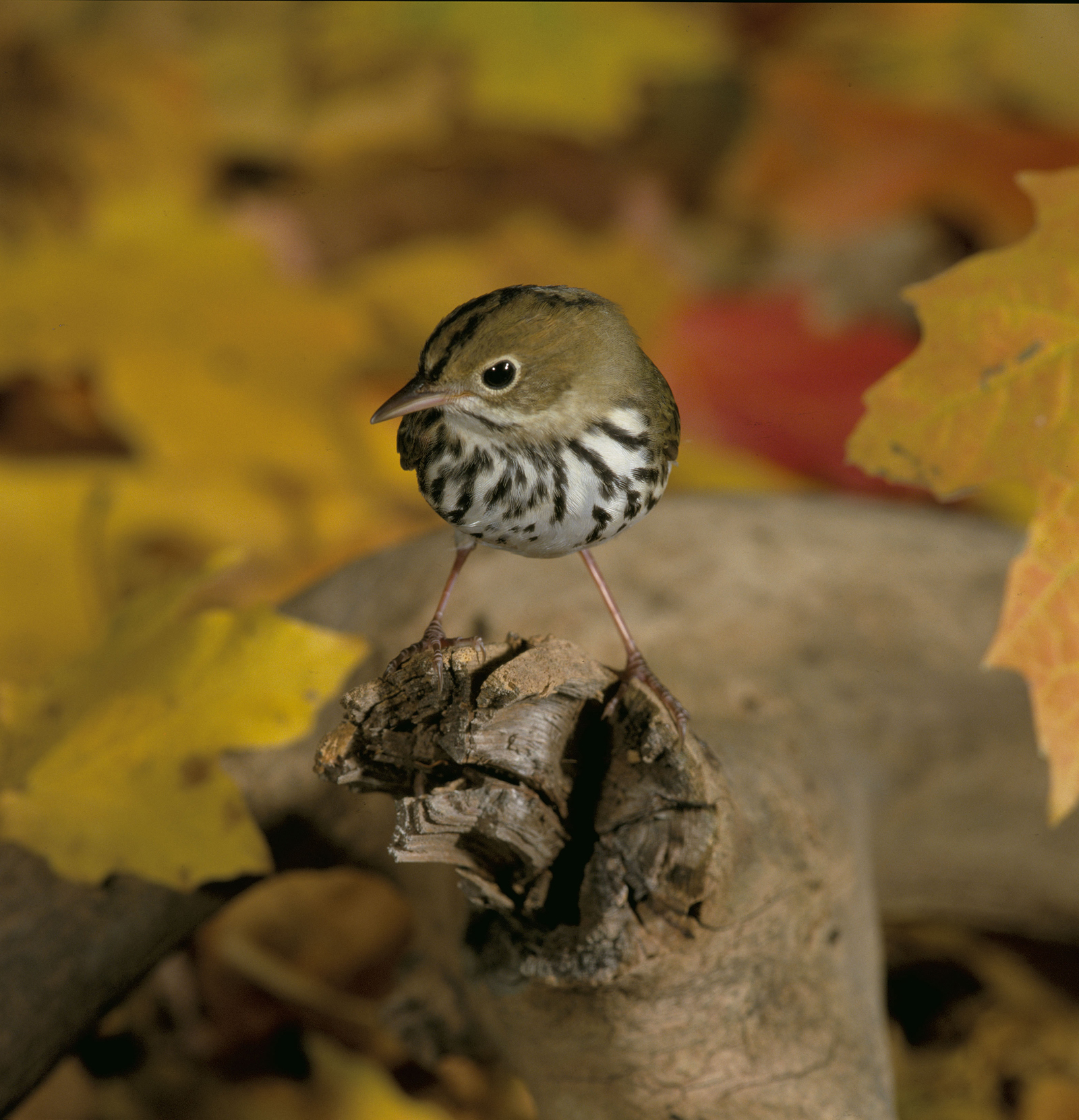
Photo by U.S. Fish & Wildlife Service • Ovenbirds are content to spend most of their time near the forest floor.

It’s been a week of arrivals at my home. Several species of warblers made their spring debuts, including a handful of male ovenbirds.

These warblers arrived on April 14 and immediately began singing their loud and ringing “Teacher! Teacher! Teacher!” song from concealment within the woodlands surrounding my home.

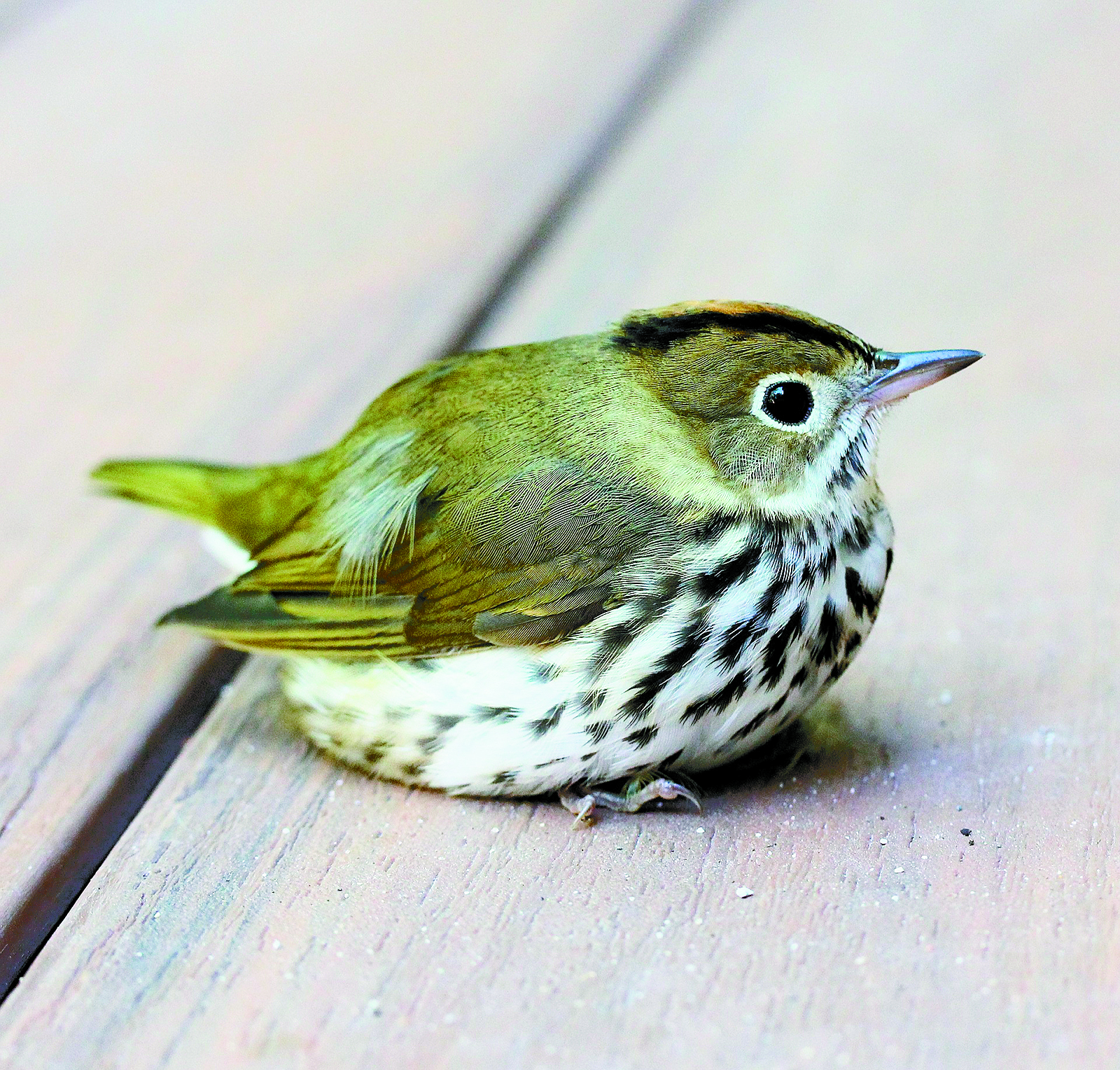
The ovenbird is not one of the brightly colored warblers, such as black-throated blue warbler or yellow warbler. The ovenbird is a small brown bird with a white breast with dark streaking — an appearance that bears a superficial resemblance to the larger thrushes that share the same woodland habitat. The only hint of color is an orange crown bordered by dark stripes atop the bird’s head. Even this orange crown patch is not easily seen. When agitated, an ovenbird may raise its head feathers, which makes this orange mark easier to detect. The ovenbird also shows a distinct white ring around each eye, as well as pink legs and a pinkish bill.

The resemblance to North America’s brown thrushes didn’t go unnoticed by some early American naturalists. Painter and famous naturalist John James Audubon painted a pair of ovenbirds, which he knew as “golden-crowned thrushes.” When comparing the two names, one can’t help but wish that the inaccurate but more romantically descriptive golden-crowned thrush had stuck.

While not likely to take an observer’s breath away with an unexpected explosion of vibrant plumage, the ovenbird’s not a drab bird. These warblers possess a subtle beauty all their own that is worth taking the time to behold.

Photo by Peggy Dyar from Pixabay • Despite the oliver-brown plumage, a closer look shows that the overbird is a bird with a subtle beauty, including an inconspicuous orange crown.

Unfortunately, ovenbirds are stubborn about letting themselves be seen. They’re easily heard. The males begin singing a loud, rollicking “Teacher! Teacher! Teacher” song almost as soon as they arrive on potential nesting grounds.

The ovenbird, unlike many warblers, is not named for its appearance. Instead, the bird’s name derives from the shape of the nest it builds. The nest is a domed structure placed on the ground, woven from vegetation and containing a side entrance. Early European settlers in North America thought the nest looked like a Dutch oven, hence the name “ovenbird” for the small warbler with the intricate nest.

Rather than hopping along the length of a branch or limb, an ovenbird walks in a deliberate fashion. This bird feeds on insects, spiders and other small prey items foraged from the woodland floor. On rare occasions, a lingering ovenbird shows up at feeders during the winter months.

Again, the most persistent characteristic of this warbler is the fact that it’s shy. It’s not as notoriously shy as warblers like mourning warbler of Connecticut warbler, but the ovenbird spends much of the time near the woodland floor and out of sight. The best time to catch a look at this warbler is once they begin nesting. Parents are extremely protective and defensive of their nest and young. Intruding too close is sure to bring some sharp alarm notes. The parents will often confront an intruder, flitting from branch to branch in nearby trees, utterly neglecting their usual preference for remaining unseen if not unheard.

Photo by Jean Potter • An ovenbird sings from a perch in the leaf canopy.

Ovenbirds spend the summer nesting season in mature deciduous and mixed forests across Canada and the eastern United States. They do not make as lengthy a migration as that undertaken by some of their relatives. Ovenbirds migrate each fall to the southeastern United States, the West Indies and also spreads out from Mexico to northern South America for the winter season.

It’s one of several warblers that nest in Northeast Tennessee and Western North Carolina. Others include Louisiana waterthrush, Kentucky warbler, common yellowthroat, Swainson’s warbler, black-throated blue warbler and American redstart, among others.

•••••

My mom saw her first hummingbird of spring on April 16 at 9:34 a.m. Of course, the bird waited until I’d left for work to make an appearance.

My solace has been an influx of other migrants in the past week. A blue-gray gnatcatcher’s fussy buzz alerted me to its return on April 10. I eventually got binoculars focused on the fidgety bird as it flitted in the upper branches of a cherry tree.

I heard the familiar chittering cries overhead while walking in downtown Erwin on April 14. Looking skyward, I watched a flock of chimney swifts flying gracefully over the rooftops of downtown buildings.

New warblers at home this week, other than the ovenbird, have included hooded warbler and black-throated green warbler, both of which put in their first spring appearance on April 15.

•••••

As noted, hummingbirds are returning. I’ve had reports from Western North Carolina and all across Northeast Tennessee. I will compile a listing of those who have shared their first sightings with me for next week’s column.
Keep sharing your hummingbird observations at ahoodedwarbler@aol.com or post them on my Facebook page. Please include the date and the approximate time of your sighting.

Tree swallows are the latest spring arrivals

Photo by Bryan Stevens • A tree swallow checks out a nesting box soon after returning in the spring.

Waiting for spring? Join the club. Between alternating bouts of unseasonably warm temperatures and frigid blasts, the weather cannot seem to decide if winter’s hanging in there a little longer or if it’s time to proceed with spring’s arrival.

I’m hopeful it’s the latter. I enjoyed a stroll in the spring sunshine on March 30 along the section of the trail near the industrial park. From the boardwalk over the water I saw my first spring swallows (a purple martin and a couple of Northern rough-winged swallows) as well as a belted kingfisher and several American robins. I also saw my first dragonflies and butterflies of spring, as well as one muskrat enjoying a leisurely swim.

Early Birds

One might think that the wild swings in weather would translate into a messy arrival timetable for some of our returning birds, but so far my own personal observations indicate a different story. At home, the usual spring “early birds,” including wood duck, red-winged blackbird, blue-headed vireo, ruby-crowned kinglet and brown thrasher, have been their usual punctual selves.

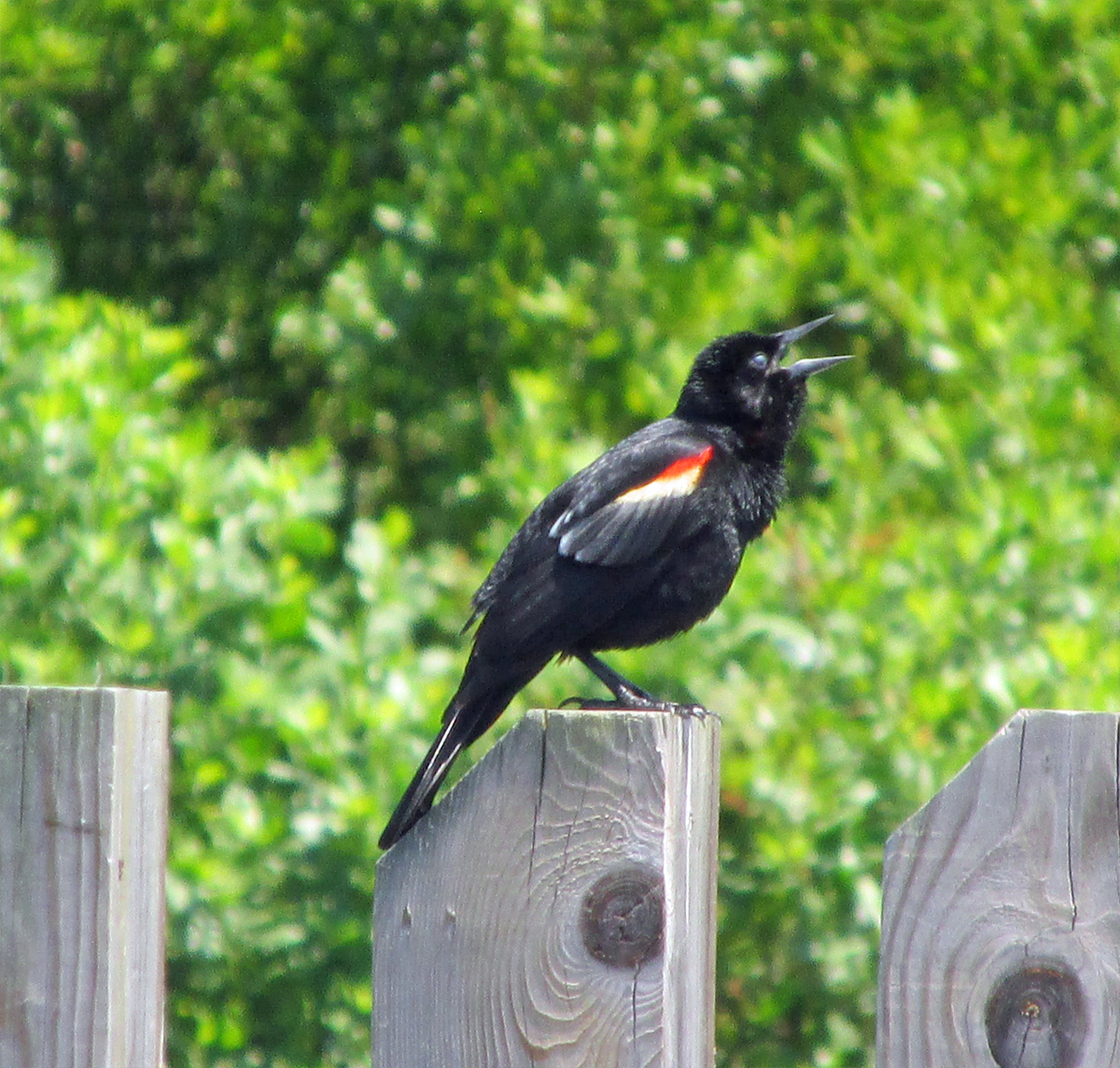
Photo by Bryan Stevens • A male red-winged blackbird sings to attract mates and ward off rivals.

The swallows I saw during my Erwin stroll, however, reminded me that one bird hasn’t returned at my home. The early American naturalist and artist John James Audubon knew this particular bird as “white-bellied swallow,” which is a descriptive name, but today the species is known simply as tree swallow.

Tree swallows have been back in the region for weeks, but they sometimes take their time finding their way to the waiting birdhouses at my fish pond. Their return dates in years past have ranged from early March to the middle of April.

Insect-heavy Diet

Swallows are insectivores, so those that return early in the spring must deal with temperature fluctuations. In prolonged cold spells, these insect-eating birds can be hard pressed to locate their usual prey. At such times, they are often forced to retreat to the area’s lakes and larger rivers, where they can swoop over the water and have an easier time plucking cold-numbed flying insects out of the air.

Once milder spring temperatures prevail, the flocks of swallows forced into these necessary habitats will disperse as pairs begin seeking nesting sites. Tree swallows are cavity-nesting birds, which often puts them into competition with Eastern bluebirds. The two species usually manage to work out a truce and settle down to nest in close proximity to each other.

The iridescent blue-green male tree swallow, complete with white underparts and a forked tail, is a handsome bird and a welcome addition to the bird population in any yard or garden. Tree swallows enjoy water, so a nearby pond or creek is a boon for attracting these birds.

Tree swallows haven’t always nested in Northeast Tennessee. Only in the last 40 years have these birds become regular nesting birds in the region. The first nesting record took place in the early 1980s at Austin Springs on Boone Lake in Washington County, Tennessee, according to The Birds of Northeast Tennessee by Rick Knight. Tree swallows soon became regular nesting birds every summer in all five counties that comprise Northeast Tennessee.

Other Swallows

It’s usually not too difficult to find five of the six species of swallows that are known to make Northeast Tennessee and Western North Carolina their home from spring to fall. In addition to tree swallow, the region’s other swallow species include: barn swallow, purple martin, cliff swallow and northern rough-winged swallow. These are all fairly common summer birds in the region. The sixth species, the bank swallow, is a bit of a specialist when it comes to nesting and occurs only sporadically in the region.

While only a handful of swallows range into the United States and Canada, a total of 83 species of swallows can be found worldwide. Some of the common names for these different swallows (also called martins in other parts of the world) are quite descriptive. A sampling includes white-eyed river martin, grey-rumped swallow, white-backed swallow, banded martin, blue swallow, violet-green swallow, golden swallow, brown-throated martin, brown-bellied swallow, pale-footed swallow, white-bibbed swallow, pearl-breasted swallow, red-breasted swallow, mosque swallow, fairy martin, pale martin, tawny-headed swallow and streak-throated swallow.

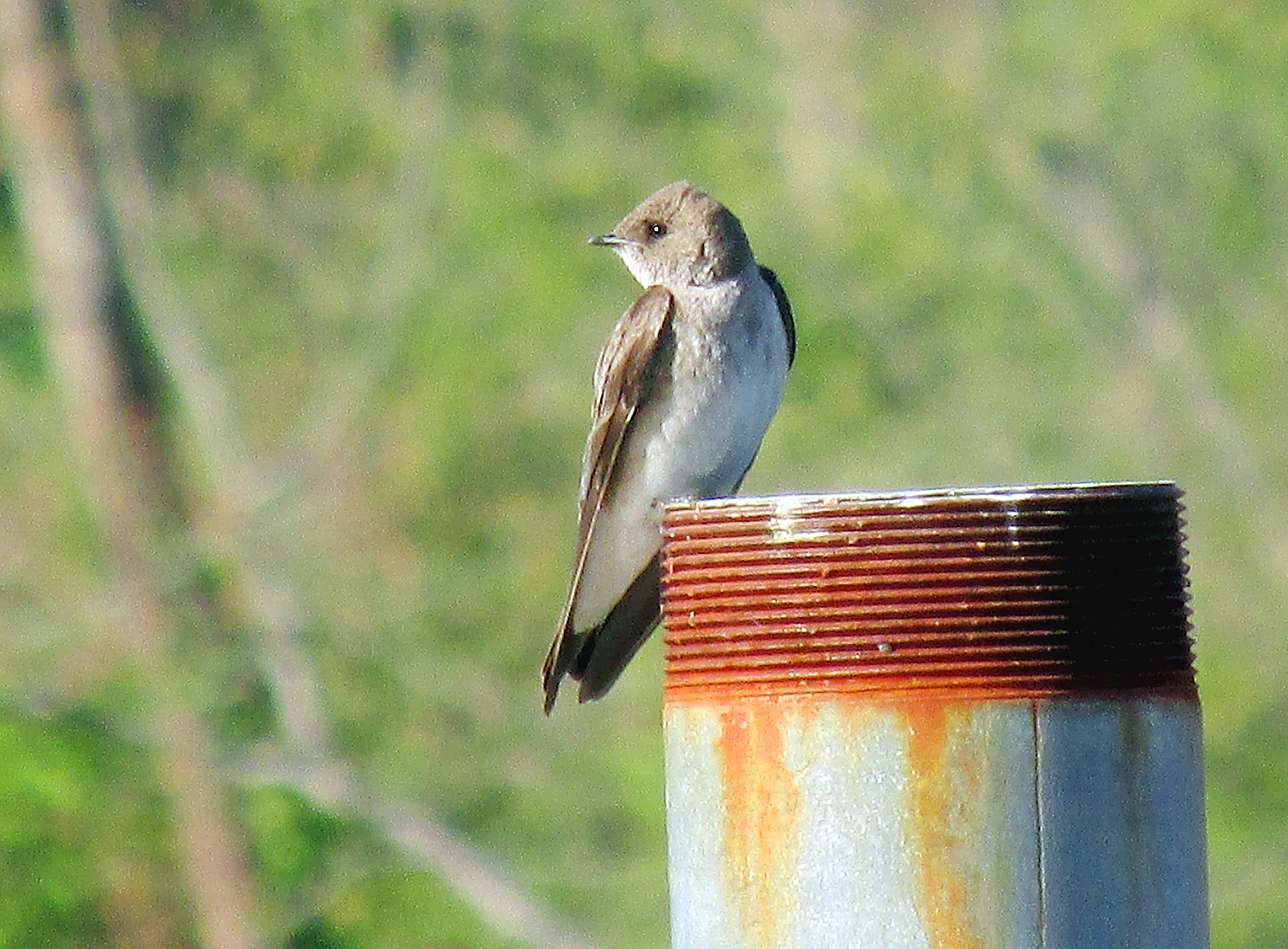
Photo by Bryan Stevens • A Northern rough-winged swallows perches on a metal pipe.

While many swallows and martins have proven highly adaptive when faced with human disturbances to their habitat, a few species have experienced declines. One species — the white-eyed river martin — was last seen in Thailand in the 1980s and very well may be extinct. Closer to home, the golden swallow is now found only on the island of Hispaniola after disappearing from Jamaica in the 1980s. The Bahama swallow, which nests on only four islands in the Bahamas, is also vulnerable. Incidentally, both these swallows are closely related to the tree swallow, with all of them belonging to the genus Tachycineta. Translated from Greek, the genus name means “fast mover,” a quite accurate description of these graceful and agile flyers.

Good 

Neighbors

With their enthusiastic twittering to each other, tree swallows make for friendly neighbors. The local bluebirds may disagree, at first, but they’ll get their feathers unruffled eventually. It’s also a pleasant diversion to watch them swoop over fields and ponds as they help control the insect population.

To increase your chances of hosting your own tree swallows, offer a bird box placed in an open area. Right now is the time to attract their attention with some prime real estate. Plans are available online to help construct your own or pick up one at a gardening center, hardware store or farm supply outlet.

Photo by Bryan Stevens • A male Eastern Bluebird perched on playground equipment at Winged Deer Park in Johnson City.

Many would-be hosts for Eastern bluebirds express disappointment when a pair of tree swallows become tenants instead. The remedy to the disappointment is simple: provide an additional nesting box.  Although there will be some initial squabbles, tree swallows and Eastern bluebirds will co-exist if they don’t have to compete for the same nesting box.

There’s one last selling point I want to mention on behalf of tree swallows. While not exactly songsters, they do produce an energetic, chirpy trill that they vocalize persistently when in the company of their fellow tree swallows. It’s hard not to be cheerful when hearing such a jubilant noise issuing from one of our feathered friends.

Hummingbird Observations

While tree swallows and their kin are great to have back, one of the most anticipated returns each year is the ruby-throated hummingbird. As I’ve done in years past, I want to hear from readers when they see their first hummingbird of spring. Email me your observations at ahoodedwarbler@aol.com or post them on my Facebook page. Please include the date and the approximate time of your sighting. Email me at ahoodedwarbler@aol.com or post on my Facebook to share your first sightings. You can also leave a comment here on the blog.

Nature Challenge event easy with a phone, keen eye for details

Photo Illustration by nayansolanki/Pixabay • A phone will be helpful during the upcoming iNaturalist City Nature Challenge.

Many new arrivals are making spring an exciting time for birders. At my home, Eastern phoebes have been back for several weeks. They make quite the racket every morning with their incessant “fee-bee” calls that commence just after sunrise. A pair of wood ducks made a stopover at the fish pond on March 16. By the end of the month, swallows, warblers, vireos and perhaps even hummingbirds should start showing up.

If you like to record and document these yearly returns, there is also a way that your record-keeping can benefit science and its knowledge of the world around us. Anyone with a phone or a computer with internet access can take part in an upcoming survey of flora and fauna in Northeast Tennessee.

Organizers for the upcoming iNaturalist City Nature Challenge point out that a cellphone can be a great citizen science tool.

The extent of the Challenge goes far beyond East Tennessee. The iNaturalist City Nature Challenges pits cities around the world against each other in a rivalry to see who can report the most observations of wild flora and fauna during a four-day period.

One of the world’s most popular nature apps, iNaturalist helps users identify the plants and animals they encounter on a daily basis. Get connected with a community of over a million scientists and naturalists who can help everyone learn more about nature. What’s more, by recording and sharing observations, users of the app help create research quality data for scientists working to better understand and protect nature. iNaturalist is a joint initiative by the California Academy of Sciences and the National Geographic Society.

Before the end of April, interested naturalists are urged to download and learn to use the iNaturalist app to contribute to scientific knowledge of Northeast Tennessee trees, plants and animals.

Melanie Kelley, a volunteer with Johnson City Parks and Recreation, has helped organize this year’s City Nature Challenge.

“JCPR is the main City Nature Challenge organizer for our ten county area,” Kelley said.

Parks in other locations are also participating. For instance, Warriors Path State Park in Kingsport is participating, according to Marty Silver, a ranger with WPSP.

According to Kelley, other parks and groups are co-organizers for the event.
Kelley said that taking part in the challenge is simple.

A smartphone or computer is needed to input the data.

“Using either a phone with the iNaturalist app or uploading photos to the http://www.inaturalist.org website, everyone is invited to go out and record wild species,” Kelley said. “From birds to grasses, trees to snakes.

“Wild is the key,” she added. “Any place it can be found! Backyards, schools, parks and gardens.”
Kelley said the City Nature Challenge is a global effort to get a worldwide snapshot of all life on earth during a four-day period.

“It is the world’s largest multi-species BioBlitz,” Kelley said.

Identifications are also crucial, according to Kelley. “This part of the challenge encourages folks to log into the website and review and confirm identifications of what others have uploaded,” she said.

Kelley noted that iNaturalist requires users to be 13 or older but that there is a parental consent method for younger users for both the app and the website.

“Each participating park/group will likely have their own age rules,” she noted.

“Last year was the first year JCPR participated in the CNC,” Kelley said. “If COVID-19 was not an issue, the CNC would be back to its roots as a direct city to city or area to area challenge.”

The rivalries can get intense.

“Last year, our good friends at Zoo Knoxville directly challenged us, so it was Knox vs Washington Counties,” Kelley said. “It was also the first year Knox participated. “

Kelley said that JCPR and Zoo Knoxville knew they would expand their areas after their first successful year taking part in the challenge.

“This allows us to better compete with Nashville’s seven-county project and Chattanooga’s 16 counties over two states,” Kelley explained.

She hopes the COVID-19 shadow over the event is felt less this year.

“Last year, we had daily group events scheduled and all those, of course, had to be cancelled,’ Kelley said.

“This year, the main CNC is again, less of a competition and more of a collaboration worldwide,“ she said. “However, this year, under a hybrid model, those that wish to have head to head challenges can do so. Oh, and yes, we do so want to take on Knox, which includes the Great Smoky Mountains National Park. We can do this!”

Kelley said that expanding the project area to the upper ten Northeast Tennessee counties means partnering with local state and city parks.

Some of the other parks on board include Bristol’s Steele Creek Park, Kingsport’s Warrior’s Path, Elizabethton’s Sycamore Shoals and Roan Mountain’s Roan Mountain State Park.

Kelley noted that Johnson City Parks are all planning on some type of group-led events to help folks who are new to iNaturalist get their feet wet with the program.

“Each park will have its own guidelines as to how they need to handle such events,” she added.

The upcoming event is both valuable to science and an entertaining way to enjoy nature.
“Overall, as a regular iNaturalist user, it is fun,” Kelley said. “More importantly to me, it is such a great way to introduce folks to the native world.

“People walk by and see a flower or a tree or anything and they probably don’t know what it is other than a bird/flower/tree,” she continued. “The app has a really good identification tool where you learn right there what that species is.”

Once identification is made easy, Kelley said that the next big challenge is getting them to the next step of understanding that species role in the larger ecology.

“This is where these group-led observation hikes play a critical role,” she said.

Kelley said that plenty of reports that show up from iNaturalist users are from Unicoi County.
She noted that there are some 4,552 individual observations recorded from Unicoi County.

“These observations represent 1,339 unique species have been recorded by 404 individual iNaturalist users,” Kelley said.

The possibilities of what can be observed and reported are seemingly endless. Everything from birds and insects to salamanders and ferns is fair game as observers scramble to make reports. Grab a phone and start taking snapshots of snakes, squirrels, sassafras trees or anything else that crosses your path. Organizers hope to get plenty of public participation for this year’s City Nature Challenge.

Kelley also quoted Doug Tallamy, a professor in the department of entomology and wildlife ecology at the University of Delaware, where he has authored eighty research articles and has taught numerous classes, including behavioral ecology and humans and nature, for more than 30 years.

Kelley said that Tallamy has been quoted saying, “Knowledge generates interest, and interest generates compassion.”

She added that iNaturalist is a great way to generate knowledge.

“Birders can upload a spreadsheet from their eBird reports for the event days and those will count in our totals,” Kelley said. “These are the only observations made during the CNC that do not require photos to count.”

Observations for the challenge must be submitted between April 30 and May 3. All observations are required to be found within the upper 10 northeast Tennessee counties of Washington, Sullivan, Unicoi, Carter, Greene, Johnson, Hancock, Cocke, Hawkins and Hamblen.

To learn more about the event, Unicoi County residents or people living in or near Northeast Tennessee can visit https://bit.ly/CityNatureChallengeNETN.

Below are events corresponding with the challenge:

• Warriors Path State Park in Kingsport will offer City Nature Challenge 2021, a friendly competition open to nature lovers. The main event at the park will be held Saturday, April 10, from 10 a.m. to noon. The park’s event is sort of an informative preview of the actual Challenge. Observations for the challenge itself must be submitted between April 30 and May 3. Ranger Brian Glover will teach participants how to use the iNaturalist app to photograph, identify, and share their nature observations with a worldwide community of scientists and nature enthusiasts. He’ll also show those taking part how to join the region’s 2021 City Nature Challenge. Be sure to download the iNaturalist app from your app store, and create an iNaturalist account before arriving at the event. Come dressed for the weather and wear good walking footwear. This is not a hike, but attendees will be wandering over some rocky and uneven ground.

• Sycamore Shoals State Historic Park in Elizabethton will offer an educational hike about better ways to enjoy interacting with nature through handy apps and tools on the average smart phone. “Tech in Nature” will be taught by Park Ranger Cory Franklin from 2 to 3 p.m. on Friday, March 26. Most people are inseparable from their smart phones and mobile devices. Franklin wants participants to embrace this cultural change and will show how to better use technology on a day to day basis in nature. Using tools such as GPS locating, plant identification and other easily accessible resources and apps, he will show ways to enhance the experience rather than take away from it. Join him for a walk around the park to better understand the tools everyone carries with them daily. The program will meet and begin at the picnic area beside the visitor center. Cost is $5, but those six and under can participate for free. For more information, call 543-5808.

Note: Although this event has already happened, perhaps Sycamore Shoals will offer this walk again in the future.

•••••

Photo by Bryan Stevens • A male Ruby-throated Hummingbird perches for a leisurely drink of sugar water.

As mentioned at the start of the column, spring is bringing back many of our favorite wildflowers, insects and, of course, birds. One of the most anticipated returns each year is the ruby-throated hummingbird. As I’ve done in years past, I want to hear from readers when they see their first hummingbird of spring. Email me your observations at ahoodedwarbler@aol.com or post them on my Facebook page. Please include the date and the approximate time of your sighting.

This year, there’s more incentive to share your sighting. The Erwin Record and Jonesborough Herald & Tribune will be giving away a hummingbird-related prize from a drawing of all the individuals who report hummingbirds. If you don’t happen to be one of the lucky people to see one of the first hummingbirds of 2021, don’t worry. To be eligible for the contest, email me at ahoodedwarbler@aol.com or post on my Facebook page a sentence or two explaining why you love hummingbirds.

Observations will be accepted through April 18. Winners will be announced in this column on April 28.

Getting ready for the spring migration of birds

It’s already the middle of March. While birds don’t follow calendars, they are punctual, and thanks to their boundless energies, the grand spectacle of spring migration is already upon us. The pace will quicken in April and early May as many of our favorite summer birds, including species ranging from hummingbirds and warblers to swifts and swallows, wing their way back to the region.

A few will stay, pair with a mate and begin the nesting season in earnest while others will continue toward destinations farther north. For fellow bird enthusiasts, now is the time to conduct some spring tasks to make our feathered friends feel more welcome when they do return.

Place birdhouses
Many birds are cavity-nesting species, which means they utilize natural nooks and crannies as locations for nests. Nesting in a natural tree cavity or in a human-provided birdhouse offers an extra degree of security not available to birds that build traditional cup-shape nests, not to mention all the birds that simply lay their eggs right on the ground without going to much effort to construct an actual nest.
Some of the cavity-nesting species in the region that will readily accept quarters in a bird house include Carolina chickadee, Eastern bluebird, white-breasted nuthatch, tree swallow, tufted titmouse, great crested flycatcher, prothonotary warbler and house wren.
Cavity-nesting isn’t restricted to songbirds. Wood ducks, Eastern screech-owls and American kestrels will make use of birdhouses built to their unique specifications.
Plans for constructing your own bird houses tailored to individual species can be found at various online sites. For those not as good with do-it-yourself projects, department stores, gardening centers and other other shops sell a variety of pre-made houses.

Put hummingbird
feeders out early
Journey North, a website that tracks the annual migration of hummingbirds as well as other wild creatures reports a slow start to the ruby-throated hummingbird spring migration. “Journey North citizen scientists in Texas and along the Gulf are noting arrivals, but reports are still few and far between,” notes an article on the website.
Reports had been received of a ruby-throated hummingbird in Fairhope, Alabama, on March 2, and another in Port O’Connor, Texas, on March 6.
However, Journey North reported February’s cold spell across much of the southern U.S. could have caused a delay in migration. To report first observations of migrating ruby-throated hummingbirds, visit journeynorth.org.
Whether they’re early, late or right on time, the hummingbirds are only weeks away. There will always be “early birds” even among hummingbirds. Increase the likelihood of seeing one of these tiny gems by putting out a sugar water feeder soon.
Remember to fill your feeder with a mixture of one part sugar to four parts water. Don’t add red coloring. Experts suspect that some dyes could be detrimental to hummingbird health. Why take the risk?

Clean feeders
This past winter saw large flocks of pine siskin, purple finch and evening grosbeak in some locations across the region. In some states, these large flocks also suffered from outbreaks of diseases, including salmonella.
As returning birds mingle with lingering winter visitors at our feeders this spring, the chance of spreading disease will increase.
Now is definitely the time to be proactive, cleaning feeders and bird baths regularly and keeping alert to any sign that ill birds might be among the visiting flocks.
Cleaning need not be laborious. Fill a spray bottle with a dilute solution of bleach water. A good ratio is no more than 1 part bleach to 9 parts water. Remove feeders, give them a quick rinse, and then spritz them with the bleach solution. Rinse thoroughly and allow to dry before refilling with seed for the birds.
Keep feeding the birds, but play the diligent host. Put out only the amount of seed that visiting birds can eat in a single day. Monitor the flocks for any sign of illness and respond quickly if such signs are detected.

Refurbish brush piles
This past winter with its heavy snow and ice, as well as fierce winds, no doubt brought down many branches. When cleaning your yard of branches, consider adding them to an existing brush pile. I’ve long been a fan of keeping a brush pile in order to provide the resident songbirds with shelter and security from the elements, as well as from predators.
If you don’t have a brush pile, spring’s the perfect time to create one. If an unkempt pile of sticks offends your aesthetic sensibilities, tuck the brush pile into an obscure corner or locate it at the margins of the lawn or garden.
Personally, I like to locate brush piles near my busier feeders. A brush pile gives visiting birds a quick retreat if a predatory hawk arrives unexpectedly. For some birds, the need for dense cover is paramount.
Offering brush piles, as well as hedges and dense shrubbery, will help welcome visitors such as gray catbirds, Eastern towhees, brown thrashers and some sparrows. Wide, open spaces make many songbirds nervous.

Install
water features
With a large fish pond, a flowing creek and a couple of mountain seeps on my property, I’ve never needed to introduce an additional water source. For those with properties that don’t offer ready access to water, adding an ornamental pool or fountain, or even a bird bath or artificial waterfall, will act as a magnet for many birds. American robins and cedar waxwings love a place to splish and splash, as well as take a refreshing sip. Migrating warblers, which for the most part ignore feeders, are almost magically drawn to water features.
There is also something relaxing for the human psyche when it comes to water features. Treat yourself as well as the visiting birds by adding one to your lawn or garden.

Make beneficial
landscape additions
Spring’s a great time to plan ahead. While a handout of sunflower seed is appreciated by many birds, there’s nothing that beats organic sources of food.
Add plants and trees to the landscape of your yard and garden with the express purpose of providing birds with seeds, fruits and berries. Most experts urge native plant varieties that meet the nutritional needs of many bird species.
Flowers can be chosen that provide that desired burst of color for an interval but then go on to produce fruit or seeds craved by many birds. Native flowers can also be planted that offer a natural source of nectar for ruby-throated hummingbirds. Do some homework. Some nurseries specialize in native plants.

Give yourself a treat
Now is also the perfect time to indulge in a purchase that will enhance your enjoyment of the returning birds. If you have been wanting a new pair of binoculars, a new software app to help identify birds or a camera to let you document bird sightings with photographs, there’s no time like the present.
Welcome spring and the returning birds at the same time while ensuring maximum enjoyment of both.

Photo by Pixabay.com • A good pair of binoculars will bring birds much closer.

Love is in the air for visiting red-shouldered hawks

Photo by U.S. Fish & Wildlife Service/Lee Karney • A Red-shouldered hawk perches in branches.

As spring creeps closer, lovebirds spring up among a variety of birds, ranging from Eastern bluebirds to Northern cardinals. Of course, this inclination for birds to establish bonded pairs isn’t limited to songbirds.

As has occurred for the past couple of years, a red-shouldered hawk arrived at my home in early February ahead of Valentine’s Day, which proved appropriate considering what transpired after the handsome raptor’s arrival.

The raptor’s usual habit is to choose a perch in the branches of a large willow tree at the fish pond to secure a prominent spot for surveying its surroundings. If it’s the same red-shouldered hawk that has visited in past years, it has overcome its past shyness and does not fly instantly when I step outdoors. In fact, the hawk has remained perched even while I have been engaged in activities around my parked car, the garage and my mailbox.

As I discovered on Feb. 21, this hawk’s not a loner this year. There’s a pair of these striking hawks in residence! There’s ample evidence that they’ve established a pair bond, too. In fact, the two raptors have shown no shyness at all, going about their enthusiastic mating in full view of any and all passersby.

I’m pleased, even if I feel a bit voyeuristic, at this evidence that there’s a mated pair of these hawks that have adopted my home as their own. I’d love for them to decide to nest and raise some young in the nearby woodlands. A neighbor who previously lived close to me had shared on her Facebook page observations and photographs of red-shouldered hawks spending the summer months on her property, so I’m hopeful that my visitors might do the same. My neighbor, now deceased, was extremely detailed in her day-to-day observations of the natural world that took place in the fields and woods around her home.

Photo by Bryan Stevens • This captive red-shouldered hawk was rehabilitated after suffering an injury and now works in an educational program at Brookgreen Gardens in South Carolina to teach the public about raptors, other birds, and various types of wildlife.

Red-shouldered hawks are definitely a raptor worthy getting to know better. According to a factsheet published by the New York State Department of Environmental Conservation, this raptor breeds in moist woodlands, riverine forests, the borders of swamps, open pine woods and similar habitats. Nesting almost always occurs near water, such as a swamp, river or pond.

Different raptors utilize different strategies for subduing prey. The red-shouldered hawk is an ambush predator. This raptor usually selects a favorable perch and remains motionless and patient while scanning for possible prey. The hawk will drop rapidly onto any prey that wanders carelessly within range. In the summer, prey items largely consist of reptiles and amphibians, including snakes and frogs, as well as some insects and crayfish. Most of these creatures are scarce during the colder months of the year, which prompts these hawks to adopt a diet that focuses on rodents and the occasional songbird. Other than the altercations with the resident crows, I haven’t observed any encounters between the hawk at my home and any other birds — with one exception.

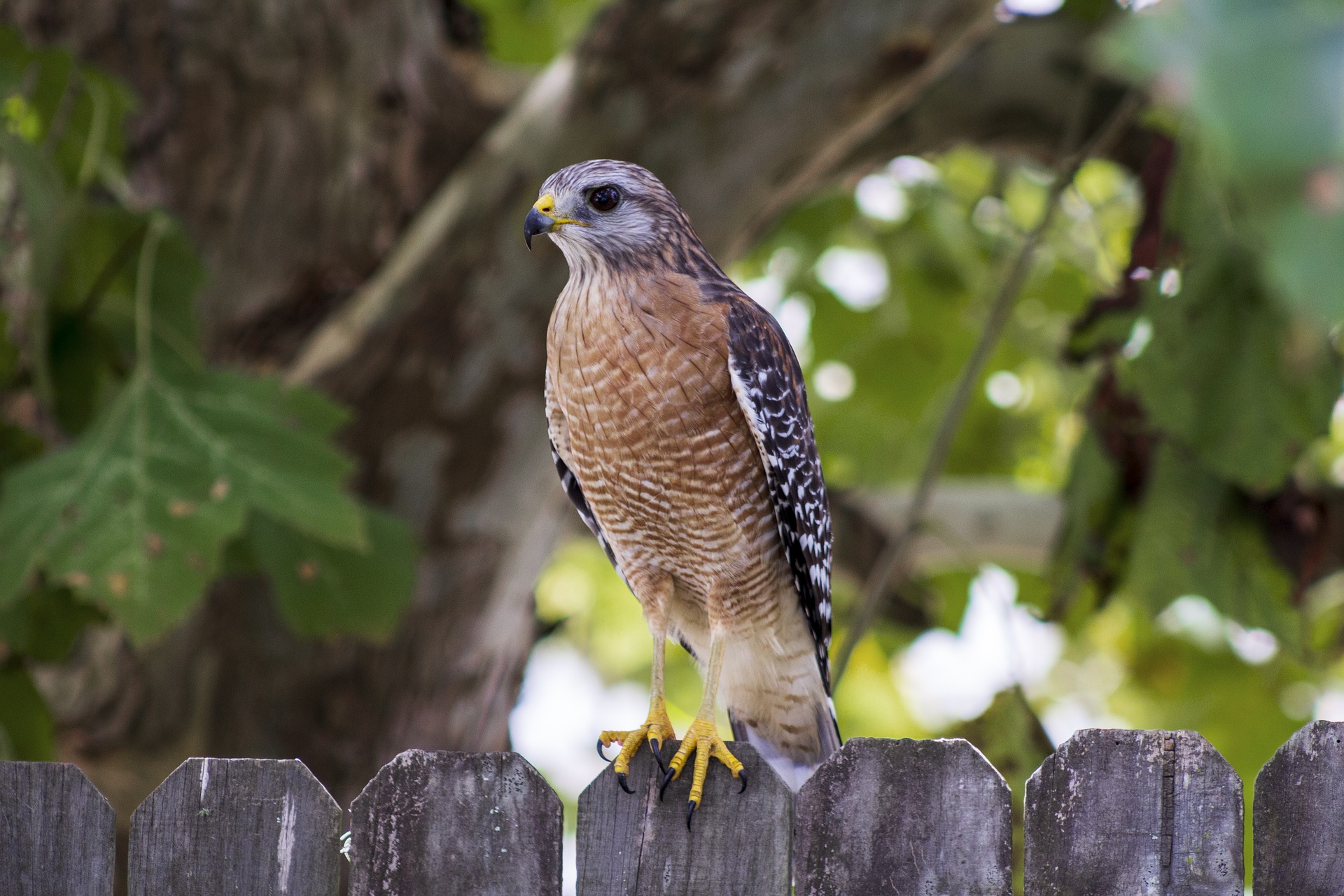
Photo by Peter Benoit from Pixabay • A red-shouldered hawk perches on a suburban fence.

On a morning a couple of years ago, a red-shouldered hawk was on its usual perch when seven Canada geese, another rare visitor to my home, suffered some sort of fright and took flight. The noisy geese flew directly over the willow, which spooked the raptor into taking flight in the opposite direction of the departing geese. I still fondly recall that amusing but accidental clash between these two species of birds.

The frogs at my fish pond interrupted their hibernation on Feb. 12 to begin their own amphibious serendades daily. I’ve even speculated that the red-shouldered hawks may have timed their return to coincide with the emergence of this potential food source. Considering how many frogs of several different species make the pond their home, it wouldn’t be far-fetched to think they are one of the major attractions bringing the hawks back year after year.

The red-shouldered hawk produces a distinctive, piercing whistle that reminds me of the shrill call of a killdeer. The two hawks that are visiting this year have been more vocal than usual. In the past I took their atypical silence as an effort to avoid the local crows. So far, the crows have left them alone this year, but in years past the local crows would flock together to mob the unfortunate hawks if they happened to take notice of their presence.

Photo by U.S. Fish & Wildlife Service • A red-shouldered hawk levels a penetrating stare.

During courtship and the subsequent nesting period, these hawks are vocal. At other times of the year, they are rarely heard. It’s also possible for a person to mistakenly think they have heard one of these large hawks. Blue jays have apparently learned to imitate the “kee-yar” call of this hawk, often working a flawless rendition of the whistled notes of this large raptor.

In contrast to the related red-tailed hawk, the red-shouldered hawk soars less and prefers to perch hidden in the cover of trees. This hawk’s name comes from the reddish-brown shoulder patches in the bird’s wings. Adults show a tail marked with vivid bands of black and white that is quite distinctive.

The red-shouldered hawk belongs to the same genus of raptors as its larger relative, the red-tailed hawk. The genus, buteo, includes about two dozen large raptors that are often dominant avian predators in their respective habitats. The red-shouldered hawk is known by the scientific name Buteo lineatus.

The red-shouldered hawk is less common in the region than some of the other raptors. This hawk’s stronghold is in Florida and other southern states like South Carolina and Georgia. I’ve seen many of these hawks on visits to both the Sunshine State and Palmetto State.

Some of the buteo species have adapted to life on islands, including the Galapagos hawk and the Hawaiian hawk. Outside the United States, buteo raptors are often known as buzzards. When the first European colonists came to the New World, they applied the term buzzard to both native vultures, as well as the large raptors like Swainson’s hawk and broad-winged hawk that reminded them of the ones back in Europe.

Around the world, there are some 30 species of Buteo hawks. In the Old World, these raptors are known as buzzards instead of hawks. In the New World, particularly in the United States, the term buzzard more often refers to vultures than hawks.

Some of the more descriptively named Buteo hawks include the gray-lined hawk of South America, the forest buzzard of South Africa and the Eastern buzzard, which is native to Mongolia, China, Japan and some offshore islands.

Several Buteo species have been given common names to honor people. Some of these include Ridgway’s Hawk, named for ornithologist Robert Ridgway; Archer’s buzzard, named in honor of the British explorer and colonial official Sir Geoffrey Francis Archer; and Swainson’s hawk, which is named for British naturalist William Swainson.

It’s been nice hosting these beautiful raptors, although the crows and jays likely disagree with me.

Restless robin flocks signal spring’s approach

When I posted Jan. 29 on Facebook about seeing my first flock of American robins in 2021, I didn’t anticipate the avalanche from other observant bird enthusiasts.

Priscilla Gutierrez commented on seeing about 30 robins in a field along Limestone Cove Road in Unicoi.

“They don’t come to the feeders,” Priscilla noted. “It was wonderful to see them.”

Alice Torbett in Knoxville shared that she saw her first flock of robins about two weeks ago when they swooped in to harvest berries from the holly tees at her Knoxville home. “They were very considerate to wait until after Christmas,” Alice wrote.

Erwin resident Brenda Marie Crowder commented that “tons of Robins are eating my holly berries right now. With snow dropping and all.”

Jonesborough resident Nan Hidalgo reported that she had five robins in her yard on a recent Friday afternoon.

Christine M. Schwarz in Alexandria, Virginia, shared her own sightings.

Photo by Bryan Stevens • An American robin grasps a perch and keeps an eye on its surroundings.

“Three weeks ago there was a large flock at Mount Vernon,” Christine wrote in a comment to my post. “I have seen a smaller group over here by Fort Belvoir, too. I can’t believe they’re migrating now — more like wintering over.”

Byron Tucker, who lives in Atlanta, commented, “The other day, I saw a flock of robins and blackbirds mixed together.”

Dee Obrien, formerly of Elizabethton, Tennessee, but now living in Florida, lamented the timing of the robins. “They always seem to come back to soon, poor little things,” she wrote. “It is too cold.”

Becky Boyd shared her own experience with robins. “I’ve had dozens here in Knoxville,” she said. “They all recently left, except one loner who is terrorizing the bluebirds and attacks them at the feeders.”

Erwin resident Donna Rea, and a former co-worker at The Erwin Record, posted a question to my Facebook robin discussion.

“What do robins eat this time of year?” Donna asked. “Will they eat out of our feeders if the ground is frozen and they can’t find a hibernating worm?”

Photo by Jack Bulmner/Pixabaycom • An American robin plucks a berry from a branch.

I suggested in my reply that robins might eat suet at feeders, as well as fruit. More likely, the restless robins in the region are probably scouring the countryside for holly trees with berries. Of course, robins are omnivorous in their appetite and would gladly take an earthworm if they could coax one out of the chilly ground.

South Carolina resident Catherine Romaine Henderson simply posted an optimistic comment on my robin post. “Please tell me spring is coming!”

The American robin is indeed widely held to be a harbinger of spring. Furthermore, the robin is a popular American bird. In fact, this bird has been designated the official state bird by Wisconsin and Michigan.

In truth, many robins forego migration to endure a few months of cold weather. Their ability to shift their diet from earthworms and insects to fruit and feeder fare helps robins eke out a living. Robins remain an abundant bird but their fondness for co-existing with humans can leave them vulnerable to pesticides applied to lawns and gardens.

According to the website, “All About Birds,” the American robin nests three times a year. On average, however, only 40 percent of robin nests succeed at fledging young. Even once out of the nest, young robins are vulnerable. The website estimates that only 25 percent of each year’s fledged robins will reach November. So, the young robins that join some of the large flocks people are seeing in the region are birds that have beaten the odds.

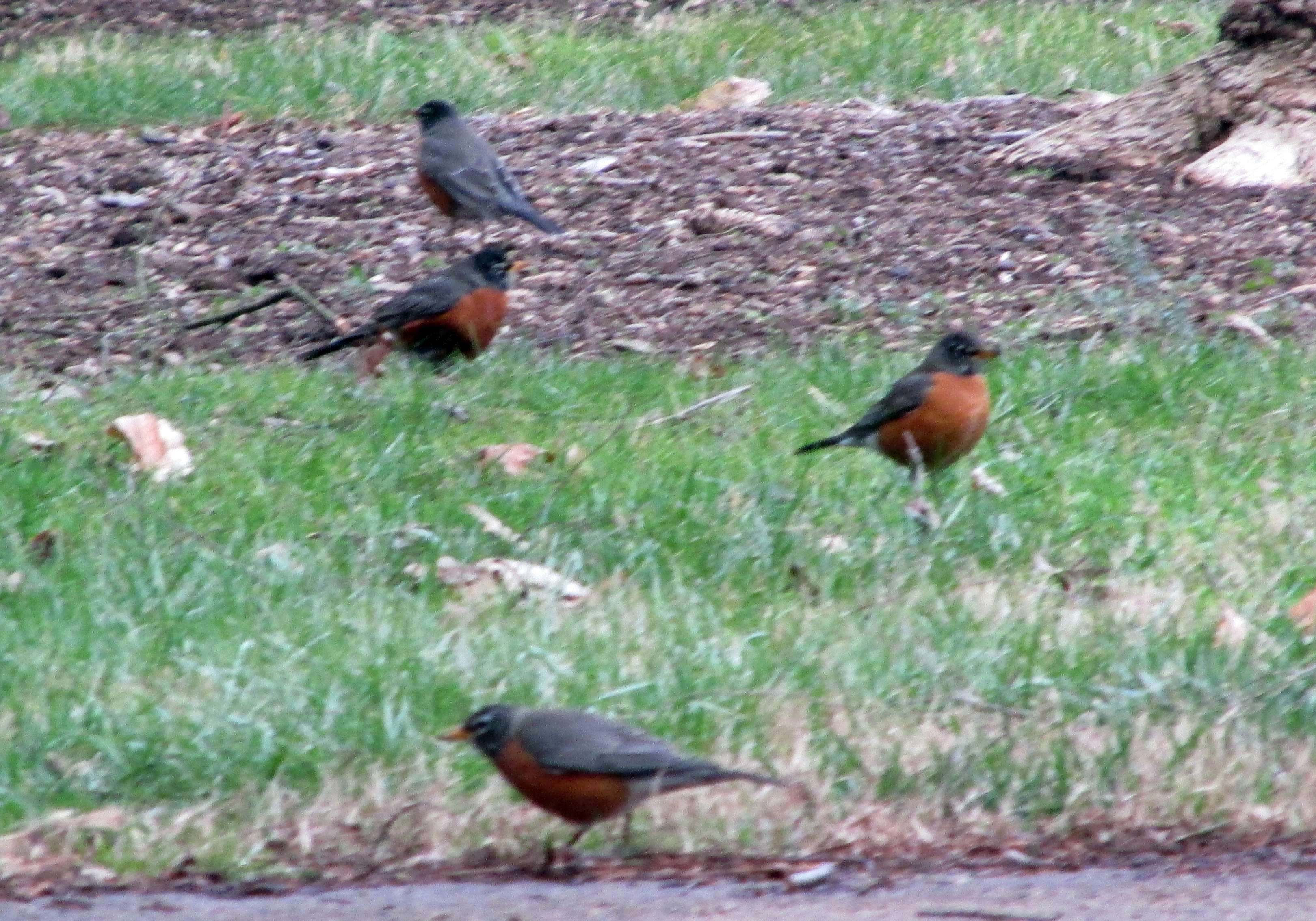
Photo by Bryan Stevens • Returning American robins, prominent in lawns and gardens during their annual spring migration, will soon turn their attention to nesting duties.

Even the robins that do depart the region each fall don’t migrate far. Many robins that spend the summer in Canada or the United States only migrate as far as the Gulf States, southern Florida, southern California, Baja California and Mexico.

The American robin is a large bird in the thrush family, which in North America also includes such birds as Eastern bluebird, wood thrush, and Townsend’s solitaire.

In the British Isles, the European robin is simply known as “robin” or “robin redbreast.” When the first English colonists arrived in New England and other parts of colonial-era North America, they took pleasure in finding that some of the birdlife in the New World resembled familiar birds from their homeland. The red-breasted American robin looked like the bird they knew in the Old World as “robin,” which motivated them to name the New World bird “robin,” as well.

Other than the red breast, however, the two robins are not all that similar. The American robin is the larger of the two birds. Further separating these two birds is the fact that the European robin is not a thrush but rather a member of the family of Old World flycatchers.

Photo by Bryan Stevens • While American robins like fruit when its available, they also spend a lot of time feeding on earthworms and insects.

In some ways, the two robins are similar. Both are fond of earthworms, spending a great deal of their time on the ground foraging for worms. They will also follow human gardeners at their work, waiting patiently for the followed person to disturb the soil with a spade or hoe and expose earthworms for the waiting bird. They are also rather tolerant of humans and have learned to make their own homes close to human dwellings.

Some of the British transplants to North America must have felt homesick for familiar things because several unsuccessful attempts were made to introduce the European robin to the United States and Canada. European robins introduced in New York and Oregon failed to gain a foothold, unlike the introduction of such alien birds as the house sparrow and European starling.

On a few occasions, our American robins have overflown their destinations and ended up in the United Kingdom. For instance, an American robin became a first for London birdwatchers when one was found in that nation’s capital city in March of 2006. Whether of the European or American persuasion, robins have long been a favorite of birdwatchers and nature enthusiasts.

They have even adapted to take food at feeders. If you’d like to try your luck at attracting robins to feeders, know that they like their sunflower seeds hulled. They will also eat mealworms, fruit, peanut hearts and suet. Robins prefer to feed on the ground or on an open platform feeder.

Robins are such friendly and engaging birds. If we can have them near us for 12 months of the year, who’s going to complain?


Hermit thrushes brave East Tennessee winters

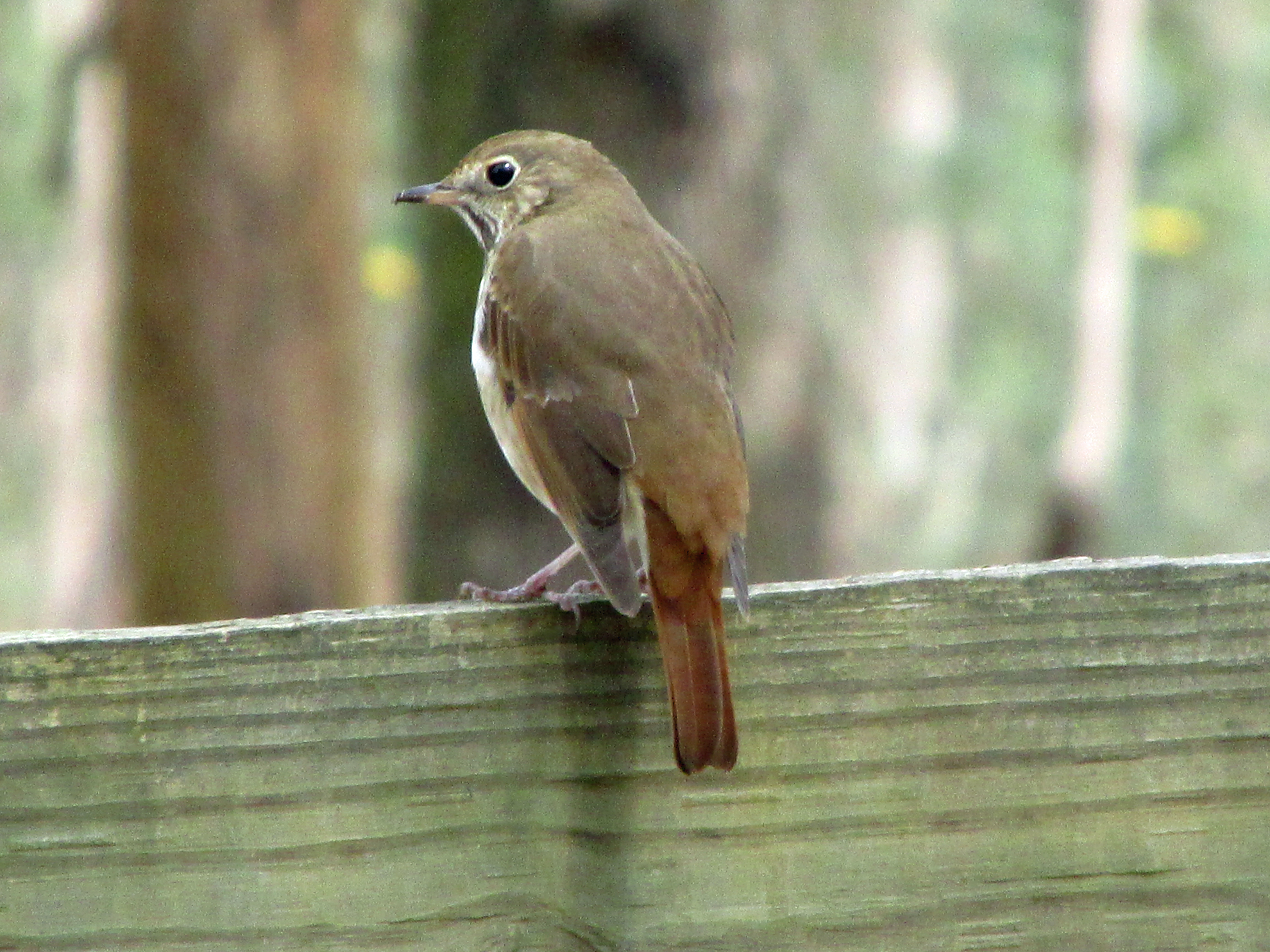
Photo by Bryan Stevens • A hermit thrush perched on a fence rail shows the reddish tail, a reliable field mark to separate this species from close relatives. The tail contrasts from the rest of the bird’s plumage.

Karen Miller sent me an email about a winter visitor in her yard at her home in Parrottsville, Tennessee. “I have seen a hermit thrush eating holly berries for 10 days,” Karen wrote. “Is he migrating or is he perhaps a winter visitor here in Parrottsville?”

To answer her question, I replied and informed her that the thrush is a winter visitor. The hermit thrush takes up residence after its kin have already departed the region in the fall, making it one of the few thrushes to remain in Northeast Tennessee during the winter months. I’ve always thought a good nickname for this bird would be the “winter thrush” because of its presence during the colder months of the year. Of course, for those who know where to look, a few hermit thrushes spend the summer nesting season at high elevation peaks such as Roan Mountain on the Tennessee and North Carolina border.

The hermit thrush is one of the larger brown thrushes, which also includes such related birds as Swainson’s thrush, veery, gray-cheeked thrush and wood thrush. Other less closely related members of the thrush family include the American robin, Eastern bluebird and Townsend’s solitaire.

USFWS • Hermit thrushes like to keep to the shadows.

The poet Walt Whitman employed a hermit thrush as a symbol in his poem, “When Lilacs Last in the Dooryard Bloom’d,” a moving pastoral elegy in honor of the assassinated President Abraham Lincoln. Whitman evidently knew his birds, and it’s not difficult for naturalists and bird enthusiasts to identify that he referred to the hermit thrush when he wove this songbird as a symbol into his stanzas honoring Lincoln. “Sing on there in the swamp,” Whitman wrote in his poem. “O singer bashful and tender, I hear your notes, I hear your call. I hear, I come presently, I understand you…”

Whitman evidently knew of this bird’s bashful, retiring habits, and he had obviously enjoyed the flute-like notes of the hermit thrush’s call. Whitman and many other Americans have been made fans of this gifted songbird. In fact, the citizens of Vermont even proclaimed the hermit thrush as their official state bird. The hermit thrush is well known for its song — a series of clear, musical notes, each on a different pitch, consisting of a piping introductory note and a reedy tremolo. The song had often been described as melancholy by various bird experts. The birds don’t usually sing in winter, but they do produce a call note when disturbed or alarmed that is described as a low “chuck.”

The visiting hermit thrush at her home has allowed Karen Miller to get to know this somewhat reclusive bird better. “He sits on the ground, cocks his head, spies a berry and then jumps up and gets it,” she wrote. She noted that her visitor has a good appetite. “He eats four or five at a time,” she said. “I’m so glad to see him.”

Photo by USFWS • Like many thrushes, the hermit thrush is fond of fruit and berries, especially during the winter.

According to the Smoky Mountains Visitors Guide website, the hermit thrush forages for most of its food from the ground. This bird’s diet includes insects, spiders, snails, and earthworms, plus considerable amounts of wild fruits during the fall and winter. Hermit thrushes may join up with mixed flocks of birds during the winter, often associating with such songbirds as kinglets, brown creepers, chickadees and titmice. For those not fortunate enough to host a wintering hermit thrush, this bird can be found during the summer months atop some high-elevation peaks. Close to home, look for this thrush in the Roan Mountain Rhododendron Gardens. The hermit thrush is also found at some locations in the Great Smoky Mountain National Park.

Female hermit thrushes collect nesting materials and construct the nest, within which she will lay three to six eggs. These thrushes nest once or twice a season. According to the website All About Birds, nesting habits differ between hermit thrushes in the western North America and their counterparts in the eastern half of the continent. Eastern thrushes tend to nest on the ground, but those in the west often place their nests in shrubs or tree branches.

At home on Simerly Creek Road, my first hermit thrush of the winter arrived in early November of last year. During a woodland stroll with neighbor Beth McPherson, the resident thrush put on an impressive show, hopping and scraping on the woodland floor beneath a rhododendron thicket bordering a mountain spring. In such surroundings, it’s not difficult to fathom why this bird has developed such a subtle plumage of muted browns and grays. Even when foraging actively, the bird blended remarkably with the background of fallen leaves and other woodland debris.

The hermit thrush is known by the scientific name, Catharus guttatus. The term guttatus is Latin for “spotted,” which seems appropriate. Surprisingly, the hermit thrush is not closely related to the other North American migrant species of Catharus thrushes. Instead, the hermit thrush is more closely related to the russet nightingale-thrush, a Mexican songbird. The hermit thrush could accurately be called the “red-tailed thrush” for the fact that this species has a rusty-red tail that stands apart from the warm brown-gray tones of the rest of its plumage. A white eye ring, pink legs and a heavily spotted breast complete the rest of this bird’s understated appearance.

Photo by Bryan Stevens • A hermit thrush perches on a branch in a winter woodland.

The wintering hermit thrushes in the region will likely stay put for the next couple of months, but they will mostly depart the area in April or early May. If you want to look for them, now’s the time.

••••• Bryan Stevens lives near Roan Mountain, Tennessee. To learn more about birds and other topics from the natural world, friend Stevens on Facebook at https://www.facebook.com/ahoodedwarbler. He is always posting about local birds, wildlife, flowers, insects and much more. If you have a question, wish to make a comment or share a sighting, email ahoodedwarbler@aol.com.